17.7 C
London
Sunday, August 2, 2026
Home Blog

Israeli occupiers torch Palestinian vehicle, attack home in southern West Bank

0
israeli-occupiers-torch-palestinian-vehicle,-attack-home-in-southern-west-bank
Israeli occupiers torch Palestinian vehicle, attack home in southern West Bank

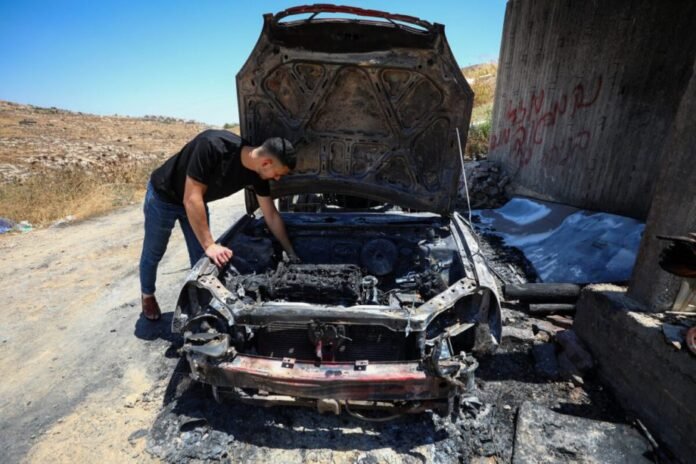
Israeli settlers set fire to a Palestinian-owned vehicle in the village of Abu Njeim, leaving the vehicle completely destroyed and unusable in southeast of Bethlehem, West Bank, Palestine on July 29, 2026. [Wisam Hashlamoun - Anadolu Agency]

Israeli settlers set fire to a Palestinian-owned vehicle in the village of Abu Njeim, leaving the vehicle completely destroyed and unusable in southeast of Bethlehem, West Bank, Palestine on July 29, 2026. [Wisam Hashlamoun – Anadolu Agency]

Israeli occupiers set fire to a Palestinian vehicle and attacked a home near the town of Surif, north of Hebron in the southern occupied West Bank, early Saturday, according to a local resident, Anadolu reports.

Ali Ghneimat told Anadolu that occupiers “attacked the outskirts of Surif from the direction of the Etzion settlement” at around 2.30 am local time (2330GMT Friday).

“They set fire to one vehicle and attempted to burn another,” he said.

The occupiers also “attacked a house and attempted to set it on fire,” but residents gathered in its courtyard thwarted the attack, Ghneimat said.

He added that the assault caused fear and panic, particularly among women and children.

Residents of the area remain in a constant state of anxiety due to repeated occupier attacks, Ghneimat said, adding that local men have been forced to leave their jobs and avoid social occasions to stay near their homes and protect them.

The UN Office for the Coordination of Humanitarian Affairs (OCHA) has documented more than 1,330 Israeli occupier attacks in the occupied West Bank since the beginning of 2026 that resulted in casualties or damage to Palestinian property.

Around 750,000 Israeli occupiers live in 156 illegal settlements and 360 outposts across the occupied West Bank, including occupied East Jerusalem, according to Palestinian figures.

High school defends staying silent while boys made AI nudes of 59 classmates

0
high-school-defends-staying-silent-while-boys-made-ai-nudes-of-59-classmates
High school defends staying silent while boys made AI nudes of 59 classmates

One of the first schools to shut down after students were found making AI nudes of female classmates is now asking a court to toss a lawsuit filed by victims who claimed that the school stayed silent for months while the emboldened boys targeted many more girls.

In a motion to dismiss this week, Lancaster Country Day School (LCDS)—a private K-12 school in Pennsylvania with fewer than 600 students—argued that it was false to say the school never reported the harm to law enforcement. The tip that the school received came from the Pennsylvania Office of the Attorney General, which is itself a law enforcement agency, the filing said.

It’s also false to say the school knew that girls were being targeted, the school argued, because the tip did not mention any specific student victims.

LCDS said that “it looked into the tip as best as their educator training allowed,” but the tip only identified one bad actor and was too vague to identify any potential victims. At no time did the school see the images, and the school maintains that all activity connected to the AI nudes happened off-campus.

Instead of warning all parents that inappropriate AI-generated images were potentially being made, the school only interviewed the boy accused of making the image and his mother. The boy has since pled guilty with another male student but at the time denied making the AI nudes, and the mother provided no more information.

Ultimately, LCDS closed its investigation and shared results with the attorney general, then never heard back. In its motion to dismiss, the school argued that it had no duty to report the images to local police because it’s only required to report tips on actual child abuse, and AI images don’t qualify as that in the state, at least not yet.

An attorney representing the school, Rory Connaughton of Saxton Stump, told Ars that “it is impossible to assert that the school failed to report to law enforcement when law enforcement provided the tip to the school and the school reported back to law enforcement.”

“The Attorney General’s office had the discretion and legal authority to refer this matter to the local police or conduct its own investigation,” Connaughton said. “That it did not use its investigative authority or refer the matter to the local police when armed with the same information available to Lancaster Country Day School, makes clear that the school acted properly and did not fail to fulfill any legal duty.”

Ars could not reach the attorney general to comment, but a spokesperson told a local news site, Lancaster Online, that the office “does not investigate information provided in tips. Rather, the information is passed along to the relevant school and/or police to investigate the information provided.”

“Boys will be boys,” school head allegedly said

Girls suing the school argued that at least 59 girls were traumatized by “an extended, catastrophic institutional failure.” They claimed that they “were forced to go to high school while ‘deepfake’ nude images of them were circulating within the school community,” and that appallingly, Lindsay Deibler-Wallace, assistant head of Upper School, took no action to protect them after telling parents that “boys will be boys.”

The victims alleged that the school never suspended the students even after “the LCDS upper school was in a state of acute panic and disruption related to the AI-generated images.” Instead, the school allegedly discouraged girls from going to police, while withholding information from parents and obstructing efforts to investigate the distribution of AI-generated child sex abuse materials (CSAM), such as by refusing to respond to detectives seeking a yearbook photo for comparison.

Two male students have since pleaded guilty to 59 felony counts of sexual abuse of children, and their victims are hoping the court will rule that LCDS was required to report the incident to police, both by law and by “reasonable institutional practice.”

Ars could not reach the victims’ lawyer for comment. However, their lawsuit emphasized that on top of emotional harms, girls targeted were also “effectively deprived” of “equal access to the educational opportunities and benefits provided by LCDS.” They’ve further accused the school of violating Title IX by being “deliberately indifferent” to sexual harassment that was “severe, pervasive, and objectively offensive.”

Gaps in laws may let school off the hook

Notably, another Pennsylvania school coping with AI-generated nudes on its campus did report the incident to police, according to a press release from lawmakers pushing to update the state’s law to ensure that schools always immediately report AI nudes.

In that case, a middle school student targeted 11 female classmates in deepfake images, and the school delayed contacting police until after concluding its own internal investigation.

State lawmakers argued that schools should not be delaying reporting AI nudes until their own probes end but rather should be required to promptly tip off police, who are better positioned to investigate the crimes.

Troublingly, delays in reporting can result “not only in lost evidence,” but also cause “significant trauma to the female victims,” whose images may spread further the longer the harm goes unchecked.

The press release said that lawmakers were motivated to close a loophole in a law defining child abuse that doesn’t explicitly mention AI-generated CSAM.

“This bill will make certain that law enforcement is notified at the earliest possible moment, and it makes other changes that put the wellbeing and safety of our children first,” the press release said. But that bill is not yet law, LCDS said, and is currently under review by the state Senate.

In LCDS’s motion to dismiss, the school claimed that the very fact that lawmakers are moving to update the law is proof that it had no legal obligation to report the vague tip that it received.

Specifically, they argued that “child-on-child” incidents such as these are not legally defined as abuse, since using AI to sexualize images of young girls is not among current child-on-child exceptions, such as rape or indecent exposure. To add weight to this defense, they cited Lancaster County District Attorney Heather Adams’ decision not to charge the school “for failing to report the AI-generated content, because possession and dissemination of AI pornography did not fall under crimes defined as child abuse.”

However, it’s unclear if that argument will hold up, since the students who made the images admitted to 59 counts of sexual abuse of a child, and the court will surely consider that. As punishment, the boys were ordered to “serve probation and perform 60 hours of community service each,” Lancaster Online reported. In their complaint, victims argued that “the tip described conduct constituting child sexual abuse” under state and federal laws—“specifically, the production and/or possession of child sexual abuse material involving minor students.”

School accused of aiding spread of AI nudes

LCDS’s attorney told Ars that only the students are criminally liable for the images and that the court should agree to leave the school out of the fight since the only alleged connection is that the boys were their students.

“What Student Plaintiffs do not allege, at any point in the Complaint, is that the images were shared in school, during school hours, or using school equipment or a school Internet connection,” LCDS’s filing said. “The sole nexus to LCDS in the Complaint is that the Student Plaintiffs and the harassers were all students of the school, but that is not enough to survive a motion to dismiss.”

Although gaps in the law may help the school escape the AI nudes scandal, its motion to dismiss did suggest that the court may not grant every demand in their filing. On aiding and abetting claims, the motion to dismiss noted that case-law is “split,” which means an unfriendly judge could side with students and leave the school on the hook for at least some liability for negligence.

However, if the judge doesn’t lean their way, LCDS argued that victims still can’t argue that the school knew the images existed or intentionally helped facilitate their spread, which the school thinks should be fatal.

For victims, the school’s response coolly denying it could have intervened sooner is likely unsurprising but still jarring. Their complaint alleged that after it became clear that the AI nudes described in the tip were real, the school failed to “provide adequate support, counseling, and resources to the victims following the abuse,” allegedly negligently inflicting emotional distress at the time when girls felt most vulnerable walking the halls.

Israeli Technology Could Halt Colombia’s Drug Traffickers as Relations Improve

0
israeli-technology-could-halt-colombia’s-drug-traffickers-as-relations-improve
Israeli Technology Could Halt Colombia’s Drug Traffickers as Relations Improve


Abelardo de la Espriella aims to restore diplomatic ties, pursue an embassy in Jerusalem and reverse Colombia’s position at the International Court of Justice

Colombia’s incoming president, Abelardo de la Espriella, is preparing to reverse nearly every major element of Gustavo Petro’s Israel policy after taking office on August 7.

His government says it will restore full diplomatic and economic relations with Israel, exchange ambassadors, lift visa requirements, pursue a Colombian embassy in Jerusalem and withdraw Colombia’s intervention in South Africa’s genocide case against Israel at the International Court of Justice.

Security could provide the most substantial area of renewed cooperation. Before the diplomatic break, Israel supplied Colombia with military equipment and security technology. De la Espriella has said he wants access to new weapons, drones and artificial intelligence from Israel and the United States.

Alberto Spektorowski, a lecturer in political science at Tel Aviv University, said Israeli technology could assist Colombia in addressing narcotics trafficking, organized crime and armed groups operating in parts of the country. He predicted close cooperation but stopped short of describing it as a formal strategic alliance. “Everything connected to state security will involve extensive collaboration with Israel,” he said. “Colombia will request it, Israel will provide it, and that relationship will become stronger.”

Everything connected to state security will involve extensive collaboration with Israel

The planned reset, outlined after a mid-July meeting in Washington between Israeli Foreign Minister Gideon Sa’ar and Colombia’s incoming foreign minister, Omar Bula Escobar, would end more than two years of diplomatic rupture. It would also move Colombia from one of Latin America’s sharpest critics of Israel’s Gaza war toward a government that frames renewed ties as a strategic and ideological priority.

Petro broke diplomatic relations in May 2024, restricted defense ties, and ultimately imposed a complete ban on Colombian coal exports to Israel. The incoming government is presenting the reversal as the recovery of a longstanding alliance. Its critics see an ideologically driven swing from one pole to the other, particularly in the decision to relocate Colombia’s embassy to Jerusalem.

“The historic relationship that the Petro government unilaterally broke will be strengthened again,” the incoming president’s office said. Colombia, it added, would recover its allies and its standing as a dependable international partner. The precise scope of the proposed visa changes has not yet been published.

Israel moved first on diplomatic representation, with government approval for the appointment of veteran diplomat Vivian Aisen as ambassador to Colombia. Aisen previously served as ambassador to North Macedonia and has held posts in Chile, London and Brussels. Colombia has not publicly named an ambassador it will send to Israel.

Marcos Peckel, executive director of the Confederation of Jewish Communities of Colombia and commissioner to combat antisemitism at the Latin American Jewish Congress, expects the restoration of relations to be announced during, or immediately after, De la Espriella’s inauguration.

The Israeli mission in Bogotá continued operating as a consulate after relations were severed, Peckel told The Media Line. Restoring it to embassy status can therefore be accomplished more quickly than establishing an entirely new mission. He said the next steps would likely include naming Colombia’s ambassador, restoring military and police attachés, and expanding security cooperation that had deteriorated under Petro but had never disappeared entirely.

De la Espriella is proposing more than a return to the relationship that existed before the rupture. Rather than reopen Colombia’s former embassy in Tel Aviv, he has promised to establish it in Jerusalem. “It was a campaign promise by the president, and he is going to fulfill it,” Peckel said. “Is it going to generate polarization? Yes. Is it going to generate debate? Yes.”

Petro called the Jerusalem proposal a grave offense to Muslim countries. The Organization of Islamic Cooperation also condemned it, warning that the move could harm Colombia’s relations with its 57 member states and describing it as contrary to United Nations resolutions governing Jerusalem’s status. The organization urged the incoming administration to reverse course and maintain support for a two-state solution.

The embassy announcement remains a political commitment rather than a completed transfer. The location, budget, and opening date have not been disclosed. Nor has the incoming government announced that it will reverse Colombia’s 2018 recognition of a Palestinian state.

De la Espriella has, however, said he will halt the opening of a Colombian diplomatic mission in Palestine, arguing that the planned representation never became operational. The decision was part of a broader reorganization of Colombia’s foreign service that also calls for the closure of 14 embassies and about 15 consulates. Closing the proposed mission would not, by itself, withdraw Colombia’s recognition of Palestinian statehood.

The planned break with Petro’s policy also extends to The Hague. Colombia filed a declaration in April 2024 to intervene under Article 63 in South Africa’s case against Israel under the Genocide Convention. It did not file the original lawsuit, and it is not a plaintiff in the case. De la Espriella’s government has said it intends to withdraw Colombia’s intervention after taking office.

The incoming administration has also announced a change in Colombia’s conduct at the United Nations, saying it will adopt what it describes as a more neutral and consultative position. It has not identified specific resolutions that Colombia would oppose, support or abstain from under the new policy.

Spektorowsk said the first phase should be understood as a diplomatic reversal. A strategic alliance may follow, he said, particularly in areas such as security and efforts to limit Iranian influence in Latin America, but that outcome is not yet assured. “The first step is the diplomatic question,” Spektorowski told The Media Line. “It is to completely change the attitude toward Israel that existed under Petro.”

He sees Israel and Palestine as symbols in a larger political contest. Parts of the Latin American left have embraced the Palestinian cause, he said, while rising conservative movements have responded by making support for Israel part of their political identity.

That symbolism should not be confused with the reasons most Colombians vote, he added. Economic performance, corruption and domestic security remain far more consequential than Middle Eastern affairs for the electorate. “The challenges for Colombia’s president will be how to rebuild Colombia and how to establish the basis of its economy,” Spektorowski said. “That is what will define him.”

Janiel Melamed, director of Barranquilla’s Citizen Security Observatory and a professor and researcher at Universidad del Norte’s Department of Political Science and International Relations, made a similar distinction. Most Colombian voters are concerned with their household finances and daily security rather than events in the Middle East, he said. Foreign policy becomes politically relevant when its consequences reach local industries or public budgets.

Melamed pointed to the coal restrictions as one example. Petro’s government initially restricted exports under Decree 1047, issued in August 2024. A later decree, Decree 0949 of Aug. 28, 2025, removed the remaining exceptions and prohibited all thermal-coal exports to Israel.

He argued that the prohibition did little to constrain Israel, which could seek other suppliers, while reducing royalty income in Colombia’s coal-producing areas. Those revenues, he said, help finance infrastructure, education and sanitation. “It was a kind of shot in the foot,” Melamed said. “The measure ended up being counterproductive to Colombia’s own national interests.”

Although the incoming government has emphasized commercial restoration, it has not yet issued a decree to repeal the coal ban. Peckel said he expects its removal to be among the first concrete measures after Aug. 7. Colombia and Israel’s free-trade agreement, in effect since 2020, was not automatically terminated when diplomatic relations were broken, but the rupture and related restrictions impeded the institutions that support trade.

For Colombia’s Jewish community, the diplomatic rupture created practical and emotional strain without stopping communal life. Synagogues, schools and other institutions continued to operate normally, Peckel said, and no wave of serious attacks followed the government’s policy.

The community nonetheless faced what Peckel called “antisemitism from the state,” citing Petro’s comparisons between Gaza and Auschwitz, references to Nazism and repeated statements about Jews. The frequency of the president’s remarks made responding to each one impractical, he said. “We did not have to interrupt any activities, prayers or schools,” Peckel said. “But it generated concern and discomfort.”

Peckel also warned that an intensely pro-Israel government could expose the community to a different form of political pressure. Colombian Jews, he said, could again be treated as stand-ins for a foreign government, this time by opponents of De la Espriella. “An excessively pro-Israel president can generate antisemitism and hostile declarations against us,” Peckel said. “That is something we are watching very closely.”

An excessively pro-Israel president can generate antisemitism and hostile declarations against us. That is something we are watching very closely

The next test comes on August 7. De la Espriella can restore diplomatic relations as soon as he assumes office, and Aisen is expected to arrive in Bogotá later that month. Colombia has yet to name its ambassador; the scope of the visa agreement and the timetable for opening an embassy in Jerusalem remain unsettled.

Reopening diplomatic channels may prove to be the easiest part of the reset. Withdrawing Colombia’s intervention at the International Court of Justice, repealing the coal decree and establishing an embassy in Jerusalem will each require separate legal or administrative action. The first announcement could come on inauguration day. Whether the two countries can build a relationship that survives Colombia’s next political shift will take much longer to determine.
How fruit flies chase invisible ribbons of smell to get to their source

0
how-fruit-flies-chase-invisible-ribbons-of-smell-to-get-to-their-source
How fruit flies chase invisible ribbons of smell to get to their source

A fruit fly hunting a piece of rotting fruit or a mate navigates by smell, following plumes of odor. Out in the wild, turbulent air swirls these plumes into a chaotic, broken landscape—dense chemical filaments laced through long stretches of clean air. A fly trying to find the source gets the smell in stutters, from constantly shifting directions, with no guarantee that a next whiff is coming at all.

Scientist had little idea of how fruit flies manage this chaotic signal with a brain the size of a pinhead. For a long time, biologists stood by the “surge and cast” model, which posited that insects solved this with hardwired reflexes. The idea was that, when a fly registers the plume with olfactory neurons in its antennae, it simply flies upwind until it’s gone and then flies side to side attempting to catch it again. But now a team led by Vanessa Ruta, a neuroscientist at the Rockefeller University, has shown that fruit flies do something far more advanced.

A treadmill for flies

The trouble with the traditional surge and cast model is that it struggles to explain how an insect tracks a meandering plume across long distances. Chemical cues floating in the air in the natural environment are often sparse and unreliable. But those same features make the mechanism behind olfactory navigation notoriously difficult to test. “Odors are invisible,” Ruta says, “and often they’re carried along by turbulent airflow.” We’ve got no way of knowing what the animal is smelling from one moment to the next.

So, Ruta’s team designed an experiment to learn that. Scientists tethered a fly (Drosophila) in place over a small ball floating on a cushion of air in complete darkness. “It’s a little fly-sized treadmill,” Ruta explains. As the fly walked on the surface of the ball, its turns steered a nozzle that blew a steady stream of air at its antennae, so the insect always felt wind coming from a fixed direction, as if it were walking across an open field. Then the researchers piped apple cider vinegar into that airstream, switching it on and off depending on the fly’s position on this virtual field.

This way, the researchers could precisely control the intensity and direction of the odor the fly was registering. “We could actually generate any kind of arbitrary chemical landscape,” Ruta says. The team could simulate a lifelike olfactory experience with turbulent plumes, straight-edged corridors, and gradients of smell running backwards. “It’s actually not a very complicated virtual reality system, but it is actually extremely powerful,” Ruta adds.

For once, the experimenters knew the identity and quantity of every molecule the fly was receiving. The first thing they tested was the surge and cast model. And it did not hold up well.

Edge tracking

In the experiment with a straight corridor of vinegar about 50 millimeters wide, flowing with the wind, the flies did not do the obvious thing and march up the middle. Instead, they hugged one edge, riding it through a repeating two-step process. The moment a fly crossed into the odor, it would whip around and move back out, loop through the clean air outside, then make a beeline back to the boundary. The team called it edge tracking.

The flies also spent far more time loitering outside the plume than inside it, even though nearly all their forward progress toward the source happened during those brief dips into the scent. “Flies will track meters along the edge of a plume and never cross over,” Ruta says.

The first explanation the researchers came up with was that the flies were climbing a rising gradient of odor toward the source. But they didn’t do that either. When the team reversed the gradient, so the vinegar grew fainter as the fly advanced, the flies tracked the edge just as well.

The team also worked with flies genetically engineered so light could switch their olfactory neurons on directly, in both antennae at once. When scientists swapped real odor for a beam of 660-nanometer red light, the insects tracked the edge of this light plume flawlessly.

The real surprise, though, came when the team took a close look at what the flies were doing when there was no smell at all to guide them.

Olfactory memories

When the researchers made a plume vanish while a fly was outside it, the insect kept heading back to where the edge should have been. Rather than searching at random, they were heading to where they knew the odorant should be. “It looked as if they had a stored memory that was still steering them in that direction,” Ruta says.

So, the team started looking for these stored olfactory memories. The first candidate was a brain structure called the central complex, which is like a navigation hub in the insect brain.

Using fluorescent imaging to watch neurons fire in real time, Ruta and her colleagues pinpointed neurons that acted as the fly’s compass. Throughout edge tracking, that compass stayed locked to the wind, indifferent to whether the fly was in odor or out. When the team silenced these neurons, the flies got lost entirely, wandering upwind with no idea how to get back.

The neuronal compass, though, was just one piece of the puzzle. To find the smell that got lost in the wind, the fly must have a goal—a memory of what to search for. The team went searching for that memory.

The team located olfactory memories in another group of neurons found in something called the fan-shaped body, already known to encode where a fly wants to go. Like in a compass, the activity of these neurons acts like a pointer, but in this case, the one that marks the fly’s intended destination. Out in the clean air, this pointer swung away from the compass to aim at the plume’s edge, several seconds before the fly physically turned to head back. Just as with the compass neurons, silencing the neurons encoding the odor’s edge position made it impossible for the flies to find it. “When they get out, they have no immediate sensory information to guide them back to the plume. That’s when the memory becomes important,” Ruta says.

To confirm whether the flies memorize where the plume’s edge is, the team tested whether the insects could update these memories.

Updating the map

To understand what might be going on in the flies’ brains, the team built a computer model in which a simulated fly flips between a leaving mode and a returning mode, updating a stored plume’s edge position every time it crosses the boundary. It turned out the most important piece of data was the entry angle, the direction from which the fly last hit the plume. Without the angle, the simulated flies could no longer edge track.

Then the researchers went back to real flies to test how fast they could revise their olfactory memories. They had flies track a plume tilted 45 degrees, then abruptly flipped it to the opposite 45-degree angle. At first the insects were lost, searching in the old direction. But a single training session—a puff of vinegar delivered whenever a fly happened to walk the correct new angle—was enough to fix the issue. The flies instantly rewrote their internal goal and began tracking the new segment.

“We could write in new entry angles,” Ruta says. To her that was some of the strongest evidence that a memory, not a reflex, was responsible for fruit flies’ olfactory navigation.

But it doesn’t necessarily mean the old surge and cast idea is done for.

Built-in redundancy

When the team ran the flies through a simulated natural plume in their computer model, the entry-angle memory worked best near the source, where the plume held together as a coherent ribbon. Farther downwind, where it shattered into chaotic filaments arriving from every direction, the memory quickly grew unreliable and got overridden. The team speculates that’s likely where the flies fall back on simpler reflexes. “Animals are adapting their strategy,” Ruta says.

She suggests they probably lean on memory when the world is predictable and abandon it when it isn’t. One of the first things the team wants to examine now is whether the memories are relevant for tracking very turbulent plumes in living flies or are in fact replaced by other mechanisms when things calm down, as their model suggested.

“There’s an increasing appreciation of Drosophila and the power of this fly to provide insights into core computations translating fleeting sensory signals into stored spatial goals,” Ruta argues. Because the fruit fly has one of the simplest and most extensively studied brains, such insights, she thinks, should be relevant for how this process works in the rest of the animal kingdom. “It’s a fundamental feature that all animals are able to carry out, including ones with more sophisticated, complex brains like our own,” she adds.

Nature, 2026.  DOI: 10.1038/s41586-026-10827-7

Putin ‘Humiliated’ as Furious Russians Turn on Him

0
putin-‘humiliated’-as-furious-russians-turn-on-him
Putin ‘Humiliated’ as Furious Russians Turn on Him


Vladimir Putin’s government is facing a fresh wave of anger after residents of a Siberian city accused authorities of covering up a foul-smelling environmental “catastrophe” while pouring resources into the war in Ukraine.

People living in Tyumen say their city has been overwhelmed by polluted water, rotting fish and a sickening stench that has lingered for weeks.

“It’s some kind of apocalypse,” a resident named Elizaveta told the independent Russian outlet Meduza. “The water reeks, the air reeks, the city is under water.”

She claimed officials appeared determined to pretend everything was “fine” despite mounting complaints from the public.

Another resident, Albina, described the water as a horrifying mixture of chemicals, dead animals and poultry-farm waste.

“A terrible smell, the entire periodic table, dead fish, and poultry-farm waste in our water,” she said.

Residents said the crisis began after severe flooding along the Tura River. Local authorities initially insisted the water remained safe, even as people reported becoming sick and developing alarming skin problems.

Albina said massive red blotches appeared across her body.

“They swell up, and they itch and burn unbearably,” she said.

Fear quickly spread across the city, with residents refusing to drink the water or use it for cooking, bathing and washing produce. Some were reportedly afraid to even give it to their pets.

One woman said she trusted the official assurances and drank the tap water, only to become ill for five days.

“No one is helping,” she said.

The outrage has also fueled criticism of Putin’s war spending.

One resident claimed ordinary Russians had been abandoned because government money was being directed toward the Kremlin’s so-called “special military operation” in Ukraine.

“All the financing is going towards those three famous letters,” the person said, referring to the Russian abbreviation SVO.

Other residents described a stomach-turning scene along the riverbanks.

“You can’t stand to be anywhere in the city near the Tura,” one man told Meduza, saying the area smelled like human waste.

He also reported seeing dead fish and even footage of a dead roe deer floating in the polluted water.

After weeks of public fury, authorities finally declared an emergency and opened a criminal investigation into the source of the pollution.

Alexander Bastrykin, the powerful head of Russia’s Investigative Committee and an old school friend of Putin, demanded an official progress report on the probe.

For residents, however, the action came far too late.

“In 50-odd years I’ve never seen water problems like this,” a man named Yevgeny said.

He said the water had occasionally appeared yellow in the past, but had never carried such a strong sewage-like odor.

“And meanwhile they’re trumpeting everywhere that there’s no problem at all,” he added.

A tanker carrying clean water finally arrived in Tyumen on Friday. Video reportedly showed enormous lines of desperate residents waiting with bottles and containers.

Authorities are now examining a roughly 224-mile stretch of the Tura River.

The official explanation blamed oxygen deprivation caused by extreme weather. The region received approximately 260 percent of its normal monthly rainfall in June, followed by unusually hot temperatures.

Officials said the heavy rain washed huge amounts of soil and organic material into the river. As that material decomposed, it stripped oxygen from the water and suffocated large numbers of fish.

Residents were not officially advised to stop drinking the tap water until July 24 — weeks after the first complaints surfaced.

Many locals remain deeply skeptical of the government’s explanation. They believe pollution from poultry operations and other sources may also be involved.

Some fear the damage could last for months or even years.

“The consequences will be terrible,” one woman warned, “for people, for agriculture, and for the river ecosystem.”

After noise complaints, judge orders Waymo to stop overnight charging in Santa Monica

0
after-noise-complaints,-judge-orders-waymo-to-stop-overnight-charging-in-santa-monica
After noise complaints, judge orders Waymo to stop overnight charging in Santa Monica

A local judge has ruled that Waymo can no longer use its side-by-side charging facilities overnight in Santa Monica, California, as these may pose a “public nuisance.”

Los Angeles Superior Court Judge Bradley S. Phillips granted this week the City of Santa Monica’s motion for a preliminary injunction in the city’s ongoing public nuisance lawsuit against the autonomous vehicle giant.

City officials and neighbors assert that the constant stream of vehicles at the charging stations create light and sound pollution and cause undue traffic congestion on the streets and nearby alleys, creating a collective bother and disruption.

“The constant ‘beep beep beep’ sound as the autonomous vehicles back out of their spaces (in their own lots) is an incessant disturbance that hinders both our tranquillity during the day and our peace during the night,” wrote Christopher Potter, a man who says he lives right next to the lots.

Under the new order, Waymo is forbidden from operating the charging lots on Broadway at 12th and Euclid Streets between 11 pm and 6 am. The Broadway charging stations sit directly across the street from a private school. Apartment buildings and other residences are also nearby, and some residents have complained consistently for over a year.

With the order in place, neighbors already notice a difference.

“I took a walk around last night, and gosh, it’s amazing,” Dylan Moore told Ars. Moore lives down the block from these Waymo lots and previously created the WaymoProblems.org website. “You can hear the crickets, you can hear your thoughts, it’s not a fleet of locusts descending on the neighborhood, it’s incredible.”

Another neighbor, who wished to remain anonymous for fear of reprisal and described himself as a “night owl,” said that he is thrilled that Waymo has abided by the court order.

“At 2 am when the bars let out, that’s when [they had been] full bore,” he said. “My apartment faces Broadway. The sound of the Waymos, yes, but the acceleration and deceleration sound that EVs have, makes it sounds like you have Tron outside your window. It [was] one after another!”

Santa Monica leadership also trumpeted the success.

“Our residents’ ability to sleep peacefully in their own homes is not negotiable,” Mayor Caroline Torosis said in a statement. “This ruling affirms what our neighbors have been telling us for more than a year, and it delivers relief while the case moves forward.”

Waymo has appealed the ruling. It did not immediately respond to questions from Ars Technica.

Waymo began using these charging facilities in January 2025. After numerous complaints and an online petition, the City of Santa Monica ordered the company to halt overnight operations. It eventually sued Waymo over the issue in November 2025 in a case that is still ongoing. (Waymo has also counter-sued.)

The next court hearing in the case is scheduled for October 2026.

Updated on August 1 to note that Waymo has appealed this ruling.

Nach Abschiebung wegen Anti-Israel-Parole: Bob-Vylan-Frontmann wehrt sich erfolgreich gegen Einreiseverbot

0
nach-abschiebung-wegen-anti-israel-parole:-bob-vylan-frontmann-wehrt-sich-erfolgreich-gegen-einreiseverbot
Nach Abschiebung wegen Anti-Israel-Parole: Bob-Vylan-Frontmann wehrt sich erfolgreich gegen Einreiseverbot


Read this article in English.

Dem Frontmann der britischen Punk-Rap-Band Bob Vylan wurde aufgrund seiner pro-palästinensischen Aussagen unlängst die Einreise nach Deutschland verweigert. Er wurde am Berliner Flughafen festgehalten und schließlich zurück nach England abgeschoben.

Die Bundespolizei begründete die Einreiseverweigerung des Sängers am 15. Juni mit seinem Auftritt beim Glastonbury Festival im vergangenen Jahr, wo er den Sprechchor „Death, death to the IDF“ („Tod, Tod der IDF“ – der israelischen Armee) angestimmt hatte.

Ende Juli hoben die Behörden das Einreiseverbot gegen den Sänger, der mit bürgerlichem Namen Pascal Robinson-Foster heißt, in einem entsprechenden Schreiben wieder auf, verweigerten jedoch jede Auskunft darüber, warum die Maßnahme aufgehoben wurde; oder wie die Entscheidung über das Einreiseverbot zustande gekommen war.

Die polizeiliche Akte zu Robinson-Foster, die The Intercept vorliegt, wirft ihm vor, antisemitische Narrative und Hamas-Propaganda zu verbreiten, die zur „Radikalisierung einzelner Bevölkerungsgruppen“ beitragen und terroristischen Gruppen oder Einzelpersonen als „ideologische Begründung“ dienen könne.

Zudem heißt es, Robinson-Foster stelle „eine Gefahr für die öffentliche Sicherheit und Ordnung“ in Deutschland dar. Seine Einreise würde dem internationalen Ansehen sowie der Glaubwürdigkeit der Bundesrepublik „erheblichen Schaden“ zufügen; dadurch entstünde der Eindruck, Deutschland unternehme keine Anstrengungen, „den propagierten Antisemitismus und dazugehörige Aufrufe zur Gewalt, insbesondere grenzüberschreitend, zu unterbinden“.

Detaillierte Fragen zu dem inzwischen aufgehobenen Einreiseverbot beantwortete die Bundespolizei nicht. Sie berief sich dabei auf Belange der öffentlichen Sicherheit und Datenschutz. Auf einen Fragenkatalog zum Entscheidungsprozess hinter der Einreiseverweigerung, ihrer Rechtsgrundlage, zu beteiligten Behörden sowie zu den Gründen der Aufhebung der Einreiseverweigerung erklärte Bundespolizei-Sprecher Nikolai Jaletzke gegenüber The Intercept, man äußere sich nicht zu Gefährdungsbewertungen, operativen Maßnahmen oder Abstimmungsprozessen zwischen Behörden.

„Zu behaupten, ich würde eine Gefahr für die nationale Sicherheit Deutschlands darstellen, ist schlicht absurd“, sagte Robinson-Foster The Intercept. „Genauso absurd ist die Behauptung, wir würden Propaganda im Namen irgendeiner verbotenen Organisation verbreiten.“

Bob Vylans Auftritt beim Glastonbury Festival sorgte weltweit für Aufmerksamkeit. Er kam zu einem Zeitpunkt, als immer mehr Kulturschaffende begannen, sich öffentlich gegen die Zerstörung Gazas durch Israel auszusprechen. Der Auftritt – insbesondere der Sprechchor „Death, death to the IDF“ – wurde von Politiker, darunter dem damaligen britischen Premierminister Keir Starmer, sowie von mehreren pro-israelischen jüdischen Organisationen scharf verurteilt. Der Antisemitismusbeauftragte der Bundesregierung Felix Klein bezeichnete den Auftritt als „Hass und Hetze“ und rief Konzert- und Festival-Veranstalter in Deutschland dazu auf, Bob Vylans Konzerte abzusagen.

Kurz nach dem Glastonbury-Auftritt waren Robinson-Foster und seinem Bandkollegen Wade Laurence George Visa für ihre Einreise in die USA entzogen worden. Deutschland ist jedoch das erste Land, das einem Mitglied der Band die Einreise verweigert und ihn abgeschoben hat.

Die The Intercept vorliegenden Dokumente betreffen ausschließlich die Umsetzung des Einreiseverbots – nicht den dahinter liegenden Entscheidungsprozess. „Unsere Position ist simpel“, sagte Alexander Gorski – der deutsche Anwalt, der Robinson-Foster vertritt. „Es gibt ein verfassungsmäßiges Recht darauf, die Akte zu kennen, auf deren Grundlage eine solche Entscheidung getroffen wird.“

Nach Robinson-Fosters Abschiebung stellte Gorski beim Bundespolizeipräsidium Potsdam einen Antrag auf Löschung der Einreisesperre aus dem Nationalregister sowie auf Einsicht in die zugrundeliegenden Akten. Kurze Zeit später hob die Bundespolizei das Einreiseverbot wieder auf – ohne jedoch zu erklären, warum. In dem zweiseitigen Schreiben, das The Intercept ebenfalls vorliegt, heißt es lediglich, dass dem Antrag stattgegeben wird und keine weitergehenden Informationen erteilt werden könnten.

„Natürlich ist es gut, dass das Einreiseverbot aufgehoben wurde“, sagte Gorski The Intercept. „Aus rechtsstaatlicher Sicht ist es jedoch hochproblematisch, wenn jemand wegen einer politischen Äußerung, die keinen Straftatbestand erfüllt, an der Einreise gehindert wird – und ihm anschließend noch der Zugang zu den zugrunde liegenden Akten verweigert wird.“

Gorski legte daraufhin formell Widerspruch ein, um Einsicht in interne Akten zu erhalten, die zur Verhängung des Einreiseverbots führten. Robinson-Foster habe ein Recht darauf zu erfahren, auf welcher rechtlichen Grundlage ihm die Einreise nach Deutschland verweigert wurde. Nicht nur, um die Rechtmäßigkeit des Vorgangs überprüfen zu können – sondern auch, um zu verstehen, welches Verhalten die deutschen Behörden zukünftig als Grundlage für eine Einreiseverweigerung ansehen.

„Wenn ein Künstler sich an das Gesetz halten will, muss er wissen, was die Regeln sind“, so Gorski.

Bislang ist unklar, wie es dazu kam, dass ein britischer Musiker, dem weder in England noch in Deutschland eine Straftat zur Last gelegt wird, von deutschen Behörden als Gefahr für die öffentliche Sicherheit eingestuft wurde. Die britische Polizei hatte entsprechende Ermittlungen zu Bob Vylans Glastonbury-Auftritt Ende letzten Jahres eingestellt und erklärt, es gebe „keine ausreichenden Beweise für eine realistische Aussicht auf eine Verurteilung“.

„Es fehlt nicht an Beweisen, es fehlt an einer Straftat“, sagte Robinson-Foster gegenüber The Intercept. „Die BBC hat den Auftritt übertragen. Man kann ihn sich einfach ansehen.“

Für Gorski steht der Fall paradigmatisch für einen grundlegenden Wandel im Umgang mit deutschem Migrationsrecht gegenüber pro-palästinensischen Stimmen. Letztes Jahr hatte das Land Berlin Abschiebeverfahren gegen vier ausländische Staatsangehörige eingeleitet, die sich an Protesten gegen Israels genozidalen Krieg in Gaza beteiligt hatten.

Gorski argumentiert, die deutschen Behörden würden das Migrationsrecht verstärkt dazu nutzen, um „unerwünschte Stimmen zum Schweigen zu bringen“, indem etwa Kritiker Israels die Einreise verweigern wird – oder indem sie des Landes verweisen werden. Ähnliche Bedenken äußerte zuletzt auch Thomas Oberhäuser, Vorsitzender im Geschäftsführenden Ausschuss der Arbeitsgemeinschaft Migrationsrecht im Deutschen Anwaltverein. Auch Oberhäuser sieht Anzeichen dafür, dass das Migrationsrecht in Deutschland zunehmend für politische Zwecke eingesetzt wird.

Gorski verwies im Gespräch auf frühere Fälle, etwa den Fall des britisch-palästinensischen Chirurgen Ghassan Abu Sitta sowie den Fall des ehemaligen griechischen Finanzministers Yanis Varoufakis. Gorski hat beide in vergleichbaren Verfahren vertreten. In beiden Fällen hatten deutsche Behörden versucht, ihre Einreise zu verhindern, um ihre Teilnahme an pro-palästinensischen Veranstaltungen zu unterbinden.

Robinson-Foster sagte gegenüber The Intercept, er sei im Juni privat nach Deutschland gereist. Er habe vor der Veröffentlichung des neuen Albums der Band Freunde und Musikerkollegen besuchen wollen. Bob Vylan tourte in den letzten Jahren mehrfach auch in Deutschland. Obwohl die deutschen Behörden das Einreiseverbot jetzt aufgehoben haben, habe der Vorfall „eine Büchse der Pandora geöffnet“.

„Es scheint, als hätte die Einreiseverweigerung in Deutschland dazu geführt, dass wir bei der Einreise in andere Länder nun immer wieder Probleme bekommen“, berichtete Robinson-Foster. Seit seiner Abschiebung seien sowohl er als auch sein Bandkollege bei Einreisen in andere EU-Länder mehrfach intensiv befragt worden. In einem Fall hätten belgische Grenzbeamte den Schlagzeuger der Band zu dem Vorfall in Deutschland befragt – obwohl dieser selbst nicht nach Deutschland eingereist sei.

„Wir möchten weiterhin Konzerte in Deutschland spielen“, sagte Robinson-Foster. „Wir sind in den letzten fünf Jahren regelmäßig auf Tour dort gewesen. Es wäre wirklich bitter, wenn wir den Kontakt zu den Menschen verlieren, die uns dort unterstützen.“

How wildfire smoke is reshaping childhood

0
how-wildfire-smoke-is-reshaping-childhood
How wildfire smoke is reshaping childhood

This story was originally published by Inside Climate News and is reproduced here as part of the Climate Desk collaboration.

For generations, summer in Montana has meant long days outdoors. Children spent afternoons riding bicycles through quiet neighborhoods, swimming in lakes and rivers, hiking forest trails, and playing baseball past sunset. Families planned camping trips months in advance, double-checking that they had all the fishing, paddling, and tenting gear they needed to sleep in cool mountain air under clear skies. 

Today, many parents instead check the Environmental Protection Agency’s Air Quality Index before deciding whether their children can play outside at all. 

As wildfire season becomes longer and more severe across the American West, smoky skies have become an increasingly familiar part of summer. In Montana, where wildfire has always been part of the landscape, summer now includes days or even weeks when children are advised to stay indoors because the air outside is unhealthy. 

Scientists have documented the growing health risks of wildfire smoke, particularly for children whose lungs are still developing.

But pediatricians and researchers say the consequences extend beyond children’s lungs. A 2024 UNICEF report found that wildfire smoke affects not only children’s respiratory health but also their learning, mental well-being, and opportunities for play, warning that repeated smoke exposure can shape childhood in lasting ways. 

A smoky valleyschool buildings should function in a changing climate.

“I remember being stuck inside because of the smoke,” said Melody Irvine, who grew up in western Montana with asthma. 

During smoky summers, outdoor activities that many children took for granted often disappeared for Irvine. Today, as a student at the University of Montana studying environmental science and social work, Irvine sees those childhood memories differently. 

 “When I was younger, it felt like something unusual,” she said. “Now it seems like smoky summers are becoming expected.”

A threat to physical, mental, and emotional development

Smoke’s shift from an occasional disruption to a recurring part of childhood is increasingly drawing the attention of public health experts. 

“Kids typically spend more time outdoors, and they’re usually running around, increasing their breathing rate and their exposure to wildfire smoke,” said Kerri Mueller, an air quality specialist with the Missoula City-County Health Department.

Smoke exposure can trigger headaches, itchy eyes, sore throats, coughing, wheezing, and asthma flare-ups, while repeated exposure may reduce lung function.

Wildfire smoke contains tiny particles known as PM2.5, which can travel deep into the lungs and enter the bloodstream. Studies in the Journal of Exposure Science & Environmental Epidemiology have linked exposure to wildfire smoke with asthma attacks, respiratory infections, and emergency department visits, particularly among children

Children play on a swingsetLori Byron, a pediatrician and chair of the nonprofit Montana Health and Climate. “We also know much more now about particulate matter from wildfire smoke. Those particles can get into our brains and even reach unborn babies.”


“We’re only beginning to understand the full extent of the harm they can cause,” said Byron. 

Although Montana lacks statewide pediatric hospitalization data linking wildfire smoke directly to children’s illnesses, pediatricians say they routinely see more children with asthma attacks and other respiratory problems during smoke events. National studies show increases in emergency department visits among children during periods of heavy wildfire smoke, Byron said.

During smoke season, many parents begin each morning by checking not only the weather forecast but also the Air Quality Index, which can determine not only if their children can play outside, but if it is safe to open the windows to cool their home.

Read Next

When wildfire smoke blankets a community for days or weeks, childhood routines begin to disappear. Soccer practices are canceled. Playgrounds sit empty. Summer camps move indoors or suspend programming. Even simple activities like walking a dog or riding a bicycle become difficult when air quality reaches unhealthy levels. 

Such outdoor play is not a luxury, according to experts, but essential to healthy child development. Running across a field, playing with friends, climbing trees, or just loitering outdoors are far more than physical exercise for children, a September 2018 study from the American Academy of Pediatrics reported. These experiences build social skills, confidence, emotional resilience and overall, well-being. Mental health experts say repeated disruptions to those routines can also leave children feeling apprehensive and uncertain. 

For children, repeated cancellations and long periods indoors can create more than disappointment. When familiar routines, social activities, and opportunities for independent play repeatedly disappear, children may begin to feel that their environment is unpredictable or unsafe. Experts say that loss of stability can heighten stress, particularly for younger children who may not fully understand why smoke keeps disrupting their lives. 

A 2023 report in Current Psychiatry Reports found that children exposed to wildfire disasters are at greater risk of anxiety, stress, depression and post-traumatic stress symptoms, underscoring that the impacts of wildfires extend well beyond physical illness.

Read Next

The emotional disruption of repeatedly losing normal childhood experiences may leave effects as lasting as the asthma attacks and respiratory problems pediatricians routinely see during smoke events, Byron said. 

And while the interruptions may be temporary, experts say their repeated incidence can lead their effects to accumulate over time. 

A recent brief from Harvard University’s Center on the Developing Child argues that repeated smoke exposure during early childhood can affect the environments and experiences that shape children’s brain development, learning and emotional well-being. 

“Kids don’t understand why the world suddenly isn’t stable or why they can’t do what was planned,” Byron said. “It kind of undermines a child’s faith in the world.”

Family pressures

Wildfire smoke also leaves parents dealing with new concerns.

“The summer I was pregnant with my daughter was especially hot and smoky,” said Sarah Lundquist, executive director of Montana-based nonprofit Families for a Livable Climate. “After experiencing heat-related fainting spells, we bought portable air conditioners and air purifiers just to keep our home safe. That experience has stayed with me. Now, as a mother of two young children, I check the air quality almost every day before deciding whether it’s safe for them to play outside. Something as simple and joyful as an afternoon at the park has become a health calculation.”

Children sense their parents’ anxiety, psychologists note, and often begin to feel less secure themselves. 

Researchers who study children’s mental health have found that environmental disasters can affect families collectively. 

Two AC units on a wall

Window air-conditioning units are seen at a Missoula County Public Schools building on June 25. Mosabber Hossain/Inside Climate News

Parents often have to rearrange work schedules, cancel summer plans, and keep children indoors for days at a time. As familiar routines disappear, families are left trying to substitute indoor activities that cannot fully replicate children’s need for exercise, social interaction, and unstructured play.

“Wildfire smoke really throws a wrench into families’ lives,” Byron said.

Pediatric experts say indoor activities can help pass the time, easing the stress both the children and their parents feel, but they cannot fully replace the physical, social, and developmental benefits of outdoor play.

While research directly linking wildfire smoke to increased screen time remains limited, many families say digital devices become children’s primary source of entertainment when smoke keeps them indoors. And while computers, tablets, and smartphones might provide some distraction when a smoke wave keeps kids housebound, they may also compound the mental and emotional challenges the lack of time outside is already imposing.

A 2022 systematic review and meta-analysis published in JAMA Psychiatry found that greater screen time was associated with more anxiety, depression, attention problems, and other behavioral difficulties in children. 

Ann Bates, a Missoula resident who occasionally works as a volunteer with children at a summer camp and does fundraising for children’s programs, believes governments need to do more to protect young people from the growing impacts of wildfire smoke. 

“I’m a mother, so I know how stressful wildfire days can be,” she said. “I was always checking on my daughter wondering what she was doing and how she would get to and from school safely. She is in college now, but when I see young children struggling at school because of the smoke, sometimes with tears in their eyes, it breaks my heart. It makes me cry because they shouldn’t have to grow up like this.” 

Smoked out schools

Smoke has become a routine consideration in Missoula County Public Schools during late summer and early fall, facilities director Burley McWilliams said in an interview, and keeping outdoor smoke from entering school buildings is far more difficult than many people realize. 

High schools, for example, serve hundreds of students who move between classrooms, cafeterias, and outdoor spaces. Doors open constantly throughout the day, allowing smoke to enter even when ventilation systems are operating. 

“Our high school has about 1,200 students,” McWilliams said. “They’re going in and out of the building all day long. Every time those doors open, smoke comes inside.” 

Heat compounds the challenge. 

Read Next

Many Montana schools were constructed decades ago, before prolonged heat waves became common. As temperatures rise, classrooms without air-conditioning become increasingly difficult to cool, particularly if smoke outside prevents opening windows, affecting both students and teachers. 

A study of California public schools found that between 2002 and 2019, wildfire and smoke accounted for nearly two-thirds of all weather-related school closure days. After the Los Angeles wildfires of January 2025, school closures, relocations, and poor air quality disrupted learning for more than 700,000 students for months. 

Researchers at Stanford University have also found that wildfire smoke can reduce students’ academic performance, suggesting that the educational costs of smoke extend well beyond the days when schools are forced to close. 

Many educators must now consider wildfire smoke in their plans for instruction, student health and school operations. 

As hotter summers, longer wildfire seasons, and more frequent smoke events become an expected part of life in western Montana, schools are increasingly being designed to protect children’s health during climate emergencies by keeping classrooms cool during heat waves, filtering smoke-filled air and, when necessary, serving as clean-air shelters for surrounding communities.

That reality has inspired Montana’s Climate Ready Schools initiative. Missoula County Public Schools is working together with partner organizations to redesign schools so they can better withstand the challenges of a changing climate. 

The plans include upgraded HVAC systems, HEPA air filtration, more shaded playgrounds, and energy-efficient buildings. 

CIS, an environmental and climate resilience infrastructure company, is primarily doing the planning, technical assistance, community engagement, and resilience design for the initiative. 

“School buildings must now be designed with climate change in mind,” said Sarah Dobie, a project manager with CIS. 

Funding, however, remains an obstacle. “Making just three schools climate-resilient is expected to cost about $30 million, an investment that is difficult for most local school districts to afford,” she said.

That leaves most families on their own to figure out how to live with smoke as increasingly hazy skies become a normal part of childhood.


Hundreds protest in Sweden’s Stockholm against Israeli attacks on Gaza, West Bank

0
hundreds-protest-in-sweden’s-stockholm-against-israeli-attacks-on-gaza,-west-bank
Hundreds protest in Sweden’s Stockholm against Israeli attacks on Gaza, West Bank

Hundreds gather to protest against Israeli attacks on Gaza and West Bank and call for a ceasefire, in Stockholm, Sweden on August 01, 2026. [Atila Altuntaş  - Anadolu Agency]

Hundreds gather to protest against Israeli attacks on Gaza and West Bank and call for a ceasefire, in Stockholm, Sweden on August 01, 2026. [Atila Altuntaş – Anadolu Agency]

Hundreds of people gathered in the Swedish capital Stockholm on Saturday to protest Israeli attacks on the Gaza Strip and the occupied West Bank, Anadolu reports.

The demonstration, held at Odenplan Square, called for an immediate ceasefire.

Carrying Palestinian flags, demonstrators marched with banners reading “There is a massacre in Palestine,” “There is genocide in Gaza,” and “Immediate permanent ceasefire for Gaza.”

Israeli Knesset member Ofer Cassif addressed the rally via video link, criticizing the Israeli government’s policies toward Palestinians.

Citing Israeli philosopher and scientist Yeshayahu Leibowitz, Cassif said the scholar had warned that when a state elevates military power and territorial expansion above all else, it risks moral collapse.

Leibowitz also warned that such a mindset could give rise to what he called “Jewish Nazism,” Cassif said.

“Today, the mass destruction, dispossession and massacres suffered by Palestinians unfortunately demonstrate the accuracy of that warning,” he added.

Here’s how engineers plan to save the satellite sent to save NASA’s Swift mission

0
here’s-how-engineers-plan-to-save-the-satellite-sent-to-save-nasa’s-swift-mission
Here’s how engineers plan to save the satellite sent to save NASA’s Swift mission

One week ago, more than 200 miles above the Earth, a refrigerator-size satellite making its way toward an attempted rescue of NASA’s $500 million Swift gamma-ray observatory suddenly spun out of control.

It didn’t look good. The spacecraft, named Link, was rotating on multiple axes, rendering it unable to maintain a reliable communications link with the ground and complicating efforts to arrest the spin. Two of the satellite’s three reaction wheels, used for pointing, also stopped working. Through sporadic radio contact, engineers discovered a problem with some of the spacecraft’s cold gas thrusters used for finer attitude control.

The Link satellite is built, owned, and operated by Katalyst Space Technologies, a satellite servicing startup that won a $30 million contract from NASA to fly up to the Swift observatory, grab onto it, and boost its orbit before succumbing to aerodynamic drag and burning up int he atmosphere.

The clock is ticking. In a few months, Swift will be too low for Katalyst to complete the rescue. This is the first time NASA has contracted with a commercial company to service one of its satellites. The space agency gave Katalyst less than a year to put the mission together. The Link satellite launched July 3 to begin the pursuit of Swift, and the mission proceeded mostly according to plan until last Saturday.

“When this happened, it was during one of the passes without comms,” said Ghonhee Lee, CEO of Katalyst, said in an interview with Ars. “We were, immediately prior, in a very stable configuration.”

Katalyst’s ground team, working from a control center near Denver, hurried to find a fix and recover the Link satellite. The good news was the spacecraft’s other systems remained healthy, including its power supply, three xenon-fueled electric thrusters, and the rendezvous and robotics hardware the Link satellite needs to capture Swift.

Keeping at it

Ars spoke with Lee, Katalyst’s chief executive, on Friday afternoon as the company’s ground team worked to stabilize the spacecraft. The first step involves using the satellite’s plasma engines to gradually slow the spin. The engines are primarily designed for orbit-raising, but they’re also suitable for attitude control because they can vector their thrust with a two-axis gimbal.

Link’s electric propulsion system is efficient but low in thrust, meaning it takes time to generate enough of an impulse to regain full control of the satellite’s pointing.

“We’ve been able to use the thrusters to point in the opposite direction of the rotation rate and affect the attitude control that way, which has been highly effective,” Lee said.

This has worked well so far. As of Friday, the spacecraft had cut its spin rate in half, from about 9 degrees per second to approximately 4 degrees per second. Officials hope to further reduce the spin rate, allowing Katalyst to improve communications with the spacecraft.

“Once we are in a more stable configuration, with much more high-bandwidth comms, we’ll be able to use that to downlink all the rich data (about the condition of the spacecraft),” Lee said. “We do know the states of the reaction wheels and the thrusters and things like that. So our GNC team—guidance, navigation, and control team—has been very hard at work with NASA, essentially remapping all of the control algorithms to be able to have an updated controller ready to go for when we are able to stabilize the spacecraft.”

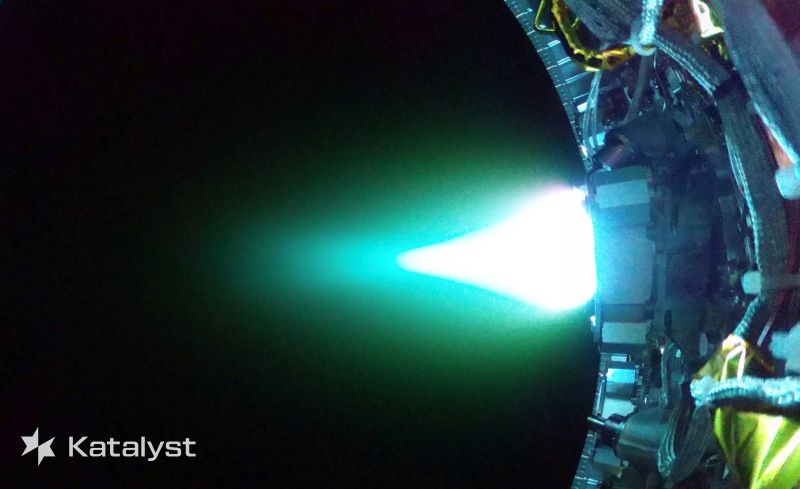
A plume of plasma exhaust coming from one of the Link satellite’s xenon-fueled electric engines.

A plume of plasma exhaust coming from one of the Link satellite’s xenon-fueled electric engines. Credit: Katalyst Space Technologies

Katalyst may eventually be able to recover the satellite’s two inoperable reaction wheels, but the team’s priority is restoring control by uplinking a new algorithm to manage its orientation through a combination of its one remaining reaction wheel and thrusters.

Engineers aren’t sure yet what caused the emergency with the Link spacecraft last weekend. It could have been an internal problem with the satellite or a collision with space junk. Lee said two cameras on the satellite will look for signs of damage after ground teams stabilize it.

Whatever the cause, Katalyst’s mission control team lost contact with Link for more than 24 hours after it spun out of control. The satellite then automatically reset itself, just as it was supposed to do.

“This was built-in fault protection logic saying, “Hey, if I haven’t heard from anybody in 24 hours, there must be something wrong. I’m going to toggle the power, turn it on and off again,’” Lee said. “It’s just built in. However, that shutdown mode is ungraceful. It basically pulls the plug on everything, and that creates some downstream effects for sensitive systems such as the reaction wheels.

“Basically, there was a big thermal spike that came about as a result of this that over-temperatured the upstream electronic circuits that control the reaction wheels, which ultimately led them to being inoperable,” Lee said.

The problem with the spacecraft’s cold gas thrusters seems to be a “separate issue,” Lee said. But engineers don’t have all the data in hand to make a final determination.

“These things all happened at once, so it’s hard to delineate between what contributed to creating the situation and what was the consequence of the situation, and that’s something we’ll have to investigate with all the data,” Lee said.

Nevertheless, Lee said Katalyst still aims to move Link toward NASA’s Swift observatory, perhaps around the end of August.

“We’re very committed to pursuing this mission,” Lee said. “We’re working side by side with NASA. I just came from a technical working meeting with their controls team, where we’re reviewing the algorithms. It seems like there’s nothing that is preventing us from reestablishing three-axis control of the spacecraft with the remaining reaction wheel, with the remaining thrusters, as well as the electric propulsion.

“It’s not the original mode that we expected to control the spacecraft with, but it seems like we will have sufficient stability and controllability of the spacecraft,” Lee said. “With this, we believe we’ll be able to do the rendezvous with Swift. We believe that we’ll be able to go and do things like the inspection of Swift within a close approach of a few dozen meters. And as it stands right now, we have not made a formal assessment, but we believe that a capture of Swift, an attempted capture of Swift, is very much in the cards.”

0FansLike
0FollowersFollow
0FollowersFollow
0SubscribersSubscribe
- Advertisement -
Google search engine

Recent Posts