20.8 C
London
Friday, September 4, 2026
Home Blog

Finland probes possible territorial violation after drone discovery

0
finland-probes-possible-territorial-violation-after-drone-discovery
Finland probes possible territorial violation after drone discovery


Finland’s Border Guard said Friday it is investigating whether a surveillance drone found on the country’s southern coast had violated Finnish territory.

The investigation will seek to establish where, when and how the aircraft entered Finland and how it may have crossed the country’s border, the Border Guard said.

A preliminary examination indicated that the aircraft was a Geoscan 701-type drone. Authorities said the model is used by both state and civilian actors.

The Border Guard said it could not confirm at this stage where the drone came from, who operated it or what its purpose was.

Authorities continue investigation

The investigation is continuing in cooperation with other authorities, the Border Guard said.

Finland’s Defense Ministry said Wednesday that the drone was designed for surveying and mapping and did not pose a danger to the public.

Will the US become China’s indirect enforcer on Taiwan?

0
will-the-us-become-china’s-indirect-enforcer-on-taiwan?
Will the US become China’s indirect enforcer on Taiwan?

Following the Beijing summit between US President Donald Trump and Chinese President Xi Jinping in May this year, their governments offered strikingly different public accounts of the meeting.

Beijing’s official readout called Taiwan “the most important issue” in the relationship and warned Washington to exercise “extra caution.” The White House account highlighted trade, Iran and the Strait of Hormuz, and did not mention Taiwan.

This divergence does not prove a secret bargain, but it shows why the expected follow-up meeting deserves scrutiny. Trump has invited Xi to Washington on September 24, although Beijing has not publicly confirmed the date.

If the summit proceeds, Taiwan should look beyond whether it appears on the agenda. The deeper risk is that Beijing may use Washington’s desire for stability to secure restraints it cannot impose directly on Taipei.

Much has changed since May. War with Iran and pressure on the Strait of Hormuz, secondary sanctions, tariffs, AI and semiconductor controls now overlap. Washington wants to prevent several crises from peaking at once; Beijing wants relief from economic and technological pressure.

Neither side must settle its fundamental disputes to reach a temporary accommodation. It needs only to prevent them from becoming acute at the same time.

Beijing’s direct pressure has failed to make its political formula more attractive in Taiwan. Military intimidation, diplomatic isolation and political warnings have instead reinforced distrust. Recent official polling still shows overwhelming opposition to “one country, two systems” and to unification under the Chinese Communist Party.

Beijing has another route. Taiwan relies heavily on US security support, giving Washington influence over Taipei that Beijing lacks. Taiwanese leaders can reject a demand from China. It is harder to dismiss an American warning that a particular initiative could destabilize the Taiwan Strait or complicate US strategy elsewhere.

From Beijing’s perspective, the shortest political route to Taipei may therefore run through Washington. Beijing can tell Washington that certain Taiwanese actions threaten the stability both powers say they want.

If US officials grow concerned about escalation, they may press Taipei to show restraint. What China cannot win through direct coercion, it may try to obtain through American crisis management.

In December 2003, during Chinese premier Wen Jiabao’s visit to Washington, President George W. Bush publicly opposed unilateral moves by either side and pointedly criticized then-president Chen Shui-bian’s proposed referendum.

The US remained opposed to Chinese coercion, but the episode showed that American pressure could restrain Taipei. Beijing may have drawn a durable lesson: US influence over Taiwan can sometimes achieve what Chinese threats cannot.

Trump’s transactional diplomacy makes that lesson newly relevant. His administration is juggling Iran, trade, technology and Taiwan, while Beijing can offer cooperation or restraint on some files and seek movement on others.

No collusion or formal bargain would be necessary. The two sides’ incentives need only converge, leaving the most consequential accommodation tacit. Taiwan could thus slip into a quieter agenda, managed below the level of public confrontation while broader US-China bargaining continues.

Silence is not inherently sinister. Washington may keep Taiwan out of a formal agenda precisely because it rejects Beijing’s claim to a say in US arms sales or Taiwan’s political future. Less public rhetoric or military signaling can also reduce miscalculation without weakening underlying commitments.

The question is what accompanies the silence. Watch for a pattern: arms-sale approvals or announcements repeatedly postponed, senior-level contacts pared back, or security cooperation slowed at roughly the same time that Beijing moderates military pressure or assists Washington on Iran, trade or other priorities.

Each development may have an ordinary explanation. Repeated timing, reciprocity and cross-issue linkage would be harder to dismiss.

Taipei should not demand that Taiwan appear on every Trump-Xi agenda. Beijing formally treats Taiwan as an internal Chinese matter and rejects outside interference. Yet in direct US-China great-power bargaining, it has found tactical value in Washington’s leverage over Taipei. Making Taiwan a bilateral agenda item could reinforce that mechanism.

Taiwan need not be discussed, but it shouldn’t be decided upon in its absence.

In practice, that requires close consultation with Washington before and after major US-China summits; sustained investment in defense and societal resilience; and deeper ties with Japan, Europe, Australia and other democratic partners. Taipei must also make the case that deterrence and responsible risk reduction are complementary goals.

US-China dialogue can lower the risk of war, and Taiwan has no interest in opposing diplomacy for its own sake. The danger begins when “stability” comes to mean narrowing Taiwan’s room for action so that Washington and Beijing can more easily manage their wider relationship.

For Beijing, that would be an attractive outcome: Taiwan simultaneously constrained by Chinese pressure and American caution. Washington should ensure that its role as Taiwan’s principal security partner does not gradually become that of an indirect enforcer of Beijing’s preferences.

As the expected follow-up Trump-Xi summit approaches, the key question is who gets to define stability in the Taiwan Strait, and who is expected to pay for it. Taiwan should welcome serious efforts to reduce great-power risk. But it cannot afford to become the object of great-power management.

Chih-Cheng Meng is a Taiwan-based political scientist specializing in international political economy, US-China-Taiwan relations and public policy. He holds a PhD from the University of Texas at Austin and was formerly an associate professor at National Cheng Kung University.

VMware migration reduces Tottenham Hotspur’s licensing fees by 85 percent

0
vmware-migration-reduces-tottenham-hotspur’s-licensing-fees-by-85-percent
VMware migration reduces Tottenham Hotspur’s licensing fees by 85 percent

Tottenham Hotspur, a professional soccer team that’s part of the Premier League, has saved over 85 percent in licensing fees by replacing its stadium’s VMware instance with Hewlett-Packard Enterprise’s (HPE’s) Morpheus VM Essentials (VME) virtualization software.

Tottenham hasn’t disclosed which VMware products it used or how much it previously paid the Broadcom firm.

The soccer organization confirmed this week to The Register that it has moved its stadium’s server, storage, and networking infrastructure to HPE solutions delivered through HPE’s hybrid cloud management platform, GreenLake. That is all “underpinned by” VME and HPE’s OpsRamp software for hybrid and multi-cloud environments, Rob Pickering, Tottenham’s CTO, told the publication, with HPE in charge of the hybrid cloud-managed service.

Tottenham is almost done with a broader redesign of its stadium’s data center and network infrastructure, The Register reported. The stadium has a data center with six aisles that uses HPE’s ProLiant Compute Gen12 server hardware and Alletra Storage MP. In an announcement this week, HPE noted that Tottenham is using “solutions including HPE Morpheus software and HPE OpsRamp software… to manage a complex, multi-site environment more efficiently while modernizing virtualization platforms and reducing operational overhead.”

“We’re at the right time of our replacement cycles to be looking at those decision points,” Pickering told SDxCentral this week.

“For at least as long as my career in technology, hypervisor has been one of those very unsexy things that you bought from one person and you just sort of got on with it. And you know, with VMware, a 400-pound gorilla in that space, they took some decisions that I think run counter to both the system integrator side and the customer side.”

Migration benefits

Pickering told SDxCentral that Morpheus VME’s “ability to do things on behalf of the hardware far outstrips what VMware can do on that front.”

“So in many ways, it’s more capable,” Pickering added.

He told The Register that “savings is a big part of the reason” for Tottenham’s migration. The organization is saving “north of 85 percent” in licensing fees compared to when it relied on VMware, the executive said.

“We moved away as we put [in] the infrastructure… over the last three months,” Pickering said. “The issues with the Broadcom takeover of VMware are well-known in terms of the commercial changes to their structure and the way that they engage with clients.”

Tottenham’s CTO said that moving from VMware was about more than saving money.

“If [virtualization is] not built into a broader AI operation stack, the value is even lower again,” Pickering said.

“Having that all connected back into an operation stack that our team can work from—one pane of glass—is worth more than just the savings that come from moving vendor A to vendor B. We do see significant savings from that, but really, it’s all part of the broader story of, ‘How do we put AI ops at the heart of what we do from a technology perspective?’”

In 2025, Pickering said that Tottenham had “a total technology team of about 35 people.” With a team that small, the “ability to use AI operations to proactively see faults and remediate them without the input of a person is really critical,” Pickering told The Register.

Dark Secrets Behind O.J. Simpson’s Prank Show Exposed

0
dark-secrets-behind-oj.-simpson’s-prank-show-exposed
Dark Secrets Behind O.J. Simpson’s Prank Show Exposed


A bizarre chapter from O.J. Simpson’s post-trial life is being dragged back into the spotlight — and the story behind it may be even stranger than the show itself.

Years after Simpson was acquitted in the 1994 murders of his ex-wife Nicole Brown Simpson and her friend Ronald Goldman, the disgraced football legend quietly starred in a hidden-camera prank series called Juiced.

The show never became a mainstream television hit, but a new documentary is revealing just how dark and uncomfortable the project became behind the scenes.

Filmmaker Rebecca Halpern explores the forgotten series in O.J. Unseen: Exploitation of Evil, premiering Sept. 7 and 8 on Investigation Discovery and HBO Max.

“It’s been kind of this mythological project that’s been lurking in the ether that nobody really knew about,” Halpern told Obsessed: The Podcast.

Simpson’s sensational murder trial consumed America for eight months before a jury found him not guilty of murdering Brown Simpson and Goldman.

The case began after the two were found brutally stabbed to death outside Brown Simpson’s Los Angeles home in June 1994.

Although Simpson was acquitted in criminal court, a civil jury later found him liable for their wrongful deaths in 1997 and ordered him to pay $33.5 million in damages.

But roughly a decade after the criminal trial, Simpson apparently saw television comedy as a possible path back into the public’s good graces.

Juiced creator Rick Mahr approached Simpson about starring in a hidden-camera prank show inspired partly by Simpson’s notorious reputation and public persona.

The title itself was a play on Simpson’s famous nickname, “The Juice.”

At the time, prank shows were exploding in popularity thanks to programs such as Ashton Kutcher’s Punk’d on MTV.

Juiced, however, had a much darker hook.

Some of its stunts reportedly referenced Simpson’s own murder case.

One particularly jaw-dropping segment showed Simpson attempting to sell an unsuspecting woman the infamous white Ford Bronco associated with the slow-speed police chase that transfixed millions of Americans in 1994.

For Simpson, Halpern believes the project was about repairing his image.

She said Simpson was willing to “feed the beast” of public fascination if it helped him remain famous or regain some level of acceptance.

But the filmmaker said the crew also had powerful reasons to keep the cameras rolling.

“They knew full well that a confession, or any kind of conversation from O.J. Simpson about the murders, was going to be ratings gold,” Halpern said.

In other words, producers understood exactly why viewers would watch.

“They knew it would get eyeballs,” she added.

Halpern said some crew members entered the project convinced Simpson was guilty, only to find themselves occasionally questioning those beliefs after spending time around him.

Simpson’s charm, friendliness and celebrity presence could apparently be disarming.

Halpern described him as a “dangerous individual, whether you think he killed them or not,” but said people could still become overwhelmed by his charisma.

“And the crew felt that way too,” she said. “Some of them went in thinking he did it. And then there were moments when they were like, ‘Well, maybe he didn’t.’”

According to Halpern, some of the documentary’s most revealing material does not come from the actual pranks at all.

Instead, it comes from behind-the-scenes footage showing Simpson interacting with producers and crew members when the supposedly polished television version was not being filmed.

For Halpern, Juiced represents something much larger than one bizarre celebrity project.

She argues the show captured an early version of today’s relentless competition for attention, clicks and shocking content.

If producers had simply wanted to make an ordinary prank show, she noted, they could have hired almost anyone.

Instead, they hired O.J. Simpson.

“They knew exactly what they were doing,” Halpern said.

The documentary also examines America’s never-ending fascination with Simpson and other true-crime figures whose cases remain cultural obsessions decades later.

Halpern said the Simpson saga had virtually every ingredient of a television soap opera — fame, wealth, violence, celebrity lawyers, shocking evidence, live courtroom drama and a verdict that divided the country.

“The whole thing has made for an enduring mystery that people cannot seem to get enough of,” she said.

O.J. Unseen: Exploitation of Evil premieres Sept. 7 and 8 on Investigation Discovery and will also stream on HBO Max.

Netanyahu Declares Fall of Iranian Regime Is ‘’Within Reach’ 

0
netanyahu-declares-fall-of-iranian-regime-is-‘’within-reach’ 
Netanyahu Declares Fall of Iranian Regime Is ‘’Within Reach’ 


Israeli Prime Minister Benjamin Netanyahu said in Tel Aviv that removing Iran’s government has become a central Israeli objective and is within reach. 

Netanyahu made the comments during a toast ahead of Rosh Hashanah, which begins next week, at the Kirya. Defense Minister Israel Katz, Chief of Staff Lt. Gen. Eyal Zamir, and members of the IDF General Staff Forum attended. 

“This regime is currently crumbling. It is weaker than ever. Overthrowing the regime is the central mission still before us, but it is near. It is not impossible, and it is within reach,” Netanyahu said. 

Netanyahu said Iran has refrained from attacking Israel because its leaders understand Israel’s military capabilities and willingness to use them. 

“It is no coincidence that they are not attacking us. They are attacking everyone except us. They know our strength, the force of our blows and our determination,” he said. 

Netanyahu also expressed confidence that Israel could eliminate the threat posed by Iran and bring down its government. 

“I am convinced of our ability to remove the threat once and for all and overthrow the Iranian regime that is fighting for its life. I say to our enemies – don’t mess with us. We have the power, the determination, and the internal unity to overcome you.” 

His remarks come as renewed fighting between the US and Iran continues and negotiations aimed at ending the conflict have reached an impasse. 

Earlier Thursday, Katz warned that any Iranian attack on Israel would prompt strikes against all of the regime’s infrastructure, “including energy infrastructure.” Iran had threatened retaliation over Israel Defense Forces operations at Lebanon’s Ali Taher Ridge, a strategic underground facility. 

Before the US renewed strikes in response to Iran targeting vessels in the Strait of Hormuz and attacking US bases in the region, US President Donald Trump declared an “economic D-Day” aimed at using financial pressure to bring down the Iranian government. Trump described it on Truth Social as “the most crushing economic operation ever taken against any country!” 

The US has imposed sanctions, frozen assets and adopted additional financial measures intended to restrict Tehran’s access to international trade and foreign currency. 

Iran is also confronting an economic crisis, with the Iranian rial falling to more than 2 million per US dollar as sharply rising inflation drives up food prices and other essential costs. 

When the American aircraft carrier loses its aura

0
when-the-american-aircraft-carrier-loses-its-aura
When the American aircraft carrier loses its aura

Most people around the world have probably come to know the American aircraft carrier in much the same way: through US Navy publicity films, Hollywood blockbusters, television news and political debates.

For decades, these images taught us what an American carrier was supposed to look like — and, perhaps more importantly, what we were supposed to feel, and to fear, when one appeared. This time, the cameras kept rolling after the heroic image should probably have ended.

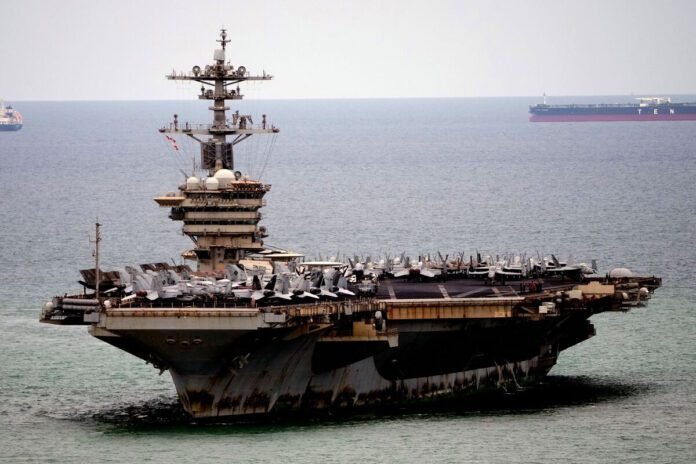
The USS Abraham Lincoln arrived in Thailand on September 2 after more than eight months on deployment, much of it literally at sea. The carrier had spent much of that time supporting US combat operations against Iran.

Its roughly 5,000 crew members finally had the opportunity to go ashore. Many headed for nearby Pattaya, the Thai beach town notorious for its red lights. By then, however, another picture of the carrier had already been circulating.

Families of sailors had reported food shortages, broken toilets, moldy showers and water contamination during the prolonged deployment. Photographs of the enormous hull showed streaks of rust.

Then came Thailand: thousands of sailors finally leaving the ship for shopping, food, drink and the nightlife of Pattaya, a city whose international reputation as an R&R destination was itself partly created by American servicemen during the Vietnam War.

From major newspapers and television networks to the endless feeds of social media, the world was suddenly seeing the American supercarrier almost with the naked eye. Captain America had somehow disappeared from the picture. The brighter the old image had been made to shine, the more glaring the rust now appeared.

I am not a paparazzo. Unlike some international reporters, I have no particular desire to follow American sailors into Pattaya’s go-go bars to investigate what happened next. To remain euphemistically polite, readers interested in the details of what awaited them there may consult the BBC.

The sailors themselves deserve no ridicule. After so long at sea, they deserved their rest. What interests me is what had already happened to the image.

Try to imagine Captain America, shield still in hand, emerging somewhat unsteadily from a Pattaya go-go bar. Americans themselves might have no difficulty accepting that even heroes are ordinary human beings who need to eat, drink, sleep, use a functioning toilet and occasionally have a night off.

But this is not the visual memory that decades of Hollywood, military publicity and political theater taught much of the rest of the world. Captain America was supposed to arrive with his uniform immaculate, his muscles tightened and his shield held at the proper angle.

The aircraft carrier belonged to much the same visual world. As an art historian who works with visual culture, I am interested in how remarkably consistent its images have been. Fighter jets roar from the flight deck. Sailors stand in formation.

The enormous ship cuts through a perfect blue ocean while escort vessels arrange themselves around it in geometrical order. The carrier is almost always given the distance it needs. And that distance turns machinery into monument.

A submarine becomes more dangerous by disappearing. A missile can wait unseen in a silo. An aircraft carrier announces itself. It is enormous, expensive and deliberately visible. It turns abstract military power into a physical object that can be photographed, filmed and sent across the world.

For much of the postwar era, American military superiority, political theater, television and Hollywood reinforced one another so successfully that the supercarrier became one of the most immediately recognizable images of national power on earth. It became a kind of Mount Rushmore at sea.

And Mount Rushmore is not supposed to stumble out of a go-go bar.
Monuments work best from the proper distance. Look too closely, and the image becomes less simple.

This is particularly important for an aircraft carrier because it carries more than aircraft. Its appearance carries an expectation about how the person looking at it should respond. Awe is part of the machinery. So is fear.

Shortly before the USS Abraham Lincoln reached Thailand, a US Navy P-8A Poseidon flew through the Taiwan Strait. The Seventh Fleet said the transit demonstrated America’s commitment to a “free and open Indo-Pacific” and repeated that the US military “flies, sails, and operates anywhere international law allows.”

Operations like this are announced publicly because presence must be visible if it is to become a political signal. I understand that signal perfectly well. I simply find it increasingly difficult to feel its intended effect.

This is not because the aircraft carrier has suddenly become militarily irrelevant. The Lincoln itself has just demonstrated the opposite. It sustained months of operations at extraordinary distance, supported combat operations against Iran and kept thousands of people and dozens of aircraft functioning through an exceptionally long deployment. As a machine of war and military organization, it remains formidable.

But being formidable and looking almighty are not quite the same thing.
Even the language surrounding the ship reveals something about the grandeur attached to it. In Chinese, an aircraft carrier is hangkong mujian (航空母舰) — something like the “Mothership of Navy and Air Force,” a union of naval and air power in a single name.

The English “aircraft carrier” sounds logistically uncool and almost comically mundane by comparison, especially when the words themselves are so strangely unpompous: a carrier carries things, while craft can be something made by hand.

Read too literally, the mightiest warship in the world begins to sound like a mule carrying a load of little wooden birds made by a folk craftsman. Chinese has somehow given the American warship an additional layer of grandeur in translation. Yet even linguistic assistance cannot protect an image forever.

This is what makes the Lincoln episode interesting to me. Rust by itself means almost nothing. Ships rust. Broken toilets do not change the balance of naval power. Food shortages do not make fighter jets stop flying. Sailors needing a shower and a night ashore is hardly evidence of imperial decline. Nor does a visit to Pattaya make the carrier’s aircraft any less lethal.

But images accumulate. The rust matters because the ship was supposed to gleam. The toilet stories matter because the floating city was supposed to look almighty. The shortages matter because abundance is part of the visual language of power.

The exhausted sailors matter because military spectacle normally turns thousands of ordinary human beings into disciplined figures arranged across a flight deck. And Pattaya matters because, after all those other images, the camera finally followed those human beings all the way out of the monument.

The sublime and the ridiculous suddenly found themselves uncomfortably close.
The United States can still decide where an aircraft carrier sails, what aircraft it carries and, when necessary, what targets those aircraft attack.

What it cannot control quite so completely is what happens to the image once it enters everybody else’s screens. The object can still arrive exactly where Washington intends but the feeling does not necessarily arrive with it.

Awe requires distance. Get close enough to almost any monument, particularly military ones, and eventually you find rust, bad plumbing and tired people who would rather be somewhere else.

Pattaya alone did not destroy the aura of the American aircraft carrier. That would give a Thai resort town far too much geopolitical responsibility. The erosion has been slower and much less dramatic.

But after the rust, the shortages, the overflowing toilets, the moldy showers and the exhausted human bodies, the sight of thousands of sailors finally heading into the neon lights felt like the last straw.

Hu Chao is a Singaporean art historian and curator based in Guangzhou, China. His research focuses on the intersection of material culture, technology, and geopolitics in Asia.

Israeli army kills 3 Palestinians, wounds others in Gaza Strip despite ceasefire

0
israeli-army-kills-3-palestinians,-wounds-others-in-gaza-strip-despite-ceasefire
Israeli army kills 3 Palestinians, wounds others in Gaza Strip despite ceasefire

The Israeli army killed three Palestinians and wounded others in separate attacks on Gaza Strip on Thursday despite an ongoing ceasefire, a medical source told Anadolu, Anadolu reports.

One Palestinian was killed and two others were injured in a drone strike targeting a group of civilians in central Gaza City, according to a medical source.

A medical source at Al-Shifa Hospital told Anadolu that the body of the deceased victim arrived at the facility heavily disfigured.

The strike on Al-Thawra Street also injured two other Palestinians, according to preliminary medical reports.

An Anadolu correspondent on the ground confirmed that the Israeli drone targeted a gathering of civilians in the area.

In an earlier attack, a medical source said Israeli army gunfire killed one Palestinian and wounded others in Beit Lahia.

A second Palestinian was later killed when Israeli forces opened fire on tents housing displaced Palestinians and homes in the area, the source added.

In a statement, the Israeli army acknowledged killing a Palestinian in northern Gaza, claiming that its forces had spotted an “armed individual who crossed the Yellow Line and approached the forces in a way that posed an immediate threat.”

It was not immediately clear whether the Palestinian killed in the army’s account was one of the two people whose deaths were reported by the medical source in Beit Lahia.

In Khan Younis, southern Gaza, a medical source at Nasser Hospital said a Palestinian was wounded by Israeli army gunfire inside a camp for displaced people in the Hamad residential area, north of the city.

In a statement, the UN human rights office said that at least 24 Palestinians, including four children and a woman, were killed in Israeli attacks over a five-day period, emphasizing that Gaza remains unsafe although it has been nearly a year since the announcement of a ceasefire.

“There is no safe place, nor safe person, in Gaza,” the office noted.

“Twenty-four Palestinians were killed in Israeli attacks over five days between Aug. 28 and Sept. 1, including four children and a woman, 21 of whom were killed in airstrikes,” the statement said.

According to preliminary information cited in the report, Israeli forces carried out a raid on Sept. 1 in the Al-Katiba area, west of Gaza City. The raid resulted in the deaths of a 3-year-old girl, a 13-year-old boy, and a 31-year-old man.

The fourth victim of the raid was a 49-year-old woman, who was killed while Israeli forces were detaining her 51-year-old husband, Muin Al-Arbeed.

The UN office noted that Al-Arbeed holds the rank of colonel in the internal security service of the de facto authority in Gaza.

The UN office stressed that Israel’s claims of targeting individuals it deems “lawful targets” do not absolve it of its obligations under international humanitarian law and international human rights law, including the duty to respect the right to life for Palestinians.

It emphasized that such claims “do not justify the daily life of horror experienced by Palestinians in Gaza,” calling for an end to the bloodshed and demanding justice and accountability for all unlawful killings in the enclave.

Israel launched its military campaign in Gaza on Oct. 8, 2023. The offensive continued for two years, causing widespread destruction, while Israeli violations have persisted despite a ceasefire that took effect on Oct. 10, 2025.

Since the ceasefire took effect, Israeli violations have killed 1,334 Palestinians and wounded 4,429 others, while rescue teams have recovered hundreds of bodies from beneath the rubble, according to Gaza’s Health Ministry.

Israel’s military campaign in Gaza has killed about 73,470 Palestinians and wounded 174,540 others since October 2023, the ministry said Thursday.​​​​​​​

Supreme Court urged to let states regulate sports bets on prediction markets

0
supreme-court-urged-to-let-states-regulate-sports-bets-on-prediction-markets
Supreme Court urged to let states regulate sports bets on prediction markets

New Jersey yesterday asked the Supreme Court to rule on whether states can regulate sports betting on prediction markets such as Kalshi.

“Companies like Kalshi claim to offer legal sports betting in all 50 states, but they refuse to follow the gambling laws of any state,” New Jersey Attorney General Jennifer Davenport said in a press release announcing the lawsuit.

In April, the US Court of Appeals for the 3rd Circuit ruled that New Jersey cannot regulate sports bets on prediction markets. The court determined that sports-related event contracts meet the legal definition of “swaps,” giving the US Commodity Futures Trading Commission (CFTC) exclusive jurisdiction.

New Jersey’s petition to the Supreme Court said, “The issue is one of tremendous practical and legal consequence: Kalshi seeks to federalize the multi-billion-dollar sports betting industry at the expense of every state sports gaming law. And the decision [by the 3rd Circuit] is badly mistaken.”

New Jersey’s petition to the Supreme Court came about a week after the 9th Circuit appeals court ruled that Nevada can stop Kalshi from allowing sports bets. Unlike the 3rd Circuit, the 9th Circuit judges determined that sports betting labeled as swaps is just gambling with a different name.

The split between circuits “has tremendous importance, as it will determine whether a multi-billion-dollar gaming industry can suddenly operate free from state sports-gaming laws,” New Jersey’s petition said.

Circuit split raised odds of Supreme Court taking case

The circuit split dramatically raised the odds that the Supreme Court will step in and determine who’s right, although Kalshi reportedly said it won’t allow bets on the case. Davenport’s office said New Jersey’s petition asks the Supreme Court “to hear a question that divided courts nationwide: whether prediction markets can offer sports wagers without following state sports-gambling laws.”

“Litigation regarding these questions has erupted across at least 20 states, with dozens of active suits pending and the gambling laws of several states currently enjoined by the federal courts,” Davenport’s office said. “This is the first certiorari petition filed with the US Supreme Court regarding the legality of this business model—of offering sports wagers self-certified by Kalshi with the Commodity Futures Trading Commission (CFTC) without following state laws.”

New Jersey regulates gambling and prohibits betting on college sports entirely but hasn’t been able to enforce its laws against Kalshi. New Jersey’s petition asked the Supreme Court to determine “whether the 2010 Dodd-Frank Wall Street Reform and Consumer Protection Act preempted States from regulating sports bets that occur within their jurisdictions if those bets are offered on markets registered with the Commodity Futures Trading Commission.”

New Jersey’s petition said that “if Kalshi is right that it can offer sports bets on federal exchanges irrespective of state law, companies can disregard all state sports-gambling statutes with ease, so long as they register with the CFTC.” New Jersey said the 3rd Circuit decision is “profoundly wrong.”

Defining sports bets as swaps

The more specific legal question is whether the US law’s definition of a swap includes sports bets. The Dodd-Frank Act amended the Commodity Exchange Act to give the CFTC exclusive jurisdiction over swaps and defined “swap” as “any agreement, contract, or transaction… that provides for any purchase, sale, payment, or delivery… that is dependent on the occurrence, nonoccurrence, or the extent of the occurrence of an event or contingency associated with a potential financial, economic, or commercial consequence.”

Judges have come to different conclusions about whether athletic contests are events with potential financial, economic, or commercial consequences. Third Circuit judges ruled that “the outcome of a sports event certainly can be associated with a potential financial, economic, or commercial consequence,” with “numerous affected stakeholders, including sponsors, advertisers, television networks, franchises, and local and national communities.”

The Trump administration has backed Kalshi in the company’s fights against states, and the CFTC has filed lawsuits itself against states to block them from regulating prediction markets. Donald Trump Jr. is an advisor to Kalshi and Polymarket, and his venture capital firm has invested in Polymarket.

While Trump has had plenty of success at the current Supreme Court, the court’s conservative majority isn’t necessarily a guarantee that states will lose this battle. After all, the three 9th Circuit judges who unanimously ruled against Kalshi were all appointed by Trump.

“Placing sports bets, even when called by another name, is still gambling,” 9th Circuit Judge Ryan Nelson wrote. Judge Kenneth Lee said the outcome of a typical sports game is not an “event” with financial, economic, or commercial consequences as conceived in US law governing swap contracts.

“Few people would describe, say, the New York Mets’ latest loss of a game as an ‘event.’… perhaps in an uber-technical sense a Mets’ loss could have marginal economic impact as some fans guzzle more beer to drown away their sorrows. But it seems somewhat fanciful to say that the outcome of a single game in a 162-game season is likely ‘associated’ with a ‘financial, economic, or commercial consequence’ that one would expect in a swap contract,” Lee wrote.

NJ: Congress did not federalize gambling regulation

New Jersey’s petition to the Supreme Court cited the 9th Circuit’s discussion of swaps and said that prohibiting state regulation of sports bets on prediction markets would conflict with other US laws on the balance of power between the federal government and states.

“Kalshi argues that in granting the CFTC ‘exclusive jurisdiction’ over ‘swaps’ on CFTC-registered markets, Congress in 2010 actually preempted sports-wagering laws applied to these bets,” New Jersey said. “But as the Ninth Circuit has since explained, these sports bets are not ‘swaps’ as the statutory text and structure uses that term. And it strains credulity to hold that Congress in resolving the 2008 financial crisis took steps to federalize regulation of sports gambling that was otherwise explicitly addressed across other federal statutes spanning decades.”

New Jersey argued that if Kalshi is right, it would mean casinos are violating US law. “Dodd-Frank also prohibits companies from offering swaps off of CFTC-registered markets. So if Kalshi is correct that Dodd-Frank federalized regulation of sports wagering, then state-licensed sportsbooks that everyone has understood to be legal since [Murphy v. NCAA]—including at brick-and-mortar casinos—have apparently been violating Dodd-Frank all along,” New Jersey said.

New Jersey also said the CFTC’s exclusive jurisdiction over swaps doesn’t preempt state laws. The state argues that even if sports bets are considered swaps, the CFTC authority is exclusive only relative to other federal agencies. The CFTC authority doesn’t preempt states’ police powers over gambling, which “Congress repeatedly recognized and embraced across decades of reticulated federal gaming laws,” New Jersey said.

Netherlands moves gold reserves to UK amid rising geopolitical uncertainty

0
netherlands-moves-gold-reserves-to-uk-amid-rising-geopolitical-uncertainty
Netherlands moves gold reserves to UK amid rising geopolitical uncertainty


The Dutch central bank (DNB) said on Wednesday it had moved 86 tonnes of its gold stock out of the United States and Canada to London, citing “increasing geopolitical unrest.”

The DNB said gold reserves held in London could be traded more easily than those held in New York and Ottawa.

“This makes it the quickest for DNB to deploy in a crisis situation,” said the bank in a statement.

“With this step, we have improved the deployability of the gold reserves. We assume that we will never need to deploy the gold, but it is nevertheless necessary to strengthen our resilience and preparedness,” said DNB President Olaf Sleijpen.

The total Dutch gold stock amounted to 612.4 tonnes and was valued at €72.2 billion at the end of 2025, the DNB said.

Before the deployment, the Dutch bank held 31.3% of its gold in New York and 19.7% in Ottawa.

After the move, both countries account for 18.5 percent of the Dutch gold reserve.

The share of gold held in London increased from 18.1 percent to 32.1 percent. The bank still holds 30.8% of its gold in the Netherlands.

The transfer was carried out partially by buying and selling and partly by physically transferring gold, said the bank.

The bank moved more than 27 tonnes of physical gold from the United States and Canada to Zeist.

The same quantity of gold was moved from Zeist to London, preventing the melting down of gold bars.

“By combining buying and selling and physical transport, the risks associated with physically moving a large quantity of gold have been spread,” said the DNB.

Confused about which VPN is right, US senator asks the NSA for guidance

0
confused-about-which-vpn-is-right,-us-senator-asks-the-nsa-for-guidance
Confused about which VPN is right, US senator asks the NSA for guidance

A prominent US senator is asking the National Security Agency to provide guidance to the general public on best practices for using virtual private networks to secure their communications from spying by foreign adversaries.

VPNs funnel all of a user’s Internet traffic through an encrypted connection to a remote server. The design provides strong assurances that no one between the user and the server can read the encrypted contents. VPNs also allow users to hide their IP addresses from the destination servers they communicate with. While US agencies have previously recommended use of VPNs, none have given recommendations on which ones provide adequate protection.

It’s all in the nuances

There are a host of limitations that can undo many of the protections users may think their VPN provides them. For instance, the encrypted tunnel often terminates once a single server decrypts the traffic and sends it on to its final destination. That means the decrypted traffic or the sending and destination IP addresses may be available for snooping by rogue employees or attackers who hack the server. VPNs also don’t encrypt certain types of metadata, such as time stamps, allowing nation-states to build profiles that can be useful in intelligence gathering.

With so many nuances, the existing recommendations to use a VPN don’t provide enough information for people to make informed decisions. Sen. Ron Wyden (D-Ore.) is asking the NSA to provide specific recommendations.

“Americans facing advanced foreign threats—including government personnel, defense contractors, journalists, and human rights defenders—deserve clear, honest advice about how best to protect their communications from surveillance by foreign adversaries,” Wyden wrote in a letter sent Wednesday to Gen. Joshua Rudd, the director of the NSA. “To that end, I request that you update NSA’s existing public guidance on VPN configurations to address this issue.”

Specific questions touch on some fairly technical details, including the general architecture of a VPN service. They include the adequacy of single-hop VPNs, which, as noted earlier, use a single server to decrypt traffic sent by the user and send it to its destination. It also asks about multi-hop architectures, in which the traffic is funneled through two or more servers, allowing the first to see only the IP address of the sender and the terminating server to see only the destination address. The letter also inquires about the use of random delays and cryptographic padding to thwart attacks that detect timing patterns or the size of messages. Wyden further asks about the adequacy of specific services such as Apple Private Relay, Nym, and Tor.

The questions are:

1. Are standard, single-hop commercial VPNs sufficient to protect Americans’ sensitive digital footprints from foreign adversaries monitoring internet backbones?

2. Does the NSA recommend multi-hop tools such as Apple Private Relay, Tor, or Nym over standard VPNs for Americans facing heightened surveillance threats?

3. What technical features, such as random delays, padding, and cover traffic, are needed to defend against sophisticated surveillance, and how does the NSA assess multi-hop systems like Apple Private Relay compared with Tor and Nym?

Nym is an open source VPN client written in Rust, a memory-safe programming language that’s resistant to attacks exploiting buffer overflows or other types of memory-corruption bugs. Nym can route traffic through a decentralized “mixnet,” which provides random time delays and the reordering of messages. The VPN can also provide a multi-hop architecture.

Apple Private Relay provides multi-hop browsing using two servers, one operated by Apple and the other by a third-party content provider. Tor is a privacy service that encrypts traffic and sends it through three servers before decrypting it and sending it to its final destination.

Each of the services comes with pros and cons. The hops provided by Nym and Tor, for example, are operated by volunteers, some of whom may be nation-state spies trying to use their vantage point to gather intelligence. Apple Private Relay relies on content delivery networks like Cloudflare and Akamai that not everyone trusts. Its protection is also limited to the Safari browser running on Apple devices.

A memo issued by the Congressional Research Service provides an overview of the options but provides no criteria for determining which ones are best. That leaves many people unable to make informed choices about what’s best for their threat model.

“There’s no trustworthy standardization” for assessing various VPN services, Micah Sherr, a Georgetown University professor specializing in network security, said in an interview. “The VPN ads you get in YouTube commercials can be incredibly misleading. It’s extremely difficult for ordinary users to determine whether they need a VPN, what a VPN actually buys them, and which one to use.”

Wyden requested that the NSA provide answers no later than October 14.

0FansLike
0FollowersFollow
0FollowersFollow
0SubscribersSubscribe
- Advertisement -
Google search engine

Recent Posts