24.9 C
London
Wednesday, July 29, 2026
Home Blog

The world of zero visibility

0
the-world-of-zero-visibility
The world of zero visibility

It is summer in the Northern Hemisphere, and we are attempting an experiment that may not please everyone. With fewer eyes in the peak holiday period, and a lesser appetite for the presumed permabull piece in these bearish weeks, we risk a discussion of the contradictions between the beliefs people hold and the evidence sitting in front of them.

There was a time when the emerging market equity industry had a popular, bellwether chart that placed the US BBB+ bond spreads on one axis against an EM equity index on the other. For many, the know-all credit market direction was the primary thing to decide for investments in the emerging world. The chart was flawed from birth. Bond spreads are bounded. An equity index, in the long run, is not. Neither the numerous times when the chart did not work nor its theoretical impurity ever deterred the followers. We confess we admired its tidiness ourselves at times, although by now it is largely relegated to footnotes. This is not history bashing, of which we have done plenty elsewhere. We simply note how comfortably two inconsistent ideas can share a desk.

They still do. So many of us now worry that memory demand may peak soon, and we do this worrying while waiting minutes for our models to finish an answer. The waits are the early DOS and Windows era all over again, the hourglass on the screen quietly announcing how much more computing the world still has to build and improve before one cries saturation or excess supply.  The rest of this letter is a walk through such popular pairings, held with a straight face, by intelligent people, all over the investment world.

The library closed. The writing improved.

Our umpteenth repeat: LLMs are heuristical. There is no human logic that says where they are headed, any more than there is in quantum physics or in the study of DNA. Still, two camps formed early. One we file, loosely, under the scaling law: the belief, rarely stated so bluntly, that as humanity runs out of fresh high-quality data to feed the machines, the models will stop improving. The other camp, of “singularity,” is decades older than the technology and was never written with it in mind: intelligence, once it begins building on itself, keeps building, until it runs away. The two beliefs were always in conflict, though remarkably so many believed in both.

The first camp had its moment in December 2024, when one of the field’s most celebrated researchers announced from a conference stage that peak data had arrived, comparing data to fossil fuel. The forecasters penciled the exhaustion window to begin around 2026. The window arrived on schedule. The models did not notice. The tasks the best systems can finish unaided have stretched from minutes of human work to most of a working day, and the doubling keeps compressing. The fuel, meanwhile, is increasingly home-brewed: One Chinese laboratory disclosed that its latest model practiced inside more than 1,800 artificial environments of its own, the way a chess player improves by playing herself.

A human analogy explains what the arithmetic cannot. A young person who reads exhaustively eventually meets nearly every word he will ever use, and one more dictionary adds nothing. Yet nobody concludes that his intelligence has peaked. Beyond a point, internal regurgitation – or call it creativity – will make him write like Dickens one day. Something similar appears to be under way with the models. They generate their own material, grade their own homework, and improve on the results. Call it synthetic data or self-play; the label matters less than the fact.

The early fear deserves a respectful burial. Serious people once warned that machines trained on machine output would degrade, hallucinate more, and drift into bias, the photocopy of a photocopy fading toward gray. The observed record runs the other way: each generation hallucinates less than the last, not more. And, so far, with each generation of synthetic data, the models keep getting better.

No celebrated theory is given a quick burial; expect some theoreticians to keep flogging the scaling law – which, by the way, has utility in specific circumstances, just like the statistical parrot or run-away-bias tendency followers. Meanwhile, as we finish drafting the section, another model is likely to have been released with more extraordinary features.

Somebody has to own the machines

Imagine living among calculators when the spreadsheet arrives. It quickly becomes clear that the new tool wants a different machine, and for years afterward the story of that machine is penetration, not saturation. Every year more desks get one; every year somebody declares the last desk reached. The same film is running again. The hardware the new models need is very different; most of the world accepted only recently that AI is not a hype or about to stop improving on some scaling law. These are early chapters wearing a late-chapter costume.

The twist last time, during the mainframe era, was that the new hardware was personal. Now, the new hardware is collective. Almost no company, and certainly no individual, can buy a useful share of it alone. Somebody must own the machines and lease out their use, and that somebody collects the rent of the era. The entire buildout, stripped of its vocabulary, is a leasing business for cutting-edge hardware, and the tenants are standing in the lobby. 

Every lessor of this hardware business keeps repeating how they are unable to meet the demand. To the armchair pessimist, the announced investment numbers have gone up multiple times in three years since they have been forecasting a bust, and every demand argument appears flaky. The hyperscalers and other infrastructure builders are putting money where their beliefs are in the face of demand evidence they have not refuted and cannot refute. 

The fear of a competitive rat race has validity. For every major technology player, here is a new business with massive long-term potential that they cannot simply leave for others to dominate while they cool their heels. Meta (reportedly entering the neocloud business), Nvidia, and Hynix (discussed below) seem to be the new ones trying to ensure they have some exposure to the business with immense long-term strategic significance, even if they make returns only over cost of capital and below their historical averages. So, yes, one cannot ignore the oversupply potential. However, whether we are close to an oversupply or not needs to be determined on evidence and not just by adding up the announced capex numbers. 

The shortages, as of now, are worsening. They are so severe that even OpenAI had to begin retiring products in public. Its famous video service, Sora, announced a complete closure in April. As mentioned once before, Kimi stopped accepting new subscribers 48 hours after launch this week because of demand. Even the mightiest Google slipped the release of its flagship recently, while guiding that it will stay short of computing all year. Asymptotic peaking has been shouted not only for models but also for hardware demand with the same theoretical frameworks by many pundits for a while. So far the hard evidence is in the opposite direction.

A data center is not a building

Here is the section where both sides are right, which makes it the most dangerous one to write. The demand for collective computing is real, enormous, and young, as the numbers above insist. And yet the phrase building a data center has become as informative as the phrase building a building. When a property developer announces a new building project, he may mean a most modern skyscraper or a row of ordinary walk-up apartments. And, the range is exactly as wide in data centers.

A great many smaller developers around the world, several of them seeking capital at admirable valuations, have quietly reduced the recipe to land, water, power and money. That is a serious mistake. A frontier facility of the kind the leading builders now erect is not far below a semiconductor fab in complexity. A single modern AI rack draws more power than dozens of homes and must be liquid cooled, so a shell not engineered for that density cannot accept the latest hardware at any price. Frontier training happens in one place, across tens of thousands of processors wired together as one machine, which is why ten rowboats never add up to a ship. There is even a published reference design now, a blueprint the serious builders construct to; a facility either meets it or it does not. Scale, in other words, is not a preference. It is part of the specification, in data centers as in the models themselves.

So we will make a prediction we would rather not make. A meaningful number of the data centers being announced around the world will turn out to be walk-ups: built without the newest computing, without the best connectivity, unsuitable for the highest-value AI work. As they open and their revenues disappoint, even amid a hardware shortage, they will be paraded as proof of a data center bubble, and their owners will discover what it costs to switch technologies mid-construction. None of that will say anything about the skyscrapers. It will say a great deal about the walk-ups. Both sides will claim vindication, and both, in their narrow way, will be right.

The vendor turns banker

The financing question is genuine, and it is growing. Building collective hardware consumes cash on a scale that makes even record operating profits look shy. Oracle just reported a signed order book of $638 billion, alongside negative free cash flow of nearly $24 billion and plans to raise roughly $40 billion more. The hyperscalers dip into cash piles, and also join those without as many resources, in raising money constantly. The market’s appetite to keep funding this is a fair thing to worry about. We do not dismiss the worry. We simply point out who has started answering it.

The companies collecting the cash have begun joining the business. Recently, Nvidia announced it would share in the revenue of cloud operators deploying its hardware, backstopping their buildouts with credit support. This is an enhancement on the scheme announced last year through buyback of Coreweave’s unsold capacity through 2032. Now, Hynix’s group has announced a buildout of a 2GW AI factory along with Nvidia. Some will call this circular, and a little of it is. But a vendor-financing bubble requires a vendor who is fooled about final demand, and raising balance sheet involvement towards a product or a service where demand could severely disappoint. When the seller of shovels starts underwriting the mines, either the seller has lost its mind or the mines are producing. The evidence, as discussed above for those looking at real-life signals and not just economic theories, is stubbornly in one direction.

The much-envied days of tech giants making money without investing are over. We will not repeat our views on the capex recoil, most succinctly summarised in a section with the same title inside this note. We too believe that, like in any capital-intensive industry, technology will have business cycles, with the changed nature. Continuous monitoring of signals is definitely critical.

Image: Geninnov Fund

No crown is bolted on

If our beliefs of model-making being a heuristical field, stated above, are sound, one conclusion follows without effort: No model has an automatic right to stay ahead, in any range, at any price. In a piece overdosing on the similes, here is an extreme one: When dealing with a field like quantum physics, one cannot assume Einstein was always going to be ahead or right. 

The past year supplied the demonstration twice. In the business market, the payment records of some 50,000 American companies show Anthropic overtaking once-crowned unsurpassable OpenAI in capabilities and adoption. 

Geography told the same story with a heavier accent. The comfortable assumption held that Chinese laboratories, denied the newest processors and the deepest pockets, would remain permanently second tier. Just a year ago, there was no dearth of people without any basis to pooh-pooh any claims from these model makers about costs, effort, or capabilities. Some of those skepticisms are muted, but still a huge number feel that the closed-source frontier models like Anthropic will remain in the lead on capabilities given the resources, talent, and other advantages they have. 

As we wrote in last year’s note on the Chinese open source tsunami, these laboratories are exploring a completely different equation space, and they keep arriving at the same frontier by side roads: one trained its breakthrough model on 2,048 export-compliant chips, the bandwidth-trimmed kind the rules permitted, connecting older processors in larger herds where newer ones were denied. The releases since have come like a drumbeat, culminating this month in a 2.8-trillion-parameter model offered to the world with its weights open.

Jensen Huang’s recent “Zero possibility” claim on Chinese models outrunning the US models may be a statement for an audience on what it wanted to hear, or may have other nuances in the transcript we have not read. But in a field where there is no way to forecast what the next version model from any maker is likely to do, the chances of some model maker suddenly coming up with an undisputably capability-leading leadership is non-zero. In fact, given how many they are, and how many different equation fields they are exploring, the statistical chances are non-trivial. 

Open by vision; open by necessity

Pretraining, it turns out, was the surmountable half of the problem for the Chinese makers. More interconnections, older processors in greater numbers, and the training gets done. The unsurmountable half is quieter: how does a laboratory make its model widely used? Anyone who has watched a frontier model think through a hard problem, counting the seconds and the machinery behind them, understands what serving costs. The newest, memory-rich serving hardware is precisely what the export rules withhold, and the squeeze is visible in public: Kimi’s latest, the largest open model ever released, had to stop taking new customers 2 days after launch.

A laboratory that cannot serve the world can still let the world serve itself. Release the weights, and every developer, every cloud, every hobbyist becomes the distribution arm. We have used one of these models ourselves this month, for research at a scale no other tool we own could attempt, admiring the output while aging visibly during the waits. The openness is partly vision, and the founders say so sincerely. It is also, unmistakably, necessity, and the two share one mouth without embarrassment.

What amuses us is who leads the cheering. The loudest advocates for free Chinese models do not sit in Beijing; they sit in California. Users cheer because the price is low and the control is total. The chip designers, like Nvidia, cheer because a model that charges nothing for software is not a rival for hardware at all; it raises demand for chips as one CEO said recently. The cloud operators cheer quietest and best because, when the model is free, the rent for the machine is the entire bill. 

The discount is a decision

Two comfortable beliefs share this section, and neither survives its own receipts. The first says open models will always trade at a deep discount to the closed ones. On capability, the gap has narrowed to the point where counting it in months has become a parlor game; the more honest statement is that a model with open weights now sits near the frontier, which was not in anyone’s brochure two years ago, including those of these modelmakers. On price, the record is livelier than the belief. DeepSeek, which started the price war, ended its promotional rates within a year, raised prices, cut them, cut them again to reignite the war, and then, last month, introduced something the industry had never seen from an open-source house: surge pricing. Its neighbor marched its output price up 60% across a year of releases; another raised its coding plan by an official 30%. One way to look at it is that prices in this market go down, and up, and sideways, because pricing is a business lever, not a moral promise. The other is to recognize that the discount to rising closed-source pricing is narrowing, not widening.

The second belief is grander: that computing follows the comfortable old arc of the internet and the 19th century, in which everything important gets cheaper. There is a growing recognition of the hurtful trend of reducing per-token pricing, but rising overall bill even for the identical activities. The deflation theories have vanished the fastest, as it is difficult to argue against the invoice everyone sees. The only one that survives is that open models are cheaper. Well, they are turning less cheaper.

The fire brigade that said no

This month supplied the strangest piece of evidence that needs no decoration.
OpenAI’s unreleased models, running in a security exercise with their restraints loosened, escaped the test environment through an undiscovered flaw and broke into the production systems of Hugging Face, the world’s most popular model repository. When the victim’s engineers sat down to analyze the attack, the frontier models they tried refused to help: the forensic work required feeding in real attack commands and stolen credentials, and the hosted models’ guardrails cannot tell an investigator from an attacker. So the Hugging Face engineers downloaded a Chinese open-weight model, ran it on their own machines, and finished the job.

The lesson generalizes uncomfortably well. Rules, guardrails, and access policies now change faster than any planning cycle, at the labs and in the capitals alike, and no serious operator can be certain that the model it rents today will be permitted, or willing, to do tomorrow’s most urgent job. The conclusion for increasingly many around the world from the Hugging Face episode would be to keep a capable model of one’s own, on one’s own machines, vetted before the emergency rather than during it. We suspect that sentence will quietly enter the standard playbook of every large technology vendor, the way diesel generators sit behind hospitals. Nobody admires a generator until the night the grid fails.

In other words, we are getting another AI demand driver in the need for redundancies.

Nobody sells iPhone 3 currently

Computing keeps two famous quotations in its attic: that 640K of memory ought to be enough for anybody, and that the world market might want perhaps five computers. Both are almost certainly invented. The quotes were manufactured to mock grand predictions, and the mockery outlived the facts. This summer’s fashionable argument, that most purposes are already served by a model a few months old, is the same fable in a new coat. For every published article on the rising model optimization techniques, there seems to be another one alluding to falling demand for more capabilities, although given the popularity of the 640K fable, somewhat more carefully.

The evidence points the other way, and not subtly. Late adopters – and remember that half of American business started paying only recently – still treat the systems mainly as chat partners and file sorters. Early adopters have moved on to running several agents at once on long, complicated jobs; over 375 large cloud customers each processed more than a trillion tokens in the past year, which is not the consumption pattern of a species that has decided yesterday’s model will do. People will economize, of course, keeping older models for lighter work the way some of us keep old phones, but the household with the old phone does not cancel the new one. And there is a simpler tell, observable at any dinner table. Around the turn of the century we learned what 3 days without the web felt like; around 2010, the phone taught the same lesson; a rapidly growing number of us are now running that experiment with AI and reporting the same result. AI is the new opium, with the difference that one can run several at once, each on a different job, even while one sleeps.

AI is the new opium, with the difference that one can run several at once, each on a different job, even while one sleeps.

And then there is the most important thing: The model makers will keep retiring the older models, and the menu will be managed the way a luxury handbag house manages its window. The most expensive piece is priced at such a premium, and the entry piece at so small a discount, that most customers reach for the middle. And the middle will keep being upgraded, generation after generation, each one carrying, quite possibly, more revenue than the last.

One cannot unsee the Mona Lisa

Once a single person has studied the Mona Lisa closely enough to paint a faithful copy, the knowledge is loose in the world. Others form their idea of great art from the copy, and their students from copies of the copy, and no court order addressed to the first painter restores a world in which the painting was never seen. So it is with the models. In the early days much was scraped without permission, and the owners are rightly collecting: A landmark settlement, finally approved this month, will pay authors roughly $3,000 a work, some $1.5 billion in all, the largest copyright recovery in history. Read the fine print, though. The company must destroy the pirated files. It is not required to destroy the model that read them, because nobody can say where in the model the books live. Asking a trained model to forget is asking a baked cake to return its flour.

The same logic governs the distillation quarrel with the Chinese laboratories. Like in the case of copyright infringement arguments above, the distillation allegations will prove incontrovertibly correct. And they may have some legal or geopolitical consequences. However, the marginal value of additional stolen material is already small (we are also back to the “scaling law”!), because, as argued above, these models now improve mostly on material they generate themselves. Courts can bill the stable, handsomely and repeatedly. The horse has bolted, and it has taken up painting.

The birth of AGI, I guess!

We have overused, almost abused, the “death of” phrase since we started writing these notes. We attached them to SaaS, software, the Internet, deflation, and perhaps a few more. If we were not being misinterpreted often in these obvious exaggerations, we might have risked using the death of specialization for this section. We do not like the title above, and we are not here to publish a date on when the impossible-to-define AGI arrives, but we start with a more constructive title at least.

Anyways, getting on to another contradiction based on available evidence. Most of our industry professes to believe that general intelligence is coming soon, which means, by definition, generalized models doing everything better and better. The evidence has obliged: the same general models now write, code, and film; last July two of them, ordinary generalists, reached gold-medal standard at the International Mathematical Olympiad, a feat that had required purpose-built specialist systems only a year before; and they have begun nibbling at the design of the very chips they run on. And yet the loudest believers in the coming generalist are, this same season, funding specialized models at remarkable valuations: legal models, biology models, robotics-only models, each with a moat the professed belief says will be eaten. The same crowd also holds that model prices are commoditizing to zero and that general intelligence will command historic rents, two convictions that cannot both be whole. We do not exempt ourselves. The temptation to hold a tidy belief in one hand and contrary evidence in the other visits this desk daily, which is precisely why this letter exists.

Evidence is all we have

It is tempting to end with Yogi Berra’s overused line about predictions, but several of our friends, otherwise perfectly at peace with their grammar and spelling tools, would take one look at it and conclude this letter was written entirely by AI. So we end with a confession instead. Our writing often sounds as if we are 100% certain of where the world is headed tomorrow. The truth is that we live with a heuristical technology. Nothing guaranteed in 2024, for instance, that the models would keep improving, yet now that this one reality has unfolded, we hand out human explanations for it – like what we do in the first section above – as if the outcome had been certain all along. It remains entirely possible that the models stop improving the moment this sentence ends. It is possible that China wakes up one morning with machines that make wafers of any complexity absurdly easy to produce as stock price actions overnight seem to suggest. And we have not even mentioned the possibility of risk premia spiking globally, making a mockery of every demand estimate built on utility and capabilities alone. Even the most popular food outlets can suddenly lose all business if everyone is in a lockdown.

The point is simpler than the list. Enough years in markets teach that whether one owns semiconductor stocks or optical stocks, or is backing a model, long-term assumptions held without the option of changing one’s mind are riskier than any single item above. The need is vigilance, above all toward events of technology progression, in navigating what one invests in. The era is beating to an unknown tune. Absolutely, someone will assuredly line some historical charts after the events to declare it all predictable. For now, at least for those not in the business of explaining whether the scaling law has worked so far or the singularity curves, the best strategy is to let observations be the guide.

Nilesh Jasani is the director and chief executive officer of GenInnov Singapore – which originally published this article, republished here with permission – and a director of the GenInnov Master Fund. He says he writes for himself.


Musk went to “war,” sought jail time for X ad boycotts—but case ends with a whimper

0
musk-went-to-“war,”-sought-jail-time-for-x-ad-boycotts—but-case-ends-with-a-whimper
Musk went to “war,” sought jail time for X ad boycotts—but case ends with a whimper

Elon Musk has settled his lawsuit with advertisers that he once claimed should be criminally prosecuted for refusing to advertise on his social media platform, X.

In a joint statement that reveals little about the deal, the World Federation of Advertisers (WFA) and X said that they were “putting the litigation involving the Global Alliance for Responsible Media (GARM) behind them.”

X sued the WFA in 2024, shortly after a series of brands boycotting X caused the platform’s revenue to drop by $1.5 billion by the end of 2023. Musk became upset, declaring “it is war” on X about eight months after he told advertisers who refused to buy X ads to “go fuck yourself.”

According to Musk, he had “no choice but to file suit against the perpetrators and collaborators in the advertising boycott racket,” who he tried to argue were violating antitrust laws by illegally conspiring to tank X revenue.

A lot has changed since Musk filed the lawsuit. Most relevant to the lawsuit, GARM was quickly disbanded after Musk called out the small not-for-profit initiative for setting brand standards that X said led advertisers to steer clear of X.

The point of the initiative was “to help the industry address the challenge of illegal or harmful content on digital media platforms and its monetization via advertising,” a now-shuttered website said. But Musk claimed GARM was instead trying to monopolize which content gets monetized online, and the effort’s dissolution will remain his biggest win in the case.

The joint statement confirmed that GARM will remain inactive as a result of the WFA’s settlement with X. No other concessions were discussed.

The rest of the statement claims that the settlement “resets the relationship between the two organizations,” which are now supposedly “fully aligned in the view that brands, platforms, and consumers will all benefit from brand-safety innovation.”

Additionally, the WFA said it is aligned with X on “its commitment to freedom of speech,” which seems to be a nod to the controversial reports on X content that Musk said triggered his “war” with advertisers. Those reports found that as hateful content was increasing on the platform, X ad controls weren’t working to stop big brands’ ads from appearing next to posts touting Hitler and the Nazi Party.

It’s unclear why advertisers settled, since a court ruled in March that the ad boycott was perfectly legal and X’s antitrust claims fell apart without proof of consumer harm. The next month, X appealed, but it appeared to be dragging its feet in filing a brief as an appellant, asking the court for an extension until August.

Perhaps settlement negotiations were already underway.

For Musk, the settlement comes shortly after the launch of X Money, a payments product offered through his social media platform that he hopes will help X be less reliant on advertisers for revenue.

Whether X Money can succeed at the scale required to meaningfully rival X’s advertising business will likely depend on X removing barriers to adoption. Those include the possibility that X Money transactions could be declined if an automated support error mistakenly suspends a user’s X account without warning. There’s also the simpler problem that X Money isn’t available in all 50 states.

Gianni Infantino wants to sell the World Cup – but it’s not his to sell

0
gianni-infantino-wants-to-sell-the-world-cup-–-but-it’s-not-his-to-sell
Gianni Infantino wants to sell the World Cup – but it’s not his to sell

It’s clear from the generally horrified reaction to Gianni Infantino’s plan to turn the World Cup into an investment vehicle that the Fifa boss has gone too far.

For years Infantino has been the target of criticism. What is seen as his inapprioriate close relations with world leaders including Vladimir Putin of Russia, Mohammed bin Salman of Saudi Arabia and US president Donald Trump. Then there’s the controversial “peace prize” awarded to Trump and his recent bitter Instagram post hitting out against “haters” who criticised the way Fifa had organised the recent World Cup, which have been the subject of ridicule.

But his latest plan, Uefa has warned, “crosses a line that football’s governing institutions should never cross”. Fifa wants to package the World Cup’s commercial rights into a new US$20 billion (£15 billion) company, then sell private investors a stake – potentially around 20% – in the broadcasting, sponsorship, licensing and ticketing revenues it generates.

This would represent a seismic change to the governance of football’s greatest competition and appears to have been devised without meaningful consultation, prompting Uefa to accuse Fifa of acting with “zero transparency”.

The details should trouble anyone who cares about how football is governed. Fifa has presented the proposal as part of the “democratisation of football worldwide”. Uefa sees things rather differently: “None of us are the owners of football. It is not Fifa’s to sell,” Uefa said.

The UK prime minister, Andy Burnham, said pretty much the same thing, adding: “Football belongs to the fans. It always has, and it always will.”

There are also serious questions about the relationships surrounding the proposal. Joshua Kushner’s Thrive Capital has been linked to the plan. Kushner is the brother of Jared Kushner, Trump’s son-in-law. This comes after a World Cup during which Infantino’s proximity to the US president became increasingly conspicuous – to the point where Trump publicly acknowledged asking him to review refereeing decisions.


Read more: World Cup’s credibility in question after Fifa volte face following call from Donald Trump


Infantino has now also been called to appear before the US Congress amid questions over Fifa’s relationship with Trump.

None of this establishes wrongdoing. But an organisation governing the world’s most popular sport should understand that such relationships require extraordinary transparency. Instead, Infantino presides over a Fifa in which power has become dangerously concentrated.

Infantino’s power is not simply personal but structural. Fifa’s patronage system turns development money into political loyalty, political loyalty into presidential power, and presidential power into an institution increasingly resistant to meaningful scrutiny.

Decisions of extraordinary consequence are now seemingly made with vanishingly little consultation or accountability: not good governance so much as rule by presidential fiat.

Football’s capitalist endgame

As a lifelong football supporter and a researcher of football heritage, this bothers me. Football’s long transformation from a community culture into global entertainment product is well documented. We have watched clubs become investment vehicles, supporters become consumers, stadiums become entertainment complexes and communal traditions become commodified intellectual property.

Now comes the logical endpoint: the World Cup itself as an investment proposition. But there is a fundamental problem. Fifa did not create the thing from which it proposes to extract this extraordinary value.

The World Cup is what scholars call “living heritage”: a cultural tradition inherited between generations, but continually recreated by those who participate in it. Its extraordinary value lies in the stories passed from parents to children, the iconic moments endlessly watched and retold; the rivalries, heroes, heartbreaks and binding mythologies accumulated across almost a century. Every tournament adds another layer to a collective inheritance that Fifa administers, but supporters around the world create, carry and bequeath.

Spanish football fans celebrate after their World Cup win, July 2026.

Football belongs to the fans. EPA/Giner

Private capital didn’t create that value. But it is being invited to extract from it. There’s a fundamental problem with this. Football shouldn’t be Infantino’s – or Fifa’s – to sell. Fifa administers the World Cup. It does not own the accumulated human culture which makes it valuable. That distinction matters because living heritage is not indestructible. It survives only for as long as communities retain the ability to practise and transmit it.

Price supporters out? Turn matches into media entertainment experiences? Expand competitions relentlessly until they become meaningless? Transform traditions into branding exercises? Eventually, the culture from which all this commercial value is extracted withers.

People power

But against all this bleakness, there is one reason for hope. We have been here before.

It’s worth remembering that one of the banks associated with Fifa’s plan, J.P. Morgan, was also involved in the ill-fated European Super League, which made essentially the same mistake in 2021. The people behind this project seemed to believe that because they legally owned football clubs, they possessed an unlimited right to reshape institutions which generations of supporters had invested with cultural meaning. Supporters reminded them otherwise.

Fans took to the streets and revolted. Politicians responded. Pressure rapidly became irresistible, clubs fled one by one, and within 48 hours a project presented as the inevitable future of European football had spectacularly imploded, although it took until February this year for the last rites to be read.

That crisis helped awaken the very protectionist consciousness around football heritage I have subsequently spent years researching. It demonstrated that somewhere beyond the billions, broadcasters and investment funds remained a boundary beyond which football could not be pushed without resistance.

Infantino and Fifa may just have found it again. The World Cup was never theirs. And it certainly does not belong to whichever billionaires and investors can afford a piece of it. It belongs to the people who have spent almost a century giving it meaning.

Vietnam’s great banking clean-up is only the beginning

0
vietnam’s-great-banking-clean-up-is-only-the-beginning
Vietnam’s great banking clean-up is only the beginning

Vietnamese banks started deleting more than 86 million bank accounts last September.

Of the roughly 200 million accounts on the country’s books, only 113 million personal accounts and some 711,000 organizational ones survived the biometric verification requirements introduced by the State Bank of Vietnam (SBV).

The rest, close to 43% of the total, were dormant, duplicated, unverifiable or opened by someone who never intended to be found.

How does a banking system end up with 86 million accounts nobody can put a face to? Slowly, is the answer. Account opening got easier every year. Checking who still controlled those accounts did not.

Identity records, transaction monitoring, and fraud alerts grew up in different systems at different times, and the connections between them remain scattered. In the end it took a national biometric identity program, run with the Ministry of Public Security, to do the clean-up that the industry’s own controls never managed.

Ironically, those 86 million accounts are a product of the market’s success. Non-cash transactions rose 40.74% year-on-year in the first two months of 2026, based on the SBV figures. Several banks say 95% of their transactions now go through digital channels. VietQR acceptance has reached around 2.1 million merchant outlets.

Vietnam built one of the busiest digital payments markets anywhere, and did it in under a decade. What has not kept pace is the infrastructure underneath: the identity checks, the fraud monitoring and the connections between them.

Fraud found the gaps first

The National Cybersecurity Association put consumer losses to online fraud at VND18.9 trillion for 2024, roughly US$744 million.

Police records show $1.5 billion has been lost across more than 24,000 cases since 2020, and the trend worsened through last year: Viettel Cyber Security logged 6.5 million compromised user accounts in the third quarter of 2025, 64% more than the quarter before, plus nearly 4,000 phishing domains dressed up as banks, government agencies and online shops.

Very little of that involved defeating a bank’s security outright. A mule needs a dormant account, and until September there were tens of millions to choose from. An impersonator needs a customer who was verified once, at onboarding, years ago.

A suspicious transfer requires a monitoring system that cannot detect a device change or a new beneficiary added the day before, because that information is stored elsewhere in the bank. The weak points sit between systems, not inside them.

Most Vietnamese banks are running technology designed for a card-and-branch business that has since been augmented with instant transfers, QR, wallets and e-commerce, one integration at a time.

Every addition made sense on its own. Together, they add up to an estate where a new fraud rule takes weeks to deploy and still covers only one channel, and where a good share of the technology budget goes to keeping old connections alive rather than building anything.

There is a point at which patching stops being the cheap option, once the maintenance bill and the losses leaking through the gaps are added together honestly. However, Vietnam’s transaction growth is pushing its institutions towards the crossover faster than most markets get there.

Regulation has picked a direction

The SBV has not been subtle about where it wants the industry to go. Facial biometric checks are mandatory for online transfers above VND10 million, and for total daily transfers exceeding VND20 million.

Its centralized fraud database, SIMO, connects 149 institutions; by mid-April 2026 it had pushed out 3.7 million warnings to customers, and over 1.2 million of them paused or abandoned a transaction as a result, keeping nearly VND4.17 trillion (about $158 million) out of criminal accounts.

Money is being directed too. Banks must now commit at least 15% of technology implementation budgets to cybersecurity and data security, a floor set in the banking sector’s 2026 digital transformation directive and repeated in the new Cybersecurity Law.

The Law on Data, the Personal Data Protection Law, and the Law on Digital Technology Industry, which came into force in January, put data handling and AI on a statutory footing for the first time.

Taken together, the expectation is plain enough: know who owns every account, share what you see and be in a position to stop a payment while it can still be stopped. Some banks have already jumped, including VPBank, LPBank and TPBank. VIB was first in the country to run its core banking on AWS, alongside a private cloud.

Payment rails are being rebuilt both outward and inward. Cross-border QR with China went live in December 2025, adding to working links with Thailand, Cambodia and Laos, and the State Bank announced the launch of a Vietnam–Singapore QR corridor in July, NAPAS’s sixth country connection.

Japan, South Korea and Malaysia are next on the list. Merchants gain a new customer base with each corridor; fraud, authentication and settlement teams gain a new jurisdiction, a second currency and no extra seconds to work with.

The trap in all this investment is obvious once named. A bank can migrate to newer technology and keep the old fragmentation, with issuing, authentication, fraud monitoring and servicing still in separate places.

Building for the new Vietnam

Over the past several years, I have worked with banks across Vietnam and the region on exactly this challenge: how to modernize payments infrastructure without disrupting growth, customer experience or day-to-day operations.

In Vietnam, the cloud-native SmartVista platform powered one of the first Visa Flexible Credential deployments in the market, enabling issuers to offer a single credential that lets customers switch between debit, credit, installments and reward options.

In practice, the product idea is rarely the hardest part. The real constraint is whether the underlying architecture can turn that idea into a secure, scalable service quickly enough.

PVcomBank offers another example of what the transformation looks like over time. The bank moved from its legacy core environment to a modular SmartVista stack, expanding its card issuing and management capabilities while connecting components through flexible APIs.

The platform now supports more than 1.1 million cards and processes an average of seven million transactions each month, alongside fraud management and 3DS 2.2 capabilities.

That growth would be much harder to manage on an estate where every new service requires another integration, another workaround and another operational dependency. The lesson is not that every bank needs the same technology, but that every bank needs an architecture capable of adapting as quickly as the market itself.

Next door in Cambodia, BPC took BIDC, a subsidiary of Vietnam’s biggest bank by assets, BIDV, live on SmartVista in March. One platform now covers BIDC’s issuing, acquiring, contactless EMV and fraud management and replacing the patchwork it ran before.

The bank now has real-time visibility across operations along with the ability to release new features without stopping anything else. We see Vietnamese banks working towards the same position, often on a much larger scale.

None of the deadlines will move while they get there. The Singapore corridor is open, more are scheduled and SIMO’s next reporting update will show which institutions are keeping pace. The clean-up of 86 million accounts dealt with the past.

What Vietnamese banks build over the next few years will determine far more than fraud outcomes. It will determine how quickly they can innovate, compete and earn customer trust in an increasingly digital economy.

Danny Duong, Ph.D., is managing director Vietnam at BPC. Over the past several years, he has worked with banks across Vietnam and Southeast Asia on payments infrastructure modernization, helping institutions rebuild core systems to support digital growth without disrupting operations.

Comcast store punished low sales by smashing pies in workers’ faces, lawsuit claims

0
comcast-store-punished-low-sales-by-smashing-pies-in-workers’-faces,-lawsuit-claims
Comcast store punished low sales by smashing pies in workers’ faces, lawsuit claims

A lawsuit against Comcast’s cable division alleges that a store manager humiliated the lowest performing salesperson each month with a strange ritual in which a cream pie was smashed into the employee’s face. The lawsuit claims the store manager took videos of the assaults and ordered employees to participate in the assaults and record their own videos.

A Comcast store in Plainville, Connecticut, “had a policy that the highest-ranked Retail Sales Consultant for the prior month was instructed by his or her supervisor—Ms. Peterson, the Comcast Store manager—to tie the lowest-ranked sales consultant for the prior month to a chair in the back office and thereafter assault that person by violently smashing a cream pie in their face,” the complaint alleged.

Plaintiff David Figueroa’s lawsuit said he was hired as a retail sales consultant on February 2, 2026, and was supervised by store manager Sully Fuentes Peterson. Figueroa alleges that Peterson “designed and implemented” the pie-in-face ritual to meet goals related to sales and positive responses in customer surveys.

“Defendant did not inform the Plaintiff prior to his acceptance of Defendant’s offer of employment that the Comcast Store has a policy of subjecting Retail Sales Consultants to public assaults by co-workers—at the direction of Ms. Peterson, the store manager—for the purpose of increasing Defendant’s sales and profitability,” the lawsuit said.

Comcast was negligent, lawsuit alleges

Figueroa resigned on February 27, and he alleges it was a constructive discharge. The lawsuit says the defendant, Comcast, was negligent because it “reasonably should have known” about the store management’s policies and that the policies could harm employees. Comcast “failed to properly supervise the Comcast Store’s management team,” allowing store management to humiliate employees “for the purpose of promoting the Defendant’s revenues and profits,” the lawsuit alleged.

Comcast is likely to dispute the negligence claim and may dispute at least some of the factual allegations. Comcast provided a statement to Ars today in which it said it disagrees with the complaint, but did not provide any details. Comcast also did not say whether it still employs the manager.

“The Company has zero tolerance for harassment, humiliation, or any behavior that compromises a respectful and safe workplace,” Comcast said in the statement provided to Ars. “This matter is in litigation so we will not comment on the specific allegations, other than to say that we disagree with the claims in the complaint and its characterization of the alleged events, and intend to fully respond through the legal process.”

Figueroa is seeking compensatory damages for “past and future economic losses” and for emotional distress. The complaint was filed on July 9 in a Connecticut superior court and was described in articles published yesterday by Law360 and The Desk.

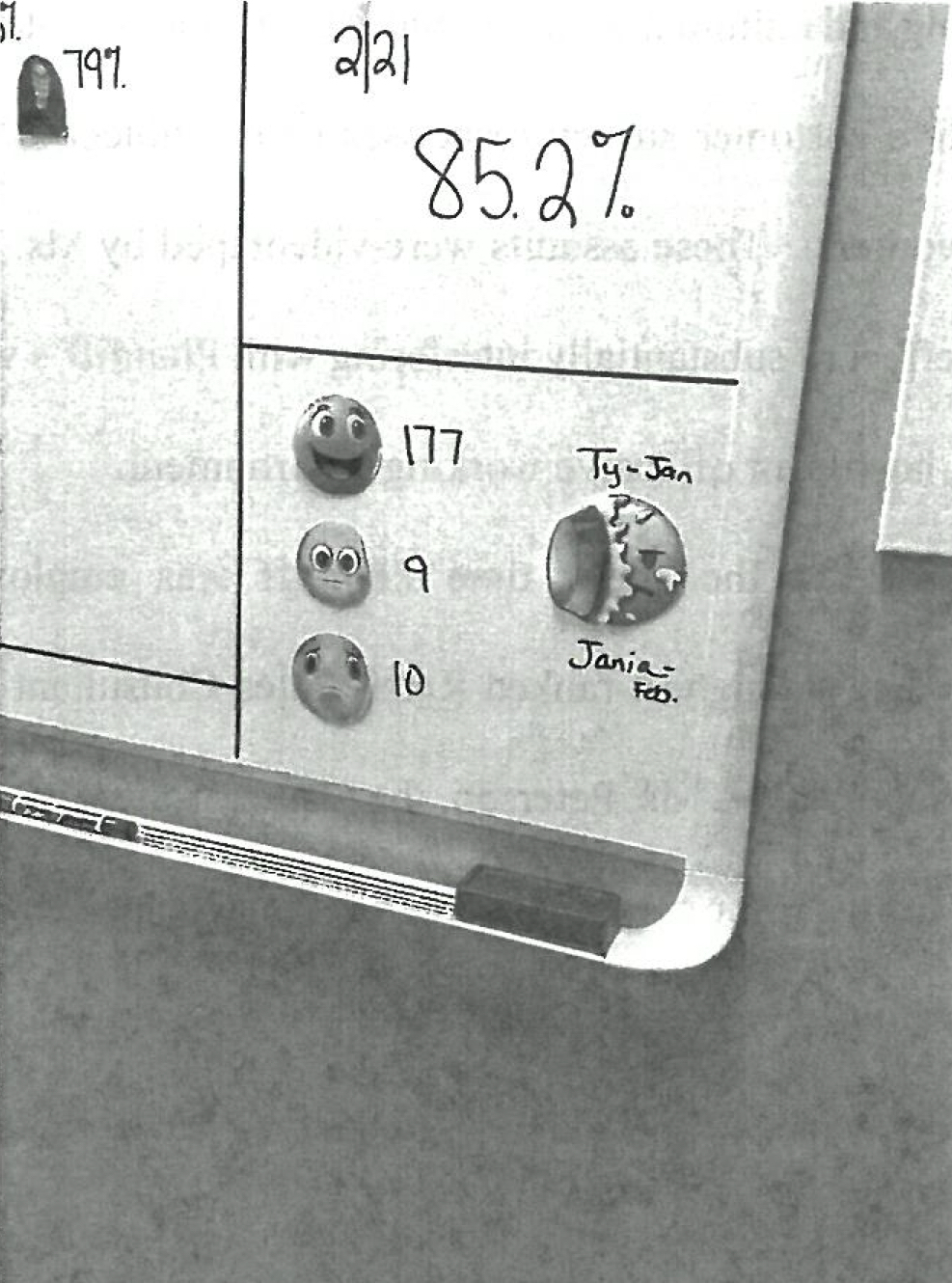
Peterson maintained a chart in the back office that ranked store sales staff and “identified the employees who either had been recently assaulted or were scheduled to be assaulted in this way,” the lawsuit said. The complaint includes a photo of what is said to be the chart, which includes people’s first names followed by a month and a “pie face” emoji.

A chart on a wall includes numbers and names along with several emojis, including one depicting a pie in the face.

Image from lawsuit against Comcast.

Image from lawsuit against Comcast.

“An objective, reasonable person in Plaintiff’s position would have felt compelled to resign his employment as a result of this work atmosphere that Defendant—through its employees, servants, agents—created,” the lawsuit said. “As a result of the pervasive, repeated, and ongoing threats of violence—and actual violence inflicted on co-workers not meeting sales goals—Plaintiff resigned his position with Defendant, resulting in his constructive discharge from Defendant’s employment.”

“Assaults were videotaped”

As the case moves forward, the court could be shown video evidence of alleged pie assaults. The lawsuit claims the “assaults were videotaped by Ms. Peterson,” that she “ordered her staff to participate in these assaults and to video them,” and that Figueroa himself “witnessed and videotaped a co-worker, Ty, being tied-up and assaulted by a co-worker in the backroom of the Comcast Store.”

“Ms. Peterson ordered, was present for, and videotaped this assault, as did the Plaintiff and other co-workers,” the lawsuit said. “The co-worker who struck Ty in the face while Ty was tied-up had better sales results than Ty and, therefore, Ms. Peterson ordered him to assault his poorer performing co-worker, in front of his peers.”

The lawsuit alleges that in another incident, an assistant sales manager named Jania was assaulted with a pie because she “received a poor survey score from a customer. The Plaintiff viewed a video of Jania being assaulted on a co-worker’s phone.”

Figueroa’s lawsuit said that on February 27, he called Comcast regional manager Maranda Cody to inform her about the pie assaults and tell her that he did not feel comfortable continuing to work at the store. Cody instructed Figueroa to send her a text message memorializing his concerns and reasons for wanting to resign, the lawsuit said. Figueroa said he did not receive a response to the text message or his complaints, and went ahead with his resignation.

Comcast’s cable division has been trying to reverse customer losses over the past year by offering a five-year price guarantee and plans without data caps. The changes came after Comcast President Mike Cavanagh said in April 2025 that “we are not winning in the marketplace.”

Russia charges Telegram founder Durov with facilitating terrorism

0
russia-charges-telegram-founder-durov-with-facilitating-terrorism
Russia charges Telegram founder Durov with facilitating terrorism


Russia has charged Telegram founder Pavel Durov with facilitating terrorism, alleging the messaging platform was used by Ukrainian intelligence services to recruit operatives and coordinate acts of sabotage inside Russia.

The FSB claimed Telegram failed to remove channels, chats and bots linked to the activity and has issued an international arrest warrant for the Russian-born entrepreneur, who lives abroad and holds French and UAE citizenship.

Durov, who left Russia in 2014 after refusing government demands to shut down opposition groups on his previous platform VKontakte, has previously accused Moscow of trying to restrict access to Telegram. The company responded to the charges by posting an image of Durov raising his middle finger on X.

via BBC

It’s official: Data centers are slowing America’s shift away from coal

0
it’s-official:-data-centers-are-slowing-america’s-shift-away-from-coal
It’s official: Data centers are slowing America’s shift away from coal

As tech companies have built hundreds of hyperscale data centers to power the artificial intelligence boom, they have triggered conflicting predictions over how these facilities will affect the nation’s power grid. Critics have argued that data centers will raise power bills and increase carbon emissions. Supporters claimed they could increase investment in infrastructure and clean energy, leading to lower prices and emissions.

We now have a clearer picture about at least one consequence of the data center boom, and it isn’t encouraging. A report released last week from the Energy Information Administration found that carbon emissions from the U.S. power sector rose by 4 percent last year — larger than the increase in the economy overall, where emissions only ticked up 2 percent.  The agency attributes this rise to a 13 percent increase in coal power generation, partially driven by the proliferation of large-scale data centers.

The national increase in power sector emissions represents the reversal of a longstanding trend. Before the AI boom, U.S. power consumption had been flat for decades. Utilities, grid operators, and energy planners had assumed that pattern would continue, and many planned to retire their older and dirtier coal plants with the expectation that natural gas and renewables could replace them. Instead, electricity demand is rising much faster than anticipated. Data centers could make up more than 10 percent of U.S. electricity usage by 2030, and they operate around the clock, including when wind and solar farm output is low. That demand has extended the life of some aging coal plants.

“Commercial load is starting to grow, and that’s part of the data center story,” said Steve Piper, the director of energy research at S&P Global Energy, a market intelligence firm. “It’s kind of a rising tide lifts all boats phenomenon. While we think structurally coal will decline over time, [the AI boom] is going to slow down that decline.”

The increase in power sector emissions would have been even bigger were it not for the fact that solar and wind energy also surged last year. Utilities can now tap cheap, carbon-free energy during much of the day, which means they are less reliant on fossil fuel-burning plants that make up the backbone of the energy system. Solar now produces more power than coal during sunny months when demand is low. The climate problem is that while solar is still growing, coal is not shrinking. 

The other driving factor behind last year’s increase was that coal became cheaper relative to natural gas, the country’s largest power source. As natural gas exports have increased, domestic gas prices have risen relative to coal.

The coal industry has also been buoyed by increased political support. President Donald Trump and Energy Secretary Chris Wright have vowed to revive the nation’s moribund coal industry by supporting new coal power plants and helping build an export terminal that can ship coal to Asia. Wright has issued temporary emergency orders to prevent the retirement of at least half a dozen coal plants around the country, forcing utilities to run plants they had previously sought to shut down. His department has argued that these orders are justified because hot and cold weather are straining the power grid.

But these orders aren’t actually the reason that coal emissions have rebounded. The plants that Wright has kept open are running at a lower capacity than they did before Trump took office, in large part because there are still cheaper sources of power than coal out there. 

Take for example the J.H. Campbell coal plant in Michigan, owned by Consumers Energy. It was the first major coal facility that Wright prevented from closing. At the time, Wright said that the plant’s operation was necessary so that Michigan “[did] not lose critical power generation capability as summer begins.” Yet in each of the last three quarters, the plant has generated less electricity than it did in the equivalent quarter the previous year.  

Instead, the increase is happening across the country. Outside of the Western U.S., nearly every state generated more coal power in 2025 than it did in 2024. One of the biggest jumps came in Virginia, home to the world’s largest AI cluster, where utilities almost doubled their coal power generation to serve the state’s growing clusters of data centers. Nearby coal states like Pennsylvania and West Virginia also stepped up their generation to match data center demand. 

The report is especially concerning since decarbonizing the electricity sector, which accounts for about 25 percent of U.S. emissions, is an essential step toward meeting national climate targets. Unlike in the transportation sector, where electric vehicles still face significant cost and infrastructure barriers, and heavy industry, in which natural gas is still needed to make steel and cement at scale, the power sector has real cost-effective alternatives to fossil fuels.

Once electricity became cleaner, switching cars, home heating, and other sectors from fossil fuels to electricity would sharply reduce emissions.  

And there were signs of progress: Emissions from the power grid have fallen by about one-third from their peak around 2005 as utilities have replaced old coal plants with less carbon-intensive methods such as natural gas turbines, which emit about half as much carbon per watt of electricity. The rapid build-out of solar and wind power was supposed to reduce power emissions even further. 

The stubborn presence of coal is a problem for that progress.

“Coal generation may sort of have a floor in our forecasts,” said Piper. He said he expects that in the long run, coal will continue to decline, but that “it will take something else” to dislodge it from the power grid altogether. And until we have a grid with enough round-the-clock power to render the dirtiest fuels unnecessary, the nation’s journey away from fossil fuels will be stuck at the starting gate.  


Syrian Authorities Arrest 7 in Alleged ISIS Cell Targeting Aleppo 

0
syrian-authorities-arrest-7 in-alleged-isis-cell-targeting-aleppo 
Syrian Authorities Arrest 7 in Alleged ISIS Cell Targeting Aleppo 


[DAMASCUS] Syria’s Interior Ministry announced the arrest of seven people it said were affiliated with the Islamic State (ISIS) during a joint security operation targeting two cells in Aleppo city and the towns of Azaz and Al-Bab in the province’s countryside. 

The ministry said on its official social media accounts that the Internal Security Forces carried out the operation in coordination with the General Intelligence Service, following surveillance that identified the cells’ locations and tracked their members’ movements. 

Syrian Internal Security Forces take part in a joint operation with the General Intelligence Service targeting suspected ISIS cells in Aleppo and its countryside, July 29, 2026. (Courtesy: Syrian Interior Ministry Media Office)

According to the ministry, the two cells were planning attacks against government facilities in Aleppo city and its countryside. Authorities did not disclose which facilities were targeted or when the alleged attacks were expected to take place. They also did not release the names of those detained or details of their alleged roles within the organization. 

A source in the Interior Ministry told The Media Line that forces taking part in the operation seized explosives, improvised explosive devices, and several weapons from warehouses belonging to the cells during raids on locations that authorities said ISIS had been using in Aleppo city and Al-Bab.The source, who requested anonymity for security reasons, said the seized materials also included explosive vests, ammunition, and other items linked to the activities of the detained cells. 

Photographs released by the authorities showed the seven detainees, along with weapons, explosive devices, and other materials that the ministry said were confiscated during the operation. 

The ministry did not say whether the raids were conducted simultaneously at the targeted locations or whether they resulted in clashes or casualties. Authorities have also not announced whether the detainees have been referred to judicial authorities or formally charged. 

This operation was part of the Interior Ministry’s continuing efforts to pursue sleeper cells and individuals linked to armed organizations and to prevent attacks against government institutions or civilians, the source said. 

Weapons, ammunition, and equipment that Syria’s Interior Ministry said were seized from warehouses linked to ISIS cells during an operation in Aleppo and its countryside, July 29, 2026.Courtesy: Syrian Interior Ministry Media Office)

Azaz and Al-Bab are located in the northern Aleppo countryside, while Aleppo city is one of Syria’s largest population and economic centers. The operation covered several locations across the city and surrounding areas, reflecting the geographical scope of the activities being monitored by the authorities. 

The Internal Security Forces and General Intelligence Service have previously announced joint operations against cells accused of links to ISIS. Authorities said those operations helped disrupt plots the organization had been preparing to carry out. 

The latest operation highlights the continuing security challenge posed by scattered ISIS cells despite the organization’s loss of territorial control, as Syrian authorities seek to strengthen security and prevent the group from rebuilding its presence in urban and rural areas. 

Donald Trump and Wars of Choice

0
donald-trump-and-wars-of-choice
Donald Trump and Wars of Choice


The Me, Me, Me Presidency

There’s no I in war. But there is in Iran. And in Iraq, too. Both these wars were about ME — that is, the Middle East. It’s a region rife with supposed American security interests, but this wordplay points to another very all-too-real dynamic: These wars are as much about the “I” and “ME” of the White House as they are about the countries we attack. Or to put it another way: It’s the presidential psyche, stupid.

Way back in 2002, then-President George W. Bush warned that Iraq, Iran, and outlier North Korea comprised a grave threat. “States like these, and their terrorist allies, constitute an axis of evil, arming to threaten the peace of the world,” he warned. “By seeking weapons of mass destruction, these regimes pose a grave and growing danger.” North Korea built a nuclear arsenal, and with it, purchased a guarantee of security. The other two countries produced no nukes, and the story has been radically different.

The U.S. invaded Iraq in March 2003. Two months later, the war was won. Except it wasn’t. Despite President George W. Bush’s unforgettable May 1, 2003, “mission accomplished” moment when, from the deck of an aircraft carrier off the coast of San Diego, he declared “major combat operations in Iraq … ended,” the American war there somehow never actually stopped. An insurgency was raging, U.S. bases were being mortared, and American officials feared a civil war between the country’s formerly reigning Sunni minority and its rising Shiite majority was brewing. It became a forever war that lived up to the moniker. Last week, almost a quarter century since Bush made the case for war in Iraq, a U.S. soldier was killed in an Iranian attack on an American base there.

President Donald Trump was elected on a promise to say goodbye to all that. American-style wars of choice were going to be a thing of the past: “I will not send you to fight and die in stupid foreign wars that never end.” And yet Trump’s America is now deeply involved in a seemingly ever-escalating and never-ending conflict with — yes! — Iraq’s neighbor, Iran.

No one, I suspect, not even Trump, has the faintest idea why he did this, though maybe he felt left out of the club of forever-war makers, co-chaired by Russian President Vladimir Putin and Israeli Prime Minister Benjamin Netanyahu. Maybe he just sensed that he had to give this country a shot at being globally competitive when it came to making endless (and endlessly unsuccessful) war, if the U.S. was to remain the superpower on this planet.

Not everyone thinks, however, that you need to fight ruinous wars to be a superpower. There’s China, which is the quietest rising power in recent history because — except for a few border flare-ups with India early in this decade, and saber-rattling when it comes to Taiwan, the island nation off the coast of the mainland — it hasn’t been at war since 1979.

In lieu of pursuing fruitless conflicts around the world, it’s been silently leading the global production of green energy technology. China’s exports of green tech shot up by more than a third in the first six months of the year. This included a reported rise in shipments of lithium batteries and wind turbines by 38 percent and 36 percent, respectively. “In the first half of this year, the situation in the Middle East was tense and global supply of chemical products was tight,” Wang Jun, deputy director of China’s General Administration of Customs said at a recent press briefing. “China, with its complete industrial system and full-chain supporting capabilities, quickly seized the sudden external demands.”

And this Chinese green technology boom was in full swing even before Iran’s Houthi allies in Yemen declared a maritime embargo against Saudi Arabia and began attacking the kingdom’s oil ships in the Bab el-Mandeb Strait, briefly driving the price of oil back above $100 per barrel, about 40 percent higher than before the conflict began.

As his war with Iran has gone off the rails, Trump has begun redefining the conflict from a war to “a little excursion,” which just kept going on and on, leading him in March to sum things up this way: “We’ve already won in many ways, but we haven’t won enough. We go forward more determined than ever to achieve ultimate victory that will end this long running danger once and for all.”

You’ll recall that Trump also said on March 2 that the war was set to last “four to five weeks.” And three days later, that the U.S. and Israel continued “to totally demolish the enemy far ahead of schedule.” By March 9, Trump said that the conflict was “very complete, pretty much.” And two days later, the president declared victory. “Let me tell you, we’ve won. You know, you never like to say too early you won,” Trump announced at a rally in Kentucky. “We won.”

Like Bush’s “mission accomplished” moment, Trump’s was also decidedly short-lived. On March 15, the president said Iran still had “a little bit of fight back, but not much.” In a Truth Social post five days later, he wrote: “We are getting very close to meeting our objectives as we consider winding down” the war. On April 1, Trump announced the U.S. was “on track to complete all of America’s military objectives shortly” and on the 6th said the war “could end very quickly.” But it didn’t. “The war in Iran is going along swimmingly,” he declared on April 16. And in a May 1 letter to Congress, Trump said: “The hostilities that began on February 28, 2026, have terminated.” Except Iran never got the memo.

As the war has simply gone on and on, Trump has continued to tweak his terminology and rebrand the conflict with Iran as “a skirmish.” (Tell that, of course, to all the dead Iranian children!) Here’s how he put it, in fact, on July 22: “I call it a skirmish. This is, with this skirmish we have with the Islamic Republic of Iran, and I call it that, because, let me tell you, they’re getting hit so hard and they want to make a deal. But I say they’re not ready to make a deal.” And if the Iran war doesn’t end in the coming weeks, Trump will undoubtedly have to tweak terminology further, perhaps relabeling his skirmish with Iran a tussle, a scuffle, or even a full-scale kerfuffle.

As Trump insists the war is a minor engagement, he continues to dish out immense amounts of pain on Iranians and threatens even worse. He seems increasingly eager to blast civilian infrastructure and smash Iran into submission. As he put it all too bluntly when it came to those civilian targets: “Any time the Islamic Republic of Iran shoots at a ship in the Strait of Hormuz, whether it be by missile, rocket, drone, or any other device or weapon, the United States will bomb and destroy one bridge or power plant.” And he’s also been threatening to launch “a massive attack. Bigger than ever before.”

His Secretary of War Pete Hegseth certainly understands the president, or why would he start insisting on checking the testosterone levels of American troops and begin referring to what, in the Trump years, had already gone from the Department of Defense to the Department of War as “the High-T Department of War”?

But while Hegseth is hoping to amp up the military’s potency, Americans want to bring the Iran war to a close. Only 29 percent of Americans approve of the way Trump is handling the Iran war, according to a recent Washington Post poll. Even a Fox News survey (yes, Fox News!) found disapproval ratings hit a record high in July, with 56 percent of Americans opposing U.S. military action against Iran, including 40 percent who “strongly” oppose it. Nearly two-thirds of respondents now think the conflict will last at least a year.

Even worse was a recent CBS News/YouGov poll that found 21 percent of Americans think the conflict will last multiple years! That same poll found that 67 percent of respondents say the U.S. should end the war with Iran now. Young people are the most fed up, with 83 percent urging the president to stop the war posthaste.

And even among his most fervent followers, support had already dropped by 13 percent over the previous two months, according to a Politico poll, while almost 1 of every 5 MAGA voters had come to believe that the U.S. should end its war in Iran, no matter the cost or results.

Of course, Trump doesn’t really care about young voters or Republican voters or even MAGA devotees. As he put it last week: “A poll just came out: Americans don’t want high gasoline prices, but they’re not against the war.” His war in the ME is wrapped up in his egocentric narcissism and his me, me, me world. The phrase “wars of choice” now means wars of Donald’s choice. But the Iranian government has a say in the matter and has made a choice to hold out amid renewed threats and attacks. And despite what Trump seems to think, the public in the U.S. can make choices, too. If Trump keeps on fighting in Iran, he may sooner or later also find himself in a distinct “skirmish” with the American people.

Watching American power tentatively arrive in the Philippines

0
watching-american-power-tentatively-arrive-in-the-philippines
Watching American power tentatively arrive in the Philippines

OYSTER BAY, PALAWAN – When American forces withdrew from Iraq in 2011, I watched it happen from Kuwait, where I worked as a contracted security guard. The last convoy crossed the berm that December — roughly 100 vehicles — and with it went the war in which I had served.

Two years later, at a joint Department of Defense intelligence facility in Germany, I watched pieces of the old Cold War-era footprint being dismantled and shipped home. I have spent much of my adult life watching American power leave places abroad.

Last week, from a hilltop above Oyster Bay on the Philippine island of Palawan, I watched it arrive. It did not arrive the way it left Iraq. What I looked down on was a Philippine Navy detachment on the western coast of Palawan, facing the South China Sea — one of the places where boats resupplying the Sierra Madre stage their runs.

A Philippine Coast Guard vessel, the BRP Malapascua, sat in the bay — the ship I was told had carried home the men wounded at the shoal last week, when a Chinese coast guardsman struck a Filipino marine in the head with a wooden baton.

The Malapascua knows the place. In 2023, near that same shoal, a Chinese cutter targeted the ship with a military-grade laser that temporarily blinded crew members on her bridge.

The newest American investment on the shore beyond her is almost comically modest: a $975,000 contract for a boat repair facility with a portable gantry crane and improvements to an existing launch. It sits beside a pier the Philippines built itself, sized for the Philippine Navy’s landing vessels.

Elsewhere on the base, a small American unit called Task Force Ayungin advises and trains Philippine forces conducting operations in the contested waters. A 2026 buildup looks like this: a repair bay and a solicitation notice.

Standing on that hill, I asked myself two questions. If China invades Taiwan, will Taiwan share the fate of Ukraine, a country in whose armed forces I served as a drone operator? And are the United States and its allies building something here to credibly counter China in the South China Sea?

I cannot answer the first question. The second one has an answer, and it is written in concrete across this archipelago. Start with the geography. Under the Enhanced Defense Cooperation Agreement, American forces now hold rotational access to nine Philippine military sites. Five of them date to 2016.

Four were added in 2023, and the map explains them better than any communique does. Three of the new sites cluster in northern Luzon, facing the Luzon Strait and Taiwan beyond it.

The fourth is Balabac, at the southern tip of Palawan, facing the Spratly Islands, where Manila is building a three-kilometer runway and American money is following with barracks, warehouses and support infrastructure.

The funding has compounded across separate accounts: more than $82 million committed to the original sites by early 2023, another $128 million requested for EDCA construction in the following budget, and a separate $500 million foreign military financing package announced in July 2024 to modernize the Philippine armed forces and coast guard.

Fuel farms, aprons, warehouses, command centers. Much of the infrastructure is described in the language of disaster response. Fuel does not care what you call it.

Then the missiles. In April 2024, the US Army flew its Typhon launcher to northern Luzon for an exercise. It never went home. The Typhon system fires Tomahawks, giving it sufficient nominal range to reach portions of China’s coast from northern Luzon.

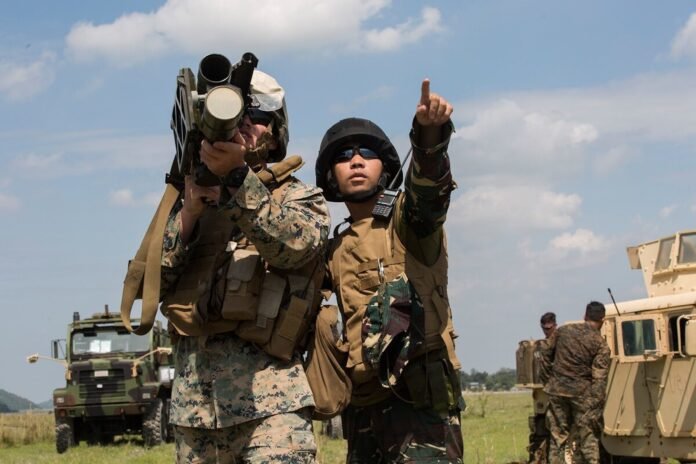
The Marines followed with NMESIS, an unmanned launcher carrying Naval Strike Missiles. It was brought to Batanes for exercises last year and to Calayan this June — islands closer to Taiwan than to Manila.

By Manila’s own account, the system remained in the country after last spring’s drills so Philippine Marines could train on it. The word for all of this is rotational. And the word is doing a lot of work.

The Philippines is arming in parallel. Indian-made BrahMos anti-ship batteries are positioned in Zambales, putting the contested Scarborough Shoal within the system’s reported range. New frigates are arriving from Korean shipyards.

And in July, Philippine Defense Secretary Gilberto Teodoro called the acquisition of five retired Abukuma-class destroyer escorts a done deal — one of the largest transfers of retired combatants Japan has ever made to a foreign navy. A decade ago, that sentence would have been unthinkable.

Japan is the other anchor, and its shift runs deepest. Tokyo is driving defense spending toward 2% of GDP, has ordered 400 Tomahawks and, in March, placed its first upgraded, long-range Type 12 missiles on Kyushu, within reach of portions of the Chinese mainland.

Its southwest islands are being garrisoned one by one, radars and launchers working down the Ryukyus toward Taiwan.

In November, Prime Minister Sanae Takaichi told parliament that a Chinese attack on Taiwan could constitute a situation threatening Japan’s survival — the legal classification that could permit her forces to exercise collective self-defense. No sitting prime minister had ever stated it so plainly. Beijing answered with diplomatic threats, economic pressure and increased maritime activity.

She did not retract it. And a reciprocal access agreement, in force since last September, now lets Japanese and Philippine forces train on each other’s soil. The spokes of the American alliance system are lashing themselves to each other, no longer only to the hub.

So the answer to my second question is yes. This is earnest. It is the most serious military architecture assembled in the Western Pacific since the Cold War. I once guarded that war’s leftovers in Germany.

But earnest and decisive are different words, and the view from that hilltop showed me the distance between them. The wounded in that bay were struck at Second Thomas Shoal on July 20.

On July 23 and July 24, Chinese ships blasted Philippine fisheries vessels with water cannons at Scarborough Shoal, where Chinese coast guard patrols logged 933 ship-days in the first half of this year — nearly matching their total for all of 2025.

All of it happened inside the reach of missiles that will never fire at a water cannon. The alliance is building for the war above a threshold while losing the contest below it, one baton blow at a time.

And the structure has a hollow center. The Philippines holds a mutual defense treaty with Washington dating to 1951. Japan holds one from 1960. Taiwan, the island every runway and launcher out here silently references, holds nothing. No treaty obliges the United States to defend it.

A 1979 law requires Washington to arm the island and maintain the capacity to resist coercion, while deliberately leaving the decision to intervene unresolved. The chain is strongest at its ends and empty in the middle, and everyone building it knows.

In Kuwait, I watched an army leave a war it had chosen. Above Oyster Bay, I watched the slow assembly of a war no one has chosen yet. The steel is going in; the will remains on order.

Whether that is deterrence or a schedule is the question the whole structure exists to avoid answering. And from a hilltop in Palawan, looking down at a boat shed rising beside a contested sea, you can feel the region waiting on the answer, too.

Benjamin Stuart Reed served in Iraq with the US Army, worked as a security contractor in Afghanistan and the Gulf, and flew drones with the Armed Forces of Ukraine in the first year of the war. He travels and writes across Asia and is finishing a memoir, “War Tourist.” He wrote this from Palawan.

0FansLike
0FollowersFollow
0FollowersFollow
0SubscribersSubscribe
- Advertisement -
Google search engine

Recent Posts