OYSTER BAY, PALAWAN – When American forces withdrew from Iraq in 2011, I watched it happen from Kuwait, where I worked as a contracted security guard. The last convoy crossed the berm that December — roughly 100 vehicles — and with it went the war in which I had served.
Two years later, at a joint Department of Defense intelligence facility in Germany, I watched pieces of the old Cold War-era footprint being dismantled and shipped home. I have spent much of my adult life watching American power leave places abroad.
Last week, from a hilltop above Oyster Bay on the Philippine island of Palawan, I watched it arrive. It did not arrive the way it left Iraq. What I looked down on was a Philippine Navy detachment on the western coast of Palawan, facing the South China Sea — one of the places where boats resupplying the Sierra Madre stage their runs.
A Philippine Coast Guard vessel, the BRP Malapascua, sat in the bay — the ship I was told had carried home the men wounded at the shoal last week, when a Chinese coast guardsman struck a Filipino marine in the head with a wooden baton.
The Malapascua knows the place. In 2023, near that same shoal, a Chinese cutter targeted the ship with a military-grade laser that temporarily blinded crew members on her bridge.
The newest American investment on the shore beyond her is almost comically modest: a $975,000 contract for a boat repair facility with a portable gantry crane and improvements to an existing launch. It sits beside a pier the Philippines built itself, sized for the Philippine Navy’s landing vessels.
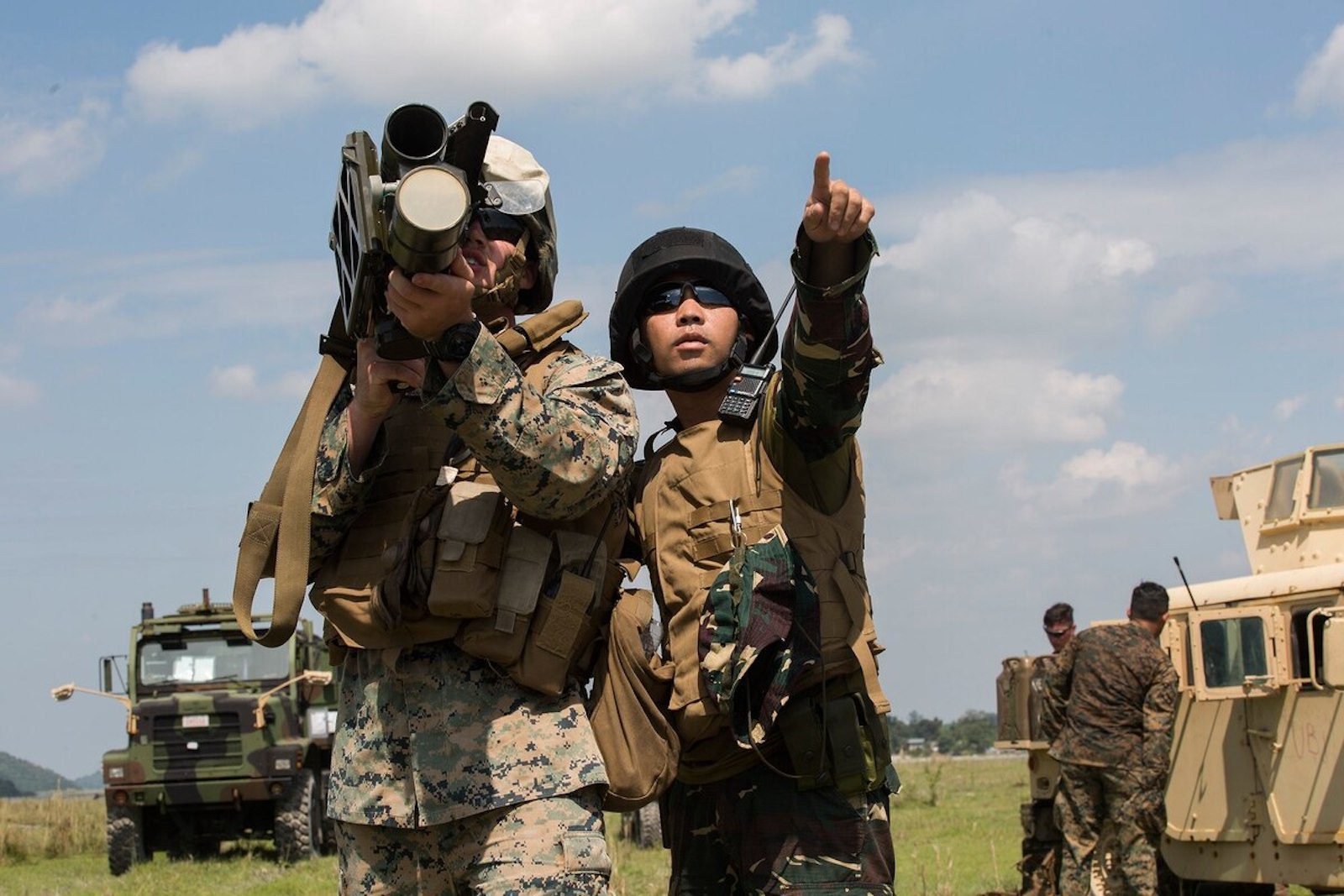
Elsewhere on the base, a small American unit called Task Force Ayungin advises and trains Philippine forces conducting operations in the contested waters. A 2026 buildup looks like this: a repair bay and a solicitation notice.
Standing on that hill, I asked myself two questions. If China invades Taiwan, will Taiwan share the fate of Ukraine, a country in whose armed forces I served as a drone operator? And are the United States and its allies building something here to credibly counter China in the South China Sea?
I cannot answer the first question. The second one has an answer, and it is written in concrete across this archipelago. Start with the geography. Under the Enhanced Defense Cooperation Agreement, American forces now hold rotational access to nine Philippine military sites. Five of them date to 2016.
Four were added in 2023, and the map explains them better than any communique does. Three of the new sites cluster in northern Luzon, facing the Luzon Strait and Taiwan beyond it.
The fourth is Balabac, at the southern tip of Palawan, facing the Spratly Islands, where Manila is building a three-kilometer runway and American money is following with barracks, warehouses and support infrastructure.
The funding has compounded across separate accounts: more than $82 million committed to the original sites by early 2023, another $128 million requested for EDCA construction in the following budget, and a separate $500 million foreign military financing package announced in July 2024 to modernize the Philippine armed forces and coast guard.
Fuel farms, aprons, warehouses, command centers. Much of the infrastructure is described in the language of disaster response. Fuel does not care what you call it.
Then the missiles. In April 2024, the US Army flew its Typhon launcher to northern Luzon for an exercise. It never went home. The Typhon system fires Tomahawks, giving it sufficient nominal range to reach portions of China’s coast from northern Luzon.
The Marines followed with NMESIS, an unmanned launcher carrying Naval Strike Missiles. It was brought to Batanes for exercises last year and to Calayan this June — islands closer to Taiwan than to Manila.
By Manila’s own account, the system remained in the country after last spring’s drills so Philippine Marines could train on it. The word for all of this is rotational. And the word is doing a lot of work.
The Philippines is arming in parallel. Indian-made BrahMos anti-ship batteries are positioned in Zambales, putting the contested Scarborough Shoal within the system’s reported range. New frigates are arriving from Korean shipyards.
And in July, Philippine Defense Secretary Gilberto Teodoro called the acquisition of five retired Abukuma-class destroyer escorts a done deal — one of the largest transfers of retired combatants Japan has ever made to a foreign navy. A decade ago, that sentence would have been unthinkable.
Japan is the other anchor, and its shift runs deepest. Tokyo is driving defense spending toward 2% of GDP, has ordered 400 Tomahawks and, in March, placed its first upgraded, long-range Type 12 missiles on Kyushu, within reach of portions of the Chinese mainland.
Its southwest islands are being garrisoned one by one, radars and launchers working down the Ryukyus toward Taiwan.
In November, Prime Minister Sanae Takaichi told parliament that a Chinese attack on Taiwan could constitute a situation threatening Japan’s survival — the legal classification that could permit her forces to exercise collective self-defense. No sitting prime minister had ever stated it so plainly. Beijing answered with diplomatic threats, economic pressure and increased maritime activity.
She did not retract it. And a reciprocal access agreement, in force since last September, now lets Japanese and Philippine forces train on each other’s soil. The spokes of the American alliance system are lashing themselves to each other, no longer only to the hub.
So the answer to my second question is yes. This is earnest. It is the most serious military architecture assembled in the Western Pacific since the Cold War. I once guarded that war’s leftovers in Germany.
But earnest and decisive are different words, and the view from that hilltop showed me the distance between them. The wounded in that bay were struck at Second Thomas Shoal on July 20.
On July 23 and July 24, Chinese ships blasted Philippine fisheries vessels with water cannons at Scarborough Shoal, where Chinese coast guard patrols logged 933 ship-days in the first half of this year — nearly matching their total for all of 2025.
All of it happened inside the reach of missiles that will never fire at a water cannon. The alliance is building for the war above a threshold while losing the contest below it, one baton blow at a time.
And the structure has a hollow center. The Philippines holds a mutual defense treaty with Washington dating to 1951. Japan holds one from 1960. Taiwan, the island every runway and launcher out here silently references, holds nothing. No treaty obliges the United States to defend it.
A 1979 law requires Washington to arm the island and maintain the capacity to resist coercion, while deliberately leaving the decision to intervene unresolved. The chain is strongest at its ends and empty in the middle, and everyone building it knows.
In Kuwait, I watched an army leave a war it had chosen. Above Oyster Bay, I watched the slow assembly of a war no one has chosen yet. The steel is going in; the will remains on order.
Whether that is deterrence or a schedule is the question the whole structure exists to avoid answering. And from a hilltop in Palawan, looking down at a boat shed rising beside a contested sea, you can feel the region waiting on the answer, too.
Benjamin Stuart Reed served in Iraq with the US Army, worked as a security contractor in Afghanistan and the Gulf, and flew drones with the Armed Forces of Ukraine in the first year of the war. He travels and writes across Asia and is finishing a memoir, “War Tourist.” He wrote this from Palawan.