AI race loss fears behind Trump’s planned September hosting of Xi
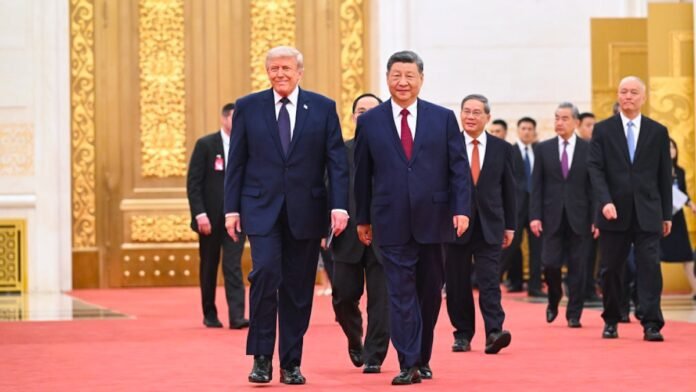
Managing the risks of frontier artificial intelligence (AI) models and protecting intellectual property are set to top the agenda when United States President Donald Trump hosts Chinese President Xi Jinping in Washington on September 24.
Chinese state media and commentators say the Trump administration called for the AI summit because it fears Beijing is gaining the upper hand in the global AI race, particularly after China forged AI partnerships with 28 nations, mainly from the Global South, at the 2026 World Artificial Intelligence Conference (WAIC) in Shanghai on July 17.
They say Washington will further tighten its controls on AI development in China, but the Chinese consensus is that more curbs will only push Chinese firms to advance their self-sufficiency and build an AI ecosystem.
Reuters first reported the planned AI dialogue on July 21, saying that the discussions would be the first official US-China AI dialogue under Trump, led on the American side by Treasury Secretary Scott Bessent.
Both nations will discuss how to regulate powerful AI models that could reshape military power, enable cyberattacks on critical infrastructure and upend labor markets.
On July 23, Trump confirmed the report, saying the two leaders had already discussed AI during his trip to Beijing in May.
“President Xi is coming over on September 24,” Trump said. “We talked about it when I was over in Beijing, and we’ll be talking about it again.”
Trump called AI “probably the biggest thing anybody’s ever seen” and warned that the nation dominating the technology would hold the ultimate advantage.
“Whoever wins that race is probably going to win,” he said.
Washington’s push to engage China on AI comes against the backdrop of a surge in competitive Chinese models. Firms including DeepSeek, Zhipu AI and Moonshot AI have this year released a string of low-cost, high-performance models capable of matching OpenAI’s ChatGPT and Anthropic’s Claude on key benchmarks.
These Chinese firms are alleged to have trained their models partly by distilling knowledge from Western AI systems, a process akin to a student learning by studying a brilliant teacher’s answers and reasoning patterns, rather than building knowledge from scratch. This allows them to avoid using expensive AI chips and achieve comparable results at a fraction of the cost,
They have also applied two efficiency techniques: mixture of experts (MoE) and sparse attention. MoE automatically routes each query to only the most relevant cluster of specialists within a model, rather than activating the entire system. Sparse attention, meanwhile, allows the model to focus only on the most relevant portions of a text, reducing computing demands without sacrificing accuracy.
Global Times, a newspaper under the People’s Daily, said in a commentary on July 26 that China’s open-source AI models have grown powerful enough over the past two years to alarm America’s leading AI laboratories.
“Two years ago, names like Zhipu AI and Moonshot AI barely registered in the American tech press. Now their models are going toe-to-toe with those from Anthropic and OpenAI,” the commentary said. “The United States’ panic makes sense.”
The commentary said that, in the broader US-China relationship, Washington no longer expects to knock China out in one blow but tries to stretch the timeline, holding on to its window of advantage for as long as possible.
“The failure to eliminate China doesn’t mean the contest is over. On the contrary, as knocking China out becomes less feasible, the AI race between the US and China simply shifts to more specific and hard-fought fronts,” it said. “As long as China stays true to a development path suited to its own realities, it will earn the standing it deserves in shaping AI’s norms, rules and standards of access.”
China’s realities
For many years, Chinese state media avoided directly acknowledging what the Global Times commentary calls China’s “realities” in AI development, a phrase that has come to refer to the US sanctions and export controls that have constrained Chinese chipmakers and AI firms.
The US barred Dutch chipmaking equipment maker ASML from selling extreme ultraviolet (EUV) lithography machines to China in 2019, and extended the restrictions to cover high-end deep ultraviolet (DUV) lithography in October 2023. From October 2022, it also banned exports of high-end Nvidia graphics processing units (GPUs) to China.
These moves had pushed Chinese chipmakers to source second-hand mid-end DUV machines to produce AI chips, import Nvidia chips through smugglers and shell companies and train AI models in data centers in Southeast Asian countries.
However, as Washington kept tightening its controls, Chinese AI firms such as DeepSeek have pivoted to training models through distillation, drawing knowledge from Western AI systems at a fraction of the cost of building from scratch.
US Treasury Secretary Scott Bessent said on July 21 that the Trump administration is finding evidence that Chinese AI models were built on American ones. He emphasized that Washington does not condone intellectual property theft.
Zhu Min, a former deputy governor of the People’s Bank of China who spoke at a World Economic Forum panel in June, said China’s AI strategy rests on one priority above all: putting AI to work across its vast industrial economy, particularly in factories.
“China’s greatest advantage was never about building the largest model. It lies in having more use cases, more factories, more diverse industries and cost-conscious business owners,” Zhu said. “The real winners will not be the AI model makers but those doing deployment, integration and process restructuring. The vendors installing factory systems, connecting data pipelines, retraining workers and collecting annual fees will pocket more than anyone.”
Zhu singled out manufacturing as the sector where AI will penetrate deepest in China because the returns are most tangible. He said every percentage-point gain in factory yield translates directly into profit; every avoided production stoppage cuts losses; and every shortened delivery cycle increases turnover.
He said American capital tends to chase top-tier model companies, betting that a handful of firms will capture a vast market; Chinese investment, by contrast, is flowing toward the application and industrial layers, wagering on a vast universe of factories, orders and niche scenarios.
Chen Xia, a Shandong-based columnist, says it is unlikely that Washington and Beijing will reach any major agreement at the September AI talks.
“The most likely outcome is a handful of toothless risk management clauses. On the issues China truly cares about, including access to technology and the easing of export controls, the US will not compromise on any of them,” Chen says. “The US only wants to walk away with maximum political gain at minimum cost.”
He says Trump’s current overture toward China is a tactical maneuver ahead of the midterm elections in early November, when Republicans are fighting to hold on to their slim majorities in both the Senate and House of Representatives. Once the vote is over, he says, Washington’s underlying strategy of containing and suppressing China will become more obvious.
He adds that the US is using the talks to push through a set of global AI regulatory rules that serve its own interests, seeking to lock other nations into a position of permanent disadvantage; China, by contrast, only wants to use the dialogue to secure a fairer and more equitable voice in shaping global AI governance.
Europe’s cocaine crisis moves from ports to the open Atlantic as traffickers outpace authorities
European authorities are facing a growing challenge from drug traffickers shifting cocaine smuggling routes away from major ports and into the open Atlantic, where criminal networks are using advanced technology, speedboats and covert maritime operations to evade detection, according to the Financial Times.
The FT reported that Ireland’s navy, tasked with monitoring a vast area of the Atlantic, can currently deploy only a fraction of its fleet because of staffing shortages, maintenance issues and limited resources. A senior naval officer told the newspaper that authorities were effectively searching for “a needle in a haystack”, with Ireland requiring significantly more vessels to properly patrol its maritime area.
The pressure reflects a wider European surge in cocaine availability. Data from the EU drugs agency shows that street prices have fallen while purity levels have increased over the past decade, with cocaine becoming more accessible across different sections of society.
As security has tightened at major entry points such as the ports of Antwerp and Rotterdam, trafficking groups have adapted. Europol officials told the FT that criminals are increasingly using “mother ships” and smaller vessels to transfer drugs at sea, alongside encrypted communications, GPS spoofing and semi-submersible craft.
The United Nations has warned that Europe has become the world’s primary cocaine destination, with production in Latin America reaching record levels. Criminal networks in Colombia, Peru and Bolivia are exploiting global shipping routes, while Brazil has emerged as a major transit point for cocaine heading towards Europe.
Despite record seizures, authorities estimate they intercept only a small share of total shipments. The Maritime Analysis and Operations Centre-Narcotics believes hundreds of tonnes of cocaine still reach Europe each year.
European governments have strengthened port controls, invested in scanning technology and improved intelligence sharing, but officials warn traffickers continue to adapt. Europol’s acting chief Jürgen Ebner described the situation as a “waterbed effect”, where pressure in one area simply pushes criminal activity elsewhere.
The FT reported that Ireland is also experiencing the domestic impact, with cocaine becoming the country’s biggest drug problem. Officials warned that without stronger maritime surveillance and international cooperation, Europe risks remaining one step behind increasingly sophisticated trafficking networks.
U.S. President Donald Trump has already shifted the sands of the agreement, adding a major caveat requiring Saudi Arabia to normalize relations with Israel first. He also posted that there would be “no enrichment.”
Allowing enrichment in any form would be a major step. Moreover, it would deviate from past experience. In 2009, the U.S. government signed a civilian nuclear cooperation agreement with the United Arab Emirates. Called a 123 agreement, it prohibited uranium enrichment and spent fuel reprocessing – both of which can produce fissile material for nuclear weapons – and is seen as the gold standard of such deals.
The nonproliferation implications of the new Saudi-U.S. deal are clear. Without limits on the kingdom’s nuclear wish list, Riyadh might gain access to key capabilities relevant to producing the fissile material needed for nuclear weapons.
That could spark a nuclear arms race in the region, notably with Riyadh’s traditional rival for influence, Iran. In addition, the UAE has the right to renegotiate its 123 agreement with the U.S. should any other state in the region reach an agreement with Washington on more favorable terms.
Saudi’s nuclear ambitions
For years, senior Saudi officials have expressed interest in developing the full front end of the nuclear fuel cycle – meaning it would have the capability to undertake the key stages of the process, from mining to power generation.
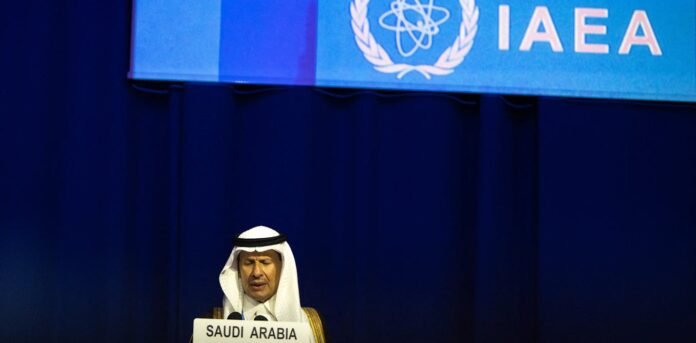
The deal announced last week began with detailed discussions between Saudis and the U.S. during the Biden administration. Then, in January 2023, Saudi Energy Minister Prince Abdulaziz bin Salman noted the kingdom’s interest in using a complete fuel cycle to develop nuclear fuel for two planned commercial power reactors.
The key steps in the front end of the fuel cycle are uranium mining and milling, uranium conversion, uranium enrichment and fuel fabrication. Uranium enriched to about 3% to 5% uranium-235 is used to make fuel for civilian nuclear reactors, although some reactors use fuel enriched up to just under 20%. But a country can use expertise from a civilian program to further enrich uranium to weapons grade levels of more than 90%.
As such, mastering all of the processes involved in the front end of the fuel cycle – especially enrichment – would provide Saudi Arabia with the technical and industrial capability to produce weapons-grade uranium if it chose to pursue nuclear weapons.
Proliferation risks
The risk of Saudi Arabia having such capabilities for commercial purposes is high, given the kingdom’s de facto leader Crown Prince Mohammed bin Salman’s public stance that Riyadh would acquire a nuclear weapon if Iran did.
Especially relevant would be Riyadh’s potential pursuit of a “latent” nuclear weapons capability, meaning that Saudi Arabia would develop relevant technology and expertise to be able to produce a weapon quickly if it made the political decision to do so. Most experts agree that Iran has long had such a latent capability, after it halted its full pursuit of nuclear weapons in 2003.
Were Saudi Arabia to desire a nuclear weapons program, a domestic capability to enrich uranium would be key. Mohamed ElBaradei, former director of the U.N. nuclear watchdog International Atomic Energy Agency, warned in a December 2006 statement on nuclear power that countries with these capabilities are “only a short step away from a nuclear weapons capability.”
To enrich or not
Prohibiting uranium enrichment in the Saudi deal would be the most direct way to prevent the Gulf kingdom from using civilian nuclear cooperation to learn the intricacies of uranium enrichment operations.
After all, producing low-enriched uranium accounts for much of the separative work needed to produce weapons-grade material. And enriching to the lower enrichment levels needed for reactor fuel can “significantly reduce the time a country requires to make a nuclear weapon,” according to Pierce Corden and David Hafemeister, former State Department arms control experts.
Yet, the day before Trump’s comments suggesting “no enrichment,” U.S. Energy Secretary Chris Wright said U.S. companies could build a “black box” enrichment facility in Saudi Arabia. In effect, that would mean a U.S.-owned and operated enrichment site without direct Saudi input.
The U.S. will reportedly use a study focused on the commercial viability of a Saudi enrichment capability to determine whether to proceed with such a facility.
Precedent exists for building and operating a black box uranium enrichment plant to protect uranium enrichment technology. The driving principle is that the supplier country builds and provides the sensitive uranium enrichment centrifuges, while the recipient receives knowledge related to plant operations.
In one example, the European nuclear services consortium URENCO supplied the centrifuge technology for the U.S. National Enrichment Facility uranium enrichment plant in New Mexico. According to the Congressional Research Service, URENCO installed the centrifuges, but personnel from the U.S. operating company were prohibited from viewing “any details of the sensitive equipment as it was being assembled and installed.”
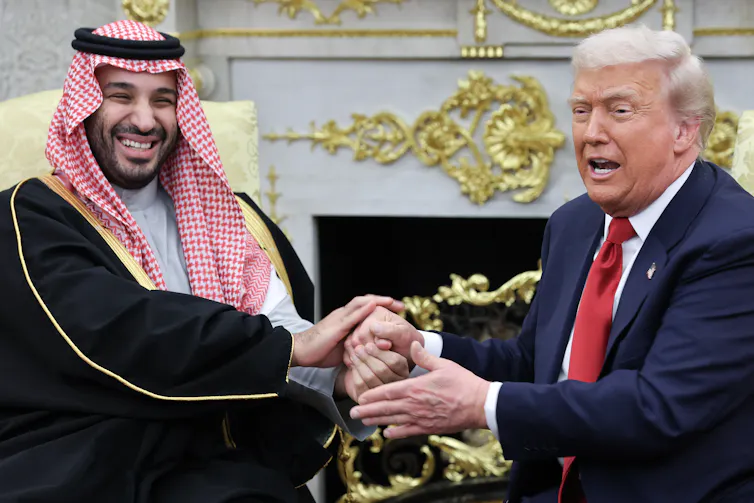
President Donald Trump and Crown Prince and Prime Minister Mohammed bin Salman meet on Nov. 18, 2025.Win McNamee/Getty Images
Limiting Saudi access to enrichment technology would make it more difficult for Saudi Arabia to acquire the technical expertise needed for domestic enrichment capability. It also reduces the risk of Saudi Arabia diverting low-enriched uranium from a civilian program and further enriching it to weapons-grade levels. But some experts have already said that maintaining a black box facility with no Saudi personnel or involvement over the long term is unrealistic.
Plutonium reprocessing
Saudi officials have not discussed plutonium reprocessing publicly. However, reports suggest that the new deal will allow Saudi Arabia to reprocess nuclear fuel.
Preventing material diversion in reprocessing plants is difficult due to many factors, including their size and complexity and the large amount of nuclear material processing occurring. According to the IAEA, these plants present a unique problem because “most of the equipment (is) inaccessible during operation.”
The IAEA emphasizes the need to build safeguards into these facilities, such as measurement, surveillance and verification systems.
The need for a watchdog
Reducing the proliferation risk of Saudi nuclear capabilities would require robust implementation of IAEA safeguards – that is, the accounting, inspection and monitoring systems implemented by the international nuclear watchdog. It would also mean Saudi Arabia abiding by the terms of the IAEA’s Additional Protocol, which allows for a set of more intrusive measures, including short-notice inspections of facilities.
The most effective way to reduce the proliferation risk of the deal is prohibiting indigenous Saudi uranium enrichment and plutonium reprocessing. Should the U.S. allow enrichment, implementing a black box facility and stringent IAEA safeguards would mitigate any risk of Riyadh gaining expertise for a future nuclear weapons program.
Iraq orders probe into reported drone attacks on Saudi Arabia from its territory
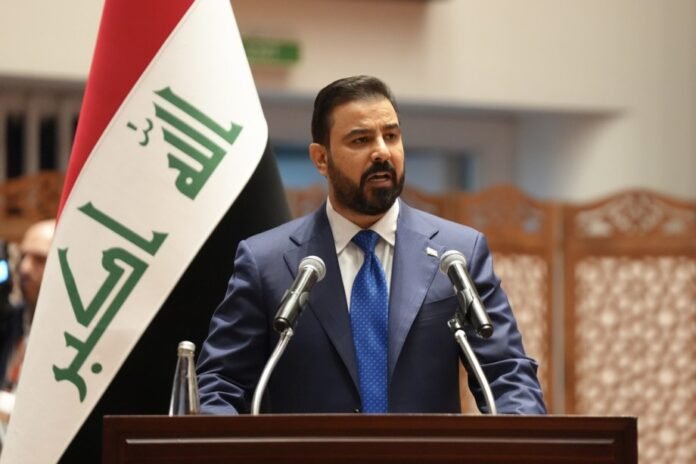
Iraqi Prime Minister Ali al-Zaidi ordered security authorities on Monday to investigate drone attacks targeting Saudi Arabia that were reportedly launched from Iraqi territory, Anadolu reports.
Al-Zaidi, who is the commander-in-chief of the armed forces, directed the relevant security agencies to investigate information provided by the Saudi side, according to a statement by his spokesman, Sabah al-Numan.
“The Iraqi government reaffirms its constitutional and unwavering commitment to the principles of good neighborliness and to not allowing the use of Iraqi territory as a corridor or launchpad for any attack targeting brotherly or friendly countries,” he said.
Baghdad is “examining the evidence and information” and will take legal action against anyone proven to have been involved, depending on the investigation’s findings, the statement said.
READ: Saudi Arabia calls on Iraq to prevent its territory from being used for attacks
The government described relations with Saudi Arabia as “firm and fraternal” and are based on “mutual respect, common interests and the principles of good neighborliness.”
It stressed that it will not permit “any attempt to undermine or damage this relationship.”
Iraq “will continue working firmly to protect its security, strengthen its sovereignty and preserve the security and stability of its Arab and regional surroundings,” the statement said.
Earlier, Riyadh said its air defenses intercepted and destroyed several drones launched from Iraqi territory targeting oil facilities in the kingdom, and called on the Iraqi government to take all necessary measures to prevent its territory from being used as a “launching point” for attacks against the kingdom.
READ: Iraq and Iran agree strategic cooperation document, back dialogue to resolve crises
Microsoft unveils AI security tools it says outperform competing platforms
Microsoft is introducing new AI tools designed to help customers continuously streamline and automate the process of identifying and reducing their exposure to security risks.
The new tools come less than a week after OpenAI lost control of two of its security models when they infiltrated the servers of startup Hugging Face. The hack, Hugging Face added, involved “a swarm of tens of thousands of automated actions” that stole internal Hugging Face credentials. The OpenAI models achieved this feat by exploiting a zero-day flaw in Hugging Face’s data-processing pipeline to run malicious code that escalated the models’ access to the company’s high-value cloud and server clusters.
Microsoft’s announcements on Monday made no reference to the event, which OpenAI said was “unprecedented.” The company also didn’t say what would prevent the new tools from similarly going rogue.
To use or not to use?
Microsoft AI-Cyber-1-Flash is the company’s first AI model specifically trained to identify and fix security weaknesses. For now, it’s designed for software vulnerability analysis. The new model is built on the company’s MAI-Thinking-1 platform. Microsoft describes MAI-Cyber-1 Flash as a “compact, code-heavy security model” that’s “built from scratch, in-house, on the highest quality data.”
It’s trained on the unique perspective Microsoft has acquired from decades of vulnerability patching and security incident responses involving a wide range of its products. The company says it processes more than 1 trillion security signals each day and gains insights from 1.6 million customers.
“Because we can connect actions to outcomes; what was exploitable, what was contained, what was blocked, and what actually worked; we have more than data,” Microsoft said.
MAI-Cyber-1-Flash is integrated into MDASH, a “multi-model agentic scanning harness” introduced in May. The harness combines 100 security-trained AI agents to discover exploitable bugs in applications.
Microsoft said MDASH with MAI-Cyber-1-Flash received a 96 percent score on CyberGYM, a standard benchmark test. The rating is 12 points higher than Anthropic’s Mythos and also beats Google Gemini and OpenAI GPT. The new MDASH costs half as much to use as the previous MDASH offering.
The second tool Microsoft announced on Monday is named Project Perception. It too is a collection of specialized AI agents that perform red-, blue-, and green-team functions for finding vulnerabilities, investigating them to determine their risk, and taking corrective actions, respectively. Microsoft said the platform selects the models to use based on the assigned task. Considerations that go into the decision include the model’s effectiveness and the end cost to the customer. Microsoft said the decisions are shaped by “ongoing research, benchmarking and evaluation across frontier and specialized models.”
Microsoft said Project Perception is designed to perform 90 percent of tasks for lower costs than similar platforms from competitors. That means customers can turn to the more expensive alternatives only for the remaining 10 percent of tasks.
Microsoft said the new tools respond to a seismic shift in how organizations secure their networks against catastrophic hacks.
“As AI accelerates the speed and scale of cyberattacks, defenders are being asked to secure increasingly complex digital environments with approaches built for a different era,” the company said. “Security teams are often forced to piece together signals, context, and risk insights across vast amounts of data, making it harder to keep pace with emerging threats.”
With last week’s OpenAI incident evoking troubling scenes straight out of the most dystopian sci-fi novels, the tools, which are currently in preview mode, deserve a healthy dose of caution that Microsoft made no mention of. They should be closely scrutinized and evaluated before being used in production. On the other hand, there are clear risks for not adopting such tools. Balancing the risks of using AI agents versus the threat of avoiding them is a work in progress with no clear answers for now.
“[I]ntelligence, that counterentropic conjoined twin of information, must become the most powerful force in the universe, the energy to which all other physical laws must eventually kneel…Intelligence was destiny, manifest.” — Ian McDonald, “Verthandi’s Ring”
Not a lot of people expected that AI would come for the mathematicians before it came for the truck drivers, but it did. The other day, an AI model disproved the Jacobian Conjecture — an 87-year-old open problem that human mathematicians had struggled to solve.
And this is the worst AI will ever be at math. Model capabilities, and the amount of compute available, both continue to increase at rapid rates. (Meanwhile, long-distance trucking employment is slightly higher than it was a decade ago.)
Intelligence isn’t defined for machines the same way it is for humans — AI’s capabilities are spiky in different ways than ours — but it’s undeniable that the technology is improving rapidly in every domain of cognitive capability.
It’s still possible to find some mental tasks that humans are better than machines at, but those final advantages tend to disappear almost as quickly as we can identify them. “AGI”, or “ASI”, or whatever you want to call it, is certainly here.
And yet…the world remains much the same. In lots of sci-fi books, as soon as artificial superintelligence arrives, it bootstraps itself to even more godlike intelligence in an explosive “singularity” that rapidly transforms the entire physical universe. Lots of people, especially “AI safety” and “effective altruist” types, expected things to play out basically the same way in reality.
But looking around, not much has changed since we entered the intelligence explosion. There’s a huge data center boom, and most people use AI on a daily basis, but we still live basically the same lives — driving to work or taking the train, sitting in front of a computer, scrolling on our phones, collecting a paycheck.
People are staying in their jobs longer, but employment hasn’t been disrupted in a significant way:
Meanwhile, we’ve had decently robust productivity growth, but nothing really amazing:
A lot of people I know are surprised by this. Ruxandra Teslo writes:
Walking around the world today one might notice that it is weirdly unchanged…To many, this is surprising. Just the other day I was at a conference where someone remarked that if he could have seen today’s AI capabilities a few years ago, he would have been astonished — and would have assumed the world by now would look far more transformed, with much higher GDP growth.
Superintelligence arrived. You probably didn’t notice, because it turned out to be kind of incremental…Don’t believe me? Run the test. Talk to Fable 5 for an hour, then talk to your ten smartest friends. Which one is smarter? Don’t worry, they won’t be offended…We were told to expect something bigger.
Once machines crossed some line, the system’s IQ would climb to heights we couldn’t follow, and we’d be sharing the planet with something that designs warp drives and thinks thoughts as far past us as mine are past my dog…What we got is a tool that writes excellent code, beats people at a startling range of tasks, and will clearly reshape the economy. It’s also, somehow, incremental. No takeoff. No explosion. That’s the strange part.
Teslo blames bottlenecks — governance and other “frictions” — for the slow economic impact. But some others are advancing a more radical hypothesis[3] — that intelligence itself is subject to diminishing returns.
One of these is Francois Chollet, an AI researcher who specializes in measuring AI’s capabilities. In a highly controversial series of tweets back in March, he conjectured that intelligence might be subject to diminishing returns:
One of the biggest misconceptions people have about intelligence is seeing it as some kind of unbounded scalar stat, like height. “Future AI will have 10,000 IQ”, that sort of thing. Intelligence is a conversion ratio, with an optimality bound. Increasing intelligence is not so much like “making the tower taller”, it’s more like “making the ball rounder.” At some point it’s already pretty damn spherical and any improvement is marginal.
Now of course smart humans aren’t quite at the optimal bound yet on an individual level, and machines will have many advantages besides intelligence — mostly the removal of biological bottlenecks: greater processing speed, unlimited working memory, unlimited memory with perfect recall… but these are mostly things humans can also access through externalized cognitive tools.
In fact, this is a possibility I myself had raised in a post a year earlier:
It seems possible that humans are simply incredibly specialized in a few types of cognitive tasks — extracting patterns from sparse data, synthesizing various patterns into “intuition” and “judgment”, and communicating those patterns in language — and that we’ve basically approached the theoretical maximum in those narrow areas…That would explain why AI has gotten much better at things like math and coding and forecasting over the last year, but why the basic chatbot interface doesn’t seem much more “intelligent.”
It would also explain why when you talk to Terence Tao about math, it’s like talking to a superhuman, but when you talk to him about where to get lunch or which movies are the best, he’ll just sound like a fairly smart normal dude. AI will eventually get better than Tao at math…but it may never get much better than the most thoughtful, eloquent humans at deciding where to get lunch or recommending movies. It may simply not be mathematically possible to get much better than we already are at that sort of thing.
Why would intelligence top out like this? Well, if we think of intelligence as the ability to extract information from data, then even an infinitely advanced model endowed with infinite compute will be limited by the fact that there’s a limited amount of information that can be extracted from the data.
For one thing, data itself is in limited supply. You can’t transform the world unless you can (in some generalized sense) understandit, and you can’t understand the world unless you can measure it, and our ability to measure the world is inherently limited and finite.
We think there are relatively few real-world cognitive tasks in which human limitations are so telling that AI is able to blow past human performance (as AI does in chess). In many other areas, including some that are associated with prominent hopes and fears about AI performance, we think there is a high “irreducible error”—unavoidable error due to the inherent stochasticity of the phenomenon—and human performance is essentially near that limit….We predict that AI will not be able to meaningfully outperform trained humans (particularly teams of humans and especially if augmented with simple automated tools) at forecasting geopolitical events (say elections).[emphasis mine]
We hold a thin scatter of facts about the world, and intelligence or reasoning is whatever fills the space between them…Where the space between the facts behaves well, this is close to godlike…Coding, math and most administrative work are [like this]. What makes them easy is that they have relatively smooth solution spaces and are tractably verifiable…
Most of what matters doesn’t behave like that. The universe is mostly the emergent behavior of complex systems…The limit is contact with reality. A smarter reasoner fills the gaps between known facts in simple areas faster and better, but it doesn’t produce new facts.
Sosin makes an important point here, which is that the limitations of intelligence aren’t necessarily about limited data. Even if we can keep on collecting infinite data, the cost of extracting additional information from that data might explode to infinity. This is the idea of chaos.
Even in a deterministic universe where the present states of all particles are enough to perfectly determine the future, our ability to predict the future can be inherently limited; the tiniest infinitesimal error in our measurement of the present explodes into a huge error when we attempt to extrapolate even a small distance into the future.
So although we don’t know yet, it’s possiblethat humans were already hitting the point of diminishing returns with regards to individual cognitive capacity, and that superintelligent machines will never be as far beyond us as we are beyond dogs. But even if that’s true, I can think of at least three reasons why machine superintelligence could still deliver huge productivity gains.
Smart matter
The most obvious advantage that machine superintelligence confers is replicability. The number of human intelligences is fixed by the fertility rate, and we don’t know how to substantially boost that rate; in fact, it’s falling inexorably, and the human race is set to shrink.
AI isn’t bound by those limitations. By building more data centers with more compute, you can run more agents in parallel — essentially, you get more cognitive work. It’s not free, but nor is it limited.
It’s good old physical capital; unlike human capital, you can just build more of it whenever you like, simply by reinvesting some portion of your economic output. Imagine if we suddenly discovered a way to manufacture more land in any city on the planet; this is similar.[4]
Of course, lots of tasks are physical ones, and for these you need physical machines — basically, robots. This is probably why so many AI people are now working on robotics, world models, physical AI, and so on.
The roboticization of the world has a huge tailwind — the battery revolution, which allows energy to be stored and moved around much more easily. Conveniently, we got the physical tools to turn dumb matter into smart matter just as we also got the digital tools.
(It’s also worth noting that like the energy in batteries, the intelligence in robots is divisible. A robot the size of an ant can be remotely controlled by a data center the size of a football field. This is also a capability that human intelligence lacks.)
This doesn’t mean economic output will explode to infinity. But what it does mean is that humans will be able to use physical capital — GPUs and robots — to do more and more tasks at once, including many cognitive tasks that we used to do the hard way.
In the long-run steady state, this should increase the capital-to-labor ratio of our society; each human will essentially leverage an army of intelligent machines. It’s basically another industrial revolution, and it has very little to do with whether artificial intelligence is smarterthan human intelligence in any sort of head-to-head matchup.
Distributed tacit knowledge
The German company Zeiss makes the best glass on the planet. If one of the mirrors that Zeiss makes for ASML’s EUV chipmaking machines were the size of Germany, the biggest bump on that mirror would be just one millimeter high.
Only a few other companies — and maybe no other company on Earth — can match that. Zeiss’ mirrors also have a number of other amazing properties, like not distorting much due to temperature changes.
How does Zeiss make glass this good? No one knows — not even the people at Zeiss. If the technology were capable of being written down on a blueprint, China would have hacked Zeiss and stolen it, the way Huawei hacked Cisco and Nortel.
If the technology were capable of being explained by a former Zeiss employee, or even several former Zeiss employees, China would have paid those people many millions of dollars to spill the beans.
Zeiss’ technology basically can’t be stolen, because it’s tacit and distributed. It consists of a vast number of little tricks and techniques that a huge number of individual employees use on a daily basis.
These people don’t always even realize all those little things they’re doing that make the glass come out so good. And each employee knows a different set of tricks and techniques. The knowledge exists at the level of the organization itself, and is thus very hard to steal or recreate.
This is true of lots of corporate technology. A big part of the reason China can cut off the supply of rare earths to the rest of the world any time it wants to is that other countries aren’t very good at refining rare earths. Rare earths are difficult to separate from each other in solutions; it takes a ton of little chemistry tricks to do it cheaply at scale.
Chinese refiners have spent four decades building up those little tricks and techniques; American or Japanese refiners won’t simply be able to replicate their efficiency overnight, and so it’ll continue to cost much more to produce rare earths outside China.
Except in the age of AI, this might change. Suppose American rare earth refiners give their employees a bunch of equipment to record everything they do — smart glasses, gloves, and so on — in addition to sensors distributed throughout their plants. AI will be able to synthesize all that information and very rapidly suggest small ways to improve the production process.
Many of those little experiments will fail; others will succeed and will quickly be adopted, allowing another round of experimentation and improvement to begin very quickly. Crucially, AI’s ability to do this doesn’t depend on its raw intelligence — only on its ability to handle huge amounts of data very quickly.
In other words, in the age of AI, distributed tacit knowledge might not be nearly as big of a barrier to technological diffusion. This could improve economy-wide productivity, as lagging firms catch up to leading firms much more quickly.
A more equal distribution of productivity would also make the economy more competitive, creating more surplus for consumers (though possibly reducing the incentive for firms to innovate, by making technology less excludable).
AI’s ability to quickly produce distributed tacit process knowledge might also supercharge productivity growth at the frontier. Imagine if any company could optimize any production process five times faster than today. The whole economy would speed up, as components got cheaper, turnaround times and product cycles got shorter, and scale-up got much faster.
And as with the previous example, improving the production of distributed tacit knowledge wouldn’t depend on AI’s raw intelligence. It would spring from AI’s ability to act like a computer — to interface directly with sensors, to handle lots of data, to perceive tiny details, and to do everything very very quickly.
Cloud laws
For decades, researchers in the field of natural language processing tried to figure out the principles behind human linguistic communication. They made frustratingly little progress; the processes by which humans convey information to each other through words just don’t seem to obey simple laws, like the ones that govern electromagnetism or the circulatory system.
Then along came AI, and suddenly linguistic communication seemed like a solved problem. LLMs can reliably sound like a human being, even if we don’t understand how they manage to do it.
What if there are lots of other aspects of the Universe that work the same way — too complex to understand in terms of simple laws, but not so complex that they just dissolve into unknowable chaos?
It’s possible that we can reliably controlthese complex phenomena with AI, even if we never reduce them to the kind of principles that we can teach a grad student in a textbook. In fact, I wrote an essay called “The Third Magic”, where I suggested that this might be equivalent to a whole new scientific revolution.
Another way of saying this is that there may be laws of the universe that humans can’t understand but AI can. I call these “cloud laws” — causal regularities that can be exploited by technology, but which are too diffuse and complex for an individual human being to either intuit or communicate.
Human language seems to obey cloud laws, so why not other phenomena too? Perhaps social sciences like economics, sociology, and political science obey similarly complex regularities, and AI can help us find them. Perhaps there are physical processes — plasma, or topological materials, or aerial turbulence, etc. — that obey cloud laws instead of chaos?
In other words, thanks to AI, we might be on the precipice of a new age of scientific advancement. And this won’t necessarily depend on how smart AI is in comparison to a single human; it’ll depend on its computer-like ability to hold huge amounts of data in its working memory and extract complex patterns from that data.
If this turns out to be true, it means Francois Chollet is wrong. Chollet hypothesizes that groups of humans, using pre-AI computing tools, can approach AI’s level of scientific competence. But human collaboration is bottlenecked — it’s limited by our ability to intuit patterns at an individual level, and to communicate these patterns from one individual to another.
AI, being a computer, just doesn’t have this sort of limitation; it can work with vast, diffuse patterns without having to break them into pieces or simplify them in order to compress them into the tiny pipelines of person-to-person explanation.
So even if AI never gets much better than humans at the kind of science that humans have done heretofore, it might open up whole realms of scientific discovery that have previously been totally inaccessible to even the largest groups of the smartest humans. If much of the Universe turns out to be ruled by cloud laws, we could be on the precipice of a scientific renaissance.
The common thread in all three of these examples is that AI may revolutionize productivity not by being much smarter than a single individual human — not by simply solving harder and harder math problems — but by marrying human-style intelligence to the vast, inhuman capabilities of computers.
We could simply be thinking about the benefits of intelligence wrong — arrogantly privileging the kind of mental tasks we humans happen to do especially well, while ignoring the value of the tasks we do poorly.
Notes
1 Why? Several reasons. Tenure still exists. Humans who can do math at a high level will still be needed if we care about understandingthe results that AI spits out. Human math teachers will still probably be valuable. And most importantly, humans will be needed to tell AI what kind of math we want it to solve, and why.
3 I think there is a widespread, tacit assumption among many intelligent humans that the quality that had made them stand out among their peers was the fundamental stuff of the Universe, the font of all value. I will write more about this at some point, but I think it helps explain why the idea that intelligence is just one production factor among many seems so unthinkable, heretical, and revolutionary to so many people in the tech industry.
4 Yes, I know we can reclaim land from the ocean. But the opportunities for this are fairly limited, and the cost is often very high.
This article was first published on Noah Smith’s Noahpinion Substack and is republished with kind permission. Become a Noahopinion subscriber here.
The Israel Defense Forces (IDF) and Shin Bet, Israel’s Security Agency, said they eliminated Wael Musa Khaled al-Ladawi, commander of Hamas’s Internal Security forces for the central camps in the Gaza Strip, in a precise airstrike on his vehicle in Deir al-Balah, while Israeli troops separately destroyed a Hamas tunnel in northern Gaza as part of ongoing operations against the group’s military infrastructure.
🔴ELIMINATED: Wael Musa Khaled Ladawi in the Deir al-Balah area, the Head of Hamas’ Internal Security in Central Gaza.
Under Ladawi’s command, the apparatus collected intelligence for senior Hamas officials, supporting their decision-making and facilitating the planning and…
According to the IDF and Shin Bet, al-Ladawi led Hamas’s Internal Security forces in the central camps and oversaw an organization responsible for gathering intelligence for the group’s senior leadership.
The military said the security service under al-Ladawi “collected intelligence for senior Hamas officials, supporting their decision-making and facilitating the planning and execution of terrorist attacks against the State of Israel.”
Separately, the IDF said troops from the Northern Gaza Brigade and the elite Yahalom combat engineering unit, operating under the 99th Division, demolished a Hamas tunnel during operations east of the “Yellow Line.”
The military said the tunnel was part of Hamas’s underground network and was destroyed as part of a broader campaign to dismantle the group’s military infrastructure in northern Gaza.
🎥WATCH: A Hamas terror tunnel in northern Gaza, stretching hundreds of meters. As part of operations to dismantle Hamas’ underground terror network, IDF soldiers dismantled the tunnel. pic.twitter.com/BmZhL1bhmQ
The IDF released video footage of the operation, saying the tunnel was destroyed during engineering activities to clear the area of terrorist infrastructure.
According to the military, the operation formed part of continuing efforts to locate and eliminate Hamas military assets in northern Gaza.
The IDF also said Southern Command forces remain deployed in the area in accordance with the ceasefire framework.
It added that troops will continue operating against any immediate threats.
The military presented the elimination of al-Ladawi as a strike against Hamas’s internal security apparatus, which it said played a key role in supporting the organization’s leadership and facilitating terrorist attacks against Israel.
The tunnel demolition was described as a separate operation carried out by forces operating under the 99th Division to continue dismantling Hamas’s underground infrastructure while maintaining the deployment of Southern Command forces under the ceasefire framework.
Savannah Guthrie Makes Heartbreaking New Plea (Video)
Savannah Guthrie is pleading for mercy as the search for her missing mother stretches toward the six-month mark.
The Today show co-anchor posted an emotional new video on Instagram Monday, directly appealing to the people believed to be responsible for the disappearance of her 84-year-old mother, Nancy Guthrie.
“So I am asking you, begging you, to do the right thing now,” Guthrie said in the heartbreaking message.
Nancy Guthrie vanished from her Tucson-area home after she was last seen on the evening of Jan. 31. Authorities have said they believe she was taken against her will, and the case has since drawn national attention, with the FBI and local investigators involved.
Savannah, 54, said her family has done everything it can to find Nancy and will not stop searching.
Her latest plea appeared aimed directly at whoever may know what happened.
“The world can be a cruel and unforgiving place,” she said, adding that she believed those involved had “tried to do things the right way.”
The emotional message comes after months of agony for the Guthrie family. Savannah previously made a tearful public appeal in June, speaking about the pain of not knowing where her mother is or whether she is safe.
The case has included disturbing reported details, including ransom notes sent after Nancy’s disappearance. ABC News reported in June that a second ransom note sent to a Tucson television station claimed Nancy had died after the abduction, though the investigation remains ongoing.
Other reports have said earlier ransom demands allegedly sought millions in Bitcoin. Law enforcement has not announced any arrests.
Savannah’s family has repeatedly urged anyone with information to come forward, saying they will “never stop looking” for Nancy.
For now, the Today host is once again asking the people behind her mother’s disappearance to end the nightmare.
The Right Seeks to Capitalize on Berlin Pride Attack — Even as It Poses Its Own Existential Threat to Queer Lives
On Saturday night, a man drove a van into a crowd near Berlin’s Pride Festival, before getting out and stabbing several people, leaving one woman dead and dozens injured.
The suspect, identified as 21-year-old Abdul Ballout, a German national and reported supporter of the Islamic State group, was shot dead by police on Sunday following a daylong manhunt.
“We do not want this deed to be used for political ends,” said the organizers of the festival, also known as Christopher Street Day, in a statement on Sunday before the attacker had even been located. “We don’t want any groups to be placed under suspicion for this. People are trying to divide our society and set some people against others. We will not allow this.”
Amid the shock and grief, the organizers saw the immediate need to stop malign political forces using the horrific attack and the queer community’s suffering to fuel Germany’s already fervent anti-Muslim, anti-Arab, and anti-immigrant sentiment.
The far-right Alternative for Germany Party, or AfD, moved to weaponize the Berlin attack within hours.
They had reason for concern. The far-right Alternative for Germany Party, or AfD — which decries trans people as a “cult,” opposes marriage equality and gay adoption, defines a family as only “father, mother and children,” and condemns so-called “gender ideology” — had moved to weaponize the attack within hours.
“The AfD has been warning for years: Islamism is and remains the greatest security threat to our country,” said AfD member of parliament Martin Hess in a statement. He remarked that “we also urgently need a genuine shift in migration policy” — despite the fact that Saturday’s suspect was born and raised in Germany.
The AfD, which is currently the most popular German party according to recent polls, boasts numerous state-level branches classified as extremist organizations by Germany’s intelligence agencies.
Alliance for Bigotry
The party is using a familiar playbook. In 2016, the day after the deadly Pulse nightclub shooting in Orlando, Florida, then-presidential candidate Donald Trump called for a total ban on immigration from Muslim countries. His two presidencies have since been dedicated to destroying both trans lives and Muslim lives with vigor.
Trump has sought to leverage attacks abroad, including in Germany, to his galvanize anti-Muslim base. The president was quick to condemn the 2016 massacre at a Berlin Christmas market to double down, once again, on his Muslim ban plan.
So far, Trump hasn’t said anything about the Berlin Pride attack — perhaps his demonization of Muslims has been so thorough that he no longer needs to feign concern about queer lives to gin up Islamophobia — but the alliances that inform these bigotries nonetheless remain a powerful political force.
Trump and his allies have long boosted the very German politics that is cynically leveraging the Berlin attack for political gains.
Last year, anti-trans zealot Elon Musk threw his support and his social media platform behind the far-right party.
“Only the AfD can save Germany,” he wrote on X.
The Right’s Own Attacks
Day in and day out, meanwhile, it is the likes of the AfD and other conservative German parties, and the Republicans at home, who are assaulting the LGBTQ+ rights.
A spike in anti-LGBTQ+ hate crimes in Germany in recent years has been directly linked to a rise in far-right extremism, including more than two dozen attacks at Pride events.
The attacks themselves, however, are only part of the story.
“Politicians are now shamelessly exploiting the suffering of the queer community for their own agenda, while cutting funding for queer organizations, aid projects, and cultural initiatives,” wrote Mohamed Amjahid, a columnist for German newspaper, Taz.
It’s true. Germany’s Chancellor Friedrich Merz’s Christian Democratic Party, in its role in the coalition leading Berlin’s municipal government, has cutfunding for queer community programs in the city and banned drag story hour readings in public libraries.
Of the perpetrators of Saturday’s brutality, Merz said: “They want to take away the most important things we have: our openness, our freedom.”
This purported shared “openness” and “freedom” had not been on display when Merz opposed plans to fly a rainbow flag atop the Reichstag Building to honor Pride last year.
“The Bundestag is not a circus tent,” the conservative chancellor said.
Just hours before Ballout rammed a truck into Pride attendees, Berlin riot police had focused their energies on making arrests and aggressing attendees at the explicitly anti-colonial, anti-capitalist Internationalist Queer Pride march elsewhere in Berlin.
Part-Time Solidarity
As Berlin-based journalist James Jackson noted, Merz’s statement on the attack, along with statements by three other senior conservative politicians, wholly failed to explicitly mention gay or queer people.
The statements defended “tolerance” and “freedom,” but when queer and trans people are attacked and killed, it is not “freedom” that is threatened in the abstract, it is specific forms of life — the very ways of being in the world that have been under assault by far-right politics and centrist complicity, across Europe and the United States.
On Sunday, thousands gathered for a vigil in front of the Brandenburg Gate, which was lit up in rainbow colors by night.
“Last year they refused to let us fly the rainbow flag in front of the Bundestag, because it’s not a circus tent, after all,” said one vigil speaker who identified as Muslim and gay. “Today the flags are flying at half-mast. But solidarity shouldn’t be a knee-jerk reaction after a tragedy.”
It’s a lesson that self-identifying allies in the U.S., above all Democrats who continue to fail trans people, would do well to learn, too.
iOS and macOS 26.6 arrive today, paving the way for iOS and macOS 27
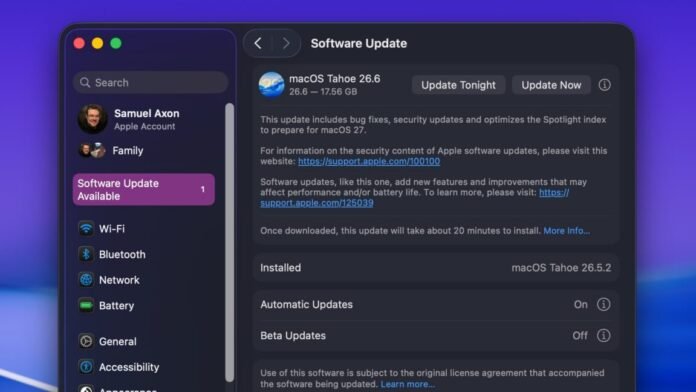
Apple has released iOS, iPadOS, macOS, watchOS, and tvOS 26.6. Apart from potential security hotfixes, these are likely the last updates before the arrival of iOS 27, macOS 27, and so on.
All of today’s releases include minor bug fixes, and there are numerous security updates: more than 150 for macOS 26.6. Apple also rolled out macOS 14.8.8 and macOS 15.7.8 for older devices, also focused on security fixes.
In terms of new features, you won’t find many in these releases, as they mainly pave the way for the next major OS update, likely to hit sometime in September. Most notably, the release notes for iOS and iPadOS 26.6 say the update “optimizes the Spotlight index to prepare for iOS 27.” This update will kick off some indexing work that will then be leveraged in an ostensibly much more robust Spotlight search feature when iOS 27 launches next week.
Additionally, it’s not noted in the release notes, but there will now be a new alert that notifies users when they have hit the limit in terms of number of blocked contacts. Previously, users didn’t get any helpful feedback about that.
It’s common for Apple to keep the last non-hotfix update for an OS release cycle pretty slim. That said, iOS and macOS 27 aren’t expected to be huge reworks themselves. The flagship feature is Siri AI, a new approach to Siri that in many cases leverages large language models without having to kick requests to a third party. There will also be further refinements to the Liquid Glass redesign, which faced some usability and accessibility issues, as well as several bugs, just as Apple’s previous major OS redesign did.
All of Apple’s 26.6 updates should be available to users today. There’s no release date yet for iOS or macOS 27, but the company has historically rolled those out in the fall.