22.3 C
London
Sunday, July 26, 2026
Home Blog

The UN returns to Damascus at the edge of reconstruction

0
the-un-returns-to-damascus-at-the-edge-of-reconstruction
The UN returns to Damascus at the edge of reconstruction

Seventeen years. That is how long it has been since a sitting United Nations Secretary-General last set foot in Damascus. When António Guterres’ plane touches down on Syrian soil, it will not be a ceremonial gesture. It is the diplomatic ignition point of Syria’s post‑Assad metamorphosis—a collapsed state now being re‑stitched through UN‑brokered legitimacy, Gulf‑conditioned constitutional engineering, Turkish‑regulated border sovereignty, and a covert Western–Syrian intelligence liaison that keeps the Islamic State’s remnants buried in the Badiya desert.

Yet for all the diplomatic choreography, one uncomfortable truth lingers: this nation of 23 million remains a house of cards, and any external anchor that slips could send it crashing back into the abyss.

The numbers tell a story of unspeakable ruin. Fourteen years of war have decimated Syria’s bureaucratic institutions. The economy has contracted by an estimated 85 per cent since 2011. Ninety per cent of Syrians now live below the poverty line. Reconstruction costs hover between $216 billion and $400 billion—twenty times the size of Syria’s GDP. Some 5.5 million people remain internally displaced, while 15.6 million continue to require humanitarian assistance. This is not a transition. This is a resurrection attempt on a patient flatlining for over a decade.

Guterres’ visit marks the moment Syria shifts from pariah to project. The UN Security Council has already lifted sanctions on Hay’at Tahrir al‑Sham, the former Al Qaeda affiliate whose cadres now control the country.

The Secretary‑General will address the newly minted People’s Assembly, conferring upon this insurgent‑turned‑government the symbolic mantle of statehood. But legitimacy conferred from without is not legitimacy earned within.

President Ahmed al‑Sharaa has appointed almost exclusively family members and longtime HTS loyalists to control key economic and security decisions. The “Idlibization” of Damascus—where former insurgent commanders retain operational control over intelligence apparatuses and revenue streams—creates a state that thinks like an insurgency, viewing politics as a continuation of war by other means.

The external scaffolding holding this fragile edifice together is as intricate as it is precarious. French President Emmanuel Macron’s July visit—the first by an EU head of state since Assad’s fall—brought with it the CEOs of TotalEnergies and CMA CGM, positioning Damascus as a pivotal transport link between the Mediterranean and the Gulf. Days later, al‑Sharaa sat across from Donald Trump at the NATO Summit in Ankara, securing explicit American backing for sanctions relief.

The Kirkuk‑Baniyas oil pipeline—a dormant 800‑kilometre corridor with an estimated rehabilitation cost of $4.5 billion to $8 billion and a planned capacity of 2 million barrels per day—has become the material artery of this new geopolitical order.

Yet pipelines do not build nations. The Golan Heights remains the primary geopolitical flashpoint capable of derailing everything. After the fall of Assad, Israeli Prime Minister Benjamin Netanyahu declared the 1974 disengagement agreement “collapsed” and ordered the army to occupy the buffer zone. Israeli forces have since carried out repeated incursions into southern Syria. Guterres’ planned visit to the UNDOF mission is not a photo opportunity—it is a desperate attempt to prevent the border from detonating into regional warfare.

The constitutional architecture designed to hold this fractured polity together is both ingenious and fragile. The proposed bicameral quota system allocates fifty of one hundred Senate seats to minorities—fifteen each for Alawites and Christians, twelve for Druze, five for Ismailis and Shia, and three for ethnic minorities.

Any legislation touching personal status laws, religious endowments, or cultural rights requires a two‑thirds majority in the Senate and a majority within each directly affected communal block. This is consociationalism as constitutional straitjacket—a mechanism designed to prevent hardline Islamist overreach.

But these protections are not internally generated; they are externally demanded by Gulf states as a condition for reconstruction aid. This is sovereignty by conditionality, where the internal social contract is underwritten by Saudi and Emirati sovereign wealth funds.

If the pipeline revenues dry up, does the constitutional architecture evaporate with them?

Observers warn that Syria’s new rulers are already mirroring the habits of the old regime, that the post‑Assad state remains extraordinarily fragile, and that no coherent roadmap for political transition exists. This is not a transition; it is a permanent state of probation.

Three trajectories lie ahead. The optimistic path—where the pipeline flows, the intelligence channels remain functional, and the minority veto satisfies Gulf conditions—could transform Syria into a strategic transit hub anchoring regional stability.

The status quo path—a Syria that muddles through, with pockets of stability and pockets of violence, never fully collapsing but never fully recovering. And the pessimistic path—where constitutional guarantees prove hollow, sectarian warfare resumes, or a Golan miscalculation triggers regional conflagration.

Guterres’ arrival in Damascus is a profound act of diplomatic faith. The UN is betting that extending international legitimacy will help produce the internal conditions for pluralism and security that justify it. But legitimacy is not a gift; it is a continuous performance.

The Syrian state is not sovereign in the classical sense—it is sovereign only through its connections: to Gulf capital, to Turkish veto power, to Western intelligence networks, to UN recognition. This is externally scaffolded sovereignty, and scaffolds are not foundations.

The question that haunts Damascus this July is not whether Syria can transition. It is whether the international community has the patience, the resources, and the strategic clarity to hold the scaffolding steady long enough for the nation to rebuild itself from within. Seventeen years of diplomatic absence cannot be undone in a single visit. But it can begin. And in Syria, beginning is everything.

The views expressed in this article belong to the author and do not necessarily reflect the editorial policy of Middle East Monitor.

How Digital Payments Are Changing Daily Life in Idlib, Syria

0


Digital wallets have moved beyond salary payments to everyday purchases, reshaping commerce in northwest Syria while raising questions about access, security, and reliability 

[IDLIB] Hassan leaves his home for the market in Sarmada, north of Idlib, to buy his family’s daily groceries. This time, he doesn’t check whether he has cash in his wallet. Instead, he simply grabs his smartphone.  

At a vegetable stall, he selects tomatoes, cucumbers and peppers. Once the vendor totals the bill, Hassan scans the QR code displayed at the shop, enters the amount and taps “Send.” Within seconds, a notification confirms the transaction, and the vendor nods to signal that the payment has been received.  

For years, Idlib has been associated with airstrikes, displacement camps and waves of fleeing civilians, becoming synonymous with one of the Syrian war’s most devastated front lines. Today, however, a different reality is taking shape. Residents are increasingly using a smartphone app called Sham Cash to pay for bread, vegetables, coffee and medicine, reflecting a shift in how money moves through an economy long shaped by war and limited banking services.  

“The app has made financial transactions much easier since it was launched,” Hassan told The Media Line. “We can now buy our daily needs or sell our goods without having to rely on paper money in many cases.”  

Customer in Idlib pays for items using app. (Salma Abdulrahman / The Media Line)

The practice is not limited to food markets. At a nearby café, Ahmad orders a cup of coffee. When it is ready, he pulls out his phone, scans the payment code, and completes the transaction in seconds. Ahmad, who was visiting Sarmada from Damascus, said the experience remains unusual elsewhere in Syria. “This level of convenience in payments doesn’t exist in any other Syrian city I’ve visited,” he told The Media Line. “So far, the app hasn’t spread this widely outside this region.”  

Flower shops, pharmacies, retail stores and gyms increasingly accept digital payments alongside cash, reflecting the growing role of electronic payments in everyday life. Residents of Idlib do not claim that cash has disappeared from the markets, but many say they can now complete most of their daily purchases using digital methods. 

The app’s adoption expanded significantly after it became the platform for paying salaries to public-sector employees and retirees, transforming it from a money-transfer service into a tool used for daily shopping, bill payments and other services. Idlib’s financial landscape has long been distinct from the rest of Syria.  

After Idlib fell outside the control of the former Assad government, the Turkish lira became widely used in local markets alongside the US dollar, while the Syrian pound played a more limited role than in many other parts of the country. Today, as Syria’s transitional government seeks to reinforce use of the Syrian pound, the region is witnessing another financial shift with the growing adoption of digital payment applications, making smartphones an increasingly essential part of everyday commerce.  

In the past, we had to stand in line for hours to collect our pensions. Now the money arrives on my phone while I’m at home.

According to a government source who spoke to The Media Line, the app now serves about 1.25 million public employees and retirees who receive their salaries through the platform. Nofal Al-Ahmad, a retiree from Idlib, said his daily routine has changed since he began receiving his pension through the app. “In the past, we had to stand in line for hours to collect our pensions,” he told The Media Line. “Now the money arrives on my phone while I’m at home, and I can immediately use it to buy what I need without carrying cash.”  

The app has also become an integral part of store owners’ business operations. Mohammad Al-Qasim, a veterinary pharmacist in Idlib, said he prefers receiving payments through Sham Cash because it simplifies financial transactions with suppliers. “Most of my customers are sheep and cattle breeders, and a large percentage of them pay through the app,” he told The Media Line. “Like most business owners in Idlib, we receive payments this way and later transfer money to suppliers. The app has become an essential part of our daily transactions.”  

Abu Khaled, who owns a candy store in Sarmada, said digital payments have become routine for his customers. “Most customers pay for sweets through the app,” he told The Media Line. “It has become part of people’s daily lives, and after getting used to it, it no longer makes sense not to use it.”  

Not everyone, however, has embraced the shift. Umm Mahmoud, who receives her husband’s pension through Sham Cash, said the app makes collecting the payment easier, but she still prefers holding cash. “As soon as the pension arrives on my phone, I go directly to a money exchange office to withdraw it,” she told The Media Line. “I trust paper money more.”  

I feel more secure when I have cash in hand

Government employee Akram Al-Qasim shares that view. While he acknowledged that the app has simplified financial transactions, he said he still withdraws his salary in cash immediately after receiving it. “I feel more secure when I have cash in hand,” he told The Media Line. “That’s why I withdraw my salary as soon as it arrives.” 

The discussion extends beyond personal preferences for digital or cash payments to the uneven adoption of the technology across Syria. Hamza Zidan, who owns a company selling loudspeakers in Idlib, said the difference becomes obvious whenever he travels to other Syrian provinces. “I travel between Aleppo, Homs and Damascus,” he told The Media Line. “Whenever I ask to pay through Sham Cash, vendors are often surprised, or refuse because they don’t use it.”  

Gym member pays with app. (Salma Abdulrahman / The Media Line)

As the app’s use continues to expand, the company behind Sham Cash says it is working to improve its services and strengthen its technical infrastructure. Mahmoud Al-Sheikh, a Sham Cash employee, told The Media Line that recent updates include improvements to the user interface, an expansion of cash withdrawal and deposit services through the addition of Al-Haram and Al-Fouad exchange companies, and enhanced security features such as fingerprint or PIN authentication.  

Other updates include the option to hide account balances and support for multiple languages. He said that the company is also working to improve the app’s performance, particularly in areas with weak internet connectivity, while expanding its network of merchants and the range of services available through the platform.  

Al-Sheikh warned that fake social media pages and groups posing as the app’s technical support team have sought users’ personal information, including email addresses and passwords. He said Sham Cash does not request such information through social media and urged users to ignore and report fraudulent accounts. Despite the app’s growing popularity, users still face challenges, particularly internet outages and technical disruptions that can delay transactions. 

In March 2026, the app experienced a several-hour outage amid reports that it had been targeted by a cyberattack. Sham Cash denied that any user data had been compromised, saying the disruption was caused by a technical issue that was later resolved. 

 Umm Saeed recalled an encounter that surprised her while shopping at a market in Idlib. “A woman stopped me and asked for help,” she told The Media Line. “I told her I wasn’t carrying any cash because I use the Sham Cash app. To my surprise, she pulled out her phone, opened a QR payment code and asked me to transfer the money through the app.” The story illustrates just how far digital payments have spread, extending beyond stores and businesses into situations where many people would never have expected to see them.  

From vegetable vendors and cafés to pharmacies, flower shops and candy stores, the smartphone has become more than a communication device. For many residents of Idlib, it now serves as a digital wallet accompanying them through their daily lives—a transformation that remains rare elsewhere in Syria. 


Meteorite Crashed into a House Containing ‘Extraterrestrial’ Clues

0
meteorite-crashed-into-a-house-containing-‘extraterrestrial’-clues
Meteorite Crashed into a House Containing ‘Extraterrestrial’ Clues


A meteorite that smashed through the roof of a New Jersey home is now giving NASA scientists a rare look at the earliest days of the solar system — and the possibility that some of life’s key ingredients were already moving through space billions of years ago.

The space rock crashed into a house in Hillsborough, New Jersey, in Somerset County, on July 16, 2024, according to a new study published in Science Advances and authored by multiple NASA scientists. What could have been dismissed as a bizarre freak accident quickly became a major scientific opportunity, thanks to the homeowners’ careful response.

According to NASA, one of the residents is an amateur astronomer and immediately understood that the object might be scientifically important. Rather than handling it casually or throwing it away, he collected the meteorite fragments with protective gloves and safely preserved them until they could be turned over for study.

That quick thinking allowed researchers to examine a rare, freshly recovered meteorite that had a documented fireball path across the sky. Scientists used video footage of the meteorite’s trajectory, along with detailed lab analysis, to trace where the rock likely came from in the asteroid belt.

“When we have both a documented fireball and a quick recovery of its meteorite, we can learn not only what the rock is made of, but where it came from in the asteroid belt,” said Peter Jenniskens, the study’s lead author and a meteor astronomer at NASA’s Ames Research Center in California’s Silicon Valley and the SETI Institute, according to NASA.

Inside the meteorite, scientists found something especially intriguing: evidence that ancient salty water once moved through the asteroid the rock came from. Using powerful microscopes, researchers discovered deposits left behind by brine, offering clues about the watery history of the asteroid long before the meteorite broke away and eventually slammed into the New Jersey home.

Even more striking, the study’s authors found that the salty water contained amino acids that are rare on Earth and are believed to be “likely extraterrestrial in origin.”

Those findings could help scientists better understand how water shaped rocky objects in the young solar system, and how some of the building blocks associated with life may have formed or traveled through space long before Earth became the planet we know today.

“If you follow the water through the solar system, you’re actually following life,” said Mike Zolensky, a meteorite researcher and co-author of the study, according to NASA.

“Following the history of water through the solar system is an essential part of understanding the origin of life,” he added.

The discovery makes the meteorite more than just a space rock that punched a hole through someone’s roof. It is a preserved fragment of ancient cosmic history, one that may help scientists piece together what conditions were like when the solar system was still forming billions of years ago.

Photos credited to M. Kirschner and M. Hankey of the American Meteor Society show both the rooftop hole where the meteorite landed and the meteorite itself.

The homeowners, who have chosen to remain anonymous, told ABC 6 that they understood almost immediately how unusual the event was.

“We knew almost immediately that what happened to us was incredibly rare and we felt a responsibility to preserve the meteorite for the scientific community,” the homeowners said in a statement to the outlet.

They said the experience still feels hard to believe.

“It’s still surreal to think that this meteorite traveled through space for millions of years before ending its journey in our home,” they added. “The entire experience has been incredible, and we’re honored to have played a small part in advancing scientific understanding through its study.”

EU Prepares for New US Tariffs as Trade Tensions Resurface

0
eu-prepares-for-new-us-tariffs-as-trade-tensions-resurface
EU Prepares for New US Tariffs as Trade Tensions Resurface


The European Union is preparing to accept a new wave of US tariffs on European goods, despite considering the measures unjustified, as Brussels prioritises maintaining the limits agreed under last year’s EU-US trade deal.

The expected duties relate to allegations over products linked to forced labour, with Washington arguing that insufficient action to tackle such supply chains is harming US businesses. The current US tariff regime is set to expire on Friday, with fresh measures expected shortly afterwards.

European Commission officials said their main objective was to ensure that any new tariffs remain within the 15% ceiling agreed in the Turnberry agreement signed in July 2025 by US President Donald Trump and European Commission President Ursula von der Leyen.

While Brussels has rejected the US findings, arguing that the EU already has strict rules against forced labour products, officials appear unwilling to reopen a wider trade dispute that could create uncertainty for European companies.

The situation highlights the delicate balance facing the EU as it seeks to defend its trade interests while preserving stability in its economic relationship with Washington.

The new measures follow months of uncertainty over US trade policy after previous tariffs faced legal challenges. The EU is now closely monitoring Washington’s next steps, hoping the latest dispute remains contained within the framework of the existing agreement rather than escalating into a broader transatlantic confrontation.

via Euronews

How Japan is putting AI in its cybernetic place

0
how-japan-is-putting-ai-in-its-cybernetic-place
How Japan is putting AI in its cybernetic place

Much of the Western debate about artificial intelligence centers on the machine itself. Will AI become conscious? Will it surpass human intelligence? Could it acquire goals of its own and escape human control?

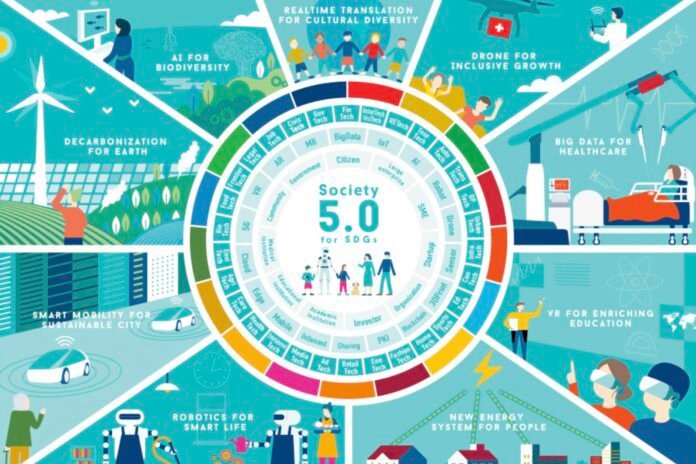
Japan’s Society 5.0 begins from a different premise. Rather than imagining AI as an autonomous mind, it places AI inside a larger social and technological system. Sensors collect information from the physical world; digital networks carry that information into cyberspace; AI analyzes it; and the resulting knowledge is returned to people, organizations, machines and public services.

Intelligence resides less in a single machine than in the circulation of information through the system as a whole. In this respect, Society 5.0 is best understood as a cybernetic vision of society. AI is a service within the feedback loop, not the sovereign agent directing it.

Beyond the information society

Society 5.0 was introduced in Japan’s Fifth Science and Technology Basic Plan, adopted in 2016. The name places the program within a sequence of historical social forms: the hunting society, the agricultural society, the industrial society, the information society, and finally Society 5.0.

Japan describes it as a human-centered society created through the close integration of cyberspace and physical space. Its objective is not technological development for its own sake, but the reconciliation of economic growth with the solution of social problems.

Those problems are particularly acute in Japan. The country has an aging and declining population, rural depopulation, labor shortages, rising healthcare needs, deteriorating infrastructure, vulnerability to natural disasters, and growing energy and environmental pressures.

Society 5.0 proposes to coordinate data, AI, robotics, communications networks and public institutions to respond to these interconnected challenges.

A cybernetic society

Japan’s foundational Society 5.0 documents generally speak of “cyber-physical systems” rather than relying heavily on the classical term “cybernetics.” Yet the architecture they describe is unmistakably cybernetic.

Cybernetics studies how systems use communication, feedback and control to adapt their behavior. A thermostat provides the simplest example: it measures a room, compares the result with a desired temperature, and adjusts the heating.

More complex cybernetic systems continually collect information about their environment, evaluate it against objectives, act, and then measure the consequences.

Society 5.0 applies this pattern on a societal scale. Physical activity generates data through sensors and connected devices. That data moves into cyberspace, where it is combined and analyzed. The resulting recommendations or decisions return to the physical world, producing new conditions and new data. The cycle then begins again.

The cybernetic connection becomes explicit in later Society 5.0-related programs. Japan’s Moonshot research program, for example, includes a goal devoted to “cybernetic avatar infrastructure.”

It envisions people using networked robots and digital avatars to extend their physical, cognitive, and perceptual capabilities. The stated purpose is not to replace humans with autonomous machine agents but to expand what people can do while preserving inclusion and social participation.

Society 5.0 can therefore be understood as a modern form of social cybernetics: data circulates among people, machines, institutions, and environments, enabling the wider system to respond more effectively.

AI as a service

Artificial intelligence occupies an important but carefully delimited place within this architecture. It processes information; it does not define society’s purposes.

In a 2017 speech explaining Society 5.0, then-prime minister and now deceased Shinzo Abe described how sensors connected through the Internet of Things would accumulate large quantities of data. AI would analyze that data, he said, producing “new wisdom.”

The examples he gave were practical: finding patterns in medical data, improving factory maintenance, and helping automated vehicles respond to road conditions.

This formulation is revealing. AI is treated as a service and tool that turns data into useful knowledge, enhancing human capabilities rather than establishing its own goals. The system’s objectives — health, mobility, safety, sustainability and well-being — remain socially determined.

That does not mean every decision must be made manually. Automated systems may control vehicles, balance energy demand, coordinate logistics, or detect medical abnormalities. But their agency is functional and delegated. They operate inside architectures established by people and institutions.

In other words, AI may optimize the means, but it does not determine the ends.

AI industrial roadmap

Japan’s Artificial Intelligence Technology Strategy translated this philosophy into an industrialization roadmap.

Rather than organizing policy around the creation of a single general-purpose artificial intelligence, the strategy concentrated on three domains: productivity, health, medical care and long-term care, and mobility. Information security supported all three.

The roadmap anticipated a phased development. In the first phase, data-driven AI would be introduced into individual industries and services. In the second, AI and data use would spread across public domains. In the third, formerly separate fields would become interconnected, producing a broader ecosystem.

The underlying logic was cumulative. AI applied to healthcare could reduce the burden on medical workers and help people remain healthy longer. AI applied to mobility could improve transport for older people and residents of depopulated regions.

AI applied to manufacturing and logistics could compensate for labor shortages. Once these systems exchanged information, their value would exceed that of isolated applications.

This is another cybernetic characteristic of Society 5.0. The intelligence of the whole emerges from coordination among specialized components. No single AI needs to become generally intelligent because capability is distributed across the system.

Model-centered to system-centered

This distinguishes Society 5.0 from model-centered visions of AI that dominate much contemporary discussion. In a model-centered approach, progress is measured primarily by the intelligence of the model: how well it reasons, writes, codes, plans, or competes with humans.

Society 5.0 instead asks how many elements can be coordinated around a social purpose. The important questions are whether healthcare data can improve treatment, whether transport systems can respond to changing demand, whether infrastructure failures can be predicted, and whether services can reach people regardless of age, location, or disability.

AI is not absent from this picture. It is ubiquitous. But it becomes ubiquitous by disappearing into infrastructure.

Society 5.0 is not simply an AI strategy. It is an attempt to define the social system within which AI should operate. Its central question is not whether a machine can become an independent intelligence, but whether networks of people and machines can make society more adaptive, inclusive, and resilient.

The distinction is fundamental. In Society 5.0, AI is not an artificial person waiting to awaken. It is a component of a larger cybernetic system, a tool for converting data into new wisdom, while human beings retain responsibility for deciding how that wisdom should be used.

Nablus: When the killer becomes the victim

0
nablus:-when-the-killer-becomes-the-victim
Nablus: When the killer becomes the victim

In the occupied West Bank, the story often starts too late.

It starts when an Israeli settler is killed, injured, or frightened. It starts when Israeli officials speak, when the army enters Palestinian villages, and when headlines describe a “clash” or a “terror attack”. Suddenly, the settler becomes the victim, the Palestinian village becomes the threat, and the occupation disappears from the story.

But Nablus cannot be understood from the middle of the story.

For years, Palestinian villages around Nablus have lived under daily pressure: land seizures, settlement expansion, military raids, road closures, intimidation, and settler violence.

This is not a normal conflict between two equal communities. It is a system where one side expands with weapons, army protection, and state support, while the other side is expected to remain silent

That is why the recent events of yesterday near Nablus cannot simply be called a “clash”. The word sounds neutral, but the reality is not neutral. A clash suggests two equal sides. But there is no equality between armed settlers living on occupied land and Palestinians living in villages surrounded by settlements, checkpoints, and military control.

Of course, individual settlers can suffer. Death is death. Fear is fear. No human pain should be mocked or ignored. But the pain of one incident cannot erase the larger reality. A settler can be a victim in one moment, while still being part of a wider system that causes fear, dispossession, and daily suffering for Palestinians.

This is the contradiction: the executioner becomes the victim only when the story is cut away from its history.

When the headline begins with Israeli pain, Palestinian pain becomes invisible. The settler becomes a civilian under attack. The Palestinian becomes a security threat. The settlement becomes a neighbourhood. The occupied village becomes a battlefield. The army becomes “protection”. Resistance becomes “terrorism”. And the occupation, which created this whole reality, disappears.

This is not by accident. This is how power protects itself.

The settlement movement has always tried to make its presence in the West Bank look normal. It wants the world to see settlers as ordinary residents, not as people living inside a political project built on occupied land. It wants attacks on Palestinians to look like isolated events, while every Palestinian reaction is used to say that Palestinians are violent and must be controlled.

But the truth is simple: a system built on domination cannot bring security.

It can bring temporary control. It can create fear. It can silence people for a while. It can build walls, checkpoints, settler roads, and military zones. But it cannot bring peace. When land is taken, when homes are attacked, when settlers enter Palestinian villages, and when the army protects one side only, violence is not an accident. It becomes part of the system.

This does not mean every settler carries the same guilt. It does not mean every Israeli death should be dismissed. It means that individual suffering should not be used to hide collective power. The victimhood of the settler cannot be used to erase the long victimhood of the occupied.

Yet this is what often happens.

The Palestinian is asked to explain his anger. The settler is rarely asked to explain why he is there. The village is asked to condemn violence. The settlement is rarely asked to justify its existence. The occupied are told to stay calm, while the occupier calls control “security”.

That is why the phrase “when the executioner becomes the victim” matters. It is not a denial of human pain. It is a refusal to forget the political reality.

A settler killed in one incident may be a victim of that incident. But the settlement project remains a machine of dispossession. The grief of one Israeli family does not erase the daily fear of Palestinian families living beside armed settlers, checkpoints, and expanding settlements. One tragic day does not erase decades of occupation.

Nablus shows this clearly. The more Israel protects settlements, the more tension it creates. The more settlers expand, the more Palestinian space shrinks. The more Palestinian life is controlled, the more resistance becomes likely. Then, when violence erupts, Israel presents itself as surprised, as if it had no role in creating the conditions.

This is the oldest trick of domination: create the wound, then cry when the wound bleeds.

The question after Nablus is not only who fired first. That question matters, but it is not enough. The deeper question is: who built the reality where armed settlers, occupied villages, military raids, and daily humiliation became normal?

Who allowed settlers to move through Palestinian land with confidence, while Palestinians move through their own land with fear? Who turned settlements into protected facts, and villages into security zones? Who decided that Palestinian life could be restricted every day, then acted shocked when this reality produced violence?

Until these questions are answered, every incident will be treated as a beginning, when it is actually only another consequence.

When the executioner becomes the victim, the world must be careful. It must see human pain, but it must also see the political structure. It must mourn the dead, but it must not forget the system that keeps producing death.

Because the real tragedy is not only that people die. The real tragedy is that occupation creates the conditions for death, then asks the world to feel sorry when those conditions return to its own doorstep.

The views expressed in this article belong to the author and do not necessarily reflect the editorial policy of Middle East Monitor.

Energy Crisis Set to Keep Food Inflation Elevated, UN Warns

0
energy-crisis-set-to-keep-food-inflation-elevated,-un-warns
Energy Crisis Set to Keep Food Inflation Elevated, UN Warns


Rising energy and fertiliser costs linked to ongoing conflicts and global supply disruptions are expected to continue fuelling food inflation, threatening efforts to make healthy diets affordable worldwide, according to a new United Nations report.

The UN warned that while global hunger has eased slightly in recent years, progress remains fragile, with more than 500 million people still projected to face chronic hunger by 2030. Africa is expected to carry the heaviest burden.

Conflicts including the war in Ukraine and instability affecting energy routes are driving up the cost of fuel, fertiliser and agricultural inputs, creating further pressure across food supply chains. The International Fund for Agricultural Development warned that prolonged shocks could push millions more people into hunger.

The impact is particularly severe for small-scale farmers, who rely heavily on fuel for irrigation, harvesting and transporting produce. Higher costs are ultimately passed on to consumers, adding to inflationary pressures.

The report highlighted that the average global cost of a healthy diet has already increased significantly, with affordability becoming one of the biggest challenges facing food security.

The UN said strengthening agricultural resilience, improving infrastructure and reducing supply chain vulnerabilities will be essential as conflicts and climate-related disruptions continue to reshape global food markets.

via Euronews

Bride in Shock After Spotting Her Dead Father in Wedding Photos

0
bride-in-shock-after-spotting-her-dead-father-in-wedding-photos
Bride in Shock After Spotting Her Dead Father in Wedding Photos


A bride who brought her late father’s old film camera to her wedding as a quiet tribute was left stunned when the developed photos appeared to show him “showing up” for the big day in a way she never could have predicted.

Mia Chard, 43, had carried her father’s 1979 film camera to major family milestones for years after his death in 2018. For her May 2026 wedding, the social worker brought it along again, hoping it would make him feel close during one of the most emotional days of her life.

But when the film came back, Chard did not just see images from her wedding. She saw her parents staring back at her from decades earlier.

The first photograph that appeared was not from the ceremony at all. It was from her brother’s 1999 graduation, more than 20 years before Chard walked down the aisle.

“I remember being stunned and not sure where these photos came from,” Chard told PEOPLE. “I identified right away that it was my brother’s graduation from 1999 that I was looking at and that the photos must have been double exposed.”

The old graduation images had somehow been layered over the new wedding photos, creating a haunting and deeply emotional blend of past and present. Chard understood the technical explanation, but she still could not explain how a roll of already-used film ended up in the camera that day.

“I still can’t say how that already used roll of film was the one that got loaded,” she said. “It really is a mystery.”

At first, the bride feared the accident had destroyed two sets of priceless memories. She thought the old photos from her brother’s graduation had been ruined, and that her wedding pictures had been lost too.

“It did feel like everything was ruined,” she said. “I thought I’d ruined the old pictures and the new ones.”

Then she kept looking.

When Chard reached the image of herself walking down the aisle, the shock turned into something far more powerful. In the double exposure, she appeared perfectly centered in the frame, surrounded by the ghostly presence of images from her family’s past.

“When I got to the picture of me walking down the aisle was when I really felt it,” she said. “The fact that somehow in the overlay, I was perfectly in the middle seemed more than a coincidence to me.”

For Chard, the photo immediately brought back one of her final conversations with her father before he died of liver disease in 2018. She remembered asking him whether he was afraid of dying. He told her he was not afraid of death itself, but he was heartbroken at the thought of leaving his family behind.

“I remember telling him that he taught and loved us well, so even if he died, he would still be with us,” she said.

Years later, as she stared at the wedding photo, the meaning felt unmistakable to her.

“Wow, he found a way to be there,” she remembered thinking.

The camera had long been one of Chard’s ways of keeping her father present for the moments he never got to witness. She brought it to birthdays, family gatherings and other major events. On her wedding day, she also tied her father’s wedding band to her bouquet before walking down the aisle.

After the emotional discovery, Chard shared the story on TikTok, expecting it might touch a few people who knew her family. Instead, the video exploded, reaching millions of viewers and prompting countless people to share their own stories about the mysterious, comforting ways they still feel connected to loved ones they have lost.

Some viewers saw the photos as a spiritual sign. Others saw them as a strange but beautiful coincidence. Chard said she is not trying to convince anyone how to interpret them.

“People are going to see it differently, and I don’t think there is a right or wrong answer,” she said. “What it means to me and what it means to you can be different, and that’s okay.”

For the bride, though, the image of herself walking down the aisle with the past layered over the present gave her something she never expected from a roll of film: the feeling that her father had found one last way to stand beside her.

AI firms want more data centers; Trump’s EPA may give neighbors less say

0
ai-firms-want-more-data-centers;-trump’s-epa-may-give-neighbors-less-say
AI firms want more data centers; Trump’s EPA may give neighbors less say

The Trump administration is quietly considering a rule change that could make it easier for polluters to build facilities—including certain gas plants and diesel generators that power data centers—with little to no notice to the public.

On Wednesday, the Environmental Protection Agency held a public hearing on a proposed rule change that would hand the power to states to decide how the public participates in the permitting process for certain new sources of air pollution. The proposed rollback comes as data centers face greater pushbackacross the US, with many communities using the permitting process to try to slow down development. Any changes could have major consequences for how ordinary people are given notice about new or expanded polluting facilities coming into their neighborhoods.

“As someone actively working in communities with data centers, I know this to be fundamentally true: People want to have a say,” Vanessa Lynch, a Pennsylvania organizer with Moms Clean Air Force, said at the EPA hearing.

Companies building any kind of facilities that release air pollution are required to get permits under the Clean Air Act. Polluting sources can either be put through a “major” permitting process, meaning that they meet or exceed thresholds for certain pollutants, or a “minor” one for those that don’t.

Major sources of pollution are reviewed by both federal and state regulators and have extensive requirements before and after construction. However, there’s less oversight of minor sources. The scope of what gets permitted as a minor source is extremely broad and can include everything from dry cleaners and auto body shops to to diesel and gas engines. The latter two are increasingly being used to power data centers, with operators such as xAI and Meta using minor source permitting processes to build behind-the-meter gas plants.

The Clean Air Act does require the public to be involved in permitting processes; Congress has specified that major sources need to have several public steps, including a public hearing. EPA rules require some public participation for minor source permits. But thanks to a patchwork of state enforcement laws, that engagement process—and whether state agencies are actually complying with EPA requirements—varies across the US.

If the proposed rule is finalized, “it would put state and local agencies most familiar with local issues in the driver’s seat to determine whether, when, and for how long to provide opportunities for public participation for proposed new minor sources and modifications,” an EPA spokesperson tells WIRED, noting the rule wouldn’t alter emissions standards.

These state-by-state differences can make a big difference in how the public gets involved. Keri Powell, an Atlanta-based attorney at the environmental legal advocacy group Southern Environmental Law Center, says that groups like hers often end up taking on cases in states like Georgia, which, she says, has a more robust public notification and participation process for minor sources. Earlier this month, the group alerted the state utility about construction issues at a data center, based on information they’d gotten from the companies’ public air permit applications. But if the EPA removes the federal requirement, community and legal groups in the state could get little to no heads up about upcoming projects and be shut out of participation and review.

“Georgia is an example of a place where I can say I’m concerned,” Powell says.

Sara Lips, the director of communications at Georgia’s Environmental Protection Division, says that the agency is “determining whether proposed federal rule changes would affect the public participation requirements per the state regulations.”

Kentucky also has stronger public participation laws for minor source permits. Byron Gary, a senior attorney at the Kentucky Resources Council, says state agencies have made an “informal commitment” behind the scenes to keep their public participation rules the same, even if the EPA changes its rules. But, he says, that could shift: “Who knows [if] the next administration, whether they would actually change it.”

Texas is an example of what lower levels of engagement look like. The data center boom there has driven a massive buildout of private gas plants, many of which rely on minor pollution permits. The state’s lower levels of enforcement have left some communities living in the shadows of data centers surprised at the scope of fossil fuel infrastructure being installed near their homes.

Since coming into power, the Trump administration has gone all in on artificial intelligence, removing multiple roadblocks for data center development at the federal level. That includes efforts at the EPA, which is working to make the US “the AI capital of the world,” the agency spokesperson says.

Companies are also spending vast sums of money on the data center buildout: Spending on data center construction outpaced spending on public transportation infrastructure for the first time in June. Given that public opposition is creating a new bottleneck for data center development, the timing of the rule revision, Powell says, is probably not an accident.

“I think it’s part of a package of rules that the Trump administration is pushing through to make it easier for AI data centers to be constructed,” she says.

This story originally appeared on wired.com.

Leaked Email Reveals New Requirements for ICE Vehicle Stops

0
leaked-email-reveals-new-requirements-for-ice-vehicle-stops
Leaked Email Reveals New Requirements for ICE Vehicle Stops


Less than two weeks ago, following a pair of fatal shootings by immigration officers in Texas and Maine, U.S. Immigration and Customs Enforcement ordered a halt to vehicle stops nationwide.

The directive was initially passed down through ICE field offices on the evening of July 13 — just hours after the Maine shooting — followed by an official agencywide memo that made the rounds the next morning.

Then, on July 15, President Donald Trump took to his social media platform Truth Social and directed ICE to resume its vehicle stops, presumably reversing the orders announced the day before by ICE internal leadership.

“The president says one thing but in reality we all follow established policy.”

Despite Trump’s apparent reversal of the ICE directive, immigration enforcement officers in at least 4 so-called areas of responsibility — ICE’s regional jurisdictions — did not resume vehicle stops, according to officials who spoke with The Intercept.

“I follow policy that comes down the appropriate channels,” said one ICE official, who works in a southern regional office and requested anonymity to avoid retaliation. “The president says one thing but in reality we all follow established policy.”

A second ICE official, who operates in the Western U.S., told The Intercept, “Following the orders of the guys I’ve worked with in the field and have my back vs the head of an administration that treats me like a meme? It’s a no brainer.”

Three other ICE whistleblowers from areas of responsibility in the Midwest, South, and Northeast also told The Intercept that vehicle stops did not resume in their areas of responsibility over the past week. (ICE did not respond to a request for comment.)

Now, however, a new official vehicle stops policy has been passed down through the proper channels at ICE’s Enforcement and Removal Operations division.

An internal agencywide email, sent on July 22 and obtained by The Intercept, ordered the resumption of vehicle stops, with new guidelines that change how deportation officers will engage with vehicles moving forward.

“ERO law enforcement officers are authorized to conduct vehicle stops,” says the email. “Officers must continue to coordinate with their immediate supervisors regarding any enforcement activities.”

Killings in Maine and Texas

The pair of deadly ICE shootings, just six days apart in the second week of July, both involved officers traveling in and engaging with vehicles. The killings — of Lorenzo Salgado Araujo in Houston, Texas, and a Johan Sebastián Durán Guerrero in Biddeford, Maine — sparked nationwide outrage and catapulted ICE back in to the news cycle.

ICE quickly came under pressure from both the public and government officials to hold the officers involved in the shootings accountable and offer more transparency about ICE’s tactics when engaging with vehicles.

One glaring issue that arose was the fact that, according to the Department of Homeland Security, the officers involved in both shootings were not wearing body cameras.

In the case of the Maine shooting, The Intercept previously reported, officers on the scene were wearing multifunctional devices designed to work as body cameras, but they were unable to record video on the devices because they didn’t have a required cloud-based subscription service.

The new ICE vehicle stops policy addressed the apparent failure in Maine and Texas to capture the incidents on video. Now, according to the new policy, at least one officer involved in a vehicle stop must be wearing “an issued and activated body worn camera.”

The rollout for ICE body cameras, however, is proceeding slowly. About half of ICE officers have been issued cameras, according to DHS, with the other half to receive them in the next two months. Officers will then need to complete a training process with the body cameras before they can use them in the field.

Gutted Training Standards

Starting in summer 2025, in an effort to ramp up deportations, the Trump administration implemented an accelerated ICE training and hiring spree that lasted until June 30, 2026.  

During that time, ICE hired more than 12,000 new recruits and cut more than 40 percent of its basic training curriculum.

Among those new recruits, according to The Atlantic, was the ICE officer who allegedly pulled the trigger in the Maine shooting.

The new ICE policy distributed on Wednesday now lists training as a requirement for officers making vehicle stops.

“The officer or officers conducting the stop must have successfully completed an ICE-administered vehicle stop training,” the guidance says.

The policy guidance says that ICE officers may make vehicle stops in cases of criminal arrests or while executing search warrants, but only when a certified member of a Special Response Team — ICE’s equivalent of SWAT — conducts the stop.

0FansLike
0FollowersFollow
0FollowersFollow
0SubscribersSubscribe
- Advertisement -
Google search engine

Recent Posts