22.4 C
London
Wednesday, July 22, 2026
Home Blog

Houthis ‘Gate of Tears’ threat deepens global inflation grief

0
houthis-‘gate-of-tears’-threat-deepens-global-inflation-grief
Houthis ‘Gate of Tears’ threat deepens global inflation grief

Photo: Anton Petrus / Getty via The Conversation

On Monday (July 20), the Iran-backed Houthi rebels in Yemen announced they would impose a “maritime embargo” on Saudi Arabia, in what could mark a dangerous escalation in the ongoing conflict between the United States and Iran.

The Houthis have indicated they plan to target Saudi Arabian vessels traveling through the Bab el-Mandeb Strait, also known as the “Gate of Tears”, which connects the Red Sea and the Gulf of Aden.

This escalation threatens to have a significant impact – particularly for Saudi Arabian crude oil traveling via the Red Sea, much of which has been recently diverted there to avoid the Strait of Hormuz.

In a statement, Saudi Arabia’s foreign ministry expressed the country’s “strongest condemnation” of the threats, and said it would take “all necessary measures” to protect its ships. It is not clear how effective this approach will be.

And as we’ve seen in the past, threats alone can be enough to disrupt the flow – and cost – of shipping activities in the Red Sea.

The ‘Gate of Tears’

The Bab el-Mandeb Strait, whose name means “Gate of Tears” in Arabic, is a narrow waterway located between Yemen to the northeast and Djibouti and Eritrea to the southwest.

Together, the Bab el-Mandeb Strait, Red Sea and Suez Canal form a vital maritime channel for global shipments, connecting nations in Europe with those in Asia and the Pacific.

About 10–12% of global maritime trade passes through the Bab el-Mandeb Strait each year.

Saudi Arabia’s ‘Plan B’

This year, the Red Sea has grown even more important for global shipping – and Saudi Arabia.

Saudi Arabia is one of the world’s largest oil producers. China is the largest buyer, but other major buyers in Asia include Japan, South Korea, India and Singapore.

With severe, ongoing disruptions in the Strait of Hormuz, which normally carries about a fifth of the world’s oil and gas, Saudi Arabia has been diverting exports to the Red Sea to bypass it.

The country’s east–west oil pipeline, connecting Abqaiq in the east with Yanbu on the Red Sea, was restored to full capacity earlier this year.

The port at Yanbu now reportedly handles more than 70% of Saudi Arabia’s crude oil exports.

The bigger risk in the Red Sea

At this stage, the Houthis have only declared a blockade on Saudi Arabian ships – not a “closure” of the shipping corridor to all traffic.

If the maritime blockade via the Red Sea is expanded further to other countries, global trade for manufactured goods, retail products, electronics and machinery could be severely impacted.

To avoid the Red Sea, ships can use an alternative path around South Africa’s Cape of Good Hope. This is a much longer and more expensive route.

Possible trouble for inflation

Insurance costs for ships transiting the Strait of Hormuz have surged since the beginning of the conflict, reportedly now ranging from 3–10% of hull value (the value of a ship itself, not the cargo). That extra insurance can add millions of dollars to each shipment.

Insurance costs for ships transiting the Red Sea have reportedly already risen in the wake of the Houthis’ announcement.

Ultimately, higher insurance costs for shipping are typically passed onto end consumers. This can add to inflationary pressures around the world.

What’s on the horizon

We don’t yet know how effective a Houthi blockade on Saudi Arabia will be. Nor if the situation will escalate any further from here.

For countries around the world, this new maritime blockade has likely dimmed hopes the economic disruption from the conflict in the Middle East will be over soon.

Businesses and governments need to continue to examine their supply-chain resilience, and consider long-term alternatives for sourcing and shipments of key goods, including oil.

Moving forward, it is also important to reduce reliance on fossil fuels and continue transitioning toward renewable energy for transport, logistics and manufacturing.

Sanjoy Paul is associate professor in operations and supply chain management, UTS Business School, University of Technology Sydney

This article is republished from The Conversation under a Creative Commons license. Read the original article.

An Afghan Christian Woman Escaped the Taliban; She May Not Escape Deportation 

0
an-afghan-christian-woman-escaped-the-taliban;-she-may-not-escape-deportation 
An Afghan Christian Woman Escaped the Taliban; She May Not Escape Deportation 


For Ziba Mastoor, escaping Afghanistan did not end the danger. After fleeing Taliban pursuit into Pakistan and then Qatar, the former Afghan government official now fears that a temporary visa could send her back to the country she says condemned her to death for converting to Christianity. 

In his article, Female Afghan Christian Convert Flees Taliban, Only To Risk Deportation, The Media Line’s Arshad Mehmood presents Mastoor’s account that Taliban intelligence operatives targeted her after she embraced Christianity in 2019, raided her home in an attempt to arrest her, and later sentenced her to “stoning to death.” She said continued harassment forced her to flee first to Pakistan and then to Qatar, where she now faces the prospect of deportation once her visitor visa expires. The Media Line could not independently verify her account of the alleged death sentence. 

Her story unfolds against a broader regional crackdown on Afghan refugees. Pakistan and Iran have accelerated deportations over the past year, raising concerns among humanitarian organizations that women, religious minorities, and other vulnerable Afghans could be returned to persecution under Taliban rule. 

Afghanistan’s Christian community remains exceptionally difficult to document because believers generally worship in secret. Kabul-based analyst Fazal Ur Rehman Zadran said openly practicing Christianity is prohibited and that many Christian families have concealed their identities or fled to neighboring countries since the Taliban returned to power. Those who escaped now face growing uncertainty as deportation policies tighten. 

The report also examines the Taliban’s broader record on women’s rights and religious freedom. Since returning to power in 2021, the Taliban has barred girls from secondary schools and universities, restricted women from much of public life, and faced criticism from the Organization of Islamic Cooperation and Islamic scholars, who argue that many of its policies have no basis in Islamic law. 

UNHCR spokesperson Qaisar Khan Afridi urged that Afghan refugees not be returned to situations where their lives or freedom could be threatened, while human rights advocates Rebecca Trotter and Hadia Sahibzada argued that international pressure on the Taliban has fallen short. Both called for stronger protection measures for Afghan women and other vulnerable groups. 

Mehmood’s full report places Mastoor’s ordeal within a wider humanitarian crisis, showing how Afghans who escaped Taliban rule can remain trapped between persecution at home and the risk of forced return abroad. 

Ukrainian drones deliver robots directly into battle by sea and air

0
ukrainian-drones-deliver-robots-directly-into-battle-by-sea-and-air
Ukrainian drones deliver robots directly into battle by sea and air

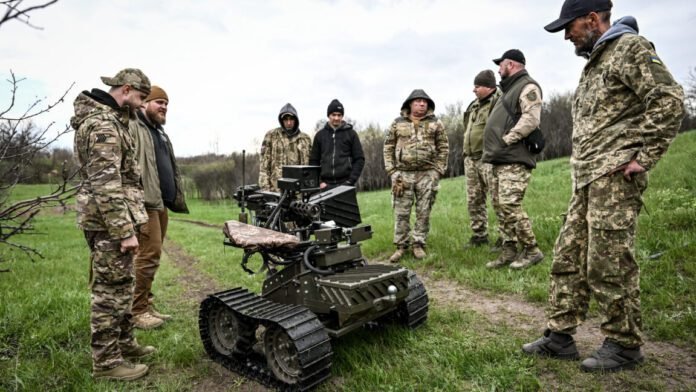
In the latest twist on battlefield innovations, Ukraine has used both flying drone carriers and drone boats to send ground robots armed with weapons or explosives into battle.

The drone-assisted deployments have enabled slower wheeled robots to bypass tough terrain and Russian defenses, and to carry out an unusual robotic amphibious assault on a contested position. Such tactics also showcase the Ukrainian military’s ongoing experimentation with using drones and robots to offset a Russian military advantage in manpower while also sparing Ukrainian soldiers from making dangerous assaults.

On July 19, a Russian military Telegram channel posted a video showing a Ukrainian hexacopter drone carrying a ground robot suspended below by a cable, according to the Ukrainian government-run news platform United24. The Russian Telegram channel described the Ukrainian heavy bomber drone as deploying a four-wheeled ARK-1 robot armed with explosive anti-tank mines on the ground where it continued toward Russian military positions—and apparently generated plenty of outraged comments from pro-Kremlin social media users.

It’s unclear how successful that particular mission was. But the tactic could improve the survivability of ground robots by helping them evade Russian aerial surveillance and drone strikes while closing with their targets more quickly. The ARK-1 robot can roll along at a top speed of nearly 28 miles per hour, although some robots are considerably slower.

Ukrainian ground robots also joined a Ukrainian military operation on June 25 that targeted the Kinburn Spit, a sandy and narrow peninsula that extends westward into the Black Sea and is connected to the Russian-occupied left bank of the Kherson Oblast.

Russian military forces captured the Kinburn Spit in June 2022 and set up positions there to help control southern Ukraine’s port access to the Black Sea, although they began withdrawing from the peninsula in early June as Ukraine’s mid- and long-range drone strike campaigns strained Russian supply lines.

During the June 25 operation, a Ukrainian drone boat lowered a landing ramp to drop off a ground robot on the still-contested Kinburn Spit, according to a video shared by the Ukrainian government on July 13. The remotely controlled robot proceeded to fire its machine gun during apparently “mild” fighting that resulted in a Ukrainian flag-planting demonstration on the contested peninsula, according to Michael Bohnert, a defense researcher at the RAND Corporation think tank, in a social media post. Although Bohnert described it as an impressive feat, he also cautioned that the amphibious robotic assault concept is probably not yet ready for heavy combat scenarios.

The robot and drone surge

Such feats come as Ukraine has orchestrated a battlefield surge of ground robots since late 2025 and demonstrated how teams of drones and robots can overcome Russian military positions on their own. Ukraine’s military robotic missions have ramped up from just under 7,500 missions in January to more than 16,600 missions in June, with robots transporting supplies, evacuating wounded soldiers, clearing or laying mines, and directly engaging in combat operations, according to United24.

Drones carrying robots into battle are also just the latest examples of Ukrainian tactical innovations that have emerged since Russia’s full-scale invasion of Ukraine in February 2022. The Ukrainian military has also been using large flying drones as motherships to carry explosive FPV drones into battle, and has even sent high-altitude balloons deep into Russia to drop one-way attack drones and missiles near their targets. The Russian military has followed suit with its own carrier drones.

Ukraine has also equipped drone boats with the capability to deploy swarms of FPV drones to attack Russian military positions near the coast of the contested Black Sea. A campaign of Ukrainian drone strikes has already effectively stopped Russian shipping of fuel, grain and other supplies through the Sea of Azov.

Meanwhile, the US military has been looking to Ukraine’s example in many cases while seeking to procure a new generation of drones. The US military even sent its own kamikaze drone boats into combat for the first time during the ongoing war with Iran, which continues to severely disrupt the crucial shipping lanes in the Strait of Hormuz.

Migrant smuggling network using rental cars dismantled across the Balkans

0
migrant-smuggling-network-using-rental-cars-dismantled-across-the-balkans
Migrant smuggling network using rental cars dismantled across the Balkans


Authorities in Bulgaria, Greece, the Netherlands, and Romania have taken coordinated action against an organised crime group suspected of smuggling migrants through the Balkans using rented, stolen and fraudulently registered vehicles.

Led by the Greek authorities and supported by Europol, the investigation targeted a criminal network composed mainly of Syrian and Egyptian nationals suspected of organising the illegal transportation of migrants from Greece through Bulgaria and Romania before facilitating their onward journey to Italy.

The action day took place on 16 July 2026, with operational activities carried out in Thessaloniki and Athens (Greece), Sofia (Bulgaria), Bucharest (Romania) and Etten-Leur (the Netherlands).

Seven arrests across three countries

The coordinated action led to the arrest of seven suspects:

  • five in Greece;
  • one in Bulgaria;
  • one in the Netherlands.

So far, authorities have linked the group to 12 migrant smuggling incidents detected between February and July 2026. A further four earlier incidents remain under investigation and are believed to be connected to the same criminal network. The migrants transported were predominantly Egyptian, Iraqi and Syrian nationals.

Criminal network continuously adapted to reduce risks

The investigation uncovered a sophisticated transport network designed to evade law enforcement. To move migrants across borders, the suspects allegedly:

  • transported migrants in small vehicles through Greece, Bulgaria and Romania before transferring them to lorries for the final stage of the journey towards Italy;
  • rented vehicles using genuine and forged identity documents before failing to return them;
  • purchased and registered cars under the names of third parties or front companies;
  • used stolen vehicles, primarily originating from Greece.

Investigators believe the network operated through dedicated cells in Greece, Bulgaria and Romania, with its members travelling frequently across the Balkans to coordinate the smuggling routes.

Europol’s support

Europol facilitated the exchange and analysis of operational intelligence throughout the investigation, helping national authorities identify links between cases and build a comprehensive intelligence picture of the criminal network.

On the action day, Europol deployed an expert with a mobile office to Greece, allowing investigators to cross-check operational information against Europol’s databases in real time, rapidly develop investigative leads and support the coordination of the participating authorities.

The following authorities took part in the action:

  • Bulgaria: General Directorate Border Police (Гранична полиция)
  • Greece: Hellenic Police – Thessaloniki Aliens Directorate (Ελληνική Αστυνομία)
  • Netherlands: Royal Netherlands Marechaussee (Koninklijke Marechaussee)
  • Romania: Directorate for Countering of Organised Crime (Directia de Combatere a Criminalitatii Organizate)

William Lawrence Is Running in a Purple Michigan District — on His Pro-Palestine Credentials

0
william-lawrence-is-running-in-a-purple-michigan-district-—-on-his-pro-palestine-credentials
William Lawrence Is Running in a Purple Michigan District — on His Pro-Palestine Credentials


In key swing districts across the country, Democratic Party leaders have backed centrist candidates with carefully calibrated positions on charged issues such as artificial intelligence and the Israeli-Palestinian conflict.

William Lawrence is running a very different campaign.

In a purple congressional district in Michigan, Lawrence, a co-founder of the progressive Sunrise Movement, is calling for a moratorium on new data centers and labeling Israel’s war in Gaza a genocide.

The approach mirrors that of Michigan Democratic Senate candidate Abdul El-Sayed, who has endorsed Lawrence.

Both men are making strong showings in the polls, and now the centrists are fighting back. A shadowy group is running misleading ads that question Lawrence’s progressive bona fides.

“We have seen this in many cases in other elections this cycle — that corporate centrists are attacking progressives for not being progressive enough.”

The line of attack is telling, Lawrence told The Intercept.

“People are sick of the status quo,” he said. “We have seen this in many cases in other elections this cycle — that corporate centrists are attacking progressives for not being progressive enough. And it shows you what voters are hungry for is change.”

An unabashed progressive, Lawrence breaks the mold of the typical candidate to run for a seat like Michigan’s 7th Congressional District, which is centered around the state capital of Lansing and the college town of East Lansing.

The district was previously represented by centrist Democrat Elissa Slotkin, who now serves in the Senate, and is currently held by Republican first-term Rep. Tom Barrett.

The other two candidates running in Michigan’s August 4 primary hew closer to Slotkin’s mold. Bridget Brink is a former U.S. ambassador to Ukraine who quit in protest of President Donald Trump’s policies on the war with Russia, and Matt Maasdam is a former Navy SEAL who served as a military aide to President Barack Obama.

Unlike Lawrence, both declined to call Israel’s war on Gaza genocide at a debate.

Lawrence also comes from a starkly different background: While Brink and Maasdam traveled the corridors of power in Washington, Lawrence focused on building grassroots power, first through his role co-founding the youth-led Sunrise Movement, which backed the Green New Deal, and more recently helping found the Michigan Rent Is Too Damn High coalition.

Mutual Endorsements

On July 7, Lawrence and El-Sayed announced that they were endorsing each other. Like Lawrence, El-Sayed is running in the progressive lane in his primary while arguing that it will not hurt his electability in the general.

“We have a lot of people who want to back both of us,” Lawrence said. “Given that the two of us both prioritize having a very robust, grassroots campaign rather than just relying on tens of millions of dollars in dark money like our respective opponents, it is especially beneficial for us to be able to integrate our grassroots operations.”

Although no independent polls of the race have been released, Lawrence’s campaign commissioned one showing him leading the pack. Another commissioned by Brink’s campaign showed her ahead.

Now that Lawrence has demonstrated that he has a shot at winning, the attacks have begun.

The Congressional Black Caucus is targeting him over a podcast episode in which Lawrence remarked to a Black anti-war activist during a conversation on organizing that he was frustrated with the position of some older Black political leaders backing “capitalist, imperialist American power.”

Lawrence says his comments have been misrepresented while apologizing for his choice of words.

Meanwhile, a super PAC called the Crush MAGA PAC is targeting Lawrence, rather than the Republican holding the seat. The group has plowed more than $500,000 into a highly misleading ad that accuses Lawrence of investing in “Wall Street, big oil, and data centers” and campaigning against Democrats for supporting the 2024 Uncommitted movement, which sought to pressure party candidates over Israel’s war on Gaza.

The investments highlighted in the anti-Lawrence ad make up a small portion of the $11,000 Lawrence has invested in a mutual fund; the mutual fund, not Lawrence himself, chose them. And, for his part, Lawrence eventually supported Kamala Harris in the 2024 election.

The source of the ad campaign against Lawrence is unclear, but he has speculated that it may be powered by pro-Israel donors.

Crush MAGA PAC is affiliated with another group called the Save Democracy PAC, which has received money from the American Israel Public Affairs Committee’s super PAC, United Democracy Project. United Democracy Project, however, denied getting involved in the Michigan congressional race. (Neither Crush MAGA PAC nor Save Democracy PAC responded to requests for comment.)

If Lawrence succeeds in the primary, he will have to win in a general election in a purple district. He believes he can show that progressive candidates can win in split districts, pointing to the election and reelection of Congressional Progressive Caucus member Rep. Chris Deluzio in a swing district in Pennsylvania.

“He’s not throwing people under the bus, and he has joined the progressive caucus, and he has now turned that into a more comfortable district. He has been winning with healthy margins,” Lawrence said. “That is what I hope to be able to do as well.”

How the Government’s Obligation to Keep Foreign Workers Safe Collided With Its Efforts to Keep Farms Afloat

0
how-the-government’s-obligation-to-keep-foreign-workers-safe-collided-with-its-efforts-to-keep-farms-afloat
How the Government’s Obligation to Keep Foreign Workers Safe Collided With Its Efforts to Keep Farms Afloat

It’s been nearly two years since I started reporting on abuses of foreign farmworkers in Georgia. Some of the workers I tracked down had come to the U.S. legally through the H-2A visa program and were harmed and exploited by labor contractors — despite protections that were supposed to be guaranteed by the federal government. 

During those two years, I’ve thought a lot about how the government’s obligation to keep foreign workers safe has collided with another priority: to help U.S. farmers stay in business. 

Farmers have long pushed for fewer H-2A regulations. That’s in part because of the skyrocketing costs of the program, which sets minimum hourly wages and requires that farmers pay for workers’ housing and transportation. As one Georgia farmer wrote last year in a letter to the U.S. Department of Labor, “It has felt like every policy that pertained to the H2A program was made focusing solely on the benefit of the migrant worker.” 

All of that brings to mind a freezing cold weekend in January 2025, early on in my reporting, when I showed up at a farmers’ conference in Savannah, Georgia. What the farmers sought at that gathering — and what happened in the months that followed — exemplifies the tension between keeping workers safe and keeping farms solvent. 

Read more

After I made my way through a brightly lit convention hall — past the tractor salesman’s stall, the labor regulator’s booth, and tables of peach preserves and dried blueberries — I arrived in a room full of farmers eager to know what President Donald Trump’s second term would mean for an industry dependent on foreign labor and facing a rising number of bankruptcies. 

A small group of lawyers and lobbyists gave several presentations to the farmers. One of them vowed that Trump could “profoundly” change the program, in part by making it easier to hire H-2A workers and pay them less. And if the lobbyists’ plans were successful, farmers would save even more money by facing fewer labor protections for workers. 

“Everything is on the table,” said Braden Boucek, an attorney who has represented the farm industry in challenges to the H-2A program’s requirements. 

In the year to come, Trump’s immigration policies would drastically reduce the number of immigrants crossing the border and accelerate deportations of people without legal status living in the country. But one important pathway — the H-2A visa program — would remain wide open. And the administration, under pressure from the farm industry, would be quick to embrace the types of changes the lobbyists told the farmers about on that frigid January weekend.


To get the financial relief that farmers were seeking, three key things had to change with the H-2A program, the lawyers and lobbyists told the farmers at the conference.

The first was to overturn parts of a rule enacted by the Biden administration. The rule granted workers the right to pursue certain union protections, including ones that would shield them from unfair treatment by their employers. Farmers opposed the rule because they felt it would make it harder to run their businesses.  

At the conference, I listened as former U.S. Labor Department assistant secretary Leon Sequeira told farmers how several ongoing lawsuits could help “invalidate” parts of the rule. The previous June, a Georgia blueberry farm, along with 17 states, had sued the administration, alleging that the rule went beyond what Congress allowed. That lawsuit, along with two others, had led to injunctions that temporarily halted part of the rule. 

Sequeira, who is a lawyer in one of the three cases, later told me that the legal effort “isn’t about denying more protection for workers.” Rather, it’s intended to protect farmers from overreach by the U.S. Labor Department. 

“People can certainly differ on whether or not workers should receive more protection under the law,” he told me. “But as multiple courts have said, that is a decision for Congress to make in passing laws, not the agency.” 

Five months after Trump took office, his administration suspended enforcement of President Joe Biden’s rule. It then proposed to rescind parts of it. That proposal is pending.

The second change was to slow or stop wage increases for H-2A workers that had soared during the first Trump administration and the Biden administration. After months of industry pressure, the Trump administration last year reduced the hourly pay rate, which it expects will save farmers more than $2 billion a year. Those savings are projected to cost H-2A workers up to 32% of their annual wages, according to the think tank the Economic Policy Institute.

The last thing I heard at the conference was an ambitious legal strategy to advance the interests of farmers even further.

One of the lawyers, Ann Margaret Pointer, explained that three recent U.S. Supreme Court rulings had together diminished the powers of the federal government. One decision limits the ability of federal agencies to create new regulations. Another makes it harder for agencies to fine companies that violate some federal laws. And a third makes it easier for employers to challenge federal regulations that had been on the books for many years.

Pointer said those decisions could pave the way for future lawsuits challenging the visa program — and could strengthen the odds of farmers winning those lawsuits. 

All three of those efforts were vital, she explained to the farmers at the conference, to “prevent some of the costs to comply with the H-2A program from falling on your shoulders.” 


I recently reached out to the lawyers and lobbyists who spoke at that conference to ask how they felt about their progress on the plan they’d described. 

Boucek, who is now a U.S. attorney in Tennessee, declined to comment for this story. 

Pointer and Sequeira both said that the Trump administration’s initial changes to the program improved the way it works for farmers. Sequeira also said that the changes are just the beginning of the wish list for the agriculture industry. 

Pointer and Sequeira said the larger changes the industry is seeking to the H-2A program will require action from Congress. They pointed to a recently filed bill that proposes to limit wage hikes, cut red tape for farmers and allow additional sectors of the farming industry to participate in H-2A. (Labor and immigrant advocacy organizations oppose the bill, saying it would harm farmworkers and would amount to executive overreach.)

Until Congress changes the statute, Sequeira said, the Labor Department “can only fiddle around the edges.”

Xi’s national team rides again to save swooning tech stocks

0
xi’s-national-team-rides-again-to-save-swooning-tech-stocks
Xi’s national team rides again to save swooning tech stocks

TOKYO — Chinese stocks just had a remarkable week, with stellar news from startup Moonshot AI delivering a DeepSeek-like jolt to a fragile market. Its new AI model reminded investors how fast China Inc. is closing the technology gap with Silicon Valley.

But as China’s “new economy” grabs the headlines, its “old economy” troubles are grabbing the wrong kind of global attention at a rough moment for Xi Jinping’s Communist Party.

A giant property crisis, near-record youth unemployment, dismal local government finances and weak consumer demand are weighing on markets — and Beijing’s “national team” is back in action.

Xi’s inner circle has reactivated its usual cast of regulators, state-backed investors, insurers and asset managers to circle the wagons after a chaotic tech-share selloff. On Sunday alone, funds tied to Beijing announced purchases of nearly US$8.9 billion in stocks.

National-team deployments have a track record of stabilizing Shanghai shares. The most famous came in summer 2015, when shares fell by a third in a few weeks.

That crisis triggered a whole-of-government response: waves of state funding into markets, trading suspensions across thousands of companies, a freeze on IPOs, and rules letting mainlanders pledge homes as collateral for margin loans. Beijing even rolled out marketing campaigns framing stock-buying as a patriotic act.

The team has been called back repeatedly since: during the 2018 margin-call crisis tied to share-pledge financing, in 2021-22 amid Covid, in 2023 when certain ETFs ran into trouble, in 2025 amid fallout from US President Trump’s tariffs, and now, as tech stocks wobble again.

This round follows investor unease over lofty chip valuations, not helped by wild swings in South Korean and Taiwanese markets. So far, the effort to put a floor under stocks is working.

The national team’s reported buying of China’s largest chip-heavy fund, the ChinaAMC STAR 50 ETF, calmed nerves after a 17% plunge last week — the most intense selloff, driven by funds unwinding leveraged positions, since 2015.

By Tuesday, concerted buying sent the STAR 50 index up 11%, its biggest single-day rally in roughly two years. The broader Shanghai Shenzhen CSI 300 Index is now up 1.7% year to date.

“The national team’s buying of the STAR 50 ETF provided exactly that signal, prompting funds to wade back in after interpreting the move as an official vote of confidence,” Zhuang Jiapeng, fund manager at Shenzhen JM Capital, tells Bloomberg. It also reassured AI investors who, Zhuang says, “had been searching for any sign that policymakers were still willing to back the trade.”

Such interventions treat symptoms, not causes. “China’s national team is offering market protection, not macro repair,” says Geoffrey Yu, strategist at BNY Mellon. “State-backed equity purchases can stabilize benchmarks and reduce downside pressure, but they don’t solve weak domestic demand or the property drag. Beijing can protect prices, but confidence still requires a stronger growth impulse.”

The underlying economic strains aren’t something 27% year-on-year export growth in June can fix — even as that trade performance puts Beijing on track for a second straight year of surpluses topping $1 trillion.

Gavekal Dragonomics notes China’s ratio of annual exports to total manufacturing sales rose to 24% in the first four months of 2026 — the highest since 2001, when China joined the World Trade Organization.

In 2019, the ratio was 18.3%. This year’s level “would be considered high for a small export-focused country,” Gavekal economists write. “For the world’s second largest economy, it’s remarkable.”

The trouble is domestic headwinds may be too strong for exports to offset. Xu Tianchen, an economist at the Economist Intelligence Unit, expects “continued export strength, mostly driven by AI” with help from a more expansionary policy mix. “But,” he says, “domestic demand remains a drag. Retail sales remain pretty flat and fixed asset investment was negative last month.”

Economist Carlos Casanova at Union Bancaire Privée says the 5.3% gain in industrial production is “increasingly concentrated in high tech and semiconductor-related goods. In other words, the gap between exports and industrial output widened, suggesting that the current export-at-all-costs strategy is delivering limited spillovers to the broader economy and raising doubts about its durability.”

Domestic demand remains “subdued,” Casanova adds, while fixed asset investment fell 5.7% year-to-date in June, led by an 8.5% contraction in private investment. Real estate investment fell 18.0% year-to-date; residential property sales fell 13.7%.

Exports, in other words, are no longer the cure-all they once were — not while domestic trends batter both household and business confidence.

The AI supercycle is reinforcing the strong side of China’s K-shaped economy by lifting production. But Citigroup Chief China Economist Xiangrong Yu notes “the benefits of this boom, however, aren’t spreading evenly across the broader economy. Consumer confidence remains subdued, having stayed negative for more than four years.”

Households, Yu adds, “continue to save heavily, maintain large excess deposits, and show limited willingness to take on additional borrowing. Meanwhile, fading policy support and earlier stimulus effects contributed to a contraction in retail sales in May, the first decline since Covid.” Property markets, Yu says, “tell a similar story.”

Conditions have improved in some Tier-1 cities benefiting from AI-related activity, Yu explains, but the broader national market remains weak. “More generally, AI is creating pockets of strength rather than generating a broad recovery in domestic demand.”

Investment trends show the same split: AI-related investment stays robust on hyperscaler, data-center and digital-infrastructure spending, while “investment in many traditional sectors faces mounting headwinds from delayed fiscal deployment, uncertainty linked to geopolitical developments, anti-involution pressures, and squeezed profit margins.” China’s reflation story, Yu notes, reflects the same uneven pattern.

The deeper problem is that Xi keeps deferring the reforms needed to stabilize China’s investment climate. The property crisis is now in its fifth year, producing the longest deflationary streak since the 1997 Asian crisis. Weak household demand and near-record youth unemployment are crushing confidence — which helps explain why China’s 1.4 billion people still save more than they spend.

Defeating deflation for good means getting Chinese households to deploy the more than $22 trillion in savings they’re sitting on. This stockpile is more than four times Japan’s annual gross domestic product, whose lost decades show the cost of complacency. The two problems are linked: roughly 70% of household wealth is tied to property.

If China’s economy became more transparent and stable, and offered real alternatives to owning property, citizens might feel less urgency to send their money abroad. Team Xi is mistaken if it thinks the answer is limiting options to move money overseas. What’s needed is the harder work of building trust — enough to make Chinese households want to invest at home.

Beijing’s renewed efforts to support China’s volatile stock markets are another stop-gap step. Encouraging pensions and mutual funds to invest more in domestic stocks and prodding mainland households to buy more shares are fine for the current quarter – not for the longer term. Such steps are only necessary, though, because Team Xi has been too slow to address the economy’s cracks.

One big debate in financial circles is whether Beijing might resort to weakening the yuan to boost growth. The pros are obvious. A weaker exchange rate would further boost exports, a key reason why China may reach 4.5%-5% growth this year.

Yet the cons are stopping Team Xi from going the weaker yuan route. For one thing, it might make it harder for highly indebted property developers to make payments on offshore bonds. That would increase default risks in Asia’s biggest economy. Seeing #ChinaEvergrande trending again is not what Xi’s party wants in 2025.

For another: the monetary easing required to depress the yuan could squander years of deleveraging efforts. In recent years, Beijing has made important strides in reducing China’s financial excesses and improving the quality of gross domestic product.

As a result, Xi and Premier Li Qiang have been reluctant to let the People’s Bank of China ease more assertively, even as deflation deepens.

Xi’s government has proved more skilled at talking the talk than walking the walk on earning the trust of global investors. Too often, Xi’s reform team put the proverbial cart before the horse.

Team Xi has tended to over-promise and under-deliver on financial reforms. And to think that pulling in more foreign capital is a reform all its own. It’s been slower to strengthen China’s financial system ahead of those waves of overseas capital.

For example, China’s inclusion in the WTO did less to recalibrate its growth engines these last 25 years than to remake the global economic system to its advantage. The 2016 inclusion of the yuan in the International Monetary Fund’s special-drawing-rights basket didn’t stop Beijing from imposing capital control or accelerate capital liberalization nearly as much as hoped.

In 2019, A-share stocks being added to the MSCI index didn’t suddenly make China’s financial system sounder, the government more transparent, companies more shareholder-friendly or the ginormous shadow-banking world any less of a menace.

Strengthening China Inc. — and generating a genuine stock rally with national-team support — requires significant heavy lifting to curb the dominance of state-owned enterprises, increase economic space for the private sector and eliminate the risk of dueling bubbles in debt, credit, assets and pollution.

The key now is for vibrant debt capital markets to help catalyze growth of all sectors, but particularly those in the high-tech space — the realm Premier Li has been elevating over the last year.

It’s also important that Beijing end the regulatory volatility of recent years, particularly concerning internet companies. More international capital markets would accelerate China’s move upmarket.

This week’s bounce in Shanghai shares may suggest investors are giving Team Xi the benefit of the doubt. It’s high time, though, that Beijing stepped up efforts to raise its financial game so that stocks soar for the right reasons, not state help.

Follow William Pesek on X at @WilliamPesek

Anthropic’s $1.5B copyright settlement approved; only 350 authors opted out

0
anthropic’s-$1.5b-copyright-settlement-approved;-only-350-authors-opted-out
Anthropic’s $1.5B copyright settlement approved; only 350 authors opted out

On Monday, a judge approved a $1.5 billion settlement between Anthropic and authors, ending the largest copyright class-action ever certified and granting the largest copyright settlement ever reached.

Back in May, some authors fought to block the settlement, which was proposed after the court ruled that Anthropic training AI on books was fair use; however, its piracy of works was likely not.

Authors opposing the settlement argued that lawyers’ fees were too high and authors’ payouts were too low. Hoping to avoid accepting the estimated $3,000-per-work payout and file separate lawsuits to seek higher damages, a handful of authors tried to opt out past the deadline.

In her order, US District Judge Araceli Martínez-Olguín overruled objections to the settlement as lacking merit. She emphasized that about 95 percent of the class received notifications and approximately 91 percent of authors and publishers impacted have already filed claims. Only 350 class members opted out, while another 54 sought to object or filed late opt-out requests, Martínez-Olguín said.

The high rate of participation suggested that most authors received timely notice of the distribution plan, agreed it was “fair,” and supported the settlement, Martínez-Olguín wrote. She also noted that the $3,000-per-work payouts were “four times the minimum statutory damages.”

Lawyers fees, plaintiffs awards cut

Although Martínez-Olguín approved the total settlement amount, she reduced both lawyers’ fees and the requested awards for the three authors who represented the class in the litigation.

Lawyers originally asked for 20 percent of the settlement in fees, requesting $300 million. Ahead of Martínez-Olguín’s ruling, that percentage was reduced to 12.5, with the total fees requested amounting to approximately $187 million.

The judge ruled that 12.5 percent was too high, however, cutting fees down to less than 7 percent of the settlement fund, which is about $101 million.

Some of those fees include future work that lawyers will do to distribute funds, and some authors argued that lawyers’ projections for time spent were alarmingly inflated. Acknowledging these concerns, Martínez-Olguín wrote in a footnote that the court decided to take “an additional step to protect the interests of the Class.” Once payouts have been finalized, lawyers will be required to file a post-distribution accounting, and if their fees are less, then the court “may reduce” them, Martínez-Olguín said.

Although the settlement likely relieves the three authors who spent years defending their works and 506,194 works from potential class members, the lead plaintiffs are likely disappointed by a decision to reduce their requested service awards from $50,000 to $15,000.

But Martínez-Olguín said that the higher amount was “unreasonable,” despite authors spending substantial time and resources on both litigation and the settlement negotiation. Without a sign that authors may face retaliation for filing the lawsuit, the judge ruled that lower awards were due.

In a statement to Reuters, lead plaintiffs said that the settlement “brings us one step closer to real accountability for Anthropic and puts all AI companies on notice they can’t shortcut the law or override creators’ rights.”

It’s unlikely, but still possible, that authors may receive more than $3,000 per work.

“If any funds remain in the Settlement Fund after all Valid Claims are paid, the Parties anticipate a redistribution of the remaining funds to Settlement Class Members unless it is economically infeasible to do so,” Martínez-Olguín said.

Authors’ lawyers celebrated the judge’s approval, writing in a press release that “rightsholders came together to call foul” on Anthropic’s piracy and describing support for the settlement among them as “overwhelming.”

Anthropic also seems happy to be done arguing about the settlement. In a statement provided to Ars, Anthropic’s deputy general counsel, Aparna Sridhar, said that Anthropic is glad the case’s landmark ruling established that its AI training was fair use and is happy that most rightsholders have already filed claims.

“We are pleased that more than 91 percent of authors and publishers covered by the settlement have claimed their share of the payment, and we’re looking forward to bringing this matter to a close,” Sridhar said.

Anthropic blocked last-minute opt-outs

For every opt-out granted, Anthropic risks facing separate litigation on what Martínez-Olguín said remains a complex case for courts to assess. It makes sense then that Anthropic was motivated to block delayed requests to opt out.

Some authors who opposed the settlement argued that they did not receive timely notices, the opt-out period was too short, and the settlement awards to authors were unacceptable, because the Copyright Act allowed for potentially higher statutory damages.

Martínez-Olguín confirmed that 350 class members successfully opted out of the settlement, but dozens of objections were denied, as were at least nine authors’ direct requests to opt out after the March 30 deadline.

Ultimately, Martínez-Olguín overruled most of the objections and denied most of the late opt-out requests.

The court only accepted two late opt-out requests from authors who showed “excusable neglect” in failing to meet the deadline, Martínez-Olguín said.

The two were co-authors who did not receive settlement notices. One author filed an opt-out request a few days late, which was granted, while the other request was granted after a much longer delay, due to the author suffering a stroke. That author also garnered the court’s sympathy by noting that she “lives in Mexico, speaks Spanish, was not able to understand the class notice, and asserts no Spanish translation was provided.”

One of the last authors to try to escape the settlement at the last minute was Donald Passman, an entertainment lawyer and author who sent his request at the end of June. That was three months after the deadline, which Martínez-Olguín said was “inexcusably late” since records showed the notices were delivered to his current address, where at least one notice was “received,” albeit more than a month after the opt-out deadline.

In a court filing, Passman argued that evidence showed he received late notice of the settlement. He allegedly couldn’t even rely on his publisher, Simon & Schuster, to forward notices and “had no information about the existence of any opt-out deadline” until he received a letter past the deadline that only invited him to claim his payout and did not mention opt-outs.

Passman did not immediately respond to Ars’ request to comment on the settlement approval. But he’s likely disappointed, since he argued that his book, All You Need to Know About the Music Business, is a key industry text and “the estimated per-work settlement payment of approximately $3,351.39 does not adequately compensate me for the potential value of my individual copyright claims.”

Anthropic fought Passman’s attempt to opt out, arguing that he took months to file his opt-out request after learning about the settlement. According to Anthropic, it allegedly strained credulity that Passman “somehow did not hear about the largest copyright settlement ever in a case that generated mountains of headlines.”

“Allowing Mr. Passman to opt out after such a long and unjustified delay would invite others to try the same, undermining finality and risking undue delay in the distribution of Settlement funds,” Anthropic argued. “In a Class of hundreds of thousands, only a tiny fraction—approximately 400—have sought to opt out.”

Martínez-Olguín agreed with Anthropic and said that granting Passman’s request risked opening the floodgates for other authors to back out of the settlement.

In her order, Martínez-Olguín reminded authors that the settlement provided non-monetary benefits they seemed to be ignoring. For one, authors can avoid costly, lengthy, complex litigation that could result in a loss with “zero recovery,” she said, citing precedent showing that “prompt closure” provides value to class members. For another, the settlement requires Anthropic to destroy all their works and allows for future litigation, should Anthropic misuse their works after the dust settles.

Woman’s First Cruise Leaves Her with ‘Catastrophic’ Injury

0
woman’s-first-cruise-leaves-her-with-‘catastrophic’-injury
Woman’s First Cruise Leaves Her with ‘Catastrophic’ Injury


A Louisiana woman’s dream cruise vacation turned into a medical nightmare after a shore excursion in Honduras ended with a devastating injury, emergency treatment aboard a Carnival ship, and a $50,000 air evacuation back to the United States.

Kristen Lindsey was reportedly on the third day of her first cruise when she took part in a rope swing excursion during a stop in Honduras. But what was supposed to be a thrilling vacation memory quickly went horribly wrong.

According to her boyfriend, Blake, a retrieval line that should not have been connected to the swing suddenly tightened just before Lindsey dropped, causing what he described as a “catastrophic saddle injury.”

At first, Lindsey apparently did not realize how serious the injury was. She reportedly thought she had only suffered a minor scratch and returned to the Carnival cruise ship.

But within hours, her condition became frightening.

The pain worsened, the swelling intensified, and the injury reportedly grew to the size of a baseball. What had seemed like an uncomfortable mishap had become a serious medical emergency far from home.

Lindsey’s mother, Tara, said her daughter spent more than 12 hours in the ship’s medical bay as her family and boyfriend scrambled to figure out what to do next.

Blake said he called 911 from the ship before Lindsey was rushed to the vessel’s medical center, where she was treated for several hours. Before leaving the ship, the couple reportedly had to pay about $4,000 out of pocket for her onboard medical care.

As Lindsey’s condition continued to deteriorate, the couple was presented with a brutal set of options.

They could keep her in the ship’s medical facility for the rest of the cruise, get treatment at a hospital in Mexico, try to make their own way back to the United States, or arrange an emergency medical evacuation.

The couple chose the air evacuation, believing it was the safest way to get Lindsey the urgent care she needed.

“We chose the air evacuation because we believed it was the best way to get Kirsten the care she needed,” Blake told NewsNation.

The decision came with a staggering price tag.

According to Blake, the emergency flight cost $50,000, including $20,000 to leave Costa Maya and another $30,000 to return to the United States.

After hours of delays, Lindsey was taken by ambulance to the airport and placed on a private medical jet bound for Fort Lauderdale, Florida. From there, she was rushed to HCA Florida Aventura Hospital, where she underwent her first surgery.

The ordeal did not end there.

After returning home to Louisiana, Lindsey continued receiving treatment at CHRISTUS Highland Medical Center. She is now undergoing a second surgery as she continues recovering from the injuries suffered during the excursion.

What began as a long-awaited vacation has left the couple facing a mountain of unexpected expenses, including medical bills, travel costs, lost income, and the complicated process of getting Lindsey safely back home.

Her family has since launched a GoFundMe campaign to help cover costs as she continues what is expected to be a long recovery.

Airbus, Kawasaki team up to send Eurodrone sub-hunting

0
airbus,-kawasaki-team-up-to-send-eurodrone-sub-hunting
Airbus, Kawasaki team up to send Eurodrone sub-hunting

Conceptual image of the Eurodrone. Image: Airbus

Japan’s Kawasaki Heavy Industries (KHI) has signed a memorandum of understanding (MOU) with Airbus Defence and Space (Airbus D&S) to collaborate on long-endurance unmanned aerial vehicles (UAVs). The agreement covers operations combining the Eurodrone with KHI’s P-1 maritime patrol aircraft, with particular attention to anti-submarine warfare.

KHI is Japan’s second-largest defense contractor. Airbus D&S is the military aircraft and space systems division of Airbus. Airbus has worked with KHI and other Japanese companies for decades, but this agreement takes the relationship to a new level of military cooperation.

Currently under development, the Eurodrone is a large, twin-engine, remotely piloted aircraft with a 30-meter wingspan. A medium-altitude, long-endurance UAV, it can cruise at altitudes up to 12,200 meters (40,000 feet) for up to 40 hours and has a maximum payload capacity of 2.3 tons, excluding fuel.

The Eurodrone will be an armed intelligence, surveillance, target acquisition and reconnaissance (ISTAR) platform able to carry air-to-surface missiles and precision-guided bombs underwing. It will also have command, control and communications, and airborne early warning capabilities. Unlike purely military drones, it will be certified to fly in civilian airspace and use standard air traffic management systems.

The Eurodrone program is supported by Germany, France, Italy and Spain, with Airbus D&S as prime contractor and Leonardo and Dassault Aviation as industrial subcontractors. The European Union co-funds the program. Japan has been an observer since 2023, as has India.

The Eurodrone program operates independently of the International Traffic in Arms Regulations (ITAR), the US export-control regime governing trade in defense products, services and data.

The collaboration will therefore help Europe and Japan reduce their dependence on the US military-industrial complex, building on the existing EU-Japan Security and Defense Partnership.

The Eurodrone is a good fit for both KHI and Japan, which is playing catch-up in drone technology and has a very large jurisdictional sea zone — including its territorial waters (such as the Seto Inland Sea) and its exclusive economic zone (EEZ).

Japan’s EEZ is almost 12 times larger than its national territory. It extends nearly to Taiwan in the southwest, to Okinotori Island, 1,740 km south of Tokyo, and to Minamitorishima (Marcus Island), 1,850 km southeast of Tokyo (see map).

Airbus and KHI are considering development of a specialized anti-submarine variant of the Eurodrone that would carry sonobuoys and torpedoes. It would work in tandem with KHI’s P-1 maritime patrol aircraft, which is designed for prolonged surveillance over the ocean. The P-1 has an operational radius of about 2,500 km and is powered by four turbofan jet engines produced by IHI Corp. (formerly Ishikawajima-Harima Heavy Industries).

A Japanese version of the Eurodrone could include Japanese sensors and other components and involve Japanese participation in manufacturing and maintenance, making it easier for Japan to operate the aircraft independently.

“Furthermore, insights gained from developing Japan’s specific variant are expected to provide substantial operational and logistical advantages for future European naval versions of Eurodrone,” Airbus said.

The Eurodrone isn’t scheduled to make its first flight until 2029, but its capabilities would already exceed those of competing medium-altitude, long-endurance UAVs if it were flying today.

Eurodrone data:

  • Wingspan: 30 meters; length: 17 meters; height: 6 meters
  • Maximum takeoff weight: 13-ton class
  • Mission payload: 2.3 tons (excluding fuel)
  • Maximum speed: 270 knots (500 km/h)
  • Flight time: up to 40 hours

Features:

  • Twin turboprop engines
  • Automatic takeoff and landing
  • Traffic collision avoidance system
  • Air traffic management communications
  • Narrow/wide-band redundant data link architecture
  • Detect-and-avoid system
  • Weather radar
  • Lightning protection
  • Ice detection and protection

Mission payload:

  • Electro-optical/infrared camera
  • Multi-mode surveillance radar
  • Line-of-sight/beyond-line-of-sight datalink
  • Automatic identification system for warship detection

Source: Airbus media assets

Airbus and KHI have jointly produced helicopters for emergency medical services, transport, law enforcement and other purposes for nearly 50 years. KHI, along with All Nippon Airways and Kansai International Airport, joined the Airbus Hydrogen Hub at Airports project in 2024.

Airbus also works with Toshiba on the development of superconducting technologies for hydrogen-powered aircraft. Airbus D&S has design, manufacturing and data supply arrangements with Japanese satellite companies Astroscale, Synspective and Sky Perfect JSAT.

Airbus has also been taking market share from Boeing in Japan, while KHI, Mitsubishi Heavy Industries (MHI) and other Japanese suppliers of aircraft components have been doing more work for Airbus and less for US aerospace giant Boeing.

Follow this writer on X: @ScottFo83517667

0FansLike
0FollowersFollow
0FollowersFollow
0SubscribersSubscribe
- Advertisement -
Google search engine

Recent Posts