19.3 C
London
Tuesday, July 21, 2026
Home Blog

Iran becoming the ‘forever war’ Trump promised to avoid

0
iran-becoming-the-‘forever-war’-trump-promised-to-avoid
Iran becoming the ‘forever war’ Trump promised to avoid

When Donald Trump returned to the White House, he promised to avoid another Middle Eastern “forever war.” After the costly experiences of Iraq and Afghanistan, that pledge resonated with an American public weary of prolonged military intervention.

For a brief moment, it appeared that this promise might be realised. The memorandum of understanding (MoU) signed by the US and Iran on June 17 seemed to offer a pathway away from escalating confrontation. Markets stabilised, regional tensions eased and there was cautious optimism that Washington and Tehran had stepped back from the brink.

That optimism has proved remarkably but unsurprisingly short-lived. US military strikes have resumed and Iran has retaliated against American and its allies across the Gulf. Iran’s proxy allies, the Houthis, have declared themselves ready to close the Red Sea chokepoint at the Bab-el-Mandeb Strait, which has provided an alternative transit route for some oil exports, particularly from Saudi Arabia.

Washington continues to combine military pressure with calls for renewed negotiations. But rather than representing the collapse of an isolated peace initiative, these developments may confirm the reality of grey zone conflict – where diplomacy manages war rather than ends it.

When Americans think of forever wars, Iraq and Afghanistan understandably dominate the discussion. Those conflicts were characterized by invasions, prolonged occupations, attempts at nation-building and the deployment of hundreds of thousands of troops over many years. Their enormous political, financial and human costs eventually became impossible to sustain.

The confrontation with Iran is fundamentally different. It is unlikely to require the occupation of territory and no serious or sustained attempt to directly remake the Iranian state.

Instead, it is fought through air strikes, cyber operations, sanctions, maritime confrontation, intelligence activity and proxy warfare. Military escalation is followed by diplomacy, diplomacy gives way to renewed confrontation, and each episode is presented as a separate crisis.

Viewed collectively, these episodes are better understood as the latest phase of a strategic confrontation that began with the 1979 Iranian Revolution rather than as isolated crises. The conflict has evolved over the years through sanctions, proxy warfare, covert operations and cyber conflict into a more direct military confrontation.

The repeated breakdown of de-escalation efforts is often attributed to mistrust or diplomatic failure. Both undoubtedly matter, but they do not fully explain why the MoU has unravelled so quickly.

Many of its core provisions have become sources of dispute. Israel has continued military operations in Lebanon, despite expectations that regional hostilities would subside. Washington initially signaled greater economic flexibility towards Iran, including easing restrictions on oil exports and discussions surrounding Iranian assets. Yet sanctions have subsequently expanded and further economic measures have been introduced.

From Tehran’s perspective, these actions represent a breach of the spirit – and, in some cases, the letter – of the agreement. From Washington’s perspective, they are responses to continued Iranian activity that it considers destabilising.

The Strait of Hormuz illustrates how quickly ambiguity can become renewed confrontation. Article 5 of the MoU envisaged Iran facilitating the safe passage of commercial shipping through the waterway. Commercial traffic initially increased following the agreement.

But disagreement soon emerged after Oman – in coordination with the International Maritime Organization and with US backing – established a temporary maritime corridor closer to the Omani coast.

Tehran viewed this as inconsistent with the agreed framework and argued that it undermined Iranian responsibility for administering safe passage. Washington rejected that interpretation, maintaining that additional security measures were necessary to protect international shipping.

The competing interpretations rapidly became another source of escalation.

The conflict itself has also evolved. What began largely as strikes against military infrastructure has increasingly extended to facilities with direct consequences for civilian life. This has included energy infrastructure and desalination plants that are essential to freshwater supplies across parts of the Gulf.

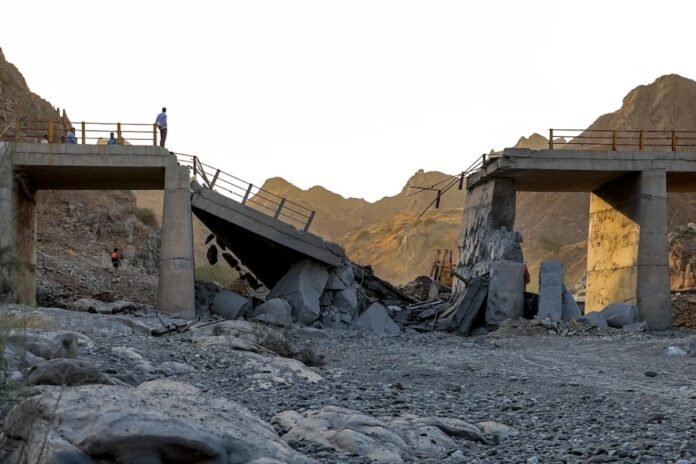
Transport infrastructure, including bridges, has also been targeted. This has prompted debate among military analysts about whether operational objectives are expanding beyond coercive signaling – using limited military force to pressure or influence an opponent’s behavior – towards broader military aims. It has also raised questions about whether some attacks could violate international humanitarian law and, depending on the circumstances, amount to war crimes.

While the expansion of US strikes in this way does not in itself demonstrate that a US ground offensive is imminent, it reflects a widening conflict whose effects increasingly reach civilian populations.

Diplomacy is managing conflict, not resolving it

The deeper problem is that the strategic objectives of the main players here remain fundamentally incompatible.

The US continues to insist that Iran’s nuclear program and regional influence must be constrained. Iran regards those same capabilities as essential to its security and deterrence. Israel continues to view a strategically stronger Iran as an unacceptable security threat.

These objectives cannot all be achieved simultaneously. As a result, diplomacy struggles – not because negotiators lack skill, but because they are attempting to reconcile goals that remain at odds. The MoU temporarily reduced tensions, but it did not alter the structural realities driving the conflict.

This has important implications for how the current crisis should be understood. Much of the debate focuses on whether the latest escalation will produce a wider regional war. That possibility cannot be dismissed.

Yet another scenario may be equally, if not more, plausible. The US and Iran are settling into a prolonged cycle of calibrated confrontation that lasts far longer than many currently anticipate.

Trump promised to end America’s forever wars. Ironically, his presidency may instead come to symbolize the evolution of a new kind of forever war without a clearly defined beginning or end.

The greatest danger may therefore not be another Iraq. It may be the gradual normalization of an enduring conflict that repeatedly disappears from the headlines, only to return in new forms because the political conditions necessary for genuine peace have yet to emerge.

This is a new normal for a US foreign policy establishment that retains militarist mindsets, a massive global military capacity and footprint, and values global primacy in an age of power shifts towards a more multipolar world.

Bamo Nouri is honorary research fellow, Department of International Politics, City St George’s, University of London and Inderjeet Parmar is professor in international politics, City St George’s, University of London

This article is republished from The Conversation under a Creative Commons license. Read the original article.

My Maddening Quest to Find Out if Blueberries Come From Farms Where Workers Were Harmed

0

My Maddening Quest to Find Out if Blueberries Come From Farms Where Workers Were Harmed

Over the past year, I’ve reported about crimes against farmworkers who have come to the U.S. legally from Mexico and Central America. I haven’t stopped thinking about how they suffered. Their wages were stolen, guns were pointed in their faces, and one woman I met was held captive, raped and nearly killed.

As I wrote those stories, there was something else I couldn’t stop thinking about — something I keep thinking about: Whenever I go to the grocery store, I have no easy way of knowing if the fruits and vegetables I put in my cart are part of the problem I’ve documented.

Footage from labor contractor Javier Sanchez Mendoza in 2018 on a blueberry farm. Mendoza was charged in a federal indictment and pleaded guilty to conspiracy to engage in forced labor. via Facebook

I eat a lot of blueberries, which happen to be the fruit grown most in the state where I live, Georgia, and the state where I tracked these abuses. During the long drives back and forth between my home in Atlanta and my reporting trips in the rural South, I had a lot of time to consider how little we know about the farms that feed us.

Max Blau/ProPublica

I struggled with the disconnect between the problems on America’s farms and the limited awareness of those problems in most American households. I felt that disconnect in my own kitchen, every time I reached for the berries in my fridge.

I wanted to know: With enough digging, would it be possible to determine if the blueberries I’m buying come from farms with a record of mistreating workers?

Federal regulators don’t require blueberry brands to disclose on their packaging any information about the individual farms they buy from. So I had to spend time — a lot of time — trying to figure that out.

I started by looking at labels on the blueberry pints in my grocery stores.

I snapped photos. I researched the brands. I read government records.

Max Blau/ProPublica

If you look closely, you’ll see that the pints often list the state where the berries are grown or the city they’re distributed from. But not the farm itself.

Mauricio Rodríguez Pons/ProPublica

As it turns out, the pints sold by a specific brand aren’t always sourced to a single farm. To keep up with demand, and to help keep prices low, brands buy berries from a whole bunch of farms and sell them under a single label.

Illustration by Andrew B. Myers for ProPublica

That makes it even harder to know if the berries you’re buying come from farms where workers were harmed.

I was able to trace one brand’s berries back from my grocery store to an individual farm. I’m not going to name that brand, though, because its practices are hardly unique. Sure enough, I found that the brand did buy berries from a farm that had hired a labor contractor, and that contractor was responsible for some of the abuses in one of America’s largest labor trafficking prosecutions.

That case, which I wrote about at length, revealed that thousands of foreign farmworkers had been illegally charged fees by labor contractors to work in the U.S. Some were forced to pick crops for little to no pay in what prosecutors described as a form of modern-day slavery.

This wasn’t the first case of the abuse of farmworkers at the hands of labor contractors. Or the last. Many of these harms might have been prevented if the workers had received the protections they were promised by the U.S. government. And there have been no substantial reforms to address the abuses, either.

The reason contractors exist in the first place is because farmers struggle to find workers in the U.S.

Many farmers speak only English. So they end up hiring contractors to bring foreign laborers to the U.S. and oversee their work.

That outsourcing can shield farmers from responsibility for — or even awareness of — harm against their workers.

Labor regulators have repeatedly failed to make sure that contractors do what the government requires them to do: keep workers safe and pay them what they’re promised.

Many farmers, brands and grocers were reluctant to talk to me about these abuses. I spoke with experts to see if there are ways for consumers to know if the people picking their blueberries are being mistreated.

Those experts, who study farm labor conditions and food supply chains, said the gold standard for preventing worker abuse is the Fair Food Program. Under the program, supermarkets and other corporate buyers commit to paying a little more for produce — a cost so negligible, at a few pennies per pound, that one expert said it shouldn’t drive up prices.

For those few pennies, grocers get crops from farms that offer their workers stronger protections.

Two farmworkers wear long pants and long sleeves, and bend over a row of tomato plants, with red buckets at their feet. Green tomatoes are scattered on the dirt around them.
Pacific Tomato Growers is one of a few dozen farms to participate in the Fair Food Program, which protects workers against abuse and exploitation. Audra Melton for ProPublica

Fruits and vegetables from those farms are labeled with a green sticker of a woman holding a basket of tomatoes. The stickers give consumers like me a clear indication that the workers who picked that produce were treated fairly.

When I’ve found these tomatoes in my grocery stores, they don’t cost measurably more than others without the label.

Tomatoes with “Fair Food” stickers in a wooden bowl.
Mauricio Rodríguez Pons/ProPublica

Dozens of farms have signed on to the Fair Food Program, and participation in it has been shown to prevent abuse in the fields.

But only a few small blueberry farms participate in the program.

Until that or something else changes, consumers will know virtually nothing about the farms their blueberries come from. And they won’t be able to make choices that could make a difference in the lives of the people who pick them.

ProPublica reached out to more than 75 blueberry brands, grocery stores, fast-food chains, farmers, trade groups and labor contractors over the course of reporting this series.

Only one brand responded. Dole wrote in a statement that it requires contract farmers to comply with labor laws to protect “worker welfare.” Dole added it can trace berries back to the farms where they came from but that it has not made that information available to consumers.

ProPublica also reached out to over 30 of America’s largest grocery and fast-food chains to ask why they haven’t joined the Fair Food Program or expanded their limited participation. None of the companies answered questions about the program.

Over two dozen trade groups declined to talk about why so few farmers participate in the program. Some have opposed efforts by regulators to enact protections like the ones that the program requires. They said the changes would “burden the whole industry for a few bad apples” who disregarded the rights of workers.

Israel Criticizes Australian Labor for Focusing on Israel While Downplaying Hamas 

0
israel-criticizes-australian-labor-for-focusing-on-israel-while-downplaying-hamas 
Israel Criticizes Australian Labor for Focusing on Israel While Downplaying Hamas 


Israel issued strong criticism of the Australian Labor Party’s proposed policy platform ahead of its national conference, saying the draft presents an unbalanced account of the Israeli-Palestinian conflict by focusing heavily on Israel while failing to adequately address Hamas’ role and the responsibilities of the Palestinian leadership. 

In a four-page statement released by the Israeli Embassy in Canberra, Israeli officials challenged several proposals set to be debated at the party’s conference this week, arguing that the draft does not accurately reflect the causes and conduct of the conflict. 

“The Embassy of Israel notes these policy motions are still in draft form, and will continue to engage constructively with the Australian Labor Party through the usual diplomatic channels,” the statement said. 

“However, the embassy respectfully submits that several elements of the draft platform risk placing responsibility for the conflict on one party while giving insufficient attention to the decisions, conduct and continuing obligations of the Palestinian leadership and terrorist organisations such as Hamas.” 

The embassy also rejected what it described as allegations that Israel is committing genocide and objected to the emphasis placed on violence by Israeli settlers in the West Bank. 

Calling settler violence a “reprehensible but marginal phenomenon,” the embassy argued that the issue occupies an outsized place in the draft platform. 

“Those seeking peace would be better served to focus its scrutiny on the terrorism experienced by both Jewish and Arab Israelis at the hands of terrorist groups such as Hamas,” the statement said. 

The intervention comes before Labor’s triennial national conference in Adelaide, where delegates are scheduled to determine the party’s official positions on a range of domestic and international issues, including Israel and the Palestinians. 

Labor’s proposed 2026 platform expands significantly on the party’s 2023 document, which addressed the issue only in relation to recognizing a Palestinian state—a policy formally adopted by the Australian government last August. The new draft includes language opposing the annexation of Palestinian territory and calling for an end to settler violence and what it describes as “the occupation.” 

Israeli officials also pointed to changes made during the drafting process. A provision in an earlier version stating, “Hamas must disarm and can have no role in the State of Palestine,” was removed before the conference draft was finalized. The current version, however, still identifies Hamas as responsible for terrorism and violent extremism. 

Australian Foreign Affairs Minister Penny Wong declined to comment. 


Pay up or not? Ransomware surge has victims facing tough choices.

0
pay-up-or-not?-ransomware-surge-has-victims-facing-tough-choices.
Pay up or not? Ransomware surge has victims facing tough choices.

Nearly half of companies that are targets of a ransomware cyber attack end up paying a ransom to release their data or systems, according to 2025 research from cybersecurity group Sophos, while the median amount demanded is rising.

Globally, some jurisdictions are responding by banning payments to hackers. In the UK, for example, the government is advancing plans to prohibit public sector bodies and critical national infrastructure groups—including the National Health Service, local councils and schools—from making payouts.

The potential veto comes as ransomware hackers have become more advanced and meticulous in their targeting of companies, particularly vulnerable small and medium-sized businesses, over time.

“In 2026, the ransomware landscape has evolved into a highly sophisticated, corporate-style ecosystem,” says Haydn Brooks, chief executive of supply chain security group Risk Ledger. “While ransomware groups operate like smart B2B operations to ensure data return, the legal and sanction risks of paying are at an all-time high.”

This has been powered by the rise of malicious AI hacking tools such as WormGPT, FraudGPT and BruteForceAI, according to Dave Spillane, systems engineering director at Fortinet, who notes that confirmed ransomware victims rose 389 percent year-on-year in 2025, from around 1,600 in 2024 to 7,831 globally.

“In the time it would have previously taken to commit one ransomware attack, hackers can now target four separate organizations simultaneously,” he says.

“The cost per attack has dramatically decreased, commoditizing sophisticated attacks, whereas the cost to defend is increasing,” agrees Shashi Kiran, chief marketing officer of tech group Nile. “What required nation states earlier can be accomplished by individuals with half-baked skills leveraging the power of AI.”

Nevertheless, whether to pay out or not remains one of the most divisive areas in cybersecurity.

Jim Walter, a senior threat researcher at SentinelOne, says that his cyber security group takes a hard line against responding to ransoms.

“Paying extortive threat actors only strengthens the ecosystem and the entities that enable it,” he says, noting that threat actors cannot be trusted to delete data upon payment.

Re-extortion and the ongoing monetization of stolen data are commonplace, he adds. “Paying absolutely does not guarantee recovery, it actually encourages further crime and extortion.”

Others are less absolute. “Our concern with a ban is what happens when a payment ban is in place but data recovery is not feasible,” says Andy Maus, head of cyber recovery services at DriveSavers, which recovers hard drive data. “Situations are almost always more nuanced than a ban accounts for.”

When it comes to critical national infrastructure, for example, such as a water utility or power provider, the consequences for customers can be more serious if a ransom cannot be paid but data also cannot be recovered. “We can see how payment bans make sense where data recovery is a viable alternative; however, blanket prohibition has the potential to cause more harm than it prevents,” Maus says.

He notes that in North Carolina and Florida, where statewide bans were introduced in 2021 and 2022 respectively, “neither ban appears to have materially deterred criminal activity.”

Brooks at Risk Ledger warns that without critical national infrastructure payouts, cyber criminals will “aggressively pivot” to the more unregulated private sector.

If public bodies are banned from paying, “the cyber insurance market will inevitably shift,” he adds, “excluding these payouts and driving premiums sky-high as the costs dwarf the original ransom demands.”

There is now a growing market of services to support companies in their response to attacks, including ransom negotiators, incident response teams and breach coaches that assess data recovery options.

Maus argues that details such as what data was stolen, whether it involves personally identifiable or sensitive health information, and which threat group is responsible, should all be part of weighing whether data recovery is viable or payment is the right option.

But instead of whether to ban payments or not, “the more important question is how to make ransomware less profitable in the first place,” says Gavin Millard, vice-president of product at cyber security company Tenable. Most ransomware attacks still rely on familiar problems such as known vulnerabilities, exposed systems and security gaps, he adds, and the focus should therefore be “exposure management.”

Walter at SentinelOne says companies need an “awareness of emerging trends in the threat landscape alongside proper technical hygiene” including the continuous monitoring of devices and enforced multi-factor authentication.

“What you really need is visibility over access to internal systems, and the ability to limit impact once they’re inside,” says Spencer Young , international senior vice-president at access management group Delinea. “Strong controls—like giving employees temporary, on-the-spot permission only when needed—shrink the blast radius and stop ransomware actors from achieving their goals.”

Others are calling for more innovative support from governments.

Rather than prohibiting payment for an attack that has already happened, DriveSavers’ Maus says investing in subsidized backup infrastructure or tax incentives for cybersecurity spending “would do more to reduce the underlying exposure.”

© 2026 The Financial Times Ltd. All rights reserved. Not to be redistributed, copied, or modified in any way.

South Korea military buildup is for the alliance – and for itself  

0
south-korea-military-buildup-is-for-the-alliance-–-and-for-itself  
South Korea military buildup is for the alliance – and for itself  

The United States and South Korea describe the latter’s defense buildup with the same enthusiasm but mean two different things. American officials call it “alliance modernization,” while South Korean officials increasingly call it “autonomous defense.” Neither side has much incentive to dwell on the difference, but it is getting harder to avoid.

As the Donald Trump administration tells it, South Korea is increasing defense spending and equipment procurement within the context of a redesigned US strategy to restructure the roles of both US and South Korean forces on the Korean Peninsula and beyond.

Modernization is the “administration’s shorthand for pushing US allies to adapt to a changing regional security environment and shoulder more of the defense burden,” Brookings Institution’s Andrew Yeo observed last fall.

Writing for the latest edition of KEI’s Korea Policy, Korea National Defense University’s In Hyo Seol describes modernization as “a redistribution of roles on a foundation of converging military interests.” 

This framework is a more comfortable one for those concerned about friction between the United States and South Korea. Differences over specific issues, such as the timeline for returning wartime operational control (OPCON) of South Korean armed forces, can be more easily managed if both Washington and Seoul share the same goal of alliance modernization.

Autonomous defense

But the reality is more complicated. South Koreans increasingly place their defense buildup and its key components within a different, though not entirely contradictory, policy framework called “autonomous defense.”

Autonomous defense traces its roots to the fear of abandonment in the 1970s, when President Richard Nixon withdrew 20,000 troops from the peninsula during the Vietnam War. More recently, defense autonomy for South Korea means greater self-reliance, indigenous weapons procurement sustained by arms exports, and ultimately limiting the reliance on US forces as a deterrent to North Korea. 

South Korean policymakers have long grappled with a persistent tension in defense policy between a desire for more autonomy and the reality of the operational indispensability of the US-South Korea alliance.

“The goal of autonomy policy is to hold our own while being alliance compatible,” a senior South Korean official told the author on a recent visit to Seoul. In other words, South Korea hopes to shift the alliance’s internal balance of power, reduce technological dependency on US defense systems and build sufficient indigenous capability to make Seoul a more equal partner.

On the surface, the Trump administration’s goals of shifting a greater share of defense burdens to its allies and encouraging a more regional approach to security would seem to be compatible with South Korea’s preferences. But Washington has been clear about the limits: Allies are expected to spend more, not to build alternatives.

The OPCON transfer initiative, for example, was initially targeted in 2012 but has since been replaced by a conditions-based threshold with no fixed timeline. The conditions range from South Korea’s own capability, both in equipment and command, to lead combined forces to its strike and air defense capabilities and, most nebulous of all, to the existence of a regional security environment that would be compatible with the transfer.

In 2019, the allies determined that South Korea met a minimum baseline capability and interoperability with US Forces Korea (USFK). Further progress slowed until recently, when the Trump and Lee Jae Myung administrations agreed that a second stage, full operational capability, would be verified this year. Seoul seems likely to establish 2028 as a new target year for OPCON transfer to occur by.

That push has been met, however, with resistance from the US military, led by USFK Commander Xavier Brunson, who suggested earlier this year that this timeline was too optimistic. The US Senate has backed that up by proposing tighter conditions for OPCON transfer. 

Arms production and exports

Similar tensions lurk not far below the surface when it comes to South Korea’s indigenous arms production and its successful export drive across Europe and Asia. Sales of armored vehicles, artillery, jet aircraft and missile defense systems have transformed the country into a global leader of arms sales.

Earlier this month, President Lee attended a NATO forum and suggested such weapons sales could underpin an evolution of South Korea-NATO ties. But senior Trump administration officials have seemingly pushed back on the notion that allies could or should replace reliance on American weapons.

South Korean President Lee Jae Myung gives a keynote speech at the NATO Defense Industry Forum, July 7, 2026. Photo: The Blue House

“The simple fact of the matter is that no alternative country or countries can compete with the US defense industrial base, either in quantity or quality,” Pentagon policy chief Elbridge Colby asserted on social media last week. The United States “makes the best equipment, and we make it at a scale that no plausible competitor can match,” Colby continued. Access to the US defense industrial base “is a privilege, not a right.”

Thus, even in its most ambitious formulation, South Korea’s autonomous defense still involves maintaining the US extended deterrence commitment in the face of threats from North Korea. Some sort of US military presence makes that political commitment concrete.

“The withdrawal of USFK is not something we want to see,” a senior Lee administration official told this writer. “But if it becomes a reality for us, and we have to fend for ourselves, we need to block the threat of nuclear weapons.”

The most obvious way to do so – and the one that has attracted the most attention in American policy circles – is a South Korean nuclear weapons program. Alternatively, policymakers in Seoul are interrogating whether rapid changes in defense technology might create a reliable form of conventional deterrence. The first option is still beyond the pale, while the second is still a ways down the road.

“We are learning the lessons of the Ukraine and Iran wars,” the senior official explained, notably laser weapons and AI-powered defense systems that can “potentially intercept hundreds of missiles at one time.” 

For now, neither the United States nor South Korea has an interest in forcing the question. But indigenous production, export markets, command authority and the first sketches of a conventional answer to nuclear coercion add up to more than burden-sharing.

Daniel C. Sneider is a non-resident distinguished fellow at the Korea Economic Institute of America (KEI) and a lecturer in East Asian studies at Stanford University. The views expressed here are the author’s alone. Originally published by KEI, the article is republished with permission.

Actress and Miss Universe Finalist Dead at 35

0
actress-and-miss-universe-finalist-dead-at-35
Actress and Miss Universe Finalist Dead at 35


Former Miss Universe Jamaica finalist and actress LaToya Malcolm has died at just 35, leaving Jamaica’s pageant and entertainment communities stunned and heartbroken.

The Miss Universe Jamaica organization announced Malcolm’s death in an emotional Instagram statement on July 18, paying tribute to the former contestant who competed in the 2024 national pageant and later captured the Miss Jamaica Bikini International title that same year.

“We are deeply saddened by the passing of Miss Universe Jamaica alumna LaToya Malcolm, who proudly competed in the 2024 Miss Universe Jamaica Competition,” the organization wrote.

“Our heartfelt condolences are with her family, friends, and loved ones. Rest peacefully, LaToya. You will never be forgotten.”

No cause of death was included in the announcement.

Malcolm was remembered not only as a beauty queen, but also as a Jamaican-based actress, entertainer, dance instructor and mentor who spent more than a decade building a name for herself in the entertainment world. According to the Miss Universe Jamaica organization, she was known for her talent, drive and passion both onstage and off.

Her pageant journey became especially powerful in 2024, when she pushed forward through grief following the death of her father earlier that year. Despite the personal loss, Malcolm continued training and went on to win the Miss Jamaica Bikini International crown.

After her victory, she dedicated the win to her late father in a touching Instagram post.

“My beloved father, Mr. Malcolm, this win was for you. Your one and only daughter continues to make you proud. I know you’re smiling down on me from heaven,” she wrote at the time.

The heartbreaking tribute has taken on new meaning after news of Malcolm’s sudden passing, with fans and fellow pageant figures now looking back on her final year as one marked by both loss and triumph.

Malcolm was also involved in community work through the Transition project, an initiative aimed at helping adolescents gain the training, support and resources needed to step into new opportunities and build brighter futures.

Her death sparked an outpouring of grief online, with supporters flooding the Miss Universe Jamaica comment section with tributes and condolences for her family.

“She was such a wonderful person,” one commenter wrote. “When I met and worked with her in 2024, she was a breath of fresh air. Even though she was grieving her dad’s passing at the time, she pushed through the Miss Universe competition. Rest In Sweet Peace Latty.”

Another person added, “She was so full of light, always joyful. I’m still struggling to comprehend how this could even be possible. My condolences to her family and friends.”

Current Miss Universe Jamaica titleholder Gabrielle Henry also shared a heartfelt message on Instagram Stories after learning of Malcolm’s death.

Henry, who made headlines last year after suffering a shocking fall from the stage at the Miss Universe pageant in Thailand, reflected on the pain of loss while honoring Malcolm’s life and legacy.

“After many years of experiencing loss and hardship, I’ve learnt the deep relevance of pausing and reflecting on the lives of those who lived fully, unapologetically and with great passion,” Henry wrote.

“To hear of LaToya’s passing is a great loss to her family and the wider community, Jamaica, her impact will always be remembered and her voice will not be forgotten. Wishing her family my deepest condolences. May she rest in peace.”

For those who knew Malcolm, her death is especially difficult because she had built a reputation as someone who kept showing up, even while carrying private pain.

She was a performer, a competitor and a woman who used her platform to inspire others. Her final public chapter showed that determination in full view, as she honored her father, chased her dreams and claimed a crown in the same year she endured one of life’s hardest losses.

Now, friends, fans and Jamaica’s pageant world are mourning a woman they say was full of light, joy and purpose.

Malcolm is survived by family, friends and a community of supporters who say her presence will not be forgotten.

AliExpress hit with record $625M fine after failing to make EU-ordered fixes

0
aliexpress-hit-with-record-$625m-fine-after-failing-to-make-eu-ordered-fixes
AliExpress hit with record $625M fine after failing to make EU-ordered fixes

Yesterday, the European Commission slapped AliExpress with the largest fine yet under the Digital Services Act (DSA), exceeding $625 million.

In a press release, the EC said that AliExpress failed to “diligently assess and mitigate risks relating to the sale of illegal, unsafe, or counterfeit products on its e-commerce platform.”

Officials found that AliExpress not only failed to staff teams dedicated to removing counterfeit and dangerous items from the platform, but it also made it easy for bad actors to evade detection.

Staff was so limited that some content moderators were sometimes given just “tens of seconds” to evaluate if a flagged product met EU standards, The Guardian reported. The result, the EC said, was that it “found millions of products that reappeared online” after being flagged for removal, “which sometimes stayed for longer than a month.”

Bad actors can easily skirt AliExpress safeguards, the EC said. All some sellers had to do to circumvent automatic takedowns was miscategorize their products so that fewer checks were required before posting dangerous goods.

For shady sellers, the risks of detection appeared low. The e-commerce site’s mandatory brand authorization system was also ineffective and understaffed, the EC found, and AliExpress did not penalize traders for selling illegal products as its policy claims it would.

Making things worse, AliExpress “inadequately assessed how its recommender and advertising systems exacerbate the spread of illegal products,” the EC said. So rather than remove illegal products, AliExpress was recommending them to consumers and helping to maximize exposure. Talking to the press, the European Union’s tech chief, Henna Virkkunen, noted that one in five Europeans shop monthly at retail sites like AliExpress, Temu, and Shein.

AliExpress also relied on a single quantitative metric to gauge how effectively its systems were working to weed out illegal products. And that metric did not properly measure the extent of the harm. EC testing found that “a high volume of illegal products”—including unsafe toys and dangerous cosmetics—“continued to circulate despite AliExpress’ moderation efforts.”

In June 2025, AliExpress was ordered to bring its platform into compliance with the DSA but failed to make the necessary changes, the EC said. The fine was calculated to be proportionate to the nature of the violations, which the EC considered “particularly serious infringements,” and to penalize AliExpress’s delayed interventions to mitigate flagged risks.

AliExpress “surprised” by DSA fine

The fine dwarfs prior penalties that Temu and X were ordered to pay for the earliest DSA violations.

Last December, X was the first to be fined. Among other violations, X was ordered to pay nearly $140 million after Elon Musk started selling blue checkmarks as the only way to verify an account. The Commission found that the change made it easier to deceive users on X, and the DSA “clearly prohibits online platforms from falsely claiming that users have been verified, when no such verification took place,” the EC said.

Temu was then fined more than $225 million after evidence showed that consumers in the EU were very likely to encounter illegal items on Temu.

Reacting to its much larger fine, AliExpress told Ars it was “surprised” by the “disproportionate” fine.

AliExpress said it plans to appeal the decision, claiming the EC ignored its “sound risk management framework and the significant, proactive enhancements we have made.” The massive online retailer noted that its EU market is substantially smaller than its China market and said that it invests “substantial resources in risk assessment and mitigation, product safety and consumer protection” and “has been and continues to be committed to meeting our obligations to consumers.”

On Sunday, however, Virkkunen, the EU tech chief, said e-commerce giants can’t rely on scale as an excuse for failing to police illegal goods.

“The spread of counterfeit clothing, unsafe toys, dangerous cosmetics and other illegal and harmful products is not an unavoidable cost of shopping online—it is a failure by AliExpress to comply with its obligations under the Digital Services Act,” Virkkunen said. “Scale is not an excuse; risks must be identified and addressed systematically to ensure consumers can safely shop online.”

Air France extends Beirut flight suspension, halts service to Saudi capital Riyadh, Dubai

0
air-france-extends-beirut-flight-suspension,-halts-service-to-saudi-capital-riyadh,-dubai
Air France extends Beirut flight suspension, halts service to Saudi capital Riyadh, Dubai

Air France said on Monday it is extending the suspension of its flights to and from Beirut, Lebanon, until Aug. 2 and temporarily halting services to the Saudi capital Riyadh as well as Dubai due to the security situation in the Near and Middle East, Anadolu reports.

“The resumption of operations will remain subject to an assessment of the security situation locally, which is rapidly evolving,” the airline said in a statement, referring to ongoing hostilities between the US and Iran, also affecting other countries in the region.

Air France said flights to and from Riyadh will remain suspended until July 24 (July 25 for departures from Riyadh), while flights to and from Dubai in the United Arab Emirates will be suspended until July 27 (July 28 for departures from Dubai).

The airline said affected passengers are being informed individually.

It also introduced commercial measures allowing customers to cancel or postpone their trips without additional charge, even if their flights have not been cancelled.

Air France reiterated that “the safety of its customers and crews is its utmost priority,” adding that it continues to monitor the geopolitical situation and airspace restrictions across the region to ensure flight safety and security.

READ: US to boost military aircraft presence in Mideast amid tensions with Iran: Report

Gulf of Thailand’s untapped energy could fuel SE Asia’s growth

0
gulf-of-thailand’s-untapped-energy-could-fuel-se-asia’s-growth
Gulf of Thailand’s untapped energy could fuel SE Asia’s growth

Cambodia and Thailand’s maritime dispute has left an untapped bounty of oil and gas underwater. Image: YouTube Screengrab

For 25 years, Cambodia and Thailand have been unable to resolve a dispute over a shared area of the Gulf of Thailand, keeping one of Southeast Asia’s most promising energy opportunities out of reach. At a time of high energy costs and growing demand across the region, leaving major resources undeveloped makes little sense.

The area is believed to hold nearly 12 trillion cubic feet of natural gas and around 700 million barrels of oil. Its value has been estimated at around $300 billion. For both countries and for the region, this is an opportunity of historic scale.

Cambodia and Thailand now have a chance to turn a long-running dispute into a source of jobs, investment, energy security and social development for millions of people. Energy resources beneath the seabed have little value if they cannot be extracted for the benefit of society.

If developed responsibly, and alongside continued investment in the energy transition, the Gulf’s resources could help power factories, support businesses, strengthen social welfare and create vital opportunities for young workers. 

They could also attract investment, help fund schools and hospitals, and give future generations a stronger foundation. Any discovery would provide economic and energy benefits to Cambodia, Thailand and the ASEAN region at large.

That is why Cambodia has spent 25 years trying to resolve this issue peacefully with Thailand. Further delay helps nobody. It hits ordinary citizens in both countries hardest.

Cambodia is racing toward upper-middle-income and then high-income status. That ambition requires reliable energy, stronger infrastructure, better skills and more productive industries. Cambodia is already investing heavily in that future. 

The Funan Techo Canal, the new Phnom Penh airport, the expansion of the port at Sihanoukville and the Phnom Penh–Sihanoukville Expressway show a country determined to connect more effectively to regional and global markets. A peaceful maritime settlement could become part of that story. It could power growth and support the next stage of Cambodia’s transformation.

Thailand has a major stake too. A Gulf settlement would support Thailand’s competitiveness and long-term energy security, while helping both countries use resources left undeveloped for a quarter-century.

For many years, Cambodia and Thailand had a diplomatic framework for the maritime dispute. The 2001 Memorandum of Understanding, known as MoU-2001, allowed both sides to discuss the maritime boundary and potential resource development without either country conceding its claim. 

MoU-2001 did not solve the dispute, but it kept open the possibility that the Gulf’s resources could one day be developed peacefully and for mutual benefit.

Thailand’s recent withdrawal from that framework was not the outcome Cambodia sought. It risks deepening the deadlock and making development harder to achieve.  Without a framework, open-ended talks will not create confidence that a resolution is possible. They will not reassure investors or convince citizens that the opportunity in the Gulf is any closer to being realized.

That is why Cambodia has initiated compulsory conciliation under the United Nations Convention on the Law of the Sea (UNCLOS). This offers the best available path forward: a peaceful process that gives both countries a structured route back to serious discussion.  Independent conciliators can help Cambodia and Thailand bridge differences and find common ground. 

The Australia–Timor-Leste process showed that UNCLOS conciliation can move a difficult seabed resources dispute toward agreement. That kind of legal certainty is exactly what future development requires.

Private companies will not invest billions of dollars in the Gulf of Thailand without confidence that the dispute can be resolved. Governments need a process that keeps talks moving when domestic political pressure makes compromise difficult.

Citizens need assurance that these resources are protected and that any future development will benefit them. UNCLOS gives Cambodia and Thailand that path.

Thailand’s decision to appoint conciliators and participate in the UNCLOS process is welcome. Both countries now have an opportunity to work through their differences constructively while keeping the focus on a settlement that benefits both peoples.

The benefits will take time. They will require international investment and careful development. No one should pretend that energy exploration is a quick answer to every social or economic need. But the opportunity is too large to remain stuck in deadlock.

When this 25-year-old dispute is resolved, the real value of the Gulf will be measured not only by the energy it supplies and the revenues it generates but also by the thousands of jobs it creates, the schools and hospitals it funds, the businesses it develops and the millions of individual futures it helps shape.

Cambodia has chosen a peaceful legal path to resolve the maritime dispute. With both countries now in the conciliation process, the task is to use it seriously, so the Gulf of Thailand can become a lasting engine of development for the people of Southeast Asia, rather than a historic missed opportunity.

Keo Rottanak is the Minister of Mines and Energy for the Royal Government of Cambodia. He previously served as managing director of Electricité du Cambodge and has spent much of his career working to strengthen Cambodia’s energy security and long-term development and advocating for regional interconnection, particularly through the ASEAN Power Grid.

New Bangladesh government’s rights vow tested by disappearance

0
new-bangladesh-government’s-rights-vow-tested-by-disappearance
New Bangladesh government’s rights vow tested by disappearance

The “disappearance” of Miraj Sheikh has become more than a missing-person case. It has emerged as the first major test of the Bangladesh Nationalist Party (BNP) government’s pledge to break decisively with the human rights practices that defined the final years of ousted Prime Minister Sheikh Hasina’s rule.

Before investigators have established what happened, the case has already evolved into a political and institutional reckoning over whether Bangladesh is replacing a culture of impunity with one of accountability, or merely replacing one set of political assurances with another.

Miraj Sheikh, a local fisherman, allegedly disappeared under circumstances that his family says point to an enforced disappearance. According to reporting by The Daily Star, his wife, who claims to have witnessed his being grabbed by Coast Guard personnel, has pleaded publicly for answers, saying she simply wants to know where her husband is.

The family’s account has resonated because it bears similarities to cases documented during the previous Awami League administration, when rights groups alleged that people were taken by men identifying themselves as members of law enforcement or security agencies before vanishing without official acknowledgment.

Those allegations formed the basis of years of criticism by domestic and international human rights organizations.

Human Rights Watch has described the Miraj Sheikh case as the “first alleged enforced disappearance since the July-August 2024 uprising” that ended Sheikh Hasina’s government.

The organization urged the BNP administration to ensure an immediate, credible and transparent investigation, arguing that the government’s response will determine whether Bangladesh has genuinely broken with past practices or whether enforced disappearances remain a continuing risk under a different political leadership.

HRW said the authorities should establish the fate and whereabouts of the missing man, preserve evidence, hold anyone responsible to account and demonstrate that no security institution is beyond civilian oversight.

The rights group cautioned against treating the incident as an isolated allegation and argued that Bangladesh’s long record of unresolved disappearances requires institutional safeguards rather than political promises.

The case has also entered Bangladesh’s judicial arena. The High Court has directed the government to investigate the alleged disappearance and report its findings, reflecting judicial recognition that the allegations warrant official scrutiny. The court has not concluded that an enforced disappearance occurred.

Rather, its intervention underscores the principle that claims involving possible state involvement or state acquiescence require prompt and impartial investigation.

The order also places pressure on the government to demonstrate transparency at a time when international attention remains fixed on Bangladesh’s human rights trajectory.

BNP’s lack of reform?

The BNP government entered office carrying significant expectations. During years in opposition, party leaders repeatedly condemned enforced disappearances allegedly committed under the Awami League government and promised that Bangladesh would restore the rule of law, judicial independence and accountability.

Those promises became a central element of the party’s political legitimacy after the July 2024 uprising. Consequently, the significance of the Miraj Sheikh case extends well beyond one family’s search for answers.

The investigation has become an early measure of whether the government is willing to subject state institutions to the same scrutiny it once demanded of its predecessor.

The debate has been complicated by the government’s evolving position on legal reforms concerning enforced disappearances.

Rights advocates had hoped that temporary legal measures adopted after the political transition would be transformed into permanent legislation consistent with international standards.

Instead, the government has appeared reluctant to move forward with comprehensive statutory protections. Human rights organizations and legal observers have argued that relying on executive commitments leaves future governments free to reverse policy, while legislation would establish durable legal obligations binding on all administrations regardless of political affiliation.

That concern has gained further prominence following reporting by Netra News, which argued that a draft law under consideration weakens rather than strengthens institutional safeguards promised after the political transition.

The report contends that proposed provisions could dilute the independence of oversight mechanisms and reduce protections sought by victims’ families.

Similarly, an earlier analysis published by Asia Times questioned whether the BNP was retreating from reform commitments that had distinguished it from the previous government.

Both publications argue that Bangladesh risks losing a rare opportunity to create durable institutions capable of preventing future abuses rather than merely responding to individual cases after they occur.

After the BNP-led parliament allowed the Enforced Disappearance Ordinance to lapse, International Crimes Tribunal Chief Prosecutor Md Aminul Islam defended the move, saying the ordinance was “unnecessary” because enforced disappearance was already covered under the tribunal’s existing law.

He said the ICT already had jurisdiction to prosecute such cases, making a separate law or tribunal unnecessary.

Lacking legal safeguards

Critics, however, contend that democratic systems are built precisely on the assumption that legal safeguards should not depend on the goodwill of those currently exercising power.

Human rights organizations have consistently argued that institutions, independent investigations and enforceable laws — not political assurances — provide the strongest protection against abuse.

This debate touches a broader question confronting Bangladesh after the dramatic political changes of 2024. The country has spent years attempting to rebuild public confidence in law enforcement and security institutions following repeated allegations of arbitrary detention, torture and enforced disappearance.

The interim administration initiated several reform efforts, including commissions tasked with examining past abuses and recommending institutional changes. Many victims’ families viewed those initiatives as the beginning of a longer process aimed at truth, accountability and guarantees of non-recurrence.

Whether those reforms become permanent now depends largely on the policies adopted by the elected government.

For the BNP administration, the stakes extend beyond domestic politics. Bangladesh’s international partners have repeatedly emphasized that improvements in governance, judicial independence and human rights will influence the country’s global standing.

Organizations such as HRW are likely to judge the government by how consistently it investigates allegations involving state institutions, publishes findings and holds perpetrators accountable where evidence warrants prosecution.

A transparent investigation into Miraj Sheikh’s disappearance would therefore carry significance well beyond a single criminal inquiry.

At the same time, fairness requires acknowledging that an allegation remains just that until established by evidence. No court has concluded that Miraj Sheikh was subjected to an enforced disappearance or that state agencies were involved.

The government’s response to the High Court’s directive, the quality of the investigation and the evidence ultimately produced will determine whether this case becomes proof of continuing abuse or an example of institutions functioning as intended.

Faisal Mahmud is a Dhaka-based journalist

0FansLike
0FollowersFollow
0FollowersFollow
0SubscribersSubscribe
- Advertisement -
Google search engine

Recent Posts