16.7 C
London
Sunday, July 19, 2026
Home Blog

Syrian President Reshuffles Security Leadership With Senior Appointments

0
syrian-president-reshuffles-security-leadership-with-senior-appointments
Syrian President Reshuffles Security Leadership With Senior Appointments


[DAMASCUS] Syrian President Ahmed al-Sharaa on Sunday announced a series of senior appointments across Syria’s security establishment, reshuffling leadership at the National Security Bureau, the Interior Ministry, and the General Intelligence Directorate as the government continues to reorganize its security institutions during the country’s transitional phase.

Under the new appointments, Interior Minister Anas Khattab was named director of the National Security Bureau while retaining his ministerial post.

Khattab has emerged as one of Syria’s most influential security officials since the fall of former President Bashar Assad. After the formation of the new administration, he was appointed head of the General Intelligence Directorate before becoming interior minister in March 2025. Since taking office, he has overseen a broad restructuring of the Interior Ministry, including consolidating security agencies, strengthening civilian policing, and expanding efforts to combat terrorism and organized crime.

The appointments also named Hussein al-Salama as deputy director of the National Security Bureau after serving as head of the General Intelligence Directorate. Al-Salama previously served as governor of Deir ez-Zor before assuming leadership of the intelligence agency.

Al-Sharaa also appointed Brig. Gen. Mulham al-Shantout as deputy interior minister for security affairs after he served as head of internal security in Hama province. Maj. Gen. Abdul Qader Tahan, formerly deputy interior minister, was named director of the General Intelligence Directorate.

The changes come as Syrian authorities continue restructuring the country’s security institutions and redistributing responsibilities among key agencies as part of broader efforts to rebuild state institutions following the country’s political transition.

The appointments follow a series of security incidents in Damascus in recent weeks. On July 2, a bomb explosion at a café in central Damascus killed five people and injured 16 others, according to the Interior Ministry. Days later, authorities said 18 people, including four police officers, were injured when two improvised explosive devices detonated as bomb disposal teams attempted to defuse them. On July 9, the ministry announced the arrest of a cell accused of carrying out the attacks, saying preliminary investigations indicated links to the Islamic State group.

Clive Davis’ Fortune Sparks Shocking Family Battle

0
clive-davis’-fortune-sparks-shocking-family-battle
Clive Davis’ Fortune Sparks Shocking Family Battle


Clive Davis spent decades deciding who would become music royalty. Now, after his death, the battle may be over the fortune he left behind.

The legendary music producer and industry titan died on June 22 at age 94, leaving behind a jaw-dropping estate, a long list of loved ones and, according to insiders, growing questions about who will inherit what.

Davis, the powerhouse record executive who helped shape the careers of some of the biggest stars in modern music, including Whitney Houston and Aerosmith, was reportedly worth tens of millions at the time of his death, with some estimates placing his fortune far higher.

Now, sources claim the late mogul’s money has become the focus of intense private speculation among those closest to him.

“Everyone adored Greg, but money has a way of changing family dynamics,” one insider told RadarOnline.com. “People are already asking who gets what.”

At the center of the swirling questions is Gregg Schriefer, Davis’ longtime partner, who shared the music legend’s life for decades. Davis is also survived by four children, eight grandchildren and two great-grandchildren, creating what insiders say could become a complicated inheritance picture depending on the exact details of his will.

One source claimed Schriefer’s future could depend entirely on what Davis put in writing before his death.

“Greg was Clive’s family in every sense except on paper,” the insider said. “They built a life together, but without a marriage certificate, everything comes down to what’s in the will.”

That single document could determine whether Schriefer is protected, whether Davis’ children inherit the bulk of the estate, and whether the music legend’s fortune becomes a quiet family matter or a high-stakes legal showdown.

Davis was not just another rich entertainment executive. He was one of the most powerful men in the history of the music business, a kingmaker whose instincts helped turn raw talent into household names. Over the course of his career, he became known as the man with the golden ear, discovering, signing or guiding artists who went on to dominate the charts for generations.

His work with Whitney Houston alone cemented his place in pop culture history. But Davis’ influence reached far beyond one superstar. His name was tied to artists across rock, soul, pop and R&B, and he remained one of the rare music executives whose fame nearly rivaled the stars he helped create.

That kind of legacy often comes with a massive financial footprint, from real estate and royalties to investments, collectibles, business holdings and personal property. And when a fortune that large is left behind, even families that appear close can face pressure once lawyers, documents and inheritance questions enter the picture.

Sources say the situation could become especially sensitive because Davis’ personal life was both deeply private and deeply meaningful to those who knew him. Schriefer was reportedly by Davis’ side for years, sharing a life with him long after Davis had already become an entertainment institution.

But legally, insiders say emotional closeness and inheritance rights are not always the same thing.

That is why the will could become the most important document in the room.

If Davis made clear provisions for Schriefer, it could help prevent conflict and ensure his longtime partner is taken care of. But if the language is vague, or if loved ones disagree over Davis’ intentions, the situation could become messy fast.

For now, there has been no public legal battle. But behind the scenes, sources claim the big question is already hanging over the family: Who gets Clive’s millions?

Davis’ death marked the end of an era in American music. To the public, he will be remembered as the executive who helped launch legends, revive careers and spot star power before the rest of the world caught on.

But privately, his loved ones may now be facing a very different kind of drama.

After a lifetime spent building one of the most glittering legacies in entertainment, the final chapter of Clive Davis’ story may come down to the fortune he left behind — and whether the people closest to him can keep the peace.

Trump again shrinks Bears Ears and Grand Staircase-Escalante National Monuments

0
trump-again-shrinks-bears-ears-and-grand-staircase-escalante-national-monuments
Trump again shrinks Bears Ears and Grand Staircase-Escalante National Monuments

This story was originally published by Inside Climate News and is reproduced here as part of the Climate Desk collaboration.

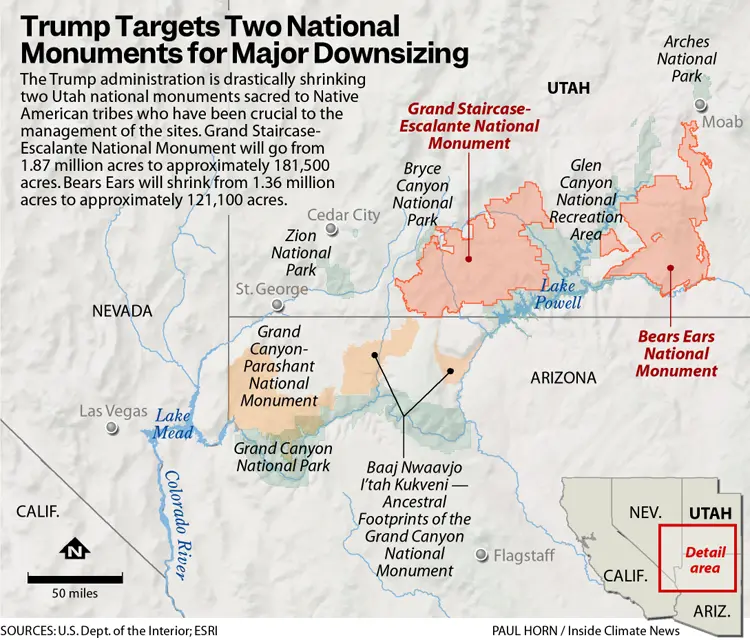
Monday morning, Bears Ears and Grand Staircase-Escalante National Monuments stretched across over 3 million acres of public lands in southern Utah, protecting some of the country’s most remote landscapes and scores of archaeological sites sacred to local tribes. By that evening, President Donald Trump had cut the monuments to just 302,600 acres.

While the two executive orders gutting the monuments and their protections repeat an action from the first Trump administration that was reversed by President Joe Biden, Monday’s reductions go far further than before.

In December 2017, Trump signed proclamations to reduce Bears Ears National Monument from 1.3 million acres to roughly 228,000 acres, an 85 percent reduction, while Grand Staircase-Escalante was cut nearly in half, from 1.9 million acres to about 1 million. Monday’s executive orders cut the monuments to less than a quarter of what was left after the previous shrinking of the monuments.

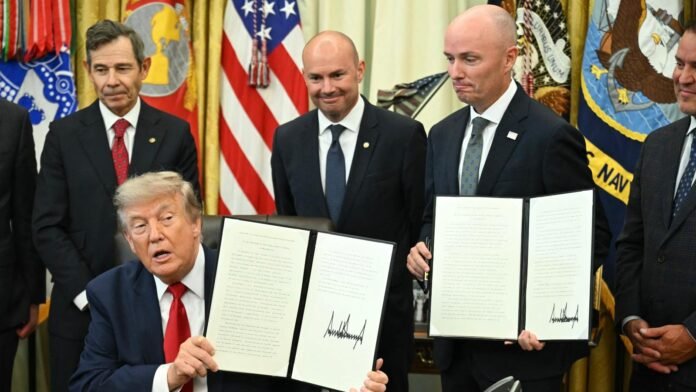
Flanked by Utah Republicans, Trump said in signing the executive orders that new restrictions made it virtually impossible to hunt, fish, or even walk on the monuments, which is not true. Both are accessible to visitors, including for hunting and fishing.

A map of shrunken Utah national monuments

Trump’s executive orders will take effect in 60 days. Shrinking the boundaries of the monuments, the orders state, will better align with the administration’s goals for public lands: opening them up to extraction. 

The orders say the decision puts power back in the hands of local communities, despite its disbanding and terminating of an inter-tribal working group for Bears Ears that led co-stewardship efforts at the monument—the first of its kind, and the result of years of advocacy from local tribes. Tribal officials said they were not consulted about the decision to reduce the monuments. 

“[Trump is] saying the quiet part out loud. He’s being honest: I’m doing this so that we can mine and drill and graze cows,” said John Ruple, a law professor and program director at the University of Utah’s Wallace Stegner Center for Land, Resources, and the Environment. “We’ll see if the American people think those are the best uses of national monuments, and we’ll see if courts agree with that, too.”

Davina Smith-Idjesa, a member of the Navajo Nation and part of both monuments’ inter-tribal coalitions, said reading the proclamations was a reminder “of genocide and that tribes are expendable” in the U.S. 

Uranium mining in the Four Corners region left members of her family sick and dead, she said after the signing of the executive orders, and now the prospect looms of these sacred areas being made available for extraction again.

A sunset view of forest and mountains

A view of Bears Ears National Monument at sunset. Tim Peterson

“Bears Ears is at my back door,” she said during a press conference Tuesday morning. “This is not a political talking point for me. This is home. My ancestors knew this land. My family knows this land. I know where our people go to pray, to gather medicines, to gather food and to heal. This is our grocery store, our medicine cabinet, our classroom, our church. And I need people to understand: You cannot take a pin, draw a line through the landscape, and tell us what remains should be enough.”

Ruple said there is little political upside to the decision, and polling consistently shows Americans support the monuments and the protection of public lands. Attacks on public lands, including Grand Staircase-Escalante, in recent years have consistently failed. 

The Antiquities Act, he said, makes clear that presidents have the power to create monuments, but not rescind them. That power rests with Congress.

The executive orders come after a June decision in the 10th Circuit Court of Appeals that reversed a district court’s opinion to dismiss a lawsuit from the state of Utah attacking the Biden administration’s restoration of the borders of Bears Ears and Grand Staircase-Escalante National Monuments after Trump first shrank them. The lawsuit also targets the powers of the Antiquities Act of 1906, which allows presidents to create national monuments. It was signed by President Teddy Roosevelt, who later used it to protect the Grand Canyon as a national monument before it later became a park. 

“If you go and eviscerate these two monuments, now I suspect we’re going to see the Department of Justice go into the district court and say, ‘Look, this case is moot. The monuments have been reduced by every inch that were restored and the Biden proclamations have now been undone,’” Ruple said. 

Read Next

Environmental groups and tribal leaders who have long advocated for the protection of the two monuments vowed to continue fighting to protect them. Both were vital to the creation of Bears Ears, which is the first and only national monument co-managed between the federal government and local tribes. 

Last time the Trump administration shrank the monuments, Earthjustice, representing a coalition of environmental groups and tribes, sued over the decision. The organization vowed to do so again.

The executive orders came as no surprise. Last March, the Trump administration announced it would eliminate California’s Chuckwalla and Sáttítla Highlands national monuments before removing language announcing that decision from a White House fact sheet. Then last June, the Department of Justice issued an opinion that the president has the power to review and eliminate national monuments.

Project 2025, the policy roadmap for a second Trump administration coordinated by the conservative Heritage Foundation, has called for reducing the size of those national monuments and others — and even suggested repealing the Antiquities Act of 1906.

In a press call Tuesday in response to the executive orders, Democratic members of Congress condemned the proclamations for prioritizing public lands for mining rather than for the American people, expressing fear that other protected areas could be targeted next and that cultural and religious sites could be vandalized.

“This is a trend coming from Donald Trump and from this administration,” said Senator Ben Ray Luján, a Democrat from New Mexico. “While these monuments are in Utah, they belong to all of us across the United States.”

“The administration is on the wrong side of history here, ignoring the voices of Tribal Nations, local communities, and the millions of Americans who want these places protected for future generations,” said Tracy Stone-Manning, Wilderness Society president and former director of the Bureau of Land Management under the Biden administration, in a statement. “As our nation marks 250 years, these public lands should be handed down, not over to drilling and mining interests.”


Turkish foreign minister urges return to US-Iran agreement, says Ankara coordinating with Qatar

0
turkish-foreign-minister-urges-return-to-us-iran-agreement,-says-ankara-coordinating-with-qatar
Turkish foreign minister urges return to US-Iran agreement, says Ankara coordinating with Qatar

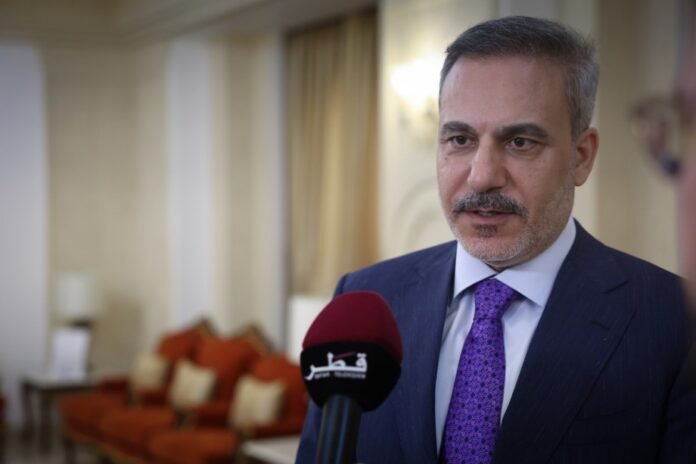
Turkish Foreign Minister Hakan Fidan on Sunday called for a return to the memorandum of understanding signed between the US and Iran, saying Qatar is using all available diplomatic channels to help resolve the crisis and that Turkiye is coordinating closely with Doha, Anadolu reports.

“I am pleased to see that Qatar is once again trying to do everything it can to resolve this crisis by using all constructive methods and all available channels. Hopefully, we will receive good news in the coming days,” Fidan said in an interview with Qatar TV during his visit to the Gulf country.

“Turkiye is also in close coordination with Qatar on this issue,” he added.

Fidan warned that hostilities between the US and Iran war have affected the regional economy and said the risk of a broader conflict could create further instability.

Recalling attacks on infrastructure in the region, he stressed the need to revive diplomatic efforts.

“Our wish is that an agreement between Iran and America will be reached again as soon as possible. As you know, with Pakistan’s mediation, Qatar’s intensive contributions and Turkiye’s support, a memorandum of understanding had been prepared.

“However, we have since moved away from that point. We need to return to it,” he said.

Fidan said he discussed these issues during meetings in Qatar and reiterated Turkiye’s support for Doha’s diplomatic efforts.

“The security and peace of Qatar, as well as the security and stability of the region, are also in Turkiye’s interest. Therefore, as in many other issues, we will continue to work together with the Gulf countries and other countries of the Islamic world on this matter,” he added.

READ: 14 US refueling aircraft arrive in Israel amid Iran escalation: Report

‘Constructive cooperation rather than competition’

Fidan described Turkiye and Qatar as two countries with deep historical ties and a strong strategic partnership, saying the foundation of bilateral relations was laid during the tenure of former Qatari Emir Sheikh Hamad bin Khalifa Al Thani, who died last Sunday.

Offering condolences to the Qatari people, Fidan said Sheikh Hamad was “not only a visionary leader for Qatar, but also for the Islamic world and the world at large.”

“He made highly significant and constructive contributions. Today, both our region and beyond continue to benefit from what he accomplished,” he added.

Fidan also praised Qatari Emir Sheikh Tamim bin Hamad Al Thani for playing a constructive regional role and strengthening Turkiye-Qatar cooperation to address regional challenges.

“We see today that the outstanding example of Turkiye-Qatar cooperation, from Lebanon to Afghanistan, from Afghanistan to Sudan, from Sudan to Gaza, the Palestinian issue and the Iran issue, is increasingly appreciated across the region and serves as a model for others,” Fidan said.

“There is a need for constructive cooperation rather than competition in the region, and Qatar is making serious efforts toward that goal,” he added.

Fidan said Gulf countries, particularly Qatar, Saudi Arabia, the UAE, Kuwait and Oman, have made significant progress by advancing development and public services while building strong states and world-class cities.

READ: Jordan says 3 Iranian missiles intercepted as sirens sound

IDF Warns Iranian Strikes on Jordan Could Spill Over Into Israel 

0
idf-warns-iranian-strikes-on-jordan-could-spill-over into israel 
IDF Warns Iranian Strikes on Jordan Could Spill Over Into Israel 


The Israeli military said Sunday that Iran launched ballistic missiles toward the southern Jordanian city of Aqaba, warning that the attack could result in projectiles or debris entering Israeli territory. 

“There may be spillover into Israeli territory as a result of the fire,” the Israel Defense Forces (IDF) said, adding that air raid sirens would sound if necessary. The military said there were no changes to the Home Front Command’s civilian guidelines. 

Initial reports said large explosions were heard over Eilat as interceptor systems attempted to destroy Iranian missiles headed toward nearby Aqaba. Images and videos shared on social media showed plumes of smoke rising over the Red Sea resort city. 

The IDF later said it had conducted interceptions outside Israeli territory involving interceptor fragments that could have crossed into Israel. It said fragments subsequently fell in northern Eilat, and no injuries were reported. 

Earlier Sunday, Jordan rejected a statement by the US Embassy in Amman that said Jordanian authorities had evacuated Aqaba’s international airport and Red Sea seaport because of what the embassy described as a “specific and credible threat.” 

Jordanian government spokesman Mohammad Al-Momani said no evacuation orders had been issued for either facility in the southern port city. Speaking to the state-run Petra news agency, Al-Momani said Jordanian authorities had detected no potential threats to Aqaba in recent hours. Jordan’s state news agency also quoted a government spokesperson as saying no decision had been made to evacuate either the airport or the seaport. 

The US Embassy had earlier advised US citizens not to travel to either location, saying Jordanian authorities had evacuated both facilities in response to a “specific and credible threat.” 

The developments came as the United States carried out an eighth consecutive night of strikes against Iran after two US troops were killed and a dozen others were injured in a series of strikes on US military bases in Jordan. 


Sharon Osbourne Sparks Death Fears After Hospital Scare

0
sharon-osbourne-sparks-death-fears-after-hospital-scare
Sharon Osbourne Sparks Death Fears After Hospital Scare


Sharon Osbourne has sparked fresh concern for her health after an unexpected hospital visit forced her to miss a major tribute to her late husband, Ozzy Osbourne.

The 73-year-old former The X Factor judge had been expected to attend the unveiling of a statue honoring the Black Sabbath legend at France’s Hellfest festival in late June. Instead, Sharon pulled out after requiring medical treatment earlier in the week.

She shared the news herself on Instagram but did not reveal what sent her to the hospital. Her brief update quickly worried fans, especially after the difficult year she has endured since Ozzy’s death in July 2025 at age 76.

“I’m sorry I couldn’t be at Hellfest for the unveiling of Ozzy’s statue,” Sharon wrote. “Unfortunately, I had an unexpected trip to the hospital earlier in the week.”

She added: “A big thank you Olivier Garnier, Ben Barbaud, and everyone at Hellfest. Special thank you to @philippe_pasqua_officiel for the absolutely stunning statue!”

While Sharon did not offer more details about her condition, sources claimed those close to her have been increasingly worried about how much she has taken on since losing Ozzy.

“Sharon has been through an extraordinary amount emotionally since losing Ozzy,” one source close to the family claimed. “People around her have been worried because she has thrown herself into preserving his legacy while still dealing with immense grief.”

The insider added that news of her hospitalization caused real alarm among friends and family.

“When word spread that she had been admitted to the hospital, there was genuine concern that she had reached breaking point,” the source said.

Another insider claimed friends fear Sharon has barely slowed down since Ozzy’s passing.

“Friends are frightened because Sharon has barely stopped since Ozzy passed away,” the insider said. “She has been determined to honor him, yet she’s also been carrying an enormous emotional burden behind closed doors, and there is a real fear she is at death’s door now.”

Despite the scare, Sharon has continued to focus on projects tied to Ozzy’s legacy. One of the most talked-about is an AI-powered digital avatar of the rock icon, which has already drawn criticism from some fans.

Sharon has pushed back against claims that the project is a cash grab.

“Technology moves on,” she said on The Osbournes podcast. “For somebody to turn around to me and say I’m doing a cash grab, no. You don’t know my husband. I know my husband.”

She said Ozzy often wondered how long people would remember him.

“My husband would say to me over and over, ‘How long do you think I’ll be remembered?’” Sharon said.

She added that the project is something that can be passed down through the family.

“[It’s something] that will pass on through our family, and it’s for our grandkids,” she said.

Her son, Jack Osbourne, has also defended the technology. He said the project is being built carefully and is not meant to make it seem as though Ozzy is still alive.

According to Jack, the avatar uses what he described as “closed AI,” relying only on verified material related to Ozzy’s life and career.

“This is going to be tasteful,” Jack said. “It’s innovative. It’s either we do it, or someone else is gonna do it.”

He added: “For me, it’s not about pretending he’s still alive. It’s making sure he’s never forgotten.”

The project was announced during The Enduring Legacy of a Rock Icon and His Family: Ozzy Osbourne and The Osbournes at Licensing Expo. It is being developed through a partnership between Hyperreal and Proto Hologram.

The companies have said the digital recreation will be able to hold conversations with fans using authenticated data from Ozzy’s life and career.

Sharon appeared excited about the possibilities when discussing the technology.

“The things that you can do with that are just endless,” she said.

Jack later responded to critics on his YouTube channel, insisting the project is far more advanced than a simple chatbot.

“Here’s the thing, it’s gonna be so tasteful what we’re doing,” he said. “It’s not gonna be f—— lame. It’s really complex what we’re doing.”

He continued: “This isn’t just like hooking up an image of my dad to ChatGPT. This is some high-level technology that we’re gonna be working with, and it’s gonna feel very real, and it’s kind of wild how it will be utilised.”

For now, Sharon’s fans are left hoping her hospital scare was only temporary. But her absence from the Hellfest tribute has raised new concerns about how deeply Ozzy’s death continues to weigh on the woman who spent decades by his side.

As mosquito ranges expand, better monitoring is key to preventing disease

0
as-mosquito-ranges-expand,-better-monitoring-is-key-to-preventing-disease
As mosquito ranges expand, better monitoring is key to preventing disease

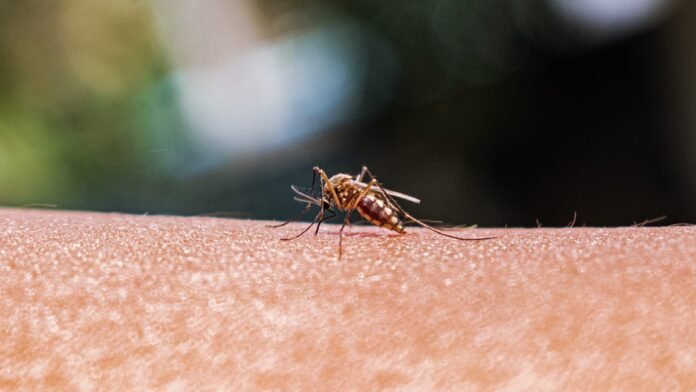
With summer heat comes pool parties, beach days, backyard cookouts, and, of course, swarms of bloodthirsty mosquitoes.

But while insect bites have always been a side effect of time spent outdoors, the species doing the biting are changing in historically temperate regions like New England. As climate change makes these areas warmer and wetter, their ranges are expanding—and any diseases they carry come with them.

In Connecticut, for example, a statewide mosquito monitoring program has detected 54 different species, including invasives like the Asian tiger mosquito, which can transmit potentially serious diseases including dengue and Zika. The mosquito’s historical territory is in hot and humid climates farther south, but it has been moving north.

“There are a number of new species that are creeping into our area,” said Philip Armstrong, chief scientist at the Connecticut Agricultural Experiment Station, which coordinates the state’s mosquito trapping and testing program.

Programs like these are key for preventing mosquito-borne diseases, especially as climate change alters the risks. “You really do have to test the mosquitoes to know where the hot spots are for these viruses,” Armstrong said. “By the time we learn about human cases, it’s usually too late to do anything.”

There aren’t statewide monitoring programs in much of the country. Instead, a patchwork quilt of more than 1,000 mosquito control agencies tries to keep ahead of an evolving problem. Most are run at the local level, with a wide range of organizational structures and monitoring practices.

The US ought to have a national surveillance database collecting and sharing information from all monitoring programs, said Dan Markowski of the American Mosquito Control Association, a nonprofit that works to reduce mosquitoes and vector-transmitted diseases. But, he added, “it all obviously comes back to money.”

Last week, Connecticut announced that mosquitoes in the state have already tested positive for West Nile virus this season. The virus, which appears every summer, has become the leading cause of mosquito-borne disease in the Northeast. While most infections are asymptomatic, it can cause flu-like symptoms and has resulted in more than 3,300 deaths since it first appeared in the US in 1999.

Connecticut established its monitoring program two years before that to monitor for a different virus: Eastern equine encephalitis, a rare but serious mosquito-borne disease that can cause neurological issues and has a roughly 30 percent fatality rate. While it is still uncommon, outbreaks are becoming more frequent in New England.

“There’s these cycles of increased virus activity, and we didn’t see that before, historically,” Armstrong said. “It has the hallmarks of something that’s being affected by climate change.”

In temperate regions like the Northeast, global warming can alter mosquito-borne disease risks not only by expanding the range of virus-carrying insects but also by lengthening the transmission season, reducing the number of mosquito predators and changing habitats, among other factors. Researchers predict that tropical mosquito-borne diseases like Zika, dengue, chikungunya, and malaria will likely become established in temperate areas because of climate change.

“As the temperatures rise, you can actually speed up mosquito development, so you can have multiple cycles of mosquitoes every year in new areas,” said Brian Leydet, who studies mosquito- and tick-borne diseases at the State University of New York College of Environmental Science and Forestry.

Beyond mosquitoes, Leydet said environmental changes can also affect viruses and their original hosts, such as birds and deer, creating complex ecological shifts that can be difficult to study.

Leydet helped establish a monitoring program in St. Lawrence County, New York, in 2024, after an Eastern equine encephalitis outbreak. Unlike Connecticut, New York does not have a statewide program, and many counties “lack the infrastructure and budget to conduct regular mosquito monitoring,” according to the project announcement.

Monitoring programs are typically labor-intensive and expensive, requiring teams to set and check traps, alongside specialists who can identify, sort, and test the samples. While some traps attract female mosquitoes with “stinky water” loaded with decaying organic material, others require dry ice to release carbon dioxide that mosquitoes sniff out when hunting for mammals. But in rural parts of New York, dry ice can be hard to come by—the team had to make their own.

Even beyond the logistical and resource challenges, communication, coordination, and data sharing for mosquito monitoring can be a challenge.

“One of the problems with states that are not comprehensively doing these surveillance programs is that surveillance is hit or miss,” Leydet said. “A lot of these surveillance programs are run by the counties, and they’re not really talking to each other.”

Leydet’s lab found that this patchwork system means some invasive mosquito species are flying under the radar.

Funding is another challenge to better surveillance. “If the county doesn’t have money or resources, these programs fade away,” Leydet said. “If we don’t have these surveillance programs, then all we’re doing is responding to a problem when it’s already a problem, and that’s never how prevention works.”

That could change with a bill introduced in the New York State Legislature this session, which would lay the groundwork for a comprehensive mosquito surveillance program—rather than what the bill calls the “sparse and disintegrated” current system—to help public health officials respond before an outbreak.

Proactive measures can include removing pools of standing water, applying targeted larvicides in breeding habitats, and warning the public to use insect repellent and cover bare skin when outdoors, though outbreaks may require more widespread pesticide spraying.

Leydet said greater centralization would be a start, but widespread coordination in large states like New York can be a challenge: “There is general interest in these programs, but when you start seeing what they cost, it’s like, ‘Maybe we’re not that interested.’”

Still, he said, “any help is better than nothing.”

This article originally appeared on Inside Climate News, a nonprofit, non-partisan news organization that covers climate, energy, and the environment. Sign up for their newsletter here.

It’s Scary As Hell Being Black in America Right Now

0
it’s-scary-as-hell-being-black-in-america-right-now
It’s Scary As Hell Being Black in America Right Now


Alain Stephens is an investigative reporter covering gun violence, arms trafficking, and federal law enforcement.

There is a tangible heat to being Black in America this summer. 

Every morning starts the same. A jolt of coffee and nicotine as my thumbs scroll a daily intake of Black death and indignity. 

It mostly comes dosed in tears. Tears of Black moms and aunties, projected behind stone-faced fathers and grandpops trying to hold it together behind press podiums. 

This summer, it was Nolan Wells, an 18-year-old who disappeared during a trip to Mississippi’s Horn Island over the Fourth of July. Wells, who traveled to the island with a predominately white group of friends, was found dead in the water two days later. Authorities have not announced a final determination of what happened, but Wells’s family has challenged the official timeline and sought an independent autopsy. The investigation remains ongoing, which is to say that another Black family is waiting for answers in the indeterminate dark. In a state synonymous with deep-seated anti-Black racism, and the highest number of recorded lynchings, speculators and community members have begun to fear the worst.

It’s an expectation that has set the tone for living while Black in this new era. Where at any moment you, as Black person, can be erased for the most negligible of offenses, and if you’re not careful, be discarded into the void.

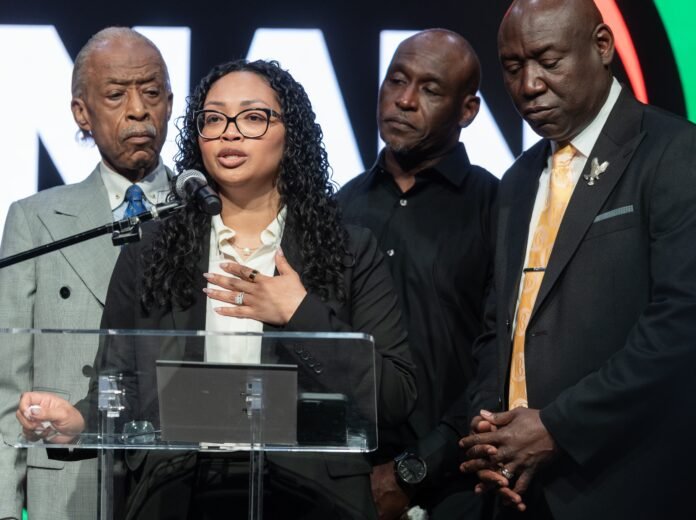
Before Nolan Wells, we watched in June as another Mississippi family laid their Black boy to rest. Kohen Wiley, who was just a year old, was shot and killed by Senatobia police officers, who fired into the vehicle where Wiley was sitting on his mother’s lap. After a friend of Wiley’s mother was accused of shoplifting a box of diapers at a Walmart, police opened fire on their car under the pretense that the vehicle was “oncoming” toward the officers. Civil rights attorney Ben Crump has said the officers were not in the car’s path, citing a photo from the scene. A month later, investigators have yet to release body camera footage of the incident or provide any new answers. No charges have been filed.

Black Americans had already borne witness to those familiar echoes. Earlier that month, a jury in South Carolina acquitted 61-year-old Rick Chow of a murder charge after he shot and killed Cyrus Carmack-Belton, 14, for the alleged offense of stealing bottled water. Video evidence of the 2023 incident shows the store owner chasing Carmack-Belton out of the shop after falsely accusing him of theft. Chow, who had twice before shot patrons he suspected of shoplifting, would go on to shoot the teenager in the back as he fled. 

Whether over a box of Pampers or a gulp of water, it is a startling reminder that for too many non-Black Americans, protecting even the most trivial property can take precedence over the sanctity of a Black life.

It’s an existential dread that has now turned into expectation, an anxiety meant for the mind to blunt the inevitable oncoming pattern of pain, disappointment, and injustice — in this case, being Black in America.

These deaths do not exist in isolation. They arrive amid a broader retreat from the institutions that, however imperfectly, once acknowledged Black Americans as a constituency deserving of protection and investment.

And the casualties of Black existence transcend more than just bodies. The Trump administration has waged full spectrum warfare on Black identity in every sense. 

Since Trump returned to office, Black workers have experienced rising unemployment, with Black men seeing some of the steepest job losses in recent memory, according to an analysis by the Economic Policy Institute.

This coincides with broader efforts by the Trump administration to dismantle federal diversity, equity, and inclusion initiatives, directing agencies to terminate DEI programs and contracts while encouraging similar rollbacks throughout the private sector. The administration has also sought to reshape how race is discussed across the federal government, from education and museums to civil rights enforcement. 

At the same time, the administration has continued to chip away at the legal architecture of voting rights, with years of court decisions making it more difficult to challenge racial gerrymandering and voting restrictions. The Supreme Court’s recent decision dismantling key Voting Rights Act protections has opened the door for states to erase Black-majority districts, which threatens to strip Black communities of congressional representation across the South. 

If there was anything novel to the current pulse of American white supremacy, it is that it doesn’t seek domination but to erase Blackness altogether.

Trump’s supporters have come out in droves to support this mission, from swarms of masked white supremacists descending on the U.S. Capitol in honor of our nation’s 250th birthday to the endless viral videos of white men brandishing guns at Black people doing anything from swimming at the pool to handing out flyers

It is no surprise that, under the constant reminder that the market value of Black life has plummeted, many Black Americans are succumbing to despair. Suicide rates among Black Americans — especially young Black men — have risen sharply over the past decade. Researchers point to a convergence of untreated depression, limited access to mental health care, economic instability, exposure to violence, and the cumulative weight of racialized stress.

None of those policies alone determine whether a police officer fires a gun, whether a jury reaches a particular verdict, or what pushes a broken down mind over the brink. But together they communicate something many Black Americans increasingly recognize: that America has further turned tail and ran away from its promise of an egalitarian society, or even the aspiration that it should be one. 

That departure has consequences well beyond Washington. It shapes who receives the public’s attention, which communities are viewed as worthy of investment, and whose fears are treated as matters of national concern. 

For Black Americans watching another summer marked by funerals, investigations, and courtroom disappointments, the sentiment is not simply that violence persists. It is that the country is becoming less interested in confronting why it persists at all

That is the understanding of it. But the feeling is something entirely different.

And that feeling is scary as hell.
Libya joins China’s payment system, reducing reliance on US dollar

0
libya-joins-china’s-payment-system,-reducing-reliance-on-us-dollar
Libya joins China’s payment system, reducing reliance on US dollar

The Governor of the Central Bank of Libya, Naji Mohammed Issa, and the Governor of the People’s Bank of China, Pan Gongsheng, agreed Saturday to connect Libyan commercial banks to China’s payment and settlement system, Anadolu reports.

In a statement on its website, the Central Bank of Libya said Issa, who is visiting Beijing, met with the Governor of the People’s Bank of China on Friday.

They reviewed the volume of trade between the two countries and discussed ways to strengthen it and increase its growth rate.

“The importance of launching a new phase of genuine strategic partnership between the two central banks was discussed. It was agreed to connect Libyan commercial banks to China’s Cross-Border Interbank Payment System, CIPS, which will simplify financial transfers and make them easier to conduct,” it said.

CIPS was launched by the People’s Bank of China in 2015 to facilitate international transfers using the Chinese yuan.

It serves as an infrastructure that enables banks to send and receive yuan-denominated payments directly, reducing reliance on the US dollar by eliminating the need to process transactions through intermediary banks.

READ: Libya announces new oil field discovery with estimated reserves of 195M barrels

The statement added that the two sides also agreed to address existing obstacles and facilitate trade procedures in a way that would increase the volume of trade between the two countries.

It would begin with the implementation of direct money transfers to China, making transactions easier for small-scale traders.

The two sides also agreed to allow letters of credit to be opened directly through Chinese banks, according to the statement.

They also agreed to arrange a visit to Beijing by an official Libyan banking delegation, headed by the governor of the Central Bank and accompanied by the directors of Libyan commercial banks, to meet their Chinese counterparts at the earliest possible opportunity.

The statement noted that the planned visit aims to establish cooperation between commercial banks in the two countries and to benefit from China’s experience in electronic payments and direct financial transfers.

It added that the measures would help reduce reliance on the informal market, ensure compliance with anti-money laundering and counter-terrorism financing standards, and improve the reputation of Libya’s banking sector.

READ: China, Pakistan urge US, Iran to cease hostilities, resume dialogue

Syria and Iraq Sign US-Backed Deal To Revive Strategic Oil Pipeline 

0
syria-and-iraq-sign-us-backed-deal to revive-strategic-oil-pipeline 
Syria and Iraq Sign US-Backed Deal To Revive Strategic Oil Pipeline 


[DAMASCUS] Syria and Iraq have signed two memorandums of understanding to revive the long-idled Haditha-Banias crude oil pipeline, in a move that has drawn strong backing from the United States and could reshape regional energy routes if brought to fruition.  

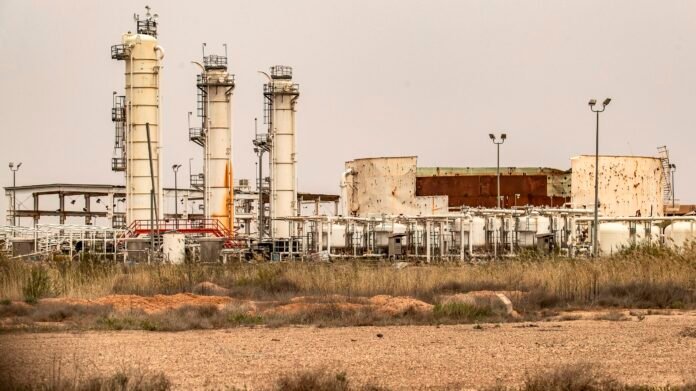
The agreements, signed during meetings in Washington, aim to restore one of the Middle East’s most strategically significant oil corridors, linking Iraqi crude production to Syria’s Mediterranean coast and providing Baghdad with an additional export outlet beyond the Gulf.  

Under the first agreement, the Syrian Petroleum Company and Iraq’s Basra Oil Company will cooperate to rehabilitate the pipeline, which is historically connected to the Kirkuk-Banias route. A second memorandum was signed with an international consortium comprising Chevron, UCC Holding, and TI Capital to conduct technical and financial studies and prepare implementation plans for the project.  

According to the Syrian government, the signing ceremony took place in the United States in the presence of Iraqi Prime Minister Mohammed Shia al-Sudani, the US secretary of energy, and senior officials from both countries.  

The project revives a pipeline with deep historical roots. Construction of the Kirkuk-Banias line began in 1950, and the pipeline entered service in 1952, carrying Iraqi crude from the Kirkuk oil fields to Syria’s Banias terminal on the Mediterranean through an approximately 890-kilometer route built by the Iraq Petroleum Company.  It remained one of Iraq’s principal export arteries until April 1982, when Syria halted Iraqi oil flows after siding with Iran during the Iran-Iraq War.  

Efforts to restore the pipeline have repeatedly stalled over the past four decades because of political tensions between Baghdad and Damascus, international sanctions imposed on Iraq during the 1990s, damage to infrastructure following the 2003 US-led invasion of Iraq, and the collapse of a joint rehabilitation initiative launched in 2007.  

Washington welcomed the latest agreements, with the US State Department describing the pipeline as a priority regional infrastructure project with strategic significance for both countries. The department also expressed support for the US-led consortium participating in the technical and financial aspects of the rehabilitation effort, noting that the pipeline is ultimately expected to transport up to two million barrels of crude oil per day.  

Economic analyst Abdel Azim al-Maghrabel told The Media Line that, if implemented, the project could become one of the region’s largest energy infrastructure developments.  

“It would provide Iraq with a new export corridor to the Mediterranean, reducing reliance on traditional shipping routes while increasing flexibility in reaching international markets,” he said.  

Al-Maghrabel added that Syria could also benefit by restoring its role as a regional energy transit state through transit revenues and renewed investment in its energy infrastructure.  

“The project extends beyond economics,” he said. “It has the potential to reshape regional energy corridors by establishing a land route linking Iraqi crude directly to the Mediterranean. The participation of major international companies also reflects growing interest in reinvesting in Syria’s and Iraq’s energy sectors.”  

Preliminary estimates suggest the first phase could take around 30 months to complete. Syria could earn roughly $200 million annually in transit fees during the initial stage of operations, with revenues potentially exceeding $500 million per year once the pipeline reaches full capacity, although those figures have yet to receive independent technical or official confirmation.  

Despite the political momentum surrounding the agreements, significant obstacles remain. Securing a pipeline that spans vast desert areas, rehabilitating decades-old infrastructure, mobilizing billions in investment, and completing the necessary legal and regulatory frameworks will all be essential before construction can proceed.  

While the memorandums mark the first serious attempt in more than four decades to revive the pipeline, analysts say the project’s success will ultimately depend on whether political commitments translate into financing, security coordination, and tangible progress on the ground.  


0FansLike
0FollowersFollow
0FollowersFollow
0SubscribersSubscribe
- Advertisement -
Google search engine

Recent Posts