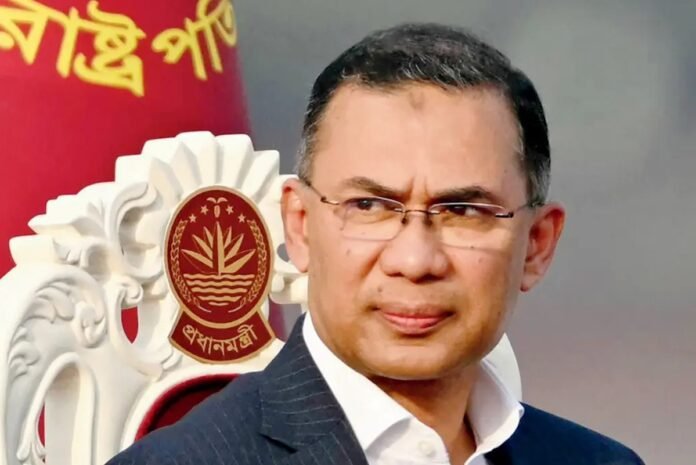
Driven by shifting domestic political dynamics and a transforming regional landscape, Bangladesh’s new prime minister, Tarique Rahman, who came to power after a landslide in February this year, has shelved plans to visit its most consequential neighbor, India, for the time being.
Senior officials at the Ministry of Foreign Affairs and diplomatic sources familiar with the matter have confirmed this strategic decision to Amar Desh, one of Bangladesh’s highest-circulated vernacular daily newspapers. This correspondent also independently verified the claim by speaking with relevant Foreign Ministry officials.
A state visit to New Delhi by a Bangladeshi prime minister has always been the country’s most important bilateral engagement, as well as its most sensitive and challenging. Dhaka manages no bilateral relationship as complex as its one with India, particularly over unresolved, structurally significant disputes such as transboundary water sharing.
Although New Delhi initially declared that a fresh chapter in bilateral relations would begin after Rahman assumed office, the Indian administration has yet to take meaningful steps to translate that public assurance into reality, at least from the perspective of policymakers in Dhaka.
Tensions are compounded by critical structural deadlines. The much-discussed Ganges Water Sharing Treaty expires this December, yet New Delhi has not responded to Dhaka’s requests to keep the existing agreement in force until a comprehensive new treaty is negotiated.
Diplomatic sources say the level of mutual trust required for a high-profile prime ministerial visit is absent. Alongside what Dhaka views as New Delhi’s hostile reaction to Rahman’s recent trip to Beijing, India has heightened border friction through alleged push-ins.
Furthermore, Zahed Ur Rahman, one of the prime minister’s top policy advisers, was recently subjected to prolonged harassment at Delhi airport. Most critically, India is seen as trying to destabilize Bangladesh by protecting and enabling Sheikh Hasina, who has been convicted of crimes against humanity, to re-enter the political arena from her sanctuary in Delhi.
Against this backdrop, all discussions regarding a visit to New Delhi have frozen. Diplomatic sources in both capitals say the likelihood of such a visit taking place this year is virtually non-existent.
Political analysts in Dhaka have welcomed this measured distance, arguing that the prime minister has made the right call. They contend that India has historically refused to trust any political force in Bangladesh other than the Awami League and Hasina. Though the new government has been in office for less than six months, New Delhi has already sought to exert pressure by fostering instability inside the country.
Analysts argue that unless India fundamentally changes its patronizing approach, Dhaka should maintain its distance. They stress that the government must ensure the strategic foundation established in Bangladesh-China relations is not undermined.
Setting aside India, the Foreign Ministry is now focusing on Rahman’s participation in the upcoming United Nations General Assembly in New York, alongside planned state visits to Japan and Saudi Arabia.
This diplomatic freeze coincides with a startling domestic development. Nearly two years after fleeing Bangladesh amid a historic student uprising, Hasina announced her intention to return home from exile in Delhi this December.
In a recent interview with Reuters, the ousted prime minister, now 78, acknowledged that she could face immediate arrest, execution or assassination. Yet she insisted she had no alternative, declaring that she wanted to die on the soil where her parents were buried.
Whether that journey materializes remains uncertain, but the announcement reveals how dramatically her political options have narrowed. Exile in India no longer appears sustainable.
Mounting legal pressure from Dhaka, India’s delicate diplomatic balancing act and the steady collapse of her party’s domestic structure have left her with little room for maneuver. The International Crimes Tribunal has sentenced her to death over crimes against humanity linked to the deadly suppression of the student protests.
Dhaka has repeatedly sent extradition requests to India, while New Delhi has carefully avoided making any public commitment. Despite hosting her since August 2024, India has never publicly granted her political asylum, as doing so would amount to a permanent commitment to shield her indefinitely.
Instead, she remains a highly sensitive guest whose presence complicates India’s effort to rebuild ties with Bangladesh’s new administration. For India, the dilemma is profound. For more than 15 years, New Delhi invested heavily in Hasina’s administration, which became its closest strategic partner in South Asia.
Abandoning that ally risks damaging India’s credibility across the region, yet continuing to protect a leader sentenced to death for mass killings carries mounting diplomatic costs. Every improvement in bilateral relations narrows New Delhi’s room for indefinite delay.
Faced with these challenges, Bangladesh’s latest diplomatic reshuffle offers the clearest indication that Dhaka is recalibrating how it intends to deal with its largest neighbor after years of what many officials describe as unreciprocated goodwill.
The decision to replace High Commissioner M Riaz Hamidullah in New Delhi with serving Foreign Secretary Asad Alam Siam marks a significant shift in diplomatic philosophy.
Internally, Hamidullah’s tenure had come to symbolize an overly deferential approach towards India, one that leaned heavily on cultural diplomacy even as border irritants accumulated, according to a senior Foreign Ministry official familiar with the deliberations.
The turning point came with the incident involving Zahed Ur Rahman, who abandoned his visit to India after being held up at immigration in New Delhi. Dhaka reacted by summoning India’s acting high commissioner and lodging a formal protest.
Taken together, the suspension of a prime ministerial visit, the diplomatic reshuffle in New Delhi, the public dispute over Hasina’s future and Bangladesh’s growing emphasis on alternative strategic partnerships point to a broader recalibration rather than a passing diplomatic disagreement.
Unless trust is rebuilt through concrete actions on both sides, the relationship is likely to remain defined by caution instead of the political momentum that both capitals had once promised.
Faisal Mahmud is a Dhaka-based journalist

![People stage a pro-Palestinian demonstration and call on Labour Party leader Andy Burnham, who is preparing to take office as prime minister, to impose comprehensive sanctions on Israel, in London, United Kingdom on July 18, 2026. [Raşid Necati Aslım - Anadolu Agency]](https://www.middleeastmonitor.com/wp-content/uploads/2026/07/AA-20260718-42007374-42007364-PROPALESTINIAN_PROTEST_IN_LONDON_CALL_ON_ANDY_BURNHAM_TO_IMPOSE_SANCTIONS_ON_ISRAEL.jpg "Pro-Palestinian protest in London call on Andy Burnham to impose sanctions on Israel")
![People stage a pro-Palestinian demonstration and call on Labour Party leader Andy Burnham, who is preparing to take office as prime minister, to impose comprehensive sanctions on Israel, in London, United Kingdom on July 18, 2026. [Raşid Necati Aslım - Anadolu Agency]](https://www.middleeastmonitor.com/wp-content/uploads/2026/07/AA-20260718-42007315-42007299-PROPALESTINIAN_PROTEST_IN_LONDON_CALL_ON_ANDY_BURNHAM_TO_IMPOSE_SANCTIONS_ON_ISRAEL.jpg "Pro-Palestinian protest in London call on Andy Burnham to impose sanctions on Israel")
![People stage a pro-Palestinian demonstration and call on Labour Party leader Andy Burnham, who is preparing to take office as prime minister, to impose comprehensive sanctions on Israel, in London, United Kingdom on July 18, 2026. [Raşid Necati Aslım - Anadolu Agency]](https://www.middleeastmonitor.com/wp-content/uploads/2026/07/AA-20260718-42007315-42007301-PROPALESTINIAN_PROTEST_IN_LONDON_CALL_ON_ANDY_BURNHAM_TO_IMPOSE_SANCTIONS_ON_ISRAEL.jpg "Pro-Palestinian protest in London call on Andy Burnham to impose sanctions on Israel")
![People stage a pro-Palestinian demonstration and call on Labour Party leader Andy Burnham, who is preparing to take office as prime minister, to impose comprehensive sanctions on Israel, in London, United Kingdom on July 18, 2026. [Raşid Necati Aslım - Anadolu Agency]](https://www.middleeastmonitor.com/wp-content/uploads/2026/07/AA-20260718-42007315-42007306-PROPALESTINIAN_PROTEST_IN_LONDON_CALL_ON_ANDY_BURNHAM_TO_IMPOSE_SANCTIONS_ON_ISRAEL.jpg "Pro-Palestinian protest in London call on Andy Burnham to impose sanctions on Israel")
![People stage a pro-Palestinian demonstration and call on Labour Party leader Andy Burnham, who is preparing to take office as prime minister, to impose comprehensive sanctions on Israel, in London, United Kingdom on July 18, 2026. [Raşid Necati Aslım - Anadolu Agency]](https://www.middleeastmonitor.com/wp-content/uploads/2026/07/AA-20260718-42007315-42007297-PROPALESTINIAN_PROTEST_IN_LONDON_CALL_ON_ANDY_BURNHAM_TO_IMPOSE_SANCTIONS_ON_ISRAEL.jpg "Pro-Palestinian protest in London call on Andy Burnham to impose sanctions on Israel")
![People stage a pro-Palestinian demonstration and call on Labour Party leader Andy Burnham, who is preparing to take office as prime minister, to impose comprehensive sanctions on Israel, in London, United Kingdom on July 18, 2026. [Raşid Necati Aslım - Anadolu Agency]](https://www.middleeastmonitor.com/wp-content/uploads/2026/07/AA-20260718-42007315-42007298-PROPALESTINIAN_PROTEST_IN_LONDON_CALL_ON_ANDY_BURNHAM_TO_IMPOSE_SANCTIONS_ON_ISRAEL.jpg "Pro-Palestinian protest in London call on Andy Burnham to impose sanctions on Israel")
![People stage a pro-Palestinian demonstration and call on Labour Party leader Andy Burnham, who is preparing to take office as prime minister, to impose comprehensive sanctions on Israel, in London, United Kingdom on July 18, 2026. [Raşid Necati Aslım - Anadolu Agency]](https://www.middleeastmonitor.com/wp-content/uploads/2026/07/AA-20260718-42007315-42007308-PROPALESTINIAN_PROTEST_IN_LONDON_CALL_ON_ANDY_BURNHAM_TO_IMPOSE_SANCTIONS_ON_ISRAEL.jpg "Pro-Palestinian protest in London call on Andy Burnham to impose sanctions on Israel")
![People stage a pro-Palestinian demonstration and call on Labour Party leader Andy Burnham, who is preparing to take office as prime minister, to impose comprehensive sanctions on Israel, in London, United Kingdom on July 18, 2026. [Raşid Necati Aslım - Anadolu Agency]](https://www.middleeastmonitor.com/wp-content/uploads/2026/07/AA-20260718-42007374-42007365-PROPALESTINIAN_PROTEST_IN_LONDON_CALL_ON_ANDY_BURNHAM_TO_IMPOSE_SANCTIONS_ON_ISRAEL.jpg "Pro-Palestinian protest in London call on Andy Burnham to impose sanctions on Israel")
![People stage a pro-Palestinian demonstration and call on Labour Party leader Andy Burnham, who is preparing to take office as prime minister, to impose comprehensive sanctions on Israel, in London, United Kingdom on July 18, 2026. [Raşid Necati Aslım - Anadolu Agency]](https://www.middleeastmonitor.com/wp-content/uploads/2026/07/AA-20260718-42007315-42007302-PROPALESTINIAN_PROTEST_IN_LONDON_CALL_ON_ANDY_BURNHAM_TO_IMPOSE_SANCTIONS_ON_ISRAEL.jpg "Pro-Palestinian protest in London call on Andy Burnham to impose sanctions on Israel")
![People stage a pro-Palestinian demonstration and call on Labour Party leader Andy Burnham, who is preparing to take office as prime minister, to impose comprehensive sanctions on Israel, in London, United Kingdom on July 18, 2026. [Raşid Necati Aslım - Anadolu Agency]](https://www.middleeastmonitor.com/wp-content/uploads/2026/07/AA-20260718-42007315-42007303-PROPALESTINIAN_PROTEST_IN_LONDON_CALL_ON_ANDY_BURNHAM_TO_IMPOSE_SANCTIONS_ON_ISRAEL.jpg "Pro-Palestinian protest in London call on Andy Burnham to impose sanctions on Israel")