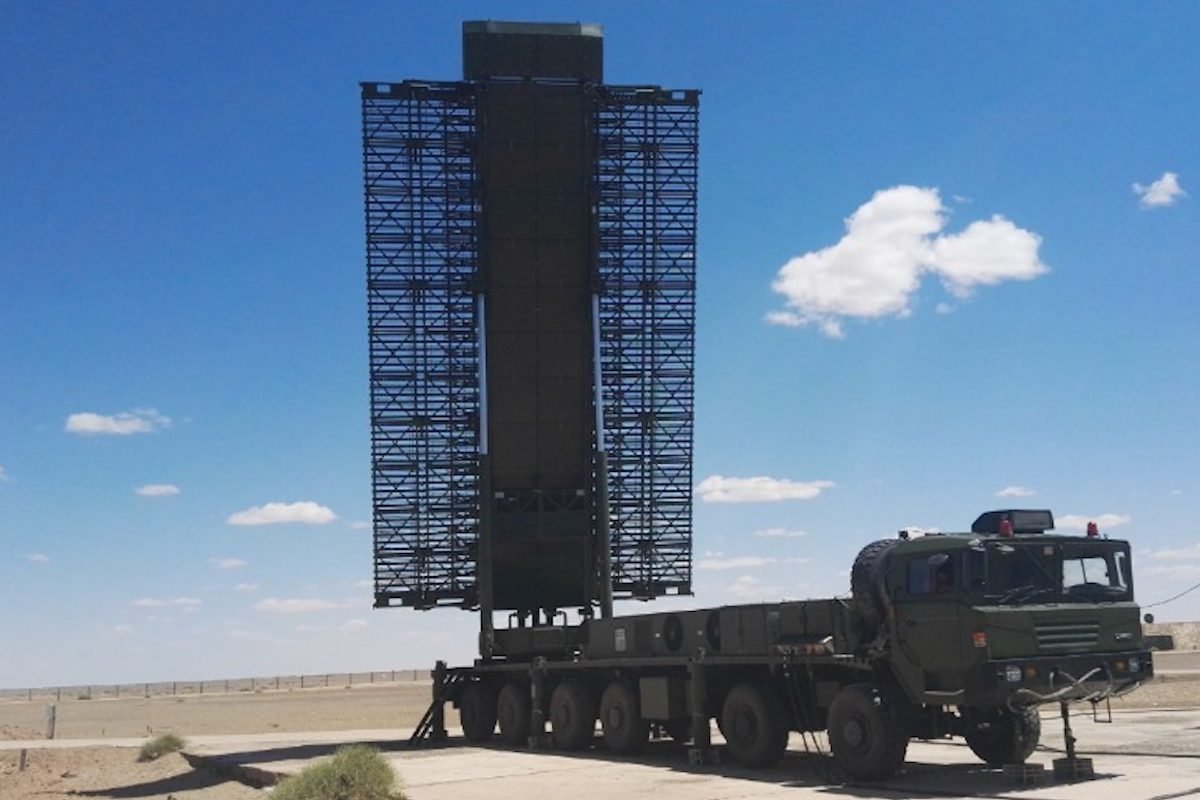
China is building an increasingly sophisticated anti-stealth network, but its effectiveness may depend less on individual radar performance than on its ability to integrate, maintain and operate the wider system under combat pressure.
Last month, the China Aerospace Studies Institute (CASI) released a report arguing that China’s drive to counter and replicate US stealth technology is reshaping the Indo-Pacific air balance but remains constrained by flawed assumptions about how low-observable aircraft operate.
The report found that the 1999 Serbian shootdown of an F-117 reinforced Chinese confidence in low-frequency radar and encouraged investment in layered sensors, integrated air defenses and indigenous stealth aircraft, including the J-20, J-35 and planned H-20 bomber.
But the report argues that China often treats stealth as a hardware problem, underestimating US advantages in mission planning, electronic warfare, software, training and tactical adaptation.
Chinese radars may provide early warning but still struggle to generate the continuous, weapons-quality tracks needed for engagement amid clutter, electronic attack and complex terrain around Taiwan and the South China Sea.
The report warns that exaggerated confidence in counter-stealth defenses could embolden Beijing and heighten the risk of miscalculation. It recommends that the US institutionalize stealth education, expand operator training and sustain bomber deployments in the Indo-Pacific.
The central question is whether China can turn an expanding collection of sensors into a resilient combat network capable of maintaining reliable tracks on low-observable aircraft.
In a March 2025 CASI report, Eric Hundman wrote that China is systematically replacing third-generation air-defense systems with more advanced fourth-generation hardware designed to improve detection of stealth aircraft.
According to Hundman, this approach combines highly mobile active radars with passive sensors that can detect targets without continuously transmitting and revealing their positions.
He adds that by networking radars operating across different frequency bands at the brigade level, the People’s Liberation Army (PLA) aims to combine incomplete observations into a broader air picture.
He notes that China ultimately envisions a redundant, interconnected sensing network capable of maintaining surveillance of fifth-generation aircraft and constraining US freedom of action.
Yet a March 2023 article by Lu Xiaoqiang and his co-authors in the peer-reviewed Chinese Journal of Aeronautics found that radar returns from stealth aircraft are highly dependent on geometry because radar cross-section varies sharply with aspect angle.
Lu and his co-authors say that stealth shaping concentrates stronger radar returns into a small number of narrow angular sectors while suppressing returns across most other aspects. Consequently, they state that stronger detections occur mainly when one of those narrow signature peaks aligns with a radar’s line of sight.
They point out that because the aircraft’s aspect changes continuously in flight, those peaks may appear only briefly, producing intermittent contacts rather than a stable track during penetration.
But even with that limitation, a January 2023 article by Ye Kang and his co-authors in IET Radar, Sonar & Navigation shows how a distributed radar network could partially compensate for such intermittent and corrupted data through collaborative track fusion.
Kang and his co-authors say that individual radar nodes first filter background noise and reject tracks identified as probable deception targets. They add that the nodes then exchange and iteratively reconcile their remaining track estimates with neighboring sensors.
They note that repeated exchanges reduce the influence of any corrupted sensor and allow the network to converge on a more reliable estimate of the target without depending entirely on a central command node.
A greater uncertainty is whether these concepts can survive the maintenance, integration, electronic warfare and command pressures of actual combat.
A January 2026 Newsweek report raised questions about the performance of Venezuela’s Chinese-made JY-27A radars during a US raid, citing maintenance problems, limited readiness and weak integration as possible explanations.
Newsweek cites a Miami Strategic Intelligence Institute assessment saying spare-parts shortages and minimal Chinese technical support had reportedly left more than 60% of Venezuela’s radar fleet out of commission.
The episode illustrates a broader point: even a functioning counter-stealth radar has limited value if it cannot pass usable tracks to command centers, fighters or surface-to-air missile batteries.
Reporting on recent operations in Iran has prompted similar questions, although the available public evidence remains incomplete.
Van Taylor points out in a May 2026 Wall Street Journal (WSJ) article that China’s YLC-8B anti-stealth radars failed to detect low-observable US and Israeli aircraft in a high-intensity combat environment during the opening hours of Operation Epic Fury.
Taylor adds that instead of tracking stealth targets, the network was bypassed entirely; the sole US F-35 damaged during the March hostilities was struck using a passive infrared sensor system rather than any radar, exposing operational deficiencies in China’s military hardware.
Separately, Miles Maochun Yu argued in a Hoover Institution commentary this month that the June 2026 crash of a light aircraft into Beijing’s CITIC Tower raised questions about coordination within China’s tightly controlled airspace.
Yu attributed the incident to possible institutional barriers between civilian air-traffic authorities and military command. However, Chinese authorities later said the pilot had deliberately deviated from his approved flight area and had mental health issues; they did not link the crash to military command failures.
He further argued that recent PLA leadership purges may have disrupted command relationships and readiness. His broader argument is that advanced sensors cannot compensate for fragmented authority, poor readiness or delayed command decisions.
China’s counter-stealth challenge will therefore turn increasingly on whether the PLA can keep a dispersed sensor network connected, supplied and responsive under sustained attack. Until that capability is demonstrated, the network may constrain US flight planning and raise the cost of penetration without reliably denying access to stealth aircraft.