22.8 C
London
Saturday, July 18, 2026
Home Blog

Bangladesh shelves India reset as tensions trump trust

0
bangladesh-shelves-india-reset-as-tensions-trump-trust
Bangladesh shelves India reset as tensions trump trust

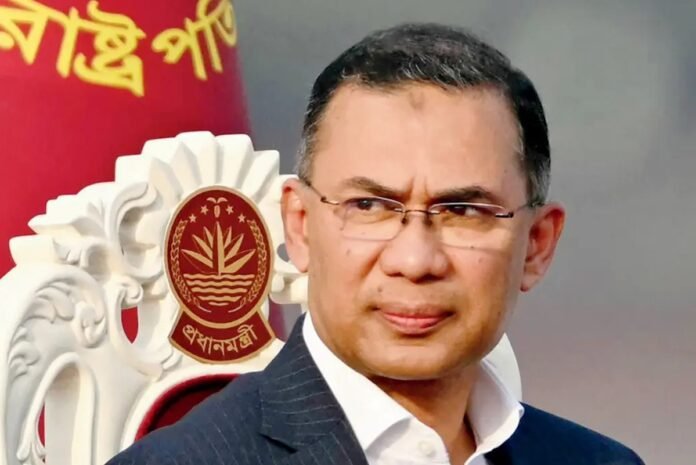
Driven by shifting domestic political dynamics and a transforming regional landscape, Bangladesh’s new prime minister, Tarique Rahman, who came to power after a landslide in February this year, has shelved plans to visit its most consequential neighbor, India, for the time being.

Senior officials at the Ministry of Foreign Affairs and diplomatic sources familiar with the matter have confirmed this strategic decision to Amar Desh, one of Bangladesh’s highest-circulated vernacular daily newspapers. This correspondent also independently verified the claim by speaking with relevant Foreign Ministry officials.

A state visit to New Delhi by a Bangladeshi prime minister has always been the country’s most important bilateral engagement, as well as its most sensitive and challenging. Dhaka manages no bilateral relationship as complex as its one with India, particularly over unresolved, structurally significant disputes such as transboundary water sharing.

Although New Delhi initially declared that a fresh chapter in bilateral relations would begin after Rahman assumed office, the Indian administration has yet to take meaningful steps to translate that public assurance into reality, at least from the perspective of policymakers in Dhaka.

Tensions are compounded by critical structural deadlines. The much-discussed Ganges Water Sharing Treaty expires this December, yet New Delhi has not responded to Dhaka’s requests to keep the existing agreement in force until a comprehensive new treaty is negotiated.

Diplomatic sources say the level of mutual trust required for a high-profile prime ministerial visit is absent. Alongside what Dhaka views as New Delhi’s hostile reaction to Rahman’s recent trip to Beijing, India has heightened border friction through alleged push-ins.

Furthermore, Zahed Ur Rahman, one of the prime minister’s top policy advisers, was recently subjected to prolonged harassment at Delhi airport. Most critically, India is seen as trying to destabilize Bangladesh by protecting and enabling Sheikh Hasina, who has been convicted of crimes against humanity, to re-enter the political arena from her sanctuary in Delhi.

Against this backdrop, all discussions regarding a visit to New Delhi have frozen. Diplomatic sources in both capitals say the likelihood of such a visit taking place this year is virtually non-existent.

Political analysts in Dhaka have welcomed this measured distance, arguing that the prime minister has made the right call. They contend that India has historically refused to trust any political force in Bangladesh other than the Awami League and Hasina. Though the new government has been in office for less than six months, New Delhi has already sought to exert pressure by fostering instability inside the country.

Analysts argue that unless India fundamentally changes its patronizing approach, Dhaka should maintain its distance. They stress that the government must ensure the strategic foundation established in Bangladesh-China relations is not undermined.

Setting aside India, the Foreign Ministry is now focusing on Rahman’s participation in the upcoming United Nations General Assembly in New York, alongside planned state visits to Japan and Saudi Arabia.

This diplomatic freeze coincides with a startling domestic development. Nearly two years after fleeing Bangladesh amid a historic student uprising, Hasina announced her intention to return home from exile in Delhi this December.

In a recent interview with Reuters, the ousted prime minister, now 78, acknowledged that she could face immediate arrest, execution or assassination. Yet she insisted she had no alternative, declaring that she wanted to die on the soil where her parents were buried.

Whether that journey materializes remains uncertain, but the announcement reveals how dramatically her political options have narrowed. Exile in India no longer appears sustainable.

Mounting legal pressure from Dhaka, India’s delicate diplomatic balancing act and the steady collapse of her party’s domestic structure have left her with little room for maneuver. The International Crimes Tribunal has sentenced her to death over crimes against humanity linked to the deadly suppression of the student protests.

Dhaka has repeatedly sent extradition requests to India, while New Delhi has carefully avoided making any public commitment. Despite hosting her since August 2024, India has never publicly granted her political asylum, as doing so would amount to a permanent commitment to shield her indefinitely.

Instead, she remains a highly sensitive guest whose presence complicates India’s effort to rebuild ties with Bangladesh’s new administration. For India, the dilemma is profound. For more than 15 years, New Delhi invested heavily in Hasina’s administration, which became its closest strategic partner in South Asia.

Abandoning that ally risks damaging India’s credibility across the region, yet continuing to protect a leader sentenced to death for mass killings carries mounting diplomatic costs. Every improvement in bilateral relations narrows New Delhi’s room for indefinite delay.

Faced with these challenges, Bangladesh’s latest diplomatic reshuffle offers the clearest indication that Dhaka is recalibrating how it intends to deal with its largest neighbor after years of what many officials describe as unreciprocated goodwill.

The decision to replace High Commissioner M Riaz Hamidullah in New Delhi with serving Foreign Secretary Asad Alam Siam marks a significant shift in diplomatic philosophy.

Internally, Hamidullah’s tenure had come to symbolize an overly deferential approach towards India, one that leaned heavily on cultural diplomacy even as border irritants accumulated, according to a senior Foreign Ministry official familiar with the deliberations.

The turning point came with the incident involving Zahed Ur Rahman, who abandoned his visit to India after being held up at immigration in New Delhi. Dhaka reacted by summoning India’s acting high commissioner and lodging a formal protest.

Taken together, the suspension of a prime ministerial visit, the diplomatic reshuffle in New Delhi, the public dispute over Hasina’s future and Bangladesh’s growing emphasis on alternative strategic partnerships point to a broader recalibration rather than a passing diplomatic disagreement.

Unless trust is rebuilt through concrete actions on both sides, the relationship is likely to remain defined by caution instead of the political momentum that both capitals had once promised.

Faisal Mahmud is a Dhaka-based journalist

Pro-Palestinian protest in London call on Andy Burnham to impose sanctions on Israel

0
pro-palestinian-protest-in-london-call-on-andy-burnham-to-impose-sanctions-on-israel
Pro-Palestinian protest in London call on Andy Burnham to impose sanctions on Israel

People stage a pro-Palestinian demonstration and call on Labour Party leader Andy Burnham, who is preparing to take office as prime minister, to impose comprehensive sanctions on Israel, in London, United Kingdom on July 18, 2026.

People stage a pro-Palestinian demonstration and call on Labour Party leader Andy Burnham, who is preparing to take office as prime minister, to impose comprehensive sanctions on Israel, in London, United Kingdom on July 18, 2026. [Raşid Necati Aslım - Anadolu Agency]

People stage a pro-Palestinian demonstration and call on Labour Party leader Andy Burnham, who is preparing to take office as prime minister, to impose comprehensive sanctions on Israel, in London, United Kingdom on July 18, 2026. [Raşid Necati Aslım – Anadolu Agency]

People stage a pro-Palestinian demonstration and call on Labour Party leader Andy Burnham, who is preparing to take office as prime minister, to impose comprehensive sanctions on Israel, in London, United Kingdom on July 18, 2026. [Raşid Necati Aslım - Anadolu Agency]

People stage a pro-Palestinian demonstration and call on Labour Party leader Andy Burnham, who is preparing to take office as prime minister, to impose comprehensive sanctions on Israel, in London, United Kingdom on July 18, 2026. [Raşid Necati Aslım – Anadolu Agency]

People stage a pro-Palestinian demonstration and call on Labour Party leader Andy Burnham, who is preparing to take office as prime minister, to impose comprehensive sanctions on Israel, in London, United Kingdom on July 18, 2026. [Raşid Necati Aslım - Anadolu Agency]

People stage a pro-Palestinian demonstration and call on Labour Party leader Andy Burnham, who is preparing to take office as prime minister, to impose comprehensive sanctions on Israel, in London, United Kingdom on July 18, 2026. [Raşid Necati Aslım – Anadolu Agency]

People stage a pro-Palestinian demonstration and call on Labour Party leader Andy Burnham, who is preparing to take office as prime minister, to impose comprehensive sanctions on Israel, in London, United Kingdom on July 18, 2026. [Raşid Necati Aslım - Anadolu Agency]

People stage a pro-Palestinian demonstration and call on Labour Party leader Andy Burnham, who is preparing to take office as prime minister, to impose comprehensive sanctions on Israel, in London, United Kingdom on July 18, 2026. [Raşid Necati Aslım – Anadolu Agency]

People stage a pro-Palestinian demonstration and call on Labour Party leader Andy Burnham, who is preparing to take office as prime minister, to impose comprehensive sanctions on Israel, in London, United Kingdom on July 18, 2026. [Raşid Necati Aslım - Anadolu Agency]

People stage a pro-Palestinian demonstration and call on Labour Party leader Andy Burnham, who is preparing to take office as prime minister, to impose comprehensive sanctions on Israel, in London, United Kingdom on July 18, 2026. [Raşid Necati Aslım – Anadolu Agency]

People stage a pro-Palestinian demonstration and call on Labour Party leader Andy Burnham, who is preparing to take office as prime minister, to impose comprehensive sanctions on Israel, in London, United Kingdom on July 18, 2026. [Raşid Necati Aslım - Anadolu Agency]

People stage a pro-Palestinian demonstration and call on Labour Party leader Andy Burnham, who is preparing to take office as prime minister, to impose comprehensive sanctions on Israel, in London, United Kingdom on July 18, 2026. [Raşid Necati Aslım – Anadolu Agency]

People stage a pro-Palestinian demonstration and call on Labour Party leader Andy Burnham, who is preparing to take office as prime minister, to impose comprehensive sanctions on Israel, in London, United Kingdom on July 18, 2026. [Raşid Necati Aslım - Anadolu Agency]

People stage a pro-Palestinian demonstration and call on Labour Party leader Andy Burnham, who is preparing to take office as prime minister, to impose comprehensive sanctions on Israel, in London, United Kingdom on July 18, 2026. [Raşid Necati Aslım – Anadolu Agency]

People stage a pro-Palestinian demonstration and call on Labour Party leader Andy Burnham, who is preparing to take office as prime minister, to impose comprehensive sanctions on Israel, in London, United Kingdom on July 18, 2026. [Raşid Necati Aslım - Anadolu Agency]

People stage a pro-Palestinian demonstration and call on Labour Party leader Andy Burnham, who is preparing to take office as prime minister, to impose comprehensive sanctions on Israel, in London, United Kingdom on July 18, 2026. [Raşid Necati Aslım – Anadolu Agency]

People stage a pro-Palestinian demonstration and call on Labour Party leader Andy Burnham, who is preparing to take office as prime minister, to impose comprehensive sanctions on Israel, in London, United Kingdom on July 18, 2026. [Raşid Necati Aslım - Anadolu Agency]

People stage a pro-Palestinian demonstration and call on Labour Party leader Andy Burnham, who is preparing to take office as prime minister, to impose comprehensive sanctions on Israel, in London, United Kingdom on July 18, 2026. [Raşid Necati Aslım – Anadolu Agency]

People stage a pro-Palestinian demonstration and call on Labour Party leader Andy Burnham, who is preparing to take office as prime minister, to impose comprehensive sanctions on Israel, in London, United Kingdom on July 18, 2026. [Raşid Necati Aslım - Anadolu Agency]

People stage a pro-Palestinian demonstration and call on Labour Party leader Andy Burnham, who is preparing to take office as prime minister, to impose comprehensive sanctions on Israel, in London, United Kingdom on July 18, 2026. [Raşid Necati Aslım – Anadolu Agency]

Rocket Report: India’s Vikram-1 nears debut flight; AST to become rocket company?

0
rocket-report:-india’s-vikram-1-nears-debut-flight;-ast-to-become-rocket-company?
Rocket Report: India’s Vikram-1 nears debut flight; AST to become rocket company?

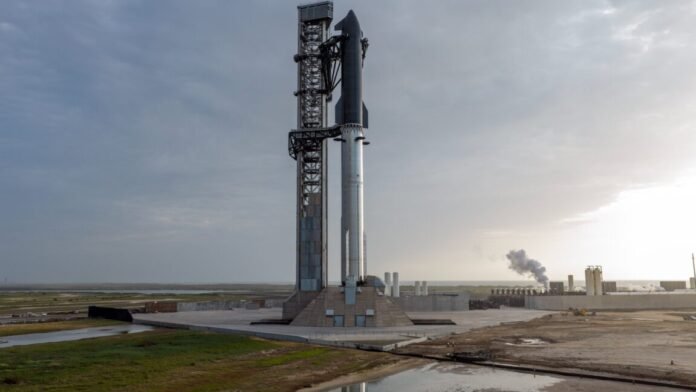
Welcome to Edition 9.03 of the Rocket Report! SpaceX counted down all the way to T-0 on Thursday evening in South Texas before a handful of Raptor engines decided not to light at ignition of the rocket. It is not clear whether the vehicle can be worked on at the pad, or whether Starship will need to be de-stacked before this can occur. In any case, a few days delay beats a significant issue in flight.

As always, we welcome reader submissions, and if you don’t want to miss an issue, please subscribe using the box below (the form will not appear on AMP-enabled versions of the site). Each report will include information on small-, medium-, and heavy-lift rockets as well as a quick look ahead at the next three launches on the calendar.

Vikram-1 rocket gets a launch date. The debut launch attempt by Skyroot Aerospace of its Vikram-1 rocket is now set for July 18, at 11:30 am local time in India. This will be the first time a commercial rocket developed in India attempts to reach orbit. Designed to carry small satellites weighing up to 350 kg to low-Earth orbit, Vikram-1 is targeting a 450 km orbit at a 60-degree inclination.

A major step for India … The new rocket will carry technology demonstration payloads from Grahaa Space, Cosmoserve, DCubed, and Skyroot’s own SCOPE, along with Cosmos Diamonds’ artwork “Cosmic Bloom” and a micro-art piece. “We have done everything that could be done to test Vikram-1 on ground,” said Pawan Kumar Chandana, co-founder and chief executive of Skyroot, in an emailed news release. “We are eager to see how Vikram-1 performs in real flight environment for the first time. This is our first test flight, and we will be getting valuable data from it.”

Japan conducts rocket landing test. Japan’s space agency has conducted a test flight of its experimental reusable rocket in a northern part of the country, the Japan Broadcasting Corporation reports. JAXA said the rocket took off and landed as planned after reaching a height of about 11 meters. The flight lasted about 40 seconds and included a 16-meter horizontal translation relative to the ground before landing.

Step by step … JAXA has been developing the RV-X rocket to demonstrate technologies needed for a reusable launch vehicle. The conical fuselage stands about 7.3 meters tall and is somewhat similar in appearance to the DC-X vehicle developed by NASA in the 1990s, and SpaceX’s Starhopper. The agency says it plans to analyze the data from the flight for the development of an experimental reusable rocket in a joint project, called CALLISTO, with French and German research institutions. (submitted by tsunam)

The Ars Technica Rocket Report
The easiest way to keep up with Eric Berger’s and Stephen Clark’s reporting on all things space is to sign up for our newsletter. We’ll collect their stories and deliver them straight to your inbox.

Sign Me Up!

A new suborbital test range Down Under. A company called Spinifex Space was established this week to provide end-to-end suborbital launch campaigns, private range access, and test and evaluation infrastructure from facilities in southwestern Queensland, Payload reports. Spinifex says its team spun out of Black Sky Industries, an Australian developer and supplier of solid rocket propellant and solid rocket motors.

Helping others get to space … Spinifex itself does not build rockets. Instead, its products are the land and the licenses required for flight. The company will support static-fire testing, hypersonic vehicles, kinetic effectors, energetics handling, and destructive testing. The closest domestic alternative is Woomera, the government-owned range where Australia tests its missiles.

China lands orbital booster. China’s sprawling state-owned rocket developer, maker of the country’s Long March rocket family, announced it recovered a reusable orbital-class booster for the first time last Friday in the South China Sea. The milestone mission began with the liftoff of a medium-lift Long March 10B rocket from the Wenchang Commercial Space Launch Site on Hainan Island, Ars reports. About 10 minutes later, the Long March 10B booster descended from space and guided itself into a four-legged frame affixed to an offshore vessel. Tensioned cables, stretched over the ship in a grid pattern, captured the rocket as it shut down its landing engines, leaving the smoldering booster hanging in midair.

Joining Western rocket companies in the club … The rocket’s upper stage continued into orbit and deployed a payload known only as CX-26. Chinese officials hailed the flight as a “complete success.” SpaceX and Blue Origin use propulsive landings to return their Falcon 9 and New Glenn boosters to offshore platforms or onshore landing pads. With Starship, SpaceX pioneered a new method of catching the rocket’s reusable booster back at its launch pad using mechanical arms mounted to the launch tower. (submitted by tsunam)

AST SpaceMobile seeking other launch vehicles. The direct-to-cell satellite company announced its intention to offer $1 billion in convertible notes on Wednesday after the US stock market closed. Shortly after the announcement, the stock value dropped more than 10 percent as investors appeared concerned about dilution of their shares. What is interesting for our purposes is the reason offered by AST SpaceMobile for the transaction: the need for more rockets to get its large BlueBird satellites into orbit.

Company considering acquisitions … AST SpaceMobile intends to “pursue an expanding universe of growth initiatives and secure additional access to orbit for its space-based cellular broadband network, including partnerships and/or acquisitions to further vertically integrate its business and mitigate risks associated with third-party launch providers.” The decision follows the failed static-fire test of a New Glenn rocket in April, which was due to launch a BlueBird satellite to expand the company’s constellation. The company’s plan for future launches on New Glenn are necessarily on hold.

Japan seeks to increase launch activity. The Japanese government wants to sharply increase the number of launches despite struggles with both current and new launch vehicles, Space News reports. The country would like to increase the number of government and commercial launches to 30 per year by the early 2030s. That is an ambitious target, because Japan, to date, has conducted just two orbital launches in 2026.

It’s a stretch goal … An H3 rocket launched June 11 on a test flight of a new variant of the vehicle. That launch also served as a return to flight for the H3 family after the previous launch in December failed to place its payload, a navigation satellite, into orbit. The other was the third flight of Kairos, a small launch vehicle developed by Space One, on March 4. It was a failure. One way to reach the goal of 30 launches a year is for Japan to host launches of foreign rockets, officials said.

Ariane 6 is cleared to launch CubeSats. The European Space Agency has awarded a contract to launch its solar storm-monitoring CubeSat on an Ariane 6 rocket, European Spaceflight reports. Scheduled for launch in early 2027, the Henon CubeSat will be flown as a secondary passenger alongside the space agency’s PLATO telescope, which will be tasked with finding Earth-like exoplanets.

Up to 16 satellites … Before the award, a feasibility study was conducted to confirm that CubeSats could be safely accommodated as secondary payloads aboard an Ariane 6 flight. “Henon was a reference case, but we also looked at how many CubeSats could be accommodated in this launch architecture,” said Roger Walker, head of CubeSat missions at ESA. “We can fit up to four 16U CubeSats, in fact.” After the launch, Henon will use its miniaturized electric propulsion system to maneuver into a distant retrograde orbit around the Sun.

Starship test flight is scrubbed at ignition. The next test flight of SpaceX’s Starship spacecraft and Super Heavy booster was set to launch as soon as Thursday, Ars reports. However, a handful of the rocket’s 33 Raptor engines failed to light at the vehicle’s ignition, and therefore the launch attempt was aborted automatically. Shortly after this abort on Thursday evening, SpaceX founder Elon Musk said the next launch attempt would “hopefully” take place in a few days.

Seeking validation …  For this flight technicians have installed 20 Starlink V3 satellites into the ship’s deployer, a system of pulleys and cables designed to eject a stack of satellites one at a time through an opening on the side of the spacecraft. The satellites will not be part of SpaceX’s operational network, but engineers will attempt to briefly establish laser communication links between the Starlink V3s and other spacecraft flying in low-Earth orbit. If successful, these links will validate Starlink V3’s interoperability with SpaceX’s previous generation of Starlink satellites.

How many launches to build a data center megaconstellation? In a new feature, Ars looks into the technical challenges of building orbital data centers and assesses what it might take to build SpaceX’s proposed 1 million satellite megaconstellation. The key to all of this is not radiation or the need to cool data centers in space. The single-most important factor is cheap access to space. For the purpose of the analysis, Ars modeled three scenarios: high-performing Starship and low-satellite mass; medium-performing Starship and satellite mass; and low-performing Starship and high-mass satellites.

The numbers are pretty daunting … The optimistic scenario would require 17,500 Starship launches to deploy 1 million satellites. The most pessimistic scenario would require 77,000 total launches. Over a period of five years, by the way, for the pessimistic scenario that would be 42 Starship launches a day. As for total costs, including launches, satellites, and ground systems, under the most optimistic scenario the constellation could be deployed for $1.45 trillion. Pessimistically? Hold your breath: It’s $9.8 trillion.

NASA mission moves to Falcon Heavy. NASA’s SunRISE (Sun Radio Interferometer Space Experiment) mission will launch on a SpaceX Falcon Heavy rocket from the agency’s Kennedy Space Center in Florida, the space agency said this week. As part of the announcement, NASA did not announce a launch date for the heliophysics mission, which had originally been scheduled to launch on United Launch Alliance’s Vulcan rocket.

Six new eyes on the Sun … The mission is flying as a rideshare sponsored by the United States Space Force’s Space Systems Command. SunRISE comprises six toaster-oven-size small satellites, or SmallSats, that will operate as one giant radio dish slightly above geosynchronous orbit (about 22,000 miles, or 35,000 kilometers, in altitude) to track the rumbles of radio bursts coming from within the Sun’s atmosphere, or corona. (submitted by Tfargo04)

Next three launches

July 16: Starship | Flight Test 13 | Starbase, Texas | 22:45 UTC

July 18: Vikram 1 | Aagaman test flight | Satish Dhawan Space Center, India | 06:00 UTC

July 20: Falcon 9 | Starlink 17-39 | Vandenberg Space Force Base, Calif. | 14:00 UTC

End-times prophecy jumps from lunatic fringe to US elite belief

0
end-times-prophecy-jumps-from-lunatic-fringe-to-us-elite-belief
End-times prophecy jumps from lunatic fringe to US elite belief

It recently emerged that tech billionaire Peter Thiel is running a secret society that brings together fellow CEOs and billionaires with political leaders. Members reportedly include figures like NATO supreme commander Alexus Grynkewich and the son-in-law of US President Donald Trump, Jared Kushner.

Thiel, a German-American entrepreneur and activist, was a co-founder of PayPal and software firm Palantir. Revelations about the society – known as “Dialog” – have attracted widespread attention. And Thiel himself gave a confidential lecture series in San Francisco this year, in which he framed issues of politics and technology in biblical terms.

Thiel has said he believes that humankind faces existential threats from nuclear war or runaway artificial intelligence (AI) that could lead to “Armageddon.” In such an end-times era, so the thinking goes, only the most ingenious – like those in the secret society – would survive.

Thiel is an extreme, but by no means isolated, case. Other powerful people in politics and technology are viewing today’s world through a lens of civilizational crisis and impending catastrophe.

End-times politics

Over the centuries, political leaders have often invoked fears of decline and collapse. In ancient times, Augustus, the first Roman emperor, championed the narrative that Rome faced moral collapse to justify concentrating power in his own hands.

Yet the current moment of “end-times politics” is different on several fronts. Threats, both real and imagined, spread faster than ever, diffused through social media algorithms that favour hysteria and conspiracy.

In Silicon Valley, influential figures routinely discuss AI as either humanity’s salvation or an extinction event. Palantir CEO Alex Karp has described the AI race as “our Oppenheimer moment”, when the world’s rich nations must decide whether to halt the development of a dangerous technology or tip the balance of power in its favour.

Yet the phenomenon extends beyond eccentric tech circles. End-times narratives have made their way into the halls of power, as political figures seize the opportunity to propagate radical politics.

US military personnel have filed a large number of complaints, stating that their commanders have been using biblical end-times rhetoric to justify the US attacks on Iran. Their leadership reportedly made reference to Armageddon, viewing the war in Iran as a necessary step in bringing about the return of Christ.

Youtube video

Weaponizing Jesus.

This occurs in a context where the Trump administration has been catering to the Christian right, particularly evangelicals, as a major constituency for its “spiritual warfare.” The US Secretary of War Pete Hegseth, in particular, has been portraying himself as an instrument of god in an existential civilizational battle for Christianity.

Hegseth and other central figures have reportedly been stacking their departments with evangelicals and Christian Zionists. These instances can be viewed as elements of a larger shift, where political and corporate leaders mix their interpretation of Christianity with beliefs about US supremacy.

Radical minds, radical politics

Trump’s threats towards Iran, including his decree in April that “a whole civilization will die tonight, never to be brought back again”, indicate the consequences of this myth-making. It paves the way for radical politics in the US, and also beyond.

The Trump administration has claimed that Europe is facing continental decline and “civilizational erasure” due to immigration and European integration. In the same vein, Nigel Farage, leader of Reform UK, has sounded the alarm about the UK facing “societal collapse”.

Research has shown that people are more willing to support extraordinary measures when they believe they face an existential threat. It has also been shown that political leaders’ psychological dispositions matter more in times of uncertainty.

The unforeseeable effects of technological and environmental transformation create risks and anxiety – and the danger is that leaders treat opponents, social movements or minority groups as mythical foes.

End-times politics then becomes a struggle over the definition of the ultimate threat to humankind. We are in a time when humans face multiple risks. These worldviews eventually determine how national politics and geopolitics evolve.

There is another reason to pay attention. For much of the modern era, the most influential people were elected leaders and state officials. Today, a novel type of leader has emerged: technology executives with wealth and media influence.

Their influence can extend deep into the state – symbolized by Elon Musk’s role in the US Department of Government Efficiency and the critical role of SpaceX in US global strategy.

For a long time, scholars explained global politics in terms of institutions and structural relations, and globalisation through business interests. Now, the future of both increasingly depends on the psychology of a small political and corporate elite.

End-times leaders will exaggerate certain threats while downplaying others. Often, technology executives will establish links between a prosperous future and the necessity of disruptive innovation.

US venture capitalist Marc Andreessen has been a proponent of “technological accelerationism” – the idea that unregulated technological development is the only way to overcome the world’s existential problems.

The challenge is distinguishing between genuine threats and narratives that amplify fear while obscuring more pressing problems. At a time when the debate is saturated with predictions of collapse, it may be more important than ever to focus on the risks that are supported by evidence – the climate crisis and an erosion of democratic systems, for example.

On the question of whether technology can overcome climate change and bring world peace, it might be wise not to take the word of tech billionaires. After all, Thiel has recently been hedging his bets between a bunker in New Zealand and a refuge in Javier Milei’s Argentina.

Joscha Abels is a post-doctoral researcher, Institute of Political Science, University of Tübingen and Juliana Tappe Ortiz is post-doctoral researcher, Institute of Political Science, University of Tübingen

This article is republished from The Conversation under a Creative Commons license. Read the original article.

‘The Pitt’ Star is Being HAUNTED by Legendary Ex

0
‘the-pitt’-star-is-being-haunted-by-legendary-ex
‘The Pitt’ Star is Being HAUNTED by Legendary Ex


Katherine LaNasa says her late ex-husband Dennis Hopper stayed with her long after his death — at least in her dreams.

The Pitt actress, 59, was married to the Hollywood legend from 1989 to 1992. Years later, after Hopper died in 2010 at age 74 following a battle with prostate cancer, LaNasa said she felt as if he still had unfinished business with her.

The actress said Hopper “would not leave me alone for a really long time.”

LaNasa, who shares 36-year-old son Henry Hopper with the Easy Rider star, recalled a series of vivid dreams that left her shaken.

In one dream, she said Hopper appeared at the Academy Awards.

“He was in a wheelchair and he fell down and it was super upsetting,” the Truth Be Told actress said.

At the time of Hopper’s death, his personal life was anything but peaceful. The actor was in the middle of a bitter split from his fifth wife, Victoria Duffy.

Because of that, LaNasa ended up spending more time with him near the end of his life, even though they had been divorced for years.

“I was the last wife that he’d been with that he wasn’t currently divorcing,” she said.

LaNasa said the experience created a kind of emotional intimacy that was hard to explain.

“I think that level of intimacy when you’re dying is maybe only something you can do with a partner?” she said.

That closeness may be why, in LaNasa’s view, Hopper seemed to keep reaching out after he was gone.

But eventually, the dreams became too much.

“He used to come over to me in a sweat and I told him he had to leave me alone, and then he did,” LaNasa said.

Still, the strange feeling did not disappear right away.

LaNasa said she felt unsettled after telling someone how strange the dreams had been. That same day, she took an unusual route home and stumbled upon a gallery showing Hopper’s photographs.

Inside, she said, there was one image that stopped her cold.

In the back of the gallery was a photograph of Hopper wearing a fedora and winking at the camera.

LaNasa took it as a sign.

She said Hopper appeared to her only one more time after that.

In the final dream, the two were in a cafeteria in Greece. This time, the feeling was different.

“We were both in a cafeteria in Greece, and he told me that he was okay and that he wasn’t in pain anymore and he was good,” LaNasa said.

After that, the visits stopped.

“And I never heard from him again,” she said.

Malaysia Orders Deportation of All Israelis as Authorities Investigate Foreign Tech Community

0
malaysia-orders-deportation-of-all-israelis-as-authorities-investigate-foreign-tech-community
Malaysia Orders Deportation of All Israelis as Authorities Investigate Foreign Tech Community


Malaysia will immediately deport any Israeli citizens found in the country, Prime Minister Anwar Ibrahim said Wednesday, as federal authorities investigate allegations that Israelis using dual citizenship were participating in a technology-focused community in Johor’s Forest City.

“We will not allow it,” Anwar told reporters. “If there are Israeli nationals, since we do not recognize Israel, they will be deported immediately.”

The investigation centers on Network School, a co-living community for startup founders and digital nomads established by former Coinbase executive Balaji Srinivasan. The project, located in the China-backed Forest City development across the Johor Strait from Singapore, came under scrutiny after an online promotional video drew widespread attention.

In the video, residents describe living on “a man-made island near Singapore,” while Srinivasan says, “We’re building Silicon Valley outside Silicon Valley.”

The promotion also generated criticism online. One social media user wrote: “Sounds like a cult, definitely operates like a cult, recruits like a cult.”

The Johor state government subsequently called for a federal investigation into both the commune’s activities and the nationalities of those taking part.

Malaysia’s Immigration Department later announced that it had inspected 266 foreign nationals from 40 countries at the site and found that all possessed valid travel documents. Officials said, however, that broader inquiries into the identities and activities of those involved remain ongoing.

Anwar also instructed authorities to examine the project’s business operations, including its premises licenses, accommodation arrangements and land use. He said any violations should be met with “firm action without compromise.”

Malaysia has no diplomatic relations with Israel and does not permit Israeli passport holders to enter the country without special government approval. Authorities acknowledged that people with dual citizenship may, in some cases, enter using a passport issued by another country.

Anwar said the government would not compromise on either national security or its political position on Israel. The prime minister has maintained a strongly pro-Palestinian stance and open ties with Hamas following the escalation of the conflict in Gaza.

2026 Lucid Gravity Touring review: A strong act 2

0
2026-lucid-gravity-touring-review:-a-strong-act-2
2026 Lucid Gravity Touring review: A strong act 2

When Lucid introduced the Air electric sedan in late 2021, the first Air Dream Edition I tested packed over 1,100 hp (820 kW) and carried a $180,000-plus window sticker. It’s easily the most powerful street car I’ve tested; the only vehicle I’ve driven with more power was a purebred race car with a third the mass, and it was on a proper track. Its combustion engine was also about 1,000 times louder than the Air, helping to remind us that “combustion” really does mean explosion after explosion.

For Lucid’s second act, the company debuted the Gravity electric SUV last year, and I’ve just tested the 2026 Gravity Touring, which starts at about $82,000 in the US, including the required destination charge.

My test model carried a bevy of options, including a 22-speaker audio system, the Comfort and Convenience package, third-row seating, a Dynamic Handling package (combining rear-wheel steering and three-chamber air suspension), a luxury seating package (bundling Nappa leather and massaging and ventilated front seats), and special metallic paint.

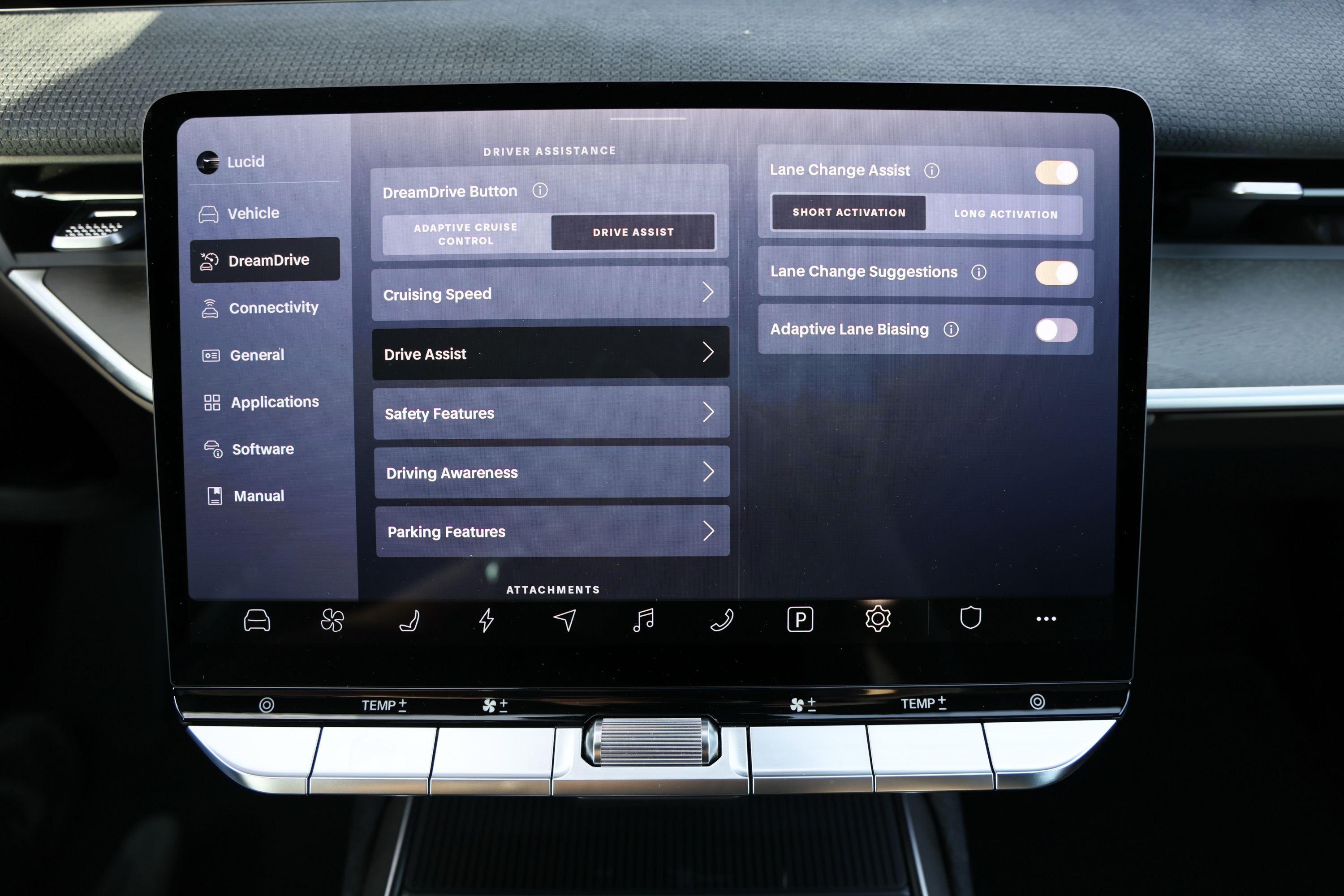
Also fitted was Dream Drive 2.0 Pro, an optional collection of active driver assists beyond the standard fare (adaptive cruise control, lane departure warning and lane keeping, blind spot warning, and drowsy driver alert) to offer hands-free driving assist, automatic lane change assist, and even an alert to warn of impending curb rash while parking. Over-the-air software updates occur automatically. Together, all the options raised our test vehicle’s cost to $107,200.

Lucid also builds a more expensive Grand Touring version, starting at over $100,000. While the Touring uses a 16-module, 89-kWh battery pack, the Grand Touring’s 22-module pack delivers 123 kWh, and power output grows from 560 hp (418 kW) to 828 hp (617 kW). The Touring’s driving range of 337 miles (542 km) increases to 450 miles (742 km) in the Grand Touring, too.

A Lucid Gravity in profile

This might be the entry-level Gravity, but it’s none the worse for that.

This might be the entry-level Gravity, but it’s none the worse for that. Credit: Jim Resnick

On paper, that all sounds like a substantial difference in power and range, but in practice, it really isn’t. After a week with the Touring, I never needed more power, nor did I feel the driving range was shy of the mark compared to a combustion-engine SUV of similar size with a decently provisioned fuel tank.

Charging up the Gravity proved easy at any one of several local Tesla Supercharger stations. Since the Gravity has an NACS port and I have a Supercharger account, there was no messing around—the Lucid supports plug-and-charge (ISO 15118) and will verify account details with compatible chargers as part of the handshake procedure, so there’s no messing around with apps.

From one full-up charge, a mixture of suburban and highway driving yielded 320 total miles (514 km) of range. That’s close enough to the EPA estimate that most owners are unlikely to feel shortchanged.

More importantly, the Gravity retains the charging performance that has become one of Lucid’s defining strengths. During one charging session, the Gravity reached 95 percent state of charge from 15 percent in 31 minutes. Lucid also claims the Gravity can add up to 200 miles (321 km) on an 11-minute charge, though that requires a 400 kWh DC fast charger, according to the company’s consumer website. I averaged 3.3 miles/kWh (18.8 kWh/100 km) consumed in suburban and city driving while netting 3.8 miles/kWh (16.3 kWh/100 km) during steady-speed driving on freeways.

A Lucid Gravity from behind

The Gravity is more agile than its size might suggest.

The Gravity is more agile than its size might suggest. Credit: Jim Resnick

Plenty of horses

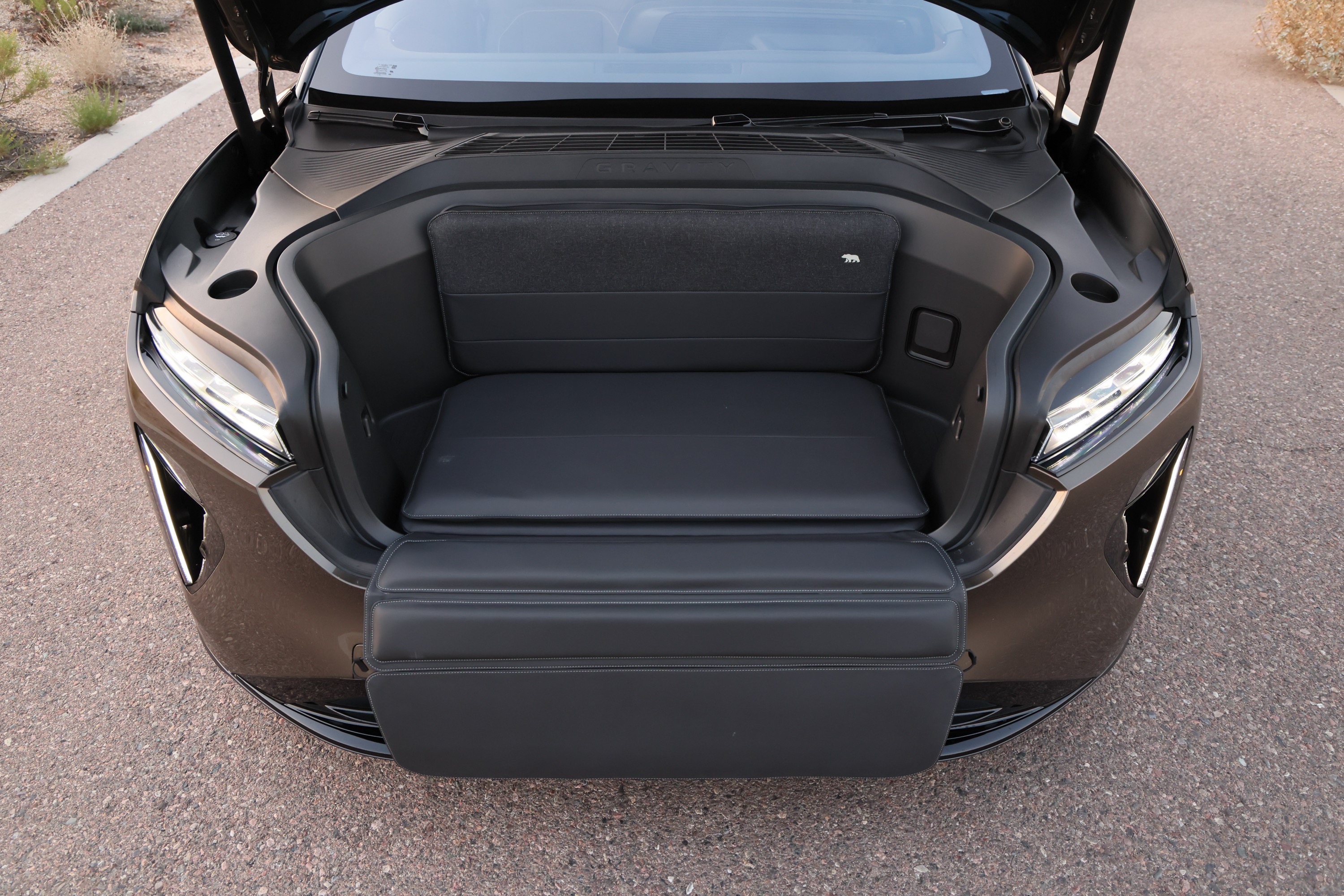
Using two motors, one under the frunk making 147 hp (110 kW) and a main rear 413-hp (308 kW) motor, the Gravity’s combined output of 560 hp and 811 lb-ft (1,100 Nm) of torque certainly stands out.

Those figures are no match for the Grand Touring’s bonkers 828 hp (617 kW), yet despite this deficit in power, the Touring remains quicker than the overwhelming majority of SUVs, with enough oomph to merge onto the diciest freeway on-ramp, pass several slow cars at once on a two-lane rural highway, or just simply shock your mother-in-law.

Though I did no measured testing, I’d peg the Gravity Touring as extremely fast, with gobs of power on demand at any time, compared to the absurdly fast Grand Touring or any of those 1,000+ hp Airs. Lucid claims a 0–60 time of 4.0 seconds for the Touring. Soberly, though, I’d suggest the real-world performance difference between the top-power Grand Touring and the Touring is less significant than the difference in stats columns.

Despite the acceleration, it’s the polish that impressed me the most. Steering is precise and feels naturally weighted from parking lot speeds to cruising on the interstate. The optional three-chamber air suspension strikes a pleasing balance between ride comfort and body roll control, isolating occupants from rough pavement without allowing the vehicle’s considerable mass (at about 5,200 pounds/2,360 kg) to feel unwieldy.

Lucid gravity middle row

The middle row.

With the seats flat, it’s van-like in terms of space.

Lucid also fits serious braking hardware, with six-piston Brembo-built front calipers clamping giant 15-inch rotors. Over twisty sporty-car roads, the Gravity didn’t exactly become a Ferrari, but it negotiated tight corners, hills, heavy braking, and gravel-covered patches with way more talent than I anticipated. Interestingly, in everyday driving, even when throttle-closed regenerative braking is switched off, the Gravity still slows markedly, as if regen is engaged.

Visually, the Touring is mostly indistinguishable from the more expensive Grand Touring, which is fortunate because its design is one of the vehicle’s strongest assets. The proportions look coherent, and the surfaces are aerodynamic without looking experimental. The illuminated front fascia, full-width lighting elements, and expansive glass roof create a modern aesthetic that feels premium rather than performative.

The test vehicle wore optional Supernova Bronze metallic paint. Coupled with the standard Stealth Appearance package, the flat-sided wheels, and the broad-shouldered look of the front-end graphic and front lights, the Gravity Touring is handsome, but it doesn’t really shave much visual weight. It certainly looks like it weighs 5,200 lbs, even though it wears it well.

The brighter silver paint contrasting the greenhouse and A and D pillars against the darker bronze lower body somewhat detracts from the overall look. And a two-tone aesthetic doesn’t really sync with a “Stealth” Appearance package, visually or linguistically. Because the Gravity appears to be lower than most SUVs, there’s a large station wagon feel to the form that I like.

Lucid Gravity main instrument display

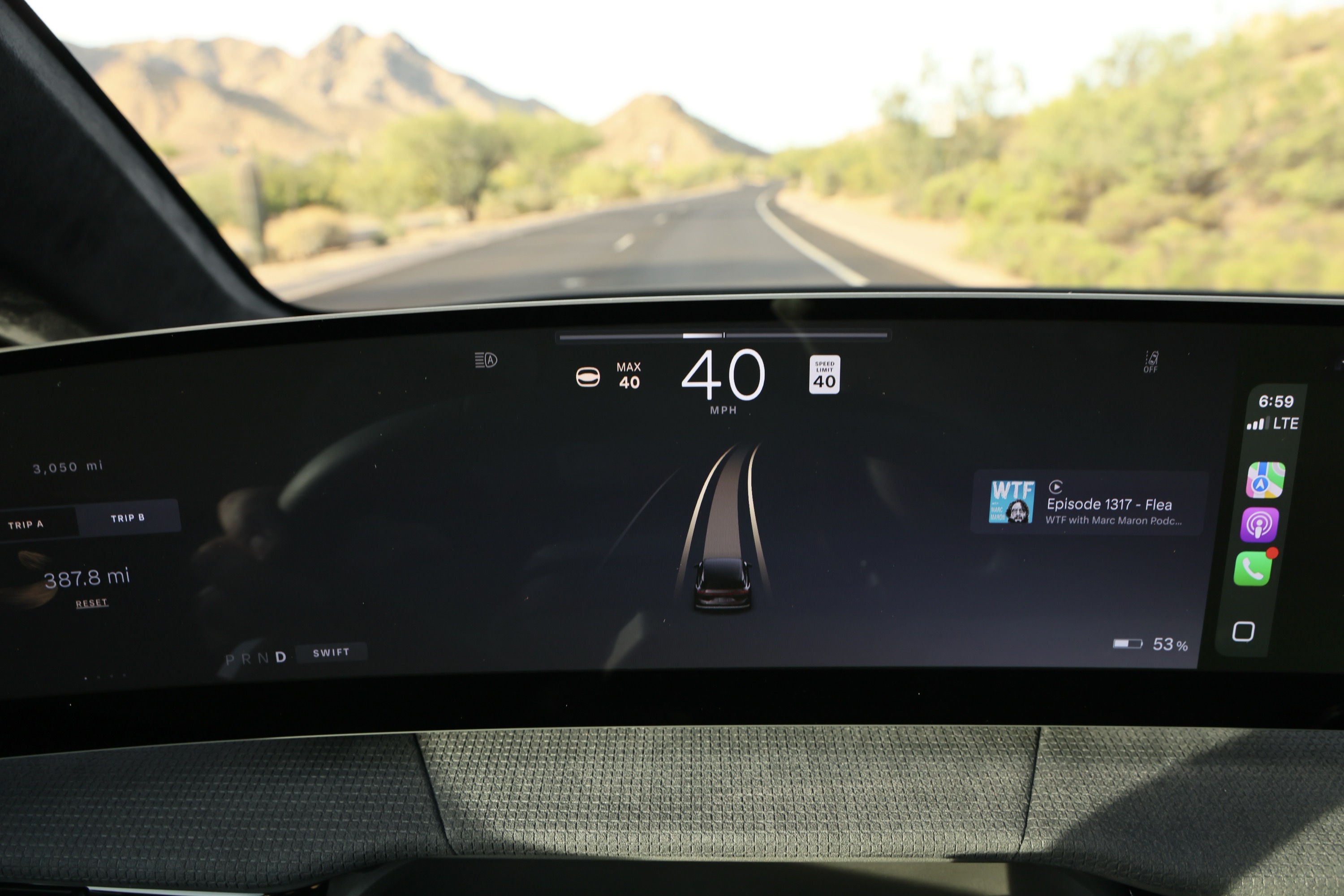
The main instrument display is very minimalist.

Lucid Gravity infotainment screen

The second infotainment touchscreen UI is clear. CarPlay lives in the upper screen alongside the main instrument display.

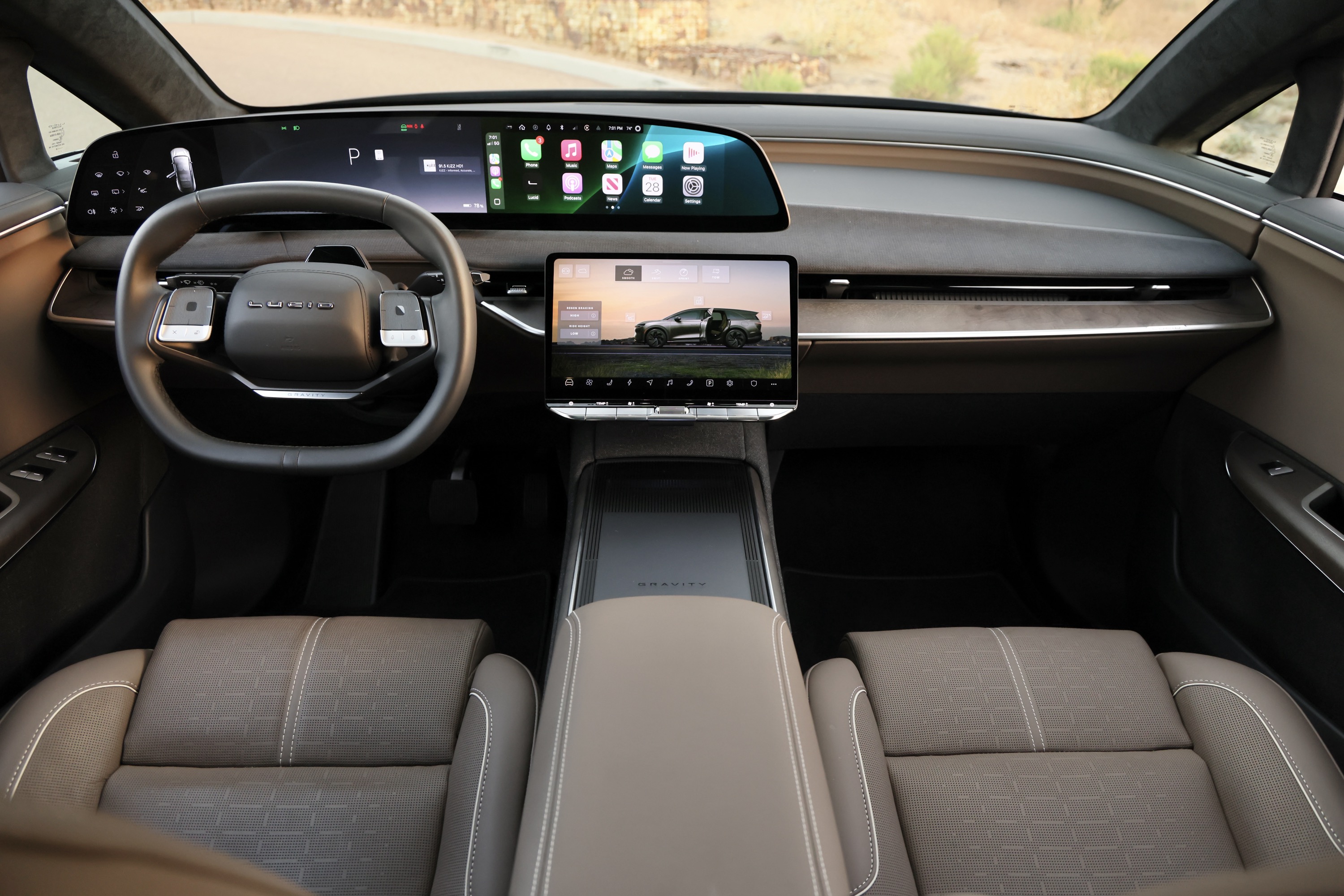
Inside, the clean, almost Scandinavian design follows the same philosophy. The driver’s environment is dominated by Lucid’s Clearview Cockpit, which combines a sweeping 34-inch curved 6K OLED display with a 12.6-inch central touchscreen. It’s sophisticated and information-rich without feeling overwhelming, and instruments and displays are clearly visible.

The squared-off steering wheel (akin to the current Corvette’s) remains unconventional though less problematic than it initially appears. Unlike a yoke, it doesn’t really alter the driving experience. It just asks for a brief adjustment period.

The cavernous inside

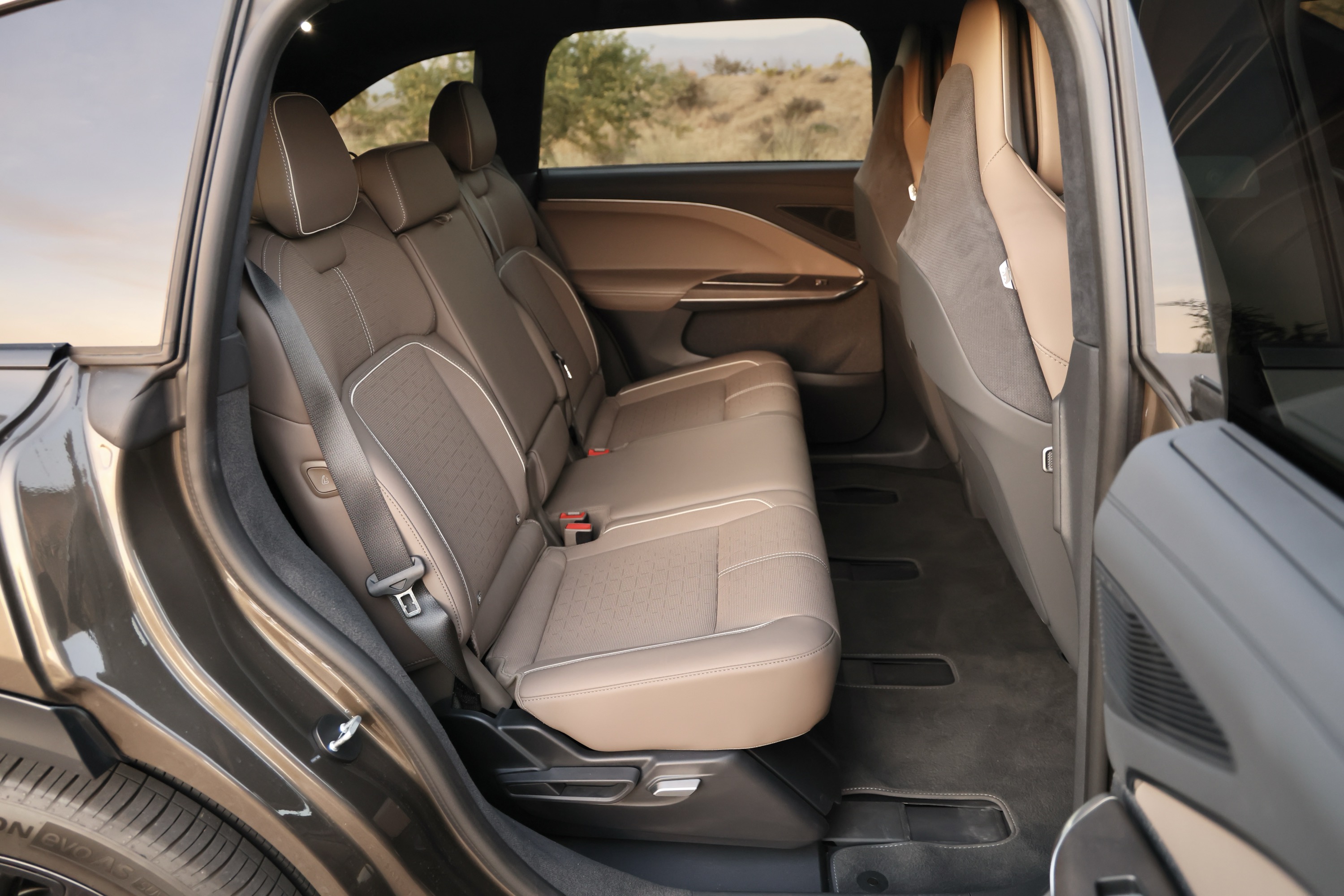
There’s plenty of passenger room, and the front seats offer great comfort and outstanding massage functions. Though the giant A pillars blocked more than their fair share of the driver’s view at the 10- and 2 o’clock positions, front-seat occupants enjoy nearly 41 inches (1,041 mm) of legroom, while rear passengers get even more, at 42.6 inches (1,082 mm). There should also be an industry award for a third-seat row that can swallow an adult—the Gravity would win.

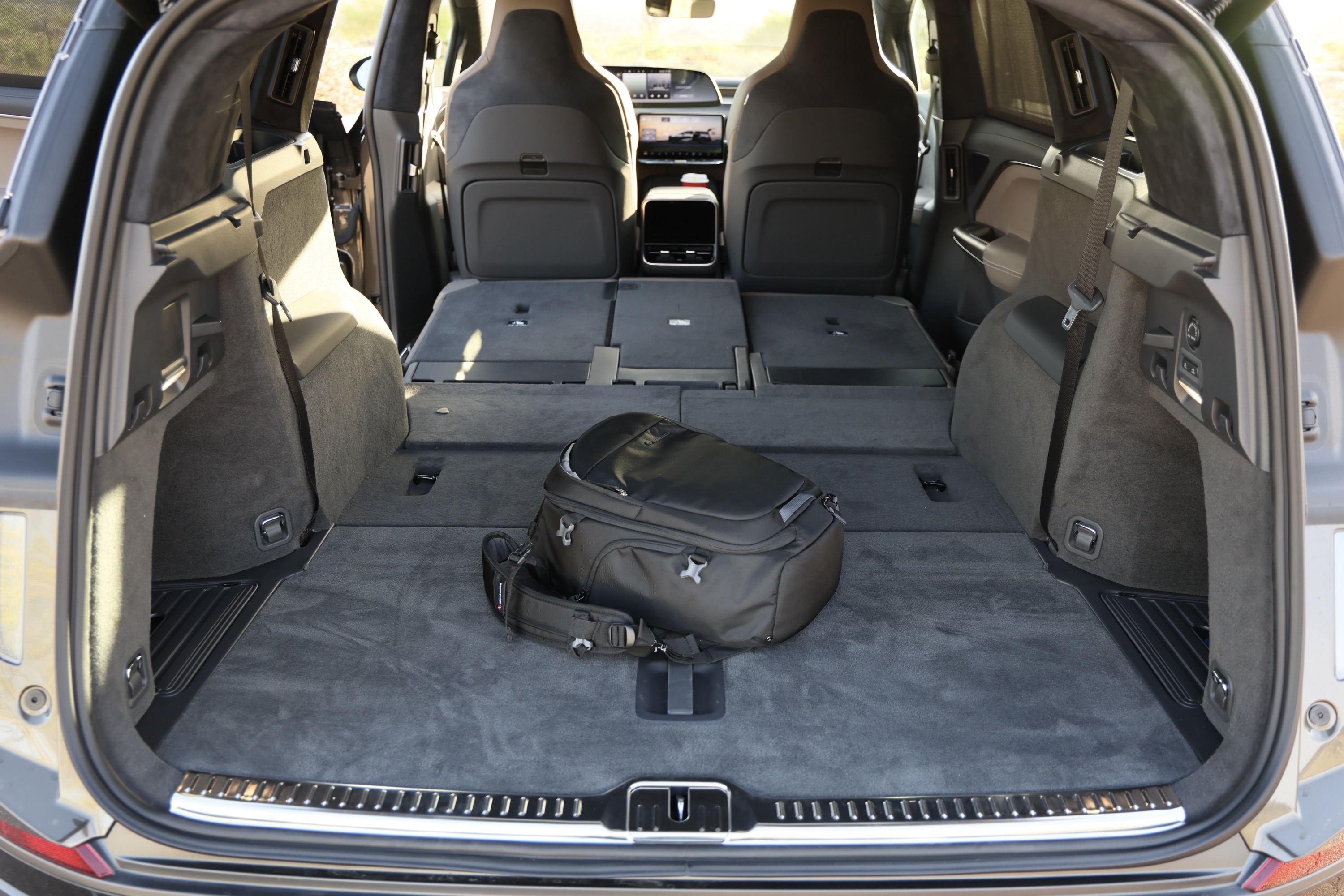
Cargo space measures 56 cubic feet behind the second row and expands to a healthy 112 cubic feet (3,171 L) with the seats folded and slid forward. (The standard Ford Expedition offers 108.5 cubic feet (3,072 L) with all rows folded, as a comparison.) That’s enough room to accommodate bulky cargo with the ease of a minivan.

There are execution issues, though. Although the fantastic Clearview Cockpit display is larger than the Air sedan’s, some interior materials do not meet the standard set by the design itself. Also, the interior panel on my test vehicle was disappointing—and not just for a $100,000 vehicle; it would be lackluster on the $45,000 Subaru I tested immediately afterward.

The cargo area’s removable carpeted panels that plug the gap between seatbacks and the rearmost bulkhead felt cheap and home-built. Even the floor mats were thin and had already started curling at the corners. And though the third-row seats accommodated my 6-foot, 1-inch (1.85 m) frame, they folded and erected awkwardly.

Lucid Gravity charge port.

A native NACS port.

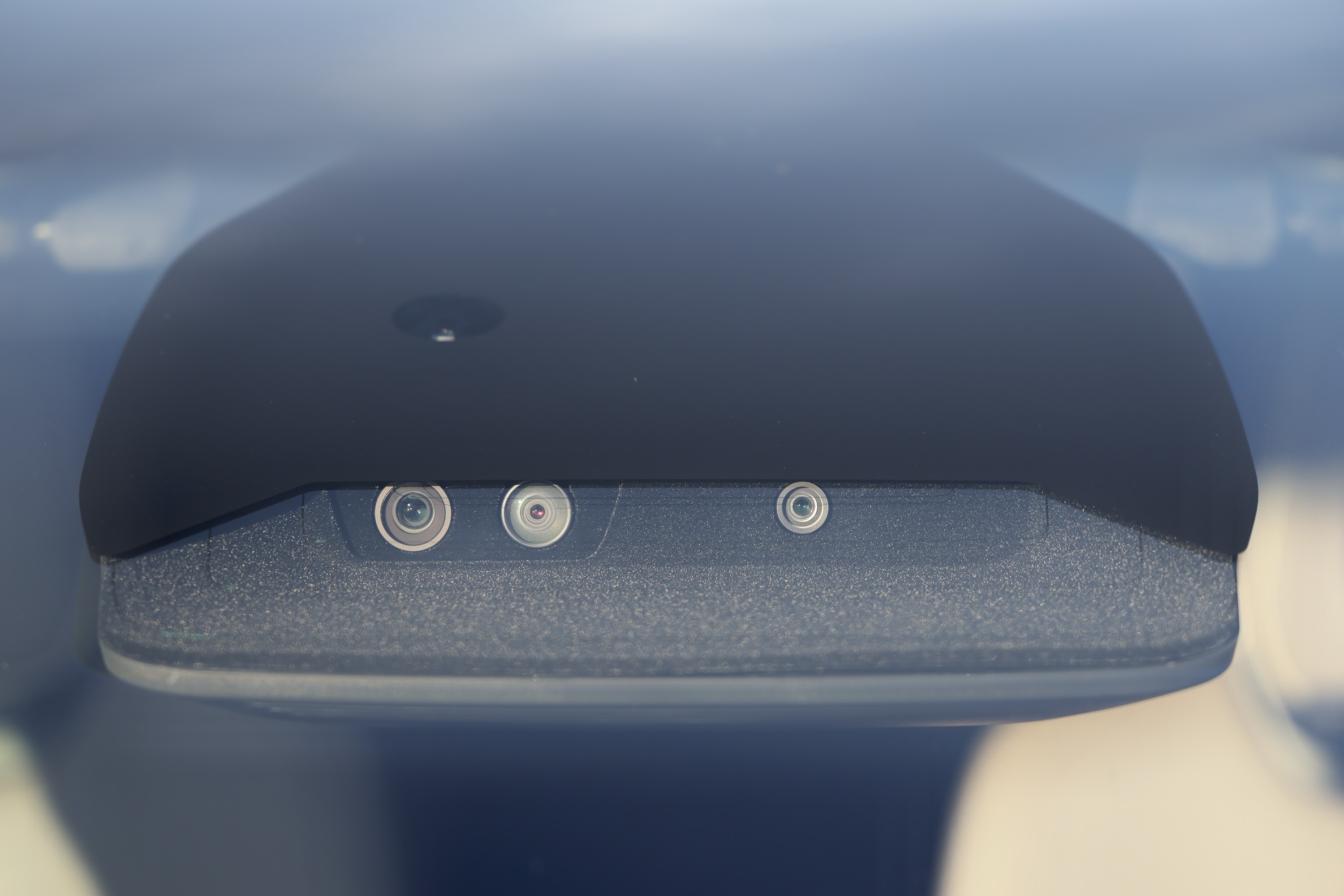
Lucid Gravity cameras

Some of the ADAS sensors.

Software execution is an increasingly important consideration in modern cars, and the Gravity’s is excellent. Smartphone integration (Apple CarPlay, in my case) proved quick and simple, with reconnection on subsequent start-ups happening very quickly. The test vehicle showed a bit of latency when playing music from my phone, with graphics from a prior track still displayed after the next track’s audio started.

Speaking of audio, the 800 W Surreal Sound Pro system, with 22 speakers around the cabin, deserves mention. It sounds superb. It employs Dolby Atmos signal processing, and though I personally don’t care for elaborate signal processing with my audio (I’m a musician), the Touring’s processing didn’t get alien like some systems. I could also disable it when I wanted. The best of the Burmester audio systems in various large Mercedes are still top in my automotive book, but the Gravity’s Surreal system comes close.

Objectively, the Gravity Touring undercuts the top-shelf Grand Touring by about $20,000 while preserving nearly everything that makes the Gravity compelling. It gives up some battery capacity and a measure of outright performance but retains the exceptional packaging, charging capability, and the balance of ride quality, comfort, refinement, and design.

As a great second act for a new company, the Lucid Gravity also builds anticipation for its mid-size act 3.

From solo to symphony, China bids to fine-tune the AI race

0
from-solo-to-symphony,-china-bids-to-fine-tune-the-ai-race
From solo to symphony, China bids to fine-tune the AI race

Artificial intelligence should not be a solo performance by one country, but a symphony of international cooperation.

That was Chinese President Xi Jinping’s framing on July 17, when he opened the 2026 World AI Conference and High-Level Meeting on Global AI Governance in Shanghai, his first appearance at the event in person.

It is a good line, and it captures a real anxiety felt across much of the developing world that the AI revolution could entrench rather than narrow the gap between rich and poor nations.

A day before Xi spoke, representatives from 29 countries, including Kazakhstan, Laos, Pakistan, Russia and Indonesia, signed an agreement establishing the World Artificial Intelligence Cooperation Organization, a new intergovernmental body headquartered in Shanghai.

Xi called its creation a milestone, and Beijing pledged 5,000 AI training and research opportunities for developing countries over the next five years, alongside new cooperation centers aimed at ASEAN, the Arab League, the African Union, the Shanghai Cooperation Organisation and BRICS members.

This is not China’s first pass at the idea. Beijing floated a global AI cooperation body at last year’s WAIC, but the proposal was vague. This year, it acquired legal form, a headquarters and 29 founding signatories, along with the presence of UN Secretary-General Antonio Guterres at the signing ceremony, which gives the initiative a degree of international legitimacy that a purely Chinese program would lack.

Xi’s appeal to the Global South is genuine and well-timed. Many developing economies have watched the AI race unfold as a contest between a handful of American and Chinese firms with the compute, capital and chips to compete, and have found few avenues to shape the rules rather than simply receive them.

A body that promises training, seminars and application-focused cooperation centers, rather than only investment tied to political conditions, addresses a real gap. Officials in Southeast Asia and the Arab world have reason to take the offer seriously.

But the framing deserves scrutiny alongside the welcome. WAICO arrives explicitly as a counterweight to what Chinese officials and state media describe as Western dominance of AI governance, and it launches amid intensifying competition between Washington and Beijing over the future of the global AI ecosystem.

That does not make the initiative insincere, but it does mean the “symphony” metaphor sits alongside a fairly conventional exercise in great-power technology diplomacy, one in which Beijing is building influence and standard-setting power in exactly the arenas where Washington has historically led.

The notable absence of major US technology firms from the Shanghai summit underscores how far the two governance tracks have already diverged.

There is also a track record to weigh. Last year’s WAIC produced a Global AI Governance Action Plan and a proposal for the same cooperation organization now being formally launched, but independent trackers noted at the time that public details were thin and implementation unclear.

A year on, WAICO has gone from proposal to signed agreement, which is real progress, but the harder test, whether the training slots, cooperation centers and technology transfers materialize at the scale promised, is still ahead.

Member governments and observers will want to see delivery, not just declarations, before crediting Beijing with having solved the access gap it describes.

None of this should obscure what is genuinely new here. The world’s first intergovernmental organization built specifically around AI cooperation is a notable institutional fact, whatever one thinks of its sponsor or its politics.

For countries long accustomed to being AI rule-takers rather than rule-makers, an invitation to help write the rules, even one issued by Beijing and shaped by its interests, is worth engaging with rather than dismissing.

The test now shifts from speeches to delivery. Xi has offered the Global South a seat in the AI conversation.

Whether WAICO becomes a genuine platform for shared benefit, or another venue in which a rising power sets terms that smaller states must accept, will depend on what happens in Shanghai’s cooperation centers over the next five years, not on what was said at the podium this week.

Dr. Bilal Habib Qazi works as a research analyst at the Institute of Regional Studies, Islamabad. The views expressed here are the author’s alone and do not necessarily reflect those of the author’s affiliated institution.

Will AI fix prior authorization—or make it worse?

0
will-ai-fix-prior-authorization—or-make-it-worse?
Will AI fix prior authorization—or make it worse?

If you’re like me, you or a loved one has struggled through the process of gaining pre-approval for the medical care that your physician has recommended. Personal stories abound regarding the tribulations of patients as they go through hoops to get their health insurer to pay for certain prescription medications, medical procedures, and more.

When used judiciously, this process—known as prior authorization—serves as a check on overuse and spending on services or technologies for which there are less costly alternatives. But a large majority of physicians voice concerns about care delays, which can cause patients to abandon recommended treatments while waiting for the insurance company to verify their eligibility and confirm that the treatment is, indeed, medically necessary. Patients who are denied care may submit an appeal, but that requires more time.

AI might be able to help. With its ability to efficiently sort through vast reams of information, artificial intelligence could theoretically expedite approval of unambiguously allowable claims, thereby reducing care delays. However, AI-driven prior authorization is facing resistance, as it may increase wrongful denials of health insurance coverage. A 2025 American Medical Association survey of physicians revealed significant concern about the application of AI tools, with 61 percent of doctors worrying that AI will exacerbate denials of what they deem are necessary treatments.

The AMA advocates requiring insurers to provide detailed clinical reasoning to justify denials of coverage, in addition to more transparency regarding AI algorithms.

In an email to Undark, health policy analyst Camm Epstein wrote that “AI should be used to make appropriate care easier to approve, not necessary care easier to deny.”

President Donald Trump’s administration is currently piloting a program in six states, using AI to reduce unnecessary medical spending. But it remains to be seen whether this new approach will help fix a tortuous system.

Regardless of the degree to which AI is involved, the public views prior authorization as a major burden. In Medicare Advantage—the privately run alternative to original Medicare that now enrolls roughly 55 percent of Medicare-eligible seniors and disabled people—insurers issue millions of full or partial claim denials annually based on prior authorization. Federal government reports issued in June showed that plans sometimes even reject requests for skilled nursing and rehabilitation admissions. Erecting obstacles to medically appropriate care is viewed as a particular area of concern.

Patients can request medical exemptions or appeal plan decisions, but the process is often complicated and cumbersome. NBC News reported that some patients are “stuck in prior authorization” purgatory as they “run out of time or treatment options.”

A newly released Commonwealth Fund survey finds that roughly one in five American working-age adults with private insurance reported that either they or a family member were denied insurance coverage for physician-recommended medical care in 2025. Forty-one percent of people who experienced a prior authorization denial said it delayed their care, and more than a quarter reported that their health problem worsened as a result.

The government and private insurers have tried to make improvements.

A rule issued by former President Joe Biden’s administration in 2024, for example, included reforms designed to reduce delays for patients with government-run plans while streamlining the prior authorization process for physicians. It required insurers to make certain prior authorization decisions within 72 hours for urgent requests, and seven calendar days for non-urgent requests. Per Jan. 1 of this year, these timeline requirements went into effect for most health plans in the public sector. Last year, together with insurers, the Trump administration pledged to further streamline and accelerate prior authorization processes. Private insurance companies vowed to standardize electronic requests by 2027 and to “reduce the volume of medical services subject to prior authorization” by 2026, including for common procedures like colonoscopies and cataract surgeries.

Now, the Trump administration wants to further ameliorate prior authorization protocols by expanding the use of AI.

This year, the Centers for Medicare and Medicaid Services began a demonstration project called WISeR, or Wasteful and Inappropriate Service Reduction Model. Using AI, WISeR is designed to reduce waste and fraud in original Medicare, aiming to decrease unnecessary procedures. The project runs through December 2031 in six states, and combines technologies such as machine learning with human clinical review to evaluate services CMS believes may be vulnerable to overuse, fraud, and abuse, including skin and tissue substitutes, electrical nerve stimulator implants, and knee arthroscopy for knee osteoarthritis.

Although prior authorization has been used extensively in Medicare Advantage, it has rarely been deployed in original Medicare. And this shift might not be good for patients.

An HHS Office of Inspector General memorandum published in 2022 pointed to more than one in 10 instances in which Medicare Advantage plans denied beneficiaries’ access to services even though they apparently met coverage rules. (Being denied access doesn’t mean patients can’t ever gain access. In 2024, for example, Medicare Advantage plans overturned 81 percent of denials upon appeal.)

By integrating AI into the prior authorization process, CMS says the WISeR model will “ensure timely and appropriate Medicare payment for select items and services.” But this is not how critics see it. Before WISeR was implemented, Wendell Potter, an advocate for health insurance reform and former executive at health insurer Cigna, covered the political pushback against the model on the Substack publication “HEALTH CARE un-covered.” In the same publication, Zena Wolf, a researcher with the Center for Health & Democracy, cited investigations by the Washington Post, KFF Health News, and the Seattle Times that suggest in the first few months of the year, the model has caused delays in care and denials in some instances in each of the six states where it is being piloted. And despite automated processes, there can be a high administrative burden for health care providers, which includes additional work dealing with denials.

Additionally, vendors participating in the WISeR model, who were hired to carry out AI-driven prior authorization, earn a share of what CMS calls “averted expenditures.” This could entail revenues for rejecting care requests. In turn this points to a broader discussion about long-standing concerns regarding profit-making on the basis of discouraging patients from getting medically necessary care. Several lawmakers have introduced resolutions and amendments to block funding for the WISeR model, citing threats to patient access.

Yet the Trump administration seems to be of two minds when it comes to prior authorization. As CMS expands its use in original Medicare using AI, the agency wants to lessen and streamline its use by private insurers, including Medicare Advantage plans. CMS Administrator Mehmet Oz has warned insurance company executives that they must ease the burden of prior authorization, or the federal government will impose regulation: “If you don’t do it yourselves, then we’re going to do it for you,” he told the National News Desk, a TV news program.

Possibly to preempt further executive branch action or passage of laws by legislators, health plans released data recently that suggest they’re complying with administration demands. The industry-based survey reveals that between June 2025 and April 2026, requests for prior authorization declined by 11 percent. It’s unknown, however, whether the denial rate has decreased.

Responding to an industry group survey conducted last year, all responding health plans agreed with the statement, “AI or algorithms without clinician or practitioner review are not used to deny prior authorization requests that involve medical necessity or clinical considerations.” Moreover, insurers promised more transparency around clinical reasoning underlying prior authorization.

This may alleviate some of the worry about a lack of human review of decisions made by AI. But placating detractors won’t be easy.

Jared Dashevsky, a physician and founder of a media and educational platform called Healthcare Huddle, wrote that AI could “eliminate barriers, reduce administrative waste, give us more time with patients. But that’s not what’s being built.” Instead, he says, there’s an “arms race to deny faster and appeal faster. More automation of a broken system that shouldn’t exist in its current form.”

This article was originally published on Undark. Read the original article.

http://arstechnica.com/

Kasparov Warns Putin Will Escalate War Rather Than Seek Peace Deal

0
kasparov-warns-putin-will-escalate-war-rather-than-seek-peace-deal
Kasparov Warns Putin Will Escalate War Rather Than Seek Peace Deal


Russian opposition figure Garry Kasparov has warned that Vladimir Putin is unlikely to pursue a peace agreement with Ukraine and may instead escalate the conflict after Russia’s parliamentary election in September. The former world chess champion argued that Putin has historically responded to pressure with further aggression and that any settlement short of a Russian defeat would allow Moscow time to rebuild its forces.

Kasparov suggested a possible escalation could involve testing NATO’s resolve through a limited provocation, such as an incursion into a Baltic state, rather than a full-scale attack. He pointed to recent Russian measures easing troop mobilisation and continued Kremlin messaging as signs that Moscow is preparing for prolonged conflict rather than negotiations.

His comments come as Ukraine intensifies strikes against Russian military logistics and energy infrastructure, with officials in Estonia saying the attacks have weakened Russia and could strengthen Kyiv’s position in future talks.

Kasparov urged Europe to abandon hopes of a compromise-based solution and instead support a Ukrainian victory through stronger sanctions and pressure on Russia’s elite. He also called for programmes to help skilled Russians who oppose the Kremlin relocate, arguing that Russia’s technological and professional talent represents a key vulnerability for Putin’s government.

Kasparov, one of the Kremlin’s most prominent exiled critics, said the ultimate objective should be separating Putin from the country’s elites, claiming that Russia’s defeat in the war would threaten the president’s hold on power.

via Politico

0FansLike
0FollowersFollow
0FollowersFollow
0SubscribersSubscribe
- Advertisement -
Google search engine

Recent Posts