21.6 C
London
Friday, July 17, 2026
Home Blog

Fear of humanoid robots spurs human workers to strike at Hyundai auto factory

0
fear-of-humanoid-robots-spurs-human-workers-to-strike-at-hyundai-auto-factory
Fear of humanoid robots spurs human workers to strike at Hyundai auto factory

Thousands of unionized Hyundai auto workers began walking off the job early after negotiations with the South Korean automaker broke down over plans to deploy humanoid robots—the most significant pushback from organized labor so far over the latest wave of robotic automation.

The partial strike at Hyundai’s automotive production complex in the city of Ulsan in South Korea represents “the car industry’s first factory stoppage addressing humanoid robots,” according to The Wall Street Journal. Workers have already ended their day and night shifts two hours early at the world’s largest automotive plant from July 13 through July 15, and plan to start staging four-hour strikes from July 20 to 22 after 15 rounds of negotiations failed to reach an agreement, The Korea Times reported.

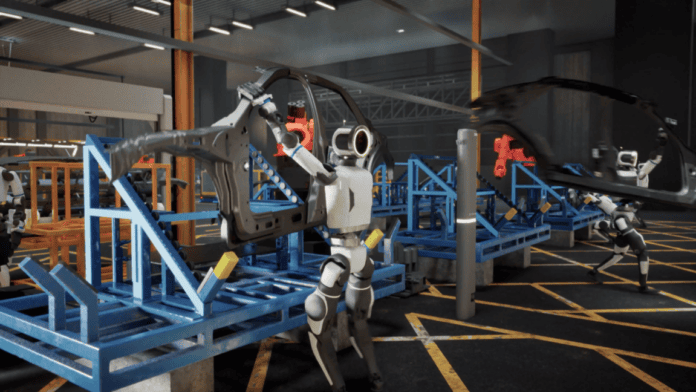
Union pushback began as soon as Hyundai Motor Group unveiled the latest version of the Atlas humanoid robot, a two-legged robot that stands at more than 6 feet tall and can lift more than 100 pounds, at the start of this year. Atlas is made by Boston Dynamics, the US robotics company that is about to become a wholly owned subsidiary of Hyundai.

Hyundai aims to deploy more than 25,000 Atlas robots across various Hyundai and Kia manufacturing plants, according to The Korea Herald. It plans to start with its US factories in 2028 but has not disclosed a timeline for deploying elsewhere.

Each Atlas robot costs an estimated $130,000 but may pay for itself within about two years of operations, according to Samsung Securities Co. analyst Esther Yim in a Bloomberg interview. If the robot cost eventually falls to $100,000, James Hong at Macquarie Securities Korea Ltd. suggested that its operational cost could fall below the US federal minimum wage of $7.25 and significantly undercut a typical auto worker’s salary.

The Hyundai Motor union representing more than 39,000 South Korean workers has responded by demanding that the automaker shift production workers’ hourly pay to a fixed salary to protect against any automation-driven reduction in work hours, along with raising the worker retirement age from 60 to 65, The Wall Street Journal reported. The union has also sought bigger worker bonuses.

Hyundai is just one of many automakers attempting to deploy humanoid robot workers. Tesla is developing its own Optimus robot for use in its electric vehicle factories, and BMW has been running pilot tests with humanoid robots made by Figure AI at its automotive plant in Spartanburg, South Carolina. Multiple Chinese automotive companies such as leading EV maker BYD are also trying out humanoid robots and sometimes developing their own.

This is also part of a broader automation trend with a long history, given how the global automotive industry has been a leading adopter of industrial robots, such as large robotic arms, for decades. More than 1 million robots were already in automotive factories around the world by 2021 and accounted for one-third of robots across all industries, according to the International Federation of Robotics. The United States had deployed 38,000 industrial robots as of 2025, with the automotive industry alone having installed 13,500 units.

Unlike industrial robots that are usually designed to perform one specific task, some robotics companies are pitching humanoid robots powered by the latest AI models as being capable of eventually doing a wide variety of tasks while fitting more easily into workplaces designed for humans. Such a vision will require overcoming multiple challenges in AI training and hardware development before humanoid robots can become general-purpose robots working autonomously in workplaces or homes.

The test case at Metaplant America

Hyundai plans to first put the Atlas humanoid robot to work at Metaplant America, an electric vehicle factory located outside of Savannah, Georgia, starting in 2028. Hyundai may face less organized pushback on that initial deployment because the US workers at the Georgia factory are not unionized. However, United Auto Workers (UAW), the union representing about 400,000 autoworkers across the US, Canada, and Puerto Rico, has been attempting to organize workers at Hyundai’s Georgia facility.

Metaplant America is already considered the most heavily automated automotive factory in the United States. The facility has more than 850 robots unloading auto parts, stamping out steel components, putting together car frames, and installing car doors, according to IEEE Spectrum. It also uses 300 automated guided vehicles to carry auto parts to the appropriate work stations while avoiding human workers.

Boston Dynamic’s famed four-legged robot, Spot, has also been deployed onsite to perform “exterior quality inspection” at Metaplant America’s weld shop. During a July 2026 visit to the facility, an Atlanta Journal-Constitution reporter described seeing the Spot “robotic dogs probe their sensor-embedded noses to sniff out defects.”
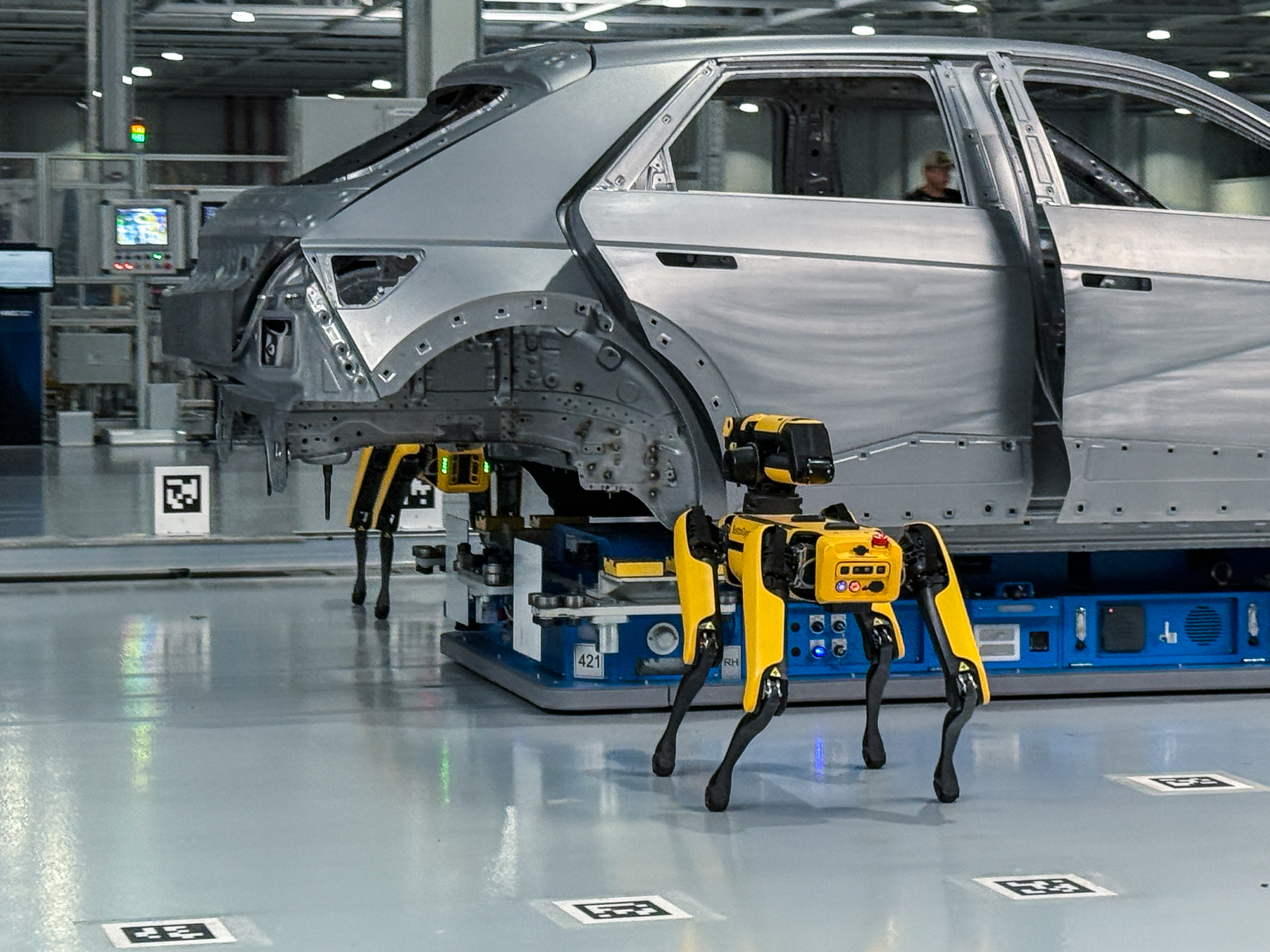
A pair of Boston Dynamics robots inspect a Hyundai Ioniq 5 body shell at the HMG Metaplant outside Savannah, GA.

A pair of Boston Dynamics Spot robots inspect a Hyundai Ioniq 5 body shell at the Hyundai Motor Group Metaplant outside Savannah, Georgia.

A pair of Boston Dynamics Spot robots inspect a Hyundai Ioniq 5 body shell at the Hyundai Motor Group Metaplant outside Savannah, Georgia. Credit: Jonathan Gitlin

The Atlas humanoid robots would start out by sorting and organizing automotive parts when they first deploy to Metaplant America in 2028. But Jerald Roach, a general assembly executive at Hyundai’s Metaplant, told The AJC that the humanoid robots won’t pose a threat to the human workforce. Roach described human hands with their sense of feel and touch as being necessary for handling soft car parts such as hoses, wires, carpets, and trim panels.

Hyundai has also committed to employing 8,100 human workers in full-time roles at Metaplant America by 2031 as part of its economic development deal with Georgia. State and local leaders provided the automaker with an incentive package worth an estimated $2.1 billion to set up shop in Georgia. The AJC’s reporting found that Hyundai’s facility already employed more than 3,800 workers by the end of 2025.

But labor unions in both South Korea and the United States clearly want to see stronger commitments from automakers in the face of such automation efforts. The United Auto Workers recently criticized General Motors for installing about 50 new robot arms at the automaker’s flagship electric vehicle factory in Detroit after laying off more than 1,300 workers as a supposedly temporary measure.

During the UAW Constitutional Convention held in Detroit in June 2026, UAW President Shawn Fain also warned against “the threat of humanoid robotics and mass automation” undermining worker employment and compensation. The next several years will show whether humanoid robots do indeed prove cost-effective in comparison to their specialized industrial robot counterparts and human workers.

EU plans to pay China to help Ukraine kill Russians

0
eu-plans-to-pay-china-to-help-ukraine-kill-russians
EU plans to pay China to help Ukraine kill Russians

China and Russia may no longer see eye to eye on Ukraine. Image: X

The Financial Times published a piece on July 15 alleging that “Ukraine to buy Chinese drone parts with EU funds.”

According to the newspaper’s sources, “Kyiv has obtained a carve-out for part of a €6 billion tranche to purchase drone components from China”, following the disbursement of the first €1 billion.

President Volodymyr Zelensky said the goal of the drone deal is to double annual production to 20 million by tapping the European Union’s financial and industrial capacity – something that can only happen with Chinese assistance.

Ukraine’s former deputy defense minister confirmed in summer 2023 that his country’s “volunteers” procure Chinese drones for their armed forces.

The New York Times reported earlier this year that “by 2024, the vast majority of drones that Ukraine sent to the front were assembled domestically — but still almost entirely with Chinese components. A year later, however, the share of parts from China in Ukraine’s drones had fallen to about 38%.”

The Times added that “Ukraine still buys cheaper Chinese components because the Ukrainian military needs huge numbers of drones and has a limited budget to buy them … According to a Ukrainian official who asked for anonymity to discuss sensitive procurement issues, Ukrainian and Russian companies often buy parts from the same factories in China.”

These facts contextualize the reported carve-out in the EU loan. Neither the EU nor Ukraine has the industrial capacity to double drone production; only China does.

Some might doubt that China would accept payment from the EU to help Ukraine kill Russians, assuming that China and Russia are allies. In reality, they are only strategic partners, and Russia has armed India and Vietnam against China for decades as part of its regional balancing acts.

It’s arguable that China doesn’t want anyone to win in Ukraine, largely because the conflict’s indefinite continuation cynically serves its grand strategic interests.

The US would be unable to “pivot (back) to (East) Asia” to more forcefully contain China, while Russia could become weak enough to become China’s junior, not equal, partner.

The first goal’s importance is self-evident, while the second could let China secure the bargain-basement prices it has reportedly demanded for the Power of Siberia 2 gas pipeline and press Russia to curtail or halt military-technical exports to India – giving China a trump card in its dispute with India.

Additionally, Xi declared a new vision of “constructive strategic stability” with the US during Donald Trump’s recent visit to Beijing, so it’s possible that China’s newly robust military balancing act between Russia and the EU-Ukraine axis – whereby China ramps up EU-funded drone sales to Ukraine – is part of a quid pro quo with the US.

For instance, China might avoid the tariffs that the late Lindsey Graham’s bill could impose on it if Trump waives them in the name of “national interests”, effectively rewarding Beijing for arming Ukraine at scale.

The intensification of the new US “war of attrition” against Russia therefore hinges on whether China helps Ukraine for profit and “detente” at the cost of Russian civilian lives, or refuses out of solidarity with Russia in the spirit of their strategic partnership.

Russia’s arms sales to India and Vietnam preserve the regional balance and haven’t killed civilians, while China’s drone sales to Ukraine would upset that balance and cost civilian lives.

This article was first published on Andrew Korybko’s Substack and is republished here with editing for clarity, fluency and updates on Trump’s response on Friday. Become an Andrew Korybko Newsletter subscriber here.

Iran again threatens to target regional infrastructure if attacked

0
iran-again-threatens-to-target-regional-infrastructure-if-attacked
Iran again threatens to target regional infrastructure if attacked

Iran has again warned that it will target infrastructure across the region if its own infrastructure comes under attack.

Brigadier General Abolfazl Shekarchi, spokesperson for the Iranian Armed Forces General Staff, said on Iranian state television on Thursday evening that any attack on Iran’s infrastructure would trigger retaliation.

“If our infrastructure is attacked, all infrastructure in the region will become our targets,” Shekarchi said.

He blamed the United States for the current tensions in the region, saying Washington’s military presence was the main cause of instability.

“The problem is that the United States came here from the other side of the world. If it were not here, the countries of the region would not have these problems among themselves,” he said.

Shekarchi also repeated that Iran would never allow any US intervention in the Strait of Hormuz.

READ: US strikes on bridges in Iran leave dead and injured

“If the United States were not in the region, the Strait of Hormuz would not have been closed,” he added.

He said Iran had designated a safe maritime route for ships passing through the strait and warned that any other routes would be considered unsafe, with vessels using them potentially facing danger.

On Iran’s military capabilities, Shekarchi said the country had sufficient strength to fight a prolonged war.

He added that Iran’s military power was now greater than it had been during what he described as the 12 -day war and said the country continued to develop its military capabilities.

Earlier on Thursday, the US Central Command (CENTCOM) announced it had launched a new wave of strikes against Iran for the fifth consecutive night.

READ: Iran condemns US strike near children’s cancer hospital as ‘barbaric attack’

Savannah Guthrie ‘Stepping Away’ from Today Amid Security Scare

0
savannah-guthrie-‘stepping-away’-from-today-amid-security-scare
Savannah Guthrie ‘Stepping Away’ from Today Amid Security Scare


Savannah Guthrie is taking a temporary break from Today — and her announcement came on the same day her co-host Craig Melvin was caught up in a frightening security scare at NBC’s New York headquarters.

Guthrie revealed Thursday morning, July 16, that she will be stepping away from the morning show for the next few weeks to film a new television project.

“We’re about to do it. Guys, I’m headed over to shoot Wordle over the next few weeks,” Guthrie said on Today, confirming she will host the new game show based on the hugely popular online word puzzle.

“We’re going to shoot the whole season, and we’re super excited,” she added. “I can’t wait for everyone to see it. It’ll probably air, I think, in the new year.”

The move comes as Guthrie has also been dealing with a deeply personal situation. The search for her missing mother, Nancy, is nearing the six-month mark.

Guthrie’s new project has been in the works for some time. Jimmy Fallon, who is producing the Wordle game show, first announced it in May during an appearance on Today.

At the time, Fallon said he and the New York Times had been developing the puzzle into a TV game show for “the past two and a half years.”

“I know, we’ve been holding this secret between us for like, a long time now,” Guthrie said during that May segment.

Fallon also brought along clips from the pilot, showing Guthrie on a sleek set surrounded by the familiar yellow, green, and gray Wordle squares. The footage also showed her interacting with an enthusiastic contestant.

Fallon said the team knew they needed the right kind of host for the show.

“We were like, who’s the perfect host for this? We need to have someone who looks like they play Wordle. Someone who knows how to run a show and host it,” he said.

“We did the pilot, and you were amazing,” Fallon told Guthrie.

While Guthrie was celebrating her new role, her Today colleague Craig Melvin was dealing with a frightening situation of his own.

Melvin, 47, was reportedly approached by an unknown man Thursday morning as he entered NBC’s headquarters at 30 Rockefeller Center in New York City.

The incident happened just hours after Guthrie’s announcement.

In a statement, NYPD officials said officers received a report at around 9:19 a.m. on Thursday, July 16, 2026, about a disorderly person inside 30 Rockefeller Center, which is located within the Midtown North Precinct.

Police said officers responded and took an unidentified individual into custody. No injuries were reported.

According to reports, the man managed to get past security and into a restricted backstage area, apparently near the dressing rooms. He allegedly approached Melvin and lunged at him while yelling a racial slur.

The disturbing encounter did not happen on air.

Witnesses said Melvin was quickly surrounded by several people after the scare. It was later reported that he may not have been the intruder’s original target, as the man was allegedly looking for Today weatherman Al Roker.

The situation remains under investigation.

The incident quickly raised questions online about security at NBC, especially around one of the most famous morning shows in the country.

“This is absolutely shocking and completely unacceptable behavior,” one person wrote on X.

Another questioned how the man was able to get so close to the Today team, writing, “Security around live TV shows seems tighter for fans than for actual intruders. How does someone get that close?”

A third person added, “Live TV security has one job, and this sounds like a pretty loud failure.”

For Today viewers, it made for an unusually eventful morning. Guthrie is heading off to film a major new game show, while Melvin’s close call has left many asking how a stranger allegedly got so far inside one of NBC’s most high-profile buildings.

US Hits Civilian Infrastructure With Strike on Iran Bridge

0
us-hits-civilian-infrastructure-with-strike-on-iran-bridge
US Hits Civilian Infrastructure With Strike on Iran Bridge


The United States struck a bridge connecting Bandar Abbas and Shiraz on Thursday. Tasnim reported that the strike hit the Bandar Abbas-Kahorstan-Shiraz bridge, causing power outages in the Kahorstan area. Kan News also reported the attack. 

The bridge strike came days after President Donald Trump publicly warned that Iranian infrastructure could become a target if Tehran failed to resume negotiations with Washington. 

Speaking during an interview on Fox News, Trump said the United States would broaden its target list if diplomacy failed. 

“Next week it gets really bad for them,” President Trump said. “We’re going to knock out all their power plants. We’re going to knock out all their bridges unless they get to the table and negotiate.” 

He also said energy facilities remained under consideration: “I’ll save the energy targets for last, but ultimately we’ll hit energy targets.” 

According to President Trump, US negotiators told their Iranian counterparts on Tuesday evening that Tehran should return to negotiations. 

“They better make a deal, or you’re not going to have anything left,” he said. 

Iran responded with fresh warnings directed at the region’s energy infrastructure. An adviser to Supreme Leader Ayatollah Ali Khamenei said, “We will destroy the entire energy supply chain in the region.” 

Separately, a report said Iran has instructed the Houthis to close the Bab-el-Mandeb Strait if the United States attacks Iran’s electricity grid. 


xAI can’t deny Grok makes CSAM anymore. So it’s suing users.

0
xai-can’t-deny-grok-makes-csam-anymore-so-it’s-suing-users.
xAI can’t deny Grok makes CSAM anymore. So it’s suing users.

Facing mounting pressure to acknowledge that Grok can still be used to generate non-consensual sexualized images of adults and minors, xAI filed a lawsuit Tuesday, suing the first user that Elon Musk’s firm has accused of using its chatbot to create illegal content.

The complaint targets Terry Wayne Harwood, who was arrested earlier this year for possession and distribution of child sexual abuse materials (CSAM), the South Carolina attorney’s office announced.

As xAI alleged, the company assisted in that arrest after discovering that Harwood had been using two xAI accounts for months to undress or “nudify” non-sexual images of multiple victims, including a young girl who appeared to be as young as 10.

xAI’s lawsuit comes a little more than a week after a different young girl joined a proposed class action representing several kids allegedly harmed by Grok. She alleged that her stepfather committed suicide after he was discovered using Grok, possibly in conjunction with other AI tools, to create 7,000 sexualized images of her and then distribute them on the dark web.

In that case, the victim alleged that xAI refused to help police identify the user who uploaded her image to Grok. To support claims that it is xAI’s common practice, her lawyers cited a 2026 National Center for Missing & Exploited Children (NCMEC) report confirming that 90 percent of xAI’s CyberTipline reports “were not actionable by law enforcement because xAI declined to include user information that would allow law enforcement to track and locate perpetrators.”

As victims accused X of shielding predators, Musk had previously maintained that he had not seen any examples of Grok-generated CSAM. Rather than move to restrict Grok’s outputs to make CSAM outputs impossible, Musk warned users to act responsibly, posting on X on January 3 that “anyone using Grok to make illegal content will suffer the same consequences as if they upload illegal content.”

While Musk was posting through it, though, Harwood was allegedly ignoring Musk’s warning and prompting Grok as many times as it took to get the chatbot to generate likely nonconsensual explicit images.

Now Musk seemingly can’t deny that Grok makes CSAM. xAI’s lawsuit claimed that Harwood used at least two accounts with convoluted usernames—“ceae2cb4-a9f6-4885-8ae9-6e2096d084f4” and “befccb94-4029-454d-9f1f-0d4945e8fa7c”—to generate illegal content from December 8 to February 18.

Sometimes Grok safeguards did prevent harmful outputs, “refusing to follow” some of the prompts “on the basis that such material violated Grok’s content moderation guardrails.” The lawsuit includes an example of an especially creepy prompt that Grok rejected, using phrases like “white slime” to mask intent to generate sexualized images.

That particular prompt may have been rejected for an obvious reason, though. Harwood explicitly asked the chatbot to “remove all her clothing,” which directly violates xAI user terms against requests to undress real people. In the proposed class action, it’s alleged that xAI overlooks a lot of bad requests, only reporting to NCMEC one prompt to depict “gang rape” out of 7,000 harmful outputs in the most recent victim’s case.

Likely to avoid other bad actors circumventing safeguards, xAI did not include examples of Harwood’s successful prompts or describe methods used to bypass filters. xAI only alleged that Harwood modified prompts to get around safeguards “in clear violation of the xAI Terms of Service and of US law,” including “some” requests for “obscene” images involving the “likeness of minor children.”

A spokesperson for the South Carolina attorney general’s office told Ars that Harwood’s case is still pending. Specifically, he has been charged with “distributing, transporting, exhibiting, receiving, selling, purchasing, exchanging, or soliciting CSAM that was ‘through the use of an artificial intelligence platform.’”

The spokesperson was not authorized to verify if Grok was the platform used. However, xAI’s complaint alleged that “upon information and belief, at least some of the images at-issue in the Harwood Criminal Action were generated or altered through Defendant’s violative use of Grok.”

xAI did not immediately respond to Ars’ request to comment.

xAI’s plan to blame users

In the lawsuit, xAI makes its case for why only users should be liable for Grok-generated CSAM. If the court agreed, such a finding could strengthen xAI’s defense in the looming potential class action, which lawyers estimate could involve thousands of victims. It could also give xAI a hammer to bring down on other users any time a victim comes forward with a complaint.

xAI said that it was partly suing Harwood for breach of contract to avoid “substantial legal fees” and the “risk of considerable liability for damages” that may be sought if any of his alleged victims sues xAI over his harmful Grok use.

Musk’s firm argued that Grok should be viewed by the court as “a neutral tool, subject to user control.”

“Like any generative AI tool, every response, every image, every generation is the result of the user’s prompts and directions,” xAI argued.

The complaint emphasized that xAI’s terms of use draw “a bright line” between safe Grok uses and those that are harmful, and every user agrees to the terms upon sign-up.

As relevant in Harwood’s case, Grok users are prohibited from using Grok to “undress or nudify real persons,” or otherwise using the chatbot to alter “a real person’s image or likeness to depict them in an intimate or sexual context,” xAI’s terms said. Users are also banned from “depicting likenesses of persons in a pornographic manner” or “sexualizing or exploiting children.”

It’s further noted that any CSAM uncovered by xAI is reported to NCMEC.

In its complaint, xAI claimed that Harwood alone is responsible for his outputs because he “flagrantly violated” xAI’s rules and “went to great lengths to circumvent” Grok’s “technological safeguards.”

Harwood allegedly did this by relying on “misleading prompts,” xAI said. And Harwood also failed to police himself once he saw that he could generate illegal content, xAI argued. In the complaint, xAI alleged that Harwood should have known that he was banned from using Grok after the first time he relied on the chatbot to make illegal content. Glaringly, though, xAI does not indicate that Harwood received any warnings that his account risked penalties.

Instead, Harwood allegedly “continued to use Grok during the Relevant Period after violating the xAI Terms of Service,” xAI argued. “The xAI Terms of Service to which he agreed prohibited his use after his prior violations.”

xAI is hoping the US district court will rule that Harwood violated xAI’s terms and breached his contract with xAI. But perhaps more importantly, Musk wants the court to recognize an indemnity clause that holds that only users—and not xAI—are liable for Grok-generated CSAM and NCII. According to xAI, when people use Grok, they are responsible for all of their content, which xAI insisted includes both inputs and outputs.

Whether the court will agree that users are responsible for AI outputs has yet to be seen. Perhaps notably, the Copyright Office does not view AI outputs as human-created. That could throw a wrench in xAI’s offense, if the court struggles to see how child sex images generated by an AI tool could be created by the user if any other image could not be legally credited that way.

If xAI wins this fight, Harwood could owe substantial damages, including damages for “any real harm to third parties,” xAI’s “exposure to potential third-party claims and lawsuits,” and “any xAI reputational harm,” the complaint said.

ASEAN’s AI race is officially underway

0
asean’s-ai-race-is-officially-underway
ASEAN’s AI race is officially underway

AI cities abound in ASEAN regional headlines, as if the future had already arrived. Numbers pale compared to spending in the US, where the so-called hyperscalers alone have poured well over a trillion dollars into AI data centers since 2022. But resources permitting, ASEAN is gearing up for a big regional rollout.

There’s a catch: our ChatGPT sessions, our Claude chats, the cameras that watch us — the AI that is supposed to change everything, maybe take our jobs and usher in a world of plenty, or possibly even destroy us all — does not live in a “cloud.” It runs in vast warehouses of computers that gobble enough electricity and water to power small nations.

The latest entrant is Thailand, whose Board of Investment (BOI) reported more than 1 trillion baht (US$30.7 billion) in investment applications in the first quarter of 2026, with the digital sector accounting for some 874 billion baht.

National races for data center crowns have recently become a regional obsession. Yet it might be more useful to ask whether ASEAN overall, or any member nation, has what it takes to be a serious AI player: reliable power and water. In that sense, ASEAN’s AI future is fragmented — separate grids, separate aquifers and, above all, inter-nation rivalry.

The original map everyone is working from was drawn by Singapore. The city-state’s moratorium on new data center builds, imposed in 2019 and only partially relaxed in 2022, was the single most consequential policy decision in the region because it forced pent-up demand to relocate elsewhere.

Singapore still hosts more than 70 facilities and roughly 1.4 gigawatts of capacity, but its Energy Market Authority effectively caps data centers at around 12% of national grid load. Data center construction costs there ranked second only to Tokyo’s globally in 2025, at $14.53 per watt.

In short, Singapore’s answer has been to ration access and sell scarcity as a premium. In December 2025, it opened a second Call for Applications for at least 200 megawatts, requiring half the power to come from green sources, and it is anchoring a 700-megawatt low-carbon park on Jurong Island.

In other words, the city-state has stopped competing on volume and started competing on governance and efficiency. Other ASEAN states are now racing individually to pick up the slack Singapore left behind.

A causeway away

The largest beneficiary sits a causeway away. Johor has gone from Singapore’s overflow valve to a market in its own right, and the numbers are impressive.

JLL projects Malaysian capacity will more than double to 2,055 megawatts by the end of 2026, a roughly 70% compound annual growth rate. Another 3,500 megawatts are in the pipeline beyond that.

According to Cushman & Wakefield, Thailand and Malaysia together supplied nearly two-thirds of all new Asia-Pacific data center capacity — measured in megawatts of IT load — in the first half of 2025. But Johor is also where the model’s limits first became visible to ordinary residents.

In February 2026, residents of Gelang Patah protested outside a data center construction site over water — a resource that centers consume in enormous volumes for cooling, and the kind of essential, basic resource Malaysian voters notice fastest.

The AI boom will likely bring many more such backlashes in the years ahead, given precarious resources across much of the region.

Thailand’s bid should be read against that backdrop, and its most telling asset is not the BOI’s headline numbers but who is doing the building.

Gulf Development — the country’s largest privately-held power producer — has pledged up to 140 billion baht over five years to expand from roughly 200 megawatts of data center capacity toward 2,000, in partnership with Google, which is putting $1 billion into a Bangkok cloud region, as well as Microsoft and a Singtel-AIS venture.

Arguably, that’s the whole story in one company. When reliable power — “firm power,” as it’s known in the business — is the leading hurdle, whoever already owns the power plants is halfway to the finish line.

Elsewhere in ASEAN

CBRE now ranks Thailand alongside Indonesia as a high-growth Asia-Pacific destination, with Eastern Economic Corridor campuses scaling past 300 megawatts.

The caveat is that BOI approval is not a guarantee of a built facility, and Thailand’s own promoters concede that power readiness and a thin pool of skilled operators remain real constraints. Approved value, signed agreements and operational megawatts are three different things.

Indonesia is the market where scale and sovereignty collide most directly, which makes it the one to watch. Microsoft has committed $1.7 billion and Nvidia a smaller sum to a venture in Solo, but the more telling deal is RangeIDC’s $5 billion campus in Batam — the first overseas project for a Shenzhen-listed operator, sited on an island that is itself a low-latency (i.e., data speed) annex of Singapore.

Jakarta is simultaneously building a sovereign-AI story around GPU Merdeka and the Sahabat-AI local-language models, pitching domestic control of compute as a national project.

Chinese capital, American chips and Indonesian sovereignty rhetoric are being poured into the same concrete. How Jakarta manages that triangle will tell us more about the region’s direction than any megawatt tally.

The Philippines is the market that most regional analyses leave out, and the omission is a story in itself. The country has a credible pipeline — ABB recently energized VITRO Santa Rosa in Laguna, billed as the country’s first AI-ready hyperscale site, with announced builds from ePLDT, STT GDC, Digital Edge and others behind it.

What holds it back is structural: grid-delivered power costs around $154 per megawatt-hour, the second-highest in ASEAN after Singapore, on a grid that cautious investors consider high risk.

On the other hand, Manila has the land, the connectivity and an anglophone workforce. But until it can guarantee firm power, it will remain the market everyone thinks of last.

AI eyes on Vietnam

Vietnam is the mover to watch on the variable governments actually control — the rules. Hanoi now permits wholly foreign-owned data centers, an unusual move that reportedly drew more than $7 billion in AI data center commitments before the country’s national AI law took effect in March.

STT VNG’s second Ho Chi Minh City hyperscale facility was due online in the first half of this year, and Nvidia has planted a research center and acquired a domestic AI unit.

Notably, the ceiling here is not Vietnamese policy, but Washington’s: US export controls on advanced accelerators stretched local procurement times from eight weeks to 26 weeks and pushed spot prices for high-end cards to punishing levels, splitting the market between operators with offshore access to chips and those without.

And perhaps that best sums up ASEAN’s AI story in miniature. Southeast Asia’s data center buildout is routinely described as a digital-economy success story. Aggregate capacity may well triple by 2030. But the underlying contest is not for an “AI city.”

It is about who can deliver firm, increasingly green electricity; defend their water tables against the first stirrings of organized public anger; and balance American silicon and Chinese capital without being captured by either — a difficult-to-achieve outcome in an every-nation-for-itself ASEAN.

Chris Taylor is a senior risk consultant at Access Asia Group, a due-diligence consultancy based in Singapore.

Greek islands face drought as tourist season hits

0
greek-islands-face-drought-as-tourist-season-hits
Greek islands face drought as tourist season hits


Seven Greek islands in the Aegean Sea have declared drought emergencies this year to preserve water as climate ​change makes summers hotter and rainfall more erratic.

Now, authorities are wondering if it will rain next year to sustain the thousands of tourists who ‌strain the supply of water just when locals need it most.

The butterfly-shaped island of Astypalaia, which relies on bottled water for drinking, lies east of the mainland and did not benefit from rain in northern and western parts of Greece that gave the country its wettest winter since 2022.

For Astypalaia in the southeastern Aegean, it was the second driest season since 2020, according to data by ​local authorities, creating dilemmas for officials.

“If we collected all the water dropped throughout the year in a bucket or in a washbowl, it would be 2.5 ​cm deep,” said mayor Nikos Komineas, standing near a man-made lake surrounded by dry hills with sparse low scrub, the island’s ⁠sole water reservoir built in the mid-1990s.

FARMERS GO BACK TO RELYING ON WELLS

Authorities cut off farmer Evdokia Palatianou from a man-made lake to save water in April. The ​vegetables she grows in her orchard withered as she was forced to rely on brackish water pumped from her well.

“Unless it rains, I won’t plant anything,” said Palatianou, 71, ​standing next to a dead tree once full of mandarins on the coastal village of Livadi, the island’s main fertile region.

The lake supplying water for household use and irrigation in Livadi and to the main tourist town of Chora, the island’s capital, now contains some 150,000 cubic metres, a sixth of its storage capacity.

With daily consumption at about 900 cubic metres in the summer, it would ​last around five and a half months.

Authorities declared a water emergency in May to fast-track a temporary desalination plant with a daily output of 600 cubic metres for ​Chora, and blocked irrigation for farmers in Livadi to safeguard the lake’s reserves until autumn, Komineas said.

“We did it with a heavy heart, but anyway, thankfully there’s this alternative for them,” he ‌said, adding ⁠that if rain replenishes the Livadi reservoir, they will reconnect the farmers.

CONSUMPTION SOARS DURING PEAK SUMMER MONTHS

A map compiled by the Copernicus European Drought Observatory marked Astypalaia in orange in June, an early sign of emerging drought.

At the seaside village of Analipsi on the island’s east, sheep and goat farmers carry in water to fill up tanks or use low-quality water from boreholes.

A desalination plant that supplies tap water there was unable to cover a population that swells to 7,000 from 1,400 in midsummer, so a second, temporary ​facility was set up in Chora pending ​construction of a permanent one planned ⁠for the end of the year.

Dozens of energy-intensive desalination plants are installed on Greek islands. Κomineas said the temporary plant was a fallback for drought, while admitting it was costly.

“A major worry for me was what will happen if there is no rain ​once again this year,” he said.

HOTELS CONSIDER WATER-SAVING MEASURES

Some hoteliers on Astypalaia have already taken action to save water. Carolina Alkalai, 42, who ​operates a hotel on ⁠a hillside in Chora, with views of the castle and the Aegean Sea, offers a €5 voucher to guests who skip the daily cleaning service.

“Clients have embraced it,” she said. She envisioned a second hotel on the island that would incorporate a cistern able to retain rainwater instead of a pool or a jacuzzi.

Environment Minister Stavros Papastavrou has approved €15 million ($17 million) for ⁠desalination, grid ​upgrades and water tanks on nine of Greece’s more than 200 inhabited islands, including 1.5 million euros ​for Astypalaia. In June, he briefed other environment ministers in Luxembourg on water resilience.

“For Greece, water isn’t theoretical- it’s about security, economic growth and the protection of local communities,” he said.

The Athens-based National Centre for Scientific ​Research “Demokritos” says drought could get worse by 2049 as global temperatures rise, exacerbating water scarcity on the vulnerable islands.

It’s official: EU will force Google to share search data and open up AI on Android

0
it’s-official:-eu-will-force-google-to-share-search-data-and-open-up-ai-on-android
It’s official: EU will force Google to share search data and open up AI on Android

Europe wasted no time using its landmark Digital Markets Act (DMA) to try and rein in Big Tech. Companies like Apple, Meta, and Google have faced steep fines and orders to modify their business practices since the law came into force in 2024. And the hits keep on coming for Big Tech in Europe. After several months of consideration, the European Commission has announced new DMA measures that will force Google to support interoperability and competition in the European Union, and Google is not happy about it.

The new “specification measures” cover two elements of Google’s business: Android phones and search. Both changes could theoretically increase competition and give users more choices, but Google claims they will undermine privacy and security. But as a “gatekeeper” under the DMA, Google has no choice but to comply. As the European Commission points out in its announcement, these decisions are legally binding.

On Android, Google will have to open up access to competing AI platforms. Currently, Google’s Gemini gets preferential access to the system. Gemini is preloaded on all Google-certified Android phones and can wake up in response to the “Hey Google” hot word. Google’s AI also includes system and app automation features, screen content access, and more.

“Third-party AI assistants are therefore limited in how they can offer their innovative services, making them less attractive to 60% of EU users who have an Android device,” the Commission said in its press release.

Whether mobile AI is truly innovative is up for debate, but according to EU regulators, users should be able to install an AI system of their choice without losing features. The Commission says these measures have been designed to preserve user privacy and device integrity. However, generative AI feeds on data, and deploying any such assistant on your phone means inviting your chosen model to pig out. Google is at least the devil you know.

The EU’s mandates for Google Search could have more wide-ranging implications. Google will be forced to share search data with competing search providers, giving them a better chance of gaining market share and loosening Google’s iron grip on web search. The Commission alleges this action was necessary because Google’s past sharing offers have not gone far enough.

Under the new rules, Google will have to provide data to other search firms transparently and for a reasonable fee. Google will also have to treat AI chatbots as search services for the purposes of data sharing. The goal is for other companies to get access to search metrics similar to what Google itself sees, which EU regulators claim is essential for a smaller player to challenge Google’s dominance.

Google calls for “balance”

Google was vocally opposed to the EU’s new rules before they were finalized, and the company is not mincing words now that they’re final. Kent Walker, Google’s president of global affairs, claims Google offered more measured solutions that it believed could satisfy the DMA’s goals, but the path chosen by the European Commission goes too far and will harm users.

“Today’s decisions risk undermining vital privacy and security guardrails for millions of Europeans,” said Walker.

Walker objects to the Commission’s position that AI assistants need greater access to Android. He claims that AI tools are widely supported, with phone makers playing a key role in vetting them. Granting non-Gemini AI platforms deeper integration with Android could circumvent safeguards, he said.

Similarly, Google contends that sharing search data as the EU now demands will risk user privacy. The DMA action calls on Google to anonymize data using a multilayered approach, and the Commission is open to amending its decision to ensure identifiable data is appropriately handled. Google acknowledges that regulators are open to adjusting the rules, but Walker still characterizes this ruling as a threat to privacy, business trade secrets, and even national security.

Google will have some time to hash out the specifics with EU regulators. The company must be ready to start sharing search data with other companies in January 2027. The Android platform must be updated for deeper integration with AI apps by July 2027.

China’s desert mock-up rehearses a US warship’s death at sea

0
china’s-desert-mock-up-rehearses-a-us-warship’s-death-at-sea
China’s desert mock-up rehearses a US warship’s death at sea

This month, multiple media outlets reported that satellite imagery showed a detailed, full-scale replica of a US Navy Arleigh Burke-class guided-missile destroyer in China’s remote Taklamakan Desert.

Construction of the 155-meter mock-up began around October 2025 at the Ruoqiang Test Range in Xinjiang and was completed within six months. Located 2,700 kilometers from the nearest ocean, the structure marks a major advance over previous flat outlines, incorporating a full mast, simulated radar equipment and sensors designed to reproduce an active warship’s radar profile.

The mock-up could allow the People’s Liberation Army (PLA) to test anti-ship ballistic missiles, hypersonic weapons and AI-assisted guidance systems against a more realistic target and simulated electronic countermeasures.

The facility aligns with China’s anti-access and area-denial (A2/AD) strategy, which seeks to deter or defeat US carrier strike groups intervening in a conflict over Taiwan. The facility also includes rail-mounted structures that can simulate moving naval targets and comes amid a reported expansion of domestic missile production.

Replicating a warship’s radar signature could help refine target classification, over-the-horizon tracking and weapons guidance. Detecting a vessel is not enough: identifying its type and affiliation allows forces to verify targets, select appropriate weapons and coordinate electronic countermeasures and intercepts.

Having previously built flat mock-ups of US carriers in Xinjiang, China’s shift to three-dimensional destroyer replicas suggests it may be studying how to sequentially breach a carrier strike group’s (CSG) defenses, beginning with its escorts.

Losing an Arleigh Burke wouldn’t automatically render a US carrier defenseless, as US naval defense relies on a network of escorts, aircraft and satellites, as well as the carrier’s own systems.

However, losing one would remove nearly 100 vertical-launch cells, a major radar and fire-control node, antisubmarine capability and part of the formation’s command network in a single strike.

The remaining ships would face larger surveillance sectors, fewer engagement opportunities and greater magazine pressure, potentially forcing the carrier to withdraw, alter course or divert aircraft from strike missions to self-protection.

In a May 2026 article in the peer-reviewed journal Tactical Missile Technology, Gao Tianyun and his co-authors argue that defeating a carrier group would require opening a narrow breach in its distributed defenses rather than attacking every ship simultaneously.

Their proposed attack sequence begins with submarine-launched hypersonic missiles striking forward Aegis missile-defense nodes, with decoys and low-cost munitions drawing defensive fire toward the flanks, while concentrated hypersonic salvos would overwhelm successive escorts along a single attack corridor.

Gao and his co-authors say a “leader-follower” missile swarm would then re-task surviving weapons after each strike and guide ballistic missiles toward the carrier.

They add that aircraft and expendable reconnaissance systems would assess the damage, allowing AI to reallocate missiles and repeat the strike–assess–strike cycle until the group’s command structure, defenses and carrier core collapse.

But striking a desert mockup is far easier than finding and attacking a moving target that can fight back.

Destroying a moving warship — let alone a carrier — remains a daunting challenge. Space-based sensors may work well against ships in port, but tracking maneuvering vessels can be limited by satellite coverage, revisit times and network bandwidth; imagery only a few hours old may already be useless for targeting.

Arleigh Burke-class destroyers also operate within mutually supporting, multilayered defenses combining hard-kill interceptors with soft-kill countermeasures.

SM-6, SM-2 and RIM-116 interceptors, backed by close-in weapons systems, provide layered kinetic protection. Meanwhile, electronic warfare, chaff and infrared flares can obscure a ship’s signature or confuse incoming missile seekers.

The best defense may also be a good offense. US forces could therefore follow a “shoot the archer” approach, destroying missile launchers and their supporting sensors before they can attack.

Drawing on the “Inside-Out Defense” concept developed by Thomas Mahnken, Travis Sharp, Billy Fabian and Peter Kouretsos, US forces could combine survivable units inside the First Island Chain with supporting forces operating beyond the densest missile-threat zone.

Forces operating within the First Island Chain could include mobile land-based cruise and anti-ship missile batteries, air and sea drones, special operations units, stealth fighters and submarines designed to survive within China’s A2/AD zone.

They could pass targeting data to surface action groups and combat aircraft positioned near the zone’s outer edge. Farther back, CSGs, amphibious ready groups (ARGs) and strategic bombers would generate sorties, provide strategic reserves and preserve nuclear deterrence.

Yet such a distributed posture would remain dependent on the sensors, communications and logistics networks connecting its widely separated forces.

Rather than attacking carriers and destroyers directly, the PLA could target the force integrators — the networks and logistics assets that hold US joint operations together. Potential targets include forward air and naval bases, logistics ships, tankers, airborne early-warning aircraft, missile-defense radars, satellites and computer networks.

The aim would be to blind and starve US forces, fragment their operations and create openings to destroy major warships, including an Arleigh Burke destroyer or even a carrier.

A US-China naval clash may therefore hinge less on the ability to destroy individual warships than on the capacity to fuse sensors, maintain targeting networks and sustain missile salvos under combat disruption.

That prospect could push US forces toward a more distributed and logistics-resilient posture while making satellites, bases, tankers and command networks — not carriers alone — the decisive targets in a Western Pacific conflict.

0FansLike
0FollowersFollow
0FollowersFollow
0SubscribersSubscribe
- Advertisement -
Google search engine

Recent Posts