23 C
London
Tuesday, July 14, 2026
Home Blog

Lawsuit claims Meta’s layoff decisions were made by AI, not humans

0
lawsuit-claims-meta’s-layoff-decisions-were-made-by-ai,-not-humans
Lawsuit claims Meta’s layoff decisions were made by AI, not humans

Meta’s AI-fueled layoffs of 8,000 employees targeted workers with disabilities and those who took protected medical or family leaves, alleged a lawsuit filed by 26 employees who were selected for termination. Meta used internal AI tools to select employees for layoffs, according to the complaint filed yesterday by 26 “Doe” plaintiffs in US District Court for the Northern District of California.

“Meta did not assemble the termination list through the considered judgment of managers who knew the work. Instead, Meta used a constellation of internal artificial-intelligence systems—including a system referred to internally as ‘Metamate,’ employee-trained ‘second-brain’ agents, keystroke- and activity-monitoring data, AI-token-usage dashboards, and algorithmically assisted performance ranking and calibration—to score, rank, and select employees for inclusion on the list,” the lawsuit said.

Employees were allegedly graded, among other things, on how much they used Meta’s AI tools. “Meta’s internal dashboards classified employees by their stage of adoption of its artificial-intelligence tools, using categories such as ‘AI Native,’ ‘AI First,’ and ‘AI Enabled,’” the lawsuit said.

The lawsuit is apparently “the first against a major US company to challenge the alleged use of AI in conducting layoffs,” according to Reuters. The complaint alleges that Meta’s tools for monitoring employees did not account for differences caused by disabilities and protected leaves.

“Those tools draw on inputs—performance ratings, calibration scores, productivity and output metrics, ‘AI-native’ ratings, and AI-token consumption—that, by design, cannot be accumulated by an employee who is on protected medical or family leave, or whose output is reduced by a disability,” the lawsuit said.

Meta says people, not AI, made layoff decisions

Meta says that people made the layoff decisions. “These claims lack merit and are not based on facts. Workforce management and organizational decisions were and are made by people, not AI,” Meta said in a statement provided to Ars today. Meta did not provide any other comment on the lawsuit.

The lawsuit alleged that Meta management did not take steps to adjust scores for employees who took leave or who requested reasonable accommodations for disabilities.

“Meta did not neutralize those inputs for protected leave; did not exclude protected-leave-takers or accommodation-seekers from the selection cohort; and did not pause the system for the individualized, leave- and accommodation-neutral review that the law requires,” the complaint alleged. “The result was that employees who took protected leaves were disproportionately selected for layoff, based on scoring that not only failed to account for their protected leaves, but in effect penalized the employees for exercising their legal rights to these leaves.”

The 26 plaintiffs requested leaves or disability accommodations in the 24 months before being selected for layoffs, the lawsuit said. The layoffs are not yet finalized, but employees are scheduled to start losing their jobs on July 22, the lawsuit said.

Employee told of layoff “day before her water broke”

The May 2026 layoffs came after an internal memo in which Chief People Officer Janelle Gale told staff that Meta would cut about 10 percent of employees and stop hiring for about 6,000 open roles. “We’re doing this as part of our continued effort to run the company more efficiently and to allow us to offset the other investments we’re making,” Gale’s memo said.

The lawsuit said that “Meta announced these cuts even as it reported record revenue the prior month and committed to spending between $125 billion and $145 billion—more than double its 2025 expenditure—on artificial intelligence in 2026, prompting employees to question why the job cuts were necessary.”

According to the lawsuit, one Meta “scientist was selected while on approved pre-birth pregnancy leave—the day before her water broke, and just two days before she gave birth.” The lawsuit described plaintiffs who were selected for termination while on maternity or paternity leave, and others who were on medical leave for disabilities. Some allegedly had returned to work under approved work-from-home accommodations that remained in effect when they were selected for termination.

The plaintiffs work for Meta in California, Illinois, Washington, New York, the District of Columbia, Pennsylvania, and Florida. They allege that Meta violated the US Family and Medical Leave Act, the Pregnancy Discrimination Act, the Americans with Disabilities Act, and the Pregnant Workers Fairness Act.

They also alleged violations of various laws imposed by states and the District of Columbia. For example, an update to California’s Fair Employment and Housing Act “forbids the use of an automated-decision system that produces disparate-impact discrimination on the basis of disability or sex, including pregnancy,” the lawsuit said.

Plaintiffs want to recalculate employee scores

The lawsuit seeks an injunction requiring Meta to preserve each worker’s job and/or protected-leave status, and an independent audit to examine the layoff-selection process. The proposed audit would “examine the inputs, weights, and outputs of the selection process; determine whether protected-leave status, accommodation status, or any proxy was used as an input; recompute selection scores using leave- and accommodation-neutralized inputs; and identify any named Plaintiff whose selection cannot be justified on leave- and accommodation-neutral grounds.”

Plaintiffs also want an order requiring Meta to preserve all data, models, and documents related to the layoffs “and the algorithmically assisted selection process.”

Although there are 26 plaintiffs, the lawsuit is not a class action. The complaint said that Meta conditions employment on an arbitration agreement that waives the right to participate in class actions against the company. The plaintiffs want to go through arbitration individually, but say a court order is necessary to preserve their employment while that process unfolds.

“Plaintiffs seek a preliminary injunction maintaining the status quo of their employment—preventing Meta from finalizing their separations, and from altering their compensation, benefits, equity vesting, or protected-leave status—pending an independent audit of the algorithmically assisted selection process and resolution of the merits of their claims in arbitration,” the lawsuit said.

Why Iran shut the Strait of Hormuz after decades of holding back

0
why-iran-shut-the-strait-of-hormuz-after-decades-of-holding-back
Why Iran shut the Strait of Hormuz after decades of holding back

US forces have struck hundreds of Iranian targets – including in the southern port city of Bandar Abbas – over three consecutive nights in a bid by the US president, Donald Trump, to regain some modicum of control over the Strait of Hormuz.

Trump has also inscribed the US as the “guardian” of the vital waterway. He has revived a naval blockade of Iranian ports and briefly demanded a 20% charge on all cargo passing through. His own secretary of state, Marco Rubio, had ruled out such a toll just two weeks ago.

Iran, meanwhile, has escalated by striking two tankers in the strait, killing a crew member. It has also hit US bases across the Gulf. Tehran’s brazen attempt to frustrate the US, and by extension the world economy, by targeting commercial vessels in the strait is indicative of the leverage it holds in this war.

But amid this cycle of tit-for-tat strikes, a key question is why Iran has decided to menace the strait in the current conflict when it has possessed the capacity to do so for decades.

Iranian fishermen steering a boat past ships stuck in the Strait of Hormuz.

Iranian fishermen steering a boat past ships stuck in the Strait of Hormuz, near Bandar Abbas in southern Iran, in June 2026. Amirhossein Khorgooei / ISNA News Agency / EPA

For four decades, the threat to close the Strait of Hormuz represented a match that was never lit. Even at the height of the Iran-Iraq war in the 1980s, where more than 400 vessels were attacked in the Gulf, Tehran demonstrated conspicuous restraint.

It never attempted to seal the strait itself, not even after a US warship – the USS Vincennes – mistakenly shot down an Iranian passenger plane in 1988, killing 290 people.

Back then, Tehran’s logic dictated that closure of the strait would undermine its own oil revenue and invite retaliation. As political scientist Caitlin Talmadge put it in 2008: it would amount to “the military equivalent of cutting off its nose to spite its [enemies] face”.

The Strait of Hormuz served as a key instrument of Iranian coercive diplomacy. Tehran leveraged the prospect of closure as a deterrent and bargaining tool, without resorting to its implementation.

In 2011, Iran’s vice-president at the time, Mohammad Reza Rahimi, threatened that “not a drop of oil will pass through the Strait of Hormuz” if western sanctions on its petroleum exports went ahead. Yet Tehran ultimately acquiesced and allowed the embargo to take effect without closing the strait.

Through every round of escalation prior to 2026, this pattern of bluffing endured. That Tehran has chosen to act upon its threats in the current conflict makes the decision especially telling.

Accepting more risk

This about-turn speaks to a shift in Iran’s psychological risk perception, rather than material capability alone. Here, prospect theory offers a compelling answer. The theory holds that decision makers do not weigh risks consistently or rationally.

People are less likely to accept risk when operating within a frame of gains – preferring the certainty of what they hold over any gamble. But when leaders read a situation as one of loss, the logic reverses and they take greater risks to recover those losses.

The clearest window into this shift is the first statement attributed to the new Iranian supreme leader, Mojtaba Khamenei. In a March 12 statement, two weeks after the assassination of his predecessor Ali Khamenei, he declared:

The revenge we have in mind is not just because of the martyrdom of the illustrious leader of the revolution. Every member of the nation martyred by the enemy is a separate case that demands we seek revenge … the leverage of closing the Strait of Hormuz must definitely continue to be utilised.

The statement presented each death not as a tragic cost of war, but a sacred debt that the US and Israel owe through retributive action. And the Strait of Hormuz was presented as the answer. Khamenei’s insistence that its leverage “must definitely continue to be utilised” transformed the strait into the mechanism through which accumulated losses are regained.

This narrative has been echoed well beyond Tehran. In an address delivered facing the strait itself in mid-April, Iranian cleric Hojjat al-Islam Jafar Rastakhiz stated that “for 47 years the criminal America has sanctioned us” and now “the Strait of Hormuz, because of the atrocities of America, has been closed”.

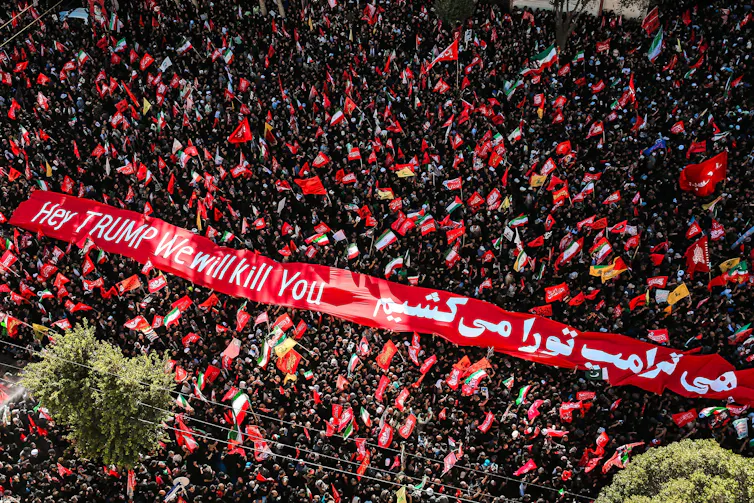
Ali Khamenei’s funeral, which recently took place across Iran during a week of mass processions, turned the regime’s losses into a public ritual. Mourners were heard chanting: “Our word is one! Revenge! Revenge!”

Aerial shot of a crowd in the city of Mashhad displaying a banner reading: 'Hey Trump, we will kill you'.

Crowds in the city of Mashhad taking part in the burial of Ayatollah Ali Khamenei unfurl a banner reading: ‘Hey Trump, we will kill you’. Iranian Supreme Leader Office / EPA

This rhetoric reveals how the regime now narrates its own position. It has portrayed Iran as a state burdened by an accumulation of military, political and symbolic losses that demand recovery. In doing so, it has created the very conditions under which greater risk acceptance becomes conceivable.

In all of this, there is an uncomfortable implication for the US. Trump’s decision to commit to further strikes on Iran, while defending commercial vessels in the strait, may be subsidising the psychological conditions that sustain Tehran’s risky behaviour.

Effective deterrence presumes an adversary weighing what it stands to lose. But against a regime that believes it has already lost, each strike simply deepens the deficit it is gambling to recover. The fight is now being waged on ground that Tehran has defined.

TV Star Suffers ‘Freak Accident’ During Surgery

0
tv-star-suffers-‘freak-accident’-during-surgery
TV Star Suffers ‘Freak Accident’ During Surgery


Grey’s Anatomy actress Leven Rambin is opening up about a terrifying health ordeal after what was supposed to be a routine surgery turned into an emergency.

The 36-year-old actress, who played Sloan Riley in season six of Grey’s Anatomy, revealed that she woke up in the ICU after undergoing surgery for endometriosis.

But instead of coming out of the procedure with the answers she expected, Rambin said she was left with a nicked aorta, emergency surgery, and a massive scar.

“Going in for the endometriosis diagnostic and removal, and coming out with a NICKED AORTA, emergency surgery and a scar the size of my forearm was not on the bingo card,” she wrote on Instagram.

The Texas-born actress shared several photos from the hospital as she documented the scary experience for fans.

In one image, Rambin could be seen lying in a hospital bed while wearing a gown and reading Gone Before Goodbye, the Harlan Coben and Reese Witherspoon book.

Despite the ordeal, she managed to smile for the selfie.

Other photos showed an IV in her hand and Rambin resting in the hospital as nurses and family members surrounded her.

The All My Children alum said the road ahead will not be easy, but she is focused on healing.

“The road to recovery will be long but I am determined to heal & start my family,” she wrote.

She added, “Oh how I love being a woman.”

Rambin also thanked fans who had reached out with messages of support, especially those who had gone through similar medical scares.

“Thank you all for your support and prayers,” she wrote. “ESP those who have shared they went through something similar. It helps me feel less alone.”

Fans quickly flooded her comments with concern and encouragement.

“Omg! I am so sorry and that is so freaking scary!” one person wrote. “That is not supposed to happen.”

The fan added that they had undergone several surgeries for endometriosis and never would have expected something like that to happen.

“I am so glad you are ok,” the commenter wrote.

Another fan posted, “Omg! So thankful you’re still here with us.”

A third wrote simply, “Praying.”

Another supporter added, “Leven!! You’re so loved and we’re all here for you – so sorry this happened!!”

Rambin’s surgery was connected to her battle with endometriosis, a condition that affects tissue similar to the lining of the uterus.

Endometriosis happens when cells similar to those in the womb are found outside the uterus. Each month, those cells react like the lining of the womb, building up, breaking down, and bleeding.

But unlike a period, the blood has no easy way to leave the body, which can lead to severe pain and fertility issues for some women.

Rambin has been candid about her desire to start a family.

In June, the Fire Country actress said she was preparing for surgery as part of her fertility journey. She had previously frozen her eggs and said the procedure could help determine whether she would be diagnosed with infertility.

She explained that the surgery was needed for insurance to cover the next steps and to better understand her fertility status.

In a previous TikTok video, Rambin said a nurse had reassured her that her body was “normal.”

She also shared that a doctor told her, “This could be your lucky month but if you want to be efficient you can go ahead and do the IVF.”

Rambin said at the time that she was also planning to undergo endometriosis diagnostic surgery.

“So that should be fun,” she said. “She said the best time to get pregnant is right after that.”

“So let’s go ladies,” Rambin added.

The actress is now recovering from a much more serious ordeal than she ever expected, but her message to fans made one thing clear: she is still determined to heal and move forward with her dream of becoming a mother.

China’s Africa lending model has a split personality

0
china’s-africa-lending-model-has-a-split-personality
China’s Africa lending model has a split personality

Over the past two decades, China’s rise as the world’s largest bilateral creditor has profoundly altered the global development finance landscape.

Yet international scholarship on Chinese sovereign lending — especially to Africa — remains trapped in a binary: Western-centric “debt-trap diplomacy” narratives versus Beijing’s “South-South cooperative altruism” rhetoric.

Understanding this requires moving beyond these ideological framings to analyze the macroeconomic externalities of China’s internal economic architecture — specifically, a “dual system” China has employed in its overseas financing over the past 30 years: internal Keynesianism paired with external neoliberalism.

In other words, China’s overseas sovereign credit acts internally as a macroeconomic vent for domestic state-Keynesian industrial overcapacity, while its external execution relies on pragmatic, depoliticized and commercialized market mechanisms that mirror neoliberal risk-mitigation frameworks.

1. Internal Keynesianism’s external mirror

To understand Chinese infrastructure financing overseas, one must look beyond conventional geopolitical accounts and focus on the deep structural mechanisms of China’s domestic macroeconomic engine.

Within this state-directed loop, central and subnational governments act as the ultimate planners, resource allocators and systemic risk guarantors. By channeling massive liquidity through state-owned policy banks and large state-owned commercial banks, Beijing engineered an unprecedented domestic credit expansion.

While this model sustained high GDP growth rates for decades, a state-Keynesian regime dependent on continuous capital-intensive injections inevitably runs into diminishing marginal returns. By the mid-2010s, this had produced severe structural overcapacity across a number of sectors, along with a buildup of subnational balance-sheet distress.

When domestic fixed-asset absorption reached its peak, the Chinese state faced an urgent structural mandate: find an external vent for its surplus industrial capacity and its large accumulation of U.S. dollar foreign exchange reserves. This process mirrors what geographer David Harvey calls the “spatial fix” — the displacement of overaccumulated domestic capital into long-term overseas infrastructure projects.

Thus, the Belt and Road Initiative (BRI) emerged as the logical international extension of this internal Keynesian model. The micro-financial loop of this externalization was designed with considerable institutional precision:

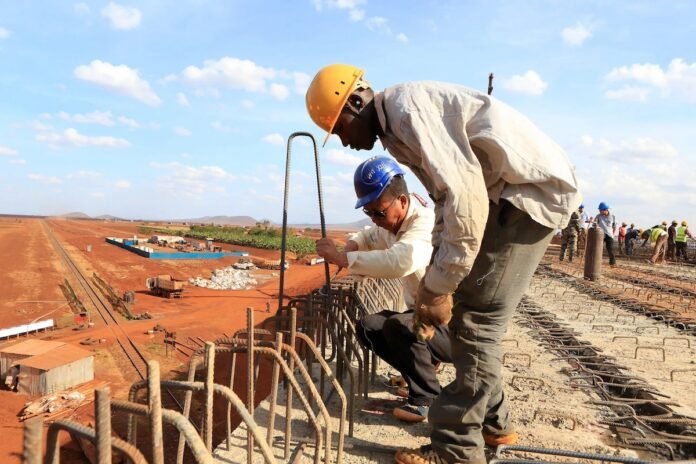
First, a Chinese policy bank extends a dollar-denominated sovereign loan or export buyer’s credit to an African state government. Second, the loan agreement embeds strict procurement and exclusivity clauses, stipulating that the financed infrastructure asset must be built by designated Chinese state-owned enterprises acting as engineering, procurement and construction contractors.

Finally, and critically, while the sovereign debt is legally registered to the borrowing African government, the capital itself rarely leaves the Chinese banking system: In the clearing process, the dollar funds are transferred directly from the bank’s headquarters in Beijing to the corporate accounts of the Chinese state-owned enterprises executing the project.

Through this arrangement, Beijing converted low-yielding dollar reserves into overseas commercial orders for its domestic industrial base, effectively exporting its overcapacity to economies abroad.

2. External neoliberalism in practice

While the macro-level motivation for China’s overseas credit expansion remains rooted in state-backed Keynesianism, the micro-level behavior of Chinese capital changes once it enters the international market.

On foreign soil, Chinese banks operate with a pragmatic, highly commercial focus on capital preservation, risk insulation and asset securitization that mirrors neoliberal financial logic.

Traditional Western multilateral institutions — the Bretton Woods system led by the World Bank and the International Monetary Fund (IMF) — embed explicit political and economic conditions within their credit facilities.

Guided by the “Washington Consensus,” these institutions require borrowing states to implement sweeping structural adjustment programs, which often mandate fiscal austerity, state-enterprise privatization, transparency reforms and, occasionally, specific judicial or electoral changes.

China, by contrast, operates under a diplomatic doctrine of “non-interference” and “no political strings attached.” International observers, however, often misinterpret this lack of political conditionality as an absence of commercial or legal conditions as well.

In contract design, commercial enforcement and financial risk mitigation, Chinese banks often behave like highly rational market actors. Rather than attempting to reshape the governance structures of recipient states, Chinese capital insulates itself from host-country governance risks through strict commercial and legal mechanisms.

The clearest institutional example of this external neoliberal risk insulation is the “Angola Mode,” a structure often categorized as “commodity-backed infrastructure lending.”

When extending credit to sovereign states with low credit ratings, high institutional fragility and restricted access to international capital markets, Chinese financial institutions have designed a tightly closed-loop system for protecting their exposure:

  • The offshore escrow mechanism: The credit arrangement bypasses the domestic central bank and fiscal systems of the borrowing state. Instead, a binding contract mandates the creation of an offshore escrow account, typically maintained in an international financial hub or directly with the lending bank in Beijing.
  • The revenue interceptor: The borrowing state mandates that revenues from its strategic commodity exports be paid directly into this offshore escrow account by the buyer. The creditor bank holds a senior security interest over the account, automatically deducting principal and interest payments before any residual capital is remitted to the borrowing nation’s domestic treasury.

Through these offshore structures, the lending and repayment of capital are detached from the fragile and often corrupt central banks and currency systems of the borrowing countries.

In other words, as long as Angolan oil continues to be extracted and shipped to China, the repayment cash flow is intercepted directly by Chinese financial institutions in escrow accounts established overseas.

This approach — securing capital without altering the borrowing country’s institutions, relying solely on sophisticated financial contracts and resource-monetization flows — takes the underlying neoliberal logic of “property rights, contracts, free flow of capital and risk-bearing” to its extreme.

3. When Keynesian credit meets market anarchy

This dual-track credit model — internal Keynesianism paired with external neoliberalism — operated smoothly during the commodity super-cycle between 2000 and 2018, securing an expansive global market share for China’s industrial capacity while fueling the largest postwar infrastructure boom on the African continent.

But this architecture, which interfaces internal Keynesian capital generated under tight state control with an anarchic international market governed by neoliberal rules, harbors an inherent structural mismatch. That mismatch eventually produced a sovereign debt crisis across much of Africa.

When operating the Keynesian model domestically, the Chinese government has near-total control over the financial system. Systemic debt distress within state-owned enterprises is managed largely through administrative coordination: The central state can orchestrate debt rollovers, direct liquidity injections, enforce financial repression, or mandate state-backed commercial banks to absorb non-performing loans.

In effect, the system assumes that a single sovereign coordinator can always socialize the costs of financial distress. The international debt system, however, operates under structural anarchy: There is no global sovereign authority to underwrite or bail out a bankrupt state.

When the external macroeconomic environment shifted sharply in the early 2020s — particularly amid the Federal Reserve’s aggressive interest rate hikes — global liquidity flowed rapidly back to Washington, triggering a sharp depreciation of non-dollar currencies and volatile swings in commodity prices.

For African countries heavily reliant on dollar-denominated debt and narrow, single-industry economies, this amounted to near-fiscal suffocation.

Once systemic sovereign defaults occurred, the limitations of relying purely on commercial contract design — without sovereign enforcement mechanisms — became apparent. Zambia was the first African country to experience a serious sovereign default, and its debt structure was extremely complex.

Several major Chinese banks had accumulated billions of dollars in claims in Zambia, much of it secured by resource collateral or escrow accounts. But when Zambia’s national finances collapsed, its foreign exchange reserves were depleted as well, and severe social unrest followed. China then encountered what some Western political economists call the “creditor’s dilemma.”

On one hand, China cannot deploy military or extrajudicial force to seize physical assets in a defaulting state — doing so would violate Beijing’s diplomatic narrative of South-South solidarity and risk igniting anti-Chinese sentiment, damaging its standing among the Global South.

On the other hand, Chinese banks initially resisted participating in multilateral debt-relief frameworks such as the Paris Club, preferring confidential, bilateral negotiations that would preserve their specific collateral structures.

That approach ran into resistance from the IMF and Western private bondholders, who demanded comparable treatment and full transparency around Chinese collateral agreements, accusing Chinese lenders of nondisclosure. Beijing, in turn, countered that private bondholders sought high yields without accepting equal losses on their holdings.

This back-and-forth has made clear to Chinese banks that in the world of overseas neoliberal markets, no contract, however carefully designed, can fully hedge against the systemic risk posed by the bankruptcy of a sovereign state.

4. The shift toward ‘small and beautiful’ lending

Facing the backlash from sovereign debt defaults, alongside domestic structural changes and subnational debt clearing, China’s sovereign lending network to Africa entered a period of strict rebalancing between 2024 and 2026, gradually abandoning its earlier era of aggressive expansion.

During the peak expansion phase of the BRI, the annual disbursement of new Chinese sovereign loans regularly exceeded the total principal and interest payments remitted by African states.

Today, due to tighter credit risk assessments by Chinese banks, the debt service African nations pay annually on legacy loans has outpaced the inflow of new Chinese sovereign credit. In short, China has shifted from an aggressive liquidity provider into a protective creditor focused on recovering capital from a mature loan portfolio.

In September 2024, the Chinese government announced financial support of 360 billion yuan (about $50 billion) over the following three years. A closer look at the details, however, reveals that the core of this funding differs fundamentally from the lending of a decade ago.

This shift rests on at least three new anchors for China-Africa financial relations in the coming decade.

First, to shield bilateral credit networks from Western monetary shocks and Federal Reserve interest rate cycles, Beijing has steadily increased its allocation of yuan-denominated sovereign loans and bilateral currency swap lines.

By extending credit in yuan, Beijing encourages African borrowers to procure Chinese industrial equipment directly in yuan, later servicing the debt with yuan revenue earned from commodity exports to China.

Second, massive, capital-intensive transportation and logistics projects have given way to targeted, high-yield interventions. Individual project financing caps are strictly monitored, with credit redirected toward two primary sectors: the green energy transition and Digital Silk Road financing for 5G telecommunications infrastructure such as cloud data centers. These “small and beautiful” projects carry high strategic value, in part because they help lock in Africa’s future digital dependence on Chinese technology.

Third, to counter criticism that its lending model mirrors historic extractive patterns — extracting raw materials while exporting finished goods back to Africa — China has also been gradually shifting its investment strategy toward localized industrial value-addition.

Chinese credit is increasingly directed toward funding processing plants, smelters and special economic zones within Africa. Chinese firms are also establishing more downstream assembly units for electric vehicles and lithium battery components in regional hubs such as Nigeria and Egypt, integrating African industrial bases directly into China-led green energy supply chains and helping route around Western trade barriers.

5. Toward a third credit paradigm

In sum, the 20-year history of China’s sovereign lending to Africa is neither the “history of geopolitical intrigue and debt traps” portrayed in some Western narratives, nor the purely altruistic “history of South-South charity” that transcends the laws of capital, as depicted in China’s official messaging.

It is, at its core, the product of a large, policy-driven state capitalist economy. Faced with domestic overcapacity and the limits of credit expansion, China has pursued a distinctive and inherently tense experiment: internal Keynesianism paired with external neoliberalism in the globalization of its capital overseas.

Over the next decade, the world may see the emergence of a new, third credit paradigm — one centered on yuan-denominated pricing, comprehensive risk control, a dual engine of digital and green technologies, and deep integration with local supply chains.

Only by moving beyond Cold War-style framing and examining the institutional details of China’s credit duality can observers accurately grasp the direction of its future overseas financing.

Jiahao Yuan is an economist focusing on international development finance and Chinese macroeconomic policy.

Probe into explosive diarrheal cases points to Taco Bell and bad lettuce

0
probe-into-explosive-diarrheal-cases-points-to-taco-bell-and-bad-lettuce
Probe into explosive diarrheal cases points to Taco Bell and bad lettuce

Lettuce and salad greens have become the prime suspects in an explosive outbreak of the diarrheal parasite Cyclospora, which is surging nationwide but erupting to extraordinary heights in Michigan.

In recent years, Michigan has typically reported around 50 cases of cyclosporiasis, which causes urgent bouts of watery diarrhea, abdominal cramps, and nausea. But, this year, as of July 14, the state has reported 3,309 cases of the food-borne pathogen. Of those 44 have been hospitalized.

Based on interviews with more than 1,000 people sickened in Michigan, the latest data is pointing to leafy greens as the source, according to the Michigan Department of Health and Human Services (MDHHS).

“Although we do not have a definite product identified as the source of the outbreak, we want to let Michiganders know what we have learned so far so they can take steps to protect their families,” Natasha Bagdasarian, Michigan’s chief medical executive, said in an announcement. “Early information has shown lettuce as a common product that regularly comes up during the investigation. We will continue to provide updates as we learn more.”

Taco Bell suspected

Separately, The Washington Post reported that state and federal officials are looking into whether Taco Bell restaurants may have been a source of food contaminated with the single-cell parasite.

According to local media sources in the Detroit area, Taco Bell restaurants put up signs reading, “We are currently unable to sell Lettuce, Cilantro, Onion, Pico de Gallo, and Guacamole due to a nationwide recall.”

It’s unclear what recall the restaurant is referring to; no nationwide recalls have been announced by Michigan or federal authorities related to cyclosporiasis cases. The Post reported that Taco Bell did not respond to multiple requests for comment on the signs or the decision to pull certain produce.

A source familiar with the investigation told the outlet that some sickened people interviewed reported having eaten at Taco Bells, while others did not, suggesting that there could be multiple sources of the contaminated food item.

Identifying the source of Cyclospora can be difficult because it can take up to two weeks between when a person eats contaminated food and when they develop symptoms, making recall of the possible food sources difficult, the MDHHS noted. They also pointed to the “complex food distribution networks” as complicating factors in tracking the source or sources.

National situation

While Michigan is seeing the highest numbers of cases, at least 33 other states are also reporting illnesses. New York has reported 470 cases. Ohio is seeing at least 397 cases. North Carolina has reported at least 240.

The Centers for Disease Control and Prevention is collecting data on cases, but has been slow in reporting them. After this story was published, representatives for the CDC and the Food and Drug Administration updated their data and held a press briefing on the cyclosporiasis situation. The CDC is now reporting 1,645 cases across 34 states as of July 13, with 141 of the cases being hospitalized. There have been zero deaths (this infection is rarely ever fatal).

Additionally, the CDC said it is aware of reports of more than 5,100 additional cases from state and local health departments. But these cases require follow-up to confirm the infections and whether they were domestically acquired, the CDC said.

The CDC and FDA believe that multiple clusters of disease are driving the large case count and wide distribution of illnesses across the country this year. The skyrocketing cases in Michigan, however, are thought to be part of a multi-state outbreak spanning Ohio, Virginia, and Western Virginia. In the briefing, Gwen Biggerstaff, deputy director of CDC’s Division of Foodborne, Waterborne, and Environmental Diseases, said it appears that the cases in this region may be from a single source, however a clear genetic or epidemiological link has not been confirmed. The CDC has created an outbreak investigation page for updates on this outbreak.

While both the CDC and the FDA representatives were aware of reports linking the cases to salad greens and Taco Bell, they would not confirm in the briefing that either are leading suspects in the eyes of the federal agencies.

Biggerstaff said the agency is pulling together data on what people ate and where, genetic data from the parasites, and trace-back data on food sources. “Right now we don’t have a specific source identified and we’re working very hard to continue collecting and analyzing those data,” she said in the briefing.

Donald Prater, FDA’s acting deputy commissioner for food, added only: “What I can say at this point is that we’re continuing our traceback investigation on multiple produce items, including the lettuce.”

Combining the CDC’s confirmed and probable cases, the US is already over 6,745 cases at this point in the summer, which is when cyclosporiasis cases peak. This tally is well above historical numbers; the US has typically reported between 2,000 and 5,000 cases a year.

Amid the outbreak with no clear source as of yet, health officials are recommending that people be cautious about leafy greens, particularly bagged or boxed greens. It’s recommended to instead buy whole heads of lettuce, discard the outer two or three layers of leaves, and then wash the rest thoroughly. But, sticking with peel-able or smooth-surfaced produce is safer. The safest choice is cooking produce to at least 158° F (70° C), which will kill the parasite.

Past cyclosporiasis outbreaks have been linked to bagged salad mixes and kits, fresh cilantro, fresh basil, raspberries, snow peas, and green onions, MDHHS notes.

People who experience frequent watery diarrhea should consult with their healthcare provider. An antimicrobial treatment can treat the infection, along with rest and hydration.

This post was updated July 14, 2026 to include information provided in the CDC/FDA press briefing.

The US may be hitting a tipping point for heat pumps

0
the-us-may-be-hitting-a-tipping-point-for-heat-pumps
The US may be hitting a tipping point for heat pumps

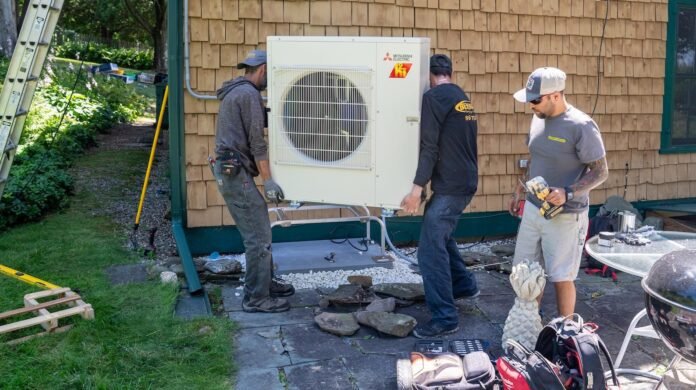
It appears America is falling in love with heat pumps, which is a tall order for an appliance. They use tricks of physics to extract warmth from wintry air and bring it inside, a far more efficient way of staying toasty than with gas furnaces. (It’s better to move heat from one place to another, instead of generating it by burning fossil fuels. Cold-climate heat pumps can still do this in the most frigid of places.) As a bonus, in the summer a heat pump reverses the process to act like a traditional air conditioner, providing comfort in all seasons.

According to a new report from the nonprofit Building Decarbonization Coalition, over the past 15 years, heat pump sales have doubled. In the first quarter of this year, the appliances outpaced shipments of fossil fuel furnaces by 32 percent, and narrowly missed beating out AC units. And in 2024, 46 percent of new housing included a heat pump, compared to 47 percent that went with forced-air furnaces. (This includes models running on natural gas and electric versions that work like giant hair dryers.) 

“All the trends are pointing towards increased heat pump adoption, not only versus gas, but also versus just traditional one-way air conditioning,” said Kevin Carbonnier, associate director of analytics at the coalition. “It’s not just that heat pumps are better, more comfortable, more efficient than furnaces. But also, you get the two-in-one appliance.”

A major driver of this electrification is new housing. Three quarters of new apartments in the US are heated electrically, and if you’re doing that, the thinking goes, you may as well install electric stoves. At that point, it doesn’t make sense for a builder to spend money with everything needed to pipe natural gas into the place. “It’s kind of becoming more of a common-sense measure to only build electric, especially with these new buildings, because the appliances are also so much more efficient,” said Kristin George Bagdanov, associate director of research at the coalition. 

The tricky bit is that homebuilders too often opt for resistance heating, like baseboard heaters, which are basically giant toasters. These have a “coefficient of performance,” or COP, of one, meaning you get one unit of heat for every unit of energy that goes into the device. Heat pumps, by contrast, have a COP of between 2 and 4, making them at least twice as efficient. (And vastly more so than even the most advanced gas furnaces.)

Apartment builders seem to be coming around to heat pumps, though. Half a century ago, vanishingly few new structures used them, in favor of resistance heating. But since 2010 — in the Northwest, at least — 18 percent of new apartment buildings featured heat pumps, according to a recent report from the nonprofit Sightline Institute. Multifamily housing, then, is a hugely powerful and popular way for the U.S. to decarbonize, as both Democrats and Republicans agree that the country urgently needs new housing. The Building Decarbonization Coalition’s report also notes that in new housing overall, including single-family homes, heat pumps were installed nearly half the time in 2024.

Utilities are also experimenting with a way of heating and cooling buildings even more efficiently with heat pumps. It’s known as networked geothermal: The utility drills holes in the ground, installs pipes that look almost exactly like gas ones, pumps liquid through them, and delivers it to the homes and businesses in a neighborhood, where heat pumps use the water, rather than air, to work their magic. Because the earth might still be 50 degrees Fahrenheit as air temperatures drop below freezing, the devices can extract consistent subterranean heat in the winter, then spend the summer drawing heat from structures and adding it to the liquid, which circulates back through the ground. This makes a utility’s geothermal system up to seven or eight times more efficient than having the same homes using gas furnaces. 

You might imagine a future, then, where liquid, not natural gas, flows into neighborhoods with nothing but electrified kitchens. “It’s all the same skill sets: managing infrastructure systems, drilling, laying down pipe in the street,” Carbonnier said. “All the same stuff that the gas workers are already doing.”

Ultra-efficient systems like networked geothermal aren’t just ideal for decarbonization because they run on electricity. As the U.S. uses more electricity in general — as massive data centers plug into the grid, for instance — utilities will have to build out more solar and wind farms, transmission lines, and battery banks to store power. Those costs get passed down to ratepayers. The less energy we use warming and cooling our homes, the less additional electricity and infrastructure we’ll need, reducing energy bills. (Electric vehicles are another way utilities are trying to avoid adding infrastructure: All those batteries will place extra demand on the grid, but can also send power to it in times of need. This will also lower costs for customers.)

Energy bills have exploded of late, entering the political zeitgeist, as pressure increases on politicians to do something. “I think for a long time individual consumers were taught that it was their fault if their bills were high, either they weren’t turning off their lights or they were keeping their thermostat too low or too high,” George Bagdanov said. Now they’re learning more about how public utility commissions set rates, how much money building out additional fossil fuel infrastructure costs, and how a utility’s investors reap financial rewards. “And then we kind of saw more of a shift to the conversation being about the systems around those bills,” George Bagdanov said.

Meanwhile, the market continues shifting in favor of the heat pump. “It’s been four years in a row that there’s more heat pumps being shipped out from manufacturers than fossil fuel furnaces,” Carbonnier said. “I think we are at a tipping point.”


US House minority leader to oppose bid to cut off Israel aid

0
us-house-minority-leader-to-oppose-bid-to-cut-off-israel-aid
US House minority leader to oppose bid to cut off Israel aid

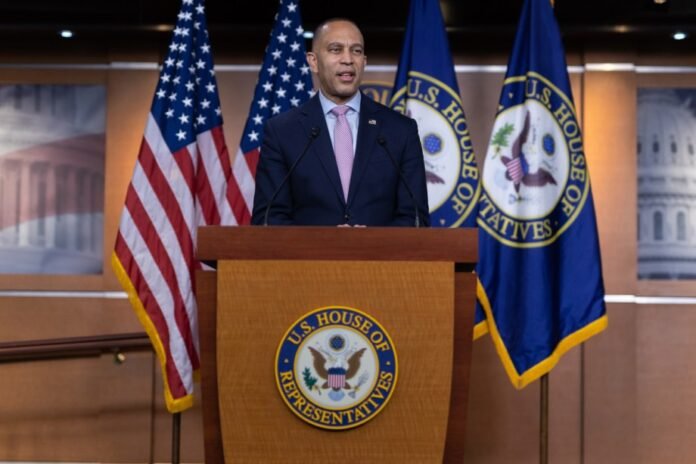
House Democratic Leader Hakeem Jeffries said Tuesday he will oppose Republican Rep. Thomas Massie’s amendment that would cut off all US assistance to Israel, Anadolu reports.

The amendment, which the House of Representatives is expected to consider in the coming days as part of a broader foreign operations spending bill, would mark the first standalone vote of the current Congress on ending US military and other assistance to Israel.

The measure is expected to expose deep divisions within the Democratic Party on support for Israel.

Dozens of Democrats are expected to back the proposal, which would eliminate the $3.3 billion in annual US assistance to Israel.

In a letter, Jeffries argued that the amendment would limit the US’ ability to counter militant groups, including Hamas and Hezbollah, which he described as terror organizations hostile to the US and Israel.

READ: Poll: 40 % of non-religious US Jews accuse Israel of genocide in Gaza

“In my view, there are more decisive ways to achieve the urgent change necessary when it comes to the far-right Netanyahu government. Republican leaders are desperately trying to weaponize an amendment they do not support for nakedly partisan reasons.

“However, given the strongly held views throughout the Caucus in this important area of foreign policy, we are not whipping this vote,” he said.

The Democratic leader argued that “American policy in the Middle East must change” for the benefit of Israelis and Palestinians, criticizing Israeli Prime Minister Benjamin Netanyahu’s government.

“The far-right Netanyahu government has isolated Israel from much of the world, severely damaged its standing in the U.S., jeopardized normalization efforts in the region and repeatedly undermined prospects for peace,” he said.

The US has long been criticized for providing support to Israel in its war in the Gaza Strip, where more than 73,000 victims, mostly women and children, have been killed since Tel Aviv initiated a genocidal war beginning Oct. 7, 2023.

READ: Katz boasts of Gaza’s destruction, says it is the result of a ‘well-thought-out policy’ and announces plan for three military outposts

Lindsey Graham’s Sister Appointed To Fill His Senate Seat After His Sudden Death 

0
lindsey-graham’s-sister-appointed-to-fill-his-senate-seat-after-his-sudden-death 
Lindsey Graham’s Sister Appointed To Fill His Senate Seat After His Sudden Death 


Darline Graham Nordone, the sister of the late Republican Sen. Lindsey Graham, will temporarily represent South Carolina in the US Senate following her brother’s sudden death over the weekend, Gov. Henry McMaster announced. 

Nordone will serve the remainder of Graham’s current term, which ends in January. Senate Republican Majority Leader John Thune said shortly after the announcement that she could be sworn in as early as Tuesday, making her the first woman to represent South Carolina in the US Senate. 

“This is such a tremendous honor,” Nordone said at a news conference attended by dozens of her brother’s staff members and advisers, some of whom were in tears. “Lindsey was always there for me. Now I will be there for him.” 

Graham died Saturday night at age 71, apparently from an aortic rupture. The senator never married or started a family, and Nordone remained a visible presence throughout his political career, joining him at speeches and public events and appearing in some of his campaign advertisements. 

Their relationship dated back to the deaths of their parents, who died a little more than a year apart. Graham was 22 when he became the legal guardian of his then-13-year-old sister. While later serving as a lawyer in the Air Force, he formally adopted Nordone so she could receive his military benefits. 

Nordone previously recalled that Graham hugged her on the day their father died “and promised he would always be there for her and take care of her.” She said her brother kept that promise. 

McMaster said he contacted Nordone in the early hours of Sunday, shortly after Graham’s death, and asked her to accept the Senate appointment. President Donald Trump also backed the move and expressed support for Nordone’s appointment earlier that day. President Trump wrote yesterday that McMaster should name her as the interim replacement. 

Nordone has worked as an optometrist in the optical field and for several South Carolina government agencies, including the Commission for the Blind and the state’s Department of Employment and Workforce. 

Special Republican primaries are expected next month to select a candidate for the November general election to fill Graham’s seat. His death has opened a contest among several prominent South Carolina politicians. 


Houthis fire missiles at Saudi Arabia, breaking years of calm

0
houthis-fire-missiles-at-saudi-arabia,-breaking-years-of-calm
Houthis fire missiles at Saudi Arabia, breaking years of calm


Yemen’s Houthi movement fired missiles at Saudi ​Arabia after accusing the kingdom of bombing an airport under their control on Monday, breaking a four-year truce in the conflict between ‌the kingdom and the Iran-aligned group.

Saudi Arabia intercepted missiles “launched by the terrorist Houthi militia toward the southern region,” the spokesperson for a Saudi-led military coalition in Yemen said on X.

Houthi military spokesperson Yahya Saree said they had targeted the international airport in Saudi Arabia’s Abha, the capital of a mountainous southern region bordering Yemen where many Saudis escape the summer heat.

The strikes ​are the first claimed by the Houthis against Saudi Arabia since an informal truce went into effect in March 2022 following Houthi attacks on ​Saudi energy infrastructure.

Monday’s violence threatened renewed conflict on Saudi Arabia’s southern border after Iranian drone and missile attacks targeting its ⁠eastern regions and Riyadh subsided following an April truce in the Iran conflict.

The country’s size relative to other much smaller Gulf states meant it fared better during ​the war, continuing to export oil via a pipeline from the east to its west coast on the Red Sea, bypassing the Strait of Hormuz.

A wider conflict ​with the Houthis, who have in the past targeted Red Sea shipping, could challenge that.

The Saudi government’s communication office did not immediately respond to a request for comment.

IRANIAN PLANE

Earlier Monday, the Houthi movement, which controls northern Yemen, accused Saudi Arabia of launching airstrikes against the international airport in Sanaa and had vowed to retaliate. The Houthis called Monday’s attacks “blatant aggression” and ​said they had ended a period of de-escalation.

They also warned airlines against flying in Saudi airspace until the “siege” on Sanaa airport was lifted.

The strikes on Sanaa ​airport were claimed by Yemen’s internationally recognized government, which is heavily backed by Riyadh, where many of its members reside.

The Yemeni government’s defence ministry said the runway at Sanaa International Airport ‌had been ⁠targeted to prevent an Iranian plane from landing in violation of Yemeni sovereignty.

It said government forces would respond to any hostile aircraft violating Yemen’s airspace “by all available means”, and held Iran responsible.

An armed forces spokesman later said the aircraft had landed at Houthi-controlled Hodeidah airport.

It was unclear whether any attempt had been made to stop it from landing in Hodeidah, about 150 km (93 miles) southwest of Sanaa, on Yemen’s Red Sea coast.

YEARS-LONG WAR FLARES UP

Another minister said the Houthis were detaining ​another plane, belonging to the International Committee ​of the Red Cross, at Sanaa ⁠airport. Hachem Osseiran, ICRC spokesperson for the Middle East, told Reuters all ICRC staff and the crew of the plane were safe and accounted for, declining to comment further.

In recent days an ICRC-mediated prisoner exchange deal between the Houthis and ​Yemen’s internationally recognised government fell through, with both sides exchanging blame in a sign of growing tension.

Yemen has faced ​civil war and proxy ⁠warfare from outside powers for more than a decade after the Houthis seized the capital and forced the internationally recognised government to relocate to the south.

The Saudi-led coalition intervened in 2015 against the Houthis, triggering one of the world’s worst humanitarian crises.

Violence flared again late last year after a separatist movement backed by the United Arab Emirates ⁠swept through ​territory in the south, splintering the Saudi-led coalition created to fight the Houthis.

Still, the 2022 truce ​between Saudi Arabia and the Houthis has largely held, despite regional escalation tied to the Israel-Gaza war, where the Houthis fired on numerous Red Sea ships, as well as the Iran war.

Source:  Reuters

ICE Orders Halt Vehicle Stops After Deadly Shootings by Federal Agents

0
ice-orders-halt-vehicle-stops-after-deadly-shootings-by-federal-agents
ICE Orders Halt Vehicle Stops After Deadly Shootings by Federal Agents


Internal orders handed down by leaders at U.S. Immigrations and Customs Enforcement instructed officers in the field to stop making vehicle stops, according to five ICE officials around the country.

The directive, handed down in at least three of ICE’s administrative regions Monday and effective immediately, came after a pair of killings in Texas and Maine by ICE agents that involved attempts to stop cars.

The ICE officers who spoke with The Intercept, who asked for anonymity to discuss internal orders, said the shift was meant to mitigate the chances of shootings like the ones that sparked outrage by taking the lives of two immigrants over the past week.

“Whatever these chucklefucks did in Maine and Houston is serious.”

“We have been told to either grab them before they leave their parking spot, or follow them and arrest them where they stop (ie a gas station or place of work) to avoid these situations,” said an ICE official from the South.

“This shit isn’t normal,” the official said. “Whatever these chucklefucks did in Maine and Houston is serious.”

ICE did not immediately respond to a request for comment.

The five officials who spoke to The Intercept about the directive all hail from ICE’s Enforcement and Removal Operations division, which carries out most of the federal government’s street immigration arrests. (ICE’s Homeland Security Investigations, the agency’s criminal investigative arm, did not receive a directive about vehicle stops, according to two special agents.)

The directive to ICE’s Enforcement and Removal Operations, which was first reported by the New York Times, didn’t come down as written orders, two of the ICE officials told The Intercept.

Instead, said one of the ICE officials who works in the Mountain West region, the order came down through field office directors to avoid red tape associated with putting an official policy in place.

Along with street arrests, vehicle stops had become go-to tactic for ICE in the second Trump administration, with ramped-up enforcement that has included crackdowns on large cities like Minneapolis. Under past administrations, including President Donald Trump’s first term, ICE relied mostly on transfers from local jails and prisons to satisfy its enforcement priorities.

The vehicle stops also contributed to a recent explosion of immigrant detentions, with ICE announcing roughly 10,000 arrests over a five-day period in late June 2026.

Ending the vehicle stops, said the ICE official based in the South, “definitely hinders enforcement.”

Killings in Vehicle Stops

In a recent period of less than a week, Mexican national Lorenzo Salgado Araujo was shot and killed by ICE officers in Houston and Colombian national Joan Sebastian Guerrero was shot and killed in Biddeford, Maine.

Details surrounding the shootings are still emerging, but Department of Homeland Security officials have said that neither Araujo nor Guerrero were the intended targets of the ICE enforcement operations that claimed their lives. The officers involved in the shootings were not wearing body cameras in either case.

The killings sparked public outrage and probes at both the state and local levels.

In addition to investigations by FBI and the Homeland Security Department’s Office of the Inspector General, Maine’s attorney general and the attorney general in Harris County, Texas, which includes Houston, launched investigations. Local police departments in both Maine and Texas are assisting with the investigations.

There are few precedents for ICE to cut off its enforcement division agencywide from using vehicle stops to make apprehensions.

As federal agents surged into mostly Democratic major cities, confrontations between ICE and demonstrators, activists, and immigrants led to violence — especially after the killings of Renee Good and Alex Pretti during ICE’s Operation Metro Surge in Minneapolis over the winter.

The outrage over the shootings led to operational guidance emphasizing de-escalation and reducing confrontations during field operations, with several field offices even briefly suspending proactive street enforcement or vehicle-stop tactics following orders of ICE upper management.

Since Operation Metro Surge’s end in mid-February, ICE has focused on smaller, decentralized “at-large” enforcement operations under the leadership of new Homeland Security Secretary Markwayne Mullin, a strategy that has allowed ICE to, until recently, operate with a lower profile, while maintaining previous arrest quotas.

0FansLike
0FollowersFollow
0FollowersFollow
0SubscribersSubscribe
- Advertisement -
Google search engine

Recent Posts