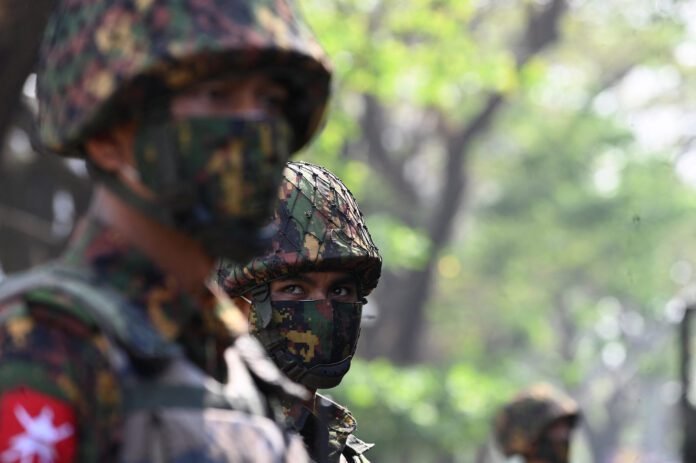
Within days, he and 21 other conscripts, several of them recaptured deserters under death sentence, walked into Karen National Liberation Army lines and defected.
The incident was emblematic of a controversial conscription policy that briefly gave the Myanmar junta the manpower to look like it was recovering after significant losses on the battlefield — and is now, two and a half years in, running out of runway.
Western policymakers being told the regime has “stabilized” should look hard at what the battlefield actually shows before they weigh engagement, sanctions relief or post-election recognition.
The bubble and its leaks
The Tatmadaw activated the dormant 2010 People’s Military Service Law on February 10, 2024, after losing more than half the country’s townships in a coordinated resistance offensive.
It has since inducted roughly 120,000 men through 25 conscription cycles, with over 60,000 forcible recruitments in 2025 alone — six times the army’s 2020 intake. Unlawful Conscription Watch has verified 32,974 individual cases between May 2025 and May 2026.
The conscripted manpower bought the regime a window. It let coup leader Senior General Min Aung Hlaing retake roughly 20 towns, including Falam, Lashio and Myawaddy, and push columns into Hpapun and Kyaukphyu, while expanded drone units, mechanized paratroopers and gyrocopters added new tactical options.
But resistance forces still controlled approximately 87 towns as of mid-May, and most of the junta’s headline “recaptures” are urban pinpoints — a battalion planted in a town center for a propaganda photograph, while resistance forces reorganize in the surrounding villages.
The 2024 law set a nominal two-year term for conscripts, and that clock has now expired for the first wave. Fearing the next intake will collapse if it doesn’t release anyone, the regime has let a token cohort go home. But the “emergency” clause lets it retain conscripts for up to five years, and it is using that clause aggressively.
Accounting for men killed at the front, disappeared or deserted, fewer than half of all conscripts have returned to civilian life. Only about 12% have been formally released.
Conscripts are sent to the front straight from training, in violation of the junta’s own February 2024 pledge. At Kyaukphyu’s besieged Taung Maw Oo naval base in Rakhine State, hundreds of new recruits have not helped to break the Arakan Army’s siege and are quickly winding up as casualties or deserters.”
Resistance fighters on the Karen front describe having to pause fighting periodically to let junta units collect the bodies of freshly conscripted troops killed in wave after wave.
Desertion and defection have become structural features of the junta’s fielded force. The Hpapun conscript who killed his commander planned it from the moment his column left base, gained the officer’s trust to be assigned as bodyguard and coordinated 22 personnel in a single defection cluster.
Similar cases surface almost weekly. The resistance’s task, increasingly, is not to defeat these conscripts on the battlefield but to receive them when they cross the line.
Pinned down and undermanned
The junta is fighting simultaneous campaigns in every state and region except Yangon, and every front is bleeding manpower. In Arakan, an 18-month offensive has produced almost nothing; the Arakan Army now threatens Sittwe and Kyaukphyu, and allied formations are pushing into Ayeyarwady, Bago and Magway.
In Chin, the push from Hakha into Kanpetlet and Mindat has stalled. In Kachin, Regional Military Command 4’s offensive toward Shwegu has been broken up by repeated ambushes — the RMC commander himself was evacuated after being wounded.
In Sagaing, guerrilla interdiction has cut the regime’s main logistics corridors. In Karen, relief columns trying to reach the besieged Waw Lay Kone garrison have collided with intensified fighting around Minlatpan. In Karenni, the regime holds urban pinpoints and nothing more; in Tanintharyi, tempo is rising against a thin junta presence.
The unit picture is the most telling. All ten of the Tatmadaw’s Light Infantry Divisions — LIDs 11, 22, 33, 44, 55, 66, 77, 88, 99 and 101 — are simultaneously pinned to active fronts, with no strategic reserve rotating out to rest and refit.
Of the army’s 20 Regional Military Commands, 15 are committed to forward combat operations. RMC 16 was overrun and is being rebuilt from scratch in Lashio; RMCs 5, 9 and 15 have collapsed and cannot be reconstituted at all.
This is what strategic exhaustion looks like in an order of battle. The manpower the regime pulled in during 2024 and 2025 has been largely spent. The resistance is now destroying not just outposts but entire regime columns.
Shredded social contract
The Tatmadaw’s social contract with the Bamar majority is gone. Mandalay lawmakers have publicly likened the junta’s recruitment teams to human traffickers.
Yangon families stay indoors after 7p.m. to avoid overnight inspections, and a parallel extortion economy in deferment bribes has emerged around the ward administration system.
Skilled labor is fleeing. The International Organization for Migration (IOM) recorded 2.3 million registered Burmese migrant workers in Thailand alone, with undocumented numbers more than double that; three in four Myanmar youths are no longer in education or training. The World Bank warns of “long-lasting implications for productivity and household incomes.”
The border crisis originates on the ground that the junta itself controls. The narcotics, scam compounds and trafficking flows alarming Bangkok, New Delhi, Dhaka and Beijing all come out of territory where the junta either no longer governs or governs by predation.
The European Union (EU) has formally told the International Labor Organization (ILO) that Myanmar’s conscription and travel controls “expose workers to trafficking and forced labor across the migration cycle”; Thailand now repatriates detained Burmese nationals knowing men aged 18–35 are conscripted immediately on return.
The functional partners for border stabilization are the authorities actually administering those zones — the Karen National Union (KNU), the Kachin Independence Organization (KIO), the Arakan Army (AA), Chin National Front (CNF) and National Unity Government-aligned interim administrations — not a command structure in Naypyidaw that cannot police its own recruitment teams.
Civilian casualties are inflicted by the junta directly — and cannot be resolved by negotiating with it. Roughly 3.7 million people are internally displaced. The Office of the UN High Commissioner for Human Rights (OHCHR) documented 702 verified civilian deaths in the six months around the junta’s January 2026 election alone, including 224 women and 153 children, with airstrikes accounting for the majority.
These deaths are the operational pattern of a single belligerent — the same belligerent now abducting civilians to replenish the force that kills them with airstrikes.
The response that should follow is not another ASEAN Five-Point dialogue with the perpetrator. Rather, it should seek to degrade the perpetrator’s capacity to inflict harm on civilians through aviation-fuel sanctions, arms-supply interdiction and direct support to the resistance.
Proper international response
Min Aung Hlaing’s regime controls a smaller share of the population than at any time since 1962, and is fielding an army whose own soldiers are killing its officers, with its entire divisional structure committed forward without reserve.
Three implications follow. First, no recognition, sanctions relief or post-election engagement should rest on the claim that the regime has restored order. It has militarized the abduction of its own civilians, is hemorrhaging the soldiers it abducts and has burned through its strategic reserve.
Second, sanctions on the financial, aviation-fuel and arms-supply networks sustaining the conscription-and-airstrike model — particularly the Russian aviation-fuel pipeline and the regional banking conduits moving conscription-bribery revenue — remain the most effective non-kinetic levers available. There are no fresh divisions behind the ones now in the field.
Third, support for the NUG, federal-democracy coordinating bodies, ethnic resistance organizations and the defector-reintegration infrastructure is the highest-leverage strategic investment that can be made in Myanmar. Every conscript who crosses the line is a former junta soldier, a future federal-army cadre and a witness to the regime’s crimes.
The bodyguard in Hpapun was not a resistance fighter when his column left Kamamaung. He was a kidnapped civilian in a junta uniform. By the time he reached the front, he had chosen which Myanmar he intended to serve and live in.
International policy should be calibrated with the same recognition: federal-democratic Myanmar is not a future possibility to be debated, but a present reality being assembled by the people the junta itself is forcing into a choice.
James Shwe is an independent Myanmar American democracy advocate based in California, writing on Myanmar resistance strategy, sanctions enforcement, and Indo-Pacific policy.