29.4 C
London
Tuesday, July 14, 2026
Home Blog

US wartime buildup races against China’s industrial clock

0
us-wartime-buildup-races-against-china’s-industrial-clock
US wartime buildup races against China’s industrial clock

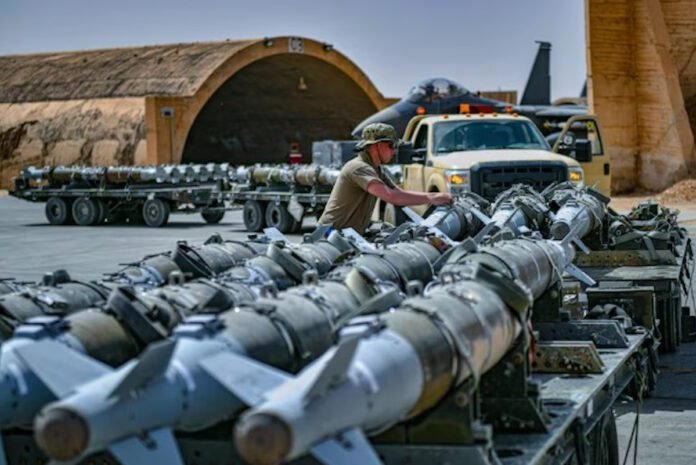
The US push for a wartime industrial base is accelerating, but its real test is whether new weapons can be produced, delivered and sustained fast enough for a multi-front Indo-Pacific conflict.

This month, the Center for Strategic and International Studies (CSIS) released a report indicating that, although the US has made significant progress towards preparing its defense industrial base for wartime needs, important weaknesses in stockpiles and supply chains persist.

The report outlines how the US Department of Defense (DoD) has leveraged large-scale public and private capital to counter strategic adversaries like China. The US DoD expanded its vendor ecosystem by adding 5,000 new entrants in FY 2025 and driving nontraditional contract obligations past US$120 billion.

To replenish munitions depleted during the Iran War, the DoD secured historic multiyear agreements to boost interceptor production and shifted its strategy toward a “high-low mix,” aiming for low-cost munitions to comprise 70% of requested units by FY 2031.

Furthermore, the US committed $7.6 billion between 2025 and 2026 to build a secure “mine-to-magnet” rare earth supply chain outside Chinese control.

Despite these aggressive acquisition reforms and an estimated defense budget request of 4.6% of GDP for FY 2027, the report warns that institutionalizing true readiness will take years, as manufacturing lead times for vital weapons still stretch to over 3 years.

While the US is measuring industrial mobilization by money committed and capacity promised, the decisive test is whether it can outproduce China, move matériel across the Pacific, and replace losses faster than a real war consumes them.

However, it remains to be seen whether the projected production can meet the demands of high-intensity conflict on the Korean Peninsula, over Taiwan or across simultaneous theaters.

In a pre-emptive strike against North Korea, Nicholas Anderson and Daryl Press estimate in a 2025 Texas National Security Review (TNSR) article that a highly localized operation would rely on 24 long-range B-1 and B-52 bombers carrying 528 air-launched cruise missiles (ALCMs), as well as 120 sea-launched Tomahawk cruise missiles fired from naval vessels.

Furthermore, Anderson and Press add that US ground forces on the Korean Peninsula would contribute 48 M270A1 precision-guided Multiple Launch Rocket Systems (MLRS) to the immediate counterbattery campaign against North Korean artillery. That expenditure pales in comparison to the cost of a potential US-China conflict over Taiwan.

Seth Jones estimates in a May 2026 CSIS report that in the first seven days of a conflict, the US  military would expend 3,000 to 5,000 baseline Joint Air-to-Surface Standoff Missile (JASSMs), 3,500 to 4,000 JASSM-Extended Range (JASSM-ER), and 400 to 1,000 Tomahawk cruise missiles, severely depleting or exhausting key US stockpiles almost immediately.

A simultaneous or near-simultaneous Korea–Taiwan conflict would split scarce US missiles, bombers and logistics, forcing support for one front at the expense of the other.

This raises the question of whether US munitions production can offset China’s industrial advantage and replace wartime losses quickly enough to alter the regional balance.

The Heritage Foundation’s January 2026 TIDALWAVE report compares the US and Chinese munitions systems, noting that while the US Indo-Pacific munitions system has significant structural fragility, the Chinese system is a massive, highly integrated enterprise optimized for high-intensity regional conflicts.

According to the TIDALWAVE report, the US model relies on finite stockpiles and could face an extreme “Triple Bind” supply failure within 25 to 120 days due to a two-year production lag, critical bottlenecks in rocket motors, and heavy reliance on imported Polish TNT.

In contrast, it says China’s state-owned conglomerates — like NORINCO — leverage automated, robotic “smart factories” that maintain resilient peacetime production with a 150% to 250% wartime surge capacity, allowing China to sustain prolonged combat depth.

However, the report points out that both nations share profound chokepoint vulnerabilities: the US is deeply dependent on Chinese rare earth minerals, while China’s highly centralized, rail-dependent distribution networks remain uniquely susceptible to targeted cyber warfare and advanced semiconductor export sanctions.

The comparison suggests that China holds the advantage in sustained regional munitions production, but both sides remain vulnerable to targeted disruption at critical industrial and logistical chokepoints.

Even if the US consolidates its supply chains and expands munitions production, those gains may not translate into combat power if vulnerable ports, transport networks, dispersed bases, storage sites and maintenance hubs cannot deliver and sustain the weapons under Chinese attack.

Highlighting the vulnerability of US facilities in the Pacific, Thomas Shugart III and Timothy Walton argue in a January 2025 Hudson Institute report that chronic underinvestment in Indo-Pacific combat logistics has left US forward bases unhardened and acutely vulnerable.

They warn that Chinese precision strikes could disable interdependent fuel lines, aboveground storage tanks and munitions stocks essential for sustained flight operations. Shugart and Walton add that these weaknesses would also hinder the dispersal of aircraft to alternative bases, particularly where prepositioned munitions, redundant fuel supplies and other passive defenses remain inadequate.

Kelly Grieco and her co-authors reach a similar conclusion in a December 2024 Stimson Center report, warning that Chinese missile attacks on forward-base runways could sever logistics and refueling links. They argue that prolonged runway closures could immobilize aerial tankers and restrict the operations of short-range fighters dependent on in-flight refueling.

Grieco and her co-authors also note that damaged airfields would impede deliveries of spare parts and munitions, while exposed fuel and weapons stocks could be depleted within days without reliable resupply routes.

US munitions expansion will have limited wartime value unless forward bases and logistics networks can survive attacks and keep aircraft fueled, armed and operational.

Beyond these logistical constraints, US contracts and investment announcements may overstate wartime capacity because much of the reported progress has yet to produce delivered weapons, qualified suppliers, skilled workers or sustained industrial output.

Mark Cancian and Chris Park argue in a May 2026 CSIS report that major funding increases and ambitious industrial framework agreements still leave a prolonged “window of vulnerability,” as billions in projected procurement have yet to materialize as battlefield-ready weapons.

Cancian and Park point out that while the DoD highlights aggressive contract actions, critical interceptors and missiles face severe manufacturing backlogs, requiring three or more years from appropriation to reach US stockpiles.

They stress that money alone cannot instantly resolve deep supply chain bottlenecks or expand actual factory output, and that maximum potential surge capacities remain theoretical projections rather than active, sustained industrial production.

The next phase of the US defense-industrial buildup will depend less on announcing capacity than on proving, through sustained production and contested-theater exercises, that weapons can be replenished and delivered faster than China can disrupt their flow.

Unless the US aligns factory expansion with hardened logistics, allied production and realistic multi-theater planning, new capacity may arrive too slowly to strengthen deterrence before the next regional crisis.


New York bans data center construction for a year, rattling AI industry

0
new-york-bans-data-center-construction-for-a-year,-rattling-ai-industry
New York bans data center construction for a year, rattling AI industry

New York became the first state to pause all construction of massive new data centers after Democratic Governor Kathy Hochul announced a one-year moratorium on Tuesday, Reuters reported.

The state-wide ban applies to data centers using 50 megawatts or more, officials told Reuters, and it won’t be lifted until the state figures out what “consistent standards” for responsible data center development in New York should look like.

Across the US, calls to halt data center construction have multiplied, as Americans grow increasingly concerned about risks of pollution, rising energy costs, and diminishing water supplies. At the federal level, Bernie Sanders (I-Vt.) and Alexandria Ocasio-Cortez (D-N.Y.) have introduced legislation seeking a possible nationwide construction ban. But Republicans are seemingly unlikely to embrace that legislation, given Donald Trump’s claim that such moratoriums would threaten America’s lead in the AI race.

However, officials on both sides of the aisle are cautious that their views on data centers could get them voted out. At every level, pressure is increasing on elected officials to consider residents’ fears before signing contracts that fail to consider if data center construction will benefit the public. New York’s move comes after researchers last month found that more than $130 billion data center projects have been blocked or delayed by protests so far this year.

On Tuesday, Hochul directed “state officials to develop a Generic Environmental Impact Statement (GEIS) to ensure that new data centers coming online are being held to ‘consistent standards,’ as well as examine the potential environmental impacts of the construction and operation of data centers in the state,” Reuters reported.

New York has fewer data centers than hotspot states like Virginia and Texas that have drawn more projects, but it did have a long queue of data centers waiting for approval to connect to the state’s energy grid, Reuters noted. Some projects had sparked backlash, The Washington Post reported, and New York lawmakers had already passed a bill to impose a data center moratorium in response. Hochul has yet to receive the bill for signing, Reuters reported, but her office described the law as “complicated” and said it would take some “time to work through” once it does reach her desk.

In the meantime, Hochul said it was her “responsibility to take action and lead,” as “data center development threatens to ⁠hike up utility bills, deplete our natural resources, and create uncertainty for New Yorkers.”

“New York will lead the way in creating the strongest standards in the nation for data center development, ensuring that when companies succeed because of New York, New Yorkers succeed too,” Hochul said in a statement.

NY threatens to repeal tax giveaways

Possibly providing a blueprint for other state-wide bans, New York’s bold anti-AI stance was viewed as “a striking setback for artificial intelligence companies that politicians once courted for investment,” the Post reported. It comes after Maine’s governor vetoed a prior state-wide effort to temporarily ban construction out of concerns that Maine’s legislation didn’t exempt a favored project already underway.

Hochul is clearly taking a firmer stance against massive projects concerning New Yorkers. Although her office insists that she isn’t anti-AI, she believes that she must take steps to ensure responsible growth of the industry in New York, where electricity prices are among the highest in the US. On Tuesday, Hochul indicated that she also planned to repeal sales tax exemptions for data centers, which could influence other states that, prior to the AI backlash from constituents, leveraged the tax giveaways to lure investments from the AI industry.

In New York, Hochul has suggested that old incentives and voluntary commitments that AI firms previously relied on to strike deals with officials were no longer enough. States need more information to assess whether residents will be protected from potentially harmful projects.

Hochul had already moved to ensure that data centers don’t force residents to pay higher prices as energy demand in the area skyrockets. In February, Hochul announced a plan to ensure data centers pay their “fair share” for energy grid updates, which she said would set a “simple standard” to “ensure everyday New Yorkers do not subsidize this energy-intensive industry.”

“These industries must pay more; if they do not, they must supply their own energy,” Hochul’s office said in a press release.

The moratorium shows that New York is serious about mulling how to set higher standards for data center construction, but the greatest immediate impact of the moratorium may be the momentum it gives to the anti-AI movement by signaling that stopping all construction in a state is possible.

Lithuania appoints Sinkevicius prime minister

0
lithuania-appoints-sinkevicius-prime-minister
Lithuania appoints Sinkevicius prime minister


Lithuania’s parliament on Tuesday voted in favour of a government manifesto presented by Social Democrat Mindaugas Sinkevicius, clearing ​the way for him to become prime minister and ‌for his proposed cabinet to take office.

NATO and European Union member Lithuania, which borders both Russia and Belarus, is the top defence spender in ​NATO as a share of the country’s economy, devoting ​an estimated 5.33% of its gross domestic product (GDP) to ⁠the military this year.

Sinkevicius’ government manifesto pledged to keep ​the spending above 5% of GDP and to seek a continued U.S. ​troops presence in the Baltic nation as a key deterrent against Russia, while continuing to support Ukraine.

“It would be a mistake to believe that ​Russian military threat is subsiding due to the large losses ​it is now taking”, Sinkevicius told parliament on Tuesday, referring to Moscow’s ongoing ‌war ⁠against Ukraine.

He replaces Social Democrat Inga Ruginiene, prime minister since last year, who is moving aside for the party leader to take over amid recent turmoil in her coalition government.

The new centre-left three ​party coalition, which ​includes the ⁠For Lithuania and Farmers and Green Union parties, commands a small majority in parliament.

Populist party Nemunas ​Dawn, whose leader faces charges of incitement to hatred ​against Jews ⁠and belittling the Holocaust, is no longer part of the government.

In parliament, 72 of the 141 members backed the new government ⁠platform ​while 29 voted against it and four ​abstained. The remaining members were absent.

The next election in Lithuania is scheduled for ​October 2028.

Trump’s Granddaughter Kai, 19, Shows Off Her Abs

0
trump’s-granddaughter-kai,-19,-shows-off-her-abs
Trump’s Granddaughter Kai, 19, Shows Off Her Abs


Kai Trump is putting in the work — and she is not shy about showing the results.

The 19-year-old granddaughter of Donald Trump proudly gave fans a look at her toned midsection in her latest YouTube vlog, lifting her shirt after a busy day of weight training and golf.

“Just got home, and guys, look at that,” Kai said as she pulled up her navy sleeveless top to show off her abs. “Working on my six-pack.”

The University of Miami golf recruit has been regularly giving her followers a peek into her workouts, golf routine, and life as one of the most visible young members of the Trump family.

In the new video, Kai showed herself doing a tough gym session before heading out for a full 18-hole round of golf with a friend.

At one point, she performed single-arm kettlebell lifts with one knee propped on a bench. She also showed clips of herself doing single-arm cable triceps pushdowns, giving her 1.5 million YouTube subscribers another look at the training routine behind her athletic build.

After the workout and golf outing, Kai returned to her mother’s house, where she proudly pointed out the progress she has been making.

The vlog also gave viewers a behind-the-scenes look at how Kai spent the Fourth of July with her grandfather at the White House’s America 250 celebration.

While Kai and Donald Trump share a well-known love of golf, they do not appear to share the same enthusiasm for serious gym time.

Trump joked about his own workout habits in May while announcing that he was bringing back the Presidential Fitness Test for students. The program had been discontinued in 2013 under former President Barack Obama’s administration.

“I work out so much,” Trump said at the time. “Like, about one minute a day, max. If I’m lucky.”

The president has long made it clear that he is not a big fan of traditional exercise.

In a 2015 interview, Trump argued that avoiding the gym had actually helped him sidestep the injuries some of his fitness-focused friends had suffered.

“All my friends who work out all the time, they’re going for knee replacements, hip replacements — they’re a disaster,” he said.

Trump made a similar point in 2018, saying he believed he got more movement than people realized through his daily routine.

“I get exercise. I mean, I walk, I this, I that. I run over to a building next door. I get more exercise than people think,” he told Reuters.

During that same interview, Trump also recalled getting on a treadmill for the first time in quite a while during a physical exam.

“I was on a treadmill for the first time actually in quite a while, and it was at a very steep angle, and I was there for a very long time,” he said. “They were surprised.

US-Israel military merger bill a threat to American democracy

0
us-israel-military-merger-bill-a-threat-to-american-democracy
US-Israel military merger bill a threat to American democracy

It’s called Section 219. Tucked away in the massive congressional spending bill known as the National Defense Authorization Act, or NDAA, this provision of the law would effectively require our nation to permanently entangle the American military with the Israeli military.

Among other things, the United States-Israel Defense Technology Cooperation Initiative would require the US to share intelligence with Israel and establish a system of weapons research, development, and production, particularly in the domains crucial to warfare in the modern age: artificial intelligence, autonomous systems, and various other fields of high defense technology.

The House provision, which has a Senate version known as Section 1217, would also forbid the president of the United States from limiting intelligence collaboration with Israel over its human rights abuses. If the President ever wants to limit such collaboration, he or she must tell Congress and can only cite American national security as a basis.

In other words, these bills would connect the US and Israeli militaries in unprecedented ways and make it exceedingly difficult for any future president to unwind this partnership with a foreign government.

If these bills pass in their current form, the US military would be more integrated with Israel’s than with that of any other country, including America’s NATO allies.

There’s a reason why members of Congress are trying to sneak this bill through right now, buried in a massive and must-pass defense spending bill: This might be their best, last chance to thwart the will of the American people.

Over the past three years, American public opinion has turned sharply against the Israeli government.

Thanks to the modern miracle of social media, Americans were able to directly see the human carnage as the Israeli military slaughtered and starved, by the most conservative estimate, over 73,000 people in Gaza.

Americans were also able to see the consequences of the Israeli military’s ethnic cleansing in Lebanon, which has destroyed ancient cities, including Christian towns, and displaced a million people from their homes.

Most recently, the American people watched as the Israeli government openly convinced the Trump administration to launch an unnecessary, illegal and failed war on Iran that has resulted in the deaths of thousands of civilians, over a dozen American soldiers, and a global economic crisis, including a sharp rise in gas prices.

The American people are simply fed up. According to recent Pew data, 60% of American adults have an unfavorable view of Israel, up from 42% in 2022.

Majorities of voters under 50 in both parties feel this way: 57% of young Republicans and 84% of young Democrats. Most Americans oppose further unconditional US military aid for the Netanyahu government.

Recent election results, in which candidates who staked their campaigns on investing American taxpayer dollars here at home instead of overseas in the Israeli military, have also shown that the tide is rapidly changing.

Even prominent conservatives like Tucker Carlson have decried the Israeli government’s influence on our political system while once-dominant conservative voices like Ben Shapiro known for supporting Israel have flailed and bled support.

Instead of respecting the clear will of the American people, members of Congress dedicated to maintaining unconditional US support for Israel have introduced bills meant to ensure changes in American public opinion never become changes in American public policy.

This should be unacceptable to everyone in our nation.

Although the US-Israel merger bills are currently making their way through Congress, the fight to strip these provisions from the NDAA is not over.

Just this week, Rep. Adam Smith (D-Wash.)—the ranking member on the House Armed Services committee — announced that he was withdrawing his support for the provision.

“I cannot support endless conflict even though I support Israel’s right to exist,” said Smith. “For these reasons, I will vote to remove Section 224 from the National Defense Authorization Act if it comes to the floor.”

If the joint technology development, intelligence sharing, and weapons production are enshrined in law, they would become extraordinarily difficult for future presidents or Congresses to undo, regardless of changing public opinion or policy priorities.

The United States would be permanently locked into a strategic alignment with a foreign government, taking away the American people’s ability to decide on the future of the relationship.

Members of Congress who recognize American sovereignty and respect American democracy must join Rep. Smith and others in opposing these provisions, and all Americans should call on their members of Congress to do so.

If joint technology development, intelligence sharing, and weapons production are required by law, they would become extraordinarily difficult for another Congress or future presidents to undo, regardless of changing public opinion or policy priorities.

Our nation would be trapped a strategic alignment with a foreign government, taking away the American people’s ability to decide on the future of the relationship.

The US military is meant to protect American interests, and Congress is meant to serve the American people. That’s why Section the US-Israel merger bills must go.

Robert McCaw is government affairs director for the Council on American-Islamic Relations (CAIR), America’s largest Muslim civil rights and advocacy organization. Ismail Allison serves as CAIR’s communications coordinator.

– Common Dreams

US Refueling Planes at Ben-Gurion Could Force Tens of Thousands of Ticket Cancellations 

0
us-refueling-planes-at-ben-gurion-could-force-tens-of-thousands-of-ticket-cancellations 
US Refueling Planes at Ben-Gurion Could Force Tens of Thousands of Ticket Cancellations 


Israel’s airport authorities warned Tuesday that airlines could be forced to cancel tens of thousands of departing tickets as early as the beginning of August, as 33 US refueling planes occupy aircraft parking spaces at Ben-Gurion Airport during the busy summer travel season. 

The evacuation of American refueling planes from Ben-Gurion Airport has been frozen as fighting between Iran and the United States escalates. Four additional US. refueling aircraft landed in Israel overnight on Tuesday, while 18 planes scheduled to depart in mid-July remain at the airport. 

Thirty-three US refueling planes currently parked at Ben-Gurion are using spaces also needed by civilian aircraft. The Israel Airports Authority warned that continued pressure on available parking could lead to significant flight delays, reductions and cancellations if the situation does not change in the coming days. 

Israel Airports Authority Director General Sharon Kedmi sent a letter Tuesday morning to the transportation minister and other officials warning that the shortage of parking spaces for commercial aircraft could disrupt Ben-Gurion Airport’s operations at the height of the summer travel season. 

This warning comes as passenger traffic at Israel’s main international airport is expected to remain particularly heavy. About 90,000 travelers are expected to pass through Ben-Gurion Airport this coming Thursday, while daily passenger traffic is expected to exceed 90,000 in August. 

The presence of US refueling aircraft at the airport was anticipated under an agreement between the United States and Israel that granted American planes immediate permission to return to Ben-Gurion Airport and park there. However, the current number of aircraft has created concerns over the availability of parking for commercial planes. 

Separately, the regional security situation has prompted additional restrictions on Israeli aviation. The Shin Bet has ordered an extension of the ban on Israeli airlines flying to the United Arab Emirates until the end of October 2026. 

Airport authorities warned that unless a solution is found to the shortage of aircraft parking spaces, flight reductions and cancellations could affect tens of thousands of passengers during the peak summer travel period. 


Boomers, not Gen Z, are the generation cutting back most on alcohol

0
boomers,-not-gen-z,-are-the-generation-cutting-back-most-on-alcohol
Boomers, not Gen Z, are the generation cutting back most on alcohol

Baby boomers are the generation cutting back most on alcohol consumption, outstripping Gen Z’s abstinence, as moderation takes hold at every level of society.

Seventy-one percent of boomers, those born between 1946 and 1964, consumed alcohol in the past six months—the lowest drinking rate of any generation and down 2 percentage points from three years ago, according to IWSR, a market researcher for the global beverage industry.

By contrast, 74 percent of Gen Z who are at the legal drinking age reported drinking in the past six months, up from 66 percent three years ago, as young people in their late teens and 20s catch up with the total adult population drinking rate of 76 percent.

The study challenges assumptions that young people are driving the weak demand and falling sales plaguing the global drinks industry.

“The narrative that Gen Z is the generation of moderation is now conclusively debunked,” said IWSR President Marten Lodewijks.

Shares at spirits groups such as Diageo, Pernod Ricard, and Brown-Forman have languished, prompting fierce debate in the sector as to whether the declines are a result of inflationary pressure or longer-term shifts to healthier lifestyles and online socializing.

The survey of more than 32,000 people across the 15 largest alcohol markets found that drinkers consumed 3.9 drinks at each occasion, down from 4.4 drinks in 2024 and 2025.

“The moderation trend increasingly appears to be driven by lifestyle choices, resulting in a structural rather than cyclical change,” Lodewijks said.

While declines were in part due to continued economic uncertainty, alcohol consumption was not keeping pace in regions where incomes are rising, in a further sign the industry’s woes are structural.

The survey found that boomers drank the fewest number of drinks on the fewest occasions, at just 2.6 drinks.

Lodewijks said it was typical for consumers to drink less in their 60s and 70s, but that the results showed bigger than expected drops across all metrics.

“If this trend continues, it may actually be the Boomers, not Gen Z, who deserve the title ‘generation of moderation,’” he added.

While rates are falling globally, in a few emerging markets drinking is on the up.

In India, the participation rate among high-income earners in urban populations was 77 percent, up substantially from 67 percent three years ago. In China, the rate among drinkers in the same cohort was 89 percent, up from 86 percent three years ago.

© 2025 The Financial Times Ltd. All rights reserved. Not to be redistributed, copied, or modified in any way.

Tunisia: Rached Ghannouchi sentenced to 3 years in prison in case related to donation of Gandhi Peace Prize

0
tunisia:-rached-ghannouchi-sentenced-to-3-years-in-prison-in-case-related-to-donation-of-gandhi-peace-prize
Tunisia: Rached Ghannouchi sentenced to 3 years in prison in case related to donation of Gandhi Peace Prize

Tunisian judicial authorities have issued a final ruling sentencing Rached Ghannouchi, leader of the Ennahda Movement and former Speaker of the Tunisian Parliament, to three years in prison in a case related to his donation of the Gandhi Peace and Tolerance Prize, which he received in 2016, to the Tunisian Red Crescent.

The ruling is the latest in a series of legal cases involving Ghannouchi, who is already serving prison sentences in other cases as part of ongoing judicial proceedings involving several senior Ennahda figures.

Since President Kais Saied announced exceptional measures in July 2021, Tunisian authorities have launched numerous investigations and prosecutions involving prominent political figures, including leaders of the Ennahda Movement. These cases have included allegations related to financial offenses, national security, and terrorism.

Tunisian authorities maintain that the proceedings are being conducted in accordance with the law and under an independent judiciary.

Ennahda rejects the allegations against its leaders and argues that the prosecutions are politically motivated.

The court’s decision adds to the legal challenges facing Ghannouchi, one of Tunisia’s most prominent political figures since the country’s 2011 revolution.

What We Uncovered About the Sexual Assault of Alice Sebold and a City’s Buried Rape Crisis

0
what-we-uncovered-about-the-sexual-assault-of-alice-sebold-and-a-city’s-buried-rape-crisis
What We Uncovered About the Sexual Assault of Alice Sebold and a City’s Buried Rape Crisis

There’s one indisputable fact about the events of the night of May 8, 1981: Alice Sebold, who had earlier that day just completed her freshman year at Syracuse University, was brutally raped while walking home through a park.

Anthony Broadwater was arrested several months later and subsequently convicted of the assault. He’d spend 16 years in prison, repeatedly being denied parole because he refused to admit guilt. Upon his release in 1998, he was required to register as a sex offender.

Read More

Sebold would go on to write and speak about the attack, culminating in the publication of “Lucky,” a memoir about the rape. The book would become a bestseller after the success of Sebold’s first novel, “The Lovely Bones.”

But 40 years after the assault, a court vacated Broadwater’s conviction after the Syracuse district attorney joined a motion to clear him and said in court that Broadwater should never have been prosecuted. While the exoneration made headlines around the world, we wondered how many other victims in Syracuse had been left behind and what else the police might have missed.

What we discovered: No part of the system in Syracuse at the time could be depended on. Police brushed off rapes. Prosecutors bungled confessions or were defeated at trial. Judges overlooked irregularities. And Syracuse University seemed more interested in suppressing news of a rape epidemic than solving it.

Here are some of the key findings from our yearslong investigation into what went wrong after that night in May 1981. You can read the full story of how ProPublica reporter Joaquin Sapien reinvestigated the notorious case — and rapes surrounding it — decades after the fact here.

As Rape Cases Piled Up in Syracuse, Police Failed to Investigate

At the time of Sebold’s rape in the spring of 1981, Syracuse was experiencing a rash of sexual assaults. Hers was the third such attack in the city’s Thornden Park in about seven months. A fourth had occurred a block away. Like the police report in Sebold’s assault, those cases had also been quickly consigned to the inactive file.

Beyond the park, women in Syracuse were being sexually assaulted in their dorm rooms and homes. A nursing student was later attacked at the same spot as Sebold, on the same day that her roommate was raped in their shared apartment. A freshman was raped in a sorority house by a man who broke in through a window. The descriptions of the perpetrators, many of whom carried a knife, were often eerily similar; several were roughly the same height, weight and race.

And yet there were no apparent signs of urgency from law enforcement.

Syracuse University Quashed Media Coverage of Rape and Other Crimes

In addition to Syracuse police appearing to deprioritize rape cases in the early 1980s — a time when few survivors reported their assaults — documents and testimony indicate that the city’s namesake university actively quashed media coverage of these attacks.

If a police report was labeled “NO PRESS,” a former detective in the Sebold case explained in a 2025 deposition, it meant that the university “put their foot down and said no press for any kind of rape, robbery, burglary that’s anywhere in the area of Syracuse University.” He testified that seeing this designation on police reports at the time was not unusual.

A spokesperson for Syracuse University said in an email that “we are not in a position to speak to the actions or decisions of prior administrations,” but the university is now equipped with “comprehensive policies, a steadfast commitment to preventing sexual and relationship violence and robust support structures to help every survivor that comes forward.”

A black-and-white police lineup photograph shows five men standing side by side against a cinder block wall. They are wearing matching short-sleeved shirts and trousers, looking directly at the camera.
Anthony Broadwater, second from the right, was not identified by Alice Sebold during a lineup. Instead, she chose the man standing on the far right. Onondaga District Attorney/New York Times/Redux

Police and Prosecutors Botched the Lineup and Rushed the Case to Indictment

It was not police work or media coverage that led authorities to Broadwater. His arrest only occurred after Sebold saw him on the street months after the assault and believed he was her rapist. Police arrested the 20-year-old, and he agreed to appear in a lineup.

But at the lineup, Sebold did not identify Broadwater as her attacker. Instead, she selected a man standing to his left.

Police had no other evidence linking Broadwater to the assault aside from a pubic hair sample he had volunteered for comparison to one found on Sebold, which, in a world before DNA testing, could essentially tell investigators only that both Broadwater and the rapist were Black.

The current DA says the case should have ended then and there. “Case is over,” he told ProPublica. “Stop.”

But rather than release Broadwater and continue gathering evidence, an assistant district attorney, Gail Uebelhoer, asked Sebold to draft an affidavit on the spot, explaining what had happened. Sebold wrote in the affidavit that she had picked the man in the No. 5 position because he had been looking at her.

In “Lucky,” her bestselling memoir about the rape, Sebold said Uebelhoer tried to allay concerns about picking the wrong man by claiming that the man she picked and Broadwater were “dead ringers” for each other and implied that the two men coordinated their appearance in the lineup to confuse Sebold. Both men have adamantly denied ever appearing in another lineup together.

Hours after the lineup, Uebelhoer presented the case against Broadwater to a grand jury. In a 2025 deposition, she said she could not remember many of the key details in Sebold’s case but asserted that she had done her job by presenting it to a grand jury without hiding its flaws.

Broadwater’s Decision to Forgo a Jury Trial Backfired

When his case moved forward, Broadwater and his lawyer hoped he’d be better off by opting for a bench trial, in which a judge, not a jury, would decide his fate.

But the judge seemed to have a soft spot for Sebold. In her memoir, she recalls how the judge spoke privately to her during a break in the proceedings, expressing concern about how she was holding up and asking about her family. If a juror had asked such questions of a witness, they would likely have been kicked off the jury and a mistrial might’ve been declared.

The judge also allowed Uebelhoer — then visibly pregnant and no longer handling the case — to take the stand as a witness for the prosecution, where she appeared to imply that Broadwater was responsible for Sebold’s botched identification at the lineup.

Immediately after the prosecutor finished his closing argument, the judge found Broadwater guilty without leaving the bench to deliberate.

The Rapes Continued After Broadwater’s Conviction and a Possible Suspect Emerged

Broadwater’s conviction did not end the rash of sexual assaults in Syracuse. Only four months after the trial, a high schooler named Thomas Weakfall admitted raping five women, four of them within a mile of Thornden Park. He told police his spree had begun in late 1981.

While there’s no evidence that Weakfall attacked Sebold, he did match key elements of the description she gave of her rapist: Black, 16 to 18 years of age, about 5’7” and 150 pounds. Weakfall was Black, 16 years old, 5’9” and 140 pounds, according to police reports. Broadwater was 20, stood 5’6” and weighed about 175 pounds.

But the rape case against Weakfall collapsed because his confession was deemed inadmissible. Officers had taken his statement without a defense attorney present, unaware that Weakfall was already represented by an attorney on an unrelated burglary charge. He ultimately pleaded guilty to second-degree burglary, got five years probation and was released.

Two deer stand on an illuminated grassy hillside next to a walking path at dusk. To the left, a long-exposure blur shows other deer running, with a dense line of dark trees and a twilight sky in the background.
Sebold walked down this path in Syracuse’s Thornden Park before she was raped in 1981. Benjamin Cleeton/The New York Times/Redux

Weakfall Confesses Again, but Not to the Sebold Rape

Records show police arrested Weakfall for an attempted rape of a woman inside her car in October 1983. He was released from custody for four months, before pleading guilty to a lesser charge of attempted sexual misconduct. He received a sentence of one year.

During those same four months, Sebold’s roommate was raped in their apartment. She was one of five women attacked in the same cluster of blocks over a five-month period, according to contemporary news accounts. Police suspected that one man had committed the crimes.

While police reports in these assaults suggest an older, taller attacker, elements of the crimes — burglarized homes; women raped at knifepoint and beaten; some bound and gagged — matched Weakfall’s methods.

Sebold’s roommate also told police that, after the assault, she tried to get her assailant to leave by yelling out that her roommate was coming home. He replied: “I know her, we had a thing, we had a deal in the past.”

In 1985, after being spotted using a stolen ATM card, Weakfall confessed to additional rapes, saying he’d assaulted at least three women in the previous few months. This time, his confession stuck and he ultimately served 12 years of an 18-year sentence.

While Weakfall did confess to committing rapes that occurred indoors, he has denied assaulting anyone outdoors. In interviews with ProPublica, he admitted “violating” women but also said he did not commit all the assaults he’d confessed to.

Producers Trying to Make a Film About “Lucky” Sparked the Unraveling of Broadwater’s Conviction

In 2013, a movie producer tasked with writing a screenplay based on “Lucky” contacted Paul Clapper, a retired detective who had played a tangential but important role in the Sebold case. According to the producer, he replied, noting that there were a number of questions in the case: Was the right person arrested? Was Sebold a good witness? If DNA testing had been available, would there have been the same outcome? However, the producer said Clapper never elaborated on this list, and ultimately this attempt to film “Lucky” fell by the wayside.

Years later, a second producer endeavored to make a movie of Sebold’s memoir. His concerns about the story were such that he hired a private investigator to dig deeper. The investigator, Dan Myers, met with Clapper and came away with the impression that Clapper believed Broadwater was innocent of the crime and Weakfall was guilty. Myers brought his concerns to a pair of Syracuse lawyers, who filed a motion to vacate Broadwater’s conviction in 2021. More than 40 years after the rape, and after more than two decades of living as a registered sex offender, Broadwater was exonerated.

A man and a woman stand together with somber expressions, looking toward the camera. The woman is wearing a bright orange jacket and holds the arm of the man, who is wearing a blue patterned shirt. A bookshelf filled with legal volumes stands behind them, and a glass-framed reflection is visible on the right.
Broadwater and his wife, Elizabeth, after his exoneration. He spent 16 years in prison and more than 20 as a registered sex offender. Matt Burkhartt/The Washington Post/Getty Images

The Aftermath: “I’ll Never Write Anything Good Enough”

Five years after the court vacated Broadwater’s conviction, Sebold has no doubt he is innocent and told ProPublica she now questions her decision to report her rape to the police: “None of this would have happened.”

Despite his exoneration, Broadwater said the stigma of being a convicted rapist was still hard to shake, even with his record cleared and a multimillion-dollar settlement from New York state. “I’m still embarrassed that I was convicted and sent to prison for rape for 16 and a half years,” he said. The city of Syracuse and county of Onondaga are contesting Broadwater’s claims. He explained that his life “still ain’t normal. Ain’t never gonna be normal. How could it be normal?”

Sebold and Broadwater have discussed through intermediaries the possibility of meeting in person. But their shared reluctance to travel has made plans difficult.

Sebold said she did recently write a letter to Broadwater in which she takes responsibility for her role in his wrongful conviction. The letter describes, she said, “the deep sorrow I hold for what happened.”

“I’ll never write anything good enough,” Sebold said about the three pages that took four years to compose. It is “probably, in my mind, the most important thing I’ll ever write.”

Whither ASEAN? A decade of silence on the South China Sea

0
whither-asean?-a-decade-of-silence-on-the-south-china-sea
Whither ASEAN? A decade of silence on the South China Sea

This article first appeared on Pacific Forum and is republished with permission. Read the original here.

July 12 marked the 10th anniversary of the arbitral tribunal ruling in favor of the Philippines on its South China Sea submission — a ruling China ignored, and one that has become a footnote in the gradual degradation of the rules-based order.

Ten years on, we live in a very different world: one in which Russia has invaded and occupied parts of a major European nation, and one in which China has built a string of heavily militarized islets, bristling with weapons, across one of the world’s most consequential maritime corridors — a corridor that carries roughly one-third of all global shipping.

The rules-based order is increasingly fractured, and as the July 12 joint statement from 14 nations showed, its defense is piecemeal by “coalitions of the willing.” But the statement’s signatory list is the more telling story here: of the 14 governments that commemorated the ruling, only one—the Philippines—is actually an ASEAN member state—something that Chinese trolls trumpeted on social media.

In 2013, when the Philippines asked the Permanent Court of Arbitration (PCA) to rule on the historic rights and source of maritime entitlements in the South China Sea, and on the lawfulness of China’s conduct, the international courts still looked robust—capable of working through China’s sullen non-engagement with the process.

Beijing refused to send representatives to the arbitration or even accept correspondence from the tribunal’s judges, but that refusal was never a bar to proceedings. Article 9 of Annex VII to UNCLOS is unambiguous: “Absence of a party or failure of a party to defend its case shall not constitute a bar to the proceedings.”

On July 12, 2016, the PCA duly ruled that China’s non-participation could not be used to infringe the Philippines’ right to arbitration, and the tribunal delivered its verdict on the broader questions Manila had raised.

That judgment did not award “sovereignty” over any Philippine-claimed islets or features — but it did unambiguously dismantle China’s gibberish legal arguments that are foundational to its claims to the South China Sea, claims that overlap with the exclusive economic zones of Vietnam, Malaysia, Brunei, and Indonesia as much as the Philippines.

This was never a bilateral dispute. It was, in effect, a case that the Philippines took on board for all of the ASEAN claimant states.

For those familiar with China’s claims, Beijing has long argued — and continues to argue — that it holds “historic rights” over the South China Sea, promoted through the “nine-dash line” as the boundary of its “jurisdiction.” In 2009, China sent two Notes Verbales to the UN Secretary-General asserting “indisputable sovereignty over the islands in the South China Sea,” attaching a copy of the nine-dash line map.

Any competent maritime legal adviser would have counseled against such a submission: “historic rights” claims are notoriously weak in international law, and a set of dashes on a map does not constitute a legal argument. In committing these claims to writing and submitting them to the UN, China revealed two things that should have mattered to every ASEAN capital, not just Manila.

First, by refusing to clarify what exactly the nine-dash line was meant to denote, Beijing showed itself an expansionist power, intent on controlling a geostrategically important sea lane that skirts its territory. Second, it showed itself willing to join international “all in” legal regimes, like UNCLOS, and then break their terms at will.

The United States, by contrast, has never ratified UNCLOS, wary of the obligations that ratification would impose; China signed readily, then reneged on the parts it disliked. For ASEAN specifically, that second point should have been the more alarming one: it means no code of conduct, no framework, no bilateral memorandum that Beijing eventually signs with the bloc will bind it further than its preferences allow.

Any agreement is, to Beijing, little more than “a piece of waste paper.” This is less a sign that an alternative rules-based order is emerging than that the age of naked power is reasserting itself through the cracks of the old one and ASEAN, as a bloc built on consensus and non-interference, remains its softest target.

In 2016, the Permanent Court of Arbitration took China’s two Notes Verbales apart, piece by piece, finding them “contrary to” the scope of UNCLOS, a convention China had itself signed and therefore, “without lawful effect.” In short: the world’s foremost maritime legal body had ruled that China’s claims were dead on arrival.

Beijing’s response was to carry out a media campaign of intimidation against Manila and begin building four large outposts, each fitted with a runway of roughly 10,000 feet, on Woody Island, Fiery Cross Reef, Mischief Reef and Subi Reef. The work continues today, increasingly at the expense of ASEAN member Vietnam. According to CSIS’s Asia Maritime Transparency Initiative, China is currently dredging a new outpost at Antelope Reef in the Paracel Islands, roughly 216 nautical miles from Da Nang.

At an estimated 1,490 acres, the new outpost is set to become China’s largest in the South China Sea, with space for power plants, underground storage, coastal-defense and anti-ship missile emplacements, and extensive surveillance and electronic-warfare facilities. It is a continuation of China’s broader strategy of territorial consolidation, pursued, deliberately, one claimant state at a time.

That, in miniature, is the root of the ASEAN problem: Vietnam is the state with the most immediate stake in Antelope Reef, and Vietnam was not among yesterday’s 14 signatories either. ASEAN centrality is meaningless in the face of this piecemeal approach.

That is not an accident. It is the pattern. ASEAN operates by consensus, and a bloc that includes members economically dependent on Beijing — Cambodia and Laos foremost among them — has repeatedly been unable to issue a unified position on the South China Sea, dating back to the 2012 breakdown at the ASEAN Foreign Ministers’ Meeting in Phnom Penh, the first time in the organization’s history it failed to produce a joint communiqué.

China understands this mechanism better than ASEAN’s own members sometimes seem to: a bloc that must agree unanimously can be neutralized by capturing or pressuring a single member. The result is that even a claimant state as exposed as Vietnam finds it easier to stay silent than to force the issue inside ASEAN, leaving the defense of a judgment that vindicated the whole region to outside powers instead.

Yesterday, the United States joined 13 other nations in commemorating the 10th anniversary of the award. Only one of those 14 signatories was an ASEAN member state: the Philippines.

Next year, in August 2027, ASEAN will mark its 60th anniversary since the signing of its founding document: a moment to celebrate six decades of economic, cultural and diplomatic progress, but also one to reckon with the organisation’s failure to live up to its founding promise of “promoting peace and stability, through respect for justice, the rule of law, and adherence to the principles of the United Nations Charter.”

China’s response to both the original award and to yesterday’s joint statement are each a strong indicator of where Beijing is headed. Long cloaked in the “hide and bide” posture of a responsible global citizen, China is now attacking the norms and conventions of the post-war order—dismissing them as relics, reshaping them, or hollowing them out from within.

Whatever its rhetoric, Beijing is not building an alternative rules-based system; its parallel institutions have a decidedly mixed record. What is clear is its preference for a hierarchy running from Beijing outward to its neighbors, negotiated one capital at a time rather than with a bloc that might act together. And that is at the crux of ASEAN’s problem.

John Hemmings (john@pacforum.org) is director for the National Security Center at the Henry Jackson Society and senior advisor at Pacific Forum.

0FansLike
0FollowersFollow
0FollowersFollow
0SubscribersSubscribe
- Advertisement -
Google search engine

Recent Posts