21.4 C
London
Saturday, July 11, 2026
Home Blog

Like a cheat code for your car: We investigate ECU tuning

0
like-a-cheat-code-for-your-car:-we-investigate-ecu-tuning
Like a cheat code for your car: We investigate ECU tuning

Anyone who has followed the aftermarket automotive performance industry for long enough can tell you just how dramatically it has changed over the past few decades. What once required mechanical tinkering and a lot of know-how can now be done in mere minutes via an electric control unit (ECU), which can extract significant boosts in horsepower and torque from naturally aspirated, turbocharged, or supercharged engines.

In some ways, though, the process has become much more difficult.

Just ask Alabama-based Audi Performance & Racing, more prominently known as APR. As modern vehicles become increasingly software-driven and OEMs continue to tighten security, the company has had to work harder each year to offer ECU tuning that delivers more power while staying within factory parameters for overall reliability. It’s a far more arduous process now than it was in the early aughts, when my own B5-generation Audi S4 was still fresh on the market.

I recently spoke with APR engineers to discuss the transition and learn more about the fascinating history of ECU tuning—including why unlocking more boost, advanced ignition timing, and other performance gains once felt more like entering a cheat code in a video game.

Simpler times

People have been modifying engine air/fuel ratios and ignition timing since the term “automobile” became commonplace. The early hot rod and muscle car eras stand out as high points, as do the early days of turbocharging.

Fast-forward to the ’90s, and aftermarket tuners were routinely cracking open an engine’s computer, removing the appropriate memory chip, inserting it into a reader, and writing lines of code to a new chip. From there, they could make the changes they wanted: letting the turbo (or turbos) build more boost before dumping it all out the wastegates, adding fuel to accommodate the extra boost pressure, and more.

In the early 2000s, APR went further with its Enhanced Modular Chipping System, or EMCS.

A blue Audi S4 in profile

The author’s Audi S4.

The author’s Audi S4. Credit: Peter Nelson

The EMCS had its own processor and memory, with four times the memory and four engine maps: one for 91 octane fuel, one for 93 or 100 octane, and others, each with its own advantages. Its processor could even tell the ECU to check whether it should use a different map.

How could it do this? As APR Calibration Engineer Chas Gorton explained, around the turn of the century, “Somebody had the bright idea: ‘Hey, we have the cruise control; what if we add a sequence of events that causes that window to move?’ That’s where program switching started.”

Before that, an early version relied on a physical switch on the side of the ECU, a cumbersome setup that meant popping the hood, removing trim, and flipping a switch. Eventually, somebody sat down and reverse-engineered a better solution, Gorton explained.

“What do I have access to, what can I see from this other controller that we just added to the ECU to know when the user is doing something?” Gorton said.

By digging into the system, APR could monitor the state of the cruise control, so it wrote code to change maps, clear fault codes, and perform other functions when a specific sequence of inputs was made via the cruise control stalk.

That’s why it’s like a cheat code—simply perform some basic, easy-to-remember actions while the engine is off, and you can increase the factory boost a few PSI over stock for extra performance or control.

My interest in tuning started when I picked up a used (and presumably very old) APR-chipped ECU for my S4’s twin-turbo 2.7-liter V6. The first map is the factory tune, while the second increases the factory max boost pressure from around 9 PSI to 14.5 (1 bar) on 91 octane. The third map runs 1 bar on 100 octane. Because that fuel resists knock, ignition timing can be advanced quite a bit to take advantage of the boost.

An Audi S4 engine bay

The S4’s engine bay, now with APR power.

The S4’s engine bay, now with APR power. Credit: Peter Nelson

On just the 91 map, my little sedan pulls as it should have from the factory. 250 hp (186 kW) and 258 lb-ft (350 Nm) was respectable for the turn of the century, but come on—this thing has two turbos. The 100 map, on the other hand, pushes it into modern premium sport-compact territory. I have yet to subject it to a dyno test, but I wouldn’t be surprised if output was closer to just over 300 each at the wheels.

After the floodgates

The introduction of the onboard diagnostics (OBD2) port in 1996 not only benefitted consumers and automakers from a serviceability standpoint; it also, in Gorton’s words, “opened the floodgates” for aftermarket ECU tuners. One of the mandates of OBD2 was the ability to update factory ECU software via the port—this also gave tuners an easier way to work their magic.

As Gorton and other APR engineers told me, they technically had the ability to plug in and start making changes as early as 1996, when OBD2 was implemented, but no one had yet figured out the security measures the OEMs put in place. It was still easier to pop the chip out and make changes from the bench, including installing the EMCS when it debuted.

That opened the door for tuners to later make changes as needed via the port. Around 2005, advances in technology meant it was no longer necessary to physically access the ECU, and work could be done directly through the port. By 2008, VW/Audi had significantly tightened security, forcing tuners to return to the drawing board. That’s when the true cat-and-mouse game between OEM security and the aftermarket began.

Beyond security measures, the increasing complexity of OEM software didn’t help, either. It gradually became physically impossible to fit different maps into the system. At one point, it was possible to apply only the changes between maps, but features like radar cruise control and other modern technological amenities put an end to that. Then the software itself was relocated across different areas of the ECU. Over time, the calibration strategy changed significantly.

When APR and other tuners are working on a new tune, there are so many unknowns that require extensive poking and prodding. “I can’t even roadmap how many layers of security we have to break through, let alone how long it’s going to take to break through,” said Gorton. “Up until the day it’s released, we honestly don’t know how long we have until it’s ready because there are so many unknowns.”

A tuning engineer sits at a laptop

An APR engineer working on a tune.

An APR engineer working on a tune. Credit: APR

“The biggest challenge that we run into is that whenever [APR’s reverse engineering team] finds a new vulnerability, 99.9 percent of those end up as a dead-end,” said Jamie Harvey, software engineering manager and powertrain calibration engineer at APR. “And you have to do some serious legwork to get to that dead-end.” That process repeats over and over and can be very disheartening to the team.

“What we have to do is look at how the code executes and goes through its steps and basically look at it at every step along the way and go, ‘Can I make it do something out of the ordinary at that step?’” Gorton said. “And if I can, can I then make the next step do something out of the ordinary that works with that previous step? How do we set up these little blocks to jump on to get around the security?”

Part of the process is to tell the ECU how much data is being flashed, something both Gorton and Harvey described in detail. You’re basically saying, “I’m going to send you a 4 megabyte file and I need you to start here and end here.”

But then there’s the question of whether tuners even need to tell the ECU where the endpoint is—maybe it does the math itself. So what happens if you give it an unusually small or large number? How does it handle bad data at that step, and what does it do with it? “Will it unlock another path that we can use?” Gorton said.

The process is tedious, to say the least.

It can even brick the ECU. As Harvey noted with a chuckle, APR ends up making a lot of “$1,800 lawn ornaments.” He also clarified that the company often holds on to them, as they could potentially be recovered and used for future R&D.

Sheer complexity

Mapping out a safe tune that preserves factory protections, such as fault codes, has always been hard work, but it has only become more challenging as technology has progressed.

This reflects the increasing complexity of modern fuel-injection systems. For the B5 Audi S4, there were only 10 to 15 things that needed adjustment, APR said. By contrast, the 2005 Volkswagen GTI required 90. “Current production stuff? We’re well-north of a couple hundred changes,” said Gorton—about 225 for the 2022 GTI and over 400 for the current Porsche 911 Carrera.

“We’re over 500 on the latest product that’s coming out,” Harvey added. As he explained, turning one knob can cause 50 others to react, so you have to find the sweet spot for each parameter to ensure everything works in harmony.

Factory ECU calibrations are also now global, meaning variables like fuel quality and operation environment must be accounted for in a single file. Tuners often don’t know which parts of the code correspond to their region, so APR says its software is designed to work no matter your location.

Then there are the surprising differences between models that share the same engine, like an 8V-generation Audi A3 and a Mk7-generation VW GTI. Each development team has its own philosophy for how the car should drive and perform.

Torque management is a prominent concern—should the model be tuned to err on the side of efficiency, or should it be more snappy and fun? Those differences make APR’s job harder because even with identical engines, “the two teams came at the same problem from opposite directions, and nothing lines up,” Gorton said.

Modern ECU tuning as a push-to-pass on the track

Despite the growing complexity of ECU tuning, it has brought some advantages to motorsports. The first year APR fielded a race team in the Grand-Am KONI Challenge Series (IMSA’s Michelin Pilot Challenge is the modern equivalent), it had a calibration engineer present at every event. “If he needed to, he could make a change to the file in the car to meet the conditions,” Gorton said.

In the second year, the company began adjusting the boost levels. Because of how complex modern ECUs are, you can’t just add a manual boost controller anymore since the system is constantly monitoring conditions and will respond by triggering errors or going into limp mode.
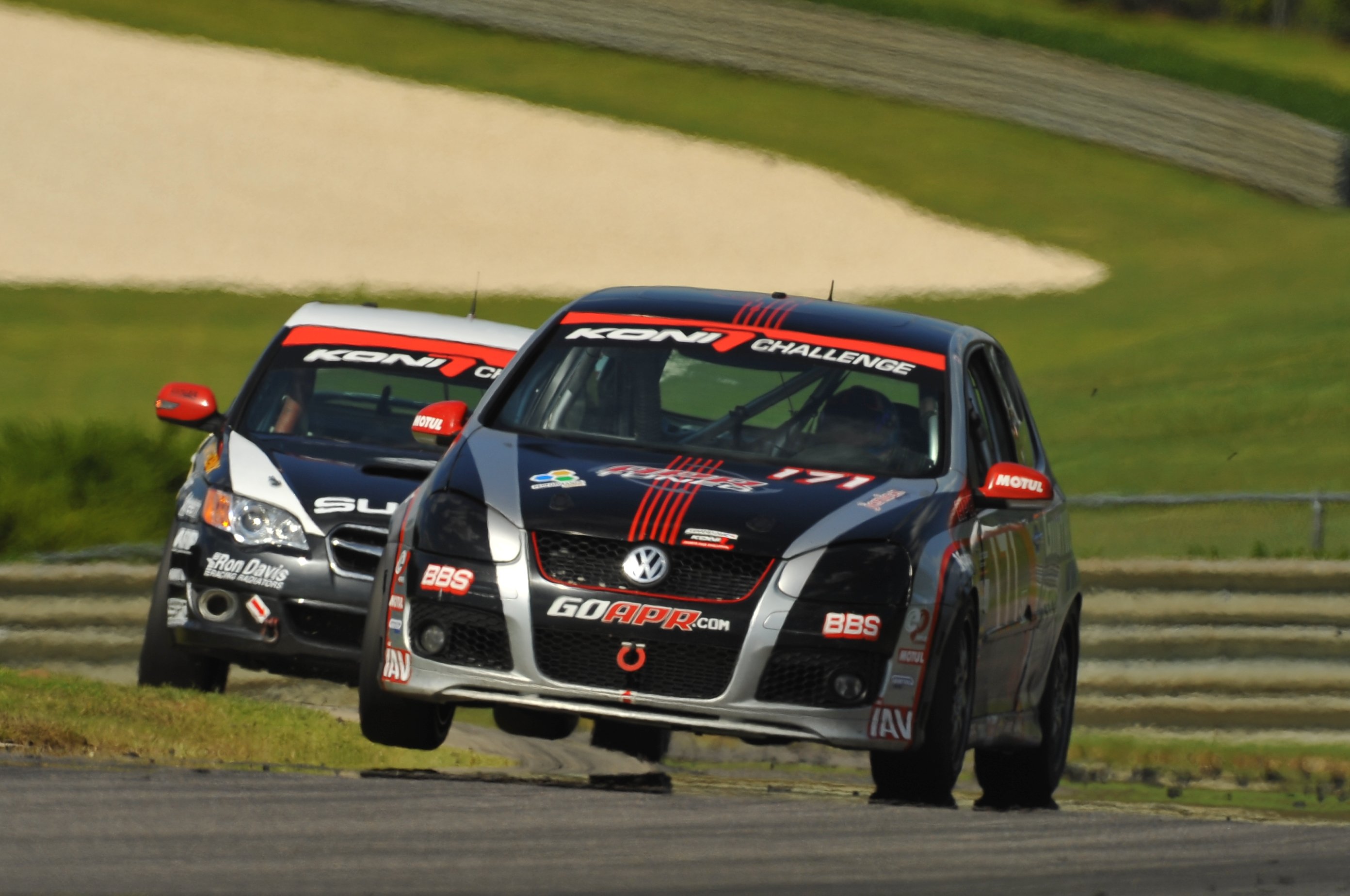
A racing Golf GTI

APR’s Koni Challenge race car.

APR’s Koni Challenge race car. Credit: APR

“One year, we did some creative interpretation of the rules,” said Ian Baas, marketing coordinator and in-house hot shoe at APR (including during the 2008 and 2009 Koni Challenge seasons). “Basically, we were able to put a push-to-pass system in our vehicle that would over-boost it for a certain period of time without actually sending any red flags.”

If a driver had a bad exit out of a corner, they could quickly pull the cruise-control stalk and get a few more PS—and therefore an extra slug of power—for a limited amount of time.

“In order to capitalize on it, you had to have incredibly good boost control by the calibrator,” Harvey added. “Every moment you went over that line, a timer would start clicking every millisecond you were over it. If we didn’t cross that line, that was in reserve for the moment that the driver needed it.”

This level of precision carried over to its street products—APR has long emphasized the effort it has put into its boost control.

Of course, the first time this push-to-pass function was used, it raised some eyebrows. At one event, “I was faster than the GS [meaning, the fastest class] cars,” Baas shared with a laugh. “We were fastest overall in one [practice] session.”

What’s next?

As technology advances, new models arrive, and new powertrains—including hybridized ones—enter the market, giving tuners more software than ever to dig into and modify. But not before breaking through the constantly evolving security measures that OEMs implement.

And even when automakers use the same hardware, each approaches security in its own way. BMWs were once easy to break into and tune, but once that changed, it took tuners a long time to regain entry. The same is true for Ford, which has recently begun implementing more robust security measures. APR’s sister companies under the Holley umbrella have run into the same problems, and while APR can share general approaches to cracking, it can’t provide specifics since the process varies so much by manufacturer.

During our chat, the team understandably couldn’t share details of what’s next. But as Gorton put it, “You gotta keep pushing the envelope. You can’t just sit back and do what you’ve been doing and expect the business to keep growing.”

French court orders town hall to remove Palestinian flag

0
french-court-orders-town-hall-to-remove-palestinian-flag
French court orders town hall to remove Palestinian flag

Palestinian, French and European Union flags fly outside the town hall in Vaulx-en-Velin, an eastern suburb of Lyon, France, on July 11, 2026. [Mathieu Prudhomme - Anadolu Agency]

Palestinian, French and European Union flags fly outside the town hall in Vaulx-en-Velin, an eastern suburb of Lyon, France, on July 11, 2026. [Mathieu Prudhomme – Anadolu Agency]

A French court ordered the town hall of Vaulx-en-Velin, a suburb of Lyon, to remove a Palestinian flag flying from its facade, ruling that it breached the principle of neutrality in public services, Anadolu reports.

The Lyon administrative court, ruling in an emergency procedure brought by the Rhone prefect, ordered the flag to be removed without delay and imposed a fine of 100 euros ($117) for each day of non-compliance.

The Palestinian flag was raised on July 4 during a municipal event and displayed alongside the French and European flags.

READ: Israel deports French journalist over criticism of Gaza genocide

UN probe says mass killings, rapes, abductions, starvation by Sudan force amount to genocide

0
un-probe-says-mass-killings,-rapes,-abductions,-starvation-by-sudan-force-amount-to-genocide
UN probe says mass killings, rapes, abductions, starvation by Sudan force amount to genocide


Sudan’s RSF forces carried out mass killings, abductions ‌of women and girls, mass gang rapes and forced starvation in a city they besieged and captured last year, as part of an intentional policy amounting to genocide, a U.N. probe said.

The Rapid Support Forces, ​which are battling the Sudanese army in a civil war, committed the crimes in al-Fashir ​in north Darfur, which they captured last year after a long siege, the U.N. ⁠Fact-Finding Mission for Sudan found.

Survivors described to the mission being raped in rooms where bodies of ​recently killed civilians, including their own family members, were still lying on the ground.

The report found ​that the RSF and allies committed the war crime of starvation by imposing a prolonged siege on the city, impeding relief supplies, and shelling food production systems.

The RSF has denied such abuses in over three years of civil ​war, saying the accounts have been manufactured by its enemies and making counter-accusations against them.

The U.N. ​human rights chief warned on Friday that a similar “catastrophe” was unfolding around another large city, al-Obeid, the capital of ‌North Kordofan ⁠state, and that his office had documented patterns of summary executions, abductions, torture and sexual violence in the surrounding region.

Members of the U.N. human rights council on Monday condemned the violence and set up an urgent inquiry,into alleged abuses there.

Britain and other states have warned of a risk of large-scale ​atrocities as the RSF ​massed forces around al-Obeid, ⁠now home to around half a million people including more than 83,000 internally displaced people.

The fact-finding mission had already concluded in a previous report in ​February that mass killings of non‑Arab communities when the RSF captured al-Fashir ​bore hallmarks of ⁠genocide.

Its new report said it found additional evidence that the widespread and systematic pattern of conduct of the RSF, including large-scale killings, mass-scale rape and deliberate starvation, was part of an intended policy.

“The patterns ⁠we documented ​in al-Fashir – including encirclement, attacks on civilian infrastructure, restrictions on ​humanitarian access, and widespread abuses against civilians – serve as a stark warning,” said Mohamed Chande Othman, the mission’s chair.

“The international ​community must heed these lessons and act to prevent further catastrophe,” he added.

Source:  Reuters

Rocket Report: “Panic” over Transporter availability; Isar to launch from Canada

0
rocket-report:-“panic”-over-transporter-availability;-isar-to-launch-from-canada
Rocket Report: “Panic” over Transporter availability; Isar to launch from Canada

Welcome to Edition 9.02 of the Rocket Report! Our attention in the coming days turns to Asia, where there are a couple of notable rocket debuts. Up first is the Long March 10B on Friday, a medium-lift rocket with a reusable first stage. After launch this stage will attempt a landing on a recovery ship. Then, as early as Sunday, the private Indian company Skyroot may attempt to launch its first rocket, Vikram-1.

As always, we welcome reader submissions, and if you don’t want to miss an issue, please subscribe using the box below (the form will not appear on AMP-enabled versions of the site). Each report will include information on small-, medium-, and heavy-lift rockets as well as a quick look ahead at the next three launches on the calendar.

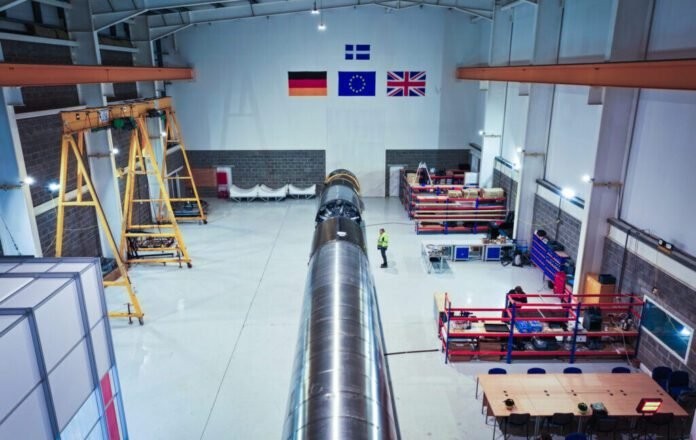
RFA sets launch date for August. Almost two years after an RFA One first stage burst into flames during a static fire test, German rocket-builder Rocket Factory Augsburg is preparing for a second attempt at the rocket’s inaugural flight from SaxaVord Spaceport in Scotland, European Spaceflight reports. The launch window will open on August 10, the Spaceport said in its announcement.

Getting close … The notice did not identify a specific operator, stating simply that it was “one of SaxaVord’s clients.” However, it did provide enough detail to identify Rocket Factory Augsburg as the unnamed customer. Additionally, in April, Rocket Factory Augsburg announced that it was working toward a launch window opening on July 1. However, the company stressed that “there are uncertainties, and the schedule may evolve.” Now, it seems, there is less uncertainty.

Final Pegasus rocket delivers its payload. After flying just once in seven years, the air-launched Pegasus XL booster successfully launched the half-ton “Link” satellite for Katalyst Space Technologies on July 4. The mission is intended to rescue NASA’s Swift satellite by boosting its orbit, Ars reports. An aircraft carrying the rocket and satellite took off from the US Army’s Ronald Reagan Space and Missile Test Range on Kwajalein Atoll, a facility leased from the Marshall Islands. This was likely the final time a Pegasus rocket, first deployed in 1990, would fly.

Why choose a Pegasus booster? … The Swift rescue mission needed to launch into an unusually low-inclination orbit to reach its target. Swift’s orbit is inclined 20.6 degrees to the equator, and the Link satellite would have required a launch on an oversized, more expensive rocket to reach that orbit from a spaceport like Cape Canaveral, Florida. Launching from the equatorial Pacific solved that problem. Over the next several weeks, Katalyst will perform checkout procedures for Link, including assessments of its propulsion, sensor, and navigation systems.

The Ars Technica Rocket Report
The easiest way to keep up with Eric Berger’s and Stephen Clark’s reporting on all things space is to sign up for our newsletter. We’ll collect their stories and deliver them straight to your inbox.

Sign Me Up!

Impulse Space enters military launch competition. This week, the US Space Force brought two more companies into the pool of bidders eligible to compete for its launch contracts—Impulse Space and Relativity Space. For a rocket company, cracking into the lucrative US military launch market is both a sign of maturity, as well as an important source of revenue. The inclusion of Relativity Space, which is making credible progress toward the launch of its heavy-lift Terran R rocket, is perhaps not a huge surprise, Ars reports. But the other company, a provider of in-space propulsion, was.

The Space Force gets creative … Impulse Space is developing a “kick stage” it calls Helios, which can provide up to 9 km/s of delta-V to a payload, rapidly boosting it from low-Earth orbit to geostationary orbit about 36,000 km above the Earth’s surface. Essentially, this allows the company to transform a medium-lift rocket, such as SpaceX’s Falcon 9 vehicle, and give it the performance of a larger and more powerful rocket. Impulse Space will contract with the Space Force to provide end-to-end service, procuring a launch vehicle and then stacking the Helios stage and designated satellite into the payload fairing of the rocket.

Isar inks deal to launch from Canada. Halifax-based Maritime Launch Services Ltd. says Germany’s Isar Aerospace plans to build a dedicated complex for its Spectrum rocket at the Nova Scotia company’s site near Canso, CBC reports. The two-stage rocket is designed to carry small- and medium-sized satellites into space. The German company, which has already established its first launch site in Norway, has created a new Canadian subsidiary, Isar Aerospace Canada Inc.

Launches could begin in a couple of years … Canada does not have the ability to launch satellites on its own and has relied on the United States to get its satellites into orbit. Ottawa has flagged space launches as a key sovereign capability in its new defense industrial strategy. German rockets launching from Canadian soil may be a bridge to that until Canadian companies can develop their own boosters. The spaceport developer, Maritime Launch CEO Stephen Matier, says Isar plans to spend about $100 million as a tenant to make its launch pad ready. Isar will begin construction this year with plans for space launches by 2028.

What’s left for the Atlas V before retirement? The final flight of United Launch Alliance’s Atlas V rocket is still several years off, but an important era for the once-dominant launch company recently came to a close, Ars reports. The final flight of an Atlas V for the Amazon Leo broadband constellation lifted off from Cape Canaveral Space Force Station in Florida last Thursday, sending 29 satellites to orbit to move the network closer to providing initial services. Thursday’s launch marked the ninth Atlas V flight for Amazon Leo and the fourth Atlas V launch in less than three months, hitting a cadence the rocket has rarely seen in nearly a quarter-century of service.

A long goodbye … The surge of launches comes as the Atlas V nears the end of its near-flawless career. Thursday’s launch was the 110th flight of an Atlas V rocket since its debut in 2002. There are six more Atlas Vs in ULA’s inventory to launch Boeing’s Starliner crew capsules to the International Space Station under contract to NASA. But it is not certain today that Boeing will use all six of those Atlas Vs. Last year, NASA reduced the number of guaranteed missions in Boeing’s commercial crew contract from six to four after chronic delays in the program. It would be difficult to source a fairing to use the Atlas V for missions other than Starliner.

ArianeGroup and Beyond Gravity extend deal. ArianeGroup and Beyond Gravity have signed a new contract for the operational phase of Ariane 6, the companies said this week in a news release. The agreement covers the supply of 27 payload fairings for flights 16 to 42 of Ariane 6. Depending on the mission, the European heavy-launcher can be equipped with a short (14-meter) or long (20-meter) payload fairing.

Moving into operational phase … The new contract for the operational phase starts at the end of 2026 and marks the largest to date in the history of Beyond Gravity’s Swiss launch vehicle business. As part of the contract, Beyond Gravity will produce 20 long and seven short fairings. “We are delighted to actively help shape the ramp-up of the Ariane 6 launch vehicle program by supplying key technologies,” Barbara Frei-Spreiter, chief executive officer of Beyond Gravity, said.

Panic setting in over future of Transporter missions? There are growing concerns within the small-satellite industry that SpaceX is winding down its Transporter program, at least using its workhorse Falcon 9 rocket, Space News reports. Several customers of those rideshare missions have previously said SpaceX is not accepting Transporter reservations beyond late 2028 or early 2029. Now a competitor, Rocket Lab, says it has heard the same from its customers.

SpaceX may focus on its own internal needs … “In the last three to six months, the term I would use to describe customer conversations about access to Falcon 9 would be anxiety. There seems to be a panic setting in,” said Adam Spice, chief financial officer of Rocket Lab, on Tuesday. “There’s not as much conviction that Falcon 9 is going to be available for the merchant market out beyond what they’ve committed to the manifest.” He said he expects SpaceX to focus Falcon 9 more on its own internal customers, including Starlink and its future orbital data center system.

ArianeGroup testing more powerful Vinci engine. Details of a previously unannounced test campaign involving an upgraded Ariane 6 rocket engine have emerged in new annual filings, European Spaceflight reports. The corporate filings describe the testing of a 200-kilonewton version of the rocket’s Vinci upper stage engine at DLR’s Lampoldshausen facility in Germany. The upgrade increases the engine’s thrust by around 11 percent, from 180 kilonewtons. The testing was “conducted throughout the year” and included a long-duration test in October that lasted 570 seconds.

Part of Block 2 upgrades … The upgraded Vinci engine is being developed under a European Space Agency contract. Evidence from a September 2022 ESA Space Transportation Proposal presentation suggests that the adaptation of the engine was part of a 357.6 million-euro Ariane 6 Product Adaptations Element approved at the agency’s Ministerial Council meeting in 2022. The more powerful upper stage engine is part of a suite of upgrades included in the Ariane 6 Block 2 configuration. This upgrade package also includes the more powerful P160C solid-fuel boosters introduced in June and a lighter upper stage structure.

Falcon 9 sets new reuse record. SpaceX broke another rocket reuse record Thursday morning when it launched its most-flown Falcon 9 booster for a 36th time, Spaceflight Now reports. It flew in support of the Starlink 10-42 mission, which added another 29 broadband Internet satellites to the company’s low-Earth orbit constellation. SpaceX currently has more than 10,700 Starlink satellites in orbit.

Piling up milestones … SpaceX’s most-flown booster, B1067, began flying in June 2021 with the company’s 22nd Dragon flight as part of the Commercial Resupply Services-2 contract with NASA. It went on to fly the Crew-3 and Crew-4 missions as well as 24 batches of Starlink satellites. A little more than eight minutes after liftoff, B1067 landed on the drone ship, A Shortfall of Gravitas, positioned in the Atlantic Ocean. This was the 160th landing for this vessel and the 635th booster landing to date for SpaceX.

Rockets may be starting to dictate satellite design. It wasn’t easy to find anyone outside of SpaceX clamoring for a rocket like Starship just 10 years ago. Today, the space industry can’t wait for Starship to finally deliver. With a payload capacity of more than 100 metric tons (220,000 pounds) to low-Earth orbit, SpaceX’s new rocket is changing the thinking of just about everyone in the space industry. Included in this is a reversal of how things usually go in the balance of supply and demand between launch vehicles and satellite operators, Ars reports.

Rack ’em like pancakes … Rocket designers have long engineered their vehicles to match trends in the satellite industry. They designed for their customers’ needs, or at least for what their customers were telling them they needed. But in 2026, a new era of abundant super-heavy-lift launch promises to unlock entirely new applications for satellites and new designs. Notably, one trend is toward flat-packed, stackable satellite architecture. For example, Muon Space, a satellite manufacturing startup, announced earlier this month that it is developing a new high-power satellite design to take advantage of Starship’s payload accommodation.

Blue Origin will seek to raise private capital. The rocket company founded by Jeff Bezos, Blue Origin, is raising private capital, Ars reports. Bezos is seeking a $10 billion investment in the company, valuing it at $130 billion. Founded in 2000, Blue Origin is seeking to become a global leader in spaceflight, developing a line of super heavy lift rockets, lunar landers, and plans for two megaconstellations. It is seeking to compete in the same areas—launch, telecommunications, data centers from space—as SpaceX.

Seen as likely to happen … In March, Ars predicted that Bezos would likely take on outside investors in the near future in order to compete financially with SpaceX. Even so, the amount Blue is seeking to raise is dwarfed by the $85 billion that SpaceX raised through its initial public offering process earlier this year, and its valuation of approximately $2 trillion. Blue Origin also needs such a plan to compete with the lucrative stock options offered by SpaceX to its employees.

Next three launches

July 10: Long March 10B | Demo mission | Wenchang Space Launch Site, China | 04:10 UTC

July 11: Falcon 9 | Starlink 10-48 | Vandenberg Space Force Base, Calif. | 02:00 UTC

July 12: Gravity 1 | Unknown Payload | Haiyang Oriental Spaceport, China | 02:00 UTC

Actress’s Heartbreaking Final Years: Star Hid Away on Texas Ranch and Feared ‘Aliens’

0
actress’s-heartbreaking-final-years:-star-hid-away-on-texas-ranch-and-feared-‘aliens’
Actress’s Heartbreaking Final Years: Star Hid Away on Texas Ranch and Feared ‘Aliens’


Shelley Duvall spent her final decades far from the bright lights of Hollywood, living quietly on a 10-acre ranch in Blanco, Texas, where locals claimed the once-beloved star had become increasingly isolated and troubled.

Duvall, best known for her unforgettable role as Wendy Torrance in The Shining, died in 2024 at the age of 75. As the two-year anniversary of her July 11 death approaches, new attention is being paid to the actress’ painful final chapter — one marked by seclusion, strange fears, and a long retreat from the industry that made her famous.

The actress moved to the rural Texas ranching community in the early 2000s after stepping away from acting. For more than 20 years, she largely kept to herself, living a life that was a world away from the red carpets, movie sets, and famous co-stars of her earlier career.

Residents in the area later claimed they had seen Duvall wandering around town alone. According to a resurfaced 2009 interview, some locals alleged she would “mutter” and talk about “aliens living in her body.”

One source claimed Duvall had taken extreme precautions around her property because of her alleged fear of extraterrestrials.

“Shelley keeps her gate locked all the time,” the source said. “She has barbed wire around the fence and said it was to keep the aliens out. She told a friend of mine that she can’t leave the house until the aliens are asleep.”

The source described the situation as “terribly sad.”

Another alleged insider from a local hardware store claimed Duvall once came in asking for supplies to block what she believed was a “portal” on her land.

“One time, she came in and asked for dirt and boards to block up a hole in the backyard because, she said: ‘That’s a portal into another dimension. That’s where the aliens are coming in,’” the insider claimed.

The person also alleged Duvall once said she needed wood because she believed metal hidden inside her bed was being used by aliens to shock her.

Duvall’s struggles became painfully public in 2016 when she appeared on Dr. Phil in an episode that was widely criticized at the time. During the interview, the actress admitted she was “very sick,” appearing to suggest she may have been dealing with mental health issues.

She also made troubling claims about her late Popeye co-star Robin Williams, saying she believed he was still alive and “shapeshifting.” She also spoke about alien “implants” she claimed were inside her leg.

Before her quiet life in Texas, Duvall had built a remarkable Hollywood career. She appeared in films including Annie Hall, 3 Women, Popeye, Roxanne, The Portrait of a Lady, and more.

But no role haunted her public image quite like The Shining.

Duvall later described the 1980 horror classic as her “most difficult” and “almost unbearable” role. For years, rumors swirled that director Stanley Kubrick had pushed her to the edge while filming the psychological thriller. Jack Nicholson even alleged that clumps of her hair had fallen out during the production.

“From May until October I was really in and out of ill health because the stress of the role was so great,” Duvall said in the book The Complete Kubrick. “Stanley pushed me and prodded me further than I’ve ever been pushed before.”

In 2002, around the same time she moved to Texas, Duvall walked away from acting entirely. Her Hollywood absence lasted more than two decades.

Then, in a surprising final act, she returned to the screen one year before her death. Duvall’s last role was as “Mama” in Scott Goldberg’s 2023 psychological horror film The Forest Hills.

It was a brief return for a star whose life had taken a heartbreaking turn far from Hollywood — a woman remembered for her wide-eyed vulnerability on screen, and for the lonely, complicated years she spent out of the spotlight.

Volkswagen Group tells its board how to fix it, unions disagree

0
volkswagen-group-tells-its-board-how-to-fix-it,-unions-disagree
Volkswagen Group tells its board how to fix it, unions disagree

Volkswagen Group is doing well with electric vehicle sales in its home region, but costly tariffs and eroding market share in China and North America have been hurting it badly. Europe’s largest automaker, which also owns brands including Audi, Porsche, Skoda, and Lamborghini, has seen its profit margins evaporate, and yesterday the company’s supervisory board was presented with a plan to ameliorate that. An expected call for factory closures and redundancies wasn’t included—at least not in VW Group’s public statement—but according to Reuters, the measure failed anyway in a 12-7 vote.

Unlike most automakers, worker unions are extremely powerful at the VW Group. Half of the 20 seats on the supervisory board are appointed by worker councils. Another two seats are spoken for thanks in part to the company’s partial ownership by the German state of Lower Saxony—currently held by that state’s minister of education and minister-president. So while profit has been important, it’s not the only thing that matters to the decision-makers.

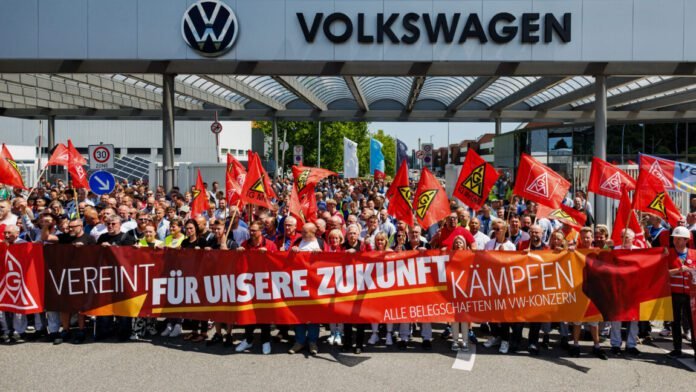
Over the years, there have been lengthy fights over any suggestion of redundancies. Lately, VW Group and its unions spent months in negotiations in 2024 before finally agreeing to a plan to cut 35,000 jobs by 2030.

That number had scaled up to 50,000 by this March, as the extent of its problems continued to grow. Then, in late June, a German magazine reported that now, 100,000 jobs would go by 2030, along with the unthinkable: closing four German factories, something that has never been done in its history.

However, Volkswagen’s public statement on the restructuring plan makes no mention of job losses or factory closures—at least not directly.

But it does call for a heavily edited model lineup, with half as many vehicles offered across all its brands. These will be “concentrated on the most attractive market segments,” VW Group says, which probably means mostly crossovers, now as beloved by European car buyers as their counterparts in the US. To make things simpler for the factories, “offering complexity—for example, the number of available equipment options—will be reduced by up to 75 percent.”

The proposal also details a mismatch between global demand for VW Group products, at 9 million vehicles a year, and the company’s annual capacity to build 10 million vehicles a year (although it notes that VW has reduced its capacity by 2 million units since COVID).

So while the plan doesn’t explicitly say VW will cut jobs and shutter plants, it does involve building fewer cars with less differentiation to them, something that sounds like it’s less labor-intensive.

Or did. Assuming Reuters’ sources are correct, it’s time for Blume and his colleagues to think of something else.

How to build homes that can survive extreme heat

0
how-to-build-homes-that-can-survive-extreme-heat
How to build homes that can survive extreme heat

This story was originally published by Vox and is reproduced here as part of the Climate Desk collaboration.

It was not the postcard-worthy aesthetics that prompted Greek islanders to first drench their cliffside-carved homes, churches, and pathways in a thick layer of pearly white paint.

Much like wearing a white tunic on a hot sunny day, painting your house a shade of reflective white is a fine way to keep an ancient island cool, bouncing some of the sun’s heat back into space instead of absorbing it into the structure of the buildings themselves. Before air conditioning existed, people in warmer areas of the world often built with similar techniques in mind: Iran’s picturesque chimney-like badgirs or wind catchers have helped desert dwellers stay cool for millennia, for example, and in the tropics, Malaysians have long engineered their homes on stilts to avoid floods and let a breeze in.

Many homes and cities in Europe are still living as if AC had never been invented, relying largely on their thick shutters, ventilated courtyards, and other strategies to encourage shade and airflow. But after a deadly, record-shattering heat wave tore through western Europe last month, killing at least 1,300 people, it has become increasingly clear that old-world buildings are not cooling enough on their own for our new world of heat.

After a similar heat dome pulsed over the eastern U.S., a nation of AC aficionados faces the inverse of this problem. Since just after the end of World War II, the U.S. has built its homes, schools, and hospitals so thoroughly with AC in mind that most buildings have no built-in defense against the heat at all. The air conditioner made possible America’s cavernous McMansions, megamalls, and frigid glass office towers, engineered like ectotherms, liable to soak up a heat wave like a cold-blooded lizard sprawled out on a rock on a scorching summer’s day.

Read Next

Clearly, climate change has, to some extent, vindicated America’s hyperreliance on the AC. Unlike in Europe, with its suddenly vulnerable passive cooling systems that kept things temperate back when weather used to be normal, the U.S. can take the heat as long as the air is on. In the aftermath of the AC-enabled postwar housing boom, the likelihood of an American dying on a scorching hot day fell by a staggering 80 percent.

But the roaring, life-saving success of the AC has also embedded a profound vulnerability: the moment the power goes out, as it’s prone to do in a heat wave — or that electricity bills get too onerous, which tends to happen when the AC is cranked — the nation’s cold-blooded buildings convert into furnaces.

In most conventional American houses, if you “lose power in the middle of an extreme heat wave or in a blizzard, you’ve got hours before you need to get out,” said Alexander Gard-Murray, executive director of Passive House Massachusetts, a group that encourages the state to build naturally cooler buildings — or “passive houses” — from the start. Some techniques are state-of-the-art and technologically novel, others are ancient, and still many others are basic common sense: don’t build facing the sun, plant trees, add an awning, and replace heat-radiating asphalt driveways with gravel.

Notably, none of these strategies involves shoving your AC unit out the window. But they can help your air conditioning work a lot less hard — which, by the way, could cut your electricity bills in half — at a time when America’s electrical grid is desperately straining to keep everything online. Most importantly, it ensures that “if something does go wrong, if the power goes out,” said Gard-Murray, “you’re still going to be okay.”

Air conditioning reshaped how America builds for heat

American homes used to reflect the cities they were built in. Cool air flowed beneath the floorboards of New Orleans’ breezy raised shotgun houses. Boston’s winter winds met the saltbox house’s long, sloping roofs, and Pueblo tribes used thick blocks of mud to build adobe homes that withstood the desert’s daily fluctuations.

But in 1947, an engineer named Henry Galson transformed how America builds with his invention of “the people’s air conditioner,” a low-cost AC unit — until then, a luxury item — snug enough to nestle into a residential window. With millions of service members returning from World War II, the nation needed more housing, and it needed it fast. Cheap air conditioning allowed builders more flexibility to mass-produce the suburbs that sprawled out as a solution to America’s post-war housing crisis — even in hot climates like the Sunbelt.

Air conditioning made large swaths of the country newly habitable, fueling the spectacular growth of many now-flourishing metropolises across the American South and Southwest. In less than a century, the AC transformed blisteringly hot Phoenix from a small desert town, population 65,000, into the fifth-largest city in the country.

Read Next

At the same time, as the AC became ubiquitous in America, “many architects stopped designing buildings for their specific context,” said Sonia Chao, associate dean of architecture at the University of Miami and author of Calibrating Coastal Resilience. “What we have today are buildings in South Florida that look a lot like the buildings being built in California or Arizona,” or more temperate climates, when in fact “we really shouldn’t be building in the same ways.”

Most homes in South Florida once sat atop crawl spaces that protected them against floodwaters and let in a breeze to naturally cool the rooms above, said Chao. But many local buildings are now built directly atop concrete, meaning that “as the earth itself gets warmer,” the homes above absorb the heat too.

Of course, if you blast your AC high enough, you probably won’t feel it. And, for decades, that gave American developers tacit permission to pare down the elements like thick masonryhigh ceilings, shaded porches, and window shutters that once naturally kept us cool in favor of cheap drywall and easier-to-construct boxy floor plans that helped them cram sprawling tracts of readymade starter homes across suddenly bustling desert cities such as Phoenix and Albuquerque. They cleared trees and poured asphalt, churning out decades’ worth of leaky, heat-absorbent neighborhoods. But it didn’t matter — so long as the AC kept running.

The problem with America’s hyperreliance on the AC

AC proved transformational to American life in profoundly positive ways, stretching the boundaries of where one can comfortably live and greatly reducing extreme heat as a public health threat. The problem is, if for whatever reason, the AC is not running, many American homes now become immediately and extraordinarily exposed. “We all like to believe that the grid is safe and stable,” said Katrin Klingenberg, executive director of Phius, which sets standards for passive homes constructed in the U.S. “But it’s actually way more vulnerable than we all think.”

Researchers estimate that if Phoenix were to experience a two-day blackout during one of its regular heat waves — knocking out air conditioning citywide — it would quickly kill 12,800 people, or roughly 1 percent of the population, while a full half of the city would require emergency medical care.

Arizonans will always need AC to stay safe from the heat, but they could be far more resilient to temporary lapses if their homes and neighborhoods were better designed to stay cool without it. If Phoenix planted enough trees to shade half of its streets — which would be enough to lower the city’s temperature by at least a few degrees— 27 percent fewer residents would die in such a blackout, according to the study. If every building installed a “cool roof” — simply painting it with a white material to better reflect sunlight — then the death toll would plummet by 66 percent.

Read Next

This is not just a thought experiment. Driven by extreme weather and an aging electrical grid, the number of power outages in the U.S. has doubled over the past two decades. After Hurricane Beryl knocked out power for millions in Texas in 2024, at least dozens — and possibly hundreds — of people died from heat-related causes, meaning the outage may have been deadlier than the storm itself.

“It overcomes you really fast,” said Patricia Solis, executive director of the Knowledge Exchange for Resilience at Arizona State University, which focuses on Maricopa County, where hundreds of people die from heat-related causes each year, many inside their own homes, their air conditioning broken, turned off, or unplugged.

One of them was Stephanie Pullman, a 72-year-old who died in Phoenix in 2018, a day after her electricity was cut off over a $51 unpaid bill. Another was Patricia Miletich, a 70-year-old with memory issues, whose busted AC was blowing hot 110+ degree air into her RV when she died in June 2024. Upwards of a quarter of Arizonans who succumb to heat inside their homes live in mobile houses, structures whose thin walls, poor insulation, and cramped concrete quarters make them especially expensive to cool with AC, and especially deadly without it.

Because this extreme heat is “going to happen increasingly to more and more of us around the world,” Solis warned, we have to “make it a part of the way that we build our environments, that we build our homes, that we rebuild our homes.”

How to build a home for the climate we actually have

It’s not as hard or expensive as you might think to build a cooler home, one that does at least some of the work needed to keep things more comfortable in extreme temperatures.

Something as simple as facing an RV away from the sun, adding an awning or garden trellis, or installing vinyl skirting around the foundation to prevent hot air from coming up through the floor, could make a mobile home safer to be in if the power goes out, says Solis. And even in less catastrophic conditions, these age-old adaptations would make an AC unit cheaper to run. When she began her work, some mobile home park owners sought to outright forbid residents from adding cooling features like a small window garden for purely cosmetic reasons. Solis and her team later helped pass a law outlawing such practices.

Even earning the gold standard of building cooler buildings — a “Passive House” certification from Phius — isn’t “some space-age, super advanced crazy thing,” said Gard-Murray, of Passive House Massachusetts. “It’s not about doing extraordinary things; it’s about doing ordinary things extraordinarily well,” he said, like making sure your walls are airtight and thick enough to act as a buffer against outside temperatures.

Read Next

If most American buildings absorb heat like a plastic water bottle left out in the sun, a passive house is built like a thermos, keeping things relatively temperate regardless of the temperature outside. To illustrate that, a group of architects once built two miniature houses, one according to normal building codes and the other like a passive house, plopped them in a park in New York City, and filled both with 1,800 pounds of ice. One month later, the mini passive house had 40 percent of its ice left, while the other one had only 7 percent.

You can imagine how much safer that makes you if your AC ever goes out, and makes it up to 90 percent less energy-intensive to run — enough to cut your utility bills in half — when it’s on. “If we’re much more intentional about insulating the property, the heating and cooling systems have to do a lot less work,” said AJ Patton, founder of the Chicago-based developer 548 Enterprises, which is currently building Chicago’s largest-ever Passive House-certified affordable housing complex.

“Too often we’ve used sustainable technologies as a luxury item,” said Patton, but the biggest benefits to these homes are for lower-income households who could really use the savings on their bills or are more vulnerable to having their power cut off.

As of now, only about one percent of homes being built in the US are built according to passive standards. One might assume that building such a sensible, sustainable, and safer home must be prohibitively expensive, or else it would be much more common. After all, who doesn’t want a significantly lower utility bill, all other things being equal? But in reality, at least in Massachusetts — where passive designs are now the mandatory norm in many cities — a survey found that such buildings only cost as little as two to three percent more than conventional buildings.

Read Next

Equally important in a country with a notorious housing shortage, the municipalities in Massachusetts that have opted into more stringent requirements continue to build new homes at a faster clip than those that haven’t, and they approved more new housing permits after the change. There could be a lot of factors at play in those differences, but at the very least, it shows that requiring strict standards in this case might not, as some skeptics fear, “crash our housing production,” Gard-Murray said.

The real reason why these building techniques don’t happen more often comes down to a lack of awareness, experts told me, along with the fact that the biggest financial benefits are for whoever pays the utility bill, not the developer who has to pay the upfront costs. It doesn’t help either that the Trump administration has cut or let expire tax credits that helped defray the extra costs of energy-efficient buildings. Some projects like Patton’s lost out on $300,000 in expected incentives in real time.

“The moronic government policies of the last 18 months are not helping us,” said Mark Ginsberg, a founding partner of Curtis + Ginsberg Architects, which has completed about 25 multi-family passive projects in New York City, most of them affordable or supportive housing.

“There are too many people burying their heads in the sand and saying climate change isn’t real,” he said. That’s easier when the AC hides the worst effects of extreme heat from us. But on the verge of a heat wave poised to put 175 million Americans at risk, it may be past time to give our AC a little boost, too.


Why the West keeps missing the point on Russia

0
why-the-west-keeps-missing-the-point-on-russia
Why the West keeps missing the point on Russia

In early June, Ukrainian President Volodymyr Zelensky published an open letter to Vladimir Putin proposing a face-to-face meeting to end a war now in its fifth year. Putin’s reply was that talks were pointless unless Ukrainian forces first withdrew from Russian-occupied territory and Kyiv dropped its bid to join NATO.

It was a small exchange in a war full of much larger ones. But it said something about why five years of sanctions, diplomatic isolation and moral condemnation from the West haven’t moved Moscow any closer to the deal Western capitals actually want.

Ask most diplomats, and they’ll tell you that they simply haven’t been tough enough or clever enough. The more uncomfortable explanation is that they never really understood the country they were trying to pressure in the first place.

A vocabulary problem

For two decades, the standard Western vocabulary for Russia has settled on words like authoritarian, fascist and even totalitarian.

These terms, borrowed wholesale from the 20th century’s worst regimes, carry a built-in assumption: that the Russian state survives on coercion alone, that ordinary Russians are essentially a captive audience waiting to be freed and that discrediting one man would bring down the whole edifice.

It’s a comforting theory since it lets them explain Russian conduct without ever asking why tens of millions of Russians might actually consent to the arrangement. What it obscures is the uncoerced, genuinely popular foundation of the post-Soviet Russian state and of Putin’s government specifically, a foundation that has held up rather better over time than the coercive machinery Western commentary likes to discuss.

Much of the traditional Western literature on Russia leans on history and direct observation to explain what amounts to an eternal Russia, a civilization whose statehood, foreign policy and president get treated as a fresh enigma every time there’s a crisis, a riddle to be solved all over again.

The trouble is that this literature tends to collapse Russian national identity into imperial conquest, so that any Russian assertion of interest beyond its 1991 borders reads as an unreconstructed colonial reflex. But Russian history isn’t identical to the history of Russian conquest.

Underneath the shifting borders of Muscovy, the Romanov empire and the Soviet Union runs a current of Russian identity – linguistic, religious, cultural – that would have persisted no matter what shape the state around it happened to take.

An identity beyond Putin

Russian society has and is cultivating a national identity that would exist with or without Putin.

Most Russians have no illusions about how corrupt their political class is. Polling over the years has repeatedly shown large majorities holding their own leadership personally responsible for it and cynicism toward the elite runs deep, predating Putin by generations.

But the same people who mock their governors and distrust their oligarchs still see their country as fundamentally distinct from Western Europe and the United States: not a broken state waiting to be fixed through external intervention, but a different civilization on its own track.

They also know, better than most Western analysts give them credit for, what Putin has and hasn’t delivered.

While they appreciate stability, a fragile prosperity now under real strain, a rebuilt military and a handful of glittering, redone cities that serve as showcases more than as proof of any deeper modernization, ordinary Russians are also fully aware of stagnant provinces, a shrinking population and the technological dependence that sanctions have exposed.

They carry an unsentimental view of their government’s failures alongside a stubborn sense that Russia’s separateness from the West is worth defending. The West keeps expecting the first belief to erode the second. So far, it hasn’t.

Society’s grip on the state

The Western commentary on Russia tends to critique the state: its security services, its censors, the vertical of power running from the Kremlin down to the last regional governor.

What usually gets missed is the current running the other way: society’s grip on the state, as argued by scholars like Michael Kimmage and Timothy Frye. That’s the grip likely to matter more in the long run, not the Federal Security Service (FSB).

Russians are unusually good at seeing through official messaging. It’s a skill left over from seven decades of decoding Soviet propaganda, sharpened further by a partly marketized media landscape that taught people to read state messaging with suspicion long before “media literacy” became a Western obsession.

So, the government’s success at manufacturing obedience is a lot thinner than Putin would like to believe.

His own approval numbers tell the story. They hit a wartime high near 88% in early 2025, then slipped to roughly 79% by the spring of 2026, according to the Levada Center. That slide doesn’t track battlefield setbacks, which have been minor.

It reflects kitchen-table economics instead: a steep hike in the value-added tax, a documented pause in private investment that the Kremlin itself denies exists and incomes that increasingly don’t stretch to cover the basics.

This in no way looks like a population swallowing propaganda whole, but one doing its own math on what the war really costs, and adjusting its opinion of the man running it.

Why diplomacy fails

Diplomacy has failed to end the war for five years running. The 2022 Istanbul talks, the Anchorage summit and three rounds of trilateral negotiations in Abu Dhabi and Geneva in early 2026.

The reason is that the West’s main tool, economic sanctions, keeps confirming the very story that lets Russians tolerate the war in the first place: that Russia is a besieged civilization, and hardship is simply the cost of standing apart from a hostile West.

The sanctions do bite. Russia’s public finances are visibly strained, but so far, this pain has fed a story about national resilience instead of building real pressure toward compromise. If anything, each new round of sanctions seems to sharpen the public appetite for defiance more than it dulls it.

The West needs to acknowledge that Putin met Russian society halfway rather than simply imposing himself on it. This will ensure that Western pressure gets aimed narrower and focused rather than being spent on outrage that was never really a leverage to begin with.

Getting the diagnosis right

None of this is an excuse for what Russia has done in Ukraine. It’s an argument for getting the diagnosis right, not for going easy on the conclusion. The West’s mistake has been analytical, not moral.

It took its own vocabulary (fascist, totalitarian, dictator) and mistook it for a description of Russian reality, when really it was describing the West’s own outrage. Putin didn’t just capture Russian society. He met a good part of it halfway, and whatever identity emerged from that meeting will outlast him.

Western policy can keep waiting for a captive nation to rise up and be rescued, or it can start dealing with Russia’s reality. Right now, it’s doing the former, mistaking its own bad diagnosis for the Russian public’s failure to see something obvious.

Sajid Farid Shapoo is a highly decorated senior Indian security official (three-star general). He holds a PhD in security studies from Princeton University and writes regularly on geopolitics and international security issues. The views expressed are his own.

SentinelOne Report Alleges China–, India–Linked Hackers Targeted Pakistan’s Police Networks

0
sentinelone-report-alleges-china–,-india–linked-hackers-targeted-pakistan’s-police-networks
SentinelOne Report Alleges China–, India–Linked Hackers Targeted Pakistan’s Police Networks


Multiple Pakistani law enforcement agencies were targeted in separate hacking campaigns linked to groups associated with China and India, according to a report released on Thursday by cybersecurity firm SentinelOne.

Aleksandar Milenkoski, a principal threat researcher at SentinelOne, wrote in the report published on Thursday that “When multiple cyberespionage actors operate against law enforcement institutions of a single state, the convergence itself is a signal of target value”.

SentinelOne, headquartered in Mountain View, California, is a major player in modern cybersecurity, focusing on proactive, AI-driven defense against sophisticated attacks.

According to the SentinelOne report, researchers found evidence of multiple hacking campaigns and intrusions carried out by Chinese and Indian-linked hacking groups between February 2024 and April 2026, most notably against the Balochistan Police, which serves Pakistan’s southwestern province.

The report said the affected assets at Balochistan Police included network appliances, web servers, and several online applications, including the complaint management System that handles police and citizen data such as criminal and biometric records.

It further stated that a suspected China-linked actor placed custom implants in one of these web applications used by both police staff and citizens.

According to SentinelOne, other targets included the Khyber Pakhtunkhwa Police, the Islamabad Police, and the Punjab Safe Cities Authority.

The report said the China-linked activity, involving tools such as PlugX, ShadowPad, and Cobalt Strike, appeared to be motivated primarily by concerns over the safety of Chinese nationals working in Pakistan, particularly in connection with China-Pakistan Economic Corridor projects, following repeated attacks by groups such as the Balochistan Liberation Army.

It further said the India-linked activity, associated with Remcos and actors such as TAG-179, focused especially on Balochistan and likely stemmed from the broader rivalry with Pakistan, seeking insight into how the province’s security is managed amid mutual accusations of supporting militancy.

According to the report, the Khyber Pakhtunkhwa Police acknowledged that one end-user login credential was compromised but stated that no core systems were breached.

The report noted that the Balochistan Police and other agencies did not respond to requests for comment. It also said China denied involvement in such activities, while India had not commented on the report.

According to SentinelOne, Pakistani law enforcement organizations are attractive targets because they hold detailed information on the country’s internal security picture, threats within its borders, and responses to them, drawing interest from both a strategic partner and a rival.

The findings come at a time when Pakistan is grappling with a sharp rise in terrorist violence, particularly in Khyber Pakhtunkhwa and Balochistan, where security forces have faced frequent attacks and insurgent activity has intensified.

If the report’s findings are accurate, they highlight the strategic value of Pakistan’s law enforcement networks to foreign intelligence-linked cyber actors seeking insight into the country’s counterterrorism operations, security deployments, and internal threat landscape amid an increasingly volatile security environment.

So far, no official source has issued any statement confirming or denying the report.

NATO leaders weigh what to do with Erdogan’s revolver gifts after summit

0
nato-leaders-weigh-what-to-do-with-erdogan’s-revolver-gifts-after-summit
NATO leaders weigh what to do with Erdogan’s revolver gifts after summit


Belgium’s prime minister was a little surprised on landing back home from Wednesday’s NATO summit in Turkey to find that he had a handgun and ammunition in his luggage.

After NATO leaders gathered ​for Wednesday’s fractious summit in Ankara, their host, Turkish President Recep Tayyip Erdogan, handed each an unusual parting gift: ‌a vintage revolver, along with live ammunition indicating it was not just for show.

Erdogan wanted to showcase Turkey’s defence industry, which has become a key export and foreign policy tool.

Images shared by the office of Lithuanian President Gitanas Nauseda showed what appeared to be the Gumusay .357 Magnum, a rare six-shooter ​produced by Turkish arms maker MKE in the 1990s.

It was set in a wooden display box featuring Turkey’s flag ​and the NATO logo as well as a placard inscribed “Gumusay, the first revolver-type handgun produced in ⁠our country” in Turkish and English.

ENGRAVED TURKISH REVOLVERS MAKE UNUSUAL GIFTS

Spanish Prime Minister Pedro Sanchez’s spokesperson said all the leaders ​had been given the same model, engraved on the barrel with their own names.

The Belgian premier, Bart De Wever, handed his to Brussels’ airport ​police to be secured in a safe.

An aide to Polish President Karol Nawrocki told Radio RMF FM that his revolver was awaiting customs clearance at Warsaw Airport and would be kept in an appropriate place “so that it is firstly safe and secondly respected as a gift”.

“Certainly no one ​will be shooting it,” he added.

The offices of the Dutch and Swedish prime ministers said their revolvers had been take to ​their respective embassies in Ankara. The Dutch one was due to be disabled while the Swedish one was awaiting import paperwork.

The gun given to ‌Britain’s ⁠Keir Starmer came with a cleaning kit and 500 bullets, a Downing Street source said.

Italian Prime Minister Giorgia Meloni’s revolver was already stored at the seat of government, the Palazzo Chigi, along with other state gifts.

EU Commission President Ursula von der Leyen was intending to donate hers to a military museum, while the leader of Greece planned to give his to the War Museum in ​Athens.

Canadian Prime Minister Mark Carney, ​joking that “it struck me that ⁠my gift of maple syrup kind of undermatched” the Turkish present, said he had not actually seen the pistol.

“I would like to reassure Canadians – they keep guns away from me,” he told ​a press conference, saying the revolver had been deactivated and might end up in the ​national war museum.

Turkey’s ⁠modern handgun industry focuses mainly on semi-automatics, making the Gumusay something of a collector’s curiosity.

Turkish gunmakers have muscled into Europe’s civilian firearms market with inexpensive pistols and shotguns, challenging older Italian and Belgian names long associated with higher-priced sporting and service weapons.

According to the ⁠Geneva-based Small ​Arms Survey, Turkey was the world’s third-largest exporter of small arms between 2019 ​and 2024, with exports totalling about $3 billion over the period, behind the United States and Italy.

0FansLike
0FollowersFollow
0FollowersFollow
0SubscribersSubscribe
- Advertisement -
Google search engine

Recent Posts