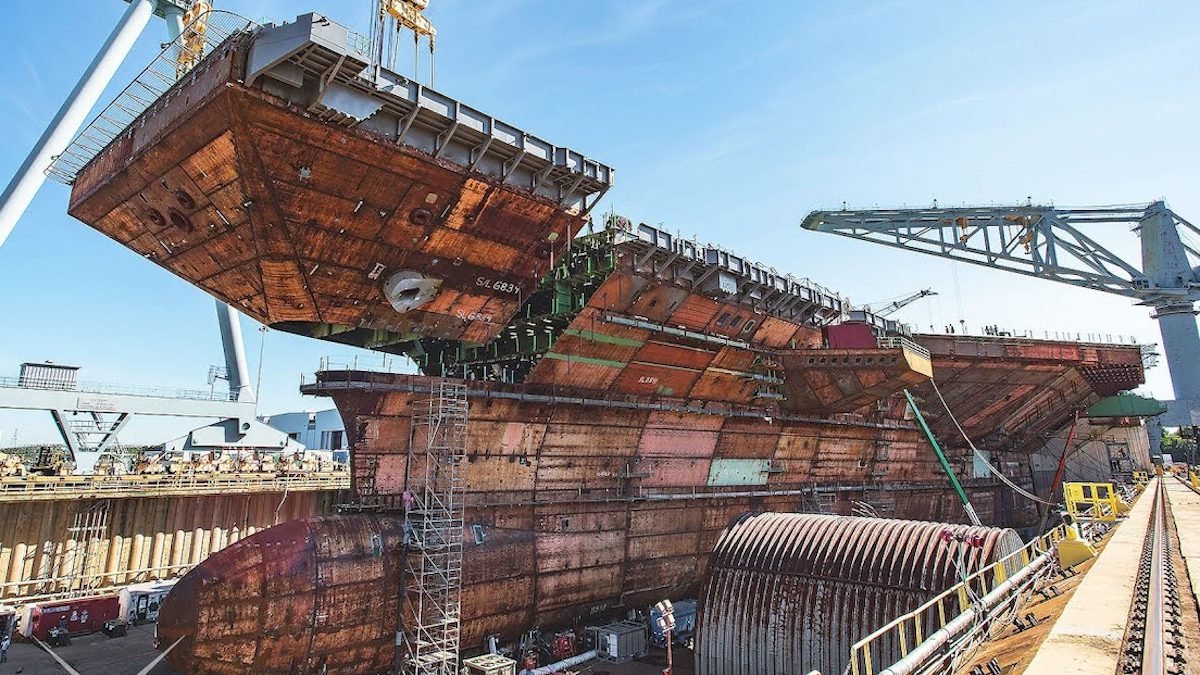
The USS Doris Miller aircraft carrier’s latest construction delay is more than a shipbuilding setback — it is a warning sign for the future of US global carrier power.
This month, multiple media outlets reported that the US Navy’s newest Ford-class aircraft carrier, the future USS Doris Miller (CVN-81), has been delayed by two years to February 2034, underscoring mounting strains in the US naval shipbuilding sector as cascading production bottlenecks, supply-chain disruptions and workforce shortages ripple through the carrier program.
The US Navy said the delay stemmed from “construction footprint constraints” at Huntington Ingalls Industries’ Newport News Shipbuilding yard in Virginia, the only US facility capable of building nuclear-powered aircraft carriers, where setbacks affecting the USS Enterprise (CVN-80) have spilled over into the USS Doris Miller’s schedule.
The revised timeline means CVN-81 will take roughly 15 years from construction start to delivery, significantly longer than earlier US carrier programs and highlighting declining shipyard efficiency compared to the Nimitz-class era.
Industry executives said dry dock congestion and out-of-sequence construction caused by late-arriving critical equipment hampered progress, although Newport News expects to hold Doris Miller’s keel-laying later this year.
The delay also reflects broader systemic problems confronting the Ford-class program, whose earlier ships — including USS Gerald R. Ford, USS John F. Kennedy and USS Enterprise — have all suffered repeated schedule slippages, forcing the US Navy to extend the service lives of aging Nimitz-class carriers to maintain its legally mandated fleet of 11 aircraft carriers.
Those problems raise broader questions about whether the US Navy can sustain global carrier-based power projection across multiple theaters simultaneously.
China presents the clearest long-term challenge to US carrier dominance, with the second-largest carrier force. Although it has only four carriers compared with the US’s 11, its massive shipbuilding capacity – 230 times that of the US – and its status as the world’s largest navy by hull numbers means it could catch up quickly.
In contrast to the USS Doris Miller’s 15-year build time, Fujian, China’s third and latest conventionally-powered supercarrier, was built in just six years, laid down in 2016 and launched in 2022.
Taking Fujian’s build time as a precedent, China’s follow-on Type 004 carrier, believed to be nuclear-powered, was first spotted under construction in satellite imagery in May 2024, with a possible commissioning date of 2030. By 2035, the US Department of Defense’s 2025 China Military Power Report (CMPR) estimates that China may have up to six aircraft carriers, with a planned total of nine ships.
Even so, the US retains major quantitative and qualitative advantages in carriers. For one, its legally mandated 11-carrier fleet has two more ships than China’s, is all-nuclear-powered, carries more aircraft and has combat experience that China cannot hope to match.
Still, the US has to deploy its carriers in multiple regions, while China can concentrate its carrier fleet in the Pacific. A major Pacific contingency could require the US to deploy as many as five carriers to the region.
While most analyses focus on how US carriers will fare against their Chinese counterparts in a clash over Taiwan or in the South China Sea, a second Battle of Midway scenario is very unlikely.
For one, carriers are too costly and strategically important to risk – hence their deployment in relatively permissive environments. Moreover, the loss of a carrier could lead to significant escalation, possibly leading to the use of nuclear weapons. It is likely that both China and the US are consciously steering clear of those scenarios.
Yet the greater threat to US carrier power may be strategic overextension rather than direct naval defeat. By tying down US forces across multiple theaters, adversaries may seek to make global force projection financially, industrially and operationally unsustainable without triggering direct war.
The Middle East offers the clearest example of that attritional pressure. The March 2026 fire aboard the USS Gerald R Ford may be attributable to crew fatigue and lack of maintenance, as the ship was sent to the region just after supporting the US capture of the Venezuelan President Nicolas Maduro in January 2026.
Prolonged US involvement in the Iran war could see substantial numbers of US Navy assets deployed indefinitely in the region, increasing operational fatigue, maintenance burdens and accident risks. Notably, the build-up to the Iran war left the US without carriers in the Pacific for three weeks in August 2024, as the USS Abraham Lincoln was deployed from Yokosuka to the Arabian Sea.
In Eastern Europe, the Ukraine war presents a possibility of expanding into the Baltic States and Finland. Ted Vician points out in an August 2025 Small Wars Journal article that Russia is likely to follow its Crimea playbook if it decides to make its move in the Baltics. Vician notes that Crimea’s 2014 seizure involved infiltration, isolation and information tactics rather than a major military invasion.
Furthermore, Brent Sadler notes in a March 2022 Heritage Foundation article that in such a situation, the US sending a carrier to the North Sea or even the Baltic Sea would send a strong message. Yet such a deployment could tie down a carrier needed elsewhere.
North Korea effectively ties US strategic attention, military resources and time in the Korean Peninsula through a strategy of permanent military menace, unconventional capabilities and the threat of nuclear escalation.
The Iran war may have incentivized North Korea to test US and South Korean reactions following the redeployment of US Terminal High Altitude Area Defense (THAAD) systems from South Korea to the Middle East through frequent missile tests.
That cycle of threats could force a sustained US carrier presence in Northeast Asia. One carrier held up in Northeast Asia to deter North Korea could not be used in the Taiwan Strait or the South China Sea.
Given these interconnected actions by US adversaries and the limits of US military power, the US may have to rely more on its allies than on its carriers to keep its adversaries at bay.
However, the prospect of a US debacle – whether a new forever war in Iran, Russia escalating the Ukraine War into the Baltics and Finland, or China absorbing Taiwan without a fight – could be a severe blow to the credibility of US security guarantees, forcing US allies to rethink US military access in their territories.
Such setbacks could damage US credibility and global influence more severely than the loss of a carrier itself.