Why Iran broke the ceasefire in the Strait of Hormuz and what might happen next – expert Q&A
The 60-day ceasefire signed by the US and Iran three weeks ago fell apart on July 8. Iran targeted vessels transiting the Strait of Hormuz without its say-so, prompting the US to respond with strikes against a range of military targets in the Islamic Republic.
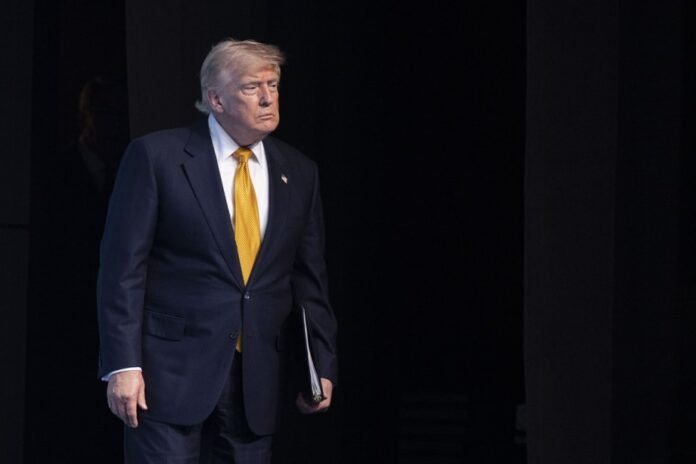
President Donald Trump declared the ceasefire “over”, saying further talks would be a “waste of time”, and the two sides have subsequently exchanged further rounds of attacks. We asked Scott Lucas, an expert in Middle East and US politics at the Clinton Institute, University College Dublin, to explain why the conflict appears to have restarted and what might happen next.
Why has Iran started this conflict up again – wasn’t the 14-point deal generally thought of as a victory for them?
The clashes arise from the quest for control of the Strait of Hormuz, the waterway through which around 20% of the world’s maritime oil and gas passes. Iran established that control days after the war began. The Trump camp needs to break it; otherwise, they will have to negotiate a deal based largely on Iranian terms.
Several rounds of clashes have taken place since the initial ceasefire was declared in April. Iran attacks a few vessels trying to cross the strait without Tehran’s permission, preventing the US from establishing a shipping corridor off the Omani coast that is outside Iranian control. The US military responds with strikes on Iranian military sites around its southern coast. After a few days, each side pulls back.
However, there is one twist in the latest cycle. The US hit not only military targets but also two civilian bridges connecting the Iranian capital, Tehran, to the second city, Mashhad.
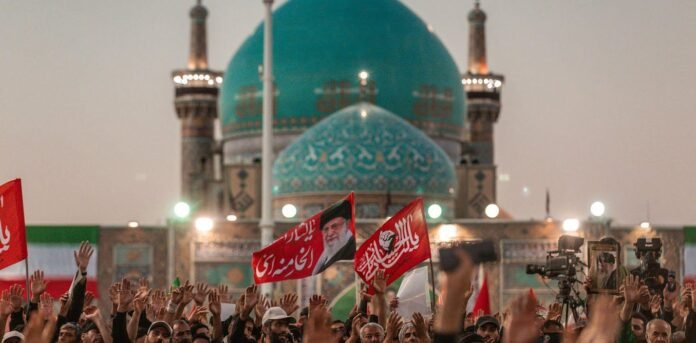
I think that may have been symbolic rather than a substantive escalation – the assassinated Iranian supreme leader, Ali Khamenei, was being buried in Mashhad on Thursday. However, this is worth watching, in case the Trump camp are thinking of renewing strikes on civilian infrastructure.
What role are the Gulf states playing and how are they aligning?
Iran’s retaliation reinforces the message the regime sent after it survived the initial US-Israeli strikes – that it has the will and capacity to survive what is thrown at it, and cause chaos in the region.
In June 2025, during Israel’s 12-day war, Tehran refrained from striking the Gulf states. This time, it made clear the gloves were off, with serious damage and effects on the political and economic positions of the six Gulf countries.
That set off a chain of consequences, including a split among those countries. The United Arab Emirates is moving closer to Israel and the Trump camp. Saudi Arabia was angered about the lack of US protection early in the war, but wanted Trump to “finish the job” with ground troops forcing the capitulation of the Iranian regime.
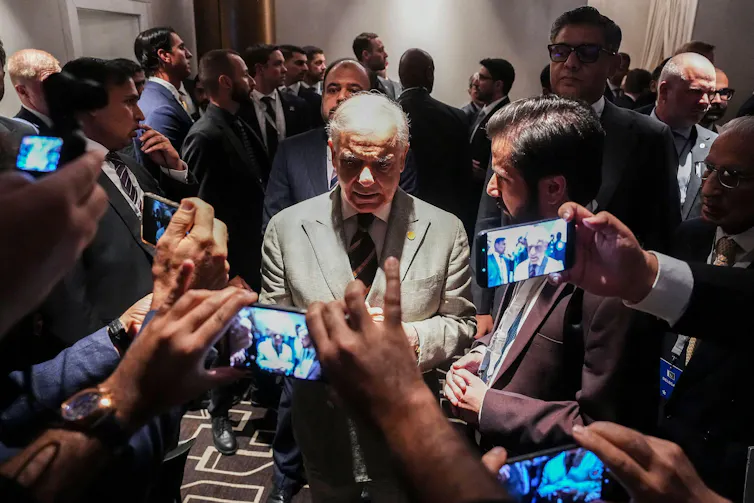
Pakistan’s prime minister, Shehbaz Sharif, talks with journalists during negotiations in Lake Lucerne, Switzerland on June 21 2026.Hamed Malekpour/Middle East Images/StringersHub/Sipa USA
Qatar has established itself as a mediator alongside – and possibly beyond – Pakistan. Oman is now manoeuvring between trying to work with Iran and trying to comply with Trump’s demands over the strait. Bahrain always follows the Saudi lead and Kuwait just wants the conflict to end.
Is there any prospect of the US strikes crippling Iran militarily?
Throughout the war, US-Israeli strikes have killed Iranian political and military leaders. They have blasted military sites, obliterated the Iranian navy, and disabled missile launchers and drone production facilities.
Mayuree Naree, a Thailand-flagged bulk carrier, damaged by a projectile in the Strait of Hormuz, March 2026.Panithi Tumkaew via AP
But much of Iran’s power lies in mobile capability, from drones and missiles to the small boats and mines of the Islamic Revolutionary Guard Corps.
US intelligence estimated in May that Iran still possessed around 70% of its pre-war stock of missiles and 70% of its missile launchers. According to the same assessments, only three Iranian missile sites along the strait were inaccessible.
Not only has all this been sufficient for Iran to control the Strait of Hormuz, it has enabled Iran to maintain its ability to retaliate against Israel and the Gulf states. And the Trump camp – which may have tried to seize stocks of enriched uranium this spring – has now learned that this task may be impossible.
Who is more resilient right now: Iran under renewed sanctions, or the Trump administration facing elections in four months?
The Iranian regime is in a stronger political position than it was before the war. Its economy was in serious trouble then, sparking January’s public protests, and it will be in serious economic trouble again unless there is a protracted ceasefire and the chance to rebuild.
Despite the potential lifting of sanctions and unfreezing of assets, it faces costs of more than $270 billion (£201 billion) in war-related damage, much of it to essential infrastructure.
But for now, it can rely on the priority of its show of defiance. The Strait of Hormuz, which had offered free passage for all vessels up to February 28, is now in the hands of the Iranians. That has made global economic shocks more significant than Tehran’s difficulties.
Before the war, Iran was ready to accept limits on its uranium enrichment and a renewal of the International Atomic Energy Agency’s inspections, disrupted by the 2025 war. Now, this issue has been relegated behind a resolution of the strait.
Unless the US military can force open the waterway, any resolution will see Iran getting benefits that were not assured before February 28. These include the lifting of some US sanctions, the unfreezing of some Iranian assets, and possibly a private investment and reconstruction fund of up to US$300 billion.
There is no upside for the Trump camp now. It has failed to get regime surrender. It has handed the initiative to its foe. Its military strength has been superseded by political ineptitude and failure. It is fighting a war which is widely disliked at home – even more so because of the self-inflicted economic pain for Americans.
Having sought a display of dominance abroad, the Trump camp now has to wear the badge of loss. With midterm elections fast approaching in the US, this could be costly.
Trump claims Iran asked US to continue ‘talks,’ declares ceasefire ‘over’
US President Donald Trump said Friday that Iran has asked Washington to continue “talks” and that Washington agreed to do so, while reiterating that a ceasefire secured last month between the two countries was “over,” Anadolu reports.
“The Islamic Republic of Iran has asked us to continue ‘talks.’ We have agreed to do so, but the United States has stated to them, in no uncertain terms, that the Cease Fire is OVER!” Trump wrote on his social media platform Truth Social.
Separately, in an interview with the New York Post, Trump said he left instructions for the US to launch massive strikes on Iran if Tehran succeeds in assassinating him.
“I’ve left instructions — if anything happens, to just literally bomb them at levels that they’ve never seen before,” Trump said in an interview with the New York Post.
READ: Israel seeks US green light to strike Iran
Trump said Iran has wanted to kill him “for a long time,” adding: “That’s what we’re dealing with.”
In mid-June, Iran and the US signed a memorandum of understanding under Pakistani mediation aimed at ending their military conflict and reaching a lasting peace agreement.
However, both sides exchanged attacks over the past two days amid escalation following Iranian attacks on three commercial vessels in the Strait of Hormuz.
Tehran launched a series of strikes Thursday on US military infrastructure in Bahrain, Kuwait, Qatar and Jordan in retaliation for a second day of overnight US attacks.
READ: Israeli prime minister says Iran war ‘has not ended’
He’s Suspected of Hiring a Venezuelan Gang for a Political Killing. Trump Officials Still Work With Him.
Reporting Highlights
Suspected of Hiring Gang: The Trump administration is working directly with a powerful Venezuelan leader under investigation for an alleged political killing in Chile.
Crucial Figure in Venezuela: Diosdado Cabello remains the interior and justice minister, even though he is the target of U.S. drug trafficking charges and a $25 million bounty.
Implicit Geopolitical Deal: Washington exploits the U.S. indictment to ensure Cabello’s cooperation, while he shields himself with his power over Venezuela’s stability, former officials say.
These highlights were written by the reporters and editors who worked on this story.
When Rafael Enrique Gámez Salas crossed the Mexican border in late 2024, U.S. Border Patrol agents first thought he was like hundreds of thousands of other Venezuelan migrants fleeing their country’s devastating economic and political crises.
But today the 40-year-old sits in a federal jail in Los Angeles awaiting extradition to Chile, where prosecutors accuse him of being a boss of Tren de Aragua, the Venezuelan street gang. Chilean authorities say Gámez organized a kidnapping that resulted in the killing of an exiled Venezuelan dissident there. Even more troubling, they believe he acted at the behest of Venezuela’s authoritarian government.
And for the past six months, the Trump administration has been working directly with the powerful Venezuelan official under investigation for allegedly ordering the crime: Interior Minister Diosdado Cabello.
The unlikely alliance with Cabello began in January, when U.S. special operations forces swooped into Caracas, captured Venezuelan President Nicolás Maduro and brought him to New York to stand trial on drug trafficking charges. While critics called the operation a blatant violation of Venezuelan sovereignty, the Trump administration declared it was restoring law and order in a strife-torn region and began to restructure Venezuela’s ruined economy and exert control over its massive oil industry.
Yet the Trump administration has left Cabello in place — despite longtime U.S. accusations that he has led the repression of political opponents and enriched himself in illicit partnerships with criminal groups. Cabello has had a seat at the table during visits to Caracas by senior U.S. officials, including Interior Secretary Doug Burgum, for negotiations over issues such as Venezuela’s lucrative mining sector. Before Maduro’s capture, U.S. authorities had charged Cabello and a top leader of Tren de Aragua in the same drug trafficking indictment as Maduro and offered a $25 million reward for him.
Cabello and other U.S.-backed Venezuelan leaders have come under fire in recent days for their response to the devastating earthquakes on June 24 that killed more than 3,600 people, injured more than 16,000 and left thousands more missing. In an internationally televised confrontation, Cabello exchanged tense words with members of a U.S. search-and-rescue team en route to aid victims in a heavily damaged area. Critics of the sluggish Venezuelan response to the disaster, including U.S. congressional representatives in Miami, accused Cabello of interfering with rescue operations and repeated their calls for his arrest on the pending U.S. charges. But a State Department spokesperson downplayed the incident as “an unfortunate misunderstanding.”
Diosdado Cabello, right, in a meeting with Venezuela’s interim President Delcy Rodríguez, center, and U.S. Interior Secretary Doug Burgum, left, in Caracas, Venezuela, in March.Leonardo Fernandez Viloria/Reuters
In Chile, authorities are investigating Cabello as the alleged mastermind behind the killing of a former Venezuelan military officer, Lt. Ronald Ojeda, who had unsuccessfully attempted an uprising against Maduro. Chile’s attorney general and other senior officials have said that Cabello became an investigative target based on testimony of captured suspects.
The 32-year-old Ojeda had been granted asylum in Chile. Authorities say they suspect that Cabello paid Tren de Aragua’s top leadership and that they, in turn, commissioned gang members in Chile, led by Gámez, to kidnap the former soldier. Chilean prosecutors believe Ojeda died while his captors were torturing him to get information about the Venezuelan political opposition.
After President Donald Trump returned to office last year, Secretary of State Marco Rubio and other officials asserted that the killing in Chile demonstrated Tren de Aragua’s ties to the highest levels of the Venezuelan government and the gang’s reach across the Americas. The president designated the gang as a terrorist group and said Maduro had sent it to invade the United States, although some law enforcement officials say the administration exaggerated the threat to justify mass deportations.
As Chile seeks the return of Gámez and prosecutors prepare to bring 20 suspects to trial, the Trump administration has been silent on the alleged role of the regime and Cabello in Ojeda’s death. U.S officials have aided Chilean counterparts with the extradition process, but they have not used the case to press Venezuelan authorities to oust, arrest or hand over Cabello, current and former U.S. officials said.
Asked at a press conference in May if the U.S. still considers Cabello a narcoterrorist, Rubio gave a brief answer. “The policy of the United States on that topic has not changed, and when it changes we will let you know,” he said.
Todd Robinson, a retired senior U.S. diplomat who served as ambassador in Caracas, said Cabello’s continuing power raises questions about whether the stated U.S. commitments to advancing the rule of law in the hemisphere are real or a cover for its interests in exploiting Venezuela’s oil.
“It’s just a horrible, horrible idea to leave him in place,” said Robinson, who was expelled from Venezuela in 2018 after criticizing human rights abuses. “I don’t know what their aim is in doing that, unless it really is about oil, not democratic transition.”
Another retired U.S. diplomat, Brian Naranjo, who served three tours in Venezuela, said the administration seems more interested in appeasing corrupt actors than uprooting them. In addition to controlling the security forces as minister of the interior and justice, Cabello maintains alliances with guerrillas in neighboring Colombia and other criminal groups that make him a danger to political stability, according to Naranjo, other officials, dissidents, and U.S. and Chilean court documents. As a result, critics say, Washington sees Cabello as a necessary evil.
“As long as he figures out a way to keep handing over things the Trump administration wants, I think he endures,” Naranjo said.
In response to a list of questions from ProPublica, a spokesperson for the Department of Justice declined to comment on any ongoing investigations. The White House referred questions to the Department of Justice. The State Department and Venezuelan government officials did not respond to requests for comment.
Although Cabello could not be reached for comment, he has publicly denied allegations of involvement in the killing of Ojeda. Responding on his television show in 2024, he said: “Venezuela has nothing to do with this kidnapping. Nothing. Resolve your problems there, in Chile.”
Cabello sometimes wields a spiked club on his television show, “Con el Mazo Dando” (“Hitting With the Club”).Latin America News Agency via Reuters
As for Gámez, ProPublica found no information indicating that the Venezuelan ex-convict had been charged with a violent offense during the nearly two years he lived in the United States. Interviewed by telephone and email from the federal jail in Los Angeles, he said he worked hard at a restaurant and as a deliveryman to support his family in Utah. He denied any role in Ojeda’s death or being a member of Tren de Aragua. He also said he has no connections to Cabello.
Gámez said that, like the dissident whose kidnapping he’s accused of organizing, he left Venezuela in part because he was an opponent of the former regime. He said the governments of Chile and the United States are making him a scapegoat.
“If only I was everything they say I am,” he said. “Obviously any leader boss has money to burn and I don’t have a penny to my name.”
Hundreds of pages of Chilean and U.S. court records paint a much darker portrait of his activities and detail his alleged role in the Ojeda case and other crimes. Interviews with current and former officials from the United States, Chile, Venezuela and Spain; Ojeda’s friends and family; Gámez; and others, along with the court records, provide one of the fullest accounts of the case.
The Crime
On Feb. 21, 2024, a stolen Nissan sedan arrived at an apartment tower in Santiago, the capital of Chile, one of the safest and most prosperous nations in Latin America. It was 3:05 a.m.
Four masked men disguised as Chilean police officers got out. On the 14th floor, three of them broke into Ojeda’s apartment, handcuffed him in front of his terrified wife and son, and dragged him out, according to court documents and security video. He was barefoot and wearing only underpants.
The kidnappers rushed Ojeda to a slum hideout, where they tortured him to death, court documents say. Then they buried his partially dismembered remains in a suitcase beneath a newly laid cement floor, documents say.
Images from security video show kidnappers disguised as Chilean investigative police as they burst into Ojeda’s 14th-floor apartment in Santiago and abducted him early in the morning on Feb. 21, 2024.Obtained by ProPublicaAlleged Tren de Aragua members disguised as police officers restrained Ojeda in the elevator after abducting him in front of his terrified family. Authorities say he died in a gang hideout while his captors tortured him to get information about the Venezuelan political opposition.Obtained by ProPublica
Weeks earlier, the Maduro regime had publicly declared Ojeda a traitor.
In 2017, Ojeda and other young dissident officers had been jailed and tortured in Venezuela. Ojeda alleged in a posthumously published memoir that his ordeal had been ordered by Cabello.
Ojeda in Colombia with former Capt. Anyelo Heredia, a fellow dissident, in December 2023. Soon afterward, they slipped across the border into Venezuela to do reconnaissance for a planned military uprising. Soldiers captured Heredia, but Ojeda narrowly escaped.Courtesy of the Ojeda family
Ojeda took refuge in Chile. But in late 2023, he went to Colombia’s border with Venezuela to try to instigate a military rebellion and narrowly escaped capture. During his final days, Ojeda feared the regime was coming for him, according to his friends and family.
“Ronald and his wife had thought about what would happen if there was a knock on the door,” said his family’s lawyer, Juan Carlos Manríquez. “They had even rehearsed for it. They had agreed to protect their son at all costs by not offering any resistance.”
A tip led Chilean police to Ojeda’s buried remains nine days after his abduction. Fingerprints recovered from the abandoned Nissan had already been traced to a member of Tren de Aragua, authorities say.
In addition to the evidence of the gang’s involvement, Chilean investigators quickly came to suspect a political crime orchestrated by the Maduro regime, which had openly declared the victim an enemy of the state.
“Ojeda had already escaped from them at least once before,” said Héctor Barros, the chief prosecutor in the case. “The regime took that personally. He was a high-priority target.”
Delivering for DoorDash
Before his odyssey across the Americas, Gámez grew up in the Caribbean port city of Maracaibo, Venezuela.
After high school, he fell into petty crime and was sentenced to four years and three months in prison for robbery and other charges in a home invasion, according to Venezuelan court records and his own account.
Nonetheless, there is no indication that he became a member of Tren de Aragua until years later, according to court documents and law enforcement officials. It is not clear when and how he joined the gang, Chilean investigators say.
About a decade ago, Gámez left Venezuela as part of what has become the largest mass exodus in the hemisphere. Maduro had been elected after the death of populist President Hugo Chávez. In 2014, the price of oil had plummeted, causing inflation, unemployment and food shortages. In addition to economic necessity, Gámez said he migrated because he belonged to a political party that opposed the increasingly repressive regime.
Gámez spent years in Chile, where he worked in bread and clothing factories and as a barber. There are no indications that he had a criminal record during that period, according to interviews and court documents.
Rafael Enrique Gámez Salas featured his work as a barber on his Instagram account while living in Santiago, Chile. Authorities say he did not have a criminal record there before he left for the United States, but allege that he became a leader of Tren de Aragua after returning to Chile in 2023.Screenshot and redactions by ProPublica
In 2021, Gámez and his family joined a record number of immigrants who headed north to the United States during the Biden administration. They surrendered to U.S. border agents in Arizona and were released pending the outcome of immigration proceedings.
“All the people who came here said there was more work and better quality of life,” Gámez said. “I also thought about the future of my children and their security because I thought this was a safe country.”
The family settled in Salt Lake City. Gámez said he found jobs in a restaurant kitchen and delivering for DoorDash, sometimes working as many as 15 hours a day.
“The whole time I was here I worked,” he said. “I never had a problem.”
Until December 2022, when a Texas state trooper patrolling near the Mexican border pulled him over for driving with expired plates and discovered that his Venezuelan passengers were undocumented. Gámez admitted that he had agreed to take the family of three to Utah, court records say. He told ProPublica he was doing a favor for a friend who is related to the family. But state prosecutors charged him with smuggling of persons and smuggling of a minor, and Immigration and Customs Enforcement deported him back to Venezuela in August 2023.
Although the government declared victory, critics said the authorities had tipped off the top gang bosses, including Hector Rusthenford “Niño” Guerrero, who managed to flee the raid.
Gámez was not involved, and Chilean authorities believe he had already left Venezuela en route back to Chile. But investigators say their later search of his communications found a post after the raid in which he appeared to celebrate Guerrero’s escape.
“They toppled the castle, but not the king,” read his WhatsApp status, according to court documents. “So the game continues.”
Authorities said the message suggests that Gámez may have had contact with the gang during his first stay in Chile or in Utah.
Citing communications and witness testimony, investigators say he was back in Chile about two months after the raid on the prison. The Venezuelan gang rapidly put him in charge of its offshoot in Santiago, called the Pirates of Aragua, according to court documents and interviews.
“There is no way he moves up that quickly when he returns to Chile unless he’s already connected,” said a former U.S. federal law enforcement official.
In early 2024, Chilean investigators say they started hearing chatter about a new gang boss, known as el Turko, who was overseeing a wave of extortion and kidnappings of immigrants.
Angered by public attention to the Ojeda case, senior Tren de Aragua leaders ordered the kidnappers to leave Chile, according to court documents and interviews. Investigators say Gámez also left, spending time in Peru and Colombia as he used his phone to oversee crimes by members of the crew still in Santiago, according to court documents and interviews.
Six weeks after Ojeda’s killing, Gámez was communicating by text with them when they attempted a carjacking that led to a gunfight with an off-duty Chilean police officer, court documents say. The officer and one of the suspected gang members were killed. Recovered text exchanges reveal that an agitated Gámez gave real-time instructions to the accused killers as they fled the scene, according to court records and interviews.
“The clothes you had,” he wrote, according to court records. “Dump them…right away the shoes…everything.”
Police arrested three suspects for killing the police officer and found data in their phones that identified Gámez as el Turko, according to documents. It included a trove of telltale communications in which Gámez, acting on instructions from senior gang bosses outside Chile, allegedly directed the plot to kidnap Ojeda, according to interviews and court documents.
“The order comes from above and they are putting their trust in me,” Gámez told his crew in a text, according to court documents.
By mid-2024, the police knew who they were looking for. But they didn’t know where he was.
End of an Odyssey
On Dec. 30, 2024, U.S. Border Patrol agents arrested Gámez after he crossed near Brownsville, Texas.
He was carrying a Colombian passport with an alias to hide his previous deportation and hoping to rejoin his wife and children in Utah, according to officials and his account. But fingerprint checks revealed his true identity.
Gámez pleaded guilty to a charge of being illegally in the country after deportation and received a sentence of 13 months in prison. He also pleaded guilty to a reduced charge in the 2022 smuggling case and was sentenced to 120 days, according to court records.
In Chile, the sprawling investigation had gathered momentum. Chilean police tracked down other fugitives abroad with the aid of U.S. and Latin American law enforcement agencies. And a number of witnesses, including accused kidnappers, implicated Gámez and the Venezuelan regime, court documents show. Three of them pointed the finger at Cabello, according to sources close to the case.
Cabello, right, with Rodríguez on Venezuela’s National Civil-Military Unity Day in April.Javier Campos/NurPhoto via Getty Images
“Diosdado Cabello, who is a Venezuelan politician, gave the instruction to do the kidnapping,” said an admitted kidnapper. Cabello allegedly paid Guerrero, the top boss of Tren de Aragua, according to that testimony.
Another alleged gang member testified that one of Ojeda’s kidnappers told him the crime was “ordered by the Government of Venezuela, planned by the leaders of Tren de Aragua, and executed by the members of the gang who were in Chile,” court documents say.
“The money was paid by the government,” the alleged gang member said.
So far, authorities said they do not have other evidence that directly connects Cabello to the crime — like communications between the Venezuelan leader and gang bosses. But last year, Chile took the extraordinary step of going to the International Criminal Court to accuse the Maduro regime of being involved in Ojeda’s death. That case is in the preliminary investigation stage as part of the court’s probe of human rights abuses in Venezuela.
The Venezuelan government responded to Chile’s charges with a statement that the case “doesn’t just lack a legal basis, but is sustained by a vicious hate towards Venezuela, showing the desperation to please the agendas ordered by the United States.”
The U.S. agenda in Venezuela has come under increasing scrutiny. Venezuela’s opposition, which has long counted on the United States for support, continues to call for Cabello’s ouster and democratic reforms. But an unspoken bargain between Cabello and the Trump administration prevails, according to dissidents and current and former U.S. officials. The administration exploits the leverage of the U.S. indictment to ensure Cabello’s cooperation, while Cabello shields himself with his power to upend Venezuela’s stability, critics said.
Naranjo, the former diplomat, said Cabello’s willingness to accommodate Washington suggests that he is “going to be around far longer than anybody wants. He’s always demonstrated his ability to react and adapt, operationally and tactically, to the circumstances in front of him.”
In a recent and dramatic sign of the evolving partnership with the United States, Trump announced June 13 that a U.S. missile strike had killed Guerrero, Tren de Aragua’s leader, in Venezuela’s lawless mining region. Trump said the strike had been “coordinated closely with our friends in Venezuela, with whom we are working very well.”
Guerrero’s death will make it more difficult for Chilean investigators to pursue the allegations that Cabello hired the gang to target Ojeda, former officials said. But Ojeda’s family and other dissidents hope that the trial in Santiago will show that the Venezuelan regime, like other authoritarian governments, enlisted organized crime to send a terroristic message to its foes at home and abroad.
“Diosdado Cabello is the person we want punished,” said Javier Ojeda, the victim’s brother.
Chilean authorities say Gámez and other suspected gang chiefs who have been captured could provide further evidence about the alleged links to Cabello. Gámez has consented to extradition, according to court documents, but the process could still take weeks. Gámez told ProPublica he decided to return voluntarily to Chile because he wants to fight the charges against him in the Chilean courts.
Gámez questioned the credibility of witnesses against him, saying one of the admitted gang members “is looking for an escape … by any means, like lying and inventing things.” He didn’t respond to some questions about the voluminous court file against him, including his alleged communications.
Gámez asserted that he’s being set up as a fall guy for political reasons. Both the Chilean and U.S. governments, he said, have exploited the Ojeda case in their persecution of Venezuelans.
Chilean authorities have arrested many Venezuelans “to use that as a strategy so they leave Chile,” he said. “The same as the president here did…everyone they caught they connected to Tren de Aragua to arrest them and throw them out of the country.”
Israel and Lebanon have a long history of failed ceasefires – will this time be any different?
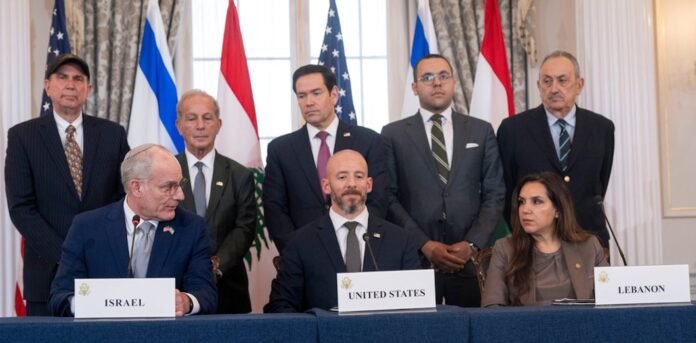
If implemented, the framework agreement hammered out between Lebanon and Israel in June 2026 could serve as the most consequential agreement between the two countries in nearly 80 years.
But that is a big “if.” The deal envisions peaceful relations between the two states and lays out a road map to disarm the Shiite militant group Hezbollah, secure Israel’s full withdrawal from Lebanon and restore Lebanese sovereignty over its entire national territory.
As it stands now, all of those provisions are a far cry from reality. For one, Hezbollah has rejected the agreement outright. Meanwhile, Israel’s continued military operations risk undermining the domestic legitimacy of the Lebanese government and, ultimately, its ability to implement the agreement.
As experts on armed conflict, ceasefires and peace processes in the Middle East, we have studied past ceasefires between Israel and Hezbollah in 1993, 1996, 2006, 2024 and April 2026. Our forthcoming paper on the subject demonstrates a consistent pattern: Each agreement created only a temporary interval before hostilities recurred or only marginally reduced violence. Throughout, there appeared to be a tacit understanding between Hezbollah and Israel that conflict would eventually resume.
A history of ceasefire breakdowns
Lebanon and Israel have never normalized relations, but they do have a precedent for an agreement that successfully contained conflict. The 1949 U.N.-brokered Lebanese-Israeli General Armistice Agreement ended hostilities following the 1948 Arab-Israeli war. With sustained international backing and U.N. monitoring, it established the de facto border that largely remains in place today and prevented a return to full-scale war for roughly two decades.
That relative stability began to unravel in the 1970s as the Palestine Liberation Organization expanded its armed presence in Lebanon, provoking repeated clashes with Israel that culminated in Israel’s invasions of Lebanon in 1978 and 1982.
Since Israel’s 1982 full-scale invasion of Lebanon, agreements and ceasefires intended to end hostilities have repeatedly broken down. Parties have exploited lulls in fighting to buy time, rebuild capabilities and consolidate political or territorial gains ahead of the next round of conflict.
The 1983 agreement between Israel and Lebanon offers both an example of this dynamic and an enduring lesson. It promised peace and normalization in exchange for an Israeli withdrawal from Lebanon. But it unraveled within a year when anti-government forces launched a joint offensive against Lebanese army positions in West Beirut, shattering the authority of the Lebanese government and fracturing the army along sectarian and ideological lines. The 1983 agreement thus failed because the Lebanese state had lost its ability to implement it.
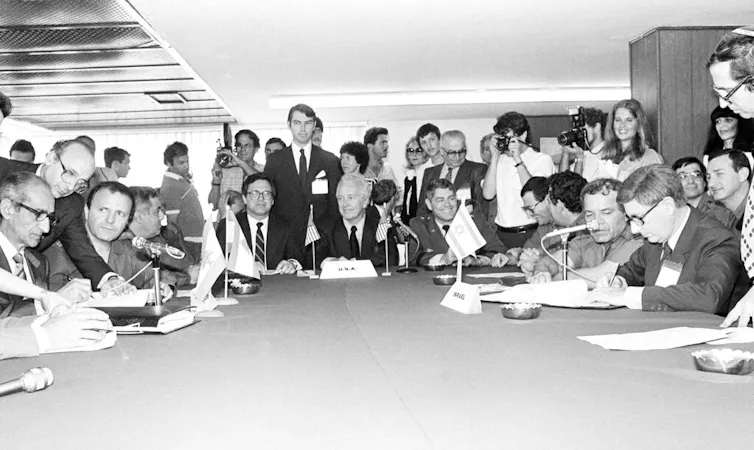
Chief Lebanese negotiator Antoine Fattal, left, and Israeli chief negotiator David Kimche, right, sign an Israeli troop withdrawal agreement in Khalde, Lebanon, on May 17, 1983.AP Photo/Bill Foley
Israel became mired in a prolonged occupation. In that environment, Hezbollah emerged from a network of Shiite Islamist militants, making its dramatic entry into the war by attacking an Israel military base in 1982. It later carried out the bombings of the U.S. Embassy in Beirut and the barracks of American Marines and French peacekeepers in 1983.
In the decades that followed, Hezbollah grew in power, leveraging sustained Iranian support and the potent narrative of resistance to Israel. Since then, conflict in Lebanon has largely revolved around the struggle between Hezbollah and Israel.
Violence flared and subsided periodically, and Lebanon and Israel reached ceasefire agreements in 1993, 1996 and after a 2006 war. Crucially, however, Hezbollah’s disarmament was either left off the agenda – as in the 1993 and 1996 ceasefires – or incorporated into a 2006 U.N. Security Council resolution that failed to lay out credible mechanisms for implementation.
As such, the periods of relative calm that followed these ceasefires created space for Hezbollah to rebuild its military capabilities, consolidate its political influence and retain the initiative over when to resume hostilities with Israel.
Can Hezbollah be disarmed?
The present-day context is in many ways unique because the balance of power in Lebanon has shifted in ways that make Hezbollah’s disarmament – and a historic Lebanese settlement with Israel – more politically plausible than at any point in decades.
Israel’s military campaigns have significantly degraded Hezbollah, while public opinion in Lebanon has increasingly turned against the group, blaming it for repeatedly dragging the country into unnecessary wars.
Even among Lebanon’s Shiite community, support for Hezbollah is weaker than in the past, and anger toward Iran, its main sponsor, is growing.
Since coming to power in 2025, Lebanon’s President Joseph Aoun and Prime Minister Nawaf Salam have sought to capitalize on this shift by pursuing Hezbollah’s disarmament in line with the 2006 U.N. resolution, which calls for the disarmament of all nonstate armed groups in Lebanon and the extension of Lebanese state authority to the south.
For years, these provisions remained largely aspirational. Today, they are a concrete possibility.
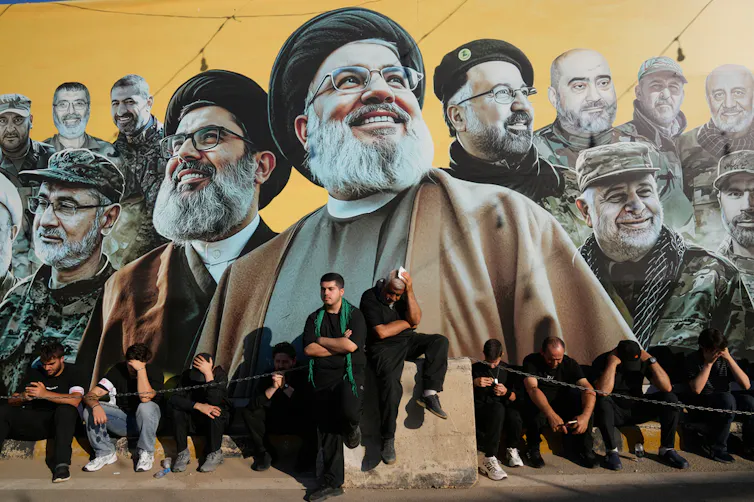
Hezbollah supporters sit in front of a giant billboard that shows the two late Hezbollah leaders – Sayyed Hassan Nasrallah and Hashem Safieddine – with other deceased commanders of the group.AP Photo/Hussein Malla
But the window for diplomacy remains narrow, and actions by both Israel and Hezbollah risk closing it. The danger is that short-term political incentives override longer-term strategic opportunities.
With elections approaching and few of the stated objectives of Israel’s war with Iran having been achieved, Prime Minister Benjamin Netanyahu is under mounting pressure to demonstrate tangible results against Hezbollah.
As such, prolonging the conflict in Lebanon may offer domestic political advantages – delaying proceedings in his criminal trial and allowing him to campaign as a wartime leader with strong security credentials.
Hezbollah, meanwhile, is attempting to capitalize politically on Israel’s continued military operations and Netanyahu’s insistence on maintaining a long-term presence on Lebanese soil.
For an organization built on resistance to Israeli occupation, reclaiming that mantle may offer the most effective path to renewed relevance and legitimacy.
The need for diplomacy
In a paradox that borders on the tragic, Israel may find itself repeating the strategic mistakes that helped create Hezbollah in the first place and giving new life to an adversary it has brought to the brink.
The broad pattern of four decades of conflict and ceasefire negotiations indicates that Hezbollah and Israel remain committed to continued confrontation. As such, the likelihood that the ceasefire will give way to full-scale war remains high, in our opinion. That is, unless ongoing, face-to-face diplomacy is strengthened and professionalized.
Expert diplomacy has often been indispensable to major breakthroughs in conflict resolution. During the 1973 Arab-Israeli war, Egyptian and Israeli commanders met face to face along the Suez–Cairo road, under U.N. auspices. Both sides had an interest in halting the fighting and broadly agreed on the principles that eventually led to disengagement and, ultimately, the Egyptian-Israeli peace treaty of 1979.
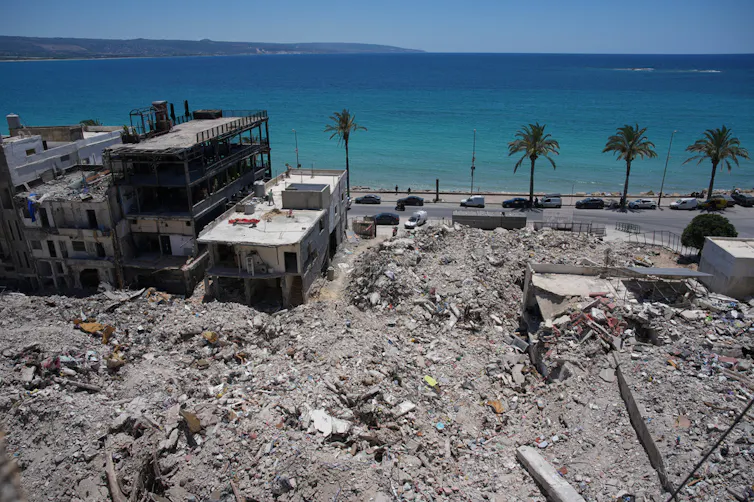
These buildings were destroyed in Israeli strikes along the waterfront in the southern port city of Tyre, Lebanon, on June 19, 2026.AP Photo/Hassan Ammar
More recently, American diplomacy demonstrated that even long-standing disputes between Israel and Lebanon are not beyond negotiation. After brokering the 2022 maritime boundary agreement, U.S. envoy Amos Hochstein launched a new round of talks aimed at resolving disputed sections of the land border and reducing tensions along the Blue Line – a U.N.-determined demarcation line pending the negotiation of the final border. Those efforts were overtaken by the Oct. 7, 2023, attacks by Hamas and the regional wars that followed, but they demonstrate that sustained U.S. engagement can produce tangible progress.
The hard road ahead
It is clear that sustained diplomacy is necessary for the success of any agreement. In the present context, that would require American pressure on Israel to curtail military operations on Lebanese territory. Moreover, the next stage of negotiations will have to confront more long-standing territorial and political disputes that have bedeviled regional peace.
At the same time, Lebanon will require steady diplomatic backing to maintain momentum on Hezbollah’s disarmament, alongside security assistance and financial support to enable the Lebanese military to extend government authority over the entire national territory.
Moments like this are rare in armed conflict. They arise not from design but from the unintended convergence of military outcomes, political shifts and diplomatic initiative. They are also fleeting.
The history of the Israel–Lebanon conflict is littered with missed opportunities and openings that closed before they could be consolidated. This may be one of them. It has the contours of a breakthrough – and the fragility of a mirage.
NASA sure seems to be asking an awful lot of private space stations
NASA this week released a much-anticipated document, known as a “draft Request for Proposals,” that provides some clarity about what it expects from US companies attempting to build privately operated space stations in low-Earth orbit.
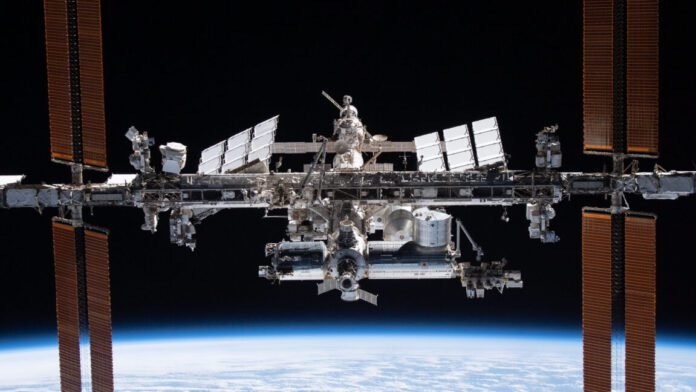
The stakes are high with this document, known as a draft RFP. The space agency, publicly, has set an end date for the International Space Station of 2030. Although there is likely to be a two-year extension, time is still running short to build, test, and fly a vehicle as complex as a space station. NASA officials and the US Congress have both said they want to avoid a gap in having a human presence in orbit, and this has created considerable urgency about what comes next.
Nearly five years ago the space agency took a concrete step toward filling this gap, awarding funding to three companies to develop space station concepts. Previously, NASA had also provided $140 million to another space station company, Axiom Space. These Space Act Agreements were intended as a prelude to a second phase of the program, which would award substantially more funding to one or two more companies to proceed into the construction and launch of their space stations. But phase two of the program kept getting delayed, in part because Congress dithered on funding.
Then, about a year ago, the interim administrator of NASA, Sean Duffy, issued a “directive” that indicated to the private companies that the rules of the game were going to be changed due to a budget shortfall. Only months later, however, it became clear this directive would not stick. In January, a key Senate staffer resorted to “begging” NASA to release the draft RFP. Then, in March, NASA suggested it may reshuffle the rules again by building a “core module” for the private space stations to dock to.
No one liked that because most of the competitors are seeking to build “free flying” stations, independent of the International Space Station. So NASA discarded the core module idea and released the draft RFP this week.
A document finally comes out
“NASA’s review reflects what we’ve been hearing from industry throughout this process. Industry believes it can meet the timelines and that a viable commercial marketplace exists where NASA is one customer among many,” said NASA Administrator Jared Isaacman, in a news release. “We’re focused on supporting those efforts, enabling the capabilities that make this transition possible, and doing all we can to ensure the United States maintains a continuous human presence in low Earth orbit.”
So what do the private companies—the key players are Axiom Space, Vast Space, Voyager, Blue Origin, and possibly SpaceX—think about the new document? This week Ars spoke on background with half a dozen officials from these firms to get a clear sense of how they are reacting.
There are two main feelings: relief and concern.
The relief is easy to explain. A government-sponsored core module was widely disliked and seen as an effort by NASA’s Johnson Space Center, which operates the International Space Station, to remain in the business of operating a space station. Now that worry is gone.
Reasons for concern
But there are multiple reasons for concern. One is lost time. The private companies expected phase two to begin at least a year or two ago, and they are struggling to raise funding and support growing workforces in the interim.
NASA is just one customer for a US-built private space station, but it is the most important customer. Its rules for human safety in orbit will drive the designs the private companies ultimately build. So companies really need to know exactly what NASA wants, and how much it is willing to pay to move forward.
And in this document, NASA has provided guidance. Quite a lot of it. Requirements are the key element of a NASA planning document like this, the bureaucratic currency by which NASA buys off on the safety of a spacecraft, such as the amount of habitable volume the agency requires. Generally companies prefer fewer requirements as it allows them more freedom for design and innovation. More requirements give NASA engineers more control over the design of vehicles.
Several of the companies were shocked by the number of requirements levied in the NASA documents. One participant estimated there are more than 3,000 requirements. The companies were hoping for hundreds. Some of the requirements do seem fairly harsh. For example, on page 50 of the 246-page “contract data requirements list,” it appears as though NASA’s chief information officer must approve all software purchases a company makes.
Reads like a cost-plus contract?
“It’s got all the requirements, deliverables, and clauses of a cost-plus contract, but they are stuffed into a firm fixed-price bag,” said Phil McAlister, NASA’s former chief of commercial spaceflight, who originally created NASA’s private space station program. “That would be OK if NASA were willing to pay for all that.”
But NASA does not appear to be willing to do that, McAlister added.
The document leaves companies with some key questions, including just how much funding is available—it could be as much as $1.5 billion over five years, or substantially less—and how many companies will be dividing that funding up. If there are two winners, the funding is probably enough. If there are three or more, it could be stretched too thin.
“At least the draft RFP is out now, so industry finally knows what NASA is asking of them,” McAlister said. “But the budget and lack of a long-term contract shows that NASA is still not fully committed to this program.”
It is important to note that this is just a draft version of the RFP document. The agency will now accept, and certainly receive, feedback from the US space industry about all of this. A final RFP could come in September, which would then allow companies to bid for contracts. Awards could be made next spring.
Indonesia is rewriting the emerging-market inflation playbook
For over three decades, the standard playbook for taming inflation has remained virtually unchanged.
Faced with surging prices, central banks invariably resort to hiking interest rates. The ripple effects are swift: demand cools, consumption slows and inflationary pressures gradually recede.
This inflation-targeting framework has anchored global monetary policy since the 1990s, proving highly effective—especially when dealing with demand-driven crises. However, the global economy is now grappling with a fundamentally different beast.
Over the past five years, price pressures have been overwhelmingly triggered by supply-side disruptions. First, the pandemic fractured global supply chains. Soon after, the Russia-Ukraine war upended energy and food markets.
Compounding these vulnerabilities are escalating geopolitical frictions — from European theaters to the US-Iran flashpoint in the Red Sea and the critical chokepoint of the Strait of Hormuz. Simultaneously, climate change has begun systematically disrupting agricultural yields worldwide.
In such a chaotic global landscape, aggressive monetary tightening can suppress consumption, but it cannot accelerate harvest cycles, reopen blockaded shipping lanes or pump more crude oil.
This mismatch begs a critical question for emerging Asia: can the burden of inflation control still be left solely to central banks?
Changing face of Asian inflation
Indonesia is currently charting a different course. When state energy firm Pertamina adjusted non-subsidized fuel prices in July 2026, public anxiety over an inflationary spike immediately flared.
These fears were well-founded; rising energy costs inevitably inflate logistics and distribution expenses, creating a domino effect that drives up food and basic commodity prices.
Furthermore, pricier non-subsidized fuel often forces consumers to migrate to subsidized alternatives. If this consumption shift intensifies, it swells the government’s subsidy burden and chokes fiscal space.
Consequently, the brewing pressure is dual-pronged: monetary and fiscal. Left unchecked, this spiral threatens not just consumer purchasing power but national economic growth targets as well.
In response to such headwinds, the standard central bank manual dictates interest rate hikes to anchor inflation expectations and cool demand. While necessary, this toolkit falls short when the root shock lies in production and distribution.
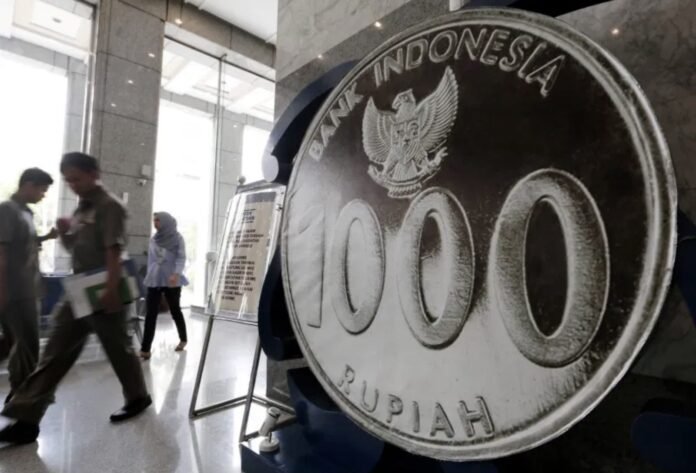
This is where Jakarta’s dual-track approach becomes instructive. Indonesia has not abandoned the Inflation Targeting Framework (ITF). As global energy shocks, a depreciating rupiah and external uncertainties mounted, Bank Indonesia (BI) acted in tandem with its global peers.
Over the past three months, BI has incrementally lifted its benchmark rate from 4.75% to 5.75% — a clear signal of its commitment to currency stability and its inflation target.
Yet, Indonesian policymakers recognize that monetary policy is a blunt instrument against supply-side shocks. Rate hikes can dampen demand, but they cannot manufacture rice, secure horticultural yields, or bring down fuel-driven freight costs.
‘Total football’ strategy
Consequently, Indonesia’s inflation strategy does not stop at the central bank’s door. Alongside monetary tightening, Jakarta has intensified cross-ministerial and inter-regional orchestration through the Central and Regional Inflation Control Teams (TPIP and TPID).
This institutional framework bridges Bank Indonesia, technical ministries, regional governments, the state logistics agency (BULOG) and private distributors. Mirroring the “total football” strategy, the success of this model relies not on a single star player, but on the synchronized execution of all institutional actors.
To be sure, other nations have deployed supply-side interventions. India taps buffer stocks via the Food Corporation of India to stabilize wheat and rice. The US periodically taps its Strategic Petroleum Reserve; and European states have utilized price caps and energy subsidies.
However, Indonesia’s distinct advantage lies in structural integration. In many economies, these interventions are reactive and siloed within disparate ministries.
Indonesia, by contrast, has formalized a institutional bridge linking independent monetary policy with supply-side logistics. The central bank retains its mandate, but it does not fight supply-chain fires alone.
The data underscores the efficacy of this strategy. The Central Statistics Agency (BPS) recorded Indonesia’s annual headline inflation in June 2026 at a manageable 3.34%, with core inflation at 2.76%. Despite fuel adjustments and rising transport costs, anchored core inflation indicates that public expectations remain stable.
Price stability, therefore, is being achieved not merely through demand destruction, but by mitigating cost-push propagation across sectors.
New policy blueprint for emerging Asia
Looking ahead, Jakarta is shifting its inflation strategy from reactive crisis management toward long-term capacity building and food security. The core philosophy is clear: supply-side shocks must be preempted before they manifest in market prices.
This paradigm shift holds profound relevance for the rest of developing Asia. Many regional economies share identical vulnerabilities: heavy reliance on energy imports, acute exposure to climate-induced agricultural shocks, and logistical bottlenecks.
Under these conditions, relying on interest rates as the sole remedy risks inflicting heavy economic pain without curing the underlying disease.
While institutional setups like TPIP and TPID cannot be copied blindly, the underlying principle is a universal lesson for the region: when supply disruptions dominate the economic landscape, inter-agency coordination is just as vital as monetary policy.
In an era defined by trade fragmentation, geopolitical volatility and climate crises, controlling inflation can no longer be judged strictly by a central bank’s ability to manipulate interest rates.
Success now hinges on a state’s capacity to orchestrate monetary, fiscal, agricultural and logistical policies in a unified front. The future of price stability lies beyond mere inflation targeting; it demands inflation governance.
Rabiul Misa is a junior analyst at Bank Indonesia. His work focuses on monetary economics, payment systems, financial inclusion, MSME development and public policy. His commentary has appeared in Kompas.id, Kompas.com, Tribun News, ANTARA News and Kumparan, covering topics including monetary policy, cross-border payments, digital finance, MSME development, and regional economic development.
China temporarily bans helium exports as US-Iran tensions flare again
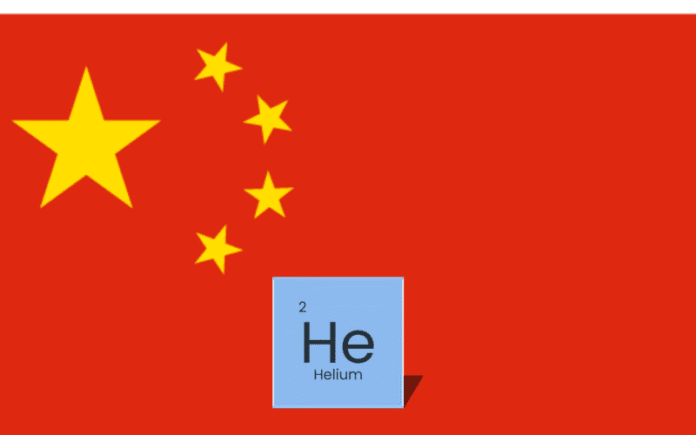
China announced on Friday a temporary export ban on helium, effective immediately, as resumption of military conflict in the Middle East threatens to trigger new shortages of the gas critical for chip manufacturing.
Earlier this year, the U.S.-Israeli war on Iran led to helium shortages, disrupting companies globally, including in China, where the AI industry increasingly relies on domestic chips for training and running AI models. Helium is essential for heat management in semiconductor production.
The helium ban is the latest example of Beijing seeking to prevent domestic shortages of critical materials by curbing exports. It has previously imposed similar measures on fuel, fertilisers and sulphuric acid.
China is also looking to boost domestic chip manufacturing capacity and reduce the industry’s dependence on cutting-edge Nvidia semiconductors that fall under U.S. export controls.
CHINA RE-EXPORTS HELIUM
China is heavily dependent on overseas helium despite efforts to expand domestic production.
Still, the export ban could squeeze global supply further because Chinese companies have increasingly acted as intermediaries, importing Russian helium and re-exporting some volumes to overseas markets, including Europe.
Analysts estimate China imports around 85% or more of its helium requirements. Qatar accounts for a major share of global helium output and has supplied more than half of China’s imports in recent years.
Helium is extracted from natural gas fields with unusually high helium concentrations and cannot be quickly manufactured from other industrial processes.
In chipmaking, it is used for wafer cooling, plasma etching, chemical vapour deposition, atomic layer deposition, lithography support and leak detection.
Prince Harry Left ‘Close to Tears’ as William Turns Cold During Explosive UK Visit
Prince Harry’s latest trip to Britain was supposed to spotlight the Invictus Games. Instead, it has turned into another royal mess — complete with legal setbacks, security drama and claims that the Duke of Sussex was left “close to tears.”
Multiple royal experts told Fox News Digital that the royal family is running out of patience with Harry’s emotional battle over police protection in the U.K. And according to one expert, Prince William may be the least moved of all.
A source previously told Vanity Fair’s Katie Nicholl that Harry was “devastated and close to tears” after the U.K. government refused to grant his family police protection outside royal residences. The decision reportedly forced Harry to return to Britain alone on July 6, without Meghan Markle or their children.
Harry is expected to remain in the U.K. through July 11 for events connected to the Invictus Games, including the One Year to Go celebrations for the Invictus Games Birmingham 2027. But the trip has already been overshadowed by the same family rift that has haunted the royals for years.
It remains unclear whether Harry will meet with King Charles during the visit, or whether Meghan and the children will join him later in the week.
“My understanding is that Harry was deeply emotional,” Kinsey Schofield, host of YouTube’s “Kinsey Schofield Unfiltered,” told Fox News Digital. “For the royal family, there is exhaustion. The king is frustrated, Prince William is detached, and the broader family has very little appetite for another round of Sussex drama.”
Schofield described William as the royal family’s “biggest realist,” saying the future king now sees every decision through the lens of protecting the monarchy he will one day inherit.
“That naturally makes him more cautious than sentimental,” Schofield said. “He is a good judge of character, and I’m told he no longer recognizes Prince Harry.”
According to Schofield, Charles and William are approaching the Harry crisis from very different places.
“King Charles still has the instincts of a father,” she said. “William has increasingly had to think like a future king. Those are very different perspectives, and history suggests heirs are often less willing to take institutional risks than reigning monarchs.”
That may explain why William appears to be keeping his distance as the latest Sussex storm plays out in public.
“William, in particular, seems grateful to be removed from the soap opera,” Schofield said. “His priority is Princess Catherine, their children and protecting the peace of his household. We have seen plenty of the Wales family this week, and they look blissful and carefree. They aren’t giving the Harry drama a second thought.”
Harry’s difficult week got even worse shortly after he arrived in London.
On July 7, the Duke of Sussex lost his yearslong privacy lawsuit against Associated Newspapers Limited, the publisher of the Daily Mail and the Mail on Sunday. The case involved Harry and six other claimants, including Elton John and Elizabeth Hurley, who accused the publisher of unlawful information gathering.
The High Court dismissed their claims after finding they failed to prove the allegations.
Associated Newspapers Limited celebrated the ruling as an “overwhelming victory” and a “magnificent vindication.” Harry, however, said the court had denied him the justice and accountability he had been seeking. The publisher has long denied the claims, calling them “preposterous” and insisting its articles were based on lawful sources, including friends, royal aides and publicists.
British royal expert Hilary Fordwich told Fox News Digital that the security dispute and Harry’s “self-inflicted court case” have been deeply stressful for King Charles.
Harry has previously said the litigation became a major source of tension with both his father and brother. By taking the matter to court, he broke with long-standing royal tradition.
“Members of the royal family don’t file such lawsuits, let alone lose on all counts in a highly public court case that Harry himself chose to file,” Fordwich said.
Now, with the case dismissed, Harry and the other claimants are expected to be responsible for court costs.
“Harry initially being in tears wouldn’t be surprising at all,” Fordwich said. “Everything is of his own doing, which must make it even more painful. He chose to leave royal life.”
Royal expert Richard Fitzwilliams was just as blunt, saying Harry’s emotions are unlikely to soften the family’s stance.
“Harry’s emotions are likely to leave the royal family cold,” Fitzwilliams told Fox News Digital.
He also called the trip “an overhyped mess,” noting that it had supposedly been planned for months but still appeared to unravel almost immediately.
“We still don’t know whether he will see his father or, if so, where and with whom,” Fitzwilliams said. “But it’s certain to reinforce William’s belief that his approach — ignoring the Sussexes — is the right one.”
The heart of the latest drama is Harry’s long-running fight for taxpayer-funded police protection in Britain.
Harry and Meghan lost that level of security after stepping back as senior working royals in 2020 and moving to California. The Duke of Sussex has since argued that his family cannot safely visit the U.K. without it.
The security decision is handled by the Executive Committee for the Protection of Royalty and Public Figures, known as RAVEC. Harry was denied the restoration of that protection, and taxpayer-funded security is generally provided only to full-time working members of the royal family on a case-by-case basis.
People magazine previously reported that Harry’s team spent several days trying to arrange enhanced private security before the trip. Palace sources said Harry was initially invited to stay at a royal residence, but declined before later accepting on Saturday.
Harry’s spokesperson told People that an offer for him to stay at Buckingham Palace during his London visit was withdrawn after he had formally accepted it. Palace sources disputed that version, claiming Harry failed to respond by the deadline and that his later acceptance came too late for arrangements to be made.
Harry had reportedly hoped to bring Meghan and their children to Britain for the first time since 2022. But after learning they would receive police protection only while on royal property, and not throughout the trip, it was reported on July 4 that they would not accompany him.
The issue is especially sensitive because Harry has said he wants his children to know their British heritage and have a relationship with King Charles, who continues to undergo cancer treatment.
In a 2025 BBC interview, Harry said he hoped to reconcile with his family because “there’s no point continuing to fight anymore.” He also claimed his father was no longer speaking to him because of the ongoing security dispute.
Harry has long blamed the British press for damaging his relationships and has said the media left him “paranoid beyond belief.” He has also blamed the press for the death of his mother, Princess Diana, and for the coverage of Meghan before the couple quit royal duties.
“They continue to come after me; they have made my wife’s life an absolute misery,” Harry testified in January, choking back tears in the witness box.
But experts say Charles cannot simply step in and overrule the government on Harry’s security, no matter how emotional the situation becomes.
“Constitutionally, the king has no role in this security decision, and Buckingham Palace cannot be seen interfering with government or legal processes,” Schofield said.
Still, she argued that Harry has tied the security fight to something far more personal: whether his children can visit their grandfather in Britain.
“But Harry understands emotional leverage,” Schofield said. “By tying security to whether his children can visit the U.K. or see their grandfather, he creates a narrative in which the palace appears cold, even though the decision is not the palace’s to make.”
According to Schofield, the trip may have only made the royal rift worse.
“This visit has likely deepened the rift because it has once again turned a family issue into a public pressure campaign,” she said. “Instead of building trust privately, Harry’s team appears to brief and litigate through the media. That makes reconciliation almost impossible.”
A source told Vanity Fair that Harry believed bringing his children, along with King Charles making a royal residence available, would lead to the full-time police protection he has been seeking.
“That has not been the case,” the source said. “The king has made it clear that while he wants to see his estranged son and grandchildren, he will not intervene in security matters.”
As the family standoff continues, Schofield said the frustration inside the palace comes down to one central contradiction.
“I’m told there is frustration that he still wants the freedom of private life with the infrastructure of public duty,” she said. “That is the contradiction at the heart of this entire fight. Harry wants the world to believe he left the institution, but not the importance that came with it.”
For now, Harry’s latest homecoming has done little to heal old wounds. Instead, it appears to have reminded the palace just how deep the divide has become — and why William may have no interest in reopening the door.
Is an air-conditioning revolution coming to Europe?
If you’re reading this while the blinds are drawn against yet another heat wave and wondering whether it’s finally time to buy an air conditioner, you’re far from alone. At the end of June, as temperatures climbed well above 40° Celsius across Europe, shoppers in France literally forced their way into stores to snatch up portable fans and ACs before they sold out. Such scenes are likely to become more common. As the planet warms, the demand for cooling is rising worldwide. The International Energy Agency (IEA) predicts two-thirds of households could own an AC by 2050.
Politicians are, of course, turning ACs into a weapon in their broader culture wars. Far-right figure Marine Le Pen pledged to roll out air-conditioning across France if her party comes to power, while the British Conservatives vowed to overturn net-zero rules that restrict AC installation in new builds. On the left, the argument runs that air-conditioning would mainly benefit the rich and not those who need it most. It would also lock Europe into the same high-energy cooling spiral seen in the US and Asia. To date, only around 20 percent of Europeans have AC at home (and a mere 4 percent in the UK), compared with roughly 90 percent in the US, where electricity is considerably cheaper.
In Europe, air-conditioning is no longer just about comfort. It helps adults stay productive through extreme heat, and children concentrate in poorly ventilated schools. It helps people nod off when the air is still stiflingly warm long after sunset. It can even save lives. One research group estimated that air-conditioning prevented nearly 200,000 premature deaths among people over 65 in 2019 alone.
Europe is warming faster than any other continent, and countries that once had relatively mild summers are now experiencing increasingly frequent and intense heat waves. Research by Nicole Miranda and her colleagues at the University of Oxford suggests that countries such as the UK, Switzerland, Norway, and Finland could see some of the largest relative increases in heat exposure and cooling demand if global warming reaches 2° C above preindustrial levels.
“We will need more cooling to protect people”, says Miranda, a senior lecturer in engineering and carbon reduction manager at the university. “The question is how to provide it in a way that is efficient, equitable, and smart. Not by panic-buying inefficient, energy-intensive portable ACs.”
June’s record-breaking heat wave offered a glimpse of what lies ahead. In northern Europe, homes and offices built to retain heat during long winters turned into ovens. A recent report by the UK’s Climate Change Committee warns that by mid-century, over 90 percent of existing homes could overheat during severe heat waves. Even further south, centuries-old architectural adaptations—such as thick stone walls, white-painted façades, blinds and small windows designed to block the sun—are reaching their limits. People in Europe are already fed up with the extreme heat.
But simply adding more air-conditioning is not necessarily the answer—at least not in its current form. Because air-conditioning is built on a paradox: The machines that keep us cool are also heating the planet. The electricity they consume already accounts for roughly 3 percent of global greenhouse gas emissions, slightly more than the aviation industry. “We expect cooling to become one of the biggest drivers of electricity demand growth worldwide, along with data centers,” says Fabian Voswinkel, an energy-efficiency policy analyst at the IEA. With new units being installed worldwide every minute, electricity demand for space cooling could more than triple by 2050.
Solar power will help cut emissions, but it won’t clear air-conditioning’s bad reputation. Conventional ACs still run on a century-old principle: refrigerants cycle between liquid and gas to pull heat out of rooms and dump it outside. Manufacturers continue to refine the technology, but many of the refrigerants remain problematic. Fluorinated gases, for instance, have a global warming potential thousands of times greater than CO2 if they leak into the atmosphere. The EU therefore introduced a regulation in 2024 to phase them out gradually. “In the next few years, air conditioners and heat pumps using these gases won’t even be able to be sold here”, says Voswinkel. But alternative gases bring their own trade-offs: Propane is highly flammable, while ammonia is toxic.
This impasse has led some scientists and companies back to the drawing board to ask: Instead of searching for a better refrigerant, what if air-conditioning systems didn’t need one at all? Their answer lies in materials that change temperature when exposed to external forces—a field known as solid-state cooling, which could revolutionize how we cool the air around us.
Paul Motzki, professor of smart material systems at Saarland University in Germany, heads an EU-funded scientific consortium focusing on nickel-titanium. When the metal is stretched and released, it snaps back to its original shape, absorbing heat from its surroundings and generating what is known as an elastocaloric cooling effect. In practice, the technology could be used to cool rooms by 5° to 10° C and, according to Motzki, do so even more efficiently than conventional AC systems today. The team is currently testing the prototype in the lab, but expects to deploy it in new buildings within the next few years. If the technology works, it “could lead to disruption, even a paradigm shift, because the technology is so different from established cooling systems,” Motzki says. The group is collaborating with Irish company Exergyn, which is also developing a refrigerant-free heat pump.
Brooklyn-based Mimic Systems has developed a heat pump based on semiconductive materials capable of moving heat in and out of rooms when an electric current passes through. The prototype is being tested in an apartment in Vancouver. Magnotherm, a spinoff from the Technical University of Darmstadt, is using magnetic fields in refrigerators and will test its prototype in a German supermarket chain later this year before taking on air-conditioning. In the UK, University of Cambridge spinoff Barocal is experimenting with flexible plastic crystals that, when squashed and released in a pressurized chamber, release heat. The startup recently raised $10 million in seed funding.
Motzki says Europe is clearly at the forefront in solid-state cooling, including in efforts to bring the technology to market. “I see a major opportunity for Europe to achieve technological leadership all the way through to market maturity,” he adds. “Of course, this will all depend heavily on private capital and public funding.”
Lindsay Rasmussen sees the same potential. At Third Derivative, a climate-tech accelerator founded by the US nonprofit Rocky Mountain Institute, she works with startups such as Mimic Systems and Magnotherm on next-generation cooling. She stresses that solid-state cooling technologies are still in their early stages—promising, but unproven at scale. But “the space can move quickly if the right capital and partnerships are in place.”
The real question is not just whether these new technologies will work, but who will scale them and how quickly. History suggests the path won’t be linear, nor will it necessarily stay in Europe. Solar photovoltaics, for instance, began with research breakthroughs in Europe, moved into commercialization in the US, and ultimately scaled in Asia through vertically integrated supply chains. Solid-state cooling could follow a similar trajectory. As Rasmussen explains, innovations typically leave the lab and startups once they become commercially viable and are picked up by major manufacturers. Today’s cooling market is already dominated by multinational conglomerates such as Daikin and Samsung, which closely track emerging technologies and are ready to move quickly.
As the world rushes to cool itself, one reality risks getting lost: Installing more air conditioners will not, on its own, solve Europe’s overheating problem. Many of its cities trap heat in tightly packed buildings and concrete streets, and the challenge is how to cool them without compromising the aesthetics that make them so distinctive.
Both University of Oxford researcher Miranda and IEA analyst Voswinkel call for a “cooling hierarchy”: The priority should be preventing buildings from overheating in the first place—through trees, shade, reflective materials, and natural ventilation. Active cooling should come later, focused on the places that need it most, such as schools, hospital wards, and care homes. From Paris, where he is based, Voswinkel points to one efficient example: Ahead of the 2024 Summer Olympics, the city expanded its district heating network to also distribute chilled river water through underground pipelines, cooling public buildings. “I think that these heat waves are making more and more policymakers realize that we have to face this new reality and make good plans,” he says.
Watchdog blows the whistle on America’s biggest AI villains
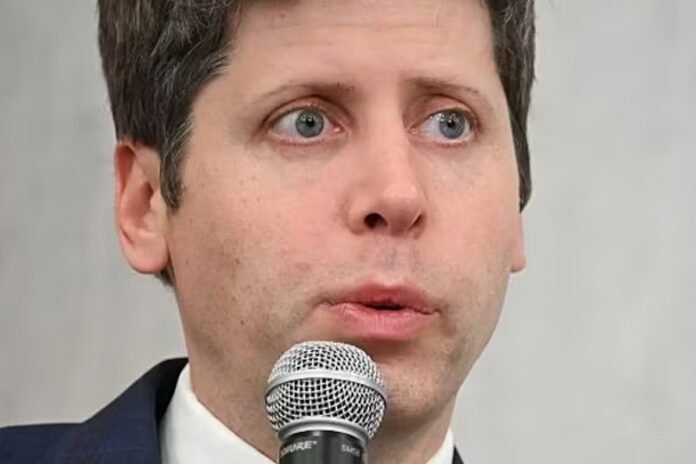
OpenAI CEO Sam Altman speaks at the Federal Reserve in Washington, DC, on July 22, 2025. Photo: Mandel Ngan / AFP via Getty Images via Common Dreams
With backlash against the artificial intelligence industry growing throughout the US, one government watchdog has created a database to help keep tabs on the people it describes as the biggest “AI villains.”
The Revolving Door Project on Thursday launched a webpage that tracks the actions of major players in the AI industry and their ties to President Donald Trump’s administration.
“The Trump administration is all in on artificial intelligence,” the Revolving Door Project explained. “The federal government shares the tech industry’s vision for AI to be embedded everywhere, displacing human thought and labor, and deepening the strains on the environment and climate.”
The watchdog added that the government is pursuing an “AI first” policy “despite little proof that its value for the American public is anywhere close to commensurate with its costs.”
While there are several well-known names on the Revolving Door Project’s list — including SpaceX CEO Elon Musk, OpenAI CEO Sam Altman, and Oracle co-founder Larry Ellison — it also shines a light on more obscure figures including Chris Lehane, director of government affairs at OpenAI, and Greg Brockman, president of OpenAI.
Lehane is notable due to his long connections to Democratic Party politics, including a stint as a special assistant counsel in the Clinton administration and work as deputy campaign manager for former Vice President Al Gore’s 2000 presidential campaign. Since then, he has mostly done public relations work for Silicon Valley firms, including Airbnb and Coinbase.
According to The Revolving Door Project, Lehane during the second Trump administration has been a big proponent of an AI regulatory framework that he describes as “reverse federalism” that aims to shut down individual states’ powers to put guardrails on the industry.
Brockman, meanwhile, is much more traditionally aligned with the GOP, as he and his wife were the largest donors to the MAGA, Inc. super PAC in 2025, and he is described by the watchdog as “a regular attendee at White House events throughout Trump’s second term.”
This coziness has helped Brockman push for policies beneficial to the AI industry such as fast-tracking data center construction and the aforementioned “reverse federalism” regulatory framework.
The Revolving Door Project also pays special attention to Marc Andreesen, co-founder of venture capital firm Andreessen Horowitz (a16z), whose allies the watchdog describes as “deeply entrenched” in the Trump administration.
Among the Andreesen acolytes to have worked in the Trump are Sriram Krishnan, a former general partner at a16z who served as a senior AI policy advisor; Peter Bowman-Davis, former engineering fellow at a16z who served as acting chief AI officer at the Department of Health and Human Services; and Scott Kupor, former managing partner at a16z who serves as director of the Office of Personnel Management.
Andreesen himself serves as a member of the President’s Council of Advisors on Science and Technology, which the Revolving Door Project describes as a “vessel… to freely lobby on behalf of the tech industry’s interests without the need for lobbyist intermediaries—especially at meetings with the president and his closest advisors.”
In a newsletter explaining the purpose of the tracker, the Revolving Door Project’s Fletcher Calcagno wrote that it was needed to help understand why the Trump administration so far has been willing to “accept Big Tech’s maximally irresponsible recommendations” for AI regulation.