
34.6 C
London
Thursday, July 9, 2026
Home Blog

A Government of Trump, by Trump, and for Trump

0
a-government-of-trump,-by-trump,-and-for-trump
A Government of Trump, by Trump, and for Trump


Tom Engelhardt created and ran TomDispatch for nearly 25 years. He was also a co-founder of the American Empire Project and the author of a highly praised history of American triumphalism in the Cold War, “The End of Victory Culture.”

I Would Have Thought You Mad

We’ve only recently passed the semiquincentennial of the United States of America. Two hundred and fifty years ago, at the moment of its founding, the U.S. was, of course, a slaveocracy. Of its founders, John Adams was essentially an oddball because he owned no slaves. But Presidents George Washington, Thomas Jefferson, James Madison, and James Monroe did own people. So, give our current president Donald J. Trump some credit: At least he isn’t a slaveowner. But that’s about the best that can be said for him.

Once upon a time, if you had described our world to me, I would have thought you mad. Who could have imagined that Americans would reelect the man who shoved aside Montenegro’s Prime Minister Duško Marković in 2017 in what appeared to be an attempt to get to the front of a photo line (because who, in any circumstance, should be photographed more than him)? This is also the same tantrum-prone president who once threw his lunch, ketchup and all, at a White House wall after his attorney general made comments he didn’t like about the 2020 election. The president who, less than two years into his second term, kidnapped Venezuela’s head of state, tried to claim Greenland as the property of the US of A, prepared for a possible future war with Cuba, blown ships out of the water in a never-ending fashion in the Caribbean Sea and eastern Pacific Ocean, has conducted staggering numbers of airstrikes in Somalia, launched a would-be forever war with Iran (brilliantly crippling the global economy while he was at it), and … well, count on it, in the next two-plus years of Donald Trump’s America, there will surely be all too many more examples of unhinged behavior to cite. Honestly, a decade ago, I would have thought you were kidding.

So, what would those slave-owning Founding Fathers, memorialized on the Fourth of July just past, have thought about Trump? What would they have said about his boorish behavior, his toddler-esque tantrums, and his endless attacks and wars?

Perhaps those founders, were they alive today, would visit Trump at Mar-a-Lago and share a meal with the odd millionaire, billionaire, or trillionaire (although Elon Musk’s trillionaire status only lasted a couple of weeks!) lurking around the club. Or perhaps they would have been spotted on the White House lawn recently with Trump, first lady Melania, and the Trump kids, not to speak of a legion of blood-sport-loving billionaires watching a mixed martial arts spectacle in honor of Trump’s 250th birthday. (Oops, my mistake, Trump is just a youthful 80, which, when — or is it, if? — he finally leaves office, will make him our oldest president ever but hardly the oldest among the almost 200 world leaders of the present moment.)

Here’s a question that those Founding Fathers might ask about Donald Trump’s America: “What kind of -ocracy is the United States today?” And the answer, of course, would not be a democracy, or even a theocracy (though The Donald does love to be worshipped), but a Trumpocracy: a government of Trump, by Trump, and for Trump; a government dedicated to the enrichment of the president and his cronies. And it’s a vengeful one at that. After all, on Truth Social last year, he reposted an AI-generated video of former President Barack Obama being arrested in the Oval Office (as Trump looks on in glee) before he’s thrown into prison. A Black man seized (in a house built by slave labor, no less) and held in bondage is something of a nod to America’s past — and wouldn’t be unfamiliar to America’s founders.

But honestly, if you were to offer an account of Trump’s America to George Washington or Thomas Jefferson, what would either of them have thought? Can you even imagine their reaction? Their dismay? You found a country and just over 250 years later, you have Donald J. Trump running it into the ground. 

Perhaps if the Founding Fathers could do it all again, they might have chosen to remain a colony of the British king, George III (whom Donald Trump makes look remarkably good). 

Coming from a largely rural land, the founders would undoubtedly find it interesting that Trump’s long solid support in the heartland finally seems to be on the verge of collapse. But then, so much of his world (and sadly, ours, too) seems to be on the edge of ruin these days.

The founders might wonder if the United States could survive another two and a half years. Or if the world can? If, that is, he doesn’t try to remain in power. After claiming to have won the last three presidential elections, Trump asked an Iowan audience ominously: “Should we do it a fourth time?” (George Washington would no doubt be disturbed, having been committed to a two-term maximum.)

In two and a half years, much less six and a half, Trump is potentially all too capable of taking not just this country but also the planet down with him. And I’m not just thinking about his ability (if that’s faintly the word for it) with allies like Israel to turn parts of this world into hell zones of war. I’m thinking instead about the climate disaster to come (as my city recently hit the 100-degree mark on an early July day) and the president who has called climate change “the greatest con job ever perpetrated on the world” and a “green scam,” and is prepared in his own fashion to heat this planet to the boiling point. Now, I’m sweating and, of course, with Donald Trump at the helm of state, it’s only going to get hotter, and hotter, and hotter.
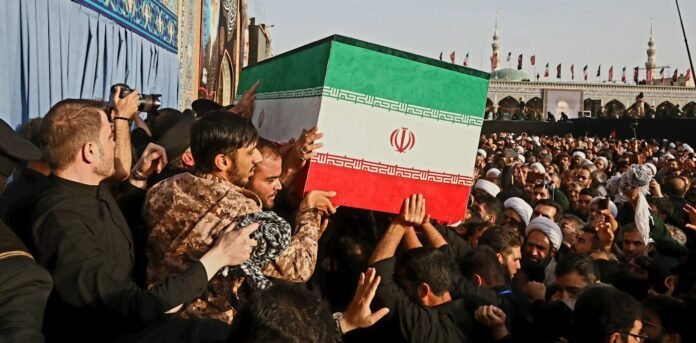
How Iran used Ali Khamenei’s funeral as a political and diplomatic tool

0
how-iran-used-ali-khamenei’s-funeral-as-a-political-and-diplomatic-tool
How Iran used Ali Khamenei’s funeral as a political and diplomatic tool

Ali Khamenei, who served as Iran’s supreme leader until his assassination in a US-Israeli operation in February 2026, will finally be laid to rest today. His burial brings a week of public mourning ceremonies and processions to an end, and comes as hostilities between the US and Iran are escalating again.

Islamic tradition calls for the prompt burial of the deceased. Iran’s first supreme leader, Ayatollah Ruhollah Khomeini, was buried within three days of his death in 1989. Qasem Soleimani, an Islamic Revolutionary Guard Corps commander who was assassinated by a US strike in 2020, was also laid to rest within a week.

The extended postponement of Khamenei’s funeral, while initially delayed by the war, was a deliberate departure from established customs. His funeral has been transformed into far more than a state ceremony. It has been an orchestrated political and diplomatic event designed by the Islamic Republic to provide maximum advantage.

A huge crowd gathered in Qom for the funeral of Ali Khamenei.

A huge crowd gathered in Qom for the funeral of Ali Khamenei on July 7. Iranian Supreme Leader Office / EPA

The primary objective for Iran’s leadership was to demonstrate their sustained public support and, hence, legitimacy. According to Iranian officials, more than 15 million people had already taken part in the funeral processions by the third day of the ceremonies. Aerial footage also showed lines of worshippers attending Khamenei’s funeral prayer at the Jamkaran Mosque on July 7, with crowds stretching 25km to a holy shrine in the city of Qom.

A clear intention of the widely broadcast mass mourning was to counter narratives from hawkish Iranian opposition, western and Israeli voices who have been suggesting that the Iranian public is eager for regime change. In doing so, they have sought to weaken the justification for the strike that killed Khamenei.

Persuading such large numbers of Iranians to attend the ceremonies could have been a challenge. Iranian society is still reeling from the trauma inflicted by the January 2026 protest crackdown, in which thousands of people were killed. Iran is also affected by persistent economic hardship. Yet Iran’s leadership seems to have succeeded in drawing in segments of the population beyond government loyalists.

By organising funeral processions in Iranian cities beyond the capital of Tehran, as well as in neighbouring Iraq, the Islamic Republic also showcased its enduring powers of mobilisation and its resilient regional network. Managing crowds on this scale demands an enormous logistical effort, including refreshments, shelter and transportation for participants.

Signalling defiance in the face of US and Israeli aggression was the government’s second key goal. Chants of “Death to America” and “Death to Israel” by thousands of mourners were meant to convey to Washington and its allies that Iran will not yield and will seek revenge for the killing of its leader.

These chants also sought to convey the message that negotiators will not compromise on core elements of Iran’s “resistance doctrine” – its strategy of ideologically and practically resisting western powers and Israel.

A crowd wave flags at the funeral ceremony of Ali Khamenei in the Iraqi city of Najaf.

Iraqis attend the funeral ceremony of the late Iranian supreme leader, Ayatollah Ali Khamenei, in the city of Najaf in central Iraq on July 8. Iranian Supreme Leader Office / EPA

However, in some respects, the government fell short in its hope for a display of national unity. Observers noted the abrupt departure from the funeral procession of Hassan Khomeini, the grandson of Iran’s first supreme leader. Khomeini seems to have been offended by a verse recitation which belittled him in comparison to the slained leader.

The conspicuous absence of former Iranian presidents Hassan Rouhani and Mohammad Khatami at the private funeral procession at the Mosalla Mosque in Tehran was another taint on the image of national unity.

This was later complemented by sharp verbal attacks against the current Iranian president, Masoud Pezeshkian, and the foreign minister, Abbas Araghchi, by mourners and hardline figures. Their anger stems from the fact negotiations with the US are advancing despite the declared “principled opposition” policy of the new supreme leader, Mojtaba Khamenei.

Iran’s funeral diplomacy

No western government figures were invited to the funeral. But invitations were extended beyond government officials for some regional countries.

From Afghanistan, for example, opposition figures such as Ahmad Massoud of the National Resistance Front and Mohammad Mohaqiq, chairman of the People’s Islamic Unity Party of Afghanistan, attended the funeral alongside a delegation sent by the ruling Taliban regime.

Each delegation from more than 70 countries was welcomed by a carefully chosen Quranic verse reflecting its standing in Tehran’s foreign policy calculus. The Saudis were greeted with the verse: “There has already been for you a sign in the two armies which met in battle.” This was widely interpreted as a pointed reminder of their regional rivalry despite efforts in recent years to stabilise ties.

Pakistan received a more positive verse: “And say, ‘My Lord! Grant me an honourable entrance and an honourable exit and give me a supporting authority from yourself’,” alluding to its mediation efforts throughout the war. Even delegations from non-Muslim powers such as China and Russia were granted this distinctive, if unusual, hospitality.

Khamenei’s funeral was designed as a powerful political and diplomatic tool to project defiance and continued resistance against what Iran has called “global arrogance”. The government aimed to demonstrate its legitimacy, regional reach, public support and continued mobilising capacity despite the isolation efforts of its enemies.

This mission seems to have been accomplished. Millions of mourners attended Khamenei’s funeral across Iran and Iraq. Huge crowds were managed successfully without any serious incident, despite high temperatures and the threat of renewed US attacks. And, perhaps most importantly, all of this has been reflected in media coverage worldwide.

We asked Ukrainians what they think of Trump – more view him as an enemy than a friend

0
we-asked-ukrainians-what-they-think-of-trump-–-more-view-him-as-an-enemy-than-a-friend
We asked Ukrainians what they think of Trump – more view him as an enemy than a friend

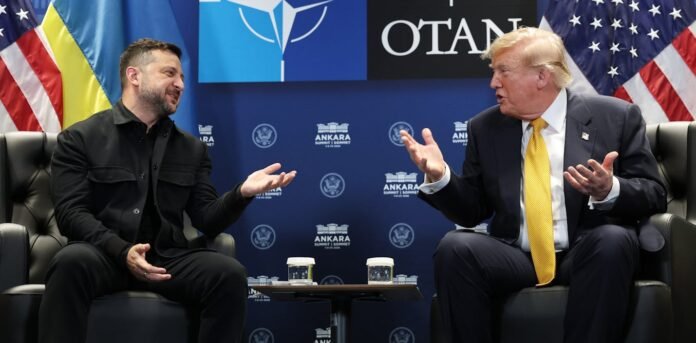
U.S. President Donald Trump lauded the “very good relationship” he has developed with his Ukrainian counterpart, Volodymyr Zelenskyy, at the NATO summit in Turkey on July 8, 2026.

In a meeting of the pair that lacked the acrimony of earlier encounters, Trump added that Ukraine has “such great people,” too. He has expressed different views privately in the past.

But what do everyday Ukrainians think of Trump?

For more than a decade, we have organized and conducted public opinion polls in Ukraine. While polling has become more difficult since Russia’s full-scale invasion in 2022, our surveys have provided a window into Ukrainian public opinion in the territories not occupied by Russia.

In our latest survey, we drilled down on how Ukrainians felt toward Trump and his administration’s diplomatic efforts, and toward Americans more generally.

Fielded by the Kyiv International Institute of Sociology, we arranged for a computer-aided telephone survey of 1,801 Ukrainians across government-controlled Ukraine from June 9-26, 2026.

Here’s what we learned:

Trump is seen as more enemy than friend

Trump has openly expressed his admiration of Russian President Vladimir Putin on many occasions. When he returned to office, Trump initiated a sharp break from the policies of his predecessor Joe Biden. The U.S. now sends less military aid to Ukraine, although U.S.-made arms continue to flow to the country thanks to European funding. A promised US$400 million military aid package has not yet been released.

Trump famously chastised Zelenskyy in a 2025 Oval Office meeting and has pressured the Ukrainian president to give up land to satisfy Putin’s territorial desire for all of the Donbas region of eastern Ukraine.

Yet Washington continues to provide Ukraine with intelligence, which is used by Kyiv for targeting its middle- and long-range drone strikes inside Russia. Washington also still enforces significant sanctions against Russia, including Moscow’s oil exports, although it has granted specific waivers of late.

To understand what Ukrainians make of all this, we asked them a direct question about Trump: Is he a friend or an enemy of their country, or a bit of both?

The results showed that only 17% of Ukrainians surveyed consider Trump a friend. More than double that consider him an enemy of Ukraine. Almost a quarter say he’s a bit of both, with a similar percentage responding “don’t know.”

Few have confidence in US negotiators

In April 2026, Zelenskyy invited Trump’s envoys – his son-in-law Jared Kushner and a real estate friend Steve Witkoff – to come to Ukraine “to see, to understand and to explain to President Trump” what the country needs.

It was, Zelenskyy added, “disrespectful” to confine their visits to Moscow but not Kyiv. So far, however, Kushner and Witkoff have declined to visit Kyiv. A U.S. administration official recently told The New York Times that Kushner and Witkoff were prepared to travel to Russia and Ukraine if there was something new to discuss, but that they would not travel “for a photo op.”

When asked about their “confidence in the U.S. team that negotiates with Putin to end the war,” just a third of Ukrainians expressed some confidence. A clear majority (57%) said they had no confidence in Kushner and Witkoff, and a paltry 2% had high confidence in U.S.-led negotiations.

Mixed feelings about US global role

The conflict in Ukraine has been overshadowed of late by the Iran war. Many of the U.S. Patriot missiles that Ukraine says it needs to protect itself from Russian attacks were abruptly diverted to the Middle East after the U.S.-Israeli attacks of Feb. 28, 2026. As a consequence, Ukrainian stocks have run out and more Russian missiles are getting through and killing Ukrainians; June saw the highest number of civilian deaths in three years.

Ukraine and its allies had hoped the U.S.-Iran ceasefire would see the European war return to the top of Washington’s foreign policy agenda. But the ceasefire remains fragile, with the U.S. stuck in a condition between war and peace. Zelenskyy recently complained: “Unfortunately, we are in the queue of wars.”

We wanted to know how the U.S. administration’s actions in the Middle East – as well as other interventions elsewhere – had influenced Ukrainians. Asked how they feel about the U.S. role in world affairs today, just 7% of respondents to our survey said they felt positively toward Washington. A quarter (26%) felt negatively, with the clear majority (62%) saying they had mixed feelings.

Warmer views of Americans, generally

Many foreign policy experts in the U.S. and Europe have decried the long-term damage the Trump administration is doing to the image of Americans in world affairs. To test the latter proposition, we also asked Ukrainians if they now viewed Americans as friends or enemies of their country.

The results decisively show that Ukrainians still consider Americans in general to be a friend, with a solid majority of 73% judging them as such. Only 4% consider them as enemy, with 11% indicating it is a bit of both.

We believe this is a stark display of confidence in the American people that contrasts with Ukrainians’ negative view of Trump. It also suggests that ordinary Ukrainians are capable of distinguishing between the policies of the current U.S. president and his advisers, and the country’s people as a whole.

Russia’s invasion in Ukraine has developed into a protracted war of endurance with no clear end in sight. Amid continued fighting and mounting deaths, Ukrainians appear pessimistic about current U.S. efforts to mediate between the two warring countries.

Washington needs the trust of Ukrainians if it is to succeed in mediating peace in Europe. That an overwhelming majority of people there view Americans as friends presents an opportunity for U.S. leaders to regain their confidence – even if Ukrainian’s opinion of current U.S. leadership is low.

Surprised doctors find 10-inch worm in man’s groin during elective surgery

0
surprised-doctors-find-10-inch-worm-in-man’s-groin-during-elective-surgery
Surprised doctors find 10-inch worm in man’s groin during elective surgery

When surgeons dug into a man’s groin to repair a painless bulge, they made the unexpected discovery of a living, 10-inch-long (26 cm) worm snug in his abdomen. Adding to the oddity, the man told the surgeons that this had actually happened to him before, according to a case report in the New England Journal of Medicine.

The 71-year-old man had opted to have surgery to repair the bulge, which was an inguinal hernia. These types of protrusions are fairly common, particularly in older men, and occur when a small amount of abdominal contents, such as fat or a bit of intestines, slips through a gap or weak point in the muscles and tissues of the abdominal wall. This bodily leakage creates an external bulge that, in some cases, can be painful and uncomfortable. If the bulge’s contents become stuck and pinched off, it can even create a life-threatening situation called a strangulated hernia. But, in other cases, the escaped innards are painless and loose and can be temporarily put back in place by simple, gentle massage.

Most people with inguinal hernias will need surgery at some point to patch up their weak abdominal wall. But, for older men with no pain or discomfort, doctors may suggest watchful waiting, delaying surgery until the need is clear. This was the case for the man. But he elected to repair the inguinal hernia, which was on his right side.

Surgeons noted that the man appeared in good health before the surgery, reporting no symptoms besides the painless protrusion. His blood work likewise appeared normal, giving no indications of anything amiss, such as an elevated white blood cell count that might signal a parasitic infection. Surgeons opted for a laparoscopic procedure, making small incisions to insert tools to fortify the abdominal wall.

As they worked, they noticed something whitish and stringy. It was wedged between his bladder and pubic bone. The surgeons used forceps to grab at a loop that was poking into view and then needed multiple tugs to gently slide out the rest. When they carefully pulled it out in its entirety and unfurled it, they recognized it as a 26 cm-long (10.2 inch) tapeworm. It was still alive, and slithered and squirmed on the surgical table. A picture of the surgical find is here.

Tapeworm extracted from man on surgical table, where it continued to writhe.

Tapeworm extracted from man on surgical table, where it continued to writhe. Credit: New England Journal of Medicine, 2026

Wandering worms

After the surgery, a genetic test identified the worm as Spirometra erinaceieuropaei, which causes a tapeworm infection called sparganosis. These worms can be found in animals worldwide but are generally rare in humans. Their lifecycle is relatively complicated. Adult worms parasitize dogs and cats, which shed eggs in their feces. The eggs hatch in water, and the larvae are taken up by small crustaceans (copepods), the first intermediate host. The larvae develop and move into their second intermediate host—fish, amphibians, and reptiles—that eat the crustaceans. Normally, the larvae would complete their lifecycle when a cat or dog eats an infected second intermediate host. The developed larvae mature into adults and begin shedding eggs from the animals’ intestines. But humans disrupt the cycle by picking up eggs in contaminated water or eating undercooked fish, reptiles, or amphibians.

Humans aren’t definitive host for the worms, and they become destined to aimlessly wander through our meat sacks. In rare instances, they can mature in the intestines and spew out eggs to complete their lifecycle. But most often, they migrate around and nestle elsewhere. They can be found almost anywhere in the body. Their movement is generally painless, but symptoms of the infection vary widely based on where they decide to settle. If it’s in the brain or spine, it can cause a range of neurological symptoms, for instance. In the man’s case, the worm’s final destination was apparently his abdominal cavity.

Oddly, the man told doctors that this wasn’t the first worm that had been pulled from his abdomen. Four years prior to his surgery for his right-side inguinal hernia, he had undergone surgery for a left-side inguinal hernia. In that procedure, surgeons had incidentally come upon another worm, which was 18 cm (7 inches). For unexplained reasons, the worm was not identified, and he was not treated with anti-parasitic drugs after the discovery.

After this second surgery and worm discovery, his doctors put him on anti-parasitic medication to kill off any possible remaining worms lurking in him. They also tried to figure out how the worms got there in the first place. The man’s only recollection of a possible exposure was eating raw snake meat during military service 50 years prior. While Spirometra are known to have long lives in humans, the lifespan is typically reported as being around 20 to 30 years.

Operation Hard Ball: US showdown with India’s global gangsters

0
operation-hard-ball:-us-showdown-with-india’s-global-gangsters
Operation Hard Ball: US showdown with India’s global gangsters

The US decision to indict jailed Indian gangster Lawrence Bishnoi and his alleged North American associate, Satinderjeet Singh (“Goldy Brar”), for allegedly directing the 2023 assassination of Sikh activist Hardeep Singh Nijjar in Canada is more than another organized crime prosecution.

Unsealed as part of the multinational Operation Hard Ball, the indictments signal a broader shift in how Western governments are responding to criminal networks whose activities increasingly intersect with national security, foreign policy and international law enforcement.

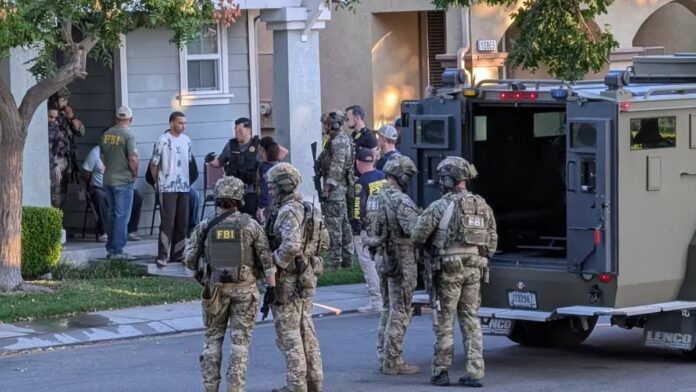
Coordinated by authorities in the United States, Canada and Europe, the operation resulted in charges against 37 defendants allegedly linked to three India-based transnational organized crime groups.

Prosecutors allege the networks were involved in murder-for-hire, extortion, racketeering, narcotics trafficking, firearms offenses and kidnappings while operating across India, the United States, Canada, the United Kingdom, Europe, Australia and New Zealand.

Investigators arrested 24 suspects, executed dozens of search warrants, and seized roughly 1,000 kilograms of cocaine, 1 kilogram of heroin, firearms and cash; several suspects remain fugitives.

The allegations will ultimately be tested in court. Even so, Operation Hard Ball already represents one of the largest coordinated Western law-enforcement actions targeting India-linked transnational criminal organizations.

Beyond the criminal charges, it raises broader questions about diaspora security, transnational repression and how states respond when domestic criminal networks acquire an international reach.

Gangland assassination

The most consequential aspect of the indictments goes beyond the allegation that Bishnoi and Brar ordered the killing of Hardeep Singh Nijjar outside a Sikh gurdwara in Surrey, British Columbia. What matters more is what prosecutors allege about the sophistication and operational reach of the organization.

According to the federal indictment, Bishnoi allegedly directed operations while imprisoned in India, communicating through smuggled mobile phones. If these allegations are substantiated in court, they would illustrate how organized criminal groups can exploit institutional weaknesses to coordinate violence across jurisdictions despite the incarceration of their leadership.

Equally significant is the breadth of the alleged criminal enterprise. Prosecutors describe networks simultaneously involved in targeted killings, narcotics trafficking, extortion, firearms offenses, money laundering and international logistics.

This reflects a wider trend identified by the United Nations Office on Drugs and Crime (UNODC), which has repeatedly warned that organized crime is becoming increasingly transnational, technologically enabled and deeply integrated into global financial and logistical networks.

As a result, democratic governments increasingly view organized crime through a national security lens rather than as a conventional policing challenge. Criminal organizations capable of intimidating diaspora communities, financing violence, exploiting financial systems and operating across multiple jurisdictions can affect domestic security and foreign policy simultaneously.

Canada’s designation of the Bishnoi gang as a terrorist entity in 2025 reflects this evolving approach. Similar debates have emerged over Latin American cartels operating across borders, Balkan criminal organizations active throughout Europe and East Asian syndicates involved in cyber-enabled financial crime.

These comparisons are not intended to equate the organizations but to illustrate a broader policy shift: transnational organized crime is increasingly treated as a strategic threat requiring intelligence coordination, international partnerships and whole-of-government responses rather than traditional law-enforcement measures alone.

Reputation test

For more than two decades, India has projected itself as a responsible security partner and an important contributor to regional stability.

That image has been reinforced through expanding defense cooperation with the United States, participation in the Quad, growing intelligence exchanges with Western partners and an increasingly prominent role in the Indo-Pacific security architecture.

The Nijjar case has complicated that picture. Former Canadian Prime Minister Justin Trudeau said in 2023 that Canadian authorities were investigating credible allegations linking Indian government agents to the assassination.

India rejected those allegations, and the newly unsealed US indictment does not accuse the Indian government of involvement. Instead, prosecutors focus specifically on members of the Bishnoi criminal organization.

New Delhi is therefore likely to argue that the case concerns organized crime rather than state conduct and should not be interpreted as a reflection of India’s broader security institutions or strategic partnerships. That position is reinforced by the fact that the US indictment does not allege official state involvement.

Yet the indictments raise broader institutional questions regardless of where legal responsibility ultimately lies. Prosecutors allege that the organization maintained operational capabilities despite its leader’s incarceration and that some defendants allegedly leveraged relationships with corrupt local officials to facilitate criminal activity.

If supported during judicial proceedings, such allegations would invite closer scrutiny of prison administration, institutional oversight and the effectiveness of law-enforcement agencies in disrupting sophisticated criminal organizations.

India’s international reputation increasingly hinges on confidence in its institutions, alongside economic growth and military capability. For governments investing in long-term Indo-Pacific security partnerships, effective governance, accountability and the rule of law are integral to strategic trust.

Although the indictments target alleged criminal actors rather than the Indian state, the case is nevertheless likely to increase congressional and policy scrutiny in Washington regarding transnational repression, law-enforcement cooperation and institutional accountability within one of America’s most important Indo-Pacific partners.

Transnational response

Operation Hard Ball illustrates how democratic states are adapting to increasingly interconnected security threats.

The investigation brought together the FBI, the US Department of Justice, the Royal Canadian Mounted Police and European law-enforcement agencies through intelligence sharing, synchronized arrests and parallel prosecutions.

It reflects a growing recognition that organized crime, illicit finance, transnational repression and foreign interference increasingly overlap and therefore require coordinated international responses.

In recent years, policymakers and researchers have devoted increasing attention to transnational repression — the use of intimidation, coercion or violence against diaspora communities beyond national borders.

While the allegations in the Bishnoi case should not be conflated with broader theories of state-directed repression, the investigation demonstrates why democratic governments are paying closer attention to cross-border intimidation and the vulnerabilities created by globally connected criminal networks.

Whether the actors emerge from Latin America, Eastern Europe, South Asia or elsewhere, the underlying challenge is remarkably similar: criminal organizations have globalized far more rapidly than many national law-enforcement systems.

Operation Hard Ball suggests governments are beginning to narrow that gap through deeper intelligence sharing, joint investigations and coordinated prosecutions.

For India, the broader implications extend beyond the outcome of a single criminal case. As strategic cooperation with the United States, Canada, Europe and other Indo-Pacific partners continues to deepen, expectations regarding institutional accountability, intelligence cooperation and criminal justice are also likely to increase.

Demonstrating the ability to investigate sophisticated criminal organizations and strengthen institutional safeguards will remain an important element of sustaining international confidence.

Ultimately, the significance of Operation Hard Ball lies less in the fate of any individual defendant than in what it reveals about the changing character of international security. The indictments neither resolve every political controversy surrounding the Nijjar case nor establish conclusions beyond the allegations before the court.

They do, however, underscore a broader reality: in an era of globalized criminal networks, states are judged as much by the institutions they build to prevent transnational violence, protect diaspora communities and cooperate with international partners as by the threats they confront.

Saima Afzal is a researcher specializing in South Asian security, counterterrorism and broader geopolitical dynamics across the Middle East, Afghanistan, and the Indo-Pacific. She is currently a research scholar at Justus Liebig University, Germany.

How can Trump ‘cut off all trade’ with Spain?

0
how-can-trump-‘cut-off-all-trade’-with-spain?
How can Trump ‘cut off all trade’ with Spain?


U.S. President Donald Trump issued an order for a trade embargo on Spain on Wednesday, asking Treasury Secretary Scott Bessent to “cut off all trade … including visits” with the country amid tensions over defense spending.

The Treasury, Commerce Department and U.S. Trade Representative’s office will work to present Trump with “a menu of Spanish products that may be embargoed in the coming days,” a U.S. official told Reuters. The comments suggest a trade ban could be partial.

Here is a look at Trump’s options to halt ​trade with Spain and the implications of such a move.

WHAT POWERS DOES A U.S. PRESIDENT HAVE TO IMPOSE A TRADE EMBARGO?

Trade lawyers say that the International Emergency Economic Powers Act (IEEPA) remains available for Trump to impose ‌a trade embargo or economic sanctions against a country despite the U.S. Supreme Court’s ruling in February against Trump’s use of IEEPA to impose tariffs.

To invoke IEEPA, Trump must declare a national emergency over an “unusual or extraordinary threat” to U.S. national security, foreign policy, or the economy. The law has been widely used to restrict commerce with Iran, Russia and North Korea and to block dollar-based dealings by thousands of companies, individuals and other entities deemed terrorism or national security threats.

Peter Shane, a New York University law professor, said it was “hard to see” how one of 32 NATO countries missing a peacetime defense spending target ​by three percentage points of GDP constitutes such an emergency for the United States.

But the Supreme Court did not pass judgment on the nature of Trump’s tariff emergency, leaving his ability to declare a national emergency “undisturbed,” said Mayur Patel, a ​former U.S. Senate Finance Committee Republican trade counsel.

“IEEPA would allow Trump to do an embargo,” said Patel, now a trade partner with Hogan Lovells in Washington, even if it is later challenged ⁠in court.

HOW MUCH TRADE WOULD AN EMBARGO AFFECT?

Total two-way goods trade topped $47.9 billion in 2025 according to U.S. Census Bureau data. Add in services, including travel, and the total grows to $74.5 billion, according to Commerce Department Bureau of Economic Analysis data, making Spain the ​23rd largest overall U.S. trading partner.

The U.S. sells more goods to Spain than it buys, exporting $26.6 billion in goods to the country in 2025 and importing $21.35 billion for a U.S. trade surplus of $5.25 billion.

Top U.S. goods import categories from Spain based on Census Bureau data ​are pharmaceuticals, electrical transformers and power converters, personal care products, petroleum products, glazed ceramics and olive oil. Top U.S. exports to Spain are pharmaceuticals, crude oil, civilian aircraft and corn.

An embargo also could disrupt bilateral investment. Spanish companies have invested €97.2 billion ($111 billion) in the U.S., making it their largest investment destination worldwide, according to Eurostat data cited by the American Chamber of Commerce in Spain.

The U.S. is Spain’s largest foreign investor, with over €116 billion ($132.4 billion) in productive capital investment employing around 200,000 people nationwide.

WHAT HAPPENS TO TRAVEL TO AND FROM SPAIN?

It’s unclear how Trump might restrict Spaniards’ travel to the U.S., where ​their national soccer team plays a World Cup match on Friday. But his administration last year banned citizens from more than 30 countries from entering the United States, including tourists, students and business travellers, citing security concerns.

Trump also did not indicate whether a travel ban ​would apply to outbound visitors to Spain, whose spending there constitutes a services import to the United States.

According to Spain’s national statistics agency INE, about 4.45 million Americans visited Spain for more than a day in 2025, a 4.3% increase from 2024. Americans made up about 4.6% of ‌Spain’s total 96.8 ⁠million visitors in 2026, the sixth largest source country after Britain, France, Germany, Italy and the Netherlands.

But according to Bank of Spain data, travellers from the U.S. were Spain’s fourth-largest source of tourism revenue at €6.15 billion in 2024. The bank said Americans tend to stay longer and spend more per trip than other tourists.

WHAT OPTIONS ARE THERE BEYOND A FULL EMBARGO?

Patel said that under IEEPA, Trump could impose a selective embargo, as he and his predecessor Joe Biden have done against Russia, allowing in some goods deemed essential. In Russia’s case these include enriched uranium, fertilizers and palladium.

Trump has previously exempted aircraft parts from his tariffs, so jet engine turbine components from Spain’s ITP Aero used by General Electric and RTX’s Pratt & Whitney could be candidates.

Trump also has other tools to impose tariffs or other ​retaliatory trade measures, including Section 301 of the Trade Act of ​1974, an unfair trade practices statute that his administration ⁠is now proposing for tariffs related to forced labor on goods from 60 trading partners including the European Union.

In addition, Trump has a Cold War-era trade law, Section 232 of the Trade Expansion Act of 1962, that he has used to protect autos, steel, aluminum and other sectors deemed important to national security.

A complicating factor in any potential trade action against Spain is that the European Union sets trade ​policy for its member countries and requires common treatment across the bloc. But the U.S. has previously threatened individual EU countries with tariffs over their digital services taxes.

The Commerce Department also ​could target certain Spanish imports with anti-dumping ⁠and anti-subsidy duty investigations. Trump’s first administration, at the behest of olive producers in California, imposed a 30% anti-dumping tariff on Spanish black olives under the Tariff Act of 1930, with a separate Commerce investigation ruling that they benefited from unfair subsidies.

HASN’T TRUMP THREATENED SPAIN BEFORE?

Yes. The first threat of trade punishment came in October 2025, when Trump said he “may” punish Spain with tariffs for refusing at a NATO summit in The Hague four months earlier to commit to raising defense spending to 5% of national output.

In March this year he went further, ordering Bessent and Trade Representative ⁠Jamieson Greer to ​begin investigations to embargo all products from Spain. To date, no such investigations have been disclosed on the Federal Register.

HOW MUCH DOES SPAIN CONTRIBUTE TO NATO?

Spanish ​core defense expenditure is expected to reach €35.41 billion in 2026 ($40.4 billion), equivalent to 2% of its GDP, according to NATO’s latest estimates, up from €11.17 billion ($12.8 billion) when Prime Minister Pedro Sanchez took office in 2018.

The country was NATO’s seventh-largest defense spender in absolute terms in 2025, according to Spanish government officials citing NATO data. It ​has mobilised a total of €3.795 billion in support for Ukraine since 2022.

Source:  Reuters

Beloved Singer Bonnie Tyler Dead at 75

0
beloved-singer-bonnie-tyler-dead-at-75
Beloved Singer Bonnie Tyler Dead at 75


Bonnie Tyler, the powerhouse Welsh singer whose raspy voice turned “Total Eclipse of the Heart” into one of the most unforgettable songs of the 1980s, has died. She was 75.

The devastating news was announced Thursday, July 9, in a message posted on Tyler’s official website by her family and team.

“We are heartbroken to announce that Bonnie unexpectedly passed away last night in hospital in Portugal as a result of the illness that she was being treated for,” the statement said.

Her loved ones said a fuller statement would be released later and asked for privacy as they deal with the tragedy.

Tyler’s death comes after a frightening health battle that began earlier this year. In May, the singer was placed in an induced coma after undergoing emergency intestinal surgery in Portugal. Last month, her spokesperson said she had come out of the coma, but remained “very unwell” in intensive care.

For fans around the world, Tyler will always be remembered for that unmistakable voice — raw, gravelly, dramatic and impossible to confuse with anyone else. It powered her biggest hits, including “Total Eclipse of the Heart,” “It’s a Heartache” and “Holding Out for a Hero.”

Born Gaynor Hopkins in Skewen, Wales, in 1951, Tyler grew up as one of seven children. Her father had become disabled after fighting in World War II, and Tyler remained deeply close to her family throughout her life.

In a 2012 interview with The Guardian, Tyler credited her mother with giving her the advice that helped carry her through decades in show business.

“My mum was a wonderful mother,” she said. “I remember she said to me: ‘Believe in yourself because no one else is going to do it for you.’ I’m sure a lot of my success is due to her words of advice.”

Tyler’s path to stardom started in a humble way. At 17, she answered a newspaper ad seeking backup singers at a local club. Before she became a global name, she spent years performing other people’s songs in clubs and dance halls.

“In those days, it was easier for people to come in the music business because there were a lot more clubs and dance halls,” she told The Guardian in 2013. “It wasn’t so much DJs around then; it was live bands.”

She said she sang in clubs for seven years, doing everything from blues to pop to country. On Sundays, the crowds came for ballroom dancing.

In 1973, Tyler married Robert Sullivan, the manager of the club where she had been singing. She later said their marriage lasted because they tied the knot before fame came crashing into their lives.

But her famous voice came from a painful twist of fate.

After singing six nights a week, Tyler developed nodules on her vocal cords and underwent throat surgery in 1976. Following four months of recovery, her voice came back stronger — and with the raspy edge that would become her trademark.

Her first major hit arrived in 1977 with “It’s a Heartache,” from her second album, Natural Force, released on RCA Records. The song soared to No. 3 in the United States, No. 4 in the United Kingdom, and topped the charts in Australia and Canada.

But Tyler was not thrilled with the song at the time.

“I was a bit cheesed off,” she told PEOPLE in 1983, explaining that she was unhappy with the management team that held her under contract and wrote much of her material. “I didn’t even like it as I was recording it.”

The hit also pushed her toward country, even though Tyler wanted to rock. During the last 18 months of that management contract, she stopped performing and waited for the deal to expire.

Her career, by her own admission, took “a bit of a nosedive.” Then came the song that changed everything.

In 1983, with a new manager and a new label, Tyler released “Total Eclipse of the Heart.” The massive power ballad was written by Jim Steinman, the late hitmaker behind songs for Meat Loaf, Air Supply and Celine Dion.

Steinman knew Tyler’s voice was something special.

“I always thought she had a great voice,” he told PEOPLE in 1983. “She reminds me of Creedence Clearwater Revival’s John Fogerty, probably my favorite male rock ‘n’ roll singer. Her voice isn’t pure or smooth. It sounds ravaged, like it’s been through a lot. It’s what rock ‘n’ roll is all about.”

When Tyler met Steinman in 1982, he played her some of his favorite songs to see whether they had the same musical instincts. He was impressed and agreed to work with her.

Steinman had originally begun writing “Total Eclipse of the Heart” for a Nosferatu musical, but he reshaped it into a grand, dramatic showcase for Tyler’s voice.

“I never thought it had a prayer as a single,” he told PEOPLE. “It was an aria to me, a Wagnerian-like onslaught of sound and emotion. I wrote it to be a showpiece for her voice.”

Tyler later said she gave the song everything she had.

“I poured my heart out singing it,” she told The Guardian in 2023.

She also recalled writing to a friend from New York after recording it, saying she had just recorded an “incredible song” but feared it was so long that no one would ever play it.

She was wrong.

“Total Eclipse of the Heart” became a monster hit, reaching No. 1 in both the U.S. and the U.K. It also helped push her 1983 album, Faster Than the Speed of Night, to No. 1 in the U.K. and No. 4 in the U.S.

The song never really left pop culture. Decades later, it still surged in popularity during real-life eclipses. In 2024, when a wide stretch of the U.S. could see a full solar eclipse, Tyler joked on Good Morning America that the song always came roaring back.

“Every time the eclipse comes, everyone all over the world, they play ‘Total Eclipse of the Heart,’ and I never get tired of singing it,” she said.

A year after “Total Eclipse,” Tyler scored another unforgettable hit with “Holding Out for a Hero,” which was featured in the 1984 movie Footloose. The song reached No. 34 in the U.S. and No. 2 in the U.K.

Tyler said in 2013 that she still enjoyed performing her biggest ’80s anthems because they always fired up the crowd. She also credited Steinman’s songwriting for helping the songs stay alive for generations.

Although her U.S. career cooled in later years, Tyler never disappeared. She continued to perform and remained especially popular overseas.

“A lot of people may have thought I’d given it up, but I’ve been working all the time,” she told PEOPLE in 1996. “All over Europe, it’s great for me.”

In 2013, she represented Britain in the Eurovision Song Contest. Across her long career, Tyler released 18 albums, earned three Grammy nominations, and in 2022 was appointed a Member of the Order of the British Empire for her services to music.

Tyler and Sullivan never had children. She was open about suffering a pregnancy loss in 1992, and later said she had still built a full and happy life.

“I think what you don’t have, you don’t miss,” she told PEOPLE in 1996. “It just wasn’t for me, you know. I’ve got a great life, and I’m far from packing it in.”

For Tyler, fame was never the whole point. The work mattered more.

“It’s no good singing if you just want to be a pop star,” she told The Guardian in 2009. “You’ve got to work at it and do it for the love for it, not because you think it will make you famous.”

She added that she had already spent seven years singing before she ever landed a record deal.

“I was already loving what I was doing,” she said. “I just got lucky and got discovered.”

Tyler is survived by her husband, Robert Sullivan.

A Puerto Rico Government Agency Exposed 1 Million Social Security Numbers

0
a-puerto-rico-government-agency-exposed-1-million-social-security-numbers
A Puerto Rico Government Agency Exposed 1 Million Social Security Numbers

The government agency that collects property taxes in Puerto Rico inadvertently exposed the Social Security numbers of approximately 1 million people, Centro de Periodismo Investigativo and ProPublica learned.

It was the latest cybersecurity lapse for the Puerto Rico government, which in the past three years has seen technology breaches interrupt government services, take websites offline and lead to citizens’ personal information being published on the dark web.

CPI and ProPublica became aware of the vulnerability related to the Municipal Revenue Collection Center’s interactive property map, known as the Catastro Digital, and notified the agency in mid-June.

The online tool provides information, such as size, boundaries, tax assessment, sale price and owner’s name, for every registered property on the island.

While a simple search of the map wouldn’t reveal sensitive information, anyone who understands how websites request data could download unprotected personal information such as Social Security numbers without a username or password.

The news organizations were able to verify the security hole and provided the agency, known by its Spanish initials, CRIM, with a detailed description of the issue that included the specific server and folders that contained the compromised data.

Despite the notification, CRIM has repeatedly denied there were any problems with its system.

“Following a review of the Catastro Digital platform, it was determined that there was NO breach of confidential personal taxpayer information, as the Catastro Digital does NOT contain or display the type of information alluded to,” CRIM Executive Director Javier García Cintrón said.

But a few days after CPI and ProPublica contacted CRIM, the news organizations were able to see that the security holes had been patched.

García denied that, saying there was no need to fix any problem. A Puerto Rico law requires any entity, including government agencies, to promptly notify users if their personal information has been breached. But García said the agency would not reach out to users to tell them that their Social Security numbers were potentially exposed, as “no protected information was at risk.”

CRIM also did not notify the Puerto Rico Innovation & Technology Service, known as PRITS, which oversees all government information technology systems. The government’s cybersecurity protocol requires informing PRITS of “any suspected security incident.”

A PRITS spokesperson declined to answer questions and said they had to be submitted under Puerto Rico’s public information law, which is meant to allow citizens to get government records and not to answer press questions.

So far this year, more than 2 million attempted cyberattacks have been recorded within the Puerto Rico government, PRITS data shows. Half of these were deemed critical incidents, which involve “severe impact on critical operations, the compromise of sensitive data, or an imminent threat to agency security or government data,” according to the agency.

In March, citizens saw their driver’s license and registration appointments postponed after an attempted cyberattack on Transportation Department systems. Last year, Puerto Rico residents could not verify their criminal record status, which they need for employment, for almost a week because of an “unauthorized access” to the local Justice Department’s criminal records database. In 2023, Puerto Rico water utility clients and employees saw their personal information published on the dark web after a ransomware attack.

An increase in attacks prompted Puerto Rico lawmakers in 2024 to approve a comprehensive cybersecurity law, Act 40, which mandated all government agencies implement minimum cybersecurity standards and principles. It also established penalties for noncompliance and required all government agencies to conduct a risk assessment at least once annually.

But three cybersecurity experts said agencies have failed to fully implement the security standards set out under the law, even as attacks become more frequent and sophisticated. Instead of periodically assessing and tackling vulnerabilities that prevent these attacks, agencies are reactive, they said.

A Puerto Rico Inspector General Office report released late last year found deficiencies across 90 local government agencies, with 60% of them failing to conduct vulnerability assessments of their IT systems.

The government would be in “much better shape” if it focused on employee training and implemented tools like multifactor authentication on the front end, said Carlos Pérez, a cybersecurity expert in Puerto Rico who is director of security intelligence at TrustedSec, a company that consults with governments and private companies.

“We are addressing the symptom but not the disease,” he said.

In most cases, the cybersecurity law falls short of requiring unified standards across the government, said a former government IT employee, who asked not be named because he feared professional repercussions. That lack of a single set of standards has allowed agencies to decide on their own how they protect personal data.

García explained that, as part of CRIM’s security measures, the agency uses passwords, usernames and text messages to validate identity. He denied that anyone could access the Catastro Digital database without a password except to conduct individual searches through the public website.

The ability to access Social Security numbers through CRIM’s property map raises concerns given the proliferation of private companies that sell Puerto Rico real estate information, obtained from public databases such as Catastro Digital. Any of those companies could have accessed the data, including personal information.

At least three property listings companies contacted by CPI and ProPublica said they were not aware of any vulnerability and did not access the sensitive data.

Free Waymo rides in California? You can thank a regulatory quirk.

0
free-waymo-rides-in-california?-you-can-thank-a-regulatory-quirk.
Free Waymo rides in California? You can thank a regulatory quirk.

Robotaxi companies have thrived in California, where the good weather, enthusiasm for technology, and sophisticated labor force have supported their growth for nearly two decades. But a delayed decision from a state regulatory agency is now slowing Alphabet’s subsidiary Waymo, the US leader in driverless robotaxi service.

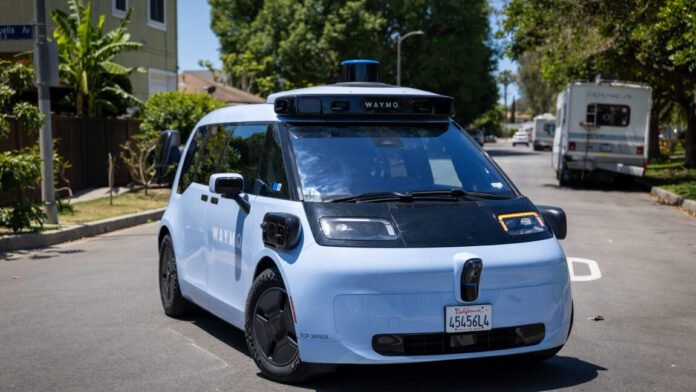
The holdup means that Waymo isn’t yet allowed to expand into parts of Northern and Southern California. And, in an upside for riders, Waymo still isn’t able to charge California passengers for rides in its new vehicle, a pale blue Chinese-made car it’s calling the Ojai, which started picking up riders last month.

If Waymo continues to operate these vehicles in its driverless ride-hail service, they could be gratis until the end of September and perhaps beyond. (The company continues to charge for rides in its Jaguar I-Pace robotaxis, which make up the majority of its fleet.)
Unlike other states that allow robotaxis to launch testing operations and later public service without much, if any, oversight, California doesn’t allow the vehicles to hit the roads without permission. To put their autonomous vehicles on the road, companies require approval from the state Department of Motor Vehicles. They also need permission from the California Public Utilities Commission, which regulates taxi and other transportation services, to carry paying passengers.

Credit: Waymo

Waymo applied to the CPUC in January to expand its service area and to add its Ojai cars to its fleet. In Northern California, its new proposed service area would span from Sea Ranch and Sacramento in the north, through Berkeley and Oakland, and into San Jose. In Southern California, it would grow past Los Angeles into Thousand Oaks and Santa Clarita, and down to the Tijuana border past San Diego.

But the process has been caught up in an unusual amount of controversy. In May, the agency asked for more information about how Waymo responds to emergency incidents, like December’s San Francisco power outage that stranded more than 60 Waymos in traffic. It also asked for new details about how Waymo makes sure that unaccompanied minors don’t ride in its cars—a violation of state law. The questions came after a labor union representing ride-hail drivers filed a formal complaint with the agency about Waymo transporting unaccompanied minors.

Now, CPUC’s Consumer Protection and Enforcement Division and Waymo have agreed to a new extension through September 25, according to Terrie Prosper, a spokesperson for the agency. Waymo’s request is “still under review, and the elements requested for approval have not been authorized,” Prosper said.

In a written statement, Waymo spokesperson Ethan Teicher said the company wouldn’t start charging for Ojai rides until the California agency approves its application but said the agency could approve its proposals sooner than September. He said Waymo is also waiting to charge for the rides “until we are satisfied with the progress made through our Trusted Tester availability in California and Arizona.”

Waymo’s Ojai is its first vehicle purpose-built to be a driverless taxi. It still has a steering wheel and brake pedals but also 13 cameras, six radar systems, and four lidar sensors, which help the vehicle orient itself. The car is manufactured by the Chinese company Zeekr, but Waymo says the vehicle avoids a ban on Chinese-connected automotive tech set to go into effect next year because the manufacturer only makes the vehicle’s shell, and its connected systems are built and added in the US.

This story originally appeared on Wired.

‘We are waiting for the Americans to save us’ – in crisis, Cubans have given up on reform from within

0
‘we-are-waiting-for-the-americans-to-save-us’-–-in-crisis,-cubans-have-given-up-on-reform-from-within
‘We are waiting for the Americans to save us’ – in crisis, Cubans have given up on reform from within

When I first visited Cuba, the island was recovering from a severe economic crisis. It was 1996, and the collapse of the Soviet Union had ushered in a prolonged period of deprivation and hardship.

On my latest visit, in early June, I encountered yet another crisis, a slow-motion humanitarian disaster.

The island is coping with severe shortages of fuel and electricity, among other essentials, due in large part to an oil blockade that President Donald Trump imposed in February.

To a degree, the current emergency mirrors the “Special Period” of 35 years ago. After the end of Soviet subsidies, Cuba plunged into darkness and hunger. “We had almost no electricity and little food,” one Cuban friend later told me. “If the government could not provide it, we did not have it, and the government had no money.”

Yet the current crisis is different in many respects. For one, there are more goods available. In Havana, at least, restaurants are open and stores are well stocked with foodstuffs.

There is also less hope and more despair.

The Cubans I spoke to – on the street, in shops and cafés, and in their homes – told me they no longer believe their government cares about their suffering. Instead, they are placing their hopes in the United States generally and the Trump administration specifically.

“We are waiting for the Americans to save us,” said one of the Cubans I interviewed. “The ones in charge [of the Cuban government] worry about themselves, not about us.”

Such views were unheard of 30 years ago. Now, they are commonplace on the streets of Havana.

Fidel’s ‘Special Period’

Soviet subsidies to Cuba at their height amounted to about US$4 billion per year. During the last six months of 1991, the Soviets gradually stopped supporting Fidel Castro’s revolution.

Food disappeared from Cuban stores and blackouts became the rule. Cuba had no money with which to buy oil to generate electricity. Cars disappeared from the streets, replaced by a few overcrowded buses, bicycles and horse-drawn wagons.

Two men paste over the image of a man on a billboard

Workers paste over a portrait of former Soviet leader Mikhail Gorbachev in Havana in 1991. Peter Turnley/Corbis/VCG via Getty Images

Between 1991 and 1993, Cuba’s GDP declined by at least one-third. The average Cuban lost between 5% and 25% of his or her body weight.

Castro, Cuba’s longtime communist leader, proclaimed this crisis a “Special Period in Time of Peace.” A Cuban I know refers to it as the “time when we ate cats and dogs.”

Common enemy, common purpose

I first went to Cuba as a graduate student studying history, searching for potential dissertation topics. Arriving in 1996, I was struck by the continued scarcity of electricity, gasoline and food.

But I was also impressed by the Cubans’ solidarity: Almost to a person, Cubans I spoke to blamed the U.S. embargo for their plight.

The Eisenhower and Kennedy administrations imposed the embargo, effectively prohibiting trade and tourism between the U.S. and Cuba, in retaliation for Cuban nationalization of U.S. property.

Cubans directed most of their anger toward Washington. Graffiti criticizing Republican Sen. Jesse Helms – co-author of the Helms-Burton Act, which enshrined the embargo as an act of Congress – and President Bill Clinton was common.

Just as important, Cubans I met then believed that they all shared the same miseries — even their leaders, to a degree. So far as most of them knew, all Cubans were hungry, relying on kerosene lanterns and riding bicycles thanks to the “Yankee blockade.”

After all, that was what their government told them.

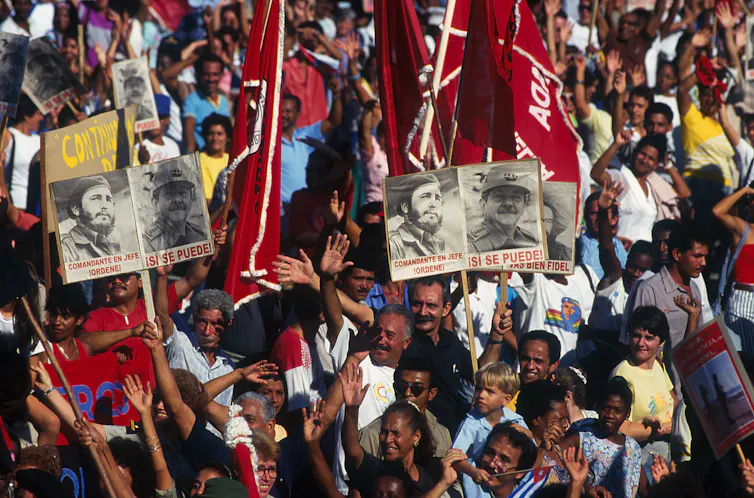
A crowd holds aloft photos of two men.

In 1996 Cubans generally still supported the country’s revolutionary leaders, Fidel and Raul Castro. Antonio Ribeiro/Gamma-Rapho via Getty Images

More food, more cynicism

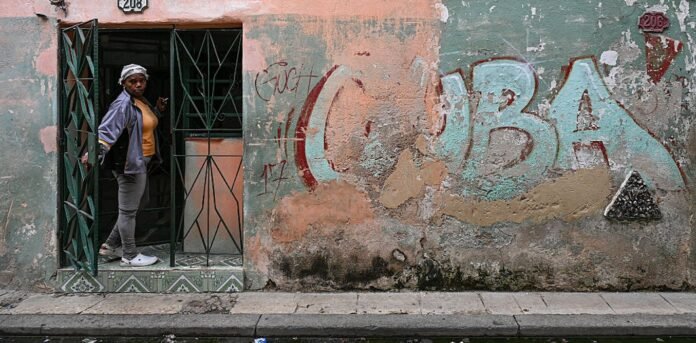
Today, Cubans appear far less likely to believe such propaganda. Indeed, from what I could see, the old revolutionary slogans are disappearing from public spaces, erased or defaced. Nor could I find a recent copy of Granma, the Communist Party’s newspaper, anywhere.

Instead, Cubans turn to the internet, reading abroad what their government obfuscates or denies at home. As one friend told me, “We have the internet now. We can read for ourselves, and we are much harder to lie to.”

Unlike during the 1990s, food is prevalent in Havana for those who can afford it.

Private individuals import goods, legally and illegally, keeping private stores stocked even with American luxuries, such as whiskey, as well as Cuban staples, including rice and beans.

Purchasing food in private stores, however, remains an expensive proposition. A pound of rice and beans can cost a dollar – cheap to Americans but exorbitant relative to the average Cuban monthly wage of US$15-$20.

Inflation is rampant, among the worst in the world. While I was in Havana, the Cuban peso traded at roughly 550-580 to the dollar. When I last visited, in 2024, it was about 250.

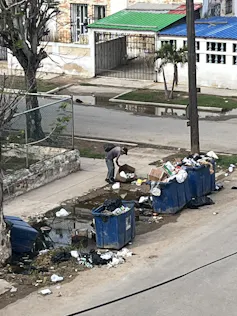
A man looks through trash in the street

Trash builds up on the streets of Havana. Joesph Gonzalez, CC BY-SA

During my latest trip, gasoline cost $40 per gallon, when you could find it. Private entrepreneurs sell gasoline in the streets, along highways and even in once-functioning state-owned petrol stations.

The libreta, the rationing system that used to insure Cubans against hunger, operates only sporadically now.

Less social cohesion

A decade ago, crime was infrequent and petty. Now it is common and violent, fueled by deprivation and drugs. During this visit, friends told me not to walk the streets at night.

Drug abuse is also increasingly a problem. The young use opioids, especially fentanyl, which is cheap and easy to find. As one Cuban observed, “We now enjoy the problems of poor Americans.”

During my trip, I interviewed at least 35 Cubans – from colleagues and friends to people on the street, usually in stores and cafes. No one refused to speak to me, though most would only do so anonymously.

Almost all of them save one, a Communist Party member, said that their leaders do not share their suffering.

They hear of their leaders’ lifestyles and the first lady’s fashions; they see the consumption habits of members of the Castro family on social media.

Thanks to the internet, Cubans also know of the holdings of GAESA, a conglomerate controlled by the military that touches much of what is profitable in Cuba. Many Cubans say, with reason, that the revenues of GAESA, as well as other quasi-public entities, insulate the elite from the hardships of life in Cuba.

Every Cuban I spoke to, again save one, told me that their leaders are resisting the Trump administration in order protect their privileges and positions – not Cuban sovereignty.

“It’s not hard,” a Cuban woman working in a souvenir shop told me. “All they need to do is make a deal with the U.S. But they won’t because it would mean giving up their own private Cuba. They are greedy f–kers.”

The Americans are coming

Nonetheless, the Cuban government is yielding to American pressure, however slowly.

President Miguel Díaz-Canel recently announced a dramatic expansion of private enterprise in Cuba, following measures to promote foreign investment, most notably from Cuban Americans in Florida.

This is welcome news to most Cubans. Having given up on their own leaders, almost all the Cubans I spoke to are waiting for Americans to save them.

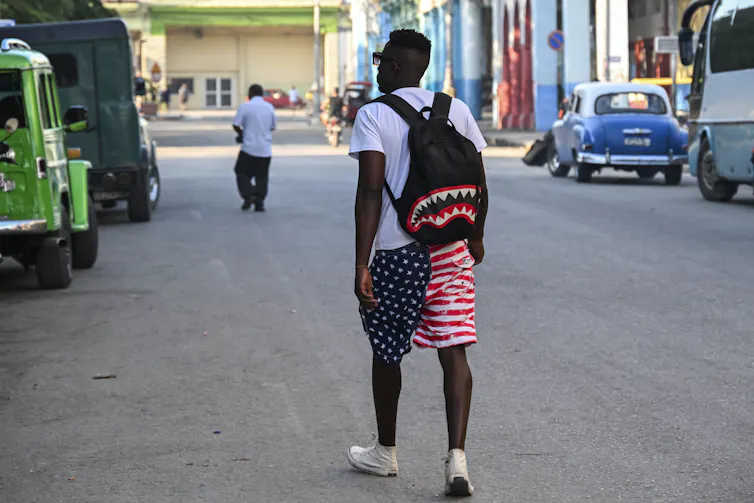
A man wears a backpack and red, white and blue shorts.

A man wearing shorts depicting the U.S. flag walks along a street in Havana on May 6, 2026. Yamil LAge/AFP via Getty Images.

Make no mistake: The Cubans I spoke with want the oil embargo to end, and no one wants a U.S. invasion. “There has already been enough misery,” observed a Santeria priest. “There is no need for death and injury.”

But Cubans I spoke with want U.S. pressure to continue. They believe that their government will never adopt policies designed to improve the quality of all Cubans’ lives absent pressure from the U.S.

Target the elite

That said, people said they would like such pressure to be more narrowly targeted at the elites themselves, with less hardship for the average Cuban.

The recent termination by Mastercard and Visa of transactions is one such measure; the vast majority of Cubans do not have credit cards.

“It’s time for them to suffer like we suffer,” concluded one Cuban, speaking of her unelected leaders.

Given such contempt, when coupled with pressure from the Trump administration, it’s hard to see how what remains of the Cuban Revolution can long endure.

Alejandro Rodríguez Bidondo, a professional tour director and translator in Havana, assisted with the research necessary for this article.

0FansLike
0FollowersFollow
0FollowersFollow
0SubscribersSubscribe
- Advertisement -
Google search engine

Recent Posts