Have a 401(k)? Help ProPublica Investigate What’s Really Happening to Your Money.
For some employees, the 401(k) system works great: They have easy access to low-cost funds with high returns. But many participants are stuck in investments with bloated fees and pay for costly advisory services on top — and may never know it because they’ve never scrutinized their plans’ disclosures. (If you’re worried this is you, our questionnaire below explains how you can check.)
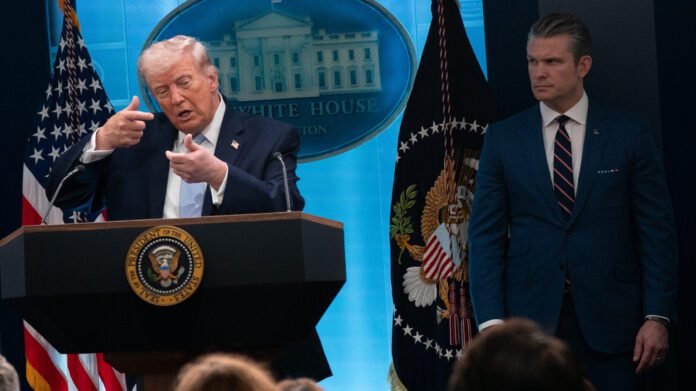
As we’ve reported, the Trump administration wants employers to include less-regulated “alternative” investments like private equity and cryptocurrency in 401(k) plans. To make that happen, the administration is changing regulations and pulling back on enforcement of the law that protects participants.
ProPublica is taking this opportunity to investigate these changes and the broader 401(k) system. To do this reporting, we need detailed insight into what’s happening inside plans: what products financial services companies are pushing and what fees they are charging. Many of these details are not made public, but they are disclosed to plan participants. That’s why we need to hear from participants in these plans, employers (particularly small-business owners) and those with expertise in the industry. The more people we hear from, the better informed our reporting will be.
Note: We are not asking for anything that shows your account balances or personal information. If you have a 403(b) plan and work for a private, tax-exempt organization, we’d also like to hear from you.
Our team may not be able to respond to everyone personally, but we will read everything you submit. We take your privacy seriously. We are gathering these materials for the purposes of our reporting and will contact you if we wish to publish any part.
If you would prefer to use an encrypted app, see our advice at propublica.org/tips.
Concentration Camps Inside a Concentration Camp: Israel’s New Plan for Gaza | Palestine This Week
In this episode of Palestine This Week, we examine Hamas’s decision to dissolve its government and the wider implications of Trump’s so called peace plan, as Israel moves ahead with proposals for “controlled humanitarian zones”.
In this episode of Palestine This Week, we examine Hamas’s decision to dissolve its government and the wider implications of Trump’s so called peace plan, as Israel moves ahead with proposals for “controlled humanitarian zones”.
We also discuss whether Hamas remains a major threat or has become a convenient justification for continued Israeli domination, before turning to new claims about 7 October, debates over just war theory, Zionism’s erasure of Palestinians, Mike Huckabee’s remarks in Jerusalem and reports that US officials feared Israel was plotting to kill Iranian negotiators.
WATCH: Podcast by Jasim Al-Azzawi with former CIA analyst Larry Johnson & Ray McGovern
Google revamps Android AI dev benchmark, adds Fable 5 and other agents
Code generation is emerging as one of the most popular applications for large language models (LLMs), but not all agents are equally good at all development tasks. Google created a benchmark earlier this year to evaluate how LLMs perform in Android app development, and Android Bench is getting a big update today. The leaderboard now includes a raft of new models, and Google has adopted a new framework that should be easier to use. Developers are invited to run their own tests and submit feedback that could shape the future of Android Bench.
While they are popular coding tools, LLMs don’t get everything right. Separating the useful outputs from straight-up slop means choosing the right tool. Android Bench aims to demonstrate which AI agents do best on a suite of 100 Android development tasks. After launching Android Bench in March, Google has added metrics like cost and efficiency, as well as open-weight models.
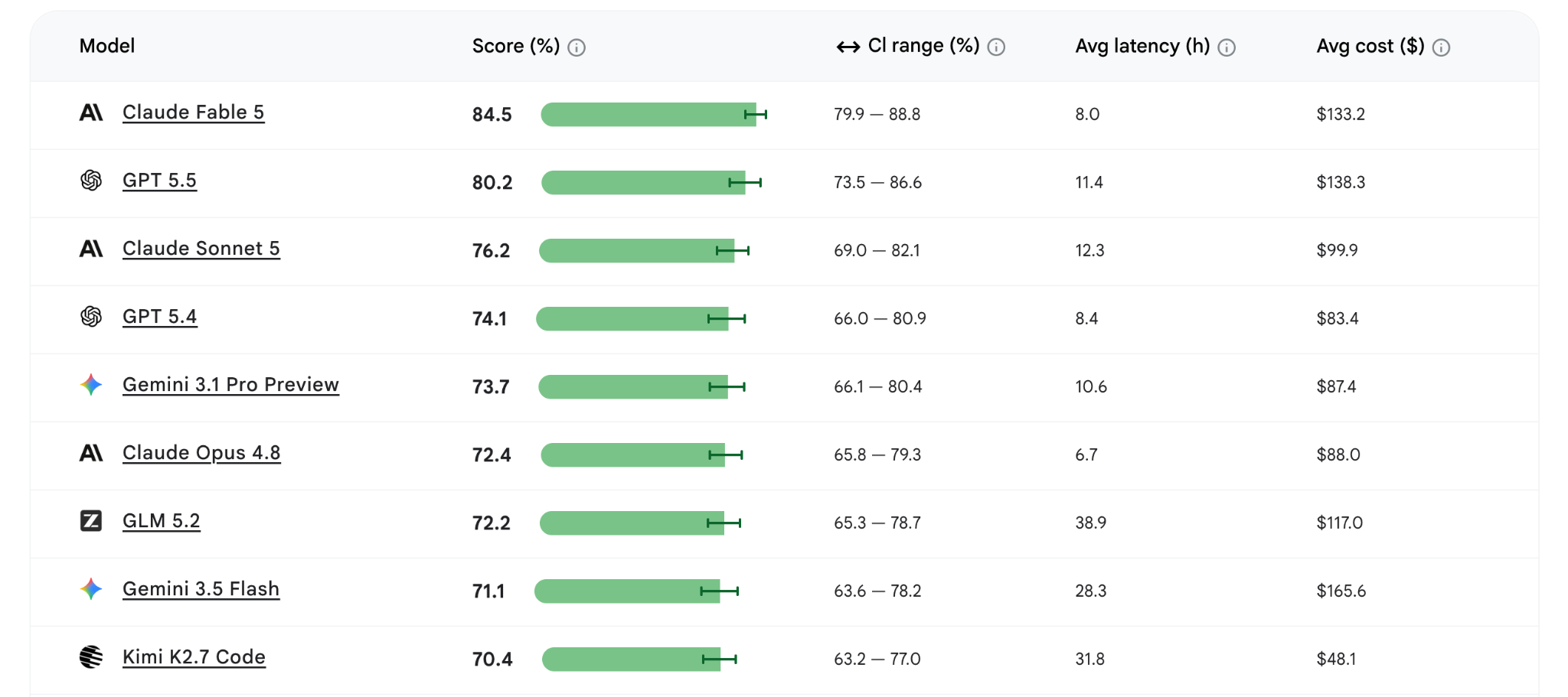
To keep Android Bench relevant, Google is updating the test with eight new models, including all the latest heavy-hitters: Claude Fable 5, Claude Sonnet 5, Claude Opus 4.8, GLM 5.2, Kimi K2.7 Code, MiniMax M3, Qwen 3.7 Plus, and Qwen 3.7 Max.
Even the initial release of Android Bench didn’t have Google’s AI models at the top—OpenAI’s latest LLMs were slightly in the lead. The story is worse for Gemini now that Google has expanded the lineup. In the new leaderboard, Gemini 3.1 Pro is in fifth place, behind GPT 5.4, Claude Sonnet 5, and Claude Fable 5. In fact, Fable 5 lives up to the hype with a sizeable lead at 84.5 percent accuracy in the test.
Google’s updated leaderboard shows Gemini slipping to fifth place.
Credit: Google
Google’s updated leaderboard shows Gemini slipping to fifth place. Credit: Google
However, Fable 5 and GPT 5.5 also have extremely high operating costs, chewing through more than $130 in tokens for the 100-problem, 10-run benchmark. Gemini 3.1 Pro didn’t score as high, but it only costs $87 to run the test. Gemini 3.5 Flash, which is supposed to be cheaper to run than other models, has the highest cost on the leaderboard because it took so much longer to complete the benchmark: $165 per run and a 28-hour runtime.
The Android coding performance gap for Google’s models is a problem as the company shifts many of its projects toward agentic development. Obviously, Google would prefer that Android developers use Google’s tools in their workflows, which may be why Google has reportedly been offering to buy application source code from developers for AI training.
Community collaboration
Android Bench is supposed to evolve over time, adopting new workflows to test models. Google hopes that developers will want to contribute to Android Bench by sharing benchmarks and development tasks. To make that more feasible, Google is switching to the Harbor framework. According to the company, this testing sandbox makes it easy for developers to run, evaluate, and share results for Android Bench.
Google re-ran all its previous tests with Harbor to get a new baseline for LLM performance. So there’s been some shift in the previously reported scores even though the underlying tests haven’t changed (yet). The historical data will remain online in an archive.
With the new, easier framework, developers can run their own development tasks against Android Bench and submit those for possible inclusion in the official test. The Android Bench GitHub has been updated with the new dataset and instructions on how to get involved.
Iran ceasefire was always going to break – here’s why
Less than a month after a ceasefire was signed between the US and Iran, conflict has returned to the Middle East. The peace agreement Donald Trump signed at the palace of Versailles in France on June 18 – which he hailed as Iran’s “unconditional surrender” – is now, in the US president’s own words, “over”.
I recently argued that the memorandum of understanding (MoU) between Washington and Tehran was best understood not as a peace agreement but as a “deferred crisis” – a ceasefire with a built-in detonator. That detonator has now gone off.
Trump’s declaration that further talks with Tehran are “a waste of time”, which he made on the sidelines of the Nato summit in Ankara, Turkey, on July 8, follows an escalation spiral that will feel grimly familiar to anyone following this conflict.
Iran attacked three commercial vessels in the Strait of Hormuz on Tuesday. The US responded with what one unnamed US official described as “punishment” strikes on more than 80 Iranian targets and reimposed sanctions on Iranian oil sales – stripping away Tehran’s central gain from the deal.
Iran, in turn, launched retaliatory strikes on US military installations in Bahrain and Kuwait. Oil prices have surged, reviving the very economic pressure – rising prices at the American gas pump – that dragged Trump to the negotiating table in June.
None of this should come as a surprise. The agreement signed at Versailles did not resolve the contradictions that produced the war. It institutionalised them and inadvertently created the very conditions under which escalation becomes more likely.
The US has launched fresh strikes on Iran in response to attacks on commercial shipping in the Strait of Hormuz.
The structural flaw in the ceasefire deal was visible from the outset. The MoU rested on Iran reopening the Strait of Hormuz in return for the lifting of sanctions on Iranian oil – almost the only lifeline sustaining the Iranian economy. But nothing in the agreement resolved the question of Lebanon.
Iran had made clear that one of its core objectives was to prevent further Israeli strikes against Hezbollah – an attempt to salvage its proxy network in the region. Israel, for its part, cannot permanently suspend its right to self-defence as the price of a US diplomatic agreement. Reports suggest the Israeli prime minister, Benjamin Netanyahu, was “fuming” over the MoU agreement, which Israel was not party to when it was drafted and signed.
This has produced the cycle now on full display: continued Israeli military action in Lebanon, Iran flexing its leverage over the Strait of Hormuz and US strikes on Iranian assets to save face – even as Washington pressures Israel to stand down. Each iteration intensifies the conviction in Tehran, Jerusalem and Washington that restraint is no longer a viable course of action.
Leaders abandon restraint not simply when threats grow, but when holding back stops feeling like a way of acting at all. Restraint survives only while it seems to be working, points towards a better future and feels like a choice rather than something imposed. When those conditions fail, restraint starts to look like paralysis and escalation becomes the only way of restoring control.
For Trump, all three of these conditions have collapsed. Iran is attacking commercial shipping despite the deal. Oil prices are climbing as the US midterm elections approach. And every Iranian strike demonstrates that Tehran, not Washington, is setting the tempo and direction of the ceasefire. This dynamic is fundamentally unsustainable for the US.
For Netanyahu, this collapse is not a failure but a confirmation of his lack of conviction in the ceasefire deal. Israel never accepted the premise of the MoU. Its security establishment has maintained throughout that the war with Iran was paused, not concluded, and that any framework granting Iranian-backed forces impunity in Lebanon was unsustainable.
Shortly after the deal was signed in June, Netanyahu said that Israel’s “struggle is not over” and its military will “remain in these security zones for as long as necessary to defend our country”.
What comes next
Two scenarios now present themselves and, in both, the Strait of Hormuz decides the outcome. In the first, the US continues its bombardment of Iranian military assets while attempting to keep the strait open by force. This is a formidable task.
Iran does not need to defeat the US Navy to close the waterway; it merely needs to make transit unsafe enough that insurers refuse to cover vessels. Sustained airstrikes may degrade that capacity, but they cannot eliminate it. This raises the question of whether ground forces would eventually be required, though this development would probably be challenged by Congress.
In the second, Trump limits the strikes and uses them as leverage to renegotiate the ceasefire. But this path has its own problem. Without the ability to guarantee free navigation of the strait, it is hard to see how Trump extracts a better deal than the one he has just abandoned – from a belligerent and emboldened Iran that has absorbed enormous punishment and survived.
Either way, Trump’s off-ramps are narrowing. Until Iran loses its leverage over the strait, the cycle we are currently witnessing makes a prolonged conflagration more likely.
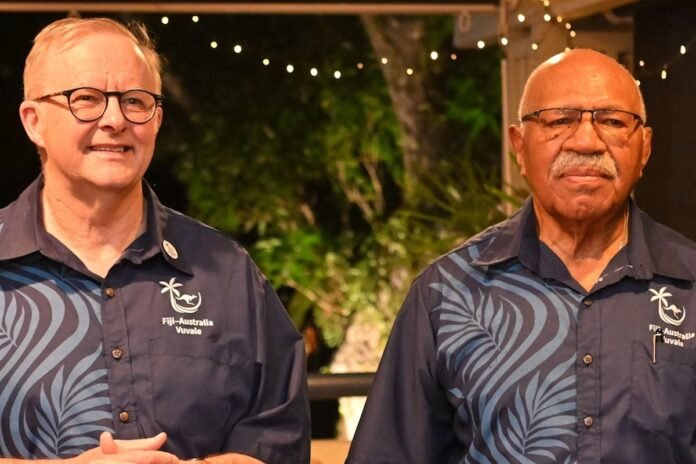
As part of his tour of the Pacific, Prime Minister Anthony Albanese has signed a significant defense treaty with his Fijian counterpart Sitiveni Rabuka.
Called the Ocean of Peace Alliance or Veitacini Treaty, the agreement is the latest step in Australia’s efforts to sign treaties that make it the regional “hub” for its Pacific Island country partner “spokes.” It follows:
Shortly after the agreement with Fiji was signed, China conducted a long-range missile test in the Pacific Ocean. The test provoked criticism from regional leaders, and underscored the need for Pacific Island countries to collectively think through their defense and security arrangements.
There is also much to digest in the Veitacini Treaty, and its accompanying Vuvale Union, which seeks to elevate security, economic ties and people-to-people links.
Article 6 provides that each party would “act to meet the common danger” of an armed attack in the Pacific on any of the parties. But this comes with the caveat that this action will occur “in accordance with its domestic processes.”
That qualified undertaking is much weaker than the more definite guarantee provided in the NATO Treaty, which states an “armed attack on one” party is deemed to constitute an attack on all parties, and they will consequently “exercise the right of individual or collective self-defense.”
As with the Nakamal Agreement Australia recently made with Vanuatu, the Veitacini Treaty is largely symbolic. Even if the treaty was enforceable, Australia relies on the US to defend it and would struggle to defend Fiji on its own.
Indeed, the symbolism of the Veitacini Treaty is the point. Look beyond the diplomatic platitudes of “friendship” and “mutual respect”, and the treaty is intended to send a signal about Fiji and Australia’s shared concerns about China’s strategic interest in the region.
A leader does not repeatedly reassure a country that a treaty is not aimed at it unless everyone understands it is, at least partly, a signal to that country, and to a region watching to see whether Fiji has picked a side.
Questions the region should ask
First, does the Veitacini Treaty encourage the militarization of the Pacific?
Article 12 provides that other Pacific Island countries can request to accede to the treaty if they are “in a position to further (…its) purposes and principles.”
This implies these countries will require militaries, which only PNG, Fiji, Tonga and New Zealand have. It also raises the risk of creating two tiers of security relationship in the region: the deeper integration generated by mutual defence treaties available to countries with militaries, and lesser security cooperation treaties to those without.
This may lead Pacific Island countries to conclude they should develop militaries if they are going to shape the regional strategic agenda. Indeed, it is something Solomon Islands has foreshadowed.
Given the costs, this may entrench dependence on Australia as the main provider of defence assistance. Militaries can also be a mixed blessing: useful in leading disaster responses; risky for internal instability (as Fiji’s 1987 and 2006 military coups demonstrate).
Second, how does an alliance sit with the region’s architecture?
Although pushed by Rabuka, the Blue Pacific Ocean of Peace Declaration was endorsed by Pacific Islands Forum leaders at their 2025 leaders’ meeting as a regional vision. Borrowing its name for a bilateral (for now) military alliance raises the question of who speaks for the Ocean of Peace: the forum, or Fiji and Australia?
With the Forum Secretariat’s headquarters in Suva, and Fiji positioning itself to host an Ocean of Peace Centre under the accompanying Vuvale Union, there is the risk of reinforcing perceptions that Pacific regionalism is already too Suva-centric. This is a longstanding grievance, particularly among Micronesian Forum members.
Alliance obligations imply interoperability, sustained exercises, and equipping and maintaining forces able to – as Article 6 of the treaty provides – “act to meet the common danger.”
The costs of achieving this are high, as Australia is regularly reminded in its efforts to keep up with the US. Will the Fiji budget stretch to meet these costs, or will it depend on Australian assistance?
The cost of mutual defense is particularly high. Although heavily qualified, a perceived need to make “insurance payments” on an alliance can see a country entrapped into following its ally into wars it wouldn’t choose. This could, in turn, risk entangling the region more broadly.
Second, how does the Veitacini Treaty interact with ANZUS?
Both treaties relate to armed attacks in the Pacific, with Australia as the ally that links the two. What obligations may arise, for example, if Australia responds to an attack on the US in the Pacific (say, on its massive Joint Region Marianas base on Guam), and in turn is attacked itself?
Will Fiji be expected to respond? Has Fiji unnecessarily made itself a strategic target? China’s ballistic missile test may be an unsubtle reminder to Fiji of the potential risks of this approach.
Third, how transparent will implementation be?
The treaty leaves governance to consultation mechanisms that the parties will “determine”. Previous agreements offer little comfort: implementation of the Falepili Union and the Nauru-Australia Treaty has proceeded largely out of public view.
Nor is there any publicly available systematic assessment of whether the 2019 Fiji-Australia Vuvale Agreement (which was renewed in 2023) has delivered.
A good neighbor?
Australia has legitimate strategic concerns about China. But Australia’s response of Pacific treaty-making resembles “sugar-rush” diplomacy: announcements first, hard questions later.
Whether Australia and Fiji can answer these questions in ways that advance Australian, Fijian, and Pacific security will depend on transparency, honest evaluation and genuine deference to the Pacific Islands Forum.
One thing is certain: the region will notice whether Australia behaves like a good neighbor.
President Trump Calls Iran ‘Scum,’ Says MoU Is “Over,” Signals More US Strikes
President Donald Trump declared Wednesday that the memorandum of understanding (MoU) with Iran was effectively finished, saying he no longer wanted to negotiate with Tehran even as he left open the possibility for US negotiators to continue talks.
Speaking at the NATO summit, Trump said the agreement was “over” and sharply criticized Iran’s leadership.
“I think it’s over. I don’t want to deal with them anymore they’re scum … they’re led by sick people and they’re vicious, violent people,” Trump said.
“We make a deal. They [Iran] go outside, talk to the press, they say ‘we never even talked about it’. There’s something wrong with them. They’re cuckoo. As far as I’m concerned, it’s over.”
Despite those remarks, Trump said he would not prevent his negotiating team from continuing diplomatic efforts.
“Now, I’ll let our wonderful negotiators keep talking if they want, but I don’t see it. I don’t like these people,” President Trump said.
It was not immediately clear whether Trump was referring only to the US negotiating team, led by Vice President JD Vance along with senior advisers Steve Witkoff and Jared Kushner, or whether his remarks also included regional mediators such as Qatar, Pakistan and Turkey.
Trump also indicated the the US military would repeat the strikes on Wednesday night.
“We hit them very hard last night, very probably hit them hard again tonight,” he said. “They’ve been the bully of the Middle East and they’re not the bully anymore.”
NATO Secretary General Mark Rutte defended the US military operation, describing the strikes as “absolutely necessary” and saying Iran was “basically violating the ceasefire.”
The comments came as fighting between the United States and Iran continued to intensify.
Earlier Wednesday, Iran’s Foreign Ministry said US military action and other alleged violations of the memorandum of understanding had rendered the agreement “ineffective.”
US Central Command said Tuesday it had launched “powerful” strikes in response to attacks on three tankers in the Strait of Hormuz.
Iran said Wednesday it had retaliated by targeting US military sites in Bahrain and Kuwait. The United States also announced it had revoked its temporary suspension of sanctions on Iranian oil sales.
US rare earths flow to Asia as domestic demand is slow to emerge
US rare earths produced by Washington-backed companies are flowing to Japan and South Korea, as American demand has yet to materialize despite the Trump administration’s push to develop a national supply chain.
Rare earths products produced by MP Materials, Energy Fuels and Phoenix Tailings—which together have won billions of dollars in US government support—are being sold to companies in Asia, where the scale of magnet manufacturing remains larger than the nascent production in the US.
China’s lock on global supplies of rare earths and critical minerals has become a national security concern in the US and other Western nations, since Beijing started restricting access to them. The metals are crucial to 21st-century technology and are used in the manufacturing of everything from weapons guidance systems to electric vehicle batteries.
Nick Myers, chief executive of Phoenix Tailings, said Japanese customers were “clamoring” for the rare earth metals it produces, given the dramatic cut in exports of the materials from China this year.
The start-up’s customers were “primarily in Korea and Japan,” he said. “Unless the [US defense] primes move quickly, I will sell out… other companies are paying top dollar faster.”
Phoenix, backed by a CIA-funded venture capital firm named IQT, is scaling up production but is not yet a significant producer and does not disclose sales figures.
A host of US companies have outlined plans to mine rare earths and produce magnets domestically, but the industry will take time to grow, experts said.
“Today, there are two countries where [neodymium iron boron] magnets are produced at scale. One is Japan, the originator, and one is China,” said Thomas Kruemmer, author of the Rare Earth Observer blog. The magnets are used in everything from cars to fighter jets and the semiconductor industry.
MP Materials is the leading US rare earths producer by a wide margin. The Nevada-based company’s sales of neodymium-praseodymium (NdPr) oxide and metal—its largest division by revenue—were “primarily generated” under MP’s agreement with Sumitomo Corporation of Americas, which distributes the material to Japanese customers, its latest quarterly earnings show.
Some material also goes to an unnamed US technology and industrial company, under a deal penned in the first quarter of 2026.
In the same quarter a year ago, the largest portion of MP’s sales by revenue—mined material, not NdPr—went to China’s Shenghe Resources. But MP has stopped selling to Shenghe as part of its deal with the US government.
MP ultimately plans to produce its own magnets at scale, which would require it to consume much of what it produces. Mined rare earths are turned into oxides, which are used to make metals and alloys that go into magnets.
The company has penned agreements with General Motors and Apple to supply them with its magnets. It said in May that it expected to begin shipping finished magnets to GM this year.
Meanwhile, Energy Fuels—which won $725 million in conditional government funding in June—plans to scale its production of rare earths and also has eyes on Asia.
“We will be sending oxides in the near-term to Korea,” said chief executive Ross Bhappu. Last year, a major South Korean manufacturer made a small amount of Energy Fuels’ NdPr into magnets.
Energy Fuels is in the process of acquiring Australian Strategic Materials, which owns a rare earths metal-making plant in South Korea. It also announced a $1.9 billion deal to buy German magnet maker Vacuumschmelze (VAC) in June, which Bhappu said would result in more of Energy Fuels’ products going to VAC’s US operations.
China is the largest global producer of the widely used neodymium iron boron magnets. Outside China, Japan produces 10,000-15,000 tonnes per year, while South Korea produces 2,000-3,000 tonnes annually, and the US produces 1,000 tonnes or less, according to John Ormerod, a rare earths consultant at JOC LLC. There is also some production in Europe.
Phoenix, which secured a conditional $500 million from Washington in June, said government funding would help it scale up metal and oxide production, which would “expand the pie for everyone.”
MP’s recent earnings have been boosted by the money it receives under its US government deal—which guarantees a minimum sale price for some products and tops up any shortfall from the price paid by third parties.
Norwegian-led investigation into dark web child abuse forums leads to arrests across seven countries
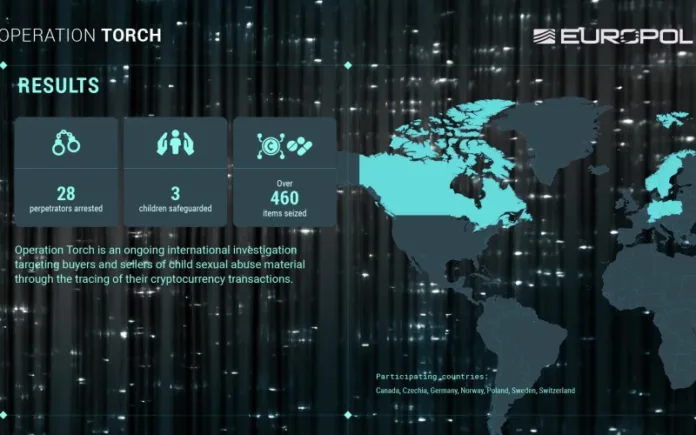
A coordinated international operation supported by Europol has resulted in the arrest of 28 people as part of an investigation into child sexual exploitation, with authorities also safeguarding three children.
The operation was carried out between late May and mid-June 2026 by law enforcement authorities in Canada, Czechia, Germany, Norway, Poland, Sweden and Switzerland. According to Europol, the investigation remains ongoing and further arrests are expected.
Cryptocurrency tracing aided investigation
Europol said officers seized more than 460 items during the operation, including electronic devices, cryptocurrency wallets, drugs and large quantities of doping substances.
The agency said all of the suspects are men aged between 22 and 54. Investigators alleged that one suspect had extensively used artificial intelligence to generate illegal material, while some of the victims were members of another suspect’s immediate family.
According to Europol, investigators believe the suspects used cryptocurrency to pay for access to dark web forums where child sexual abuse material (CSAM) could be viewed or downloaded. The suspects are expected to face charges related to the storage, acquisition and sharing of child sexual abuse material.
The investigation was led by Norwegian law enforcement, which Europol said developed a method in 2025 to trace cryptocurrency transactions. The agency said this enabled investigators to identify individuals who had allegedly paid for access to child sexual abuse material and also helped identify two suspected sellers of such material.
Europol said it supported the investigation by coordinating participating authorities, analysing and enriching operational intelligence, producing analytical products and assisting Norwegian investigators in distributing evidence packages to the countries involved.
The agency said tackling the sexual exploitation of children remains one of its priorities. It highlighted its Stop Child Abuse – Trace an Objectinitiative, which asks members of the public to help identify objects linked to unresolved cases, and Help4U, a digital platform launched in November 2025 to provide information and support for children and teenagers affected by sexual abuse or online exploitation.
The participating countries were Canada, Czechia, Germany, Norway, Poland, Sweden and Switzerland.
Louise Lasser, the actress best known for playing an overwhelmed suburban housewife on the cult 1970s television series Mary Hartman, Mary Hartman, has died at the age of 87.
Lasser died of natural causes at her New York City home on Monday, according to reports.
The actress also became well known for her marriage to controversial filmmaker Woody Allen and for a turbulent career that included an Emmy nomination, a drug arrest and one of the most infamous episodes in Saturday Night Live history.
Lasser was married to Allen from 1966 until 1970. She was his second wife and worked with him on several early projects, including his rewrite of What’s Up, Tiger Lily?, the 1969 comedy-crime movie Take the Money and Run and the 1972 film Everything You Always Wanted to Know About Sex * But Were Afraid to Ask.
Allen had previously been married to Harlene Rosen. The two wed when Rosen was 17 and Allen was 20, but their marriage ended in 1962 after six years.
Lasser’s biggest breakthrough came when she landed the starring role in producer Norman Lear’s satirical soap opera Mary Hartman, Mary Hartman.
The show followed a struggling Ohio housewife attempting to survive the bizarre pressures of everyday suburban life. It also took sharp aim at American consumer culture and the traditional image of the perfect housewife.
Lasser’s character, famous for her pigtails and puffy-sleeved outfits, became a television sensation. The program aired five nights a week and ran for two seasons.
Her performance earned her an Emmy nomination in 1976.
But that same year, Lasser’s personal life began making headlines.
She was charged with cocaine possession after police reportedly found 80 milligrams of the drug on her while she was shopping inside an antiques store. She was later sentenced to six months of probation.
Just two months after the arrest, Lasser hosted Saturday Night Live in an episode that became one of the most controversial broadcasts in the show’s history.
The episode included sketches involving drugs and apparent emotional breakdowns, leaving many viewers unsure whether Lasser was acting or suffering a real-life collapse on live television.
The broadcast was later frequently excluded from SNL reruns.
Following Mary Hartman, Mary Hartman, Lasser continued working steadily in television and movies.
She appeared in Taxi and It’s a Living and wrote and starred in the television movie Just Me and You.
Her other film credits included Simon, Rude Awakening, Modern Love, The Night We Never Met, Wolves of Wall Street and National Lampoon’s Gold Diggers.
Decades later, she appeared in three episodes of the HBO comedy Girls.
In its obituary, The New York Times described Lasser as appearing “somehow simultaneously neurotic and girlish,” a quality that helped define many of her most memorable performances.
Lasser was born in Manhattan in 1939 and raised in the Bronx. She was the only child of Sol Jay Lasser, a tax accountant and author, and Paula Eisenreich Lasser, a designer.
She attended Brandeis University but dropped out during her senior year to pursue acting lessons.
After leaving school, she returned to her parents’ Manhattan home and began appearing in television commercials for major brands, including NyQuil and Excedrin.
In 1967, Lasser became the first woman to win a Clio Award for her performance in a Florida orange juice commercial. The Clio is considered one of the advertising industry’s most prestigious honors.
Her acting career had already begun gaining momentum on Broadway several years earlier.
In 1962, Lasser served as an understudy for a then-20-year-old Barbra Streisand in the musical I Can Get It for You Wholesale. She briefly took over the role after Streisand left the production.
Lasser is survived by her longtime partner, Michael Citriniti.
Why Would Anyone Trust Ex-CIA Agents in Elected Office?
Alex Skopic is an associate editor at Current Affairs. His writing has also appeared in Protean and the Cleveland Review of Books, and has been selected for The Best American Essays 2026.
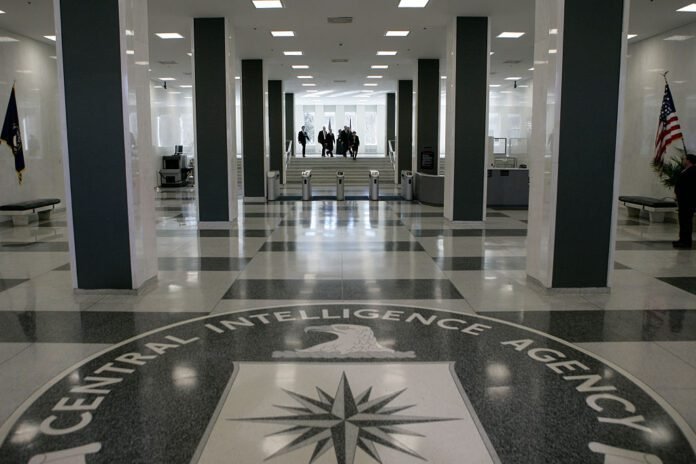
The Democratic Party is rife with internal caucuses and factions. There’s the Congressional Progressive Caucus, the Congressional Black Caucus, the Blue Dog Coalition, the “Squad,” and so on. But since 2019, when Elissa Slotkin and Abigail Spanberger first took seats in the House of Representatives, the party has had another, more sinister emerging faction: the CIA Spook Caucus.
In the last seven years, the Spook Caucus has only gained in strength. Both of its core members have graduated from the House to higher office, with Slotkin elected to the Senate in 2024 and Spanberger elected the governor of Virginia the following year. Soon afterward, Spanberger was selected by the Democratic leadership to deliver the rebuttal to Donald Trump’s 2026 State of the Union Address, which elevated her to the national stage. Slotkin, meanwhile, has floated the idea of a 2028 presidential run.
And in the 2026 midterms, the Spook Caucus might expand further: In the Democratic primary for Virginia’s 8th Congressional District, former CIA officer Adam Dunigan is running for the opportunity to challenge GOP nominee Anthony Sabio, who is also ex-CIA. But if you happen to care about concepts like “human rights” or “democracy,” this influx of intelligence operatives into our elections is extremely bad news.
Spanberger’s honeymoon period with the Virginia Democrats is already over. Less than a year into her tenure as governor, she has vetoed 31 of the General Assembly’s bills, including “high-profile Democratic priorities” like collective bargaining rights for public workers and protections against ICE agents making warrantless arrests inside courthouses. On the labor bill, local unions say Spanberger betrayed a campaign promise she’d made to them. After vetoing two bills to limit ICE arrests, the ACLU of Virginia said her actions “constitute a voluntary surrender” to the Trump administration’s immigration agenda.
But this about-face shouldn’t be surprising, because the public doesn’t really know who Abigail Spanberger is or what she believes, deep down. That’s the problem with electing a CIA officer: They’re professionally trained liars. In a 2025 interview with the Washington Post, Spanberger said she used to have five different passports and identities: “I would travel in ‘true name,’ but then I would meet people not in ‘true name.’” The profile explicitly calls this spycraft “interpersonal skills transferable to politics.” In other words, this is someone who was accustomed to saying whatever people want to hear while concealing her true intentions. So whenever she speaks to Virginia voters, they have no way of telling whether she’s “in true name” or not. The unions found that out the hard way.
As usual, then, we have to judge by actions over words. With this spring’s veto spree, Spanberger’s actions are wildly out of step with the wishes of the voters who elected her, who overwhelmingly support unions and are growing more distrustful of Immigration and Customs Enforcement. (Seeing your fellow Americans shot dead in the street will do that.) But the vetoes are perfectly in tune with the interests of the national security state, from the drug enforcement agents who still want to make weed busts to ICE itself. Those are Spanberger’s colleagues, and the former CIA agent has moved to protect their power to surveil and police the people she supposedly represents.
Instead, she’s reserved her harshest attacks for socialists. In 2020, after Joe Biden squeaked his way into the presidency, Spanberger told party leaders, “We need to not ever use the word ‘socialist’ or ‘socialism’ ever again,” a clear shot at rising left-wing leaders like Bernie Sanders and Alexandria Ocasio-Cortez. It was an intervention in the ongoing conflict over the future of the Democratic Party, intended to prevent it from ever becoming a truly progressive one — as the Bezos-owned Washington Post also noted with approval.
Hostility to socialists is baked into the institutional culture of the CIA. It’s practically the agency’s reason for existing, and over the course of the 20th century, the CIA and its handpicked dictators massacred countless socialists around the world, from overthrowing President Salvador Allende in Chile, to sponsoring terrorist attacks against Cuba, to the mass slaughter of Indonesian communists via the “Jakarta Method.” Today, though, Spanberger’s anti-socialist stance is directly at odds with the will of Democratic voters, who now approve of socialism at a higher rate (66 percent) than capitalism (42 percent).
What about Slotkin, who now says she won’t rule out a run for president? Like Spanberger, her track record with the CIA is a black box. On her official biography webpages, we’re told only that she chose to join the agency shortly after 9/11, and served “three tours in Iraq alongside the U.S. military” as a “Middle East analyst.” In a 2020 interview with the New Yorker’s Isaac Chotiner, she volunteered that she was specifically an “Iraqi Shia-militia expert.” After that, it was on to a role as a national security adviser for both the late Bush and early Obama administrations, a few years as an acting assistant secretary of defense, and then the House and Senate.
This raises some nasty questions. Exactly what information was Slotkin “analyzing” in Iraq, and how was it obtained? We know that one of the primary ways the CIA gathered “intelligence” about “Iraqi Shia militias” was by grabbing and torturing people it suspected of being militants at black site prisons like Abu Ghraib. We know, too, that only a small fraction of those people actually had anything to do with terrorism. So it’s plausible that at least some of Slotkin’s “analysis” was based on the supposed “intelligence” gleaned when you subject a random Iraqi farmer to waterboarding, stress positions, or “rectal rehydration.”
Worse, Slotkin graduated to an adviser to the Bush/Cheney administration in its last days. In that role, she might have known about some of the CIA’s abuses before the infamous “torture memos” came out in 2009. She might have had the opportunity to blow the whistle. It feels highly unlikely that we’ll ever know for sure.
The CIA and the broader “intelligence community” needs global conflict, in the same way that cops need crime, priests need sin, and the Orkin man needs termites.
Slotkin’s more recent statements about the Middle East don’t exactly inspire confidence, either. Like many liberals, she’s willing to criticize the GOP’s war-mongering, but only on tactical grounds, not basic moral principle. For instance, she has said the Bush administration “completely misread how difficult it would be to try and be the government for another country.” Similarly, she told Chotiner that Trump’s 2020 assassination of Gen. Qassem Soleimani might be unwise and provoke a “strong reaction.”
What she doesn’t say is that invading other people’s countries and killing their leaders, and then trying to “be the government,” is inherently illegitimate and criminal. But she can’t, not really, because having worked for the CIA, she’d be condemning her co-workers — and her own record of service.
We can see the same pattern play out with more recent cases of U.S. aggression. When the Trump administration attacked Iran and Venezuela earlier this year, Slotkin moved in lockstep with the majority of the Democratic Party, voting for war powers resolutions against hostilities with both countries. (This, to her credit, makes her more reliable than John Fetterman, who has voted to preserve Trump’s power to attack Iran on multiple occasions.)
But her public statements tell another story. When the Trump administration made a request for $50 billion in additional funding for the Iran war, Slotkin was open to the idea, telling Politico reporters only that “I need to know the goals and the plan. … I don’t rule anything out.” And when Trump deposed and kidnapped Nicolás Maduro, she criticized him for working with Vice President Delcy Rodríguez’s “illegitimate government” rather than following through on his promise to “[get] rid of that administration” entirely. Again, there’s no indication that waging regime-change wars is wrong in itself; only that Trump had bungled the job by not going far enough.
China, though, is Slotkin’s biggest bête noire. Like a lot of centrists who have taken the wrong lessons from the election of New York City Mayor Zohran Mamdani, Slotkin has taken to making short-form video content. She calls these videos her weekly “Intel Briefings,” and they’re skin-crawling to watch, like something you’d see on a TV in the background of a Paul Verhoeven movie.
Beating the drum for conflict with China is a constant theme. In one representative “briefing,” Slotkin tells viewers about “an issue that a lot of Michiganders know about: China and the threats that they pose.” (The “threat” turns out to be that China may buy computer chips from Nvidia, which is apparently “the equivalent of President Truman giving Russia some of our best nuclear blueprints.”) In another video, she condemns Trump for putting out a national security strategy that fails to “go hard against China.”
The tone is always slightly condescending: At one point, Slotkin tells us about “the leader of China, Xi Jinping,” as if we’ve never heard of the guy before. The content is pure paranoia, with a new Cold War accepted as a normal and even desirable state of affairs.
To be clear, the American people do not want conflict with China. In the most recent Pew polls from April, only 28 percent of respondents said they considered China an “enemy,” and China’s favorable ratings have been rising since 2023.
But the CIA and the broader “intelligence community” needs global conflict, in the same way that cops need crime, priests need sin, and the Orkin man needs termites. It justifies their existence, and their mammoth, ever-increasing annual budgets. So every week on YouTube, we get a former CIA agent pushing what’s good for the CIA and bad for everyone else.
More basic than any of this, though, is that the concept of “the intelligence community” is elitist to the core. Its first principle is that the American public, unwashed reprobates that we are, aren’t even qualified to know about the most important decisions being made in terms of foreign policy, let alone influence them at the ballot box. Only the “intelligence community” with its experts and analysts should do that, and always behind several layers of official secrecy. It’s a fundamentally anti-democratic notion, and it comes from a set of agencies which have overthrown a long list of democracies over the years. So there’s no reason to expect they’d respect our democratic choices at home, either. If you’re the Democratic Party, you can’t really position yourself as champions of “our democracy” and also embrace the CIA Spook Caucus as an unalloyed good.
As the maxim goes, “The purpose of a system is what it does.” To that end, the purpose of the CIA is to lie, manipulate, torture, and kill, all to preserve the existing global power structures, not to mention the agency’s own power and prestige. That’s what it does; that’s what it’s for. There’s no way anybody, anywhere should trust a former CIA officer within 100 miles of elected office. Personally, I’d vote for a Satanist or my local weed dealer before any member of the “intelligence community.” We should look at would-be Democratic politicians like Slotkin, Spanberger, and now Dunigan with the same horror as if Allen Dulles had run for Congress as a Democrat in 1965. Under no circumstances should we trust these people — and if we offer them our votes, we do so at our own peril.