China’s nuke missile test routine or cause for Pacific panic?
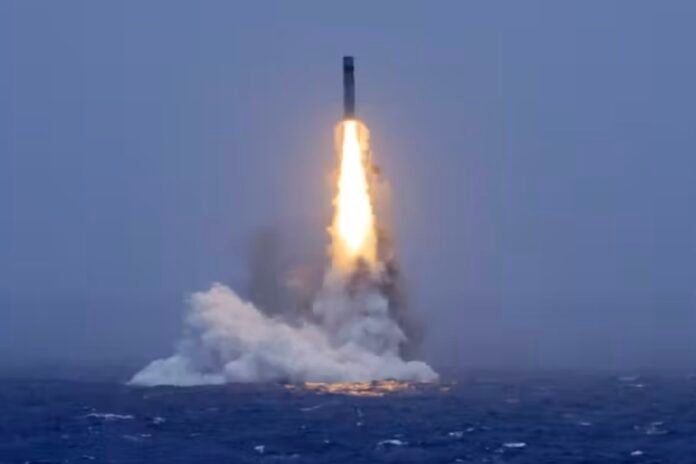
Image: Chinese People’s Liberation Army-Navy.
On July 6, a Chinese navy submarine fired a long-range ballistic missile into international waters in the South Pacific. The nuclear-capable missile, which was launched from underwater and carried an inert dummy warhead, is believed to have splashed down near Tuvalu.
The Chinese government said the event “was a routine part of China’s annual military training program” and was “not directed against any specific country or target.” It added that other countries had been notified, and urged them not to “over-interpret it.”
Reactions from Australia, New Zealand, Taiwan and Japan were immediate and pointed, with Australian Foreign Minister Penny Wong calling the test “destabilizing.”
Commentators were quick to link the test to a new defense pact between Australia and Fiji, signed earlier that day. On this view, the test was intended as an intimidating reminder that Beijing’s missiles can reach throughout the Pacific.
Routine testing?
Every nuclear power that operates strategic ballistic missiles, be they submarine-launched or land-based intercontinental ballistic missiles, periodically test-fires unarmed missiles to confirm the weapons still work, retain their range, and can hit their targets accurately.
The Chinese test in itself is nothing new or particularly alarming. It is part of the basic maintenance of a nuclear arsenal. The tests are not frequent, but they are routine. This one coincided with the beginning of China’s annual naval exercises with Russia.
It’s not at all clear that the test or its timing was intended as intimidation. China maintains a declared no-first-use policy regarding nuclear weapons, meaning it will only use them in retaliation to the use of nukes by somebody else.
Submarine-launched ballistic missiles exist specifically to provide a “second strike” capability – they would survive a nuclear attack on the Chinese mainland, most likely from a major power such as the US, and could be used to respond.
Testing a strategic second-strike capability to intimidate middle and small powers such as Australia, Fiji and other Pacific nations makes little sense. Chinese land-based intercontinental ballistic missiles can already reach as far as Australia and Pacific Island nations.
Submarine-launched missiles like the one tested are deterrents aimed at other nuclear powers, to ensure the credibility of their deterrent even in the event of an overwhelming first strike that completely destroys their land-based nuclear arsenals.
If China really wanted to intimidate Fiji, for example, it would be a lot cheaper and more effective to fly a strategic bomber through or near Fijian airspace, or sail an aircraft carrier battle-group nearby.
Poor handling
None of this means China handled the test well. The Australian government has complained it received notice of the test only hours beforehand, which it says is “not consistent” with The Hague convention on ballistic missile testing.
This is a legitimate concern, as even an unarmed missile poses significant risks to aircraft and shipping in the area, and it’s worth China addressing. But a scramble on notice timing is a different problem from the question of whether the test itself was provocative.
The deeper issue is the asymmetry in how these tests are received. If the US had tested a submarine-launched missile in the Pacific, it’s unlikely Australia or any other US ally would have blinked.
So perhaps what has really provoked the response is not so much the missile itself or the short notice. The issue is watching a potential future adversary show off a capability every other nuclear power already possesses and regularly exercises.
A question of perspective
With all that said, a political dimension to China’s motivation for the test and its timing can’t be ruled out. But we can’t know it from the evidence available.
It’s inarguable the test shows a nuclear-armed China continuing to build and rehearse the same kind of deterrent architecture other nuclear powers rely on.
Whether that reads as a routine technical milestone or a geopolitical warning shot may depend less on the missile itself than on who is watching it.
The First Major Overhaul of Public Lands Grazing Regulations in a Generation Looks to Cut Out Public Involvement
ProPublica is a nonprofit newsroom that investigates abuses of power. Sign up for Dispatches, a newsletter that spotlights wrongdoing around the country, to receive our stories in your inbox every week.
The federal government is rewriting its rules governing ranching on public lands to increase the number of cattle, sheep and other livestock grazing on 155 million acres in the West, an area twice the size of New Mexico.
Public lands grazing is overseen by a nearly century-old system that heavily subsidizes some of the wealthiest Americans while doing little to address its harms to the environment, ProPublica and High Country News found last year.
Even though rangeland management experts say overgrazing has degraded public lands, the new rules being drafted by the U.S. Department of the Interior’s Bureau of Land Management — the first overhaul since 1995 — would instead expand the practice.
The proposed rules would also ratchet back public participation in the agency’s decisions to allow grazing on federal public lands. The BLM’s proposed updates would strictly limit who has a say and when they can object, eliminating many steps where the public has been able to observe and comment on decisions to issue or renew permits.
“They’re clearly trying to reduce involvement of anyone other than ranchers,” said one BLM employee who works on rangeland management.
The BLM did not respond to questions about the proposed regulations, which were released publicly in May and, after a period for public comment, will go back to the agency in mid-July for further review.
In a June news release announcing the action, the agency said it “reflects the Trump administration’s priority to reduce unnecessary regulatory burdens, promote productive working lands and strengthen local economies.”
ProPublica and High Country News spoke to multiple current and former BLM employees to gauge the impact of the proposed regulations. Some, like the BLM staffer who works on rangeland management, requested not to be named because they still are employed by the agency. The employees agreed that the updated regulations offer several concrete benefits, including a requirement that the agency study the ecological impacts of all uses of public lands — from timber harvesting and recreation to mining and oil drilling. The current rules limit such reviews to the livestock industry, where they have uncovered tens of millions of acres of damage due to overgrazing.
The regulations would also allow the BLM to handle low-level violations of grazing regulations more informally, avoiding potentially unnecessary fights between ranchers and regulators; clean up sections of the code that may be at odds with recent court decisions and laws; and offer the agency and ranchers more flexibility in how they manage the range, allowing for quicker decision-making responding to a local ecosystem’s needs.
Tim Canterbury, president of the Public Lands Council, a ranching trade group, in a news release called the update “a massive step forward.”
He said the existing regulations grew from the “cattle free by ’93” movement of the early 1990s that was hostile to ranching and aimed to rid public lands of livestock. “The resulting regulations all but ensured ranchers did not have the flexibility to take full advantage of the scientific and management advances that the industry has made over the last 35 years,” Canterbury said.
Other groups working on rangeland management say the regulations go too far in the opposite direction, tipping the scales toward ranchers. They point to proposals allowing ranchers to continue business as usual if they appeal agency decisions limiting grazing, threatening Native American tribes’ ability to graze bison and enshrining highly subsidized grazing fees. (ProPublica and High Country News found that in 2024 the federal government charged ranchers $284 million below market rate for the use of public lands.)
“We can expect considerably more places where cows and sheep are going to be and more damage,” said Josh Osher, public policy director of the Western Watersheds Project, a conservation group. “I think we see big impacts on wildlife.”
Cattle gather around a water tank on a Bureau of Land Management parcel near Elko, Nevada, leaving the surrounding area bare from grazing and the weight of their steps.Aerial support provided by LightHawk
“Back to the Ronald Reagan Years”
The livestock industry influenced the regulatory rewrite from both outside and inside the Interior Department.
The National Cattlemen’s Beef Association and Public Lands Council, two main trade groups, publicly celebrated their meetings with the secretaries of the Interior and Agriculture departments in the spring. Among their agenda items was a memorandum of understanding allowing the trade groups to give guidance to the departments, including on a “Grazing Action Plan” that involved updating regulations.
The groups did not respond to requests for comment. (The Western Landowners Alliance, which represents conservation-minded ranchers and landowners, said it’s still evaluating the regulations.)
Representatives of Native American tribes and conservation groups, meanwhile, told ProPublica and High Country News that the administration offered them no opportunity to provide input on the draft regulations before they were published.
They also take issue with the process due to the involvement of Karen Budd-Falen, a high-ranking official in the Interior Department and a long-time grazing advocate whose family is in the ranching business. She served in the first Trump administration and was barred from discussing grazing policy due to potential conflicts of interest. But after rejoining the department, she received an ethics waiver allowing her to work on grazing policy.
“You want to know what put the public ranchland out of business — it was Bruce Babbitt’s regulations,” she told Lummis, referring to President Bill Clinton’s Interior secretary from 1993 to 2001. “By the first of next year, you will see fully new regulations that don’t just fix a few of the Babbitt things. We went back to the Ronald Reagan years and are putting back in those regs.”
“I am so excited about these regulations,” she said.
Native American tribes that manage bison herds say Budd-Falen’s efforts to aid ranchers could hurt their operations. Several rancher and stock grower associations in Montana, which at one time were represented by Budd-Falen, have railed against a conservation group called American Prairie that uses permits to graze bison herds to revitalize local ecosystems. The ranchers worry this will cost them subsidized leases and that the bison could spread disease to their cattle.
The Trump administration has sided with the ranchers in the dispute — first by revoking American Prairie’s permits and then by redrafting grazing regulations to mandate public lands livestock operations be “production-oriented,” potentially eliminating permits for herds used to revitalize ecosystems. Tribes fear they too could lose permits for the bison herds they manage to preserve cultural practices or restore the land.
“We’re really concerned about this,” said OJ Semans Sr., a member of the Rosebud Sioux Tribe and executive director of the Coalition of Large Tribes, which represents more than 15 tribes. “I’m just kind of confused about how badly it was written.”
Habitat used by threatened and endangered species has been overgrazed across the Southwest, including in Arizona in the Coronado National Forest (left) and on state trust lands in the Santa Rita Mountains (right).
Less Public Input, More Public Lands Grazing
Ranchers have long complained that conservationists are quick to sue to prevent them from placing their herds on public lands, miring their businesses in litigation. The BLM’s updates would reduce green groups’ ability to challenge decisions.
The agency proposes changing the definition of “interested public,” meaning those who have a say in rangeland management. Under the new proposal, the public would have to prove a “cognizable” interest in the grazing in question. The agency did not respond to a request to define its use of the word. But a former BLM higher-up said that would likely set a higher bar for who gets advance notice of agency decisions and their ability to comment on them. Environmentalists assume it means only those with a business interest would be allowed to influence agency decision making.
The new regulations would also remove a mandate that the BLM include the public in “consultation, cooperation and coordination,” the agency’s process of gathering feedback when preparing to take actions such as authorizing grazing. The update would significantly narrow who must be involved, staff said.
Throughout the regulations, the agency proposed changes that would keep animals on the land.
Mark Squillace, a law professor focused on natural resources at the University of Colorado Law School, noted that if a rancher appeals an unfavorable ruling, it is automatically paused, meaning the rancher can continue the very practices that had been found to be harmful. “That effectively invites everyone to appeal to avoid the decision,” Squillace said. “That is a disaster.”
The new regulations also elevate cows’ status as firefighters, making it easier to place herds on public lands under the justification that they eat vegetation that could become fuel for wildfires.
Nada Culver, deputy director of the BLM during the Biden administration, said that some provisions would make it more difficult for agency staff to tell ranchers to take animals off the land, hindering their ability to address overgrazing. And renewing permits to continue grazing would be even easier under the new regulations, she said.
“The most text in this regulatory proposal is devoted to explaining why the public no longer gets to participate in pretty much every step of the process,” Culver said.
The Trump administration has also prioritized restocking vacant areas, which may be without cows and sheep because they are far from a water source, they need time to recover from wildfire or the agency is attempting to eradicate invasive species. Within months of President Donald Trump returning to the White House, political appointees instructed staff to build lists of every vacant plot that might be eligible for more livestock.
“By the end of next year,” Budd-Falen said in her discussion with Lummis, “every single vacant allotment will be filled by a rancher.”
Grazing is allowed on the BLM’s Horseshoe Allotment in Arizona’s Agua Fria National Monument.
F1 in Britain: Automated software to blame for crushing expectations
Formula 1 returned to what is a home race for most of the teams on the grid this past weekend with the British Grand Prix. Yet again this season, we saw the fastest car not win the race, as reliability has been a problem. But racing giveth and racing taketh away, and the beneficiary of one driver’s bad luck was another driver who really needed that win. Perhaps the bigger story, though, was the unfulfilled expectation that we’d see a late-race restart after the safety car came out on lap 48 of 52. An on-screen message told commentators and viewers this would be the case, but it was displayed in error, and what had been an entertaining race ended as something of a damp squib.
Silverstone, like many of Britain’s race circuits, was a World War II airbase before being demobbed, which means it’s quite flat and can be rather windy. It’s also pretty fast even in its current layout (which was changed in 2010), with corners that are among the best places in the world to watch an F1 car change direction. There were worries that the new cars would find their hybrid power units starved of energy part-way round the track, and in qualifying, the cars were limited to recovering and deploying just 6.5 MJ across a lap, compared to the 8 MJ per lap allowed in the sprint and main race.
That energy limit in qualifying was about right—unlike at Suzuka in Japan, where we had the rather pathetic sight of cars slowing down before the fast 130R corner, drivers in qualifying looked to be at the limit through corners like Copse, Maggotts, and Becketts.
Hamilton’s weekend started stronger than it finished, but P3 was still a great result.
Credit: Paul Foster/Alessio Morgese/NurPhoto via Getty Images
Hamilton’s weekend started stronger than it finished, but P3 was still a great result. Credit: Paul Foster/Alessio Morgese/NurPhoto via Getty Images
On Friday, one driver in particular stood out: Ferrari’s Lewis Hamilton. The most successful driver at Silverstone since its inception, the place named a straight after him as part of that 2010 update. It must be weird going to a track knowing they named part of it after you because you’re just that good; that honor usually comes in retirement. But Hamilton was on form, buoyed up by a massive crowd, most of whom were there to see him.
Much had been expected of a newly upgraded Ferrari engine in Austria, but a combination of altitude and heat meant we did not see it at its best. With thicker, cooler air, the gap to the Mercedes was much less, and an inspired lap from Hamilton, egged on by more than 100,000 spectators, saw him grab the sprint pole from Mercedes’ Kimi Antonelli by 11 milliseconds.
The following day, Hamilton managed to keep the young Mercedes driver at bay and held out for eight laps before the inevitable happened. But Hamilton still finished second, and less than 3 seconds back after 17 laps. That’s much less of a deficit than we’ve seen before. That afternoon saw qualifying for Sunday’s race, but this time Hamilton could only manage third on the grid. Antonelli snatched pole, but between them was Charles Leclerc, Hamilton’s teammate at Ferrari.
Leclerc has been ill at ease with his race car, and if you’re not comfortable in an F1 car, you won’t find its limit. He failed to finish in Monaco and Barcelona and finished a distant eighth in Austria, albeit after qualifying second. This past weekend looked like that trend might continue, until something finally clicked between Leclerc and his Ferrari SF-26. Both Ferraris made better starts than Antonelli with Leclerc in the lead.
Something’s broken
Then on lap 41, something broke in the steering or suspension of Antonelli’s Mercedes, possibly after riding heavily over one of the circuit’s serrated curbs. The Italian driver made another two pit stops to try to solve the problem but to no avail. He would end the race in ninth on the road but was scored 15th after being penalized for repeatedly driving off-track in an attempt to bring his damaged car home.
The exit clause in Max Verstappen’s Red Bull contract is about to open; will he exercise it?
Credit: PETER POWELL / POOL / AFP via Getty Images
The exit clause in Max Verstappen’s Red Bull contract is about to open; will he exercise it? Credit: PETER POWELL / POOL / AFP via Getty Images
Up front, Leclerc looked set to cruise to his first win in almost two years. Then, on lap 48, the active rear wing on Max Verstappen’s Red Bull malfunctioned at Stowe corner. For 2026, F1 cars use a low-downforce configuration on the straights, then a high-downforce setting for the corners. But if front and rear wings don’t transition between the two states quickly enough, it can make the car uncontrollably unstable.
And this is what happened to Verstappen in qualifying in Austria, and now again during the race in Britain. The four-time champion had been in an engaging battle with the other Mercedes of Russell and the Ferrari of Hamilton up until this point; now speculation is stronger than ever that he might walk away from the sport at the end of the season to go GT3 racing instead.
The safety car came out to allow the Red Bull to be recovered from the gravel trap it was parked in. With just four laps remaining, there was every prospect of the race finishing under caution as there wouldn’t be time to reorder the cars and then conduct a restart. Indeed, the rules state that one lap must be completed behind the safety car after the lapped cars are allowed to unlap themselves, and this only happened on lap 51. Leclerc took the win ahead of Russell and Hamilton, who swapped positions when the Ferrari made a pit stop, but the Mercedes didn’t when the safety car came out.
Unfortunately, the unlapping command also caused an automated message to show up announcing that the safety car would be in that lap, meaning a one-lap race to the end with shades of the title-deciding fiasco in Abu Dhabi 2021 (when the rules weren’t followed). But there was never an actual command issued from race control to bring in the safety car, and not enough time to bring the race back to green, and the automated message was erroneous. Eight seconds later, it was replaced by “safety car deployed” again.
Charles Leclerc (R) and his race engineer, Bryan Bozzi (L), celebrate on the podium.
Credit: Clive Mason/Getty Images
Charles Leclerc (R) and his race engineer, Bryan Bozzi (L), celebrate on the podium. Credit: Clive Mason/Getty Images
Races can and do end under cautions even if the race organizers try their hardest to avoid it. Sometimes late-race incidents can’t be cleaned up in time, even if it’s somewhat unsatisfying, although F1’s race director does have the option of a red flag and then a standing restart. Finishing under yellow flags is also easier to deal with when you know it’s going to happen, but yesterday’s on-screen display error caused a lot of false expectations and ruined the ending for more than a few, particularly after the commentators hyped it up. Here’s hoping the boffins at F1’s UK tech center in Biggin Hill can make sure it doesn’t repeat itself.
Woman suspected in Monaco bombing found shot dead near Kyiv
The body of a Ukrainian woman suspected of carrying out a bomb attack that targeted a wealthy Ukrainian-born businessman in Monaco last week was found near Ukraine’s capital Kyiv, Ukrainska Pravda reported on Tuesday.
Citing sources in law enforcement, the Ukrainian news outlet said the woman had been shot and her body was found close to 11 p.m. local time (2000 GMT) on Monday.
Anastasiia Berezovska, 39, was named as the chief suspect in an Interpol Red Notice, which said she was Ukrainian, spoke German and was wanted by authorities in Monaco for attempted murder, placing an explosive device in a public place with criminal intent, and criminal conspiracy.
Monaco’s deputy prosecutor said last week that the attacker had left the principality on foot to nearby France then fled by car to Germany via several European countries, including Italy.
Ukrainian-born Vadym Yermolaiev, his partner and son were wounded in the attack on Monday last week, sources said.
Ukrainska Pravda, citing another source in the law enforcement agencies, reported that two suspects had already been detained in connection with the case.
One of them is an officer with the Main Directorate of Intelligence (HUR), while the other is a former law enforcement officer, Ukrainska Pravda said.
Ukrainian police and HUR did not immediately respond to a request for comment.
Yermolaiev was given Cypriot nationality in 2019 and was placed under Ukrainian sanctions in 2023. Ukrainian media reported this was for doing business in Russian-occupied Crimea.
Norman Solomon: You’ve downplayed the importance of the individual in history. But the United States now has as president an individual who transformed power relations and the political landscape.
Karl Marx: I can assure you that he did not do that by himself. Power relations are class relations. And by the way, I never said individuals are irrelevant to history. I exhorted individuals to get involved in changing history.
NS: President Trump has rolled back gains from the last hundred years and more. Also, he’s mentally unstable, to put it mildly.
KM: The basics still hold. As I wrote in 1869 about a situation in France where a cult existed around a tyrant, the class struggle “created circumstances and relationships that made it possible for a grotesque mediocrity to play a hero’s part.”
NS: But now one highly dangerous and unhinged person has taken control of the US government. And he got there with a majority of votes of the working class. It’s been a huge shock to have a virtual psychopath as president.
KM: Those you would call liberals like to disconnect such poisoned flowers from their historic roots. Victor Hugo was like that, as with so many commentators in your day, endlessly heaping their derision on the despicable despot. Hugo excelled at bitter and witty invective against Louis-Napoleon Bonaparte after the coup d’etat.
As I pointed out, “The event itself appears in his work like a bolt from the blue. He sees in it only the violent act of a single individual. He does not notice that he makes this individual great instead of little by ascribing to him a personal power of initiative unparalleled in world history.”
NS: Actually, Trump does seem to insanely wield destructive power in ways unparalleled in world history.
KM: But he did not obtain that power through his own will. If you fixate on an individual personality, you’ve lost the historical plot.
NS: One sociologist, Dylan Riley, recently commented: “From a Marxist perspective, much of the left-liberal critique of contemporary American politics can be viewed as essentially petty bourgeois. It revolves around moral arguments advocating for equal opportunities and less social division and conflict.”
And he added: “I think that Marx’s central point on this is to emphasize the importance of class struggle as the mechanism through which any class compromise is actually imposed. And if you miss that point then your politics are disabled from the get-go.”
KM: First, I’m glad to say that I am not a “Marxist,” given how much idiotic rubbish has been babbled by some who so label themselves. You can look it up, “Ce qu’il y a de certain, c’est que moi, je ne suis pas Marxiste.”
But that aside – yes, certainly, there is just no way to reasonably talk oneself around the primacy of class struggle. The phrase might sound overly polemical to petty-bourgeois ears in the America of the 21st century, but that’s the most powerful engine driving history. You can deny or evade it, but you can’t really avoid it.
NS: Trump is a voraciously narcissistic capitalist, but he’s also flagrantly racist and misogynist.
KM: Of course, capitalism functions to oppress and divide the working class. Systems of racism mean more profits for the few. Likewise, women are exploited and underpaid for their labor. I wrote about this extensively.
NS: The horrible fact remains that we are now oppressed by an extremely reactionary vicious president aspiring to become an unlimited tyrant. And he harbors special hatred for women and people of color, with horrendous social impacts.
KM: Class struggle failed to result in the needed remedies to appalling human conditions, with some special victimizations within the working class. On this point, we could leave the last words to my comrade Friedrich Engels, who wrote in 1890:
The ultimately determining element in history is the production and reproduction of real life. Other than this neither Marx nor I have ever asserted. Hence if somebody twists this into saying that the economic element is the only determining one, he transforms that proposition into a meaningless, abstract, senseless phrase.
The economic situation is the basis, but the various elements of the superstructure – political forms of the class struggle and its results, to wit: constitutions established by the victorious class after a successful battle, etc., juridical forms, and even the reflexes of all these actual struggles in the brains of the participants, political, juristic, philosophical theories, religious views and their further development into systems of dogmas – also exercise their influence upon the course of the historical struggles and in many cases preponderate in determining their form.
NS: So, you and Engels agreed that many different forces shape history, yet one individual can conceivably make all the difference at certain junctures?
KM: Fred clarified his point further this way: “We make our history ourselves, but, in the first place, under very definite assumptions and conditions. Among these the economic ones are ultimately decisive. But the political ones, etc., and indeed even the traditions which haunt human minds also play a part, although not the decisive one.”
And he went on: “There are innumerable intersecting forces, an infinite series of parallelograms of forces which give rise to one resultant – the historical event.”
NS: Well, right now the historical event that keeps happening often seems to be dominated one way or another by Donald Trump.
KM: Even if it seems that way, the main propellant of a current event can often look obvious while unfolding as optical illusion. As I noted back in 1843, “The demand to give up the illusions about its condition is the demand to give up a condition that needs illusions.”
Never forget that a few live in obscene luxury while billions live in immiseration and billions of others are barely able to scrape together the essentials of life. The struggle between classes might seem an antiquated concept, but nonetheless it is the main factor that undergirds history, past, present and future.
NS: Some people complain that’s what you always say.
George W. Bush’s Marriage Nearly Exploded Over His Drinking
George W. Bush’s battle with alcohol reportedly pushed his marriage to the edge — and triggered a brutal family war that left his relationship with younger brother Jeb Bush “toxic.”
Behind the polished public image of one of America’s most powerful political families, insiders claim years of drinking, bitter arguments and secret divorce warnings threatened to tear the Bush clan apart.
The most shocking allegation centers on Laura Bush, who was reportedly so troubled by her husband’s heavy drinking that she turned to Jeb for help.
Jeb’s advice was allegedly blunt and devastating: Leave George before things get worse.
“When George was drinking heavily, he and Laura were having serious marital problems,” an insider claimed. “Laura came to level-headed Jeb for advice, and he told her to leave his brother for her own good.”
According to the source, the warning was not a one-time conversation.
Jeb allegedly continued urging Laura to file for divorce for years as the couple’s marriage “teetered on the brink.”
The family secret reportedly blew up during one explosive argument between George and Laura.
In the heat of the fight, Laura allegedly revealed that Jeb had been telling her to walk away from the marriage.
The disclosure reportedly sent George into a rage.
“Laura admitted Jeb had told her to file for divorce,” the insider claimed. “Naturally, her husband exploded, and his relationship with Jeb went from bad to toxic.”
The dramatic fallout was allegedly only the latest chapter in a lifetime of rivalry between the Bush brothers.
George and Jeb have reportedly clashed since childhood over everything from girls and baseball to puppies, politics and their places within the powerful Bush dynasty.
Although the family worked hard to keep their disputes hidden from public view, tensions allegedly boiled over again when Jeb entered the 2016 presidential race.
George had already followed their father, George H.W. Bush, into the White House and reportedly believed he would be the final Bush to hold the nation’s highest office.
“George W. thought he would be the second — and last — Bush living in the White House,” the source claimed. “He was happy he and his dad, George H.W., shared the honor.”
But Jeb’s presidential ambitions allegedly struck a nerve.
The insider claimed George feared another Bush presidency could reduce his own historical importance and push him further into the shadow of both his father and younger brother.
According to the source, George worried his “role in history” would be “diminished” if Jeb won the White House.
Still, the political jealousy reportedly paled beside the damage caused by George’s drinking.
Laura and George married in 1977, but their early years together were allegedly rocked by his growing dependence on alcohol.
George eventually quit drinking completely in 1986, when he was around 40 years old.
Years later, the former president admitted that giving up alcohol may have saved his future — and possibly his life.
“I doubt I’d be standing here if I hadn’t quit drinking whiskey, and beer and wine and all that,” Bush told ABC News in 2007.
He said the turning point came after one particularly heavy night.
“I had too much to drink one night, and the next day I didn’t have any,” he recalled. “The next day, I decided to quit, and I haven’t had a drink since 1986.”
Bush later acknowledged just how difficult it was to break free.
“It’s a difficult thing to do, which is to kick an addiction,” he said.
The former president also admitted alcohol had begun battling for control over the other important parts of his life.
He said drinking could compete with “affections” for family, health and exercise.
“It was the competition that I decided just wasn’t worth it,” he explained.
Bush described himself as a “better man” after quitting and later used his own painful history to encourage a teenage girl struggling with drug abuse.
“I was trying to encourage her to stay strong,” he said.
Bush explained that he wanted her to understand that addiction can affect anyone — even people who are rich, powerful and famous.
George and Laura ultimately stayed together, weathering the alleged drinking crisis, divorce warnings and fierce family tensions before entering the White House in 2001.
But the insider’s claims reveal a far darker story behind the scenes — one in which George’s drinking allegedly brought his marriage close to collapse, turned brother against brother and nearly shattered America’s most famous political dynasty.
Trump says US prefers nuclear deal with Iran but warns military action remains an option
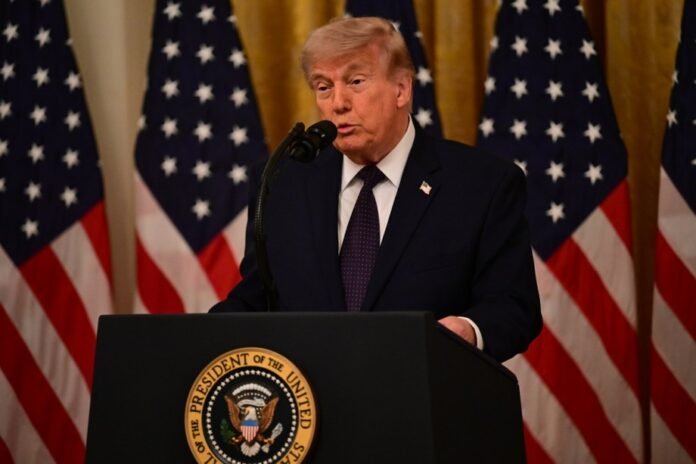
President Donald Trump said Monday that the US remains committed to reaching a nuclear agreement with Iran but warned that Washington is prepared to use military force if diplomacy fails, insisting Tehran must never acquire a nuclear weapon, Anadolu reports.
“We’re either going to make a deal or we’re going to finish the job. Okay, and it won’t be tough to finish the job. I’d rather make a deal, because I don’t want to affect 91 million people,” Trump told reporters at the White House.
Trump said the US has the capability to strike Iran’s infrastructure if necessary.
“We can knock down their bridges in one hour, we can knock out their energy supply … They don’t have any money now. We haven’t given them any money.”
The president again ruled out Tehran having nuclear weapons.
“Iran cannot have a nuclear weapon. I’m not looking for regime change,” he added.
READ: Israeli defense minister threatens Iranian leaders as Iranians mourn Khamenei
Later, speaking at a Rose Garden Club Lunch at the White House, Trump said recent US military operations had weakened Iran’s military capabilities and again urged Tehran to reach an agreement.
“We wiped out their navy, their air force, their radar, their leaders. We wiped out everybody,” Trump said. “And then I heard they’re doing very well. No, they’re not doing well at all.”
Iran wants to make a deal “so badly,” Trump said.: “We’ll see what happens. They have to make the right deal, because they cannot have a nuclear weapon.”
“We’ll see what happens. We’re gonna win one way or the other. We’ll win the nice way or the not nice way.”
Trump’s remarks came after indirect US-Iran talks concluded last week without any public indication of progress toward a broader agreement, despite a 60-day ceasefire intended to provide space for diplomacy following the conflict that began with US and Israeli strikes on Iran on Feb. 28.
READ: Iranian parliament speaker: We have no peace with US and will not recognise Israel
The incredible shrinking Xbox: Five studios, 3,200 employees let go
Last month, Xbox executives laid out some “hard truths” about Microsoft’s struggling gaming division that they said would require a difficult “Xbox reset.” This morning, Microsoft revealed the brutal shape of that “reset,” announcing plans for 3,200 layoffs and the divestment of five smaller studios that the company has spent years acquiring and shepherding.
Half of those 3,200 layoffs are effective today, new Xbox CEO Asha Sharma wrote, while the other half will come by the end of Microsoft’s 2027 fiscal year (which runs through June 30, 2027). CNBC cites “a person familiar with the matter” in reporting that these cuts amount to roughly 20 percent of the Xbox division.
When combined with 1,600 newly announced layoffs across the rest of Microsoft, the company as a whole is letting go of just over 2 percent of its workforce. But The Seattle Times reports that Microsoft’s total headcount has remained relatively stable thanks to other hiring.
The newest Xbox cuts follow a string of Microsoft gaming layoffs in recent years, including 1,900 jobs cut in the wake of the Activision Blizzard acquisition and 650 jobs cut later in 2024. In July of 2025, another round of layoffs led to the cancellation of a number of in-development gaming projects at Xbox such as Perfect Dark and Everwild. In today’s announcement, though, Sharma said that “none of our first party publicly announced games or projects are being cancelled as part of these reductions.”
Sharma characterized these Xbox staffing reductions as a way to “simplify” a division that has become bloated with complicating layers of middle management. Some decisions in the gaming division currently pass through “14 layers” of decision-makers, Sharma said, before promising that the new Xbox will be a “flatter organization” with “no more than 5, and where possible, 3” layers of management involved in any decision.
Today’s announced layoffs also seem focused on reining in a large Xbox platform team, which Sharma said has grown “40% larger than they were at the start of this generation, even as our player base and playtime have declined.” That could have an outsized impact on the development of Project Helix, the recently announced hybrid console that will also play generic PC games.
Hit the road, small studios
Amid these layoffs, Microsoft is also executing a massive reversal of its studio acquisition spree that dates back to 2018. Compulsion Games (We Happy Few) and Double Fine Productions (Psychonauts) will “return to management” and operate independently with full control of their intellectual property, Sharma writes. Ninja Theory (Hellblade: Senua’s Sacrifice) and Undead Labs (State of Decay), meanwhile, have been purchased by other unnamed companies, while France’s Arkane Studios (Dishonored, Prey) is reviewing “potential strategic options” to operate outside of Xbox.
Sharma bluntly admitted that these smaller studio acquisitions have been a financial mistake for Microsoft, resulting in a loss of “64 cents for every dollar we invested” in a “typical year.” In recent years, Sharma writes that Xbox has “learned that we are not the best home for every type of studio” and that “it is neither possible nor desirable to own every great independent studio.”
The era that brought games like Hellblade: Senua’s Sacrifice to Xbox is over.
Credit: Arkane Studios
The era that brought games like Hellblade: Senua’s Sacrifice to Xbox is over. Credit: Arkane Studios
At the same time, some of the larger game studios Microsoft has acquired are still apparently considered very desirable parts of its portfolio. Mojang (Minecraft) and King (Candy Crush) will now report directly to Sharma, reflecting their outsize share of Microsoft’s monthly player base and the “critical geographic, demographic, and differentiation” they bring to the gaming division, Sharma writes. And across Activision, Blizzard, Bethesda, and Xbox Game Studios, Sharma writes that Microsoft will be “shifting investment to focus on higher priority projects.”
The shift in Microsoft’s gaming priorities from small indie acquisitions to massive conglomerates has been apparent in recent years, with Microsoft shutting down Arkane Austin (Redfall) and Tango Gameworks (Hi-Fi Rush) shortly after finalizing its $69 billion investment in Activision Blizzard King in 2023. But today’s round of studio divestments seems to put a hard stop on the era where Microsoft was willing to put money toward pulling interesting indie developers into the Xbox fold.
In this new era, Microsoft will be refocused on taking big swings with the “industry-defining franchises” that it said last month had suffered from a lack of adequate funding in recent years. That’s good news for fans of Call of Duty, Fallout, and Halo, but less good news for fans of the offbeat experiments that have until now filled out Xbox Game Pass subscriptions.
It’s a hard pivot that Sharma admits is necessary because of bad Xbox investments in recent years, including a focus on Game Pass subscriptions and multi-platform games that “have created meaningful value,” but “did not grow at the pace we expected.” Those relative failures led to an Xbox division that essentially threw good money after bad and “added more teams, more investment, and more time, hoping for a better outcome,” Sharma wrote.
At the same time, those moves weakened Microsoft’s core gaming business, Sharma writes, resulting in a division “operating at margins that are 3-10x lower than comparable platform and publishing businesses.” But the people responsible for those strategic failures are not the ones who will be bearing the brunt of the division-wide changes announced today.
“I know this is painful,” Sharma writes. “These changes will directly affect people who have poured their creativity into building Xbox. Many joined us through acquisitions, while others were recruited here, or sought us out because they loved this industry and loved Xbox. Today’s decisions do not reflect their talent or dedication.”
China’s weapons may face mounting questions over quality, reliability and after-sales support, but its arms trade still serves a larger strategic purpose: locking vulnerable states into long-term military, economic and political dependence.
That paradox is at the center of a June 2026 report by The Takshashila Institution, which argues that China’s rise as a major global arms exporter has outpaced its ability to guarantee battlefield performance and life-cycle support.
The report says China’s state-led military-industrial complex has supplied a rising number of tanks, drones, ships, missiles and aircraft to buyers, including Pakistan, Thailand, Saudi Arabia, Iraq, Algeria, Nigeria, Kenya and Myanmar.
It notes repeated problems in widely exported systems, including thermal and metallurgical issues in VT-4 tanks used by Thailand and Nigeria, and crashes, offloading incidents or groundings involving CH-4B drones operated by Jordan, Iraq and Algeria.
China became one of the world’s top arms exporters while reducing its own dependence on imports, with Pakistan, Serbia, Thailand and Algeria relying heavily on Chinese weapons systems by 2025.
Still, the report says operational failures, spare-parts shortages, sanctions pressure, corruption probes and renewed US and Russian competition may limit deeper defense ties beyond close partners such as Pakistan.
Yet China’s offer remains attractive because its weapons are relatively affordable, come with fewer political conditions attached than Western arms and can complement wider Chinese infrastructure, finance and diplomatic relationships.
For China, such sales offer more than revenue: they provide combat feedback, increase political leverage and strengthen ties with states that often have few Western alternatives.
Their deeper value lies in the ecosystem around them: frigates, jets, drones, tanks and armored vehicles require spare parts, maintenance, software updates, training and access to the supplier over years.
Those dependencies give China channels of influence long after the initial sale, helping bind clients’ foreign policy, defense and economic interests more closely to its own.
Pakistan shows how that dependence works. Stockholm International Peace Research Institute (SIPRI) data show China was the world’s fifth-largest arms exporter from 2021 to 2025, accounting for 5.6% of global arms exports.
Pakistan was by far China’s biggest customer, taking 61% of its arms exports over that period. Pakistan’s reliance on Chinese systems has deepened as US sanctions linked to its nuclear and missile programs have blocked access to US and Western weapons.
For China, arming Pakistan also helps to keep rival India strategically stretched. A crisis involving Pakistan in Kashmir and China along the Himalayan frontier would force India to divide strategic attention, military assets and political bandwidth between two nuclear-armed adversaries.
The military relationship is reinforced by economics. Pakistan is a central node in China’s Belt and Road Initiative (BRI), with the China-Pakistan Economic Corridor (CPEC) linking western China to the Arabian Sea through Pakistan’s Gwadar port.
That’s given China rich leverage over Pakistan. The deeper Pakistan’s dependence on Chinese arms, finance and infrastructure becomes, the harder it is for Pakistan to resist China’s geopolitical preferences. Any attempt to scale back CPEC projects or limit Chinese influence could expose Pakistan to financial penalties, diplomatic pressure or reduced military cooperation.
Myanmar is in a similar situation. Chinese arms sales to the coup-installed junta suggest Beijing sees the military regime, despite its brutality on the battlefield and lack of recognition in the West, as the most viable force for holding the country together and protecting Chinese interests.
The China-Myanmar Economic Corridor (CMEC) is central to those interests. Like CPEC, it offers China another hedge to its Malacca dilemma through roads, pipelines and a key port on the Indian Ocean. Between the February 2021 coup and 2023, Myanmar reportedly received $3 billion in Chinese foreign direct investment, much of it tied to CMEC and mining.
Chinese weapons have kept the junta in the fight against a panoply of rebel groups. Fighter jets, helicopters, artillery and armored vehicles supplied by China have boosted the military’s conventional advantage, even as the coup regime has lost significant ground across the country, including in western Rakhine state where much of China’s commercial interests lie.
But dependence has costs. Writing for Mizzima in January 2026, Maung Maung Myint argued that the junta’s overriding focus on regime survival has trapped Myanmar in dependence on China, contradicting the sovereignty Myanmar’s military claims to defend.
He described Myanmar as a “zombie client state” that claims sovereignty while lacking real decision-making power and relying on external support to sustain an unpopular war machine.
China’s support for Myanmar also weakens ASEAN’s already limited ability to respond to the civil war. Several Southeast Asian governments are reluctant to confront the junta directly, whether because of their own histories of military rule or dependence on Chinese economic and defense ties.
That reluctance gives China another leverage point in the region and risks carrying over into other disputes, including the South China Sea, where China benefits from a divided regional bloc.
The key question, then, is not whether Chinese weapons are uniformly reliable. The Takshashila Institution report shows clearly that Chinese arms have many serious shortcomings. The more important issue is how China embeds even contested arms sales in a wider system of military dependence, infrastructure finance and political leverage.
For the US and its allies, competing with that model requires more than selling better weapons. It requires offering states credible alternatives, including defense cooperation backed by financing, infrastructure, diplomacy, training and long-term support. Otherwise, China can continue turning imperfect weapons into lasting strategic influence.
Sa’ar Says Hamas Governance Plan Is Meant To Avoid Disarmament
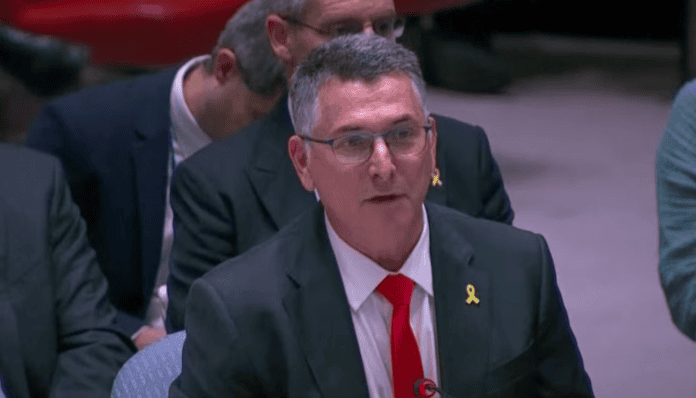
Israeli Foreign Minister Gideon Sa’ar on Monday said Hamas’s proposal to transfer Gaza’s civilian administration to a technocratic committee is an attempt to preserve the terrorist group’s military power, insisting that any postwar arrangement must include the organization’s complete disarmament.
Sa’ar said Hamas’s July 6 announcement does not represent a genuine relinquishment of control but instead mirrors what he described as the “Hezbollah model,” under which civilian institutions handle day-to-day administration while an armed group continues to wield military authority.
“The willingness to ‘make room’ for a technocratic government is designed to prevent Hamas from being disarmed,” Sa’ar said. “Hamas is interested in a ‘Hezbollah model’ in Gaza: the technocratic committee will be responsible for garbage collection and municipal services, and Hamas will remain the dominant military force.”
Reaffirming Israel’s position, Sa’ar said, “Israel insists on implementing the Trump plan as written, with the disarmament of Hamas and other terror organizations and the demilitarization of the Gaza Strip at its core.”
Hamas has presented the transfer of governing responsibilities as a measure intended to advance the stalled peace process. The proposal, however, does not include any commitment by the group to relinquish its weapons.
According to the official, any technocratic committee assuming responsibility for Gaza would do so only after Hamas had been completely stripped of its military capabilities.
The official also said reconstruction of Gaza would not proceed while Hamas remained armed, adding that proposals calling for rebuilding before the terrorist group’s military infrastructure is dismantled would not be accepted.