5.2 C
London
Thursday, November 26, 2026
Home Blog

Why is India so afraid of Pakistan’s Netflix love story?

0
why-is-india-so-afraid-of-pakistan’s-netflix-love-story?
Why is India so afraid of Pakistan’s Netflix love story?

<

article id=”post-953579″>

In George Orwell’s “1984”, the greatest threat to an authoritarian system is not an army approaching its borders or an enemy preparing an attack. It is the possibility that people might begin to think differently.

In Orwell’s imagined world, controlling information becomes a way of controlling reality: books disappear, inconvenient histories are rewritten, and independent voices become dangerous simply because they offer another version of the truth.

It is a fictional world, but its warning feels increasingly relevant in contemporary South Asia, where even a drama can become a national security concern.

This week, an Indian film workers’ association appealed to Prime Minister Narendra Modi to prevent Netflix from streaming Pakistan’s first original series, Jo Bachay Hain Sang Samait Lo, in India.

Featuring some of Pakistan’s most recognizable actors, including Fawad Khan, Mahira Khan, Hania Aamir and Sanam Saeed, the series premieres internationally on December 4, 2026. Adapted from Farhat Ishtiaq’s bestselling Urdu novel, it follows six interconnected love stories across three generations.

The Indian association’s censorship demand goes well beyond one particular production. The All Indian Cine Workers Association has called for a permanent law prohibiting Pakistani entertainment content, artists and productions from Indian television, cinema screens and streaming platforms.

The appeal reflects a familiar approach in which cultural exchange is not treated as an opportunity for fostering understanding but as something to be restricted whenever bilateral relations deteriorate.

Pakistan is preparing to introduce its storytelling to a global streaming audience, while voices within India’s film industry ask their prime minister to ensure Indian audiences never see it.

When entertainment is the enemy

In May 2025, India’s Ministry of Information and Broadcasting issued an advisory asking OTT platforms and streaming services operating in the country to discontinue Pakistani-origin films, dramas, songs and other content.

It followed the Pahalgam terrorism incident of April 22, 2025, after which India accused Pakistan of involvement, an allegation Islamabad denied. The military confrontation that followed further damaged fragile cultural relations, and Pakistani artists faced renewed restrictions as entertainment became entangled in the wider political dispute.

Governments have legitimate responsibilities to protect their citizens, but those responsibilities should not automatically make every artist, filmmaker, musician or television production from a neighboring country a security threat.

So what is so threatening about an Urdu-language drama about relationships, family and human emotions?

There was a time when Pakistani dramas crossed the Indian border without diplomatic permission. Humsafar, starring Fawad Khan and Mahira Khan, found an audience in India after its 2014 broadcast. Zindagi Gulzar Hai and other Pakistani productions also found viewers who connected with their characters, emotional depth and familiar cultural experiences.

These audiences did not necessarily agree on politics, history or national identity. They simply recognized something human in the stories.

That is perhaps the most uncomfortable aspect of cultural exchange for those who prefer political hostility to remain permanent. A television drama can introduce audiences to people they have been encouraged to view only through the language and imagery of rivalry.

A familiar expression, a shared language or an emotionally compelling character can reveal similarities that political rhetoric obscures. Culture does not resolve territorial disputes or erase historical disagreements. But it can create spaces in which societies recognize one another beyond the boundaries of official narratives.

This is why cultural exchange matters most between countries with difficult political relationships.

Modi’s politics of exclusion

Modi’s government has increasingly operated in a political environment where national identity, security and cultural belonging are closely intertwined.

The treatment of Pakistani artists and entertainment illustrates how quickly the language of national security can extend into the cultural sphere. A permanent legal prohibition on Pakistani entertainment would institutionalize the hostility, turning a political disagreement into a long-term barrier between ordinary people, artists and audiences.

It would also send a conflicted message about India’s confidence in its own cultural industry. A country with one of the world’s largest film industries should have little reason to fear that its audiences might watch a Pakistani drama. If a production is compelling, audiences can judge it on its merits. If it isn’t, viewers will change the channel.

The irony is striking given the global ambitions of Indian entertainment. Bollywood has benefited enormously from the ability of cinema and television to cross linguistic, geographical and political boundaries. Yet when Pakistani storytelling seeks similar recognition, sections of the Indian film industry demand that the doors be closed.

For Pakistan, Jo Bachay Hain Sang Samait Lo is much more than another television production. It marks a new stage in the international visibility of Pakistani entertainment.

The Netflix collaboration lets a Pakistani creative team introduce Urdu-language storytelling to a global audience, with established actors and a novel by a Pakistani author showing the potential of the country’s literary and entertainment industries.

Its importance does not depend on whether Indian subscribers can access it. In fact, the controversy has drawn more international attention to a production that might otherwise have been discussed mainly in entertainment circles. India’s bid to restrict its audience has added a dash of controversy that has become part of the story around its launch.

Enemies out of artists

Returning to Orwell, the most unsettling feature of 1984 is not merely censorship but the gradual normalization of the idea that certain thoughts, voices and expressions should not exist.

When governments and political organizations treat artistic expression as an extension of national confrontation, ordinary cultural relationships become casualties of geopolitical hostility.

There is a difference between defending national interests and cultivating permanent antagonism. There is also a difference between political disagreement and the belief that an entire population’s creative expression can and should be denied an audience.

India may be able to restrict access to Pakistani content within India’s borders, but it cannot determine whether the rest of the world watches, appreciates or embraces Pakistani storytelling.

Perhaps that is the master narrative of the story. A drama can be denied a screen in one country and still travel across continents. An actor can be excluded from one film industry and still find a global audience. A language can be politically marginalized in one market and celebrated in myriad others.

In Orwell’s world, power sought to control what people could see, hear and remember. In the real world, however, stories can outlive the political anxieties that try to silence them.

Pakistan’s first Netflix original should therefore be viewed not as a challenge to India, but as an opportunity for Pakistan. Its success should be measured by the audiences it reaches, the conversations it creates and the confidence it brings to the country’s creative industry.

After all, a nation confident in its own identity has little reason to fear the stories told by its neighbors. And a story, unlike a border, was never meant to remain confined to one side of any line.

Farwa Imtiaz is an independent academic researcher with a master’s degree in peace and conflict studies from the National Defence University, Pakistan. Her work has been featured in The Friday Times, Paradigm Shift, South Asia Times, Voice of Germany, Global Connectivities, Stratheia, EcoAsiaNews, International Policy Journal, South Asia
Journal, Sri Lanka Guardian, Global South Forum and Middle East Monitor.

Source: Iwpost.com

Draining peatlands is responsible for a few percent of our global warming

0
draining-peatlands-is-responsible-for-a-few-percent-of-our-global-warming
Draining peatlands is responsible for a few percent of our global warming
Much of the focus for human-caused climate change is on fossil fuels, which are creating most of our problems. But land use change is also a large component of the story, accounting for about one-third of total historical CO2 emissions. Deforestation plays a major role here, but practices like draining wetlands also factor in. Exactly how much of our history of eliminating wetlands has contributed to warming is challenging to figure out. But thanks to new sources of data that measure emissions from today’s surviving wetlands, it’s possible to put a better number on it.

A new study led by Jevan Yu at MIT focuses on peatlands—environments like bogs and fens where organic matter accumulates into thick layers of material. Some 600 billion tons of carbon are held in these vast stores of peat, which is more than you can find in all the world’s living vegetation, the researchers note.

Because these areas are permanently inundated, any oxygen in the water is quickly used up, leaving the job of decaying all that organic matter to anaerobic bacteria that work much more slowly and don’t digest everything. So instead of seeing organic carbon turning into the CO2 gas released by aerobic bacteria, in peatlands, a subset of it gradually turns into methane gas. Methane is an even more potent greenhouse gas than CO2 itself and ultimately gets oxidized into CO2. That means there’s a little trade-off from peatlands—most of the carbon they have is kept out of the atmosphere, but the carbon that does escape does so as methane.

Many peatlands have been drained by digging ditches that let water flow out to repurpose the land for agriculture or other uses. That lowers the water level, supplying oxygen to the exposed peat and ringing the aerobic bacteria dinner bell. Methane emissions get turned down, and CO2 emissions get turned way up.

History re: peats

The researchers used recent studies that measure gas emissions from peatlands to build a global model that estimated CO2 and methane release as the water level drops. The two gases respond differently to a given drop in water level, and CO2 in particular responds differently depending on where in the world the bog is located. Using reconstructions of water-level changes due to historical peatland drainage, the team ran their model starting in 1800.

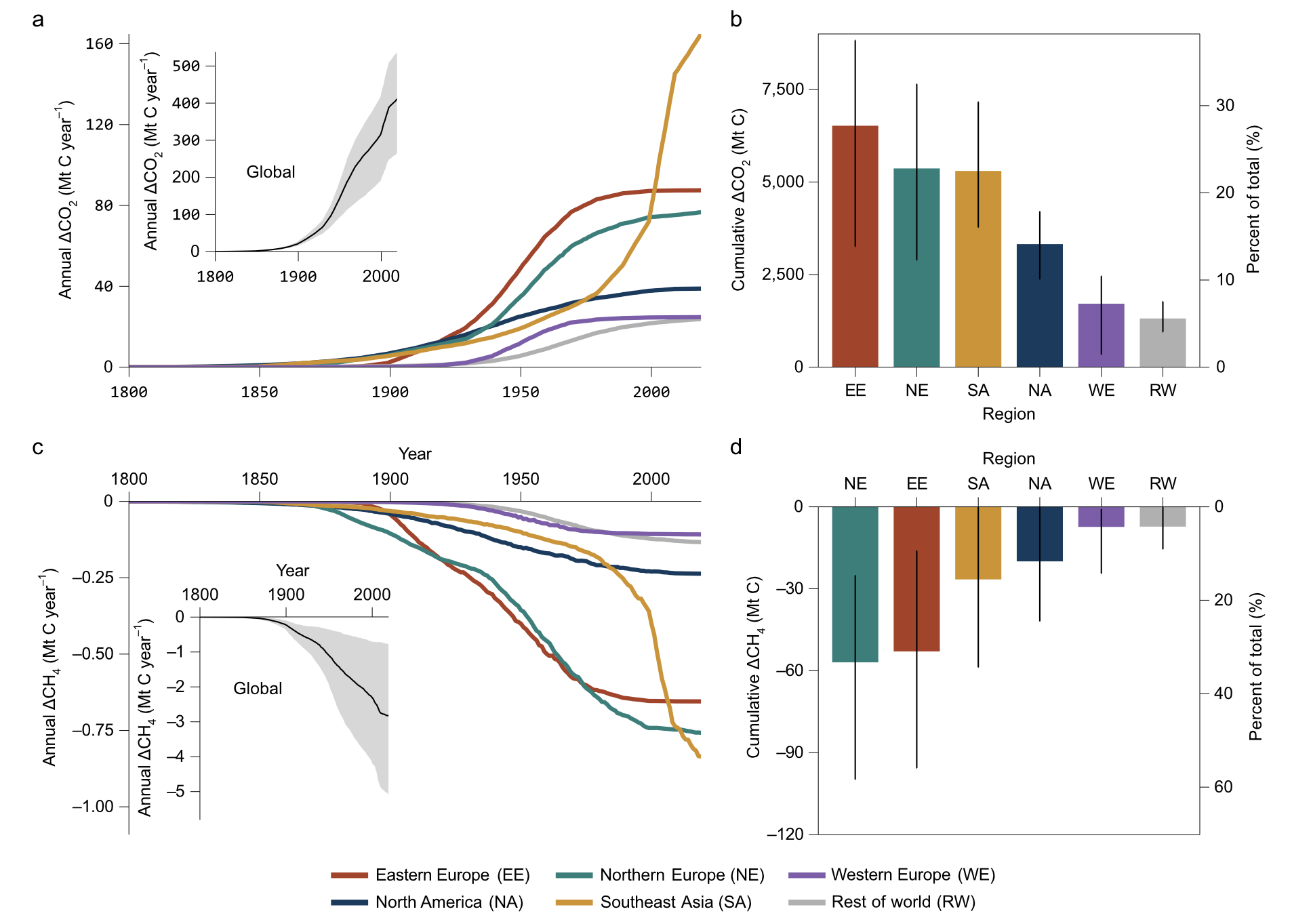
The simplest way to represent the climate impact of both CO2 and methane changes was to calculate the change in Earth’s energy budget—the strength of the greenhouse effect, in other words. They calculated the total effect in 2020 at about +83 milliwatts per square meter of the Earth’s surface from the CO2 emissions, and about -9 milliwatts per square meter from the reduced methane emissions, for a total effect of +73 mW. That is 2.7 percent of the total human-caused change in Earth’s energy budget. (With the error bars on all these numbers, it’s 1.8–3.6 percent.)

Or to look at it another way, it means that around 4 percent of all the carbon that was buried in peatlands is now in the atmosphere.

Regionally, over half of the total CO2 came from Europe, almost a quarter came from Southeast Asia, and only 14 percent came from North America. The timing is quite different, as well, with the contribution from Southeast Asia only jumping up in the last few decades.

Image of four charts.

Regional emissions timeline (left) and total shares (right) for carbon dioxide (top) and methane (bottom).

Regional emissions timeline (left) and total shares (right) for carbon dioxide (top) and methane (bottom). Credit: Yu, et al./Nature

Draining a peatland only starts the process of releasing carbon, though. So that means past land-use change will still be producing emissions in the future. To examine this, the researchers also ran their model forward to 2100.

If peatland water levels were simply held constant from 2020 on, the total change in Earth’s energy budget would nearly double, from 73 to 138 milliwatts per square meter by 2100. Moderate restoration of peatland water levels could reduce that growth, and ambitious restoration could even cause the effect to shrink slightly below its 2020 potency in their analysis. This is a process we can halt if we really want to.

But since rolling all the way back to the landscape of 1800 is unlikely, elevated emissions will continue for a long time. That makes this another part of the climate system where change plays out slowly, with long-term consequences.

Nature, 2026. DOI: 10.1038/s41586-026-11339-0 (About DOIs).

Source: Iwpost.com

Asia’s payment revolution is really a monetary sovereignty story

0
asia’s-payment-revolution-is-really-a-monetary-sovereignty-story
Asia’s payment revolution is really a monetary sovereignty story

<

article id=”post-953583″>

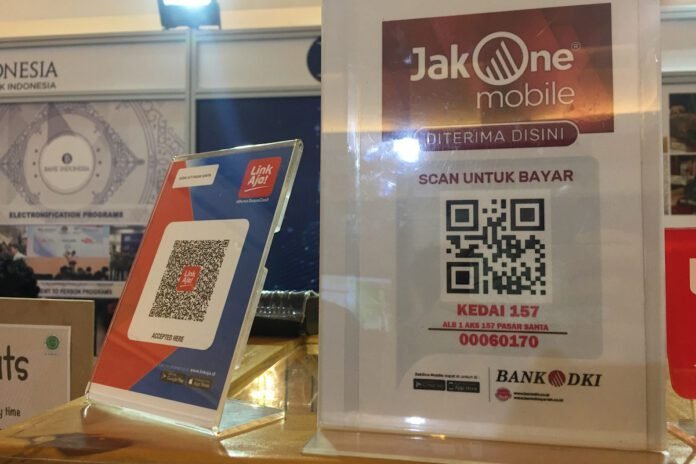
Asia’s payment landscape is changing in ways that are easy to overlook. An Indonesian tourist can now pay at participating merchants abroad by scanning a QR code through a domestic payment app.

Foreign visitors can do the same in Indonesia. Behind that simple transaction lies a much larger shift. Asian central banks are building a regional payment network that gives their economies greater control over how money moves across borders.

Indonesia offers one of the clearest examples. Bank Indonesia introduced the Quick Response Code Indonesian Standard, or QRIS, to unify a fragmented domestic QR-payment market. Merchants no longer needed to display different codes for every payment provider.

Adoption has been rapid. In the first half of 2026, QRIS processed 12.55 billion transactions worth around 600.7 trillion rupiah. It was used by more than 66 million people and nearly 45 million merchants, most of them micro, small and medium-sized enterprises.

Transaction volume was twice the level recorded in the first half of 2025. These numbers matter because Indonesia is not taking an experimental platform overseas. It is extending a domestic payment system that has already achieved mass adoption.

Cross-border QRIS payments have connected Indonesia with several regional partners, allowing Indonesian travelers to use participating domestic applications abroad and visitors from partner countries to pay Indonesian merchants. This is usually described as a story about convenience, tourism and digital innovation.

But its strategic significance goes further. When payments are directly connected and settled in local currencies, consumers and businesses can avoid unnecessary currency conversions. A transaction between two Asian countries does not always need to pass through a third currency before reaching its recipient.

That does not mean Asia is abandoning the US dollar. The dollar remains central to trade invoicing, foreign-exchange reserves, commodity markets and international finance. Asian central banks are neither able nor necessarily seeking to overturn that system.

This distinction matters because local-currency initiatives are often presented in extreme terms. One side sees them as evidence that the dollar’s dominance is ending. The other dismisses them as political gestures with little commercial value. Indonesia’s experience points to a more practical story.

Transactions under Bank Indonesia’s Local Currency Transaction framework reached the equivalent of US$14.1 billion by July 2025, up 112% from $6.7 billion in the same period a year earlier. The seven-month figure was already equal to 87% of the $16.28 billion recorded throughout 2024. Average monthly users rose from 5,020 in 2024 to 7,568 in 2025.

These figures remain small compared with Indonesia’s total international transactions. Yet their growth shows that local-currency cooperation is moving beyond declarations made at regional meetings.

The link between payment connectivity and local-currency settlement is especially important. Cross-border QR systems provide a channel that consumers and small businesses can use.

Local-currency arrangements provide the settlement framework behind those payments. Together, they can bring monetary cooperation out of central-bank conference rooms and into ordinary economic activity.

The regional ambition is already clear. In 2023, ASEAN leaders backed stronger regional payment connectivity and wider use of local currencies. They connected the initiative with cheaper cross-border payments, deeper financial integration, stronger regional value chains and reduced exposure to exchange-rate volatility.

Technology is making that ambition more credible. Project Nexus, initiated by the Bank for International Settlements Innovation Hub, developed a framework for connecting domestic instant-payment systems. Instead of creating a separate link between every pair of countries, participating systems can connect through a shared platform.

Indonesia, Malaysia, the Philippines, Singapore and Thailand were involved in the project’s development. Under the Nexus model, most cross-border payments could reach their recipients within 60 seconds.

In 2025, the central banks of Indonesia, India, Malaysia, the Philippines, Singapore and Thailand established Nexus Global Payments to move the initiative toward implementation.

Yet faster payments do not automatically produce monetary sovereignty. Greater connectivity brings greater exposure to fraud, cyberattacks and money laundering. It also raises difficult questions about data governance, consumer protection and responsibility when a cross-border transaction fails.

Indonesia’s own figures reveal the challenge. Its financial-inclusion index reached 93.61% in 2026, while its financial-literacy index stood at 69.57%. Access to financial services is expanding faster than many consumers’ ability to understand and manage digital risks.

There is also a regional divide. Singapore’s advanced financial infrastructure, Indonesia’s enormous digital market and the more limited systems of developing ASEAN economies do not begin from the same position. Without regulatory coordination and technical support, payment integration could widen the gap between regional leaders and late adopters.

This is why Bank Indonesia’s role deserves attention. It has helped connect three areas often treated separately: domestic financial inclusion, cross-border payment infrastructure and local-currency settlement. That combination offers a more realistic route to monetary resilience than dramatic calls for dedollarization.

It does not require Asian economies to abandon the dollar or choose between rival geopolitical blocs. It gives them additional channels through which to conduct regional transactions.

For economies repeatedly exposed to global interest-rate cycles, exchange-rate volatility and disruptions in capital flows, having more options is itself a form of resilience. Asia’s payment revolution is not a revolt against the dollar. It is an effort to ensure that the dollar is not the only road available.

If Asian central banks can build secure and trusted rules behind these new connections, the lasting result will be more than a faster payment at the checkout counter. It will be a regional financial system in which monetary sovereignty is strengthened not through isolation, but through connectivity.

Hari Suciono works at Bank Indonesia. The views expressed are solely those of the author and do not necessarily reflect those of the institution.

Source: Iwpost.com

Barzani rejects Baghdad’s ‘unconstitutional’ decisions, warns against imposing its will on Kurdistan

0
barzani-rejects-baghdad’s-‘unconstitutional’-decisions,-warns-against-imposing-its-will-on-kurdistan
Barzani rejects Baghdad’s ‘unconstitutional’ decisions, warns against imposing its will on Kurdistan
Masoud Barzani, leader of the Kurdistan Democratic Party (KDP), affirmed Wednesday that Iraq’s Kurdistan Region would not engage with any decisions or measures falling outside the framework of the Iraqi Constitution.

Barzani warned against attempts by any party to impose its will on the people of Kurdistan through decisions he described as ‘unconstitutional’.

His remarks came during a meeting with Italian Ambassador to Iraq Niccolò Fontana, also attended by Italian Consul General in Erbil Tommaso Sansone.

The meeting addressed political developments in Iraq and relations between the federal government in Baghdad and the Kurdistan Regional Government (KRG).

According to a statement issued by Barzani’s office, the discussions also addressed a “military decision” taken by the Iraqi federal government on Tuesday, without providing further details about the measure.

READ: Iraq seeks Iranian clarification over drone attack on residence of Kurdish regional premier

Barzani emphasised that the Iraqi Constitution remains the definitive reference for determining constitutional powers and governing relations between Baghdad and Erbil.

He said the Kurdistan Region had made every possible effort to resolve outstanding disputes with the federal government, stressing that “no individual or party has the right to impose its will on the people of Kurdistan through unconstitutional decisions and a mindset of denial.”

For his part, Fontana underscored Italy’s interest in the role and status of the Kurdistan Region within Iraq, reaffirming Rome’s support for a “strong and unified” Kurdistan Region.

The Italian ambassador expressed hope that outstanding disputes between Baghdad and Erbil could be resolved through dialogue and mutual understanding.

The remarks come amid ongoing disagreements between the federal and regional governments over constitutional powers and the nature of their relationship.

READ: Iraq begins closing unofficial border crossings with neighboring countries

Source: Iwpost.com

Guilty: Huawei faces steep penalties for stealing T-Mobile, Cisco trade secrets

0
guilty:-huawei-faces-steep-penalties-for-stealing-t-mobile,-cisco-trade-secrets
Guilty: Huawei faces steep penalties for stealing T-Mobile, Cisco trade secrets

On Tuesday, a US jury convicted one of China’s key telecommunications and AI giants, Huawei Technologies, of stealing trade secrets from US tech firms and evading sanctions against Iran.

Although the longrunning charges stem back to 2018, the verdict coming now threatens to inflame US-China tensions at a sensitive time, just as Donald Trump prepares to increase tariffs on China. In a press release, however, the US Department of Justice celebrated the outcome as critical to protecting the US financial system, the global telecommunications industry, and US national security.

The jury convicted Huawei of charges including bank fraud, conspiracy to defraud the US, money laundering conspiracy, and “substantive” violations of the International Emergency Economic Powers Act.

Among crimes, Huawei was found guilty of “repeatedly” lying to banks about its business in Iran. Huawei also frequently lied to the US government that “it did not assist Iran’s government, military, or intelligence community,” the DOJ said. In reality, the DOJ proved at trial that Huawei was conducting business in Iran under the name “Skycom” to evade sanctions, while providing Iran with “turnkey services with respect to an Internet backbone and broader accessibility for mobile networks.” Further, Huawei helped the Iranian regime “monitor and censor its users’ access to the Internet” and provided surveillance cameras to monitor protests, the DOJ said. In a statement, the acting principal deputy assistant attorney general for national security, M. Scott Proctor, said Huawei “empowered our enemies” and “harmed our national security.”

Huawei stole US trade secrets

As the DOJ successfully argued, Huawei lied about its Iranian business specifically so that it could continue obtaining billions in US dollars by participating in a global marketplace that gave it necessary access to steal US tech. Among companies targeted, US Attorney for the Eastern District of New York Joseph Nocella Jr. said that Huawei blatantly stole from T-Mobile and Cisco, as well as a semiconductor storage company called CNEX and an antenna manufacturer called Quintel.

“The misappropriated intellectual property included trade secret information and copyrighted works, such as source code and user manuals for Internet routers, antenna technology, and robot testing technology,” the DOJ said.

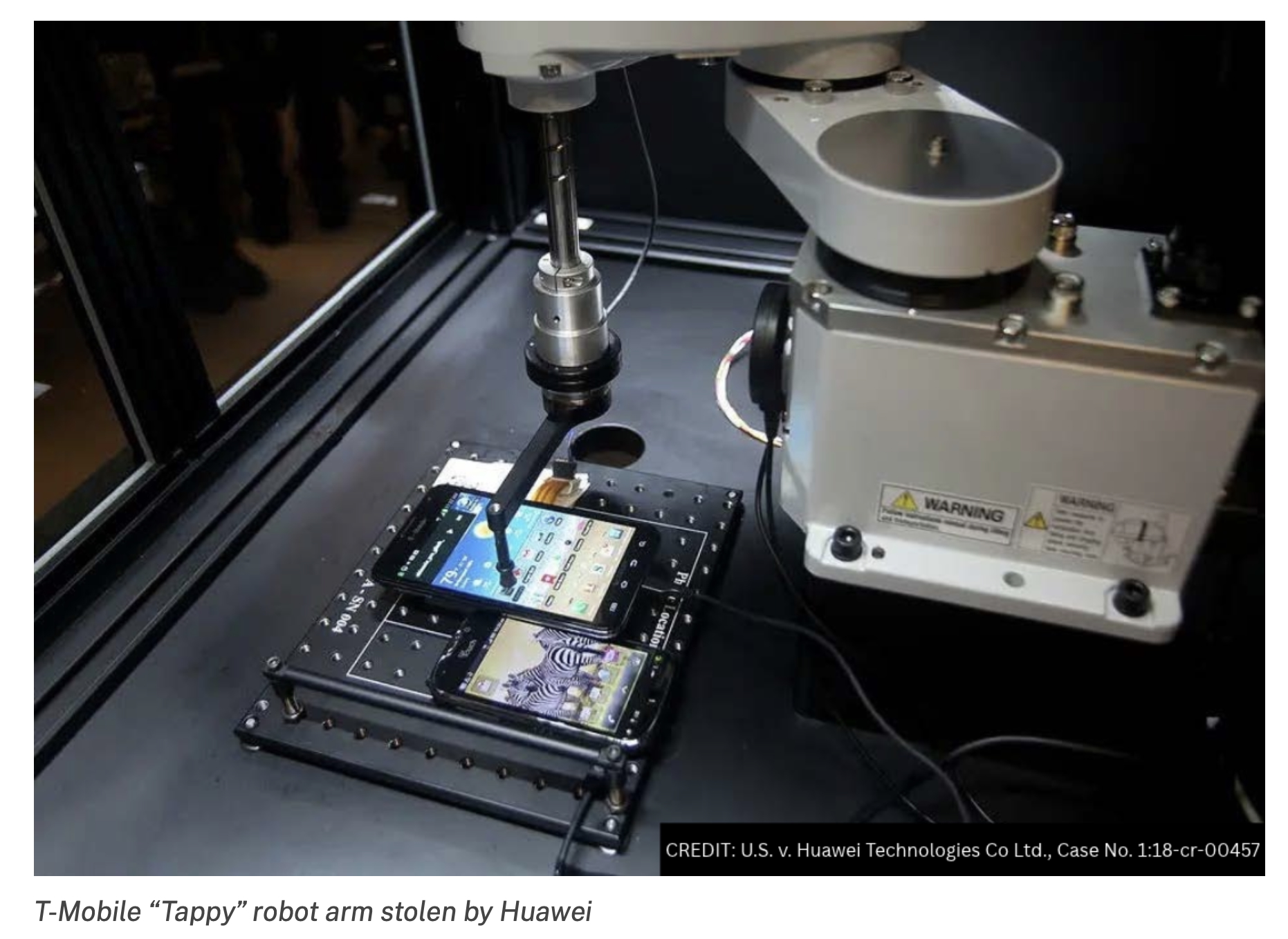
T-Mobile’s “Tappy” targeted by Huawei.

DOJ shared evidence of Huawei technology theft.

One of the stolen ideas was the design of a T-Mobile robot called “Tappy,” which helped the US firm “assess the responsiveness of touch screens by mimicking a human touch,” the DOJ said. To copy the design, Huawei signed a non-disclosure agreement, then sent photos and technical details back to China. Even bolder, when that intel was deemed insufficient, “a Huawei employee stole a part of the robot in his backpack and carried it out of T-Mobile’s controlled laboratory,” the DOJ said.

Huawei’s tactics weren’t always sophisticated, but they were effective, the DOJ said, building into “a long-running conspiracy to steal intellectual property of US companies.” At trade shows and tours of rivals’ facilities, Huawei employees would pretend to “get lost,” the DOJ said, so they could wander into restricted areas and take photos of hardware, The New York Times reported.

Huawei engineers would also sometimes hide their activity by spelling words backwards. For example, Huawei was able to copy the source code used on Cisco routers—which the DOJ said was “identified as the ‘crown jewel’ of Cisco technology”—by taking notes in which they spelled Cisco as “ocsic.” Another time, the DOJ noted that a Huawei employee was caught “photographing proprietary Fujitsu equipment” while wearing a badge that falsely identified him as an employee of “Weihua.”

During the trial, Meredith Arfa, a federal prosecutor, noted that Huawei employees were sometimes paid bonuses for their crimes, since the theft was so integral to Huawei’s business model, NYT reported.

Roman Rozhavsky, the assistant director of the FBI’s Counterintelligence and Espionage Division, said that Huawei spent years expanding its international enterprise “through theft of trade secrets, fraud, and other criminal conduct at the expense of US companies and the rule of law.”

Huawei will appeal; China lashes out

Huawei has been banned from selling its tech in the US since 2019, so NYT noted that the guilty verdict is unlikely to rattle the company’s finances much. However, the financial penalties stemming from the verdict could be steep, as the DOJ explained that they include “criminal fines, forfeiture, and restitution.”

Sentencing is scheduled for September 14.

Huawei continues to deny any wrongdoing and rejects US claims that the Chinese Communist Party directed the thefts. NYT noted that Huawei’s investors have argued that the US fight is politically motivated and seeks to hobble “a Chinese initiative to build 5G networks around the world.”

Outside the courthouse following the verdict, Brian Heberlig, a lawyer for Huawei, told reporters that it’s significant that the jury did not convict Huawei of racketeering charges or conspiracy to obstruct justice. According to Heberlig, the examples of US technology theft merely represented “isolated misconduct by company employees,” which inevitably happens in a company so large, with “hundreds of thousands of people.”

Heberlig confirmed that Huawei planned to appeal and considered the jury’s opposition to racketeering charges to be a “profound rejection of the United States’ narratives about what Huawei is.”

“The allegations that the government made in this case overreached and simply weren’t consistent with the successful, innovative and hard-working company that we came to know and deeply respect in this trial,” Heberlig said.

After the verdict, China “lashed out” at the US, AFP reported. According to Chinese foreign ministry spokesperson Guo Jiakun, the US is trying to use the ruling to “suppress” Huawei.

China “firmly opposes the US suppressing and containing Chinese enterprises and firmly supports Chinese enterprises in safeguarding their legitimate rights and interests,” Guo said.

However, the FBI’s Rozhavsky suggested that even China, which frequently negotiates with Trump as the trade rivals continually clash, can’t spare Huawei from substantial penalties.

“This case serves as a stark reminder that the Chinese government continues to pose a serious threat to our economic and national security, but today’s guilty verdict proves the FBI and our partners will aggressively investigate, expose, and hold accountable those who target our nation,” Rozhavsky said. “No company is too big, too powerful, or too well connected to exploit the US and its citizens and expect to escape American justice.”

Source: Iwpost.com

Poland plans no-fly zone along eastern border after Russian airspace violations

0
poland-plans-no-fly-zone-along-eastern-border-after-russian-airspace-violations
Poland plans no-fly zone along eastern border after Russian airspace violations
cde.news desk · 2 min read

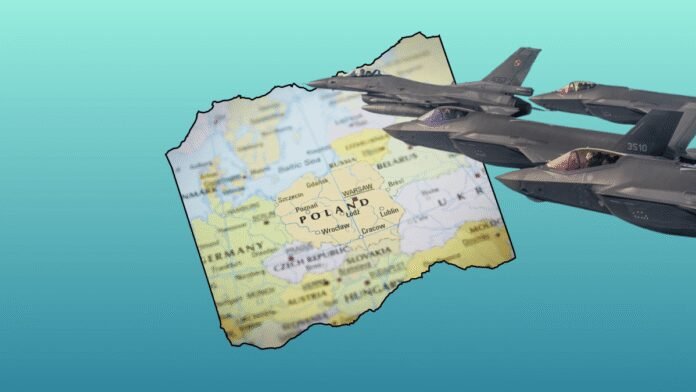
Polish Deputy Defence Minister Cezary Tomczyk said on Wednesday that the government wanted the new regulations to take effect in late December or early January.

The restricted area would extend tens of kilometres inland from Poland’s eastern border.

Tomczyk said Poland had already introduced a procedure known as positive identification at the request of Lt. Gen. Ireneusz Nowak, operational commander of the armed forces.

The procedure allows fighter pilots to identify intruding objects using radar readings and other data and decide whether to shoot them down.

Previously, visual identification was required.

“For this to be possible in practice, we also need a no-fly zone along our country’s eastern border,” Tomczyk said.

Two draft regulations prepared by the defence ministry were published last week. The first proposes permanent, round-the-clock flight restrictions in an area designated SOP1, while the second envisages restrictions in a separate zone, SOP2, between 10 p.m. and 6 a.m. local time.

The precise boundaries of the zones have yet to be announced.

The proposals follow two Russian violations of Polish airspace in recent days.

On Friday, November 20, three Russian Kh-101 cruise missiles entered Polish airspace and crashed in the country’s southeast during a Russian attack on western Ukraine.

On Monday, November 23, a Russian drone briefly violated Polish airspace during another Russian nighttime attack on targets in western Ukraine.

Polish and allied fighter aircraft are regularly deployed near the eastern border to protect the airspace of NATO’s eastern flank.

Tomczyk declined to confirm a Bloomberg report that Poland had asked its NATO allies at a meeting in Brussels on Monday to consider shooting down Russian missiles over Ukraine if they were heading toward allied territory.

He said the alliance had previously rejected such an arrangement.

“NATO is in no way in favour of this. It creates numerous complications,” Tomczyk said, adding that any such decision would require the agreement of all member states.

Via Polskie Radio

Source: Iwpost.com

Rob Lowe Reveals Shocking Scandal That Nearly Destroyed His Hollywood Career

0
rob-lowe-reveals-shocking-scandal-that-nearly-destroyed-his-hollywood-career
Rob Lowe Reveals Shocking Scandal That Nearly Destroyed His Hollywood Career


Rob Lowe was one of Hollywood’s biggest heartthrobs when a scandal involving a secret recording threatened to destroy everything he had worked for. Nearly four decades later, the actor is revealing disturbing new details about the demands for money, his decision to remain silent, and the devastating fallout that sent him into hiding.

The 62-year-old star revisits the controversy in his new Netflix documentary, Rob Lowe: The Outsider, which premiered November 24. Among his most startling revelations is his claim that he was pressured to hand over large sums of money to prevent the recording from becoming public.

The scandal began with an encounter in Atlanta during the 1988 Democratic National Convention. Lowe, then 24, met two women at a nightclub and later recorded a private encounter with them in his hotel room. The footage eventually surfaced, triggering a media firestorm when it emerged that one of the women was just 16 years old.

Lowe has consistently maintained that he had no idea the teenager was underage.

“I’m not trying to do revisionist history,” he explains in the documentary, recalling that he met the women inside a nightclub restricted to adults over 21. He points out that even he was required to show identification to enter.

But the controversy surrounding the woman’s age was only part of the nightmare.

Lowe now alleges that the recording was stolen and that people subsequently demanded substantial payments to keep it from being released.

Rather than surrender to the demands, the actor refused to pay, a decision that ultimately failed to prevent the footage from circulating.

“I was unwilling to be blackmailed,” Lowe recalls, acknowledging with bitter humor that his refusal did little to stop the scandal.

By May 1989, the controversy had exploded into international headlines. Lowe was attending the prestigious Cannes Film Festival to promote his upcoming thriller Bad Influence when he learned that his personal life had overshadowed his latest movie.

Suddenly, one of Hollywood’s most recognizable young actors was facing a public-relations disaster.

Lowe says industry advisers urged him not to defend himself publicly, a strategy that left him feeling increasingly isolated as the controversy intensified.

Instead of confronting the growing media frenzy, he retreated into his home and largely disappeared from public view.

The situation became so overwhelming that he even skipped Los Angeles Lakers playoff games despite having coveted courtside seats.

His younger brother, actor Chad Lowe, recalls becoming increasingly concerned as Rob stopped answering calls and withdrew from the people closest to him.

The scandal also brought serious legal consequences.

The mother of the 16-year-old filed a civil lawsuit against Lowe, alleging that her daughter had been sexually exploited. The case was eventually settled out of court.

Lowe was never criminally charged in connection with the encounter. However, he agreed to complete 20 hours of community service as part of an arrangement with Atlanta authorities to avoid potential prosecution.

Although the controversy threatened his once-promising career, Lowe eventually began rebuilding his reputation. He continued promoting his films and later demonstrated a willingness to joke about his troubled past during an appearance on Saturday Night Live.

That willingness to confront public embarrassment would become an important part of his comeback.

Over the following decades, Lowe successfully reinvented himself, earning acclaim for his work on The West Wing, Parks and Recreation, and 9-1-1: Lone Star.

Perhaps the most surprising twist, however, is how the actor now views the scandal that nearly ended his career.

Lowe has repeatedly credited the experience with forcing him to reconsider his lifestyle and ultimately pursue sobriety.

He entered recovery in 1990 and has remained sober for more than 36 years.

During a 2019 appearance on SiriusXM’s The Jess Cagle Show, Lowe described the scandal as a turning point that helped him build a completely different life.

He credited his recovery with contributing to his lasting marriage to Sheryl Berkoff, whom he married in 1991, and the family they built together. The couple shares two adult sons, Matthew and John Owen.

Although the controversy remains one of the darkest chapters of his Hollywood career, Lowe has suggested that without it, he might never have made the changes that ultimately transformed his future.

Now, with a successful career, a decades-long marriage, and more than three decades of sobriety behind him, Lowe is revisiting the scandal on his own terms, offering a rare glimpse into the personal turmoil behind one of Hollywood’s most notorious controversies.

Fact-checked against November 24–25, 2026 reporting on the Netflix documentary, historical reporting on the 1989 legal agreement, and Lowe’s earlier comments about recovery.

Source: Iwpost.com

Infinity of phalluses: Yayoi Kusama’s big, bold and psychedelic art legacy

0
infinity-of-phalluses:-yayoi-kusama’s-big,-bold-and-psychedelic-art-legacy
Infinity of phalluses: Yayoi Kusama’s big, bold and psychedelic art legacy

<

article id=”post-953558″>

Japanese artist Yayoi Kusama’s installations are big, bold and controversial. From the time she burst upon the pop art scene in the 1960s until her death on August 14, 2026, at the age of 97, she challenged the Western, male-dominated art world.

She also upended assumptions about mental disorders, which many people have uncritically seen as the source of her creativity. Her phallic sculptures and confounding mirror rooms are still popular, and they defy artistic classifications. Kusama’s resistance to categorization raises an intriguing question: What is her lasting effect on the art world?

Kusama took a major step into the global art scene after sending two canvases for display at Amsterdam’s Stedelijk Museum on February 5, 1962. After that, she shifted her direction to avant-garde sculpture.

She created Accumulation No. 1, her first work in a series that employed sewn phallic protrusions. The series thrust her into New York City’s pop art scene and would lead to her fantastical Infinity Mirror Rooms installation.

Exhibit of Yayoi Kusama's work, featuring a chair, sofa, shelf, high-heeled shoes, suitcase and jacket covered in phallic protrusions
Accumulation No. 1 is shown on the far left, among other similarly themed works. J. Countess/Getty Images via The Conversation

A major retrospective of her work is on view at the Stedelijk Museum through January 17, 2027.

The specter of her mental health issues, however, still undermines her art’s significance. Critics often link the repetition in her work to obsessive-compulsive disorder.

But as an art historian who has studied Kusama extensively, I argue that she intentionally used compulsivity to examine gender issues in the art world. A close look at Accumulation No. 1 reveals how she pulled this off.

Phallic focus

Kusama’s emphasis on gender came into focus when she arrived in the male-dominated New York art world. During the 1940s and 50s, while abstract expressionism reigned in New York, women in the scene were treated as wives and assistants.

Painter Grace Hartigan had to adopt the pseudonym “George” to gain recognition. By the 1960s, that was starting to change. Venezuelan sculptor Marisol Escobar’s May 1962 exhibition at the Stable Gallery bucked the trend of gender conformity by integrating self-portraits into her sculpture series.

Kusama’s Accumulation No. 1 emerged as New York artists were seeking to move beyond abstract expressionism. The gestural paintings of this art movement were what some critics saw as an existential struggle toward originality coded as masculine. Pop artists refused this model: They turned instead to ready-made objects and impersonal repetition, evoking factory production.

Kusama procured furniture and egg cartons for her Accumulation sculptures, as well as a wooden rowboat for another sculpture that became Aggregation One Thousand Boats Show. She decided to focus on sewing — an art rooted in her female Japanese education — and she ordered a sewing machine.

White boat covered in white protrusions, set in a room patterned with the same image
Yayoi Kusama’s Aggregation: One Thousand Boats Show (1963) was shown in a retrospective of her work at Stedelijk Museum in Amsterdam in 2026. Lina Selg / AFP via Getty Images via The Convesation

Kusama embraced femininity by using phalluses – a symbol of patriarchal authority – made from assorted fabrics sewn into tubular shapes, filled with cotton and painted white. She upholstered an armchair with these protrusions, colonizing an eerie domestic scene with phalluses made through a traditionally feminine craft.

In this way, she transformed furniture into a vessel of complex meaning, with gender as the key component to interpretation.

Neurosis or intention?

Art critics and scholars have often interpreted the time-consuming process of creating these phalluses as evidence of obsessive-compulsive neurosis. But this assumption overshadows Kusama’s careful planning and deliberate choices in her art. Intensive manual labor is a common component of Kusama’s work.

In 2008, filmmaker Heather Lenz interviewed Kusama’s friend Helen Yrissary, who helped sew the protrusions on the armchair. She noted that while there were always five assistants who crafted the phalluses, only Kusama herself secured them to the chair. In Accumulation No. 1 and Accumulation No. 2, obsession was more of a calculated aesthetic and conceptual choice than a compulsive action.

Kusama knew about obsessive-compulsive disorder and the anxiety it can cause. Drawing on Sigmund Freud’s psychoanalytical theories, she explained in her autobiography that she developed the phallic image while she was exploring “kyōfu” – fear, or feelings of the uncanny – in the Accumulation series.

According to Freud, the potential for the uncanny is rooted in a child’s first awareness of the anatomical differences between the sexes. He postulated that female children are traumatized when they realize they lack a penis, creating what he called penis envy.

Male authority

Kusama’s Accumulation series may have functioned as a satire of penis envy. And it may have led her to the idea of vanquishing men’s authoritative power.

In one of her self-portraits from 1966, Kusama flaunted a phallic protrusion near her crotch. This gesture suggests that the protrusion might be her own penis, that she might be bisexual or that she might not fall under the category of “female.”

Such efforts to redefine female sexuality inspired many female artists at the time. Toward the late 1960s, artist Louise Bourgeois, who admired Kusama’s work, created several sculptures, including Fillette (Little Girl), that employed phallic shapes as commentary on psychological complexes and gender.

But when Kusama premiered Accumulation No. 1 and Accumulation No. 2, The New York Times gave her work only a brief mention. When, three months later, sculptor Claes Oldenburg showed his similarly sewn “metamorphic” sculptures, he received rave reviews in numerous art magazines, bringing him to the attention of the international art world. It was only much later in the 2010s, after Kusama gained global prominence, that Oldenburg admitted her influence on his work.

Kusama’s popularity today stems from works that are both visually expansive and socially subversive. Aggregation: One Thousand Boats Show was her first all-over exhibit – an exhibition in which a repeated motif covers the gallery’s four walls, drawing the audience into the work rather than asking them to view it as a separate object.

On display at the Gertrude Stein Gallery from December 1963 to January 1964, it featured a sculpture of the phallus-embedded boat surrounded by its image repeating across the wall.

Although Kusama sought to subvert male authority, she appears nude in a photograph of the phallus boat installation, her back to the camera, trapped between the real and the illusory. Rowing the boat seems like the only way to escape the omnipresence of masculinity.

She seemed even more entrapped by patriarchal symbolism in her Infinity Mirror Room — Phalli’s Field, where she lays among an array of phalluses covered in red polka dots.

Psychedelic culture

In 1966, Kusama found a way to break away from male domination through her “Peep Show” at the Castellane Gallery in New York. In it, she reduced the towering phallus to a small dot of light. It was her first work of psychedelic art, a category the curator Christoph Grunenberg characterized as both “artistic experiment and dissenting politics.”

Incorporating Beatles music, flickering strobe lights and mirror reflections, “Peep Show” was intended to produce effects similar to those of psychoactive drugs such as mescaline, psilocybin and LSD, liberating users from established social norms and opening the possibility of alternative values.

The exhibit, later known as “Love Forever,” also aimed to alter perception by inducing synesthesia — a neurological state in which stimulating one sensory-cognitive pathway triggers involuntary experiences in another.

Kusama’s Infinity Mirror Rooms continue to dazzle crowds.

Kusama remembered attending a lecture by Timothy Leary, a former Harvard University psychology professor and psychedelics advocate, at the Village Theater in New York, a hub of psychedelic culture.

In 1968, she collaborated with light artist Joshua White on Self-Obliteration, a fusion of sound, lights and images that Leary claimed “would demonstrate what an LSD session is like.”

Kusama’s ability to transform any neurosis she may have had into liberation began with Accumulation No. 1 and continued through Fireflies on the Water (2002), Soul Under the Moon (2002), Infinity Mirror Room—Aftermath of Obliteration of Eternity (2009) and Infinity Mirrored Room—The Souls of Millions of Light Years Away (2013).

The ethereal visions embodied in her psychedelic mirror rooms stand in for the mind-altering drugs that release people from the rationality of society and fuel the desire to change.

Through Kusama’s Accumulation and Infinity Mirror Room series, I argue that she turned the human body into what philosopher Herbert Marcuse described as “an instrument of pleasure.” By making the body an instrument of pleasure rather than labor, Kusama subverted the age-old patriarchal order.

Midori Yamamura is associate professor of art history, City University of New York

This article is republished from The Conversation under a Creative Commons license. Read the original article.

Source: Iwpost.com

Ars Live recap: Don’t expect military attacks on data centers to stop

0
ars-live-recap:-don’t-expect-military-attacks-on-data-centers-to-stop
Ars Live recap: Don’t expect military attacks on data centers to stop
Drone attacks on data centers.

Amazon data centers came under military attack for the first time ever in the Middle East this year, and Russia and Ukraine exchanged an unprecedented flurry of drone strikes on each other’s data centers. To examine what such attacks on data centers mean for the future of cloud services that all modern societies depend upon, Ars hosted a live discussion.

In a conversation with Ars Technica Tech Reporter Jeremy Hsu, Joseph Jarnecki at the Royal United Services Institute first talked about why public cloud data centers have increasingly become military targets during the 2026 Iran war and the ongoing full-scale Russian invasion of Ukraine:

We see an increasing acknowledgement and fact of dual use in particularly the public cloud, but also just across the board in private cloud data centers as well. The dual use that I refer to is the utilization of compute functions within these data centers—within cloud services—by militaries, for example, to run battlefield management systems, to do their HR, to do their resource management. Once a military uses a piece of civilian infrastructure, at least under international law or in terms of the principles of targeting that are taken forward by militaries, it can sometimes become a military object and is therefore of interest to an adversary, and there’s an incentive to target it.

Jarnecki also highlighted the fact that relatively cheap kamikaze drones can inflict disproportionate economic costs and create widespread cloud disruptions when striking data centers:

The second reason that we’ve seen targeting particularly in Russia’s largest data centers or some of Russia’s largest public cloud data centers like Yandex, as well as American hyperscalers that are based in the Gulf, is to impose economic cost in a way that would be disadvantageous for an adversary and would otherwise be quite difficult to impose in other ways. So it’s relatively low cost of munition to high cost of disruption. If you think about the amount of investment that’s been put forward by AWS and other companies in the Gulf to build out these data center installations relative to the cost of the amount of Shahed drones that are manufactured, produced, and utilized by Iran to target these data centers, I would put it very, very conservatively at 100X or even more. The cost ratio is really very lucrative for the adversary, and it provides the opportunity to really degrade the economic outcomes of who you are targeting.

Much of the discussion also focused on cloud resilience lessons for both governments and hyperscalers, with the latter including large cloud and data center operators such as Amazon, Google, Microsoft, and Meta. Jarnecki highlighted the example of how Ukraine took steps to safeguard its cloud infrastructure when Russian President Vladimir Putin ordered Russian military forces to launch the full-scale invasion of Ukraine in February 2022:

I think that Ukraine anticipated this problem set very effectively. They anticipated and understood that Russia would not be discriminating necessarily in its targeting of civilian digital infrastructure particularly, and therefore conducted a large-scale cloud migration at the onset of the full-scale war in part in reaction to the anticipated targeting but then also actual targeting that took place through kinetic means.

Such lessons are important because 2026 is unlikely to be the last year in which data centers come under substantial military attack, Jarnecki said:

Unfortunately, I think that this really does indicate a continuation of this kind of targeting, not just because data centers are, despite efforts to harden some of them, relatively squishy, relatively easy to find, and have the potential, because of their complexity, to induce cascading risks within the facility or more widely if they are hit particularly by kinetic munitions. So at present, I would say it’s a dangerous trend that is likely to crop up again.

Throughout the event, Jarnecki also addressed viewer questions about whether data centers can realistically be hardened or built underground to withstand physical attacks, and even how orbital data centers or low-Earth orbit satellite constellations such as Starlink could provide backup options from space.

Source: Iwpost.com

China-Indonesia coal-to-ethanol deal is neither green nor clean

0
china-indonesia-coal-to-ethanol-deal-is-neither-green-nor-clean
China-Indonesia coal-to-ethanol deal is neither green nor clean

<

article id=”post-953570″>

Last week in Shenzhen, Indonesia and China signed a US$1.8 billion agreement to turn Indonesian coal into ethanol, a liquid that can be mixed into petrol.

President Prabowo Subianto oversaw the signing. The partners include state oil company Pertamina, Indonesia’s Ministry of Higher Education, Science and Technology and Beijing Petrochemical Engineering. The stated goal is to reduce Indonesia’s petrol imports.

A few days later, Energy Minister Bahlil Lahadalia announced in Jakarta that the Bakrie Group, one of Indonesia’s best-known business families, will join the project. He also announced that construction had already started.

But Pertamina says the deal is still only a memorandum of understanding, a first step before any binding contract. A full study of costs and risks has not yet been done. Nobody yet knows where the plant will be located, how much it will produce or where the coal will come from.

So the partner was picked before the numbers were known. There are three key problems with all this.

Who benefits?

Bahlil is not only the energy minister. Since August 2024, he has also led Golkar, one of the country’s biggest political parties.

Aburizal Bakrie, the senior figure of the Bakrie family and former Golkar chairman, sits on the party’s honorary council. When a minister who also runs a party hands a role in a state-backed project to a group linked to his party’s elder, without any study, the public has every right to ask why.

The license matters, too. Bahlil said the Bakrie Group’s old coal contract has been turned into a new special mining license. In Indonesia, large coal miners who want longer contracts must promise to build plants that process coal at home.

In 2023, the energy minister at the time confirmed that these coal processing projects would go ahead as part of that deal. Put simply, a coal company can keep mining for decades if it promises to build a factory.

Whether the factory ever makes money is someone else’s problem. This kind of industrial policy rewards political closeness and protects old coal interests. It does not grow a new industry.

In 2022, then-President Joko Widodo broke ground on a $2.1 billion plant in South Sumatra to turn coal into dimethyl ether, or DME, a gas meant to replace imported cooking gas.

A year later, the main investor, US firm Air Products, walked away. A senior energy ministry official admitted that the project simply did not make economic sense. Air Products also left a coal-to-methanol plan in East Kalimantan that involved Bakrie companies.

The Institute for Energy Economics and Financial Analysis calculated that making DME would cost almost twice as much as importing cooking gas, and that the plant would need a state subsidy of at least $354 per tonne to earn a profit.

By 2025, state miner Bukit Asam said its possible new partners wanted to invest far less than Air Products had planned. Coal-to-ethanol faces the same basic problem. Turning solid coal into liquid fuel needs huge machines, a lot of energy and a lot of water. That makes the fuel costly.

When oil prices fall, the plant loses money and the government is asked to cover the gap through subsidies, tax breaks or cheap loans from state banks. In the end, taxpayers pay.

China’s green headfake

In 2021, President Xi Jinping promised the United Nations that China would help developing countries build green energy and would stop building new coal power plants abroad.

A coal-to-fuel plant is not a power plant, so it slips through a gap in that promise. But it carries the same environmental harm.

Inside China, this industry is already a worry. The Center for Research on Energy and Clean Air found that coal-to-chemicals was the only major sector where China’s emissions were still rising, and that its planned growth could add 2% to the country’s total emissions by 2029.

Some analysts warn that China risks repeating old mistakes and being left with plants nobody needs. Sending the same technology to Indonesia exports that risk.

A plant like this runs for 25 to 30 years. Once built, it gives Indonesia a reason to keep digging coal long after other countries have moved on.

And if climate rules get stricter or clean fuels become cheaper, the plant could lose its value long before its time. The cost would land on Pertamina, on state banks and finally on the public.

Indonesia should still work with China on energy. China makes most of the world’s solar panels, wind turbines and batteries, and builds them cheaply.

Indonesia has plenty of sun and a fast-growing need for power. If the real aim is to import less petrol, the better path is to switch motorbikes and buses to electric and charge them with solar and wind power.

Jakarta should pause this project until an independent study of its costs and risks is made public. And if Beijing wants to be seen as a green partner, it should spend its money where its promises are.

Bhima Yudhistira Adhinegara is the executive director of the Center of Economic and Law Studies (CELIOS), a Jakarta-based think tank. Muhammad Zulfikar Rakhmat is the director of the China-Indonesia and MENA-Indonesia desks at CELIOS.

Source: Iwpost.com

0FansLike
0FollowersFollow
0FollowersFollow
0SubscribersSubscribe
- Advertisement -
Google search engine

Recent Posts