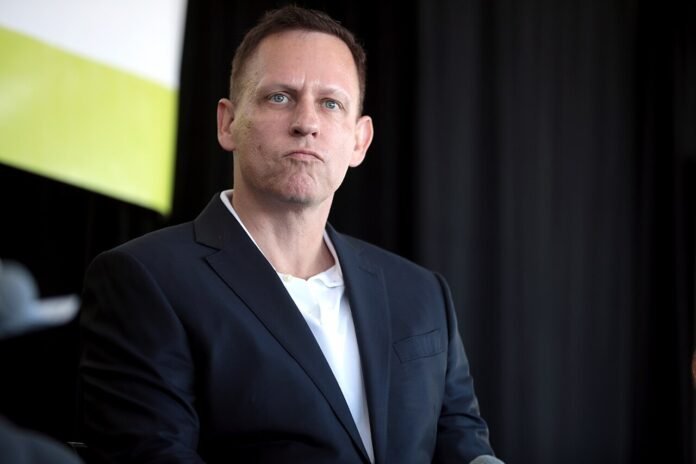
According to a Thursday report from CNN, Thiel told the Aspen Ideas Festival in Colorado on Tuesday that the pope was inadvertently serving as a “Chinese communist agent” when he released a 42,000-word encyclical that called for strict regulation of AI, a technology that the pontiff said heightens the “risk of dehumanization” throughout the world.
Thiel argued that this sort of thinking was dangerous, CNN reported, because it could result in the US losing the “race” to build more advanced AI to China. Because of this, Thiel continued, the pope is essentially “working for the Chinese communists” by trying to tap the brakes on AI development.
Thiel, a co-founder of PayPal and Palantir, has long decried AI critics in harsh terms. Over the last year, he has been delivering a series of lectures in which he has said that opponents of AI development are working as agents for the Antichrist.
Journalist Christopher Hale, who writes the Letters From Leo newsletter, noted on Friday that Thiel in the past has even speculated that Pope Leo could be “a manifestation of the Antichrist.”
Thiel has said that he instructed Vice President JD Vance, a longtime political ally who received major funding from the tech billionaire for his 2022 Senate campaign, to ignore the pope’s moral guidance despite influencing Vance to convert to Catholicism, Hale added.
“Thiel seeded the vice president’s Catholic faith,” Hale wrote, “and he now tells wealthy festival audiences that the leader of that faith works for a communist government.”
In addition to his attacks on the pope, Thiel also warned about “a democratic-socialist takeover of the Democratic Party,” pointing to recent victories in New York and Colorado of candidates backed by the Democratic Socialists of America.
Thiel said that this “takeover” would doom the US, arguing that “when the Democratic Party goes, this country is over,” according to CNN.
The New York Timesreported in May that Thiel has grown so concerned about the political situation in the US that he’s created a “foothold” for himself in Argentina, which is currently being governed by ideologically like-minded libertarian President Javier Milei.
“Thiel, who has a history of collecting backup countries as he hedges his bets against the United States, is considering making Argentina another Plan B,” the Times reported. “Born in Germany and raised in the United States, he received citizenship in New Zealand in 2011, and applied for a passport in Malta in 2022.”
The geopolitics of energy storage: Who will control the batteries of the Middle East?
For more than a century, geopolitical influence in the Middle East has been defined by oil reserves, natural gas resources and the strategic waterways that connect them to global markets. Pipelines, shipping lanes and export terminals have shaped alliances, driven conflicts and determined the economic fortunes of states across the region. Yet the global energy transition is quietly introducing a new strategic variable that could redefine regional power: energy storage.
The rapid expansion of renewable energy is transforming the fundamentals of energy security. Unlike hydrocarbons, electricity generated from solar and wind sources cannot always be consumed when it is produced. Solar and wind generation are inherently intermittent, creating a growing need for technologies capable of balancing supply and demand. In this emerging landscape, batteries are no longer merely industrial products; they are becoming strategic infrastructure.
This shift has implications that extend far beyond engineering. Just as oil storage facilities once became essential elements of national energy security, large-scale battery systems are increasingly shaping the resilience of electricity networks, digital infrastructure and critical industries.
The geopolitics of energy is therefore evolving from a competition centered on extraction and transportation to one that increasingly values storage, flexibility and system reliability.
The geopolitics of energy storage
The significance of energy storage lies not simply in its technological function but in its ability to reshape strategic relationships. Control over large-scale storage capacity increasingly translates into greater grid flexibility, improved electricity reliability and enhanced resilience against supply disruptions. In future electricity markets, storage capacity may become an important source of geopolitical leverage, particularly for countries seeking leadership in the post-hydrocarbon economy.
The pace of this transformation is already visible. According to the International Energy Agency (IEA), global battery deployment more than doubled in 2023, making energy storage one of the fastest-growing segments of the global energy industry. Battery systems are now being deployed alongside renewable energy projects, electricity grids and industrial facilities at unprecedented speed.
For the Gulf states, this development represents both an opportunity and a strategic challenge. During the twentieth century, regional influence was largely derived from abundant hydrocarbon reserves. In the twenty-first century, however, competitive advantage may increasingly depend on the ability to convert renewable electricity into reliable, dispatchable energy through advanced storage technologies. This explains why energy storage has become an integral component of national development strategies across the region.
READ: The Next Energy War Will Be Over Rules, Not Resources
Saudi Arabia’s Vision 2030 aims to generate half of the Kingdom’s electricity from renewable sources by the end of the decade. Achieving such an ambitious objective will require not only large-scale solar and wind generation but also substantial investments in battery storage capable of stabilising the national grid. Likewise, the United Arab Emirates has expanded investment in utility-scale battery systems to complement some of the world’s largest solar power projects, recognising that reliability has become as important as generation capacity itself.
These investments are not merely environmental initiatives. They are strategic decisions designed to strengthen economic competitiveness, support industrial diversification and increase regional influence in future electricity markets.
Countries capable of combining low-cost renewable electricity with advanced storage infrastructure will possess an important advantage. Electricity itself may emerge as an exportable strategic commodity, particularly as regional electricity interconnections continue to expand.
The growing integration of Gulf electricity markets illustrates this transition. Regional grid connectivity has traditionally been viewed as a mechanism for improving energy security during periods of peak demand. In the coming decade, however, interconnected electricity systems supported by advanced storage technologies could evolve into new instruments of regional influence, enabling countries to export both electricity and energy resilience.
Critical minerals: The hidden geopolitics behind batteries
Behind every battery lies another strategic competition that receives far less public attention. The race to dominate energy storage is also a race to secure access to critical minerals such as lithium, cobalt, nickel and graphite. These materials have become essential components of modern battery technologies, transforming global supply chains into arenas of geopolitical rivalry.
China currently occupies a dominant position in many stages of battery manufacturing and mineral processing, while the United States and the European Union are investing heavily in alternative supply chains to reduce strategic dependence.
As competition over critical minerals intensifies, partnerships between technology providers, mining companies and energy-producing states are likely to become increasingly important.
For Middle Eastern governments seeking to diversify their economies beyond hydrocarbons, participation in these emerging industrial ecosystems may prove as strategically valuable as investment in renewable generation itself. The future of regional energy influence may therefore depend not only on the ownership of oil and gas resources but also on integration into global battery supply chains.
Artificial intelligence is reshaping energy demand
The strategic importance of energy storage extends well beyond renewable electricity. The rapid expansion of artificial intelligence is creating an unprecedented surge in electricity demand, fundamentally changing the relationship between digital infrastructure and energy policy.
Every major AI model, cloud platform and high-performance computing facility depends on uninterrupted electricity. Modern data centres cannot tolerate frequent voltage fluctuations or prolonged outages without significant economic consequences. As governments compete to establish themselves as regional AI hubs, the reliability of electricity systems becomes a strategic consideration rather than a purely technical one.
This is particularly relevant in the Gulf, where countries are investing simultaneously in artificial intelligence, digital infrastructure and renewable energy. These ambitions are closely interconnected.
Without reliable storage infrastructure, efforts to develop large-scale AI ecosystems may face serious limitations. Stable electricity systems are rapidly becoming a prerequisite for technological competitiveness.
Energy storage therefore serves two strategic purposes. It supports the transition towards cleaner electricity while simultaneously enabling the digital economy that many Middle Eastern governments envision for the coming decades.
China, the United States and the new battery rivalry
The competition over energy storage is no longer confined to commercial markets. It has become an important dimension of strategic rivalry between major powers. China has established a dominant position across much of the global battery value chain, including mineral processing, battery-cell manufacturing and large-scale deployment. This leadership has been reinforced by extensive investment in industrial capacity and long-term access to critical raw materials.
The United States and its allies, meanwhile, have responded through industrial policy, supply-chain diversification and strategic partnerships intended to reduce dependence on Chinese manufacturing. Legislation such as the US Inflation Reduction Act and similar European initiatives reflects growing recognition that battery technology has become an issue of economic security.
For Middle Eastern countries, this rivalry presents both opportunities and strategic dilemmas. Rather than serving solely as energy exporters, Gulf states are increasingly positioning themselves as investment destinations for advanced manufacturing, clean-energy technologies and battery supply chains. Partnerships with both Western and Asian firms are expanding, allowing regional governments to diversify their economies while strengthening their technological capabilities. This emerging competition may prove as consequential as previous rivalries over oil production, LNG infrastructure or pipeline routes.
Critical minerals: The next energy battle in West Asia
Iran’s position in the emerging energy storage order
Despite sanctions-related constraints, Iran retains significant engineering capacity, an established industrial base and considerable renewable energy potential that could support future advances in energy storage technologies.
Although international investment remains limited, domestic research institutions and engineering industries possess the technical foundation needed to expand indigenous capabilities in battery technologies, smart grids and electricity management systems. For Iran, strengthening energy-storage capabilities is not simply about supporting renewable energy generation. It also offers an opportunity to improve grid resilience, reduce transmission inefficiencies and enhance greater technological self-sufficiency in a rapidly changing global energy landscape.
As neighbouring countries accelerate investments in clean-energy infrastructure, maintaining technological competitiveness will require increased attention to storage technologies alongside traditional energy assets.
From oil fields to battery banks
For more than a century, the Middle East’s geopolitical influence has rested on its vast hydrocarbon resources. Oil and natural gas will undoubtedly remain central to the region’s economy for decades to come. Yet the global energy transition is steadily broadening the foundations of power. Energy storage is emerging as a strategic capability that extends well beyond electricity. It underpins renewable energy systems, strengthens critical infrastructure, supports artificial intelligence, enhances economic resilience and increases national security. Countries that recognise this transformation early—and invest accordingly—will be better positioned to shape the next phase of regional energy politics.
The future balance of power in the Middle East may therefore depend not only on who possesses the largest energy reserves, but increasingly on who can store, manage and distribute energy most effectively.
In the twentieth century, strategic influence flowed through pipelines. In the twenty-first, it may increasingly flow through batteries.
The views expressed in this article belong to the author and do not necessarily reflect the editorial policy of Middle East Monitor.
Visiting the stars (and planets, and telescopes) in VR
Having a computer strapped to my face for 40 minutes was one reason to feel a little sweaty. But the tour of the Universe I had just received in virtual reality—including visits to the near vicinity of the Sun, the giant black hole at the center of our galaxy, and a hellscape of an exoplanet 41 light-years distant—provided another excuse for sensing some heat.
Smithsonian Starstruck: An Immersive Experience is a 40-minute astronomy walk-through. It debuted in Washington, DC, in May with solo adult tickets now ranging from $29 to $35 and group tickets for four or more starting at $18 each (all now discounted by 15 percent); it will also open in Denver, Orlando, Florida, and San Antonio, Texas, later this year. I stopped by on a Monday in June to take it in.
After some onboarding that included setting such preferences as closed captioning and signing a waiver, I had enough time to sit on a bench next to the exhibit space (which has hosted other VR experiences) to enjoy watching another attendee with a VR headset blurt out, “Oh my God!”
After putting on an HTC Vive Focus 3 headset and receiving introductory coaching about how to move through the exhibit space, the tour began. My virtual self was standing below a glittering night sky at the Multiple Mirror Telescope at the Smithsonian Astrophysical Observatory’s Whipple Observatory.
The stars in my VR night were big and bright, but they blurred noticeably when I moved my head. I had to wonder how a headset more recent than this 2021-vintage model would have performed; in other cities, Starstruck patrons will don a newer HTC product, the Vive Focus Vision, and the DC exhibit will move to that model at some point.
From there, we walked from one viewing spot to another in Starstruck’s room, occasionally bumping into each other as we followed the lead of a virtual tour guide wearing what looked like an approximation of SpaceX’s spacesuits and voiced by narrator James Seawood. We strolled to watch a re-creation of the Universe’s self-birth via the Big Bang, then ambled over for a close-up look at a stellar nursery that the Hubble Space Telescope made famous as the Pillars of Creation.
Seawood described the scene of star formation floating before our perch as “a cosmic pressure cooker” and “beautiful chaos.”
VR vistas
As we stood on a virtual set of glowing hexagonal blocks, the VR vistas zoomed as far out as a view of thousands of galaxies and as close as a dangerous proximity to the Sun—with NASA’s Parker Solar Probe keeping us company. Starstruck features three other of NASA’s farthest-seeing observatories: Hubble, the Chandra X-Ray Observatory, and the James Webb Space Telescope.
Each spacecraft’s close-up in the tour comes with a chance to press a “Take a picture” button that didn’t seem to do anything, plus an opportunity to play with a small model of it. I could not resist a chance to inspect JWST’s intimidatingly complex design, so I picked up a gossamer version of the observatory 1.5 million kilometers away from my real-world spot and gently turned it in my virtual hand.
Credit: Smithsonian Starstruck
Credit: Smithsonian Starstruck
Much of Starstruck focuses on the life cycles of stars and their planets, and a particularly evocative segment transported us to the hellish surface of Janssen, an exoplanet also known as 55 Cancri Ae that’s in an orbit so close to its star Copernicus that its year lasts about 17 hours.
The experience’s depiction of that planet’s surface as rugged rock outcrops with lava flowing around them (and stashes of diamonds crushed into being by the intense heat) may understate Janssen’s brutal environment—some analyses suggest that its entire surface is molten rock.
Many exoplanets are stuck in inhospitable orbits that make life or just the presence of liquid water impossible, and this stop on the tour brings home Earth’s good fortune. As Seawood put it: “We hit the stellar jackpot.”
Two other stops provided an up-close look at the death throes of stars.
A visit to Betelgeuse showed that the late-stage red supergiant in the constellation Orion was looking distinctly lumpy as it had begun to fuse higher elements. The visit then took us into the future with the star going supernova, putting on a show that no one on Earth has seen for centuries.
The last stop in space took us to just outside the event horizon of Sagittarius A*, the unimaginably enormous black hole at the center of the Milky Way. Starstruck made its most effective use of VR’s potential here; I raised my virtual hand to direct a beam of light toward the black hole, then saw it bend into that inescapable gravity well and shift into the red.
The tour ended by taking us back to a particularly remote corner of Earth and another sky full of stars: Chile’s Atacama Desert, the future site of the Giant Magellan Telescope (SAO is among its founding partners). It depicts that still-under-construction observatory as finished, with its enclosure open and its seven primary mirrors angled up to see a little farther into the Universe.
For a VR connoisseur with an Apple Vision Pro at home, the experience here might not deliver enough technical wow. But if you’re a space nerd or astronomy enthusiast—especially if you can assemble three like-minded friends as an away team to qualify for the group discount and make it less awkward when you walk into each other mid-tour—it provides an engaging escape.
A city councilman pursues purpose and dignity in suburban Japan
The city of Kashiwa, in Chiba Prefecture, is quiet for its size. Lying less than an hour’s train ride to the northeast of mega-metropolis Tokyo, Kashiwa – home to many commuters and their families – presents a calm contrast to the hectic pace of its big-city neighbor. Politics in Kashiwa is milder, too.
Tokyo is not just an urban giant, with all the political cut and thrust that comes with millions of competing interests. It is also Japan’s political capital, a fact intensified by Japan’s close relationship with the United States and the geopolitical complexity that that entails. When one is talking politics in Tokyo, one is talking about intrigue with international resonance.
When one is talking politics in Kashiwa, one is talking about building playgrounds and keeping fire departments properly funded. But because Kashiwa is much less visible than Tokyo, and much freer of partisan straitjacketing, there is room for those who practice a politics of purpose over a high-profile act of national and international performance.
In the relative calm of Chiba, Hiroki Uchida, a Kashiwa City Council member, spends his days fighting not to be seen but to be heard. He speaks also on behalf of others whose voices have often been squelched in the political arena. I recently spoke with Uchida about his political work. What I found was a man who puts human dignity over partisan politics.
Q: Please tell me a little about your background.
A: I was born not far from Kashiwa in Noda, Chiba Prefecture, in 1971. I was born with a visual impairment, completely blind in my right eye, but able to discern some visual information, although very weakly, with my left eye. Now, however, I have no sight in either eye.
I had perfect attendance in my third year as an elementary student, but as a fourth-year student I was very severely bullied by my teacher. This bullying continued through much of my time in elementary school. Because I was often not in class, my teacher had a kind of funeral for me, putting my photo on my classroom desk and burning incense in front of it as though I had died.
As a result, I stopped going to school – except on days when we had music lessons. I was very fond of music.
I had some friends in middle school, but as high school entrance exams approached they became busy with studying and we drifted apart. I thought sometimes of suicide, and attempted suicide as well.
I also was studying, though, and was able to enter high school. There, I met other people with visual impairments like myself. I also met people with hearing impairments, people with psychological conditions, people from foreign countries and others who might have been subjected to bullying as I had.
I entered high school in 1985. The next year, 1986, there was a nuclear accident in Chernobyl, in the Soviet Union, in what is now the country of Ukraine. My friends and I began working to ensure that there would be no such accidents in Japan, and that Japan would use renewable energy resources instead.
We also fought against discrimination, often as part of the disabled liberation movements of the day, and on behalf of hisabetsu burakumin [descendants of hereditary outcastes], women, people of African descent and other groups facing social exclusion. I found that the problem of discrimination, at root, lay in the social structure.
When I graduated from high school I began to work in rehabilitation at a hospital. In addition, I was volunteering at a night school that a friend had started, helping twice a week with students with various disabilities and from various disadvantaged social backgrounds.
It was also around this time that I decided to work in a more dedicated way toward eliminating discrimination in society. And, I discovered the great danger that discrimination poses to society. Fighting for one’s rights is fighting for one’s survival.
Q: Sadly, this has been proven true in recent years.
A: Yes. Ten years ago, in July, 2016, Satoshi Uematsu, an employee of the Tsukui Yamayuri En care home in Sagamihara, Kanagawa Prefecture, murdered nineteen people with disabilities who were residents there. The murderer said that such people’s lives had no value.
Q: You work as a politician in Kashiwa. Please tell me about the history of discrimination here in our part of Chiba Prefecture.
A: A very unfortunate historical example from right here in Kashiwa also illustrates the dangers of discrimination. This is the Fukudamura incident of more than a century ago. This incident was the culmination of many different kinds of discrimination, most prominently against people thought to be from the Korean peninsula.
The Fukudamura incident happened on September 6, 1923, five days after the Kanto earthquake on September 1 of that year. In the immediate aftermath of that natural disaster, while fires were blazing in Tokyo, a baseless rumor started to circulate that Koreans had been poisoning wells. Chiba Prefecture was placed partially under martial law on September 4.
In Fukudamura, a village near the Tone River later incorporated into Noda City – next door to today’s Kashiwa – a group of fifteen medicine salespeople traveling from Kagawa Prefecture, in Shikoku, had stopped to rest before crossing the Tone and continuing on into Ibaraki Prefecture.
Impromptu militias formed after the earthquake were on high alert. Militias from Fukudamura and Tanakamura, later part of Kashiwa City, rounded up the salespeople on the suspicion that they were Koreans who had been poisoning wells as rumored.
The salespeople were not Koreans, however, but hisabetsu burakumin. Discrimination against them meant that they often could find no other work besides traveling sales. This is why they were in Chiba at the time, far from Kagawa.
But because they spoke a dialect of Japanese very different from that spoken in Chiba, some of the militia members jumped to the conclusion that they were Koreans. Of the fifteen people in the group, the guards killed nine. Three of the murdered people were small children. Eight people drowned after being thrown in the Tone River, while the ninth, also thrown in the river, was cut down after managing to swim to shore.
These murders sprung entirely from discrimination—against Koreans, against hisabetsu burakumin and against traveling salespeople.
Q: I believe one of the murdered women was pregnant, so her unborn child would be the tenth person killed. It seems that the people who killed the traveling salespeople from Kagawa were prosecuted, but later pardoned and released from prison. One of the murderers became the head of Tanakamura village, and later a member of the Kashiwa City Council. He had murdered people thought to be Koreans, and because of that he was lionized by some in Kashiwa.
A: It is a very dark chapter in Chiba history.
Q: How has the Fukudamura incident affected your political career?
A: I do my political work in Kashiwa today rooted in the lessons that must be learned from this history. I think that everyone working in politics in Kashiwa, and all of us who live here as well, must learn these lessons, too. People with disabilities, people from foreign countries – there are many today whose rights and dignity are violated by discrimination.
I likely would not have known about the Fukudamura incident had I not myself experienced discrimination. Even if I had learned about it, I would not have seen it in the way that I do had I not also been discriminated against.
Today, Kashiwa has developed into a big and prosperous city. It is just for this reason that I think the Fukudamura incident must not be forgotten. As immigrants come into Kashiwa, especially from neighboring countries in Asia, discrimination comes again to the fore here. This calls to mind not just the Fukudamura incident but also the eugenics ideology that was used to justify discrimination against disabled people and others in the postwar. We must remember that eugenics has had influence in Japan, and in the world. We must never forget it.
I want to continue fighting so that no one, for any reason, is discriminated against in Kashiwa. Peace and human rights are always a set, and we cannot have one without the other.
Jason Morgan is an associate professor of global studies at Reitaku University, Kashiwa, Japan.
Israel Unseals Thousands of Operation Entebbe Records Ahead of 50th Anniversary
Prior to the 50th Anniversary of Operation Entebbe, Israel State Archives released thousands of pages of newly available government records documenting Israel’s response to the 1976 Air France hijacking, including complete transcripts of Cabinet and Security Cabinet meetings, records of a special security team established by Prime Minister Yitzhak Rabin, and additional files made public for the first time.
The release, issued by the Israel State Archives in the Prime Minister’s Office, also makes public all archive files relating to Operation Entebbe, including documents that had previously been released separately, presenting what the archives described as the full record of the government’s handling of the crisis.
The documents trace the government’s deliberations from the first reports that contact had been lost with the Air France flight after its stopover in Athens through the rescue mission carried out a week later.
Cabinet records show Rabin interrupting a government meeting to announce that the aircraft had apparently been hijacked. During the session, ministers were informed the plane had landed in Benghazi, Libya, although officials still did not know the hijackers’ identities, intentions, or final destination.
After Eli Mizrahi, Rabin’s chief of staff, suggested ministers remain available for updates later that day, Rabin responded: “There is no need whatsoever for that. My intention is to hold the government of France responsible for the fate of the Israelis flying on the Air France plane and not to absolve the government of France from this responsibility.”
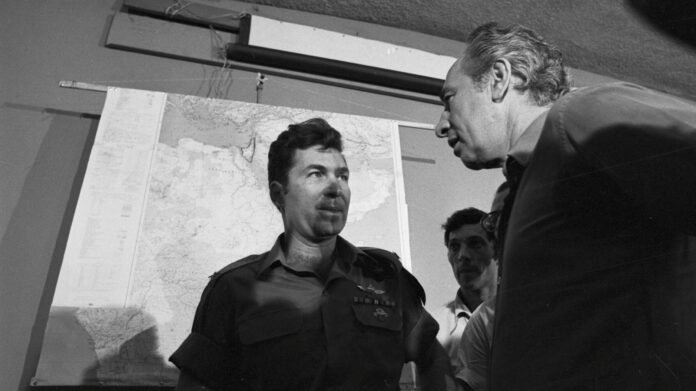
The archive also includes, for the first time, recordings of 26 telephone conversations held by Eli Mizrahi with Rabin, the Foreign Ministry director general and other officials during the hostage crisis, as well as transcripts of five conversations between Col. Baruch Bar-Lev and Ugandan ruler Idi Amin.
Additional material includes diplomatic correspondence with France and other governments whose citizens were aboard the hijacked aircraft, records relating to UN Security Council deliberations after the operation, hundreds of letters sent to Rabin following the rescue, photographs whose copyrights have expired, files concerning films about Operation Entebbe, and documents related to the commemoration of Lt. Col. Yonatan Netanyahu, commander of the General Staff Reconnaissance Unit, who was killed during the raid.
Among the newly released documents is an interview with hostage Yitzhak David, who was wounded during the rescue operation and recalled that being separated from the non-Israeli hostages revived traumatic memories from his experience as a Holocaust survivor.
Rocket Report: Indian startup nears first launch; SpaceX’s millenary milestone
Welcome to Edition 9.01 of the Rocket Report! Back in January, I wrote about the 20 launches and landings we were most excited about in 2026. The list included things that were, at the time, officially scheduled to occur this year. I also gave my own view of the probability of each of these events actually happening before December 31. Halfway through the year, we can only count one of the events as completed, and that was NASA’s Artemis II mission in April. Many are now scheduled for next year, proving again that delays are a constant in the space industry. A couple of them—such as the launch of NASA’s Roman Space Telescope—do appear to be on track to happen soon.
As always, we welcome reader submissions. If you don’t want to miss an issue, please subscribe using the box below (the form will not appear on AMP-enabled versions of the site). Each report will include information on small-, medium-, and heavy-lift rockets, as well as a quick look ahead at the next three launches on the calendar.
Swift Boost Mission reaches orbit. A pioneering commercial mission to reboost the orbit of NASA’s Swift astronomy satellite launched early Friday after attempts earlier in the week were thwarted by bad weather and a technical issue. The Link servicing satellite developed by Katalyst Space Technologies soared to orbit on the tip of a Northrop Grumman Pegasus XL rocket that dropped from the belly of a modified L-1011 jetliner over the remote Pacific Ocean. Mission managers called off two launch attempts Tuesday and Wednesday due to poor weather around the L-1011’s staging base on Kwajalein Atoll in the Marshall Islands. On Thursday, “a launch vehicle issue temporarily prevented teams from deploying the rocket” after takeoff of the L-1011.
A rarity these days… This was the last scheduled flight of the air-launched Pegasus rocket, which had success in the 1990s and 2000s as a small satellite launcher for NASA and the US military. Usage of the Pegasus rocket has declined amid the rise of more affordable commercial launch options, especially SpaceX and Rocket Lab. Upon reaching orbit, Katalyst’s Link satellite will spend several weeks approaching the Swift observatory, which is unable to counter atmospheric drag and is likely to reenter the atmosphere and burn up later this year. Launched in 2004, Swift was never designed to be serviced in orbit. The Link mission will attempt to raise the satellite’s altitude and extend its mission.
The Ars Technica Rocket Report
The easiest way to keep up with Eric Berger’s and Stephen Clark’s reporting on all things space is to sign up for our newsletter. We’ll collect their stories and deliver them straight to your inbox.
Launch window set for India’s first commercial rocket. Skyroot Aerospace is set to launch the first test flight of its Vikram-1 rocket between July 12 and August 4 from the Satish Dhawan Space Center, marking India’s first private attempt to place a launch vehicle into orbit, the Economic Times reports. The mission aims to gather critical in-flight performance data across propulsion, stage separation, guidance, navigation and control, and overall vehicle performance. The test flight will originate from a launch pad originally built for India’s government space program.
The sky’s the limit... Skyroot has raised approximately $160 million to date, including a $60 million fundraising round announced in May, boosting its valuation over $1 billion. The Vikram-1 rocket is powered by three stages burning solid propellant and a fourth stage with liquid-fueled engines for the final maneuvers to place payloads into orbit. It is designed to place nearly a half-ton of payload mass into low-Earth orbit.
Rocket engines delivered for Rosalind Franklin. NASA has delivered the braking engines for the European Space Agency’s Rosalind Franklin mission to Mars, European Spaceflight reports. The braking engines are one of three major contributions NASA has committed to the mission, along with launch services and Radioisotope Heater Units (RHUs) to keep the rover’s instruments warm during cold Martian nights. The Rosalind Franklin rover is set for launch in late 2028 after years of delays, most of which were caused by geopolitical tensions and not technical issues.
American-made... NASA is providing the braking engines as part of the US contribution to the ESA-led mission, which aims to place the first European rover on the surface of Mars. The throttling MR-80 engines, which burn hydrazine fuel, were manufactured by L3Harris, formerly Aerojet Rocketdyne. Four of them will control the lander’s final descent. NASA and L3Harris will deliver a fifth spare engine to Europe to round out the propulsion contribution. The same kinds of engines were used for the landings of NASA’s Curiosity and Perseverance rovers on Mars in 2012 and 2021.
NASA taps Rocket Lab for three launches. NASA has selected Rocket Lab to launch a pair of science missions on three Electron rockets in 2027, Space News reports. One of the missions is the Polarized Submillimeter Ice-cloud Radiometer, or PolSIR, which consists of two suitcase-sized satellites to measure the rise and fall of ice crystals in tropical clouds. The PolSIR satellites will launch on back-to-back Electron rockets from Rocket Lab’s spaceport in New Zealand no earlier than June 2027.
Going solo... The other launch NASA awarded to Rocket Lab is for the Total and Spectral Solar Irradiance Sensor-2, or TSIS-2, mission set to fly from New Zealand in early 2027. The TSIS-2 spacecraft will be the successor to TSIS-1, an instrument mounted on the outside of the International Space Station to measure the amount of solar energy entering the Earth’s atmosphere. NASA decided to build a dedicated satellite for TSIS-2 and launch it on a rideshare mission on a SpaceX Falcon 9 rocket. Now, TSIS-2 will also get a dedicated ride to space with Rocket Lab.
Isar Aerospace announces all-German mission. Planet Labs is placing a bet on startup Isar Aerospace, signing up to launch at least one of its satellites on the Spectrum rocket that has yet to make orbit, Aviation Week & Space Technology reports. The launch from northern Norway could come as early as this year, Isar Aerospace said in an announcement Thursday. It would involve one of Planet’s Pelican high-resolution Earth observation satellites assembled in the US-based company’s new Berlin manufacturing facility. “With both satellite and rocket being built in Germany, this launch will be a national first for the country, demonstrating rapid advancements in the nation’s sovereign space capabilities,” Isar said in a statement.
How about that next launch?... Isar has not provided any update on the next test flight of its Spectrum rocket, which has missed several opportunities to launch since January. Officials scrubbed the most recent launch attempt June 15 after “detecting off nominal behavior in the vehicle’s fluid systems.” This mission will attempt to place a batch of CubeSats into orbit after lifting off from Andøya Spaceport in Norway. The first Spectrum launch failed in March 2025.
End of an era for Atlas V. The final flight of United Launch Alliance’s Atlas V rocket is still several years off, but an important era for the once-dominant launch company came to a close early Thursday, Ars reports. The final flight of an Atlas V for the Amazon Leo broadband constellation lifted off from Cape Canaveral Space Force Station, sending 29 satellites to orbit to move the network closer to providing initial services. It marked the ninth Atlas V flight for Amazon Leo and the fourth Atlas V launch in less than three months, hitting a career-ending cadence the rocket has rarely seen in nearly a quarter-century of service.
Farewell to the Bruiser... This was also the final launch of an Atlas V rocket with a payload fairing. Six more Atlas Vs in ULA’s inventory are assigned to launch Boeing’s Starliner crew capsules to the International Space Station, and those missions will fly without a fairing. Additionally, Thursday morning’s mission was the last to use the Atlas V’s most powerful configuration with five strap-on solid rocket boosters. ULA’s next launch will be the return to flight of its newer Vulcan rocket, which has been grounded since February due to problems with its solid-fueled boosters.
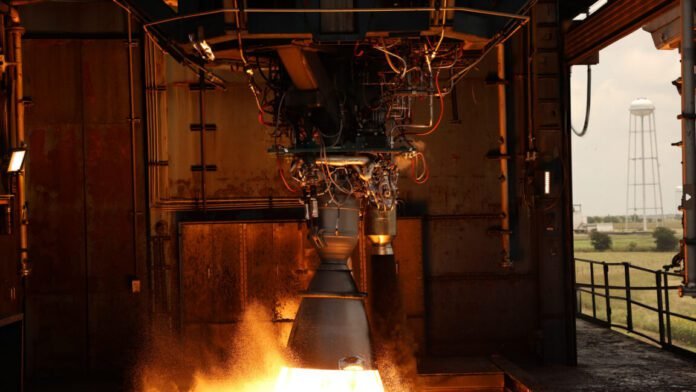
A millenary milestone for SpaceX. With multiple launches each week, it’s easy to lose sight of just how impressive the Falcon 9 rocket is. The Falcon 9 and Falcon Heavy have flown 671 times, and the majority of those missions flew with reused boosters and engines. This week, SpaceX announced on X that it has manufactured the 1,000th Merlin 1D engine for the Falcon rocket’s first stage. Nine of these kerosene-fueled engines power each Falcon 9 launch, and 27 of them fly on the Falcon Heavy. A modified version of the Merlin engine flies on the upper stages of both rockets.
Refurbishment over production… The production of 1,000 Merlin 1D engines is a remarkable milestone for any rocket engine, but it’s important to note that the Merlin 1D is reusable. The Merlin 1D has logged more than 6,000 engine flights with 1,000 units. “With Falcon’s reusability, recovering these engines has enabled continued reliability enhancements, making Merlin one of the most reliable rocket engines ever manufactured,” SpaceX wrote on X. Another highly reliable, but single-use, rocket engine with similar thrust is Russia’s RD-107/108. Five of those have powered each variant of Russia’s R-7 rocket family since the 1950s, a legacy now carried on by the Soyuz launch vehicle. With more than 2,000 flights by Soyuz and its kin, that amounts to more than 10,000 RD-107 and 108 engines produced at a plant in Samara, Russia.
SpaceX launches rare GEO mission. A SpaceX Falcon 9 rocket launched Sunday carrying a multi-ton radio broadcasting satellite for SiriusXM to replace two aging satellites in geostationary Earth orbit, Spaceflight Now reports. The SXM-11 satellite is a behemoth as far as spacecraft go, with a launch mass of about roughly 7 metric tons (15,000 pounds). The satellite is destined for a position over the equator at an altitude of more than 22,000 miles (nearly 36,000 kilometers), where its velocity will match the Earth’s rotation to provide continuous radio broadcast coverage over the United States.
Still in business… Of SpaceX’s 78 launches of the Falcon 9 and Falcon Heavy this year, this was just the third carrying a payload heading for geostationary orbit, once the preferred destination for nearly all commercial communications satellites. Today, the trend is decidedly bending toward low-Earth orbit with megaconstellations like Starlink. But SiriusXM remains in business, as does the manufacturer of the SXM-11 satellite: Lanteris Space Systems, a subsidiary of Texas-based Intuitive Machines. The company, formerly branded as Maxar, was acquired by Intuitive Machines in January 2026 for about $800 million.
NASA pleased with Blue Origin’s pad cleanup. NASA Administrator Jared Isaacman said this week that Blue Origin has been putting significant resources into the cleanup of its launch pad since the explosion of its New Glenn rocket there in late May, Ars reports. “Blue Origin’s response to the situation is almost beyond impressive, and that’s not just a NASA assessment,” Isaacman said in response to questions from reporters on Wednesday afternoon. The explosion May 28 took out Blue Origin’s only launch pad. NASA has a significant stake in Blue Origin’s return to flight. It is counting on the company’s Mk. 1 lander to carry dozens of cargo missions to the Moon, and its Mk. 2 lander to eventually ferry people to the lunar surface. The company’s New Glenn rocket was expected to play a critical role in launching both of those landers.
New concept of operations… Blue Origin says it plans to return to flight with New Glenn before the end of the year, but the launch pad will look different. Dave Limp, Blue Origin’s CEO, said the investigation into the explosion is still underway. “Early analysis points to the aft section of the first stage,” he wrote on the company’s website. During the anomaly, Blue Origin lost the lightning tower at its launch site as well as the massive transporter-erector, which moved the rocket from a nearby integration hangar out to the launch site and lifted it vertically for takeoff. For return to flight, Blue Origin will not rebuilding the transporter-erector, but will instead use a crane to lift the rocket vertical on its launch mount. Once there, and after pre-flight testing, a payload fairing would be placed atop the vehicle ahead of launch.
Next three launches
July 4: Long March 6A | Unknown Payload | Taiyuan Satellite Launch Center, China | 09:31 UTC
July 5: Falcon 9 | Starlink 10-50 | Cape Canaveral Space Force Station, Florida | 10:36 UTC
July 7: Falcon 9 | Transporter 17 | Vandenberg Space Force Base, California | 07:10 UTC
Meghan Markle Wants to be ‘Royal Again’ as U.S. Fame Fades
Meghan Markle may be preparing for a dramatic return to the United Kingdom — but one royal commentator claims her reasons have little to do with repairing family relationships.
The Duchess of Sussex, 44, is expected to accompany her husband, Prince Harry, when he travels to England during the week of July 6 to promote the countdown to the 2027 Invictus Games in Birmingham.
While Harry, 41, reportedly views the visit as an emotional homecoming, commentator Mark Dolan claims Meghan sees the trip as a carefully calculated career move.
According to Dolan, Harry misses his family, his former royal duties and life in Britain. Meghan, however, allegedly wants to remind the world that she is still a duchess as her celebrity power in the United States begins to cool.
“I think that Harry wants to come back to the UK because he misses his family,” Dolan said during an appearance on Matt Wilkinson’s The Royal Exclusive podcast.
“He misses his royal activities, and he misses England. He misses the UK.”
Harry is scheduled to attend several events connected to the Invictus Games, including a reception in London marking one year until the international competition begins.
The trip could also offer Harry another opportunity to reconnect with his father, King Charles III, whom he has reportedly seen only twice since 2022.
But Dolan believes Meghan’s motives are far more strategic.
“For Meghan, it’s business,” he claimed. “I believe that Meghan is pathologically transactional, and so I think this trip is strategic for her.”
Dolan argued that Meghan may see the return as an opportunity to revive her royal image at a time when her American brand is reportedly struggling to maintain momentum.
“I think Meghan sees a return to the UK as a chance to recalibrate those royal credentials, to go back to the royal well so she can be ‘Duchess’ again, because that’s fading in the U.S.,” he said.
He also suggested the couple may want very different things from their relationship with Britain.
“I think it’s emotional and nostalgic for Harry, which I think is, by the way, a big tension within the marriage,” Dolan added.
Harry and Meghan stepped away from their roles as senior working royals in 2020 and moved to California with their children, Prince Archie and Princess Lilibet.
Following their stunning royal exit, commonly known as “Megxit,” the couple signed a series of high-profile deals worth millions of dollars.
Their agreement with Spotify later ended, while their Netflix partnership produced the explosive 2022 documentary series Harry & Meghan.
The series included several damaging accusations about life inside the royal family.
One of the most controversial moments came when Meghan recalled learning that she would need to curtsy before meeting Queen Elizabeth II.
Meghan demonstrated the curtsy with a deeply exaggerated bow as Harry sat beside her looking visibly uncomfortable. The scene sparked fierce backlash, with critics accusing her of mocking royal tradition.
Now, Meghan could be preparing for her first visit to England since attending the late Queen’s funeral in September 2022.
Her possible return has already fueled speculation that she wants to reclaim some of the royal glamour she once enjoyed before leaving palace life behind.
The trip is also expected to reignite the bitter debate over security for Harry and his family.
Harry has repeatedly argued that he does not feel safe bringing Meghan and their children to Britain without official police protection.
However, Dolan claimed Princess Diana’s former bodyguard, Ken Wharfe, believes the Sussexes’ security demands may have more to do with status than actual danger.
“He said there’s no way the U.K. authorities or the King would allow Harry to come to harm while he’s in Britain,” Dolan said.
According to Dolan, Wharfe suggested Harry may miss the visible signs of royal importance, including flashing blue lights, police escorts and helicopters.
“It’s the status that comes with royal armed protection that Harry, burdened with the self-image of being ‘the spare,’ wants,” Dolan claimed.
Neither Harry nor Meghan has publicly confirmed that Meghan will make the trip or responded to Dolan’s accusations.
But should the Duchess return to British soil, all eyes will be watching to see whether the visit becomes a genuine royal reconciliation — or Meghan’s bold attempt to put the “royal” back into her fading Hollywood brand.
Trump’s Communist Boogeyman Playbook: Charging Protesters as Terrorists
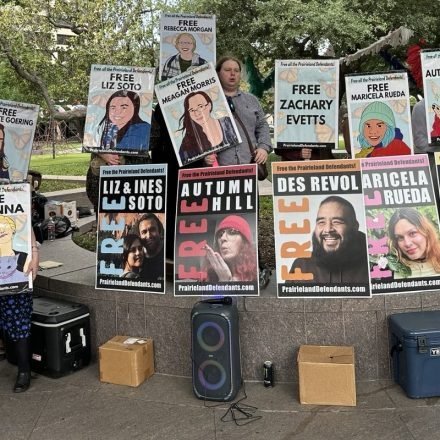
A noise demonstration that took place outside of the Prairieland Detention Facility in Texas one year ago has resulted in decades of prison time for the anti-ICE activists involved. Federal judges sentenced eight defendants, who the government cast as antifa operatives, to between 30 and 100 years in prison for terrorism-related charges last week; seven more people were sentenced this week.
“There’s a stunningly wide gap between what the Justice Department has put in its press releases and what top officials have said, versus the evidence that was actually presented at trial,” says Intercept reporter Matt Sledge, who has been covering the Prairieland case and was present at the sentencing. “It’s a real stretch to assert, as the government did, that this was all one coherent group.”
“There’s a concerted effort to characterize opposition to ICE or opposition to the Trump administration as some form of conspiracy, as an effort to provoke terrorism,” says Mark Bray, author of “Antifa: The Anti-Fascist Handbook.” “There are a number of things that can be said about the various sentences, but perhaps the most obviously egregious is that handed out to Daniel Sanchez [Estrada]: 30 years for moving some zines, some literature, which is not illegal to possess.”
This week on The Intercept Briefing, host Jessica Washington speaks with Bray and Sledge about Prairieland as a test case in Trump’s war on dissent, and why the administration is determined to convince the public that antifa is a domestic terrorist organization.
“I don’t think Trump or his allies really care about antifa per se. It’s a useful umbrella term to craft into a boogeyman scare tactic. In a way that ‘Communist’ was used in past generations, antifa is used now,” says Bray. He and Sledge point out that in the wake of Charlie Kirk’s killing, the Trump administration became much more aggressive in its targeting of the left and dissent in general.
“You had these Prairieland defendants who had already been arrested and charged, and then the government really ups the ante against them by bringing material support for terrorism charges against them, which really contributes to these long sentences. And I think it’s a preview of what’s going to happen elsewhere,” says Sledge. “It shows that in this post-Kirk era, the government is going to use the most aggressive charges it can find against people it does not like.”
“What that calls upon is creating a different kind of antifascist movement, and to me perhaps the most inspiring kind of model or example is the anti-ICE movement, which does not under many circumstances call itself an antifascist movement,” says Bray. “I think that this moment is bringing out the best in a lot of people, whether or not they have activist experience or not, in organizing with their neighbors. The best moments of antifascism throughout history have been those moments where it ceases to be some sort of specialty politics, but becomes just a common-sense way of protecting our neighbors, those most vulnerable amongst us, and protecting our freedoms.”
For more, listen to the full conversation of The Intercept Briefing on Apple Podcasts, Spotify, YouTube or wherever you listen.
Transcript
Jessica Washington: Welcome to The Intercept Briefing. I’m Jessica Washington, politics reporter at The Intercept.
Matt Sledge: And I’m Matt Sledge, also a politics reporter at The Intercept.
JW: Matt, it’s really great to have you back on the show. Today, we’re going to talk about some really important reporting you’ve been doing on the Prairieland case.
Last week, judges sentenced eight protesters to between 30 and 100 years in prison on terrorism-related charges for their participation in a July 4 protest last year outside of the Prairieland Detention Facility in Alvarado, Texas.
His wife, Maricela Rueda, who was present at the anti-ICE protest but left early, received one of the harshest sentences — 70 years — because she asked her husband to move her zines.
You were at the sentencing. What was the room like when people heard that they would be spending, for some of them, the rest of their lives behind bars for attending a protest?
MS: I would say it was very somber, but also strangely reserved. I think many of the defendants and their supporters went into the courtroom expecting very long sentences. At the same time, some of them held out a sliver of hope that the judges who were sentencing people in two courtrooms at the same time might listen to their pleas for downward variations from the sentencing guidelines, might do something to attempt to distinguish between the different roles of the people who were at the protest and the one person who wasn’t there, Daniel Sanchez Estrada. And that essentially didn’t happen.
They all got really harsh sentences, and the judges made it clear that they were trying to send a message.
JW: Matt, we talked about this a little bit offline before the podcast, but it’s hard to imagine that the jurors who handed down these convictions could have imagined that they would be sending people to prison for these enormously long sentences, could have imagined that someone would spend 70 years in prison for a nonviolent act. What do you think is going through these jurors’ heads now?
MS: It’s hard to put yourself in someone else’s heads, but I wouldn’t be surprised if they’re surprised. Because even though some of these charges had various serious-sounding names like “riot” and “material support of terrorism,” jurors almost never know the sentencing ranges that come with charges.
And in this case, probably did not know or expect that federal prosecutors would seek — and the judges would apply — these very harsh terrorism sentencing enhancements that really raised the sentences for all the defendants.
JW: Can you tell us what happened outside of the Prairieland Detention Facility and how this case came to be in the first place?
MS: There were a group of people, generally from the kind of lefty scene in the Dallas–Fort Worth area, that wanted to stage what they termed a “noise demonstration” protest outside this ICE facility, a show of solidarity, they later said, with the people detained inside the facility. This is one of these facilities that saw a huge increase in the number of people detained under Trump.
There had been a daytime protest outside this facility earlier on the day on July 4, 2025. This group of people, around a dozen people, went that night, much later around 10:30, wearing all black, carrying fireworks, and in some instances carrying guns — which is legal to do in Texas.
They set off some fireworks. One of the people who was there described it as actually a kind of festive environment. Then the police were called, as you might expect, and some of the demonstrators there were already gone by the time the gunfire erupted. A responding local police officer was left with a gunshot wound to his neck. And then the person later convicted of shooting the gun that left the police officer injured, Benjamin Song, escaped that night and was on the run for several days, hiding out in the Dallas–Fort Worth area.
So there was a large police manhunt. This was a big story in the Dallas–Fort Worth area for days.
JW: Obviously, federal prosecutors have a different spin on who these protesters were and what their connection to each other was. Federal prosecutors have labeled this group of protesters as a “North Texas Antifa” terrorist cell.
What are prosecutors trying to do here by labeling protesters as members of antifa, and what evidence did they actually have to make a case that these individuals were “antifa operatives”?
MS: There’s a stunningly wide gap between what the Justice Department has put in its press releases and what top officials have said, versus the evidence that was actually presented at trial.
I’m not aware of anybody associated with this group ever claiming that there was such a thing as the “North Texas Antifa Cell,” which is what the government has branded this as. Several of the cooperating defendants, the people who helped the government out in its prosecution, said they did not think of themselves as antifa.
I think it’s safe to say that everybody involved in this protest was politically on the left, outraged over the Trump administration’s immigration policies and other things. Some of these people may have thought of themselves as anarchists or consumed antifascist zines, but it’s a real stretch to assert, as the government did, that this was all one coherent group.
“It’s a real stretch to assert, as the government did, that this was all one coherent group.”
In fact, at trial, the government story was a little more nuanced than what it put in its press releases and referred to a smaller planning group and then a larger group of people who had essentially just showed up to this demonstration. But there were two really different spins from the protesters and their attorneys and the government as to the intentions going into this night.
The people on trial said basically to a person that they did not go there intending to hurt anybody, they were just trying to show solidarity. Then the government pointed to things like wearing all-black clothing and bringing guns and ballistic vests as evidence that they were essentially going there looking to attack.
JW: Could you just explain to our listeners why it’s a bit of a misnomer to call antifa a group, or particularly in the way that the government is describing here?
MS: The whole idea behind the ideology or movement, whatever you want to call it, is that it’s very decentralized and is all about individuals or small groups taking direct action against people they view as fascists.
This idea that there might be a whole movement of people committed to antifascism is a little too complicated for antifa’s critics to grasp. [Laughs] They insist that there is this, like, global network.
There are certainly small groups and larger groups of people who identify as antifascists. They certainly talk to each other. But again, this idea that there was something called a “North Texas Antifa Cell” just doesn’t seem to be supported by the facts.
JW: So Daniel Sanchez Estrada was sentenced to 30 years in prison for moving a box of zines, as we’ve already discussed. Elizabeth Soto and her husband, Ines Soto, were sentenced to 50 years for their part in the protest. But part of the evidence used against the Sotos was that they owned a printing press to print zines. Matt, what kind of zines are we talking about here?
MS: Yeah, a lot of the zines and kind of social media feed evidence that the government presented at trial were your standard, off-the-rack anarchist, antifascist zines you might find at any anarchist bookstore or book fair, something like that. Something that would not be surprising at all to someone who has spent time in those spaces.
There’s nothing that came close to being directly relevant to plotting either a protest or an attack outside the Prairieland Detention Center. The government stretched and pointed to zines that were from years before and discussed very general tactics.
So it’s stuff that you may have seen before. It’s not some super secret stuff. It’s very typical anarchist, anti-government zines.
JW: So anything I could probably find in a bookstore in Bushwick, is what you’re telling me.
MS: Exactly.
“There’s nothing that came close to being directly relevant to plotting either a protest or an attack outside the Prairieland Detention Center.”
JW: Speaking of, one of the frequent takeaways I’ve heard from this case is that it proves Signal is not as secure as you think.
Matt Sledge: Yeah, there was something interesting that came out at trial, essentially like a glitch in the way Signal worked and the way it interfaced with iPhones. I’m probably oversimplifying or butchering this, but basically our phones store what pops up in the little notification center when our phones are locked. The feds were able to use that to glean some of these communications.
But you also have to remember they had several cooperating defendants. There were several Signal group chats going on at the same time. So even if Signal is perfectly buttoned down and the government hasn’t found some new hack or glitch to do — your messages with your fellow organizers, or anybody else you want to communicate with in an encrypted fashion, are only as good as the weakest link in the group.
If someone decides they’re going to be willing to cooperate with the government and they’re in your Signal chat, the government’s probably going to be able to get access to it, which is why security researchers say it’s really important to have disappearing messages on and keep groups as small as you need them to be, and so on, common-sense approaches.
But I also just think that Signal is not like some silver bullet for privacy protection; it’s a way of reducing risk. People should think about it that way.
I’ve seen this also in government bulletins to local police that using Signal or another encrypted messaging app is a threat indicator — when people who use Signal, including Pete Hegseth, would say it’s just a way of keeping their messages private. But Hegseth is a good reminder that you have to look at who you’re including in your Signal group.
JW: I do appreciate a little Hegseth diss as a part of the Signal explanation, as that was, I would say, one of the more high-profile — “leaks” is really not even correct to describe what happened there.
MS: Yeah, it’s not a leak when you just send a journalist out of the blue your war plans. [Laughs]
JW: Yeah, really can’t call it that. But I did want to talk more broadly about not just the legacy of this case, but what the administration is trying to do more broadly. The Prairieland protest case came on the heels of the killing of conservative activist Charlie Kirk, which the Trump administration almost immediately used to justify cracking down on the broader left.
Matt, can you talk about how the administration is trying to silence critics more broadly by labeling all dissent and protests as acts of terrorism, and can you talk about the other active cases the government has against activists?
MS: Yeah, I think it’s important to remember the timeline. The Prairieland demonstration happened in July of 2025, and then Charlie Kirk was killed in September 2025.
Very soon after that, President Trump issued this executive order purporting to designate “antifa” as a domestic terrorist organization — not something he can actually do, but so it goes.
So you had these Prairieland defendants who had already been arrested and charged. And then the government really ups the ante by bringing material support for terrorism charges against them, which really contributes to these long sentences.
I think it’s a preview of what’s going to happen elsewhere. It shows that in this post-Kirk era, the government is going to use the most aggressive charges it can find against people it does not like.
In terms of other cases, you can look to Illinois, where the protesters outside the Broadview facility there, the government attempted to charge them. The grand jury initially rejected it and the government was able to secure charges, and then the case fell apart under government scrutiny.
So the charges may differ from case to case. The exact logic of how these cases work may differ, but the overarching strategy of using the most aggressive charges you can find and painting this all as a big conspiracy is going to continue.
“In this post-Kirk era, the government is going to use the most aggressive charges it can find against people it does not like.”
JW: The cases that you just brought up had given some people hope that while the government may be trying to target protesters and dissenters, they didn’t have the power to jail them to the extent that they obviously wanted to and were intending to.
The Prairieland case and these sentences is a really scary wake-up call that the government is incredibly powerful and that these are not just words or prosecutions. This is an intent to really jail Trump’s dissenters and to jail any kind of opposition to this regime and that they have the power to do that in some of these cases.
We’re going to leave it there. Matt, I just really want to thank you for this update and your reporting. To continue following Matt’s work, sign up for The Intercept’s newsletter at theintercept.com.
MS: Goodbye, Jessie. Thanks for having me.
JW: Next, we zoom out with Mark Bray, author of “Antifa: The Anti-Fascist Handbook.”
Bray is a history professor at Rutgers University and a frequent target of the right. He also consulted as an expert witness with one of the Prairieland defendants but did not testify. With Bray, we’ll take stock of the Trump administration’s crackdowns on dissent and talk to him about his own experiences being targeted by the right.
[Break]
JW: Mark, welcome to The Intercept Briefing.
Mark Bray: Thank you for having me.
JW: Mark, we just spoke to my colleague, Matt Sledge, about the details surrounding the Prairieland case. But to start, can you just give us your reaction to the charges and to the sentencing?
MB: Certainly when we look at the Prairieland case and some other somewhat similar cases during this second Trump administration, we can see that there’s a concerted effort to characterize opposition to ICE or opposition to the Trump administration as some form of conspiracy, as an effort to provoke terrorism. I see it in that context.
There are a number of things that can be said about the various sentences, but perhaps the most obviously egregious is that handed out to Des — to Daniel Sanchez — 30 years for moving some zines, some literature, which is not illegal to possess.
It’s part of this broader effort to characterize opposition as terrorism conspiracy that we’ve seen in various manifestations. It seems like a particularly egregious version of that, when, to my knowledge, many of the people who were at this protest in Prairieland aren’t even accused of firing the weapon that was supposedly fired.
JW: Yeah, you’re right. The fact that Benjamin Song is the only person who actually fired a weapon and that everyone else participated in what appears to be nonviolent protesting — the charges that were handed out are really hard to even contemplate.
I want to get a little bit more personal as well. So The Guardian reported that you acted as a consultant for one of the defendants but didn’t testify. I know your name also came up multiple times during the trial. Can you talk about that, and what that was like for you?
MB: I was in Spain at the time. I had left the U.S. in response to death threats from the far right and my concerns about the political situation in the U.S. So I was unable, unfortunately, to testify in person. I was consulted by the attorneys for Daniel Sanchez, for Des. I think they asked whether I could testify remotely, and I imagine they were turned down because they didn’t follow up on that.
But part of what I did was, they sent me a Dropbox link or some such equivalent to read all of the radical literature that he transported, all of the scanned zines.
I read through a bunch of them; a few of them I was familiar with already. And a few things stood out. As I said, number one, it’s not illegal to own these things. Just because you own a book or a piece of writing doesn’t mean you necessarily agree with everything in it or anything in it. I own a copy of “Mein Kampf” — that doesn’t make me a Nazi.
“Just because you own a book or a piece of writing doesn’t mean you necessarily agree with everything in it or anything in it.”
Although these folks were accused of being part of some sort of supposed antifa cell, very few of the zines that he transported had anything to do with antifa politics, and one of them was actually a critique of it.
So it just goes to show you that the political claims are intentionally superficial, vague, and minimalist in order to be able to package as much stuff they don’t like under the same kind of terrorist umbrella as possible.
JW: I want to get into why you had to flee a little bit more deeply. But before that, we spoke to Matt Sledge about this, but I wanted to get your take as well. Why is the administration determined to convince the public that antifa, a decentralized antifascist movement, is a domestic terrorist organization? What are the motivations here, and what does it mean if they can successfully convince us that these are terrorists?
MB: I guess the starting point is to recognize that I don’t think Trump or his allies really care about antifa per se. It’s a useful umbrella term to craft into a boogeyman scare tactic. In a way that “Communist” was used in past generations, antifa is used now.
Certainly, the FBI have been monitoring antifa groups for years now, and I’m sure they have a reasonably accurate sense of what it is. There’s a number of different groups in different cities that organize against the far right in a variety of ways. None of them are particularly large. There aren’t that many of them in the U.S., relatively speaking.
But by arguing that antifa is — as a number of far-right provocateurs over the years have argued — like the paramilitary wing of the Democratic Party, that phrasing shows us how they’re trying to make the case that whatever kind of far-left radical figure is actually just a version of the center-left, and that everyone who is not with us is against us.
That, I think, is reflected in the term “antifa-aligned,” which the Department of Homeland Security promoted as a framework for thinking about this. That, OK, there are antifa groups, there’s antifa-aligned. It’s like different layers to the onion to be peeled back.
For me, it’s a useful term because it’s poorly understood. It’s associated in the popular imagination with people who cover their faces, who engage in acts of violence. And in that way, it’s a useful linchpin for framing a conspiracy.
Beyond that, we haven’t actually seen self-described antifa groups in the streets opposing the far right in the U.S. since last decade. It’s not particularly germane to what’s going on in U.S. politics, but of course, the reality of it is not particularly important to Trump and his allies.
JW: That’s really interesting. This isn’t just an attack on the left, and I think people on the left can often see it as, “OK, this is an attack on the left.” This is an attack on any kind of resistance, any kind of dissent, any kind of opposition to Trump. And have we seen this in history? You alluded to attacks on communists, but can you talk a little bit about the history of targeting the left and the broader ripple effects?
MB: There are so many cases. One that comes to mind is something I wrote a book about. I wrote this book called “The Anarchist Inquisition” about Spain and France at the turn of the 20th century. In short, there were anarchist bombings and assassinations — actual anarchists who said, “Yes, I’m an anarchist,” who tried and sometimes succeeded and sometimes failed to kill the king of Spain or to kill the president of France.
They didn’t have a ton of allies, and even in the anarchist movement, most disagreed with that strategy. But the Spanish government, and to a lesser extent the French government, used that as an excuse to arrest all sorts of trade unionists and Freemasons and anti-clerical figures and socialists in this big scandal in the 1890s, El proceso de Montjuïc, where these people were put in a dungeon. And it was this effort to create this conspiracy among the left that all these different people were somehow in cahoots to try and overthrow the monarchy.
“It’s useful for the right to portray all of the left as being the same.”
So there are many cases throughout history around this. You can go forward into the movements of the ’60s. It’s useful for the right to portray all of the left as being the same. Which is actually a useful way I think those of us on the left should remind ourselves — that while there are comparisons between different kinds of right-wing forces, it’s also a mistake to say that all different kinds of fascists and far-right formations are all the same. Because there are differences there too, and understanding them makes sense. Flattening the dynamic can be useful rhetorically on both sides, but it’s usually not accurate.
JW: One thing I have just been thinking about is we’ve seen so many attempted prosecutions of protesters under the Trump administration, and this is their first real victory against, they’re calling it their first real victory against antifa.
Obviously, as we’ve discussed, it’s much more complicated than that. But we’ve seen the administration attempt to prosecute the Broadview Six, who were arrested for protesting outside of an ICE facility in Chicago. Obviously there are sillier instances where federal prosecutors tried to go after someone for throwing a Subway sandwich.
But now that they have their boogeyman scenario for the left, they have sentenced people to prison for the rest of their lives for protesting against injustices perpetrated by their government — does this embolden the administration? Do they learn that they can successfully prosecute people for opposing them?
MB: It certainly emboldens the administration to get this verdict and to get these sentences. Looking back to the fall of last year, when I received threats for my alleged involvement in antifa groups — which is not true, I haven’t participated in any of those groups — the specter of a kind of antifascist Red Scare was looming large.
I think that to a reasonable extent, it kind of faded a bit as the administration focused on a lot of other problems and issues, or created them. It’s come back a bit recently with the Prairieland case, the Prairieland verdicts, also the anti-ICE activists arrested in Minneapolis. There seems to be a bit of a return toward trying to stitch together this alleged antifascist conspiracy.
It’s so Orwellian to think that the antifascists are the bad guys in the midst of an increasingly authoritarian regime, which many scholars of fascism call, to one extent or another, if not fascist, trying to create something akin to fascism. So I do think it emboldens them. I do think it establishes a precedent.
We know that the legal system is all based on different kinds of precedents. And when the administration tried to make the case for antifascism as terrorism back in the fall, they cited a number of different cases which really had nothing to do with it. But what that shows us is that they’re trying to establish a track record, establish the reality of this enemy, this internal enemy they’re trying to combat. This helps them do it because there’s something they can point to. Of course it’s a dishonest intellectual, if you even want to call it intellectual project, to fake evidence and then refer to it as evidence of the thing you’re trying to use as evidence for the evidence. But we know how this administration functions, and it’s not surprising.
“It’s so Orwellian to think that the antifascists are the bad guys in the midst of an increasingly authoritarian regime.”
JW: As someone who has had to deal with the comms side of the White House, I will say it is not very surprising at all.
You touched on this already a little bit, but because you’re widely viewed as an antifascist expert and you wrote the 2017 book, “Antifa: The Anti-Fascist Handbook,” you’ve long been a target of the right, so much so that you and your family had to leave the country.
Can you talk about that experience and how the threats you were receiving escalated over time to the point that you had to make that decision?
MB: When my book was published in 2017, it was rushed to publication and came out days after Charlottesville. It became a bestseller and was really the book of record for talking about what it was that antifa groups did and what they thought and why.
In that context, I received quite a few death threats. I was visited by the FBI. There was a bomb scare at my work. I was denounced by my employer, the president of Dartmouth College, but not fired because I received support from fellow faculty. But over the coming years, that kind of diminished. Antifa was not particularly pertinent to the news, with maybe the exception of a week in 2020 when Trump tried to blame the Black Lives Matter protests that erupted in response to the police murder of George Floyd on antifa. It pretty much disappeared.
At first, frankly, I didn’t think much of it because I had received threats in the past. Even when Turning Point USA — the local group on my campus, although they were really fed the initiative by the national organization — crafted a petition to have me fired for writing my book, I kind of shrugged. It changed when some of the threats included my home address, and then my home address was published online on X, along with information about my family.
In a country that’s awash in guns, I was very concerned about something like something that happened to Charlie Kirk happening to me, and I was also very alarmed about the political direction of the country. So my goal was not actually to publicize that I was leaving the country, that leaked, but I was planning on leaving. Spain’s sort of my second home, I’ve done research there over the years.
Now, going back to your earlier point though, the degree of the kind of onslaught of the Red Scare that I was fearful of did not fully materialize over the coming months. It didn’t — I don’t regret going — but it didn’t fully materialize.
I was concerned about all sorts of progressive activists being rounded up, and fortunately that hasn’t happened. It doesn’t mean that we need to stop our vigilance. That’s why we’re talking about issues like this. But it didn’t fully materialize. I do think it’s picking up again a little bit now, so I don’t think we’re out of the woods, so to speak.
But that was my experience, and I returned to the U.S. last week. I’m going to take all sorts of precautions to make sure the same thing doesn’t happen again and to do what I can to keep speaking about these issues.
JW: Why do you think that the energy, the kind of Red Scare energy we had seen pick back up, why do you think it died down, and what do you think brought it back? Do you attribute that to Charlie Kirk’s death specifically? I think a lot of people think that the right used that as an excuse. I’m curious why you think it went up and down in that way.
MB: The killing of Charlie Kirk was obviously an excuse. Even before we knew who had done it Trump was blaming the left.
The effort to frame Tyler Robinson as a leftist is ridiculous if you actually look at all the kinds of convoluted things he believed. Then there was this effort for a few weeks to craft the antifa terrorist threat. Now, why it stopped, I’m not entirely sure. I do think that we live in this social media era where you can make something a big deal very quickly, but just as quickly people move on to the next thing.
“In that context, the antifa terrorist threat was almost completely abandoned because Pretti and Good were simply called terrorists.”
I wonder if there was an element of that, particularly in the context where the administration was trying to pursue a number of different objectives at once. I felt, I don’t know what your opinion was, but towards the end of 2025, the kind of authoritarian momentum of the regime started to wane a little. And then all of a sudden January hit, Maduro gets kidnapped from Venezuela, the ICE occupation of Minneapolis grows even more intense. It seemed like particularly with the killings of Renee Good and Alex Pretti, that there was an effort to get the momentum back going again. In that context, the antifa terrorist threat was almost completely abandoned because Pretti and Good were simply called terrorists.
So the middleman term between leftist and terrorist was antifa. They took out the middleman term: Leftists are terrorists. They’re coming back to it now. I’m not entirely sure how far they’ll get with it. One of the questions you always have with the growth of authoritarianism or fascism or whatever you want to call it in democratic states is, to what extent can the institutions that are designed to thwart those advances hold up?
I think overall it’s been a mixed bag in the U.S., but certainly you’d have to think that Trump and his allies do not believe that they can simply arrest just anyone and claim they’re part of a terrorist conspiracy at this point or they would have done it. A lot of the arrests that ICE made have not held up, and so I guess they don’t feel fully emboldened.
But as you suggested earlier, every step they take, every supposed precedent they establish could make them feel more emboldened to take steps moving into the future. The one last thing I’ll say, though, is that I think the real linchpin for these efforts is something more approximating a genuine crisis or emergency, where they can more believably say, “If we don’t deal with these terrorists, our efforts to save the country will be for naught.”
Right now I don’t think that most Americans believe that there is this internal terrorist conspiracy, that’s something they have to be concerned about, especially when the price of groceries is going through the roof, or of gas. But if they get some situation where that’s more plausible, then I’d be more scared.
JW: As you noted, you wrote your handbook just at the start of Trump’s first term. The forward is written by the late Joshua Clover, who recounts pivotal moments in those years in which antifascists were pushing back against the rise of white nationalism. Nearly a decade later, how do you think about this moment that we’re in, and how we’ve gone from the Unite the Right rally in Charlottesville, Virginia, where a group of neo-Nazis chanted, “Jews will not replace us,” holding tiki torches, to all of the in between and where we are now?
MB: When I published “Antifa” in 2017, I described the situation we were in as a moment of preventative antifascism that was akin to one extent or another to the post-war European context of trying to organize such that Nazis or fascists couldn’t bring back another horrific regime. We’re not in that situation anymore in the U.S., and I think to some extent we’re in a bit of an unprecedented situation, which I know that’s a term that’s thrown around a lot, but I mean it when I say it.
Whereas you look at the growth of Hitler’s regime in Germany or Mussolini’s in Italy, from the point at which they had the opportunity to take authoritarian power to the kind of consolidation of the regime, there was a much quicker, more straightforward ascension. Hitler outlawed various different political parties and threw their leaders in jail pretty quickly over the months after the Reichstag fire, which provided the context for the Enabling Act [of 1933], which allowed him to centralize his power.
In the U.S., we are not in the status quo, but we’ve not yet fully reached a kind of fascist or authoritarian regime, that we do still have other political parties. You can at least, under most circumstances, protest. So thinking about that in between I think is very interesting, particularly since the kinds of antifascist politics that I wrote about in the book were designed by different kinds of leftists after World War II to stop small and medium-sized fascist groups before they reached the halls of power.
But now, figures like Stephen Miller and Pete Hegseth and so forth they have their hands on the wheel. So what that calls upon is creating a different kind of antifascist movement, and to me perhaps the most inspiring kind of model or example is the anti-ICE movement, which does not under many circumstances call itself an antifascist movement.
I would call it an antifascist movement, which ironically is exactly what Trump is trying to get us to call it from a different angle. I think there’s a kind of contestation over language, contestation over images of suffering. I found it shocking when they published the alternate video of the killing of Renee Good in order to essentially — I and many others interpreted it — for us to think that she deserved it because of the context of her partner shouting at the ICE agent.
So contestations over images of violence over words, and I think that this moment is bringing out the best in a lot of people, whether or not they have activist experience or not, in organizing with their neighbors. The best moments of antifascism throughout history have been those moments where it ceases to be some sort of specialty politics, but becomes just a common-sense way of protecting our neighbors, those most vulnerable amongst us, and protecting our freedoms.
That’s what I think is happening now, and that’s what I hope we’ll continue to see, and that could produce really inspiring social movements over the years to come.
“The best moments of anti-fascism throughout history have been those moments where it ceases to be some sort of specialty politics, but becomes just a common sense way of protecting our neighbors, those most vulnerable amongst us, and protecting our freedoms.”
JW: To your point, what we’ve been witnessing with these anti-ICE protests is not just organized groups in Signal chats working together, although that is obviously happening as well. We’re seeing everyday people watch their neighbors get dragged out of their homes and standing up and saying, “I won’t stand for this.”
You have to think that the movement of antifascism — separate from how, the Trump administration is trying to describe antifa — but this larger movement of antifascism does have legs if people are willing to stand up for each other, to see their neighbors as members of their family, as members of their community.
We’re going to have to leave it there, but Mark, thank you so much for joining me on The Intercept Briefing.
MB: Thank you so much.
JW: We want to know what issues you are following, send us an email at podcasts@theintercept.com or leave us a voice mail at 530-POD-CAST that’s 530-763-2278
That does it for this episode.
This episode was produced by Laura Flynn. Ben Muessig is our editor-in-chief. Maia Hibbett is our managing editor. Fei Liu is our product and design manager. Nara Shin is our copy editor. William Stanton mixed our show. Legal review by David Bralow.
Slip Stream provided our theme music.
This show and our reporting at The Intercept doesn’t exist without you. Your donation, no matter the amount, makes a real difference. Keep our investigations free and fearless at theintercept.com/join.
And if you haven’t already, please subscribe to The Intercept Briefing wherever you listen to podcasts. Do leave us a rating or a review, it helps other listeners to find us.
Microsoft launches firm to help companies adopt AI with $2.5 billion
Microsoft said it is creating a new company that will help customers select AI technologies that work for their businesses and generate returns on their investment.
Microsoft Frontier Company, as the new operating entity is called, will kick off with $2.5 billion in funding from the tech giant to work with clients such as Unilever and Novo Nordisk.
Large corporations are relying less on renting out AI from a single provider, such as Anthropic or OpenAI, and are instead using a mix of technologies, including open-source models, tailoring them to their needs. This is a costly affair and stretches the time it takes to generate a return on their investment.
Microsoft Frontier Company will offer customers help to select and integrate AI tools – from Microsoft and outside – with that customer’s unique internal data. Critically, the customers will get to keep the results of that work rather than send it back to Microsoft.
Patrick Moorhead, CEO of analyst firm Moor Insights & Strategy, said large businesses suspect that using models from Anthropic and OpenAI will eventually grant these frontier labs expertise to compete with them, especially in fields such as coding and law.
Microsoft partly owns ChatGPT-maker OpenAI and had added Anthropic’s models to its Copilot AI assistant earlier this year, partly in response to booming enterprise demand for the AI lab’s offerings.
Judson Althoff, CEO of Microsoft Commercial Business, said the new firm was born partly out of Microsoft’s own experience when models such as China’s DeepSeek and Google’s Gemini began to catch up to OpenAI.
“Three years ago, when we built Copilot, we made a mistake by binding it to OpenAI models only,” Althoff told Reuters. “You wanted models to amplify your intelligence and be able to have that sort of swappability for state-of-the-art and fine-tuning.”
The combination of data and the models mattered more to the customer than any particular model, and they needed the flexibility to switch among AI models quickly, he said.
This newsletter was first published in The Conversation UK’s World Affairs Briefing email. Sign up to receive weekly analysis of the latest developments in international relations, direct to your inbox.
This weekend marks 250 years since the Second Continental Congress, representing the 13 American colonies, assembled in Philadelphia to sign the Declaration of Independence. The country had already been at war for more than a year and would continue its armed struggle against Britain for another seven. But on July 4 1776, the United States of America was born.
The ideas that found expression in the Declaration were not new. Tensions between the British crown and its American colonies had been percolating for years. And the philosophical ideas behind America’s revolutionary fervour were also finding expression in Europe, particularly in France and Britain.
As Tom Cutterham, a professor of American history at the University of Birmingham, writes, the sort of ideas that inspired America’s revolutionary thinkers had for some years “been closely tied to questions about corruption, oligarchy and executive tyranny in Britain itself”. He points to the likes of Thomas Paine, John Wilkes, Granville Sharp and Catharine Macaulay who were writing passionate arguments against British despotism.
Macaulay argued that the authority of a monarch rests on a contract between ruler and ruled which, if broken by the monarch, is void. It’s an idea which is said to have inspired Benjamin Franklin’s contribution to the Declaration of Independence. Cutterham tells the stories of the Britons who supported America’s struggle to throw off its colonial masters.
This weekend’s celebration of America’s 250th birthday comes at a time of deep division in the US. There are even two separate organisations planning rival events. One – America250 – was set up in 2016 by the US congress and signed into law by Barack Obama. The other – Freedom250 – was launched in 2025 by the current president, Donald Trump. The former was specifically established as a bipartisan committee, while its hard to see that latter as anything but a partisan expression of the president’s vision of America.
The situation mirrors the debate raging in the US over American history itself, writes Andrea Loux Jarman, an expert in US constitutional law at Bournemouth University. As Jarman notes, early on in Trump’s second presidency, he issued an executive order, Restoring Truth and Sanity to American History, which targeted what the administration likes to call “woke history”.
Part of this has involved removing or rewriting information panels in museums which, the order says: “inappropriately disparage Americans past or living (including persons living in colonial times)”. Instead educational information should “focus on the greatness of the achievements and progress of the American people”.
Needless to say information in museums and galleries about the horrors of slavery are among the “woke history” on the Trump administration’s target list. It’s a row which is likely to find its way to the Supreme Court before it can be resolved, writes Jarman.
With this ideological struggle in mind, it’s vital that the celebrations do not overlook the huge contribution that African Americans have made to their country’s history, writes Jenny Woodley, a specialist in American history at Nottingham Trent University.
Even as the founding fathers were honing the ideas that would overthrow British rule, in 1772 an enslaved woman named Phillis Wheatley published a poem that compared her enslavement to “the iron chain, Which wanton Tyranny with lawless hand Had made, and with it meant t’enslave the land”.
Nearly two centuries later, in his I Have a Dream speech, Martin Luther King Jr called the Declaration of Independence a “promissory note” that guaranteed all people their inalienable rights. He said the bank of justice was not bankrupt and it was time for all Americans to “cash this check”.
Martin Luther King: US constitution was a ‘promissory note to which every American was to fall heir’.
But as the US celebrates 250 years since this promissory note was issued, “the ‘bank of justice’ is looking increasingly short of funds”, writes Woodley. She says it’s vital this celebration is one that is shared by all Americans, or – to borrow from the US constitution: “We the people”.
It’s commonplace to read of American democracy as “an experiment” or a “work in progress”. For many of us, just how fragile that work remains was illustrated by the events of January 6 2021, when a mob stormed the US capital in an attempt to prevent Congress from ratifying the results of the 2020 election, which Trump still insists was fraudulently stolen by his opponents.
Happily democracy prevailed that day. But over its 250 years there have a number of occasions when the US has been deeply divided and democracy itself was thought to be imperilled. Historian Sarah Trott, of York St John University, recounts five of the most dangerous moments for the American experiment.
For more than four years Ukraine has endured a war of aggression from its much larger neighbour Russia. And, despite the Russian expectation that Ukraine would capitulate in less than a week after Vladimir Putin launched his full-scale invasion in February 2022, Ukraine has so far proved resilient in the face of whatever Russia has thrown at it.
Russia targeted civilian areas of Kyiv in a massive overnight bombardment on July 1.AP Photo/Danylo Antoniuk
And in recent weeks the mood music coming out of both Moscow and Kyiv has changed significantly. Mounting Russian casualties, shortages of food and fuel and an apparent deadlock on the frontlines are taking their toll on Russian morale.
Meanwhile the success of Ukraine’s drone warfare and its ability to strike at targets deep inside Russia have enabled it to chalk up some important successes. This is especially the case in Crimea, writes Jennifer Mathers, who explains why the peninsula, often referred to as the “jewel in the crown” of Putin’s vision for a pacified Ukraine, is of such significance in this war.
But four years of war have taken a huge toll on civilian life in Ukraine, especially for those families who have been divided by the conflict. Irina Kuznetsova, who researches the impacts of displacement for people in Ukraine’s war-torn regions, details the obstacles faced by separated Ukrainian families.
Sign up to receive our weekly World Affairs Briefing newsletter from The Conversation UK. Every Thursday we’ll bring you expert analysis of the big stories in international relations.