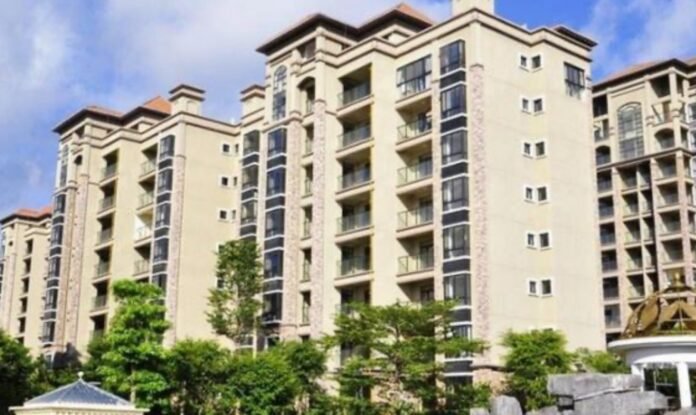
China’s home prices continued to fall in the first half of 2026 as buyers held back, betting that values would drop farther. With sales volumes and prices both in decline, analysts see little sign of a near-term recovery.
Data released on Wednesday by the China Index Academy showed that secondary-market home prices across 100 major Chinese cities fell 0.42% month-on-month in June, to an average of 12,639 yuan (US$1,750) per square meter. Of those cities, 88 recorded declines while only 12 saw gains.
The secondary market slide was broad-based across city tiers. In June, first-tier city secondary home prices fell 6.95% year-on-year. Second-tier cities fared worse, dropping 8.21% on the year, while smaller third- and fourth-tier cities fell 7.48% year-on-year.
Among the 10 largest cities, Nanjing and Wuhan posted the steepest year-on-year declines in June, with secondary market prices dropping 11.45% and 10.89%, respectively. Beijing, Tianjin, Guangzhou and Chongqing all saw falls of between 8% and 10%. Hangzhou, Shanghai, Chengdu and Shenzhen recorded year-on-year declines of between 5% and 8% in June. Shenzhen performed best among the ten cities, with a 5.27% drop compared with a year earlier.
Chinese commentators widely read the first-half data as confirmation that the downward trend in home prices has yet to run its course, with further declines expected through the remainder of 2026.
A Henan-based columnist writing under the pen name Qingjin Wenwang describes how the mood among prospective buyers had visibly shifted.
“A friend of mine started looking for a home to buy ahead of marriage in late 2025. Back then, sellers were confident and showed little willingness to negotiate,” he says. “By June 2026, when he returned to the same district to look at similar properties, sellers had largely softened their tone and kept asking him when he could sign a deal.”
The experience left his friend with a growing fear that prices could fall farther even after he commits to a purchase, he says.
Citing figures released by the National Bureau of Statistics (NBS) last month, he outlines four reasons why a genuine recovery remains out of reach:
- Prices have not stabilized. In May, only 16 of 70 major cities saw new-home prices rise month on month and just 10 recorded secondary-market gains. Third-tier cities saw declines accelerate.
- Buyers are still retreating. New housing sales fell 10.8% year on year by floor area and 13.5% by value in the first five months of 2026. Many households are deferring purchases indefinitely.
- Developers are pulling back. Real estate investment dropped 16.2% year-on-year in January-May, new construction starts fell 22.6% and completions declined 23.4%.
- Secondary market confidence has eroded. Price anchors in many cities have quietly shifted lower – and, once buyer psychology turns cautious, it is slow to reverse.
The NBS said on June 16 that only four of 70 cities recorded a year-on-year increase in new home prices in the first five months of 2026. In the secondary market, no city saw prices rise over the same period, with most cities recording year-on-year declines of between 5% and 8%.
“Since 2021, China’s property market has undergone a dramatic transformation. New home sales peaked at 1.79 billion square meters that year and have fallen every year since, dropping below one billion square meters in 2025,” a Guangdong-based property columnist says in an article published on Wednesday. “In many cities, prices have fallen more than 40% from their peak, and some have dropped more than 50%. Such a steep decline in such a short period is by any measure severe.”
He points to three structural reasons behind the downturn:
- China’s population entered negative growth in 2022 and has continued to shrink. Experience elsewhere shows population decline is very hard to reverse, and China is likely to remain in negative growth for the foreseeable future.
- The era of rapid urbanization that once drove explosive housing demand is largely over. Millions of people flocking to cities in the past decades fueled a surge in home prices, but that wave has run its course.
- Overall housing supply is no longer scarce. After years of construction, China has enough homes overall, except for tight supply in major cities and prime areas.
Back to 2006
In late April, a wave of articles by Chinese commentators drew wide attention online, arguing that four years of declines had pushed home prices back to levels last seen around 2006, once inflation and currency depreciation were stripped out. The articles cited data compiled by the Bank for International Settlements (BIS) and sparked a heated debate on Chinese social media about the true state of the property market.
The Federal Reserve Bank of St. Louis used BIS figures to illustrate China’s home prices relative to a 2010 baseline index of 100.
The first chart, tracking nominal residential property prices, showed China’s home price index climbing from 78 in 2006 to a peak of 145.9 in 2021, before sliding back to 114 in the first quarter of 2026.

The second chart adjusts for inflation and currency depreciation. On that measure, the index rose from 88.5 in 2006 to 113 in 2021, then fell to 85.1 in the first quarter of 2026, putting real home prices below their level two decades ago.

The adjustment is analogous to the difference between nominal and real gross domestic product (GDP) growth, where the latter strips out the effects of inflation or deflation to reflect actual economic expansion.
A Jiangsu-based columnist writing under the pen name Duanwei Liwen says the data should not be applied uniformly nationwide.
“Home prices in Beijing, Shanghai and Shenzhen are still absurdly high. I see no sign their home prices have returned to any historical low,” she says. “You cannot use one national figure to explain the situation in every Chinese city.”
She says first-tier cities have proven more resilient, while the far greater pressure is in third- and fourth-tier cities, where prices have fallen back to levels of a decade ago or lower. She adds that the real value of the BIS-based index lies in its role as a warning signal to those who rush into the market, betting on a bottom.
“Over the past few years, many people have already fallen into this trap,” she says. “They see prices pull back and assume the floor has been reached, or they see policy ease slightly and conclude a rebound is coming. Then prices keep falling, and they cannot sell their properties.”
A writer at Sina Finance, a Beijing-based news website, pushes back against the inflation-adjusted framing, arguing that nominal prices are more meaningful for most people, since household incomes and daily expenses are not inflation-adjusted. Based on the BIS nominal home price index, he says, it is undeniable that China’s home prices in 2026 have returned to 2016 levels.
He says any credible prediction of where prices are headed in the coming years must weigh a range of factors, including demographic trends, rental yields, income distribution and the balance between supply and demand.
Read: China’s population falls for fourth year amid economic woes
Follow Jeff Pao on Twitter at @jeffpao3