
Eoin Higgins is the author of “Owned: How Tech Billionaires on the Right Bought the Loudest Voice on the Left.”
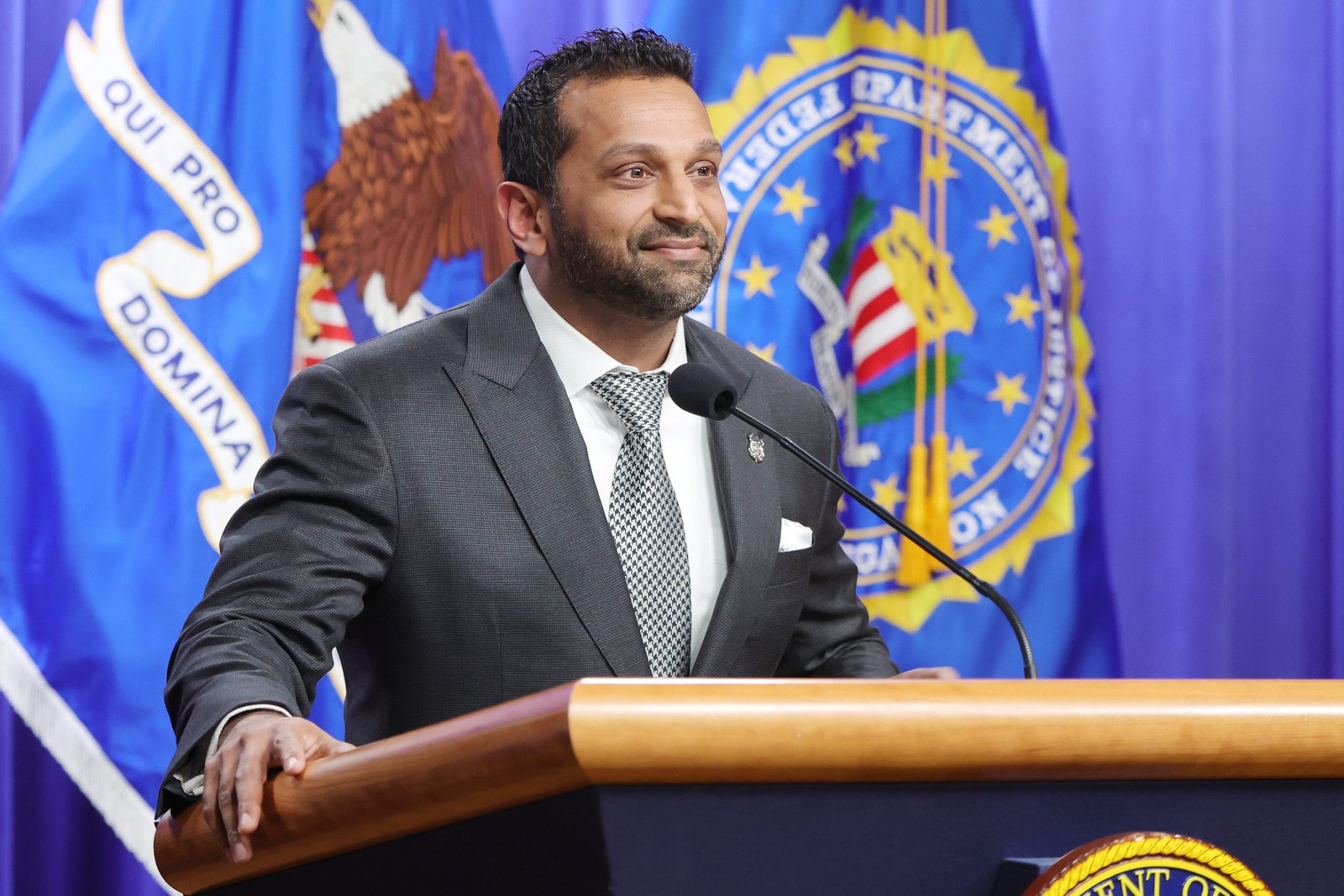
Smarting from the humiliation of a report published at The Atlantic about his time in office, FBI Director Kash Patel did what conservatives have done over and over in the age of Trump: He sued for defamation.
The Atlantic’s story detailed allegations about Patel’s mismanagement of the office and FBI staffers’ concerns that his behavior has become borderline dangerous. According to the magazine’s reporting, staffers have observed that the director frequently drinks to the point of intoxication and has been unreachable behind closed doors multiple times, at one point necessitating agents breaking down a door. In his lawsuit, Patel said that the allegations are demonstrably false.
Patel’s case — which names the publication and the writer as defendants and demands $250 million in damages — doesn’t appear very strong; it’s unlikely he’ll win in court. But a legal victory isn’t necessarily the goal. Such lawsuits apply financial pressure and ensure newsrooms think twice before publishing critical articles in the future.
For all the modern right-wing movement’s bleating about its commitment to free speech, in practice they’re anything but, with a demonstrated penchant for using the legal system as a cudgel against people who say things they don’t like. Known as strategic lawsuits against public participation, or SLAPP, they are a tool of the powerful — and have multiple levels of use.
Most immediately, SLAPP allows plaintiffs the potential to muzzle their critics, who will be less likely to launch attacks against someone who has already proven litigious. This applies not only to the defendant, whether it’s an individual or an institution, but also to others like them who will think twice rather than risk a protracted (and expensive) legal battle.
Even if these anti-free speech crusaders don’t win a judgment, they have a good chance of draining their opponents’ bank accounts.
Typically, the more deep-pocketed someone, or their backers, are, the more they can bleed out defendants by dragging on court cases for as long as possible, racking up legal bills that will have to be paid. Most publishers and newsrooms have lawyers on retainer or in-house, but their legal insurance deductibles are still high, potentially running into the hundreds of thousands of dollars per case.
Even if these anti-free speech crusaders don’t win a judgment, they have a good chance of draining their opponents’ bank accounts — and breaking their spirits.
Federal action is is sorely needed to make sure the use of SLAPP doesn’t spiral further out of control. Many states, including New York and Minnesota, have anti-SLAPP laws on the books, but their application in federal courts remains unsettled. Patel filed his suit in D.C. federal court, where the appellate court says the anti-SLAAP statute does not apply.
Universal application of these laws is needed so the powerful can’t turn to federal courts for meritless filings, and some lawmakers, like Rep. Jamie Raskin, D-Md., and Sen. Ron Wyden, D-Ore., have introduced legislation to that end. So far, however, those bills have not made it to law.
Patel is far from the only conservative figure to deploy the courts as a weapon against his critics, and this isn’t even his first shot at it; he has an ongoing 2019 lawsuit against Politico, for that outlet’s reporting on his time with the National Security Council during Donald Trump’s first term, and another defamation action, against former FBI official Frank Figliuzzi for comments on MS NOW, was dismissed on Tuesday.
Trump’s manipulation of the legal system to punish detractors predates his time in politics, but it’s gone into overdrive since his first term. The president has filed multiple defamation suits against members of the media and their organizations, including $475 million against CNN in 2022 (which was dismissed in 2023); the Pulitzer Prize Board for an award he objected to in 2022 (ongoing); journalist Bob Woodward and his publisher Simon & Schuster in 2023 (dismissed); ABC News in 2024 (settled for $15 million); CBS parent Paramount in 2024 (settled for $16 million); the Wall Street Journal in 2025 (dismissed), the New York Times in 2025 for $15 billion (ongoing), the BBC in 2025 for $10 billion (ongoing); and others. To be clear, this is not an exhaustive list.
Trump and Patel are two of the better known conservative figures attacking free speech via the courts, but it’s a mainstay tactic in MAGA world. Laura Loomer, an Islamophobic off-and-on ally of Trump, sued late-night personality Bill Maher over comments he made about her relationship with the president (the case was thrown out on Wednesday evening). In 2013, Trump sued Maher for breach of contract after the HBO pundit promised $5 million to charity if the then-real estate magnate could prove his mother was not an orangutan. (Trump withdrew the case.)
Elon Musk, the tech billionaire with close ties to the White House, used his X social media platform to file a suit against Media Matters for America over its reporting on ad content running alongside antisemitic posts on the site. And David Sacks, another tech billionaire who worked as Trump’s crypto and AI czar, threatened the New York Times over its reporting on his conflicts of interest in a public legal letter last December.
Closer to home, I’m currently being sued, along with my publisher, Hachette, for more than $1 million by conservative pundit Matt Taibbi over my book, “Owned: How Tech Billionaires on the Right Bought the Loudest Voices on the Left,” which delves into his ideological shift to the right. And the editor of this piece you’re reading now, Katherine Krueger, was sued for $100 million alongside her former employer Splinter by 2016 Trump spokesperson Jason Miller for a story about a court filing that alleged he drugged a woman with an abortion pill. Miller refuted the allegation, but that case was thrown out on summary judgment because it accurately reported what was in the court filing; mine is ongoing.
In some circumstances, as Trump found after he was elected to a second term in 2024, SLAPP lawsuits can succeed, irrespective of the strength or weakness of the claim. ABC News and Paramount settled with Trump in what are widely regarded as payoffs to a powerful figure who can control their corporate future. Corporations have made the calculation: Better to get on his good side than risk four years of retribution, and, after all, what’s a few million dollars compared to the benefits of having the world’s most powerful person looking kindly on you?
Whether or not Patel expects to win a $250 million judgment, a central claim in his lawsuit is that his word is enough to shut down speech.
But for the right wing, SLAPP suits also serve to make an ideological point. Whether or not Patel expects to win a $250 million judgment, a central claim in his lawsuit is that his word is enough to shut down speech.
Because he told The Atlantic the claims in their article weren’t true, they shouldn’t have published it, the complaint argues: “Defendants published the Article with actual malice, despite being expressly warned, hours before publication, that the central allegations were categorically false.” The objections of a powerful man should be enough to avoid bad press, this line of reasoning goes; publishing anything to the contrary is wrong.
That’s the animating principle behind the right-wing’s relationship with the media. If they disagree with it or find it embarrassing, you shouldn’t publish it; if you disobey, you must be punished.
It wasn’t until Trump — and decades of ideological capture of the courts — that there was the potential to regularly use the legal system as a weapon against critics. Until there are First Amendment protections against SLAPP, we can expect the powerful to continue dragging their detractors to court.