America at 250: five times the US constitution has come under threat
The story of the US is, in many ways, remarkable. It achieved independence against the odds, its constitution has lasted more than two centuries and its democracy has weathered war, economic depression, social upheaval and political change. But reflection on American history rarely settles into simple celebration.
From the beginning, the US was an experiment rather than an inheritance. It was built on the idea that free people could govern themselves through constitutional institutions. And because of that, Americans have repeatedly wondered whether the experiment was in danger of failing.
In some cases, fears proved exaggerated. In others, they were justified. But taken together, these moments reveal that fear of constitutional failure has been a recurring theme throughout US history. As the US approaches its 250th anniversary, several events stand out as moments of constitutional peril.
1. Tensions with France
The first major test of the constitution arrived soon after its signing in 1787. Eleven years later, in 1798, the formal alliance between the US and France was replaced with intense mutual hostility and paranoia as tensions grew over diplomatic insults and French attacks on American shipping. Congress passed the Alien and Sedition Acts as a response to external threats and domestic instability.
But critics saw something different: a government using fear to suppress dissent. The Sedition Act made certain criticisms of federal officials a crime, with newspapers and political opponents becoming targets of prosecution. For a nation that had recently fought a revolution in the name of liberty, this episode exposed an uncomfortable reality that constitutional rights could not be assumed.
The significance of the Alien and Sedition Acts lies not in their three-year duration but in the questions they raised. How much liberty are citizens willing to surrender when they believe the nation is under threat? And how much dissent can a democracy tolerate? Those questions have returned throughout American history.
2. The civil war
No crisis would test the republic more severely than the civil war in 1861. The decision of southern states to secede from the US shattered the assumption that political disagreements would remain within constitutional boundaries. This turned the long-running conflicts over slavery, citizenship, federal authority and the meaning of the union itself into open war.
Had the Confederacy succeeded, the US would probably have ceased to exist in the form envisioned by its founders. Yet even this example is more complicated than a simple narrative of survival. The union was preserved, slavery abolished and new constitutional amendments transformed legal definitions of freedom and citizenship. But these promises were only partially fulfilled.
The US government abandoned its efforts to protect the rights of newly freed Black Americans after the civil war, allowing the southern states to enforce legalised racial segregation and systemic disenfranchisement for nearly a century. This reminds us that constitutional survival and constitutional justice are not always the same thing.
The 20th century brought new challenges. During the cold war, fears of communist influence and Soviet espionage spread throughout American society. Some fears were grounded in reality, but the atmosphere created by the “second red scare” (1947-59) extended far beyond legitimate security concerns.
Commonly associated with Senator Joseph McCarthy, this period is remembered not because Americans feared communism but because fear itself became politically powerful. Loyalty investigations, blacklists and public accusations affected thousands. People found their careers damaged or destroyed based on suspicion, association or allegations.
McCarthyism remains historically significant because its underlying dynamic is so familiar. When faced with threats, democratic societies often struggle to uphold civil liberties. This episode raises a broader question that remains relevant today: can a free society preserve its freedoms when citizens believe those freedoms are being exploited by enemies?
4. Watergate scandal
The Watergate scandal of 1972 to 1974 presented a different kind of constitutional challenge. What began as a burglary at the Democratic National Committee headquarters in Washington quickly evolved into broader investigations. These investigations exposed direct efforts by President Richard Nixon to obstruct justice, misuse government agencies and conceal wrongdoing within the executive branch.
At its heart was a central question: was the president subject to the law? Democracies depend on elections but also limits to power, even when that power is exercised by democratically elected leaders.
What makes Watergate noteworthy half a century later is not just the misconduct that was uncovered, but the response it provoked. Journalists investigated, courts asserted their authority, Congress conducted oversight and ultimately Nixon resigned. While Watergate shook public confidence, it demonstrated that constitutional checks and balances could function when tested.
President Richard Nixon ultimately resigned following the Watergate scandal.Will Oliver / EPA
5. The 2020 election
The most recent chapter in America’s story remains close enough to the present that its full historical significance is still debated. The aftermath of the 2020 election and events on January 6 2021, when Trump supporters staged a violent attack on the US Capitol building in Washington, exposed divisions over elections, legitimacy and democratic norms.
The attack disrupted a process that Americans had taken for granted: the formal certification of a presidential election and the peaceful transfer of power. What made this episode so important was the challenge it posed to confidence in electoral processes themselves. Democracies depend upon winners and losers accepting constitutional outcomes, even when they are disappointed by them.
The constitutional system ultimately carried out its responsibilities. Courts heard challenges, state officials certified results, Congress completed the certification process and the transfer of power took place. Yet this episode left enduring questions about public trust, political polarisation and American democratic health.
As Americans prepare to mark 250 years of independence, these different episodes suggest that constitutional government has never been self-sustaining. From fears of republican collapse to concerns about civil war, political repression, executive overreach and contested elections, each generation has confronted its own version of constitutional peril.
Perhaps the most remarkable feature of the American experience is not the crises themselves, but the debates over how to preserve the republic have endured alongside them. America’s constitutional democracy is not a finished achievement. It is a continuing project, renewed and tested by every generation.
NASA chief praises progress Blue Origin is making after launch failure
NASA Administrator Jared Isaacman said this week that Blue Origin has been putting significant resources into the cleanup of its launch pad since the explosion of its New Glenn rocket there in late May.
“Blue Origin’s response to the situation is almost beyond impressive, and that’s not just a NASA assessment,” Isaacman said in response to questions from reporters on Wednesday afternoon. He noted that officials from the US Space Force have also been deeply involved in Blue Origin’s planning and work since an anomaly during a test firing took out New Glenn’s only operational launch pad on May 28.
NASA has a significant stake in Blue Origin’s return to flight. It is counting on the company’s Mk. 1 lander to carry dozens of cargo missions to the Moon, and its Mk. 2 lander to eventually ferry people to the lunar surface. The company’s New Glenn rocket was expected to play a critical role in launching both of those landers.
Plan A is to launch on New Glenn
Before the accident, Blue Origin had been hoping to launch its first Mk. 1 mission, named Endurance, later this year for a cargo landing on the Moon. Additionally, the company is developing a test version of the Mk. 2 lander for launch as part of the Artemis III mission, which NASA hopes to fly during the second half of next year.
Blue Origin officials, including chief executive Dave Limp, have said the company is working toward rebuilding Launch Complex 36A, completing the anomaly investigation, and launching New Glenn on a return-to-flight mission before the end of this year. Privately, some NASA officials have expressed skepticism about this timeline. Most independent observers have suggested that a 12- to 18-month timeline is probably the most realistic for New Glenn’s return to flight.
Isaacman stressed this week that NASA’s preferred option is for the Endurance mission, which will carry two NASA science and technology payloads to the lunar surface, to launch on New Glenn.
“They’re making great progress,” Isaacman said of Blue Origin. “So plan A is very much still to launch the Mk. 1 on New Glenn. They are very committed to getting back in the business of launching New Glenn before the end of the year. And Plan A is looking a lot better today than it was weeks ago, just based on the progress that the Blue Origin team is making.”
NASA considering its options
However, he added that prudence demands that NASA should also study alternative launch vehicles for the Endurance mission as well as Blue Origin’s lander for Artemis III. Options include SpaceX’s Falcon Heavy or United Launch Alliance’s Vulcan rockets.
So NASA is closely watching Blue’s recovery. Isaacman said he receives daily updates from his team.
“We’ve got time into 2027 before we’re getting nervous,” Isaacman said. “If we start tracking towards mid-2027, that has implications for the Artemis III mission, and for uncrewed landers, and that would be more concerning.”
“We continue to actively investigate the cause of the anomaly,” he wrote. “The vehicle is highly instrumented with extensive data from multiple camera angles and sensors, giving us confidence in our ability to identify and correct the root cause. Early analysis points to the aft section of the first stage.”
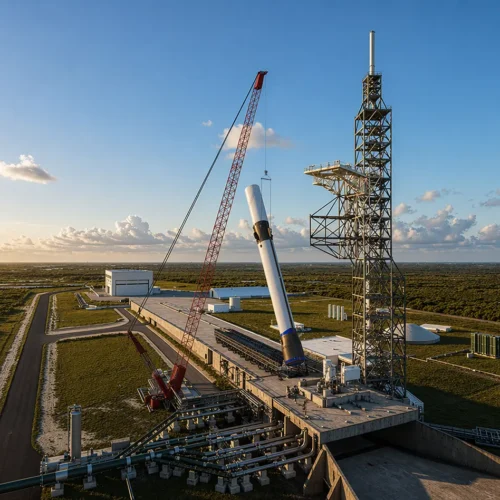
During the test anomaly, Blue Origin lost the lightning tower at its launch site as well as the massive transporter-erector, which moved the rocket from a nearby integration hangar out to the launch site and lifted it vertically for takeoff.
To expedite a return to flight, Limp said, the company is not rebuilding the same pad and is skipping construction of a new transporter-erector (which would take a long time). The company released a video showing how its engineers envision this process working. It involves using a crane to lift the integrated first and second stages onto the launch mount. Once there, and after pre-flight testing, a payload fairing would be placed atop the vehicle ahead of launch.
Isaacman lauded Blue Origin for this transparency as it moves toward returning to flight, noting the broad interest within the space community in this topic.
Lawsuit shows it’s past time for Samsung and SK Hynix to speak up
For a quarter of a century, consumer technology was the most dependable disinflationary force in the world economy. Each year, the device in the hand did more and cost less, and that quiet subtraction flattered every inflation print on earth.
That era is over. This is slowly turning into consensus, with the “technology is always deflationary” crowd finally yielding to the weight of evidence. We have chronicled the long, cascading narrative of this Silicon Shock since its first tremors.
The structural phenomenon we originally christened as techflation has since hardened into the invisible gravity of the global macroeconomic landscape. It has broken out of its cage; today, it is actively distorting core monetary gauges, bending both producer prices and personal consumption expenditures into its own inescapable orbit.
It is a profound inversion. Technology has never been considered a source of inflationary pressure. Even in recent years, when the cost of living became a persistent concern, blame was heaped on traditional causes: tariffs, then energy, then labor. Each had a face the public could resent and a politician willing to point.
But those costumes have worn through. The trade fights have cooled, and oil has come off its war-driven highs as the market begins to look past energy as the whole story. With the usual suspects fading from the conversation, the eye naturally travels to the one category that was never supposed to climb at all.
The world is now busy inventing names for it. Some are settling on chip inflation; others have reached for memflation or ramageddon. The vocabulary is the tell. One does not coin a word for a phenomenon one intends to forgive. A villain is being assembled, and the naming is the first stage of the assembly.
The evidence has stopped being anecdotal. We use US numbers to make the point, but the forces are global. Headline inflation in the US has climbed to 4.1%, a three-year high and the fourth straight month of acceleration, with the core measure lodged at 3.4% and no longer falling toward its target.
Producer prices for electronic components have run up close to 27% over the past year, from under 6% in January; computer software and accessories on the shelf are up around 15%; and in the channel, contract prices for ordinary memory have more than doubled in just two quarters. By one estimate, the data center build-out alone is now adding roughly 0.4 points to core inflation. This may not appear dramatic, but it is an extraordinary share to assign to a single technology.
The institutions that move slowest have begun to concede it. The Federal Reserve now acknowledges that the construction frenzy is probably pushing inflation higher, and one of its governors has warned of a fresh price shock driven by AI investment demand. The question that its own economists pose is the one that should trouble the memory makers most: whether this is the old, volatile chip cycle, soon to turn, or a new supercycle that will not.
As always, we are staggered by how much the market believes it can explain away through exhausted phrases like “cycle” and “supercycle.” But what separates this wave from its predecessors is that it answers to no embargo and no statute. It is pure arithmetic.
A boom in one corner of computing is consuming the parts every other corner is built from. Agentic systems that run without pause, and a token economy without a ceiling, pull memory into the data center, leaving the rest of the world to bid for the remainder.
This is the flip we described: pricing power migrating from the cutting edge to even mature products because of capacity reallocation. Producers who spent two decades competing with one another into losses now dictate terms, carrying the composure of a supplier who knows the buyer has nowhere else to go.
In the hunt for a villain, simplicity wins, and it will not matter whether the simplest story on offer is the right one. Globally, the prices of everyday technology products have begun rising like never before. The headlines are turning shrill; consumer gadgets are no longer luxury items, and rising prices hurt the most vulnerable sections of the economy. Those implementing the sticker price shocks have a simple defense: they are helpless because their component costs, particularly the easily understood memory chips, are skyrocketing.
That memory makers are posting extraordinary profits does not help. In financial markets, the vast majority cannot reconcile the fact that companies they have historically held in little regard are suddenly making more money than their favorites in other sectors. With new narratives being actively supplied by popular gadget makers, chatter about “price gouging” is rising in volume.
The account is skin-deep, but it lands on a target the world was already primed to dislike: the memory makers, resented long before they were rich, largely dismissed as commodity peddlers. Now, the fattest margins in their history arrive to harden the grudge rather than soften it.
Unless they put in real effort to rewrite this story – and, with the minor exception of Micron, nothing suggests they intend to – this does not remain a quarrel about laptops. It worsens in ways they are not braced for, and its next stage is geopolitical.
Everyone’s favorite hate object
We were not surprised when Apple’s outgoing chief blamed memory, and not foundry costs or anything else, for the prices it was lately forced to raise. Memory is the safest thing to accuse in the supply chain. Nobody boycotts a chip they have never seen, sold by a company they may not be able to name, and these particular companies are the easiest in technology to resent. Their margins have climbed to brush Nvidia’s, and a component supplier that’s earning like the most glamorous name in the industry draws every species of scorn, snideness and envy that the market keeps in stock.
The resentment is not confined to angry consumers. It runs up the chain to the makers’ own peers. At its June shareholder meeting, TSMC’s chief told the room he envied memory’s 80% gross margins but would never reach for them, drawing a careful line between his disciplined foundry and the opportunists down the road. In the same month, TSMC quietly informed customers of price increases across nearly three-quarters of its wafer business. The point is not that TSMC is a hypocrite. It is that memory that has become the foil against which everyone else, even a fellow monopolist raising its own prices, gets to look restrained.
The analysts who do not cover memory pile on from the other direction. To them the unbelievable margins are not evidence of a structural shift but proof that the top is near, a cyclical reckoning overdue, never mind that almost none of them forecast even a sliver of the run that multiplied memory prices severalfold, and in places far more. Having missed the climb, they are determined to be early on the fall.
What makes memory such a comfortable target is partly that few credit the makers with doing anything extraordinary. But it is more than the makers, the Korean two above all, simply take it. They absorb the blame, the scorn and the cyclical obituaries without rebuttal.
When they do surface in public they wear the humility face, all but agreeing that this strange golden phase will pass and normal service resume. It will not, at least not soon, and not only because of demand and supply. The difficulty of adding capacity, and of anyone outside the three even attempting it, is something we have set out at length (Is DRAM at a Permanently Higher Plateau?).
In that world, the studied modesty is not grace. It is an invitation. A producer who will not make his own case hands it to everyone who would rather make it against him. The memory makers have explained the cycle a hundred times. They have not begun to explain themselves.
There has never been any respect for memory makers
Try a question that sounds absurd and is not. When did the world last treat a memory chief as an oracle of the AI age, the way it hangs on every word from Jensen Huang, or settle in for an hour to hear his view of where it is all heading? When did one of them command a stage as a visionary rather than a supplier? It does not happen.
Micron’s boss was at last year’s celebrated White House tech dinner and has stood with the administration to pledge American investment; the two Korean chiefs shared a podium with their own president just this week. But notice what those appearances were: a number pledged, a fab promised, a national champion taking its assigned place. No one asks the memory makers what they think the future holds. It is quietly assumed they have nothing worth hearing.
Three years into the generative AI era, a grudging consensus has formed that the cognitive layers are no longer untouchable. Software development, the purest office work of the industry, has lost its old unquestioned scarcity; the argument was resisted at first and is now nearly conventional. Yet as software sheds its halo, the reverence only migrates one rung down, to chip design.
We argued in January that design is hardware’s software, the high-status intellectual labor the market knows how to admire – abstract, and architectural, and apparently weightless (Chip Design: Hardware’s Software). Even as the crowd around it thickens – Arm, Qualcomm and a steady parade of Chinese entrants – the romance of cognition clings to it. Foundry work keeps its honor, too. The world has learned, at least dimly, to treat the yield and packaging of a TSMC as a kind of miracle.
Memory was never extended the courtesy. To investors, it was a cycle, to customers a cost line, to technologists a commodity. The shorthand was self-satisfied: a chip is a chip, standardized by committee, so where is the genius? Memory has design, but not of any complexity or intricacy that anyone needs to admire.
Memory’s hardest problems sit precisely where the market refuses to look, in the etching of capacitor structures at brutal aspect ratios, in deposition, in yield, in coaxing billions of identical cells to behave almost perfectly. It is why the masters of logic manufacturing, Intel and TSMC among them, do not simply wander into leading-edge DRAM or HBM and win.
The cleanest proof arrived this year from inside the industry’s own leader. Samsung, the rare house that builds world-class logic and memory under one roof, stumbled on the yields for its most advanced AI memory and watched a pure-play rival take the crown. Mastery here is not bought with a balance sheet or borrowed from an adjacent triumph.
None of which the world credits, and that is the danger, not the insult. Respect would have bought them defenders, the customers, analysts and commentators who explain a company charitably when its prices turn.
The danger in that is not wounded pride. These are engineers, and they may be perfectly content to be unglamorous. The danger is subtler and worse: disrespect, sustained for decades, has left them without a single friend. So now, at the precise moment the world goes looking for someone to blame, the memory makers find themselves the most profitable companies on earth and with nobody in their corner.
Geography of the grudge
The second root is harder to say without being misheard, so we will say it plainly. The two largest memory makers are not American. They are Korean. To a macro commentator in the West, that single fact is quietly doing a great deal of work.
The argument writes itself on the podcasts and the cable hits. Several of the largest American companies have begun to lag the broader market, their margins visibly pressed, and the cause is increasingly placed offshore. For the multitude raised on passive investing, who watched their funds compound on the long outperformance of the majors, the Mag Seven and every moniker before it, a foreign supplier eclipsing those names can only be temporary, a glitch their corporate chieftains – and, if not them, then their politicians – must correct.
Of late the story has turned further. On consensus forecasts, the three memory makers may earn more in operating profit next year than Apple, Meta, Alphabet and Amazon make between them, with enough left over for a TSMC or a JP Morgan, if not both. A component supplier, out-earning the marquee American names whose products it sits inside. Set that way, it reads as an injustice in search of an author. One has only to read the popular commentators in the financial press to feel the frustration: companies that merely live on the largesse of the giants, on their capex, are making this kind of money, and seemingly at the expense of the very portfolios built on those giants.
There is an unspoken assumption beneath it, that a domestic champion should be shielded from the shock, and that the foreign supplier exists to absorb the pain. The notion that the American giant might instead take the hit itself, accept thin returns or a stretch of losses to spare its customers, is treated as faintly unthinkable, while the identical sacrifice is demanded of the foreigner without a second thought. If only those firms would charge less, the reasoning runs, the shelf would be cheap again.
The history beneath this is badly told. In the Western version, the downstream American giants built the Asian fabs; Apple, the story goes, made TSMC. As we set out in our ASML piece, the corridors of those fabs remember it differently. For years the manufacturers held almost no pricing power, their margins kept on a tight, Cupertino-controlled leash by the very clients who used rock-bottom components to flatter their own returns (The Last Polite Monopolist).
Micron, the lone Western maker, has begun, gently, to say as much, noting that the aggressive squeezing of the last downturn is what starved the investment and seeded today’s shortage. It is a fair point and a useless one. It explains the system to a room of investors. It does nothing to soften a household paying more for a laptop.
The fabs feel no debt to the clients who spent a decade crushing them, and no urge to subsidize the downstream any longer. As the bill reaches the ordinary consumer, the distance between the Western assumption of cheap components and the Asian refusal to keep providing them stops being a supply dispute. It becomes a grievance with a flag on it, the raw material from which the next stage, the geopolitical one, is built.
One aside, since it returns when we close. Memory is among the few frontier technologies where the West seems strangely relaxed about Chinese parity. With prices spiking, Apple is already lobbying Washington to loosen the curbs on sourcing from a blacklisted Chinese maker, the case being that Chinese gains in memory threaten far less than they would in models, foundries or EUV. It is a small crack in a wall the West built on purpose, and where small cracks lead is the subject we end on.
A trillion-dollar industry cannot whisper
The memory makers have outgrown their own language, and they have not noticed. For decades, they spoke exclusively in the impoverished grammar of the “cycle.” Demand was strong or weak, inventory high or low, price down then up then down again. Every presentation relied on the same spartan vocabulary to explain their helpless, almost compulsive behavior around CapEx.
When the AI boom broke their historical trendlines last year, their language did not evolve; it just bolted on a prefix. Now, everything is a “supercycle.” The makers, particularly the Koreans, seem entirely content to cosplay as the inadvertent, passive beneficiaries of a weather event.
That studied humility might have suited a commodity price-taker in 2015. But for a cohort of companies now collectively commanding trillion-dollar valuations and gatekeeping the most critical constraint of the AI economy, this silence creates a dangerously wrong impression. It is an elementary error of public relations, and it is actively mutating into a legal liability.
Retire the ‘supercycle’ before it becomes exhibit A
Last week, the cost of that silence materialized in the US District Court for the Northern District of California as Garciaguirre v. Samsung Electronics. The 17 plaintiffs – a mix of individuals and small businesses – claim the memory oligopoly conspired to keep commodity DRAM artificially scarce to inflate prices. The complaint argues the makers used their coordinated pivot toward high bandwidth memory (HBM) as a smokescreen to deliberately throttle the production of older DDR3 and DDR4 modules.
This is exactly what happens when you refuse to explain yourself. Extraordinary margins attract extraordinary scrutiny. If the Korean giants refuse to publicly articulate that their chips are not simple commodities, but rather bespoke, thermodynamically complex engineering marvels critical to global security, they will be treated exactly like a cartel. The public will demand they charge less, regulators will demand they pay more in fines and politicians will demand they pay more taxes.
People like GenInnov should not be the tiny group to explain why these companies are critical for the security and primacy for those intend to lead the AI industry or their products are as customized as GPUs of NVIDIAs or AMDs. If the three companies do not want to be banded together as a world’s macro-hurting cartel, they must take charge in retiring the explanations revolving around “super-cycles,” often initiated by their own managers and never resisted in conversations involving analysts and other pundits.
The story they decline to tell is the most interesting one in technology. Compute has grown heavier at every layer, from the components on a single board to the architecture of an entire AI factory, and the demand has rippled vertically through everything that feeds it, from MLCCs and substrates to the lasers and PCBs of optical transceivers, where lead times have stretched from weeks to months.
Memory caught the largest wave of all. The models themselves have grown denser, and the regurgitation that began with reasoning and is compounding in the agentic era consumes memory faster than almost anything else, because a machine that thinks longer and never stops must hold more of its context in silicon.
Nvidia spells this out in public: as context lengths grow and inference turns interactive, memory becomes the dominant constraint on efficiency. Its newest accelerators carry hundreds of gigabytes of HBM each, several times the prior generation. An AI server now holds eight to ten times the memory of an ordinary one, and HBM burns roughly three wafers for every one a commodity part would need. The data center has climbed from a third of DRAM demand to half, on its way to two-thirds. That is why the shock spread outward from HBM into DRAM, into NAND, and finally onto the shelf.
That last point matters. The lawsuit may fail. It may deserve to fail. Parallel investment in HBM is not proof of collusion; it may simply be what happens when every serious AI customer bangs on the same three doors at the same time. But the lawsuit is still important because it shows the shape of the accusation now forming. The plaintiffs do not need to understand HBM yields, TSVs, wafer starts, packaging constraints, Nvidia roadmaps or hyperscaler contracts to create a story. They need only four words: they all moved together.
That is why “supercycle” is no longer harmless. It sounds like a shrug. It sounds like management saying prices rose because prices rose. In a commodity downturn, that language merely annoys shareholders. In an inflationary boom, with laptop, console and phone prices rising downstream, it becomes an exhibit.
The C-suites in Seoul might loathe the podcast circuit, and they may lack the theatrical flair of the American tech majors, but remaining aloof is no longer a luxury they can afford. An industry with three trillion-dollar companies cannot outsource its narrative to its customers and its critics. The industry is now too large, too profitable and too politically exposed to hide behind commodity diction.
If Samsung, SK hynix and Micron want the world to understand that this is not a cartel story, they must stop speaking as if price were an act of God. They need to show the order books, the capacity math, the fab lead times, the HBM trade-offs, the customer commitments, the packaging bottlenecks and the economics of underinvestment after the last bust.
Until the makers say it themselves, in words larger than supercycle, they remain what they have always allowed the world to call them: passive beneficiaries in the boom, and in the bust the simpletons who never saw it coming. The error compounds the moment anyone bothers to look, as being shown by the plaintiffs of the lawsuit.
When the stock becomes the story
The second error is one of stewardship, and it is becoming the most expensive.
These are no longer specialist chips followed by a narrow circle. SK Hynix briefly overtook Samsung to become the most valuable listed company in Korea, worth about $1.35 trillion; Micron crossed a trillion dollars in value for the first time this spring. They are among the largest single expressions of the AI trade anywhere. And their home market cannot carry them safely. Samsung and SK Hynix together now make up more than half the entire KOSPI, up from a third a year ago. When two stocks are the index, the index has nowhere to hide.
So it did not hide. After Korea launched sixteen single-stock leveraged ETFs on the two names in late May, retail money poured in, the funds swelling past $9 billion with roughly nine in ten holders being individuals. The world’s most volatile market turned more volatile with these products.
A week ago and a day after the regulator admitted it had approved those products too hastily, the whole thing broke. The KOSPI fell 9.99%, with Samsung and Hynix having their worst single day since the 2008 crisis. The leveraged funds built on them fell roughly a quarter in a session. This is what a casino looks like when the house steps away from the microphone.
The memorymakers did not build those products and cannot control their stocks, and they should not try. But that is not the obligation. The obligation is to stop feeding a vacuum. A company of this size and volatility has to communicate through the turbulence, narrow the informational gaps, explain capacity and demand visibility and downside risk, and warn plainly against speculative excess rather than bask in it.
Silence or even practiced humility is not neutrality here. When the leverage finally unwinds and retail investors are wiped out, the firms that said nothing, that behaved like quiet engineering houses while a bubble inflated on top of them, will be the ones blamed for the wreckage. That too is an elementary error, and the scrutiny that punishes it is rising by the week.
Do not invite the cartel story
Two audiences appear to have read our recent notes with unusual care, and we find we are not flattered. The first are the plaintiffs. For much of last year we pointed, more or less alone, at the oddest tell in the industry, three ferocious rivals retiring DDR4 in near-unison, a coordination we called unprecedented at the time and of historic significance later. That single observation is now the spine of a federal lawsuit discussed above.
The second reader is the Korean state, which seems to have taken to heart our more sardonic line, that the surest way to prove these blood-feuding rivals were not built solely to ruin one another would be to line them up behind their president. On Monday, that is exactly what happened. For once, we would rather not have been read so closely.
The third error is the most dangerous of the three, because it needs no truth to do its damage, and this week it walked onstage in person. To a domestic audience, this is excellent political theater; it is the visual of national champions securing the semiconductor frontier. But to a global economy choking on techflation, it is catastrophic optics. Seen from a world wincing at its memory bills, the same frame reads differently, the two firms that make two-thirds of the planet’s memory holding hands with their president for the cameras and promising, in unison, to steer the supply for ten years.
As such, the companies that claim to be fiercely independent competitors, the pattern of joint appearances is starting to jangle.
Each tableau, two rivals controlling 70% of DRAM and 80% of HBM, a head of state, a decade of synchronized capacity, reads less like national champions than like a cartel taking a podium. The viral fried-chicken dinners that turned Korea’s chip and tech chiefs into folk heroes beside Nvidia’s Jensen Huang only deepen the sense of a small circle perpetually in one another’s company.
None of it proves anything. Much of it is simply what national industrial strategy looks like now. But politics does not process nuance. Angry consumers see dearer gadgets, device makers point upstream, analysts see record margins and lawyers see concentration. The old word assembles itself: cartel.
The memory makers have a record they seem to have forgotten. Between 1998 and 2002, the industry ran a convicted price-fixing conspiracy. Executives went to prison, and hundreds of millions in fines were paid. The named victims included Apple, the very same firm pointing fingers today.
This is the same elementary error in its most combustible form. Compete in public and be dismissed as simpletons; appear in concert and be suspected as conspirators. The only exit is to explain, separately and clearly, that disciplined capacity is a response to demand and the brutal arithmetic of fabs, not a private agreement, and to say it before a regulator or a candidate says something more convenient first.
Speak, or be spoken for
Micron cannot carry the industry’s case forever. The lone Western maker has begun, gently, to make it, arguing that years of brutal customer pricing starved the investment that would have prevented today’s shortage. But Micron is the smallest of the three and the most conflicted witness, a beneficiary defending its own record margins. The two firms that actually set the weather, the Korean giants, say almost nothing in the languages that matter. That silence has stopped being safe, because the stakes have outgrown the pricing cycle.
Consider how critical memory has already become: Apple is currently lobbying Washington for permission to buy memory from CXMT, a Chinese maker blacklisted by the Pentagon. When the world’s most valuable company asks the US government to trade a national security red line for component price relief, you know exactly how immense the pressure has become.
Meanwhile the relief everyone is counting on in the long-term may also not arrive. The tens of billions in new fabs from Samsung, SK Hynix and Micron will not produce at scale until 2028 or beyond, and on the present trajectory of AI memory demand, even that may fall short. Long before the concrete is poured, the inflation that memory is now feeding could do real damage to the very tech demand the boom depends on, a feedback loop we have warned about for some time.
And the mood is turning. The din against the memory makers is rising from every direction at once, from the product chieftains raising their own prices, from the podcasters, from the commentators. Inside seven days the memory makers were sued for conspiracy, watched their shares crater in a leveraged panic, and then, in the third act of the same week, lined up beside their head of state to pledge a decade of joint construction. Any one of them is survivable. Together they compose a portrait, and not a flattering one.
Here is an industry earning margins higher than almost any company in history, and the world has decided the winners are accidental, the profits unearned, the beneficiaries undeserving. That resentment does not stay abstract. It hardens into lawsuits, into hearings, into trade fights, into the search for a foreign villain.
The makers do not need to perform at Jensen Huang’s volume, touring the world with a roadmap and a leather jacket. But they do need to be heard, in the outlets ordinary people read, giving their own account of why scarcity exists and why discipline is not collusion. Until the largest two learn that, they are far more exposed than any product cycle would suggest, not because the demand is fragile, but because they have not learned the nuances required to manage being the most profitable companies on earth.
And if they imagine the cure for their stock’s wild swings is to ship the volatility abroad, an SK Hynix listing in New York into another thin pool of leverage, they are in for a surprise. They are already drawing the gaze of politicians in their own capital and well beyond it, and they have not begun to manage what people believe about them.
Forty years ago, memory was the quiet engine that made the digital world cheap. Today it is the upstream producer the world has chosen to blame for making it expensive, an OPEC that has not yet realized it is one. The barrels did not learn to speak in the 1970s, and the producers paid for it in politics for a generation. The memory makers can explain the AI shock now, in their own words, on their own terms. Or they can wait, and be explained, by the angriest audiences they have ever had.
Nilesh Jasani is CEO of Geninnov Fund, which originally published this article. The article is republished with permission.
Iran says IAEA inspectors ‘will not be granted any access’ to bombed nuclear sites
Iran’s Parliament Speaker and top negotiator Mohammad Bagher Qalibaf said Wednesday inspectors from the International Atomic Energy Agency (IAEA) “will not be granted any access” to its bombed sites, Anadolu reports.
“Parliament itself passed the law, and the Supreme National Security Council has also adopted a corresponding resolution,” Qalibaf said in televised remarks posted on his Telegram channel.
“Under this law, no access whatsoever will be granted to sites that have been bombed and damaged,” he added.
The speaker stressed that Tehran “will not grant any access” beyond what has been authorized by the country’s Supreme National Security Council.
“The IAEA inspectors are only entitled to the Bushehr Nuclear Power Plant and the Tehran Research Reactor,” he added.
His comments come as a memorandum of understanding between Washington and Tehran, brokered by Pakistan, entered into force on June 18 after it was electronically signed by Iranian President Masoud Pezeshkian and his US counterpart Donald Trump.
The agreement provides a framework for ending the war that began in late February and addressing outstanding issues between Washington and Tehran through negotiations, including a cessation of hostilities across all fronts, including Lebanon, sanctions relief, the nuclear file, the full reopening of the Strait of Hormuz and broader regional security arrangements.
Israel’s Knesset gave preliminary approval on Wednesday to the proposed Torah study Basic Law, moving forward legislation that would enshrine Torah study as a constitutional principle.
The measure, introduced by Knesset members Moshe Gafni, Yaakov Asher and Yitzhak Pindrus, cleared its first reading by a 63-53 vote.
If ultimately enacted, the bill would designate Torah study as a “fundamental value.” Its sponsors say the measure is intended to place Torah study on equal constitutional footing with other foundational principles, while legal experts have warned it could be invoked to justify exemptions from military service.
Prime Minister Benjamin Netanyahu participated in the debate and voted in favor of the proposal. Four coalition lawmakers opposed the bill: Yuli Edelstein, Dan Illouz, Sharren Haskel and Moshe Solomon.
Legal experts also cautioned that, should the rights of Torah students and military personnel conflict, the legislation could give constitutional priority to Torah study.
Opposition leaders quickly denounced the vote.
Together chairman Naftali Bennett said, “Immediately after the new government is formed, we will repeal the Basic Law of Torah Humiliation. The law will disappear, but the mark of shame on the miserable Knesset members who supported it will remain.”
Yashar chairman Gadi Eisenkot said, “The attempt to turn draft evasion into a Basic Law is a direct blow to our national backbone. At a time when the burden on those who serve is reaching record levels and the price they pay is unbearable, the coalition is choosing to create a bypass route for draft evasion.”
Backers of the legislation said it is designed to restore Torah study to what they consider its proper standing in the Jewish state.
Addressing the plenum, Yitzhak Pindrus said Torah study ranks above military service as the state’s highest value.
Gafni said, “In recent years there has been a degradation in the honor of the Torah. Therefore, under the instruction of the leading Torah sages, I decided to bring this Basic Law to restore the honor of the Torah, which has sustained the Jewish people for thousands of years and distinguishes us from all other nations.”
United Torah Judaism chairman Yitzhak Goldknopf said the proposal was intended “to recognize the Torah of Israel that was given at Mount Sinai,” adding that Torah students should not be treated “as though he were a thief.”
T-Mobile moving tens of thousands of virtual machines off VMware amid lawsuit
T-Mobile is asking a New York court to rule that Broadcom was contractually obligated to continue supporting its VMware perpetual licenses.
In its complaint, T-Mobile said it has tens of thousands of virtual machines using VMware software across approximately 303,140 CPU cores. It also said that it was migrating off VMware but noted the time-consuming and technical challenges involved in migrating over 1,000 applications.
It filed its lawsuit, which was first reported by The Register today, in the Supreme Court of the State of New York in August 2025 (PDF).
The mobile company claimed that in 2023, it bought perpetual VMware licenses, plus two years of support with the option to buy a third year. But after Broadcom bought VMware, it stopped sales of VMware perpetual licenses in favor of subscriptions and started bundling VMware products into a few, more expensive bundles.
When T-Mobile tried to extend support for a third year for $5,288,398.45, Broadcom wouldn’t allow it, per an August 2025 filing from T-Mobile. A Broadcom representative reportedly told T-Mobile via email: “Broadcom announced end of available of all perpetual products, which includes Stated Out Year Renewals for perpetual support.”
A judge granted T-Mobile an injunction that allowed it to receive support services from October 2025 through August 3, 2026, for $5.28 million, plus the posting of a $500,000 undertaking.
Now, T-Mobile seeks a declaration that it was entitled to renew support services and further relief as the court deems necessary.
At one point, T-Mobile wanted support so badly that it offered $20 million for two years of software updates and support services. The company cited litigation costs and “mitigating interruption and security risks to both the network and the business” as part of its reasoning.
In a filing last month, Broadcom claimed that it has incurred $24 million in costs to provide T-Mobile with support for six VMware products and to assign it three dedicated support account managers. T-Mobile responded that it doesn’t use three of the six named products and has opened only two service cases this year.
As noted by The Register, Broadcom previously argued that T-Mobile’s case stands out because T-Mobile waited a long time before trying to extend support.
“Thousands upon thousands have successfully migrated to subscription,” a Broadcom lawyer said in an October 2025 hearing, per the publication. “T-Mobile is the outlier here that is in litigation. … Thousands upon thousands of customers have already transferred under these sorts of provisions and accepted and understood that end of availability applies.”
However, it’s worth pointing out that the financial and technical burdens involved in suing a conglomerate like Broadcom. Those challenges may have deterred organizations, especially smaller ones, from getting into litigation over VMware.
Neither T-Mobile nor Broadcom has publicly commented on the case.
CPEC gave Balochistan roads and power. CPEC 2.0 must deliver jobs
In 2015, Balochistan had power outages lasting 16 to 18 hours daily, according to provincial records at the time, roads that petered out into gravel tracks, and a port at Gwadar that saw fewer than 20 ships dock in an entire year.
A decade of investment under the China-Pakistan Economic Corridor, or CPEC, has changed each of those facts — not completely, not always equitably, but measurably. Whether CPEC’s Phase 2.0 turns that foundation into something Balochistan’s residents can feel in their own lives is the open question.
Nationally, 38 CPEC projects worth more than US$25 billion have been completed, including 17 energy initiatives valued at $18 billion. Daily power outages that once ran as long as 18 hours have been reduced to near self-sufficiency across the country.
In Balochistan specifically, the 1,320 megawatt (MW) China Hub Coal Power Plant in Hub District — built at an investment of $1.9 billion — became the province’s first large baseload power source.
Road connections through the western corridor did more to transform the province’s day-to-day isolation: the Surab-Hoshab N-85 highway, the M-8 linking Hoshab to Gwadar and the Khuzdar-Basima road together opened terrain that had been effectively cut off from national commerce.
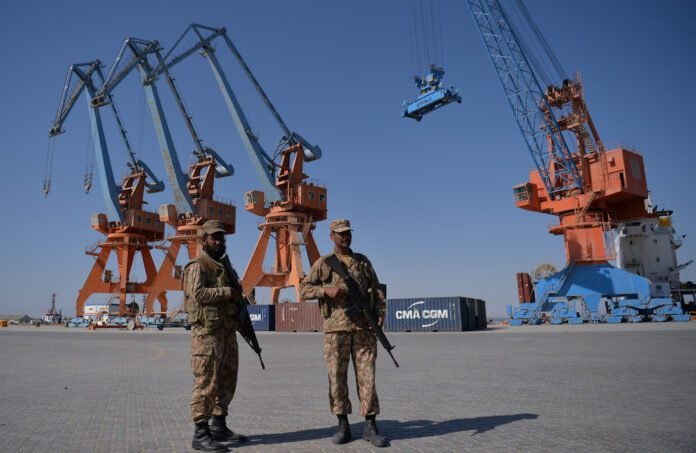
The physical transformation of Gwadar is the most visible marker of the CPEC decade. The New Gwadar International Airport, inaugurated in January 2025 with a $230 million Chinese grant, is Pakistan’s largest airport by area and can handle wide-body aircraft.
The Pak-China Friendship Hospital, built with $100 million in Chinese funding, provided free medical treatment to around 43,000 patients from poor communities in Gwadar in 2025 alone. A desalination plant has supplied drinking water to a city that periodically ran dry.
Gap between cranes and careers
This is where honest accounting matters most — because the numbers are real, but the gap between construction employment and lasting economic activity is equally real.
According to official documents, CPEC projects in Balochistan have so far created or engaged 7,313 workers across road, energy, port, health and education schemes.
The breakdown tells the fuller story: the Pak-China Friendship Hospital created 515 jobs, of which 441 went to Balochistan domicile holders; Gwadar Port and Free Zone created 216 positions, with 214 going to local residents.
The New Gwadar International Airport generated 107 jobs, with 63 held by Balochistan-domiciled individuals — exceeding the federal government’s prescribed 6% quota. Most of these, however, were construction-phase or operational roles tied to individual facilities.
A significant share of high-skill positions is still occupied by technical experts from other provinces or overseas, namely China. The province’s own workforce has not yet been trained to the level industry demands – and that is the real gap CPEC 2.0 must work to close.
The broader economic signals are turning, at least on paper. Balochistan is projected to record provincial GDP growth of 5.8% in the upcoming fiscal year, outpacing the national average.
The federal government allocated a record 206 billion rupees — roughly $739 million — to Balochistan under the Public Sector Development Programme for 2025-26, with 73.5 billion rupees already disbursed across 148 active projects by March 2026, spanning roads, water, power and education.
In April 2026, Gwadar Port processed around 11,000 shipping containers in a single month, compared with roughly 8,300 for all of 2025 combined. That surge was driven in part by disruptions in the Strait of Hormuz, which rerouted global shipping to alternative ports.
Gwadar handled it — not a small thing for a port that was a construction site less than a decade ago. But it also underscores the central challenge: a port whose activity spikes because of a war elsewhere has not yet earned a permanent place in global shipping networks.
CPEC next phase
CPEC 2.0 is not a rebranding exercise of the original CPEC. There are specific, traceable actions behind it. The 14th Joint Cooperation Committee meeting in Beijing in September 2025 formally adopted an Action Plan for 2025-2029.
Its concrete outcomes so far include China’s commitment to finance 85% of the Karakoram Highway realignment; a mutual agreement to jointly secure around $6 billion in multilateral funding for the long-delayed ML-1 railway upgrade; and the signing of 21 business-to-business agreements worth $8.5 billion, presided over by Prime Minister Shehbaz Sharif.
These were not declarations of intent — they were signed documents with financing structures behind them. For Balochistan, the most significant institutional shift under Phase 2.0 is the planned expansion of Special Economic Zones from seven to 44, including 37 newly notified zones coordinated by the Board of Investment.
Bostan SEZ in Pishin, a 1,000-acre industrial zone, is among four priority SEZs that have moved into active implementation. Twenty-four enterprises have already been allotted plots there, with those investments projected to generate several thousand additional jobs, predominantly for local residents.
The Pak-China Vocational and Technical Institute in Gwadar graduated its largest-ever cohort of 1,200 students in January 2026, evidence that a pipeline of trained local workers is being built.
The most consequential long-term bet for Balochistan, however, sits alongside CPEC rather than inside it. The Reko Diq copper-gold project — one of the world’s largest undeveloped deposits, in Chagai District — secured $3.5 billion in international financing in late 2025 from the Asian Development Bank, the US Export-Import Bank and other lenders.
First copper exports are projected for 2029. Officials estimate the project will generate roughly $70 billion in revenue over its roughly 37-year life and create thousands of construction-phase jobs in Balochistan, part of a broader US-Pakistan financing package expected to support more than 13,000 jobs across both countries.
Reko Diq’s ore needs roads built under CPEC. Its investors need a functional Gwadar airport. Its workers need a surrounding functional economy. These projects are inseparable, and their combined effect on Balochistan over the next decade could dwarf everything CPEC’s first phase delivered.
Hard road ahead
Vietnam built its economic transformation on exactly this sequence: infrastructure first, then SEZ-anchored export manufacturing and then integration into global supply chains. The result was GDP growth averaging 6-7% annually for over a decade and a country that went from entrenched poverty to a global electronics hub.
Pakistan now has the infrastructure layer. The airport is open, the roads have been paved, and the port is now moving cargo briskly. What it still needs is the harder layer beneath – regulatory predictability, transparent revenue frameworks and institutions that outlast political cycles.
The Bostan SEZ must move from plot allotments to operational factories. The 1,200 vocational graduates of 2026 need industrial employers waiting for them in Balochistan, not in Karachi.
The revenue structure of Gwadar’s port concession — what Pakistan retains and how much flows back to the province — needs to be publicly accounted for and placed before parliament, not managed inside Islamabad’s ministries.
And the over 10,000 additional jobs projected under CPEC’s pipeline for Balochistan must be tracked publicly, project by project, with the same transparency that Phase 1 applied to megawatt counts and road kilometers.
Balochistan holds 75% of Pakistan’s mineral wealth, the country’s only deep-sea port and a coastline 400 kilometers from the world’s most strategically sensitive shipping chokepoint. It has waited long enough for those advantages to work in its favor.
CPEC gave the province its first international airport, its first major public hospital and its first baseload power plant. Phase 2.0 must give it something harder to build and easier to measure: a local economy that employs its own people, adds value to its own resources and does not need a war elsewhere to prove its worth.
Rabia Abrar is a researcher and freelance writer with a focus on public policy, governance and institutional reform in Pakistan. Her work examines state capacity, education systems and socio-economic development.
Fans ‘Crushed to Death’ During World Cup Celebration
Two Mexican soccer fans were crushed to death in Mexico City after a massive World Cup celebration spiraled into tragedy following the host nation’s historic win.
The victims, a 19-year-old woman and a 44-year-old man, died of asphyxiation Wednesday as more than one million fans flooded the streets to celebrate Mexico’s dramatic victory over Ecuador, according to the city’s health ministry.
Authorities have not confirmed reports of a possible third death.
The chaos erupted after Mexico defeated Ecuador to secure its first World Cup knockout win since 1986, sending the co-host nation into the round of 16 and setting off wild scenes across the capital.
Much of the celebration centered around the Angel of Independence monument and the city’s famous Reforma Avenue, where seas of fans packed shoulder-to-shoulder, waved Mexican flags, jumped, screamed and lit up the night with fireworks.
What began as a euphoric national party soon turned deadly as the enormous crowds became dangerously packed.
Families, friends and die-hard supporters had poured into streets, bars, parking lots and makeshift fan zones to honor Mexico’s undefeated World Cup run. Videos from the capital showed thousands of fans cheering, bouncing in unison and tossing people into the air as the roar of the crowd echoed through the city.
But amid the frenzy, two fans were unable to escape the crush.
The deadly celebration came after one of Mexico’s biggest soccer moments in decades. The national team had suffered seven straight exits at the same stage from 1994 to 2018 and failed to advance past the group stage in 2022.
Now, Mexico is headed deeper into the tournament with momentum — and with the hopes of a nation riding on every match.
Mexico is scheduled to play again Sunday at home against the winner of Wednesday’s match between England and Congo.
The team has been nearly unbeatable at the iconic Azteca Stadium, where it holds an undefeated record across 10 World Cup matches. Mexico has suffered just two official losses at the venue, with its last coming in a World Cup qualifying defeat to Honduras on Sept. 6, 2013.
With the win over Ecuador, Mexico extended its unbeaten streak to 12 games, dating back to a friendly loss against Paraguay in November.
The victory also marked a major milestone for the region. Mexico became the first CONCACAF team to knock out a CONMEBOL side in a World Cup knockout match, ending South America’s dominance in the previous five meetings.
But the historic night will now be remembered for both national glory and heartbreak, as a celebration meant to unite millions ended with two fans dead in the streets.
ICE Flouting Federal Judge’s Order to Stop Arresting Immigrants at New York Courts
Federal agents took three people into custody at immigration courts in New York City over the last week in what lawyers said appears to be the first grave violations of two orders by federal judges barring such arrests.
On Thursday, U.S. Immigration and Customs Enforcement agents arrested an Ecuadorian man at a court at 26 Federal Plaza and a man from the Dominican Republic at another court at 290 Broadway, both in Lower Manhattan. The arrests continued on Monday, when ICE agents detained a third man, originally from Guatemala, at 290 Broadway.
In legal filings challenging the detentions of the men taken Thursday, advocates with the nonprofit Make the Road New York accused ICE of not only violating their clients’ right to due process, but also of brazenly flouting a federal court order.
The judge’s order barred ICE from making arrests at Manhattan immigration courts in all but a narrow handful of exceptions, while a similar ruling issued on June 23 from a federal court in California applies nationwide.
By detaining the men at court on Thursday, ICE appears to be directly contravening the New York order without yet providing a justification, according to Rep. Dan Goldman, D-N.Y.
“ICE continues to flagrantly violate the law by arresting immigrants who are attending their mandatory court hearings, despite a court order mandating an end to courthouse arrests,” Goldman said in a statement to The Intercept, adding that his office was working to get the men released.
ICE appears to be acting outside the law, according to Murad Awawdeh, the head of the advocacy group New York Immigration Coalition.
“We’re witnessing ICE, yet again, operate in a lawless and rogue fashion and not following court orders.”
“We’re witnessing ICE, yet again, operate in a lawless and rogue fashion and not following court orders,” Awawdeh said. “We’re supposedly a nation under the rule of law, and our judicial branch has said that this agency must stop engaging in this lawless behavior, and they continue to do so.”
In its habeas corpus filings, lawyers from Make the Road demanded that the two men arrested Thursday be released and allowed to continue navigating the immigration process.
In a statement to The Intercept, a spokesperson for ICE denied that the agency had violated any court order. The spokesperson did not explain how the arrests fit into the exceptions to the ban on courthouse arrests put in place by the federal judge.
No Exceptions
From May 18 until last week, just two arrests had taken place at Manhattan immigration courts; in both cases, the detainees were swiftly released after lawyers and immigrant rights groups mobilized to invoke the federal judge’s order.
That has not been the case for the men arrested on Thursday and Monday. All three men have since been transferred to detention centers, according to ICE records.
The Dominican man arrested Thursday is currently being held at ICE’s Delaney Hall detention facility in Newark, New Jersey, while the Ecuadorian man arrested the same day is being held at the D. Ray James ICE Processing Center in Folkston, Georgia. The Guatemalan man arrested on Monday is being held at the Orange County Detention Facility in upstate New York. (The Intercept is withholding the detained men’s names because of the sensitive nature of their cases.)
The arrests appeared to end a brief period of calm at Manhattan immigration courts in the wake of the May 18 ruling by Judge Kevin Castel requiring ICE to revert to a policy put in place in 2021. The Biden-era policy allowed for courthouse arrests with prior authorization in only a handful of instances, including when a person might pose a threat to national security or to public safety — narrowly defined as cases in which agents are in direct pursuit of a subject or if it would not be possible to make the arrest in another location.
In their statement, the ICE spokesperson pointed to a conviction for trespassing on the part of the Dominican man and a 2025 conviction for disorderly conduct on the part of the Ecuadorian man.
One immigration lawyer said the courthouse arrests were part of a growing pattern of increased ICE detentions.
“For whatever reason, that order is essentially being disregarded, and we’ve seen a pretty significant uptick in detentions,” said Benjamin Remy, senior coordinating attorney at the immigration protection unit of the New York Legal Assistance Group.
In the year and a half since President Trump returned to office and unleashed the agency as part of his mass deportation agenda, ICE has repeatedly been found in violation of orders around the detention of immigrants. The alleged violations have been ramping up in recent months, according to advocates and court records.
“We’ve seen ICE have a fairly flexible and adaptive relationship when it comes to the truth and the facts,” Remy said, “and to complying with court orders and frankly to rule of law as a fundamental concept.”
An Impossible Bind
Beginning in May 2025 and continuing for almost exactly a year, ICE arrests at 26 Federal Plaza, 290 Broadway, and another immigration court at 201 Varick Street were commonplace, with hundreds of people swept up by masked ICE agents when they showed up for scheduled hearings. According to an analysis published last August by The City Reporter, a local news site, more than half of courthouse arrests nationwide were taking place in New York.
Like the overwhelming majority of people arrested in immigration courts over the past year, the men arrested over the past week were following demands made of them by the immigration system.
Both men arrested last week had fled home due to persecution, entered the U.S., and been detained before obtaining release as their cases proceeded, according to petitions filed on their behalf by Make the Road New York. When summoned to court, both showed up as instructed.
ICE has repeatedly defended the arrests as legitimate. Immigration advocates, however, have warned that it puts immigrants in an impossible bind, forcing them to decide between risking arrest by following the law and showing up to court, or losing any chance of lawfully remaining in the country by skipping a hearing.
“It is not uncommon for me to encounter folks walking into court in the morning already just sobbing,” Remy told The Intercept. “These arrests are discouraging the legal process. It’s discouraging people’s fundamental constitutional right to due process and to be able to have their day in court.”
You’ve never heard of these glaciers, but they’re becoming critical climate havens as America’s iconic mountain glaciers and their water fade
If you have ever hiked in the high peaks of Colorado, the Wasatch Range in Utah or the Tetons in Wyoming, you’ve almost certainly seen a rock glacier, perhaps without even knowing it.
Rock glaciers are slow-moving masses of rock debris and ice that flow downhill the same way that glaciers do, but they are covered by a thick layer of rock and boulders that can easily be mistaken for stable ground.
The thick debris mantle shades the ice, keeping it colder, similar to how ski areas have started covering their slopes with reflective blankets in summer to stave off melting. The result is that rock glaciers continue to provide meltwater for streams in summer as they always have, but they aren’t disappearing.
A cross section of a rock glacier shows the thick permafrost layer that stores frozen water.Utah Geological Survey
We found that the Tetons’ white, icy glaciers thinned by 2.75 feet per year (0.84 meters per year) between 2014 and 2022, about seven times faster than in the previous half-century. Rock glaciers, on the other hand, were close to stable, losing only about 0.16 feet (0.05 meters) per year in 2014-2022, with no change relative to the 1967-2014 period.
Every year, mountain glaciers partially melt and then rebuild again as snow falls in winter. But as temperature rise, glaciers are losing more ice than they gain. The vast majority of glaciers in temperate mountain ranges like the Tetons are projected to melt away completely by the end of the century, meaning a critical source of water for mountain streams and lakes will disappear. However, where rock glaciers are present, their protected ice will continue to release meltwater into the streams below, buffering the streams against warming temperatures and drying.
Because of this, streams fed by rock glaciers have emerged as potentially critical climate refugia – places likely to stay cooler while everything around them warms – for cold-water wildlife in high-mountain ecosystems.
Researchers move across the ice of Teton Glacier, the largest alpine glacier in Grand Teton National Park. D. McGrath
A wide array of species already live in the cold meltwater that emerges from rock glaciers, from stoneflies to the bull trout that eat them. As glaciers fade, the ties between cold-water animals and rock glaciers will likely only become tighter.
For instance, the meltwater stonefly (Lednia tumana), an aquatic insect listed under the U.S. Endangered Species Act in 2019 due to climate-related habitat loss, relies on the fading glaciers of Glacier National Park. But it can also be found downstream of rock glaciers, which are likely to give the stonefly a chance of survival as other glaciers disappear.
Our study showed that having a major ice source feeding a stream has limited the warming of that stream over the past decade.
Scott Hotaling and colleagues hike up to a large rock glacier in the Tetons.
We found that streams fed by rock glaciers warmed slowly, by about 1.1 degrees Fahrenheit (0.6 degrees Celsius) over the decade, while icy glaciers warmed by about 1 F (0.9 C). Streams that were fed by seasonal snowpack, small patches of ice and groundwater warmed more rapidly, by 6.1 F (3.4 C) over the same period. In one instance, the small snowfields feeding one of our long-term study sites largely disappeared, causing the stream below it to stop flowing by late summer.
How much water is in rock glaciers?
Rock glaciers will not replace the glaciers and snowfields that are disappearing. A recent study estimates that rock glaciers in the region hold the equivalent of 0.6 cubic miles (2.5 cubic kilometers) of water, about one-fifth the amount in mountain glaciers.
And climate projections show that even rock glaciers are not immune to a warming climate. Many could become ice-free by the end of the century under current warming projections.
Researchers use radar technology to measure ice thickness on a rock glacier in Colorado. D. McGrath photo.
Understanding how much ice is contained in rock glaciers and how fast they are likely to melt is vital to help natural resource and land managers plan for the landscapes they will be managing later this century.
Rock glaciers also offer unique analogs for studying what appear to be debris-covered glaciers on Mars. Research has sought to better understand these rock glacierlike features on Mars, as well as test technology, such as the use of drone-based radar systems to measure ice and debris thicknesses, here on Earth.
So, the next time you’re out in the mountains, staring off into the distance, look carefully for these large fields of rock that appear to be flowing down the mountainside. And pay attention to that small trickle of meltwater emerging from the toe of the rock glacier.
While meltwater from rock glaciers alone certainly won’t make up for the glaciers lost, it could help mitigate the most severe impacts where rock glaciers persist.