21.7 C
London
Tuesday, June 30, 2026
Home Blog

Spoiler alert in the US-Iran peace process

0
spoiler-alert-in-the-us-iran-peace-process
Spoiler alert in the US-Iran peace process

In a seminal article, entitled “Spoiler Problems in Peace Processes,” Stephen Stedman writes that “peacemaking is a risky business.”

The greatest source of risk “comes from spoilers—leaders and parties who believe that peace emerging from negotiations threatens their power, worldview and interests, and use violence to undermine attempts to achieve it.”

Spoilers can be inside or outside a peace process. Those inside have signed an agreement but fail to fulfill key obligations; those outside are either excluded from it or have excluded themselves. In terms of managing spoilers, it is important to determine why a particular party is refusing to honor a peace agreement.

Spoilers are already causing problems for the memorandum of understanding (MOU) between Iran and the US announced on June 14, after weeks of Pakistani mediators trading proposals back and forth between the parties. 

The 14-point MOU was officially signed by President Donald Trump on June 17 in Versailles and by President Masoud Pezeshkian in Tehran the next day.

Post-MOU negotiations

To develop the MOU into a permanent peace agreement, face-to-face negotiations were scheduled for June 19 in Bürgenstock, Switzerland under the auspices of Pakistani and Qatari mediators.

But because heavy fighting in Lebanon between Israel and Hezbollah was violating the first clause of the MOU, which called for the termination of military operations “including in Lebanon,” the Iranians declared that they would not attend and threatened to reclose the Strait of Hormuz. Vice President JD Vance, who was to lead the US delegation, also canceled his flight to Switzerland.

Nonetheless, on June 20, after Iranian state TV announced that Iran’s delegation, led by the Speaker of Parliament Mohammad Bagher Ghalibaf and Foreign Minister Abbas Araghchi, had arrived in Switzerland, Vance departed the US to join Special Envoy Steve Witkoff and Trump’s son-in-law Jared Kushner, who had traveled there earlier.

The talks, dubbed the Lake Lucerne Summit, began on the morning of June 21 with separate meetings between the leaders of each delegation with the mediators, followed by quadrilateral talks in the afternoon between the two parties and two mediators.

Vance presented a promising opening statement, saying: “Never before has the Iranian and American leadership met at such a high level… What the President has asked us to do is turn over a new leaf to transform our relationship with the people of Iran, and to extend an outstretched hand that says to the people of Iran that if your leadership is willing to give up being a driver of regional instability, if they are willing to give up nuclear weapons ambitions for the long term, then the United States is willing to fundamentally transform our relationship.”

But 80 minutes later, the Iranians got word that Trump (apparently annoyed by the threatened closure of the Strait of Hormuz) told Fox News in a phone call that unless the strait remained open, the negotiators talking to Vance will “never make it back to their country—in fact, they will have no f**king country to return to at all.”

In response, the Iranian delegation protested to the mediators, saying this was an unacceptable threat to their personal safety and then staged a walkout. Their absence was apparently temporary, because Vance, describing the talks as “messy,” later said: “Yes, they did threaten to walk out… but we were negotiating well past one in the morning… so they didn’t [permanently] walk out.”

In all, there were about 18 hours of intensive talks and consultations.

Outcome and substance of the negotiations

The talks produced a road map for a final deal within 60 days and created a High-Level Committee for Political Oversight to manage the process and coordinate the three working groups who will report to the committee weekly: a Nuclear Working Group, a Sanctions Tracking Group, and a Monitoring and Dispute-Resolution Group.

Two crisis management mechanisms were also agreed: a Strait of Hormuz Secure Communication Channel (i.e., a hotline) to provide communication links between maritime security forces to “avoid incidents and miscommunication” and guarantee safe passage for shipping through the Strait of Hormuz; and a Lebanon De-Confliction Cell to prevent further military escalation and ensure compliance with the cessation of hostilities.

In the end, the talks were more successful than the first round in April in Islamabad. Vance called them “a good foundation;” Araghchi said the mediators delivered “major progress.” A joint statement by the mediators described “encouraging progress” and cited a “positive and constructive atmosphere.” The Swiss Foreign Ministry also welcomed “constructive progress.” Technical talks between the working groups began the next day.

Spoiler Issues

Although the negotiations were successful, several parties—Israel, Hezbollah, Trump, and hardliners in Iran—almost derailed the process and are still attempting to do so.

The success of the process appears to be due to the mediators employing “the departing train strategy, which implies that the peace process is a train leaving the station at a preordained time: Once set in motion, anyone not on board will be left behind.”

It is a determination that the peace process will go irrevocably forward regardless of spoiling efforts. Other strategies that Stedman proposes for managing spoilers include: inducement, socialization, deterrence-coercion, and withdrawal.

Although a comprehensive accounting of each spoiler’s motivation and strategies for dealing with them exceed the scope of this article, some general points can be made.

Israel and Hezbollah

Long-term enemies, Israel and Hezbollah, reengaged in fighting on March 2, when Hezbollah launched missiles against Israel to protest Ayatollah Ali Khamenei’s assassination, followed by intense hostilities between them.

Since the first clause of the MOU calls for the termination of military operations, including in Lebanon, this presents a dilemma, since both Israel and Hezbollah were outside the US-Iranian peace process and didn’t agree. Indeed, Israeli Prime Minister Benjamin Netanyahu explicitly stated that since it isn’t a party to the MOU, Israel will not withdraw from Lebanon.

In response, the US established a separate mediation process between Israel and Lebanon (with Hezbollah again outside the process) which agreed to ceasefires of varying lengths, subsequently violated by both Israel and Hezbollah.

More recently, Lebanon and Israel have agreed to a lasting peace and security deal, whereby the Lebanese Armed Forces would gradually assume control over all Lebanese territory as Hezbollah is disarmed; in parallel, Israeli forces would engage in a staged withdrawal. Hezbollah, however, rejects this and says that it will not disarm until Israel withdraws totally.

Netanyahu, his government, and much of the Israeli public are disappointed with the MOU since it doesn’t address many of their war aims, e.g., regime change, Iran’s ballistic missile program, and its support for proxies. They also oppose sanctions relief and other economic benefits.

Both Israel and Hezbollah fit the description of “total spoilers,” who are often “led by individuals who see the world in all-or-nothing terms” and are opposed to compromise. “Any commitment to peace by a total spoiler tends to be tactical—a move to gain advantage in a struggle to the death.”

The “departing train strategy,” used by the mediators at the Lake Lucerne Summit, is a good way to manage total spoilers. Another effective approach is for the spoiler’s patron to warn the spoiler of dire implications if it escalates attacks, which apparently Trump has done, much to Netanyahu’s annoyance.

It has also been argued that Hezbollah might moderate its actions for now by inducement, e.g., the promise of renewed assistance from Iran if economic benefits accrue from the peace process, but if this allows it to rearm later, that would merely postpone the problem.

Trump the spoiler

Trump is, of course, inside the peace process and probably fits the description of a “greedy spoiler,” i.e., one who “holds goals that expand or contract based on calculations of cost and risk. A greedy spoiler may have limited goals that expand when faced with low costs and risks; alternatively, it may have total goals that contract when faced with high costs and risks.”

Although Trump reportedly wants out of the war, his firm belief that any provocation must be met with a response of greater intensity inevitably causes conflict escalation. When four days after the Lake Lucerne Summit, Iranian hardliners attacked a vessel trying to exit the strait, Trump ordered bombing of Iranian missile and drone sites.

Hardliners in Iran

Iran’s new Supreme Leader, Mojtaba Khamenei, has given his conditional approval to the MOU, with the qualification that he will not accept excessive demands by the US.

He also praised the efforts of the Iranian negotiating team, which is seen as an attempt to silence opposition from hardliners. As well, the Islamic Revolutionary Guard Corps (IRGC) leadership, the Supreme National Security Council, and some members of parliament support it.

The hardline Paydari Front, however, which rejects engagement with the West and considers itself the guardian of revolutionary values, opposes it. There are also hardline members within the IRGC. As well, segments of the population oppose the MOU and demonstrations broke out when it was signed, with calls for death to the negotiating team.

The recent incidents in the Strait of Hormuz are an example of how this opposition can manifest itself. Like Trump, IRGC hardliners believe that every provocation must be met with a greater response, which accounts for their recent attacks on US bases in Kuwait and Bahrain, following Trump’s bombing. These hardliners were also outside the peace process and fit the typology of total spoilers.

Conclusion

The four spoilers mentioned above are currently presenting significant challenges to the MOU and must be managed if the peace process is to go forward.

One problem is that the lack of specificity in the MOU allows for different interpretations that spoilers can exploit to disrupt the process. This relates to how the MOU was negotiated, i.e., through the long-distance exchange of each party’s preferred positions, as opposed to the mediators sitting with the parties to explore their underlying interests before developing options.

The current dispute is apparently related to Iranian interests to have control of how clearing of the strait takes place, i.e., with vessels exiting on the Iranian side, rather than the Omani side, which the US is encouraging. If parties’ interests with regard to this issue had been thoroughly explored during negotiations, a more specific formulation could have been included which might have avoided this problem.

Another issue is the inclusion of conditions in the agreement (e.g., the termination of military operations in Lebanon) that must be fulfilled by parties who are outside the process and don’t agree (notably, Israel and Hezbollah).

Attempts to overcome this through US mediation between Israel and Lebanon, but with Hezbollah still outside the process, are not addressing the interests of one of the major parties and are thus stalemated.

It also appears that the procedural mechanisms established at the Lake Lucerne Summit to deal with such problems are not being utilized. A Strait of Hormuz Secure Communication Channel is apparently non-operational.

Presumably, the new Monitoring and Dispute-Resolution Group could also be engaged. Hopefully, the mediators will quickly assist the parties in resolving the current dispute and ensure that these mechanisms become operational.

Of particular concern is Stedman’s warning that history has shown that when peace processes are scuttled by spoilers and war resumes, the results are often catastrophic, with the casualties being infinitely higher than those of the original conflict. Rwanda offers a horrifying example.

Such an ominous possibility is foreshadowed by Trump’s recent post on Truth Social: “There may come a point when we are no longer able to be reasonable, and will be forced to militarily complete the job that we very successfully started. If that happens, the Islamic Republic of Iran will no longer exist.”

In order to keep the peace process on track, the international community needs to be aware of the role of spoilers and do everything in its power to manage any disruptions before the conflict escalates again, perhaps tragically.

Dr. Connie Peck is the founder of the United Nations Institute for Training and Research Programme in Peacemaking and Conflict Prevention — the first training program in negotiation and mediation for senior UN staff and diplomats (now in its 33rd year). She is the author of a number of books and numerous articles and book chapters on conflict resolution and the nuclear threat.

– Common Dreams

Commercial ship traffic through Strait of Hormuz rises more than 50% over past week

0
commercial-ship-traffic-through-strait-of-hormuz-rises-more-than-50%-over-past-week
Commercial ship traffic through Strait of Hormuz rises more than 50% over past week

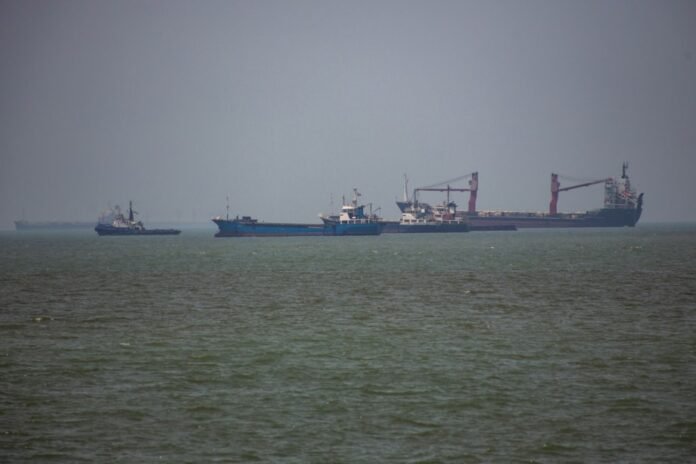
Commercial vessel traffic through the Strait of Hormuz rose more than 50% from the previous week amid ongoing negotiations following a temporary deal between the US and Iran, Anadolu reports.

Negotiations between the two countries remain fragile despite the deal reached on June 14, which took effect on June 18.

Before the war broke out at the end of February, an average of 130 commercial vessels transited the Strait of Hormuz each day. Following a virtual standstill after joint US-Israeli strikes on Iran and Tehran’s subsequent retaliation, maritime traffic through the strategic waterway has begun to recover following the US-Iran deal.

Despite the recent increase, traffic through the strait remains around 70% below pre-war levels.

Industry representatives remain cautious about using the waterway because of the fragile state of US-Iran negotiations and continuing uncertainty.

According to data from analytics firm Kpler, 223 commercial vessels transited the Strait of Hormuz during the week of June 15-21, averaging 32 transits per day.

READ: Oil prices rise as US-Iran tensions escalate

The lowest daily traffic was recorded on June 17 with 19 vessels, while the highest was 54 on June 22.

During the week of June 22-28, 343 commercial vessels passed through the strait, with the daily average rising to 49 vessels. The lowest daily total was 24 vessels on June 28, while the highest reached 76 on June 24.

June 24 recorded the heaviest traffic through the Strait of Hormuz since the war began on Feb. 28.

Compared with the previous week, traffic through the strait increased by nearly 54%, with tankers carrying crude oil and petroleum products—primarily from Iran, Saudi Arabia, the United Arab Emirates, Iraq and Kuwait—accounting for most transits.

At least 6 million barrels of crude oil transited the Strait of Hormuz on Monday, the data showed.

A significant share of vessels continued to use the route designated within Iranian territorial waters, with most of those transits carried out by shadow fleet and sanctioned vessels.

READ: Iran says $6B of its funds in Qatar ‘should be released’ under US deal

Netanyahu’s Ultra-Orthodox Draft Deal Turns Unity Pitch Into Election Fight

0
netanyahu’s-ultra-orthodox-draft-deal-turns-unity-pitch-into-election-fight
Netanyahu’s Ultra-Orthodox Draft Deal Turns Unity Pitch Into Election Fight


Gabriel Colodro captures the moment Prime Minister Benjamin Netanyahu tried to celebrate a Lebanon security understanding and instead stepped straight into Israel’s next election fight. The issue is not only Hezbollah, Lebanon, or Washington’s mediation. It is the ultra-Orthodox draft crisis, and whether Netanyahu can credibly promise a “broad national government” while keeping his current coalition alive through a deal that slows enforcement against yeshiva students who ignore military call-up orders.

The political collision is sharp because Israel is still at war, soldiers are still being killed, and the burden of service has become a national fault line. Netanyahu says his future coalition will be open to anyone who accepts principles such as Israel as the nation-state of the Jewish people, individual rights, a free economy, defense independence, draft understandings, judicial compromise, and rejection of Palestinian statehood. His critics hear something else: a unity pitch from a leader still bound to ultra-Orthodox parties that resist broad military service.

Likud lawmaker Moshe Saada defends the freeze on arrests as practical politics, arguing that coercion will not bring haredim into the army and that economic pressure would work better. Yesh Atid’s Moshe Tur-Paz calls the arrangement “disgraceful,” saying Netanyahu is trying to keep ultra-Orthodox parties locked to him before the election while Israel’s security needs grow more urgent.

The numbers make the drama worse for Netanyahu. A Channel 12 poll found 62% opposed the ultra-Orthodox deal, while the current coalition bloc remained short of a majority. Gadi Eisenkot, Naftali Bennett, Yair Golan, Benny Gantz, and others are all circling the same question from different angles: Can there be a broad government with Netanyahu still leading it?

Colodro’s full report shows how one draft deal turned “unity” from a campaign slogan into a stress test. He lays out the real choice now facing Israeli politics: whether national service, coalition survival, and postwar governance can fit inside the same government—or whether one of them has to break.

Women in the Army Are More Likely to Be Killed by Fellow Soldiers Than Enemy Combatants

0
women-in-the-army-are-more-likely-to-be-killed-by-fellow-soldiers-than-enemy-combatants
Women in the Army Are More Likely to Be Killed by Fellow Soldiers Than Enemy Combatants


Twenty-three-year-old Sarah Roque had been in the Army for just over four years when a man fatally shot her in the head.

Roque wasn’t in a war zone, and the killer wasn’t an enemy combatant. It was Wooster Rancy, a fellow soldier stationed at Fort Leonard Wood, Missouri, who had gone to Walmart for trash bags on the last day Roque was seen alive in October 2024. The Army found her body in a dumpster behind the barracks.

“Even now, I still can’t believe it,” her mother, Ana Roque, told The Intercept. “That murderers could exist in one of the supposedly safest places in the country.”

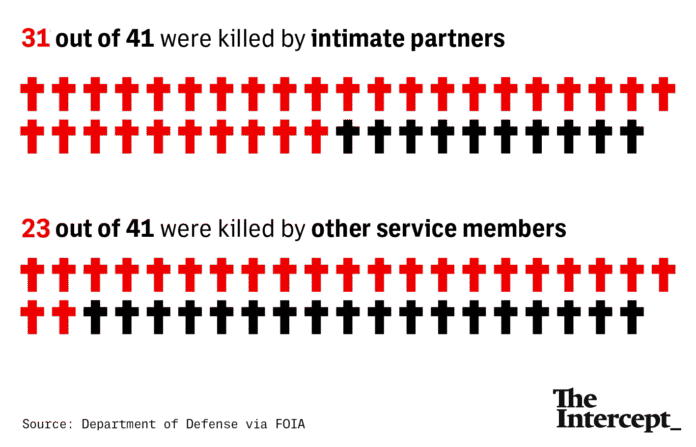
A first-of-its-kind analysis by The Intercept found that in the Army, women are more likely to be killed by their fellow service members than by enemy combatants, in a reversal of the threat soldiers are trained to face. Between 2011 and August 2025, at least 41 women died by homicide in the Army — more than half of them at the hands of other service members or veterans. Using Defense Department manpower data to calculate per capita death rates, The Intercept found that active-duty Army women face a higher risk of homicide than male soldiers, the opposite of national and global trends.

The Intercept found that active-duty Army women face a higher risk of homicide than male soldiers.

In many cases, women in the Army are killed by current or former romantic partners. Over 70 percent of victims had an intimate relationship with the perpetrator at one point, and the rate of homicides among women soldiers from intimate partner violence is at least three times higher than the national average. In others, like Roque’s case, it’s unclear how male soldiers chose their victims.

“There was no connection between Sarah and Rancy. They never spoke, never texted, and their paths never crossed,” said Ana Roque. Given that Rancy was convicted of murder in February, Roque added, “I can’t complain about the prosecutors, they did their job. But my grievance is that they didn’t push to uncover the truth behind why he did it.’”

Research points to the military’s hypermasculine culture, which historically devalues women, as a contributing factor to high rates of violence against them. But the existing scholarship is insufficient, said Erin Siegal McIntyre, a journalism professor at the University of North Carolina at Chapel Hill who has spent years digging into the hidden structures of militarized institutions.

“There’s no way to know how bad the problem really is,” Siegal McIntyre said. “There is an abysmal amount of data collected on domestic violence perpetrated by law enforcement officers, for example, many of whom are former military.”

Analyzing over 14 years of Defense Department death data obtained through a Freedom of Information Act request, The Intercept’s investigation is the first to compare rates of violence against women in the Army to factors like duty location, jobs, and relationships with perpetrators. The FOIA data also reveals deaths not previously announced by the Army and the Department of Defense.

Violence against women in the military also appears to take a mental toll. In addition to the 41 women who died by homicide, another 128 died by suicide, the majority of them lower-ranking enlisted soldiers. From 2011 to 2024, the last complete year of data, homicide and suicide rates for women in the Army were double their equivalents for women nationwide.

The Army doesn’t make any of this public, and the Intercept’s investigation has found flaws in what data collection currently occurs: Homicide and suicide death rates are not separated by gender or calculated per capita, preventing deeper analysis and comparison.

There’s also nothing publicly accessible on how many homicides are committed by service members, who their victims are, or where homicides occurred. The Defense Department’s annual suicide report doesn’t note how many of the deceased had experiences with sexual assault or harassment.

Meanwhile, systems meant to protect women are being rolled back and dismantled.

In September, Defense Secretary Pete Hegseth eliminated the Defense Advisory Committee on Women in the Services. It had existed for nearly 75 years, focusing on issues including sexual harassment and assault. In January, he ordered a six-month review of women in combat roles. In April, a woman who had been a whistleblower on sexual harassment within the Army Special Operations community was accused of sharing classified information and arrested by the FBI. Hegseth has also intervened to block the promotions of women officers.

In a statement to The Intercept, a spokesperson for the Army denied that its protections were insufficient.

“The Army has several programs and policies to protect service members who experience sexual assault or domestic violence,” said Army spokesperson Heather Hagan.

A Pattern of Abuse

When Spc. Mayra Diaz was assaulted on the Army base at Fort Hood, Texas, she was lucky to survive.

Diaz was blindfolded, with her hands bound over her head, having water poured on her face — “waterboarding me and causing me to choke,” Diaz later wrote. Her attacker “then wrapped a cord around my neck in an attempt to kill me.”

The assailant was a superior, Sgt. Greville Clarke, who knocked on her door at the barracks before threatening her with a pistol and raping her during the attack. The Army knew two other women had been assaulted at the barracks in similar attacks; officials chose not to issue a public warning, citing concerns about compromising the investigation and causing potential panic.

The problems of homicide and suicide among women in the Army are inextricable from the prevalence of sexual assault. In some cases, like Diaz’s, a sexual attack involves an attempt on a woman’s life. Rape and sexual abuse are known to be detrimental to mental health, increasing the risk of suicide or self harm.

“There’s a huge correlation between sexual assault and suicide rates,” said Josh Connolly, senior vice president of Protect Our Defenders, an advocacy group for victims of military sexual trauma. “It’s unambiguous — sexual assault rates are higher than in the civilian world.”

The Intercept’s investigation found suicide is the leading cause of death of Army women.

Male soldiers faced a smaller increase in suicide rates compared to civilian men than Army women did compared to civilian women, and men in the Army have a lower risk of dying by homicide than their non-military counterparts.

In fact, The Intercept’s investigation found, suicide is the leading cause of death of Army women.

Some cases have made national headlines, such as the March 2023 death of Pvt. Ana Basaldua Ruiz at Fort Hood, who took her own life at 20 years old after reporting sexual harassment.

For Ruiz’s family, the timing of her death raised troubling questions, echoing fellow Fort Hood soldier Vanessa Guillén’s infamous 2020 murder by an Army specialist. A subsequent Army inquiry into Ruiz’s case, reported by Telemundo, pointed to a “persistently toxic culture permissive of harassment.

Years earlier, in the wake of Guillén’s death, an independent review revealed “a total disregard and disrespect for female soldiers.” Investigators issued 70 recommendations, including a sweeping overhaul of the military’s sexual harassment and assault prevention programs.

But the violence didn’t stop. Women at Fort Hood continued to experience a grim roll call of harm: Homicide. Sexual assault. Suicides.

Three deaths at Fort Hood were never reported publicly by the Army but appeared in the data obtained by The Intercept.

Counting Guillén and Ruiz, there were nine fatalities from homicide or suicide among women stationed at the base in five years. The Defense Department’s most recent suicide report does not provide data on how many suicide decedents experienced sexual trauma, although the Pentagon has provided this data in previous years.

From 2001 to 2023, nearly 1 in 4 women service members experienced sexual assault, according to the Brown University’s Costs of War project, much higher than the numbers annually reported by the Pentagon. Research identifies those experiences as a key driver of suicide risk. Over the past two decades, suicide rates among women veterans have risen faster than among men.

In Diaz’s view, institutional failures were a key factor in her assault.

“Because the Army took no action to address the string of female soldiers attacked in their barracks,” Diaz wrote in a federal tort claim, “Sergeant Clarke was empowered to continue preying on the female soldiers at Fort Hood, including me.”

Clarke assaulted five women before he was apprehended October 2022 and convicted in 2025 of charges including attempted premeditated murder. He died by suicide in custody.

Diaz was “in a U.S. Army base in a locked barracks, opening the door to someone in uniform. It was very reasonable for her to think that that was a safe thing to do,” Christine Dunn, an attorney representing Diaz, told The Intercept. “You don’t expect someone who’s in a uniform to be a serial predator.”

“Sergeant Clarke was empowered to continue preying on the female soldiers at Fort Hood, including me.”

Diaz wrote that leadership denied repeated requests to move her into family housing off-post, and only after she and her sexual assault representative made clear that remaining in the barracks was “an untenable environment” was she finally allowed to leave.

“I suffered from extreme paranoia, exacerbated by my attacker remaining at large,” Diaz wrote. “I abused alcohol in an attempt to forget what happened to me. … I began going to weekly therapy but have stopped going because I still find the attack very traumatizing to talk about.”

The Army did not provide comment on Diaz’s case or reports of Clarke’s predation specifically.

The anxiety, Diaz wrote, has never fully gone away.

“What happened to me was a result of the United States Department of the Army’s and the Department of Defense’s negligence,” her complaint stated. “It was entirely preventable.”

False and Frivolous

Last year, Pete Hegseth directed the Army to change its 15-6 regulation, which governs the process for investigating military-related misconduct like sexual harassment. Now the first step is verifying the “credibility of accusers with new disciplinary measures for soldiers who submit knowingly false or frivolous complaints.

Some fear the rule may discourage those experiencing sexual harassment from reporting incidents, perpetuating a “culture of victim blaming,” according to Protect Our Defenders’ Connolly.

While Hegseth rolls back protections, the issue of violence against women in the military appears to be getting worse. The Intercept’s analysis shows that from 2011 to 2020, the per capita rate of women dying by suicide or homicide in the Army was 15 per 100,000. From 2021 to 2024, following the Army’s attempted reforms in the wake of Vanessa Guillén’s killing, the rate increased over 35 percent, to 21 per 100,000.

And deaths continued their pace in 2025.

Siegal McIntyre, the UNC professor studying domestic abuse, pointed to cases like that of Sgt. Francine Martinez, who was just weeks away from her 25th birthday on a night out at Fort Hood in September 2021, when she ran into the father of her child. He was a fellow soldier with whom she had recently separated, and Martinez had filed for child support weeks earlier.

An argument broke out, and when Martinez got into a car to leave, he followed, and eventually shot her in the head. She was hospitalized for two weeks before dying from her injuries, leaving behind her 1-year-old.

Research and Pentagon data indicate that rates of domestic and intimate partner violence in the military, particularly in the Army, are higher than the civilian population. Most victims are women, who also make up most of the homicide cases tied to that violence.

Martinez’s death was one of three cases the Defense Department reported in 2021 in which service members killed someone in a domestic or interpersonal dispute.

But data compiled by The Intercept identified at least seven cases that year in which service members were suspected of killing a spouse or partner in acts of domestic or intimate partner violence — more than double the official count.

“When the situation involves a marriage or partnership between agents and service members, it only complicates reporting,” said Siegal McIntyre.

A Naval Criminal Investigative Service report from 2021 suggests the number could be higher still, identifying several additional domestic violence-related homicides. The Intercept’s investigation also found other years’ congressionally mandated reports also have data tracking problems.

A Project on Government Oversight investigation revealed thousands of abuse cases involving Army personnel were mishandled, many never entered into tracking systems. Investigators could only look at 10 out of more than 60 Army installations. A Government Accountability Office report found the Pentagon doesn’t reliably screen for sexual assault when service members seek care or leave service and lacks systems to prioritize treatment or ensure confidential, long-term support.

“I don’t think there’s a mechanism within the Army for holding itself accountable,” said Dunn, who is also representing some of the 80 victims suing Army gynecologist Maj. Blaine McGraw, who was assigned to Fort Hood in 2023; he has since been accused of recording and making harmful physical contact with women during gynecological exams. (The Army did not comment on McGraw’s case, which remains ongoing.)

Some women who came forward had gone to McGraw seeking rape kits for sexual assault and say his actions further traumatized and distressed them.

“When the institution is facilitating the assaults and allowing them to happen, the institution needs to be held accountable,” Dunn said. “Almost every client who comes to me wants to come forward so that this wouldn’t happen to other women.”

A Failing System

In response to questions from The Intercept, the Army acknowledged having recorded more homicides than were noted in the dataset provided based on The Intercept’s FOIA request.

Between 2021 and 2023, the Army recorded a total of 16 homicides among active-duty women, Hagan told The Intercept. The data provided to The Intercept for its FOIA request counts only nine.

Hagan did not respond to follow-up questions on the discrepancy, and the Army did not provide data outside the years 2021 to 2023.

But the additional homicides would make the disparities found by The Intercept’s investigation even wider. If the same pattern of undercounting extends across the full 14-year span of our data, the true toll could be substantially higher.

After the independent review of Fort Hood following Guillén’s killing, Hagan said, the Army “implemented a series of major reforms to strengthen prevention, reporting, and accountability for sexual harassment and assault.” It shifted its criminal investigations division to civilian leadership, requiring more independent investigations, establishing stricter missing-soldier response protocols, and expanding data-driven oversight of cases.

But the deaths have continued, including another homicide at Hood last year. To advocates, there are other solutions to address these failures.

“You have to call DoD into Congress and demand answers on why progress hasn’t been made,” said Connolly. “Congress could scrutinize the data on domestic violence and other issues. They can appropriate more resources to DV investigations and hold hearings.”

“The potential solution lies with how funding is or isn’t tied to oversight,” Siegal McIntyre said. “Without Congress doing its job, nothing can change.”

Rep. Chrissy Houlahan, D-Pa., a House Armed Services Committee member and Air Force veteran, said The Intercept’s findings reflect a broader failure of leadership and oversight.

“This report is staggering, and unfortunately, unsurprising,” she said. “Servicewomen consistently bear the brunt of harassment, assault, retaliation, and systemic failures within the ranks, and it is costing them their careers, their safety, and in far too many cases, their lives.”

In a 1995 Defense Department study on homicide victims by gender, female service members across active-duty branches were killed at higher rates than both their male counterparts and women nationally. A Marine Corps and Navy-specific study covering 1995 to 1999 found similarly elevated risks.

The Pentagon never did further analysis. Ana Roque believes that change would fundamentally start with how the military builds itself to protect women like her daughter.

“I understand that the country needs soldiers, but recruiters need to be more careful regarding where these individuals come from,” Roque said. She called for more police and camera surveillance on bases, arguing that if it had been present, “they could have seen him moving my daughter’s body in broad daylight.”

She wishes she could have her daughter back.

“She always had a smile, no matter how difficult her day was,” Roque said. “She made time to help colleagues with various issues and never said no. I have many stories written in my notebook from soldiers and civilians who knew her and told me, ‘She saved me,’ simply by taking a minute to listen to them. She loved her family; we would talk three times a day: at 7 a.m., during my lunch break, and at night, when she would always say ‘Good night, Mommy.’”

How we analyzed the data

Reporters working for The Intercept submitted Freedom of Information Act requests to the Pentagon seeking data on all U.S. Army active-duty noncombat deaths from 2011 through August 2025. In response, the Department of Defense provided a spreadsheet detailing 5,285 U.S. Army deaths over the 14-year period categorized by rank, gender, military occupation, and cause of death. The latter was classified as either illness, self-inflicted, accident, pending, or undetermined.

To calculate the per capita suicide and death rates for women in the U.S. Army in this time period, The Intercept pulled manpower data from the Defense Department for each year in our analysis to provide the total number of women in the Army. National and international data on homicide and suicide was pulled from the FBI Crime Data Report, United Nations Office on Drugs and Crime, and the Centers for Disease Control and Prevention in order to compare suicide and homicide rates.

There is no publicly available equivalent data for Army veterans, nor has such an analysis been done for the Navy, Air Force, or Marines.


The 988 Suicide & Crisis Lifeline offers 24-hour support for those experiencing suicidal thoughts or for those close to them, by chat, text, or telephone. Service members can dial 988 and press 1 to reach the Military and Veterans Crisis Line. Support is free and confidential.

Wildwood featurette lifts the veil on building its stop-motion world

0
wildwood-featurette-lifts-the-veil-on-building-its-stop-motion-world
Wildwood featurette lifts the veil on building its stop-motion world

Color us officially intrigued by Wildwood, director Travis Knight’s forthcoming stop-motion animated fantasy film. Laika Studios released an extended teaser back in May, which has racked up nearly 90 million views. A full trailer is likely coming, but in the meantime, the studio has released a fascinating behind-the-scenes featurette showcasing how the animation team built out the elaborate fantasy world piece by piece.

(Some spoilers for the 2011 novel below.)

The film is an adaptation of the 2011 novel by Colin Meloy—frontman of indie folk rock band The Decemberists—and his wife, illustrator Carson Ellis. Meloy and Ellis live in Portland, Oregon, right by Forest Park, where they often hike the trails. In Wildwood, they transformed that local landmark into a magical hidden world filled with talking animals and lurking threats, only accessible to people of The Wood—and select Outsider “half-breeds.”

Twelve-year-old Prue McKee discovers the forest while out walking with her baby brother, Mac. A murder of crows swoops down and carries him away, and Prue discovers the Wilderness while hunting for him. Her schoolmate, Curtis Mehlberg, follows her, and both are able to enter that magical world. Fantastical adventures ensue as the pair encounter a mysterious woman, Alexandra, who has lost her son, along with coyotes, bandits, and some pretty big secrets.

Knight is CEO of Laika Studios, which optioned the film rights for the novel shortly after publication. It’s a natural fit, given that Laika and Knight also produced 2016’s lovely Oscar-nominated animated film Kubo and the Two Strings. (Knight’s live-action films include Bumblebee and this year’s Masters of the Universe.) They do old-school stop-motion animation, which is what makes the behind-the-scenes featurette such a great marketing ploy. Who wouldn’t be interested in seeing all the painstaking, handcrafted sets and figurines slowly come to life?

Peyton Elizabeth Lee voices Prue, while Jacob Tremblay voices Curtis and Carey Mulligan voices Alexandra. The cast also includes Angela Bassett as a giant golden eagle called the General, Jake Johnson and Maya Erskine as Prue’s parents, and Arthur Knight as her baby brother, Mac. In addition, Mahershala Ali, Jemaine Clement, Awkwafina, Charlie Day, Amandla Stenberg, Tom Waits, Tantoo Cardinal, Richard E. Grant, Rob Delaney, Marc Evan Jackson, Ólafur Darri Ólafsson, Blythe Danner, and Len Cariou will voice as-yet-undisclosed roles.

Wildwood hits theaters on October 23, 2026.

Blue justice: Asia-Pacific’s crucial ocean governance test

0
blue-justice:-asia-pacific’s-crucial-ocean-governance-test
Blue justice: Asia-Pacific’s crucial ocean governance test

The Asia-Pacific is experiencing an unprecedented transformation in ocean governance.

Governments across the region are expanding marine protected areas, investing in blue carbon initiatives, deploying digital fisheries monitoring systems and positioning the ocean as a cornerstone of climate resilience and economic growth.

The momentum was on full display at the 2026 Our Ocean Conference in Mombasa, Kenya, where more than 100 governments, businesses and civil society organizations announced 320 commitments worth $6.4 billion for marine conservation, sustainable fisheries, climate resilience and blue economy development.

The scale of ambition is remarkable. What was once viewed primarily as an environmental agenda has evolved into a strategic economic project. Marine ecosystems are increasingly valued not only for their biodiversity but also for their role in carbon sequestration, food security, renewable energy and geopolitical influence.

Yet amid this enthusiasm for blue growth, a fundamental question remains largely unanswered: Who benefits from the blue economy?

The answer may determine whether the region’s ocean transition becomes a model for sustainable development or a new source of social and political tension.

More valuable than ever

The Asia-Pacific contains some of the world’s most productive fisheries, largest mangrove forests and most diverse marine ecosystems. It is also home to hundreds of millions of people whose livelihoods depend directly on coastal and marine resources.

As climate change intensifies and global demand for sustainable investment grows, ocean space is becoming increasingly valuable. Governments are now expected to simultaneously expand marine conservation, support fisheries production, develop offshore renewable energy, protect biodiversity, attract blue finance and achieve climate mitigation targets.

The result is a new competition for ocean resources.

Marine protected areas, or MPAs, are expanding under the Global Biodiversity Framework’s commitment to protect 30% of the world’s land and oceans by 2030 — the so-called “30×30” target.

Blue carbon projects are attracting growing climate finance as investors seek carbon credits generated from mangrove and seagrass restoration. Offshore wind projects are proliferating across East Asia. Digital monitoring systems are transforming fisheries governance from Indonesia to Taiwan and South Korea.

Individually, these initiatives are widely supported. Collectively, however, they are reshaping who has access to the ocean and under what conditions. This is where the concept of blue justice enters the conversation.

Blue justice

Blue justice challenges the assumption that environmental sustainability automatically leads to social sustainability.

The concept emerged from growing concerns among fisheries scholars, development practitioners and coastal communities that the benefits of the blue economy are often distributed unevenly.

While conservation organizations, investors, governments and large industries frequently gain influence within emerging ocean governance frameworks, small-scale fishers often remain marginalized from decision-making processes.

This concern is particularly relevant in the Asia-Pacific, where small-scale fisheries support food security and livelihoods for millions of people. According to the UN Food and Agriculture Organization, about 600 million people worldwide depend at least partially on fisheries and aquaculture for their livelihoods, with a significant concentration in Asia.

Yet many blue economy discussions continue to prioritize investment flows, conservation targets and technological innovation while paying relatively little attention to questions of access, participation and equity.

The issue is not whether marine conservation or climate action should occur. The issue is whether communities most dependent on marine resources are able to participate meaningfully in shaping those transitions.

Protected waters

One of the most ambitious global conservation goals is the protection of 30% of the world’s oceans by 2030.

Across the Pacific, governments and conservation organizations have embraced this objective. New marine protected areas have been announced or expanded in several regions, while international funding increasingly supports large-scale marine conservation initiatives.

From a biodiversity perspective, the rationale is compelling. Marine protected areas can help restore fish stocks, protect vulnerable species and improve ecosystem resilience against climate change.

However, conservation success is not measured solely by ecological indicators.

Many coastal communities depend on access to fishing grounds that have sustained livelihoods for generations. Restrictions imposed without meaningful consultation can generate resentment, reduce compliance and ultimately undermine conservation objectives.

Recent discussions surrounding large marine protected areas in parts of the Pacific have highlighted this tension. While conservation advocates emphasize ecological benefits, local stakeholders often ask a different question: Who decides which areas are protected, and who bears the economic costs?

The challenge is not unique to the Pacific Islands. Similar debates are emerging throughout Southeast Asia and parts of East Asia as governments expand marine conservation commitments.

Without community legitimacy, conservation risks becoming politically fragile.

Next resource conflict

If marine protected areas represent one governance challenge, blue carbon may represent the next.

The Asia-Pacific hosts some of the world’s largest blue carbon ecosystems. Mangrove forests in Southeast Asia and coastal wetlands across the Pacific are increasingly attracting international climate finance due to their ability to absorb and store carbon. Governments and development institutions are investing heavily in restoration projects as part of broader climate mitigation strategies.

Yet blue carbon raises difficult questions. If carbon stored in mangroves acquires financial value, who owns that value — governments, investors, conservation organizations or local communities?

These questions remain unresolved in many jurisdictions. Without clear benefit-sharing mechanisms, there is a risk that blue carbon projects will replicate historical patterns of resource extraction in which external actors capture economic gains while local communities face new restrictions on resource access.

Blue carbon should not become another example of conservation for global benefit but local sacrifice.

Blue economy equity

The Asia-Pacific is poised to become the world’s leading blue economy region.

Its governments are investing in conservation, digital governance, climate adaptation and marine innovation at a scale unmatched elsewhere.

Yet the success of these initiatives will not ultimately be determined by the number of hectares protected, the volume of carbon credits generated or the amount of blue finance mobilized.

Those metrics matter, but the more important question is whether coastal communities experience greater security, stronger participation and improved livelihoods as a result of these transformations.

The region does not face a choice between conservation and development, nor does it face a choice between climate action and economic growth.

The real challenge is ensuring that the transition toward a sustainable ocean economy remains socially legitimate. Blue justice is not an obstacle to the blue economy – it may be the only way to ensure its long-term success.

Yogi Putranto is head of the Fisheries Intelligence and Surveillance Team, Cilacap Marine and Fisheries Surveillance Resources Station, Ministry of Marine and Fisheries Affaires, Republic of Indonesia.

To Protect Its Drinking Water, This City Has to Appeal to the Oil Regulators That Put It at Risk

0
to-protect-its-drinking-water,-this-city-has-to-appeal-to-the-oil-regulators-that-put-it-at-risk
To Protect Its Drinking Water, This City Has to Appeal to the Oil Regulators That Put It at Risk

Reporting Highlights

  • Preventing Water Pollution: Oklahoma restricts oil field wastewater injection within a half-mile of public water wells to protect against pollution. Regulators have let companies do it anyway. 
  • Ignoring Its Own Rules: The Frontier and ProPublica identified at least 114 injection wells in Oklahoma that are located within a half-mile of a public water supply well despite the state rule.
  • Taking on the Oil Industry: Officials in Enid are pushing back against one of the state’s biggest industries and asking for added protections from oil field wastewater injection.

These highlights were written by the reporters and editors who worked on this story.

Down a dirt road in northwest Oklahoma, only a few hundred yards from where the city of Enid draws its drinking water, a company injects the toxic byproduct of oil production deep underground.

That close proximity violates a state rule meant to protect public groundwater supplies from oil field wastewater, which can be saltier than the sea and laden with toxic metals. Injection operations are banned within a half-mile of public water wells unless regulators hold a hearing to ensure that such activity will not pollute the water. 

But in 2018, without a hearing, state regulators approved this injection well, an apparatus that applies pressure to dispose of wastewater down a steel tube. And in the years since, the well, named the Flying Monkey, has repeatedly failed structural integrity tests, signaling a potential leak.

The Frontier and ProPublica mapped every injection well in the state to determine how close they are to public water wells. We identified at least 114 injection wells in communities across Oklahoma — including the Flying Monkey and two others in Enid — that are located within a half-mile of a public water supply well. More than 300,000 Oklahomans live in communities that rely on these water wells, according to our analysis.

Sources: Oklahoma Corporation Commission, Oklahoma Department of Environmental Quality, Oklahoma Water Resources Board

The city of Enid has complained to the state about the threat to its water. In Oklahoma and beyond, toxic oil field fluid has spread underground and threatened municipal supplies. Midland, Texas, is still cleaning up groundwater polluted by a leaking injection well more than two decades ago. 

But Enid officials are powerless under state law to pass their own rules governing these wells. And so they are appealing to the same Oklahoma agency that had approved the Flying Monkey to now revoke the permit that allows the well to inject wastewater. The city is also asking the state to impose stronger protections against pollution from injection, as more oil and gas companies seek permission to drill wells that dispose of their wastewater nearby. It’s a rare example of pushback against one of Oklahoma’s most powerful industries. 

The Oklahoma Corporation Commission, which is responsible for ensuring that industry operations do not pollute groundwater, has approved thousands of orders for waivers or adjustments to state rules in recent years, according to the agency’s administrative court database. These include nearly 400 orders granting exceptions to injection regulations alone since 2022, agency records show. 

The agency has repeatedly declined to punish oil and gas companies for causing widespread pollution, according to an earlier investigation by ProPublica and The Frontier. The news outlets also found that the agency chose not to pursue stronger rules for wastewater injection following industry opposition. In response to that reporting, the agency told the news outlets that the state is committed to “doing the right thing, holding operators accountable, protecting Oklahoma and its resources, and providing fair and balanced regulation.”

Enid’s case will be heard in the agency’s administrative law court later this year. Neither city leadership nor their attorney agreed to be interviewed before the matter is resolved. The Oklahoma Corporation Commission declined to comment for this story, citing the ongoing case, as did the Flying Monkey’s current operator, BCE-Mach III Midstream Holdings LLC. 

Ben Ezzell, a former Enid city commissioner, said he hopes the state recognizes that the community is asking for “reasonable” protections against catastrophic long-term damage to its water supplies. 

“It’s ultimately all one big aquifer,” he said. “You can’t just pee in part of the pool. If any of the aquifer is tainted, all of the aquifer will be tainted.”

Skirting State Laws 

A row of hulking grain elevators sits just outside Enid’s main commercial district, evidence of the prolific local farm economy that earned the city of 50,000 the nickname “Queen Wheat City.” But in the heart of downtown, a large art deco building gestures at one of Enid’s other vital, long-standing industries: It was once the office for Continental Resources, now the world’s largest private oil company.

Although Continental outgrew Enid more than a decade ago, pumpjacks pulling up oil still seesaw up and down near town. Oil production inevitably means wastewater. And dozens of injection wells west of Enid blast the industry’s byproduct underground in the same area where many of the city’s water wells are located.

A sign reads, “Main Street Enid,” and behind it is the main street of a small town, with a row of buildings painted in pastel colors.
Continental Resources, the world’s largest private oil company, was once headquartered in downtown Enid. The city is now pushing back against one of the state’s biggest industries in asking for added protections from oil field wastewater injection. September Dawn Bottoms for ProPublica

The nation’s bedrock water protection law — the Safe Drinking Water Act — singles out oil and gas injection of wastewater as a particularly urgent threat to drinking water. And it requires oil states to draft specific regulations to protect public water wells. 

Oklahoma, however, has not always followed its own rules. In 2018, a small company called Hinkle Oil & Gas applied for a permit for an injection well — the Flying Monkey — less than a quarter-mile from two of the city’s water wells, according to publicly available data. 

But on its application, the company had checked a box attesting that the injection well was not within a half-mile of a public water supply well — the distance that, under state rules, should have triggered a hearing to evaluate the Flying Monkey’s pollution threat. “This was demonstrably false,” Enid’s lawyers wrote in a September 2025 court filing

The commission approved Hinkle’s application for the well without a hearing, giving the company the green light to inject more than 800,000 gallons of wastewater into the earth each day. Hinkle declined to answer questions about the Flying Monkey. The commission did not respond to questions about whether it verified the distance before approving the permit. Nor did it respond to The Frontier and ProPublica’s offer to show agency officials our mapping of the 114 injection wells across the state that are located within a half-mile of a public water supply well. 

Later in 2018, Hinkle transferred the well to another small company, which applied for a new permit to convert the Flying Monkey to a commercial well to dispose of the wastewater produced by other oil companies, too. By approving the permit, the city contends, regulators allowed the company to violate another state rule meant to protect public water wells from commercial disposal sites. The new company’s application also failed to acknowledge the close proximity of the public water supply well. The company has since filed for bankruptcy.

Both of these permits were ultimately signed by Patricia Downey, the manager of the agency’s underground injection control program, and read: “decision without hearing.” Downey did not respond to any questions sent directly to her, including whether she knew about the Flying Monkey’s proximity to public water wells.

In the last five years, the state has shut down the Flying Monkey repeatedly — for months at a time — for failing mechanical tests required by the state that evaluate the well’s structural integrity. Failing these tests can indicate a problem with the well that may be allowing wastewater to escape. The well has failed five of these tests since 2021, including one in March due to a leak in the well’s tubing that the company had reported to the agency, according to state records. The agency’s report about the March incident does not reference an investigation into whether the leak reached nearby groundwater. The agency typically notes when an investigation is conducted. It did not answer questions about whether it investigated the well for potential pollution.

In the court filing last fall, Enid’s lawyers described this pattern of violations as “a significant compliance red flag, especially given the well’s immediate proximity to Enid’s public supply well.” The city wants the state to terminate the Flying Monkey’s permit. After a period of inactivity last year, the well began injecting wastewater again last summer, only to be shut down again this March. State records indicate that the Flying Monkey’s operator, BCE-Mach III Midstream Holdings, repaired the tubing leak in April, and the well’s status is listed as active; the company declined to comment.  

Neither the company’s nor the commission’s court filings include responses to Enid’s accusations. In June, BCE-Mach III Midstream Holdings refiled a permit application for the Flying Monkey, acknowledging the proximity of the city’s water supply wells.

Close by the Flying Monkey, another wastewater injection well — Estill #8 — sits roughly a quarter-mile from three of Enid’s water wells. 

In its application, submitted in August 2012, an affiliate of the U.S. Energy Development Corp. acknowledged the proposed injection well’s proximity to the city’s water supply but subsequently urged state regulators to approve an emergency order to allow the well to begin injecting wastewater immediately. Waiting for the required hearing, the company wrote, would result in “irreparable financial harm” because any delay would deprive it of a way to get rid of the wastewater generated by its nearby oil wells. In general, oil companies want their wastewater disposal sites to be as close as possible to their producing wells to reduce the cost of transporting the fluid. The commission approved the emergency order on a temporary basis while it considered whether to issue a permanent permit, and the well began injecting wastewater in November 2012. 

In February of the following year, the company returned to the commission to renew its request to continue injecting without a standard hearing. The commission approved the second request in March and two weeks later authorized the well’s official permit without a hearing. The commission did not answer questions about the permitting process for Estill #8.

The well has been operating ever since, injecting more than 12 million gallons of wastewater into the earth last year. (A third injection well also operates within a quarter mile of a city water well, but that one was permitted in the 1970s, before modern regulations were established.) The state has tested these injection wells every few years and has not identified problems with either one.

Three Wastewater Injection Wells Are Within a Half-Mile of an Enid Public Water Well

Lucas Waldron/ProPublica

Enid’s Quiet Battle

In this arid part of Oklahoma, where surface water is scarce, Enid has become a vital source of drinking water for a dozen smaller, more rural communities as well as Vance Air Force Base. Even after the recent completion of a 70-mile, $400 million pipeline to bring water from Kaw Lake, Enid will continue to rely heavily on its groundwater wells. 

“In the 21st century, water is going to be the new gold,” Frank Baker, an Enid city commissioner, said in an interview. 

Driven by increasing concern over water scarcity and the potential for contamination, the city’s effort to protect its water has stretched for two years but has received scant attention around town. The issue hasn’t previously been covered in the media. The City Council hasn’t discussed it in public meetings. And few follow the obscure quasi-judicial system of the Oklahoma Corporation Commission. 

If residents knew how close injection wells operate to their drinking water supply, they would be concerned, said Elizabeth Betchan, a barista at a downtown coffee shop. “I would feel more comfortable if there was more of a buffer there,” she said. 

Enid is asking regulators to impose a ban on oil and gas wastewater injection within a half-mile of its water wells, with no possibility of exceptions. It also wants the state to require additional testing, pollution monitoring and mechanical safety measures for wells within 1 mile of an Enid water well, according to its application to state regulators. 

“I think a mile is probably too close,” said Eddie Mack, a retired manager of a rural water district who also served on Enid’s planning commission.

Pollution from high-pressure wastewater injection can radiate much farther than a mile. Oil companies have acknowledged that their injection wells can impact one another’s operations that were 3 miles apart, according to agreements between companies on how to respond in such scenarios. The Frontier and ProPublica identified more than 400 wastewater injection wells across Oklahoma that are within 1 mile of a public water supply well. 

Regulations for this issue vary widely among oil states. Colorado and Ohio set a minimum buffer of 1,000 feet between injection wells and public water supplies. Many states do not have fixed setbacks, instead relying on belowground geological evaluations to ensure that injected fluid does not contaminate aquifers. 

A leak from one injection well can cause severe pollution that lasts decades. That’s what happened more than 20 years ago in Midland, Texas, which has no fixed buffer requirement between injection wells and public water wells. After the company responsible went bankrupt, cleanup fell to the city, which has spent millions of dollars trying to stop the pollution from spreading, according to an investigation by Inside Climate News

But Enid’s bid to protect its groundwater faces numerous obstacles. 

Five companies have formally opposed the city’s request for stronger rules to protect its groundwater. Those include Flying Monkey owner BCE-Mach III Midstream Holdings, Estill #8 owner U.S. Energy Development Corp. and two others — D&B Operating and Royalty Energy Development LLC — that have pending applications for new injection wells near Enid. Neither of the latter two companies responded to requests for comment.

Matthew Allen, an attorney representing U.S. Energy Development Corp., argued in a May procedural hearing that the city’s proposed changes would “significantly increase the regulatory burden” and costs to companies. He also said that the administrative court was the incorrect venue for the city to pursue such a significant change. Neither Allen nor other company representatives responded to requests for comment. 

Kaylee Davis-Maddy, Enid’s attorney, emphasized during the hearing that the city was not trying to establish a statewide rule. Rather, she said, Enid wants the rules to apply within a geographic boundary to protect its freshwater. Davis-Maddy declined to be interviewed.

Enid has to bring its appeal to the state agency in large part due to a 2015 law that forbids cities and counties from establishing their own regulations on oil and gas operations. 

That matters because even if the administrative law judge sides with Enid, such a decision must be approved by the regulatory agency’s three elected commissioners. Right now, two of them are former state legislators who in the past have opposed efforts by Oklahoma municipalities to restrict oil and gas operations.

Before winning election to the commission in 2024, Brian Bingman served in the state Senate, where, as the Senate president pro tempore, he was the lead author of the bill to ban local governments from regulating the oil and gas industry. Kim David, another commissioner, voted for the bill as a state senator. All three commissioners were elected with significant financial support from the oil and gas industry. Neither Bingman nor David responded to requests for comment. 

At the time the preemption law passed, several local governments were considering restrictions on hydraulic fracturing amid a wave of earthquakes caused by oil and gas injection. The legislation mandated that any regulation of the industry be approved by the corporation commission. 

The state Supreme Court upheld the law in its 2022 decision nullifying a requirement by the city of Norman, about 20 miles south of Oklahoma City, that oil and gas companies maintain extra liability insurance.

“Municipalities no longer possess a broad police power to regulate oil and gas,” the court wrote in its unanimous decision. 

Ukrainian families have been torn apart by the war – reunifying them is no easy task

0
ukrainian-families-have-been-torn-apart-by-the-war-–-reunifying-them-is-no-easy-task
Ukrainian families have been torn apart by the war – reunifying them is no easy task

Russia’s war in Ukraine has caused the largest forced population displacement crisis in Europe since the second world war. As of 2026, roughly 4.4 million refugees from Ukraine hold temporary protection status in the EU. Around 4.6 million more are internally displaced.

Hundreds of thousands of families in the country have been separated and many relatives have not seen each other for years. Men subject to conscription cannot leave Ukraine, while older adults and people with mobility issues face difficulties evacuating. Others have simply chosen to stay in their homes.

Travelling around Ukraine is unsafe and trips abroad are expensive and, sometimes, restricted. Even digital communication is not always possible, particularly for families now split across Russia and Ukraine, because the Russian authorities have blocked access to foreign social media platforms.

Moving to Russia has been a reality for many people in Ukraine. Over 1 million Ukrainians fled to Russia between 2014 and 2015, when Russia began orchestrating hostilities in the Donetsk and Luhansk regions of eastern Ukraine. A similar amount are thought to have crossed the Russian border since the full-scale invasion in 2022.

Between 2016 and 2018, I carried out research on Ukrainians displaced in Russia. I found that some people had opted to move to Russia rather than relocate to other parts of Ukraine because they feared a deepening crisis in their homeland. Many of the people I encountered had friends in Russia or used to work there.

When the full-scale invasion began, fleeing to Russia was often the only option for people living near the frontlines to escape alive as the war made it extremely difficult to travel from areas behind Russian lines to other regions of Ukraine. The US State Department says hundreds of thousands of Ukrainian civilians from the occupied territories, including tens of thousands of children, have also been forcibly transferred to Russia during the war.

A map showing the Russian occupied territories in eastern Ukraine.

Many Ukrainian civilians have been forcibly transferred from occupied areas to Russia during the war. magr80 / Shutterstock

Family reunification

Instances of family reunification have been rare, particularly for families now divided between Russia and Ukraine. Ukraine’s borders with Russia have been closed since 2022 and the entry of Ukrainian citizens is limited to the Sheremetyevo Airport in Moscow. Even then, entry is only possible after travel through third countries such as Turkey.

Admission is also far from guaranteed. A recent study conducted by Women Building Bridges, an initiative made up of activists from Ukraine and Russia, details the obstacles faced by separated Ukrainian families. Decisions about whether Ukrainian citizens can enter Russia are decided by border control units with no transparency.

Entry is often denied for extended periods, appeals are largely ineffective and the reasons for refusal are not disclosed or available in advance. The risk of entry bans to Russia following refusal have also led many Ukrainian citizens to refrain from travelling. As one woman who moved to Russia while her daughter stayed in Ukraine told the authors of the study:

Now, they impose bans for 20 or even 50 years. If I were to fall seriously ill and my daughter had to persuade border officers at Sheremetyevo to let her in, showing medical documents – God forbid. If she will be denied an entry, then no document will help later.

Ukrainian citizens arriving at Sheremetyevo have also reported facing questioning and body inspections by border guards, as well as having their phones and laptops examined. Some have been detained for days without clear legal grounds or timelines, while others say they have faced threats, psychological pressure and cases of violence.

Meanwhile, it is incredibly difficult for Ukrainians currently living in Russian-occupied territories to access Ukrainian or EU consular services. In-person services such as passport renewals require people to exit occupied areas and travel to government-controlled Ukraine or Ukrainian embassies in third countries. This creates further difficulties in reunifying separated families.

Planes taxiing at Sheremetyevo Airport in Moscow.

Sheremetyevo Airport in Moscow is the only legal way Ukrainian citizens are currently able to enter Russia. Telsek / Shutterstock

Building peace

Family reunification is not just a humanitarian issue, it is also an important part of successful peacebuilding and reconciliation. According to a 2019 report by the International Committee of the Red Cross, the psychological anguish when families remain separated can spread “over generations”. This can scar the history and social fabric of entire communities and hinder collective healing, the report says, hindering collective healing.

However, family separation is currently a blind spot in peace instruments. The Language of Peace database of 252 interstate peace instruments, which was developed by researchers at the University of Cambridge, reveals that there are only a few that mention families. These include the 1973 Paris peace accords, which aimed to establish an official ceasefire in Vietnam, as well as the 1999 Nairobi agreement between Sudan and Uganda.

Families in Cyprus were separated by an impermeable border after Turkey’s 1974 invasion and, until crossings opened in 2003, they rarely met relatives on the other side. And more than 70 years on from the division of the Korean peninsula, thousands of Koreans have died without an opportunity to see their loved ones.

One can only hope that Ukrainian families will not have to wait as long to be together again.

Kalshi sues Illinois over new tax on prediction market sports bets

0
kalshi-sues-illinois-over-new-tax-on-prediction-market-sports-bets
Kalshi sues Illinois over new tax on prediction market sports bets

A fight between states and the federal government over who should regulate sports betting is heating up, as states accuse prediction markets like Kalshi of taking the exact same sports bets as gambling platforms without paying taxes or adhering to stricter controls.

Last Tuesday, Kalshi sued Illinois Attorney General Kwame Raoul, Governor J.B. Pritzker, and other officials after the state classified Kalshi and other prediction markets as unlicensed sports wagering operators.

It’s not the first legal battle between a prediction market and a state, but it is perhaps the most urgent for Kalshi, which is the biggest prediction market for sports bets. Across the board, prediction markets just had their biggest week ever, amid major sporting events like the NBA Finals, the World Cup, and the Stanley Cup. If the law stands, Kalshi would owe taxes no other state is charging and could face felony charges if violations are found.

For Illinois, regulating prediction markets has fast become a priority. Kalshi’s lawsuit came after Illinois logged its most devastating year of legal sports betting losses on record in 2025, when residents lost close to $1.5 billion, the Daily Herald reported. And it’s not just existing exchanges that could siphon more losses off residents. As Meta toys with building a similar sport-wagering platform that could one day accept real money and plug into its vast social networks, it seems likely Illinois is hoping to get ahead on regulatory plans before such betting becomes even more popular and normalized.

Moving to regulate more sports betting in the state, Illinois passed a law adding new taxes specifically on sports betting conducted on prediction markets. Starting July 1, Kalshi would have owed a 1.75 percent tax on the first 5 million sports wagers per fiscal year, then a 3.5 percent tax on every subsequent wager.

Additionally, getting the state license would have cost Kalshi $15 million for the first four years, then $1 million annually. Kalshi—valued at $22 billion—considers the license too “costly and burdensome,” the complaint said.

Kalshi wants exclusive CFTC oversight

Specifically, Kalshi sued to block Illinois from requiring the platform to obtain the expensive sports betting license, verify that bettors are located in the state, and pay additional taxes.

The company has alleged that states like Illinois are overstepping in attempting to regulate prediction markets as if they were sports wagering operators. Instead, a federal agency, the Commodity Futures Trading Commission (CFTC), has exclusive authority to regulate Kalshi, the platform argued.

Further, Kalshi alleged that complying with Illinois law and restricting residents there would violate the CFTC’s requirements to provide uniform access nationwide to its platform.

Without the court’s intervention, Kalshi will be forced to choose between violating state or federal law, the platform argued. It has asked the court to clarify that the CFTC alone can regulate prediction markets and to order a preliminary injunction stopping Illinois from lumping Kalshi in with traditional betting platforms like FanDuel.

Without an injunction, Kalshi may face civil and criminal penalties, the platform said. According to Kalshi, complying with Illinois law—and a patchwork of state laws that could follow—would also require the platform to invest in expensive “technological solutions to limit access.” And there’s no guarantee that Illinois would grant the license, threatening irreparable harms, including income and reputation loss, Kalshi argued.

What is a sports bet according to Kalshi?

The key fight that Kalshi and other prediction markets must win is over the legal definition of sports betting.

Kalshi’s lawsuit comes after the CFTC sued Illinois in April. In that complaint, the CFTC alleged that what Illinois defined as illegal sports bets on Kalshi were rather permissible “swaps” on “directives contracts” known as “event contracts” that the CFTC allows, so that stakeholders can hedge their risks when navigating uncertain but financially significant events.

In its complaint, Kalshi explained that event contracts “are financial tools used to mitigate risk” caused by future events. As Kalshi explained:

“They identify a future event with several possible outcomes, a payment schedule for the outcomes, and an expiration date. Most commonly, event contracts involve a binary question: Every ‘yes’ position has an equal and opposite ’no’ position. For example, a derivatives contract might center around whether a magnitude 8 earthquake will take place in Los Angeles County before January 1, 2027. A purchaser may trade on either the ‘yes’ or the ‘no’ position on the contract. If an earthquake does take place in Los Angeles County before the end of the calendar year, then the ‘yes’ positions would be paid out.”

The primary difference flagged by Kalshi is that there is no “bet” against the “house.”

“Traders do not take a position against the exchange itself,” Kalshi said. Instead, “traders’ ability to hedge risk requires counterparties willing to assume risk in the hope of seeing a return.”

Unlike sports bets, sports event contracts are financial tools for sports industry stakeholders, Kalshi argued. Examples included media companies hedging risks tied to viewership, advertisers weighing how lucrative a sponsorship might be, or insurance companies impacted by ticket revenue.

States disagree on sports bet definition

However, most states disagree that the “swaps” of “event contracts” made on Kalshi—where Pew Research found sports made up 80 percent of trading volume since 2024—are different in any way from traditional sports bets.

The outcome for bettors in both scenarios is always binary, states argued, since they either win or they lose. And neither outcome “serves the traditional hedging, price-information discovery, or risk-allocation purposes of derivatives typically regulated by the CFTC,” states have recently argued.

Earlier this year, Illinois AG Raoul joined officials from 40 states and the District of Columbia in signing a letter to CFTC chair Michael S. Selig, arguing that the CFTC “lacks exclusive jurisdiction” and does not have the “means or ability to regulate sports gambling.” Even under federal law, the common definition is broad, they argued, writing that “any distinction between sportsbook bets and prediction-market bets is illusory.” As states explained:

“On so-called ‘prediction markets,’ users can make all the same wagers they can make at a traditional sportsbook. What team will win a game. The potential spread of a game. The total number of points in a game, and “prop” bets—asking how many points, rebounds, or some other statistic for each player. The same bets are made on sportsbooks. And nothing is different for the bettor.”

“In short: both federal and state law confirm that sports betting occurs whenever someone stakes money on the outcome of a sports contest. That ordinary definition applies to event contracts on prediction markets,” the letter concluded.

Kalshi risks more Illinois fights

Illinois seems certain that there are many questions that courts must answer before prediction markets like Kalshi can keep taking sports wagers. In a motion to stay the CFTC’s lawsuit, Illinois raised questions such as: Are event contracts a form of gambling? And should states be allowed to regulate them alongside the CFTC?

“The question whether prediction markets are subject to state or federal regulation (or both) began percolating in courtrooms across the country around fourteen months ago, and the results so far are mixed,” Illinois’ filing said.

With the support of Donald Trump, the CFTC seems unlikely to back down from the fight with states. About a week before Illinois passed its law classifying prediction markets as sports betting operators, the CFTC proposed new rulemaking that lays out how the commission would manage its exclusive control over regulating these markets. As Illinois’ court battle continues, the CFTC is accepting comments from the public on their proposal through July 27.

If Illinois wins its fight against Kalshi, the prediction market and the federal commission fear the state will be emboldened and next move to regulate “contracts concerning elections and other political events,” a recent CFTC court filing said. Those contracts have been subjected to ever-widening scrutiny over suspected insider trading, and senators have already banned themselves from prediction markets after some lawmakers were found trading on their own elections.

Gaza Board of Peace Meets as IDF Warns Hamas Is Rebuilding for War

0
gaza-board-of-peace-meets-as-idf-warns-hamas-is-rebuilding-for-war
Gaza Board of Peace Meets as IDF Warns Hamas Is Rebuilding for War


A two-day meeting of the US-led Gaza Board of Peace opened in Cyprus on Tuesday as participants worked to advance plans for postwar governance in the Gaza Strip, while a Kan News report said senior Israel Defense Forces (IDF) officers have warned that Hamas is rebuilding its military capabilities and preparing for renewed war.

The June 30-July 1 meeting is focused on overcoming reconstruction deadlocks and refining plans to replace Hamas with the National Committee for the Administration of Gaza (NCAG), a committee of Palestinian technocrats. Delegates are discussing funding shortfalls, security challenges, and the steps required to implement the US plan for Gaza.

Representatives from the Board, the NCAG, and High Representative Nickolay Mladenov are attending the talks. Former British Prime Minister Tony Blair is also participating and holding discussions with Cypriot President Nikos Christodoulides.

Earlier in the week, Kan News reported that senior officers in the IDF Military Intelligence Directorate and Southern Command warned Chief of Staff Lt. Gen. Eyal Zamir that Hamas’ military wing is rebuilding for another round of fighting.

According to the report, Hamas is producing hundreds of explosive devices and anti-tank missiles each month, recruiting fighters between the ages of 18 and 22, resuming training for its Nukhba force operatives, attempting to smuggle drones and communications equipment from the Sinai Peninsula, and rebuilding underground infrastructure throughout the Gaza Strip.

The officers also told Zamir: “Hamas is strong on the ground, no one is threatening it, and the organization is not prepared to give up control of Gaza.”

Kan News reported that the IDF has conveyed to the Americans its position that fighting should resume. Washington, however, opposes a return to combat and seeks to preserve the current situation created by the agreement while continuing to advance President Trump’s vision and the Peace Council.

The broadcaster also reported that a senior Hamas delegation, led by Mousa Abu Marzook, met with Russian officials in Moscow on June 10. A Palestinian source familiar with the meeting said discussions centered on Clause 8 of the roadmap concerning Hamas disarmament.

According to the source, Hamas expressed conditional agreement but demanded that implementation be handled exclusively by the NCAG, that any international stabilization force coordinate directly with the Palestinian factions, and that no weapons removed from Gaza be transferred to Israel or any external party.

0FansLike
0FollowersFollow
0FollowersFollow
0SubscribersSubscribe
- Advertisement -
Google search engine

Recent Posts