Wall Street’s got China’s currency ambitions all wrong
Wall Street has spent nearly two decades operating on a flawed assumption about China’s financial intentions.
Eventually, Beijing would want what Washington has: the world’s reserve currency, the deepest capital markets and the extraordinary geopolitical advantages that come with financial dominance.
That theory increasingly looks wrong. And if it is, investors may be underestimating one of the most important long-term shifts taking place in global finance.
At this month’s Lujiazui Forum in Shanghai — seen as China’s equivalent of the World Economic Forum in Davos — the financial writing was on the wall for those who cared to notice.
Senior officials announced a fresh round of measures designed to expand offshore renminbi markets, strengthen cross-border financing channels, bolster international participation in Chinese financial markets and promote Shanghai’s role as a global financial center.
Among the measures unveiled were a new renminbi repo facility for foreign central banks and sovereign institutions, expanded offshore renminbi trading arrangements and additional initiatives designed to deepen cross-border liquidity and settlement channels.
Most investors saw at the Forum what they have seen for years: another attempt to internationalize the renminbi. Markets largely treated the announcements as incremental. This may prove to be a mistake.
What they may be missing is that China no longer appears to be trying to replace the American financial system. Instead, it appears to be trying to ensure it no longer depends exclusively on it.
Those are fundamentally different objectives. One requires replacing the dollar. The other requires reducing the strategic costs of operating in a dollar-centric financial world.
The distinction could have profound implications not only for geopolitics but also for markets, capital flows, sanctions risk, reserve diversification and the future pricing of global financial assets.
The conventional debate about China’s financial ambitions has always centered on one question: Can the renminbi replace the dollar?
The numbers suggest the answer remains no, at least for now. The US dollar accounts for approximately 58% of global foreign exchange reserves. The renminbi accounts for around 2%. The dollar also features in nearly 90% of all foreign exchange transactions globally.
American capital markets remain unmatched in size, liquidity, institutional depth and investor confidence. By any conventional measure, dollar dominance remains secure. But Beijing’s recent behavior suggests that replacing the dollar may no longer be the objective.
Instead, China appears to be pursuing something far more achievable and, from an investor’s perspective, potentially more consequential: constructing a financial ecosystem that can function alongside the dollar-based system rather than entirely within it.
Crucially, that ecosystem does not need to replace the dollar to succeed. The best analogy may not be monetary history. It may be the internet. For years, many Western observers assumed China’s digital economy would eventually converge with the global internet.
Instead, Beijing built its own ecosystem — developing its own search engines, payment platforms, social media companies, cloud infrastructure providers, e-commerce champions and regulatory architecture.
China never replaced the global internet. It simply built a system that it controlled. The same logic increasingly appears to be shaping Chinese financial strategy.
Over the past 20 years, China has quietly assembled many of the components required for a parallel financial architecture. Beijing has established dozens of offshore renminbi clearing arrangements and more than 40 bilateral currency swap agreements with foreign central banks.
It has developed the Cross-Border Interbank Payment System, or CIPS, which processed more than 175 trillion yuan ($24.5 trillion) in transactions last year, up 43% year over year. More than 1,700 direct and indirect participants now access the system across nearly 190 countries and territories.
China has also expanded cross-border renminbi settlement, promoted digital currency initiatives, and gradually opened selected areas of its domestic capital markets to international participation. Meanwhile, China’s banking system, with assets exceeding $60 trillion, is now the largest in the world.
None of these initiatives alone threatens dollar dominance. Nor do they need to. Taken together, however, they accomplish something different: they reduce China’s dependence on American-controlled financial infrastructure and create alternative channels for trade, finance, liquidity and investment should geopolitical tensions intensify.
In effect, China is building a parallel financial architecture. But unlike previous challengers to dollar dominance, Beijing doesn’t appear to believe that this architecture must replace the existing system to achieve its strategic objectives.
This objective has become considerably more important in recent years. Chinese policymakers have closely observed the sanctions imposed on Iran, the financial restrictions placed on Russia after Crimea, and — perhaps most significantly — the freezing of hundreds of billions of dollars in Russian sovereign reserves following the invasion of Ukraine.
Regardless of one’s views on those decisions, they demonstrated the extraordinary reach of American and Western financial power. They also demonstrated something else: reserve assets, payment systems and financial infrastructure are no longer politically neutral.
From Beijing’s perspective, financial dependence increasingly resembles strategic vulnerability. From an investor perspective, it suggests that China is planning for a world in which financial fragmentation, sanctions risk and geopolitical competition become structural rather than temporary features of global markets.
This helps explain why China’s financial reforms often appear contradictory to Western investors. On the one hand, Beijing seeks greater international participation in Chinese markets. On the other, China remains reluctant to surrender control over capital flows, exchange rates and critical financial infrastructure.
China may not be pursuing financial liberalization in the traditional sense at all. Rather, it appears to be pursuing financial resilience — and for Beijing, resilience may matter more than dominance.
So, while investors are asking whether the renminbi will become the next dollar, Beijing appears to be asking a different question entirely: Can China continue to finance trade, provide liquidity, support its partners and maintain economic stability during a prolonged geopolitical confrontation with the US?
Those are fundamentally different objectives. China doesn’t need to build the next American financial system to alter the geopolitical balance of power, reshape capital allocation decisions, increase the costs of sanctions and force markets to reassess assumptions about financial globalization.
It only needs to build one that works well enough when access to the American system becomes uncertain. For decades, investors have priced in globalization on the assumption that financial integration would continue to expand. Beijing increasingly appears to be betting on the opposite.
Wall Street continues to debate whether China can replace the dollar. Beijing appears to have concluded that it doesn’t have to.
Syria’s Buildex Trade Show Draws 710 Companies as Reconstruction Interest Grows
The Damascus exhibition brought together firms and brands from 51 countries as Syria’s construction, infrastructure, and energy sectors seek new partnerships
[DAMASCUS] The 24th edition of Buildex, Syria’s international construction and building exhibition, opened on June 10 at the Damascus Fairgrounds, bringing together 710 companies and 1,400 brands from 51 countries, according to organizers.
The scale of participation highlights growing regional and international interest in Syria’s construction sector and in potential investment opportunities linked to reconstruction and broader economic recovery projects.
Buildex Damascus 2026. (Rizik Alabi/The Media Line)
Held under the patronage of the Ministry of Local Administration and Environment, this year’s exhibition carried the slogan “From the Beginning to a New Beginning.” Officials said the theme reflects their efforts to promote economic development, reconstruction, and international expertise and investment.
Spanning more than 140,000 square meters, Buildex has established itself as one of the Middle East’s largest specialized exhibitions in the construction sector, bringing together companies across building materials, infrastructure, engineering, energy, real estate, and industrial and logistics services.
This year’s exhibition included participants from the United States, Germany, Italy, Austria, Denmark, Switzerland, and Greece, as well as exhibitors from China, Turkey, Saudi Arabia, the UAE, Qatar, Jordan, Egypt, Kuwait, Malaysia, India, Lebanon, Iraq, Algeria, and Libya.
The varied exhibitor mix suggests that the Syrian market continues to attract international companies’ attention at a time when the country is facing mounting demand for urban redevelopment, infrastructure upgrades, and the rehabilitation of essential services.
Chinese exhibitors occupied two full halls, demonstrating growing interest among Chinese firms in Syria’s construction and infrastructure sectors, and Italy participated through an official national pavilion featuring several industrial and engineering companies. The participation of companies from the United States and several European countries was also viewed as a sign of interest in future business opportunities in Syria.
Buildex Damascus 2026. (Rizik Alabi/The Media Line)
Mohammad Faroun, a conferences and exhibitions specialist, told The Media Line that large economic exhibitions often serve as a launching point for long-term commercial and investment relationships, allowing international firms to better understand the needs of emerging markets and build networks of potential partners before moving to more advanced stages of cooperation and investment.
“Although the exhibition is not directly aimed at announcing new investments, it provides an advanced platform for communication between global companies and both the public and private sectors in Syria,” Faroun said. “It also gives investors, manufacturers, and technology providers an opportunity to assess market needs and explore future areas of cooperation.”
It also gives investors, manufacturers, and technology providers an opportunity to assess market needs and explore future areas of cooperation
Minister of Local Administration and Environment Mohammad Anjarani said Buildex represents an important opportunity to support Syria’s economic recovery and reconstruction efforts, noting that participating companies and experts can offer practical solutions to development and service-related challenges, particularly in infrastructure, waste management, and public services.
He added that the scale of international participation reflects growing interest in contributing to Syria’s reconstruction and rehabilitation process, while emphasizing the continuation of service and development projects, including the rehabilitation of hospitals and schools, road works, and upgrades to public facilities.
Tourism Minister Mazen al-Salhani said the exhibition has gained increasing international visibility, noting that some companies that participated in previous years have moved from market exploration to direct investment by establishing factories and production projects inside Syria. “This reflects growing investor confidence in the opportunities available in the Syrian market,” he said.
This reflects growing investor confidence in the opportunities available in the Syrian market
Damascus Governor Maher Marwan Idlibi told The Media Line that organizing such exhibitions helps strengthen international economic ties and supports the development of policies and systems related to investment and development. He added that participating companies create opportunities to transfer expertise and modern technologies and to implement development projects that could improve economic and living conditions.
Mohammad Hamza, director-general of the General Organization for Fairs and International Markets, told The Media Line that Buildex has become a key platform for showcasing the latest solutions and technologies in the construction sector. “It also offers local and international companies an important opportunity to form partnerships and explore business and investment opportunities that can support the national economy and stimulate development,” he said.
Buildex Damascus 2026. (Rizik Alabi/The Media Line)
Buildex 2026 covered a wide range of specialized sectors, including building materials, stone and marble, paints, insulation products, ceramics and sanitary ware, heating and air-conditioning systems, elevators, aluminum and glass, as well as heavy, medium, and light machinery and equipment.
The exhibition also highlighted renewable energy technologies, water solutions, environmental sustainability, safety and security systems, electrical equipment, and modern lighting, as well as digital technologies for project management and smart infrastructure.
Real estate developers, engineering offices, logistics and shipping companies, and banking institutions also participated, turning the exhibition into an integrated economic platform that brought together multiple segments of the construction, development, and investment chain.
The exhibition included a business-to-business platform to facilitate direct meetings between Syrian and international companies, along with a program featuring product launches, technical demonstrations, and scheduled meetings with investors, suppliers, and decision-makers.
By the time the fair closed, Syrian officials said 21 contracts had been signed, with several new companies entering the Syrian market and others moving towards local manufacturing in place of imports.
Native American Tribes Came Together to Secure Their Rights to Colorado River Water. Four States Are Stalling the Deal.
Reporting Highlights
Certainty on the River: Tribes have negotiated a settlement to resolve the largest outstanding claim to the Colorado River, while providing billions of dollars for water infrastructure.
Upper Hand: Colorado, New Mexico, Utah and Wyoming — the Upper Basin states — are resisting the deal because it allows the Navajo and Hopi to lease water outside their reservations.
Unfulfilled Promise: It has been 118 years since the Supreme Court ruled that the federal government owes tribes water, but many are still fighting to resolve their rights.
These highlights were written by the reporters and editors who worked on this story.
A deal to bring Colorado River water to Native American communities in northern Arizona, where a third of homes lack running water, is being blocked by neighboring states, caught up in a broader battle over how to divide the dwindling river.
The largest tribal water rights settlement in U.S. history — the product of decades of negotiations to secure water for the Navajo Nation, Hopi Tribe and San Juan Southern Paiute Tribe — was on the verge of being realized before Colorado, New Mexico, Utah and Wyoming stepped in to oppose it being codified by Congress.
Those four states, known collectively as the Upper Basin, are at a stalemate with the Lower Basin states of Arizona, California and Nevada over new rules governing how they share the Colorado River, a key water source for nearly 40 million people. Congress and the White House, under both Democratic and Republican leadership, have declined to approve the settlement until all parties reach an agreement.
For 83-year-old Marilyn Tewa, the stalemate means her family will continue to go without running water. Tewa serves on the Hopi Tribal Council, where her duties include working on the water rights agreement, but her village of Mishongnovi, on the tribe’s northern Arizona reservation, lacks indoor plumbing.
Every other day, she loads 5-gallon buckets into her pickup and drives 5 miles to a windmill originally built for livestock that draws untreated water from underground.
“That’s what keeps us alive,” Tewa said, tapping the spigot on a May afternoon.
Back home, Tewa bustled about her kitchen while her daughter kneaded dough for dinner. There’s no faucet in the kitchen, which is decorated with a framed American flag and a painting of a katsina, a figure with spiritual significance in Hopi culture. Instead, the family stores water in large plastic containers. Because of the lack of indoor plumbing, the Tewa family and its neighbors use portable toilets that stand among the houses.
If passed into law, the Northeastern Arizona Indian Water Rights Settlement Act would resolve the largest outstanding claim on the Colorado River while providing about $5 billion in federal funding to build infrastructure to transport the water across the reservations. The legislation would also go beyond water rights, creating a reservation for the San Juan Southern Paiute. The tribe’s effort to secure a permanent homeland was added to the settlement due to their difficulty getting it through Congress independently.
“That’s my prayer,” Tewa said, “that we get this settlement through for all three tribes.”
The stalemate over water rights means 83-year-old Marilyn Tewa will continue living without running water.
The tribes need pipes, pumps and treatment plants to use the water secured through the settlement. To defray the cost beyond the federal government’s expected contribution, the Navajo and Hopi plan to lease some of their water rights, almost certainly to growing towns around Phoenix. The towns would pay to use the tribes’ water for a set number of years.
While the Lower Basin states support the settlement, the Upper Basin states have latched onto this provision in particular as they stand in the way of the settlement.
The Colorado River’s upper and lower basins don’t precisely follow state borders. Some states have portions in both sections, and the line dividing the two basins cuts across northeastern Arizona and directly through the Navajo reservation. If water moves across that line, they argue, the rules governing the river give them veto power over the settlement. (It’s an open legal question whether approval from all seven states is necessary.)
The Upper Basin states fear that, in the future, water they currently control might be leased on an open market. They view any monetary transaction that moves water downstream as setting a precedent that could allow the highest bidder — possibly thirsty cities with money such as Los Angeles, Phoenix and Las Vegas — to buy vast quantities of their water.
In an effort to assuage that concern and close the deal, the Navajo and Hopi made major concessions over the volume of water and length of time they could lease. The tribes also offered to leave some of their water in one of the river’s drought-depleted reservoirs to help keep water levels high enough that it could continue flowing downstream. But the Upper Basin has not wavered in its opposition.
Tewa’s family travels 5 miles each way to haul water in 5-gallon plastic buckets from a well initially drilled for livestock.
ProPublica and KJZZ News-Phoenix reached out to the governor, senators and lead negotiator from every Upper Basin state for comment. Utah’s and Wyoming’s lead negotiators deferred to the letter they co-signed. A spokesperson for New Mexico Gov. Michelle Lujan Grisham said in a statement that the tribes addressed most of the state’s concerns but that questions remain as to whether the water that the tribes would lease to Arizona cities could be counted as part of what the Upper Basin states are legally required to send to the Lower Basin. “New Mexico remains committed to finding a workable solution,” the spokesperson said.
A spokesperson for Colorado Gov. Jared Polis also said the state is “committed to finding a path forward” and pointed to the letter that Becky Mitchell, the state’s lead river negotiator, submitted to Congress. Mitchell wrote that the settlement’s leasing provisions violate laws governing the river and that the state was concerned about what the sale of water across the basin would mean for “the security and certainty” of Colorado’s share of the river.
Heather Tanana is an assistant professor at the University of Denver’s law school, where she focuses on federal Indian law. She is also a citizen of the Navajo Nation and said the Upper Basin is “trying to hide behind” how the river has traditionally been managed rather than find a way to give the tribes access to a resource that is rightfully theirs and one that they need to survive.
“It’s a fundamental human rights issue,” she said.
While negotiations drag on, the three tribes continue waiting for water they say will help them to build more housing, grow sustainable economies, better protect public health and preserve cultural practices.
The Hopi believe their ancestors return as clouds to bring the rain that nourishes their corn, but drought is wracking the region. An overreliance on groundwater has dried up springs that have been used for ceremonies and agriculture for centuries. When the settlement brings more water to the reservation, Tewa said, aquifers will have a chance to recharge, restoring the springs.
“I’m speaking on behalf of my children, my grandchildren and their children that haven’t come yet,” she said. “I hope, in the future, that they will have water.”
The village of Mishongnovi, which Tewa represents on the Hopi Tribal Council, sits atop a rocky mesa.Tewa washes her hands with untreated water she hauled from a well.
Fighting for Water Since Elvis Was on TV
That the settlement even reached Congress seemed like a small miracle to those involved.
If the tribes were to use every drop to which they are entitled, the system of sharing the river that supports more than $1 trillion in annual economic output would collapse.
“Everybody’s getting free Navajo, Hopi and San Juan Southern Paiute water right now. The seven basin states are all benefiting in the absence of a settlement,” said Ethel Branch, a former Navajo attorney general who was involved in the negotiations, adding that the water had been “stolen for over a century.”
In 1908, the Supreme Court ruled that, if the federal government confined tribes to reservations, then it owed them enough water to sustain an agrarian economy on that land. But securing that promised water, referred to as “Winters rights,” has proven arduous.
Tribes were excluded from the compacts that apportioned the river. The Navajo in particular were barred from joining a seminal case quantifying other users’ rights, and members of the tribe themselves rejected a proposed settlement in 2012 when they viewed the deal as unfair. So the tribe went back to the Supreme Court, asking that the justices force the federal government to quickly settle the claims. The Navajo once again lost, with the court’s majority deciding that their treaty with the U.S. didn’t require the government to take any “affirmative steps” to deliver the water it owed the tribe.
“At each turn, they have received the same answer: ‘Try again,’” Justice Neil Gorsuch wrote of the Navajo in his dissent. “When this routine first began in earnest, Elvis was still making his rounds on The Ed Sullivan Show.”
Arizona politicians and tribal leaders have since concluded that they needed to combine all three tribes’ claims to finally settle their rights.
That was no simple feat. The Navajo and Hopi have long had a contentious relationship. Underlining their thorny partnership, leaders of various tribes around the region have accused Navajo, the largest tribal nation in the U.S., of flexing their political strength to the detriment of other tribes.
About a third of homes on the Navajo Nation lack the pipes and other infrastructure necessary to deliver running water, including near Page, Arizona, close to a large reservoir on the Colorado River.
But Navajo and Hopi struck a deal, and Arizona moved off its bargaining position. Now in lockstep, the settlement’s supporters turned to Congress, only to hit more roadblocks: The House of Representatives balked at the spiraling price tag to fund the deals; presidential administrations were unwilling to expend political capital on such settlements; and more than a dozen settlements are in the works, clogging the system. (No settlement has been enacted since 2022.)
“Partisanship has gone to a new low in this country, and Indian water settlements have gotten swept up into that,” said Pam Williams, who spent about two decades as director of the Secretary’s Indian Water Rights Office in the Department of the Interior before she retired last year.
In November 2024, as President Donald Trump prepared for his return to the White House, the tribes believed they had an opening to get their settlement through Congress while President Joe Biden was still in office.
Navajo leadership had supported the Democratic presidential ticket and feared the incoming administration would be vindictive toward them.
Every basin state’s lead negotiator, tribes’ staff and a federal representative descended upon the Arizona Department of Water Resources’ offices in Phoenix for what several attendees described as a “Hail Mary.” At the meeting, the Navajo offered a major compromise: limiting how much water they could lease and for how long they could lease it.
But the Upper Basin states showed up with a list of grievances, multiple attendees told ProPublica and KJZZ News-Phoenix, and weren’t interested in negotiating over the Navajo leasing concessions.
“It’s difficult for the Upper Basin to wrap their heads around this settlement,” said Tom Buschatzke, Arizona’s Colorado River lead.
Navajo President Buu Nygren says the fact that his tribe’s reservation straddles the upper and lower divisions of the Colorado River Basin should not be held against the tribe as it negotiates for water.
In March 2026, leaders from the tribes traveled to Washington for a Senate hearing where they made an impassioned plea for Congress to pass a version of the bill that now included the concessions they had offered in the Hail Mary meeting. Sen. Lisa Murkowski, the Alaska Republican who ran the hearing, expressed support for the settlement but worried its $5 billion price tag was too high, a concern echoed by an Interior Department official who testified. (The tribes and department are currently negotiating to shrink that cost.)
All four Upper Basin states submitted comments opposing the settlement. Their main concerns were about the ability to lease across the basin and whether the water for the settlement would be counted against the upper or lower division of the river.
Leasing would last only as long as it’s needed to pay for infrastructure to distribute their newly acquired water, said Navajo President Buu Nygren. It would not set a precedent, he said, because no other tribe straddles both basins.
“We shouldn’t be punished for being in two basins,” Nygren said, “because other tribal nations, other settlements have been able to lease water.”
A construction crew installs pipes at the new LeChee Water Treatment Plant near Lake Powell, along the Arizona-Utah border.The former Navajo Generating Station’s intakes, which drew water from Lake Powell to cool the coal power plant, sit unused, awaiting funding from the stalled settlement.
“How Precious Water Is to Us”
During the decades that the tribes fought to access their water, they helped quench the thirst of growing cities in the Colorado River Basin.
A water intake plant on Navajo land drew from Lake Powell to cool the nearby Navajo Generating Station. The coal plant powered pumps for the Central Arizona Project, the 336-mile series of canals that sends Colorado River water to Phoenix and Tucson.
The power station shut down in 2019, and the intake plant was handed over to the Navajo for the iiná bá-paa tuwaqat’si pipeline, which means “for life” in Diné and “water is life” in Hopi, to deliver water to the three tribes. But for now, the massive pumps remain mothballed, the building sitting musty and dark like a tomb, and the pipeline remains an engineering schematic, waiting for funding from the stalled settlement.
The irony is not lost on tribal leaders, they told ProPublica and KJZZ News-Phoenix: After helping deliver water beyond their lands, they are now blocked from using that same water and infrastructure to sustain their communities. The insult is compounded, they said, by the fact that water use is drastically lower on reservations.
“It’s not about green-grass lawns or golf courses or swimming pools,” said Crystalyne Curley, speaker of the Navajo Nation Council. “It’s just basically turning on the faucet and getting water to boil eggs for your children or turning on a faucet to wipe and clean the table or washing your hands after butchering a sheep.”
San Juan Southern Paiute Vice President Johnny Lehi Jr. is fighting for the settlement because it would finally ratify a treaty with the Navajo that would create a reservation for his tribe.
For the San Juan Southern Paiute, the settlement is also about having a permanent homeland. They have no reservation but struck a deal with Navajo in 2000 to transfer some of its land. Since the tribes already reached an agreement, it’s an uncontroversial proposition. But, without political clout to get Congress to take it up, the land transfer was pulled into the water settlement.
“During the COVID era, it took a lot of the tribal elders, and there are only a handful that saw the treaty signed and are really wanting to see this before their time is up,” said San Juan Southern Paiute Vice President Johnny Lehi Jr., whose father signed the 2000 agreement. Finally securing a reservation, he said, means the ability to build housing and develop an economy for a tribe that currently rents its government building.
Nearby, on the Hopi reservation, Councilmember Marilyn Fredericks grabbed a pair of hiking poles, donned a hat with a roadrunner pin on it and set out from her village on a recent spring afternoon. To stay fit as she grows older, she walks up and down the hand-carved steps of a terraced garden that used to produce food for her community.
Seven natural springs once fed the garden, but only two still flow. Ponds that stored their excess sit dry, stains on the rock now just a memory of the water. It’s been six years since there was enough to plant.
The settlement would fund a pipeline that would be “our umbilical cord,” Fredericks said. Future generations of Hopi have a right to clean, reliable water, she said. “This is evidence of how precious water is to us.”
Germany’s proposal to ease trade tensions with China has not gone down well in Beijing
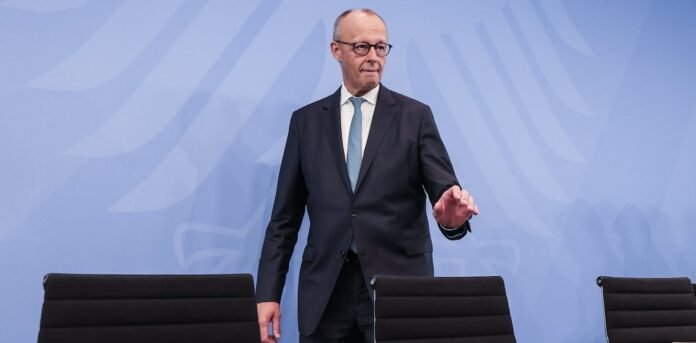
Trade tensions between the EU and China are deepening. On June 16, the EU’s trade chief, Maroš Šefčovič, said the bloc’s unbalanced trade relationship with China “had reached a point that requires a reset”. The German chancellor, Friedrich Merz, then criticised Beijing days later for what he claimed were its unfair trade practices.
In comments made in Brussels after a European Council meeting, Merz accused China of “flooding markets” through the use of “high subsidies”. He also said China’s currency was undervalued by 30%, making its goods artificially cheaper in global markets. Merz pointed to the Plaza accord as an example of how this issue could be addressed.
Signed in 1985 between the US, Japan, Britain, Germany and France, the Plaza accord was an agreement which saw Japan agree to appreciate the value of its currency, the yen, against the US dollar. The five signatory nations also collectively agreed to intervene in currency markets to weaken the US dollar, which had appreciated massively in the early 1980s, reducing the global competitiveness of US goods.
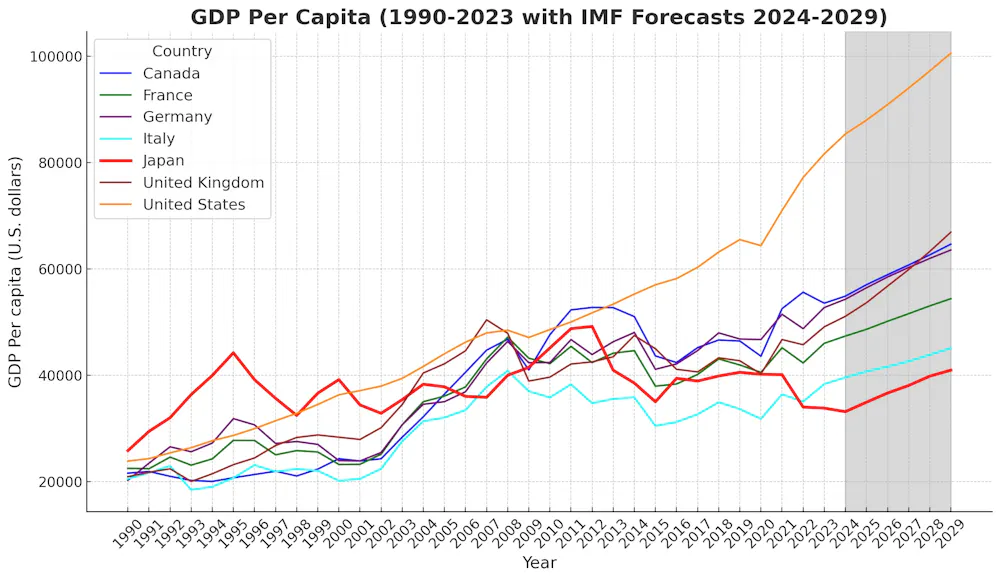
The yen’s value quickly increased following the Plaza accord, appreciating by around 46% against the US dollar by 1986. In doing so, the imposition of protectionist measures against Japan was avoided. However, the yen’s appreciation had some severe consequences for Japan, which is something Chinese policymakers are seemingly very aware of.
For example, the yen’s appreciation was widely seen as being a major contributor to the Japanese asset price bubble in the late 1980s. The implosion of this bubble led to Japan’s so-called “lost decades” of economic stagnation, which has characterised the Japanese economy since then.
Japan’s GDP per capita has stagnated around US$40,000 (£30,000) since the 1990s, while other major economies have experienced significant growth.Wikimedia Commons, CC BY
For Chinese policymakers, the current trade tensions between Beijing and the west are reminiscent of the contentious relationship between the US and Japan decades ago. Many of the complaints made about China’s growth model and economic practices are similar to the gripes about Japan at that time.
Those complaints primarily concerned Japan’s significant trade deficit with the US, as well as its alleged unfair trade practices that disadvantaged American manufacturers. Among other things, the US claimed that Japanese semiconductor and electronics manufacturers were flooding the US market with products priced below the cost of production.
Consequently, China views the Plaza accord not as a mutually beneficial agreement. It instead sees the accord as a US-led attempt to cripple Japan’s economy that spelled the beginning of the end for the competitiveness of Japanese manufacturing. This is a stance that has regularly been conveyed by Chinese state media.
In 2018, China’s state-run Xinhua news agency described the Plaza accord as the cause of Japan’s economic woes. This line was also present in a recent editorial in the Global Times, a tabloid under the direction of the Chinese Communist party’s flagship newspaper, the People’s Daily. The editorial argued the accord was a historical example of western economic coercion and political pressure, rather than a model for international cooperation.
Coming to blows
Merz’s message may not have been intended as a suggestion that the EU should seek to curtail the Chinese economy. But, given the wariness among Chinese policymakers of the negative effect of the Plaza accord on Japan, it is likely to be interpreted as such by Beijing.
In recent years, China has reacted forcefully to what it perceives as external attempts to limit its economic competitiveness. It has taken proactive measures against the US in response to the imposition of tariffs and other restrictions on Chinese goods and Donald Trump’s proposed Mar-a-Lago accord, through which he hopes to lower the value of the US dollar to boost American exports.
On June 22, for example, China added an additional ten US firms to its rare-earths export control list in response to US restrictions on Chinese firms such as electric vehicle manufacturer BYD. The Chinese commerce ministry said the measures were a response to the “US government’s malicious practice”, adding they were taken to safeguard national security and interests.
Merz’s comments leave Europe open to similar measures. These measures perhaps most notably include tighter restriction on European access to Chinese rare earths, which are key components in many modern military technologies. Such a move would hamper the EU’s push to rearm itself in the face of Russian aggression.
However, unlike Washington, Brussels has been hesitant to start an open trade conflict with Beijing. As a result, China’s most likely response to trade tensions with Europe will be to follow its established pattern of dealing with individual states bilaterally rather than the EU as a whole. Beijing has used this approach to overcome previous efforts by the EU to forge a unified line regarding China.
What is clear is that the relationship between the EU and China is entering a contentious stage. Their differences are set to intensify as China seeks to maintain its global dominance in manufacturing and make strides in key technologies that were once the preserve of advanced European economies.
NASA’s X-59 “frankenjet” tests supersonic flight without the sonic boom
More than two decades since the Concorde supersonic airliner last took to the skies, NASA has been flying an experimental aircraft designed to replace loud sonic booms with a quieter thump equivalent to a car door slamming shut 20 feet away. A successful NASA flight test program could influence the design of future supersonic airliners capable of flying overland routes without rattling buildings—and people’s nerves.
The Lockheed Martin X-59 Quesst—an acronym for Quiet SuperSonic Technology—first took flight late last year and recently began supersonic test flights. But unlike with many experimental “X-plane” aircraft that may never leave restricted airspace near Edwards Air Force Base in California, NASA plans to eventually take the X-59 on a tour around the United States so residents of various cities and towns can provide feedback on the quieter sonic “thumps” it produces.
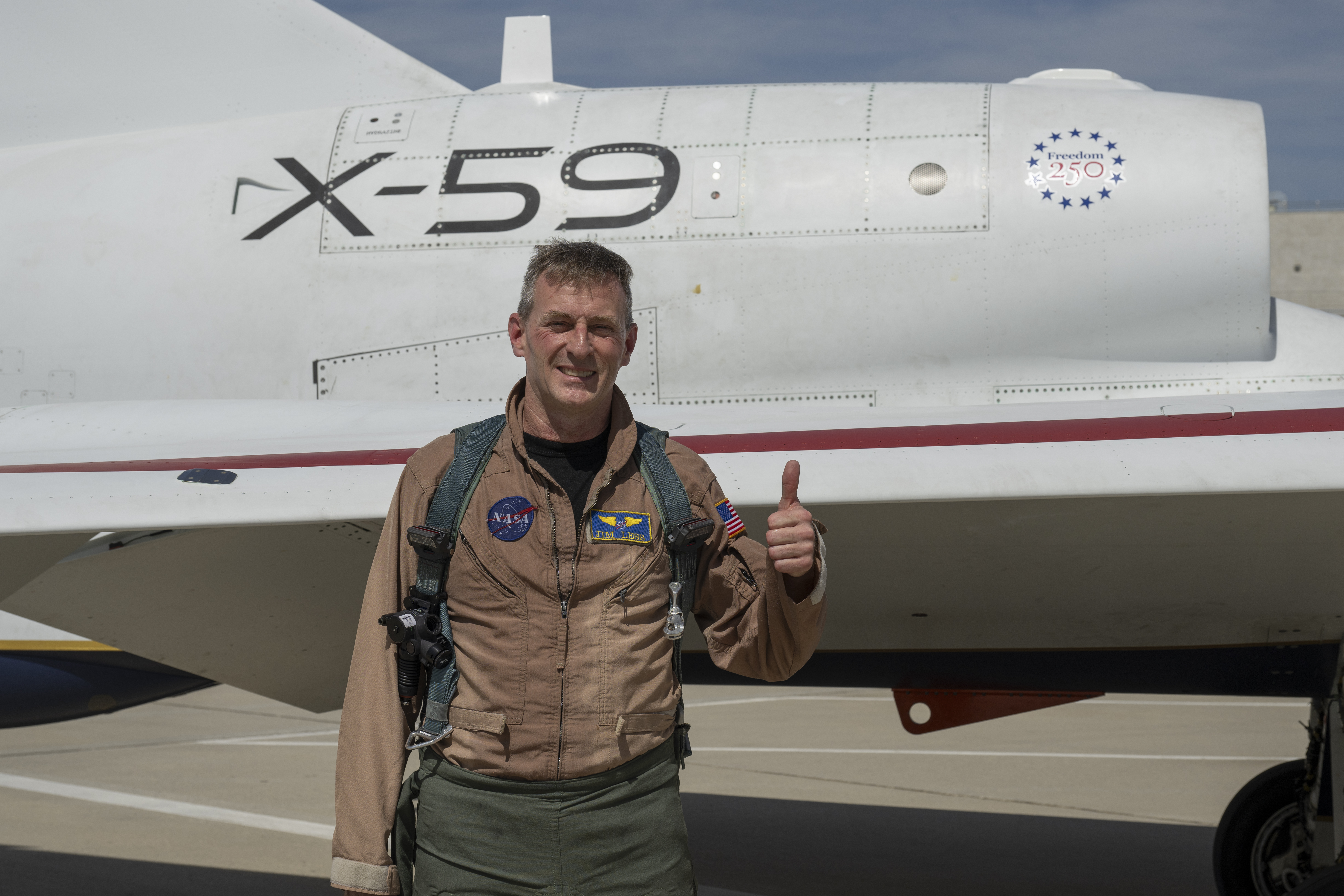
“Usually an X plane is kind of bare-bones—‘cobble it together from a bunch of parts from other airplanes and just demonstrate one thing,’” said Jim “Clue” Less, a NASA test pilot and aerospace engineer, in an interview with Ars. “We need to demonstrate that one thing, but then we need a plane that’s robust enough that we can fly it all over the place and gather that data.”
The move comes at a time when the US Congress has been advancing legislation that could legalize overland supersonic travel. That would reverse a 1973 ban implemented by the US Federal Aviation Administration, which was informed by the public backlash and noise complaints following US military tests of supersonic flights over Oklahoma City, Chicago, and St. Louis in the 1960s.
But even if the X-59 program shows that quieter supersonic travel is possible, any potential revival of commercial supersonic flights would still have to prove financially viable despite challenges such as massive fuel consumption costs.
Less and Peter Coen, the mission integration manager for NASA’s Quesst mission and former manager of NASA’s Commercial Supersonic Technology project, spoke at length with Ars about the quirks of piloting a supersonic aircraft with no front window, the X-plane’s “frankenjet” design, a harrowing early flight test, and what people around the United States can expect once the X-59 starts doing its national tour.
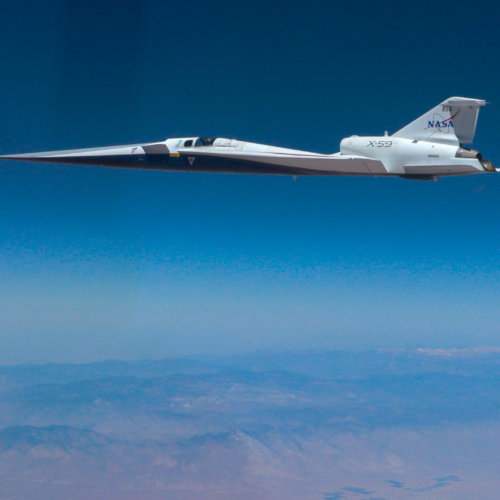
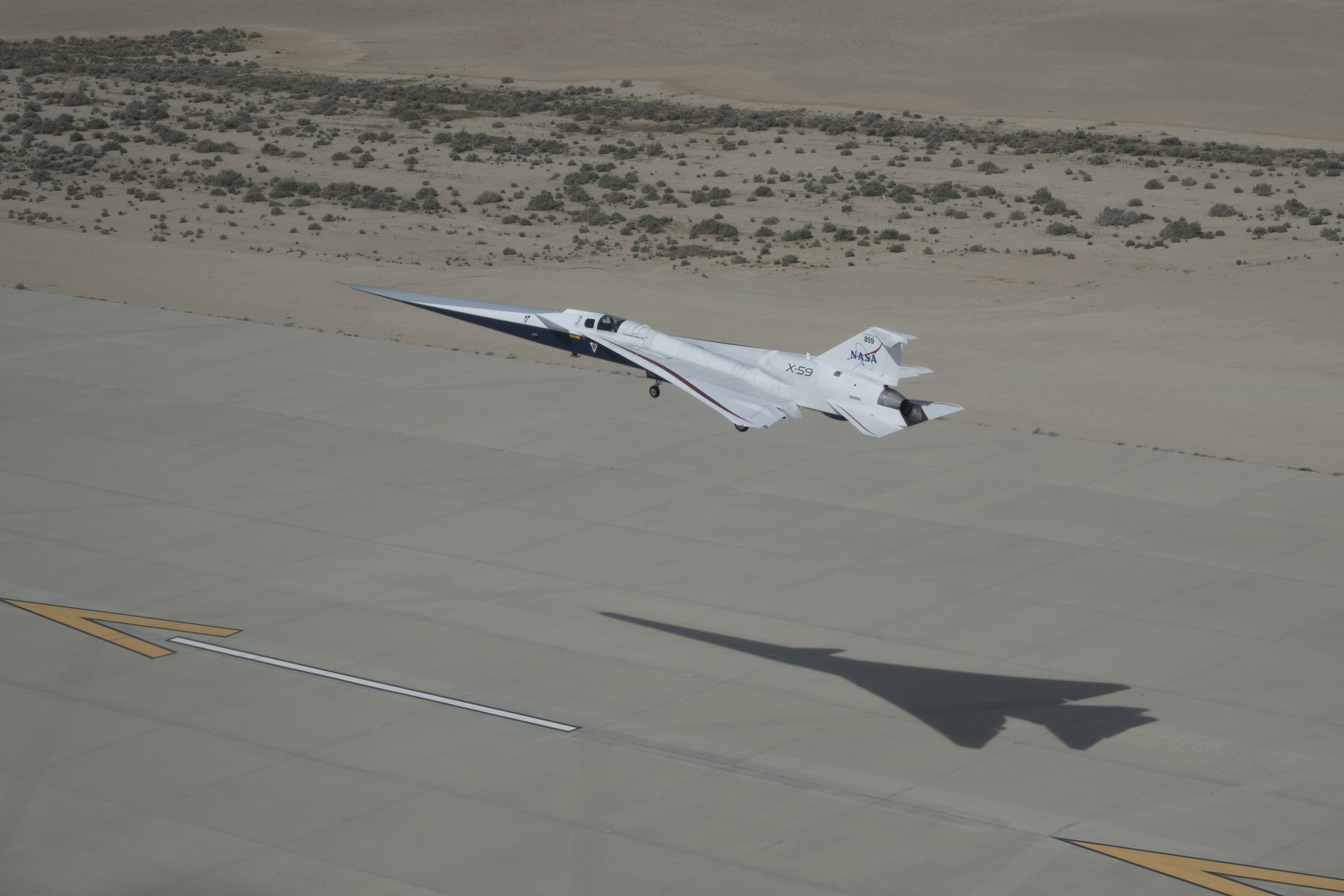
NASA’s X-59 quiet supersonic jet flies over the Mojave Desert during its third flight on Thursday, March 26, 2026, from NASA’s Armstrong Flight Research Center in Edwards, California.
NASA’s X-59 quiet supersonic jet flies over the Mojave Desert during its third flight on Thursday, March 26, 2026, from NASA’s Armstrong Flight Research Center in Edwards, California. Credit: NASA | Carla Thomas
An airframe designed for sonic thumps
The X-59’s distinctive airframe, developed by Lockheed Martin Skunk Works in partnership with NASA, is most likely to stand out at first glance—especially the long, tapered nose that makes up almost a third of the aircraft’s nearly 100-feet length. The nose is designed to help break up the shockwaves that are typically created when an aircraft flies faster than the speed of sound.
“All the features of the X-59, from its long tapered nose to the engine mounted on top to the shape of the wing—each one of those features was done in one way or another to control the strength of a shockwave,” Coen told Ars.
A supersonic aircraft typically creates multiple shockwaves emanating outward from the nose, canopy, engine inlet, wings, and tail of the aircraft. Those individual shockwaves “start to pile up on each other” and eventually form two remaining shockwaves that travel down to the ground, Coen explained. People on the ground usually hear the double bang of the two shockwaves as a single sonic boom.
The “trick to solving the sonic boom problem” involved creating an airframe design that could make shockwaves of similar strength while spacing them out as equally as possible along the airplane, Coen said. That slows down the process of multiple shockwaves merging into larger ones and allows the atmosphere to weaken the smaller shockwaves to smear out the sharp pressure change into a more gradual increase.
The result is that human ears will hear a “thump or a whoosh” as opposed to a typical sonic boom, Coen said. Whereas the Concorde’s sonic boom noise was around 105 perceived level in decibels (PldB)—potentially enough to rattle window frames and household items if the supersonic airliner wasn’t banned from overland flights—NASA’s Quesst mission goal is to demonstrate a softer sonic thump closer to 75 PldB.
Not flying blind
One trade-off of the X-59’s long, tapered nose is that there is no forward window for the pilot. As a NASA presentation notes, the last notable crewed aircraft that flew in the United States without forward-facing windows was Charles Lindbergh’s Spirit of St. Louis monoplane that made the first nonstop transatlantic flight in 1927.
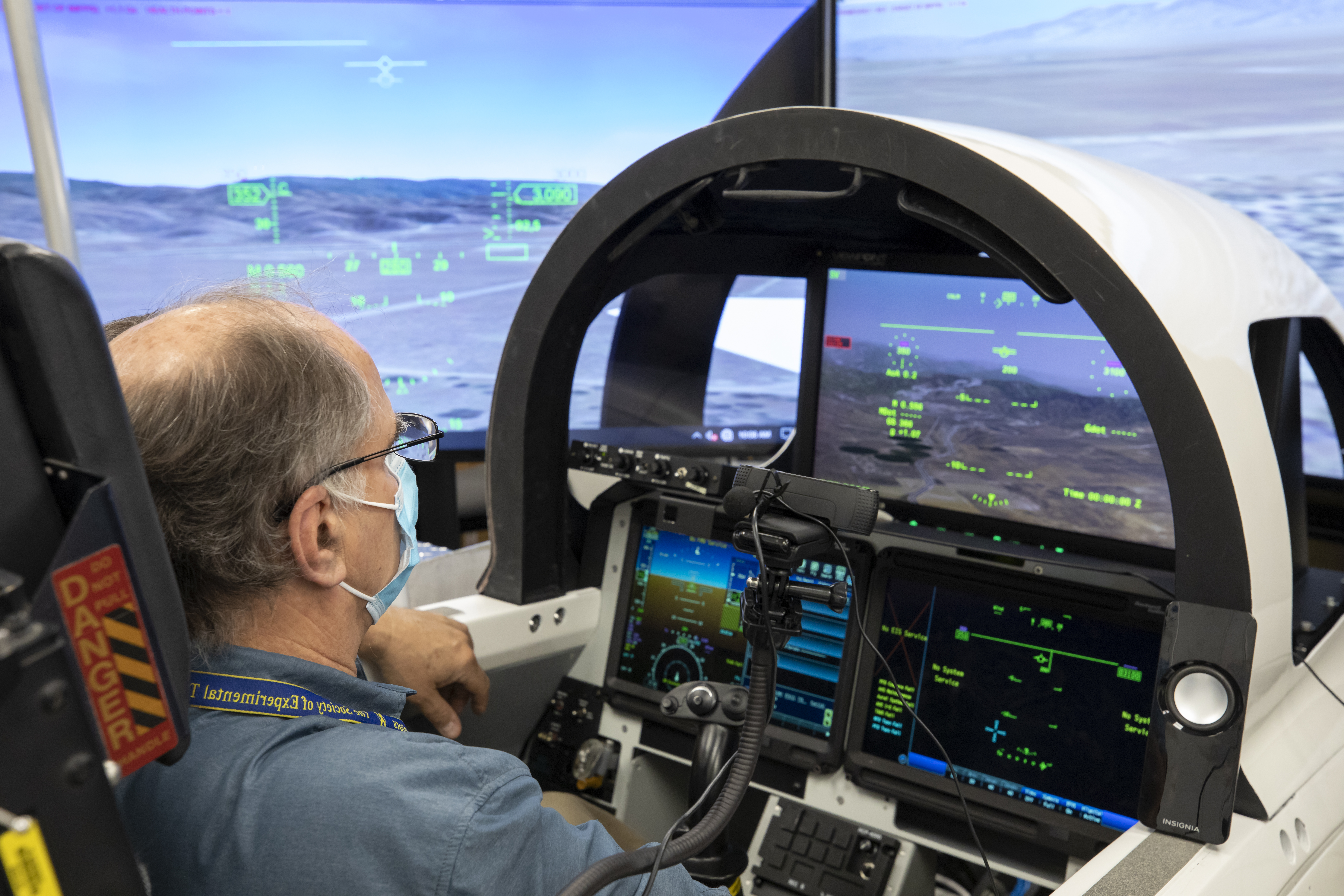
Instead, the X-59 pilot relies on an eXternal Vision System (XVS) developed by NASA Langley Research Center, which uses two high-resolution cameras on the top and bottom of the aircraft to display a forward view to the pilot through a 4K monitor. The same monitor provides additional flight data through augmented reality features to assist with takeoffs and landings.
The X-59 also has actual side windows that allow a pilot to check for runway edges when taxiing on the ground, taking off, and landing.
A close-up of the cockpit view of the eXternal Vision System before it was placed in the X-59. Instead of a front-facing window, the pilot uses monitors for forward-facing visibility.
A close-up of the cockpit view of the eXternal Vision System before it was placed in the X-59. Instead of a front-facing window, the pilot uses monitors for forward-facing visibility. Credit: Lockheed Martin | Garry Tice
Although some engineers and project managers were initially concerned about how well the pilots could adapt to the XVS system, Less and David Nils Larson, the lead X-59 test pilot, had prepared ahead of time by spending hundreds of hours training in an X-59 simulator, with Less having more than 300 hours and Larson spending more than 500 hours. They also practiced an estimated 1,000 simulator landings each.
“It’s not like hopping in an F-18 or an F-15, where you’ve got great visibility all around, but when we’re in the X-59, this is normal to us,” Less told Ars. “It’s gotten very routine.”
In 2021, NASA also evaluated the XVS technology’s ability to help the pilot easily spot nearby aircraft, performing live flight test scenarios with the hardware installed aboard a NASA Beechcraft King Air. A pilot using the XVS system was often able to spot nearby aircraft faster than a pilot sitting up front and looking out the window, possibly due to the technology’s image-processing capabilities.
“We’ve been able to show that it’s not only an equivalent level of safety to having a canopy, it’s actually better in some cases,” Less said. “I don’t know if this kind of system will find its way into future airliners—non-supersonic airplanes—just because it may allow you better visibility.”
Frankjet origins
Like many experimental aircraft, the X-59 is a “frankenjet” because it uses “off-the-shelf” components from many different aircraft, Less said. For example, the aircraft’s landing gear comes from an F-16 Fighting Falcon jet. The throttle that controls the aircraft’s engine power originated from an F-18 Super Hornet fighter jet that operates from aircraft carriers, whereas the stick comes from an F-117 Nighthawk stealth attack aircraft.
The aircraft’s fuel system and hydraulics also incorporate components from F-16 and F-18 fighter jets. The X-59’s F414-GE-100 engine—capable of providing 22,000 pounds of propulsive energy—is a customized variant of a turbofan engine used in F-18 Super Hornets.
The X-59 cockpit is based on the rear cockpit of a T-38 jet trainer, allowing Lockheed to reuse the T-38 canopy and ejection seat for the experimental aircraft. But the result is a relatively small cockpit space for the test pilots Less and Larson, who are both more than 6 feet tall.
“It does make for a pretty small, cramped cockpit—we’re always complaining about that,” Less told Ars. “Everything is right there at our fingertips, though, which is pretty nice.”
One of the most important components is the avionics system that allows the pilot to access the aircraft’s various navigation and communications systems. The X-59 incorporates a Rockwell Collins Pro Line Fusion avionics system commonly used in Beechcraft King Air turboprop aircraft. That will make it easier for the experimental supersonic jet to eventually operate safely alongside other aircraft at civilian airports and when flying in the US National Airspace System.
NASA test pilot Jim “Clue” Less is seen after completing his first flight of the X-59 and the aircraft’s second flight overall at Edwards Air Force Base in California on Thursday, March 26, 2026.
NASA test pilot Jim “Clue” Less is seen after completing his first flight of the X-59 and the aircraft’s second flight overall at Edwards Air Force Base in California on Thursday, March 26, 2026. Credit: NASA | Ryan Kline
First flight tests
But before the X-59 can start a national tour, the test pilots must put the aircraft through its paces. The first phase of the X-59 program that began with the inaugural flight on October 28, 2025, involves testing the aircraft’s handling qualities and limits under various flight conditions while proving the aircraft’s safe operational limits. Between late 2025 and June 2026, Less piloted the X-59 during 10 flights while Larson took the controls for nine flights.
The X-59’s long nose and overall shape make the aircraft “a little bit sensitive in pitch” when the nose is moving up or down, Less said. That showed up as a potential issue early on during the simulator runs, so NASA and Lockheed Martin tried to ensure that the autopilot systems could provide backup in case the aircraft didn’t handle well in flight.
The initial test flights showed that the aircraft handled better than expected despite the pitch sensitivity. “If you start aggressively trying to control a very precise pitch attitude, you get into a little bit of an oscillation, but you can easily get out of that,” Less explained.
The most notable in-flight anomaly so far appeared during the X-59’s second flight on March 20, which happened to be the very first flight for Less. About four or five minutes after takeoff, a warning light appeared on the cockpit display that suggested the aircraft was experiencing an uncontrolled loss of air that might trigger a fire.
The aircraft’s pressurization system automatically shut down due to a potential bleed leak, which also cut off airflow inside the cockpit. Fortunately, Less had not flown very high yet and was able to quickly return to base for a safe landing. The post-flight investigation showed that the warning light had been a false alarm—the result of the indicator’s instrumentation being incorrectly installed.
“It may seem like we spent a lot of time and effort training, but it pays off when you get out there and something’s not going quite right and we know how to respond,” Less said. “We think we’re prepared for every contingency.”
Measuring the sonic thump
The X-59 has performed smoothly for the most part despite the few anomalies. On June 5, 2026, it went supersonic for the first time, with Less as the pilot. The 81-minute flight saw the aircraft reach a top speed of Mach 1.1—about 713 mph—at an altitude of 43,400 feet.
However, the experience of going supersonic as a pilot is significantly less exciting and more anticlimactic than what Hollywood films often show, Less said.
“What surprises most people is when you go supersonic, you really don’t know other than your gauges telling you that you’ve gone supersonic,” Less told Ars. “I was showing my wife and my daughter some video of the moment that we went supersonic, and I said, ‘I’m sorry, it’s kind of boring.’”
NASA followed up on that milestone with a second supersonic flight test on June 12 that achieved a top speed of Mach 1.4—approximately 924 miles per hour—and reached an altitude of 55,000 feet. Those represent the speed and operational altitude that the X-59 will aim for in future flight tests intended to evaluate the sonic thump.
X-59 supersonic flight test points.
The early supersonic flight tests have included retired Air Force F-15 jets and F-18 jets being repurposed as NASA chase planes to follow the X-59 prototype and help monitor its operational performance. However, the sonic booms generated by the chase planes currently obscure any quieter sonic thump from the X-59.
The coming months of flight tests could pave the way for the start of the program’s second phase by the end of 2026, which would still take place in restricted airspace near Edwards Air Force Base. That next phase will focus on measuring the shockwaves generated by the X-59 in flight, along with evaluating the sonic thump impact on the ground.
“We’re going to fly the X-59 with a specially instrumented nose boom on the front of the airplane, which will be able to measure the flow field, the strength, and location of the shockwaves near the airplane,” Coen said.
NASA also plans to measure the shockwaves high up in the atmosphere by mounting a microphone system on a motor glider flying at an altitude of about 10,000 feet. An array of specialized and ruggedized acoustic recorders will also record the weakened shockwaves once they reach the ground.
Going on national tour
The ultimate test of the X-59 design’s success would come in the third phase of the program, when NASA plans to fly the aircraft above communities all across the United States. The agency wants to perform X-59 flight tests over communities that are broadly representative of the United States when factoring in demographics, building construction, climate, geography, and a host of other characteristics.
The ground microphone arrays will once again be deployed, but NASA also plans to recruit community members who can share their feedback on the sounds they hear each day during the flight tests. Each community may experience frequent flight tests for about a month, during which they may hear quieter and louder sonic thumps ranging from 70 PldB to 90 PldB, Coen said.
“Each day, we’ll fly over the community and [fly] the X-59 a little bit differently, so each flight will produce either a quiet sound or a louder sound,” Coen said. Many people may not even hear anything on the lower end, but the louder sonic thumps could approach “something that is quite annoying,” he said.
For the first community test, the X-59 will take off from NASA Armstrong Flight Research Center at Edwards Air Force Base in California’s Mojave Desert before conducting supersonic test runs over an unspecified neighboring community that does not typically hear sonic booms from other test aircraft.
But follow-on tests elsewhere in the United States will require an airfield capable of supporting the X-59’s runway requirement of 10,000 feet. Although NASA has not yet finalized its list of communities designated for the flight tests, dozens of major airports have the runway lengths capable of accommodating the X-59.
NASA’s X-59 quiet supersonic research aircraft approaches landing at Edwards Air Force Base in California on Thursday, March 26, 2026.
NASA’s X-59 quiet supersonic research aircraft approaches landing at Edwards Air Force Base in California on Thursday, March 26, 2026. Credit: NASA | Carla Thomas
Community feedback and other data from the X-59 test flight program will eventually be shared with the US Federal Aviation Administration and the International Civil Aviation Organization, so regulators will have the evidence to create new standards for overland supersonic flights.
“The objective is to come up with a standard that enables innovation and allows us to have supersonic flight in the future but still protects the public on the ground,” Coen said. “Phase 3, where the public is allowed to weigh in on what they heard and how it affected them, is something that I’m personally really looking forward to.”
World’s first trillionaire a flashing red light for US democracy
Elon Musk is the world’s first trillionaire. Image: YouTube screengrab
The red emergency light is flashing on America’s democracy dashboard, like a damaged aircraft teetering toward a mountain.
Elon Musk becoming the planet’s first trillionaire should make us tremble for the future of self-governing republics. It’s as if we’re bringing back modern pharaohs to dominate our societies.
The concern here isn’t with wealth per se. It’s the tremendous power of concentrated wealth to distort markets, politics, and society. When you have Musk’s level of wealth, you’re no longer just buying another mansion or private jet (of which he already has several). You’re buying a media outlet, a senator, and maybe, in the case of Musk, elevating a president.
Musk has no inhibitions about deploying the power of his considerable wealth. He bought Twitter, one of the public squares of our time, and transformed it into X, a partisan and disinformation platform rife with hate speech and extremism.
In the 2024 election cycle, he donated $291 million to President Donald Trump and Republican candidates, according to Open Secrets. As Michael Mechanic wrote in Mother Jones, “Musk expended 0.1% of his wealth in the process and got far more in return.” Mechanic notes “The Trump administration promptly shelved dozens of investigations into Musk’s companies.”
Public Citizen found that 70% of the agencies that were targeted by DOGE had conflicts of interest for Musk’s businesses. For example, Musk directed DOGE to dismantle the Consumer Financial Protection Bureau, which would have overseen X’s move to become a payment processor.
Musk was further rewarded with lucrative government contracts for SpaceX, Starlink, and other Musk-companies. In early 2025, The New York Timesreported on a boost in multi-billion-dollar contracts for Musk’s companies as the Trump administration took power.
That was Musk as a “mere” centi-billionaire. What other power might Musk be able to wield as the world’s first trillionaire?
But it’s not just Musk. America’s 16 centi-billionaires (including Musk) have a combined wealth of $4 trillion. And the 977 billionaires on the Forbes US wealth list now own a combined $9.24 trillion, according to analysis by Americans for Tax Fairness.
This isn’t a partisan concern. Whether it’s liberals like George Soros and Tom Steyer or right-wingers like Musk and Peter Thiel, this concentration of power and influence should trigger the flashing red light.
Billionaires—and soon trillionaires as well—are spending hundreds of millions of dollars to influence our elections while working Americans struggle to afford food, housing, and healthcare.
It’s clearer than ever that those two facts are connected. We need to get serious about curbing this billionaire influence and supporting regular people—starting with a wealth tax.
Oxfam observes Musk could give $100 to every person on Earth and remain one of the 10 richest people on the planet.
Ellen Weston, the veteran actress best known for her roles on The Young and the Restless, Guiding Light and Get Smart, has died. She was 87.
Weston died on May 28 at Cedars-Sinai Medical Center in Los Angeles, her friend and manager Susan Zachary confirmed to The Hollywood Reporter.
To longtime soap fans, Weston was instantly recognizable as Suzanne Thurston on The Young and the Restless, where she played the ex-wife of slick conman Derek Thurston, portrayed by Joe DiSazio, from 1979 to 1981.
But her television career stretched back decades.
Weston’s earliest major role came on Guiding Light, where she played Robin Fletcher from 1963 to 1964. She later appeared on Another World and also popped up on the classic spy comedy Get Smart as Dr. Steele.
Her work made her a familiar face during a golden era of daytime and network television, when soap operas and sitcoms ruled American living rooms.
Friends remembered Weston as far more than just a talented actress. In a statement shared with The Hollywood Reporter, they described her as “beyond a loyal friend” and called her a “fierce advocate” for the people she loved.
“She was our consigliere dispensing advice, wisdom, compassion and care in equal measure — especially when we most needed an ear, a shoulder and a true confidante,” the statement read.
Those close to Weston said she carried herself with elegance until the very end.
“She took excellent care of herself, always tastefully put together with gorgeous outfits, the perfect makeup and more,” her friends said. “Up until the very end, she was still dancing and taking new classes.”
According to the statement, one of her final passions was a pottery class taught by a close friend, which ended just one month before her death.
Weston also appeared alongside Elizabeth Montgomery in Bewitched in 1972, adding another beloved TV classic to her long list of credits.
Later in life, she stepped behind the camera as a writer and producer. One of her most notable projects was the 1999 TV movie And the Beat Goes On: The Sonny and Cher Story. She also returned to Guiding Light in 2003, this time as a writer.
Iran deal Trump trashed looks a lot like the one he’s signing
At Switzerland’s Lake Lucerne last week, US Vice President JD Vance announced that Iran had agreed to let United Nations nuclear inspectors back into the country and called it a first step toward permanently ending Tehran’s nuclear program — a claim Iran’s foreign ministry promptly disputed.
The framework Vance’s team is negotiating, brokered through Pakistan and Qatar, would reopen the Strait of Hormuz, lift oil sanctions and unfreeze billions in Iranian assets. Behind the triumphalism, however, was a bargain: caps on uranium enrichment, a smaller stockpile, inspectors on the ground and sanctions lifted in return for compliance.
That was the deal Trump tore up in 2018, repeatedly calling it “stupid” and the “worst deal ever.” It took a war for him to reopen it. In late February, a joint US-Israeli strike killed Iranian Supreme Leader Ali Khamenei, disrupting Iran’s command hierarchy.
The strait has since been closed, reopened and threatened, causing global oil prices to spike, fall and spike again. Tehran now insists it alone will police the waterway while imposing tolls on passing ships, threatening freedom of navigation through a channel through which one-fifth of the world’s oil moves.
Nine days after the June memorandum of understanding was signed, the US was bombing Iran again, including strikes on coastal missile and radar sites. The attacks came in response to an Iranian drone attack on a cargo ship in the strait.
Iran’s regime is weaker but angrier, with President Masoud Pezeshkian still saying flatly that his country will never surrender the right to enrich. The endgame on the table looks less like a victory than containment: a postponement with airstrikes attached, the very policy the deal was built to replace, now rebuilt at gunpoint.
The way we have come to read Russian President Vladimir Putin is instructive here. In 2015, Michel Eltchaninoff published a short book arguing that Putin’s instincts are rooted in the Orthodox emigre philosopher Ivan Ilyin, offering real insight into a tradition that treats the state as a bulwark against liberal chaos — and, in doing so, lending Putin a coherence he had not altogether earned.
He did not reason his way to Ilyin. He picked the philosopher up late, as a vocabulary for decisions already taken. His real education came from the KGB, from deal-making in 1990s St. Petersburg and from the Soviet Union’s collapse he watched firsthand in Dresden in 1989 — a superpower rotting from within — which left him certain that, in the end, everyone acts out of self-interest. The conviction came first; the philosophy came later.
Strongmen tend to invoke a thinker after executing their actions. This sequence — action first, followed by doctrine to justify it later — shapes both how strongmen rule and how entire systems are created or dismantled. This dynamic is now visible in Trump’s White House.
The old order now being dismantled was itself an improvisation. The generation of 1945 built it from scars rather than blueprints, with American money, a wary peace with Joseph Stalin and bone-deep fear of repetition.
They assembled the United Nations, Bretton Woods and NATO, structures that lasted 80 years and achieved something rare in keeping the great powers of the continent from war.
Their success, however, ultimately led to their downfall. The heirs misread a hastily improvised safeguard as a permanent rule and maintained the institutions and procedures long after the original fears that justified them had faded.
This pattern was particularly pronounced in Iran, where Washington has spent more than 40 years managing the situation rather than resolving it. The 2015 Joint Comprehensive Plan of Action (JCPOA) agreement exemplified this approach on a smaller scale: contain, monitor and delay.
Trump saw that the 2015 deal was hollow but mistook the remedy. He believed destroying Iran’s nuclear sites would end the threat, when Tehran’s real strength lay in its missiles and proxies.
Walking away spent those constraints without securing the better deal that never came. The war that followed did shift the balance of power. Yet the terms now taking shape would be recognizable to the negotiators of a decade ago.
That is because the doctrine the war was meant to vindicate — zero enrichment and full dismantlement — is being surrendered at the table. The instinct outran the doctrine, and the reality that you can bomb a facility but not the knowledge of how to build one, or that Iran will trade enrichment caps but not the right to enrich, has reasserted the old logic.
The lesson isn’t that force is ineffective. Rather, the old order didn’t fall because of a better idea but because the memory sustaining it faded and habit took over. In a crisis, people typically seize the moment without knowing what comes next.
Putin found a coat that suited him after the fact. Trump’s impulsive decisions, driven largely by grievance, lack a guiding philosophy.
The last order was built under conditions of exhaustion, necessity and the depletion of easier options. The next one probably will be too. Lake Lucerne, for all its talk of new beginnings, really reflects the cost of past decisions catching up.
Eric Alter is a non-resident senior fellow at the Atlantic Council’s Middle East programs and a former UN civil servant.
Israeli officer killed, soldier injured in southern Lebanon, military says
The Israeli military said Sunday that one officer was killed and a soldier injured in a “clash” in southern Lebanon, Anadolu reports.
A military statement said the slain officer was a platoon commander in the Golani Brigade’s 12th Battalion.
The army said the officer was killed in a clash that occurred after a Hezbollah ambush near Deir Siryan in southern Lebanon.
The military said another soldier was lightly wounded in the incident.
According to Israeli military figures, at least 32 soldiers have been killed since the outbreak of war with Iran on Feb. 28.
The military does not specify where casualties occur, but most have reportedly been recorded in southern Lebanon and along Israel’s northern border.
Israel maintains strict censorship regarding the results of Hezbollah attacks, imposing restrictions on media coverage and warning against publishing images or information related to casualties or targeted locations.
Since March 2, Israel has been waging an offensive on Lebanon that has killed at least 4,246 people, injured 12,190 others, and displaced over 1 million people, according to the latest official figures.
Israel occupies areas in southern Lebanon, some for decades and others since the previous war between 2023 and 2024. During the current offensive, Israeli forces pushed more than 10 kilometers into Lebanon.
On Friday evening, Lebanon and Israel signed a US-mediated framework agreement for a phased Israeli withdrawal from all Lebanese territory, beginning with two unnamed pilot areas.
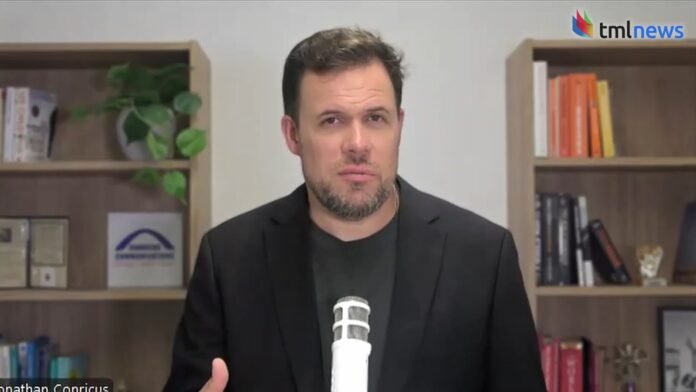
Why Is Jonathan Conricus Chiding Netanyahu, Blaming Egypt, and Hailing Lebanon Deal?
Conricus says the US-Iran memorandum gives Tehran sanctions relief and diplomatic breathing room without confronting its nuclear ambitions, missile program, or support for proxy groups
Jonathan Conricus, a senior fellow at the Foundation for Defense of Democracies think tank and a former international spokesman for the Israel Defense Forces, sees the Middle East as a series of collisions rather than a single crisis. One moment, the conversation is about attacks in the Strait of Hormuz and US retaliation; the next, it is about Iran, Bahrain, and a threat from President Trump to “complete the job,” together with a question about whether the memorandum of understanding (MOU) was really an MOU at all. Then it is back to Lebanon, where Conricus sees an opening that others seem determined not to notice. Calling the Lebanon track “the big news of the weekend,” Conricus said it gave him “a glimmer of hope that maybe the future will be different” from the near-constant war Israel has faced over the last almost three years.
The Lebanon development cut against the grain of the usual regional alignments. He said it is “very interesting to see, very telling to see, who is for a peace deal between two sovereign states and who’s against it.” In his view, the divide exposes something fundamental: Those truly committed to sovereignty, democracy, and peace should be welcoming a roadmap between Israel and Lebanon, not reflexively resisting it because it weakens “Iran and Hezbollah.” He also cast the moment as a quiet rebuke to those who have spent years claiming to care about human rights while opposing any development that might reduce violence.
Conricus made clear that this is not a simple peace announcement but a process. Asked about criticism from Israeli hard-liners, he dismissed National Security Minister Itamar Ben-Gvir as “an outlier” who does not have authority over the issue and whose posture reflects his political agenda “in election season.”
Still, what matters, he argued, is the practical framework: a continued Israeli military presence in southern Lebanon until the situation is fit for withdrawal, and a phased handoff in which the Lebanese Armed Forces move into selected areas just beyond the “yellow line,” take responsibility, and dismantle what remains of Hezbollah’s capabilities. He described it as a “pilot program,” with the possibility of expanding if it works, and said plainly that if there is a chance of peace between our two sovereign states, “then I think it’s definitely worth taking calculated risks in order to do so.”
That is the core of his Lebanon position: not an immediate peace, but a tentative one built on the weakening of Hezbollah. Before October 7, he said, the group was “very, very powerful,” armed with “more than 130,000 rockets,” advanced missiles, and the ability to strike deep into Israel. After the fighting that followed, after what he called the “beeper attack,” after the elimination of Hassan Nasrallah and other senior commanders, and after the elimination of the Radwan unit, Hezbollah’s military weight had been reduced enough to create room for something else: the chance for the Lebanese state to reassert itself.
We have now kind of turned the tables in Lebanon
“We have now kind of turned the tables in Lebanon,” Conricus said, arguing that Israeli military action—“forced upon Israel,” as he put it—unexpectedly opened the door for Lebanon to act like a sovereign state rather than a battleground for outside powers. He framed this as a rare strategic opening not only for Lebanon but potentially for Saudi Arabia too, though he said that Riyadh is unlikely to move under the current Israeli government and that normalization would probably come only after Israeli elections because of the “political baggage and weight” attached to Prime Minister Benjamin Netanyahu. Even then, he warned, the “so-called Palestinian issue” will remain the familiar wrecking ball, with actors trying to “sidetrack and ruin” attempts at regional normalization.
Conricus suggested that a Saudi move under American leadership would work “very well” for the Iranian regime’s opponents, but he was deliberate in separating the strategic possibility from the political mess accompanying it.
If the Lebanon discussion carried a note of guarded possibility, the exchange on Iran was far more pessimistic. Asked about the 60-day ceasefire and the broader US approach, Conricus said the region is living in “kind of a twilight zone.” His main complaint was that the memorandum of understanding with Iran does not confront the central problems at all. “It doesn’t address their nuclear weapons aspirations. It doesn’t address their ballistic missiles,” he said, adding that it also sidesteps Iran’s proxy activity and support for terror across the region.
It doesn’t address their nuclear weapons aspirations. It doesn’t address their ballistic missiles.
What the MOU does do, in his view, is hand Tehran a diplomatic and economic victory. He called it “a very frustrating document,” then “very generous,” and said it provides sanctions relief, access to the dollar system, and permission to sell oil, all “without really getting much in return.” That, he said, is not only a policy error but “quite a betrayal to the Iranian people,” especially after those who took to the streets believed help was coming and instead found themselves facing a strengthened regime with more money to feed the Islamic Revolutionary Guard Corps and terror networks. He sounded especially bothered by the mismatch between rhetoric and reality: a campaign that seemed aimed at weakening the regime now producing a financial windfall for it instead.
His critique of the US posture was blunt. Washington, he suggested, is focused more on oil prices, gas prices, midterm elections, and domestic politics than on what is happening in the Middle East. And the assumption that money appeases extremist regimes, Conricus said, is one that history has already rejected. “That never happens,” he said. “You give money to terrorists and terror supporters, they will use it exactly to continue to promote that agenda.”
Switching to Gaza, Conricus drew a sharp distinction between visible anger on the ground and the structural reality of life in the Strip. He described Gaza as an area where the civilian population is squeezed into a shrinking space under “Hamas oppression,” with “no freedom of expression, … no freedom of assembly, and … absolutely no right for anybody to criticize Hamas or to pose an opposition to what Hamas does.” Hamas, he said, rules by force and cruelty, using “the power of the AK-47” and a “medieval” system of punishment to keep people afraid.
That is why, he argued, demonstrations against Hamas should not be dismissed lightly. He called them courageous acts that can carry “capital consequences,” because in Gaza dissent can mean torture or death. Even there, Conricus kept returning to the same position: Nothing substantive can change until Hamas disarms. The first item in the agreement, he said, is that Hamas must “lay down their weapons” and hand power over to a civilian body that can begin rebuilding. Until then, there is no real way forward, and no use pretending otherwise.
The plan he described is simple in structure, if not in execution: Once Hamas disarms, the civilian side takes over, aid flows more effectively, and the situation can begin to improve. But he is skeptical that the transition will happen anytime soon. He said plainly that Hamas is violating the agreement, refusing to relinquish control, and continuing to oppress the civilian population because it wants to remain in power. That is why, in his view, international coverage often misses the point: It focuses on suffering but not enough on “why are they suffering, what brings this suffering, and most importantly, how can it be stopped?” For him, the media’s emotional emphasis becomes a kind of avoidance if it is not tied to the root cause.
The conversation then moved to one of the most pointed questions in the exchange: If civilians in Gaza are afraid, and if Hamas will not disarm, should ordinary people be armed so they can defend themselves or resist Hamas? Conricus acknowledged the comparison with Iran, where many millions are alienated from the regime, but he stressed that Gaza is different in both scale and political culture. He noted that Hamas has had “grassroots support” in Gaza and that, up until October 7, it enjoyed “very substantial levels of support” from the population. After the devastation of war, support has fallen, but he remains unconvinced that the underlying mindset has changed.
That uncertainty is central to his caution. He said he does not know whether Gazans have truly renounced the jihadi dream or accepted coexistence with Israel as a permanent reality. He conceded that they are suffering and unhappy, but that alone does not prove a deeper political or ideological shift. On weapons for anti-Hamas clans, he said there are reports of Israel providing arms to some local groups in places such as Khan Younis and Rafah, but he emphasized that this is still “very sporadic” and not yet a strategic tipping point. His gut feeling, he admitted, is that while many Gazans are angry at Hamas, “deep down, they’re still jihadist” and still believe in “taking what they call Palestine by force.” It was a stark statement, but one he presented as a judgment rather than a finding based on scientific evidence.
Turning to Egypt, Conricus described Egypt’s closure of Rafah as “very, very cruel” and “cold-hearted,” accusing Cairo of refusing to allow Gazans out for medical, family, or humanitarian reasons.
He argued that Egypt could have shortened the war by allowing civilians to evacuate into a temporary humanitarian zone outside Gaza, leaving only Hamas to fight. Because it did not, he said, the war became longer and deadlier than it needed to be. That criticism broadened into a sweeping indictment of Egyptian policy. Conricus said Egypt does not look at Gaza with compassion but as a tool to use against Israel. He pointed to school curricula that he described as indoctrinating its children to “the worst levels of anti-Semitism documented in the Arab world,” to a military he sees as oversized for a country without obvious land threats, and to exercises that resemble old war plans from 1973. He argued that Egyptian authorities enabled Hamas to stockpile weapons by allowing transfers through Sinai and Rafah, effectively letting “powder” accumulate in a “powder keg.” He also blamed years of Israeli complacency—especially under Netanyahu, though not only under him—for allowing weapons to keep flowing into Hamas’ hands.
At the same time, he did not reject the peace with Egypt. He said plainly that he prefers peace to war and wants peace over conflict. But he thinks the agreement is “very, very superficial,” and he believes Israel needs a reset in how it deals with Cairo. That means demanding more transparency, pushing for changes in education and public sentiment, and being far more forceful about stopping weapons transfers into Gaza. He also argued that international humanitarian law should have made Egypt the place where civilians could flee from Gaza during wartime.
Conricus recalled that in 2004, when he was a company commander in Givati, he saw “big Hamas tunnels under Rafah” already large enough for small trucks and cars. “We allowed it to fester,” he said, a line that seemed to carry both an admission and a warning. It was also a reminder that the Gaza crisis he describes did not appear overnight, and that the structures now dominating the Strip have been building for years.
Gaza is a mess
His final comment on the subject was as blunt as it was simple: “Gaza is a mess.” Across Lebanon, Iran, Gaza, and Egypt, Conricus kept returning to the same basic framework: Military realities create political openings, political openings require calculated risks, and real change depends on confronting the actors he sees as blocking it. In his view, the region is not short on plans. It is short on the conditions needed to make them real.
The mood, then, is not one of either optimism or despair so much as conditional possibility. Lebanon might open. Saudi Arabia might follow later. Iran may yet be forced to confront the consequences of its own weakness. Gaza could improve if Hamas disarms. But each of those futures is suspended on a first step that Conricus repeats almost like a refrain: “First things first”—a hard-edged belief that diplomacy only becomes meaningful after power changes on the ground.