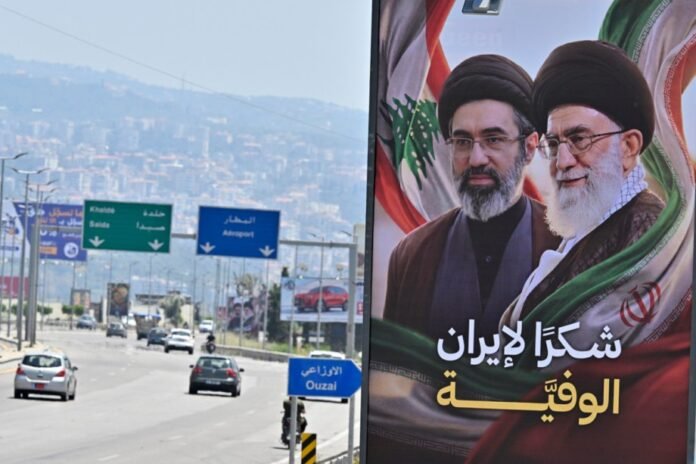
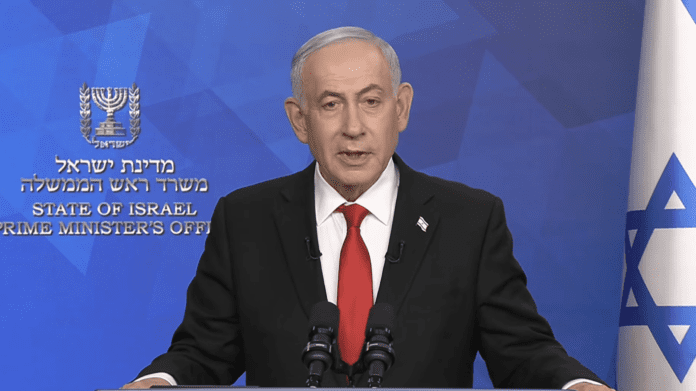
Prime Minister Benjamin Netanyahu defended Israel’s framework agreement with Lebanon on Saturday, saying the accord preserves Israel’s military freedom of action, weakens Hezbollah and Iran, and creates new diplomatic opportunities, while using a wide-ranging press conference to address questions about the military campaign, domestic politics, and Israel’s regional strategy.
Opening the briefing, Netanyahu said Israel had withdrawn only from two pilot areas that the Israel Defense Forces determined were not operationally necessary and would remain in what he described as the “yellow security zone.”
“We remain in the yellow security zone that protects us, and that is a tremendous, tremendous achievement,” he said, arguing that international pressure to remove Israeli forces from the area had failed.
Netanyahu thanked President Donald Trump, Secretary of State Marco Rubio, Ambassador Yechiel Leiter, and the Israeli negotiating team, as well as the Lebanese government, for helping reach the agreement. He said Israel had “dealt Hezbollah a severe blow” and was “breaking not only Iran’s axis of terror, but also its political axis.”
The prime minister said Hezbollah had possessed 150,000 rockets and missiles before the war and that Israel had destroyed about 90% of that arsenal, eliminated Hassan Nasrallah and the commanders of the Radwan Force, and killed more than 1,000 Hezbollah terrorists since the war began, including more than 200 during the past two weeks.
Netanyahu also said Israeli forces had seized the Beaufort and the Ali al-Taher Ridge overlooking Bint Jbeil and continue destroying Hezbollah’s infrastructure throughout the security zone.
“There are bunkers there, there are tunnels there, there are terror villages there. We are eliminating all of it,” he said, while adding that Israel still faces challenges, particularly the threat posed by explosive drones.
The first question came from Nadav Elimelech of i24NEWS, who asked whether the agreement limits Israel’s operational freedom against Hezbollah and whether such operations could jeopardize the agreement. Elimelech also asked about legislation concerning ultra-Orthodox military service and Netanyahu’s proposal for a broad national government.
Netanyahu insisted the military’s instructions remain unchanged. “If you see a threat, act,” he said. “It is not only the right to act—it is the obligation to act against an immediate threat.” He said the standing orders had recently resulted in the elimination of 200 terrorists and described an operation in which Israeli forces destroyed a building containing seven Hezbollah terrorists before they could attack.
Turning to domestic politics, Netanyahu argued that Israel must avoid internal divisions.
“As Menachem Begin said, ‘No more civil war.’ There will not be one here,” he said, adding that he intends to establish “a broad national government—not a narrow government, not a left-wing government dependent on Arab parties.” Netanyahu said any party willing to recognize Israel as the nation-state of the Jewish people, support individual rights, a free economy, technological advancement, and Israel’s ability to defend itself would be welcome.
Responding to Elimelech’s question on Haredi conscription, Netanyahu called for broad agreement on military service and judicial reform. He said arrests of Torah students inside yeshivas discourage enlistment, arguing that “Young Haredim want to enlist,” but that such enforcement produces “exactly the opposite” result. At the same time, he said those not engaged in Torah study should remain subject to the full force of the law.
Channel 14 reporter Saria Herush asked how Israel would respond if Hezbollah violated the agreement and what assurances Israel had received from Lebanon and the United States that Hezbollah would be removed from southern Lebanon.
Netanyahu replied that Israel’s primary guarantee was its own military capability. “The moment they violate the agreement … we strike with great force,” he said, adding that the Lebanese government’s decision to sign the agreement was “a very courageous move” because it effectively told Hezbollah and Iran, “We are making peace with Israel.”
He also said support for the agreement had emerged among Lebanon’s Christian, Druze, Muslim, and even some Shiite communities, while cautioning that Israel would judge the accord by Lebanon’s actions. He said the Lebanese army must still reform itself because “There are jihadists within its ranks.”
Ynet’s Itamar Eichner challenged Netanyahu over comments by opposition lawmaker Gadi Eisenkot, who described Lebanon as “a political graveyard for prime ministers,” and also asked about government recognition of the Armenian Genocide.
Netanyahu dismissed Eisenkot’s criticism, arguing that following his advice would have meant stopping operations in Khan Yunis, avoiding Rafah, never entering Lebanon, and leaving Hamas and Hezbollah largely intact.
“So, you know what I say? I’ll answer you in Yiddish,” Netanyahu said. “Who cares?” He added that his decisions were guided by national security rather than political considerations and defended operations in Gaza, Lebanon, Syria, and Iran. On the Armenian Genocide, he responded, “I did not block it, and I certainly support it.”
Danny Zaken of Israel Hayom asked whether the Lebanon agreement conflicted with the US-Iran memorandum of understanding and which political parties Netanyahu hoped would join a future coalition.
Netanyahu said Israel was not a party to the US-Iran agreement but would continue protecting its own interests. He announced plans to send a delegation to Washington to present Israel’s position on Iran’s nuclear program and said Secretary of State Marco Rubio had supported Israel’s insistence on maintaining the security zone in southern Lebanon.
Asked which parties he hoped to bring into government, Netanyahu said he would welcome anyone who accepted his core principles. He specifically rejected the creation of a Palestinian state “between the Mediterranean Sea and the Jordan River,” saying public opinion had shifted during the war. He also argued that most Israelis reject internal conflict and said a broad national consensus was necessary to capitalize on what he described as Israel’s military victories in Gaza, Lebanon, and Iran.
Concluding the press conference, Netanyahu rejected criticism that Israel had failed to achieve all of its wartime objectives, saying opponents who had advocated halting operations in Khan Yunis had been prepared to accept “zero” achievements. “Your government didn’t achieve 100 percent; you only achieved 80 or 90 percent,” he said of his critics. “That is a joke. It is simply not serious.”
He said Israel had removed the immediate nuclear threat from Iran, severely degraded Tehran’s ballistic missile production, brought back all of the hostages from Gaza, dismantled most of Hamas’ military capability, and transformed the strategic balance in Lebanon. Netanyahu concluded that those gains should now be preserved through a broad national government capable of addressing the remaining challenges and pursuing additional regional agreements.
![Ambassador Mike Waltz, Permanent Representative of the United States to the United Nations holds a press briefing at the UN Security Council (UNSC) Media Stakeout following adoption of a US-drafted UNSC Resolution, endorsing President Donald Trump's plan to end the war in Gaza on November 17, 2025, in New York City, United States. [Selçuk Acar - Anadolu Agency]](https://i0.wp.com/www.middleeastmonitor.com/wp-content/uploads/2025/11/AA-20251118-39734622-39734616-US_AMBASSADOR_WALTZ_HOLDS_A_PRESS_BRIEFING_AFTER_THE_ADOPTION_OF_A_USDRAFTED_UNSC_RESOLUTION.jpg?fit=920%2C613&ssl=1)