17.9 C
London
Wednesday, July 1, 2026
Home Blog

Supreme Court keeps birthright citizenship, overruling Trump order

0
supreme-court-keeps-birthright-citizenship,-overruling-trump-order
Supreme Court keeps birthright citizenship, overruling Trump order

Illustration: KLC Journal

WASHINGTON — The U.S. Supreme Court Tuesday struck down President Donald Trump’s attempt to redefine the constitutional right to birthright citizenship.

In the 6-3 decision, a majority of the justices upheld the country’s long understanding of automatic citizenship by birth on American soil, regardless of the immigration status of a newborn’s parents. The opinion, written by Chief Justice John G. Roberts, Jr., found the president’s executive order violated the 14th Amendment of the U.S. Constitution. 

“Arguments for limiting birthright citizenship to those domiciled in the United States fail,” Roberts wrote. “Children born in the United States to parents unlawfully or temporarily present are ‘subject to the jurisdiction’ of the United States and are citizens at birth under the Fourteenth Amendment’s Citizenship Clause. Under the Constitution, they are citizens at birth.”

The White House did not immediately respond to States Newsroom’s request for comment, but a day before the decision, Trump said in the Oval Office that he would accept the Supreme Court’s ruling. 

“It’s up to them, but in terms of for the good of the country, it’d be great if they … didn’t allow it,” Trump, who in a highly unusual move for a president attended the oral arguments on the case, said of birthright citizenship. 

It’s a major blow to Trump, who has sought to redefine who is American as part of his broader immigration agenda. 

But it also follows two decisions from the high court that vastly expanded the president’s authority over immigration policy by allowing him to limit asylum seeker claims at the Southern border and strip legal protections for 350,000 Haitians and 6,000 Syrians.  

Tuesday’s decision is based on one of the first executive orders that the president signed on the first day of his second term. It aimed to deny citizenship to children born to parents who either do not have legal status, or hold temporary legal visas. 

Experts warned if the order were to take effect, it could create an entire class of stateless people and cause chaos for hospitals and local governments.

-States Newsroom

Marlon Brando’s Secret Celebrity Phone Tapes Allegedly Left Hollywood Terrified

0
marlon-brando’s-secret-celebrity-phone-tapes-allegedly-left-hollywood-terrified
Marlon Brando’s Secret Celebrity Phone Tapes Allegedly Left Hollywood Terrified


Marlon Brando was one of the most celebrated actors in Hollywood history, but one of the strangest stories about his private life had little to do with the big screen.

Years after his death, the late movie icon is still linked to claims that he secretly recorded phone conversations with some of the most famous people in the world.

As the July 1 anniversary of Brando’s death approaches, the unusual allegation has resurfaced, along with questions about what may have been captured on those tapes.

Peter Manso, author of “Brando: The Biography,” previously claimed Brando had an elaborate recording system installed inside his home.

According to Manso, the setup automatically recorded calls from several phone extensions throughout the property.

“All the calls were automatically taped,” Manso said in a resurfaced interview. “It was connected to his eight or nine phone extensions all over the house.”

Manso also claimed he legally received a shoebox filled with some of the recordings.

The biographer described Brando as a “consummate control freak” and said many of the actor’s friends and associates did not know their conversations were allegedly being recorded.

Once rumors of the recordings began circulating in Hollywood, the claims reportedly caused concern among some well-known figures.

Manso said certain celebrities and members of famous families feared the tapes could eventually be sold or released to the public.

The alleged recordings have drawn attention because of Brando’s extraordinary reach in Hollywood and beyond.

Over the course of his career, Brando formed relationships with some of the biggest names in entertainment, including Michael Jackson, Frank Sinatra, Tony Curtis, Brigitte Bardot, John Wayne, Sammy Davis Jr., Spencer Tracy, Bing Crosby, Paul Newman, Sophia Loren, Rod Steiger and Steve McQueen.

Manso alleged Brando heard and repeated private stories involving major stars, powerful families and personal scandals from Hollywood’s golden age.

One of the most notable claims involved Marilyn Monroe.

According to Manso, Monroe allegedly shared private information with Brando about the Kennedy family and other political matters. Brando, Manso claimed, later repeated some of those stories to people close to him.

Manso also said Brando spoke openly about actress Rita Moreno, one of the great romances of his life.

Brando and Moreno had a long and intense on-again, off-again relationship after starring together in the 1954 film “Désirée.”

It remains unclear how many recordings existed, what they contained or whether all of the claims surrounding them can be verified.

Still, the story has remained one of the more unusual pieces of Brando lore.

Brando first rose to national fame as Stanley Kowalski in “A Streetcar Named Desire,” a role he had played on stage before bringing it to film.

He went on to build one of the most respected careers in American cinema, with landmark roles in “On the Waterfront,” “Guys and Dolls,” “Mutiny on the Bounty,” “The Godfather,” “Superman” and “Apocalypse Now.”

Brando died on July 1, 2004, at UCLA Medical Center in Los Angeles. He was 80.

His death was later attributed to respiratory failure caused by pulmonary fibrosis, along with congestive heart failure.

More than two decades later, the alleged secret recordings remain a fascinating and unsettling chapter in the life of one of Hollywood’s most complicated legends.

Reddit will require you to log in to use old.reddit.com

0
reddit-will-require-you-to-log-in-to-use-oldreddit.com
Reddit will require you to log in to use old.reddit.com

Reddit will start requiring people to be logged into Reddit to use old.reddit.com.

The new requirement will take effect “over the next month,” a Reddit employee going by the username boat-botany announced on the social media platform today. The person claimed that the change is part of an ongoing effort to “tighten how automated systems access Reddit.”

The Reddit employee wrote:

Old Reddit’s logged-out experience is a significant source of abusive scraping and automated traffic on the platform. It’s also an important interface for many long-time mods and Redditors. To strike the right balance between preserving your access to Old Reddit while preventing abusive scraping and automated traffic, over the next month we will start requiring everyone to log in.

In a follow-up comment, boat-botany defined abusive behavior as that which violates Reddit’s rule prohibiting activity that interferes with the platform’s “normal use” or that “create[s] programs or applications” that break Reddit’s (controversial) API rules.

“By logging in, we get a lot more signal that allows us to detect whether an account is breaking the rules, and then we can block that traffic or enforce those accounts,” boat-botany said.

As of this writing, Ars was still able to use old.reddit.com without logging in.

The news is likely to upset some longtime Reddit users who have relied on old.reddit.com for a familiar look that they find easier to navigate and digest and who also want to view Reddit without logging in for convenience and/or privacy.

When a user asked boat-botany why New Reddit isn’t scraped as often as Old Reddit, the Reddit employee pointed to a comment by another user.

“[T]he shape of malicious traffic is always changing,” the user, Nestramutat, wrote. “It’s going to be a constant cat and mouse game[.] As you ban one method, a new one gets developed. It’s easy to see abusive traffic in hindsight, but it’s harder to pre-emptively block it. Given that they’re claiming Old Reddit doesn’t have the modern security stack, this is likely proving to be an even greater challenge.”

Nestramutat also said that the login requirement won’t eliminate malicious traffic but will add a barrier against threat actors.

“You’re also now attaching an account ID to every malicious request, plus account creation is only available on New Reddit (with the enhanced security stack),” they added.

The Old Reddit login requirement follows recent Reddit testing that blocked logged-out visits to Reddit’s mobile website to push people to its mobile app. Making Old Reddit users log in could impact Reddit scraping but also will address Reddit’s interest in connecting as much traffic as possible to specific users—a strategy that is common among companies like Reddit that rely on advertising for revenue.

Old.reddit.com might not exist “forever”

Perhaps more alarming for old-school Redditors is that boat-botany’s post left the door open for Reddit retiring old.reddit.com. In a follow-up comment, boat-botany wrote that Old Reddit is not shutting down “right now,” adding:

We can’t promise it will be around forever, but [Reddit CEO Steve Huffman] himself has said we’ll keep supporting it while folks are still using it. That said, it doesn’t have the same modern security tech stack reddit.com has, so we need to tighten security on old reddit to keep it viable.

In May 2025, Huffman addressed the longevity of Old Reddit in a post: “We’ll figure out how to work around it and keep it online as long as people are using it.”

The new login requirement will likely decrease use of old.reddit.com, though we don’t know how much. While many old.reddit.com users may visit the site while logged in, the forcefulness of the login requirement could deter longtime users.

“All part of the force-feeding of non-self-curated content to users. It’s really sad to see. [If] Old Reddit is phased out, I will no longer be able to make viewing my [subscribed-to subreddits] the default option for … using Reddit. It’s quite sad,” Reddit user ClarkFable posted in response to today’s announcement.

Advance Publications, which owns Ars Technica parent Condé Nast, is the largest shareholder in Reddit.

China cites 40 Japanese firms for ‘advancing remilitarization’

0
china-cites-40-japanese-firms-for-‘advancing-remilitarization’
China cites 40 Japanese firms for ‘advancing remilitarization’

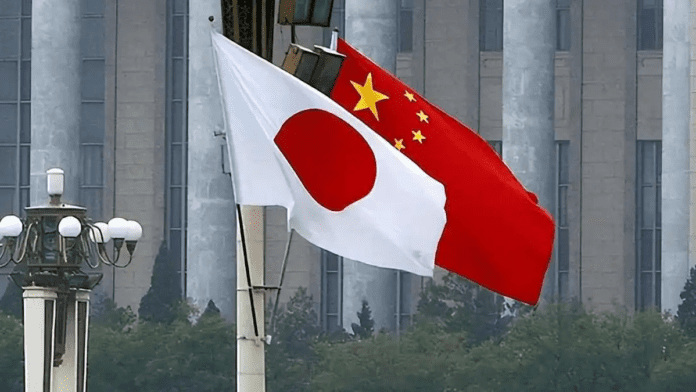
China has added 40 Japanese companies to its export control lists, accusing them of supporting Tokyo’s military buildup, as trade and military tensions between the two countries continue to escalate.

China’s Ministry of Commerce said on Monday that 20 Japanese entities had been placed on its Entity List and another 20 on a watch list. The ministry cited their roles in advancing Japan’s military capabilities and “re-militarization.” The move follows a similar round of listings in February.

“Japan has refused to reflect on its actions and instead gone further down the wrong path, accelerating its pursuit of new-style militarism, deploying offensive weapons and launching offensive missiles from overseas,” said a spokesperson for the commerce ministry. “The 20 entities placed on the control list are those involved in boosting Japan’s military strength, while the 20 on the watch list failed to verify the end users or end uses of the dual-use items they handled.”

“We hope Japan will turn back from the wrong path, correct its wrongdoings, do serious soul-searching and go back to the right track,”  Guo Jiakun, a spokesperson of the Chinese Foreign Ministry, said in a regular media briefing. “The relevant measures target only the dual-use items, and will not affect the normal business exchanges between China and Japan. Japanese entities have no need to worry as long as they operate in good faith and in compliance with the law.” 

He stressed that it is fully justified, legitimate and lawful for China to take these measures, which aim to contain what China sees as Japan’s reckless neo-militarism.

On February 24, Sino-Japanese relations deteriorated when China’s Ministry of Commerce added 20 Japanese entities to its export control list, including Mitsubishi Heavy Industries Shipbuilding Co Ltd, Fujitsu Defense & National Security Ltd, and NEC Aerospace Systems Ltd. The two rounds of sanctions in February and June have hit a total of 80 Japanese firms.

“The control list is defined by entities where there is a clear, confirmed national security risk,” said Wan Zhe, an economist and professor at Beijing Normal University. “The 40 entities placed on China’s Entity List are directly involved in boosting Japan’s military strength, meeting the threshold for serious harm to national security and interests under the dual-use export control regulations.”

“Forty other companies were added to the watch list as their end users and end uses for dual-use items could not be verified,” she said. “They have not yet reached the level of clearly endangering China’s national security, but they still need to be closely monitored targets.”

She said that the core goal of the measures is to curb Japan’s military expansion capabilities at the supply chain level, and that the policy is precisely targeted at risk, with the vast majority of compliant Japanese companies and normal trade and industrial cooperation between China and Japan left unaffected. She said the combined measures are both defensive, plugging gaps in the system, and reactive, a proportionate countermeasure that draws a clear line on national security while demonstrating strategic judgment.

Beijing’s latest export control measures come as Japan presses ahead with a long-range missile buildup that Chinese experts say is aimed at China.

In late March, Tokyo announced the deployment of its Type 25 missiles, its first long-range strike weapons capable of hitting ground and maritime targets at extended range. The series includes a surface-to-ship variant based in Kyushu and a hypersonic gliding variant based at Fuji, both with a range of over 1,000 kilometers, putting mainland China within reach. Tokyo plans to extend the hypersonic variant’s range to 2,000 to 3,000 kilometers in future versions. 

The missile deployment came alongside the largest overhaul of Japan’s Maritime Self-Defense Force since its founding. Its main surface fleet units were merged into a new Fleet Surface Force, a new amphibious warfare unit was established in Sasebo, and the Air Self-Defense Force began building a dedicated space operations unit. 

“Japan’s military moves are part of the government’s strategy to fundamentally strengthen its defense capabilities, using limited equipment and personnel to pursue far more aggressive military goals,” said Fan Xiaoju, a research fellow at the China Institutes of Contemporary International Relations. “These moves reveal the underlying tone of Japan’s diplomatic and security policy, a pursuit of military supremacy and stronger deterrence.”

“Combined with the rising tide of populism and xenophobia inside Japan, the country is heading in an increasingly dangerous and uncontrollable direction,” she said. “Japan should hold a correct view of history, honor its commitments and treat its neighbors well. That is what would truly serve regional peace and stability, as well as Japan’s own security.”

Japan’s photoresists

China’s newly imposed export controls on Japanese firms also came after Prime Minister Sanae Takaichi told G7 leaders at a summit in France on June 16 that China’s export controls against Japan risked disrupting partner nations’ supply chains. She called on G7 members and multilateral development banks to build more resilient mineral supply chains.

An article published by NetEase on June 22 said that four major Japanese photoresist makers, Tokyo Ohka Kogyo, JSR, Shin-Etsu Chemical and Fujifilm, had stopped accepting new orders for advanced argon fluoride (ArF) and extreme ultraviolet (EUV) photoresists and trimmed orders for lower-end krypton fluoride (KrF) grades. 

EUV photoresists are used for the most advanced chip nodes below 7 nanometers, while ArF photoresists cover nodes from 65nm down to 7nm. KrF photoresists are suited only to larger nodes of 65nm and above.

The article said China’s photoresist imports from Japan fell by about 95% to just 111.3 tons in the first quarter of 2026, down from 2,200 tons a year ago. High-end photoresist imports recorded zero in the second quarter.

As of now, neither the Japanese government nor the four companies have confirmed a coordinated halt.

Chinese commentators have mixed views on the matter. Some dismissed the photoresist ban report as fake news, saying it lacked any verifiable evidence. Others said this may be a good opportunity for domestic photoresist suppliers, such as Jiangsu Nata Opto-Electronic Material Co Ltd and Red Avenue New Materials Group Co Ltd, to grow, as their manufacturing yields have matched those of their Japanese peers. Still, some said the reality is stark if the news is true.

“Japan’s photoresist ban has opened a rare window for domestic suppliers, but a window of opportunity is not the same as a shortcut,” writes a Liaoning-based columnist using the pen name Digital Observatory. “One domestic supplier saw its KrF photoresist’s yield rate plunge during testing because of a mismatch with the lithography’s temperature. Long-term stability, resistance to etching and ion implantation and storage life all still need to be tested over time.” 

The columnist adds that domestic photoresist suppliers’ limited production capacity is another major problem, and large-scale domestic substitution in advanced chipmaking will only occur in three to five years.

Read: Japan seeks G7 price floors to break China’s rare earth grip

Follow Jeff Pao on X at @jeffpao3

Iraq’s Green Zone Raids Test al-Zaidi’s Anti-Corruption Push

0
iraq’s-green-zone-raids-test-al-zaidi’s-anti-corruption-push
Iraq’s Green Zone Raids Test al-Zaidi’s Anti-Corruption Push


Arrests of politicians and senior officials have raised questions over whether Baghdad is confronting entrenched corruption or staging a limited show of force before a Washington visit

Iraqi security forces arrested politicians and senior officials in overnight raids inside Baghdad’s fortified Green Zone on Sunday, in one of the most visible anti-corruption operations Iraq has seen in years and an early test of Prime Minister Ali al-Zaidi’s new government.

The Green Zone has long been a symbol of Iraq’s post-2003 political order: A protected enclave separated from ordinary Iraqis and home to the institutions, embassies, and political networks that have shaped the country’s fragile balance between Washington, Tehran, and its own entrenched elite.

Reuters reported that elite units from the Counter Terrorism Service (CTS) raided homes in the heavily fortified district, while Iraq’s state-run Iraqi News Agency (INA) said 47 suspects were detained, including members of parliament and government officials. The arrests followed judicial warrants linked to suspected corruption networks, with some cases reportedly stemming from testimony by Adnan al-Jumaili, the former deputy oil minister for refining affairs, after his earlier detention.

The Associated Press, citing INA, reported that those arrested included 12 current lawmakers, one former legislator, a former adviser to former Prime Minister Mohammed Shia al-Sudani, and another high-ranking Oil Ministry official. Some were associated with al-Sudani’s Shiite political bloc, while others were linked to the Sunni Azm Alliance. The specific charges against them were not immediately made public, but an investigative judge said the probe concerned allegations that state resources were used for electioneering and that government contracts were exploited for commissions and personal gain.

For al-Zaidi, who took office in May, the operation provides a political opening. It allows the new government to present itself as active, forceful, and willing to challenge a corruption system that has drained Iraqi state institutions for years. But the raids also raise a central question: Do the arrests mark the start of a genuine confrontation with Iraq’s deepest corruption networks—including those tied to armed factions and Iran-linked political interests—or are they a controlled spectacle aimed at satisfying public anger and external pressure while leaving the real centers of power untouched?

The timing gives the operation added political weight. Al-Zaidi is expected to visit Washington in mid-July to deepen economic, trade, and investment ties with the United States. Reuters reported that the visit is intended to strengthen the Iraqi-US partnership, but also noted that the prime minister faces the broader challenge of curbing Iran-backed fighters, tackling entrenched corruption, and balancing ties between Washington and Tehran.

That balance has grown more sensitive after recent US-Iran understandings and the broader regional effort to reduce hostilities. Earlier this month, US Special Presidential Envoy for Iraq and Syria Tom Barrack visited Baghdad in what The National described as the highest-level American engagement since al-Zaidi’s government was formed. Washington’s deeper cooperation with Baghdad has been linked to efforts to disarm Iran-backed militias and bring weapons under state authority.

A report by Asharq Al-Awsat on the Barrack-al-Zaidi meeting, citing a US Embassy statement, said the two sides discussed Iraq’s plans to ensure the “complete disarmament and disbandment of all armed groups and formations operating outside the authority and control of the Iraqi state,” as well as preventing Iraqi territory from being used to threaten regional peace. The same report noted that mechanisms for imposing a state monopoly over arms remain unclear and that some factions have continued to oppose disarmament.

In that context, analysts read the Green Zone raids as more than a domestic anti-corruption operation. One publicly reported link to Iran-related allegations was the arrest of Ali Maarij, the deputy oil minister for distribution affairs. Reuters reported that the United States sanctioned Maarij in May, accusing him of helping divert Iraqi oil to benefit Iran and Iran-backed militias and of facilitating the blending of Iranian crude with Iraqi oil for export using falsified documents. Iraq’s Oil Ministry denied the allegations at the time, saying the activities described by Washington did not fall within Maarij’s responsibilities.

Still, the broader campaign has not yet visibly targeted the most powerful Iran-aligned militia figures or the political leaderships around them. For some Iraqi observers, that is the point.

Middle East political analyst Dr. Tallha Abdulrazaq argues that the operation should be judged not by the scale of the raids, but by who remains untouched.

For there to be a real shift, [al-]Zaidi would have to start targeting the real big whales of corruption that have plagued Iraq for almost a quarter of a century since the US-led invasion in 2003

“For there to be a real shift, [al-]Zaidi would have to start targeting the real big whales of corruption that have plagued Iraq for almost a quarter of a century since the US-led invasion in 2003,” Abdulrazaq told The Media Line. “This operation is designed to give the impression that Iraq is finally cleaning itself up, but the reality is that those arrested are small fry and expendable fall guys.”

His assessment is severe, but it captures widespread Iraqi skepticism toward state-led reform campaigns. Iraq has seen previous governments announce anti-corruption efforts, only for them to stall, be reversed, or become entangled in elite bargaining. Under former prime ministers Haider al-Abadi and Mustafa al-Kadhimi, reform language often collided with the realities of Iraq’s power-sharing system, party patronage, and militia-linked economic influence.

Political analyst Alfadhel Ahmad offered a more cautious reading. He said the arrests have generated momentum for al-Zaidi but warned that their real meaning depends on what comes next.

“So far, the arrests have targeted third-tier Sunni politicians and associates of former PM Mohammed Shia al-Sudani—most linked to the network of Adnan al-Jumaili, the oil ministry undersecretary arrested earlier,” Ahmad told The Media Line. “Real intentions are hard to judge yet, but these arrests have clearly added political momentum and a cautious popular legitimacy to al-Zaidi’s new government.”

Ahmad also pointed to the choreography of the raids as part of the message. The use of elite security units gave the operation the appearance of a decisive state intervention, even if many of the targeted figures were not among Iraq’s most protected actors.

“There’s also a deliberate effort to project spectacle—deploying tanks and counterterrorism units to arrest figures who mostly have no militia protecting them,” he said.

The deployment of the CTS is especially symbolic. The CTS is one of Iraq’s most respected security forces, closely associated with the fight against the Islamic State group, also known as ISIS, and, at least formally, answerable to the prime minister. Its use in a corruption operation inside the Green Zone sends a political message that al-Zaidi can command the state’s coercive institutions against senior political figures.

Abdulrazaq sees the use of the CTS as part of the performance rather than proof of institutional strength.

“The use of the Counter Terrorism Service was, again, just for theatrical purposes,” he said. “… it was designed to show that Zaidi himself has authority and command.”

The deeper issue is whether Iraq’s state institutions can act independently of the networks that dominate them. For years, corruption in Iraq has not been limited to individual theft or administrative abuse. It is embedded in party financing, public-sector contracts, oil revenues, border crossings, ministries, and armed groups with political representation.

That helps explain why anti-corruption campaigns are often interpreted through factional politics: who is arrested, who is spared, and whose benefits are protected.

The Iraqi state literally is the militia-linked economic structure and the militia-controlled parliament and government. There is no separation between them.

“This strikes at the heart of the matter,” Abdulrazaq said. “The Iraqi state literally is the militia-linked economic structure and the militia-controlled parliament and government. There is no separation between them.”

For Ahmad, the test is still open. He does not rule out the possibility that al-Zaidi could use this early momentum to expand the campaign, but says the threshold must be clear: The government would have to move beyond expendable figures and begin touching interests tied to powerful factions.

“Worth remembering: Iraqi politicians have always reversed reform and anti-corruption efforts,” Ahmad said. “Iraqis have a long record of distrusting government action, fearing the same outcomes they’ve seen before.”

“Al-Zaidi has a clear chance to prevent backsliding by building on this momentum to expand toward key politicians and test the waters for confronting interests tied to pro-Iranian militias in Iraq,” he added.

That is also where the Tehran question enters the story. The raids unfolded while Iranian Foreign Minister Abbas Araghchi was in Iraq. Iranian state media reported that Araghchi held separate meetings with the governors of Karbala and Najaf to discuss arrangements for funeral ceremonies in Iraq for the late Iranian Supreme Leader Ayatollah Ali Khamenei.

Some observers have questioned whether the arrests, the US diplomatic track, and Araghchi’s visit are connected. Both analysts interviewed rejected a direct link between Araghchi’s trip and the Green Zone operation, but they interpreted that absence differently.

“I wouldn’t bother reading too much into the timing apart from the fact that it shows Iran isn’t bothered at all by [al-]Zaidi’s move,” Abdulrazaq said. “Tehran is extremely pragmatic and would be more than happy to sacrifice a few nobodies and placeholder MPs just so that the current system that serves its interests continues.”

Ahmad was more restrained, saying there is no evidence so far that the two matters are connected.

“Regarding Araghchi’s visit, those two things are not connected—at least for what is known till now. He came to arrange Khamenei’s ceremonies in Najaf and Karbala.”

The distinction is important. There is a difference between proving operational coordination with Tehran and arguing that the campaign avoids Iran-linked power centers. The first requires evidence that has not publicly emerged. The second is a political assessment based on who has been targeted so far and who has not.

Ahmad said the campaign may be useful to the Coordination Framework, the largest Shiite political bloc and the core parliamentary force behind Iraq’s current order, as it tries to navigate US pressure without rupturing its ties to Iran-aligned factions.

“The Coordination Framework … may be trying to market this campaign to Washington,” he said. “But importantly, the campaign has not yet touched any Iran-linked interests or proxies.”

That gap between optics and substance could become decisive ahead of al-Zaidi’s expected Washington visit. The United States is not only looking at corruption as a governance issue; it is also looking at corruption as part of the infrastructure that allows armed groups, smuggling networks, and foreign influence to survive inside the Iraqi system.

Abdulrazaq argued that Washington’s focus is less about corruption itself than about regional compliance.

“I don’t think the US necessarily cares about corruption per se,” he said. “What the US cares about is compliance with its ambitions in the region.”

Ahmad’s conclusion was similar, though less categorical. He said the real measure will be whether the campaign moves against militia-linked interests, not only politicians without serious armed protection.

“Against the broader US demands, there’s no sign anything has changed on the ground,” he said. “I think we should watch what follows these campaigns—specifically whether the government moves to undermine militia-linked interests.”

Ahmad said that if the campaign stops where it is, it will likely be read as a maneuver by Iraq’s political elite to manage American expectations.

“Otherwise, the likeliest reading is that Iraq’s political class is trying to circumvent US demands and present Washington a false picture—especially ahead of the PM’s anticipated visit—at the expense of expendable, marginal politicians.”

Another layer is internal score-settling. Anti-corruption campaigns in Iraq often become tools in factional struggles, especially when the justice system is activated selectively. Abdulrazaq said this campaign appears to fit that pattern.

“This is absolutely also about score settling,” he said. “To be clear, those arrested are almost certainly also corrupt, but, effectively, Zaidi is eliminating certain political rivals on behalf of the Coordination Framework of Shia Islamists close to Iran.”

The arrests have created three parallel narratives: The government’s narrative is that Iraq is finally acting against corruption. The public’s cautious reaction is shaped by years of disappointment and distrust. The analysts’ warning is that the campaign may be real only if it expands toward the political and militia-linked structures that have long been treated as untouchable.

For now, al-Zaidi has achieved visibility. The Green Zone was sealed, senior figures were detained, and the state projected force at a moment when Washington is demanding proof that Baghdad can control armed groups and reduce Iranian influence. But visibility is not the same as transformation.

What comes next will determine whether this becomes a turning point or another episode in Iraq’s long history of controlled reform. If the arrests remain confined to lower- and mid-level actors, Sunni rivals, and associates of the previous government, the campaign will reinforce the suspicion that Baghdad is offering Washington a staged concession while preserving the system beneath it. If it moves toward senior militia-linked economic interests and the political figures protecting them, then al-Zaidi may begin to test the foundations of Iraq’s post-2003 order.

Until then, the Green Zone raids remain less a conclusion than a question: whether Iraq’s new government is confronting corruption or simply managing the appearance of confrontation at a moment when both Washington and Tehran are watching.

June research roundup: 6 cool science stories we almost missed

0
june-research-roundup:-6-cool-science-stories-we-almost-missed
June research roundup: 6 cool science stories we almost missed

It’s a regrettable reality that there is never enough time to cover all the interesting scientific stories we come across. So every month, we highlight a handful of the best stories that nearly slipped through the cracks.  June’s list includes insight into the science of soccer’s scissors feint; the physics of poo’s distinctive coiled shape; a boron buckyball; and the latest breakthrough in the ongoing Vesuvius challenge to decipher the Herculaneum scrolls.

The science of soccer’s scissors feint

With the FIFA World Cup in full swing, even scientists’ thoughts are turning to soccer (or football for everyone else in the world). For instance, one common and highly effective dribbling maneuver is the “scissors feint,” in which a player uses the outside of their feet to fake going one way and then cutting to the other. Japanese scientists studied university and junior high school soccer players of varying skill levels to study dribbling dynamics, focusing on the scissors feint. The movements were captured with high-speed cameras.

The researchers looked at several variables, including body speed, joint kinematics, distance between players, and changes in relative speed between attackers and defenders. They described their findings in a paper published in the Japan Journal of Physical Education, Health and Sport Sciences. Most notably, the team found that raw speed is not the only factor in skilled dribbling. The best players actively regulate their distance to the defender while maintaining a high body speed, for example. They can generate explosive, rapid acceleration by coordinating their knee flexions and extensions. And they have minimal foot lift and a pronounced trunk inclination when executing feints, so their actions are quicker and more deceptive.

Per The Guardian, this year’s FIFA ball design , the Adidas Trionda, seems to be giving goalkeepers a bit of trouble when it comes to reading the ball’s speed and responding accordingly. FIFA shifted last year to the four-panel ball with intentionally deep seams to create optimal in-flight stability and a more predictable trajectory. It’s also designed to function better in wet or humid conditions. So why are goalkeepers struggling to stop the balls?

A paper published last month in the journal Fluids might hold the answer. The authors fired the Trionda ball through a wind tunnel and analyzed the aerodynamics. (It’s a common experimental approach used to study baseball aerodynamics, too.) They found that the ball traveled faster once it hit a certain velocity regardless of where it was struck. They attribute this to the so-called “drag crisis,” i.e., the point where the air flow around the ball shifts from a smooth laminar flow to a turbulent flow. The resulting disruption in drag makes the ball move faster, so it doesn’t slow down as goalkeepers have been conditioned to expect. Hitting the ball on the seam reduces drag, and the effect is less likely to occur at higher altitudes.

Japan Journal of Physical Education, Health and Sport Sciences, 2026. DOI: 10.5432/jjpehss.07-25031 (About DOIs).

Fluids, 2026. DOI: 10.3390/fluids11050128.

Reading a complete Herculaneum scroll

A text by the philosopher Philodemus from a Herculaneum scroll

Credit: Vesuvius Challenge

The Vesuvius Challenge is an ongoing project that employs “digital unwrapping” and crowdsourced machine learning to decipher the first letters from previously unreadable ancient scrolls found in an ancient Roman villa at Herculaneum. The 660-plus scrolls stayed buried under volcanic mud until they were excavated in the 1700s from a single room that archaeologists believe held the personal working library of an Epicurean philosopher named Philodemus. The badly singed, rolled-up scrolls were so fragile that it was long believed they would never be readable, as even touching them could cause them to crumble.

In 2023, the Vesuvius Challenge made its first award for deciphering the first letters, and the following year, the project awarded the grand prize of $700,000 for producing the first readable text. Last year brought the successful generation of the first X-ray image of the inside of a scroll (PHerc. 172) housed in Oxford University’s Bodleian Libraries—a collaboration with the Vesuvius Challenge. The scroll’s ink has a unique chemical composition, possibly containing lead, which means it shows up more clearly in X-ray scans than other Herculaneum scrolls that have been scanned. That project focused primarily on detecting the presence of ink rather than deciphering the characters or text, although the team was able to identify the Greek word for “disgust.”

The latest breakthrough: One of the scrolls, PHerc. 1667, has now been “virtually unrolled” and read in full, with the technical details and a full column-by-column transcription appearing in a preprint on the arXiv. The text is a philosophical treatise on ethics and human moral progress, and the final column revealed the name Aristocreon, a nephew and disciple of the Stoic philosopher Chrysippus. So the team believes the scroll likely dates to the 2nd century BCE. There are gaps in the text where the papyrus surface has been lost, but it’s still an impressive achievement. The team was also able to use higher resolution imaging to reveal ink on another scroll, PHerc. Paris 4, and to recover the title and author of a third scroll, PHerc. 139.

arXiv, 2026. DOI: 10.48550/arXiv.2606.29085.

A boron buckyball

A new boron nanomaterial: The carbon Buckminsterfullerene or "buckyball" (left) made from 60 carbon atoms was named after the geodesic sphere (middle) popularized by futurist Buckminster Fuller.

Credit: Wang Lab / Brown University

Buckyballs, aka buckminsterfullerenes, are carbon molecules comprised of 60 carbon atoms arranged in such a way as to bear an uncanny resemblance to soccer balls—just very tiny nanoscale soccer balls. They were first discovered in 1985 by Rice University physicists, who shared the 1996 Nobel Prize in Chemistry for the achievement. Buckyballs helped launch the nanotechnology revolution. Now, scientists at Brown University have produced the first experimental evidence for a new kind of “buckyball” molecule made up of 80 boron atoms. They described their results in a paper published in the journal Chemical Science.

Chemist Lai-Sheng Wang has been trying to make boron structures similar to those achieved by carbon, like the buckyball, for three decades. His team has made clusters of 36 boron atoms in a thin, atom-thick disk; two could be stitched together to create the boron equivalent of graphene. And in 2014, they found a 40-atom boron cluster arranged in a hollow cage shaped like a buckyball, although it did not have the trademark perfect spherical symmetry.

Wang’s team made its boron buckyball by zapping a boron target with a high-powered laser, producing a plume of boron atoms that cooled and formed different kinds of nanoclusters. They then weighed each cluster to determine the number of atoms, and used photonelectron spectroscopy to determine the shapes of the clusters. They were surprised to find an 80-atom cluster that was both highly stable and highly symmetrical. The result isn’t entirely consistent with current theory, which predicts a boron buckyball shouldn’t be stable, but Wang et al. have done an exhaustive search of various configurations for 80 boron atoms and still think a buckyball is the most likely candidate.

Chemical Science, 2026. DOI: 10.1039/D6SC02674E.

These spiders build ballistic traps

A ballista spider waits for a green tree ant to bite the cone of its web and spring the snare

Credit: Ajay Narendra et al. 2026

Researchers have discovered a new species of spider native to Australia with a novel hunting strategy. According to a paper published in Current Biology, these nocturnal spiders weave a main web, but also construct snare traps underneath to capture green tree ants and launch them upward to the main web at accelerations of up to 1,367 meters per second squared. There’s no official species name yet, but they belong to the genus Propostira, and the authors have dubbed them “ballista spiders.”

Co-author Greg Anderson of QIMR Berghofer Medical Research Institute in Brisbane first witnessed a catapulted ant in 2022, but the motion was pretty much a blur, and he lacked adequate camera equipment to investigate at the time. In the following year, he and his co-authors spent 10 days studying the spiders, which typically hide under leaves during the day. The spiders build their conical traps around dusk by attaching silk tension lines to a leaf, a task that can take as long as four hours. Then the spiders release a special chemical that specifically attracts green ants.

When an ant locks onto the trap with their mandibles, it gets stuck, and its struggles release the trap’s anchor point, launching the ant up to the main web. It took high-speed cameras set at 5,000 to 7,000 frames per second to capture that moment. Anderson et al. hypothesize that this is the spider’s strategy to avoid hunting on the ground, which carries a risk of counterattack from an ant colony.

Current Biology, 2026. 10.1016/j.cub.2026.04.066.

The shape of poo

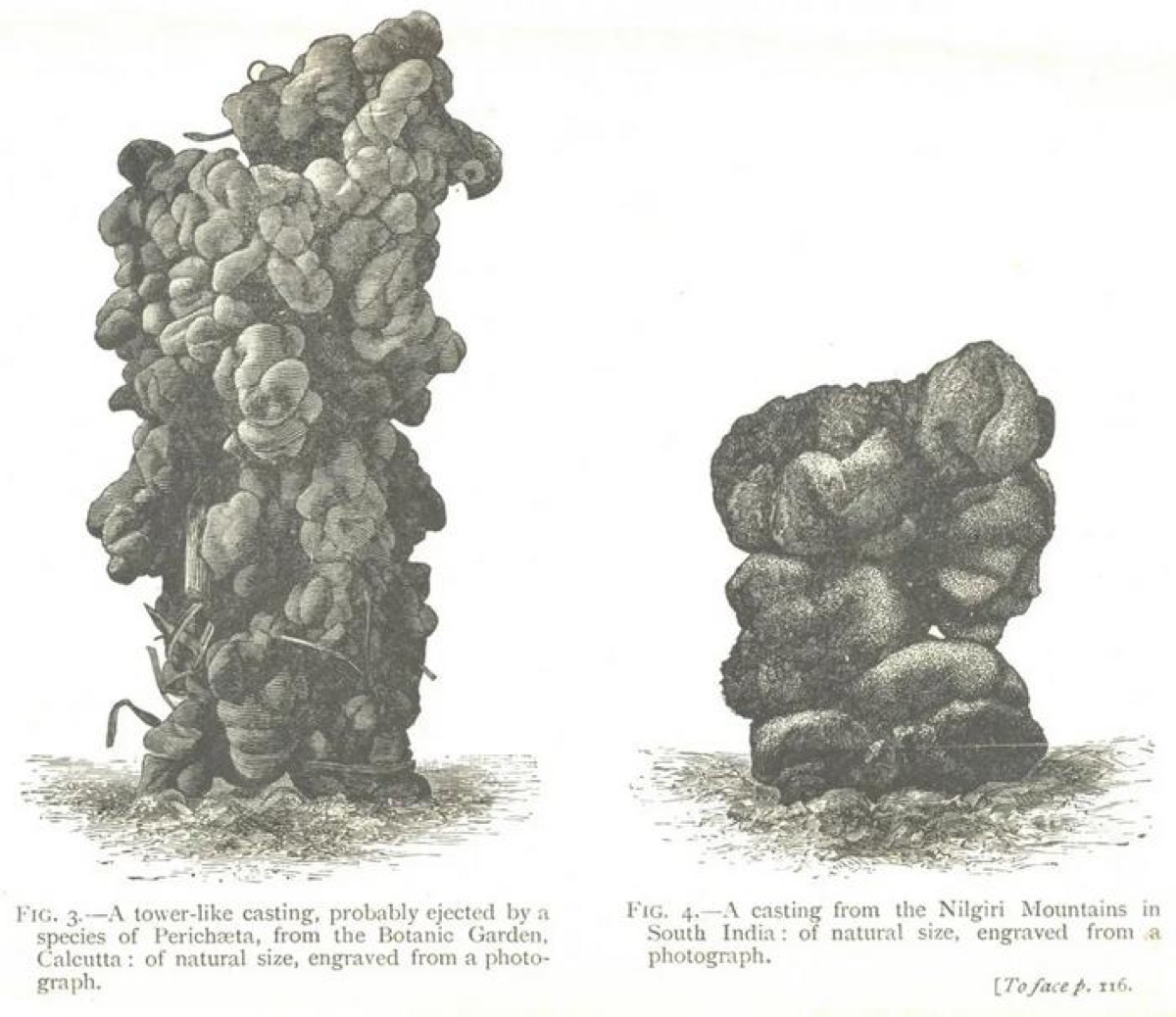
Drawings of earthworm poo from Darwin’s 1881 publication “The formation of vegetable mould through the action of worms, with observations on their habits.”

Drawings of earthworm poo by Charles Darwin (1881)

The excrement of a lug worm takes a shape that can be explained by the physics and mathematics of coiling ropes.

Lugworm excrement

The poop emoji is instantly recognizable because, well, we’ve all seen those telltale coils circling around a broad base and tapering to a point—just like swirling soft-serve ice cream. This happens because most creatures release their feces downward; the tapering occurs because the feces fall from decreasing heights. But lugworms produce coils of feces with uniform spirals that don’t taper into a point. Because they live in U-shaped burrows, they release their poo upward. Charles Darwin observed as much in 1881, noting that worms defecated “either upwards or downwards with respect to the slope” of their respective burrows.

According to a paper published in the journal Nature Communications, both kinds of coiled feces owe their shape to physics—specifically a mathematical description of how ropes and similar materials coil called the elastic rope-coiling theory. It all comes down to the material’s stiffness and whether the feces moves with or against gravity’s downward pull. The lugworm produces “anti-gravitational” poop. The distinctive shapes of the poo emoji and lugworm poo are both a “direct consequence of the physics governing elastic coiling in gravitational fields,” the authors concluded. They’re planning to design a second poo emoji and officially propose it to the Unicode Consortium.

Factors like muscular control and extrusion rate of the poo had little to no effect on the final shape. By contrast, the Australian bare-nosed wombat produces distinctive cubes of poop instead of tapered cylinders. A 2021 paper found that the secret lies in their intestines, which have varying stiff and soft regions that serve to shape the poo during the digestive process. Earlier preliminary findings by the same group won the 2019 Ig Nobel Physics Prize.

Nature Communications, 2026. DOI: 10.1038/s41467-026-72566-7.

How did Botticelli’s model really die?

Credit: Sandro Botticelli/Public domain

One of 15th-century painter Sandro Botticelli’s most famous works is the Birth of Venus, depicting the naked goddess, newly birthed, standing in a giant scallop shell. The model for the painting (disputed by some historians) was allegedly Simonetta Vespucci (nee Cattaneo), a renowned beauty in Florentine high society whom Botticelli greatly admired. He painted her five times before her untimely death in her early 20s. Her open coffin was carried through the streets of Florence. The poet Poliziano dubbed her “the Unrivaled” (La Sans Par).

It was long believed that Simonetta had succumbed to tuberculosis, but in 2019, Paolo Pozzilli of Queen Mary University of London and several co-authors argued that she may have suffered from a pituitary tumor (adenoma) that gradually increased in size due to prolactin and growth hormone secretions, citing her appearance in several portraits as evidence. This could have caused a sudden tumor-related fatal apoplexy.

Pozzilli et al. have now expanded their analysis in a paper published in the journal Endocrinology, Diabetes & Metabolism. For instance, they examined letters between Simonetta’s father-in-law, Piero Vespucci, and Lorenzo de Medici, which described how Simonetta had collapsed during a ball a few days before her death. Her symptoms included headache, hallucinations, vomiting, and a high fever, all symptoms of a rapidly expanding pituitary tumor, per the authors. Pozzilli et al. also think the tumor would explain the irregular eye positioning in the Birth of Venus, suggesting the model had a squint or a misalignment of the eyes, which will be the subject of future research.

Endocrinology, Diabetes & Metabolism, 2026. DOI: 10.1002/edm2.70261.

Congressional Dems Shift to Overwhelmingly Oppose Involvement in Israel’s War on Lebanon

0
congressional-dems-shift-to-overwhelmingly-oppose-involvement-in-israel’s-war-on-lebanon
Congressional Dems Shift to Overwhelmingly Oppose Involvement in Israel’s War on Lebanon


Democratic Party leaders in the House reversed course and moved to back a resolution against U.S. involvement in Israel’s war on Lebanon on Tuesday, giving the bill overwhelming support from Democrats for the first time since Congress began seeking to address the conflict.

The resolution sponsored by Rep. Rashida Tlaib, D-Mich., failed 235–189, with near-universal opposition from Republicans.

The vote was another sign of changing attitudes among Democrats about Israel.

Still, the vote was another sign of changing attitudes among Democrats about Israel: 187 Democrats voted in favor of it, and only 22 voted against.

Tlaib’s resolution marked the second time she has forced the House to go on the record about the war on Lebanon, which Israel says is aimed at Hezbollah but has left a fifth of the country displaced and thousands dead.

Under the 1973 War Powers Act, any member of Congress can force a vote on U.S. involvement in hostilities. Critics of Israel suspect the U.S. military has supported Israel’s attacks on Lebanon through help with developing target lists or refueling military aircraft. (U.S. Central Command, which oversees military operations in the region, did not immediately respond to a request for comment.)

On June 4, Tlaib’s first attempt to pass a war powers resolution about Lebanon failed on a 324–92 vote.

House Democratic leaders opposed that earlier resolution because of what they said were drafting errors that might have inadvertently forced the U.S. to stop protecting its embassy in Beirut or providing aid to the Lebanese Armed Forces, the regular military of the Lebanese government.

The more recent version of the legislation gained the support of Democratic leaders by including explicit carveouts for those activities. While leadership did not officially whip the vote, the ranking member of the House Foreign Affairs Committee, Rep. Gregory Meeks, D-N.Y., who is close to Minority Leader Hakeem Jeffries, D-N.Y., spoke in support of the measure on Monday.

Speeches from Meeks and Tlaib, however, revealed a divide in what Democrats thought the measure might accomplish.

Meeks criticized the conduct of Hezbollah and Israel alike, adding that, to his knowledge, no U.S. forces were directly involved in combat in Lebanon. The resolution would prevent the Trump administration from joining in the war, he said.

Tlaib, meanwhile, cast the resolution as a way to cut off U.S. support for Israeli forces. She pointed to Israeli National Security Minister Itamar Ben-Gvir’s call “to burn all of Lebanon” as proof of the Israeli government’s intent there.

“I want to make this very, very clear: The United States is not a bystander to these war crimes,” Tlaib said. “It is an active participant. The United States is currently engaged in illegal and unauthorized hostilities supporting the Israeli invasion of Lebanon, in violation of the War Powers Act.

“The United States is not a bystander to these war crimes.”

“Without that support,” she added, “those jets cannot drop bombs to kill Lebanese children. Congress must reassert its constitutional authority and immediately vote to end all unauthorized U.S. participation in the destruction of Lebanon.”

Only two Republicans, Reps. Thomas Massie of Kentucky and Lauren Boebert of Colorado, voted in favor of the resolution. The Republican caucus was officially represented during the Monday floor debate by Rep. Brian Mast, R-Fla., the chair of the House Foreign Affairs Committee.

“This resolution only seeks to embolden Hezbollah. That is the only thing that it does,” Mast said. “There are no U.S. forces engaged in hostilities. Do we train Lebanese Armed Forces? Yes, we do. Do we provide intelligence? Yes, we do. But we don’t have forces engaged there.”

Ahead of the vote, Erik Sperling, the executive director of Just Foreign Policy, a group that is sharply critical of Israel, said he was pleased to see more Democrats backing Tlaib’s resolution.

“Democrats have been pretty unified about speaking out against the killing of innocents and all of the harm by the Iran war, but there has been less vocal outrage about the mass killing and occupation in Lebanon,” Sperling said. “This is just an important signal that Democrats are aware of the way the Lebanon war is a humanitarian crisis and is the key roadblock to ending this war and delivering the peace that Americans are demanding.”

Trump’s DOJ Said Police Reform Was “Factually Unjustified.” A New Report Shows Otherwise.

0
trump’s-doj-said-police-reform-was-“factually-unjustified”-a-new-report-shows-otherwise.
Trump’s DOJ Said Police Reform Was “Factually Unjustified.” A New Report Shows Otherwise.

Last year, when the Trump Justice Department dropped its oversight of troubled police departments in cities such as Louisville, Kentucky, and Minneapolis, it argued that the reform efforts were “factually unjustified.”

But according to a new report by the American Civil Liberties Union, officers in those places were continuing to engage in the very behaviors that attracted federal scrutiny in the first place, including using excessive — and dangerous — force against people experiencing mental health crises.

The ACLU reviewed hundreds of police use-of-force reports in four communities where, under the Biden administration, the DOJ had found evidence of unconstitutional policing. In their review, ACLU investigators found agencies continuing to misuse Tasers and failing to properly review their officers’ use of force.

In one case, Minneapolis police repeatedly shocked a man with a Taser after he complied with their orders. In another, a Louisville officer broke a man’s car window during a mental health call while a second officer pointed his gun, escalating the encounter, according to the report. That officer then pulled the man from the car, at which point the man brandished a knife. The officers hit him with a baton and shocked him seven times.

The records primarily span from late 2024, after President Donald Trump won a second term in the White House, to early 2025, as the new administration began to shift the Justice Department away from its traditional focus on civil rights enforcement. 

The report also cites reporting by ProPublica, which has detailed police misconduct and reform efforts in Louisville and Memphis, Tennessee. In the fall of 2025, Trump deployed hundreds of National Guard troops, U.S. Marshals and immigration officials to Memphis because, he said, “of the crime that’s going on.” The operation, ProPublica found, ensnared innocent residents of the majority-Black city who said they were targeted and harassed because of their race. The U.S. Marshals Service, which led the effort, disputed the claims of racial profiling.

The aim of the ACLU effort, the authors said, was to hold local police accountable in the absence of federal oversight and to keep reforms moving in communities where investigators found or had concerns of excessive force and racial targeting. To do that, the nonprofit made public records requests for reports detailing officers’ use of force and other records from police or sheriff departments in Phoenix; Louisville; Worcester, Massachusetts; Minneapolis; Mount Vernon, New York; and Memphis.

“We did this project because we feared the Department of Justice was abandoning communities that needed help to ensure that reforms were made in their communities, and our analysis of the records unfortunately proves that to have happened,” said Jenn Rolnick Borchetta, the deputy project director on policing for the ACLU.

The ACLU also sought records from Rankin County, Mississippi, where in 2023 members of the 

Rankin County Sheriff’s Department, calling themselves the “Goon Squad,” beat and tortured two Black men. The officers were convicted and sentenced to decades in prison in 2024. Biden’s DOJ launched an investigation into the sheriff’s department, and reports indicate that the Trump administration is continuing the probe. A spokesperson for the sheriff’s department told Mississippi Today that the agency “will continue its cooperation with the investigation in order to show that all aspects of the department’s policing are within constitutional boundaries.”

The Justice Department did not respond to a request for comment. White House spokesperson Abigail Jackson dismissed the ACLU’s findings as “partisan talking points” from an organization that she said “suffers from a severe case of Trump Derangement Syndrome.” She also defended the administration’s approach. “President Trump is a champion for our great law enforcement officers and has encouraged them to arrest criminals and enforce the law — unlike the Biden Administration,” Jackson said.

The ACLU report spotlights Louisville and Minneapolis in particular because they had signed reform agreements with the Biden Justice Department before the Trump administration dropped the underlying lawsuits and quashed the cases in 2025. The two cities were also more forthcoming than the others in response to the ACLU’s records requests. 

According to the report, officers from the Louisville Metro Police Department used excessive force, including striking people in their face, head or body while they were handcuffed, and failed to adequately review incidents of force, mischaracterizing facts during those reviews to make force appear more reasonable. A spokesperson for the Louisville police department told ProPublica it “reviews use-of-force incidents through multiple layers of supervision, and when policy violations are identified, appropriate corrective action is taken.”

Police also escalated encounters with people experiencing mental health crises by pointing their guns at them, the ACLU found. The issue has been particularly pronounced this year.  

In March, Louisville police officers fatally shot and killed a 28-year-old woman named Katelyn Hall in her apartment while she was experiencing a mental health crisis. The incident is still under investigation, but police have said Hall posed a threat to officers because, they said, she was holding a piece of broken porcelain. 

Two months later, a Louisville police officer shot and killed 27-year-old Martin Nitzken Jr., who was unarmed and naked in the street. A caller reported Nitzken was having a “mental break,” according to local reports. The officer who shot Nitzken was indicted on charges of manslaughter and reckless homicide. He has pleaded not guilty. The officer’s lawyer did not respond to a request to speak to his client.

The Minneapolis Police Department’s records showed evidence of excessive force, improper use of Tasers and poor reviews of use of force, the ACLU report says. The police department didn’t provide comment.

Both Louisville and Minneapolis have adopted local versions of the reform agreements they had inked with the Biden administration, and local leaders have pledged to institute changes, which are being overseen by independent monitors. A spokesperson for the city of Louisville noted that its leadership “voluntarily” took on the reform effort after the DOJ “abandoned” federal oversight.

But, as ProPublica has reported, progress has been slow in Louisville, and the results have been mixed there, particularly in the area of mental health. 

“That the problems are still persisting in the same way is suggesting to me that the police departments are not doing enough to improve that conduct,” Borchetta said.

After the killings of Hall and Nitzken, Louisville’s mayor, Craig Greenberg, told local press the city was “moving as rapidly” as it can to change the way police respond to mental health calls by allowing behavioral health experts to help officers during such incidents.

Read more

The ACLU’s findings were “not all bad,” though, the authors wrote. The nonprofit credited Louisville for its transparency and for instances in which the review process worked “to identify, correct, and improve possible misuses of force.”

The organization had intended to produce a more expansive report but said that proved impossible due to the resistance and delays by the other local police departments it was scrutinizing. The Justice Department had investigated those cities and issued reports finding evidence their departments had engaged in unconstitutional policing. But the cases had not progressed beyond that when Trump was elected. 

Memphis and Phoenix refused to turn over the use-of-force records, the ACLU said, so the organization turned to the courts. The nonprofit sued Memphis in February for the documents. “Only then did Memphis finally agree to respond. This production is continuing, as is the ACLU’s review,” the report states. A spokesperson for the Memphis Police Department blamed the delay on the ACLU’s initial request, which they said was “overly broad” and lacked specificity and was thus denied.

The nonprofit sued Phoenix earlier this month for its records. The litigation is ongoing. The police department there did not respond to a request for comment.

In Worcester, Massachusetts, where the DOJ had previously found officers engaging in sex acts during undercover investigations, the ACLU said officials initially withheld a substantial amount of records, citing a statute meant to protect the privacy of sexual abuse victims. Worcester eventually relented and provided more records, the ACLU said, but still withheld reports for more than a dozen incidents. “Reliance on the statute to exempt records of police activity from public scrutiny thus turns a protection for survivors into a sword against them,” the report states.

A spokesperson for the city of Worcester rejected the ACLU’s assertion that the reports were withheld to protect the police department. “To conclude that the reports were withheld to protect the WPD when the law allows no discretion in determining whether such reports are public or not is an egregious misrepresentation of the law and of the city of Worcester’s appropriate response in accordance with the law,” the spokesperson told ProPublica in a statement.

Harmeet Dhillon, the head of the DOJ’s Civil Rights Division, has criticized the use of federal reform agreements, known as consent decrees, saying they represent an expensive form of micromanagement and “divest local control of policing from communities where it belongs.”

Notably, in its report, the ACLU found that a number of the law enforcement agencies’ use-of-force records were not detailed and thorough, making it difficult for the public or the agencies themselves to identify problems or prevent excessive-force issues. 

Borchetta said that the ACLU’s review is ongoing and the organization will take whatever action is needed to unlock more public information.

“You can make real change when people in the community want change and are pushing for it,” she said. “So we expect and hope that we can continue to work with communities and support them with this information, so that they can get the reform the DOJ tried to deny them.”

What’s next after the failure to end North Korea’s nukes program

0
what’s-next-after-the-failure-to-end-north-korea’s-nukes-program
What’s next after the failure to end North Korea’s nukes program

The dust has now settled on the ostentatious June summit between Chinese President Xi Jinping and North Korean leader Kim Jong Un in Pyongyang. But perhaps the biggest takeaway was what was left unsaid.

Chinese readouts from the summit conspicuously excluded any mention of denuclearization in North Korea (meaning North Korea giving up its nuclear weapons). This signals a shift away from a decades-long policy goal of Beijing.

It’s the latest in a long list of setbacks for international efforts to denuclearize North Korea, and my soon-to-be-published research shows experts are widely concerned about the depth of the challenge.

In early 2026 I ran a survey and focus groups involving over 70 international experts in nuclear weapons. I asked them to forecast the probability of six hypothetical nuclear scenarios occurring by 2035:

  • China achieves a nuclear second-strike capability against the United States.
  • North Korea achieves the same.
  • Japan acquires nuclear weapons.
  • South Korea acquires nuclear weapons.
  • North Korea gives up its nuclear weapons.
  • The United States or China uses a nuclear weapon.

    North Korean denuclearisation came in last, with experts assessing only a 3% probability by 2035.

    Expert-assessed probabilities of hypothetical nuclear scenarios occurring by 2035. CC BY

    After over 30 years, it seems the international mission to denuclearize North Korea has failed.

    Why? And what does this mean for the region?

    How did we get here?

    North Korea began pursuing nuclear weapons in earnest in the 1990s. This was driven by insecurity from the collapse of its superpower patron (the Soviet Union). Another factor was the still-unresolved status of the Korean War, which ended without a peace treaty.

    International efforts to denuclearize North Korea initially focused on diplomatic negotiations. However, efforts broke down due to North Korean cheating on interim agreements and major North Korean provocations. This included the country’s withdrawal from the nuclear non-proliferation treaty and a series of nuclear and missile tests.

    International denuclearization efforts then shifted from carrots to sticks, primarily economic sanctions. The aim was to compel North Korea to renounce its nuclear weapons.

    By the 2000s, even North Korea’s erstwhile supporters — Russia and China — got in on the act. They supported an oppressive regime of United Nations sanctions against North Korea’s nuclear weapons and missile programs.

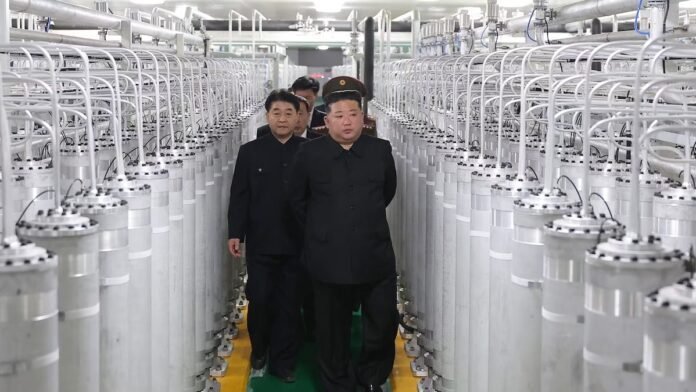
    These efforts ultimately failed. Pyongyang now possesses a diversified missile arsenal theoretically capable of reaching the continental United States as well as an estimated 60 nuclear warheads with a scalable production capability.

    What went wrong?

    The full coercive potential of economic sanctions was never realized.

    By the late 2010s, Russia and China had withdrawn support for sanctions, using their veto in the Security Council to block new sanctions resolutions.

    They also provided economic lifelines to North Korea through lax sanctions enforcement in the border region.

    Russia and China also used their positions on the UN sanctions monitoring committee to obstruct investigations into sanctions violations involving Chinese and Russian entities.

    Russia even resorted to state-sponsored sanctions violations to procure North Korean arms and soldiers to bolster its position in Ukraine.

    When UN sanctions lost their teeth, the US relied on autonomous sanctions to maintain economic pressure against North Korea. US autonomous sanctions cut off US market and financial system access for foreign entities that traded with North Korea or provided it financial services. But these measures, too, were neutered.

    The US avoided politically and economically challenging sanctions against Chinese targets. And it scaled back new sanctions designations to facilitate the first Trump administration’s ill-fated diplomatic outreach to Kim Jong Un.

    These gaps were ruthlessly exploited by a sophisticated network of North Korean sanctions evaders. They were able to draw upon their merchant fleet, diplomatic corps, overseas workers and state-sponsored hackers. This was how they moved sanctioned cash, crypto and commodities despite sanctions.

    The result was a compromised international economic sanctions regime. North Korea was never pushed to the brink of economic ruin. It was never forced to consider seriously whether the possibility of foreign military intervention (without nuclear weapons to deter it) seemed preferable to the certainty of economic collapse.

    What’s next?

    Based on past performance, economic sanctions will never be strong enough to denuclearize North Korea.

    Unconditional engagement is also not viable. The Kim regime has staked too much of its legitimacy on the nuclear enterprise.

    And the international interventions that toppled Libyan and Iranian leaders (two states that decided against nuclear weaponization) likely only reinforced perceptions in Pyongyang that nuclear deterrents are crucial.

    Now, the only realistic path runs through radical political reform. That means regime change and/or reunification with the south.

    One expert told me:

    The only scenario I can imagine in which there are no North Korean nuclear weapons is a world in which there is no North Korea.

    International stakeholders have few good options for driving this; such demand must come from within.

    Rather than directly denuclearizing North Korea, our focus should now be on buying time while the regime’s vulnerabilities (on succession, elite cohesion and ideology) fester. This could generate internal demand for radical political reform.

    Regional states should continue to support economic sanctions to slow North Korean nuclear weapons and missile development.

    This would involve multilateral enforcement activities stopping North Korea from engaging in ship-to-ship transfers of sanctioned goods and remote IT work.

    Regional states should publicly maintain a policy of denuclearization. It is important to deny Pyongyang the propaganda coup of being able to say the international community tolerates its nuclear weapons.

    And regional states should pursue counterforce options. In particular, ballistic missile defense would help reduce exposure to North Korean nuclear threats.

    Christopher J. Watterson is a research fellow in foreign policy and defense at the US Studies Centre, University of Sydney.

    This article is republished from The Conversation under a Creative Commons license. Read the original article.

    2 Palestinians killed, 19 injured in Israeli airstrikes in Gaza despite ceasefire

    0
    2-palestinians-killed,-19-injured-in-israeli-airstrikes-in-gaza-despite-ceasefire
    2 Palestinians killed, 19 injured in Israeli airstrikes in Gaza despite ceasefire

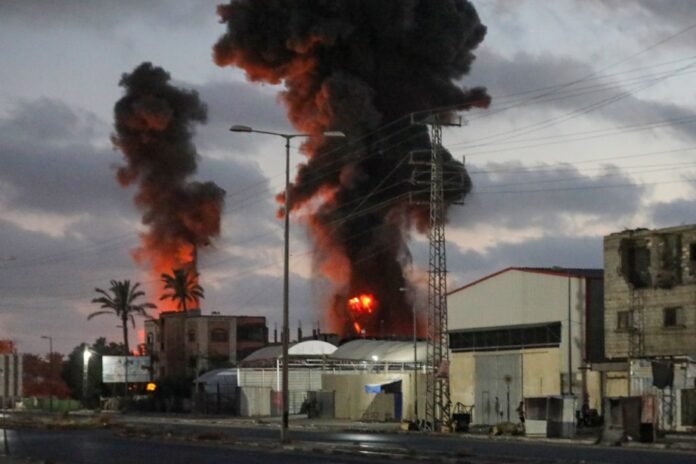
    Two Palestinians, including a child, were killed and 19 others injured in Israeli airstrikes in the Gaza Strip on Tuesday, in the latest violation of the ceasefire agreement in force since Oct. 10, 2025, medical sources said, Anadolu reports.

    The sources said an Israeli drone struck an electric bike on Asdaa Street in Al-Mawasi area, west of Khan Younis in southern Gaza, killing two and injuring 17 others.

    In northern Gaza, a Palestinian was seriously injured after an Israeli drone strike hit the rooftop of a house near Abu Sharkh roundabout in the Al-Faluja area, west of Jabalia refugee camp, the sources said.

    Another Palestinian was seriously wounded in a separate drone strike targeting a house in the Sheikh Radwan neighborhood, north of Gaza City.

    Witnesses said Tuesday’s attacks took place in areas outside Israeli military control under the ceasefire agreement.

    According to Gaza’s Health Ministry, Israeli ceasefire violations have killed 1,053 Palestinians and injured 3,406 others since October 2025.

    READ: Board of Peace says first ‘tactical vehicles’ arrive at multinational force base in Gaza

    0FansLike
    0FollowersFollow
    0FollowersFollow
    0SubscribersSubscribe
    - Advertisement -
    Google search engine

    Recent Posts