Court Inquiry Denounces “Disturbing Pattern” of Violations at Arizona’s Largest Sheriff’s Office
Arizona’s largest sheriff’s department is losing ground in its effort to comply with court-mandated reforms tied to a long-running racial profiling lawsuit and settlement, a monitor has found.
An investigation launched last year by the monitor’s team and published this month alleges a “disturbing pattern” of violations of department policy and court orders that undermined efforts to investigate misconduct and root out racial profiling in the Maricopa County Sheriff’s Office. The findings echo allegations from a decade ago that led to contempt charges against sheriff’s office leaders.
The monitor’s investigation follows an analysis by Arizona Luminaria and ProPublica that found ongoing racial disparities in traffic stops by the sheriff’s office, which continue to hold back its compliance with court orders. The accusations this time center on the department’s Professional Standards Bureau, which investigates reports of misconduct.
U.S. District Judge G. Murray Snow, who is overseeing the settlement, appointed Robert Warshaw as the monitor in 2014 to track compliance with mandated reforms. Among other things, Warshaw said the sheriff’s office leadership tried to pressure the bureau’s commander to reopen closed investigations into two deputies who had been disciplined and placed on the Brady list, a public database of officer misconduct. The monitor also claimed that top leadership attempted to interfere in the disciplinary process to protect employees accused of wrongdoing. When the commander resisted, he was placed on leave, investigated by an outside agency and temporarily transferred out of the bureau, the report alleges.
“What the Monitoring Team has found here is an attempt to create an internal culture where favor and reprisal are tools of control: to impact outcomes; to instill fear in changemakers; and to grant favors and position to those who bend to misguided directions,” the report stated.
As a result, the monitor determined that the sheriff’s office has regressed in its compliance with the reforms mandated in a settlement of the Melendres v. Arpaio class-action lawsuit. The suit accused the law enforcement agency of using traffic stops to arrest people on immigration charges, racially profiling Latinos in the process. At the time, the court found that when the public did report misconduct, then-Sheriff Joe Arpaio and others interfered with investigations. The court held Arpaio in criminal contempt in 2016 for continuing to make immigration arrests in violation of court orders, though he was eventually pardoned by President Donald Trump.
The constitutional violations began in 2007 under Arpaio. The current sheriff, Jerry Sheridan, inherited the settlement when he took office in January 2025. Sheridan climbed the ranks of the department to become Arpaio’s second-in-command in 2010. He was found in civil contempt in 2016 for denying knowledge of a court order to stop making immigration arrests, despite evidence to the contrary presented in court. Sheridan contends he was always truthful. He distanced himself from his former boss during his campaign and after taking office, stating that he was committed to seeing through the reforms.
Read More
The sheriff’s office filed a 78-page response to the inquiry with the court, denying any violations of court orders or department policy and labeling the investigation as “speculative” and “improper.” The sheriff’s office said the incidents in question proved that internal checks strengthened by court orders were working properly, and that the monitor was penalizing the department for following those orders and policies. The department also asserted that the sheriff’s decision to place the commander on administrative leave and refer him for investigation by an outside agency was justified and also required by court orders.
Upon taking office, Sheridan’s newly appointed staff asked the bureau commander’s advice about reviewing investigations that had been completed or were under appeal to understand if they could potentially change the outcome, but ultimately chose not to take further action, the office said.
“Because the complaint alleged criminal-nature misconduct (evidence tampering) against the current PSB Commander, referring the matter to an outside agency was the only way to avoid a conflict of interest,” the sheriff’s office said in the court filing.
In a separate statement to reporters, Sheridan questioned whether the monitor’s investigation had strayed into “areas involving management discretion, personnel administration, and internal policy disagreements that are more appropriately addressed by agency leadership.”
The sheriff’s office also questioned the timing of the inquiry’s release, two weeks before oral arguments over whether to end court oversight. Lawyers for the sheriff’s office are preparing to argue that the law enforcement agency has fulfilled all of the settlement’s requirements on racial profiling and should be released from the settlement. The monitor “discussing these issues has everything to do with providing inflammatory soundbites” to aid the plaintiff’s opposition to Maricopa County’s motion to end oversight, the sheriff’s office stated in its response filed in court.
Snow has issued four court orders since 2013 with 368 requirements for the department. Warshaw, the monitor, tracks compliance with Snow’s orders and reports the department’s progress quarterly.
The Professional Standards Bureau remains a focal point of court oversight, largely over a backlog in misconduct investigations. Its failure to eliminate the backlog is one of the main reasons the sheriff’s office has not fully complied with orders to prove it can police itself.
Capt. Gregory Lugo has led the bureau since February 2021. He helped reduce the backlog from over 2,100 misconduct investigations in November 2022 to 371 as of May. But in April 2025, Sheridan placed Lugo on leave, sparking the monitor’s inquiry.
At the same time, the sheriff’s office referred a criminal complaint against Lugo to the Arizona Department of Public Safety. The state agency closed the investigation without finding evidence of wrongdoing, according to the monitor’s report. A separate investigator hired by the court to review the Department of Public Safety’s investigation found the allegations against Lugo were unfounded and also cleared him of any wrongdoing.
The criminal complaint was filed by a sergeant whom Lugo demoted in 2020. Lugo also had filed insubordination charges against him. The sergeant appealed the charges, which were initially sustained but overturned after Sheridan took office.
“The Monitoring Team concluded that the stated reason for Captain Lugo’s transfer was a pretext,” and that instead it was taken in retaliation for not going along with the meddling in investigations, in violation of court orders, the report said.
The monitor team also highlighted the case against a deputy who was dismissed for clocking into a sheriff’s office station when he was instead working an off-duty job. The deputy appealed. Sheridan’s second-in-command questioned the deputy’s dismissal and asked Lugo about reviewing that decision, but Lugo said the deputy was fired for timesheet violations totaling “thousands of dollars.”
The monitor said Sheridan and another member of the command staff also inquired about potentially weakening disciplinary policy to avoid firing a sergeant who was arrested for DUI. Command staff argued the sergeant should not have been fired because he self-reported the arrest. Lugo warned that change was not likely to be approved by the monitor or the attorneys involved in the settlement.
The monitor’s inquiry into the Professional Standards Bureau has resulted in a decline in the sheriff’s office compliance with the settlement. Compliance rates, which measure the department’s progress, decreased in three of the four court orders. The biggest drops were for an order focused mainly on internal oversight and discipline, where implementation rates dropped from 95% to 70%. Compliance rates for an order directed at ending the backlog in pending investigations dropped from 88% to 68%.
Because the sheriff’s office disputes the accusations, it contends that it remains in full compliance with requirements related to the monitor’s inquiry and called the change in its compliance rates “punitive, draconian oversight.”
The costs to taxpayers of implementing the reforms has reached $350 million, according to the county. On June 22, the county’s Board of Supervisors approved an additional $36 million for compliance expenses in the upcoming fiscal year. But the court has questioned these costs. The monitor published an audit last October that determined the sheriff’s office misattributed or inflated about 72% of its settlement-related expenses.
The American Civil Liberties Union, which represents all Latino drivers in Maricopa County as part of the settlement, said the monitor’s latest inquiry proves that the department cannot be trusted to police itself without court oversight and called for the sheriff’s office leadership to be held accountable for the alleged violations of court orders.
“A public law enforcement agency like the MCSO cannot be allowed to operate with impunity if it is to have any legitimacy with the communities it serves,” the ACLU said in its response to the monitor’s inquiry.
Snow will hear oral arguments on Friday over the motion filed by Maricopa County attorneys. They argue court oversight of the sheriff’s office should end completely and immediately, asserting that court reforms have now gone beyond the original scope of the lawsuit and that the sheriff’s office does not racially profile any longer.
How Experts Bolster Israel as UN Challenges Its Existence
Legal experts and Israel advocates say UN bodies and international courts are no longer only judging the war, but helping shape the political battlefield around it
For Hillel Neuer, executive director of UN Watch, the problem begins before a vote is taken, before a report is published, and before another accusation against Israel becomes a headline. It begins, he says, with the world inside the United Nations itself.
“I remind myself every time I walk in the UN that I’m entering a dystopian universe, not unlike 1984, as described by George Orwell, where there’s doublethink and doublespeak, and the truth is often erased and rewritten,” Neuer told The Media Line in Jerusalem.
Hillel Neuer and Joseph Tipograph at JNS International Policy Summit, June 2026. (Gabriel Colodro/The Media Line)
More than two and a half years after the Hamas-led attacks of October 7, 2023, Israeli officials, legal advocates, policy researchers, former military figures, and Christian supporters of Israel are increasingly describing Israel’s diplomatic and legal exposure as a front of its own. At the JNS International Policy Summit held in Jerusalem this week, speakers returned repeatedly to a common theme: Israel’s military struggle is now inseparable from a parallel fight in the UN, the International Criminal Court (ICC), the International Court of Justice (ICJ), Western campuses, and social media over the language of legitimacy.
The claim, as speakers across the summit framed it, is not simply that Israel faces criticism. It is that international institutions, legal forums, and public narratives can reinforce one another, turning reports into headlines, headlines into political pressure, and political pressure into mandates, court filings, and boycotts.
At the Misgav Institute of National Security, that line of thinking led executive director Asher Fredman to ask what was driving what he called “this campaign of accusations against Israel, claims against Israel, legal steps against Israel.” His answer was blunt: “The United Nations is a central engine and catalyst of this campaign,” Fredman told The Media Line. In his view, too many policymakers still treat the UN as a stage for symbolic resolutions rather than as a system that shapes budgets, mandates, commissions, elections, and legitimacy itself.
That diagnosis underpins a Misgav Institute report co-authored by Fredman and former Israeli Ambassador to the UN Gilad Erdan, which urges the United States to move from trying to reform the UN to a strategy of “Disengage, Withdraw, and Replace.”
Fredman said Washington should stop presuming automatic funding and support only those UN functions that clearly serve American interests. He argued that Israel has made a parallel mistake by focusing heavily on bilateral ties while treating UN votes as diplomatic theater. “People don’t understand that the UN is actually really important, because the UN often gets to the very core legitimacy of a country, and that leads to legal proceedings, that leads to boycotts, that leads to blacklists.”
People don’t understand that the UN is actually really important, because the UN often gets to the very core legitimacy of a country
That same concern surfaced most sharply in the summit’s legal discussions, where the central strategic question was whether Israel should keep fighting within international institutions or devote more effort to weakening their authority from the outside. The debate has only intensified since the ICC issued arrest warrants in November 2024 for Prime Minister Benjamin Netanyahu and former Defense Minister Yoav Gallant, while Israel has continued to challenge the court’s jurisdiction.
For Ron Soffer, an international lawyer, the danger is practical as well as symbolic. He described the ICC as “a strategic threat to the State of Israel” because, unlike UN bodies that issue condemnations, it can pursue arrest warrants. Alan Baker, a former Israeli ambassador to Canada who took part in the Rome Statute negotiations, said Israel’s decision not to join the court had been vindicated. “We didn’t make a mistake,” he said.
Others argued that Israel and its allies should stop expecting legal arguments alone to prevail. “The ICC is not a court, it does not function as a court, and we can have the cleverest legal arguments. It will not help,” said Eugene Kontorovich, professor of law and director of the Center for the Middle East and International Law at George Mason University’s Antonin Scalia Law School. In his view, pressure and sanctions would be more effective than persuasion alone.
The ICC is not a court, it does not function as a court, and we can have the cleverest legal arguments. It will not help
Not everyone at the summit agreed. Representing hundreds of direct victims of the October 7 atrocities before courts, including the ICC, Yael Vias Gvirsman, founder and CEO of October 7 Justice Without Borders, argued that the legal arena should not be ceded to Israel’s adversaries. The issue, she said, is not whether the ICC is good or bad in the abstract, but “what place we choose to fill in this space.”
That divide carried over to the International Court of Justice, where South Africa’s genocide case against Israel remains in the written phase; in May 2026, the court set November 22, 2027, as the deadline for South Africa’s reply to Israel’s written pleading.
Kontorovich called the case “a legal October 7th” and argued that, because Israel accepted ICJ jurisdiction under the Genocide Convention, the court now has a platform that could be invoked in every future Israeli war. Jonathan Turner, chief executive of UK Lawyers for Israel Charitable Trust, countered that disengagement cannot be the only answer. “We can say, until we’re blue in the face, that its advisory opinions are not binding,” Turner said. But unless Israel and its allies put facts before the court, he argued, the world will not hear the rebuttal.
Vias Gvirsman took the same position there, arguing that Israel should use precedent and evidence to challenge South Africa’s case. “If we want to respect ourselves, we have a good case; let’s bring it to the court,” she said.
Nowhere did the debate become more concrete than in the discussion of the United Nations Relief and Works Agency for Palestine Refugees in the Near East (UNRWA). In the United States, that strategy has already met a legal obstacle: a federal district court in New York ruled in 2025 that UNRWA, as a subsidiary organ of the United Nations, has immunity in US courts and dismissed the case against it, even as Israel has separately moved through domestic legislation to strip the agency of immunity in Israel.
In that litigation, Joseph H. Tipograph of Heideman Nudelman & Kalik argued that UNRWA is “not a refugee agency” in the ordinary sense because, in his view, it perpetuates refugee status across generations. “If UNRWA is immune, it can do what it wants,” Tipograph said.
If UNRWA is immune, it can do what it wants
A similar approach has been pursued in Israel. Nitsana Darshan-Leitner, founder of Shurat HaDin, said her organization pressed for legislation stripping UNRWA of immunity in Israel after representing the family of a victim whose body, she said, was taken into Gaza by UNRWA officials in a UNRWA vehicle. When the attorney general later filed her position in court, Darshan-Leitner said, the new Israeli law had already limited the room for argument. The attorney general’s position, as Darshan-Leitner described it, was that her “hands are tied” because Israeli law no longer recognizes UNRWA’s immunity in that case.
For Neuer, UNRWA sits at the center of the broader UN problem. He argued that the agency has become an institution that perpetuates the conflict through education, employment, and a political narrative of return. UN Watch reports released over the past two years allege deep Hamas infiltration of UNRWA staff unions and schools. UNRWA has rejected the broader charge that it knowingly enables terrorism and says it acts on neutrality violations when evidence is presented. “If we want to have peace in this region, de-radicalization begins and ends with UNRWA,” Neuer said.
The same institutional critique shapes his view of the UN’s future leadership. While arguing that the next secretary-general will matter only within limits, because what he sees as anti-Israel machinery is embedded in mandates, bureaucratic culture, and member-state politics, Neuer singled out former UN human rights chief Michelle Bachelet. “She already was the UN Human Rights Chief, and she had a very poor record,” he said, arguing that she gave China, Russia, and other dictatorships too much room. More broadly, he argued that the UN should operate more like triage in an emergency room, saying, “We don’t need a UN if all they’re going to do is appease dictatorships. We need someone, we think, to speak out for victims, especially in non-democracies.”
We don’t need a UN if all they’re going to do is appease dictatorships
That larger struggle was echoed by Israeli leaders. Foreign Minister Gideon Sa’ar framed the issue in diplomatic terms, saying Israel must push back against language that turns accusations into accepted political categories while also building new alliances. Referring to a European commissioner who had called Israel an apartheid state, Sa’ar said Israel could not treat such language as ordinary criticism. “We also, as a country, must draw red lines,” he said. At the same time, he argued that Israel cannot spend all its energy “blocking initiatives against Israel.” Diplomacy, he said, must also be proactive, pointing to new Israeli embassies, a push to increase the number of embassies in Jerusalem, and what he called his ministry’s “Latin America year” in 2026.
President Isaac Herzog said Israel must “employ truth to counter the bias, distortions, and double standards spread constantly in the media, online, and across the halls of the United Nations.” Prime Minister Benjamin Netanyahu framed it as another theater in a long war, calling the battle against delegitimization and antisemitism the “Eighth Front,” and saying, “We will fight on the Eighth Front as well.”
From Mike Huckabee, the US ambassador to Israel, the message came in the language of faith and history. After outlining President Donald Trump’s position on Iran, Hezbollah, Hamas, and the Houthis, Huckabee described the US-Israel alliance as rooted in something older than contemporary politics. America, he said, is tied “more to Mount Sinai than it is to Athens or Rome.”
The Christian-Israel Alliance Forum at JNS Summit, June 2026. (Gabriel Colodro/The Media Line)
At a separate Christian-Israel Alliance Forum chaired by Josh Reinstein, president of the Israel Allies Foundation, the emphasis shifted from courts and UN agencies to faith networks, media, and public advocacy. For Troy Miller, president and CEO of the National Religious Broadcasters, the issue is “not just about a battle that’s anti-Semitic or anti-Zionism,” but part of a wider struggle over Western civilization, Christian persecution, and the worldview that will shape the international order. “If we end up divided and fighting this separately, we’re going to fail,” he said.
That point was echoed in more strategic language by Sagiv Asulin, a former senior Mossad officer and expert on influence operations and strategic perception at the Jerusalem Center for Security and Foreign Affairs. Israel, he said, is winning militarily on many fronts but “losing terribly” on the front of public perception and propaganda. After October 7, he said, he found himself thinking not only about that day’s paradigm, but about “the paradigm of October 8th,” and how anti-Israel demonstrations and narratives appeared so quickly on Western campuses and streets.
The media dimension came through most directly in Katie Huch’s remarks. The creative director at New Beginnings Church and Larry Huch Ministries said younger audiences are being shaped by platforms where anti-Israel content far outnumbers pro-Israel content. “Social media is a problem, but it’s also a tool, and we can use it to our advantage,” she said, arguing for both digital engagement and bringing young Christians to Israel.
David Parsons, senior vice president and spokesman for the International Christian Embassy Jerusalem, made the same case through tourism and public diplomacy. “Christians come and leave as goodwill ambassadors of this country,” he said.
Military and political figures pushed the argument further. Col. Richard Kemp said Israel cannot expect to win without being blamed by audiences that begin from the assumption that it is illegitimate. Jonathan Conricus, a former Israel Defense Forces international spokesman, said Israel has done too little in the information arena. “If you leave a vacuum for your enemy, he will populate it,” Conricus said.
No one put the failure more sharply than former Prime Minister Naftali Bennett. Israel, he said, has allowed its public image to collapse in the United States and cannot rely indefinitely on the personal sympathy of any one president. “If Israel were a PR firm, I definitely would not hire us,” Bennett said.
If Israel were a PR firm, I definitely would not hire us
Even Neuer, one of the summit’s harshest critics of the UN, argued that Israel can damage its own case. While he said UN bias persists regardless of the government in power, he singled out inflammatory rhetoric by National Security Minister Itamar Ben-Gvir as self-defeating. When Israeli ministers use language that appears to celebrate suffering, he said, “you lose almost all of your friends.”
For Fredman, that points to a practical agenda: tie bilateral relationships to multilateral conduct, condition UN funding, expose hostile networks, and invest far more in strategic communications. “Israel for years has not only been greatly under-investing in its strategic communications and public diplomacy, but on the level of creating people-to-people ties and cooperation with civil society, it has not received resources,” he said.
For Vias Gvirsman, the answer must also preserve moral limits. In her closing remarks, she described law as power, but power that must reflect “sanctity of life” and “human dignity.” The question, she said, is “how do we fight a battle we cannot lose” without losing identity and values along the way.
That tension may define Israel’s next phase. Its leaders insist the country has changed the military equation against Iran, Hezbollah, and Hamas. Its lawyers, advocates, and supporters argue that the institutional equation remains far more difficult. In the UN, the ICC, the ICJ, and the court of public opinion, Israel is trying not only to defeat specific accusations but to prevent those accusations from becoming the language by which governments, courts, and media judge it.
Ukraine to conduct preemptive attacks on facilities Russia uses for war, Zelenskiy says
Ukraine will carry out preemptive attacks on facilities Russia is using for its war, President Volodymyr Zelenskiy said in his evening address on Wednesday, as Kyiv expands strikes on energy infrastructure in an attempt to force Moscow into talks.
“I instructed our intelligence services and military to act preemptively against facilities Russia uses to expand its war effort,” Zelenskiy said.
On Wednesday, Ukrainian drones knocked out power in the biggest city in Russian-held Crimea and targeted facilities in central and southern Russia, as a fuel crisis deepened with Kyiv continuing to strike refineries and energy assets.
The capital’s Moscow oil refinery will be offline for at least six months after sustaining extensive damage in Ukrainian drone attacks, industry sources said, complicating Russian efforts to tackle fuel shortages across the world’s largest country.
Russia’s production of petroleum products and coke dropped 13.5% year-on-year in May, accelerating from earlier declines, the rare official data published on Wednesday showed.
Russia, the world’s third-biggest oil producer, has stopped publishing much of its oil production and export data since its full-scale invasion of Ukraine in 2022.
Queso Enchiladas are creamy, cheesy, and packed with Tex-Mex flavor. These easy chicken enchiladas are made with shredded rotisserie chicken, flour tortillas, sour cream, taco seasoning, jalapeño, green chilies, cheddar, Monterey Jack, and a warm queso blanco sauce.
This recipe is perfect for a quick family dinner because it uses simple ingredients and comes together in about 35 minutes. The filling is rich and flavorful, the tortillas bake until soft and tender, and the queso sauce makes every bite creamy, cheesy, and delicious.
Why You’ll Love These Queso Enchiladas
Ready in about 35 minutes
Made with rotisserie chicken
Creamy, cheesy, and comforting
Easy Tex-Mex dinner
Perfect for busy weeknights
Great for family meals
Make-ahead and freezer-friendly
Simple ingredients with big flavor
What Are Queso Enchiladas?
Queso enchiladas are soft tortillas filled with a creamy chicken and cheese mixture, then covered in a smooth queso blanco sauce before baking.
This version uses shredded rotisserie chicken for convenience and Velveeta Queso Blanco for a creamy, melty sauce. Diced tomatoes with green chilies add extra Tex-Mex flavor and a little mild heat.
What Is Queso Blanco?
Queso blanco means “white cheese” in Spanish. It is mild, creamy, and commonly used in Mexican and Tex-Mex cooking.
In this recipe, Velveeta Queso Blanco melts into a smooth sauce that coats the enchiladas beautifully. It gives the dish a creamy, cheesy flavor without being too sharp or salty.
Ingredients
For the Chicken Filling
3 cups shredded rotisserie chicken
1 medium jalapeño pepper, diced, plus more for garnish if desired
2 tablespoons taco seasoning
1 cup sour cream
½ cup shredded sharp cheddar cheese
½ cup shredded Monterey Jack cheese
2 tablespoons chopped green chilies, drained
For the Queso Sauce
1 pound Queso Blanco Velveeta, cubed
1 can diced tomatoes with green chilies, 10 ounces, undrained
For the Tortillas
8 medium flour tortillas
Optional Toppings
Diced fresh tomatoes
Sour cream
Diced jalapeño
Fresh cilantro
Ingredient Notes
Chicken
Rotisserie chicken makes this recipe fast and easy because it is already cooked. You can also use leftover cooked chicken or homemade shredded chicken.
Jalapeño
Jalapeño adds a little heat to the filling. For a milder version, leave it out or remove the seeds before dicing.
Taco Seasoning
Homemade taco seasoning gives the best flavor, but a store-bought packet works well too.
Sour Cream
Sour cream makes the filling creamy and tangy. Plain Greek yogurt or softened cream cheese can also be used.
Cheese
Sharp cheddar and Monterey Jack add flavor and creaminess. You can also use Colby Jack, mozzarella, or a Mexican cheese blend.
Green Chilies
Canned green chilies add mild spice and extra flavor. If you do not have them, use chopped pickled jalapeños or leave them out.
Queso Sauce
The queso sauce is made with Velveeta Queso Blanco and diced tomatoes with green chilies. It melts into a smooth, creamy sauce that covers the enchiladas.
Tortillas
Flour tortillas are soft and easy to roll. Corn tortillas can also be used for a more classic enchilada flavor.
How to Make Queso Enchiladas
Step 1: Prepare the Baking Dish
Preheat the oven to 400°F.
Lightly spray a 9×13-inch baking dish with nonstick cooking spray.
Set aside.
Step 2: Make the Chicken Filling
In a large bowl, combine the shredded chicken, diced jalapeño, taco seasoning, sour cream, cheddar cheese, Monterey Jack cheese, and green chilies.
Mix until everything is well combined.
Step 3: Make the Queso Sauce
In a medium saucepan over medium heat, add the cubed Queso Blanco Velveeta and the undrained diced tomatoes with green chilies.
Cook, stirring occasionally, until the cheese is fully melted and the sauce is smooth.
Step 4: Add Sauce to the Pan
Spread 1 cup of the queso sauce evenly into the bottom of the prepared baking dish.
This helps keep the enchiladas creamy and prevents sticking.
Step 5: Fill the Tortillas
Lay one tortilla on a flat surface.
Spoon about ½ cup of the chicken mixture into the center.
Roll tightly and place seam-side down in the baking dish.
Repeat with the remaining tortillas.
Step 6: Add the Queso Topping
Pour the remaining queso sauce evenly over the rolled tortillas.
Spread it gently so all the enchiladas are fully covered.
Step 7: Bake
Bake uncovered for 15 to 20 minutes, or until the enchiladas are heated through and the cheese sauce is bubbling around the edges.
Step 8: Garnish and Serve
Remove from the oven and let cool slightly.
Top with diced tomatoes, sour cream, jalapeños, and chopped cilantro if desired.
Serve warm.
Can I Use Corn Tortillas?
Yes, corn tortillas work well and give the enchiladas a more traditional flavor.
To prevent tearing, warm the corn tortillas before rolling. You can heat them in the microwave, warm them in a skillet, or lightly dip them in warm sauce before filling.
How to Roll Enchiladas Without Tearing
Warm the tortillas first so they are soft and flexible.
Do not overfill them. About ½ cup of filling per tortilla is enough.
Roll gently but firmly.
Place the enchiladas seam-side down in the baking dish to keep them closed while baking.
Queso Enchiladas vs. White Chicken Enchiladas
Queso enchiladas and white chicken enchiladas are both creamy and cheesy, but the sauces are different.
Queso enchiladas use a melted queso blanco sauce with diced tomatoes and green chilies. They have a bold Tex-Mex flavor with a little spice.
White chicken enchiladas usually use a creamy white sauce made with ingredients like butter, cream cheese, sour cream, and chicken broth. They are milder, buttery, and rich without tomatoes.
Tips for the Best Queso Enchiladas
Use Rotisserie Chicken
It saves time and makes this recipe perfect for busy nights.
Warm the Tortillas
Warm tortillas roll more easily and are less likely to tear.
Don’t Overfill
Too much filling can cause the enchiladas to burst open.
Cover Completely with Sauce
The queso sauce keeps the tortillas soft and creamy while baking.
Let Them Rest Before Serving
Let the enchiladas cool for a few minutes after baking so they hold together better.
Variations
Spicy Queso Enchiladas
Add extra jalapeños, hot sauce, or pepper jack cheese.
Mild Queso Enchiladas
Leave out the jalapeño and use mild diced tomatoes with green chilies.
Corn Tortilla Version
Use warmed corn tortillas instead of flour tortillas.
Beef Queso Enchiladas
Use cooked ground beef instead of chicken.
Vegetarian Queso Enchiladas
Replace the chicken with black beans, corn, sautéed peppers, or cooked rice.
Make-Ahead Instructions
Queso enchiladas are great for meal prep.
Assemble the enchiladas in the baking dish.
Make the queso sauce and let it cool before pouring it over the top.
Cover tightly and refrigerate for up to 2 days.
For the best texture, you can store the sauce separately and pour it over the enchiladas right before baking.
Add a few extra minutes to the baking time if baking straight from the refrigerator.
Freezing Instructions
You can freeze queso enchiladas before baking.
Assemble the enchiladas and pour the cooled queso sauce over the top.
Wrap the dish tightly with plastic wrap and aluminum foil.
Freeze for up to 2 to 3 months.
Thaw overnight in the refrigerator before baking.
Bake as directed until hot and bubbly.
Storage Instructions
Store leftover queso enchiladas in an airtight container in the refrigerator for up to 3 days.
Reheating
Reheat in the oven at 350°F for 15 to 20 minutes, or until warmed through.
You can also microwave individual portions until hot.
What to Serve with Queso Enchiladas
These enchiladas pair well with:
Mexican rice
Cilantro lime rice
Refried beans
Black beans
Corn salad
Chips and salsa
Guacamole
Pico de gallo
Simple green salad
Roasted vegetables
Frequently Asked Questions
Can I Use Leftover Chicken?
Yes. Any cooked shredded chicken works well in this recipe.
Can I Use Corn Tortillas?
Yes. Warm them first so they do not tear while rolling.
Can I Make These Ahead?
Yes. Assemble and refrigerate for up to 2 days before baking.
Can I Freeze Queso Enchiladas?
Yes. Freeze tightly wrapped for up to 2 to 3 months.
What Can I Use Instead of Velveeta Queso Blanco?
White American cheese or another smooth melting white cheese can be used.
Queso Enchiladas are creamy, cheesy, easy, and full of Tex-Mex flavor. With rotisserie chicken, a simple sour cream filling, soft tortillas, and warm queso blanco sauce, this recipe is perfect for family dinners or busy weeknights.
Add your favorite toppings and serve with rice, beans, or salad for a complete meal everyone will love.
If Europe wants to ‘go it alone’ on security, countries need to learn to sing from the same songsheet
The G7 summit at Evian from June 15 to 17 is most revealing not for what was agreed, but for what was exposed about the state of play among Europeans, and their relationship with the US. For all the choreography and displays of unity, the summit was, in large part, theatre. It was an attempt to paper over what is becoming increasingly obvious: many of the most critical international issues are now decided without the EU. Brussels is now, at best, an informed bystander.
This was obvious when the US president, Donald Trump, signed a physical copy of his deal with Iran at a post-G7 dinner at the Palace of Versailles hosted by Emmanuel Macron. It was a diplomatic coup for France, rather than a plan hatched by the EU.
The G7 produced nine joint declarations and seemingly reaffirmed more than just the bare minimum of western unity that has been possible of late. The leaders’ statement on geopolitical issues included strong language on Ukraine. The G7 promised “to increase the delivery of air defence capacities, additional systems and interceptors, and long-range capabilities” and “to increase the pressure on the Russian war economy”.
Yet, it fell short on concrete provisions and timelines. And it notably lacked the commitment to the “robust and legally binding security guarantees” and “the deployment of the Multinational Force – Ukraine” that France, Germany and the UK (the “E3”) had emphasised in their joint declaration with Ukraine’s president, Volodymyr Zelensky on June 7.
The E3 and Ukraine mini-summit showed European diplomatic coordination at its most effective. Évian, by contrast, showed how little of that coordination carries into the decisions that ultimately matter.
Europe’s struggle for relevance is also obvious in relation to Ukraine. The last meaningful – if hardly constructive – negotiations occurred in the so-called “Geneva track” in February. Mediated by Trump’s Witkoff-Kushner team (which was also involved in talks with Iran), this brought Russia and Ukraine together for talks.
But while Washington reported “meaningful progress”, Zelensky commented that “sensitive political matters … have not yet been sufficiently addressed” and called for European to be involved in the next round of talks. This has not happened.
Meanwhile, Europe’s own efforts also failed. Putin immediately rejected the call from E3 and Ukraine for direct talks. This was reinforced in a June 19 essay penned by Russia’s foreign minister, Sergey Lavrov, accusing Europe of complicity in the 2014 political crisis in Ukraine which ousted the pro-Russian president, Viktor Yanukovych, and precipitated the conflict. He added they had sabotaged any attempts at peace.
But the EU was already at loggerheads with itself. Earlier that day, EU leaders gathering for a summit in Brussels discovered that António Costa, the European Council president, had instructed his office to reach out to the Kremlin — without consulting member states — to lay the groundwork for potential peace negotiations with Russia over Ukraine. Their reaction ranged from surprise to outrage. Germany’s chancellor, Friedrich Merz, and Macron both publicly pushed back against Costa. Macron stated that “he [Costa] cannot represent [EU states] when security guarantees are at stake”.
The episode was damaging for reasons that go well beyond procedural embarrassment. The spectacle of European leaders publicly repudiating their own council president will have given Moscow the satisfaction of knowing that Europe still cannot speak with a single voice.
The European Commission president, Ursula von der Leyen, tried to bring the message under control. At her press conference after the EU leaders’ summit, she noted that “sooner or later Russia will need to come to the negotiating table, and when that comes we need a united European message to President Putin”. That ambition, however, contrasts sharply with the reality of the earlier Costa episode.
A unified approach
Diplomatic embarrassment is not the only issue when it comes to how quickly Europe will be able to close the persistent gap between ambition and reality.
On June 8, the German government formalised its withdrawal from the Future Combat Air System (FCAS), the €100 billion (£86 billion) joint fighter jet project launched in 2017 as the flagship expression of Franco-German defence ambition. FCAS also included engines, sensors and a digital intelligence network known as “combat cloud”.
One point of contention was reportedly the leadership role played by French aerospace giant Dassault. Germany wanted more of a leadership role and the partners are reported to have had divergent visions of the end product.
Germany’s aspiration to “lead or substantially shape” future European air combat systems may seem rational given the country’s financial muscle and engineering prowess. With more than €750 billion committed to rebuilding its armed forces by 2030, Germany’s instinct that this investment should produce proportionate industrial and strategic leadership is understandable. But when applied to European defence cooperation, it is counterproductive.
Vladmir Putin and Donald Trump in Alaska, August 2025: the aggression of one and unreliability of the other are encouraging European nations to make their own securoity arrangements.EPA/Sergey Bobylev/Sputnik/Kremlin pool
While European states, including Germany, have repeatedly stressed the need for collective action on defence, there is a repeated fallback on national initiatives. It’s hard to escape the conclusion that Europe continues to struggle to effectively coordinate efforts.
In a development that neatly illustrates this point, on June 20 the UK unveiled three prototype long-range strike missiles built without any US-manufactured components. The product of an 18-month programme known as Project Brakestop, the explicit purpose of developing this capability is to remove Washington’s ability to veto their deployment in Ukraine.
On the positive side, the UK’s ability to pull this off is commendable. It encapsulates the transformation in European thinking about the transatlantic relationship under Trump – and the capability to follow through on this.
But as an act of strengthening European strategic sovereignty, it falls short. It is British rather than European.
Europe’s ambition to rise to the simultaneous challenges of Trump’s transactionalism and Putin’s adventurism has been stated loudly and clearly on more than one occasion over the past 18 months or so. This ambition is most commonly expressed in the quest for strategic autonomy or “going it alone”. But it is not matched with an ability to act coherently.
Beyond denial: how oil execs shaped a landmark climate study
This article was originally published by ProPublica in cooperation with Drilled.
It is rare that a single scientific paper shapes how people think about a challenge as daunting as climate change. But one, known as “Wedges,” published 22 years ago by researchers at Princeton University, told an irresistible story.
It made solving climate change seem possible, even simple. It claimed that the world didn’t have to wait for innovation because it had the tools to start work immediately.
The trick was to do a little of everything and let the effects add up. Renewable energy, nuclear power and conservation were certainly pieces of the solution puzzle. But so were a slew of steps that involved using oil, gas and coal despite the carbon dioxide emissions they would continue to produce.
One fix that “Wedges” leaned especially hard on was carbon capture and storage, a technology that promised to grab carbon pollution from smokestacks and other sources and trap it forever underground. Do that enough, and climate change could be curtailed without upending the world as we know it.
The paper, written by scientists Robert Socolow and Stephen Pacala, became a phenomenon. Former Vice President Al Gore highlighted it in his Oscar-winning climate change documentary. US presidents from George W. Bush to Joe Biden incorporated ideas from it into policy. The United Nations’ panel on climate change worked it into at least three major reports over more than a decade. It was presented in classrooms at Harvard and MIT and cited more than 3,000 times in scientific papers. It was even turned into a board game.
For a generation, people learning how to address global warming were taught the ideas in the “Wedges” paper.
What they didn’t learn was this: “Wedges” was significantly shaped by the British oil giant BP — one of the single global entities most responsible for causing climate change.
In 1997, BP abandoned climate change denial. Instead, the company quietly launched a far-reaching effort to intertwine oil company interests and climate science, in part by using its vast resources to shape the research that major universities undertook.
While its chief executive, John Browne, was rebranding his company as Beyond Petroleum, BP sought out researchers who were already thinking about how to address climate change without replacing fossil fuels. The company found them at Princeton University, where it set about amplifying their work by donating $15 million to start the Carbon Mitigation Initiative. The research program was framed around finding solutions to climate change while keeping fossil fuels in play, focusing heavily on carbon capture.
The “Wedges” paper was the initiative’s first big swing. And it succeeded beyond anything its authors could have imagined.
BP executives were deeply involved throughout the paper’s creation, according to an investigation by ProPublica and Drilled. Socolow and Pacala, the authors of “Wedges” and the new center’s co-directors, not only discussed ideas with the company but, in a departure from academic norms, passed drafts back and forth and welcomed extensive feedback.
Like a book publisher shaping a clunky early draft into a bestseller, an executive at the company suggested the scientists punch up the language, which they did. Browne himself suggested wording that became a part of the title. Together they helped make wonky scientific ideas more digestible for popular consumption. BP even tried — unsuccessfully — to revise a version of it.
“Chaps, I have had a go at rewriting the paper,” Browne’s climate adviser wrote the researchers at one point.
Then, while the paper was being prepped for publication, BP began aggressively promoting the ideas it contained. Browne touted the framework in a speech as evidence that oil and gas had “sustainable futures” and published an endorsement of “Wedges” in an essay in Foreign Affairs magazine. BP inserted the paper’s ideas into its sustainability reports promoting greater efficiency and natural gas — which it argued offered a low-carbon alternative to coal.
“Wedges,” whose ideas were turbocharged by the sort of high-level marketing scientific papers rarely get, became a regular part of thinking about climate change in classrooms and boardrooms alike. And as that happened, BP kept pouring millions more dollars into Princeton each year, in part to explicitly advance carbon capture and storage technology and, as internal documents make clear, to get the university’s help in turning the idea into a bona fide government-backed solution.
“Chaps, I have had a go at rewriting the paper.”
Chris Mottershead, BP climate adviser
Gardiner Hill, a former vice president and climate executive at BP who worked with the Princeton program, told ProPublica and Drilled that BP took academic freedom seriously. It “did not oversee any of the publications” that Princeton put out under its sponsorship, he said. A spokesperson for BP declined to respond to two lists of questions sent by ProPublica and Drilled.
Socolow and Pacala say they were sincere in their intent to solve climate change in the best way they believed possible, at a time when it was not obvious that wind and solar would succeed the way they have today. The researchers say BP had no control over the scientific content of the paper. They rejected the view that technologies didn’t exist to start solving climate change immediately and hoped carbon capture offered, as Pacala said, a way to make fossil fuels “climate safe.”
But “Wedges” oversold the readiness of carbon capture and storage, describing it as “already deployed” industrially. Reporting by ProPublica and Drilled has found that even today, the technology faces financial and technical hurdles and is unlikely ever to work at the scale needed to avert extreme warming.
And the broader solution set that “Wedges” promoted, including expanding the use of natural gas, has meanwhile helped perpetuate a system in which fossil fuels remain the predominant source of energy and the emissions they cause have continued.
“An unfortunate consequence” of the “Wedges” paper, wrote climate scientist Ken Caldeira, New York University physics professor Marty Hoffert and others in a 2013 critique, “was to make the solution seem easy.”
Moreover, for the past quarter century, as research into carbon capture and storage and other industry-friendly solutions have enjoyed robust funding and attention, other ideas that might have replaced carbon-heavy energy entirely — reducing warming and potentially saving lives — were drowned out, several researchers told ProPublica and Drilled.
“Wedges” would likely never have been written without BP’s funding, Socolow said. Scientists and ethicists say the paper may not have been seen as credible or earned its acclaim had the extent of BP’s involvement been fully disclosed.
Neither BP nor Princeton responded to specific questions about our findings.
This is the story of how one of the most influential climate papers in history came to exist thanks to the support of one of the companies most responsible for causing the climate crisis — and one with a deep financial stake in how the technologies described in the paper would play out.
This is part of a broader investigation by ProPublica and Drilled into how the fossil fuel industry has helped steer the global response to climate change by pouring billions of dollars into research at elite universities. Since the 1990s, oil companies have sponsored research centers, kept offices on campuses, paid the salaries of scientists and, in at least one case, held veto power over what professors and scientists could study with their money.
Today, the impacts of those efforts are everywhere, so ingrained in our understanding of what it means to solve climate change that it can be hard to conceive of another way forward. Even the UN’s assessment of how to deal with the threat of climate change continues to pin hope on capturing tremendous amounts of carbon pollution and burying it in the Earth.
So little has been done to avert fossil fuel emissions for so long, said Zeke Hausfather, a climate scientist with the research nonprofit Berkeley Earth,that there is little remaining choice.
“We’ve just wasted so much time,” he said, that meeting goals to limit global warming has become “functionally impossible.”
A place of influence: ‘establishing cooperative relationships
Photo illustration by Tonje Thilesen for ProPublica
On a sunny morning in the spring of 1997, Browne took to the podium at Stanford University’s open-air Frost Amphitheater to deliver a speech unlike anything ever heard from an oil executive.
“There is now an effective consensus … that there is a discernible human influence on the climate,” Browne, a small, professorly man with an air of British formality, told the audience. For years, BP and the other big oil companies had been part of an industry group called the Global Climate Coalition, working to sow doubt about global warming and avert agreements that would force cuts in heat-trapping pollution. Now Browne, having pulled BP out of the group, was suddenly pledging his company would be taking “substantial, real and measurable” action to fix the crisis.
Still, Browne cautioned against haste even as he urged action. If governments were too aggressive in cutting fossil fuel use, he warned, their actions would “crash into the realities of economic growth.” Instead, BP would seek to be more efficient — seizing “low-hanging fruit.” And it would experiment with capturing carbon to stop fossil fuel emissions from entering the atmosphere.
This was the start of a long transition in BP’s branding and in the way it worked with thought leaders to shape the company’s future.
John Browne, former chief executive of BP. Photo: Stanford Graduate School of Business
By then, oil companies had already begun investing in universities’ climate work. Exxon started giving money for climate research to Columbia University’s Lamont-Doherty Earth Observatory in the late 1970s. Then, in 1991, the company funded the launch of the Joint Program on the Science and Policy of Global Change at Massachusetts Institute of Technology, according to the program’s former co-director, Henry Jacoby. Chevron, Shell and BP also later supported the program, which developed influential climate-related models.
Fossil fuel companies recognized that they could benefit from spotlighting the research of prominent scientists whose ideas were aligned with their interests. And they strategized to boost the influence of those ideas in the global policy response to climate change.
In 1998, the American Petroleum Institute, the largest and most powerful oil industry lobbying group in the US, established what it called its Global Climate Science Communications Plan. An internal document described the importance of outreach aimed at “establishing cooperative relationships” with “scientists whose research in this field supports our position” and developing “opportunities to maximize the impact of scientific views consistent with ours.”
In 1999, Browne asked his chief scientist, Bernie Bulkin, to find research programs the company could support in the US. Bulkin — who told ProPublica and Drilled that he had never heard of the API initiative to engage with scientists — decided to set up a climate-focused program that could test the viability of carbon capture and storage, a budding technology.
For decades, oil companies had extracted carbon dioxide from the Earth and pumped it back underground to force more oil out under pressure, a process called enhanced oil recovery. If that process were adapted to store CO2 in the earth forever, then billions of tons of carbon emissions could, in theory, be captured from smokestacks and buried. Global emissions could be reduced without cutting fossil fuel use at all.
A handful of scientists had been making the case that this might be doable. One of them was Socolow, a theoretical physicist who had been leading an interdisciplinary environmental program at Princeton since 1971.
In 1997, Socolow ran a summer workshop for the US Department of Energy in which he and other experts suggested that natural gas, coal and other fuels could be used to make clean-burning hydrogen. If the emissions from the process could be captured and stored away forever, it might be possible to use fossil fuels without contributing much to global warming.
Socolow wanted to address climate change. But he was also predisposed to remedies that would not require what he described as “a priori, the sacrifice of the energy value of oil, gas, and coal.” In graduate school he studied with scientists who had worked on the Manhattan Project, and he worried that supporting nuclear energy could lead to the proliferation of weapons. He thought solar, wind and hydro power would each present their own environmental problems.
Carbon capture and storage, though, could make switching away from fossil fuels less urgent and was something that “brings the oil industry to the table.”
Robert Socolow, left, and Stephen Pacala, right, of Princeton University, pictured in Time magazine in 2007. Photo: Jonathan Saunders
The oil companies had doubts that carbon capture and storage technology would work. “Nobody had any idea what it would cost and whether there was anything practical at scale,” Bulkin recalled in an interview. Still, Bulkin thought there would be little downside for BP in trying. If it didn’t work for the climate, it might help the company produce more fossil fuels.
Bulkin began evaluating America’s top universities. It was, he wrote in his 2019 memoir, a “determinedly elitist” selection process aimed at getting “the greatest benefit to the company.” Researchers at MIT and Stanford had pioneered work on carbon capture and enhanced oil recovery. But a colleague had heard Socolow give a presentation on carbon capture and was impressed. So Bulkin added Princeton into the mix, and in early 2000, Bulkin said, each of the universities submitted proposals to BP for funding of a program to expand carbon capture research.
Stanford saw carbon capture and storage as a geological problem, MIT more of an engineering challenge, Bulkin said. Princeton’s labs didn’t have the technical expertise in carbon capture that the other two schools had. But Socolow came off as masterful at synthesizing energy challenges and environmental concerns, and Pacala brought deep knowledge of how carbon moves between Earth’s atmosphere, land and oceans. Together, they offered a more systemic way of thinking about carbon capture.
That June, weeks before BP announced it was rebranding as Beyond Petroleum, Bulkin told Pacala and Socolow they had won. BP would commit roughly $15 million over 10 years to form the university’s Carbon Mitigation Initiative. The program would focus roughly one third on earth sciences research, one third on carbon capture and one third on policy efforts. Pacala got Ford Motor Co. to contribute $5 million more.
When it was announced that October, the $20 million gift amounted to the largest corporate grant in Princeton’s history.
A spokesperson for Princeton told ProPublica and Drilled that partnerships with corporations make up just over 3% of the university’s research funding but help it “address real-world problems.” Princeton, the spokesperson added, maintains policies that “prevent outside funders from exercising undue influence over research,” including not permitting sponsors to have veto power over publications.
Representatives from Columbia University and Ford did not respond to requests for comment. A representative from MIT wrote that Exxon “did not direct the Joint Program’s research agenda.”
From the start, Princeton’s contract with BP was supposed to protect its academic independence, Pacala told ProPublica and Drilled. The company wasn’t supposed to direct what its money was going to be spent on, he said. “BP can’t tell us what to do.”
But BP and the Princeton researchers were eager to collaborate, and both Socolow and Pacala said they sought ideas no matter where they came from. “The university has an obligation to welcome all points of view, while fiercely protecting its own independence and the independence of its investigators,” Socolow said in an email.
In late 2000, Princeton researchers, BP officials and representatives from Ford gathered at the enormous Italianate mansion of Princeton’s president.
“We spent about two days just talking about what would be useful to us,” Bulkin recalled in an interview. Princeton scientists “threw out ideas, and we said, ‘Well, we could help on this’ or ‘That’s maybe interesting, maybe not,” he said. “Tell us more.’”
Together, the scientists and their funders hammered out an ambitious vision: According to a memo summarizing the meeting, the Carbon Mitigation Initiative would become a “world-class” program focused on basic earth science and carbon capture through “a new kind of engagement.”
It would become “a place of influence” that would, ultimately, “help shape government research priorities.”
Evolution of ‘Wedges’
Photo illustration by Tonje Thilesen for ProPublica
In January 2003, BP executives traveled to Princeton for the Carbon Mitigation Initiative’s second annual meeting. The center had much to show for its work on earth systems modeling and had made technical progress on carbon capture and storage. But Pacala and Socolow quickly turned to their newest work: a simple framework they were developing to bring CO2 emissions under control immediately using methods that already existed.
Climate progress was in a state of paralysis. Groups denying the evidence of climate science were eroding political support for policy action. At the same time, climate modelers were suggesting it might be too expensive to fix climate change until the end of the century. President George W. Bush, in tacit agreement, pulled the United States out of the Kyoto treaty, the 1997 legally binding agreement that 192 countries signed to reduce emissions. Instead, Bush’s administration focused on expanding basic research into low-carbon energy technologies, which suggested to Pacala and Socolow that leaders didn’t think they had tools to address the crisis.
The Princeton researchers believed they did have tools and that failing to deploy them soon could spell disaster for the climate. They’d listed the fuels, technologies and conservation approaches that would lead to lower emissions, including manufacturing cars that get 60 mpg, expanding wind and solar power, regrowing forests and developing hydrogen-based fuels. The idea was to stack them up, allowing each to account for a portion of the reductions needed to flatten the surging rate of global emissions. They diagrammed it for their BP sponsors as a big triangle beneath the rising line of future carbon emissions, what Socolow recalls describing as a “wedge,” cut up into equal-sized slices. Each one represented a strategy that could offset a billion tons of CO2 each year by the middle of the century.
Source: The journal Science. Annotated by ProPublica.
Many of the approaches remained dependent on using fossil fuels and could result in still more emissions, not less. So the plan also leaned heavily on carbon capture to remove pollution and make those approaches work. “We were CCS enthusiasts,” Socolow said in an interview.
But the researchers appeared to be stretching their own parameters to make carbon capture and storage fit. The “Wedges” framework was supposed to be made up of “ready to deploy” technologies. Yet carbon capture and storage had barely been tested, and no experts interviewed could recall a commercial power plant using it.
Still, the Princeton group kept it at the center of the mix.
That fall, Pacala traveled to London to present the work directly to BP CEO Browne. In the city’s Westminster district, Pacala traversed the leafy St. James’s Square and entered BP’s brick office building, where he was shown past a pair of security guards and seated across from Browne in a busy room.
Pacala, whom a colleague described as an expert “pitchman,” presented his chart of ideas: Use oil and gas more efficiently. Replace coal-fired power plants. Reduce emissions, ultimately, by capturing them and burying them underground. Each action, he said, would take “slices” out of the total amount of future carbon pollution.
Browne listened attentively. The straightforward framework made a complex problem seem manageable. But the “slices” terminology confused him. “They’re kind of wedges, aren’t they?” Pacala recalls him saying.
“We’re like, ‘Yeah, whatever you want,’” Pacala remembers thinking. “‘You’re paying the bills, buddy.’”
From that point forward, Socolow and Pacala were thoroughly committed to “Wedges.” Days after the London meeting, they wrote the material up into a white paper for BP titled “The Stabilization Wedge: Consolidation of BP’s Environmental Leadership.” In an email to ProPublica and Drilled, Socolow wrote that the document was not a first draft of “Wedges,” but, he added, it was the first substantial write-up of his ideas.
A November 2003 email from BP climate adviser Chris Mottershead to Pacala and Socolow proposes that BP and Princeton co-brand the research BP sponsored. Courtesy of Science History Institute. Redacted by ProPublica.A March 2004 email from Mottershead to Pacala and Socolow says he has rewritten a draft of their paper. Courtesy of Science History Institute. Redacted by ProPublica.
In the months following, Pacala and Socolow refined that work, and BP remained closely involved.
At one point the researchers sent an early paper draft for review, and Chris Mottershead, Browne’s climate adviser, offered “scathing criticism,” Pacala recalls. Mottershead asked for a “punchy” and “non-academic” tone that might have more popular appeal.
In response Pacala says he did “a complete blank-sheet-of-paper rewrite” and sent the revised draft back to Mottershead and Socolow four hours later. Mottershead loved it. He later replied with a question: “What is the potential for co-branding the ‘wedges paper … ?’” Socolow and Pacala declined.
Mottershead wanted to change certain terms and asked for a more open-ended timeframe to reduce emissions. He was denied. Another time, he checked the researchers’ calculations, finding a single error.
In late 2003, Browne himself borrowed from the “Wedges” thinking in a speech. A few months later, records show, Socolow solicited feedback from another member of BP’s management. The researchers also contributed ideas from their work for BP’s internal training and corporate communications.
Then in March, Mottershead wrote his own version of the two scientists’ near final draft, stating in an email that he was attempting to “make the word ‘wedge’ the brand for the work.”
To Mottershead, Princeton’s draft was too dense to break through into popular discourse. He pushed for language that would make the “wedges” concepts more digestible.
“We’re like, ‘Yeah, whatever you want. You’re paying the bills, buddy.’”
Stephen Pacala, “Wedges” co-author and co-director of Princeton’s Carbon Mitigation Initiative
Most significantly, the draft shows, Mottershead tried to inject language that raised doubt about the legitimacy of basic climate science, describing that science as “provisional” and adding that “great uncertainties remain.”
Ultimately, Mottershead did not convince the authors to adopt that specific text. “BP tried to cross the line repeatedly,” Pacala said in an interview. “They were constantly trying to push their agenda. We just didn’t do any of it.”
But several edits would survive, including one that couched emissions in the context of economic growth and another in which Mottershead suggested moving a punchy line from lower in the article up to the very top. All, Pacala says, were changes the researchers would have made anyway.
Still, the situation amounted to what several academic researchers describe as a highly unusual level of coordination on a major scientific work on climate change. Pacala went so far as to offer Mottershead co-authorship, at one point placing his name at the top of the paper. Yet Mottershead declined. In retrospect, Pacala told ProPublica and Drilled, Mottershead contributed to the paper’s style and presentation but not to its original scientific ideas. Mottershead did not respond to several messages, including a list of questions, over several months.
The relationship “flies in the face of the idea of academic independence,” said Benjamin Franta, an associate professor of climate litigation at University of Oxford who studies fossil fuel influence in academia.
Pacala and Socolow each defended their independence in several interviews with ProPublica and Drilled, saying that it is common for sponsors to be involved in sharing preliminary ideas. Socolow wrote that he was buoyed by BP’s interest and thought it offered “a way of amplifying Steve’s and my impact.”
Pacala acknowledged that there are “inevitable dangers of proximity” to industry but said that BP’s staff had “no control over the findings.” Instead, the researchers believed they were influencing BP by encouraging it to plan for climate change, which, Pacala said, “was a win.”
Pacala rejected the concern that BP’s influence on their thinking might be subtle, stating that people who are subconsciously influenced in this way have “weak character.”
In fact, decades of peer-reviewed research has found that, across fields of study, industry funding tends to bias researchers whether they are aware of it or not, affecting what people choose to study and what they find. Industry-funded studies of food or drugs are more likely to conclude they are safe. In medical settings even a small gift from a drug company — like a box of doughnuts — can lead doctors to prescribe its brands more often.
One of the few studies to look at the impact of oil and gas funding in academia found that reports out of fossil-fuel-funded research centers describe natural gas more favorably than renewables, whereas reports from centers less reliant on that funding do not. The influence of this funding, according to a working paper from Harvard researchers, is not always visible to those swayed by it.
“It’s the whole subconscious bias problem,” said Harvard historian of science and corporate influence expert Naomi Oreskes. If “continued funding relies on having this good relationship and having this alignment, you are going to be influenced by it.”
At Princeton, Michael Oppenheimer, the director of Princeton’s Center for Policy Research on Energy and the Environment, said that he does not believe Socolow or Pacala would have been swayed by feedback they disagreed with. But Oppenheimer, a close colleague of the two, added that Princeton doesn’t train researchers on how to navigate the influence that might come from close interactions with sponsors.
And whether the researchers were affected by that proximity or not, Mottershead’s persistent feedback about the article’s scientific ideas “goes over the line,” Oppenheimer said. “That’s bad, that’s unacceptable.”
A spokesperson for Princeton told ProPublica and Drilled that the university provides “extensive guidance and information” to faculty and researchers about working with industry. Sponsors review drafts only to guard confidential material, the university added, or in cases where a sponsor is a co-author of a work. The university did not respond to a question about whether the extent of BP’s involvement in “Wedges” violated its policy and did not say whether it trains its staff on how to protect against more subtle influence.
Other colleagues at Princeton encouraged Socolow and Pacala to challenge BP more. In written feedback on the original draft for BP, visiting scientist Stefano Consonni said that the researchers needed to be more blunt with BP about the difficulty of and need to move away from fossil fuels in order to truly reduce carbon emissions. Bob Williams, a senior research scientist at Princeton whose detailed work on carbon capture inspired Socolow’s, warned the researchers that the draft made solving climate change “sound easier than it actually is.”
In early May 2004, Socolow and Pacala submitted their paper to the journal Science. By then, “slices” had indeed become “wedges,” a decision Socolow says they made to “harmonize” their vocabulary with Browne’s. The paper included 15 wedges, three of which involved some form of carbon capture and eight of which involved using traditional fossil fuels, though in more efficient, or less polluting, ways.
It described all of those wedges as “already deployed at an industrial scale,” a characterization that some experts said stretched the facts in the case of carbon capture and storage. Pacala told ProPublica and Drilled that each of the components required for carbon capture and storage were in use and just needed to be combined in a new way. He conceded the paper’s description was a “communications compromise.”
And the researchers made a key assumption — one that left room for the continued use of oil and gas — about how much carbon pollution the atmosphere could absorb while still avoiding disastrous warming. The number was in the mainstream at the time, but BP officials made it clear to the researchers that they supported it.
In an email to Socolow after the paper’s submission, Mottershead celebrated, writing that the target meant that “around 50% of primary energy could still come from fossil fuels.”
This, Mottershead wrote, was “THE key piece of the framework for politicians and business, in my view.” Socolow acknowledged, in another subsequent email, that the figure would keep the fossil fuel industry a “part of things for at least another 50 years.”
In the July/August 2004 edition of Foreign Affairs, Browne published his own lengthy essay, titled “Beyond Kyoto,” in which he introduced key elements of the “Wedges” framework.
In a small-type footnote that comprises “References and Notes,” Socolow and Pacala list BP and Ford as sponsors of the Carbon Mitigation Initiative and thank Mottershead as a BP employee, along with several other scientists.
But it is not clear that anyone understood the depth of their collaboration. In response to emailed questions, Science pointed to its policy stating that anyone contributing substantially to an article must be listed as an author. The journal does not have a policy about sponsors providing editorial feedback on drafts. And in a statement, a spokesperson wrote, “Science cannot assess authorship questions based on third-party descriptions of contributions.”
Science also pointed to a conflict disclosure essay from 2004, which describes a “check off form” to gauge potential conflicts, a form that the journal provided to researchers. The journal said it did not keep copies of forms from that time.
“Obviously there’s a conflict of interest here,” said Oxford’s Franta, pointing to BP’s financial interest in climate policy that might arise from the paper’s conclusions.
“The issue is how well it is managed,” Pacala said, noting that “almost every researcher” with outside funding grapples with such issues. “Of course there is conflict of interest.”
Regardless of whether explicit conflict disclosures were in place or were met, said Dana Fisher, a sociologist at American University who studies climate policy and activism, there were norms and expectations around interactions with sponsors. BP’s repeated input on the “Wedges” paper throughout its development, she said, was simply “wrong.”
“That is not how science is supposed to happen.”
A credible success: ‘How to save the world in 15 easy steps’
Photo illustration by Tonje Thilesen for ProPublica
In 2006, former Vice President Al Gore’s movie, “An Inconvenient Truth,” exposed millions of viewers to the fact that fossil fuel use was pushing the planet toward disaster. Gore soberly presented the earth’s dwindling ice, rising seas and increasingly violent weather. And then, toward the end, he shifted to optimism. Americans need not despair, he said, because “we already know everything we need to know to effectively address this problem.” Behind him as he spoke, the opening words of Socolow and Pacala’s paper — the same ones Mottershead had suggested moving to the top — appeared on a screen.
Papers published in Science often enjoy a media moment and then fade into obscurity. “Wedges” was different. Its simple, optimistic message — polished with the help of BP’s sophisticated public relations expertise — had an irresistible allure. And the media loved it. “How to save the world in fifteen easy steps,” read one headline the day it was published. “The 15 ways to stop global warming revealed!” read another.
Socolow gave dozens of interviews and spoke at institutions including the American Petroleum Institute, Lehman Brothers and the United Nations Conference of the Parties, where representatives from more than 190 countries coordinate international climate action. When the Bush administration released a major climate change technology strategy document in 2006, it highlighted the “Wedges” framework. “‘I get it, we don’t need pie in the sky,” Socolow recalled an administration official telling him.
“Wedges” fast became part of the zeitgeist. In 2006, Pacala and Socolow wrote a popular article about it for Scientific American. BP, in lockstep, took out a full-page ad. In 2007, Princeton released online a “Wedges” game, of which Pacala built a prototype from planks of wood in his garage. High school students, business leaders and policymakers played it.
University professors folded Princeton’s climate plan into their lessons across the country. Geoffrey Supran, a climate disinformation expert at the University of Miami, says that the paper was “mandatory reading” when he was a grad student at MIT.
“This was a paradigm paper for a whole generation of university students and grad students,” said Franta, who was also taught the “Wedges” paper as a graduate student at Harvard. “It was like, ‘This is how you solve climate change.’”
The findings of the “Wedges” paper were referenced in the conclusion of former Vice President Al Gore’s movie, “An Inconvenient Truth,” when Gore says, “We already know everything we need to know to effectively address this problem.” Screenshot : “An Inconvenient Truth.”
Had a BP executive’s name been on the top of “Wedges,” the paper’s message would likely have been less credible and its release met with more skepticism as a product of oil industry interests, several academics told ProPublica and Drilled.
“Would Gore have used it if he knew?” asked Craig Callender, a philosophy professor at the University of California San Diego, referring to the details of BP’s involvement. “Many were already skeptical of the wedge paper’s reliance on CCS,” he said. “If they saw the hand of BP behind it, that skepticism would have grown.”
A spokesperson for Gore distanced him from Socolow and Pacala’s work but did not directly address the question of whether knowledge of BP’s role in the paper would have changed his opinion of their findings. Pacala said in an interview that he thought broader disclosure of BP’s partnership would have made the paper more credible, not less.
Branded as Princeton research, the paper’s influence continued to expand, boosting the university program’s renown and the stature of Pacala and Socolow.
In 2007, Time magazine in its “Global Warming Survival Guide” touted the scientists as “innovators. ”Socolow was offered a seat on a National Research Council committee on climate policy. He testified before the Senate Finance Committee, where, in a 2007 hearing, he touted a BP carbon capture and storage pilot project as evidence that the technology was “commercially mature.”
He argued that the US should offer tax credits for coal power only if those plants used carbon capture technology. A year later, Congress inserted a significant carbon capture subsidy into the tax code — though it didn’t require coal plants to adopt it.
Pacala, meanwhile, was selected as chair of the National Academies of Sciences, Engineering and Medicine committees focusing on emissions monitoring and on carbon dioxide removal. In 2021, when President Joe Biden appointed him to serve on his Council of Advisors on Science and Technology, a White House press release cited the “Wedges” paper as Pacala’s standout accomplishment.
The paper would go on to see an explosive degree of exposure. According to Supran’s lab at the University of Miami, the roughly 3,000 peer reviewed papers that cite “Wedges” have themselves now been cited over 210,000 times, demonstrating a ripple effect rare in the universe of published science.
“That is not how science is supposed to happen.”
Dana Fisher, sociologist at American University
“Wedges” “certainly did help them a lot,” Bulkin said of the two scientists’ swift rise. “And of course, it increased the reputation of CMI and of Princeton as leading thinkers about climate change.”
This was exactly what was intended. And the benefits cut both ways.
BP’s investment in Princeton had proven an enormous success. “Wedges” “drove strategy” within the company, according to a 2014 internal memo. After the paper was published, BP announced it would double down on carbon capture and storage demonstration projects. It also said it would spend $8 billion over 10 years on four other wedge strategies: solar, wind, hydrogen and natural gas. (The company had nearly $240 billion in oil-and-gas-related revenues in 2005 alone.)
As BP’s initial commitment came to a close, Princeton and the company worked out a deal to keep it going. Princeton’s proposition was that it would continue to do work that would grow political and regulatory support for carbon capture, effectively using the university’s reputation to advance BP’s policy interests. “The few research groups perceived by the public as relatively unbiased will have a major role to play,” Pacala and Socolow wrote to BP in a 2007 funding document.
In response, Pacala says that Princeton was “advancing its own interest to provide to the public unbiased information.” Any “partial alignment” with BP was coincidental.
Another funding document stated that with BP’s support, Princeton sought to become “the world’s premier institution in climate and energy” and suggested its graduates could one day work for the company. In addition to carbon capture, the documents showed the initiative’s work had expanded in earth sciences, climate modeling and policy.
Jeff Greenblatt, a former researcher for Socolow who contributed to the “Wedges” paper, said the researchers had engaged in “a delicate dance” between maintaining their intellectual integrity and pleasing BP. “I’m sure that if they included that fossil fuels were not part of the solution to a significant extent, they probably would have seen their last year of funding,” he said. “That’s just the reality of these kinds of things.”
Socolow, in an interview, agreed that BP’s funding was likely conditioned on his support for maintaining fossil fuels. “There was a synergy,” he told ProPublica and Drilled in January. When the university and BP revisited their relationship for a 2016-2020 funding renewal, the parties made it explicit: “A premise from the outset was that CMI’s job was to invent a future where the fossil fuel industries have not disappeared,” the renewal document said. “This is still our job.”
BP extended its funding for Princeton’s Carbon Mitigation Initiative three times. It was originally slated to sunset in 2010 but was renewed through 2015, then 2020 and finally until 2025. All told, the company gave Princeton’s program more than $56 million.
Meanwhile, for all of the paper’s popular acclaim, many fellow scientists say “Wedges” missed its target.
“We thought it was wrong,” Caldeira, the climate scientist and former researcher at Lawrence Livermore National Laboratory, told ProPublica and Drilled. His research showed that far more carbon needed to be dealt with than “Wedges” acknowledged and that effective solutions would require much more research.
Two years before “Wedges” was published, Caldeira and Hoffert, the NYU professor, published their own research in Science concluding that a “radical restructuring of the global energy system,” was needed. They thought that few of the technologies “Wedges” focused on were mature and described “severe deficiencies.” In 2013, they explicitly criticized Pacala and Socolow’s analysis in a rejoinder article titled “Rethinking Wedges,” in which they wrote that “Pacala and Socolow gave us a way to believe that the energy-carbon-climate problem was manageable.”
To a lot of people, Hoffert said, “Wedges” served a purpose. “You have to give people hope” that climate change could be solved without radically disrupting society, he said in a recent interview. “Yet in the end,” he added, if that hope is gained by convincing people they can continue without getting rid of fossil fuels, “you’re gonna be driving the car over a cliff.”
The fact is, he added, BP “got their money’s worth.”
Microsoft adds another year to Windows 10 extended update program
Microsoft ended official support for Windows 10 in 2025, but the company may have a harder time than expected putting the operating system out to pasture. After promising a year of optional extended update support, Microsoft has changed its policy, tacking on another year to its Extended Security Updates (ESU) program. If you are still clinging to Windows 10, you don’t have to do anything but enjoy that extra year.
The last regular updates rolled out to Windows 10 in October of last year, but the Internet can be a dangerous place for unpatched Windows machines. That was a problem for Microsoft, as Windows 11 usage had only barely surpassed Windows 10 when support ended. Microsoft’s solution was to give everyone on the old OS a free year of extended updates.
That program was set to end on October 12, 2026, but Microsoft has updated its policy with hardly a whisper, pushing back the end of extended updates to October 12, 2027. The ESU support page was updated with that date, and Microsoft’s blog post on the program has a new editor’s note confirming the change.
The prevalence of Windows across so many devices and form factors has given Microsoft a massive customer base for decades, but it has also stymied the company’s efforts to roll out new operating systems. Microsoft famously extended the support window for Windows XP numerous times throughout the 2010s as it became apparent that millions of PCs would never be updated. Windows 10 isn’t quite as entrenched as XP was, but it has still been a slog getting people to upgrade to Windows 11 even nearly five years after release.
Unlike many past Windows updates, Windows 11 required some users to buy new PCs with specific CPU technologies and a Trusted Platform Module (TPM). Microsoft was widely criticized for excluding perfectly serviceable PCs, and that’s turning into a problem in 2026. The AI-driven shortage of storage and memory has made system upgrades vastly more expensive, potentially slowing upgrades. Some have also avoided Windows 11 due to Microsoft’s intense focus on AI features.
The result is that Windows 10 remains stubbornly popular. According to StatCounter data, Windows 10 is still running on about 26 percent of PCs, while Windows 11 sits at 72 percent. That means there are still hundreds of millions of active Windows 10 installs, but those machines will be up to date for at least an additional year.
Credit: Microsoft
Credit: Microsoft
To join the ESU program, just look for the enrollment option in the Windows Update menu. Customers in the EU get these updates for free, but in other regions, you have to sign in with a Microsoft account and sync your system settings to be eligible for free updates. Otherwise, it costs $30 (or 1,000 Microsoft Rewards points) to join the program.
Once you’re in, the ESU license works on up to 10 devices, but Microsoft stresses this is for personal use—businesses have to pay per device for Windows 10 updates, but the program is available through 2028. But at this rate, Microsoft might be releasing Windows 10 updates even beyond that timeline.
Young Soccer Star Dies After Jumping into River to Escape Heatwave
A promising 21-year-old soccer player has died after jumping into a river to cool off during a scorching European heatwave that has already been linked to dozens of drownings.
Kenzo Kies was swimming with three friends in the Rhône River in Lyon, France, on Monday, June 22, as temperatures in parts of the country climbed to a blistering 104 degrees.
What began as an attempt to beat the dangerous heat quickly turned into a tragedy.
Emergency crews were called to the scene around 5:30 p.m. local time. Kies’ three friends were rescued from the water, but he was the last to be found. He was pulled from the river in critical condition and rushed to the hospital.
Doctors later declared him brain dead, according to French outlet L’Equipe. He died in the hospital, the BBC reported.
The drowning happened near Parc de la Feyssine, where swimming in the Rhône is prohibited, according to French media.
Kies played for En Avant Guingamp, a French soccer club in Ligue 2, the country’s second-highest professional division. He had joined the club last summer and was playing with the reserve team.
The club announced his death in a heartbreaking tribute on X.
“En Avant Guingamp has had the sorrow of learning of the death of Kenzo Kies, a young player with the Club,” the team wrote.
“A Guingamp native since last summer, he was playing this season with the reserve team,” the club added. “En Avant Guingamp extends its most sincere condolences to Kenzo Kies’s family as well as to all his loved ones, and offers them its full support during this painful ordeal.”
Before joining Guingamp, Kies spent years training in the youth systems of Lyon and Saint-Étienne, two well-known French soccer clubs.
Saint-Étienne also mourned the young athlete in an emotional statement released Wednesday, June 24.
“The Green Generation is in mourning,” the club wrote. “A resident of the Robert-Herbin Sports Center for seven years, a talented player and discreet young man appreciated by all, Kenzo Kies has lost his life in dramatic circumstances.”
The club added, “AS Saint-Étienne extends its most sincere condolences to his loved ones as well as to those — teammates and coaches alike — who shared a piece of his Stéphanois journey. Kenzo, in the corridors of L’Étrat, no one will ever forget you.”
Kies’ death comes as France battles a deadly heatwave that has pushed people toward rivers, lakes and other bodies of water in search of relief.
French Prime Minister Sébastien Lecornu said 40 people have drowned in heatwave-related incidents since Thursday, June 18. Many of the victims were young people, according to French outlet Libération.
Sports and Youth Minister Marina Ferrari warned that swimming in dangerous or unsupervised areas during extreme heat can turn deadly in moments.
“It’s not something to be taken lightly, going swimming in unsupervised areas during a heatwave,” Ferrari told French radio, according to the BBC.
For Kies’ teammates, coaches and loved ones, the tragedy has left a young life and promising soccer career cut short far too soon.
Trump Claimed to Run Venezuela. After Earthquakes, He’s Walking That Back.
After abducting Venezuela President Nicolás Maduro, U.S. President Donald Trump declared that America would “run” Venezuela. When asked in January who was leading Venezuela, Trump said, “We’re in charge.”
Yet after back-to-back earthquakes rocked multiple Venezuelan cities on Wednesday, toppling scores of buildings and killing at least 188 people and injuring at least 1,520, Trump merely offered assistance.
“The U.S.A. stands ready, willing, and able to help! I have instructed all agencies of our government to get ready to move quickly,” he wrote in a Truth Social post. “We will be there for our new and great friends.”
One U.S. government official told The Intercept that Trump’s offer doesn’t go far enough since Venezuela is now a U.S. “vassal state.” “Don’t we run that country?” the official asked, speaking on background and referencing Trump’s comments. “That’s an obligation that exceeds friendship.”
At the same time, Venezuelan American organizations and progressive foreign policy groups are about to circulate a letter calling on the Trump administration to provide massive, unconditional humanitarian aid to Venezuela in the wake of the 7.2 foreshock and 7.5-magnitude quake, as well as long-term economic damage from U.S. sanctions, according to details of the letter shared exclusively with The Intercept by Just Foreign Policy, one of the groups that drafted the letter. The organizations argue that the United States bears a unique obligation to Venezuela and that U.S. aid “must match the scale of the harm the United States has played a role in creating.”
This all comes after Trump seemed to suggest earlier this week that the U.S. has reaped billions of dollars of Venezuelan oil wealth in the last six months.
After ousting Maduro, Trump’s installed a puppet government run by former Maduro ally Delcy Rodriguez. She has carried out day-to-day governance under the threat of a looming U.S. criminal indictment alleging corruption and money laundering charges. Trump also warned that the U.S. might attack again if Rodriguez did not comply with his demands.
“Should the U.S. be responsible for rebuilding? Any word from Trump on that?”
The costs of Absolute Resolve — the military operation and abduction of Maduro — topped $206 million, according to an analysis by Brown University’s Costs of War Project. Since then, the Trump administration has seized control of Venezuela’s oil industry and claims to be exploiting it for massive returns. This week, Trump said that the U.S. has recovered its war costs 28 times over through oil extraction; this equates to roughly $5.7 billion.
“The people are happy in the country. They have smiles,” Trump said of Venezuelans on Tuesday, prior to the earthquakes. He claimed Venezuela has shared in the economic rewards.
But the letter being drafted by the Venezuelan American and progressive groups cites a recent economic analysis by Venezuelan economist Francisco Rodríguez showing that U.S. policy has failed to produce the economic recovery Trump has claimed. The letter notes that sanctions have left Venezuela operating at a “diminished capacity,” that “the buildings that collapsed were not maintained,” and “the hospitals that must now treat nearly a thousand injured were not adequately supplied” as a direct result.
In the port city of La Guaira, for example, more than 100 buildings were destroyed in the twin earthquakes. “Should the U.S. be responsible for rebuilding?” the U.S. government official mused. “Any word from Trump on that?”
The White House did not respond to a request for comment on whether the U.S. would ease sanctions or help to rebuild Venezuela.
U.S. Southern Command, which spearheaded the war on Venezuela earlier this year said on Thursday that it was “working with the Department of State to support U.S. government relief operations in Venezuela.” The command added that it “has established an operational planning team that includes experienced subject matter experts from the Bureau for Humanitarian Assistance, who are advising staff and leadership responsible for disaster relief planning and mission-related decisions.”
But disaster aid is inadequate, according to Just Foreign Policy and the other groups. “Emergency relief alone will not be enough. Venezuela’s recovery will require access to its own financial resources and the ability to import the equipment, construction materials, medicine, fuel, spare parts and other goods needed to rebuild homes, hospitals, schools, roads, ports and critical infrastructure,” they wrote.
Even before the earthquakes, almost 8 million people in Venezuela were in need of humanitarian aid, according to the United Nations. The letter from Just Foreign Policy and others calls on the Trump administration to “provide immediate, massive humanitarian assistance with no political conditions attached,” to release Venezuelan oil revenues currently held in U.S.-controlled accounts, and to suspend remaining sanctions impeding disaster response and reconstruction.
After a civil rights complaint, Chicago built the nation’s largest air monitoring network
This story is a partnership between Grist and Chicago Public Media, a public media company serving the Chicago metropolitan region.
Serap Erdal stopped at a light pole in Chicago’s Grant Park, pulled out her phone, and began pinching at the screen. Behind her, towering skyscrapers cut into a sunny blue sky as she scanned her palm-sized map of the city. The researcher barely noticed the hum of city buses, cars, and cyclists buzzing around her in the city’s busy downtown. She was working out what was in the cool summer air.
Fixed to the pole above her was one of the city’s new solar-powered air quality monitors. The tracker, encased in a metallic silver shell about the size of a tissue box, is part of the nation’s largest community air quality monitoring network. Today, the network has 277 air monitors across Chicago collecting air pollution data from every ward and community area, with an increased concentration in already-overburdened neighborhoods.
A bright green dot flashed on Erdal’s phone. She smiled.
“Currently, the air quality index at this location is 31,” said Erdal, a professor of environment and occupational health sciences at the University of Illinois Chicago. The reading puts the air quality in the city’s public park in the Environmental Protection Agency’s safest category, meaning it poses little to no risk to public health. “Because we have a clear day and it’s breezy, concentrations across the city are quite uniform,” she added.
On that day in June, almost all of the city’s monitors were green, except for one on the far South Side, where legacy industrial facilities and freight traffic pump emissions into nearby Black and Latino neighborhoods. In the coming years, the monitoring system is expected to elucidate the dramatically uneven air quality in different neighborhoods, even on clear and breezy days.
Serap Erdal shows the Open Air Chicago map on her phone. Erdal helped launch the project last fall. Tyler Pasciak LaRiviere / Chicago Sun-Times
The project, called Open Air Chicago, went live last fall and is part of a five-year project to collect hyperlocal air quality data and provide Chicagoans with real-time pollution information. The data is also intended to help officials develop guidance for permitting, urban planning, and air quality control. The network is about to face its first Chicago summer, when air pollution typically worsens. Pollution from cars, heavy vehicles, and industry reacts with sunlight and heat, forming ground-level ozone, a harmful pollutant and the key ingredient in smog, in the summer. As climate change makes summers longer and hotter, the conditions for smog formation are also becoming more common.
The monitoring effort originated as a result of a fight over the city’s decision to relocate General Iron’s scrap-metal shredding operation from the mostly white Lincoln Park neighborhood to the predominantly Latino and Black Southeast Side. In 2021, local environmental activists filed a civil rights complaint with the federal Department of Housing and Urban Development, arguing that the move discriminated against low-income communities of color and harmed their health.
The city and the community groups reached a settlement in 2023, which included launching the community air monitoring network. Chicago officials partnered with the University of Illinois Chicago to launch it last fall at a combined cost of over $4 million to cover operations through the beginning of 2030.
“This air monitoring system is creating an ongoing record of what the air quality is in Chicago,” said Oscar Sanchez, the director of the Southeast Environmental Task Force, one of the groups that successfully filed the civil rights complaint.
higher rates of respiratory issues, they lacked time-stamped data to establish connections between their poor health and the region’s air quality. Sanchez said the monitoring system changes that.
“This is Chicago working in good faith,” he said. “We’re here to ensure that there’s publicly available information so people are not gaslit about their experience.”
Each air monitor is less than a mile from the next. The low-cost equipment measures ground concentrations of two airborne pollutants: nitrogen dioxide, typically formed by the combustion of fossil fuels, and PM2.5, which are small particles just one-twentieth the width of a single human hair and capable of passing through a person’s respiratory system and entering the bloodstream. Exposure to both pollutants is linked to childhood asthma and cardiovascular issues. PM2.5 is increasingly being singled out as the world’s leading environmental health-determining factor — associated with acute mortality and morbidity for respiratory and cardiovascular health outcomes.
Even as air quality has improved in recent decades, it can still reach unhealthy levels during the summer when sunlight and warm temperatures react with pollutants in the air to form ground-level ozone. That seasonal smog can further degrade air quality when it mixes with smoke from increasingly frequent wildfires. Climate change is exacerbating these conditions in the Midwest, according to Daniel Horton, an assistant professor of Earth and planetary sciences at Northwestern University.
“We also have to deal with the consequences of increased frequency and intensity of wildfires,” Horton said. “That’s a problem that doesn’t necessarily occur in our backyards, but when the wind blows in the right direction, we suffer the consequences in the Midwest.”
Read Next
Wildfire smoke now dependably turns Chicago’s summer skies into a hazy orange. In 2023, smoke from the record-setting Canadian wildfires reached the Windy City and raised ground-level ozone levels by nearly 10 percent of the federal pollution limit, according to a study published earlier this year. The study also found that central, western, and southeastern neighborhoods in Chicago were most impacted by ozone.
So far, wildfires have already burned through 2.5 million acres nationwide. That’s nearly double the 10-year average for this time of year. The recent surge in wildfires, tied in part to climate change, is reversing the country’s steady progress toward improving air quality, according to a recent study published earlier this month in Science.
Between 2003 and 2015, the study found that stricter federal air quality rules successfully cut down on the toxic gases that form ozone, or smog, by approximately 11 percent. Since 2015, however, rising ozone levels have undone about a third of the nation’s headway toward cleaner air — translating to an increase of 318 premature deaths per year from wildfire-related ozone since 2013.
Grace Adams, project administrator at the Chicago Department of Public Health, looks at one of the individual air sensor readouts on her phone. Tyler Pasciak LaRiviere / Chicago Sun-Times
Back in downtown Chicago, Erdal said the program is expected to run through 2029. City officials hope to keep the network online even longer. Over the noisy downtown traffic, she said the network is the culmination of two decades of citizen-based research with communities across the city’s West Side and Southeast Side. Previously, she worked on a project to monitor vehicle emissions in several of the city’s majority-Latino neighborhoods, which included helping local environmental justice activists install low-cost PurpleAir sensors.
Now her big goal is that the data collected over the next five years can help craft a roadmap for city officials and community leaders to cut down Chicagoans’ exposure to unsafe air.
“We hope we’ll strengthen the network in the future,” Erdal said. “Measuring more pollutants and providing more data to the public.”

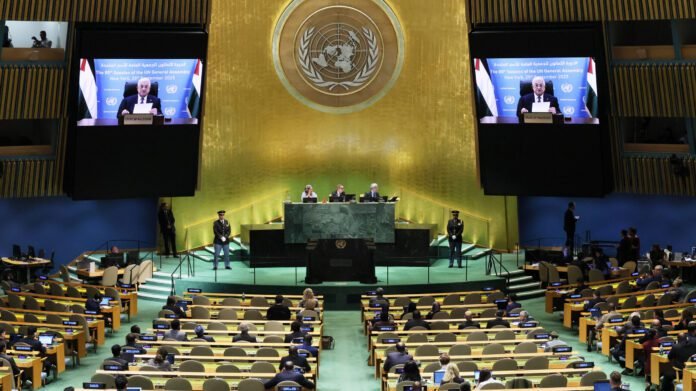




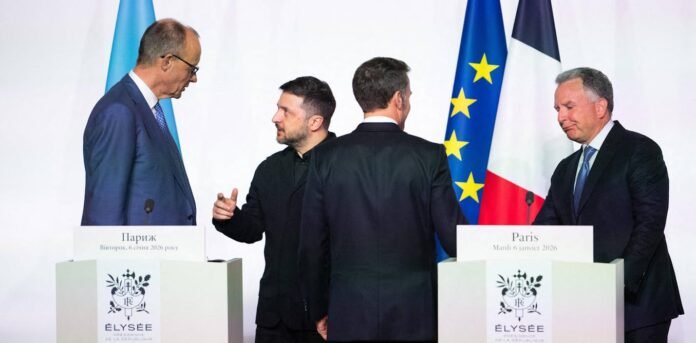







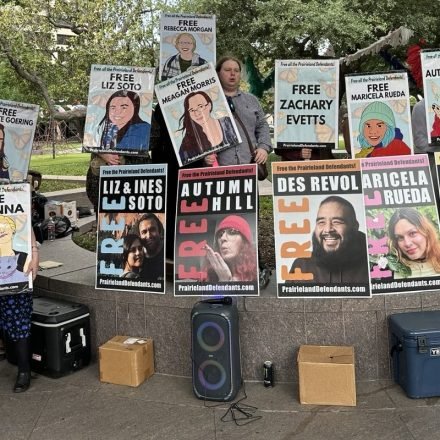

 higher rates of respiratory issues, they lacked time-stamped data to establish connections between their poor health and the region’s air quality. Sanchez said the monitoring system changes that.