19 C
London
Tuesday, June 23, 2026
Home Blog

With Starfall, SpaceX eyes an edge in global cargo delivery from orbit

0
with-starfall,-spacex-eyes-an-edge-in-global-cargo-delivery-from-orbit
With Starfall, SpaceX eyes an edge in global cargo delivery from orbit

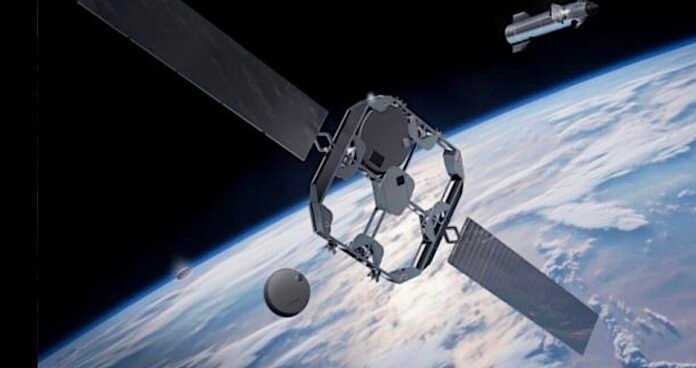
A SpaceX Falcon 9 rocket is set to launch Tuesday to test a new reentry vehicle designed to deliver cargo anywhere in the world from low-Earth orbit.

The company developed the new saucer-shaped reentry pod, called Starfall, under a veil of secrecy. Its purpose is to support the “transport and delivery of goods through space,” according to an environmental assessment published by the Federal Aviation Administration last month.

The first demonstration of the Starfall vehicle is scheduled for Tuesday morning. At least one of the Starfall vehicles will ride into orbit atop a Falcon 9 rocket from Cape Canaveral Space Force Station, Florida, perhaps alongside another undisclosed payload. After circling the planet two times, the Falcon 9’s upper stage will release Starfall to reenter the atmosphere and target a parachute-assisted splashdown in the Pacific Ocean around 800 miles west of California.

That is according to airspace and maritime warning notices telling pilots and sailors to steer clear of the Starfall splashdown zone.

The mission has a one-hour launch window beginning at 6:43 am EDT (10:43 UTC) Tuesday. SpaceX’s official webpage for the mission includes a timeline of key events during the launch, but it is devoid of any more information about the payload or the exact sequence of events for the Falcon 9’s upper stage. In its public messaging, SpaceX is effectively treating the launch like it would a classified mission for the US government.

From here to anywhere

What we do know about Starfall primarily comes from the FAA’s environmental assessment. In that document, the FAA writes that Starfall will “enable point-to-point delivery of critical cargo through space on rapid timelines” and provide access to space for commercial in-space manufacturing, a nascent market that, so far, is largely geared toward pharmaceuticals. Starfall could bring those materials back to Earth for commercial use. A private company named Varda Space Industries is already working in this area.

The FAA’s environmental review approved SpaceX’s proposal for two Starfall reentry demonstrations. It did not specify if these demos would happen on one or two missions. SpaceX intends to recover the vehicle, including parachutes and heat shields, “to the to the maximum extent practicable,” the FAA said.

The Starfall vehicle is cylindrical in shape, with a diameter of 10.2 feet (3.1 meters) and a height of 2.5 feet (0.75 meters). Starfall weighs approximately 4,600 pounds (2.1 metric tons) with capacity for about 2,200 pounds (1 metric ton) of payload, for a total weight of 6,800 pounds (3.1 metric tons). Designed exclusively for cargo, Starfall is smaller than SpaceX’s human-rated Crew Dragon spacecraft used for ferrying astronauts to and from the International Space Station.
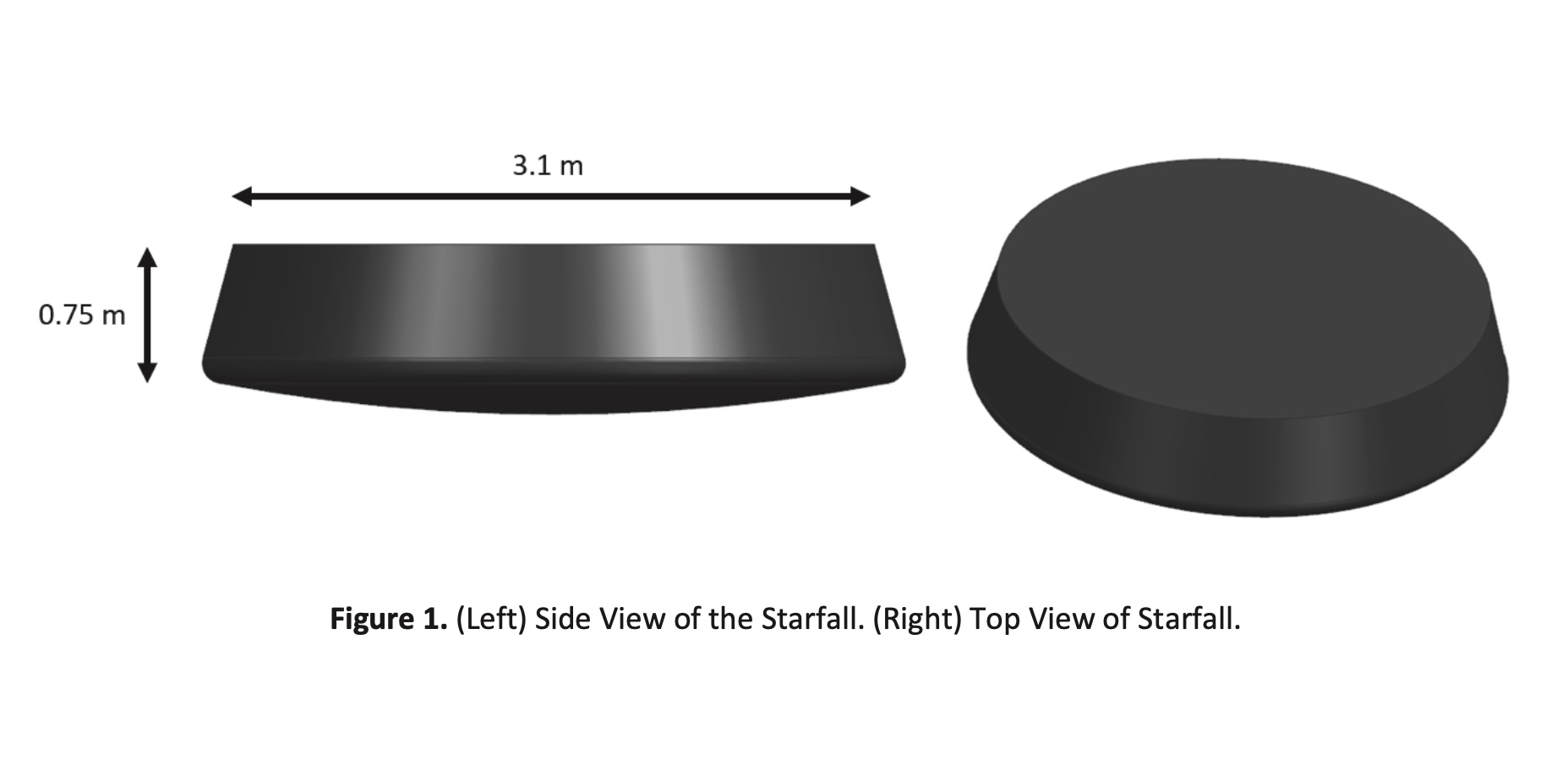
A closer look at the Starfall reentry vehicle.

A closer look at the Starfall reentry vehicle. Credit: SpaceX

The first Starfall Demo mission will spend a few hours in low-Earth orbit, but the vehicle could also fly on shorter suborbital trajectories after launching on either Falcon 9 or the much larger Starship rocket. This version of Starfall is not capable of de-orbiting itself, but instead relies upon its launch vehicle to guide it back into the atmosphere. After separating from its rocket carrier, the disc-shaped vehicle uses compressed nitrogen gas to point its heat shield in the right direction for reentry.

So who might use something like Starfall? The US military is one obvious answer. The Pentagon is already working with SpaceX on a concept named Rocket Cargo or Point-to-Point Delivery, which would use Starship to deliver massive loads of equipment and supplies to far-flung locations in less than an hour. Starship is an enormous vehicle, nearly 20 stories tall and 30 feet wide, that must land at prepared sites. Starfall could prove to be a more versatile option for lighter deliveries.

The military has also signed agreements with Blue Origin, Rocket Lab, and Anduril for studies and development of technologies for global cargo delivery from space. Notwithstanding Starship, which is still undergoing experimental flight tests, SpaceX may have an early advantage with the Starfall delivery vehicle.
Washington brought a memorandum to a war made of history

0
washington-brought-a-memorandum-to-a-war-made-of-history
Washington brought a memorandum to a war made of history

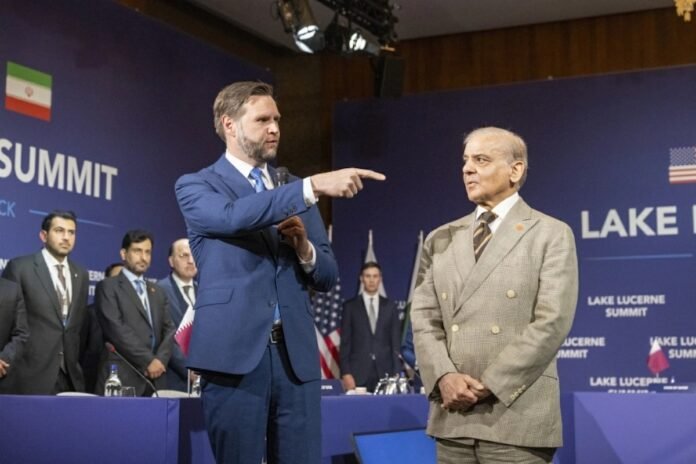
US Vice President JD Vance and Pakistan’s Prime Minister Shehbaz Sharif during talks between the US and Iran, mediated by Pakistan and Qatar, at the Buergenstock resort in Obbuergen, near Lucerne, Switzerland, June 21, 2026. Image: YouTube Screengrab

American power has a tell. When faced with a war it wants to end, Washington develops a comprehensive plan that includes phased withdrawals, monitoring arrangements, economic incentives, and a timeline. It then acts as though the document itself were the peace.

This has gone on for decades, through one Middle Eastern conflict after another, with the same confidence in the process and the expectation of the same result. One side flies in with hope and a document. The other lives with history. That gap has defeated every agreement before this one, and no drafting exercise has ever closed it.

For years, I was asked to assess the legal risk in agreements like this one across the Middle East and Africa: whether a given commitment would hold as the parties’ interests shifted. I thought about that work this week as Washington celebrated its memorandum of understanding with Iran.

The relief is real and well deserved: a 60-day ceasefire, the reopening of the Strait of Hormuz, and the end of hostilities after a difficult war. However, old patterns persist because it only offers a temporary window to de-escalate nearly 50 years of hostility. This cannot serve as a final resolution.

Sanctions waivers are being issued, while the most difficult issues are being postponed to future negotiations that have yet to start. The key promise—that Iran will not develop a nuclear bomb—has been repeatedly made by Tehran over the years.

Even the signing process showed signs of instability; the vice-president’s initial meeting in Switzerland was canceled at the last moment, and Israel attacked Beirut on a morning when the White House was optimistic about peace. Ultimately, it appears to be a carefully crafted process imposed on forces it cannot influence.

This goes beyond any one administration. It is the reflex of an entire order. The generation that built the postwar system did so amid the rubble of two world wars. The United Nations, Bretton Woods and NATO: all these institutions were not the projects of idealists but a shield, improvised by frightened people against a catastrophe they had personally lived through.

Their successors took over the shield but lost sight of its original purpose. As the fear that once motivated its creation faded, the machinery continued operating independently, with its summits, signed agreements, and established rules. Over time, the process itself became more significant than its intended goal.

The recipients understood all of this long before the diplomats who authored the documents. The proposals didn’t persuade because they mirrored a reality the recipients already experienced — on disputed land, among the dead, with grievances that no timetable could resolve.

They were polite to the visiting negotiators, like guests who traveled great distances but brought the wrong tools. While the gap between the written proposals and the ongoing conflict was obvious to any observer, hardly anyone recognized it.

Two men made careers out of saying it aloud. Vladimir Putin and Donald Trump both understood that the order had hollowed out and that those running it were going through the motions, no longer believing in it.

But noticing the decay is not the same as remembering why the order was built in the first place. Putin chose to wreck it from the outside. This week, Trump holds a deal in one hand and the threat to go “right back to dropping bombs” in the other. Neither man has what the founders had: knowledge of what it costs when there is no order at all, paid for in ruin.

That is the hard lesson buried in this week’s agreement, and in every commitment I was asked to weigh for the risk that it would fail. The postwar order was not engineered from clever frameworks. It was built by people who had seen the alternative firsthand and were terrified of it.

You cannot manufacture that terror in a conference room, and no memorandum can substitute for it. The next settlement that truly holds, in the Middle East or anywhere else, will probably be built the way the last one was: not from wisdom but from exhaustion, after the disaster the process was meant to prevent has already arrived.

I would like to be wrong about that. Nothing I learned weighing these agreements has ever given me reason to think that I am.

Eric Alter is a non-resident senior fellow at the Atlantic Council’s Middle East programs and a former UN civil servant. 

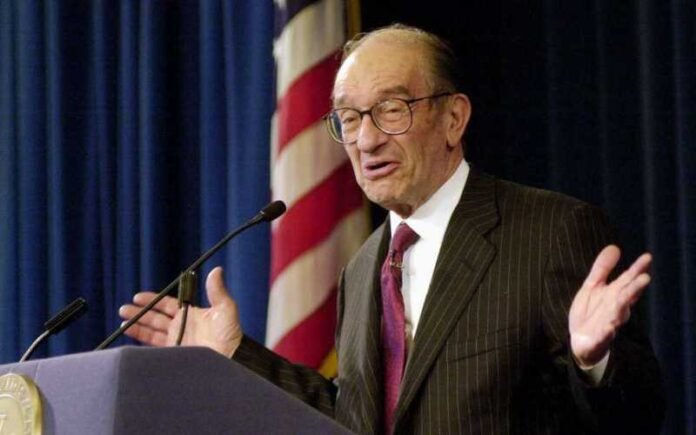
Former US Fed chair Alan Greenspan dies aged 100

0
former-us-fed-chair-alan-greenspan-dies-aged-100
Former US Fed chair Alan Greenspan dies aged 100


Former US Federal Reserve chair Alan Greenspan due to complications from Parkinson’s disease, his family said on Monday. He was 100.

Greenspan was chief of the Federal Reserve for nearly 19 years from 1987 until 2006, overseeing an economic boom from the final years of the Cold War through to the Dot-com Bubble of 2001.

But critics have argued that his leadership created the conditions for the Global Financial Crisis in 2008.

“He was a giant of a man who helped shape the US economy for decades under presidents of both parties, but was always honest in acknowledging his mistakes,” his wife, NBC News correspondent Andrea Mitchell, told the broadcaster in a statement.

“To me, he was my husband, who shaped my life from our very first date in 1984. He had ‘irrational exuberance’ for baseball, the Washington Commanders, tennis, golf and music, especially jazz.”

In a statement, the Fed expressed its “deep sadness” at Greenspan’s passing and lauded his “monetary policy and economic thought.”

“Under his leadership, the Federal Reserve achieved a sustained era of price stability that supported economic growth and helped anchor the public’s confidence in the institution,” the Fed said.

‘The oracle’ with a controversial legacy

When he stepped down in 2006, Greenspan was known as “a maestro” and “the oracle” for overseeing the second-longest period of economic expansion in US history.

He earned rockstar status for his decision not to raise intrest rates in the face of an inflation threat, judging that a productivity surge in the mid-1990s would instead keep inflation in check.

But he left a complex legacy.

Greenspan had a “legitimate claim to being the greatest central banker who ever lived,” Alan Blinder, a Princeton economics professor who served as Fed vice chair, told the AFP new agency.

However, Greeenspan’s “excessive reliance on the self-regulating aspects of markets seemed dangerously naive, and eventually blew up in his face and everybody’s face,” Binder added.

Banks came to rely on the so-called “Greenspan put” — the Fed’s tendency to cut rates or provide liquidity whenever banks were in trouble. This, combined with Greenspan’s belief in light financial supervision, was blamed for the 2007 subprime mortgage crisis and the Global Financial Crisis that followed in 2008.

It culminated in the worst recession since the 1930s and saw millions of Americans have their homes foreclosed. Greenspan would late acknowledge that he made a “mistake” in assuming the nation’s banks could essentially regulate themselves.

“I think the deification that came just before the financial crisis was never really deserved, and I think the lambasting that he took after he left was never fully deserved either,” Stephen Oliner, a former senior official at the Fed, told Reuters.

After leaving the Fed, Greenspan led his own consulting firm in Washington and also served as an adviser to major financial firms, including Deutsche Bank.

UN committee warns Palestinian children increasingly unprotected amid pressure on rights groups

0
un-committee-warns-palestinian-children-increasingly-unprotected-amid-pressure-on-rights-groups
UN committee warns Palestinian children increasingly unprotected amid pressure on rights groups

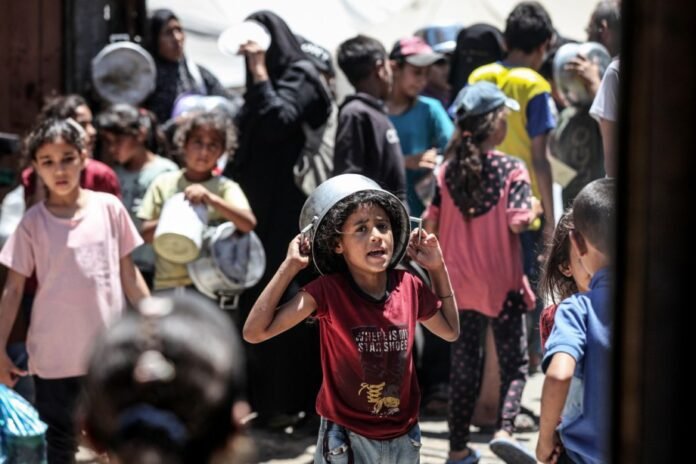
The UN Committee on the Rights of the Child on Monday warned that Palestinian children are being left increasingly unprotected as human rights defenders and humanitarian organizations are forced to halt or scale back their work in the occupied Palestinian territories, including Gaza and the West Bank, Anadolu reports.

In a statement, the committee strongly condemned what it described as Israel’s recent tactics of labeling human rights defenders and civil society organizations as “terrorists.”

It said the measures have been accompanied by military raids, travel bans, financial sanctions, threats of arrest, destruction of records and threats of secondary sanctions against partners supporting their work.

The committee expressed concern that organizations assisting children are being forced to curtail operations because of “sustained harassment, threats, bans, sanctions and attacks on their reputations.”

READ: Israeli army kills 2 Palestinians in southern occupied West Bank

“For more than three decades, these organizations have played a vital role in defending Palestinian children, including in the Israeli military courts, and in documenting grave violations against Palestinian children at the hands of Israeli forces,” it said.

“Without them, Palestinian children will be even less protected, and violations of their rights risk continuing with impunity.”

The committee called on Israel to immediately remove restrictions on child rights defenders and humanitarian groups and urged the international community to hold Israeli authorities accountable for attacks targeting Palestinian human rights defenders.

“Child rights defenders have continued to stand with Palestinian children and families in extraordinarily dangerous conditions,” it said. “They must be protected, not punished.”

READ: ‘Losing bet’: Hebrew media reports failure of armed militias to challenge Hamas in Gaza

Following user outcry, AMD reinstates memory encryption in consumer CPUs

0
following-user-outcry,-amd-reinstates-memory-encryption-in-consumer-cpus
Following user outcry, AMD reinstates memory encryption in consumer CPUs

Consumer AMD CPUs will once again offer encryption protections against physical attacks after facing user backlash for silently removing the feature.

As Ars reported last week, AMD stripped the protection, known as TSME, from consumer Ryzen processors. Short for Transparent Secure Memory Encryption, TSME encrypts the entire contents stored in memory, making the data useless to adversaries performing cold boot attacks and similar intrusions requiring physical access.

Now you see it, now you don’t, soon you’ll see it again

About a decade ago, AMD added TSME to its high-end CPUs. Over the next few years, AMD added the protection to lower-end processors, including the consumer version of its Ryzen chips, a CPU that costs less than the Pro version. Over the years, users of these lower-end chips have gotten used to the added security, although some security experts (and plenty of novices, too) note that consumer chips are far less likely to be targeted by physical attacks. Recently and without warning or notice, the lower-end line of AMD chips suddenly dropped the protection, and it did so in a way that was impossible to detect on Windows machines and required a fair amount of technical work when using Linux. AMD last week declined to explain or acknowledge the change.

Following the revelation, social media was deluged by comments from AMD consumers decrying the move. They noted that AMD’s quiet removal of TSME after supporting it for so long seemed underhanded. The move came solely as a result of firmware changes made in a recent update. With no physical changes required to silicon, continued support was largely, if not purely, a matter of will rather than a necessity required by changes to hardware. The critics called on AMD to reverse the move.

Over the weekend, AMD said it planned to do just that in a firmware update scheduled for release next month. More often than not, the chipmaker refers to TSME as Memory Guard.

“Regarding certain non-PRO Ryzen 9000-series desktop processors, a BIOS option to enable Memory Guard was previously available but was removed in a recent update,” AMD said in an email. “Based on valuable community feedback, we will reinstate this option in an upcoming BIOS release in July.”

The company has yet to explain why it removed the protection. Critics speculate that AMD dropped it in an attempt to steer customers toward more costly CPUs.

It’s possible, though, that there were less nefarious reasons, such as the difficulty of continued support as chip designs changed. Another possibility is that AMD made the move for performance reasons. Encrypting and decrypting data in memory creates latency. Slowdowns are the enemy of gamers, one of the more popular customer segments using the 9000-line of Ryzen processors. Since many gamers already voluntarily disabled TSME and had little need for it in the first place, AMD may not have considered the change of much consequence.

The incident, and AMD’s refusal to discuss it, is emblematic of the public relations landscape that has emerged over the past two decades. Once, Big Tech and corporations in general were willing to acknowledge service and product changes to ensure customers had a predictable experience. They also showed a willingness to admit mistakes and to say how they planned to do better. Now, there’s only silence. As the companies’ power and dominance have mushroomed, their sense of accountability has diminished proportionately.

AMD didn’t respond to questions sent for this story.

TSME transparently encrypts all physical memory flowing in or out of the processor. It protects against cold boot attacks and similar attacks that use sophisticated techniques to siphon data out of memory chips once an adversary has gained physical access to them. Memory pages are automatically encrypted and decrypted on each write or read. An ephemeral encryption key is created during each system start and isn’t accessible by software. Unlike Secure Memory Encryption, TSME is OS independent, a condition that makes it much easier to enable.

The automatic encryption and decryption does come at a performance cost that differs depending on the tasks the chips are performing. Some game developers advise users to disable TSME.

Oftentimes, disabling security protections is frowned upon. In this case, the move is less risky since systems running consumer chips are less likely to store data that’s valuable enough to motivate a sophisticated physical attack.

The counterargument is that AMD has included TSME in its consumer Ryzen CPUs for about a decade. The company long left the decision to enable or disable the protection to users. Critics argue that the removal deprived them of a capability that had been tacitly promised. Making the move silently only added to the sense AMD was pulling a fast one.

Despite AMD’s continued opacity about the incident, the company deserves credit for restoring TSME. Customers complained, some bitterly, and AMD heard and granted their demands.

Trump threatens to invade Iran, torpedoing Swiss peace talks

0
trump-threatens-to-invade-iran,-torpedoing-swiss-peace-talks
Trump threatens to invade Iran, torpedoing Swiss peace talks

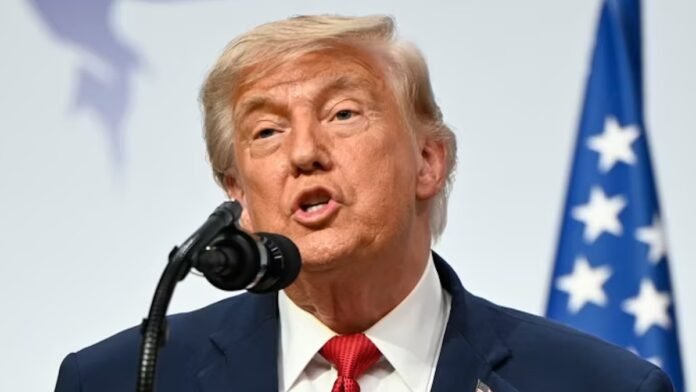
US President Donald Trump’s threats to destroy Iran and send US forces to occupy the country on Sunday appear to have derailed peace negotiations in Switzerland, with the Iranian delegation reportedly walking out and demanding an apology.

Following Iran’s announcement that it was closing the Strait of Hormuz again after Israel intensified its assault on Lebanon, Trump went on a tirade Sunday in which he threatened to assassinate negotiators and said Iran “won’t have a country” if access to the critical waterway was shut off, while also threatening to “take over” Iran with a full US invasion.

According to Fox News correspondent Trey Yingst, Trump told the Iranian negotiators that if they close the strait, which Iran claimed to have shuttered once again on Saturday, you “won’t even make it back to their f***ing country,” in what appeared to be a threat to assassinate the negotiators, as happened during the initial phase of the war.

But after Trump’s threats — which broke the first clause of the memorandum of understanding — Iran’s negotiators filed a complaint with the Pakistani and Qatari mediators and stormed out of the mountain resort where talks were being held, according to several outlets.

While Trump clearly sought to project strength, Iran’s chief negotiator, Mohammad Bagher Ghalibaf, said his team “do not take American threats seriously.”

In previous months, as Trump sought to squeeze concessions from the Iranians, he issued escalatory threats to wipe out their “whole civilization” and “blow up” the whole country. However, he did not act on those threats, even as Iran refused to budge from its negotiating posture.

“Don’t they think that if their threats had worked, they wouldn’t have ended up in today’s desperate situation?” Ghalibaf said.

Ghalibaf said the US had “better be more careful with their statements,” adding that “our armed forces are ready to respond in a different way.” He said, “No matter what they say, we are the ones who act.

While the Iranian delegation left the venue, talks are reportedly continuing via mediators. However, according to the Lebanese outlet Al Mayadeen, the delegation said it will not return until Trump apologizes for his threats and Israel fully withdraws from Lebanon.

According to senior Israeli officials cited by Channel 12, Israel is reportedly considering “limited withdrawals” from Lebanon, including in areas within its so-called “buffer zone.” Despite Iranian claims, the officials said the US has not requested Israel’s withdrawal from the country.

Previous peace talks have been derailed by Trump’s threats to commit indiscriminate war crimes in Iran. But last week has seen perhaps the most violent swing yet in his approach toward Iran.

While last week Trump acknowledged Iran’s right to enrich uranium and maintain a nuclear energy program like that of other nations, his outburst Sunday appeared to have been prompted by a statement by Iranian President Masoud Pezeshkian, who said the US would be “forced to accept” its right to enrichment.

Responding to statements by Pezeshkian, who said Iran would not give up its “right to enrich uranium”, Trump reportedly said Pezeshkian had better “watch his mouth” and “shape up,” or the US “will take over the rest of the country.”

The threat to fully occupy Iran, which Trump made publicly for the first time on Sunday, stands in sharp contrast to his comments that continuing the war for much longer would cause “economic catastrophe” and that even limited ground operations, such as one he had proposed to seize Iran’s uranium, would be too big an effort to be worth it.

The war with Iran is already deeply unpopular among the American public, even without US boots on the ground. Polls have shown that even a majority of Republicans would be opposed to Trump escalating the war by deploying ground troops, and military officials have shelved planned operations to occupy certain strategic locations, including Kharg Island, fearing a large number of American casualties.

Nevertheless, Trump also told Yingst that the US could become the “guardian angel” of the Strait of Hormuz, collecting tolls and taking oil from countries using the waterway for exports. He did not make clear how the US would gain control of the strait under such a scenario.

Iran announced that it would close the strait again on Saturday after Israel deepened its occupation and escalated its bombing of southern Lebanon, despite the MOU’s ceasefire agreement covering all fronts.

Iranian negotiators have described an end to Israel’s Lebanon occupation, which has killed more than 4,000 people and forced more than 1.2 million Lebanese civilians from their homes in the south, as a red line for negotiating peace.

Behind the scenes, Trump has acknowledged that Israeli Prime Minister Benjamin Netanyahu is using Lebanon to sabotage the ceasefire and drag the US back into a full-scale war.

In the phone call with Yingst, Trump once again said he was “disappointed Israel can’t put Hezbollah away,” adding that Israel “can’t do anything without knocking buildings down.” He also said he was close to allowing Syrian President Ahmed al-Sharaa—the former leader of al-Qaeda’s Syrian affiliate—to take over the operation against Hezbollah.

And while Trump has raged against Israel’s actions in Lebanon while privately claiming that Prime Minister Benjamin Netanyahu is trying to sabotage peace, he has not taken concrete action to force Israel to comply with the memorandum’s terms.

“The mixed messages coming out of the White House,” remarked Jeet Heer, a writer at The Nation, “are going to make it much harder to end the war, and could in fact spark further conflict.”

Trita Parsi, executive vice president at the Quincy Institute for Responsible Statecraft, described Israel’s continued escalations as “an existential threat” to the peace process between the US and Iran.

He told ABC News on Saturday that Iran’s threat to close the strait just before a meeting in Geneva this weekend was meant to be “part of a background of how serious they are” about ensuring that the US understands the stakes if Israel refuses to withdraw.

“Israel would prefer for this war to continue until you have a complete defeat of the Iranians, which, of course, is not in the cards,” Parsi said. “The Israelis sold this war to Trump as a quick, easy fix to the region’s problems that would take no more than four days, and they were dead wrong.”

“Now, Trump is recognizing that US interests necessitate that he pull out of this war and strikes this deal, but the Israelis are trying to sabotage it because they are afraid they’re going to be left out, that the balance in the region is going to shift against their interests,” he added.

“They’re willing to essentially jeopardize their relationship with the United States over this.”

Common Dreams

Montreal Police Confirms 3 Dead After Côte-des-Neiges Shooting

0
montreal-police-confirms-3-dead-after-cote-des-neiges-shooting
Montreal Police Confirms 3 Dead After Côte-des-Neiges Shooting


Montreal police announced on Monday that three people were dead after a shooting incident in the Côte-des-Neiges neighborhood.  The fatalities included a police officer, the suspect and a civilian.  

When law enforcement responded to an active shooting situation the police officer was reported as injured, and residents were told to remain indoors as officers searched for an armed suspect. 

A female police officer who was in critical condition is now stable.  The police reported a weapon used by the suspect has been seized. 

The Service de police de la Ville de Montréal issued an imminent-threat alert around 11:30 a.m. local time, warning that an armed and dangerous person was believed to be in the Côte-des-Neiges sector. Police told people in the area to avoid the streets, lock their doors, and stay away from windows while the operation continued. 

“We are asking everyone to avoid the sector. The situation is not under control,” Montreal police spokesperson Jean-Pierre Brabant said. 

Early reports placed the police response near Jewish institutions in Côte-des-Neiges, a diverse west-central Montreal neighborhood with a sizable Jewish population and several Jewish schools, synagogues, and community buildings. Authorities had not announced a motive or said whether the incident was connected to the Jewish community. 

Local and international outlets initially reported uncertainty about the number of casualties and the circumstances of the shooting. Police had not immediately released details about the suspect, the nature of the officer’s injuries, or whether any civilians had been wounded. 

The incident comes after several security scares involving Jewish institutions in Montreal since the October 7, 2023, Hamas-led attack on Israel and the ensuing war in Gaza. Jewish schools in the city were struck by gunfire in separate incidents in 2023 and 2024, prompting increased concern among Jewish community organizations and local officials. No connection between those earlier cases and Monday’s police operation had been reported. 

Côte-des-Neiges is one of Montreal’s most densely populated and ethnically varied areas, home to students, immigrants, religious communities, and major institutions. A police alert in such a neighborhood carries immediate public-safety concerns, especially when issued during daylight hours. 

As of the latest reports, police were asking the public to avoid the area and allow officers to continue their operation. 

Man used massage gun on his tired eyeballs. It went as well as you’d expect.

0
man-used-massage-gun-on-his-tired-eyeballs-it-went-as-well-as-you’d-expect.
Man used massage gun on his tired eyeballs. It went as well as you’d expect.

For our weary eyeballs, strained and tired from long periods locked onto screens, rest and relaxation can do wonders. But a man in Scotland came up with an eye-popping plan to try to pamper his pooped peepers.

Ophthalmologists discovered it when the man, who was in his 20s, appeared at an eye treatment center in Edinburgh. He told them he had noticed increasing floaters and flashing lights in his right eye over the previous six days. According to a BMJ Case Report, the man said he hadn’t had any eye or head injuries before the vision problems began, and that his family didn’t have a history of eye disorders that might explain them. Besides having mild near-sightedness and needing glasses, he usually didn’t have any problems with his eyes, he said.

When the doctors—Niamh O’Connell ‍‍and Ashraf Khan—took a close look, they were surprised to find that both of his eyes were in terrible shape. In his right eye, he had multiple retinal tears, widespread retinal bruising, and a condition called retinal dialysis—a retinal break at a junction in the front of the eye—that is usually seen after a significant eye injury. In his left eye, he had more widespread bruising and six full-thickness rips in his retina.

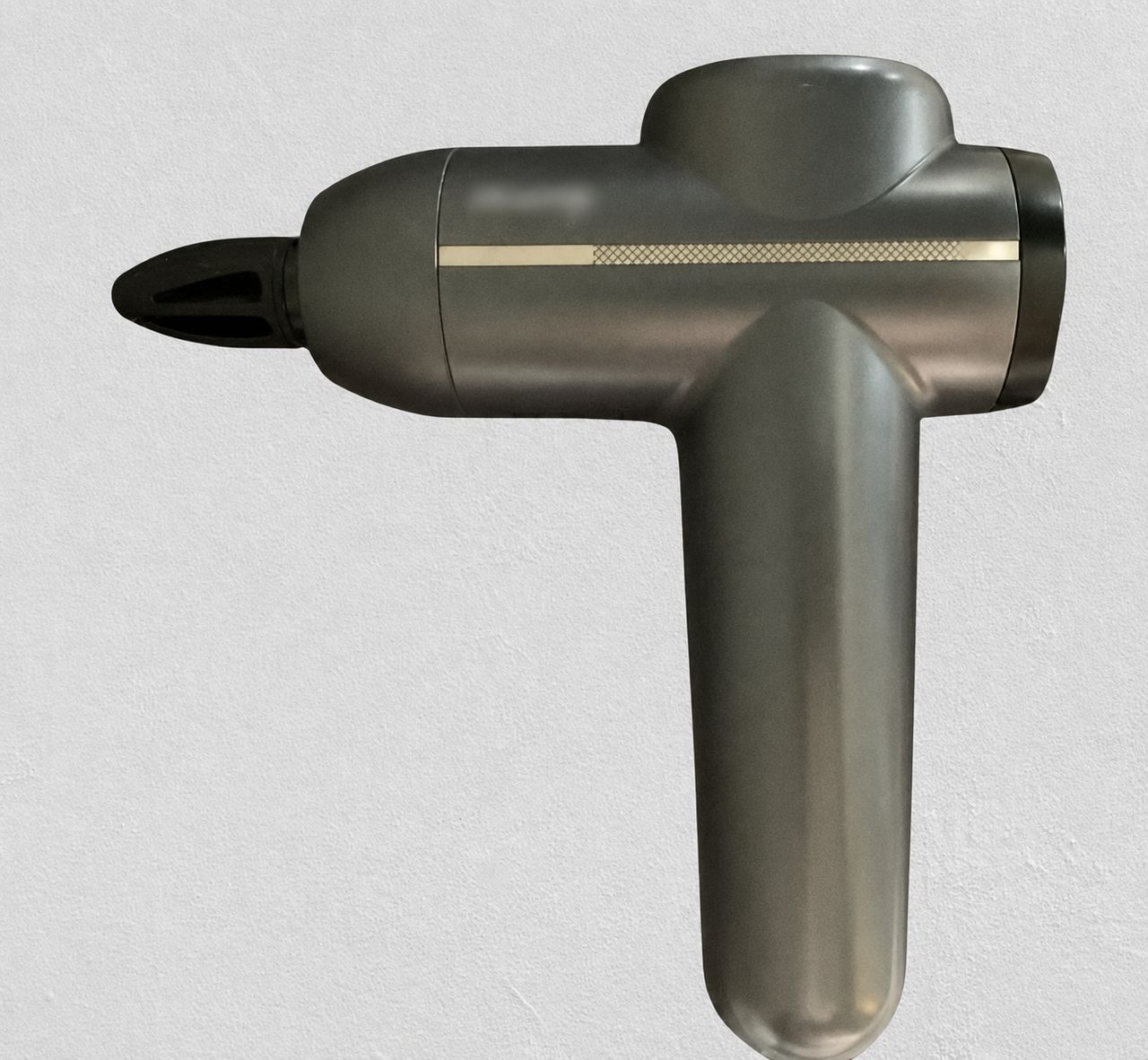
Given the findings, they had more questions. They pressed him on any “untoward” things that might have happened to his battered orbs. The man then reluctantly admitted he had been trying to soothe his tired eyes with a percussive massage gun. Specifically, he used a gun with a small head attachment shaped like a bullet.

The massage gun with the small head attachment the man used.

The massage gun with the small head attachment the man used. Credit: BMJ Case Reports, 2026

Describing the man as a “hesitant historian,” the doctors said he eventually confessed to using the massage gun directly on and around both eyes on a weekly basis for three months to help with his eye fatigue. They noted that he did not have a history of psychiatric conditions or drug use.

Occular offense

The doctors acknowledged that percussive massage therapy may be helpful for some soft tissues, like muscles, with the vibrations possibly relieving pain, improving blood flow, and promoting relaxation. But it can demonstrably cause serious damage to the eyeballs.

The ill-conceived thwacking therapy likely caused all of the damage to the man’s eyes, the doctors concluded. The gun would have rapidly compressed the eyeballs back, causing them to squish out from the sides, which is thought to lead to retinal dialysis. Still, the doctors noted that the retinal dialysis was unusual because it was seen in the lower quadrant of the eye closest to the ear (inferotemporal quadrant). When retinal dialysis occurs from blunt trauma—like taking a fist to the eye, a more common cause of trauma—it usually occurs in the upper quadrant closest to the ear (superior temporal). Overall, the man’s case marks a first in scientific literature for how to injure an eyeball.

After identifying the injuries, the doctors used laser treatments to mend the retinal tears and rips and seal the break. At a six-month follow-up appointment, the man’s condition was stable without any deterioration. His vision was preserved, despite his injuries having a high risk of progressing to vision loss.

While his decision to put a massage gun to his eyes was highly questionable, he at least demonstrated good judgment in the aftermath, saving his sight, his doctors concluded. “This favorable outcome was likely due to the patient’s prompt presentation soon after noticing symptoms and the immediate initiation of treatment,” they wrote.

Jeffrey Epstein ‘Exploited’ Bill Gates’ Marriage

0
jeffrey-epstein-‘exploited’-bill-gates’-marriage
Jeffrey Epstein ‘Exploited’ Bill Gates’ Marriage


Melinda French Gates never trusted Jeffrey Epstein — and according to a bombshell new column, she may have been the only one in Bill Gates’ inner circle who saw the warning signs clearly.

A new piece from bestselling author Michael Wolff claims the disgraced financier had a disturbing front-row seat to the unraveling of Bill and Melinda’s 27-year marriage.

Wolff, writing on his Substack HOWL, described Epstein as someone who allegedly inserted himself into Gates’ personal and professional world at a time when the Microsoft billionaire was trying to expand the Gates Foundation into a global powerhouse.

But behind the polished public image of one of the richest and most famous couples in the world, Wolff claims Epstein saw something far darker.

According to Wolff, Epstein believed Gates was dealing with two major problems around 2014: growing the foundation into something as influential as Microsoft — and escaping what Epstein allegedly viewed as a miserable home life.

“Or, at least, this is how Epstein came to perceive and portray the situation,” Wolff wrote.

Bill and Melinda Gates would not divorce until 2021, two years after Epstein died by suicide in a Manhattan jail while awaiting trial on federal sex-trafficking charges.

But Wolff claims that years before the split, Epstein had what he called a “detailed picture of the marriage’s hellscape.”

“Melinda Gates’ version of the breakup of her marriage puts considerable blame on Epstein — and her abhorrence of her husband’s new friend,” Wolff wrote.

Epstein’s version, according to Wolff, was very different. He allegedly claimed Gates was the one who needed a trusted friend because he was so unhappy with his wife.

That alleged friendship soon created what Wolff described as the “Melinda problem.”

French Gates reportedly objected to Epstein’s growing influence around her husband and the foundation. Epstein, of course, was not just any wealthy acquaintance. He was already a convicted sex offender, having served time after soliciting a minor for prostitution.

Wolff claims French Gates was especially alarmed by what came up when she searched Epstein’s name online.

In Wolff’s telling, Epstein and Gates allegedly discussed how to improve Epstein’s public image so French Gates would be more willing to accept him in their orbit.

But French Gates has made it painfully clear that she never accepted him.

She has said she met Epstein only once — and was immediately shaken by him.

“Have you ever in your life been around somebody that you just know is evil?” she told The Guardian earlier this month, becoming emotional as she recalled the encounter.

“Any woman who has ever been around somebody who is evil or had an experience and then if you’re around somebody else who is evil. Just no, no,” she said.

French Gates has also publicly criticized her ex-husband for continuing to associate with Epstein despite her objections.

She has said Gates’ relationship with Epstein was one of the factors that contributed to the end of their marriage.

Gates has since acknowledged that French Gates was skeptical of Epstein. Earlier this year, he reportedly told foundation staff that she was “always kind of skeptical about the Epstein thing.”

The Epstein connection resurfaced again this year after newly released files included an explosive allegation involving Gates and a sexually transmitted infection. According to the documents, Epstein drafted a 2013 email claiming Gates had contracted an infection after “sex with Russian girls” and allegedly discussed giving Melinda antibiotics.

Gates has strongly denied the claim and said there is no truth to it.

For French Gates, however, the renewed attention around Epstein has brought back painful memories.

During an interview with NPR host Rachel Martin on the podcast Wild Card, French Gates said seeing the Epstein coverage made her feel “sad, just unbelievable sadness.”

She said the details were “personally hard” because they brought back “very, very painful times” in her marriage.

“I left my marriage, I had to leave my marriage, I wanted to leave my marriage,” she said.

Bill and Melinda French Gates were once seen as one of the most powerful couples in the world — billionaires, philanthropists and public do-gooders with a global empire of influence.

But years later, Epstein’s name is still tied to one of the most painful chapters of their private life.

And Melinda French Gates has made one thing clear: she knew something was wrong from the start.

Heatwave tightens its grip on Europe

0
heatwave-tightens-its-grip-on-europe
Heatwave tightens its grip on Europe


A prolonged heatwave is expected to grip much of Italy until at least the end of June, with temperatures forecast to reach 39°C across large parts of the country, according to weather service iLMeteo.it.

Italian Meteorologist Mattia Gussoni was quoted by ANSA as saying that the highest temperatures will be concentrated across the northern plains and the Tyrrhenian regions. Major cities including Milan, Florence and Rome are expected to experience severe bioclimatic stress, with daytime highs of 37-38°C feeling even hotter because of the urban heat island effect.

Night-time conditions are also expected to remain oppressive, with temperatures struggling to fall below 24-25°C, creating so-called “super tropical nights” that hinder the body’s natural cooling process and can significantly affect sleep quality.

The heatwave extends beyond Italy, with France and Germany expected to be at the centre of the European heat event. Temperatures could approach 40°C in Paris and several German cities, while London is forecast to reach around 35°C as the hot air mass pushes unusually far north.

In France, authorities have placed dozens of regions under the highest level of heat alert, with temperatures forecast to exceed 42°C in parts of the southwest. Nearly 2,700 schools are expected to close or modify timetables because of the extreme conditions, while French officials have confirmed three heat-related deaths and warned that the hot weather is likely to persist for several more days.

In the United Kingdom, the heatwave is expected to bring temperatures of up to 35°C in London. Authorities have issued health warnings as unusually high temperatures are forecast to put pressure on transport infrastructure and increase health risks, particularly for vulnerable people.

According to iLMeteo.it, the heat is being driven by a large subtropical air mass spreading across Europe and the Mediterranean. The combination of already hot air and additional warming caused by compressing air within a strong high-pressure system could produce temperatures up to 15°C above seasonal averages in parts of France and Germany, raising the possibility of challenging records set during the 2003 European heatwave.

The forecast indicates mostly sunny and increasingly hot conditions across Italy through Wednesday, with isolated afternoon thunderstorms developing over mountainous and inland areas. The subtropical high-pressure system is expected to strengthen further, with temperatures potentially reaching 41°C from next weekend.

Via ANSA/BBC

0FansLike
0FollowersFollow
0FollowersFollow
0SubscribersSubscribe
- Advertisement -
Google search engine

Recent Posts