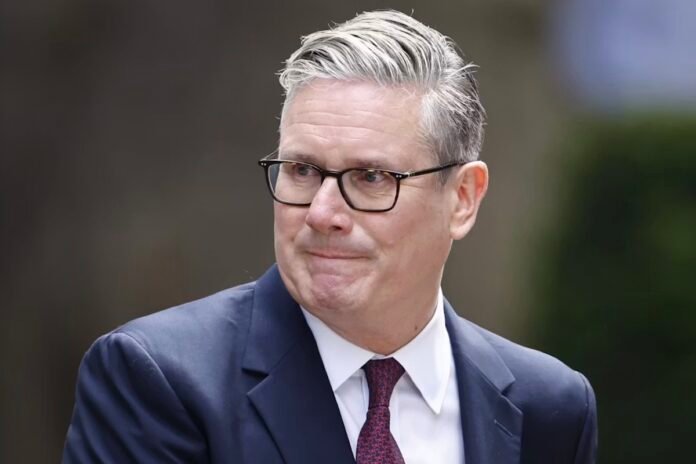
Keir Starmer has resigned as leader of the Labour party, and so in time as the UK’s prime minister. In the end, despite his numerous assurances that he would fight on, after Andy Burnham’s resounding win in the Makerfield byelection, the pressure on Starmer became too great to withstand. It makes him the sixth British PM in a decade to stand down.
The immediate cause of his decision was the final collapse in support for him in the party and in cabinet, clarified in private conversations over the weekend. In setting out his plans, Starmer has avoided the avalanche of resignations that toppled Conservative PMs Boris Johnson and Liz Truss.
The overall aim seems to be a more orderly transition – “with good grace” – than those under recent Conservative governments. Yet his emotional statement reflecting on his time in the highest office still highlights a leader who knows he has failed.
Starmer was not popular the day before he walked into 10 Downing Street. On the eve of the 2024 general election, his net satisfaction rating with Ipsos stood at minus 21. This was a historic low for an incoming prime minister.
While 31% of the public said they were satisfied with his performance, 52% were dissatisfied, marking the first time a leader had secured a parliamentary majority while holding a significantly negative approval rating.
Yet in the environment of British politics since the Brexit referendum, such figures hardly seemed unusual. Starmer’s predecessor Rishi Sunak entered the 2024 campaign with a net satisfaction score of minus 56, according to YouGov.
At the time, I argued that Starmer would likely see an upsurge in popularity having actually achieved a Labour victory after 14 long years. In 1997, Tony Blair enjoyed a record-breaking honeymoon with satisfaction ratings soaring to plus 60 in the months following his victory.
Even David Cameron saw his approval leap to plus 21 shortly after forming the coalition in 2010. The office of prime minister typically confers a halo of competence on its new occupant.
Starmer’s popularity did indeed improve. But only to a kind of tepid neutrality. In the immediate aftermath of the election, his net favorability rose to plus 3 in Opinium’s first post-election poll, while YouGov recorded a similarly rapid recovery to roughly break even.
Unlike the sustained euphoria of the Blair years, Starmer’s “bounce” was in absolute terms a shallow recovery that barely lifted him above the water line before the tides turned once again.
At the same time, measured by his majority, he seemed in an unassailable position. Yet the same could have (and indeed was) said of Boris Johnson. Following the 2019 election, talk was of the Conservatives securing a “decade of dominance”, arguing that the structural realignment of the “red wall” had created a near-permanent Tory majority that would keep Labour out of power until the 2030s.
In the event, Johnson was out just over three years later and the talk now is of Conservative extinction.
A dangerous pattern
Where did it go wrong for Starmer? Paradoxically, the answer may be found in the fate of his predecessor as Labour leader. Jeremy Corbyn’s record now looks similar to Starmer’s.
Between 2017 and 2019, Corbyn’s personal ratings plummeted from a competitive minus 11 during the 2017 campaign to a disastrous minus 44 by the time of his 2019 defeat. By then, the strategic ambiguity that once held his coalition together collapsed under the pressure of Brexit.
Starmer’s rise and fall took almost exactly the same period of time. And it happened for a set of reasons uncomfortably similar for either side of the Labour party’s ideological divide to admit.
In both 2017-2019 and 2022-24, Labour’s fragile polling lead was driven less by enthusiasm for the opposition and more by a collapse in government competence. As data from the 2024 “loveless landslide” illustrated, Labour secured around 64% of seats on just 34% of the vote – the lowest share for any majority government in history.
Just as Corbyn was squeezed by the populist-right Brexit party and pro-EU center party the Liberal Democrats in 2019 over its middle-of-the-road position on Brexit, Starmer faced a similar pincer movement in the mid-2020s.
On one flank, Reform UK eroded the Labour vote in post-industrial heartlands; on the other, the Green Party and pro-Gaza independents successfully targeted urban progressives. The Greens ended up quadrupling their MPs in 2024 and independent candidates secured historic wins in Labour strongholds.
Labour’s electoral results in office reflected this – byelection losses to both Reform UK and the Greens, disastrous local election results in England, and failing to dislodge a struggling and scandal-plagued Scottish National Party north of the border.
Fittingly, this latest resignation took place almost exactly ten years to the day of the 2016 Brexit referendum. Make no mistake, the divides created and solidified as a result of the Brexit moment are still at the heart of British politics – even if many people have forgotten the details of that dispute.
As Professor Tim Bale has recently argued, British politics is best seen as an example of two-bloc polarization. Voters are locked into broad identity-based camps and Brexit position is the key underlying variable. Yet this reality is obscured by the fact that these blocs are internally fragmented and only occasionally address the issue directly.
While voters may occasionally unite against a common enemy, they remain deeply divided on other aspects of policy, leaving leaders like Starmer (or Corbyn, for that matter) trying to hold together a sandcastle coalition that crumbles the moment the tide comes in.
Nicholas Dickinson is lecturer in politics, University of Exeter
This article is republished from The Conversation under a Creative Commons license. Read the original article.





 more than 800 group working across 49 states to oppose some
 7 percent of voters in a recent survey said they trust tech CEOs to make decisions that affect their lives.