29 C
London
Friday, June 19, 2026
Home Blog

German Nun Awarded Order of Merit After Decades of Caring for Leprosy Patients in Pakistan

0
german-nun-awarded-order-of-merit-after-decades-of-caring-for-leprosy-patients-in-pakistan
German Nun Awarded Order of Merit After Decades of Caring for Leprosy Patients in Pakistan


[ISLAMABAD] Germany has honored a long-serving humanitarian worker at the Rawalpindi Leprosy Hospital with the Order of Merit (Federal Cross of Merit) of the Federal Republic of Germany in recognition of decades of medical and social service to some of Pakistan’s most vulnerable patients.

In a ceremony held on Wednesday at the German Ambassador’s Residence in Islamabad, the award was presented by German Ambassador Ina Lepel on behalf of German President Frank-Walter Steinmeier, who had approved the distinction on April 29.

The Order of Merit is Germany’s highest civilian honor and is awarded for exceptional contributions to society, including humanitarian work and public service.

This year’s recognition was given to Sister Annette Dimigen, a member of the Protestant Sisterhood of the Christ Bearers, for nearly 30 years of service at the Rawalpindi Leprosy Hospital, also known as the German Leprosy Hospital.

She arrived in Pakistan in 1997 and has since played a key role in both administrative operations and humanitarian outreach through the Aid to Leprosy Patients (ALP) Association.

Born in Hanover in 1964, Sister Annette initially worked as an agricultural engineer and inspector before joining the sisterhood and dedicating her life to volunteer service in Pakistan.

Over the decades, she has helped support thousands of patients affected by leprosy, tuberculosis (including multidrug-resistant TB), and cutaneous leishmaniasis.

The embassy praised her long-standing commitment, saying she served “with deep dedication, guided by charity and compassion for those in need,” and described her as one of Germany’s most effective humanitarian representatives in Rawalpindi.

It also highlighted her collaborative work with hospital colleagues, including Dr. Chris Schmotzer, and the broader medical and nursing teams who have worked for decades to expand treatment access and reduce stigma around leprosy.

The Rawalpindi facility remains one of the region’s key specialized centers, providing care to hundreds of thousands of patients annually through both inpatient and outpatient services.

Rawalpindi Leprosy Hospital was founded by Sister Ruth Pfau, a German-born physician and Catholic nun who devoted her life to fighting leprosy in Pakistan.

She arrived in the country in 1960 and played a pioneering role in establishing a nationwide network for the treatment and rehabilitation of leprosy patients, which later expanded into specialized care centers, including services linked to Rawalpindi.

Through her leadership and collaboration with local medical teams, she helped introduce modern treatment approaches, train healthcare workers, and significantly reduce the stigma surrounding the disease.

Her lifelong humanitarian work earned her widespread national and international recognition, and she is remembered as one of the most influential figures in Pakistan’s public health history.

Pakistan didn’t just appreciate her informally, it officially decorated her with some of its highest civilian awards, treating her as a national humanitarian icon.

She passed away on August 10, 2017, in Karachi, at the age of 87.

State-level recognition and national respect were bestowed upon her. In 2017, after her death, she was afforded a state funeral in Karachi, accompanied by full military honors.

Wasian and proud — but does the label uplift or divide?

0
wasian-and-proud-—-but-does-the-label-uplift-or-divide?
Wasian and proud — but does the label uplift or divide?

“Wasians” are having a moment right now. Think of Winter Olympians Alysa Liu and Eileen Gu, singer-songwriter Olivia Rodrigo, actors Lola Tang (The Summer I Turned Pretty) and Hudson Williams (Heated Rivalry), or singer/dancer Megan Skiendiel from Katseye.

In fact, Icelandic-Chinese singer Laufey featured many of these same “Wasians” in her recent Madwoman music video.

“Wasian” is a portmanteau of the words white and Asian. It has been popularised in coverage around a growing cohort of high-achieving young Gen Z artists, athletes, and actors of mixed white and Asian heritage – and proud of it.

The hype around “Wasianness” has galvanized mixed- or half-Asian meetups trending on social media. This includes the recent “largest half-Asian gatherings ever” in New York and San Francisco in May. One is planned for Melbourne later this month.

Many of these meet-ups have sought to include non-Wasian half-Asians – people with, for instance, one Asian parent and one Black parent. Yet much of the recent media focus has been on “Wasians.”

But not everyone loves the term – and the ideas underpinning it are ripe for interrogation.

A language for shared experiences

Part of the appeal of the term lies in its ability to create community. Mixed-race people often feel they must choose one side, or be excluded from both.

A common experience for many “Wasians” is being seen as “not Asian enough”, especially when it comes to Asian language or cultural knowledge skills. Your family background or appearance may also be deemed “insufficiently Asian.”

Mixed-race Asians can find themselves in a paradoxical position; too Asian to be fully accepted as white, yet insufficiently Asian to be recognized as “properly” Asian.

“Wasian” can provide a language for shared experiences that don’t fit neatly in conventional racial categories.

The increasing visibility of mixed white-Asian public figures also conveys a sense that (some) mixed-race identities are becoming more recognized and celebrated.

If you’ve grown up navigating multiple cultural worlds, the idea can be empowering. It can serve as a form of self-identification and resistance to labels often imposed by others. It can be about strategically reclaiming space through coming together over shared experiences.

Viral “waydar” or “mixed Asian radar” social media clips highlight “superpowers” of connection between mixed Asians against experiences of marginalization.

For some, it’s about celebrating a chameleon-like ability to adapt and bring the “best of both worlds” to the table. The recent meetups may reflect histories of racial minorities gathering in solidarity.

But are we celebrating ‘proximity to whiteness’?

Yet, much of the “Wasian” discourse centres whiteness in ways that other mixed-race descriptors do not. This label specifically highlights white-Asian ancestry rather than mixed-raceness more broadly.

This can reinforce the idea that whiteness remains the desirable point of reference. Race upholds hierarchies. As such, not all mixed-race identities are valued equally.

As some social media users have observed, the “Wasian” label raises questions about a society that values proximity to whiteness. We must ask whether mixed white-Asian identities are afforded social advantages unavailable to other minority groups.

These debates are further complicated when considering beauty standards and representation.

The current “Wasian” moment has emerged alongside media that frequently privileges lighter skin, Eurocentric features and racially ambiguous appearances. This reflects colourism shaped by racial and class hierarchies, among others.

Yes, greater visibility for mixed-race people can be positive. But it can also reproduce longstanding hierarchies. Certain kinds of racial diversity are presented as more palatable because they more closely reflect dominant white norms.

The celebration of “Wasian” identities can even sometimes slide into a celebration of “acceptable” Asianness. It is a version of Asianness that is softened, diluted or made more palatable through association with whiteness.

It is available chiefly to those who come from greater socioeconomic privilege.

Broader tensions about race

The current “Wasian” conversation reveals broader tensions about race in multicultural societies.

It raises questions about who can claim an identity, how racial belonging is policed, and why some forms of racial mixture attract celebration over others.

One of us (Aaron Teo) is a parent of a mixed-race child, and the other (Alexandra Lee) is mixed-race. For us, the issues surrounding “Wasianness” underscore the fact race remains deeply shaped by histories of exclusionary hierarchy and unequal power.

In Australia, the concept of “mixed-raceness” was used to justify the Stolen Generations(with similar patterns elsewhere). It has also been part of larger genocidal intentions to “breed out” blackness.

In other colonial contexts, such as India and French colonial Indochina, mixed children were born under wider conditions of (sexual) violence perpetrated by white male colonizers against local populations.

Racial mixedness has been the norm in many Meso- and South American countries, and a feature of non-Western scholarship. Chicana (Mexican-US) feminist writer Gloria Anzaldúa, for instance, writes about what she calls “mestiza consciousness.” This is a fluid way of navigating multiple identities that embraces contradiction rather than seeking strict definitions.

However, these kinds of perspectives seem to be diminished or even absent from much of the current “Wasian” discourse, reflecting the dominance of white Western perspectives.

Questioning racial hierarchies

The label “Wasian” goes some way to disrupting conventionally separate categories of white and Asian. But it can still fail to meaningfully disrupt existing racial hierarchies and race-based categorization.

The current “Wasian” discussion presents an opportunity to shake up conversations about race and identity. If we’re interested in disrupting the status quo, it’s important to think carefully about how the discourse fits with broader systems that perpetuate racism and celebrate whiteness.

Aaron Teo is lecturer in curriculum and pedagogy, University of Southern Queensland and Alexandra Lee is research fellow in sociology, Deakin University

This article is republished from The Conversation under a Creative Commons license. Read the original article.

Indonesia needs not only GCC investors, but also bankable green projects

0
indonesia-needs-not-only-gcc-investors,-but-also-bankable-green-projects
Indonesia needs not only GCC investors, but also bankable green projects

In a previous essay, we argued that Indonesia’s sovereign wealth fund, Danantara, could serve as a bridge between the Gulf’s immense pools of capital and Indonesia’s vast renewable energy potential. That argument remains valid. As Gulf Cooperation Council (GCC) countries diversify beyond hydrocarbons and seek long-term investments in emerging markets, Indonesia stands out as one of the world’s most promising destinations for renewable energy development.

Yet capital alone cannot deliver an energy transition. If Indonesia is serious about achieving President Prabowo Subianto’s ambition to build up to 75 gigawatts of renewable energy capacity in the coming decades—a transformation that could require at least US$235 billion in investment—it will need not only GCC investors, but also something far less discussed: a pipeline of bankable green projects.

This distinction matters because green investment has become one of the defining economic priorities of our era. The Monetary Authority of Singapore estimates that ASEAN requires approximately US$200 billion in green investment annually through 2030 to meet climate and development goals. Despite this enormous demand, investment flows continue to fall short, reflecting not only financing gaps but also the difficulty of generating commercially viable projects capable of attracting capital at scale. 

Indonesia exemplifies this challenge. For years, the country has announced increasingly ambitious renewable energy targets while paying insufficient attention to the institutional, social and bureaucratic foundations necessary to achieve them.

Renewable energy plans are unveiled, investment figures are celebrated and gigawatts are promised. Yet much less attention is devoted to project preparation, local participation and capacity building.

Ask financiers what constrains green investment in emerging markets, and many offer a surprisingly consistent answer: money is not always the problem. Rather, the shortage lies in bankable projects. A bankable project is more than an engineering blueprint or political aspiration. It requires clear regulations, predictable revenue streams, manageable risks, community support and business models that can generate long-term returns.

This problem is particularly acute in Indonesia. Even institutions established to facilitate energy transition financing often face limitations in preparing investment-ready projects. Designing renewable energy investments requires expertise that spans engineering, project finance, land acquisition, environmental safeguards and stakeholder engagement. Such capabilities cannot be built overnight, yet they are essential if Indonesia hopes to translate ambitious targets into actual infrastructure.

The experience of GCC investors offers important lessons in this regard. Investors from the Gulf have demonstrated a greater willingness than many conventional financiers to enter frontier sectors and support projects from an early stage.

The UAE-backed Cirata floating solar project illustrates how Gulf capital can help pioneer new technologies and business models in emerging markets. What this experience suggests is not that Indonesia lacks interested investors, but that attracting sustained investment requires a stronger pipeline of projects that meet international standards of bankability.

OPINION: Danantara and the Gulf could finally turn Indonesia’s renewable energy ambition into reality

Increasingly, therefore, the bottleneck lies on Indonesia’s side. The country still lacks a comprehensive blueprint for renewable energy development that integrates project preparation, institutional coordination and community readiness. Announcing large investment targets is important, but targets alone cannot substitute for the painstaking work of developing projects capable of convincing investors that risks are manageable and returns are achievable.

This challenge extends beyond economics and finance. Renewable energy transitions are not merely technological transformations; they are also social transformations. Indonesia has often approached infrastructure development from the top down, with government institutions dominating nearly every stage of project implementation. Yet renewable energy may deliver its greatest benefits when built from the bottom up, through stronger participation by local governments, cooperatives and communities.

Community-based renewable energy projects can create stronger local ownership, reduce resistance and ensure that the economic benefits of investment extend beyond state institutions and large corporations. Such an approach generates broader trickle-down effects while helping communities become active participants rather than passive recipients of development. A green transition rooted in society is ultimately more durable than one imposed solely through government policy.

Indonesia’s broader development experience reinforces this lesson. The World Bank has argued that faster growth and better jobs depend on business-enabling reforms, regulatory certainty and investments in both physical and human capital. Weaknesses in regulation, competition and market reforms have constrained private investment and kept resources concentrated in lower-value activities. Similar barriers continue to hinder renewable energy development, limiting the country’s ability to attract new technologies, expertise and capital. 

Danantara therefore has an opportunity to become more than an investment vehicle. It can become an institution that prepares projects. Establishing a dedicated green project preparation facility under Danantara or PT SMI—a Special Mission Vehicle under the Ministry of Finance and Indonesia’s designated ETM Country Platform, though one that has itself been criticized for lacking the technical capacity to structure bankable green projects—with international technical partners would strengthen project readiness. Standardizing power purchase agreements and improving State Electricity Company’s credit-enhancement mechanisms could reduce uncertainty for investors. Expanding capacity-building programs for project finance professionals within state institutions would further strengthen Indonesia’s renewable energy ecosystem.

Most importantly, Indonesia should pilot several fully bankable renewable energy projects with GCC partners before announcing ever larger investment portfolios.

Indonesia’s renewable future will not be determined solely by the amount of capital it can attract. It will depend equally on whether the country can build institutions, communities and project pipelines capable of transforming ambition into reality. GCC investors can become important partners in this transition, but even the deepest pools of capital require projects worthy of investment.

Indonesia’s green transition therefore requires two things at once: investors willing to finance the future and institutions capable of building it. Without both, ambitious targets will remain on paper. With both, Indonesia could emerge as one of the most important renewable energy success stories in the Global South.

OPINION: The latest Indonesia-Qatar defence agreement needs deliverables, not diplomacy

The views expressed in this article belong to the author and do not necessarily reflect the editorial policy of Middle East Monitor.

Android verification is coming: Google confirms timeline and supported app stores

0
android-verification-is-coming:-google-confirms-timeline-and-supported-app-stores
Android verification is coming: Google confirms timeline and supported app stores

Almost 20 years ago, Google pitched Android as the more open alternative to Apple’s walled garden. Last year, Google announced it would begin erecting its own walls through developer verification. The company has issued an update on its plans, affirming that the verification system will begin rolling out in select countries later this year. We’re also learning which app stores are participating in verification and the timeline for key features like the recently revealed “advanced flow” for bypassing verification.

Google has claimed that developer verification is a necessary change to smartphone software distribution, pointing to the increased prevalence of scams that trick Android users into installing malware apps. Google’s solution requires verifying the identities of developers outside the Play Store just like it does for devs publishing on its platform. This has proven to be a contentious change for myriad reasons.

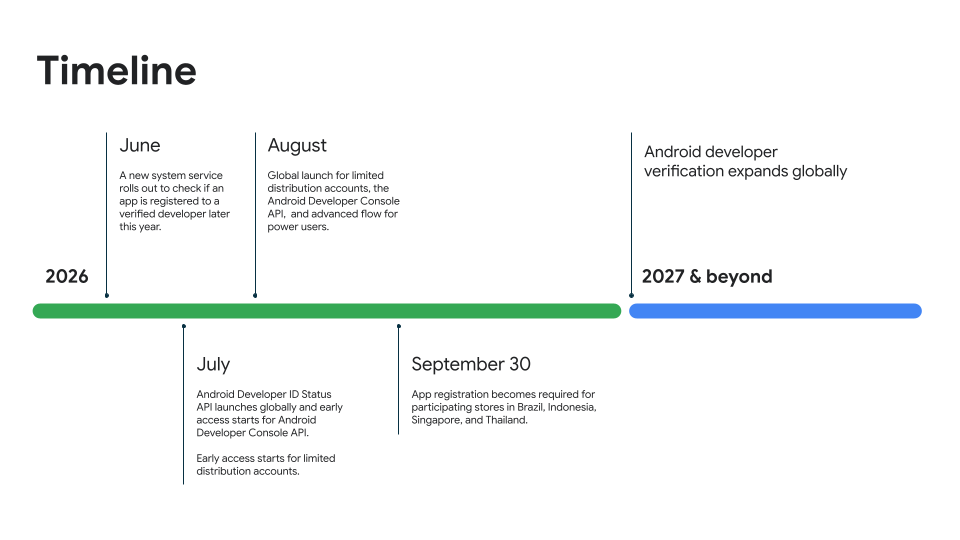
In the new blog post, Google’s Matthew Forsythe confirms that the developer verification system is slated to come online on September 30 of this year. The initial deployment will be limited to countries with a high level of app scams: Brazil, Indonesia, Singapore, and Thailand.

Google released its new developer console back in March, giving external developers the opportunity to pay $25 and verify their identities early. Developers who don’t register will find that their apps cannot be sideloaded on Google-certified Android devices once verification has rolled out. Google says that almost every app in the Play Store is now ready for the change, and a “large majority” of apps outside Google Play have completed verification.

This system places more burden on developers who want to make software for Android, even if they don’t want to deal with Google directly. There are a few updates that aim to streamline the experience. Google is following through on its promise to extend verification to trusted third-party stores—if a developer is verified in one of these storefronts, they are verified on Google’s side. Google says it will verify the apps in the following stores when it begins enforcing the new restrictions.

  • Google (Google Play)
  • Honor (HONOR App Market)
  • OPlus (OPPO App Market)
  • Samsung (Galaxy Store)
  • Transsion (Palm Store)
  • vivo (V-Appstore)
  • Xiaomi (GetApps)

Developers will also have access to new APIs to make registering as an external developer less arduous. In the coming months, Google will release an Android Developer ID Status API that will check if a package name is already registered with Google. The Android Developer Console API will let you register and manage your app package names without leaving your development environment, too.

The countdown begins

The next step toward verifying apps will come this month as Google deploys a new system service on most certified devices. The package (com.google.android.verifier) will appear on phones and tablets running Android 8 or higher, allowing Google to block the installation of unverified apps. It will remain dormant until verification is activated in your specific region.

Credit: Google

In July, Google plans to roll out the new developer APIs and begin testing for “limited distribution” accounts. This is Google’s solution for hobbyists who want to make their own apps and share them with a small group. Limited accounts won’t require a fee or government ID verification, but you can install these apps on up to 20 devices.

In August, the advanced flow will become available globally ahead of verification becoming mandatory in the first markets. As detailed a few months ago, the advanced flow will allow users to bypass verification, but the process isn’t easy. You’ll have to navigate to a buried menu, confirm you understand the risks multiple times, and wait a whole day before completing the process.

And that brings us to September, when Android devices in Brazil, Indonesia, Singapore, and Thailand will begin checking verification status before installing apps. However, things get murky after that. Google will undoubtedly monitor how verification works as millions of users are suddenly limited to verified apps, which could affect how it moves forward. Google says it intends to expand developer verification in 2027, eventually making it a global device policy.

All 380 fixtures for 2026/27 Premier League season

0
all-380-fixtures-for-2026/27-premier-league-season
All 380 fixtures for 2026/27 Premier League season


The 2026/27 Premier League fixtures have been released and the dates of all 380 matches are below.

The kick-off times of weekend and Bank Holiday matches are 15:00 UK time, while for midweek matches it is 20:00 unless otherwise stated.

Friday 21 August 2026
20:00 Arsenal v Coventry City (Sky Sports)

Saturday 22 August
12:30 Hull City v Manchester United (TNT Sports)
Everton v Crystal Palace
Ipswich Town v Sunderland
Nottingham Forest v Leeds United
17:30 Brentford v Tottenham Hotspur (Sky Sports)

Sunday 23 August
14:00 Brighton & Hove Albion v Aston Villa (Sky Sports)
14:00 Manchester City v AFC Bournemouth (Sky Sports)
16:30 Newcastle United v Liverpool (Sky Sports)

Monday 24 August
20:00 Fulham v Chelsea (Sky Sports)

Saturday 29 August
AFC Bournemouth v Everton
Aston Villa v Arsenal
Chelsea v Brighton & Hove Albion
Coventry City v Hull City
Crystal Palace v Manchester City
Leeds United v Brentford
Liverpool v Nottingham Forest
Manchester United v Ipswich Town
Sunderland v Fulham
Tottenham Hotspur v Newcastle United

Saturday 5 September
Arsenal v Chelsea
Brentford v Sunderland
Brighton & Hove Albion v Leeds United
Everton v Manchester United
Fulham v Crystal Palace
Hull City v Aston Villa
Ipswich Town v Liverpool
Manchester City v Coventry City
Newcastle United v AFC Bournemouth
Nottingham Forest v Tottenham Hotspur

Saturday 12 September
AFC Bournemouth v Brentford
Aston Villa v Nottingham Forest
Chelsea v Hull City
Coventry City v Brighton & Hove Albion
Crystal Palace v Ipswich Town
Leeds United v Newcastle United
Liverpool v Fulham
Manchester United v Manchester City
Sunderland v Arsenal
Tottenham Hotspur v Everton

Saturday 19 September
AFC Bournemouth v Liverpool
Brentford v Chelsea
Brighton & Hove Albion v Arsenal
Everton v Ipswich Town
Fulham v Manchester United
Leeds United v Crystal Palace
Manchester City v Sunderland
Newcastle United v Hull City
Nottingham Forest v Coventry City
Tottenham Hotspur v Aston Villa

Saturday 10 October
Arsenal v Leeds United
Aston Villa v Brentford
Chelsea v AFC Bournemouth
Coventry City v Newcastle United
Crystal Palace v Nottingham Forest
Hull City v Everton
Ipswich Town v Fulham
Liverpool v Manchester City
Manchester United v Tottenham Hotspur
Sunderland v Brighton & Hove Albion

Saturday 17 October
AFC Bournemouth v Sunderland
Brentford v Liverpool
Brighton & Hove Albion v Crystal Palace
Everton v Chelsea
Fulham v Hull City
Leeds United v Manchester United
Manchester City v Ipswich Town
Newcastle United v Aston Villa
Nottingham Forest v Arsenal
Tottenham Hotspur v Coventry City

Saturday 24 October
Arsenal v Everton
Aston Villa v Manchester City
Chelsea v Tottenham Hotspur
Coventry City v Fulham
Crystal Palace v Newcastle United
Hull City v Brentford
Ipswich Town v Nottingham Forest
Liverpool v Brighton & Hove Albion
Manchester United v AFC Bournemouth
Sunderland v Leeds United

Saturday 31 October
AFC Bournemouth v Leeds United
Aston Villa v Fulham
Brentford v Nottingham Forest
Chelsea v Manchester United
Coventry City v Sunderland
Hull City v Ipswich Town
Liverpool v Arsenal
Manchester City v Brighton & Hove Albion
Newcastle United v Everton
Tottenham Hotspur v Crystal Palace

Saturday 7 November 
Arsenal v Hull City
Brighton & Hove Albion v Brentford
Crystal Palace v Liverpool
Everton v Coventry City
Fulham v Newcastle United
Ipswich Town v AFC Bournemouth
Leeds United v Tottenham Hotspur
Manchester United v Aston Villa
Nottingham Forest v Manchester City
Sunderland v Chelsea

Saturday 21 November 
AFC Bournemouth v Nottingham Forest
Aston Villa v Sunderland
Brentford v Everton
Chelsea v Leeds United
Coventry City v Crystal Palace
Hull City v Brighton & Hove Albion
Liverpool v Manchester United
Manchester City v Fulham
Newcastle United v Arsenal
Tottenham Hotspur v Ipswich Town

Saturday 28 November 
Arsenal v Manchester City
Brighton & Hove Albion v Newcastle United
Crystal Palace v Hull City
Everton v Liverpool
Fulham v AFC Bournemouth
Ipswich Town v Aston Villa
Leeds United v Coventry City
Manchester United v Brentford
Nottingham Forest v Chelsea
Sunderland v Tottenham Hotspur

Wednesday 2 December
20:00 AFC Bournemouth v Brighton & Hove Albion
20:00 Aston Villa v Everton 
20:00 Brentford v Arsenal 
20:00 Chelsea v Crystal Palace 
20:00 Coventry City v Ipswich Town 
20:00 Hull City v Nottingham Forest
20:00 Liverpool v Sunderland 
20:00 Manchester City v Leeds United 
20:00 Newcastle United v Manchester United
20:00 Tottenham Hotspur v Fulham 

Saturday 5 December
AFC Bournemouth v Hull City
Aston Villa v Crystal Palace
Brentford v Manchester City
Chelsea v Liverpool
Everton v Fulham
Leeds United v Ipswich Town
Manchester United v Coventry City
Newcastle United v Sunderland
Nottingham Forest v Brighton & Hove Albion
Tottenham Hotspur v Arsenal

Saturday 12 December
Arsenal v AFC Bournemouth
Brighton & Hove Albion v Everton
Coventry City v Aston Villa
Crystal Palace v Manchester United
Fulham v Brentford
Hull City v Tottenham Hotspur
Ipswich Town v Newcastle United
Liverpool v Leeds United
Manchester City v Chelsea
Sunderland v Nottingham Forest

Saturday 19 December
AFC Bournemouth v Coventry City
Arsenal v Manchester United
Brentford v Newcastle United
Brighton & Hove Albion v Ipswich Town
Chelsea v Aston Villa
Leeds United v Fulham
Liverpool v Tottenham Hotspur
Manchester City v Hull City
Nottingham Forest v Everton
Sunderland v Crystal Palace

Saturday 26 December
Aston Villa v Leeds United
Coventry City v Chelsea
Crystal Palace v Arsenal
Everton v Sunderland
Fulham v Brighton & Hove Albion
Hull City v Liverpool
Ipswich Town v Brentford
Manchester United v Nottingham Forest
Newcastle United v Manchester City
Tottenham Hotspur v AFC Bournemouth

Wednesday 30 December 
20:00 Aston Villa v Liverpool 
20:00 Coventry City v Brentford 
20:00 Crystal Palace v AFC Bournemouth
20:00 Everton v Manchester City
20:00 Fulham v Arsenal 
20:00 Hull City v Leeds United
20:00 Ipswich Town v Chelsea 
20:00 Manchester United v Sunderland 
20:00 Newcastle United v Nottingham Forest 
20:00  Tottenham Hotspur v Brighton & Hove Albion 

Saturday 2 January 2027
AFC Bournemouth v Aston Villa
Arsenal v Ipswich Town
Brentford v Crystal Palace
Brighton & Hove Albion v Manchester United
Chelsea v Newcastle United
Leeds United v Everton
Liverpool v Coventry City
Manchester City v Tottenham Hotspur
Nottingham Forest v Fulham
Sunderland v Hull City

Wednesday 6 January
20:00 Arsenal v Brentford
20:00 Brighton & Hove Albion v AFC Bournemouth
20:00 Crystal Palace v Chelsea 
20:00 Everton v Aston Villa 
20:00 Fulham v Tottenham Hotspur
20:00 Ipswich Town v Coventry City
20:00 Leeds United v Manchester City
20:00 Manchester United v Newcastle United
20:00 Nottingham Forest v Hull City 
20:00 Sunderland v Liverpool 

Saturday 16 January
AFC Bournemouth v Ipswich Town
Aston Villa v Manchester United
Brentford v Brighton & Hove Albion
Chelsea v Sunderland
Coventry City v Everton
Hull City v Arsenal
Liverpool v Crystal Palace
Manchester City v Nottingham Forest
Newcastle United v Fulham
Tottenham Hotspur v Leeds United

Saturday 23 January
Arsenal v Newcastle United
Brighton & Hove Albion v Manchester City
Crystal Palace v Tottenham Hotspur
Everton v Brentford
Fulham v Aston Villa
Ipswich Town v Hull City
Leeds United v Chelsea
Manchester United v Liverpool
Nottingham Forest v AFC Bournemouth
Sunderland v Coventry City

Saturday 30 January
AFC Bournemouth v Fulham
Aston Villa v Ipswich Town
Brentford v Manchester United
Chelsea v Nottingham Forest
Coventry City v Leeds United
Hull City v Crystal Palace
Liverpool v Everton
Manchester City v Arsenal
Newcastle United v Brighton & Hove Albion
Tottenham Hotspur v Sunderland

Saturday 6 February
Arsenal v Liverpool
Brighton & Hove Albion v Hull City
Crystal Palace v Coventry City
Everton v Newcastle United
Fulham v Manchester City
Ipswich Town v Tottenham Hotspur
Leeds United v AFC Bournemouth
Manchester United v Chelsea
Nottingham Forest v Brentford
Sunderland v Aston Villa

Wednesday 10 February
20:00 Aston Villa v AFC Bournemouth
20:00 Coventry City v Liverpool 
20:00 Crystal Palace v Brentford
20:00 Everton v Leeds United 
20:00 Fulham v Nottingham Forest
20:00 Hull City v Sunderland 
20:00 Ipswich Town v Arsenal 
20:00 Manchester United v Brighton & Hove Albion 
20:00 Newcastle United v Chelsea 
20:00 Tottenham Hotspur v Manchester City 

Saturday 20 February
AFC Bournemouth v Crystal Palace
Arsenal v Fulham
Brentford v Coventry City
Brighton & Hove Albion v Tottenham Hotspur
Chelsea v Ipswich Town
Leeds United v Aston Villa
Liverpool v Hull City
Manchester City v Newcastle United
Nottingham Forest v Manchester United
Sunderland v Everton

Saturday 27 February
Aston Villa v Chelsea
Coventry City v AFC Bournemouth
Crystal Palace v Sunderland
Everton v Nottingham Forest
Fulham v Leeds United
Hull City v Manchester City
Ipswich Town v Brighton & Hove Albion
Manchester United v Arsenal
Newcastle United v Brentford
Tottenham Hotspur v Liverpool

Wednesday 3 March
20:00 AFC Bournemouth v Tottenham Hotspur
20:00 Arsenal v Crystal Palace
20:00 Brentford v Ipswich Town 
20:00 Brighton & Hove Albion v Fulham
20:00 Chelsea v Coventry City
20:00 Leeds United v Hull City
20:00 Liverpool v Aston Villa
20:00 Manchester City v Everton
20:00 Nottingham Forest v Newcastle United
20:00 Sunderland v Manchester United 

Saturday 13 March
AFC Bournemouth v Newcastle United
Aston Villa v Hull City
Chelsea v Arsenal
Coventry City v Manchester City
Crystal Palace v Fulham
Leeds United v Brighton & Hove Albion
Liverpool v Ipswich Town
Manchester United v Everton
Sunderland v Brentford
Tottenham Hotspur v Nottingham Forest

Saturday 20 March
Arsenal v Sunderland
Brentford v AFC Bournemouth
Brighton & Hove Albion v Coventry City
Everton v Tottenham Hotspur
Fulham v Liverpool
Hull City v Chelsea
Ipswich Town v Crystal Palace
Manchester City v Manchester United
Newcastle United v Leeds United
Nottingham Forest v Aston Villa

Saturday 10 April 
AFC Bournemouth v Manchester City
Aston Villa v Brighton & Hove Albion
Chelsea v Fulham
Coventry City v Arsenal
Crystal Palace v Everton
Leeds United v Nottingham Forest
Liverpool v Newcastle United
Manchester United v Hull City
Sunderland v Ipswich Town
Tottenham Hotspur v Brentford

Saturday 17 April
Arsenal v Aston Villa
Brentford v Leeds United
Brighton & Hove Albion v Chelsea
Everton v AFC Bournemouth
Fulham v Sunderland
Hull City v Coventry City
Ipswich Town v Manchester United
Manchester City v Crystal Palace
Newcastle United v Tottenham Hotspur
Nottingham Forest v Liverpool

Saturday 24 April
AFC Bournemouth v Arsenal
Aston Villa v Coventry City
Brentford v Fulham
Chelsea v Manchester City
Everton v Brighton & Hove Albion
Leeds United v Liverpool
Manchester United v Crystal Palace
Newcastle United v Ipswich Town
Nottingham Forest v Sunderland
Tottenham Hotspur v Hull City

Saturday 1 May 
Arsenal v Tottenham Hotspur
Brighton & Hove Albion v Nottingham Forest
Coventry City v Manchester United
Crystal Palace v Aston Villa
Fulham v Everton
Hull City v AFC Bournemouth
Ipswich Town v Leeds United
Liverpool v Chelsea
Manchester City v Brentford
Sunderland v Newcastle United

Saturday 8 May
AFC Bournemouth v Manchester United
Brentford v Aston Villa
Brighton & Hove Albion v Sunderland
Everton v Hull City
Fulham v Ipswich Town
Leeds United v Arsenal
Manchester City v Liverpool
Newcastle United v Coventry City
Nottingham Forest v Crystal Palace
Tottenham Hotspur v Chelsea

Saturday 15 May
Arsenal v Nottingham Forest
Aston Villa v Newcastle United
Chelsea v Everton
Coventry City v Tottenham Hotspur
Crystal Palace v Brighton & Hove Albion
Hull City v Fulham
Ipswich Town v Manchester City
Liverpool v Brentford
Manchester United v Leeds United
Sunderland v AFC Bournemouth

Sunday 23 May
AFC Bournemouth v Chelsea
Brentford v Hull City
Brighton & Hove Albion v Liverpool
Everton v Arsenal
Fulham v Coventry City
Leeds United v Sunderland
Manchester City v Aston Villa
Newcastle United v Crystal Palace
Nottingham Forest v Ipswich Town
Tottenham Hotspur v Manchester United

Sunday 30 May
Arsenal v Brighton & Hove Albion
Aston Villa v Tottenham Hotspur
Chelsea v Brentford
Coventry City v Nottingham Forest
Crystal Palace v Leeds United
Hull City v Newcastle United
Ipswich Town v Everton
Liverpool v AFC Bournemouth
Manchester United v Fulham
Sunderland v Manchester City

When does the Premier League season start?

The new campaign will start on Friday, 21 August – 34 days after the World Cup final in the United States.

The Premier League season will end on Sunday, 30 May 2027, with the Champions League final six days later.

Both the start and end dates of the 2026-27 season are later than usual as a result of the World Cup.

There will be 33 rounds of weekend fixtures next term, with the remaining five taking place midweek.

The Premier League has said the schedule will be designed to “avoid domestic competition clashes with Uefa competition dates, wherever possible”.

A joint-record nine Premier League teams have qualified for European competition next season.

Arsenal, Manchester City, Manchester United, Aston Villa and Liverpool will play in the Champions League.

Bournemouth, Sunderland and Crystal Palace will feature in the Europa League, with Brighton qualifying for the Conference League.

During the Christmas and New Year period, no two rounds of matches will take place within 60 hours of each other in keeping with commitments made to clubs to address congested schedules.

Rather than the traditional three two-week international breaks during the opening months of the season, there will now be two.

September and October’s international breaks will merge into a new three-week break beginning after the weekend of September 19/20, while November’s two-week international break will remain.


Power paradox: F-35 readiness crisis clouds US airpower over Taiwan

0
power-paradox:-f-35-readiness-crisis-clouds-us-airpower-over-taiwan
Power paradox: F-35 readiness crisis clouds US airpower over Taiwan

The US’s airpower edge faces a growing paradox: the F-35 is indispensable for a war over Taiwan, yet increasingly unavailable for such a fight.

This month, the US Government Accountability Office (GAO) reported that persistent supply chain bottlenecks and flawed contractor oversight have caused the F-35 fighter jet program’s full mission capable rate to plummet to just 25%, down from 38% in fiscal year 2021.

The US Congressional watchdog found that fleetwide readiness has systematically degraded, with the broader mission-capable rate dropping from 67% to 44 % over the same period.

In response to these critical shortfalls, the F-35 Joint Program Office (JPO) updated its sustainment strategy via the Global Support Solution (GSS) Reset, an overhaul requiring an additional US$13.7 billion through 2031.

However, investigators warned that achieving readiness goals is severely threatened by ongoing private-sector capacity limits on key components and an annual funding gap exceeding US$1 billion by the mid-2030s. Furthermore, the JPO consistently mismanaged performance incentives, paying Lockheed Martin millions in fees for metrics that failed to align with military service readiness requirements.

The US Department of Defense (DoD) has concurred with the watchdog’s recommendations to implement formal risk mitigation plans and restructure future defense sustainment contracts.

The implications reach well beyond maintenance metrics, directly affecting the US’s ability to prevail in a potential conflict over Taiwan. In an August 2025 report, the US Department of the Air Force stresses that the F-35 is the foundation of the US’s future fighter force structure, with its cutting-edge suppression of enemy defenses (SEAD) capability being critical for future combat success.

While the US has the F-22 stealth fighter, the F-22 is optimized for air superiority, whereas the F-35 is a multirole aircraft. Moreover, the US stopped building F-22s in 2011, leaving just 187 irreplaceable aircraft, while the F-35 remains in production. The result is that no other US fighter combines the F-35’s stealth, versatility and scalability.

Those readiness challenges are becoming more acute as China rapidly expands the industrial capacity behind its next-generation fighter force.

J. Michael Dahm reports in an April 2026 Air & Space Forces Magazine article that China’s state-owned Aviation Industry Corporation of China (AVIC) is expanding production infrastructure to build 300 fourth- and fifth-generation fighters annually.

Dahm says that Chengdu Aircraft Corporation (CAC) operates 5 J-20 production lines, producing 100–120 stealth jets annually after adding 4.3 million square feet of space.

He adds that Shenyang Aircraft Corporation (SAC) added 500,000 square feet for J-15, J-16, and initial J-35 fifth-generation batches, while building an entirely new 4-million-square-foot facility with a 12,000-foot runway north of Shenyang.

Dahm notes these expansions total over 8 million square feet, eclipsing Lockheed Martin’s entire US F-35 complex in Fort Worth. Consequently, he says the People’s Liberation Army (PLA) is projected to outpace combined US Air Force, Navy and Marine Corps fighter inventories by 2028, securing the world’s largest fighter force by 2029.

The problem for the US is that the aircraft best suited to penetrate China’s defenses is also the one increasingly unavailable to do so. That dependence on the F-35 stems from the increasingly hostile air-defense environment US forces would probably face over Taiwan.

While the US has a substantial force of older fourth-generation fighters such as the F-15, F-16, and F-18, their lack of stealth features makes them unsuitable for penetrating the heavily defended airspace likely to be encountered in a near-peer conflict with China over Taiwan.

In such a scenario, China is likely to deploy land and naval-based surface-to-air missiles (SAMs) to cover much of Taiwan, the Taiwan Strait, and the surrounding waters.

Exploring that possibility, Lonnie Henley notes in a March 2023 China Maritime Studies Institute (CMSI) report that China’s integrated coastal air defense umbrella employs imported Russian-built S-400 systems with a 400-kilometer range and S-300PMU variants with a 200-kilometer range.

Henley adds that these systems are paired with advanced domestically built HQ-9B systems reaching 300 kilometers, providing overlapping proximity that allows Chinese military forces to isolate the contested airspace tightly, readily attack incoming allied combat cargo aircraft, and subject all potential landing strips across Taiwan to repeated, devastating bombardment.

Hence, it is possible that only stealth aircraft such as the F-35, F-22, B-21,  B-2, alongside stealthy drones such as the RQ-170 and RQ-180  could operate inside that umbrella to perform SEAD missions, with older types such as the F-15, F-16, and F-18 restricted along the edges of denied airspace, launching long-range air-to-air missiles at targets cued in by stealth platforms.

Nor are emerging drone wingmen likely to solve the problem anytime soon. Brian Moscioni notes in a June 2025 Belfer Center report that whereas advanced AI software can successfully manage low-level flight maneuvers, high-level cognitive functions—including final target prioritization and overall engagement strategy—still require human reasoning and clear decision-making.

Furthermore, Moscioni says that extensive adoption in military operations remains heavily constrained by unresolved systemic issues, including computational processing latency, software hallucinations, complex ethical concerns, and a fundamental human trust gap.

More broadly, the F-35’s struggles reflect a readiness crisis affecting the US tactical air fleet as a whole. John Venable and Joshua Baker point out in a September 2025 report from the Mitchell Institute for Aerospace Studies that chronic underfunding of spare parts has driven the average mission-capable rate of the US fighter inventory to just 59%.

Venable and Baker note that despite US DoD directives targeting an 80% combat readiness goal, the collective availability of the F-16, F-22 and F-35 fleets has never exceeded 70%. They stress that this overarching logistical gridlock leaves only 354 combat-coded F-15E, F-16, and F-35 strike assets capable of immediate warfighting employment to counter peer-adversary threats.

A May 2026 report by the China Aerospace Studies Institute (CASI) suggests that China’s quantitative gains have translated into substantial force expansion, with the People’s Liberation Army Air Force (PLAAF) now fielding approximately 2,400 combat aircraft, including 15 brigades of J-20 stealth fighters.

However, the CASI report says that the quantitative advantage faces strong headwinds, such as a historical reliance on imported Russian engines and component designs. It also notes that sweeping anti-corruption purges and procurement disruptions across the wider defense industrial base continue to threaten high-end modernization timelines.

The US’s challenge in a Taiwan contingency may be less about developing advanced military capabilities than keeping them available for combat. In a conflict where stealth aircraft could determine control of the skies, the decisive question may not be how many F-35s the US possesses, but how many are ready to fly when the war begins.

NASA asks Northrop Grumman to stop working on lunar HALO module

0
nasa-asks-northrop-grumman-to-stop-working-on-lunar-halo-module
NASA asks Northrop Grumman to stop working on lunar HALO module

Three months ago, during a flashy event at its Washington, DC, headquarters, NASA announced that it was shifting the focus of its lunar plans from an orbital space station to a Moon base on the surface.

As part of this, officials said work would be paused on the Lunar Gateway planned to orbit the Moon. Of the two elements that were furthest along, NASA also revealed that one of them—the  Power and Propulsion Element—would be repurposed to serve as a core module for a nuclear-electric propulsion demonstration in deep space.

Less was said about the fate of the other major component, the Habitation and Logistics Outpost (HALO). This is the large pressurized module, 6.1 meters long, in which visiting astronauts would spend the majority of their time when visiting the Lunar Gateway. NASA has awarded contracts worth $1.1 billion to Northrop Grumman to design, build, and integrate the habitation module with the Power and Propulsion Element.

After the NASA announcements in March, Northrop Grumman began lobbying NASA and others to include the HALO module as part of NASA’s Moon Base plans. However, Ars has learned this is now unlikely to happen.

Last week, a key contractor for the HALO module, Paragon Space Development Corp., was told to stop working on the space vehicle, two sources told Ars. In 2022, Paragon received a contract worth more than $100 million to develop the life-support system for HALO.

NASA and Northrop find other projects

Publicly, no one is confirming the stop-work order or that this is the end of the line for HALO.

“HALO can be repurposed for a variety of lunar missions and it’s the most mature technology to support a deep space or lunar habitat,” a Northrop Grumman spokesperson told Ars. “Northrop Grumman and our supplier partners will continue to work with NASA as they explore how to best utilize these resources.”

However, the spokesperson added that most Northrop employees affected by any changes to HALO could be reassigned to other positions. “We are reassigning most affected employees across existing opportunities and programs within our Space portfolio,” the spokesperson added.

Two sources also indicated that the decision to stop development of the HALO module has not caused a rift between NASA and one of its major contractors. “NASA has come to good terms with Northrop on how they’re going to contribute to the Moon base,” a space agency source said.

It is unclear why work on HALO has stopped now. Possibly, NASA decided it did not need the large module for the lunar surface. Fully outfitted, the HALO module has a mass of 8 or 9 metric tons. This is a large mass to get to the lunar surface, and may be inconsistent with NASA’s walk-before-you-can-run approach to developing lunar surface hardware. It’s also possible that the corrosion issue observed with HALO will take more time and cost too much to remediate.

Regardless, the HALO work stoppage is another nail in the coffin of the Lunar Gateway, as if the project were not dead enough already.

Oscar-Winning Director’s Daughter Found Dead Inside Running Car

0
oscar-winning-director’s-daughter-found-dead-inside-running-car
Oscar-Winning Director’s Daughter Found Dead Inside Running Car


The daughter of legendary Oscar-winning director William Wyler and her husband were found dead inside a running car in Northern California, authorities said.

Judith Sheldon, 84, and her husband, Wylie Sheldon, 86, were discovered unresponsive inside a Jeep Compass in Redding around 5:45 p.m. Monday, according to a California Highway Patrol collision report.

A CHP officer first found the couple inside the vehicle. A second officer soon arrived and tried to provide medical assistance, but the elderly couple was pronounced dead a short time later.

Authorities are still investigating the heartbreaking discovery, but officials said the deaths appear to be “medically related.”

CHP Lieutenant Josh Smith told local media that foul play is not suspected at this time. However, investigators are waiting for a medical exam to confirm what happened.

The shocking discovery came during a brutal heat wave in the area.

“It was the hottest day of the year so far, or second hottest,” Smith told SFGate. “I’m sure there’s always a possibility that excessive heat played a role.”

An autopsy has been requested.

Judith was the daughter of William Wyler, one of Hollywood’s most celebrated filmmakers. The late director was behind classic films including Roman Holiday and Ben-Hur, and became one of the most respected names of Hollywood’s golden age.

The deaths of Judith and Wylie Sheldon remain under investigation.

China wins the Iran war without firing a shot

0
china-wins-the-iran-war-without-firing-a-shot
China wins the Iran war without firing a shot

“At this critical stage, relevant parties, including Israel, need to follow the overwhelming trend of peace and stability in the region,” said Chinese Foreign Ministry spokesman Lin Jian, following the signing of the first-stage US-Iran memorandum of understanding

The Chinese official’s remarks reflected much more than diplomatic optimism. They underscored a strategic reality: the US-Iran agreement is as much about restoring global energy flows as it is about ending regional armed conflict.

Much of the international debate has focused on sanctions relief, Iran’s nuclear commitments and whether President Donald Trump conceded too much to Tehran. Those questions matter. But the bigger story lies in the Strait of Hormuz, the world’s most critical energy corridor and Asia’s economic lifeline.

According to the International Energy Agency (IEA), nearly 15 million barrels of crude oil per day, representing about 34% of global seaborne crude trade, transited the Strait of Hormuz in 2025.

The waterway also carried around one-fifth of global liquefied natural gas (LNG) trade, predominantly from Qatar, with nearly 83% destined for Asian markets. Around one-quarter of global seaborne oil trade passes through the strait, making it indispensable to the world’s largest energy importers.

The conflict demonstrated how quickly that lifeline could be disrupted. Tanker traffic slowed, insurance premiums surged and freight costs climbed, driving volatility across oil markets and threatening another bout of imported inflation. The effects reached far beyond the Gulf, adding pressure on central banks already struggling to restore price stability.

No region had more at stake than Asia. China, India, Japan and South Korea depend heavily on Gulf crude and Qatari LNG to sustain manufacturing, transport and electricity generation. About 50% of China’s crude oil imports passed through the Strait of Hormuz in 2025, underscoring Beijing’s exposure to disruptions in the waterway.

While Beijing has diversified its imports through Russia and Central Asia and expanded its strategic petroleum reserves, no pipeline network can replace the volumes of oil and gas moving through the Strait of Hormuz. Stable navigation remains fundamental to Asia’s energy security.

That explains Beijing’s measured but positive response. China has consistently viewed Middle East stability through the lens of energy security and commerce rather than military competition.

Over the past decade, it has expanded strategic petroleum reserves, strengthened long-term energy partnerships across the Gulf and invested in ports, industrial parks and logistics corridors under the Belt and Road Initiative.

Its 25-year comprehensive cooperation agreement with Iran, expanding energy and investment ties with Saudi Arabia and the United Arab Emirates, and its role in facilitating the 2023 Saudi-Iran rapprochement reflect a broader strategy centered on secure energy supplies and economic influence rather than military projection.

The memorandum advances those objectives. Sanctions waivers allowing Iranian oil exports to resume will increase global supply while reducing market volatility. More significantly, the framework reportedly envisages a $300 billion private Reconstruction and Development Fund, with more than half the proposed investment already committed by companies across the Gulf, Asia, Africa and South America.

Structured as a private investment vehicle rather than a government-funded reconstruction program, the fund is expected to channel investment into Iran’s energy, logistics, manufacturing and transport sectors once a final agreement is reached. It creates a commercial incentive to preserve stability while negotiations continue.

For China, the implications extend well beyond access to Iranian crude. A more stable Gulf lowers freight costs, reduces shipping insurance premiums and improves supply-chain reliability across Asia. It also strengthens the commercial environment for Chinese firms already embedded in the region’s infrastructure and energy sectors.

Washington, too, had compelling economic reasons to reach an agreement. However ambitious the initial military objectives may have been, prolonged disruption in Hormuz threatened one of the world’s most critical energy corridors. Another sustained oil shock risked delaying interest-rate cuts, reviving inflation and weakening global growth.

The prospect of renewed private investment into Iran’s energy and transport sectors reinforces the economic logic behind the deal. Financial markets recognized the shift almost immediately. Oil prices retreated as traders anticipated additional Iranian supply, lower shipping risks and a gradual normalization of regional commerce.

China is hardly the only beneficiary. India stands to gain from lower import costs and easing inflation. Japan and South Korea secure more reliable LNG supplies, while European manufacturers would welcome lower energy costs after years of volatility.

Gulf exporters regain access to global markets, and international shipping companies benefit from safer navigation through one of the world’s busiest maritime corridors.

To be sure, the memorandum remains an interim political understanding rather than a comprehensive peace settlement. Future nuclear negotiations could falter, sanctions could return and regional rivalries remain unresolved. Commercial incentives alone cannot eliminate longstanding geopolitical tensions.

Even so, one conclusion is difficult to ignore. The contest in the Gulf was never solely about military power or nuclear diplomacy. It was equally about protecting the energy corridor underpinning the global economy.

Washington may have signed the agreement. Tehran may receive immediate economic relief through renewed oil exports and the prospect of large-scale private investment.

Yet if the Strait of Hormuz returns to stable operations, the greatest long-term strategic gains are likely to accrue to Asia. Among Asian powers, China appears better positioned than any other country to convert secure energy supplies into enduring economic and geopolitical influence.

The agreement may thus ultimately be remembered less for ending the conflict than for reopening the world’s most important energy corridor.

If that happens, Beijing’s long-term investments in Gulf partnerships, energy diplomacy and regional connectivity will look less like cautious hedging and more like a strategy whose dividends arrived without China having to negotiate the deal or fight the war.

Dr. Hriday Sarma is an advocate at the Supreme Court of India and a senior fellow at the South Asia Democratic Forum in Brussels.

ICE’s Unseen Toll in Minneapolis: Suicide Helpline Calls More Than Doubled During Surge

0


More than six months after federal agents descended on Minnesota, the toll of the immigration crackdown on the Twin Cities continues to mount.

The latest revelations about the far-reaching and deeply felt impacts of the campaign known as Operation Metro Surge come in a Human Rights Watch report published Thursday.

Based on more than 130 interviews, video analysis, and government arrest data, the report documents a dizzying array of abuses over the multi-month siege of Minneapolis and St. Paul — from lethal violence to free speech violations, unlawful detentions, and more.

While many of the abuses are well-known — including the killings of Minnesota residents Renee Good and Alex Pretti by federal agents — others occurred in the shadows of the infamous campaign.

Among the most troubling accounts are those provided by healthcare and mental health professionals.

According to the report, the National Alliance on Mental Illness in Minnesota saw a 120 percent increase in calls and a “significant increase” in the number of people struggling with suicidal thoughts or actions during Metro Surge. One medical provider knew of at least three teenagers who attempted to take their own life after their parents were detained in the crackdown, with one of the adolescents doing so on a “frequent” basis.

“One goal of the report is to bring light back to the full scope of the harm, and not only the harm that we saw in terms of violence in the streets, in terms of abusive detentions,” Reagan Williams, the author of the new report, told The Intercept, “but also the effects that that had for aspects of daily life for everybody here — the impact it had on people’s ability to leave their homes, to go to doctor, to go to school, to go to work.”

Human Rights Watch found the combination of violence and racial profiling that defined the crackdown caused many Minnesotans to forgo medical care.

The day after Good was killed, nearly a third of one healthcare provider’s patients — mostly Somali or Spanish-speaking immigrants — did not show up for pre-scheduled appointments. Another provider said the number of in-person visits at their office dropped by as much as 50 percent.

When Williams arrived in the Twin Cities, her focus was the kind of violent interactions documented in viral videos proliferating from Minnesota. She soon learned those weren’t the only issues community members were desperate to discuss.

“People that we talked with expressed emotions of exhaustion, fear, frustration, immense stress,” she said. “They expressed particular concerns for children, medical providers in particular, the impact of missing school, of knowing violence is happening in their communities — for immigrant children and children of color, the fear of having a parent taken, of themselves being taken.”

“Children are particularly vulnerable to long-term impacts of this kind of acute violence and stress,” Williams added. “Those are impacts that will continue on.”

“Near-Total Impunity”

Described by Trump administration officials as the largest immigration enforcement operation in history, the crackdown in the Twin Cities began in December and stretched into February. Thousands of officials from Immigration and Customs Enforcement and the U.S. Border Patrol conducted roving arrest operations throughout the area.

More than 4,000 immigrants were arrested during Metro Surge. At roughly 100 arrests per day, it was the highest per capita arrest rate in the country; 64 percent of immigrants arrested in the campaign had no criminal record.

“In Minnesota, US citizens and immigrants alike were racially profiled in the ordinary course of their day — approached by federal agents while driving, while at work, or while shoveling snow,” the report said. “Minnesota residents of Somali and Latin American descent were notably targeted, despite the fact that the overwhelming majority of these communities are US citizens or have green cards.”

A hotline run by the National Lawyers Guild recorded 524 cases of the U.S. citizens detained during the surge, though the figure is believed to be a significant undercount. A survey by the U.S. Immigration Policy Center at the University of California, San Diego earlier this year found that nearly a third of Minneapolis residents experienced an interaction with federal agents; of those interactions, nearly half occurred “at or near a school, healthcare facility, childcare facility, courthouse, or place of worship.”

The new report follows a fresh tally from Minneapolis officials, announced last week, estimating that Metro Surge cost the city nearly $700 million. A nonprofit serving tenants in Minnesota described the economic fallout as a “crisis,” the Human Rights Watch report said, with an 85 percent increase in people seeking rent payment assistance.

“If I told you every time ICE was near a school, you’d stop reading my messages.”

In one Minnesota school district, attendance dropped by nearly a third during the government operation. At least 14 incidents of immigration enforcement reported at or near campuses, including the arrest of a preschool teacher, a special education staff member, and a parent at a school bus stop.

“If I told you every time ICE was near a school,” the district’s superintendent told Human Rights Watch, “you’d stop reading my messages.”

Considering the sweeping impacts of the crackdown, Human Rights Watch is calling for an overhaul of the Department of Homeland Security, which oversees ICE and Border Patrol; congressional investigations into the actions of officials involved in the operation; legislation to prohibit immigration arrests at sensitive locations such as schools and hospitals; and a host of other reforms.

To date, the report said, “The many abuses committed by federal agencies during Operation Metro Surge have so far been met with near-total impunity.”

0FansLike
0FollowersFollow
0FollowersFollow
0SubscribersSubscribe
- Advertisement -
Google search engine

Recent Posts