24 C
London
Thursday, June 18, 2026
Home Blog

Undercover Cops Infiltrated Delaney Hall ICE Protest to Spy and Make Arrest

0
undercover-cops-infiltrated-delaney-hall-ice-protest-to-spy-and-make-arrest
Undercover Cops Infiltrated Delaney Hall ICE Protest to Spy and Make Arrest


Detectives with the Newark Police Division of the city’s Department of Public Safety went undercover to infiltrate protests outside U.S. Immigration and Customs Enforcement’s Delaney Hall detention facility earlier this month, according to court records obtained by The Intercept.

At the June 3 protests outside the detention center sparked by a hunger strike inside, detectives in plainclothes worked alongside uniformed officers to arrest Samuel Becker, a protester alleged to have thrown items into a fire days earlier, according to a criminal complaint. 

The protests had taken place for nearly a month outside Delaney Hall, a privately run ICE facility located on an industrial corridor in Newark, New Jersey, where detainees and their families have complained of poor conditions and retaliation by staff.

“The use of plainclothes officers presents the concern of people constantly being surveilled when they are engaging in First Amendment-protected activity.”

The operation was strictly aimed at arresting Becker, 30, who is accused of dragging a tarp into a fire during a raucous protest several days earlier, according to the complaint filed in Newark Municipal Court by police officer Elddy Torres.

“A PLAN WAS DEVISED TO DEPLOY TWO UNDERCOVER NEWARK POLICE DETECTIVES TO MONITOR AND REPORT REAL TIME INFORMATION TO SURVEILLANCE UNITS,” Torres wrote, describing what happened after Becker was identified. “AS THE UNDERCOVER DETECTIVES REMAINED WITHIN THE CROWD, BECKER WAS OBSERVED COORDINATING PROTESTERS PAST THE BARRICADED PROTEST ZONE.”

Law enforcement presence at protests can have a chilling effect, said Amol Sinha, the executive director of the New Jersey chapter of the American Civil Liberties Union, who declined to discuss the specifics of the arrest, with which he was not familiar. The psychological effect of undercover officers — and the fear of undercovers — stands out as especially problematic.

“The use of plainclothes officers presents the concern of people constantly being surveilled when they are engaging in First Amendment-protected activity,” Sinha told The Intercept. “These are moments that should be celebrated as part of democracy and not viewed through the lens of suspicion.”

While the use of undercover officers at protests is not unusual, advocates said the tactic could raise questions about suppression of speech if the aim goes beyond keeping the peace, according to Aedan Neary, a defense attorney in Kearny, who is not involved in the case.

“The concern arises out of the question of, at what point do the actions of these undercover agents become a pressure tactic as opposed to a law enforcement tactic?” Neary told The Intercept. “Is this being used to ensure that things remain peaceful? Or is this more about gathering intelligence?”

ICE Role Unmentioned

The arrest and police report also raise thorny questions about cooperation between ICE and local authorities, which is prohibited for immigration matters by a New Jersey state law passed in March.

According to Becker and two eyewitnesses to the arrest, ICE agents led the ambush that led to Becker’s detention and initially took him into custody.

“An ICE agent chased and grabbed me and quickly handed me over to an NPD officer,” Becker told The Intercept in a written statement. “The NPD officer brought me back over to the other side of the street and sat me down on the side of the ICE minivan that led the ambush.”

“An ICE agent chased and grabbed me and quickly handed me over to an NPD officer.”

While Newark police and Becker’s accounts align on basic details — such as the time and location of the arrest behind Delaney Hall, where protesters had gone to monitor vehicle traffic in and out of the facility — the complaint by Torres, the officer, says the arrest was the work of Newark police with the support of Essex County Police, omitting ICE’s role.

“ONE OF THE NPD UNDERCOVER DETECTIVES ADVISED US THAT THE GROUP WAS PLANNING TO LIGHT THE DUMPSTER ON FIRE AND PUSH IT IN THE REAR FENCE EXIT. A PLAN WAS DEVISED TO INTERRUPT THE GROUPS CONDUCT AND DISPERSE THEM BEFORE THEY COULD HURT ANYONE OR CAUSE ANY DAMAGE,” said Torres’s complaint. “NUMEROUS NPD DETECTIVES AND ESSEX COUNTY SHERIFF’S OFFICE SWAT PERSONNEL RESPONDED TO THE AREA TO MOVE THE GROUP ALONG.”

At least one of the vehicles that arrived in the convoy to make the arrest, Becker told The Intercept, was driven by ICE agents, converging on the group at the rear of Delaney Hall.

According to Becker, his interaction with that initial ICE agent making the arrest indicated some degree of intelligence sharing between federal authorities and local police.

“As I was surrounded by ICE agents and the arresting officer, one of the ICE agents accused me of [setting a] fire a different night,” Becker told The Intercept in a statement. “The ICE agent’s words matched the language NPD used when it put out a statement about my arrest the next day.”

In a statement made in a Facebook post announcing Becker’s arrest, Newark Public Safety Director Emanuel Miranda said, “He was identified by Newark Police as the individual responsible for setting a dumpster fire during the weekend protest at Delaney Hall and also attempting to start a second fire there on Wednesday night.”

The two eyewitnesses, who asked for anonymity for fear of retribution, confirmed Becker’s account of the arrest in interviews with The Intercept.

No Sanctuary

While no law in New Jersey prohibits local police from cooperating with ICE on non-immigration matters, such collaboration has become a hot button for Newark Mayor Ras Baraka, who oversaw a zealous crackdown on protests outside the facility despite publicly opposing President Donald Trump’s deportation blitz.

The recent sanctuary law prohibits New Jersey police from assisting immigration agents in enforcement of federal immigration law, but leaves room for exceptions, including the enforcement of state criminal law.

The ACLU’s Sinha said that his organization had pushed for a broader version of the law that would have prohibited any collaboration between police and ICE.

“This is why we were advocating for an end to collaboration, period,” said Sinha. “We wanted to make sure that there was no instance of collaboration between immigration enforcement and law enforcement, and the fuller version of the law that did not ultimately make its way through the legislature would have prevented that sort of collaboration.”

Catherine Adams, a spokesperson for Miranda, the public safety director, told The Intercept, “To ensure that public safety is provided to peaceful protesters in accordance with their First Amendment rights, and for the safety of other members of the public, as well as the Officers at Delaney Hall, we deploy plainclothes officers, cameras, drones, etc., to identify those at the protest site who unlawfully damage property, start fires, or commit other crimes.”

Lifeline for ICE Operations

Demonstrations outside Delaney Hall were relatively small but attracted attention due to the ferocious responses from ICE agents and employees of GEO Group, the private prison firm that operates the jail.

Over the course of several weeks, ICE agents repeatedly charged protesters in an effort to clear protesters from the entrance to allow vehicles to move in and out of the facility, often deploying batons, pepper spray, and pepper balls against demonstrators, as well as taking some protesters into custody.

Becker suffered an injury during a charge by ICE agents, when one agent swung a baton so hard that it fractured Becker’s shoulder, according to his account. On the night of his arrest, Becker’s arm was in a sling.

After initially keeping a wide berth from the clashes, state and local police operating under orders from Baraka and New Jersey Gov. Mikie Sherrill— both of whom are Democrats who have spoken out against ICE crackdowns — involved themselves in policing the protesters in late May. The scene immediately became even more volatile, with police firing tear-gas canisters, charging protesters on horseback, and kettling dozens of protesters for mass arrest. 

On May 31, Baraka instituted a curfew in the vicinity of Delaney Hall, and Newark police set up barricades to keep protesters more than half a mile away from the facility for several days. In the weeks since the curfew ended, protests have continued sporadically, but with less intensity or energy as in the initial weeks.

Baraka has repeatedly sought to minimize the city’s role in policing the protests, claiming he was trying to “bring down the temperature,” not bring an end to protests. That posture eventually shifted.

“It is not the responsibility of the Newark Police Division to secure a private facility,” Baraka said in a June 4 statement. “Our intention was never to protect Delaney Hall or HSI” — ICE’s Homeland Security Investigations division — “but to bring calm. It is a clear contradiction to the city’s position with GEO group to remain there.” 

For Becker and many other protesters, the presence of police from various agencies in New Jersey were a godsend to ICE and GEO Group — not to public safety.

“State and local police ramped up their repression of the protestors because ICE agents were having an increasingly difficult time carrying out their daily operations at Delaney Hall by themselves,” Becker said. “Without the ramped-up support of the state and local police, ICE and GEO would have continued to encounter growing difficulty suppressing the strike and operating the concentration camp.”

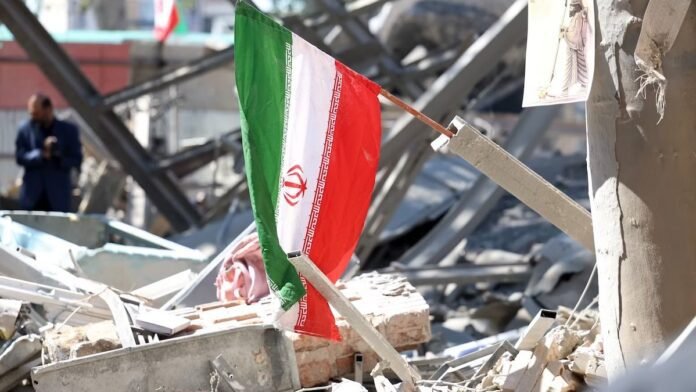
Iran ceasefire deal confirms what we’ve been saying for years: military might doesn’t work

0
iran-ceasefire-deal-confirms-what-we’ve-been-saying-for-years:-military-might-doesn’t-work
Iran ceasefire deal confirms what we’ve been saying for years: military might doesn’t work

What a disaster the war against Iran has been for Donald Trump and Benjamin Netanyahu. The Memorandum of Understanding (MoU) between the United States and Iran signed on June 17 has formally brought a halt to the devastating war. Yet, as the ink dries on the 14-point preliminary framework, the reality of the document stands in stark contrast to the grandiose, megalomaniac rhetoric that defined the start of the conflict.

Only a handful of analysts and scholars that I know of foresaw what is now unfolding, stressing the realities of Iran’s resilience in the face of international pressure for decades. I was one of them: back in 2012, I warned that there could be no military solution to curbing Iran’s nuclear programme and noted that the US not only knew this, but had warned Israel that this would be the case.

When Trump and Netanyahu launched the initial military campaign on February 28, the objective was explicitly stated: the complete destruction of Iran’s nuclear and ballistic missile programme, an end to Tehran’s support for regional proxies such as Hezbollah, the Houthis and Hamas – and regime change. But the text of the MoU reveals a profound pivot from those aims, at least as far as the White House is concerned.

Ultimately, the agreement marks the final collapse of Pax Americana in the Persian Gulf region and highlights the resilience of Iranian state sovereignty against external pressure. At the onset of the war, both Washington and Tel Aviv projected absolute confidence in their military capabilities.

Following initial waves of brutal strikes and a campaign involving more than 900 targets, both leaders repeatedly asserted that the Islamic Republic’s military capabilities were fundamentally broken.

Trump regularly claimed that victory was just around the corner, maintaining – erroneously – that Iran had “nothing left in a military sense”. Weeks into the campaign, he declared that the US military would “destroy their missiles and raze their missile industry to the ground” until it was “totally”, again, obliterated.

Promising the Iranian public that their rulers would soon be gone, Trump insisted he was successfully steering the country toward “regime change”. As the first strikes landed on Iran, he called on the people to rise up and seize control of institutions. Netanyahu echoed these exact sentiments, framing the conflict as a definitive campaign to forcibly reshape the geopolitical architecture of the region.

But intelligence assessments and events on the ground quickly exposed these claims as foolish. Despite severe structural damage, Iran retained its strategic depth, adapting by moving equipment and launching retaliatory drone and missile strikes across the region.

Rather than causing the regime to collapse, the external aggression resulted in a hardening of the state structure.

What’s in the deal

The terms of the MoU demonstrate that Washington was ultimately forced to negotiate with Tehran as an equal sovereign power, rather than a defeated adversary accepting terms of capitulation.

The agreement directly contradicts the initial war aims of the US-Israeli coalition across three major pillars. First, the framework explicitly binds the US to respect Iran’s territorial integrity and abstain from internal interference.

For an administration that spent months demanding regime change, this clause serves as a legal acknowledgment of the Islamic Republic’s permanence. It calls to mind the Algiers accords of 1981, when the US agreed to the unfreezing of Iranian assets and non-intervention in Iran’s affairs in return for 52 American hostages held since the revolution in 1979.

Faced with the reality of an intact Iranian government, Trump reversed his rhetoric at the G7 summit. Claiming that “I never cared about regime change”, the US president pivoted to describing the new Iranian negotiators as “rational, strong, and smart”.

The MoU also mandates the immediate lifting of the US naval blockade and the implementation of emergency Treasury Department waivers to allow the resumption of Iranian crude oil exports. It also signals the unfreezing of up to US$100 billion (£75 billion) in restricted Iranian assets and the creation of a $300 billion international reconstruction fund for economic development.

From a critical perspective, this demonstrates that economic blockades are ultimately unsustainable when met with asymmetrical regional deterrence. Again, this should not have been new to the US government – it’s something that we have researched and written about for years.

As I argued as early as in 2011 on a flagship show on Al Jazeera, sanctions, gunboat diplomacy and even war don’t work. Iranian society is too connected and the economy and the state too agile. And, as we now know, Tehran’s threat to close down the vital Strait of Hormuz waterway, should have been seen by Iran’s adversaries as a potent deterrent. Hopefully, decision-makers will learn their lessons from this ill-fated war.

Indeed, perhaps the most notable aspect of the MoU is what it leaves out. There is no mention of Iran dismantling its ballistic missile programme. Nor is there a requirement for Iran to sever ties with its regional proxies. Additionally, the ceasefire explicitly covers “all fronts,” effectively mandating a halt to hostilities in Lebanon – a point of major friction for the Israeli prime minister, Benjamin Netanyahu, who has vowed to maintain an Israeli security zone in the south.

Geopolitical shift

So this deal indicates a structural shift in regional politics. By launching a high-intensity campaign and failing to achieve either the destruction of Iran’s military capabilities or the toppling of its government, the US and Israel have inadvertently demonstrated the limits of their military power. No propaganda by lobbyists and diasporic pro-war monarchists can change the hard truths of scientific inquiry.

The world is transitioning rapidly into an increasingly non-polar, certainly post-western order. The MoU will stand as a historical marker where the rhetoric of superpower might surrendered to the practical necessity of diplomatic accommodation.

And yes: we’ve been predicting this for a long time, too.

Refugee numbers dropped in 2025 – but aid cuts and others trends suggest little to celebrate

0
refugee-numbers-dropped-in-2025-–-but-aid-cuts-and-others-trends-suggest-little-to-celebrate
Refugee numbers dropped in 2025 – but aid cuts and others trends suggest little to celebrate

There was surprisingly good news when the United Nations refugee agency, UNHCR, released its latest report on June 10: The number of displaced people in the world fell in 2025 for the first time in a decade.

But there are some serious caveats. Many of the people who returned home in 2025 did so to countries such as Syria, still recovering from more than a decade of war, and Afghanistan, with its humanitarian emergency and repressive Taliban rule.

Conflict in the Middle East has added even more strain, with an extra 3.2 million people temporary displaced in Iran and more than 1 million forced from their homes in Lebanon at the peak of fighting. Meanwhile, in Sudan an increasingly protracted civil war forces families from their homes on a daily basis.

Moreover, as we prepare to mark World Refugee Day on June 20, there is a backdrop that is deeply worrying to experts in migration and development: As the world walks away from the way the humanitarian system has long been financed without a new structure to replace it, refugees are the ones being left in the lurch.

Nearly one year has passed since the Trump administration officially shuttered the U.S. Agency for International Development, or USAID, slashing humanitarian budgets, canceling contracts and laying off 16,000 employees. The cuts – alongside reduced funding from European governments – have thrown the humanitarian system that supports more than 100 million displaced individuals into crisis.

In parallel, the Trump administration has pressured at least 30 countries into signing new migration deals. This has seen underresourced countries accept deportees from the United States – often people who are not even the countries’ own nationals – in exchange for aid.

As experts in migration and development, we have published three books on how and why governments of Global North countries contribute humanitarian aid.

The latest cuts and tit-for-tat deals signal a shift in how the world supports refugees. We believe rich countries are now in a race to the bottom, looking for ways to reduce spending and erase their human rights commitments.

A cliff edge for aid

The closure of USAID has had the largest global reverberation: a decline in expenditures from US$8 billion in 2024 to $5.8 billion in 2025, with future obligations also falling from $9.2 billion to $3.5 billion. But this is not just a U.S. story. The United Kingdom cut $1 billion in 2021 and never restored those funds, and Germany’s humanitarian spending declined by 76% between 2022 and 2025.

The global drop in aid has acutely affected refugee-related funding. The U.S. State Department’s Migration and Refugee Assistance spending declined from $4.6 billion in the 2024 financial year to $3.2 billion the following year, and obligations fell from $5.7 billion to $2.9 billion.

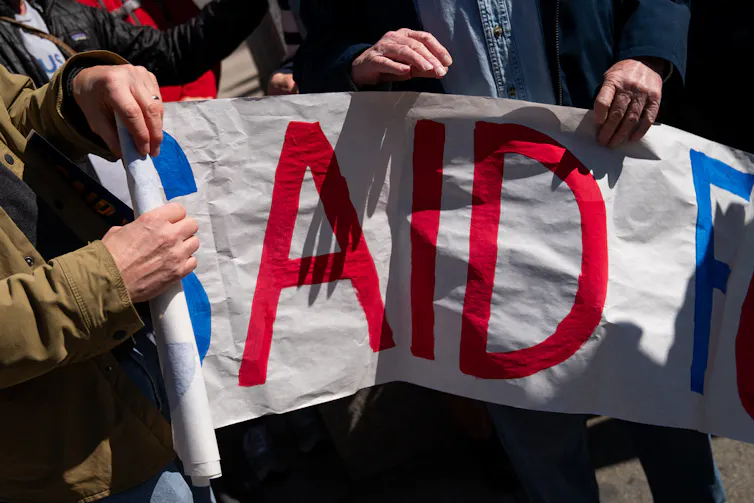
Protesters unfurl a banner.

Former USAID staff and supporters rally in protest of the agency’s dismantlement. AP Photo/Allison Robbert

For its part, UNHCR’s 2026 budget was set at $8.5 billion, a 20% reduction compared to 2025 – largely attributable to U.S. cuts. This has led to a deliberate strategic shift in how UNHCR operates. The organization has closed, merged or downsized field offices, with 185 out of 550 offices affected and more than 5,200 UNHCR staff losing their jobs – approximately 25% of its global workforce.

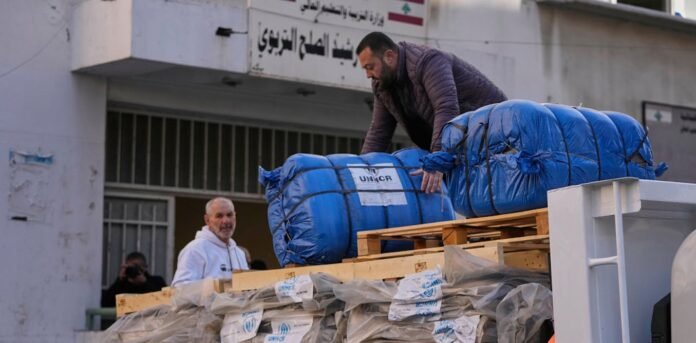
For refugees, this has a very tangible impact. For example, in Lebanon – a major refugee-host country that has also experienced mass internal displacement off and on since 2023 as a result of war with Israel – about 80,000 refugees lost shelter-related financial aid in 2025, increasing risks of eviction and homelessness.

Reset and hyperprioritization

Anticipating the global plummeting of aid, the Inter-Agency Standing Committee – the U.N.’s body for coordinating global aid responses – announced a humanitarian reset in March 2025 seeking to reorganize how aid is delivered through a lighter footprint and the pooling of resources.

Once the global aid cliff became a reality, U.N. agencies in June 2025 announced a reformulated policy of hyperprioritization to identify which populations were most at risk. “We have been forced into a triage of human survival,” Tom Fletcher, the undersecretary-general for Humanitarian Affairs and Emergency Relief coordinator, said at the time.

Concretely, this meant that the U.N. aimed to support 114.4 million people with lifesaving assistance in 2025 – just 38.3% of the 298.9 million people it identified as in need of humanitarian aid.

For UNHCR and the International Organization for Migration, the humanitarian reset has also meant focusing on a “route-based approach,” which encompasses facilitating political dialogue, building capacity and providing support to countries along the entirety of a migration route.

This partly entails protection for refugees but also promotes border security and even migrant returns. Critics have argued that the approach serves the priorities of rich donor countries that prefer to stop migration earlier in a migratory route, even when the migration in question is forced rather than voluntary.

Aid as migration control

While more recent aid cuts have and will continue to hurt refugees acutely, this new approach draws on a two-decade trend of countries leveraging aid to control migration.

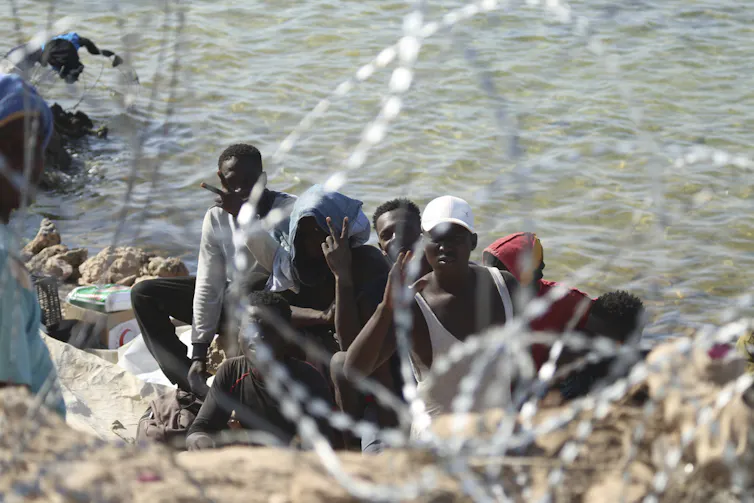
People gather by a shore with barbed wire in the foreground.

Migrants gather in an area near the Libyan-Tunisia border, as Libyan security forces and Libyan Red Cross workers distribute food aid to them. AP Photo/Yousef Murad

This policy of migration management aid, which includes support for refugees but also any funding used to control the movement of people, increased more than 1,000% from 2002-2022. Our estimates show that migration management aid amounted to $73 billion from 2002-22 and was often used to keep refugees and migrants in poorer countries at the periphery of the international system.

Our forthcoming book, “Aiding Autocrats,” explains how this type of aid goes toward supporting migrants and refugees in developing countries and is also spent on border control and state security that forces – rather than incentivizes – people to stay put.

This type of funding further entrenches what scholars have termed the “grand compromise,” whereby rich states pay for the aid for the majority of the world’s refugees, to be hosted in the Global South, as long as those hosting states prevent their onward movement. This unequal setup ensures that migrants and refugees remain contained in the countries least equipped to host them, which only works when aid functions as the grease that keeps the system hobbling along.

Building the capacity of governments, especially authoritarian ones, to manage migration and contain refugees is not an inherent global good. Indeed, our book shows that it leads to serious negative consequences and human rights violations. Funding that is distributed to governments or organizations working in repressive countries carries the grave risk of empowering security actors that not only impinge on the rights of refugees but also those of citizens.

Global aid will likely never return to its pre-pandemic level, but we think what is left – particularly after the aid cliff of 2025 – should be spent saving lives and responding to refugees’ needs, not preventing migration or facilitating returns.

On World Refugee Day, it’s worth recognizing that aid is a critical, lifesaving tool that helps refugees temporarily survive and, sometimes, permanently rebuild their lives. Humanitarian aid for refugees should be justified for its impact, independent of whether it prevents emigration or convinces countries to accept deportees.

Iran War cost US consumers $53 billion extra in raised gas prices

0
iran-war-cost-us-consumers-$53-billion-extra-in-raised-gas-prices
Iran War cost US consumers $53 billion extra in raised gas prices

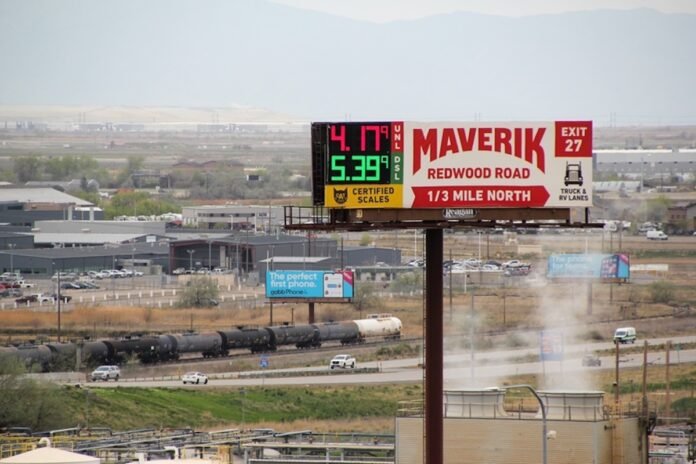
Gas prices are displayed on a billboard in North Salt Lake, Utah, USA, on Tuesday, March 31, 2026. Photo: McKenzie Romero / Utah News Dispatch

President Donald Trump said on Wednesday that if his war in Iran continued much longer, the US could have faced “economic catastrophe” with gas prices expected to soar as emergency oil reserves were exhausted.

But new reports suggest that although the war appears to be coming to an end and the Strait of Hormuz is reopening, extraordinary irreversible damage has been done already, and the economic consequences will be felt well into the future.

The Institute on Taxation and Economic Policy (ITEP) estimates that as a result of the war, Americans have paid nearly $54 billion extra for gas and fuel, amounting to more than $400 per household, than if the war had never started.

In the wake of the memorandum of understanding signed between the US and Iran, Trump has tried to claim credit as average gas prices have fallen below $4 for the first time since the early days of the war in March. However, gas still costs 25% more than it did last year.

This state of affairs can be expected to continue into the future. As The Associated Press reported Thursday morning:

Even as gas prices start to decline, it is anticipated to take weeks or months for oil to start flowing through the Strait of Hormuz again…

And Gulf oil producers that throttled back production will need time to get the oil moving again. Analysts also say ship captains may take their time to decide if passage is safe and that the threat of attack from Iran has truly receded.

In addition, refineries typically pay for crude oil a month or more in advance, so even after oil prices drop, they won’t immediately be processing cheaper products.

Fighting over the Strait of Hormuz disrupted not only supplies of crude and refined fuel but also the supply chains for fertilizer, food, and even footwear. Businesses expect higher costs to linger, which means their customers might need to prepare for that too.

Patrick De Haan, a petroleum analyst at GasBuddy, told CBS News it will be “a very long, multi-month to multi-year process for things to fully normalize,” and that it could take “until potentially mid-to-late 2027” for gas prices to return to pre-war levels.

Even as Americans, and indeed consumers around the world, continue to see their pocketbooks drained in the coming months, there is one big winner here: the fossil fuel industry.

An analysis released on Thursday by the environmental group 350.org shows that over the course of the war, households and businesses have paid the oil and gas industry an additional $374 billion in profits due to higher prices driven by the war.

Based on pricing scenarios from the International Monetary Fund, the group projected that even with the Strait of Hormuz open, the amount siphoned off could balloon to over $700 billion by the end of the year.

“Even if the Strait of Hormuz reopens tomorrow, we should expect prices to remain above pre-crisis levels,” said Andreas Sieber, 350.org’s head of political strategy. “We witness not only a massive fossil fuel crisis but a vast upward transfer of wealth built on instability of fossil fuel markets and pain.”

-Common Dreams

The first long-duration resident of the ISS, a cosmonaut, has died

0
the-first-long-duration-resident-of-the-iss,-a-cosmonaut,-has-died
The first long-duration resident of the ISS, a cosmonaut, has died

Russian cosmonaut Aleksandr Samokutyaev, who served twice as a crew member aboard the International Space Station (ISS), including during the final US space shuttle mission in 2011, has died at the age of 56.

With Samokutyaev’s death on Wednesday, he becomes the first former ISS long-duration resident to die in the 26 years that the space station has been a home to 155 other cosmonauts and astronauts as expedition crew members. The cause of his death is unknown.

Portrait of cosmonaut Aleksandr Samokutyaev.

Portrait of cosmonaut Aleksandr Samokutyaev. Credit: Roscosmos

“The leadership and staff of the Roscosmos State Corporation extend their sincere condolences to the family and loved ones of Aleksandr Mikhailovich,” officials with Russia’s space agency said in a statement.

Samokutyaev joined the cosmonaut corps in 2003. Two years later, after his basic training, he qualified for spaceflight assignments.

To ISS and back, twice

He launched for the first time on April 4, 2011, flying as the commander of Soyuz TMA-21 with flight engineers Andrey Borisenko from Roscosmos and NASA astronaut Ron Garan. Their spacecraft was named Gagarin in honor of the world’s first human in space, who had lifted off 50 years earlier from the same launch site at the Baikonur Cosmodrome.

Samokutyaev served as a flight engineer on the space station’s 27th and 28th expedition crews. In addition to Borisenko and Garan, he worked with Dmitri Kondratyev of Roscosmos, Cady Coleman of NASA, and Paolo Nespoli of ESA (European Space Agency) for about a month and Sergey Volkov of Roscosmos, Mike Fossum with NASA, and Japan Aerospace Exploration Agency (JAXA) astronaut Satoshi Furukawa for the second part of his stay.

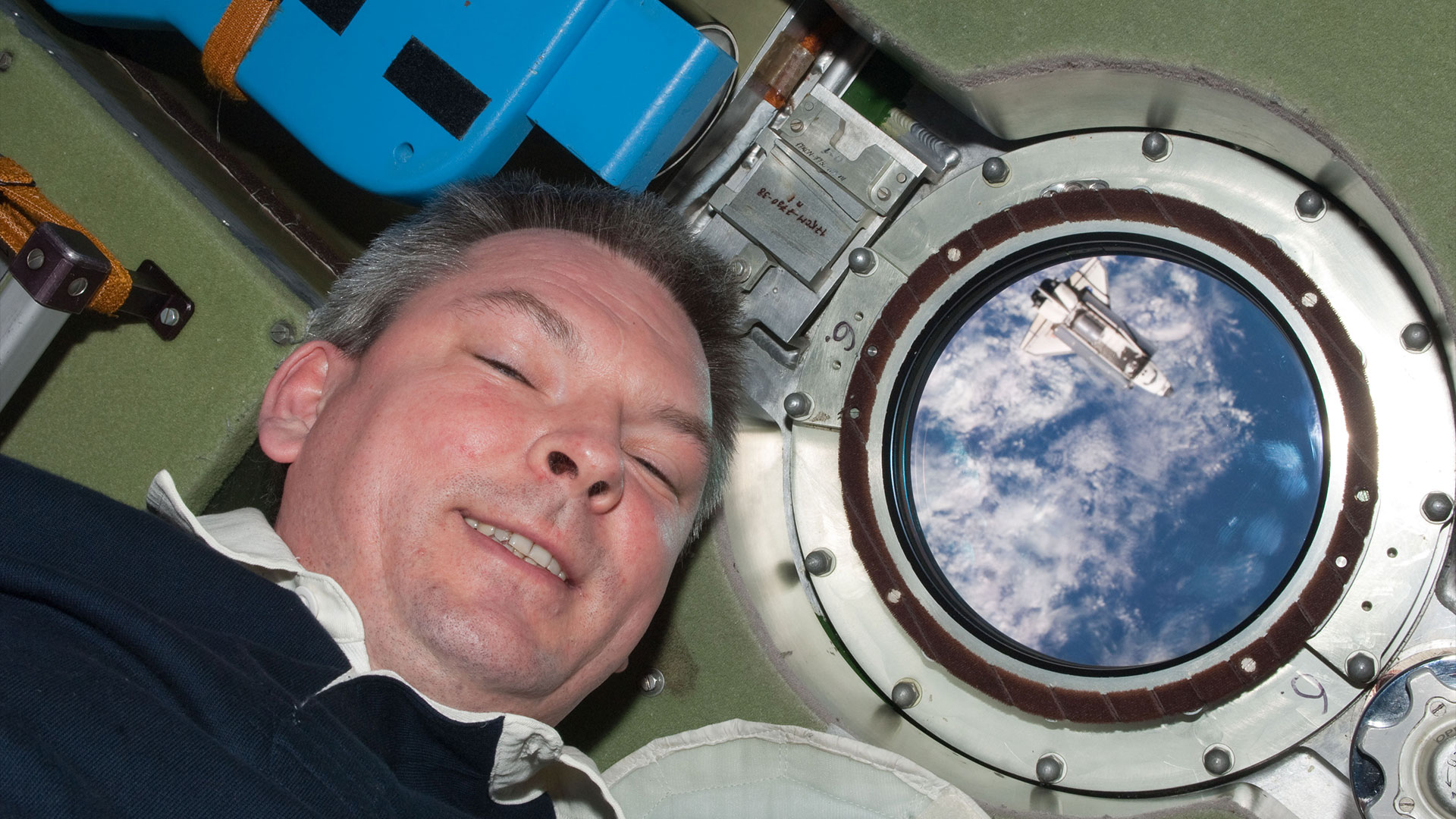
Aleksandr Samokutyaev, Expedition 28 flight engineer, in the International Space Station’s Zvezda service module with a view of space shuttle Atlantis outside the window during the STS-135 mission on July 12, 2011.

Aleksandr Samokutyaev, Expedition 28 flight engineer, in the International Space Station’s Zvezda service module with a view of space shuttle Atlantis outside the window during the STS-135 mission on July 12, 2011. Credit: NASA

On July 10, 2011, the US space shuttle Atlantis arrived at the space station, and for nine days, the four STS-135 astronauts joined Samokutyaev and his Expedition 28 colleagues aboard the orbiting laboratory. Not only was it the last time that a shuttle would visit the ISS, but it was the final mission of the 30-year program.

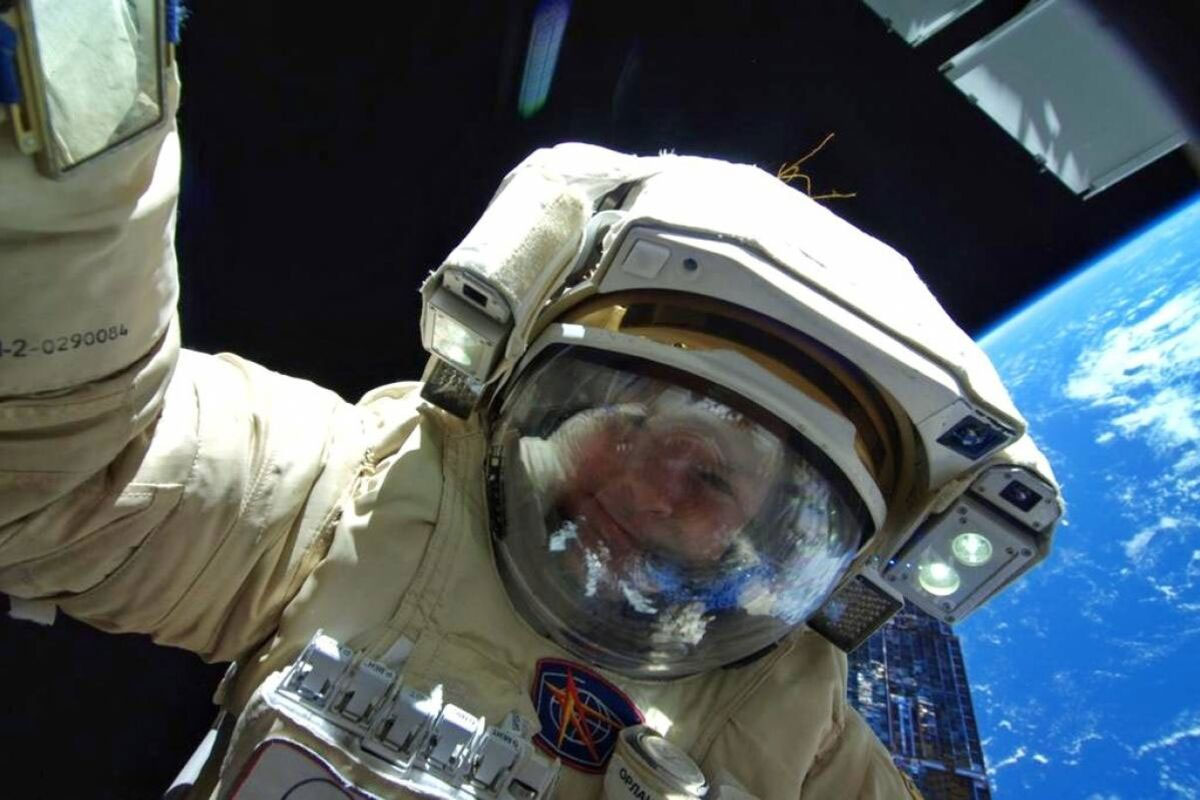
On August 3, 2011, Samokutyaev performed his first spacewalk, venturing outside of the ISS with Volkov to relocate equipment, install a materials science experiment, and hand-deploy a micro-satellite.

After 164 days in Earth orbit, Samokutyaev returned to Earth on Soyuz TMA-21 with Borisenko and Garan, landing safely on the steppe of Kazakhstan.

Cosmonaut Aleksandr Samokutyaev on his first spacewalk outside of the International Space Station on August 3, 2011.

Cosmonaut Aleksandr Samokutyaev on his first spacewalk outside of the International Space Station on August 3, 2011. Credit: Roscosmos

Samokutyaev returned to the ISS three years later, this time with Elena Serova—one of only two female cosmonauts in Roscosmos’ corps at the time and only the fourth to fly into space—and NASA astronaut Barry “Butch” Wilmore on board Soyuz TMA-14M. Samokutyaev spent about two months as an Expedition 41 flight engineer, sharing the space station with cosmonaut Max Surayev, NASA astronaut Reid Wiseman (later of Artemis II fame), and ESA astronaut Alexander Gerst from Germany.

On October 22, 2014, Samokutyaev went outside for his second career spacewalk, working with Surayev to jettison unneeded equipment and conduct a detailed photographic survey of the station’s Russian segment exterior. In total, Samokutyaev logged 10 hours and one minute on his two spacewalks.

Samokutyaev then transferred with Serova and Wilmore onto the Expedition 42 crew, working with his 2003 cosmonaut classmate Anton Shkaplerov, as well as NASA astronaut Terry Virts and ESA astronaut Samantha Cristoforetti from Italy. The three returned to Earth on March 11, 2015, adding 167 days to Samokutyaev’s time in space for a total of 331 days, 11 hours, and 23 minutes.

Samokutyaev was the 518th person to enter orbit and the 527th to fly above 50 miles (80 km), according to the Association of Space Explorers’ Registry of Space Travelers.

From pilot to politician

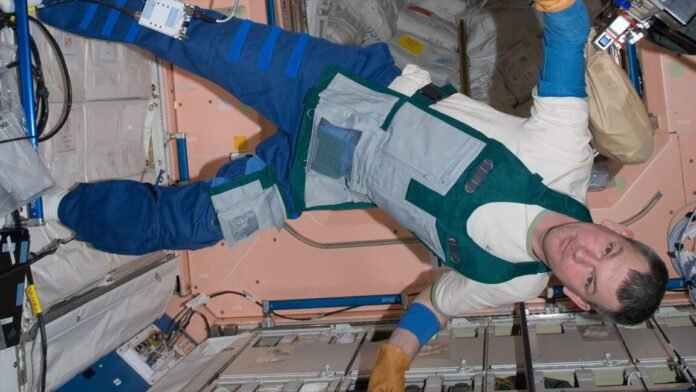
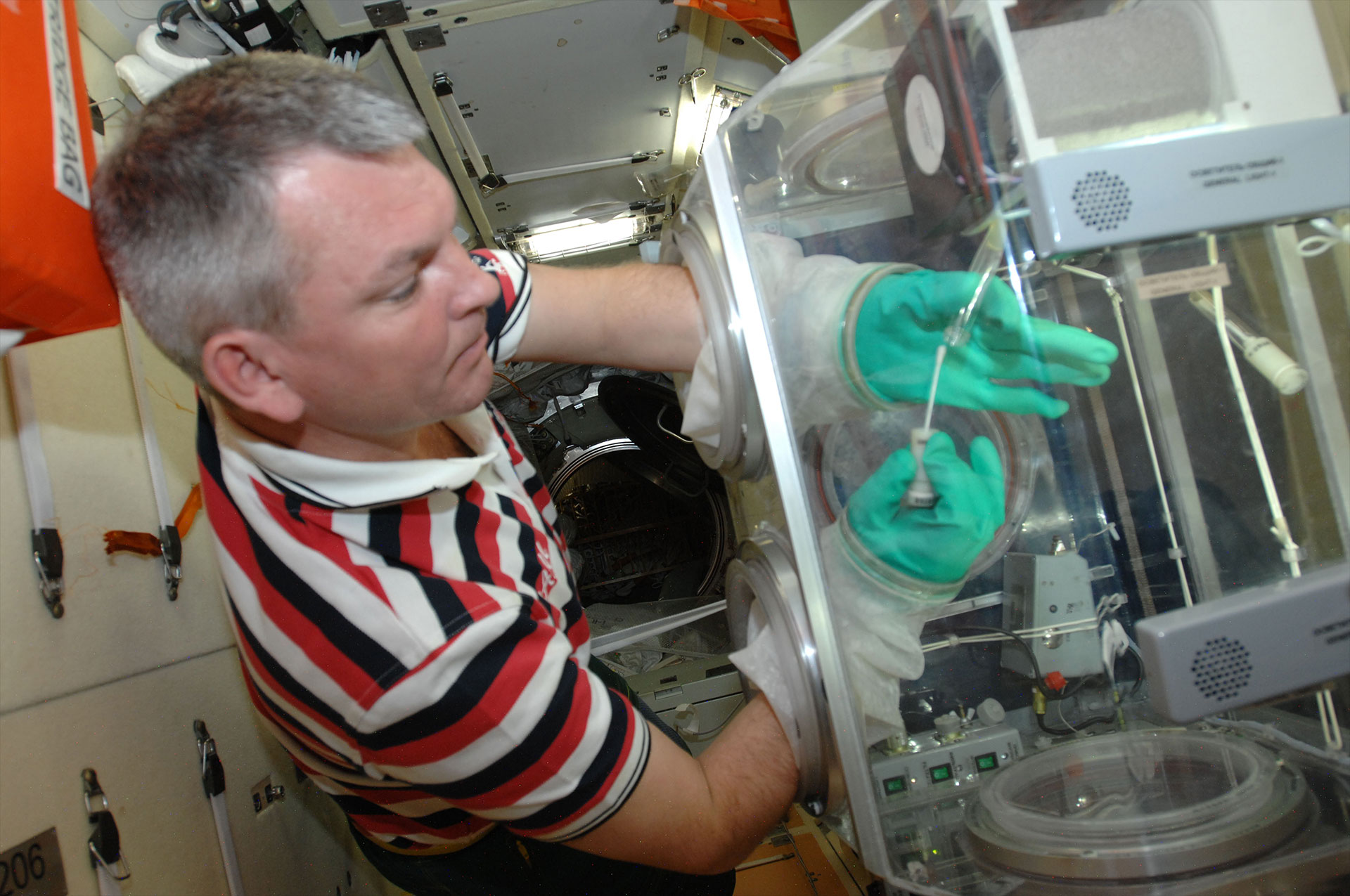
Aleksandr Samokutyaev, Expedition 41 flight engineer, works with test samples in a microgravity science glovebox in the Poisk mini-research module of the International Space Station.

Aleksandr Samokutyaev, Expedition 41 flight engineer, works with test samples in a microgravity science glovebox in the Poisk mini-research module of the International Space Station. Credit: NASA

Aleksandr Mikhailovich Samokutyaev was born on March 13, 1970, in the city of Penza, Russia. He graduated from the Yuri Gagarin Air Force Academy in 2000 and flew as a pilot, senior pilot, and deputy squadron commander in the Russian Air Force before being selected to train as a cosmonaut.

Prior to his first launch, Samokutyaev trained as a member of the Expedition 23/24 backup crew. Similarly, he served on the Expedition 41/42 backup crew before his second mission.

In 2017, an interdepartmental commission recommended that Samokutyaev be dismissed from being an instructor and the deputy commander of the cosmonaut corps, reportedly due to medical concerns. Two years later, he graduated with honors from the Russian Presidential Academy of National Economy and Public Administration and, taking up a new career as a politician in 2021, was elected as a deputy to the State Duma of the Russian Federation.

“Alexander Mikhailovich Samokutyaev did much to glorify our Penza region and improve the lives of people in his native region. His fond and cherished memory will forever remain in our hearts,” the regional government wrote in an obituary posted to its website.

For his service to the Russian space program, Samokutyaev was awarded the title of Hero of the Russian Federation, receiving the Gold Star medal and the honorary title of Pilot-Cosmonaut of the Russian Federation. He also received the Order “For Merit to the Fatherland” (4th Class), medals from the Ministry of Defense of the Russian Federation, and departmental awards from Roscosmos.

Samokutyaev is survived by his wife, Oksana Nikolaevna, and daughter, Anastasia Aleksandrovna.

Moscow hit by largest Ukrainian attack since start of Russia’s full-scale war

0

Moscow has come under the largest Ukrainian attack since the start of the full-scale war, with close to 200 drones hitting targets around the Russian capital and setting columns of thick smoke billowing high into the sky. Seventeen people were wounded in the Moscow region, according to local governor Andrei Vorobyov. Meanwhile, Russia launched more […]

The Boomerang: How America’s Semiconductor War Backfired

0
the-boomerang:-how-america’s-semiconductor-war-backfired
The Boomerang: How America’s Semiconductor War Backfired

There is an ancient Chinese proverb that Washington strategists should have remembered: When you shoot an arrow of revenge, dig two graves.” They didn’t listen. And now we are watching the most spectacular economic boomerang in modern history.

Three years ago, the United States launched what its architects called the “nuclear option” against China. They banned the export of advanced semiconductors. They blocked the machines that manufacture them. They told Beijing: your technological future ends here. In the halls of the Pentagon, there was a quiet celebration. The thinking was seductive in its simplicity. Without American chips, China’s artificial intelligence revolution would die. Its economy would stagnate. Its military would fall behind.

The CEOs of major American tech giants are no longer toasting their government’s resolve. They are rushing to Washington with a message that is equal parts urgent and humiliating: the sanctions didn’t kill China. They are killing us.

Roman Emperor Marcus Aurelius wrote that “our life is what our thoughts make it”. Washington’s thoughts, in this case, were dangerously wishful.

READ: Israel allocates over $40M to regain support among US conservatives: Report

To understand the magnitude of this miscalculation, you need to grasp one structural reality that policymakers chose to ignore: Silicon Valley’s business model does not merely depend on China. It is, in critical ways, built on China. Companies like Nvidia invest billions annually in research and development. China accounts for more than half of the world’s semiconductor production. For Nvidia alone, China accounted for between 20 and 30 percent of total revenue.

When the Biden administration banned the sale of advanced chips to Beijing, it didn’t just wound a rival. It effectively confiscated thirty percent of Silicon Valley’s income and set it on fire.

The arrogance is not without precedent. Remember the spectacular Russian energy sanctions fiasco? Europe convinced itself that cutting off Russian gas would bring Moscow to its knees. Instead, Russia pivoted east, selling to India and China, while European factories bled out under the weight of energy costs they could no longer absorb. The pain landed in the wrong capital. Washington is now running the identical play with semiconductors, apparently hoping for a different result. That is not an intelligent strategy. That is a reckless repetition.

But the deeper catastrophe has nothing to do with lost quarterly earnings. It is structural, and it may be permanent.

When you deny a superpower access to a critical technology, you do not force surrender. You force invention. The United States had constructed what economists might call a “golden handcuffs arrangement.” As long as China could purchase high-quality American chips cheaply and reliably, Beijing had every incentive to remain dependent. Dependency, managed correctly, is leverage. It is control without confrontation. Washington held that control for decades and chose to detonate it in a single regulatory announcement.

China went cold turkey. And cold turkey, for a nation with Beijing’s capital reserves and state direction, does not mean withdrawal. It means mobilization.

READ: China, Saudi Aramco discuss energy security, oil and gas cooperation

The results are arriving faster than anyone in Washington projected. Chinese firms, led by Huawei and a constellation of state-backed foundries, have made advances in domestic chip design and production that Western analysts, as recently as 2022, considered five to eight years away. The sleeping giant has awakened. But this time, it was Washington that set the alarm.

Carl Jung observed that “thinking is difficult, which is why most people judge instead.” The semiconductor ban was a judgment call dressed up as a strategy. It felt decisive. It telegraphed toughness. It satisfied a domestic political appetite for confrontation with Beijing. What it lacked was a second-order analysis of the most obvious question in economics: what does a $17 trillion economy do when you cut off its supply of a critical input? It builds its own.

The bind Washington now faces is genuinely uncomfortable. Reversing the sanctions would be read, correctly, as a strategic retreat. Maintaining them accelerates the very Chinese self-sufficiency they were designed to prevent, while bleeding the American companies that fund the next generation of innovation.

There is no clean exit. There is only the management of a wound that did not need to be self-inflicted.

The famed poet philosopher Rumi wrote that “the quieter you become, the more you are able to hear.” Had Washington listened more carefully to its own economists, its own chip executives, its own historians of sanctions policy, it might have heard what was obvious in retrospect. Coercive dependency only works when the dependent party has no credible alternative. China always had one. It was called necessity.

The greatest strategic miscalculation of the twenty-first century was not made in Beijing. It was made in Washington by officials who confused punishment with power and who forgot that empires that dictate terms must first ensure they are not the ones who need the deal.

The arrow has been shot. Both graves are being dug.

OPINION: Trump’s strategic mistakes in his war against Iran

The views expressed in this article belong to the author and do not necessarily reflect the editorial policy of Middle East Monitor.

Hunter-gatherers in Siberia died of a plague outbreak 5,500 years ago

0
hunter-gatherers-in-siberia-died-of-a-plague-outbreak-5,500-years-ago
Hunter-gatherers in Siberia died of a plague outbreak 5,500 years ago

Plague swept through groups of hunter-gatherers in southeastern Siberia 5,500 years ago, leaving dozens dead in its wake—with DNA from Yersinia pestis bacteria still trapped inside their teeth.

University of Oxford ancient DNA researcher Ruairidh Macleod and his colleagues recently sequenced the telltale bacterial DNA in teeth from plague victims at four ancient cemeteries in the area around Russia’s Lake Baikal. The tragedy that befell these communities is now the earliest known plague outbreak, courtesy of the oldest strain of Y. pestis ever sequenced.

Unearthing a new backstory for the plague

Until recently, scientists who study the evolution of diseases have held two fairly solid ideas about the origins of plague, the disease caused by Yersinia pestis bacteria. It’s a scourge so awful that it has gone down in history as not just a plague but the plague. The first idea is that the earliest strains didn’t have the right genetic traits to be really lethal. And the second is that the plague first began menacing humans when the first farmers settled in densely packed towns alongside rats and domestic animals.

But the dead of Ust’-Ida I cemetery, near Lake Baikal, tell a very different story.

“Our findings demonstrate that the earliest known outbreaks of plague occurred in prehistoric hunter-gatherers centuries before infections are observed in Neolithic farmers,” wrote Macleod and his colleagues in their recent paper.

That challenges our previous assumption that plague spillover was a side effect of people taking up farming and settling in permanent villages and towns, living closer to each other and to an assortment of animals (and their fleas).

“Much of the accepted theory around epidemiology of disease in the past is that this kind of thing shouldn’t occur in hunter-gatherers because hunter-gatherers are constantly moving around the landscape because they’re in such small groups all the time,” said Macleod in a press conference. “The theory, at least, is that infectious disease can’t really take hold and devastate entire communities in this way.”

So much for that theory.

Welcome to the world’s first plague cemetery

The Angara River flows from the depths of Lake Baikal. The people who lived along it thousands of years ago survived by hunting, foraging, and fishing. They would have lived in relatively small groups, but they seem to have stayed connected across hundreds of kilometers through marriage and family ties. Although their lifestyle would have been one of constant movement, they buried their dead in cemeteries such as Ust’-Ida, interring them with offerings of clay pots, stone tools, and bone and antler points.

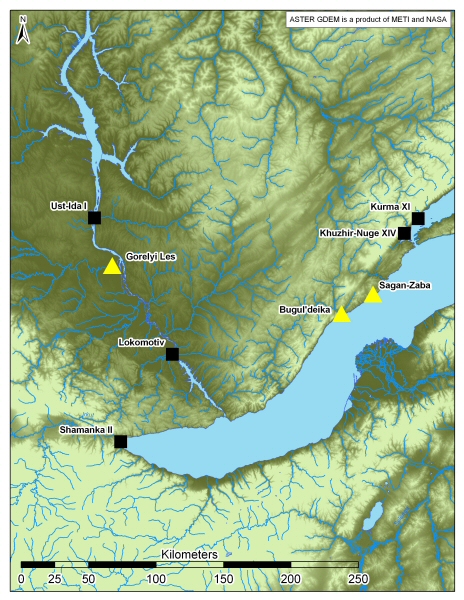
a map showing the location of archaeological sites near Lake Baikal

This map shows the location of Ust’-Ida I and Shumilikha cemeteries near Lake Baikal and the Angara River

This map shows the location of Ust’-Ida I and Shumilikha cemeteries near Lake Baikal and the Angara River Credit: By Tara Young, taray@ualberta.ca and NASA https://wist.echo.nasa.gov/api/ – NASA’s freely offered GDEM https://wist.echo.nasa.gov/api/, Public Domain, https://commons.wikimedia.org/w/index.php?curid=21156871

At Ust’-Ida, archaeologists with the Baikal Archaeology Project unearthed a grim mystery: an unusually high number of dead children, a cluster of radiocarbon dates suggesting that many of the cemetery’s occupants died at around the same time, and no evidence of violence. Something tragic happened to this ancient hunter-gatherer community, but what? Archaeologists thought ancient DNA might shed some light on the mystery.

Macleod and his colleagues started with shotgun sequencing, a technique used to identify the DNA sequences in a sample when scientists don’t know exactly which organisms they’re looking for. They used samples from the roots of 46 ancient people’s teeth from four different cemeteries along the Angara River.

And to their complete surprise, they found plague.

Fun fact: Because dental roots are fed by lots of blood vessels, anything in your bloodstream is likely to pass through your teeth at some point, which means if you die with the plague, it may leave its DNA behind in your teeth. “This is really cool evidence that the plague was in the bloodstream, which is lethal,” said co-author Frederik Seersholm, a University of Copenhagen ancient DNA researcher who clearly knows a fun fact when he sees one, in a press conference.

About 11 of the 31 people Macleod and his colleagues tested at Ust’-Ida had Y. pestis DNA in their teeth, and Macleod says that’s “consistent with pretty much everybody [in the cemetery] having died of plague,” not just those 11. That’s because the detection rate for plague DNA in the remains at Ust’-Ida matches that at Smithfield’s, a known mass grave specifically for plague victims in London. It’s safe to assume everyone buried there had the plague.

“We really didn’t know what to expect going into this, so it was a complete surprise that we discovered this really, really early evidence for large-scale lethal outbreaks of plague amongst these hunter-gatherer communities at this point in time,” said Macleod in the press conference.

Ancient DNA and future outbreaks

Macleod and his colleagues managed to sequence a full Yersinia pestis genome from at least one of the samples, and it turns out to be the oldest strain of Y. pestis ever sequenced. According to the research, it’s very close to the base of the plague family tree, emerging just a few hundred years after Y. pestis last shared a common ancestor with another bacterium called Yersinia pseudotuberculosis. This ancient plague isn’t quite the one we’re familiar with today or the version that devastated medieval Europe.

This very early version of Yersinia pestis doesn’t have some of the genes that made its descendants so virulent; it’s missing, for example, a gene that produces Yersinia murine toxin, which helps the bacteria survive passing through a flea’s digestive tract on its way from a wild prairie dog to an unlucky hiker. It also lacks the right genes to form buboes (the painful swelling and darkening of the lymph nodes that gives bubonic plague its name). But its genome, not to mention the bodies it left in its wake, reveals that this early strain of Y. pestis was still horrifically deadly and probably deeply unpleasant to have.

“There are really a kind of perfect cocktail of other types of virulence genes that cause it to be so deadly—particularly, unfortunately, for children,” said University of Copenhagen evolutionary geneticist Eske Willerslev during the press conference.

Understanding that perfect cocktail could be useful for battling modern epidemics, despite this strain of Y. pestis being so different from the ones circulating now in North America and Asia.

“What it gives you is an idea of which mutations in combination {…} are something that survives in nature,” said Willerslev. Because any combinations of features that work well tend to reappear (in the same microbe or in a different species), he said, studying ancient bacterial DNA “actually gives you some information on how these pathogens, including the plague, will develop.”

Why did the plague kill so many children?

Bubonic plague spreads through flea bites, but pneumonic plague is a respiratory disease, which spreads in a similar way to the flu or COVID-19, and that seems to be how this early version would have passed from person to person. So we can assume it would have come with respiratory symptoms like cough and difficulty breathing, along with fever. But for children, it probably would have been even worse.

When archaeologists plotted the ages of the dead on a graph, they noticed a sharp peak in children between 7 and 11 years old. Adults older than 20, on the other hand, had the lowest death rate. That lines up with data from plague outbreaks thousands of years later in London, when parish records document local children bearing the brunt of the plague’s death toll.

The Y. pestis genomes that Macleod and his colleagues sequenced offer a clue about why. According to Iversen, the 5,500-year-old strain carries a gene that makes what’s called a superantigenic toxin: a chemical that triggers a dramatic, disorganized overreaction by the immune system. Children are especially vulnerable to this kind of reaction, said Oxford University immunologist Astrid Iversen during the press conference, because their immune systems are still learning how to respond to pathogens.

Telling the story of an ancient outbreak

The outbreak probably started when the bacteria made the leap from an infected marmot (a type of ground squirrel that’s still a common plague carrier in the area) to a single person and then spread like wildfire through several interconnected hunter-gatherer groups along the river. For millennia, people around Lake Baikal have hunted marmots for food and for their fur, and close contact with a plague-ridden marmot can spread the infection. This is how it goes: accidentally inhale a few droplets of blood while skinning your latest kill or eat an undercooked marmot stew, and you’ve just doomed your whole band. And the neighbors.

photo of a furry rodent holding a fruit between its cute little paws and probably also carrying the plague

Why are all the plague reservoirs also things I want to pick up and hug?

Why are all the plague reservoirs also things I want to pick up and hug? Credit: By Stéphane Magnenat – Own work, CC BY-SA 3.0, https://commons.wikimedia.org/w/index.php?curid=7566004

That scenario is supported by the fact that people at Ust’-Ida carried the same strain of plague as those buried 37 kilometers away at another cemetery, Shumilikha, which is what epidemiologists would expect to see if they were part of the same outbreak. The burial customs at the two cemeteries suggest they belonged to different subcultures within the wider Isakovo tradition, but DNA from the plague victims reveals threads of kinship connecting them—and the plague may have made those threads deadly.

Macleod and his colleagues sequenced the DNA of the plague victims, piecing together how they were related and (through radiocarbon dating) when each member of the family died. That data revealed that the plague seemed to have spread among family members, often killing several at close enough to the same time that siblings often share graves.

“The incidence of detected infections among co-buried kin… would be consistent with the transmission of plague among humans, particularly via pneumonic transmission in the scenario of concurrent deaths,” wrote Macleod and his colleagues.

Or as Macleod put it during the press conference, direct spread between people makes a lot more sense than “an outlandish scenario that absolutely everybody got together at the same time and ate the same infected marmot.”

At Ust’-Ida, a young boy shares a grave with his aunt; both had Yersinia pestis in their bloodstreams when they died. The aunt also has a teenage niece buried nearby in a grave alongside a teenage boy who isn’t biologically related to her (it’s hard to tell if they were adopted siblings or cousins, a couple, or just close friends). And the boy’s father is buried nearby in yet another grave.

“It’s so obvious from the way people are buried… that somebody was around to bury the dead that knew who these people were when they were alive,” said Macleod. “And that adds a really really human element to the scientific work that we’ve done, seeing the impact on communities and how these communities responded to this very tragic set of events.”

Nature, 2026 DOI: 10.1038/s41586-026-10540-5 (About DOIs).

Donald Trump’s popularity is at an all-time low. History says that matters

0
donald-trump’s-popularity-is-at-an-all-time-low.-history-says-that-matters
Donald Trump’s popularity is at an all-time low. History says that matters

In his first term of office Donald Trump achieved the lowest average job approval ratings (41%) among Americans since the end of the second world war. In his second term he has fallen well below that with an approval rating of only 35% in a recent Economist/YouGov poll.

Much of this can be explained by voter perceptions of the state of the US economy. The chart below shows the relationship between the percentage of Americans who approve of the president’s handling of his job and consumer confidence. It covers almost 50 years of monthly data with the consumer confidence data coming from surveys conducted at the University of Michigan.

Presidential approval and consumer confidence in the US, 1978 to 2026

Sources: Gallup Poll archives and University of Michigan, Author provided (no reuse)

The two series track each other closely and so demonstrate a moderately strong relationship with a correlation of 0.44 (If they were unrelated the correlation would be 0 and if they were exactly the same it would be 1). In both cases higher scores denote greater approval and increasing consumer confidence. This confirms the well-known fact that the state of the economy is a big driver of presidential approval.

If we look closely at the consumer confidence index, the average score over the entire period was 84. In the late 1970s Jimmy Carter had low and falling approval ratings and consumer confidence scores. This goes a long way to explaining why he was a one-term president who lost to Ronald Reagan in the 1980 election.

A decade later, when Republican George HW Bush was president between 1989 and 1993, consumer confidence plummeted as an official recession in the US economy was declared in July 1990, leading to declining growth and rising unemployment. The Federal Reserve, which is responsible for US monetary policy, exacerbated a weak financial situation by raising interest rates in order to combat inflation. The result was that Bush senior became another one-term president and lost the 1992 election to his Democrat rival, Bill Clinton (whose campaign motto was famously: “It’s the economy, stupid.”).

However, the largest fall in consumer confidence over this period occurred after the financial crash of 2007-2008, which in turn produced a serious recession and rapidly declining consumer confidence. On this occasion George W Bush was in his second term as US president and his collapsing approval ratings paved the way for the victory of Barack Obama in the 2008 presidential contest.

Finally, when Donald Trump won the presidential election in November 2016, consumer confidence was relatively high. In January 2017 at the time of his inauguration the consumer confidence index stood at 99. Four years later in January 2021 when Joe Biden was inaugurated as president the index was at 79, a dramatic decline in historical terms.

The midterm elections for the House and the Senate take place in November this year and currently things do not look good for the Republicans. Pollsters have been asking what is called a “generic” question in their surveys about who respondents would vote for if the midterm elections took place today. They are virtually unanimous in their agreement that the Democrats will win control of the House of Representatives. In addition, it is possible, though less likely, that the Democrats will win control of the Senate.

A thought experiment

An interesting thought experiment is to suppose that we were looking at a presidential election in November rather than the midterms. What light does the current consumer confidence data throw on such a hypothetical election?

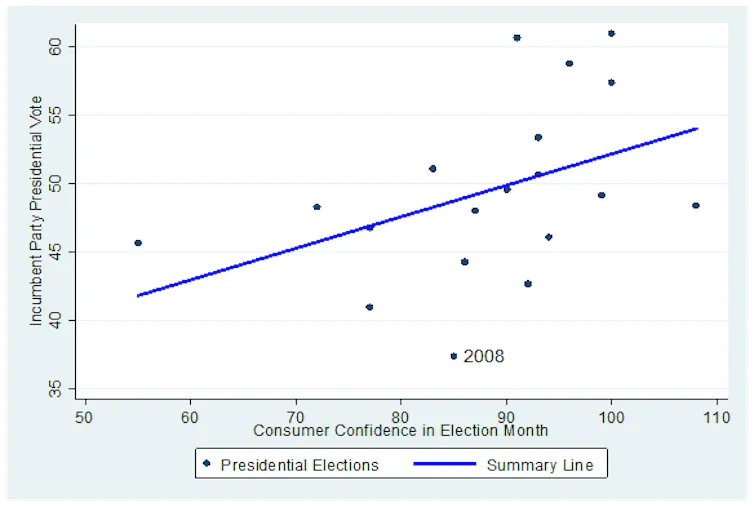
The second chart shows the relationship between voting for the incumbent’s party in the 19 presidential elections since 1978 and consumer confidence in the month of these elections.

Incumbent vote shares and consumer confidence in presidential elections since 1978

Sources: Gallup Poll archives and University of Michigan, Author provided (no reuse)

Once again, the relationship is moderately strong between the two series with a correlation of 0.43. Voters reward or punish the incumbent president or his party’s candidate depending on how they feel about the economy. As we observed in the first chart, the consumer confidence score was at its lowest at 55 in the 2008 election which Obama won. But the score on the index in June 2026 was 49, so – if consumer confidence continues to fall – then in a hypothetical presidential election in November Trump would lose very badly.

This is a thought experiment rather than a prediction of what is likely to happen in the presidential election of 2028. But when the war in the Middle East launched by the US and Israel threatens to produce a global recession it seems unlikely that consumer confidence in the US will improve any time soon.

Trump will not be on the ballot in 2028. But the Republican candidate in that election is likely to take a historical beating if the US and world economies do not improve in the meantime.

Iran gets Trump concessions, empty promises in return for little

0
iran-gets-trump-concessions,-empty-promises-in-return-for little
Iran gets Trump concessions, empty promises in return for little

The leaders of the United States and Iran have signed a 14-point memorandum of understanding to end the war between their countries, as well as Israel’s military assault on Hezbollah in Lebanon.

From the US point of view, the deal leaves a lot to be desired. Washington is giving up a lot for very little in return. President Donald Trump’s claims of success make this feel like an “emperor has no clothes” moment.

There is nothing positive for the US in the agreement that didn’t already exist before the war – including Iran’s very minimal nuclear concessions.

The US is also abandoning a number of partners – most prominently the Persian Gulf countries – but also Israel’s interests and obviously the Iranian people.

With this deal, the US is making promises it has no way of fulfilling, especially when it comes to sanctions relief and unfreezing Iranian assets.

Here is a point-by-point breakdown of some of the promises in the deal and the biggest problems I see with them.

Point 1: Israel’s bombing of Lebanon

The United States and Iran and their allies […] declare the immediate and permanent termination of military operations on all fronts, including in Lebanon.

A big problem here is the deal does not mention Israel or Hezbollah, who are the two parties to that conflict and clearly have not been consulted on this point.

Does “termination of military operations” mean Israel’s military withdrawal from southern Lebanon? This is not likely to happen. Prime Minister Benjamin Netanyahu will not be able to withdraw Israeli troops – for domestic political reasons. A large proportion of Israelis want to keep fighting Hezbollah and, at a minimum, stay in southern Lebanon.

I can see both sides respecting a ceasefire of sorts, but this conflict will definitely flare up again.

Point 5: An open Strait of Hormuz

Iran will make arrangements using its best efforts for the safe passage of commercial vessels with no charge for 60 days only from the Persian Gulf to the Sea of Oman.

This point is really striking – it basically concedes to the Iranian regime that if it just waits 60 days, it can essentially start charging a service fee for traffic going in and out of the strait.

This deal puts Persian Gulf countries and Oman in a really challenging position. They have been under direct attack from Iran, and this agreement does not have any mechanism to guarantee their security going forward.

So, the Gulf countries may well decide it’s worth it to pay Iran a service fee in exchange for their security. For them, it’s better if their oil, gas and fertilizer shipments can get out, even if they are more expensive.

Point 6: A redevelopment plan for Iran

The United States undertakes with regional partners to develop a definitive, mutually agreed plan with at least US$300 billion for the reconstruction and economic development of Iran.

The US itself is unlikely to put money into this fund. But this will be another leverage point for the Iranian regime vis-a-vis Gulf countries (which have been committed here as the “regional partners”). Iran will essentially say to them, You need to fund our reconstruction as per this agreement, otherwise we will block the Strait of Hormuz and attack you again.

The Gulf countries will come out of this war thinking first and foremost of their own territorial security and economic survival. They are likely to decide that the $300 billion reconstruction fund is a better prospect than the continued economic damage Iran can impart by threatening their security again.

The expectations on Gulf countries in this deal put them in a tricky position regarding the US.

On one hand, they need US military protection, so they are not going to overtly distance themselves from the US. But they are likely to try to diversify their partnerships and get closer to China, in particular.

Point 7 and 11: Lifting sanctions and releasing frozen assets

The United States undertakes to terminate all types of sanctions against Iran, including the United Nations Security Council resolutions, IAEA Board of Governors resolutions, and all unilateral US sanctions …. The United States undertakes to make fully available for use the frozen or restricted funds and assets of Iran upon the implementation of this MOU.

The first problematic thing here is that the only sanctions Washington can unilaterally terminate are US sanctions. In addition, it can only release frozen assets that are held in the US, which account for a very small proportion of Iran’s overall frozen assets.

The US has no mechanism to deliver on the rest of the promises here, such as canceling UN Security Council and IAEA sanctions resolutions.

The same goes for frozen assets. The only way for the US to deliver on this would be to pressure its allies through either coercive threats or incentives – and it does not seem there has been any consultation with them before signing this deal.

Point 8: The nuclear question

Iran reaffirms that it shall not procure or develop nuclear weapons. The United States and Iran have agreed to resolve the disposition of stockpiled, enriched material … with the minimum methodology to be down-blending on site under the supervision of the IAEA. The two parties also agreed to discuss the issue of enrichment and other mutually agreed matters related to Iran’s nuclear needs.

What is important here is that pursuing uranium enrichment is not specifically prohibited in this agreement. This implies it was a red line for the Iranian regime – Tehran was not going to give up uranium enrichment for civilian purposes. As a result, the US has not included it in this agreement.

Iran’s broad commitment not to develop a nuclear weapon is something that already existed before the war.

Basically, the only detailed point in this part of the agreement is that it requires the Iranian regime to dilute its existing enriched uranium to secure sanctions relief.

This is not an incredible deal for the US. The US wanted the Iranian regime to give up enriching uranium completely. The deal stipulates the two sides will merely “discuss the issue of enrichment.” And yet, the US is giving up a huge amount in sanctions relief in return.

It’s unlikely more specific details on the nuclear issue will be agreed upon in the next 60 days. If we ever do get to an agreement, which is by no means assured, it would take months at a minimum and is not likely before the end of this year.

Jessica Genauer is academic director of the Public Policy Institute, UNSW Sydney.

This article is republished from The Conversation under a Creative Commons license. Read the original article.

0FansLike
0FollowersFollow
0FollowersFollow
0SubscribersSubscribe
- Advertisement -
Google search engine

Recent Posts