US Senate passes War Powers Resolution rebuking Trump’s Iran war
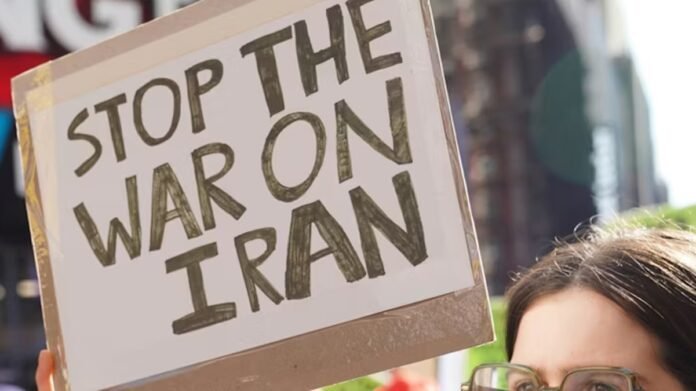
People attend a protest against US-Israeli attacks on Iran in New York on February 28, 2026. Photo: Zhang Fengguo / Xinhua
In a “major bipartisan rebuke” of President Donald Trump’s illegal war on Iran, the US Senate on Tuesday passed a war powers resolution instructing Trump to withdraw US forces from Iran.
The vote was 50 to 48, with four Republicans joining the vast majority of Democrats to approve the resolution that was passed by the US House of Representatives earlier this month.
“The House and the Senate have both stood up,” Rep. Pramila Jayapal (D-Wash.) wrote in celebration of the vote on social media. “It’s time to stop this deadly and costly conflict.”
Republican Sens. Rand Paul (Ky.), Susan Collins (Maine), Lisa Murkowski (Alaska) and Bill Cassidy (La.) voted in favor of the resolution while Democratic Sen. John Fetterman (Pa.) voted against it.
“The vote was 50-48, with four Republicans joining Democrats to say Trump should not be able to keep dragging America deeper into military conflict,” attorney Aaron Parnas wrote on social media. “This is a major bipartisan rebuke of Trump’s foreign policy chaos.”
Anti-war group CodePink wrote, “The will of the people is undeniable: It’s time to permanently end this war of aggression.”
BREAKING: US Senate passes Iran War Powers Resolution by a vote of 50-48.
The resolution demands the removal of US forces from all hostilities against Iran. It’s already passed the House.
The will of the people is undeniable: it’s time to permanently end this war of aggression. pic.twitter.com/27rxceRu81
The vote was a long time coming, as Senate Minority Leader Chuck Schumernoted it was Democrats’ 10th attempt to limit Trump’s ability to wage undeclared war since he unilaterally embroiled the US in a joint attack on Iran with Israel, beginning on February 28.
Schumer criticized the majority of Republicans for repeatedly failing to vote against the war, which he said would “go down in the history books as one of the worst foreign policy forays America has ever made,” according to The Associated Press.
Sen. Chris Van Hollen (D-Md.) wrote on social media: “Congress finally passed a war powers resolution to stop Trump’s illegal war in Iran. It has been a disaster from the start. End it now.”
The vote made history by being the first time both the House and Senate have passed a concurrent resolution calling for an end to a conflict since the War Powers Resolution of 1973, as The New York Timesreported.
Concurrent resolutions do not require a presidential signature and therefore do not typically have the force of law. However, Democratic lawmakers and foreign policy experts argue that because Congress has the ability to declare war under the Constitution, the resolution should still restrict the president’s actions.
Rep. Gregory Meeks (D-NY), who sponsored the House resolution, wrote:
“With the Senate passage of my Iran War Powers Resolution, both chambers have now made clear that the president cannot continue this war of choice and must cease all hostilities against Iran. Regardless of what President Trump says, this measure is binding under the War Powers Resolution, and I will explore all legal avenues to ensure the executive complies with the will of Congress. Congress never authorized this failed war, and the president certainly has no authority to continue it indefinitely without our consent as the Constitution demands.”
The vote comes about a week after the US and Iran signed a memorandum of understanding to move toward ending the war that has killed at least 3,400 in Iran and thousands more across the region.
However, the subsequent ceasefire and negotiations have been rocky and uncertain due to continued Israeli attacks on Lebanon and threats from Trump.
Odd police video shows drone removing knife from motionless suspect
In a supposed “nationwide first” use of drones to disarm a person, the Sacramento County Sheriff’s Office in California promoted a video showing how a small quadcopter drone used a dangling magnet to remove a knife from the hand of a motionless suspect.
The promotional video shared to Facebook and Instagram on June 22, 2026, uses the Mission: Impossible film franchise theme to dramatize video footage of the incident that took place earlier in the month, which involved what the video describes as a “felony suspect armed with a knife and a firearm” who “was not responding to negotiators.” The sheriff’s office is just one among hundreds of US police departments and sheriff’s offices that have deployed camera-equipped drones to assist first responders.
In a Facebook post, the Sacramento County Sheriff’s Office described having surrounded the suspect’s residence with a SWAT team after the “known felon and parolee-at-large was seen earlier with a firearm.” A first drone deployed to the scene located the suspect hiding in a corner of the garage, but also spotted the motionless suspect holding a knife in one outstretched arm.
Piloted by an officer wearing a drone operator’s first-person view goggles, a second small drone equipped with a magnet on a cable flew into the garage. The video shows the motionless suspect in a gray hoodie lying facedown on a chair or sofa while still clutching the knife.
The drone then used the dangling magnet to grab the knife by the blade and pull it free from the apparently unresisting suspect’s hand. A final shot from the video shows the drone flying outside with the dangling knife spinning freely beneath it, enabling police officers to retrieve the drone. Some of the action in the video is also captured from the camera perspective of the first observer drone.
It is unclear what happened to the gun that the suspect supposedly possessed at one point.
The sheriff’s office praised the “incredible display of creativity, skill and precision by the drone pilot” in its Facebook post. But several comments on the sheriff’s office Facebook post alluded to the fact that the suspect was not actively moving, including a popular comment from Vic Moss, CEO and cofounder of the Drone Service Providers Alliance, a drone industry trade association based in Lakewood, Colorado.
“The dude was comatose,” Moss wrote in the Facebook comment. “You could’ve disarmed him with a marshmallow. But congrats on good use of the drone.”
In an interview with The Hill on NewsNation, Jim Cooper, head of the Sacramento County Sheriff’s Office, said the suspect “may have overdosed” after initially responding to law enforcement. But he praised a patrol officer for coming up with the magnet idea and said it “possibly saved someone’s life, preventing us from taking a life.”
Such opportunities to safely disarm an armed suspect using a drone may still be rare as long as the person is fully conscious. In an October 2025 incident, a man armed with a rifle shot down one of the drones operated by the Sacramento County Sheriff’s Office before officers negotiated his surrender.
Sheriff’s office drone retrieves knife from suspect
Rise of drones as first responders
The main law enforcement use of drones is still geared toward scouting for situational awareness and overhead surveillance. Cooper told The Hill that his officers use drones “all the time to fly into houses, through a garage door, doggy doors.” The sheriff’s office has previously shared other promotional videos featuring drones, including a video about one of the drone operators on its SCOUT (Sheriff’s Craft Observation, Utilizing Technology) team posted on March 5, 2026.
The Electronic Frontier Foundation’s Atlas of Surveillance database lists more than 1,800 police departments and sheriff’s offices as having operated drones in the United States. The nonprofit organization also highlighted a notable rise in US law enforcement adopting “drone as first responder” programs in 2025, with tech and drone companies teaming up to sell law enforcement on drones with enhanced surveillance capabilities.
Such companies pitching drone surveillance systems tailored for law enforcement include Flock Safety, Axon and Skydio, and Brinc and Motorola Solutions. For example, Flock’s drones carry the company’s automated license plate readers.
“Flying cameras are bad enough,” wrote Beryl Lipton, a senior investigative researcher at the Electronic Frontier Foundation, in reference to the drone-as-first-responder programs. “They can see and record footage from a special vantage point, capturing video of your home, your backyard, and your movements that should require clear policies around retention, audits, and use, including when the cameras shouldn’t be recording.”
The Sacramento County Sheriff’s Office listed 18 drones in its inventory for its 2025 annual report, including commercial multirotor drones made by Chinese drone manufacturers DJI and Autel, along with a single fixed-wing drone from the Ohio-based company Event 38 capable of vertical takeoffs and landings.
In September 2025, Sacramento County supervisors unanimously approved the purchase of another 27 drones for the sheriff’s office with a starting price of $5,000 per drone, according to the KCRA 3 TV station. The drone purchases came as part of a larger $1 million package for the sheriff’s office that also included a robot and a Bearcat armored vehicle, along with other military-style equipment.
Silicon shock, token inequality, and techflation are no longer fringe theories floated on these pages. They have become the invisible gravity warping the global economy, rewriting policy, and keeping politicians awake at night.
In January, when we called silicon shock an era-defining event, we braced for a massive reckoning. What we did not expect, perhaps reflecting our own naive optimism, was the market’s infinite capacity for distraction.
The market, with its usual gift for looking busy near the wrong fire, has chosen to ask whether the AI trade is already priced in. It is a fine question for a screen. It is a poor question for an economy.
All the impatience around when technology product prices will begin to roll over massively simplifies the intricacies of hardware businesses’ moats and the realities of rising AI capabilities.
We are studying a technological earthquake the way a gambler studies a scoreboard, fixated on the ticker while the ground itself reorganizes underneath the table. There are other less glamorous and more useful issues: what happens when software, the great fixed-price machine of the last 30 years, starts burning a variable-cost fuel every time it thinks?
Three years ago, we wrote that the traditional software-as-a-service (SaaS – rhymes with grass or class) model was dying. The killer then was capability, as software began to execute the work it had merely organized, causing the old logic of renting tools to humans to crack.
That was the first death, a death by disintermediation, with value sliding off the software layer and down into the hardware that did the real thinking.
It was the story of an earlier era, the era when computers learned to speak human language and programming itself changed shape. Those are still genuine forces, but the SaaS model now faces new pressure from the techflation themes.
Simply said: the first SaaS pressure came from what AI could do. The second is being caused by what AI costs. Software companies suddenly have meaningful and fast-rising variable costs. The SaaS-type pricing worked when software companies effectively had 100% gross margins.
This note about SaaS’s second death uses a much-used term (unlike when we first used it in 2023), but has a larger body count. The turmoil caused by a new cost item, the AI compute cost, is creating ripples through the application layer.
That happens as companies, from the largest to those starting, grapple not only with costs but also with how to:
attract customers with the right pricing;
manage the rising customer anguish; and
navigate a competitive landscape that’s changing fast, due not just to products and features but also to the innovations in pricing models.
The changes in the ways software is priced and sold or what it is allowed to promise will likely remain unsettled for a while. For investors in these companies, it is not just about the implications on revenues and profits in the coming years, but in some cases about who will survive and who will suddenly be waylaid on account of sudden pricing-related business decisions.
The barrel and the refinery: software as hardware’s downstream
We may still be in the minority of one but, to us, the ongoing Silicon Shock has multiple parallels with the 1970s Oil Shock (and thus we similarly capitalize the era name).
Of course, there are massive differences, but the term is used not just to draw attention but also, repeatedly, to assert that techflation is about not just some technology companies making more or less money, but also its impact on everything macro globally for a prolonged period.
For the purpose of this note, the useful analogy is not the Oil Shock itself but what it did to the companies sitting downstream of the barrel. Refiners must buy a feedstock they do not control, convert it into something finished and discover in a crisis that they have inherited all of the volatility and almost none of the pricing power.
When crude quadrupled in 1973 and lurched again in 1979, the producers were largely insulated and frequently enriched. The converters downstream took the blow.
What is easy to forget is how much of the modern apparatus of that industry was built specifically to survive those years. Before 1973, the majors ran on posted prices, long contracts, and the comfortable assumption that a barrel bought today would cost roughly the same tomorrow. The shock retired that assumption permanently.
Spot markets appeared where stable contracts had been, the Rotterdam cargo trade became a price-setter and a generation of refiners learned to live and occasionally die on the crack spread. Petrochemical makers, one rung further down, found their margins compressing every time the feedstock jumped before their own prices could follow.
The defensive habits that followed – hedging desks, feedstock pass-through clauses, flexible plants that could switch inputs, take-or-pay contracts that moved the risk around – were not strategy in any ambitious sense. They were the scar tissue of an industry that had been taught it no longer owned its own cost base.
Software now sits in precisely that downstream seat, one rung below a silicon shock instead of an oil one. The token is the barrel. The model labs and the semi manufacturers are the producers, raising prices and signing capacity contracts and banking the spread with the serenity of people who own the well.
For software companies, it is far worse in some ways because of their history and the simultaneous forces of disruption caused by GenAI. The decades-long miracle of SaaS, the flat subscription, was only ever possible because the feedstock was free. One cannot overstate the shock of moving to the world of meaningful variable costs.
The buffet closes
For three decades, software peddled a rather exquisite miracle. The initial iteration may or may not have demanded a fortune to construct, yet every subsequent replica cost precisely nothing.
That singular property of near-zero marginal cost engineered the entire illusion of the all-inclusive buffet. Vendors could comfortably offer unlimited access for a fixed fee and retain nearly every dollar, simply because refills were effectively free.
Artificial intelligence irrevocably shattered that delicate arrangement by injecting a relentless metabolism into the code. Now, every computational response incinerates metered compute, and the foundational feedstock lurches unpredictably.
The all-you-can-eat paradigm simply collapses the moment the kitchen faces real material costs for every plate served, especially when those costs are dictated by upstream monopolies. Software no longer leases a quiet place to sit; it vends the raw electricity required to think.
The entities positioned closest to the consumer are naturally the first to falter under this new physics, loudly discovering they cannot pass the shock through cleanly.
Consider the developer revolt in real time when GitHub transitioned every Copilot plan to metered, token-based billing at the start of June, abruptly retiring the beloved premium-request model.
Users who treated the tool as a silent utility suddenly reported incinerating eight percent of a monthly allowance in two hours, while others watched a single query rack up a six-dollar toll. Microsoft subsequently retreated, pulling premium models from lower tiers and freezing signups to survey the wreckage.
What died was not a price, but a massive subsidy. The twenty-dollar unlimited plan was merely venture-funded customer acquisition, currently being clawed back with the exact ruthless efficiency of an Uber surge or a Netflix hike.
When the most aggressive Chinese discounters in the market begin stripping away the unlimited subscriptions once deployed as irresistible bait, the era of the endless buffet has conclusively ended.
A software seat historically assumed the hundredth click cost the vendor precisely what the first click did. When an autonomous agent executes a thousand actions before morning coffee cools, that foundational assumption completely shatters.
This structural collapse forces an entirely new vocabulary upon the industry, because the unit of billing inevitably colonizes the unit of thought. The sector organized itself exclusively around human attention, counting seats, calculating logins and optimizing retention.
The token measures something else entirely, tracking cognition in discrete fragments akin to a municipal power grid dispensing kilowatt-hours.
Submitting an invoice measured in tokens acts as a quiet, definitive confession regarding the fragility of an underlying cost structure. The industry is not converging on a civilized replacement for the subscription; it is actively fracturing into a dizzying portfolio of commercial primitives, desperately searching for a new grammar to obscure the spinning meter.
The grammar of the meter
The reason for this new variable cost is simple enough, which is always a warning that the consequences will be complicated. Most AI features do not run inside the customer’s own machine, at least not yet in any serious way.
They run on centralized, shared, expensive hardware owned or rented by someone else, and for now, the software company is the one standing between the user’s appetite and the upstream bill. The app may look like software. The cost base behaves like infrastructure. This is an awkward costume change, and the stitching is visible.
The clearest measure of how fast this is reordering the industry is not in any margin table. It is in the language. A business that rewrites its vocabulary every few months is a business that has not found its footing and software has spent the past year minting units at a pace that would embarrass a venture deck. The seat is being retired, and in its place has arrived a small menagerie, each unit carrying a different theory of who should absorb the uncertainty.
The seat counted a human. The token counts machine cognition in small fragments, closer to a power meter than a membership card. A token is a tiny unit of thought with an invoice attached. And with that as the unit, the entire moral economy of software changes.
This deliberate lack of interchangeability transforms the pricing landscape into a labyrinth, and the credit reigns supreme as the preferred instrument of structural obfuscation. Stripped of the polished marketing veneer, the cleverness of this pivot begins to feel slightly embarrassing.
A credit functions exactly like an airline mile, operating as a private scrip whose underlying exchange rate is controlled entirely by the issuer and routinely devalued in the dark. It naturally sounds substantially cleaner than a raw compute token during a polite sales pitch, right up until the realization dawns that it is simply fiat currency minted by a vendor, holding value exclusively within their own walled kingdom.
Salesforce currently meters Agentforce in Flex Credits, Microsoft restricts Copilot Studio to Copilot Credits, Adobe burns through Generative Credits, while SAP issues its own proprietary AI Units.
The architecture of the credit brilliantly hides the true underlying compute cost while simultaneously manufacturing immense switching friction for the trapped user. Crucially, it allows an enterprise to execute a vicious price hike merely by altering how many credits a routine task consumes, raising the real financial burden without ever laying a finger on the published sticker rate.
For all practical purposes, this is aggressive monetary policy conducted by a software company, complete with a regime of silent, unannounced inflation that the captive customer is entirely uninvited to audit.
Token pricing, with or without credits, protects the vendor because the user pays for every ounce of compute consumed, including wasted compute. Action pricing says the machine did something measurable, so someone should pay.
Outcome pricing says the machine achieved something useful, so payment should depend on success. That final model is the most elegant and the most dangerous for the vendor, because it turns software into labor with performance risk.
The industry is therefore not moving from one old model to one new model. It is splitting into dialects. Customer support wants resolutions and cost control. Sales wants qualified leads. Developer tools want tokens, requests, or model usage.
Enterprise agents want actions. Creative tools want credits. Data platforms want spend caps. Model providers want cached-token discounts, batch discounts, and faster lanes at higher rates.
And, the management is additionally struggling with new cost items. The same word, “AI,” now contains a dozen cost structures wearing one overworked suit.
There is a reason the new grammar feels unstable. No one yet knows the right unit of AI work. A prompt is too crude. A token is too technical. A seat is too human. A task is too vague. A resolution is too hard to verify. An agent-hour sounds satisfyingly industrial but may reward slow machines.
A credit hides the complexity and then quietly inherits all of it. The market is trying to price cognition before it has agreed what cognition is, which is bold, but then so was selling unlimited intelligence for twenty dollars.
The direction, however, is clear. The old software invoice measured access. The new invoice measures exertion. Once that change is accepted, the rest follows with the dull inevitability of plumbing.
The price sheet will not sit still
For most of the history of enterprise software, the commercial department was the quietest room in the building.
A pricing committee might convene once every two years to weigh a five percent increase on a premium tier, usually to justify a feature nobody had requested, and then return to its slumber. Price was the most stable thing a software company owned. It had the rhythm of a ground lease.
That room no longer sleeps. The old price sheet was a document. The new one is a confession, revised by committee and engineering and finance and legal and whoever in infrastructure has just seen the cloud bill.
Across the five hundred largest names in software, one tracker counted more than 1,800 pricing and packaging changes in 2025, against 339 the year before across a sample seven times larger.
The leaders are now revising how they charge several times a day between them, and the revisions are not the genteel kind. Lovable, the vibe-coding firm, rewrote its pricing roughly once a month through the year, launching a team plan in the spring and retiring it by summer.
Replit offers the fuller education. It began with a flat quarter of a dollar per checkpoint, moved to effort-based pricing in the summer with a rollout it later apologized for, then shipped a more autonomous agent in September that quietly turned a 200-dollar monthly habit into something users reported running past 1,000 dollars in a week, then sunset its team plan entirely the following February.
The strange part is that the arrows point in opposite directions at once. For example, Google cut its premium tier from 250 to 200 dollars in May, then halved its entry plan to 4.99 a month in June while doubling the storage attached to it.
At the top of the consumer market some stickers are falling. Read quickly, that looks like ordinary deflation, the soothing kind that lets an investor picture a clean productivity wave passing through the system.
Read slowly, it is less comforting because the same vendor cutting the headline is often complicating the meter underneath it in the same season, trading a simple monthly promise for rolling windows, weekly caps, and quota arithmetic that needed a small constitutional reform within weeks of arriving. A genuine price cut does not usually require an apology and a patch.
The enterprise side is more unsettled still, because there the vendors are abandoning the seat itself. One now provisions developers with no fixed monthly fee at all, which is close to heresy in the church of subscription software.
Another retired its old request model after conceding that a quick question and a multi-hour autonomous session had been priced too alike. A third bills a single task as a composite of the model it used, the context it retrieved, the tools it called, and the seconds it ran.
The customer is no longer buying software so much as a small live auction among models, wrapped in a familiar interface.
The deepest tell is that the largest vendors have stopped trying to choose at all. Salesforce sells the same agent through several incompatible costumes at once, and the revealing part is not that one of them is wrong.
It is that all of them are plausible, which means none has won. The revenue arrived regardless, past half a billion dollars and growing quickly, yet only around 8% of its own customers had agreed to any version, which is the sound of a market declining to answer a question the seller could not answer first.
None of this is version churn. A faster sidebar is a product change. Rewriting the unit of sale four times in eighteen months, while cutting the headline and complicating the meter in the same quarter, is an industry trying to discover in public what the thing it sells actually is.
The collective answer, delivered with the straight face of a pricing page, is that nobody yet knows. A normal industry changes its prices when the product matures. This one changes its prices because the product is not yet sure what it is.
The Chinese turn
There is an older version of this story, and it ran through container ports rather than data centers.
For two generations the reflex for defending a margin was to send the work east, where it could be done for less, and an entire architecture of global trade was built on that one arbitrage. The generative era has revived the reflex for a different reason. The constraint is no longer cheap hands. It is cheap thought.
The premise underneath it is unglamorous and correct. Most tasks do not need the newest, most capable, most expensive model. A great deal of routine software work runs perfectly well on a cheaper engine, and the Chinese models have become precisely that engine.
Built under export controls, trained and served on more mature silicon without the latest interconnects or the most abundant high-bandwidth memory, they were pushed toward thrift by the very constraints meant to hold them back. Scarcity did not make them weak. It made them frugal, which is worse news for anyone selling intelligence by the spoonful.
When the meter is running, good enough and cheap beats excellent and dear, and that single fact is quietly reorganizing the application layer. The hardest question in software is no longer what the product can do. It is which engine to call for which task, and how little can be spent clearing the bar.
The vendor becomes less a cathedral builder than a dispatcher, choosing which machine takes the job before the customer notices a choice was made. Much to the chagrin of policymakers still fighting the previous war over trade balances and tariffs, the cost gravity points one way, and the invoice keeps winning arguments the speeches cannot.
The turn is no longer fringe. Cursor built its in-house model on a Chinese open foundation and was caught only when a developer read the model’s own identifier in its traffic, an executive later conceding it had been a miss not to say so from the start. The embarrassment is the instructive part. The product was sold as homegrown. The cost structure remembered otherwise.
The most uncomfortable case sits at the largest American software company of all, reportedly weighing a self-hosted Chinese model inside its enterprise agent to keep the price tolerable, a sentence that contains the whole decade: an American giant may need a Chinese model, wrapped in an American cloud, to make an American product affordable.
The irony writes itself, though it would surely prefer a cheaper model to do the drafting. We spent a decade fearing that software would be disintermediated by intelligence. We are watching it re-intermediate itself instead, as a buyer and broker of the cheapest adequate intelligence it can source.
The application layer is not dying quietly. It is becoming a routing layer, a bargaining layer, a place where the margin is defended one model choice at a time. Its new advantage is not owning the smartest model. It is knowing when not to reach for it.
There is so much more to say on this topic. We are sure to have full-blown pieces on the subject in the coming months.
The cost of repricing trust
As I write this section, with active interventions from my Claude Cowork, I overhear my partner Venky complaining about how his Claude has again stopped working for being overloaded. I have no heart to flaunt the privileges of my higher tier access. In every group, token inequality is causing new relationship dynamics.
A price is also a promise, and an industry rewriting its prices every quarter is rewriting its promises at the same pace. On every side of the software company at once, customers, employees, and the people who fund it, the old understandings are loosening, and the evidence is piling up faster than the commentary.
The customer relationship is fraying first because that is where the meter is most visible. When GitHub moved Copilot to token billing in June, developers reported burning through monthly allowances in hours and, in the company’s own forums, called the change a joke.
When Cursor restructured its pricing in 2025, the founder conceded the rollout was not communicated clearly and offered refunds. When Google tightened Gemini’s limits, the complaints were public enough that it walked several of them back within weeks.
The pattern repeats so often it has become a sequence: Ship a price, absorb the revolt, retreat. Refunds, grace periods, restored limits and paused signups are now routine release notes rather than rare climbdowns, which is a fair measure of how often the first guess is wrong.
The complaints have also changed in kind. Customers used to dispute the size of a bill. Now they dispute its legibility, since credits, token counts and silent model swaps make a charge hard to predict in advance and harder to verify after.
In June that distrust reached a courtroom, with a proposed class action alleging that a premium AI plan sold as a multiple of usage delivered materially less than advertised and did not disclose the limits clearly. Whether the specific claim holds is for the lawyers. The signal is that pricing opacity has moved from a forum grievance to a legal one.
The strain runs inward, into territory pricing never used to touch. The request for more compute has become something escalated to finance, and access to the better model is now a managed resource rather than a default. Clearly, who has access and who does not is giving rise to new hierarchies within organizations.
Capital feels it from the other direction, and the friction is sharpest in private hands. The investor who backed software for its near-perfect gross margin now owns something that no longer behaves that way.
ICONIQ’s 2026 survey found AI product builders expecting average gross margins near 52%, compared with the 70% to 80% that defined the category, suggesting the thing being funded has quietly changed shape after the check was written.
The conversations have changed with it. Founders report sailing through the first meeting and then being held over the coals in the second on inference cost, gross margin and contract length, with later rounds stretching out and bridge extensions becoming the default while backers wait for proof the unit economics work.
The awkward part is that the spend keeps climbing for reasons the original plan did not budget for.
Techflation: tech inflation or tech conflation?
Three years ago, when we first wrote about the pressure on the software subscription model, the cause was singular and of a different kind. It lay in the changing nature of software development itself. That argument is well understood now, and most observers have taken a firm position on one side of it or the other.
Two further causes have since been added to the pile. The first we set out in our tollbooth article, which noted the growing absurdity of charging by the human seat when autonomous agents do the bulk of the work across the server.
The second, the subject of this piece, is the more serious. Software companies have quietly taken compute onto their own books, wrapping pure hardware cost inside a digital interface and discovering the unfamiliar discomfort of a variable input. A business built on the miracle of near-zero marginal cost does not easily survive the arrival of a bill of materials.
Management teams accordingly find themselves on unfamiliar ground, without the predictability that once defined their quarters. The work is no longer only about designing good software. It is also about sourcing the intelligence underneath it at a price that leaves a margin.
And the choices are genuinely hard. Whether to lean on cheaper open-weight models or pay for the frontier. How far to commit to a single cloud, at a moment when inference is beginning to diverge between providers because each routes it through its own custom silicon, so that a model’s behavior and cost now depend on whose chips it runs on.
That every competitor faces the same dilemma is not a comfort but a complication, since each rival’s move forces a response, and the responses feed the very uncertainty everyone is trying to escape.
The lack of visibility that long defined the hardware business has arrived in software, in its own form, and the people running these companies are navigating it the way one drives through fog, by watching the taillights of the car ahead.
None of this retires the deeper forces still rewiring the application layer. From the management of people to the durability of a moat, the difficulties are shared across every company that built its business on top of someone else’s models.
Among those difficulties, the management of compute cost, the token budget, is becoming the one that organizes all the others. It shapes not only profit but the speed of product development and the temper of the team. Access to the better model is now something to be allocated, and where it is allocated quietly redraws the hierarchy inside a firm.
Two years ago, the idea that office politics might turn on who holds which application programming interface (API) key would have been unintelligible. It is now a normal feature of working life, and a small but real instance of the token inequality we have written about before.
For the many companies still building, still spending more than they earn, the new cost line is a heavy charge levied well before the older questions about shifting capability have been settled, and before business plans that keep getting rewritten by each advance in capability have had time to set.
For the analysts who cover the great listed software franchises, the temptation will be to watch the topline alone, reassured by revenue that hardware bundling helps inflate, and to leave the cost base for another day. That would be a mistake.
The unraveling of the SaaS pricing model, the arrival of a gross margin where there was never one to speak of, and the unbundling of the features that margin used to conceal, have more of their consequences ahead of them than behind. The refinery has only just read the meter.
Nilesh Jasani is CEO and portfolio manager of Geninnov Fund, which originally published this article. It is republished with kind permission.
US’s climate.gov site, taken down by Trump, relaunched by nonprofit
Over decades, researchers in the US government and programs it sponsored built up a tremendous number of climate resources, from comprehensive analyses to massive datasets to basic explainers meant to inform the public. And people within the government built the climate.gov website to make it all accessible. But if you try to navigate there today, you get redirected to the climate page of the National Oceanic and Atmospheric Administration, and are greeted with the following message:
In compliance with Executive Order 14303 (“Restoring Gold Standard Science”), the White House Office of Science and Technology Policy’s June 23, 2025 Memorandum (“Agency Guidance for Implementing Gold Standard Science in the Conduct & Management of Scientific Activities”), 15 USC § 2904 (“National Climate Program”), 15 USC § 2934 (“National Global Change Research Plan”), and 33 USC § 893a (“NOAA Ocean and Atmospheric Science Education Programs”), you have been redirected to NOAA.gov. Future research products previously housed under Climate.gov will be available at NOAA.gov/climate and its affiliate websites.
Climate.gov was essentially gone, and the team that deleted implied that it happened because climate research somehow failed to uphold what the administration was calling “gold standard science.”
But the people who put together climate.gov didn’t go away. While the government didn’t hesitate to delete inconvenient climate information, dedicated volunteers outside the government managed to preserve copies of much of the material, which the federal government is prohibited from copyrighting. The volunteers and former climate.gov admins got together and launched climate.us. On Tuesday, the team announced that it had completed the project to restore everything lost when climate.gov shut down.
The website features Climate.gov’s 15-year collection of climate news and stories, expert blogs, visual status reports on key climate indicators, maps and data pathways, climate literacy resources, classroom materials, and restored access to the Fifth National Climate Assessment.
The team behind it, which includes several key people who built climate.gov, says it’s not satisfied with simply restoring what was lost. Having established a nonprofit to maintain the new website, the organization will shift its focus to what it calls “long-term public service.” It plans to establish new resources and develop additional materials to help explain the changing climate to the public.
Beloved Actor Breaks Silence on Secret Health Battle
Joe Manganiello is opening up about a private health nightmare that nearly took his life.
The Magic Mike and Spider-Man actor, 49, reveals in his upcoming memoir, Bloodlines, that he spent seven years battling a brutal autoimmune disease while the public knew him best for his ripped physique and action-star image.
According to the book’s synopsis, Manganiello’s body was hit by “a cascade of autoimmune-related illnesses” that attacked his skin, thyroid, eyes, lungs and digestive system. The battle reportedly left him dealing with chronic pain, a life-saving organ amputation and a deep personal crisis that forced him to rethink almost everything about his life.
The actor, who was previously married to Modern Family star Sofia Vergara and is now engaged to model Caitlin O’Connor, kept much of the health battle out of the spotlight as he searched for answers.
Bloodlines, set for release on October 13, will dig into illness, family history, masculinity, faith, ambition and the identities people build in order to survive.
But Manganiello’s road back was far from ordinary.
The memoir details how he followed what is described as an “unorthodox path” toward healing, one that included shamans, pagan rituals, ancient myths, long-lost family records and a renewed sense of spirituality.
In a statement to People, Manganiello said he hopes his story gives others strength while they fight their own private battles.
“Answers and healing may lie for them on the other side of whatever they are fighting through,” he said.
For years, fans saw Manganiello as the picture of strength. Now, he is revealing the painful fight that was happening behind the scenes.
Scars mark Britain’s economy 10 years after Brexit vote
Britain’s vote to leave the European Union in 2016 has acted as a persistent drag on its economy, compounding some of the deep-seated structural problems behind the push for Brexit.
From inflation to financial services, here are some indicators that help tell the story of the decade that followed.
GDP GROWTH PER CAPITA
Economists mostly agree that Brexit has damaged Britain’s economic performance, although separating its impact from that of the COVID-19 pandemic, which struck just as Britain completed its departure from the EU, is difficult.
Britain ranks second-bottom among the Group of Seven (G7) advanced economies for per-capita economic growth, ahead of only manufacturing-heavy Germany, which has struggled to adapt to a shifting global trade environment.
Successive governments have failed to meaningfully lift Britain’s economic performance, which remains marked by stop-start growth and weak long-term productivity growth.
Brexit supporters say Britain’s independence from the EU will give it flexibility in the long run, while the worst-case predictions for the economic fallout did not materialise.
Some sectors have fared well — notably fintech, life sciences and AI, where Britain has maintained a strong global position.
But economists argue that even these strengths have underperformed what might have been expected, held back by the same investment weakness, political instability and trade friction that have weighed on the broader economy.
INFLATION
Britain has seen more inflation than any other Western European country apart from Austria since the Brexit vote, with consumer prices up 41.4% as of May 2026, official data shows.
While initially pinned on one-off events like sterling’s post-referendum depreciation or Russia’s Ukraine invasion, the failure to control inflation has become a deep-seated problem.
Adam Posen, an ex-Bank of England rate-setter and president of the Peterson Institute for International Economics think tank in Washington, D.C., said Britain had become structurally inflation-prone through weak economic governance — political instability, fiscal fragility and weak productivity growth.
“In a world where the U.S. is not providing global economic insurance, a UK that is neither in Europe nor fully with the U.S. is a small, open economy in a fundamentally more exposed position than it’s been for decades. Brexit reinforces that,” Posen said.
FINANCIAL SERVICES
In 2015, Britain’s financial services exports dwarfed those of France, Germany, Ireland, the Netherlands and Italy combined. As of 2024, those five countries had collectively overtaken the UK, showing how Brexit has diluted London’s European dominance.
Between 2015 and 2025, the economic output of Britain’s financial services sector fell by 27%, and it has lost market share in 10 out of 12 categories of international finance, research firm New Financial said.
London remains the continent’s dominant financial services centre and the biggest hub for trade in the almost $10 trillion-a-day global currency markets.
BUSINESS INVESTMENT
Years of uncertainty over Britain’s post-Brexit trade terms depressed business investment, which stands only around 12% higher than its level of mid-2016, compared with 23% higher in France and 48% in the United States. Germany has fared worse than Britain, with growth of only 1% due to its poor economic performance.
BONDS
British government bonds have been more volatile than other debt issued by G7 countries, measured by the 10-year standard deviation of benchmark 10-year bonds.
That has contributed to the loss of gilts’ “safe haven” status among investors.
Britain’s poor inflation record has boosted interest rate expectations, reflected in the high rates of return offered by UK debt that add to financing pressures.
Keir Starmer’s announcement on Monday that he will quit as prime minister, in the same week as the Brexit referendum anniversary, highlights the fragile political backdrop, with Britain set to get its seventh leader in 10 years.
Bond market frailties were also laid bare during the 2022 gilts crisis when the budget plans of Liz Truss sparked a rout that forced the BoE to intervene and the then prime minister and her finance minister to resign.
STERLING
Britain’s pound is some 10% weaker against the dollar and euro versus where it was before the 2016 vote , . That has contributed to increased import costs, adding to inflation troubles at a time when Britain has also grappled with an energy shock unleashed first by Russia’s invasion of Ukraine in 2022 and more recently with the Iran war. Sterling has been susceptible to political instability and hit a record low against the dollar during the 2022 mini-budget crisis.
“Sterling has probably offered a better yield than many other major currencies but generally hasn’t performed as well as that yield would suggest, which does suggest that there’s a policy risk premium being built up,” said Michael Metcalfe, head of macro strategy at State Street Markets. Questions have resurfaced over sterling’s reserve currency standing, especially amid renewed concerns over UK debt levels. The pound remains the world’s fourth most actively traded currency, although its share has fallen sharply, the latest Bank for International Settlements FX survey shows.
Sterling has proved more resilient to political risks this year, however, with analysts pointing to slightly better economic conditions.
STOCKS
An investor in UK domestic mid-cap stocks, measured by the FTSE 250, would have lost 2% in real terms since the Brexit vote, against inflation-adjusted gains of 13% in France and 19% in Germany, before dividends.
While the blue-chip FTSE 100, home to companies with a more international focus, hit record highs earlier this year, it has traded at a deep discount to U.S. and European markets.
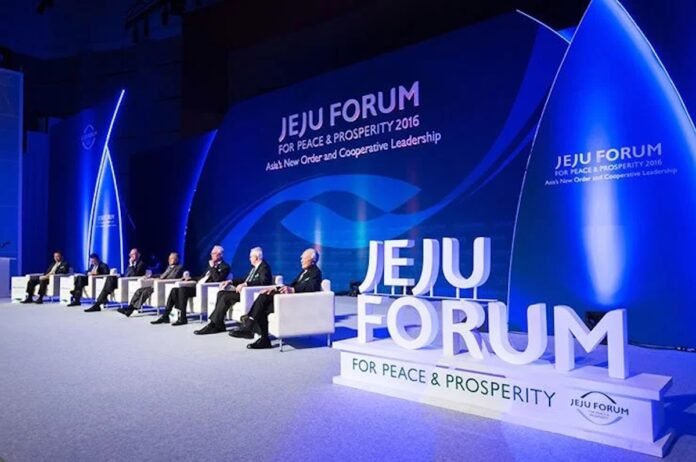
As South Korea hosts the Jeju Forum for Peace and Prosperity from June 24 to 26, an important question confronts policymakers across Asia: What is the future of peace on the Korean Peninsula? Equally important is how South Korea’s evolving strategic and domestic realities will affect regional stability and what neighboring countries can do to safeguard their interests in an increasingly uncertain security environment.
The Jeju Forum is particularly timely. The Korean Peninsula is entering a period of profound transformation driven by growing geopolitical competition, North Korea’s expanding military capabilities, changing alliance dynamics, and mounting economic and demographic challenges within South Korea itself. Together, these developments are reshaping the foundations upon which peace and stability in the region have rested for decades.
On June 13, 2026, North Korea issued one of its strongest statements in recent years regarding inter-Korean relations. In a declaration titled “South Korea Remains an Unchanging Enemy State That Has Internalized Hostility and Confrontation,” Pyongyang explicitly rejected the possibility of peaceful coexistence and reaffirmed its position that South Korea is a permanent hostile state.
The significance of this statement extends far beyond routine political rhetoric. It directly challenges the foundations of previous peace initiatives by dismissing concepts such as reconciliation, peaceful coexistence and eventual reunification. For decades, despite recurring crises and military confrontations, both Koreas officially maintained that reunification remained a long-term objective. That framework now appears to be rapidly eroding.
North Korea increasingly views South Korea not as a partner for eventual reunification but as a separate and hostile state. The language used in the June statement leaves little room for future reconciliation efforts and suggests that Pyongyang now approaches inter-Korean relations primarily through a military and security lens.
This shift reflects North Korea’s growing confidence in its strategic position. Deepening military cooperation with Russia, continued advances in nuclear and missile capabilities, growing diplomatic relevance amid intensifying geopolitical competition and greater confidence in its ability to withstand sanctions have all strengthened Pyongyang’s sense of leverage. As a result, the North Korean leadership appears to see little strategic benefit in engagement with Seoul.
Particularly concerning is North Korea’s accelerating expansion of its nuclear arsenal. Recent statements by Kim Jong-un and North Korean state media indicate a determination to continuously increase both the quantity and sophistication of the country’s nuclear weapons. Combined with advances in ballistic missile technology, tactical nuclear systems, and strategic delivery platforms, North Korea’s growing nuclear capabilities represent one of the most serious security challenges facing Northeast Asia. The continued expansion of its nuclear arsenal not only undermines prospects for denuclearization but also increases the risks of miscalculation, arms competition, and strategic instability throughout the region.
Russia has become an increasingly important factor in North Korea’s calculations. Moscow now provides diplomatic support, economic opportunities and military cooperation, all of which reduce North Korea’s dependence on inter-Korean engagement. As long as these benefits continue, Pyongyang’s incentive to pursue reconciliation with South Korea is likely to remain limited.
The broader consequence is clear. The traditional peace process that dominated discussions of the Korean Peninsula for decades is gradually giving way to a framework centered on deterrence, military preparedness and strategic competition. North Korea’s expanding nuclear arsenal is likely to further accelerate military modernization efforts by South Korea while contributing to growing geopolitical polarization across Northeast Asia.
Today, the Korean Peninsula increasingly resembles a geopolitical confrontation between two rival states rather than a divided nation seeking eventual reunification. This transformation raises profound questions regarding the future of peace, stability, and conflict management in Northeast Asia.
South Korea’s growing strategic and domestic challenges
While North Korea’s posture presents serious challenges, South Korea faces an equally complex set of strategic and domestic pressures.
One emerging concern is the future credibility of the US-South Korea alliance. Following recent developments in the Middle East and the conflict involving Iran, questions have begun to emerge in some strategic circles regarding the reliability of American security commitments. Whether these concerns are justified or not, perceptions matter in international politics.
If confidence in US security guarantees continues to weaken, regional actors may begin adjusting their strategic calculations accordingly. Such uncertainty could become a significant source of instability in Northeast Asia and create strategic opportunities for China to expand its political, economic, and security influence on the Korean Peninsula.
South Korea also faces the increasingly difficult challenge of managing China’s rise. China’s economic and military power continues to grow, making it an increasingly influential actor in regional affairs. South Korea depends heavily on China economically while relying on the US for its security. Balancing these competing realities is becoming increasingly difficult as strategic competition between Washington and Beijing intensifies.
Any major policy miscalculation could expose South Korea to significant diplomatic and security risks. More importantly, it could undermine regional stability and increase the risk of strategic confrontation among the major powers operating in Northeast Asia.
Beyond external challenges, South Korea is confronting a series of structural economic problems that could have long-term implications for national stability. Although strong demand for semiconductors has recently supported economic growth, deeper challenges remain unresolved. A shrinking workforce, slowing productivity growth, rising welfare expenditures, growing dependence on a narrow range of export industries, increasing household debt and intensifying competition from China are all creating long-term pressures on the Korean economy. The transition toward an AI-driven economy will further accelerate these structural adjustments, posing significant challenges to employment patterns, industrial competitiveness, economic resilience and social stability.
South Korea’s demographic crisis poses an even greater challenge. Despite extensive government efforts, the country’s fertility rate remains among the lowest in the world. The proportion of elderly citizens continues to rise rapidly while the number of young people entering the workforce steadily declines. Traditional family structures are under increasing strain, marriage rates continue to fall, and social isolation and mental health concerns remain significant challenges. These trends threaten not only economic growth but also long-term social cohesion.
The demographic crisis is also beginning to affect national security. South Korea’s defense industry has emerged as a major global success story, yet the country faces a growing shortage of military-age personnel. Each year, fewer young men are available for military service. Although this has not yet significantly affected operational readiness, the trend poses a long-term challenge for South Korea’s defense posture.
If left unaddressed, manpower shortages could gradually weaken the foundations of national defense and alter the regional military balance. Over the longer term, such trends may encourage North Korea to adopt a more assertive posture toward South Korea and pursue its strategic objectives with greater confidence.
What regional countries must do
The future of peace on the Korean Peninsula carries significant implications for countries across the Indo-Pacific region. North Korea’s expanding nuclear capabilities, growing military cooperation with Russia and increasing geopolitical polarization in Northeast Asia have consequences that extend far beyond the peninsula itself.
Countries such as India can no longer afford to view developments on the Korean Peninsula as a peripheral security issue while focusing primarily on economic cooperation and defense-industrial partnerships. The rapidly changing security environment on the peninsula requires a broader strategic perspective that incorporates political, military, and geopolitical considerations.
For too long, North Korea has received relatively limited attention in regional strategic thinking. That approach is becoming increasingly difficult to justify. As North Korea’s military capabilities expand and its strategic relevance grows, developments on the peninsula will have a greater impact on regional security calculations.
Particular attention should be devoted to monitoring the evolving DPRK-Russia partnership and assessing its implications for regional and global security. Concerns regarding the potential transfer of North Korean missile technologies, military expertise, and nuclear-related knowledge to third countries deserve careful scrutiny. Such developments could directly affect the security interests of countries far beyond Northeast Asia.
At the same time, regional countries should pay closer attention to South Korea’s internal challenges. South Korea is increasingly viewed as a critical economic, technological, and strategic partner in the emerging Indo-Pacific order. However, demographic decline, economic restructuring, and social pressures could affect Seoul’s ability to play this role effectively.
Ignoring these domestic challenges would be a strategic mistake for countries that have begun incorporating South Korea into their long-term regional calculations.
As leaders gather in Jeju to discuss peace and prosperity, they must recognize a fundamental reality. The future of peace on the Korean Peninsula will depend not only on relations between North and South Korea but also on how the region responds to a broader set of geopolitical, economic, demographic, and social challenges. Peace can no longer be defined simply as the absence of war. It must also encompass economic resilience, social stability, strategic balance, and the capacity of states to adapt to an increasingly complex and competitive regional environment.
The Korean Peninsula is entering a new and uncertain era. Whether this period is ultimately defined by stability, managed competition, or prolonged confrontation will depend on the strategic choices made not only by South Korea but also by the major regional powers whose interests increasingly intersect on the peninsula. The decisions taken today will shape the future security architecture of Northeast Asia for decades to come.
Swiss Talks Put Qatar and Pakistan at the Center of a New US-Iran De-escalation Track
The joint Qatar-Pakistan mediation format is notable, because it combines Doha’s established diplomatic brokerage with Islamabad’s strategic geography, military weight, and renewed relevance in Washington
The first high-level US-Iran talks in Switzerland did not produce a final agreement, but they did mark a step in transforming a fragile memorandum of understanding (MoU) into a structured diplomatic process.
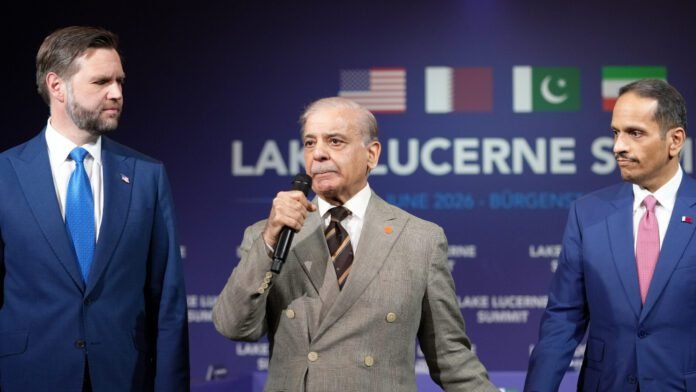
Meeting at Bürgenstock, overlooking Lake Lucerne, American and Iranian delegations agreed to continue technical negotiations under the framework of the Islamabad MoU, with Qatar and Pakistan acting as mediators.
The talks brought together US Vice President JD Vance and other senior American envoys, while Iran was represented by Foreign Minister Abbas Araghchi and other high-level officials. Qatar and Pakistan helped shape the process, issued the joint statement, and positioned themselves as mediators in a broader effort to shift the crisis from military escalation to managed de-escalation.
According to the joint statement issued by Qatar and Pakistan on June 22, the talks produced a high-level committee to provide political oversight and working groups focused on nuclear issues, sanctions, monitoring, and dispute resolution, and a roadmap toward a final deal within 60 days. The United States and Iran also agreed to establish a direct communication channel to prevent incidents and misunderstandings in the Strait of Hormuz, as well as a de-confliction mechanism involving Lebanon, the two parties, and the mediators to help support the cessation of military operations in Lebanon.
The Swiss meeting was more than a bilateral negotiation between Washington and Tehran. It reflects a wider regional recalibration in which the United States appears to be relying not only on its traditional coordination with Israel, but also on a broader network of partners, including Gulf states and Pakistan, to manage the political and security consequences of the crisis.
For Washington, the challenge is now twofold. It must test whether Iran is prepared to accept meaningful nuclear monitoring and further technical arrangements, while also preventing the regional issues linked to the crisis—Lebanon, maritime security, sanctions relief, and frozen assets—from derailing the process. For Tehran, the Swiss talks offer a chance to preserve leverage while obtaining economic and political concessions, but also require it to enter a more formalized process of implementation and verification.
The return of international nuclear inspectors is one of the most sensitive elements under discussion. Vance said Iran had agreed to invite International Atomic Energy Agency inspectors back into the country, framing this as a first step toward addressing Washington’s concerns over Iran’s nuclear program. But Tehran has been careful to avoid presenting this as a unilateral concession, insisting that any final arrangement will depend on implementation, sanctions relief, and decisions by Iran’s senior political and security institutions.
The sanctions issue is equally delicate. Iranian officials have suggested that oil and petrochemical export restrictions have been waived, that the blockade has been lifted, and that some frozen assets have been released. US officials have been more cautious in their phrasing, emphasizing mechanisms, waivers, and restrictions on how any unfrozen funds may be used. This gap between political messaging and enforceable implementation is likely to define the next stage of the talks.
For Gulf countries, however, the immediate question is less about the optics of victory and more about whether the agreement can reduce regional risk. The crisis had placed maritime routes, energy markets, Lebanon, and Gulf security under pressure. For Riyadh, Abu Dhabi, Doha, and other regional capitals, the test is not whether Washington or Tehran can claim success, but whether escalation can be contained.
Abdulaziz Alshaabani, a Saudi political analyst, said the agreement is being viewed with measured hope in Saudi Arabia. “From a Saudi perspective, the US-Iran agreement is viewed with cautious optimism, as it reduces the risk of military escalation and gives the region an opportunity to move away from a period of heightened tensions and uncertainty,” Alshaabani told The Media Line.
For Gulf countries, the key issue is not who won or lost, but whether the agreement can contribute to regional stability
“For Gulf countries, the key issue is not who won or lost, but whether the agreement can contribute to regional stability, secure maritime routes, and create a more favorable environment for economic development and investment,” he said.
His assessment reflects a broader Gulf concern that the region cannot afford another cycle of escalation around Iran, Lebanon, Israel, and the Strait of Hormuz. The Gulf economies depend on stability, investment confidence, maritime security, and energy flows. Even a partial disruption to the Strait of Hormuz can produce international consequences far beyond the immediate conflict zone.
Alshaabani said the competing narratives around the agreement remain important, but they are not the decisive factor. “Some observers argue that Iran has managed to preserve important strategic leverage, while the United States demonstrated its military capabilities without fully translating them into decisive political outcomes,” he said. “However, the more significant point is that both sides ultimately chose negotiations over open confrontation.”
That point is central to understanding the Swiss talks. The agreement neither erases the imbalance of trust between Washington and Tehran, nor resolves the disputes over Iran’s nuclear program, sanctions, Lebanon, or Israel’s security concerns. However, it does create a mechanism through which those disputes can be managed before they trigger another direct confrontation.
“In my view, the real measure of success will not be the signing of the agreement itself, but its ability to produce lasting de-escalation, strengthen Gulf security, and prevent future crises that could threaten regional stability and the global economy,” Alshaabani said. “For this reason, Saudi Arabia and other Gulf states are likely to focus less on the political narratives of victory and defeat, and more on the practical implementation and long-term outcomes of the agreement.”
Pakistan’s role in the process is significant. Islamabad has long offered itself as a possible channel between Washington and Tehran, but the Swiss talks suggest a more active diplomatic function. Pakistan is not simply offering symbolic “good offices”—it is helping facilitate communication, lower misperceptions, and support mechanisms aimed at preventing escalation.
Mohammad Ali Zafar, a political risk consultant, told The Media Line that Pakistan’s recent diplomatic activism in US-Iran mediation can be understood as part of a broader chain reaction that elevated Islamabad’s credibility in Washington. “Analysts have noted that Pakistan’s cooperation with the United States in facilitating the handover of the alleged Abbey Gate attack mastermind, Sharifullah, was widely interpreted as a signal of renewed counterterrorism alignment,” he said, adding that this was followed by Pakistan’s calibrated but firm military response to India, which drew renewed American attention to Pakistan.
The Sharifullah case remains legally complex. US authorities charged Mohammad Sharifullah over alleged ISIS-K support linked to the 2021 Abbey Gate attack, but a later jury verdict did not establish direct responsibility for the deaths at Kabul airport. Still, in diplomatic terms, the case was widely interpreted as a moment of renewed counterterrorism contact between Islamabad and Washington.
Zafar said Pakistan’s role in the US-Iran channel represents a shift in posture “from merely offering ‘good offices’ to playing a more active role in de-escalation.” In his view, Pakistan has positioned itself as a middle power willing to assume greater responsibility “by helping reduce misperceptions, facilitating communication, and supporting mechanisms aimed at lowering tensions,” adding that “this emerging role, while still evolving, has contributed to the broader international effort to prevent escalation and promote a pathway toward lasting peace.”
Pakistan’s role is also shaped by its relations with key regional powers. Islamabad has strong ties with Turkey and Saudi Arabia, maintains links with Iran, and has an interest in avoiding a regional conflict that could spill across South Asia and the Gulf. Its participation alongside Qatar also reflects a broader trend—that middle powers are increasingly central to conflict management in the Middle East.
Qatar’s role is more established. Doha has spent years positioning itself as a mediator in sensitive regional and international files, from Gaza to Afghanistan and the US-Iran channels. Its involvement in the Swiss talks fits that pattern. But the joint Qatar-Pakistan mediation format is notable because it combines Doha’s established diplomatic brokerage with Islamabad’s strategic geography, military weight, and renewed relevance in Washington.
Zafar said Pakistan’s regional coordination matters, but he cautioned against interpreting the mediation as bloc politics. “Pakistan enjoys strong and historic relations with Turkey, Saudi Arabia, and Egypt, and it has increasingly coordinated its diplomacy with these regional partners,” he said. “However, the current US-Iran mediation effort is focused primarily on achieving lasting peace between Washington and Tehran—two states that have been in confrontation for decades. Pakistan’s role here is not about bloc politics but about acting as a responsible middle power capable of lowering tensions and preventing wider regional instability.”
Pakistan’s role here is not about bloc politics but about acting as a responsible middle power
This distinction is important. The Swiss talks do not mean Pakistan is entering an anti-Israel, anti-US, or pro-Iran bloc. Nor do they mean Gulf states are aligning with Tehran. Rather, the talks show that the US is being pushed by the crisis to diversify its regional diplomatic architecture. Israel remains central to American security calculations, but Washington is also relying on Qatar, Pakistan, and Gulf coordination to manage issues that Israel alone cannot resolve.
Lebanon is the clearest example. The creation of a de-confliction cell shows how the US-Iran talks have expanded beyond the nuclear issue. Iran sees Lebanon and Hezbollah as central to its regional leverage, while Israel views Hezbollah as a direct security threat. Gulf states, meanwhile, want to avoid a broader regional war that could destabilize markets and maritime routes. The result is an agreement that seeks to integrate nuclear diplomacy, sanctions relief, Lebanon, and the Strait of Hormuz into a single de-escalation framework.
That approach may create opportunities, but it also carries risks. The more issues are attached to the US-Iran process, the more vulnerable the process becomes to spoilers. A new Israeli strike in Lebanon, a Hezbollah attack, a maritime incident in Hormuz, or a disagreement over frozen Iranian assets could all test the durability of the Swiss framework before technical negotiators reach a final deal.
For Pakistan, the mediation also raises questions about whether diplomatic credibility gained in one arena could later affect other regional disputes, including Kashmir. “On the question of Kashmir, Pakistan has consistently welcomed any constructive role the United States may play,” Zafar said.
“Linking the present US-Iran talks directly to Kashmir would be premature. … Yet, once the US-Iran issue stabilizes, new diplomatic openings could emerge. In international politics, goodwill and credibility earned in one arena can sometimes translate into influence in another.
“Diplomacy is ultimately the art of the possible, and Pakistan remains committed to pursuing a peaceful, lasting solution to the Kashmir dispute—one that reflects the aspirations and concerns of the Kashmiri people,” he said.
For now, the immediate test remains the US-Iran track itself. The Swiss talks created a process, not a settlement. They gave negotiators a timetable, not a guarantee. They showed that Qatar and Pakistan can help convene and facilitate, but they cannot, by themselves, force implementation. They also showed that the United States is adjusting to a regional environment in which military power alone does not determine political outcomes.
This is where the agreement’s deeper significance lies. Iran appears to have preserved some strategic leverage. The United States demonstrated military capability and diplomatic reach, but still has to negotiate through regional mediators. Gulf states are focused on stability, maritime security, and economic continuity. Pakistan is attempting to convert crisis diplomacy into international credibility. Qatar is reinforcing its role as a key diplomatic broker.
The Swiss track, therefore, marks not only a potential opening in US-Iran relations but also a shift in the regional balance of mediation. The coming weeks will show whether that shift can produce enforceable de-escalation—or whether the same unresolved conflicts that brought the parties to Switzerland will pull them back toward confrontation.
White House drastically shortens deadline for dropping quantum-vulnerable crypto
The White House is drastically shortening the deadline for government agencies and organizations to adopt new quantum-resistant encryption systems that will withstand attacks that use quantum computers, as the federal government seeks to protect decades’ worth of secrets belonging to militaries, banks, governments, and most individuals on Earth.
The executive order, titled Securing the Nation against Advanced Cryptographic Attacks, requires computing systems for “high-value assets” and “high-impact systems” to transition to post-quantum cryptographic key establishment schemes by December 31, 2030, and to quantum-safe digital signature schemes by December 31, 2031.
Heading off a significant threat
The new deadline, which for many organizations is about five years sooner than the previous one, comes on the heels of recent research showing that the resources and cost for building a cryptographically relevant quantum computer are far less than previous consensus estimates. In response, Google, Cloudflare, and other companies recently tightened their timelines for moving off vulnerable systems to 2029.
“The advent of large-scale quantum computers, particularly in the hands of adversaries, will pose a significant threat to widely used cryptographic security systems,” Monday’s executive order stated. “Ongoing cyber activity against our Nation also presents the risk of adversaries collecting United States information now, and decrypting it later once large-scale quantum computers are operational.”
Under a timeline the National Security Agency published in 2022, “National Security Systems”—a class including only defense and intelligence systems under the authority of the agency—were under orders to be quantum-ready between 2030 and 2033. Most other organizations had until 2035 to complete the transition. Now, many of them will be required to transition much sooner.
“So, for any system that falls into this new bucket of high-value assets and high-impact systems, their transition timelines just got shortened by 4-5 years (from 2035 to 2030/2031),” Brian LaMacchia, a cryptography engineer who oversaw Microsoft’s post-quantum transition from 2015 to 2022 and now works at Farcaster Consulting Group, told Ars. “That is a significant shortening of the transition timeline for these systems, and it follows similar timeline revisions from Google and Cloudflare that we saw announced back in late March/early April.”
The order also:
Establishes a government-wide transition coordination process to be led by the Director of the Office of Management and Budget and the National Cyber Director. Each federal agency will designate a point person responsible for reporting quantum transition progress to them.
Directs the Secretary of State to work with the National Institute of Standards and Technology, the Department of Defense and Homeland Security, the National Cyber Director, and the Director of National Intelligence to “identify and engage foreign governments and industry groups in key countries to encourage their transition to PQC algorithms standardized by NIST.”
Directs NIST and the Cybersecurity and Infrastructure Security Agency to issue guidance on the release of a CBOM (cryptographic bill of materials), which lists all components, libraries, and modules in an encryption system.
Establishes new procurement rules that appear to be aimed at requiring “covered contractors” to meet the same quantum-readiness deadlines and implement vulnerability disclosure policies.
“Critical infrastructure owners and operators can now expect support in developing their PQC migration plans,” Jordan Kenyon, senior quantum scientist at Booz Allen, told Ars. “Covered contractors could face future requirements from proposed rules to incorporate PQC compliant algorithms required by FIPS by the end of 2030 and incorporate reports of cryptographic vulnerabilities in their disclosures.” FIPS is short for Federal Information Processing Standards, a set of standards shepherded by NIST for use in computer systems of non-military US government agencies and contractors.
No one knows when a cryptographically relevant quantum computer will arrive. Experts have made wide-ranging guesses for more than three decades. A key barrier is creating a system with the required number of qubits—the quantum equivalent of a bit in classical computing—that operates correctly even in the presence of errors that occur when they interact with their environment.
In March, researchers said they discovered a way to break ECC-256, used to secure the bitcoin and ethereum blockchains, using only 30,000 physical qubits in 10 days.
That same month, a Google research team said it developed two quantum circuits that could solve the elliptic-curve discrete logarithm problem using roughly 500,000 physical qubits, half of what the same team estimated last June was needed to break 2048-bit RSA, which has a much larger key size.
In 2012, most estimates were that breaking a 2048-bit RSA key would require a billion physical qubits. By 2019, the estimate was lowered to 20 million physical qubits. The steady march of progress, as demonstrated by these latest research papers, is prodding organizations with the most to lose to err on the side of Q Day—the day a cryptographically relevant quantum computer arrives—coming sooner rather than later.
Two of the most widely used public key cryptography algorithms—RSA and elliptic curve cryptography—are based on factoring composites, which are the product of two or more primes, and the discrete logarithm, respectively. These mathematical problems are simple to solve in one direction and nearly impossible in the other. A quantum computer with sufficient resources can run Shor’s algorithm to solve these problems in polynomial time, specifically cubic time, far faster than the exponential time provided by today’s classical computers. The post-quantum algorithms replacing RSA and elliptic curve cryptography are based on problems that quantum computers have no advantage over classical computers in solving.
Contrary to what many people assume, substituting quantum vulnerable algorithms for PQC ones is anything but a drop-and-replace exercise. Public key sizes for ML-KEM—one of the replacements for RSA—are roughly three times bigger. The difficulty and scale of the work ahead is the reason the federal government is taking the move so seriously.
Separately, the White House published a second executive order directing the federal government, in partnership with private industry, to support quantum computing. Among other things, it established a “national effort” to develop the world’s first quantum computer powerful enough to “initiate the era of quantum-enabled scientific discovery.”
Prairieland Defendant Sentenced to 30 Years in Prison for Moving a Box of Antifascist Zines
FORT WORTH, TEXAS — Daniel Sanchez Estrada wasn’t accused of attempted murder or material support of terrorism after a protest turned catastrophically wrong outside an ICE detention center in Alvarado, Texas. He was merely convicted of obstructing the investigation by moving a box full of antifascist zines after the protest. Giving him a long prison term would make a mockery of justice, his defense attorney, Christopher Weinbel, told U.S. District Judge Reed O’Connor on Tuesday.
“The punishment must fit the crimes — not the headlines, not the politics, not the fears that have been mongered about the case,” he said.
Instead, O’Connor gave Sanchez Estrada a 30-year term.
The lengthy sentence was among the eight harsh terms handed down by judges in two courtrooms in Fort Worth on Tuesday to activists who played roles at or after the July 4, 2025, protest at Prairieland Detention Center. Their sentences — longer than any of those received by members of the January 6, 2021 assault on the U.S. Capitol — capped a case that is widely regarded as the Trump administration’s first major victory in its crackdown on left-wing activism.
The defendants were convicted at trial in March. Prosecutors convinced a jury that the fact that the eight defendants present at the protest wore all black and used the Signal encrypted messaging app supported their material support of terrorism charges. Sanchez Estrada, who was not at the protest, was convicted of corruptly concealing a document or record and conspiracy to conceal documents.
Only one of the defendants, Benjamin Hanil Song, was accused of firing a gun at a police officer, who left the scene with an injury to his neck; Song was convicted of attempted murder. Still, federal guidelines calling for harsher sentences for all because of links to terrorism — which were applied by O’Connor, a George W. Bush appointee, and U.S. District Judge Mark Pittman, a Donald Trump appointee — meant that all the defendants faced long prison terms.
Their only hope ahead of the simultaneous twin hearings was that the two judges might break sharply with federal guidelines. Instead, O’Connor and Pittman chose to make an example of the defendants.
Several defendants said Tuesday that they never intended to hurt anyone. Their only hope was to show solidarity with the detainees by staging a noise demonstration with fireworks, they said.
“When I went to protest on the night of July 4, it seemed more like a party to me than anything else,” Autumn Hill told the court Tuesday. “We didn’t expect or want any violence or destruction of property to occur.”
Prosecutors, however, seized on the fact that the protesters arrived at the scene with guns and fireworks. O’Connor, the judge, said several times that the defendants had committed an “assault on democracy.”
“What happened here was not by any stretch of the imagination a protest,” he said during the sentencing of one defendant.
So it went repeatedly in the two courtrooms as the judges brushed aside the defendants’ assertions that they were attempting simply to show solidarity with the detainees inside the ICE facility. Song, the sole defendant convicted of attempted murder, received a 100-year prison sentence.
The other defendants’ arguments that they should be distinguished from Song because they never fired a gun won them little relief.
Sanchez Estrada’s wife, Maricela Rueda, received a 70-year sentence, longer than most of the other defendants because of her alleged role in a conspiracy to commit obstruction by asking Sanchez Estrada to move the zines after her arrest.
Hill, Savanna Batten, Zachary Evetts, Meagan Morris, and Elizabeth Soto all received 50-year sentences for their roles in protest at the Prairieland detention facility. A ninth defendant, Ines Soto, awaits a July sentencing.
The defendants’ relatives and supporters said at a press conference after the sentencing that they had harbored few illusions about their likely sentences. They have now placed their hopes on appeals.
The Prairieland case should be placed in the context of a larger crackdown on anti-government protesters, supporters said.
In a press release Tuesday, the Justice Department hailed the case as “the first sentencing of defendants affiliated with Antifa following President Donald J. Trump’s executive order designating the group as a Domestic Terrorist Organization in September 2025.”
“Today’s sentencings show the FBI remains committed to identifying, locating, and dismantling Antifa and its funding networks across the country,” Patel said in a statement.
More indictments against activists have followed since the issuing of NSPM-7, most recently the charges in Minnesota earlier this month against 15 people accused of trying to impede federal agents during the immigration crackdown there.
“It’s not just here in the north Texas area,” said Tamera Hutcherson, a local activist who served as a member of Batten’s defense team. “This is also now in other parts of our country, and it concerns me what this means for our free speech, as well as our right to protest. If we are to bring a medical kit to a protest, does that mean we are a criminal now? If we are to even just attend a noise demonstration, does that mean we are a criminal now, and we may not return home to our loved ones?”
“ If we are to bring a medical kit to a protest, does that mean we are a criminal now? ”
Justice Department prosecutors pushed back against the idea that the defendants had been convicted merely for expressing their First Amendment rights. What distinguished them from other protesters was their belief that they were justified in using violence to accomplish their goals, said Frank Gatto, an assistant U.S. attorney for the northern district of Texas.
“The very crux here is their firm belief that the use of violence is justified,” Gatto said during the sentencing of Evetts.
Although the case centered on the government’s claim that the defendants were affiliated with antifa, prosecutors offered little evidence of that at trial. Even Pittman, the judge who oversaw the trial, questioned whether he needed to mention antifa in his jury instructions.
Still, the movement of various anti-government and antifascist zines led directly to the conviction of Sanchez Estrada, whose case stood out from the others because he was not accused of attending the July 4 protest at the ICE detention center.
Weinbel, the public defender, said the zines that Sanchez Estrada moved were his own and protected by the First Amendment. None of it helped convict the other defendants at trial, Weinbel said.
“At the heart of this case is a simple truth: Mr. Sanchez moved a box,” Weinbel said. “He is not a murderer, he is not ISIS, he is not a foreign terrorist.”
“He is not a murderer, he is not ISIS, he is not a foreign terrorist.”
Sanchez Estrada said he still could not understand why he was convicted.
“I am a father, I am a husband, I am a teacher, a poet — I am many things, Your Honor, but I am not a terrorist,” he told the court.
O’Connor said he disagreed with the idea that moving the box of the zines was harmless. At the time of Sanchez Estrada’s actions, Song was still on the run from police.
“What was at stake at that time was a known terrorist was on the run for shooting a police officer during a terrorist attack,” he said.