21.6 C
London
Friday, June 12, 2026
Home Blog

Palestinian Football Association president criticizes US over delayed visa for World Cup events

0
palestinian-football-association-president-criticizes-us-over-delayed-visa-for-world-cup-events
Palestinian Football Association president criticizes US over delayed visa for World Cup events

Palestinian Football Association President Jibril Rajoub criticized the US for failing to grant him a visa to attend World Cup-related events, saying the delay reflects disrespect for FIFA and the unifying role of the sport, Anadolu reports.

Rajoub attended the opening match of the FIFA World Cup between Mexico and South Africa in Mexico City on Thursday but remains among several accredited participants who have either been denied US visas or are still awaiting approval to enter the country.

In an exclusive statement to Anadolu from Mexico, Rajoub said he has yet to receive permission to enter the United States despite his entitlement to participate in World Cup activities as head of the Palestinian Football Association.

“I believe that FIFA regulations, or at least its traditions, require any country hosting a global event to honor its obligations toward that event by facilitating the entry of everyone connected to it,” Rajoub said.

He said the World Cup is the most important sporting event in the world and that participation by football federation presidents in related activities, including the FIFA Congress, requires host countries to facilitate their entry.

“This is not a favor on their part; it is a right, and they are obligated to uphold it,” he said.

Rajoub argued that failing to facilitate entry for participants undermines the principles associated with hosting a global sporting event.

“Through this behavior, they are stripping themselves of the moral right to host such a major sporting event,” he said.

Rajoub said he had not yet received approval to enter the US and suggested that others may be facing similar difficulties.

READ: Palestinian FA chief refuses handshake with Israeli counterpart at FIFA congress

“Up to this moment, I have not received approval to enter, and I believe I am not the only one. There are many others facing the same problem,” he said.

Rajoub said the issue goes beyond individual cases and affects the broader values promoted by international sport.

“I see this as a sign of disrespect not only toward FIFA, but also toward the sporting message that unites people and builds bridges between them. In the end, this is a global event, not an event that belongs solely to the United States,” he said.

Recent visa-related issues have raised concerns ahead of international football events hosted by the US.

Earlier this month, officials from Iran’s Football Federation said they had yet to receive US visas to attend activities related to the 2026 FIFA World Cup.

In a separate case, Somali referee Omar Abdulkadir Artan was unable to travel to the US to officiate at the FIFA Club World Cup because his visa application was not approved on time, despite being appointed by FIFA for the tournament.

Concerns have also been raised about some supporters’ ability to attend competitions in the US. Earlier reports suggested that fans from several countries, including the Ivory Coast, may have difficulty traveling to the country due to visa restrictions and entry requirements.

The US is co-hosting the 2026 FIFA World Cup alongside Canada and Mexico.

READ: FIFA under fire for silence on targeting of Palestinian athletes

The $20,000 question: Can a lawnmower engine defeat a superpower?

0
the-$20,000-question:-can-a-lawnmower-engine-defeat-a-superpower?
The $20,000 question: Can a lawnmower engine defeat a superpower?

An Aegis destroyer, the crown jewel of late 20th-century naval engineering, crewed by hundreds of highly trained sailors, detects an incoming threat over the Red Sea. The ship’s computer calculates. The captain orders. A Standard Missile-2, representing roughly $2 million worth of American industrial and technological genius, streaks skyward and detonates its target with satisfying precision.

The threat in this particular version of a scene playing out at its basics with increasing regularity across the world’s contested skies was a Shahed-series drone — basic fiberglass wrapped around a lawnmower engine — costing less than $20,000. The Americans won the engagement. But it ought to give pause to anyone still invested in the mythology of American military supremacy that the Americans are losing the war of arithmetic.

This is the central irony of what strategists are now calling the drone revolution, though “revolution” may be too dramatic a word for what is really a very old story wearing new clothes.

Empires have always faced the problem of cost asymmetry, the gap between what it costs a great power to defend its position and what it costs a weaker adversary to challenge it. The British learned this lesson in the American colonies. The French learned it in Algeria. The Americans themselves learned it, or should have, in Vietnam, in Lebanon, in Iraq and in Afghanistan.

The drone is not a new argument. It is the same argument, delivered by fiber-optic cable at 100 miles per hour.

When Russia launched its full-scale invasion of Ukraine in 2022, it expected Kyiv to fall within days. When the United States and Israel bombed Iran in early 2026, they anticipated the rapid collapse of the Islamic Republic. In both cases, overwhelming military power failed to defeat the smaller and weaker side.

Ukraine and Iran did not win these confrontations in any conventional sense. They simply refused to lose in the way they were supposed to. And they refused, in large part, because they had mastered the drone.

The economics are not complicated, even if Washington’s procurement bureaucracy seems constitutionally incapable of grasping them. Every time a $2 million interceptor destroys a $20,000 drone, a superpower’s global influence shrinks just a little bit more. Multiply that exchange ratio across thousands of engagements, across multiple theaters, across years of conflict, and you arrive at something that looks less like a military campaign and more like a slow financial hemorrhage.

Iran’s strategy, like the Houthis’ before it, is not to defeat the United States in battle. The goal is to make the cost of Western intervention so politically and economically unsustainable that the superpower simply stops showing up.

This is, of course, a limited form of victory. Drones do not hold territory. They do not sign treaties or install governments. Russia’s experience in Ukraine demonstrates that layered electronic warfare, short-range air defense, camouflage and dispersal mean that many drones fail before reaching their targets, and those that do often struggle to achieve decisive effects against hardened or mobile systems.

The drone enthusiasts, like every generation of enthusiasts for the latest wonder weapon, are prone to overstatement. No, a swarm of Shaheds will not sink a carrier strike group. No, FPV drones will not render the armored division obsolete tomorrow morning.

But that framing misses the point entirely. The question was never whether drones could defeat a superpower in a set-piece engagement. The question is whether they can raise the cost of intervention high enough, for long enough, to alter the superpower’s political calculus. And here the evidence is rather unambiguous.

Ukraine’s “Spiderweb” operation in June 2025 saw five Russian airbases, hundreds of miles apart, deep within Russian territory, simultaneously attacked by drones, wrecking or disabling roughly $7 billion worth of jet fighters.

The drones were not the assets of a peer competitor. They were the improvised weapons of a country fighting for its survival, assembled from commercial components and flown by operators who learned their craft on gaming consoles. The Kremlin, a nuclear superpower, found its strategic bomber fleet degraded by what amounted to a very ambitious hobby-drone operation.

Washington has noticed. The U.S. defense budget in 2026 is expected to dedicate around $7.5 billion to counter-unmanned aerial systems alone. Beijing, characteristically, is thinking in larger numbers: China recently launched a program to field one million tactical drones by 2026, while the United States reported procuring 50,000 in 2025.

The manufacturing gap is not a gap that more Pentagon budget lines will close. It reflects deeper structural realities about industrial capacity, supply chains and the willingness to build things quickly and cheaply rather than expensively and perfectly.

The deeper problem, as always, is cultural and political rather than technological. The United States is still clinging to hardware that is too expensive to lose. In modern warfare, if a weapon is too expensive to lose, it is too expensive to use. Shifting a military culture built around exquisite, irreplaceable platforms toward an “attritable” model, weapons designed to be expended, not preserved, requires not just new procurement rules but a fundamentally different theory of what military power is for.

Can drones defeat a superpower? The answer, characteristically, is: It depends on what you mean by defeat. They cannot conquer one. They can, however, exhaust one, financially, politically, strategically. They can turn each intervention into a referendum on whether the prize is worth the price. They can make the arithmetic so unfavorable that the calculus of restraint starts looking more attractive than the calculus of engagement.

History suggests that it’s rare for an empire to fall to a single weapon. En empire falls when the costs of maintaining its position outruns the political will to bear those costs. The drone has not invented that dynamic. It has simply made it faster, cheaper, and more available to a wider range of actors than ever before.

Washington should find that thought clarifying rather than reassuring.

Originally published on Leon Hadar’s Global Zeitgiest, this article is republished with permission.

$130 billion in data center projects blocked by protests so far this year

0
$130-billion-in-data-center-projects-blocked-by-protests-so-far-this-year
$130 billion in data center projects blocked by protests so far this year

It’s clear that communities now have an effective playbook to block data center construction. This week, researchers flagged the first quarter of 2026 as producing the “most blocked and delayed data center projects on record,” NBC News reported.

Data Center Watch, a project from AI intelligence firm 10a Labs that tracks data center fights around the US, reported that protestors “blocked or delayed at least 75 projects nationwide worth about $130 billion from January through March,” NBC News reported.

That’s “the most in a three-month period since the group began tracking in 2023,” and it shouldn’t be parsed as “a cyclical spike,” the researchers said. Instead, there’s been a “structural shift,” as “communities have internalized an opposition playbook, legislative sessions introduced formal regulatory uncertainty, and the number of active opposition groups more than doubled to 833 across 49 states,” researchers said.

The political momentum behind data center protests is expected to influence the upcoming midterm elections, with both parties increasingly sympathizing with resistance as opposition intensifies.

Sociologist’s unique take on data center opposition

Sociologist Tressie McMillan Cottom has been spending time with organizers in North Carolina to better understand the playbook that’s fueling this momentum. In an op-ed for the New York Times encouraging Democrats to make data centers a key campaign issue, she noted that she “wasn’t sold on data center resistance as a political possibility,” but “time on the ground changed my mind.”

Not only are people crossing political divides to oppose local construction projects, but also people “are passionate enough to attend political education sessions about water rights, land use, and thermodynamics,” McMillan Cottom wrote. As she explained, people aren’t just educating themselves to keep noisy factories from driving up utility costs, threatening public health, or wasting local resources; some people are, for the first time, experiencing what it’s like to work with their neighbors to overcome adversity through political will:

“I have been watching this new groundswell of dissent firsthand in community meetings, organizing sessions and civic trainings here in North Carolina. The resistance has lifelong joiners, alumni from environmental and housing movements and young organizers. There are also a lot of people who have never dreamed of being disagreeable in public, much less considered joining a raucous social movement. The imminent risk of living next to a data center may be why they show up for a meeting, but they’re committing to the issue for bigger, deeper reasons. Political corruption and corporate malfeasance make them feel politically impotent. Voicing their objections, sharing their anxieties with others, recalling politicians who override them and in some cases beating the opposition is giving them something few politicians are offering—a taste of political power.”

Although it may be hard for Democrats to craft a national message that capitalizes on anti-data-center sentiment, McMillan Cottom suggested that, if they could, it would be the “greatest untapped opportunity” to win more elections.

Data Center Watch noted that the record of $130 billion data centers blocked or delayed in early 2026 was close to matching the value of the total number they recorded for all of 2025, about $156 billion. The researchers suggested that the back half of 2025 marked a “turning point, as data center opposition emerged as a national-level narrative” that showed the AI industry can no longer see the fights as individual zoning disputes. It “is now reshaping elections, regulation, and site viability nationwide,” Data Center Watch reported last year.

For officials hoping to quickly build data centers to propel America’s AI ambitions, facing the mounting opposition as the playbook has come together has been tough, NBC News reported. Where before, officials were criticized for quietly signing deals without discussing construction with nearby residents, now they’re encountering backlash before any deal is in the books, Data Center Watch found.

“In some cases,” researchers reported, “opposition mobilized before any project was officially filed, the mere rumor of a data center was enough to trigger organized resistance.”

AI industry struggles to counter narrative

AI firms and data center developers, as well as officials who hope to benefit from striking deals, are beginning to counter the data center hate as best they can.

Most recently, OpenAI released a report claiming that China was trying to influence the US data center debate by using ChatGPT. OpenAI quickly banned the bad actors, they reported, who were creating comics and memes to post on X, as well as generating social media comments, supposedly in the hopes of swaying US sentiment.

There has also been a push to paint public dissent as “naïve,” McMillan Cottom noted, “or, worse, un-American.”

Proponents of data centers argue that debates over electricity price hikes or water resources are misinformed. In a recent Atlantic piece claiming “the data-center panic is overblown,” it’s emphasized that only drought-stricken locations or areas with strained grids need to worry about those concerns. And economists suggested that communities risk overlooking little-discussed long-term benefits, like employment gains that “are likely to grow as new data centers attract businesses that use AI.”

In Loudon County, Virginia, The Atlantic noted, 53 million square feet of data centers have been constructed over the past 20 years. Although data centers account for only about 3 percent of the county’s land area, they generate “almost half of its property-tax revenue—a projected $1.3 billion in 2026,” The Atlantic reported. Although some data center projects were removed from residential zones due to noise complaints, communities have largely benefited from letting data centers in, with lower tax rates and more affordable housing.

This week, Meta claimed a similar data center PR win in Louisiana. One of the tech giant’s data center projects more than doubled Richland Parish’s sales and use tax, leading some teachers to get $50,000 bonuses, due to an ordinance that “lets the school board collect a 1 percent sales tax to fund teacher bonuses,” The Wall Street Journal reported. Scott Franklin, a director of the parish’s chamber of commerce and a farmer who sold the land to Meta for the data center, told WSJ that “anybody that complains about teachers getting a $50,000 check, they just instantly lose all credibility with me.”

But The Atlantic story seems to gloss over one of the biggest complaints that locals have about data centers: a lack of comprehensive environmental reviews. Mostly, communities simply don’t want local officials to take the kind of shortcuts to expedite data center approvals that Donald Trump and other Republicans have called for.

In Illinois, Governor J.B. Pritzker is pushing lawmakers to develop a legislative framework for responsible data center development in the state with proper environmental reviews at its center. And other cities, counties, and states are pivoting to get residents more information as deals are increasingly obstructed by residents loudly vocalizing opposition. Most recently, a data center developer in Utah vowed to handle all communications himself to make his construction project more transparent, after backlash reduced the total approved land area for the site by 50 percent.

Dems slow to embrace data center resistance

McMillan Cottom suggested that no public officials on the right or the left have perfected their messaging to align with anti-data center sentiments. It may be money standing in the Democrats’ way of fully embracing the data center resistance, she suggested, as many AI firms are donating hundreds of millions to campaigns to sway elections.

Massachusetts Sen. Elizabeth Warren’s plans to tax AI firms to force more transparency are “wonky,” she said. And Sen. Bernie Sanders’ call for Americans to profit off AI—which Trump, to some degree, agrees on—depends on creating a wealth fund that at least one critic warned “would enshrine the tech sector’s as-yet-unproven claims of its importance.”

Perhaps Rep. Alexandria Ocasio-Cortez has come closest to plugging into the nationwide rage. After joining Sanders in calling for a nationwide data center moratorium in March, she used jars she claimed were filled with dirty data center water to press the Environmental Protection Agency over its alleged failures to investigate a Meta project in Georgia.

Meta has denied that its Georgia data center is polluting waters. But analysts think that Ocasio-Cortez’s instinct to use the jars to symbolize data center opposition seems more likely to strike a nerve and drum up support than even the most genuine pushes to regulate or tax data centers, so long as the long-term harms of construction remain unknown and the risks of AI remain abstract.

The Atlantic’s piece concluded that the “reasons for resisting data centers may ultimately have less to do with the tangible costs than the symbolic ones.”

Along similar lines, McMillan Cottom suggested that “the voters showing up to fight data centers demonstrate that a lot of us want something different.” And what many politicians and AI fans see as a sea of unsubstantiated backlash is actually “the righteous rage driving millions of Americans to look up from their enemy and finally see, instead, a neighbor and future worth fighting for,” she wrote.

Mercedes-Benz expands into drone defence as Europe boosts military spending

0
mercedes-benz-expands-into-drone-defence-as-europe-boosts-military-spending
Mercedes-Benz expands into drone defence as Europe boosts military spending


Mercedes-Benz is moving further into Europe’s fast-growing defence sector through a partnership with Munich-based start-up Tytan Technologies to develop mobile systems designed to counter small hostile drones around critical infrastructure.

Under the planned collaboration, the companies will produce a “Drone Defender” platform built on Mercedes vehicles, including the Sprinter van and the G-Class SUV already used in military variants. The system will carry sensors and interceptor drones intended to detect and neutralise suspicious unmanned aerial vehicles, including so-called first-person view (FPV) drones that have become a major concern for European security agencies.

The move comes amid reports of increased drone activity near airports and military sites across Europe since Russia’s invasion of Ukraine in 2022. Intelligence officials have linked some incidents to hostile surveillance and disruption tactics.

Tytan, founded in 2023, has already secured a contract worth around €20mn from Germany’s armed forces to develop a prototype base protection system. The new platform is expected to be significantly cheaper than existing high-end solutions such as Rheinmetall’s Skyranger, which can cost more than €10mn per unit.

Production of the new system is targeted to begin by the end of this year, with ambitions to scale output into the thousands annually. The initiative reflects a broader shift among German carmakers, which are facing pressure from slowing automotive demand and rising competition from China, and are increasingly exploring defence-related manufacturing opportunities.

The trend is also gaining traction across the industry. Reports suggest Volkswagen has explored cooperation with Israeli defence firm Rafael, while defence group KNDS has examined potential use of automotive production capacity in Germany.

Mercedes itself already produces military versions of the G-Class in Austria and has indicated that defence activity could expand further, albeit remaining a niche part of its overall business.

Women’s prize for non-fiction winner, The Finest Hotel in Kabul, gives voice to the people of Afghanistan

0
women’s-prize-for-non-fiction-winner,-the-finest-hotel-in-kabul,-gives-voice-to-the-people-of-afghanistan
Women’s prize for non-fiction winner, The Finest Hotel in Kabul, gives voice to the people of Afghanistan

The Finest Hotel in Kabul: A People’s History of Afghanistan is about an institution tasked with the job of housing strangers – Kabul’s Intercontinental Hotel. Through this hotel, which sits high on a hill, and the people within it, seasoned BBC journalist and current foreign affairs editor, Lyse Doucet, attempts tell an immersive history of the sweeping changes that have faced Afghanistan since it opened in 1969.

The book has won the third ever Women’s prize in non-fiction. As an scholar of the region, I can tell you that the hotel is a useful lens through which to tell the recent history of Afghanistan.

The modern state of Afghanistan occupies an integral position in the Silk Road region. It was home to an expansive and historic civilisation in which commerce and hospitality had long been entwined with one another.

Inns, better known as caravanseries in the region, played a central role in the provision of security, the exchange of information, and the formation of identity for traders.

Beyond caravanserais, caring for strangers occupied a critical place in the local moral universe of people in the region. In some contexts this took place in communal gathering places; in others, in villages or the guesthouses of the wealthy and powerful. Across the region, though, social institutions designed to receive, respect, and protect outsiders, from near and far, were a prominent feature of everyday life. While a very different sort of resting place, The Kabul Intercontinental sits within this rich history.


Read more: Women’s prize for non-fiction: powerful biographies, moving histories and creative approaches to health – six experts review the shortlist and winner


As with other bold architectural buildings of the 1960s, whose history is also tied up to a flow of western capital, the hotel stood for a vision of Afghanistan’s future – of modernity, development and international prestige. As the years passed, the reality ebbed and waned.

Its initial guests included Pan American Airlines flight crews and Afghan socialite and fashion designer Safia Tarzi, a scion of the country’s ruling royal family. People staying in its plush rooms enjoyed local delicacies like drinks from the Afghan-Clemd factory (a state-owned distillery) whose products included the rare taste of alcohol imported from Mongolia and others flavoured with the finest Afghan red raisins.

This luxury, however, would change as the final decade of the cold war ripped Afghanistan and its families to shreds. This is when Doucet’s relationship with the hotel began as she first checked in on Christmas eve 1988.

In its walls she experienced the Soviet evacuation. She saw armed mujahideen commanders from the hills, internationally renowned terrorists, and Taliban leaders tear out the hotel’s bars and smash the bottles of brandy they discovered within. Gone was the glamour, along with the music and mixed-gendered dancing in the hotel’s ballroom.

After the events of 9/11, the international jetset did return. However, these guests were uniformed Nato officials, local elites, international journalists and the employees of aid organisations. They flocked to the hotel, but often pursued by Taliban fighters who tracked them down with ruthless and bloody efficiency.

So Kabul’s “finest hotel” became to be associated with the cloistered and security-cordoned lives of Afghan and international elites and their acolytes. But as Doucet emphasises throughout, it was ordinary people who kept the institution afloat. Responding to changes of personnel and ideological direction, they navigated the changing, violent and deeply unpredictable world around them with deftness and skill. Many losing their lives in the course of doing so.

Around the world, similar hotels were built to demonstrate prestige and signal prosperous futures. However, while the Intercontinental’s doors never closed, others have either fallen into disrepair or come to be used for purposes quite different from those for which they were designed.

Take the Sevastopol Hotel in Moscow, which was built in 1979 to accommodate visitors for the 1980 Moscow Olympics. In the 1990s, it was transformed by Afghan merchants. Rooms built to house guests visiting for Olympics were transformed into commercial offices and retail shops; the hotel’s underground levels becoming warehouses packed full of Chinese-made toys, hardware items, and suitcases.

Doucet’s book is one of the few conventional journalistic accounts of Afghanistan that depicts the country’s ordinary people as rounded individuals seeking to lead respectable lives amid violence and unpredictability. It is a welcome corrective work and a worthy winner.

This article features references to books that have been included for editorial reasons, and may contain links to bookshop.org. If you click on one of the links and go on to buy something, The Conversation UK may earn a commission.

The biggest race in the world? The 24 Hours of Le Mans is this weekend.

0
the-biggest-race-in-the-world?-the-24-hours-of-le-mans-is-this-weekend.
The biggest race in the world? The 24 Hours of Le Mans is this weekend.

One of motorsport’s three biggest races takes place this weekend in France. It is the annual 24 Hours of Le Mans, an endurance race that, together with the Indianapolis 500 and the Monaco Grand Prix, make up the ‘triple crown,’ an unofficial achievement that only the late Graham Hill can claim to have won. This year, 62 different cars take the start, racing on a mix of permanent race track but also public roads that for the rest of the year are how locals get to the supermarket or the local McDos.

It’s not the oldest race in the world, but it’s up there—it was first held in 1923, and this year will be the 94th running. It was started as a way to give the automotive industry a grueling test for their new machinery and has remained the area of motorsport with the most road relevance. Disc brakes crossed over from aerospace to road cars at Le Mans, and better brakes continue to be tested there today, but it’s also where companies like Porsche and Audi and Toyota proved new hybrid technology, brake-by-wire systems, direct-injection engines, and advanced headlights, to name but a few.

This year, the 62 cars are split across three different classes, each crewed by three drivers who take shifts at the wheel. Some of the drivers are pros—among the world’s very best. But plenty are amateurs; in the past, lots of dentists, oddly enough. But with the cost of racing these days, it’s the tech bros. The Ruby on Rails creator, the co-founder of GitHub, and the co-founder of Crowdstrike are all racing in the LMP2 class. And Valve’s Gabe Newell owns the Aston Martin team that is competing in both Hypercar—with the outrageous-looking and -sounding Valkyrie—as well as in LMGT3, where his son Gray will be one of the drivers.

Hypercar

The top class, with the fastest cars, is called Hypercar, contested by factory teams and all-professional driver lineups. We’ve written about Hypercar quite a lot over the past few years, together with the closely related GTP class that races in IMSA’s WeatherTech series over here. These are closed-roof mid-engined prototypes, most of them hybrids purpose-designed to go racing.

Ferrari, Peugeot, and Toyota each designed their cars completely in-house to a set of regulations called LMH, which allows them to put the electric hybrid motor at the front axle, although the cars can only use this temporary all-wheel drive above 93 mph (150 km/h).

The #50 Ferrari 499p of Ferrari AF Corse, driven by Antonio Fuoco of Italy, Miguel Molina of Spain, and Nicklas Nielsen of Denmark, competes during the 94th 24 Hours of Le Mans, a round of the FIA World Endurance Championship, at Circuit des 24 Heures du Mans on June 11, 2026, in Le Mans, France. (Photo by Daniele Paglino/NurPhoto via Getty Images)

Ferrari might have won every Le Mans since the introduction of Hypercar in 2023, but it hasn’t won a race in the World Endurance Championship since the French race last year. Genesis is a new entrant for 2026.

Ferrari might have won every Le Mans since the introduction of Hypercar in 2023, but it hasn’t won a race in the World Endurance Championship since the French race last year. Genesis is a new entrant for 2026. Credit: Daniele Paglino/NurPhoto via Getty Images

Aston Martin also builds its car to LMH, but the Valkyrie started life as a road car, designed by F1 legend Adrian Newey. But it had to lose the road car’s hybrid system and quite a lot of power and aerodynamic downforce in order to comply with the LMH ruleset. Ironically, the Valkyrie is perhaps the truest car competing in the Hypercar class—when the category was first proposed by the Automobile Club de l’Ouest (which organizes the race), the idea was to get racing versions of road-going hypercars like the Valkyrie or Mercedes’ AMG-One. At least until everyone realized how expensive and difficult that might be; only Aston Martin remained up for that challenge.

The bulk of Hypercar—Alpine, BMW, Cadillac, and now Genesis—are cars built to LMDh specifications, imported from IMSA in Daytona Beach, Florida. But those OEMs aren’t responsible for all of the car. The central carbon-fiber chassis or spine comes from one of four different builders (Oreca, Dallara, Multimatic, Ligier), and all LMDh cars must use the same transmission, hybrid motor, and hybrid battery. The automakers then design the bodywork and bring their own engines and software to the party. LMDh is a cheaper approach than LMH, but it’s also notable that during the first three years of the class, which was introduced in 2023, an LMDh car has yet to actually win Le Mans, a fact that almost certainly explains the absence of Porsche from the top category in 2026.

If all that sounds a bit complicated, that’s sportscar racing for you. To keep performance level between all the different cars, the sport uses a process called “balance of performance” to handicap machines into equality, with a maximum power output of 670 hp (500 kW).

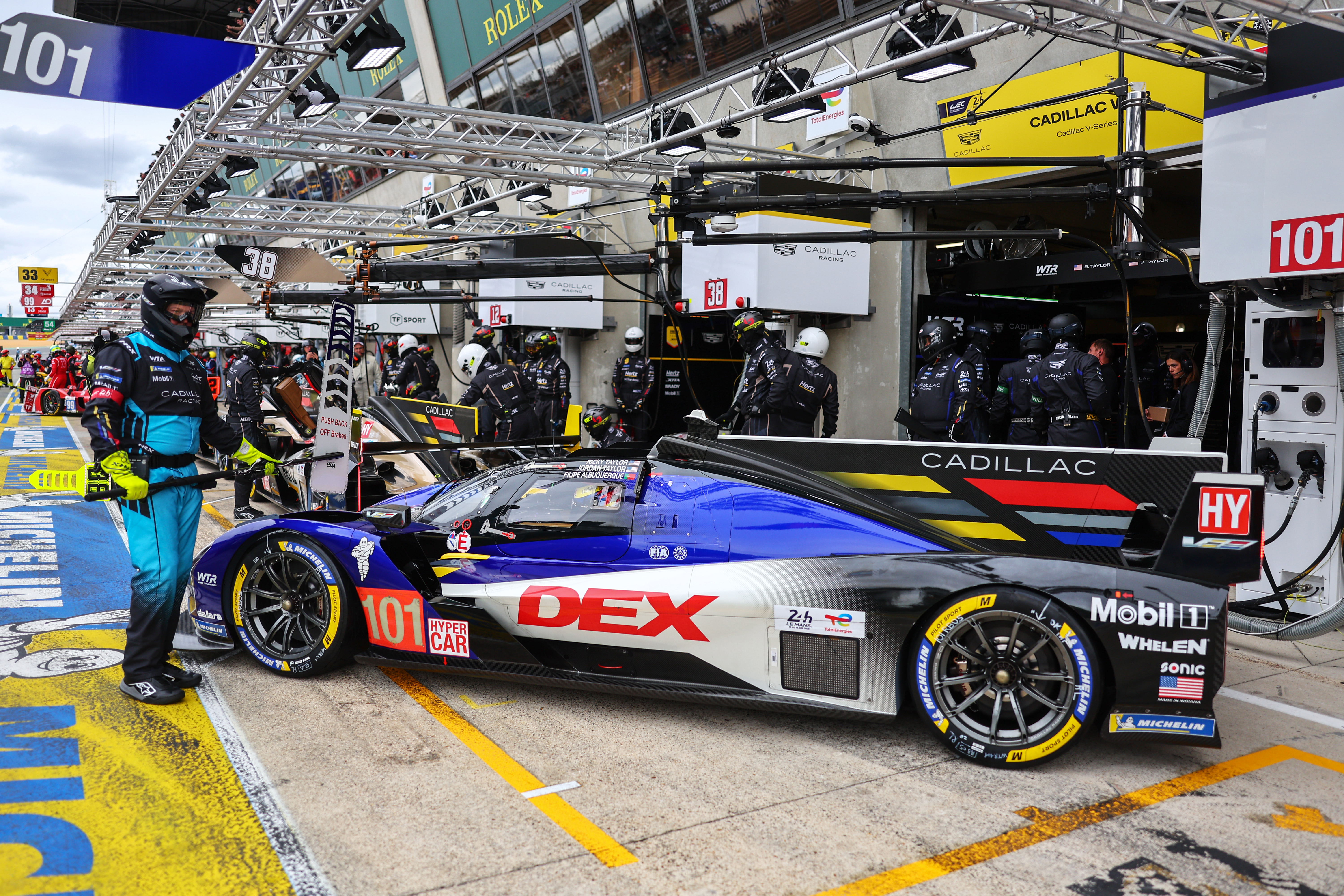
LE MANS, FRANCE - JUNE 11: The #101 Cadillac WTR Cadillac V-Series.R of Ricky Taylor, Jordan Taylor and Filipe Albuquerque driving in the Pitlane during practice ahead of the Le Mans 24 Hours at the Circuit de la Sarthe on June 11, 2026 in Le Mans, France. (Photo by Colin McMaster/Getty Images)

The less time you can spend in pit lane, the higher your chance of victory.

The less time you can spend in pit lane, the higher your chance of victory. Credit: Colin McMaster/Getty Images

Things will get slightly less complicated in 2030, I think. Earlier today the ACO and IMSA, together with the FIA (which is in charge of the World Endurance Championship, along with stuff like F1) announced that in 2030 there will be a unified class for Le Mans, WEC, and the WeatherTech championship. All-wheel drive is out; all cars will have to be rear-wheel drive hybrids. But you can either build the entire thing yourself (like LMH) or use an approved spine and hybrid system as a starting point (like LMDh).

LMP2

LMP2 cars are sports prototypes one step down from the Hypercars. Originally there were four different makes, from the same manufacturers as those LMDh spines—LMDh was developed from what was going to be the LMP2 replacement—but the Oreca 07 proved to be so much better than the other three that no one races a Ligier, Dallara, or Riley-Multimatic anymore. The cars all use the same 4.0 L Gibson V making 600 hp (447 kW), and there’s no hybrid system. These cars also have more aerodynamic downforce than the Hypercars, so they’re more enjoyable to drive, by all accounts.

Nine of the 19 LMP2 teams racing this year have a mix of professional and amateur drivers, and it’s these pro-am teams where we find our Silicon Valley entrants, as well as some other younger drivers who have yet to level up the bronze/silver/gold/platinum ranking system. The other 10 teams have more professional lineups. A standout among them to watch this year will be Doriane Pin, the young French driver who won Formula 1 Academy last year, particularly after a stunning lap during the first qualifying session, held on Wednesday.

LE MANS, FRANCE - JUNE 11: The #30 Duqueine Team Oreca 07 - Gibson of Doriane Pin, Julien Andlauer, and Richard Verschoor drives during Hyperpole ahead of the Le Mans 24 Hours at the Circuit de la Sarthe on June 11, 2026 in Le Mans, France. (Photo by Ker Robertson/Getty Images)

Doriane Pin is one of two women racing at Le Mans this weekend, along with Lilou Wadoux who is in one of the LMGT3 Ferraris. Sadly the Iron Dames team ran out of funding.

Doriane Pin is one of two women racing at Le Mans this weekend, along with Lilou Wadoux who is in one of the LMGT3 Ferraris. Sadly the Iron Dames team ran out of funding. Credit: Ker Robertson/Getty Images

LMGT3

The final category is for cars that started life as true road cars. In the past, Le Mans has had various different flavors of what the sport calls GT cars, some more specialized than others. Eventually the costs became too much for GT1, then GT2 (later called GTE, or GTLM in IMSA), and in 2024 the ACO decided to import the GT3 category, which was created back in 2005 by Stéphane Ratel as a way to make sports car racing less expensive for amateurs. (NB: less expensive is not the same thing as cheap.)

Under the old system (GT1 and GT2), the ACO published a rulebook with acceptable modifications; automakers would build their cars to those rules and then go racing to see who was fastest. But each race can only have one winner, and if one make starts to dominate, their rivals will either start spending more, driving up costs for everyone, or give up and do something else instead. GT3 solved that problem, again with balance of performance.

Each OEM builds their new car, then it’s benchmarked against the class, and the power and weight are adjusted to keep it in the right range. Different cars will make their lap times differently, and some cars will be better at particular tracks than others, but the category has been a worldwide success. And you can race a GT3 car at the Rolex 24 at Daytona or the Spa 24 Hours or the Nurburgring 24, as well as shorter but no less grueling events like the Bathurst 12 hours or the 12 Hours of Sebring, not to mention numerous other series and events. There are 25 LMGT3 cars in this year’s race, all from pro-am teams that must have at least one bronze and one silver driver among the crew.

LE MANS, FRANCE - JUNE 10: The #61 Iron Lynx Mercedes-AMG LMGT3 of Martin Berry, Rui Andrade, and Maxime Martin in action during practice ahead of the Le Mans 24 Hours at the Circuit de la Sarthe on June 10, 2026 in Le Mans, France. (Photo by James Moy Photography/Getty Images)

An assortment of GT3 cars during testing.

An assortment of GT3 cars during testing. Credit: Photography/Getty Images

Further reading

Millions or perhaps even billions of words have been spent over Le Mans across its 94 runnings, some better than others. I can highly recommend Richard Williams’ recent book 24 Hours, written for the race’s centenary year in 2023.

The race begins at 4 pm local time tomorrow—10 am Eastern, 8 am Pacific—and you can watch it in the US on HBO or Tru, or finally via the FIAWEC+ streaming service, which is no longer geoblocked. There’s also the excellent Radio Le Mans commentary, which is broadcast free online.

Myanmar’s prison releases part of a wider system of terror

0

Myanmar’s traditional New Year, Thingyan, is a time of renewal and public celebration. This year, it brought the release of some 4,300 prisoners in a mass amnesty ordered by the military. The release of President Win Myint, a close ally of well-known leader Aung San Suu Kyi, added to a sense that something, perhaps, was shifting.

But to understand what these annual releases mean, they must be placed within the wider architecture of detention, violence and control that has developed since the military coup in 2021. The releases do not constitute a meaningful reduction in the vast population of political prisoners.

According to the latest figures from the Assistance Association for Political Prisoners, more than 30,000 people have been arrested for opposing the military government. Of these, over 14,000 remain in detention, with thousands more cases that cannot be fully verified due to legal and extra-legal obfuscations by the authorities.

Annual mass amnesties have also become routine since the military coup. This year’s release was, in fact, slightly smaller than the roughly 4,900 prisoners freed around the same time in 2025. As in previous years, only a small fraction, estimated at around 150, were political detainees.

In addition, many people have been killed while participating in peaceful protests, during interrogation or in custody. Both Amnesty International and Human Rights Watch report figures of around 2,000 deaths in custody. These figures are likely to be underestimates.

Using a broader definition that includes civilians, pro-democracy activists and members of armed groups “who were arrested or captured and then killed”, the Assistance Association for Political Prisoners places the total number of deaths in detention at around 8,000 as of May 2026.

What is striking is not only the magnitude of the numbers, but their persistence. Arrests have continued year after year, even as amnesties have been announced. The overall system has not shrunk.

It has stabilized at a high level, and the expansion of prison building suggests something of a long-term systemic trend. The releases are part of the system of terror.

A recent report from the UN Special Rapporteur states that even small expressions of grief and solidarity such as banging pots and pans; participating in a “silent strike” by staying at home; buying, selling or carrying flowers on Suu Kyi’s birthday or posting a blank black panel on social media to mourn a deadly attack have led to the arrest and imprisonment of the individual or their family members.

Rumors, obfuscations and contradictions are part of a campaign of fear. Earlier this year, there were persistent rumors that four senior members of the Suu Kyi government were to be released. This did not materialize.

The release of President Win Myint had generated some optimism, but his residence reportedly remains heavily guarded, giving the appearance of a house arrest rather than release.

Extremist views spread on social media, as well as in Myanmar’s traditional media, around the time of the prisoner releases have added to concern. For example, a video post by Hla Swe, a former high-ranking army officer and member of parliament, gained more than 1,000 Facebook shares and 14,000 “likes.”

Hla Swe, nicknamed “Bullet”, stated, “Recently released people like Win Myint are not important. They are like snakes without a head. The important thing is not to put the head back on the body of the snake.” Many read this as a direct threat to Suu Kyi’s safety, or a precursor to or even an acknowledgment of her death.

During the same New Year period in which prisoners were freed, military operations continued. Airstrikes in the Sagaing region targeted villages and a monastery, killing some civilians and injuring others. These incidents are consistent with a broader pattern of attacks on non-military targets.

The legal system functions less as a mechanism of adjudication than as an instrument of control. Charges can be added, modified or reinterpreted. Individuals may be detained under one provision, released and later re-arrested under another.

A slew of new laws have been proclaimed and existing laws amended to allow the regime to justify the imprisonment of peaceful protesters.

The continued detention of Suu Kyi is emblematic. Tried behind closed doors, she has not been seen in public since the start of her trial in 2022. There is a complete blackout over the location where she has been held since her conviction in mid-2022.

It is understood that her lawyers have not seen her since the end of that year. Her family and supporters, as well as senior foreign diplomats, say that they have no independent, verifiable evidence that she is alive.

Uncertainty, opacity and contradictory messaging — including the cycle of imprisonments, releases and rearrests — in this context are not incidental. They are part of the system of terror in Myanmar.

Krishna Sen is professor at the School of Social Sciences, University of Western Australia, and a fellow at the Australian Academy of the Humanities. Ma Thida is an award-winning Burmese writer, surgeon and former political prisoner.

A longer version of this article was published by Melbourne Asia Review, Asia Institute, University of Melbourne.

President Trump Dismisses as ‘Fake News’ Iran’s Reported Ceasefire Terms 

0
president trump dismisses-as-‘fake-news’-iran’s-reported-ceasefire-terms 
President Trump Dismisses as ‘Fake News’ Iran’s Reported Ceasefire Terms 


President Donald Trump on Friday rejected reported Iranian ceasefire terms published by Iranian media, calling them “fake news” and saying they did not match the written agreement discussed between Washington and Tehran. 

The comments came less than 24 hours after President Trump halted planned US military strikes against Iran and announced a proposal aimed at ending the conflict. 

In a post on Truth Social, President Trump wrote: “The terms that Iran leaked out to the Fake News have NOTHING to do with the terms that were agreed to, in writing. What they said, including their weak and pathetic statement on having a deal, bears no relation to the truth.” 

The president was responding to a reported 14-point proposal published Friday by Mehr News agency. The framework included provisions for a $300 billion economic recovery and reconstruction package for Iran, a complete withdrawal of foreign troops from areas surrounding Iran, and the suspension of energy-related sanctions. 

Following President Trump’s announcement Thursday night, Iranian media reported there was “a high probability that the regime will approve that proposal.” Iran’s Foreign Ministry, however, said the United States had modified some elements of the original agreement. 

President Trump also questioned the prospects for reaching an agreement with Tehran. 

“Very dishonorable people to deal with. With them, there is no such thing as dealing in good faith. AMAZING!” 

The president further wrote: “Also, their totally rebuffed Drone attack last night against Indian Ships leaving the Hormuz Strait is TOTALLY UNACCEPTABLE. They better get their act together, and FAST!” 

His comments came as military activity continued following the ceasefire announcement. Reuters reported that a US official said American forces intercepted two suicide drones targeting ships in the Strait of Hormuz overnight. Iranian media reported explosions near Sirik, while Fars said Iranian military activity prevented a tanker from entering the waterway without coordination. 

NBC reported that US military forces were approximately three hours from carrying out planned strikes when President Trump announced the halt on Thursday. According to the report, naval units had already prepared munitions and adjusted air operation plans. Kharg Island, which President Trump had previously identified as a potential target, was not included in the approved strike package. 

Tim Allen Makes Shocking Confession as He Opens Up About Regrets

0
tim-allen-makes-shocking-confession-as-he-opens-up-about-regrets
Tim Allen Makes Shocking Confession as He Opens Up About Regrets


Tim Allen is pulling back the curtain on fatherhood, sobriety and the regrets that still haunt him.

The 72-year-old actor, best known for Home Improvement, Last Man Standing and the Toy Story franchise, admitted in a new interview that becoming a dad was never something he had dreamed about.

“I never really wanted to be a dad,” Allen told Us Weekly.

The comedian said he has even joked about it on stage, explaining that he was “never been a real fan of children” and found parenting to be one of life’s biggest surprises.

“As people have said many times about parenting, you go through all this stuff to get a driver’s license or a passport, but there’s nothing about raising children,” he said. “It was a work in progress.”

Allen is the father of two daughters. He shares his older daughter, Katherine, with his first wife, Laura Deibel. He shares his younger daughter, Elizabeth, with his current wife, actress Jane Hajduk.

The Toy Story star admitted he was not always around as much as he should have been when Katherine was growing up.

“With Kate, I was gone a lot, so her mom did most of the raising,” Allen said.

The actor also said raising daughters was a different world for him after growing up in a large family with seven boys and two girls.

“I have a different view of what will make a strong woman,” he said.

Allen explained that he was never very interested in what he called “girl stuff,” such as clothing, looks and gossip. Instead, he focused on teaching his daughters practical lessons about money, independence and taking care of themselves.

Over the years, Allen said he has come to understand the deep bond between a father and daughter.

“We communicate on a different level,” he said.

He added that he is sometimes stunned when his older daughter remembers advice he gave her years ago.

“I didn’t realize how much I got through to my older one,” Allen said. “Now and then she’ll say, ‘You used to say this all the time,’ and I go, ‘You actually listened.’”

Allen also opened up about one of the most painful parts of his past: the fact that he was not sober during part of Katherine’s childhood.

“I made amends to her,” he said.

The actor has been sober for nearly 30 years and said his younger daughter has only known him as the man he is today.

“With the younger one, I see how much different it is when I’ve been sober almost 30 years,” Allen said. “She never knew any of that guy.”

Allen said he has talked openly with Katherine about the past, and he believes she does not hold it against him.

“I’ve thought about it many times, and I’ve talked to Kate, and she doesn’t hold it against me,” he said.

As Toy Story 5 gets ready for release on June 19, Allen is also looking back on the darker chapter that changed the course of his life.

The actor said he “lost focus” after college and got involved in criminal activity, a period that led to him spending more than two years in prison.

“When I was incarcerated, I started reading books about men and women who had been successful out of nowhere, and I started focusing on where I wanted to be,” Allen said.

He said the experience left him ashamed and determined never to go back down that road again.

“I did not want to do that ever again,” Allen said. “I humiliated my family and friends and myself. I did not want to make that mistake again.”

Now, decades later, Allen says sobriety, fatherhood and hard-earned reflection have shaped him into a very different man.

Cameras, sensors, and 3D body scans: All the tech helping eliminate blown calls

0
cameras,-sensors,-and-3d-body-scans:-all-the-tech-helping-eliminate-blown-calls
Cameras, sensors, and 3D body scans: All the tech helping eliminate blown calls

At the 2026 World Cup, the refs on the field and the officials on the sidelines will be able to use an abundance of tech to help call penalties, spot offside violations, and make other consequential decisions.

The video assistant referee system, known as VAR, and the semi-automated offside technology (SAOT) have been used in soccer for years. But the setup at this summer’s World Cup represents some of the most advanced uses of adjudication tech to date—not just in soccer, but across all high-level sports.

During each match, the pitch will be awash in sensors, cameras, and new computer vision software. One especially notable advancement this year is the use of digital twins. Every player in the World Cup has had their body scanned by a computer. The digital twin of any athlete—which precisely matches their height, limb length, and shoe size—can be dropped into a virtual simulation of the game to determine their exact position relative to the ball, boundary lines, and other players. Officials can use all of this data to help spot infractions, determine penalties, and smooth out the edges of the beautiful game.

Even though these systems can study the action more closely than is possible with the human eye, flesh-and-blood refs are still part of the game. But when the referees get it wrong—which they do, ask any fan—and their decisions are challenged, officials can to turn to the technology to correct any mistakes, replacing subjective calls with objective truths.

These systems are primarily used to catch big errors, like checking to see if a particular player was offside during a play that resulted in a game-deciding goal. But teams can often call for a review of even inconsequential plays. It raises the question of where the system’s value lies: in bringing an impartial eye to pivotal moments, or in allowing the league to adjudicate tiny infractions of an inch here or an inch there.

FIFA and other worldwide soccer agencies have made their position on the subject clear: They want the big errors gone, sure, but those inches also matter a lot.

The eyes have it

Elements of this year’s setup are similar to the 2022 World Cup, but with upgrades. Hawk-Eye remains the event’s optical tracking provider, with its computer vision system capturing over two dozen skeletal points on each player at all times. The tracking system uses 16 high-resolution cameras this time around compared to 12 in 2022, FIFA director of innovation Johannes Holzmüller says.

And like in 2022, that optical data will be combined with advanced sensors inside the ball itself. Kinexon, a leader in the sports wearables space, will again be providing the match ball’s digital brain. This time it will include an ultrawide-band and IMU sensor setup (including both an accelerometer and gyroscope, the latter of which is vital for capturing ball spin) that tracks the ball’s precise location and any distinct touches, recording those data points 500 times per second.

The 2022 version of the ball sensor sat suspended in the center of the ball’s interior, supported by a string-based sling made by Adidas, which also makes the ball itself. This time, though, Adidas has created a small bladder to hold the sensor that’s placed along the inside wall of the ball.

“It’s vulcanized inside the bladder with a little plastic pouch,” says Maximillian Schmidt, Kinexon’s cofounder and managing director. “That vulcanization is just way more stable than those strings, which had hooks that could break easier.”

Placing the sensor along the ball’s interior wall instead of the center, however, requires some counterbalancing so the added weight on one side of the ball doesn’t make it wobble. While Schmidt says the entire setup weighs just 13 grams, his team had to calibrate everything to ensure every touch or movement of the ball is tracked evenly. And because the sensor now sits right at a point where it could be kicked directly, more robust impact testing was a key part of the process.

Combined, these optical and in-ball tracking systems will capture every nuance of all 104 World Cup games. But it’s the high-tech assist borrowed from the world of virtual reality that will make them, somehow, even more accurate.

Digital twins

During the lead-up to the tournament, all 2026 World Cup players have undergone a 360-degree high-resolution scan from FIFA’s tech partner, Lenovo. These scans will be ingested into the Hawk-Eye system, where they will replace generic avatars that have previously been used for offside and other VAR applications.

Art Hu, Lenovo’s global chief innovation officer, says these scans will define the body’s shape, muscle tone, and even shoe size with an accuracy of 1 to 2 millimeters. “That’s an order of magnitude improvement on an ordinary avatar,” Hu says.

Hu notes that this sort of full-body scanning itself isn’t especially novel, with a number of such scanners used across different sectors. The real technical challenge here is using a single scan of a player, taken while they’re standing still, and applying that digital twin to Hawk-Eye’s skeletal pose data in active gameplay scenarios—when the players are running, jumping, or sliding. The cost of these few extra inches of precision is an enormous amount of computing power and algorithmic tuning.

FIFA tested the new setup at the Club World Cup and Intercontinental Cup in 2025, plus at various youth tournaments over the last 18 months, Holzmüller tells me.

Prior versions of this digital twin tech had already been used to assist in VAR decisions for the lead-up to all goals and penalty kicks. The new one will also help review red-card penalties and incidents where an on-field official accidentally penalizes the wrong player. The VAR technicians will have the ability to overturn corner kick decisions if the system is able to detect the error and then alert the refs on the field through their headset without delaying the game. (Some calls take longer to calculate and would slow down the game as a result, and therefore VAR won’t be used for those.)

In another effort to reduce wasted time from reviews, VAR will now send immediate alerts to sideline officials for obvious, promptly detectable offside decisions, stopping play right away. This differs from past arrangements that allowed play to continue after the violation, only stopping the action later if a notable event like a goal or a penalty took place.

Holzmüller says his team is confident that the upgrades to the VAR system’s accuracy will allow for the correct call to be made more often, even on especially nuanced decisions, like “when there’s only one toe offside.”

Keeper peeper

While the vast majority of offside plays can be spotted by watching slowed-down broadcast footage in video replays, a handful of infractions (or non-infractions) occur at the precise moment between video frames. Despite the rarity of this problem, FIFA is dead set on solving it: Holzmüller says a combination of the 3D scans and ball-tracking data—which by capturing positions 500 times per second can produce higher-resolution data than video’s 60 frames per second—will supplement the video footage to provide the most complete picture possible.

Maybe the most interesting feature of the digital twin tech is a “3D goalkeeper view” within VAR. This visualizer can show the goalie’s point of view and, using the system’s digital inputs, determine if an attacking player in an offside position interfered with the keeper. This interference has long been illegal in soccer, but the number of players and size of the field have made it hard to call accurately.

Hu points out the wide array of possible uses for digital twin technologies across sports, from officiating applications like these to athlete health and performance. As models become more powerful and computing costs drop, they’ll only improve.

It’s fair to wonder if the juice is truly worth the squeeze for gaining an inch or two of resolution on certain rare calls. Holzmüller readily admits these advances, and all the technical and financial legwork that comes with them, might only change a few calls throughout the entire tournament. From FIFA’s perspective, though, there’s no question of its value when it comes to arguably the world’s biggest sporting event.

“We have to bring the best technology to the World Cup,” he says. “That’s our goal.”

This story originally appeared on wired.com

0FansLike
0FollowersFollow
0FollowersFollow
0SubscribersSubscribe
- Advertisement -
Google search engine

Recent Posts