Women’s prize for non-fiction winner, The Finest Hotel in Kabul, gives voice to the people of Afghanistan
The Finest Hotel in Kabul: A People’s History of Afghanistan is about an institution tasked with the job of housing strangers – Kabul’s Intercontinental Hotel. Through this hotel, which sits high on a hill, and the people within it, seasoned BBC journalist and current foreign affairs editor, Lyse Doucet, attempts tell an immersive history of the sweeping changes that have faced Afghanistan since it opened in 1969.
The book has won the third ever Women’s prize in non-fiction. As an scholar of the region, I can tell you that the hotel is a useful lens through which to tell the recent history of Afghanistan.
The modern state of Afghanistan occupies an integral position in the Silk Road region. It was home to an expansive and historic civilisation in which commerce and hospitality had long been entwined with one another.
Inns, better known as caravanseries in the region, played a central role in the provision of security, the exchange of information, and the formation of identity for traders.
Beyond caravanserais, caring for strangers occupied a critical place in the local moral universe of people in the region. In some contexts this took place in communal gathering places; in others, in villages or the guesthouses of the wealthy and powerful. Across the region, though, social institutions designed to receive, respect, and protect outsiders, from near and far, were a prominent feature of everyday life. While a very different sort of resting place, The Kabul Intercontinental sits within this rich history.
As with other bold architectural buildings of the 1960s, whose history is also tied up to a flow of western capital, the hotel stood for a vision of Afghanistan’s future – of modernity, development and international prestige. As the years passed, the reality ebbed and waned.
Its initial guests included Pan American Airlines flight crews and Afghan socialite and fashion designer Safia Tarzi, a scion of the country’s ruling royal family. People staying in its plush rooms enjoyed local delicacies like drinks from the Afghan-Clemd factory (a state-owned distillery) whose products included the rare taste of alcohol imported from Mongolia and others flavoured with the finest Afghan red raisins.
This luxury, however, would change as the final decade of the cold war ripped Afghanistan and its families to shreds. This is when Doucet’s relationship with the hotel began as she first checked in on Christmas eve 1988.
In its walls she experienced the Soviet evacuation. She saw armed mujahideen commanders from the hills, internationally renowned terrorists, and Taliban leaders tear out the hotel’s bars and smash the bottles of brandy they discovered within. Gone was the glamour, along with the music and mixed-gendered dancing in the hotel’s ballroom.
After the events of 9/11, the international jetset did return. However, these guests were uniformed Nato officials, local elites, international journalists and the employees of aid organisations. They flocked to the hotel, but often pursued by Taliban fighters who tracked them down with ruthless and bloody efficiency.
So Kabul’s “finest hotel” became to be associated with the cloistered and security-cordoned lives of Afghan and international elites and their acolytes. But as Doucet emphasises throughout, it was ordinary people who kept the institution afloat. Responding to changes of personnel and ideological direction, they navigated the changing, violent and deeply unpredictable world around them with deftness and skill. Many losing their lives in the course of doing so.
Around the world, similar hotels were built to demonstrate prestige and signal prosperous futures. However, while the Intercontinental’s doors never closed, others have either fallen into disrepair or come to be used for purposes quite different from those for which they were designed.
Take the Sevastopol Hotel in Moscow, which was built in 1979 to accommodate visitors for the 1980 Moscow Olympics. In the 1990s, it was transformed by Afghan merchants. Rooms built to house guests visiting for Olympics were transformed into commercial offices and retail shops; the hotel’s underground levels becoming warehouses packed full of Chinese-made toys, hardware items, and suitcases.
Doucet’s book is one of the few conventional journalistic accounts of Afghanistan that depicts the country’s ordinary people as rounded individuals seeking to lead respectable lives amid violence and unpredictability. It is a welcome corrective work and a worthy winner.
This article features references to books that have been included for editorial reasons, and may contain links to bookshop.org. If you click on one of the links and go on to buy something, The Conversation UK may earn a commission.
The biggest race in the world? The 24 Hours of Le Mans is this weekend.
One of motorsport’s three biggest races takes place this weekend in France. It is the annual 24 Hours of Le Mans, an endurance race that, together with the Indianapolis 500 and the Monaco Grand Prix, make up the ‘triple crown,’ an unofficial achievement that only the late Graham Hill can claim to have won. This year, 62 different cars take the start, racing on a mix of permanent race track but also public roads that for the rest of the year are how locals get to the supermarket or the local McDos.
It’s not the oldest race in the world, but it’s up there—it was first held in 1923, and this year will be the 94th running. It was started as a way to give the automotive industry a grueling test for their new machinery and has remained the area of motorsport with the most road relevance. Disc brakes crossed over from aerospace to road cars at Le Mans, and better brakes continue to be tested there today, but it’s also where companies like Porsche and Audi and Toyota proved new hybrid technology, brake-by-wire systems, direct-injection engines, and advanced headlights, to name but a few.
This year, the 62 cars are split across three different classes, each crewed by three drivers who take shifts at the wheel. Some of the drivers are pros—among the world’s very best. But plenty are amateurs; in the past, lots of dentists, oddly enough. But with the cost of racing these days, it’s the tech bros. The Ruby on Rails creator, the co-founder of GitHub, and the co-founder of Crowdstrike are all racing in the LMP2 class. And Valve’s Gabe Newell owns the Aston Martin team that is competing in both Hypercar—with the outrageous-looking and -sounding Valkyrie—as well as in LMGT3, where his son Gray will be one of the drivers.
Hypercar
The top class, with the fastest cars, is called Hypercar, contested by factory teams and all-professional driver lineups. We’ve written about Hypercar quite a lot over the past few years, together with the closely related GTP class that races in IMSA’s WeatherTech series over here. These are closed-roof mid-engined prototypes, most of them hybrids purpose-designed to go racing.
Ferrari, Peugeot, and Toyota each designed their cars completely in-house to a set of regulations called LMH, which allows them to put the electric hybrid motor at the front axle, although the cars can only use this temporary all-wheel drive above 93 mph (150 km/h).
Ferrari might have won every Le Mans since the introduction of Hypercar in 2023, but it hasn’t won a race in the World Endurance Championship since the French race last year. Genesis is a new entrant for 2026.
Credit: Daniele Paglino/NurPhoto via Getty Images
Ferrari might have won every Le Mans since the introduction of Hypercar in 2023, but it hasn’t won a race in the World Endurance Championship since the French race last year. Genesis is a new entrant for 2026. Credit: Daniele Paglino/NurPhoto via Getty Images
Aston Martin also builds its car to LMH, but the Valkyrie started life as a road car, designed by F1 legend Adrian Newey. But it had to lose the road car’s hybrid system and quite a lot of power and aerodynamic downforce in order to comply with the LMH ruleset. Ironically, the Valkyrie is perhaps the truest car competing in the Hypercar class—when the category was first proposed by the Automobile Club de l’Ouest (which organizes the race), the idea was to get racing versions of road-going hypercars like the Valkyrie or Mercedes’ AMG-One. At least until everyone realized how expensive and difficult that might be; only Aston Martin remained up for that challenge.
The bulk of Hypercar—Alpine, BMW, Cadillac, and now Genesis—are cars built to LMDh specifications, imported from IMSA in Daytona Beach, Florida. But those OEMs aren’t responsible for all of the car. The central carbon-fiber chassis or spine comes from one of four different builders (Oreca, Dallara, Multimatic, Ligier), and all LMDh cars must use the same transmission, hybrid motor, and hybrid battery. The automakers then design the bodywork and bring their own engines and software to the party. LMDh is a cheaper approach than LMH, but it’s also notable that during the first three years of the class, which was introduced in 2023, an LMDh car has yet to actually win Le Mans, a fact that almost certainly explains the absence of Porsche from the top category in 2026.
If all that sounds a bit complicated, that’s sportscar racing for you. To keep performance level between all the different cars, the sport uses a process called “balance of performance” to handicap machines into equality, with a maximum power output of 670 hp (500 kW).
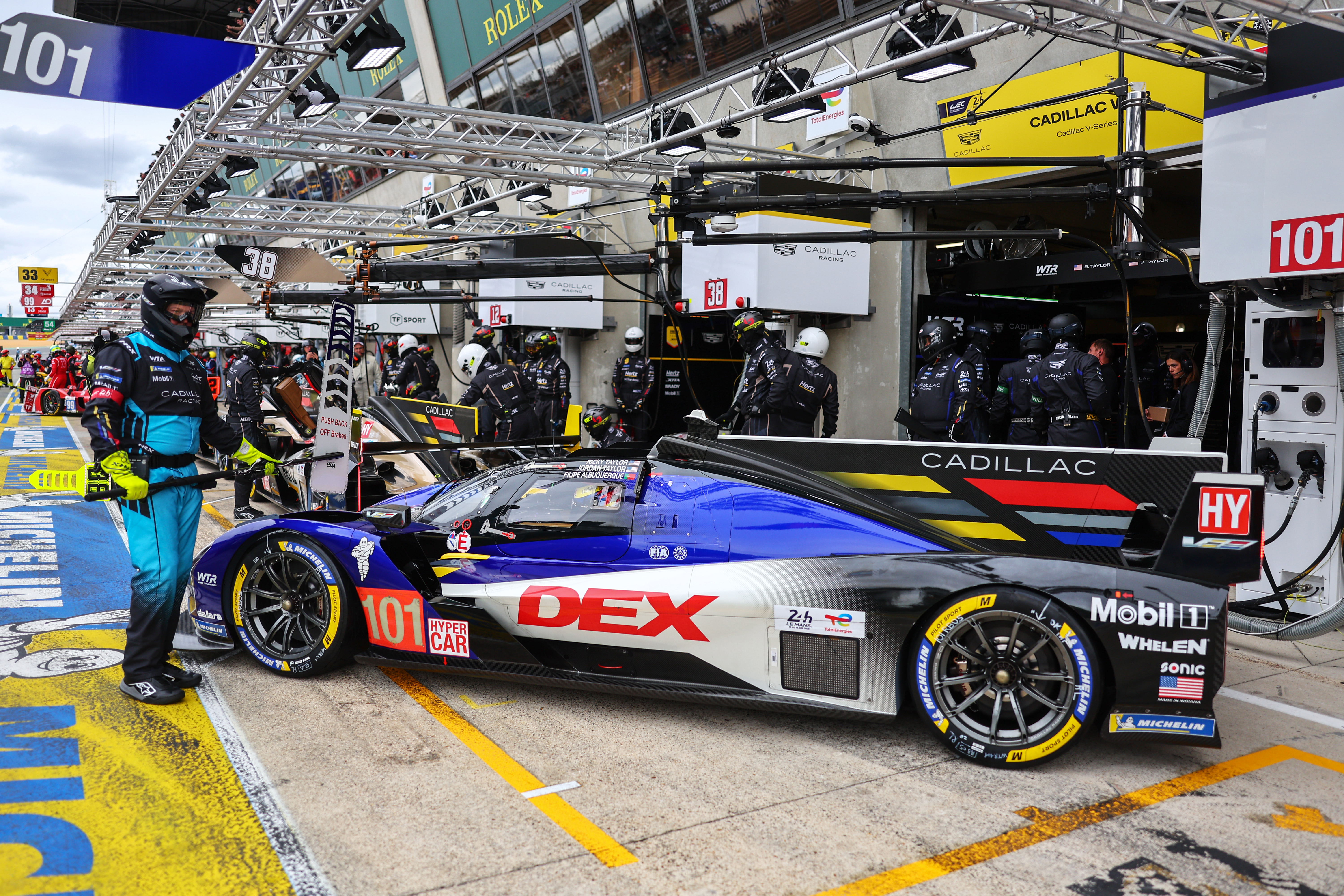
The less time you can spend in pit lane, the higher your chance of victory.
Credit: Colin McMaster/Getty Images
The less time you can spend in pit lane, the higher your chance of victory. Credit: Colin McMaster/Getty Images
Things will get slightly less complicated in 2030, I think. Earlier today the ACO and IMSA, together with the FIA (which is in charge of the World Endurance Championship, along with stuff like F1) announced that in 2030 there will be a unified class for Le Mans, WEC, and the WeatherTech championship. All-wheel drive is out; all cars will have to be rear-wheel drive hybrids. But you can either build the entire thing yourself (like LMH) or use an approved spine and hybrid system as a starting point (like LMDh).
LMP2
LMP2 cars are sports prototypes one step down from the Hypercars. Originally there were four different makes, from the same manufacturers as those LMDh spines—LMDh was developed from what was going to be the LMP2 replacement—but the Oreca 07 proved to be so much better than the other three that no one races a Ligier, Dallara, or Riley-Multimatic anymore. The cars all use the same 4.0 L Gibson V making 600 hp (447 kW), and there’s no hybrid system. These cars also have more aerodynamic downforce than the Hypercars, so they’re more enjoyable to drive, by all accounts.
Nine of the 19 LMP2 teams racing this year have a mix of professional and amateur drivers, and it’s these pro-am teams where we find our Silicon Valley entrants, as well as some other younger drivers who have yet to level up the bronze/silver/gold/platinum ranking system. The other 10 teams have more professional lineups. A standout among them to watch this year will be Doriane Pin, the young French driver who won Formula 1 Academy last year, particularly after a stunning lap during the first qualifying session, held on Wednesday.
Doriane Pin is one of two women racing at Le Mans this weekend, along with Lilou Wadoux who is in one of the LMGT3 Ferraris. Sadly the Iron Dames team ran out of funding.
Credit: Ker Robertson/Getty Images
Doriane Pin is one of two women racing at Le Mans this weekend, along with Lilou Wadoux who is in one of the LMGT3 Ferraris. Sadly the Iron Dames team ran out of funding. Credit: Ker Robertson/Getty Images
LMGT3
The final category is for cars that started life as true road cars. In the past, Le Mans has had various different flavors of what the sport calls GT cars, some more specialized than others. Eventually the costs became too much for GT1, then GT2 (later called GTE, or GTLM in IMSA), and in 2024 the ACO decided to import the GT3 category, which was created back in 2005 by Stéphane Ratel as a way to make sports car racing less expensive for amateurs. (NB: less expensive is not the same thing as cheap.)
Under the old system (GT1 and GT2), the ACO published a rulebook with acceptable modifications; automakers would build their cars to those rules and then go racing to see who was fastest. But each race can only have one winner, and if one make starts to dominate, their rivals will either start spending more, driving up costs for everyone, or give up and do something else instead. GT3 solved that problem, again with balance of performance.
Each OEM builds their new car, then it’s benchmarked against the class, and the power and weight are adjusted to keep it in the right range. Different cars will make their lap times differently, and some cars will be better at particular tracks than others, but the category has been a worldwide success. And you can race a GT3 car at the Rolex 24 at Daytona or the Spa 24 Hours or the Nurburgring 24, as well as shorter but no less grueling events like the Bathurst 12 hours or the 12 Hours of Sebring, not to mention numerous other series and events. There are 25 LMGT3 cars in this year’s race, all from pro-am teams that must have at least one bronze and one silver driver among the crew.
An assortment of GT3 cars during testing.
Credit: Photography/Getty Images
An assortment of GT3 cars during testing. Credit: Photography/Getty Images
Further reading
Millions or perhaps even billions of words have been spent over Le Mans across its 94 runnings, some better than others. I can highly recommend Richard Williams’ recent book 24 Hours, written for the race’s centenary year in 2023.
The race begins at 4 pm local time tomorrow—10 am Eastern, 8 am Pacific—and you can watch it in the US on HBO or Tru, or finally via the FIAWEC+ streaming service, which is no longer geoblocked. There’s also the excellent Radio Le Mans commentary, which is broadcast free online.
Myanmar’s traditional New Year, Thingyan, is a time of renewal and public celebration. This year, it brought the release of some 4,300 prisoners in a mass amnesty ordered by the military. The release of President Win Myint, a close ally of well-known leader Aung San Suu Kyi, added to a sense that something, perhaps, was shifting.
But to understand what these annual releases mean, they must be placed within the wider architecture of detention, violence and control that has developed since the military coup in 2021. The releases do not constitute a meaningful reduction in the vast population of political prisoners.
According to the latest figures from the Assistance Association for Political Prisoners, more than 30,000 people have been arrested for opposing the military government. Of these, over 14,000 remain in detention, with thousands more cases that cannot be fully verified due to legal and extra-legal obfuscations by the authorities.
Annual mass amnesties have also become routine since the military coup. This year’s release was, in fact, slightly smaller than the roughly 4,900 prisoners freed around the same time in 2025. As in previous years, only a small fraction, estimated at around 150, were political detainees.
In addition, many people have been killed while participating in peaceful protests, during interrogation or in custody. Both Amnesty International and Human Rights Watch report figures of around 2,000 deaths in custody. These figures are likely to be underestimates.
Using a broader definition that includes civilians, pro-democracy activists and members of armed groups “who were arrested or captured and then killed”, the Assistance Association for Political Prisoners places the total number of deaths in detention at around 8,000 as of May 2026.
What is striking is not only the magnitude of the numbers, but their persistence. Arrests have continued year after year, even as amnesties have been announced. The overall system has not shrunk.
It has stabilized at a high level, and the expansion of prison building suggests something of a long-term systemic trend. The releases are part of the system of terror.
A recent report from the UN Special Rapporteur states that even small expressions of grief and solidarity such as banging pots and pans; participating in a “silent strike” by staying at home; buying, selling or carrying flowers on Suu Kyi’s birthday or posting a blank black panel on social media to mourn a deadly attack have led to the arrest and imprisonment of the individual or their family members.
Rumors, obfuscations and contradictions are part of a campaign of fear. Earlier this year, there were persistent rumors that four senior members of the Suu Kyi government were to be released. This did not materialize.
The release of President Win Myint had generated some optimism, but his residence reportedly remains heavily guarded, giving the appearance of a house arrest rather than release.
Extremist views spread on social media, as well as in Myanmar’s traditional media, around the time of the prisoner releases have added to concern. For example, a video post by Hla Swe, a former high-ranking army officer and member of parliament, gained more than 1,000 Facebook shares and 14,000 “likes.”
Hla Swe, nicknamed “Bullet”, stated, “Recently released people like Win Myint are not important. They are like snakes without a head. The important thing is not to put the head back on the body of the snake.” Many read this as a direct threat to Suu Kyi’s safety, or a precursor to or even an acknowledgment of her death.
During the same New Year period in which prisoners were freed, military operations continued. Airstrikes in the Sagaing region targeted villages and a monastery, killing some civilians and injuring others. These incidents are consistent with a broader pattern of attacks on non-military targets.
The legal system functions less as a mechanism of adjudication than as an instrument of control. Charges can be added, modified or reinterpreted. Individuals may be detained under one provision, released and later re-arrested under another.
A slew of new laws have been proclaimed and existing laws amended to allow the regime to justify the imprisonment of peaceful protesters.
The continued detention of Suu Kyi is emblematic. Tried behind closed doors, she has not been seen in public since the start of her trial in 2022. There is a complete blackout over the location where she has been held since her conviction in mid-2022.
It is understood that her lawyers have not seen her since the end of that year. Her family and supporters, as well as senior foreign diplomats, say that they have no independent, verifiable evidence that she is alive.
Uncertainty, opacity and contradictory messaging — including the cycle of imprisonments, releases and rearrests — in this context are not incidental. They are part of the system of terror in Myanmar.
Krishna Sen is professor at the School of Social Sciences, University of Western Australia, and a fellow at the Australian Academy of the Humanities. Ma Thida is an award-winning Burmese writer, surgeon and former political prisoner.
A longer version of this article was published by Melbourne Asia Review, Asia Institute, University of Melbourne.
President Trump Dismisses as ‘Fake News’ Iran’s Reported Ceasefire Terms
President Donald Trump on Friday rejected reported Iranian ceasefire terms published by Iranian media, calling them “fake news” and saying they did not match the written agreement discussed between Washington and Tehran.
The comments came less than 24 hours after President Trump halted planned US military strikes against Iran and announced a proposal aimed at ending the conflict.
In a post on Truth Social, President Trump wrote: “The terms that Iran leaked out to the Fake News have NOTHING to do with the terms that were agreed to, in writing. What they said, including their weak and pathetic statement on having a deal, bears no relation to the truth.”
The president was responding to a reported 14-point proposal published Friday by Mehr News agency. The framework included provisions for a $300 billion economic recovery and reconstruction package for Iran, a complete withdrawal of foreign troops from areas surrounding Iran, and the suspension of energy-related sanctions.
Following President Trump’s announcement Thursday night, Iranian media reported there was “a high probability that the regime will approve that proposal.” Iran’s Foreign Ministry, however, said the United States had modified some elements of the original agreement.
President Trump also questioned the prospects for reaching an agreement with Tehran.
“Very dishonorable people to deal with. With them, there is no such thing as dealing in good faith. AMAZING!”
The president further wrote: “Also, their totally rebuffed Drone attack last night against Indian Ships leaving the Hormuz Strait is TOTALLY UNACCEPTABLE. They better get their act together, and FAST!”
His comments came as military activity continued following the ceasefire announcement. Reuters reported that a US official said American forces intercepted two suicide drones targeting ships in the Strait of Hormuz overnight. Iranian media reported explosions near Sirik, while Fars said Iranian military activity prevented a tanker from entering the waterway without coordination.
NBC reported that US military forces were approximately three hours from carrying out planned strikes when President Trump announced the halt on Thursday. According to the report, naval units had already prepared munitions and adjusted air operation plans. Kharg Island, which President Trump had previously identified as a potential target, was not included in the approved strike package.
Tim Allen Makes Shocking Confession as He Opens Up About Regrets
Tim Allen is pulling back the curtain on fatherhood, sobriety and the regrets that still haunt him.
The 72-year-old actor, best known for Home Improvement, Last Man Standing and the Toy Story franchise, admitted in a new interview that becoming a dad was never something he had dreamed about.
“I never really wanted to be a dad,” Allen told Us Weekly.
The comedian said he has even joked about it on stage, explaining that he was “never been a real fan of children” and found parenting to be one of life’s biggest surprises.
“As people have said many times about parenting, you go through all this stuff to get a driver’s license or a passport, but there’s nothing about raising children,” he said. “It was a work in progress.”
Allen is the father of two daughters. He shares his older daughter, Katherine, with his first wife, Laura Deibel. He shares his younger daughter, Elizabeth, with his current wife, actress Jane Hajduk.
The Toy Story star admitted he was not always around as much as he should have been when Katherine was growing up.
“With Kate, I was gone a lot, so her mom did most of the raising,” Allen said.
The actor also said raising daughters was a different world for him after growing up in a large family with seven boys and two girls.
“I have a different view of what will make a strong woman,” he said.
Allen explained that he was never very interested in what he called “girl stuff,” such as clothing, looks and gossip. Instead, he focused on teaching his daughters practical lessons about money, independence and taking care of themselves.
Over the years, Allen said he has come to understand the deep bond between a father and daughter.
“We communicate on a different level,” he said.
He added that he is sometimes stunned when his older daughter remembers advice he gave her years ago.
“I didn’t realize how much I got through to my older one,” Allen said. “Now and then she’ll say, ‘You used to say this all the time,’ and I go, ‘You actually listened.’”
Allen also opened up about one of the most painful parts of his past: the fact that he was not sober during part of Katherine’s childhood.
“I made amends to her,” he said.
The actor has been sober for nearly 30 years and said his younger daughter has only known him as the man he is today.
“With the younger one, I see how much different it is when I’ve been sober almost 30 years,” Allen said. “She never knew any of that guy.”
Allen said he has talked openly with Katherine about the past, and he believes she does not hold it against him.
“I’ve thought about it many times, and I’ve talked to Kate, and she doesn’t hold it against me,” he said.
As Toy Story 5 gets ready for release on June 19, Allen is also looking back on the darker chapter that changed the course of his life.
The actor said he “lost focus” after college and got involved in criminal activity, a period that led to him spending more than two years in prison.
“When I was incarcerated, I started reading books about men and women who had been successful out of nowhere, and I started focusing on where I wanted to be,” Allen said.
He said the experience left him ashamed and determined never to go back down that road again.
“I did not want to do that ever again,” Allen said. “I humiliated my family and friends and myself. I did not want to make that mistake again.”
Now, decades later, Allen says sobriety, fatherhood and hard-earned reflection have shaped him into a very different man.
Cameras, sensors, and 3D body scans: All the tech helping eliminate blown calls
At the 2026 World Cup, the refs on the field and the officials on the sidelines will be able to use an abundance of tech to help call penalties, spot offside violations, and make other consequential decisions.
The video assistant referee system, known as VAR, and the semi-automated offside technology (SAOT) have been used in soccer for years. But the setup at this summer’s World Cup represents some of the most advanced uses of adjudication tech to date—not just in soccer, but across all high-level sports.
During each match, the pitch will be awash in sensors, cameras, and new computer vision software. One especially notable advancement this year is the use of digital twins. Every player in the World Cup has had their body scanned by a computer. The digital twin of any athlete—which precisely matches their height, limb length, and shoe size—can be dropped into a virtual simulation of the game to determine their exact position relative to the ball, boundary lines, and other players. Officials can use all of this data to help spot infractions, determine penalties, and smooth out the edges of the beautiful game.
Even though these systems can study the action more closely than is possible with the human eye, flesh-and-blood refs are still part of the game. But when the referees get it wrong—which they do, ask any fan—and their decisions are challenged, officials can to turn to the technology to correct any mistakes, replacing subjective calls with objective truths.
These systems are primarily used to catch big errors, like checking to see if a particular player was offside during a play that resulted in a game-deciding goal. But teams can often call for a review of even inconsequential plays. It raises the question of where the system’s value lies: in bringing an impartial eye to pivotal moments, or in allowing the league to adjudicate tiny infractions of an inch here or an inch there.
FIFA and other worldwide soccer agencies have made their position on the subject clear: They want the big errors gone, sure, but those inches also matter a lot.
The eyes have it
Elements of this year’s setup are similar to the 2022 World Cup, but with upgrades. Hawk-Eye remains the event’s optical tracking provider, with its computer vision system capturing over two dozen skeletal points on each player at all times. The tracking system uses 16 high-resolution cameras this time around compared to 12 in 2022, FIFA director of innovation Johannes Holzmüller says.
And like in 2022, that optical data will be combined with advanced sensors inside the ball itself. Kinexon, a leader in the sports wearables space, will again be providing the match ball’s digital brain. This time it will include an ultrawide-band and IMU sensor setup (including both an accelerometer and gyroscope, the latter of which is vital for capturing ball spin) that tracks the ball’s precise location and any distinct touches, recording those data points 500 times per second.
The 2022 version of the ball sensor sat suspended in the center of the ball’s interior, supported by a string-based sling made by Adidas, which also makes the ball itself. This time, though, Adidas has created a small bladder to hold the sensor that’s placed along the inside wall of the ball.
“It’s vulcanized inside the bladder with a little plastic pouch,” says Maximillian Schmidt, Kinexon’s cofounder and managing director. “That vulcanization is just way more stable than those strings, which had hooks that could break easier.”
Placing the sensor along the ball’s interior wall instead of the center, however, requires some counterbalancing so the added weight on one side of the ball doesn’t make it wobble. While Schmidt says the entire setup weighs just 13 grams, his team had to calibrate everything to ensure every touch or movement of the ball is tracked evenly. And because the sensor now sits right at a point where it could be kicked directly, more robust impact testing was a key part of the process.
Combined, these optical and in-ball tracking systems will capture every nuance of all 104 World Cup games. But it’s the high-tech assist borrowed from the world of virtual reality that will make them, somehow, even more accurate.
Digital twins
During the lead-up to the tournament, all 2026 World Cup players have undergone a 360-degree high-resolution scan from FIFA’s tech partner, Lenovo. These scans will be ingested into the Hawk-Eye system, where they will replace generic avatars that have previously been used for offside and other VAR applications.
Art Hu, Lenovo’s global chief innovation officer, says these scans will define the body’s shape, muscle tone, and even shoe size with an accuracy of 1 to 2 millimeters. “That’s an order of magnitude improvement on an ordinary avatar,” Hu says.
Hu notes that this sort of full-body scanning itself isn’t especially novel, with a number of such scanners used across different sectors. The real technical challenge here is using a single scan of a player, taken while they’re standing still, and applying that digital twin to Hawk-Eye’s skeletal pose data in active gameplay scenarios—when the players are running, jumping, or sliding. The cost of these few extra inches of precision is an enormous amount of computing power and algorithmic tuning.
FIFA tested the new setup at the Club World Cup and Intercontinental Cup in 2025, plus at various youth tournaments over the last 18 months, Holzmüller tells me.
Prior versions of this digital twin tech had already been used to assist in VAR decisions for the lead-up to all goals and penalty kicks. The new one will also help review red-card penalties and incidents where an on-field official accidentally penalizes the wrong player. The VAR technicians will have the ability to overturn corner kick decisions if the system is able to detect the error and then alert the refs on the field through their headset without delaying the game. (Some calls take longer to calculate and would slow down the game as a result, and therefore VAR won’t be used for those.)
In another effort to reduce wasted time from reviews, VAR will now send immediate alerts to sideline officials for obvious, promptly detectable offside decisions, stopping play right away. This differs from past arrangements that allowed play to continue after the violation, only stopping the action later if a notable event like a goal or a penalty took place.
Holzmüller says his team is confident that the upgrades to the VAR system’s accuracy will allow for the correct call to be made more often, even on especially nuanced decisions, like “when there’s only one toe offside.”
Keeper peeper
While the vast majority of offside plays can be spotted by watching slowed-down broadcast footage in video replays, a handful of infractions (or non-infractions) occur at the precise moment between video frames. Despite the rarity of this problem, FIFA is dead set on solving it: Holzmüller says a combination of the 3D scans and ball-tracking data—which by capturing positions 500 times per second can produce higher-resolution data than video’s 60 frames per second—will supplement the video footage to provide the most complete picture possible.
Maybe the most interesting feature of the digital twin tech is a “3D goalkeeper view” within VAR. This visualizer can show the goalie’s point of view and, using the system’s digital inputs, determine if an attacking player in an offside position interfered with the keeper. This interference has long been illegal in soccer, but the number of players and size of the field have made it hard to call accurately.
Hu points out the wide array of possible uses for digital twin technologies across sports, from officiating applications like these to athlete health and performance. As models become more powerful and computing costs drop, they’ll only improve.
It’s fair to wonder if the juice is truly worth the squeeze for gaining an inch or two of resolution on certain rare calls. Holzmüller readily admits these advances, and all the technical and financial legwork that comes with them, might only change a few calls throughout the entire tournament. From FIFA’s perspective, though, there’s no question of its value when it comes to arguably the world’s biggest sporting event.
“We have to bring the best technology to the World Cup,” he says. “That’s our goal.”
EU agrees fast-track rules to boost defence investment and cut red tape
European Parliament and Council negotiators have reached a deal on a package of EU measures aimed at speeding up defence investment and improving the bloc’s ability to respond to security threats.
The proposals, part of the “Omnibus V” simplification agenda, are designed to streamline permitting, procurement, and cross-border transfers of defence equipment, while strengthening the European Defence Fund and easing regulatory barriers across the sector.
At the centre of the agreement is a new accelerated permitting system for defence projects such as factories and infrastructure expansions. Authorities will now have a default deadline of 42 working days to decide on applications, extendable twice in exceptional cases, but capped at 102 working days overall. If deadlines are missed, a tacit approval mechanism will apply in certain conditions.
Member states will also be required to establish single points of contact for defence projects, with digital tracking systems and annual reporting to the European Commission to improve transparency and efficiency.
The deal introduces a general transfer licence to simplify the movement of defence products within the EU, alongside updated procurement rules, higher thresholds, and longer framework agreements of up to ten years.
EU institutions say the reforms are aimed at unlocking up to €800 billion in defence investment by 2030 under the Readiness 2030 strategy, strengthening Europe’s industrial base and reducing bottlenecks in the defence supply chain.
This Blueberry Cream Cheese Crumb Cake is soft, creamy, buttery, and loaded with juicy blueberries. It has a tender cake base, a sweet cream cheese layer, and a cinnamon crumb topping that makes every bite rich, cozy, and delicious.
This is the kind of cake that works for breakfast, brunch, dessert, holidays, or a simple afternoon treat with coffee. The blueberries add bright fruity flavor, the cream cheese layer makes it smooth and indulgent, and the crumb topping gives it that bakery-style finish everyone loves.
If you enjoy blueberry desserts, this cake is a must-bake recipe.
Why You’ll Love This Blueberry Cream Cheese Crumb Cake
This cake is simple enough for everyday baking but special enough for guests.
You’ll love it because it is:
Soft, moist, and buttery
Filled with juicy blueberries
Layered with sweet cream cheese
Topped with a cinnamon crumb topping
Perfect for breakfast, brunch, or dessert
Easy to make in an 8-inch pan
Great with coffee or tea
Beautiful for family gatherings
What Makes This Cake Special?
This crumb cake has three delicious layers. The cake base is tender and sweet, the cream cheese filling adds a creamy cheesecake-like center, and the crumb topping brings a buttery cinnamon crunch.
The blueberries bake into the cake and add little bursts of juicy flavor. It tastes like a mix between coffee cake, cheesecake, and blueberry crumb cake all in one.
Recipe Summary
Prep Time: 20 minutes Cook Time: 35–40 minutes Total Time: About 1 hour Servings: 9 pieces Course: Breakfast, Brunch, Dessert Cuisine: American
Ingredients
For the Cake
1 cup all-purpose flour
1 cup granulated sugar
½ cup unsalted butter, softened
2 large eggs
1 teaspoon vanilla extract
2 teaspoons baking powder
½ teaspoon salt
1 cup fresh blueberries
For the Cream Cheese Layer
8 ounces cream cheese, softened
½ cup powdered sugar
1 teaspoon vanilla extract
For the Crumb Topping
1 cup all-purpose flour
½ cup brown sugar
½ cup unsalted butter, melted
1 teaspoon cinnamon
Ingredient Notes
Blueberries
Fresh blueberries work best for this cake because they hold their shape and add juicy flavor. You can also use frozen blueberries, but do not thaw them first.
Cream Cheese
Use softened cream cheese so the filling mixes smoothly. Full-fat cream cheese gives the richest texture.
Butter
Softened butter is used in the cake batter, while melted butter helps create the crumb topping.
Brown Sugar
Brown sugar gives the crumb topping a warm, caramel-like flavor.
Cinnamon
Cinnamon adds cozy flavor to the crumb layer and pairs beautifully with blueberries and cream cheese.
Step 1: Prepare the Pan
Preheat your oven to 350°F.
Grease an 8-inch square baking dish or line it with parchment paper.
Step 2: Make the Cream Cheese Layer
In a medium bowl, mix the softened cream cheese, powdered sugar, and vanilla extract until smooth and creamy.
Set aside.
Step 3: Make the Cake Batter
In a large bowl, beat the softened butter and granulated sugar together until light and fluffy.
Add the eggs one at a time, mixing well after each addition.
Stir in the vanilla extract.
Step 4: Add the Dry Ingredients
In a separate bowl, whisk together the flour, baking powder, and salt.
Gradually add the dry ingredients to the wet ingredients.
Mix until just combined.
Step 5: Add the Blueberries
Gently fold the blueberries into the cake batter.
Be careful not to overmix or crush the berries.
Step 6: Assemble the Cake
Spread half of the cake batter into the prepared baking dish.
Spoon the cream cheese mixture over the batter and gently spread it out.
Add the remaining cake batter over the cream cheese layer.
It does not have to be perfectly smooth.
Step 7: Make the Crumb Topping
In a bowl, combine the flour, brown sugar, melted butter, and cinnamon.
Stir until crumbly.
Sprinkle the crumb topping evenly over the cake.
Step 8: Bake
Bake for 35–40 minutes, or until the cake is golden brown and a toothpick inserted into the center comes out clean.
Step 9: Cool and Serve
Let the cake cool in the pan for at least 10 minutes.
For cleaner slices, allow it to cool completely before cutting.
Serve as is, or dust lightly with powdered sugar.
Tips for the Best Crumb Cake
Use room temperature butter and cream cheese for smooth mixing.
Do not overmix the cake batter after adding the flour.
Use fresh blueberries when possible for the best texture.
If using frozen blueberries, add them straight from the freezer.
Let the cake cool before slicing so the cream cheese layer sets.
Bake until the top is golden and the center is fully set.
Variations
Lemon Blueberry Crumb Cake
Add 1 tablespoon lemon zest to the cake batter for a bright citrus flavor.
Raspberry Cream Cheese Crumb Cake
Replace blueberries with fresh raspberries.
Mixed Berry Crumb Cake
Use a mix of blueberries, raspberries, and blackberries.
Almond Blueberry Crumb Cake
Add ½ teaspoon almond extract to the cake batter and sprinkle sliced almonds over the crumb topping.
Extra Crumb Topping
Make 1 ½ batches of crumb topping if you love a thick bakery-style crumb layer.
What to Serve with Blueberry Cream Cheese Crumb Cake
This cake is delicious with:
Hot coffee
Iced coffee
Black tea
Vanilla ice cream
Whipped cream
Fresh berries
Greek yogurt
A drizzle of lemon glaze
It is perfect for brunch, dessert tables, potlucks, and weekend baking.
Storage Instructions
Store leftover cake in an airtight container in the refrigerator for up to 5 days.
Because of the cream cheese layer, refrigeration is best.
Freezing Instructions
Wrap individual slices tightly in plastic wrap and place them in a freezer-safe bag or container.
Freeze for up to 3 months.
Thaw at room temperature or overnight in the refrigerator before serving.
Reheating Tips
Enjoy the cake chilled, room temperature, or slightly warm.
To reheat, microwave a slice for 10–15 seconds, or warm it gently in a low oven.
Frequently Asked Questions
Can I use frozen blueberries?
Yes. Use frozen blueberries straight from the freezer and do not thaw them first.
Can I make this cake ahead of time?
Yes. This cake can be made a day ahead and stored in the refrigerator. Let it sit at room temperature for a little while before serving.
Can I use a different berry?
Yes. Raspberries, blackberries, or mixed berries all work well.
Why is my crumb topping too wet?
If the topping feels too wet, add 1–2 tablespoons more flour until it becomes crumbly.
Can I make this gluten-free?
Yes. Use a 1:1 gluten-free all-purpose flour blend.
Does this cake need to be refrigerated?
Yes. Since it contains a cream cheese layer, store it in the refrigerator.
Recipe Card
Sherry’s Blueberry Cream Cheese Crumb Cake
A soft blueberry crumb cake layered with sweet cream cheese filling and topped with a buttery cinnamon crumb topping. Perfect for breakfast, brunch, dessert, or coffee time.
Prep Time: 20 minutes Cook Time: 35–40 minutes Total Time: About 1 hour Servings: 9 pieces
Ingredients
Cake
1 cup all-purpose flour
1 cup granulated sugar
½ cup unsalted butter, softened
2 large eggs
1 teaspoon vanilla extract
2 teaspoons baking powder
½ teaspoon salt
1 cup fresh blueberries
Cream Cheese Layer
8 ounces cream cheese, softened
½ cup powdered sugar
1 teaspoon vanilla extract
Crumb Topping
1 cup all-purpose flour
½ cup brown sugar
½ cup unsalted butter, melted
1 teaspoon cinnamon
Instructions
Preheat oven to 350°F.
Grease an 8-inch square baking dish or line it with parchment paper.
In a bowl, mix cream cheese, powdered sugar, and vanilla until smooth. Set aside.
In a large bowl, beat softened butter and granulated sugar until light and fluffy.
Add eggs one at a time, mixing well after each addition.
Stir in vanilla extract.
In a separate bowl, whisk flour, baking powder, and salt.
Add dry ingredients to the wet ingredients and mix until just combined.
Gently fold in blueberries.
Spread half of the batter into the prepared pan.
Spoon the cream cheese mixture over the batter.
Spread the remaining batter over the cream cheese layer.
In another bowl, mix flour, brown sugar, melted butter, and cinnamon until crumbly.
Sprinkle the crumb topping over the cake.
Bake for 35–40 minutes, or until golden brown and set in the center.
Cool before slicing and serving.
Notes
Use softened cream cheese for a smooth filling.
If using frozen blueberries, do not thaw them.
Let the cake cool before slicing for the cleanest pieces.
Store leftovers in the refrigerator for up to 5 days.
Nutrition Estimate
Per serving:
Calories: 360
Carbohydrates: 48g
Protein: 5g
Fat: 18g
Sugar: 30g
Fiber: 1g
Nutrition values are approximate and may vary depending on ingredients used.
Final Thoughts
Sherry’s Blueberry Cream Cheese Crumb Cake is sweet, creamy, fruity, and comforting. The soft cake, juicy blueberries, rich cream cheese layer, and buttery crumb topping make it a dessert that feels homemade and special.
Serve it with coffee in the morning, tea in the afternoon, or as a simple dessert after dinner.
Pinterest Description
This Blueberry Cream Cheese Crumb Cake is soft, buttery, and loaded with juicy blueberries! With a creamy cheesecake-style layer and cinnamon crumb topping, it’s perfect for breakfast, brunch, dessert, or coffee time. #BlueberryCrumbCake #CreamCheeseCake #BlueberryDessert #CoffeeCakeRecipe #EasyBakingRecipes #BrunchRecipes #HomemadeCake #BlueberryRecipes
The Right’s “Election Fraud” Cry for Midterms Previewed in Primaries
On Tuesday night, oyster farmer and combat veteran Graham Platner overwhelmingly sailed to victory in the Democratic Senate primary in Maine. His opponent, Gov. Janet Mills unofficially dropped out in late April, leaving Platner effectively unopposed. But a series of scandals rocked his candidacy, leaving his viability against Republican Sen. Susan Collins in November in question.
The veteran has repeatedly emphasized the way his combat trauma made him a worse version of himself, and how in later years he has been able to heal and evolve. In Maine, Democrats so far appear to have accepted that message of redemption, and his promise to provide a progressive economic agenda for Maine.
“It’s a very working-class state that has been very badly impacted by job loss and then, in recent years, by a pretty extreme wave of gentrification,” Intercept reporter Noah Hurowitz says. “The progressive policy agenda of Graham Platner combined with the perceived authenticity of his ‘I am a fighter, I will actually do this,’ whereas Janet Mills who has been in power and overseen a lot of this and has not been perceived to bring a lot of the changes that Mainers seek” is resonating with voters.
We also check in on California, where Intercept contributor Jordan Uhl breaks down the latest conspiracy theories about voter suppression, which conservatives have hinged on the defeat of former reality TV star Spencer Pratt, and the early results in the governor’s race. Uhl also breaks down how betting platforms like Kalshi and Polymarket are adding to the confusion, and what that could mean come November.
“If they don’t like the outcome, it’s rigged. If they like the outcome, it’s fine,” says Uhl. “At the gubernatorial level, you can see how Megyn Kelly pointing to prediction market data is symptomatic of a larger problem here. People weren’t looking to actual polling data. They were looking to the behavior of gamblers to inform their analysis.”
For more, listen to the full conversation of The Intercept Briefing on Apple Podcasts, Spotify, YouTube or wherever you listen.
Transcript
Jessica Washington: Welcome to The Intercept Briefing, I’m Jessica Washington, politics reporter at The Intercept.
Noah Hurowitz: I’m Noah Hurowitz, I cover federal law enforcement, immigration, and elections at The Intercept.
JW: Noah, it’s great to have you on again. This week we wanted to check in with you about the Democratic Senate primary in Maine where Graham Platner, the combat veteran and oyster farmer, faced a series of scandals.
But before we do all of that, let’s get into the results from Tuesday night. So Maine Gov. Janet Mills had already suspended her primary race against Platner in late April, so he was effectively running unopposed in the primary. But Noah, what were the results from Tuesday night, and what do they tell us about Mainers and what they want?
NH: The results were an overwhelming win for Platner. He came in at over 70 percent of the vote. The AP called it on Tuesday night with 8 percent showing. It was just very clear that he had carried the day, and I think a big part of that was because Governor Mills had unofficially suspended campaigning earlier in the cycle in April.
But in light of some of the news that came out the week before the primary, Janet Mills had slyly reminded people that she was still on the ballot. So there was a question going into Tuesday night of what is her showing going to be and what will that tell us about general support for Platner.
She did carry about 19 percent of the vote last time I checked which does show that one in five Democratic primary voters in Maine at least had some issue with casting a ballot for Platner in the primary. I don’t know if it tells us much about what his support is going to be in the general, because that is going to be a much more pitched battle.
It’s going to be much more Democrat versus Republican, rather than a vote where people felt like they could cast, let’s say, a protest vote against a candidate that they were not sure about.
JW: Yeah, and I really want to get more into the general election, because I think that’s going to be pretty interesting.
But we obviously can’t talk about Graham Platner without talking about the scandals that have emerged in the last few months. I’m just going to read through some of them. So until October of last year, he had a tattoo of Nazi iconography. He had previously made rape apology posts on Reddit. He was accused and admitted to sending inappropriate messages while married.
And I would argue most damning, an ex-girlfriend, who we should note is currently a Republican operative, accused him of physically restraining her and locking her in a room overnight. She also claimed that he was well aware of the meaning of the Nazi tattoo. Now, Platner has denied both allegations from his ex-girlfriend, but he has admitted to having the tattoo, which he covered up last year, and making the posts.
Do you think that these scandals hurt his campaign, or do you think that people perceive these stories as political attacks from the establishment? And by the establishment, I mean both in Maine and then also, I would argue, in the form of mainstream media like The New York Times and Politico. And I’m wondering, did those attacks maybe actually increase his support? I tend to think the latter.
NH: Yeah, the stuff about the tattoos and the Reddit posts came out pretty early into the campaign last fall. To be honest, I thought that they were going to sink him. I don’t know how you survive, having a Nazi tattoo. But he steamrolled right through that.
A big part of his message about himself has been a story of redemption. He was a combat veteran. It took him a long time to overcome a lot of the effects of that. He’s talked openly about his struggles with alcohol, about his post-traumatic stress disorder, and about how he was a very angry young man and found some level of peace after he came back to Maine, where he grew up.
The new stuff in the week before the primary, first there was an article about him having sexted with women after he was married, quite recently. And then, of course, as you mentioned, the The New York Times story, where there were allegations of physical abuse, allegations of him physically restraining his ex-girlfriend.
That, I think, did prompt a much more serious reckoning. A lot of his supporters were, A, yes, outright dismissive of what they saw as an establishment attack on an insurgent populous candidate. But I think it also, whether this is canny politics on his part or whether you choose to believe him, it was possible for him to say that, “Look, that’s just not who I am anymore. I regret deeply a lot of my actions when I was struggling in that way, and, here I am, a changed man fighting for you.” And that was a big part of his speech on Tuesday night when he accepted the nomination. He spoke a lot about redemption and about grace.
This was something that came up in my conversations with people in Maine in the run-up to the election was that, look, Maine is a state with high levels of substance use disorder. Maine is a state where there’s a lot of poverty, and there’s a lot of people who are veterans. And I think that the message of, “I was having a rough time, and I got my act together,” really does resonate. So I think there’s a combination of seeing this as an establishment attack, but also in accepting his story of getting his act together.
JW: It’s understandable, and I think at the same time, there is something to the narrative of an angry young man who really took it out allegedly on the women in his life, and then also making some of these posts that are obviously really offensive. I think particularly for female voters, I have to imagine there are a lot of women who are thinking, “I knew an angry young man, and I’m still living with the consequences of that angry young man. And it’s great for him to find redemption, but I’m still in this.” Those stories can be both triggering, but, and I imagine hopeful for some of those men who still find themselves in that place. But I think it’s a complicated space to walk.
NH: Yeah, no you’re absolutely right. And I think when it comes to someone running for office on a message of fighting for the common man or whatever. I think that a lot of the people who support his candidacy have this attitude of, yes, he had a messy personal life. Yes, some of these things that are described are inexcusable. But should that consign us to another Susan Collins term? Should that consign us to a more watered-down Democratic candidate who is not going to bring the same fire? And I think for a lot of people the answer is no. A lot of the people who I spoke to were wrestling with those questions. That’s something that’s going to continue to be in the discourse for sure.
JW: In your conversations, did you feel like people were more so focused on his progressive economic agenda, or did they feel more anger at the establishment? Is this about sticking it to Janet Mills, sticking it to Susan Collins, or is this about— He’s really putting forward a very progressive economic agenda for Maine. What do you feel resonated with people you spoke to?
NH: I think they go hand-in-hand. One of the biggest issues for Mainers is affordability. The state has been in a prolonged job crisis basically for decades.
Everybody knows someone who has been laid off from the paper mill. Because the paper mill closed, they lost their logging trucking route. People know lobstermen who have been forced off the water. It’s a very working class state that has been very badly impacted by job loss, and then in recent years by a pretty extreme wave of gentrification.
I went to school in Maine in Portland, and I don’t think I know anyone who still lives in Portland. Everyone has had to move to other cities like Lewiston and Auburn, which then in the chain reaction of gentrification and displacement then sees higher prices. But the jobs haven’t really come.
I think that the progressive policy agenda of Graham Platner combined with the perceived authenticity of his, “I am a fighter, I will actually do this,” whereas Janet Mills has been in power and overseen a lot of this and has not been perceived to bring a lot of the changes that Mainers seek.
JW: We have seen a knee-jerk reaction from some people on the left to dismiss outright the concerns around some of Platner’s actions, and accuse those who raise the issue of being a centrist or a corporate shill.
But at the same time, it’s clear that he is not the establishment pick, and his campaign has been heavily reported on and scrutinized in the media. Noah, you’ve done a lot of really great nuanced reporting on this race, which by the way everyone should check out, but what do you make of the reaction to Platner from both sides of this political divide?
NH: There’s two things. There’s what is being talked about in Maine and what is being talked about in national media. This was something that I didn’t quite get to when we were talking about the scandals, but another thing that came up in multiple conversations with political knowers of things in Maine, is that it’s not just the establishment that people see behind these attacks, but also national media — the New York Times, The Wall Street Journal, The Washington Post. People in Maine are generally suspicious of what they call folks from away.
Maine is a very unique political landscape. I hesitate to even call it purple because it is this mishmash of some right-leaning tendencies. People tend to be very pro-gun. But on the other hand, there’s a lot of more socially liberal or libertarian tendencies among Mainers. There’s people on the hard right who hate Platner because they think he’s a stooge, because they think he’s pro-immigrant, because they are in the tank for, if not Susan Collins for the power of the Trump administration, which would be badly affected by losing a Republican senator.
On the left in Maine the support is just generally there for Platner. He’s done very well there. More toward the center in, let’s say, national politics, I think that there has definitely been a lot of wariness around Graham Platner whether that’s because they think he’s going to be another Fetterman, which by the way, I don’t think he’s going to be another Fetterman. That’s best exemplified by John Fetterman going off nonstop against Graham Platner.
There’s a worry that they don’t know what direction he’s going to go in, that they can’t control him or that they just worry about his electability. But knowing Maine and having reported on this now for a while, I think that if anything he’s going to be more electable than a Janet Mills. Susan Collins has fended off pretty formidable challenges in the past. In 2020, she faced a challenge from Sara Gideon, who was a very well-known Democratic politician in Maine, fairly progressive. But she didn’t have that sort of insurgent credibility that Platner brings to the race.
And despite polling well, Sara Gideon lost badly. She lost by eight points. So I think that if anything, Maine specifically demands an outside-the-box challenge to someone as entrenched as Susan Collins.
JW: What is your expectation of how these scandals will follow Platner into the general election against Susan Collins?
Obviously she’s going to use them. I also would imagine, thinking about how things have come out so far, that there could be more things coming out. How do you imagine this is going to affect him in the general?
NH: I think that people are going to be digging. I think that national reporters and local reporters are going to be looking for anything that they can find. Just based on the kind of behavior that was described in these stories, one could assume that a messy life yields a lot of opposition research. I do think that some of the main points have already been arrived at in The New York Times reporting, and the tattoo and the Reddit post.
Susan Collins will definitely use these stories against Platner in the general but frankly, I think that it might hit a little bit less than it would coming in a primary from a Democrat, because another thing that people brought up multiple times in my reporting over the last week was that there’s this double standard.
It’s not just that, oh, Trump’s behavior has lowered the bar. It’s that Susan Collins has supported Donald Trump every step of the way, despite the Access Hollywood tape. She voted to confirm Brett Kavanaugh despite the allegations against him. She enabled the elimination of Roe v. Wade. One issue that I think matters a lot to people in Maine and has a distinct intersection here with issues of women’s rights and women’s health is that affordability is not just, “Oh, I can’t pay my rent.” Hospitals are closing in Maine, specifically OBGYN units.
So a lot of people in Maine are having to go either to Portland or to Boston for procedures that they might otherwise have been able to get at units that closed in the mid-coast area or farther north. This was something actually that Platner brought up in his speech.
So I think if you’re saying that he is bad to women based on the reporting so far, I think you can definitely make that argument, and I don’t think that Graham Platner would disagree. Ultimately I think that the Platner campaign strategy is going to be, “This is not about necessarily like personal taste. It’s about what I will deliver for the people of Maine.” And what Susan Collins has delivered for the people of Maine is Brett Kavanaugh, Donald Trump’s consistent hatred of and demeaning attitude towards women, the overturn of Roe v. Wade, and this affordability crisis where hospitals are closing in the state and forcing women to go for procedures to Portland or to Boston,
JW: So it sounds like we’re going to have a lot to watch in this race come November. Noah, we’re going to leave it there. Thank you so much for joining us.
NH: Thanks so much for having me.
JW: Next, we head to LA, where the mayoral primary has become the latest victim of right-wing panic and false claims of election fraud with Intercept contributor and my co-host, Jordan Uhl. But first, a quick break.
[Break]
JW: Hey, Jordan. Great to have you here.
Jordan Uhl: Hey, it is great to be here on the other side of the conversation.
JW: Jordan, you’ve been following the primaries for California governor and LA mayor quite closely. And because vote counting can take weeks in Los Angeles and the state generally for various reasons, including there being huge population centers and a lot of vote-by-mail ballots, it has become the latest target of claims by Republicans that there is election fraud.
President Donald Trump posted on social media, “Not possible for Spencer Pratt to have lost the LA runoffs after the big lead he had.” By the way, Pratt is the Republican candidate in the LA primary. In an interview with NBC “Meet the Press,” Trump stormed off after being pressed for evidence of his claims that the California governor’s race and the 2020 presidential elections were rigged.
[Clip plays]
Kristen Welker: …presented in a court of law-
Donald Trump: The election was rigged. It was a dirty election.
Kristen Welker: Mr. President.
Donald Trump: And it’s happening again right now in California.
Kristen Welker: You’ve never presented evidence that the 2020 election was rigged.
Donald Trump: It’s happening right now in California. Right now, it’s, look at what’s happening in California.
Kristen Welker: Where’s the evidence to that?
[Clip ends]
JW: As Republican gubernatorial candidate Steve Hilton and Pratt’s leads dwindled, conservative commentator Megyn Kelly parroted really similar talking points on her show.
Megyn Kelly: No one is going to trust this outcome if those two are eliminated from the general election given the leads that we’ve seen. … If you look at the betting markets, and they don’t know anything more than we do, generally they don’t, they’re all now voting against Spencer Pratt and Steve Hilton even making it.
JW: We’re going to end the clip there. Kelly goes on to complain about the mail-in ballots coming in as if that’s nefarious, when it’s just a continuation of legitimate vote counting.
It’s worth noting a few days later, as more votes have come in, Hilton is now set to face Democrat Xavier Becerra in the state’s general election come November. But that hasn’t stopped loud MAGA voices from claiming the LA election was stolen from Pratt.
Now, it seems to me that if you can believe an election was rigged in Los Angeles because a conservative former reality TV star with no experience and a reputation for wasteful spending and explosive outbursts didn’t win, you can believe anything.
But Jordan, how has the right tried to spin his defeat? What does it tell us as we head into November? Are there trends you’re seeing in the LA mayor’s race that mirror national trends in elections across the country?
JU: I mean, that is just patently ridiculous. The trends that we’re seeing are just continuations of trends or behavior patterns that Republicans have already exhibited in elections previously.
“If they don’t like the outcome, it’s rigged. If they like the outcome, it’s fine.”
If they don’t like the outcome, it’s rigged. If they like the outcome, it’s fine. More of the same here. At the gubernatorial level, you can see how Megyn Kelly pointing to prediction market data is symptomatic of a larger problem here. People weren’t looking to actual polling data; they were looking to the behavior of gamblers to inform their analysis.
So Hilton, now we know, is making the runoff. She was certain — based on gambling behavior — that he wouldn’t. So in her mind, the only conclusion was fraud.
There were many people who waited until later to decide who to vote for, that may not inform who they vote for in the general. But conservatives didn’t have a menu of options.
The field was largely consolidated behind Pratt in LA, and for the most part, you had the Trump endorsement of Steve Hilton for governor. While Chad Bianco, the sheriff from Riverside, did pull some votes, for the most part, they were lining up behind [Hilton]. So it was much more clear who they would vote for, so it allowed them to cast their vote early.
JW: Thinking just about Pratt, we’ve seen him on television as this kind of outrageous figure. I want to just play a couple clips just to give an idea of what millennials have going on in their mind when they hear the name Spencer Pratt.
[Clip montage plays]
Spencer Pratt: Wah, wah, wah, wah. What are you crying about, Stephanie? What the f— are you crying about? …
That’s why you’re not in my life, you crazy bitch. …
Your mom is just the vagina that made Heidi come onto Earth. Your mom is not Jesus or God!
Brody Jenner: Dude, relax, bro. What the hell is wrong with you?
Spencer Pratt: I hate that bitch. Excuse my French.
[Clips end]
JW: OK, so now that everyone’s gotten a taste of Pratt — if I’m being honest, I did that mostly for fun. But to talk about something a little bit more serious, as you’ve pointed out, betting markets are playing a role in this election. So Kalshi, Polymarket, can you explain briefly what Kalshi and Polymarket are, and how they’re factoring into this election and more elections around the country?
JU: These are, you could say, loopholes to current gambling laws. Well, you’re not actively betting in a sportsbook, you’re making a prediction about an outcome, and somehow — I’m not a lawyer — somehow that is legal. In California, sportsbooks are illegal. So in states like California, these platforms thrive. But they operate nationally for the most part.
“ Ideally, they want those customers to lose money so they make increased profits.”
They have been pumping a ton of money into advertisements, but also through influencers in paid promotional posts. Now, what that looks like is influencers or creators will point to prediction market data. The example that we saw with Megyn Kelly: Oh, well, the prediction markets are saying one thing, but then a different outcome occurred.
That’s not actual polling data. And this blurring of the lines is deliberate by Polymarket and Kalshi — not because they want people to have a clear picture, but because they want people to use their platforms. They want to bring in new customers. Ideally, they want those customers to lose money so they make increased profits.
Now, the argument that I’ve heard against this from people who have been approached by these companies is, “I don’t want anything to do with it,” because in a sense it could be seen as a form of voter suppression.
Let’s take the New York mayoral election as an example. If betting market data said that Andrew Cuomo had a 90 percent chance of winning the election, and you are a supporter of Zohran, you might see those odds and think, “It’s not worth it. He’s going to win.” But as we saw in that election, Zohran Mamdani brought the vote out and won. He is now mayor of New York. So polling showed a much closer race.
Polling in the LA mayoral primary showed in the last reputable poll before the election that Councilmember Nithya Raman was in second place. Spencer Pratt was in third. And now as these results are counted, it matches the polling data. It did not match the behavior of gamblers.
I think the biggest issue here, Jessica, is that Republicans only make up around 15 percent of the population in Los Angeles. If you look at the 2024 presidential election data, Spencer Pratt got, as it stands right now, within 1 percent of the vote share that Donald Trump got in the election. So the idea that he would somehow outperform Trump, just pull all of these votes from two Democrats in the city to somehow either make the runoff or, as he claimed in the eve of the election, win outright in the primary, which would be more than half of the vote — it was never rooted in reality or past elections.
JW: Yeah, it really concerns me. The idea that we would be replacing polls, which are, admittedly imperfect, but at least they’re scientific and evidence-based, not just vibes and guesses.
And not to air out the business of my co-host, but you’ve been approached by one of these companies. Can you tell us about that? What are they offering people to partner with them, and what are the expectations?
JU: They did. Kalshi has reached out to me twice with offers of “partnerships.” And what that looks like isn’t explicit pitching, “Hey, use this platform. I use this platform,” like you would in a traditional product placement.
It’s much more covert. They want you to integrate that betting market data into your content. It’s kind of a backdoor way of advertising. I had said no, just cut them off from the beginning in both offers; I’m not interested in that. But I have friends with representation who heard them out just to get a sense of what they were offering. I have heard from multiple people: They’re throwing around six-figure offers and, in many cases, multiple six-figure offers. We’re talking mid-six figures.
The people that I’ve talked to all said, no, they didn’t feel good about it, for the concerns that we’ve laid out. In their opinion, these companies are predatory, and it could have a suppressive effect on the vote. And there just aren’t really guardrails on these platforms which allows them to prey on people.
“They want you to integrate that betting market data into your content. It’s kind of backdoor way of advertising.”
JW:Wired reported that both Kalshi and Polymarket had to ask influencers they were partnering with to take down paid partnership tags after they falsely claimed the LA primary results were dubious. Semafor reported that Kalshi asked one of its MAGA influencers — who wrote, “Is California cheating to get Spencer Pratt out?” and “They’re stealing it, aren’t they?” to their 1.7 million X followers — to take down the post. Jordan, what do you make of that?
JU: This is a problem of their own making. I’d say a less charitable interpretation of their marketing strategy on social media would be to pay people who would likely be ideologically aligned with candidates who have no hope of winning to boost the prediction market data that shows that they are either outperforming or, in Pratt’s case, making the runoff or winning outright.
“ That’s just free money for Kalshi.”
Those outcomes were not rooted in polling data. But to a client base or a customer base who would believe those things are possible based on data from bettors — that’s just free money for Kalshi. All of those people would lose their bets, and that’s a windfall of cash.
So it seems like they were trying to walk things back when they had already paid these people to promote somebody who had no real prospects.
JW: I have to say, there is something interesting to me that this is the same year I found out what a “parlay” was, and it’s also the same year that the betting markets are trying to take over the election. But just coincidence, I guess.
So Vanity Fair just put out an article, “Spencer Pratt’s Mayoral Campaign Proves It Takes More Than Mastering the Algorithm to Get Elected.” He really did pop off with these AI videos that didn’t do it for me personally, but seemed to really be catching attention.
He had all this celebrity endorsement, but it didn’t go anywhere for him electorally. He, I think, did worse than just any kind of standard Republican probably would have done. Jordan, what do you make of the ways in which we’re maybe noticing the attention economy isn’t the exact same thing as electoral success?
JU: Spencer Pratt learned a lesson that many lefty progressive candidates over the past several years have learned the hard way, that simply running an online or Twitter-focused campaign does not lead to votes. Spencer Pratt had a lot of buzz, but that buzz was national. So of course, that’s not going to lead to votes in the city of Los Angeles.
The AI ads, some of them weren’t even made by his campaign, while they did use AI-generated images for posters and campaign art. To me, that kind of illustrates the hollowness of that campaign. It was much more sensational. It was more of a spectacle than substance. And to my knowledge, I don’t know what kind of ground game Spencer Pratt had. You need to get out and knock on doors. That it is campaigning 101.
He threw some parties. He cut a couple videos. He had some really slick ads. But are you talking about issues that matter to all of Los Angeles? The way he talked about the unhoused population in Los Angeles was seen by many as cruel and insensitive.
When talking about the fires, the fires of last year, which were a centerpiece of his campaign, it always seemed to come back to him. He lost his home. I know multiple people who lost their homes, and they didn’t resort to demonizing homeless people.
Even the frustration with the city’s response or the state’s response, no objective observer can look at those fires and the conditions that worsened them — the Santa Ana winds — that came in and made it difficult, and in many cases impossible, for helicopters to get into the hills to fight those fires, which is how they do combat wildfires in the hilly parts of the city.
The speed of those winds were 70, 80 miles an hour. You can’t get a helicopter up there. No rational person is going to see that and say, “Yes, this is clearly the mayor’s fault.” This is just a tragic disaster.
So for him to insinuate that this is all Mayor Bass and Nithya Raman’s fault is insulting to voters’ intelligence. They can recognize maybe the way it was responded to wasn’t great, but they’re not the reason the fires started in the first place.
JW: I did want to get into one positive takeaway from the LA mayoral primary that Clara Jeffery, Mother Jones editor-in-chief and my former boss, pointed out on Blue Sky, that now that the race will be between incumbent Mayor Karen Bass and Council Member Nithya Raman, we might actually get a real conversation around affordable housing and housing policy in general. Jordan, can you tell us a bit more about Raman and the issues on the table heading into November?
JU: This is going to be a very fascinating race to watch, and it has already started with Karen Bass blaming problems of homelessness on Nithya Raman. I think what she’s going to need to navigate is, Bass, the current mayor, will need to navigate is helping her potential voters understand that the city council does have a lot of power, more power in LA than city councils around the country.
Now, you can’t blame all of LA’s problems on one single council member, but I’m going to be very interested to see how this plays out. Yes, I think on the policy front, that’s great. We actually can have, ideally a substantial policy debate in a general election. This is typically not something that we see.
That’s why a lot of people, I think, were hopeful that Tom Steyer could make the runoff, because that potentially could force the favorite, Xavier Becerra, into tacking to the left on some of his positions, like oil, housing, and the billionaire tax. Unfortunately, he has nothing to hold him accountable. There’s no leverage to force him to shift positions now that he’s going to be facing Steve Hilton.
There is a shifting landscape in the LA mayoral race, which is going to be very fascinating. Nithya Raman, certainly not without critics, but she is widely seen as to the left of Karen Bass, and potentially we could see Karen Bass make promises that if she does defeat Raman in the general, will then be used to hold her accountable.
JW: Yeah, it is hard to imagine any kind of substantive debates happening in the alternate reality where we had a Spencer Pratt, Mayor Karen Bass race. Jordan, we’re going to leave it there, but thank you so much for joining me on the Intercept Briefing.
JU: Thank you so much for having me.
JW: That does it for this episode.
This episode was produced by Laura Flynn. Ben Muessig is our editor-in-chief. Maia Hibbett is our Managing Editor. Fei Liu is our product and design manager. Nara Shin is our copy-editor. William Stanton mixed our show. Legal review by David Bralow.
Slip Stream provided our theme music.
This show and our reporting at The Intercept doesn’t exist without you. Your donation, no matter the amount, makes a real difference. Keep our investigations free and fearless at theintercept.com/join.
And if you haven’t already, please subscribe to The Intercept Briefing wherever you listen to podcasts. Do leave us a rating or a review, it helps other listeners to find us.
Let us know what you think of this episode, or If you want to send us a general message, email us at podcasts@theintercept.com. What issues are you following in the midterms, send us an email or leave us a voice mail at 530-POD-CAST that’s 530-763-2278
Is China really deflating deflation? It’s harder than Beijing thinks
TOKYO – China’s “deflation-is-over” narrative is getting louder, but the foundations are still shaky.
Consumer prices rose 1.2% year-on-year in May, while producer prices jumped 3.9%, lifted by higher costs for energy, semiconductors and metals. To many economists, this is the clearest sign yet that the 2025 deflation scare is giving way to reflation.
But Japan’s long struggle shows how stubborn deflationary psychology can be. And it’s far from clear that Beijing is delivering the structural reforms needed to ensure China’s weak‑price era is truly ending.
Two reforms stand out — and neither is being pursued with urgency. First, resolving the deep housing crisis, which increasingly resembles Japan’s 1990s bad‑loan spiral. Second, building a real social safety net so 1.4 billion citizens feel confident enough to spend rather than hoard savings.
These priorities are tightly linked. With roughly 70% of household wealth tied to property, stabilizing the real‑estate market across China’s 70 largest cities is essential for reviving consumption and sustaining 4.5%- 5% growth.
But the longer Xi’s government acknowledges these pressures while avoiding decisive action, the more a deflationary mindset takes hold — and the harder it becomes to shake.
Japan is the cautionary tale. Even as the Bank of Japan prepares to lift rates to 1% next week — the farthest from zero in more than three decades — deflationary undercurrents still run through the economy.
On paper, Japan looks like it has finally escaped its low‑price trap. The BOJ expects inflation to reach 2.8% this year, suggesting reflation is taking hold. But beneath the headline, real wages remain negative, with pay packets consistently trailing price gains and domestic demand weakening as a result.
The result is a slow‑burn form of stagflation, and Tokyo has yet to deliver the structural reforms needed to close the gap between rising prices and stagnant household incomes.
“For the Japanese economy to fully break free from its long-standing deflationary mindset,” says Toshihiro Nagahama, economist at the Dai-ichi Life Research Institute, “it’s imperative for the government and the central bank to align, articulate their risk assessments, maintain honest and transparent dialogue with financial markets, and resolutely execute bold, long-term growth investments.”
Nagahama argues that today’s global economy is being shaped by an unusually dense intersection of forces — the war in Ukraine, volatility across the Middle East, and a series of historic turning points in central‑bank policy. The common thread is unmistakable: geopolitics is now driving economic outcomes, not the other way around.
With the Iran war on an uncertain path, he warns that governments can’t anchor their strategies to hopeful scenarios. They must instead plan around worst‑case risks, including the possibility of a multi‑year disruption in the Strait of Hormuz, a chokepoint that would reshape global energy flows and inflation dynamics.
“While these shifts present a formidable trial for Japan, they also represent a historic opportunity,” Nagahama notes. “As the country sheds its decades-long deflationary mindset and restores nominal growth, these external shocks serve as a critical test for fully escaping the paradigm of contracting equilibrium.”
Japan may not get the policy rethink it needs. Prime Minister Sanae Takaichi’s economic playbook still leans heavily on ultralow rates and a weak yen — the same formula Tokyo has relied on for nearly three decades. That’s why next week’s expected BOJ rate hike to 1% is already irritating a political establishment that prefers monetary comfort to structural change.
The timing is awkward. The June 16 meeting will proceed without Governor Kazuo Ueda, hospitalized with a liver infection. Yet, as Nomura economist Mari Iwashita notes, his absence is unlikely to alter the decision.
Even so, Takaichi’s camp is pressing the BOJ to ease off. Last year, she dismissed even the idea of rate hikes as “stupid,” despite mounting evidence that Japan’s 27‑year experiment with zero rates has backfired. Her government is the 14th since the late 1990s to double down on a weak‑yen strategy meant to lift exports and juice GDP.
Instead of reviving Japan’s animal spirits, the approach dulled them. Decades of near‑free money reduced the urgency for policymakers to boost competitiveness and for CEOs to innovate, restructure, and take risks. That complacency now shows: Japan Inc. is watching uneasily as BYD reshapes the global electric vehicle market and DeepSeek jolts the AI landscape — the kind of disruption Japanese firms once delivered in the 1980s.
Since taking office in October, Takaichi has shown little inclination to break from this script. “Sanaenomics” is essentially a continuation of Shinzo Abe’s playbook, built on the same reliance on ultralow rates and a deliberately weak yen.
The problem is that Japan’s current bout of inflation isn’t the healthy, demand‑driven kind policymakers once hoped for. It’s being fueled by high import costs for energy, food, and other essentials — classic cost‑push inflation, not the “demand‑pull” gains that signal rising confidence. In short, it’s bad inflation.
A similar dynamic is now confronting China. The gap between surging producer prices and muted consumer prices is the widest since June 2022. That divergence suggests manufacturers are struggling to pass higher input costs on to consumers, leaving profit margins under pressure.
If that squeeze persists, it could have serious implications for wages across a $20 trillion economy, undermining household spending and complicating Beijing’s reflation narrative.
This trajectory explains why Eurasia Group CEO Ian Bremmer entered 2026 warning that “China’s deflation trap” wouldn’t go away as easily as many hope.
The problem, Bremmer says, is that Xi continues to “prioritize political control and technological supremacy over the consumption stimulus and structural reforms that could break the cycle. Beijing has the means to prevent a crisis, but living standards will deteriorate, the fallout will spread abroad, and the world’s second-largest economy will remain stuck in a trap of its own making.”
Home prices falling for five years mean “household wealth destruction on par with America’s 2008 crash, except it’s still accelerating,” Bremmer adds. “Consumer confidence, investment, and domestic demand have cratered with it. Beijing bet big that high-tech manufacturing would fill the gap left by property. Instead, state-driven investment has created overcapacity, and weak domestic demand means there aren’t enough buyers to absorb it.”
One clear result of Xi’s “involution” policy is that too many Chinese firms are chasing too little demand, slashing prices to survive. “Margins collapse, forcing even well-run firms to cut wages and jobs to stay afloat,” Bremmer notes.
“Workers spend less. Demand weakens further, so firms cut prices again. Meanwhile, debts grow harder to service with each turn of the cycle. Banks and local governments keep zombie firms alive — rolling over loans, protecting local champions — which keeps overcapacity entrenched,” he adds.
It means, Bremmer concludes, that “the debt-deflation spiral feeds on itself. Donald Trump’s tariffs last year made the situation worse, closing off a critical export market and confronting Chinese firms with a grim choice: slash prices to find buyers outside the United States, or transship goods through third countries to reach America anyway. Either path squeezes margins further. Over a quarter of listed Chinese companies are now unprofitable, the highest share in 25 years.”
The bottom line is that deflationary pressures can persist long after headline inflation turns positive, quietly eroding confidence. That’s why markets are buzzing about the possibility of PBOC easing in the months ahead — a move that could weaken the yuan and widen China’s trade surplus.
As economist Brad Setser of the Council on Foreign Relations puts it: “Of course, no one explicitly says they would welcome a bigger surplus. But if an international institution’s policy advice is monetary easing — to fight deflation — and fiscal consolidation because of off‑balance‑sheet risks, plus more exchange‑rate flexibility, it is effectively advocating for the country to export its way out of its domestic troubles.”
Beijing, however, has been reluctant to let the yuan slide. A stable or appreciating currency serves three strategic purposes for Xi’s leadership. It reduces the risk of offshore defaults among heavily indebted property developers.
It supports Xi’s ambition to elevate the yuan as a credible reserve currency. And it helps manage tensions with the Trump White House, which remains acutely sensitive to any sign that Beijing is tilting the playing field in favor of its exporters.
However 2026 shakes out, hopes Xi’s team is successfully deflating China’s deflation could be in for a rude awakening. Japan’s example shows that even if headline data suggest that reflation is afoot, the deflationary mindset is very hard to change.