26.7 C
London
Wednesday, June 24, 2026
Home Blog

Lessons start with how Iran organized Melbourne synagogue attack

0
lessons-start-with-how-iran-organized-melbourne-synagogue-attack
Lessons start with how Iran organized Melbourne synagogue attack

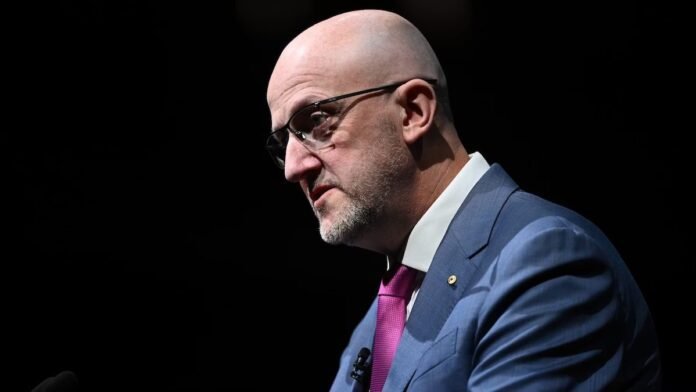
A former Australian resident living in Iraq directed the attack on Melbourne’s Adass Israel Synagogue in December 2024, Mike Burgess, the head of the Australian Security Intelligence Organization, has revealed.

Burgess said Iran, which was behind the attack, recruited the man through a “complex web of Iraqi-based militia groups”.

“Valuing his high wealth and criminal connections, the IRGC [Islamic Revolutionary Guard Corps] protected him and supported his illegal enterprises.

“That changed dramatically after ASIO publicly named Iran’s involvement in the arsons.

“This person’s Iranian backers lost their enthusiasm, and after further pressure from Australian and local law enforcement, they threw him in prison.”

Burgess gave the details while delivering his annual threat assessment speech on Wednesday evening. He also said an Iran-based Australian citizen orchestrated the firebombing of the Lewis Continental Kitchen in Bondi in October 2024, which was the “the first major attack in the summer of antisemitism.”

“This person is a senior agent of the IRGC Qods Force, running its networks around the world.

“We know more about him than he realises, including the name of his superior in Iran and the department he works for. Department Eleven-thousand, a covert unit within the IRGC Qods Force, is responsible for coordinating operations in the West.”

Burgess said he couldn’t name the individuals because of the need to protect continuing investigations and related prosecutions.

“But I want them to understand this: We know who you are, we know what you’ve done and we know who you work for.”

On antisemitism generally, Burgess said it was often seen through a narrow lens. But it could come from “diverse sources simultaneously, challenging traditional definitions, assumptions, and approaches”.

Sadly, and illogically, hatred of Jews is one thing virtually all the violent extremist cohorts have in common. Neo-Nazis are antisemitic. Islamic extremism is antisemitic.

Issue-motivated extremists can be antisemitic, particularly when they subscribe to conspiracy theories and stereotypes about the Jewish community.

Nation states can be antisemitic, as we saw with the arson attacks against the Jewish communities in Melbourne and Sydney perpetrated by criminals directed by Iran’s Islamic Revolutionary Guard Corps.

Anarchists and revolutionary groups can be antisemitic.

He said Australian companies seen to have links to Israel were being targeted with “repeated acts of vandalism and arson by far-left activists”.

“My point is that violent antisemitism is not a single, or simple, intelligence problem.”

The firebombing of a synagogue “can simultaneously be criminal arson, foreign interference, the promotion of communal violence and politically motivated violence”.

“And when Iran directs the arson, it’s an act of state-sponsored terrorism.”

Burgess once again stressed the degrading of Australian’s security environment. “Great power competition is driving an insatiable appetite for strategic advantage. As a result, espionage and foreign interference are at extreme levels, while preparation for sabotage is growing in scale and sophistication.”

“At the same time, politically motivated violence – which incorporates terrorism – remains an acute concern.”

Burgess said the degrading security environment was marked by “concurrent, cascading, and compounding threats” which could be categorized as “threats to life” and “threats to our way of life.”

In a speech filled, as usual, with case studies, Burgess related the story of a person subjected to “an unrelenting campaign of intimidation” by a foreign regime that for a decade had demanded he return to his place of birth to address unspecified corruption investigations.

The harassment included detaining the man’s relatives living overseas, interrogating them and subjecting them to travel bans.

“After receiving a desperate plea from one of the detained relatives, a family member based in Australia tried to sort things out.The family member flew to the foreign country to meet the regime’s. They interrogated the traveler for hours, and bluntly stated the individual would only be allowed to return to Australia after agreeing to maintain phone contact with the regime and file reports on the target of the harassment.”

Burgess said ASIO knew of five regimes that targeted Australians with harassment, with one country particularly active.

“In 2023 alone, that country coerced at least eight individuals to leave Australia for the place of their birth. Five were Australian citizens or permanent residents. Three never returned.”

Burgess said Australia’s defense captivities, especially AUKUS, were priority targets for foreign intelligence services.

“A spy from a foreign intelligence service approached an Australian security clearance holder online, pretending to be from a consulting company.

“The spy paid the official to write two reports on Australia’s relationship with our Pacific neighbors and then, thinking he’d been hooked, offered money for inside information on AUKUS. The foreign intelligence service wanted insights on the progress of Pillar 1, the technologies of Pillar 2, the amount of money being invested, Australia’s geo-strategic ambitions, relations between the three AUKUS governments and the likely trajectory of Australian public opinion.

“I’m pleased to report the clearance holder became suspicious and reported the contact.”

Burgess also said nation-state hackers had compromised the network of a critical Australian infrastructure provider. They were apparently preparing for sabotage, mapping out the network so it could be crippled later.

“Cyber sabotage is an evolving threat, and I have established dedicated teams to counter it. As ASIO’s understanding grows, so does our level of concern.

“The scale of this activity – led by one nation state in particular – is difficult to overstate. You’d be surprised how extensive our warrant coverage is. We struggle to find a single country in our region that has not been compromised by this state’s cyber apparatus.”

He said critical infrastructure in energy and communication as well as that supporting the military were “top targets.”

“In this case, a state-sponsored group didn’t just achieve access to the Australian critical infrastructure provider, it successfully acquired credentials – log in details and passwords – for active users of the networks, including the IT professionals guarding it.”

Burgess struck a defensive note when talking about ASIO’s counterterrorism activity in recent times, which can be read as a response to criticism that the organization had not given counterterrorism sufficient priority.

“Even when surging espionage and foreign interference demanded more attention, countering terrorism remained a priority – as I stated publicly in ASIO’s 2022 Annual Threat Assessment.

“We increased CT resourcing when we raised the threat level in 2024 and it continued to grow in the months before Bondi. Resourcing followed the threat.

“The number of ASIO officers working on our counter-terrorism mission in 2025 was almost double the number from 2005.

“That reflects a bigger ASIO but also an on-going commitment to leave no known serious threat untreated.”

But he said in the new terrorism environment, even a “vast army” of ASIO officers might not be enough “to find an individual who’s been radicalized online and uses encrypted communications”.

Michelle Grattan is a professorial fellow, University of Canberra.

This article is republished from The Conversation under a Creative Commons license. Read the original article.

Jerusalem Grand Slam 2026 To Welcome Athletes From 29 Countries 

0
jerusalem-grand-slam-2026-to-welcome-athletes-from-29-countries 
Jerusalem Grand Slam 2026 To Welcome Athletes From 29 Countries 


The Jerusalem Grand Slam 2026 will bring together approximately 76 athletes from 29 countries on Thursday, June 25, at the National Stadium in Givat Ram, Jerusalem, as the city hosts one of Israel’s leading international athletics competitions. 

Organized with the involvement of the Jerusalem Municipality and the Israel Athletics Association, the event will feature competitors from Europe, North and South America, and Africa alongside many of Israel’s top track and field athletes. 

Athletes from countries including the United States, Canada, Brazil, France, Greece, Ukraine, Hungary, Italy, Spain, the Netherlands, Ethiopia, and Uganda are expected to participate. The program will also include a 4×100-meter relay featuring national teams from Ukraine, Lithuania, and Poland. 

Among the Israeli competitors scheduled to take part are Blessing Afrifah, Yonatan Kapitolnik, Adva Cohen, Omri Shiff, Romi Tamir, Alina Drotman, and Mercy Afrifah. 

(Israel Athletics Association)

For many athletes, the competition represents an opportunity to achieve qualification standards and collect ranking points ahead of the European Championships in August. 

Now entering its third consecutive year, the Jerusalem Grand Slam has continued to expand its international profile and strengthen Jerusalem’s role as a venue for major sporting events. 

Last year’s edition produced a notable achievement when Omri Shiff set a new Israeli record in the 400-meter hurdles with a time of 49.82 seconds, ending a 34-year wait for a new national mark in the event. 

In addition to the athletics competition, organizers said a family fan zone will operate at the stadium, offering interactive activities and entertainment for visitors. 

From left to right: Ze’ev Barzilai, marketing director at Eldan transportation, Moshe Lion, mayor of Jeruslaem, Ami Baran, chairman of the Israel Athletics Association. (Israel Athletics Association)

Jerusalem Mayor Moshe Lion said the event reflects “Jerusalem’s growing status on the global sports map,” adding that the city has continued to attract international athletes and invest in sports infrastructure. 

Ami Baran, Chairman of the Israel Athletics Association, said the participation of athletes from 29 countries carries “great significance” and reflects efforts to continue bringing major international sporting events to Israel. 

The Jerusalem Grand Slam 2026 is scheduled to take place at the National Stadium in Givat Ram on Thursday, June 25. 

EU to require air con installers to tell buyers how energy efficient their systems are

0
eu-to-require-air-con-installers-to-tell-buyers-how-energy-efficient-their-systems-are
EU to require air con installers to tell buyers how energy efficient their systems are


Installers of air conditioning units will be obliged to ‌tell customers how energy efficient these systems are, under a European Union law proposed on Wednesday, in an attempt to help people manage their energy bills.

Europe is sweltering in a record-breaking heatwave this week, ​part of a broader trend of hotter summers and more severe heatwaves in the ​continent, which has made many Europeans consider installing air conditioning for the ⁠first time.

The European Commission proposed rules that would require companies installing air con units, boilers ​and kitchen appliances in the EU to show customers the energy performance label of their ​products when sending a quote for an installation.

“If you, for instance, go home and call an installer to try to have an air conditioner fitted in your flat this afternoon, because you can’t stand the ​heat, you’re quite unlikely to get the label with the offers from the installers,” a ​Commission official said. “We want to change that.”

Many customers buy these appliances directly from a local installer, which ‌means ⁠the buyer may not view the product in a physical shop first or be able to check its specifications online.

Such purchases are also often done in a rush, if an existing boiler breaks, for example, meaning customers lack time to research the new product to choose ​a more energy-efficient system ​to try to limit ⁠their energy bill.

EU countries and lawmakers must now negotiate the final rules, a process that typically takes around a year.

Air conditioning is ​historically less commonplace in Europe than in regions such as North America, ​but global ⁠warming is pushing some people to consider the investment or use existing systems more frequently. Stores in France and Spain have been reporting skyrocketing sales of air conditioning units this week.

Yandri, a ⁠28-year-old ​plumber in the Spanish capital, told Reuters on Monday ​that he sleeps with air conditioning running through the night. “You will see the bill. It is going to be big,” ​he said.

Russia’s push to control Arctic waterway presents Europe with a daunting challenge

0
russia’s-push-to-control-arctic-waterway-presents-europe-with-a-daunting-challenge
Russia’s push to control Arctic waterway presents Europe with a daunting challenge

Norway’s defence minister, Tore Sandvik, recently warned that Russia must not be allowed to control the Bear Gap. This is a stretch of water that runs roughly 400 miles between Bear Island in the southernmost portion of the Svalbard archipelago and Cape North on Norway’s northern mainland. It serves as the geographical boundary point where the shallow Barents Sea meets the much deeper Norwegian Sea.

Russia has long sought to control the Bear Gap. Control of the waterway would give Russian submarines easier access to the Norwegian Sea, where complex acoustic conditions make detection much harder for Nato forces. From there, Sandvik warned these submarines would be able to threaten Nato countries such as the UK and Denmark directly with hypersonic missiles, which have an operational range of up to 1,500km.

There is also a defensive element to controlling the Bear Gap. From the 1970s onwards, Soviet and later Russian doctrine has emphasised what is termed a “bastion strategy”. Russia has sought to create heavily defended perimeters in and around the Kola Peninsula in its far north-west to protect its ballistic missile and nuclear-attack submarines in “bubbles” close to home waters.

Russia’s northern fleet, which is based near the port city of Murmansk in the northern part of the Kola Peninsula, accounts for two-thirds of its naval nuclear strike capabilities. Thus, Russia sees control of the Bear Gap as key to ensuring Nato forces are kept out of the area and unable to threaten the northern fleet.

A Russian nuclear submarine surfaces alongside a Russian Navy warship.

Russia has long sought to create defensive perimeters in its north-western waters to protect its ballistic missile and nuclear attack submarines. Laskin Nikita / Shutterstock

Currently, no one controls the Bear Gap. But Russian activities in the area have become more assertive over the past few years. Russia’s strategy to establish control over this stretch of water seems to depend, fundamentally, on destabilising Norway. Three elements loom large.

First, Russia has been intensifying its GPS jamming operations off the coast of northern Norway in recent years. These activities make the airspace in the region hazardous for military and civilian aircraft, especially during the winter when darkness is the norm. Norway has responded by establishing three monitoring stations for detecting GPS disturbances in the region.

Second, Russia has used disinformation campaigns to frame Norway as an aggressive force. Russia’s state-owned news agency, Tass, reported in April that Ukrainian troops were training with the Norwegian special forces to prepare “terrorist attacks” against Russian ships travelling to and from Murmansk.

Norway has been actively training Ukrainian soldiers since the start of the war in Ukraine in 2022. But there is no evidence that this training is intended to support Ukrainian attacks on Russian maritime traffic in Arctic waters.

And third, Russia has engaged in provocative behaviour in and around the Bear Gap by carrying out military exercises designed to simulate the targeting of Nato assets. Despite the demands currently placed on Russian forces due to the war in Ukraine, these exercises are usually operated at considerable scale with the intention to intimidate.

In July 2025, Russia carried out a naval exercise that involved live missile firing in a vast exclusion zone, some of which extended into Norwegian territorial waters. And in March 2026, Russia’s northern fleet carried out a test of its Oniks anti-ship cruise missile over the Barents Sea, which travelled 300km to its target at sea. Russia released video imagery of the test-fire but did not confirm its exact location.

A map showing the location of the Bear Gap between Bear Island in the southern portion of the Svalbard archipelago and Cape North on Norway's northern mainland.

The Bear Gap runs between Bear Island in the southernmost portion of the Svalbard archipelago and Cape North on Norway’s northern mainland. Sémhur / Wikimedia Commons, CC BY-SA

Svalbard

Russia’s approach to establishing a dominating influence over the Bear Gap is not solely focused on harassing mainland Norway. Just north of the waterway is the Norwegian territory of Svalbard. In January 2022, Russia was widely suspected of damaging undersea fiber-optic cables connecting Svalbard to mainland Norway.

Russia also regularly harangues Norway about its management of this remote territory. The 1920 Svalbard Treaty, which established Norway as the governing authority of the archipelago, prohibits the construction of fortifications there and stipulates that Svalbard cannot be used for “war-like purposes”.

However, Russia frequently complains about what it sees as Norway’s militarisation of the archipelago. Although there is no permanent military base on Svalbard, Russia argues that Norway is violating the 1920 treaty through naval patrols of the surrounding waters as well as the periodic travel of Norwegian armed forces personnel to the islands.

Russia also maintains that Norwegian satellite infrastructure on Svalbard violates the treaty due to its potential to be used for military as well as scientific means.

If Russia is hell-bent on securing Bear Gap dominance, then its long-coveted acquisition of Svalbard could be accelerated to complete this task. One way of achieving this would be to continue complaining that Norway is breaching the terms and conditions of the 1920 Svalbard Treaty.

They might even hope to provoke Norwegian military overreach, which then provides the pretext to act directly to protect Svalbard’s small Russian-speaking community in the town of Barentsburg. The fact that the archipelago is covered by Nato’s collective defence commitment acts as a major deterrent here.

But, regardless, the threat of Russian aggression is something Norway is seemingly very aware of. In January 2025, a Norwegian white paper warned of “Russia’s willingness to use military force to achieve political goals” and called for “total preparedness throughout Norway to strengthen the resilience of the entire population”.

Russia appears to be stepping up its efforts to establish control over the Bear Gap. Preventing it from doing so is a truly daunting task for Nato forces such as Norway and the UK.

We take a ride in Slate’s $24,950 electric pickup

0
we-take-a-ride-in-slate’s-$24,950-electric-pickup
We take a ride in Slate’s $24,950 electric pickup

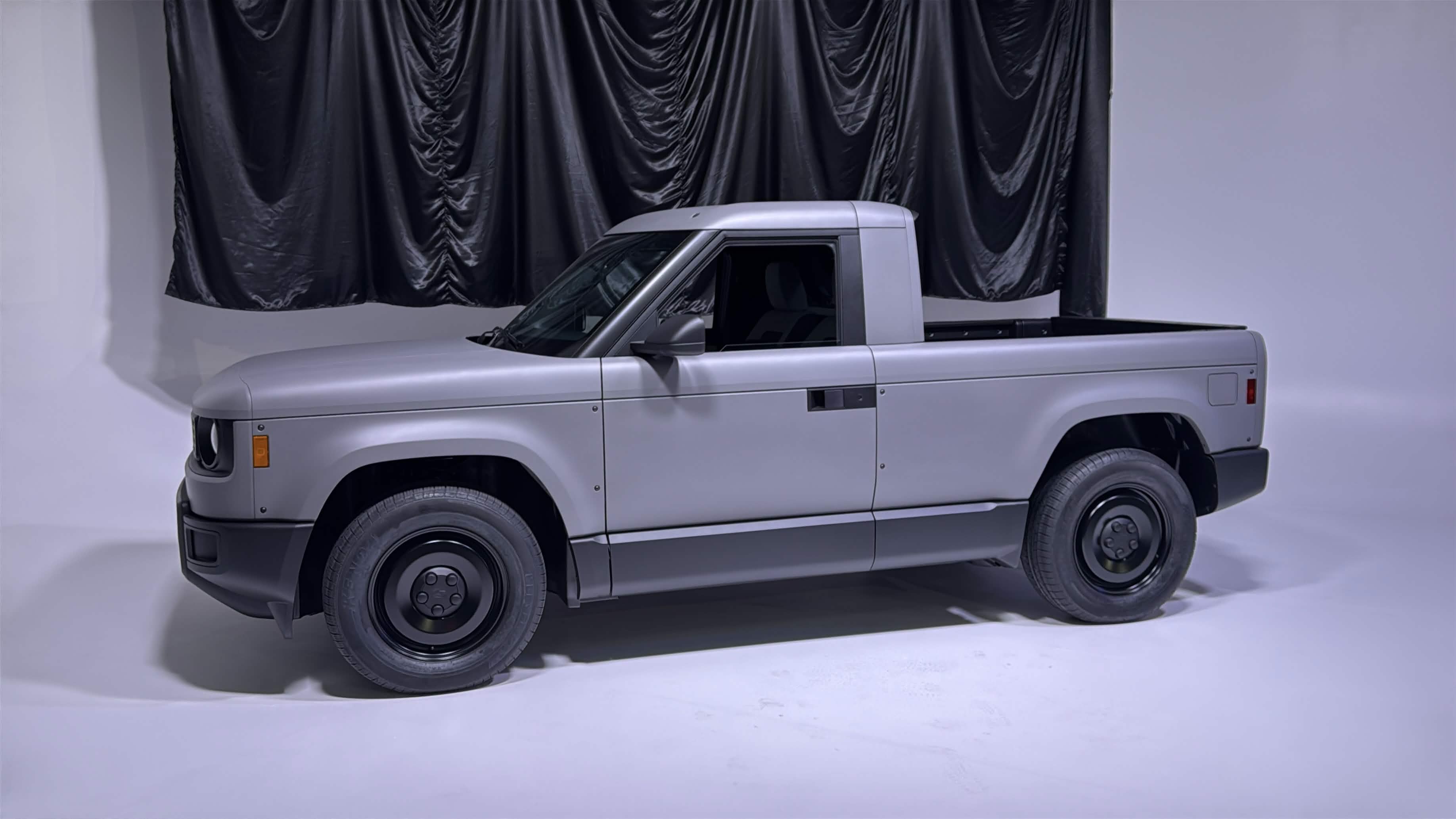
LOS ANGELES—Slate Auto has pulled a Disneyland. Let me explain.

At Disneyland, if a sign for a ride says the wait is 45 minutes, it’s actually less than that. The idea is to set expectations low and then exceed them. Slate originally said its electric truck’s entry-level battery would have 180 miles (290 km) of range, but that has expanded to 205 miles (330 km). The tow rating was originally 1,000 lbs (454 kg); now it’s 2,000 lbs (907 kg), a nice jump. Finally, the load rating was 1,400 lbs (635 kg), and it’s now 1,550 lbs (703 kg).

The automotive startup has exceeded expectations. Was it part of the plan all along? Was leaking the price of the base model of $24,950 last week guerrilla marketing? Since the truck’s unveiling a year ago, Slate’s marketing has been extremely tongue-in-cheek.

At the Slate launch event in Gardena, California, new CEO Peter Faricy told the assembled press that “Slate is so much more than an affordable truck.”

Let’s ride

Unfortunately, Slate wouldn’t let me drive the truck, so I rode shotgun. What I gathered from the passenger seat is that while the Slate has built an inexpensive vehicle, it doesn’t feel cheap. The acceleration curve was smooth as the driver stomped the accelerator while turning right at an intersection. It’s not a speedy ride; the zero-to-60 is a mild eight seconds. The top speed is 90 mph (145 km/h). Not that you’d want to go faster in the little truck. The single motor outputs 181 horsepower (135 kW) and 195 lb-ft (264 Nm) of torque to the rear wheels.

I was impressed with the pre-production vehicle’s handling of the bumps in the road and cornering. There’s an expectation that a car not quite ready for prime-time will have squeaks and some hiccups during test drives. None of that appeared during my trip around the block. I did learn that the vehicle has one-pedal-driving regenerative braking. Fans of the feature on other EVs will be happy.

That said, that’s the only level of regen. I also learned that traction control can be turned off, so if you’re a maniac who loves to melt tires while drifting, you could probably pull that off with the Slate.

A Slate Auto pickup at sunset

The specs are a little better than we were initially promised.

The specs are a little better than we were initially promised. Credit: Slate

Another surprise: The seats were very comfortable. While my time in the vehicle was extremely short, I came away impressed.

The Slate is powered by a 65 kWh gross/63 kWh usable LFP battery pack with a targeted range of 205 miles. That breaks down to 3.3 miles/kWh (19.1 kWh/100 km). It’s not the most efficient vehicle, but it’s respectable for a truck with a flat front end and single-cab silhouette. As for the long-range battery pack Slate announced at the unveiling, the automaker decided to offer a single option with more range. So that 205 miles of range is essentially a compromise.

Charging is where things can get iffy if you’re planning a long road trip. At a DC-fast charger, the NACS-enabled vehicle tops out at 120 kW. Slate says the battery can charge from 20 to 80 percent in about 30 minutes. Sure, that’s possible, but expect to wait longer than you would with most other current EVs.

If you’re driving around town, you’ll be fine. The other low-cost EV on the market, the Chevy Bolt, only supports DC fast-charging up to 150 kW. The Bolt starts at $27,600 ($28,995 including destination). The vehicle also ships with an EPA-estimated 262 miles (422 km) of range.

AC charging is a respectable 11 kW. This charge rate should be of interest to fleet managers looking for a small electric pickup for deliveries and other uses. Slate notes that level 2 AC charging from 20 to 100 percent will take four hours. Over the course of a day with shift changes and overnight charging, a Slate truck could be work-ready without needing a DC fast-charge.

Slate’s president of vehicles, Chris Barman, told Ars that the company is already in discussions with fleet managers. These companies typically want a few vehicles to test before making a purchase decision, and Slate is working with them to make that happen. Barman wouldn’t share any names, though.

Chris Barman, president of Slate Autos, presents the truck to the media in Los Angeles.

Chris Barman, president of Slate Autos, presents the truck to the media in Los Angeles. Credit: Roberto Baldwin

The vehicle rides on McPherson struts up front and a De Dion axle with coil springs in the rear. The default ground clearance is 7.8 inches (198 mm), or 7.6 inches (193 mm) with the SUV package installed. Slate does offer a lift kit that increases the clearance, though the exact increase is unclear at the moment. A completely tricked-out Slate SUV with a lift kit and appropriate tires will cost about $35,000.

All the extra bits

The truck starts at $24,950. The Slate outfitted as an SUV (Squareback) will start at $29,95, bringing the price for the SUV kit to roughly $5,000. Adding the SUV package does reduce the payload capacity, dropping it from 1,550 lbs to 1,263 lbs (573 kg). That means the SUV package weighs 287 lbs (130 kg), which is a good indication that if you buy it after taking delivery of the Slate, the shipping will be pricey, and you’ll need to call a friend to help install it. The vehicle’s towing capacity drops from 2,000 lbs to 1,824 lbs (827 kg).

Again, you can add that at purchase or buy the kit later. That’s one of the Slate selling points. The modular nature of the vehicle gives owners options to add features to their vehicle long after they’ve taken delivery. Unfortunately, Slate hasn’t yet shared the delivery cost of its vehicle. We were told that, like the rest of its offerings, it will likely be less than what others are charging.

Although we reported that the truck lacked a modem, Slate will sell you one for $275 to allow a connection to your smartphone. It comes with a one-year subscription, and you’re on the hook for monthly fees after that.

Slate says that 80 percent of the over 200 items available in its marketplace will be under $500. That includes roof racks, stereos, and vehicle wraps. Wraps are also under $500 unless you want something custom, then the price jumps to $1,299. Slate says adding a wrap requires two people and takes 12 to 16 hours; if you have professionals do it, you’ll have to ask them about labor costs. All items in the marketplace are accompanied by DIY difficulty designators—beginner, moderate, and advanced—so owners know what they’re in for if they opt to add the item themselves.

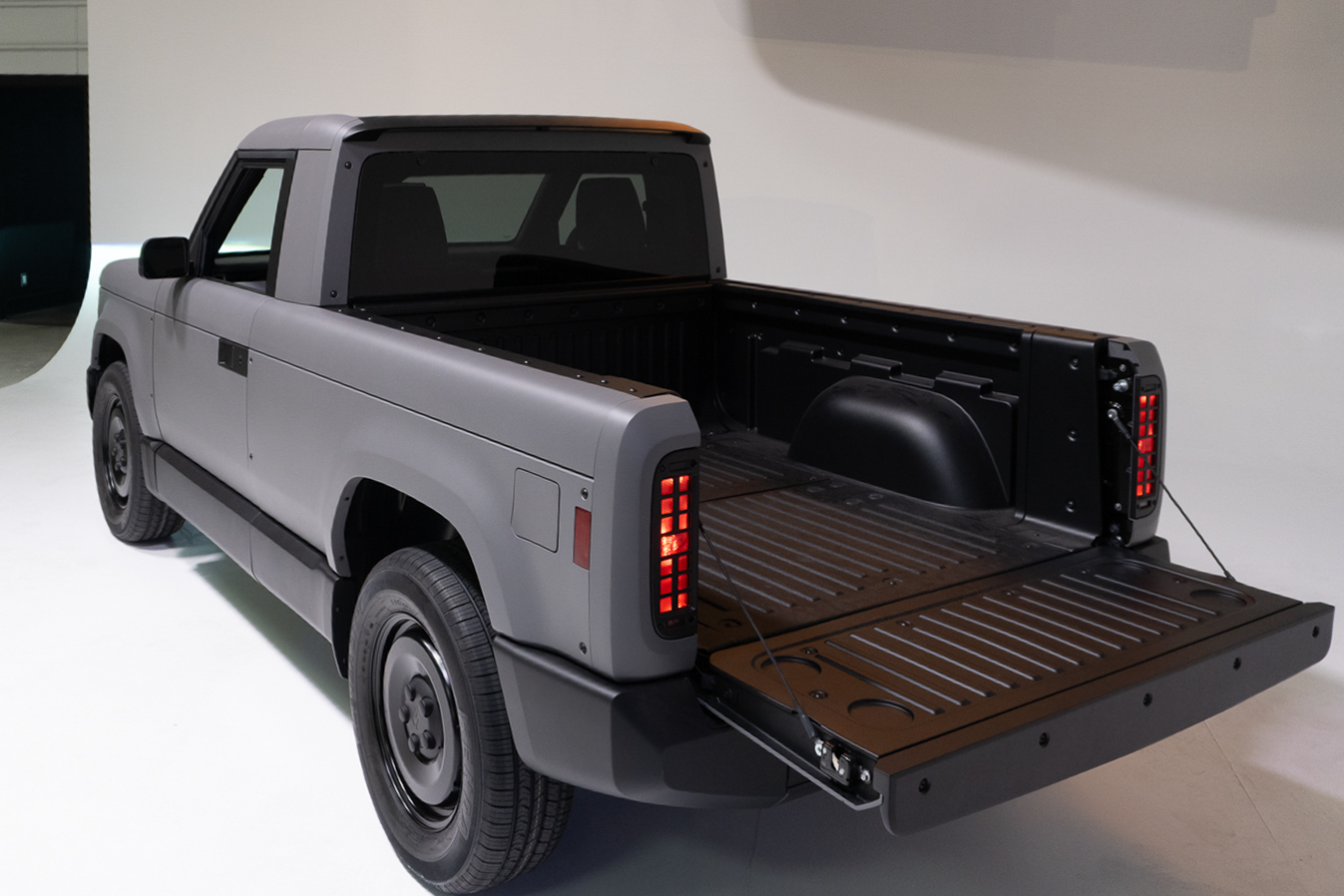
A slate truck bed

A look at the bed.

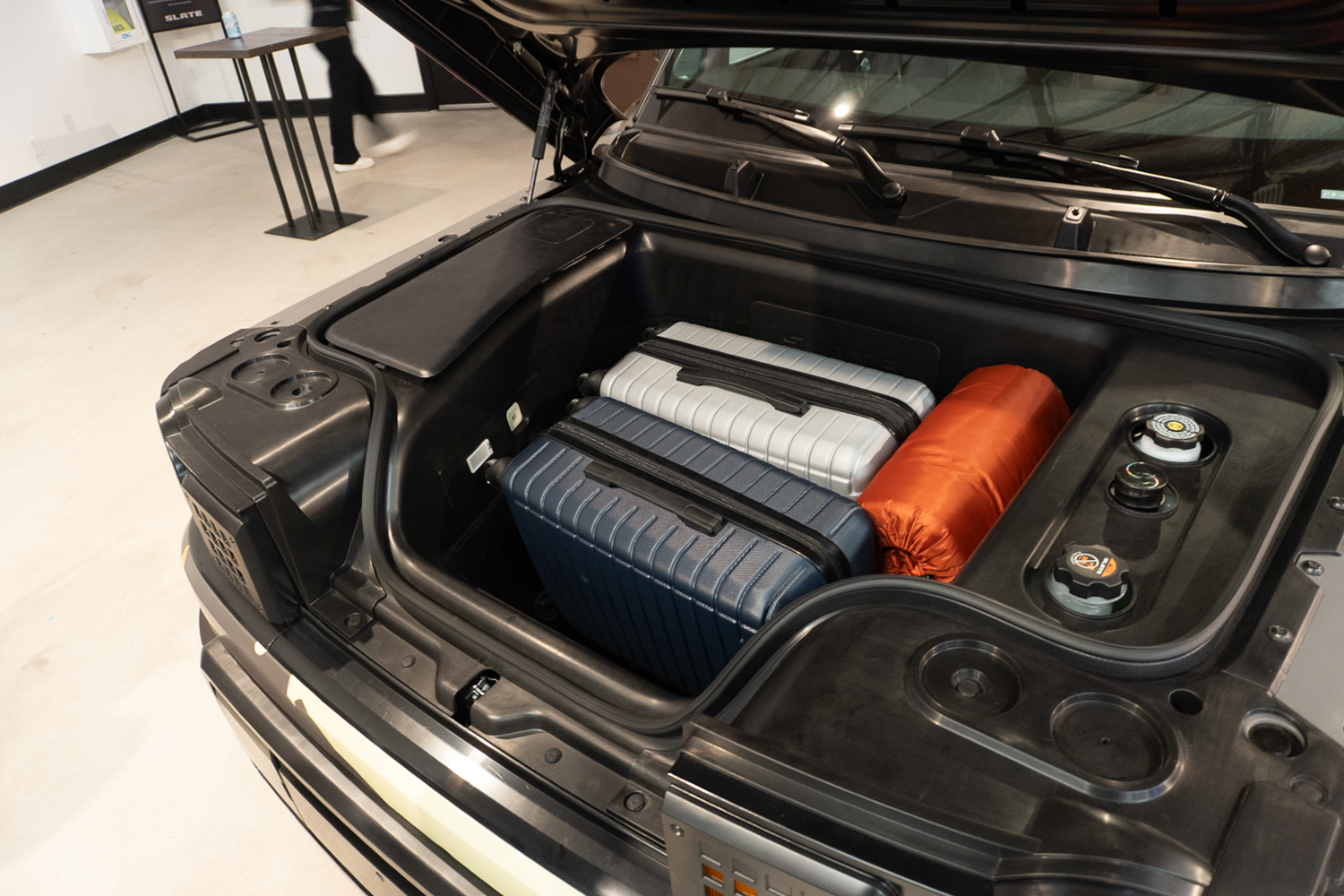
Slate truck frunk with luggage in it.

The frunk is large enough for a couple of carryons.

How that and other maintenance and repairs are done is either via DIY with access to Slate U (a series of videos and guides on how to work on your vehicle) or by a network of over 3,000 RepairPal shops, including 100 service centers that can do work on the high-voltage system—something you should definitely leave to the professionals.

If you do end up with a battery issue, Slate has a 10-year/110,000-mile powertrain and battery warranty.

What you’re not getting

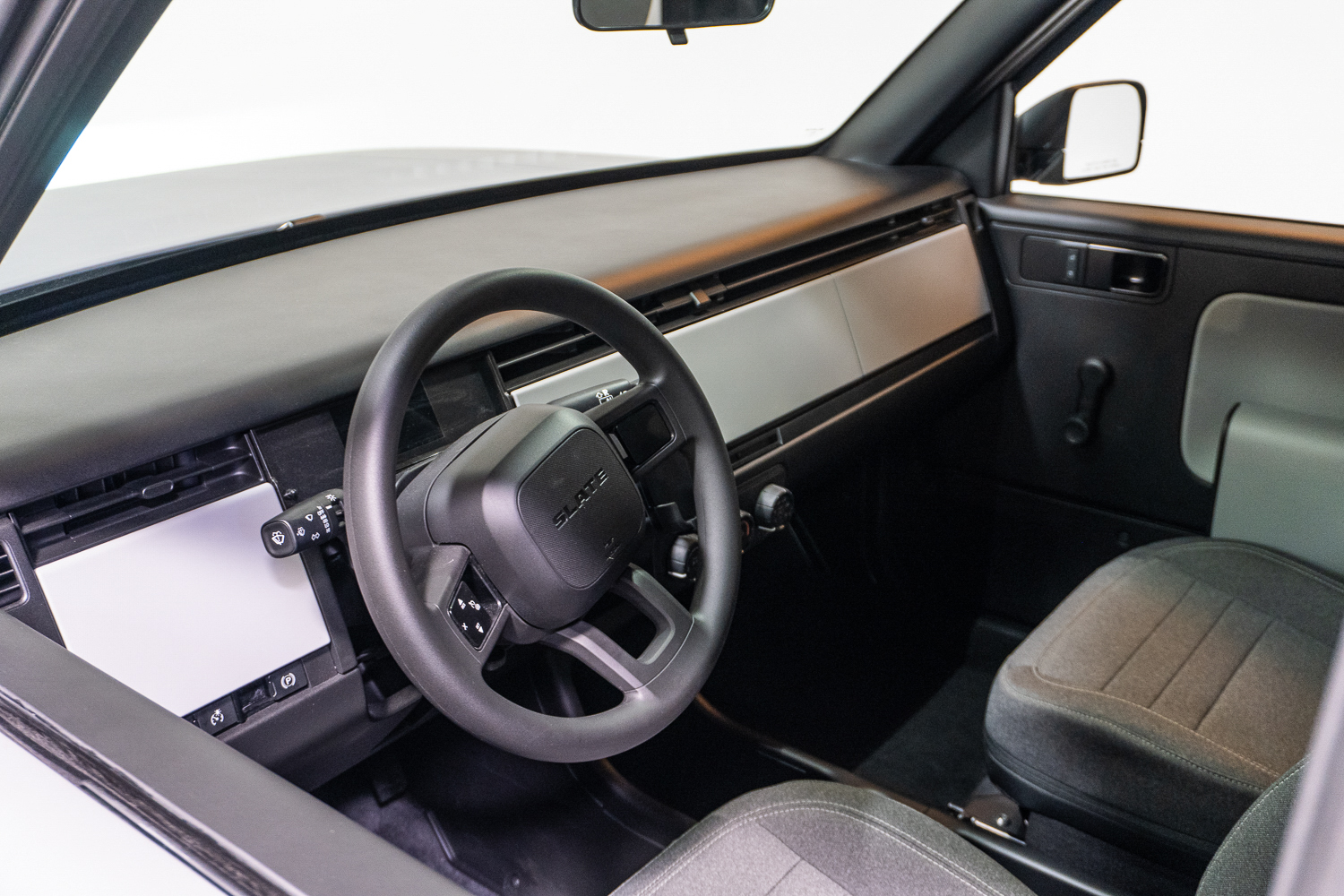
The Slate’s main selling point, beyond its low price, is how the company managed to achieve it. There’s no screen (beyond the dash cluster), no advanced driver assistance, and no modem. Slate has noted that these items increase the cost of vehicles, and there is a market of drivers who don’t want or need them.

A companion app will be available for updates, service, and other vehicle-related items. Slate recently said it would not sell any collected data to third parties and that the vehicle doesn’t need the app to run. In the vehicle, the regular connection is via a cable for the companion app; the telematics module is primarily for fleet customers, Slate told Ars.

In the base vehicle, features like a stereo or speakers are optional extras. Slate will sell those components itself, or owners looking for a personal touch can add their own. The audio system would likely require custom brackets, which could be purchased from a third party or 3D-printed (Slate says it will embrace the 3D-printing and modding community).

Weirdly, the power window option disappeared from the Marketplace, and when asked about it, a Slate spokesperson told Ars that for now, the company is sticking with crank windows. When pressed about whether the power windows would show up later, the representative was noncommittal. So get used to using your arm muscles to enjoy fresh air.

Believers of the hype?

Will the Slate live up to the Internet’s desire for a low-cost, bare-bones pickup? Slate announced in April 2026 that 160,000 individuals had placed a $50 refundable deposit for a Slate. This week, that number was updated to 180,000. Now those individuals will have to make a decision. Will they add an additional $250 to that deposit, making it non-refundable? Those who have not already placed a deposit will have to pony up $300 for a non-refundable deposit.

Slate Truck interior

You can see the replaceable dash panels here.

You can see the replaceable dash panels here. Credit: Roberto Baldwin

Those who have already put down a $50 deposit have until July 24, 2026, to lock in their delivery window. After that, the delivery time will be later.

There are two potential scenarios here. In the first, the Slate truck is at least a modest hit. Those who made the initial deposit will have their vehicles delivered first, starting in the fourth quarter of 2026. Some will likely have to wait months or even a year to take delivery of their pickup (or SUV). Some might peel off and opt for the small electric Ford pickup. But overall, the company will be in good shape as the vehicles enter the market, and it will have enough orders to justify its existence.

The second scenario is that, as with manual transmissions and station wagons, the Internet loves these features in theory, but people will ultimately opt for the more traditional (and boring) automatic transmissions and SUVs offered up by automakers. We’re not sure what amount of vehicle orders Slate needs to reach to stay the course. Should the company stumble, it might not even make it into 2027.

Right now, Slate’s annual production capacity is 150,000. According to the CEO, as of 9 am PT, over 10,000 preorders have already been placed.

When the Ford Maverick hit the market, it filled a void that automakers had ignored for years. Unfortunately, the price increased by 40 percent over time. There is a market for a small, affordable electric pickup; Ford’s upcoming electric pickup is proof of that. But even with the updated specs, will drivers give Slate a chance to deliver that vehicle?

We’ve been in a world where a vehicle evolves in the driveway via software through over-the-air updates. We’re now entering a world where a vehicle will evolve in the driveway via hardware updates.

At least that’s what Slate hopes.

Barack Obama Admits Marriage to Michelle Hasn’t Been an ‘Equal Partnership’ Amid Divorce Rumors

0
barack-obama-admits-marriage-to-michelle-hasn’t-been-an-‘equal-partnership’-amid-divorce-rumors
Barack Obama Admits Marriage to Michelle Hasn’t Been an ‘Equal Partnership’ Amid Divorce Rumors


Barack Obama is getting unusually honest about his marriage to Michelle Obama.

The former president, 64, made a surprisingly candid admission during a joint interview with his wife, saying their 33-year marriage may not have been an “equal partnership” after all.

“I don’t know if it’s been an equal partnership,” Barack admitted.

Then he took it even further.

“I’ve gotten more out of it than she has,” he quipped. “For her, it’s probably more of a mixed bag.”

The eyebrow-raising confession comes after months of chatter about the state of the Obamas’ marriage, with rumors swirling that the former first couple had been spending less time in public together and may have been quietly struggling behind the scenes.

Michelle, 62, has also been open in the past about the difficult side of life in the White House, including the pressure, the sacrifices and the emotional toll of being one of the most watched women in America.

But during their latest sit-down, the former first lady made it clear that despite the “ups and downs,” Barack also changed the course of her life in ways she never expected.

“The truth is, I probably would have been someone who stayed more put,” Michelle said, reflecting on the life she might have built if the couple had remained in Chicago and avoided the political spotlight.

“I think I would have had a beautiful life here, but it would have been smaller,” she continued. “But because of who my husband is, he offered all of us — our girls, my mom, my family — a broader sense of what’s possible in life.”

Michelle said Barack pushed her to imagine a bigger future than simply using her Harvard law degree to practice law.

“He made me think more broadly about what I could do with this Harvard law degree besides be a lawyer,” she said. “He gave me the courage. He was my ballast. He was like, ‘I got you.’ And however hard it’s been, the ups and downs, he’s got me.”

The couple’s emotional remarks came as they returned to Chicago for the grand opening of the Barack Obama Presidential Library on the city’s South Side.

For Barack, the event was more than just a political milestone. It was also a homecoming.

“Michelle and I, our wedding reception was over at South Shore Cultural Center. You could walk from here,” he said during his remarks. “Our daughters were born right down the street. This is where we bought our first home. This is where our kids took their first steps.”

He also looked back on the humble beginning of his political career.

“This is where I launched my candidacy for the Illinois state senate over at the Ramada Inn on Lake Shore Drive — serving pretzels and soda, embarking on the path that, ultimately and improbably, led to this day,” he said.

Michelle also spoke at the ceremony and gave a glowing tribute to her husband, even while acknowledging that their life together has not always been easy.

“You told me all those years ago that you couldn’t promise me the world, but you could promise me an interesting life,” she said. “And of course, you outdid yourself and managed to give me both.”

She added, “I know it hasn’t always been easy, but there hasn’t been a single second through this experience that standing by your side hasn’t left me in awe.”

The touching comments appeared to push back against the divorce speculation that has followed the couple over the past year.

Still, Barack’s blunt admission that he may have benefited more from the marriage than Michelle is sure to get people talking — especially after years of the Obamas being held up as one of the most powerful political love stories in America.

How contenders in the new space race stack up

0
how-contenders-in-the-new-space-race-stack-up
How contenders in the new space race stack up

When NASA administrator Jared Isaacman unveiled the crew of the Artemis III mission at Johnson Space Center in Houston earlier this month, he was ebullient.

We wish you godspeed on the journey ahead. You carry the fire of exploration from generations past, the confidence of this agency, and the support of this nation, and the dreams of millions who will be cheering you on.

The all-male crew – Italian astronaut Luca Parmitano and US astronauts Andre Douglas, Frank Rubio and Randy Bresnik – will launch into lower Earth orbit next year for a two-week mission to test lunar landers. This will build on the work of the Artemis II astronauts and the Artemis IV mission planned for 2028, which will see humans return to the Moon’s surface for the first time in 56 years.

Amid all of these headlines out of the US, it can be easy to lose sight of the fact it isn’t the only major actor in space. While the US might be leading the current space race, other countries are close behind.

China

In May, China successfully launched three taikonauts to its Tiangong space station. One of the taikonauts will remain on the station for a year to “explore human adaptability and performance limits”, according to Chinese state media.

(The term taikonaut, coined in 1998 but slow to catch on until recently, combines the Chinese word for outer space, tàikōng, 太空), with the Greek-derived suffix naut, meaning “sailor,” to mirror astronaut and cosmonaut.)

The space station stay will serve as a precursor to China’s plan to send a crewed mission to the Moon before the end of this decade, and establish a permanent lunar base by 2035.

China announced its plans for the International Lunar Research Station (originally in partnership with Russia) in 2021. The base will likely be establlished somewhere near the Moon’s south pole and will be supported by the use of in-situ resources.

Youtube video

These plans are very similar to those of NASA as part of the Artemis program. As such, they put China in direct opposition to the US.

China has actively invited other countries to become involved in the International Lunar Research Station. This is a deliberate attempt to position this opportunity as being more collaborative than the US-led Artemis project. States are actively invited to help set the rules of that collaboration.

Along with China, current participants include Russia, Azerbaijan, Belarus, Egypt, Nicaragua, Serbia, Pakistan, South Africa, Thailand, Venezuela, Kazakhstan and Senegal.

Although no taikonaut has yet set foot on the Moon, China has had several very successful lunar missions.

These include Chang’e 1 in 2007, a lunar orbiter mission that collected more than 1.3 terabytes of data used to produce a detailed map of the lunar surface. This was followed by Chang’e 2, which was launched in 2010 and captured high-resolution images of the Moon.

Chang’e 3 delivered the Jade Rabbit rover to the lunar surface in 2013. Chang’e 4 completed the first successful landing on the far side of the Moon in 2019. One year later, Chang’e 5 returned a lunar sample to Earth.

In 2024, Chang’e 6 returned another lunar sample – this time from the far side of the Moon – which has been studied for its resource potential.

These missions are notable for their diversity, as well as their steady cadence across a relatively short timeframe.

India

India has also achieved lunar landing success with Chandrayaan-3 in 2023, becoming the first country to land at the lunar South Pole – the desired destination for most planned crewed missions.

Chandrayaan-1, launched in 2008, was India’s first deep space mission. It consisted of a lunar orbiter and lunar probe that provided new insights into water molecules on the Moon. Chandrayaan-2, launched in 2019, consisted of a lunar orbiter, lander and rover. The lander crashed at the lunar South Pole.

India plans to launch Chandrayaan-4 no earlier than 2028 to collect samples from the Moon’s surface. This is set to be followed by Chandrayaan-5 – a planned collaboration between India and Japan – to further explore the lunar South Pole.

Russia

Russia’s lunar activities remain focused on uncrewed missions.

Russia has a long and successful history of lunar orbiters and landers, with its last successful lunar landing in 1976 during the Soviet era. Its lunar program received a setback in 2023, with the crash of Luna25 at the lunar South Pole.

However, as a partner in the International Lunar Research Station, Russia has announced the intention to build a nuclear power plant on the Moon by 2036.

The rest of the pack

Other countries are also actively involved in lunar missions.

Japan’s iSpace, for example, has experienced two unsuccessful lunar landing attempts: Hakuto-R in 2023 and Resilience in 2025. This shows lunar landings remain a difficult and challenging exercise.

The Outer Space Treaty provides that space is “free for exploration and use by all States without discrimination of any kind” and that the Moon and other celestial bodies are “not subject to national appropriation” by claim of sovereignty or any other means.

This of course means any state is open to establish a base on the Moon. Far more complex will be establishing how these various bases may operate safely on the challenging lunar surface.

Melissa de Zwart is a professor, Adelaide University.

This article is republished from The Conversation under a Creative Commons license. Read the original article.

Indigenous cultural practices are a climate solution, report finds

0
indigenous-cultural-practices-are-a-climate-solution,-report-finds
Indigenous cultural practices are a climate solution, report finds

As the impacts of climate change continue to escalate, a growing number of climate scientists and policymakers cite Indigenous lands as a model for their rich biodiversity and effective carbon storage. But that recognition has not always translated into space for Indigenous leaders in climate negotiations, access to climate resilience funding, or enforcement of human rights standards. 

That has been the case for decades. But the problems do not stop there. New research shows that approach overlooks the key role that Indigenous knowledge and culture can play in mitigating climate change. It also reveals a dangerous misconception that has taken hold in global climate discussions: the idea that Indigenous lands are so rich because they are remote or sparsely populated.

Nothing could be further from the truth. The health of Indigenous lands and their ability to store vast quantities of carbon stem from the stewardship of the people who inhabit them.   

That’s the finding of research from Conservation International, which shows that traditional knowledge, community protocol, and Indigenous culture play a direct role in protecting forests, wildlife, and the environment. Sushma Shrestha, who is Indigenous Newar from Nepal and the study’s lead author, said the research comes at a critical time. 

“All of humanity relies on everything that Indigenous peoples have to contribute and offer in terms of their lands, in terms of carbon storage, in terms of biodiversity conservation,” she said. 

The study, released as a narrative report and a peer-reviewed study, explores how Indigenous knowledge and practices benefit the planet. It also found that all 43 of the surveyed communities are experiencing drought, extreme weather, and other adverse impacts from climate change. More than half are affected by extractive industries like mining and logging. 

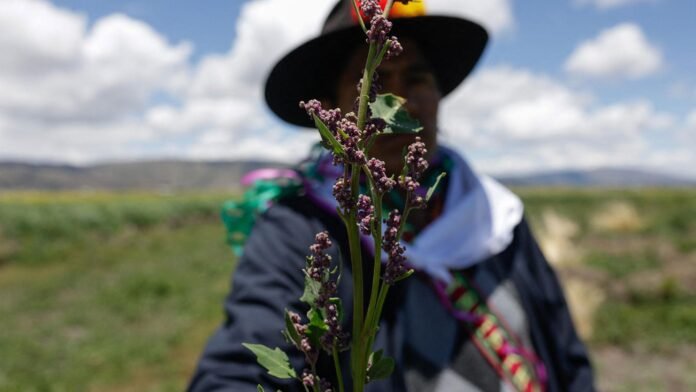
Researchers interviewed 49 Indigenous leaders from six continents about how they steward their land, which ranged from the Amazon rainforest to East African savannas and Pacific Islands. They found that traditional management practices like avoiding overfishing, maintaining sacred spaces, watching for fires and other threats, and direct resistance against extraction contribute to the remarkable health of Indigenous territory. Ninety-six percent of respondents said they had land set aside for special uses, like spiritual practices, that also benefit the environment by protecting those spaces and ecosystems. Shrestha stressed that although each Indigenous community is distinct, there are shared lessons the entire world can learn from. 

“It’s a time where all hands need to be on deck,” Shrestha said. “And collectively, actions need to be taken, and indigenous peoples have been doing this on their own for a very long time.” 

The study builds on years of research that shows, among other things, that the world’s healthiest forests are on Indigenous lands and conservation efforts are more effective when they incorporate Indigenous autonomy and decision-making at every step. 

Read Next

Drought and extreme weather were the top climate impacts cited, but 61 percent of those interviewed also called mining, commercial agriculture, logging, and other incursions serious concerns. These issues threaten to disrupt land stewardship practices that have endured for millennia. To help mitigate these challenges, Indigenous peoples are asking for mitigation and resilience funding, legal advice for protecting their territories, and recognition of national and international land rights. 

“Indigenous Peoples’ Knowledge cannot exist without Indigenous Peoples or without the ecosystems where we live,” Hindou Oumarou Ibrahim, who is Indigenous Mbororo from Chad and a former chair of the United Nations Permanent Forum on Indigenous Issues, wrote in a forward to the report. “To protect our knowledge, there is an urgent need to recognize us, and our rights and lands must be secured.”

Respondents from a wide range of countries, including Bolivia, Mexico, and the Philippines, mentioned using community monitoring or patrols to protect their land from outsiders and violations of traditional protocol. Several also called for stronger legal protections to protect their lands from being sold or developed. 

Shrestha, Ibrahim, and other Indigenous experts said that as much as Indigenous peoples are asking for help, they are also urging the world to learn from them. The Kichwa people in Ecuador, for example, restrict hunting of female tapirs and other animals to help slow population decline. The Tacana people in Bolivia, among others, do not permit tree clearing along rivers, which helps maintain water quality and prevent erosion. The list goes on, and could help the rest of the world mitigate climate change and protect the environment.

“It is my hope the voices of the sisters and brothers from all over the world reflected in this report trigger the action we need for the planet we all want, the action we need for Indigenous Peoples Knowledge to flourish, and honor our grandparents and our children that are yet to come,” Ibrahim said.

Given the scale of the threats facing the world and the urgency with which they must be addressed, Shrestha said that policy changes and enforcement of Indigenous land rights is more important than ever. She also stressed that these actions will benefit the entire world. “One thing that everybody can do, whether that is at the national level, or at the global level, is to really secure indigenous peoples’ rights to lands,” she said.


Do You Administer SNAP or Medicaid Benefits? Help ProPublica Report on America’s Safety Net.

0
do-you-administer-snap-or-medicaid-benefits?-help-propublica-report-on-america’s-safety-net.
Do You Administer SNAP or Medicaid Benefits? Help ProPublica Report on America’s Safety Net.

ProPublica is digging into pressing issues affecting millions who rely on America’s safety net programs — from longstanding concerns like electronic benefit transfer theft to changes in federal SNAP and Medicaid policies. We want to hear from officials and workers on the ground who help people navigate these programs, because no one knows the ins and outs of the safety net better.  

If you are a current or former state or local eligibility worker, intake specialist, or human services or social services administrator, or if you’re a current or former federal worker who has supported states in administering the Supplemental Nutrition Assistance Program or Medicaid, we want to hear your thoughts about new work requirements, shifts in cost-sharing between the federal government and states, efforts to combat fraud, and what other priorities may have been pushed to the wayside. 

ProPublica’s reporting goes beyond big-picture policy coverage and dives into the ways those federal policies shape everyday life throughout the country. We know each community operates differently, and we can’t be everywhere at once. That’s why we need your help.

We want to know: How is your agency, county or state preparing for the so-called One Big Beautiful Bill Act? Have shifting federal priorities changed the way you do your work? What do you feel people should know?  

Please fill out the brief form below to tell us what we should be reporting on or to stay in touch as all of these changes unfold. Our reporters read every response and may follow up with you. Your insight is what drives our reporting.

If you have questions or if your SNAP or Medicaid benefits have recently changed, we want to hear from you too. Email us at [email protected]. If you prefer to reach us via Signal, you can contact reporter Eli Hager at 301-758-2768 or Cassandra Garibay at 707-234-5175.

Formula E reveals first calendar for GEN4 with lots of real race tracks

0
formula-e-reveals-first-calendar-for-gen4-with-lots-of-real-race-tracks
Formula E reveals first calendar for GEN4 with lots of real race tracks

Formula E is in its final year for the current technical regulations, with a new single-seater EV set to be introduced at the start of next season, which begins in December in Saudi Arabia. The new car, known as GEN4, is a big upgrade—at times more powerful than a Formula 1 car, although heavier and with much less downforce. As speeds rise with the GEN4 car, we knew the sport would become too fast for some of its current venues.

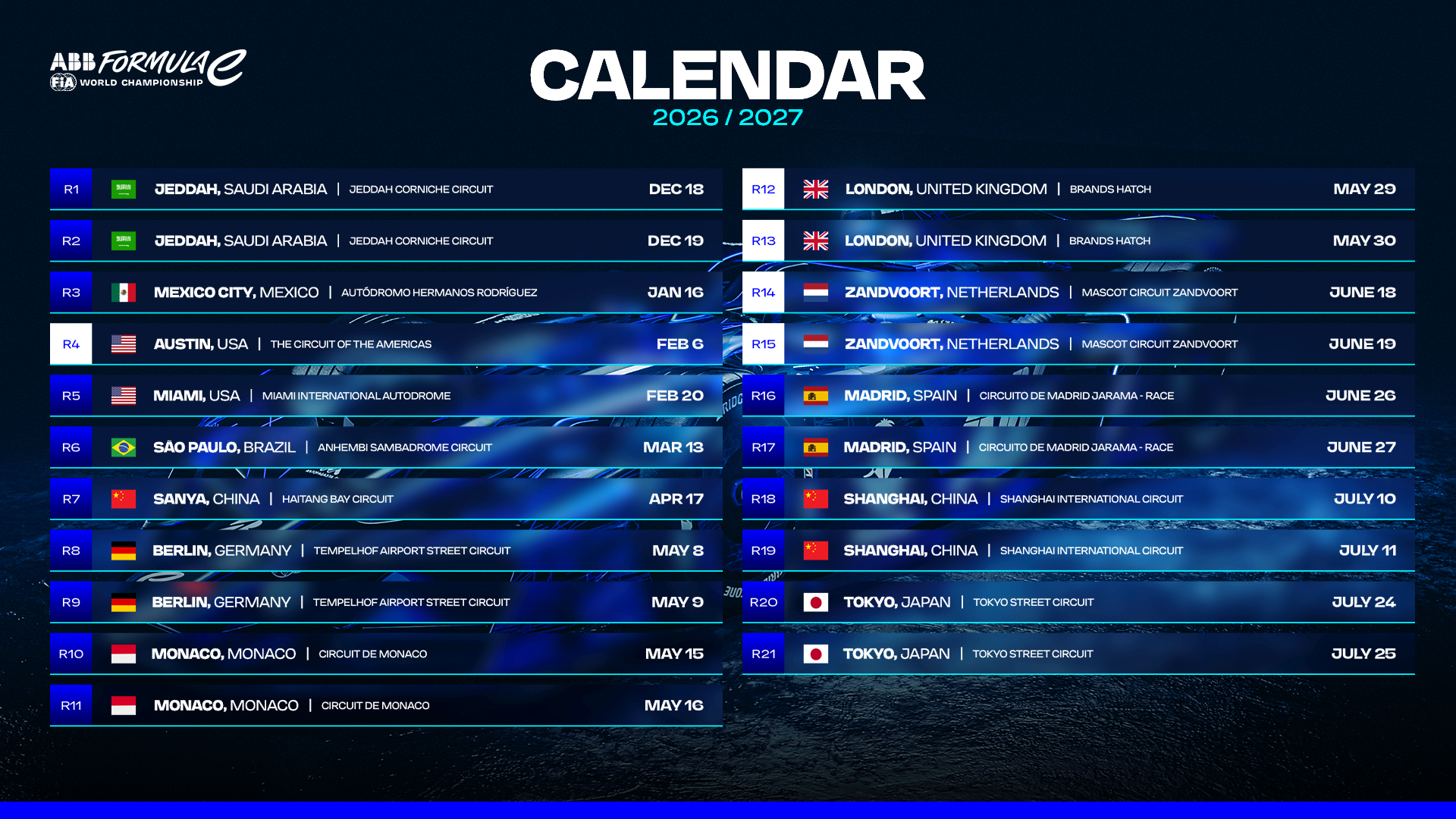
With the release of the season 12 calendar for 2026–2027, that limitation has become clear: a 21-race lineup across 13 cities that now includes several traditional race tracks.

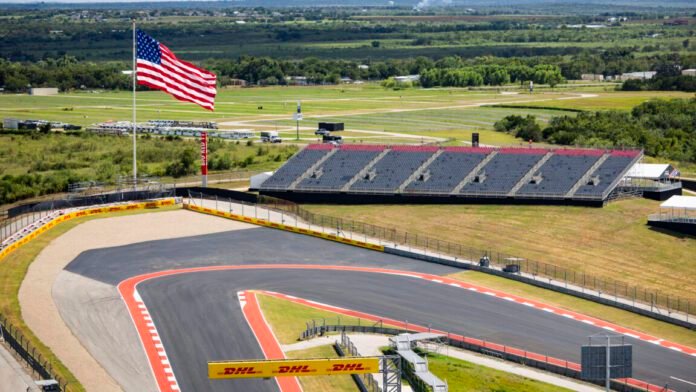
The Saudi double-header is scheduled for December 18 and 19, and is the only season 12 round this year. Then the series starts 2027 off with a string of Formula 1 venues in North America: Mexico on January 16, the Circuit of the Americas in Texas on February 7, and the Miami International Autodrome on February 20. The addition of COTA to Formula E’s calendar makes it the seventh US location for the sport since 2015, including the American Airlines Arena in actual Miami; Long Beach, California; Brooklyn, New York; Portland, Oregon; Homestead-Miami, and the Hard Rock Stadium on the outskirts of Miami.

The race at COTA will use the shorter version of that circuit, as used by NASCAR for its visits, rather than the full F1 configuration. This spares the inevitable lap-time comparisons between the two series, but the new calendar marks a clear departure from one of the series’ original selling points: racing in city centers where no other series could come visit.

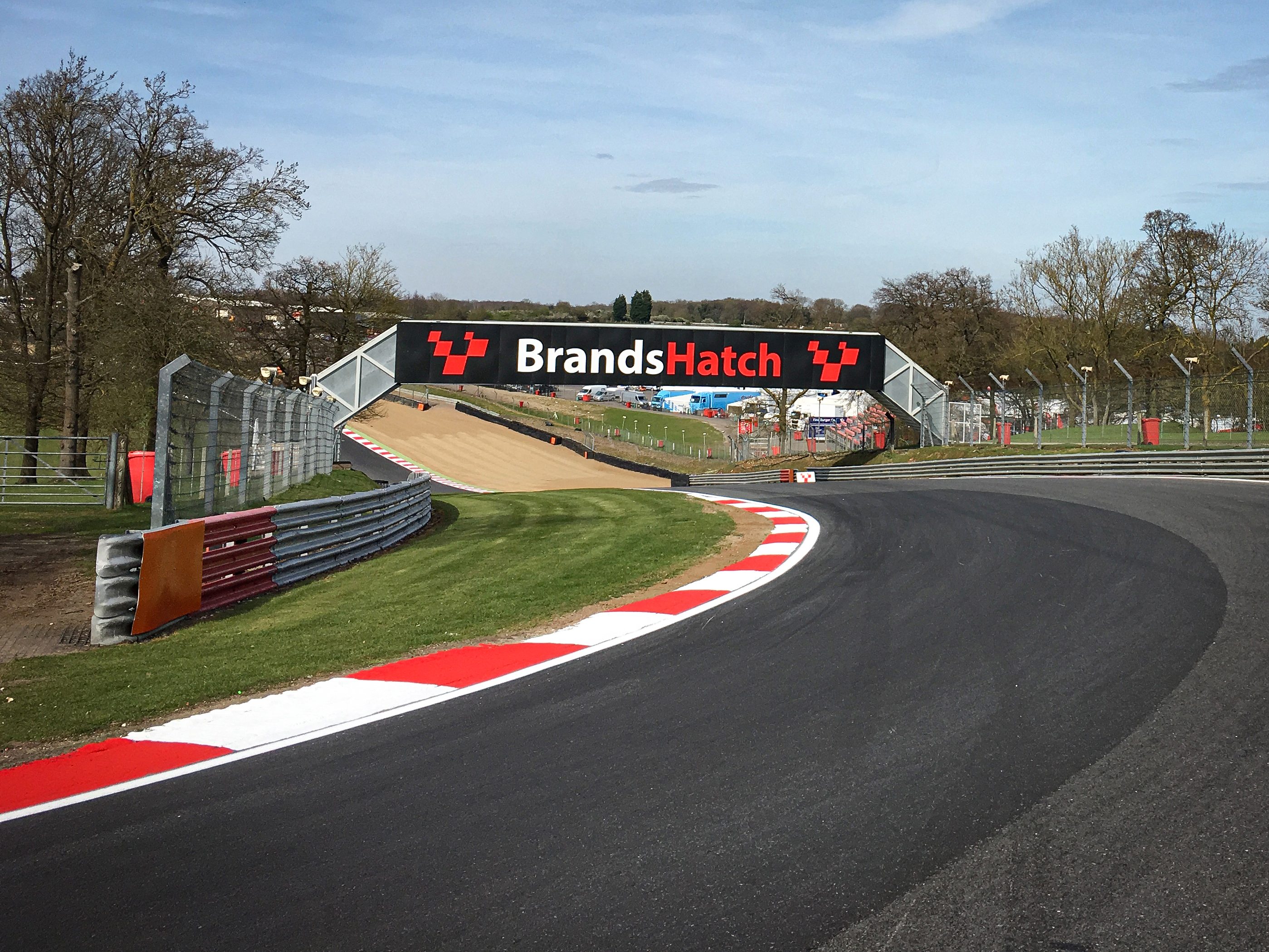
Some traditional Formula E tracks remain. Berlin-Templehof takes place in May, as does the Monaco e-Prix. But the indoor-outdoor ExCel Arena in London has been outgrown; instead, Formula E will race at the Brands Hatch circuit in Kent, just outside London, in late May. It is believed that rather than use either the Indy or GP configurations of this historic circuit, the sport will use a unique layout, similar to the way Formula E’s Monaco is ever so slightly changed from the F1 layout used a couple of weeks later.

Zandvoort in the Netherlands—another F1 venue—takes place in mid-June, followed by Jarama in Spain at the end of that month, then Shanghai at another F1 track in early July, and the season finale in Japan in late July.

A corner at Brands Hatch

Brands Hatch and its swooping elevation change will test the GEN4 car.

The Formula E 2026-2027 calendar

“We are incredibly proud to unveil our biggest and most ambitious calendar to date. Expanding to 21 races across 13 iconic cities is a huge milestone, and welcoming world-renowned tracks like COTA in Austin, Zandvoort, and Brands Hatch provides the ultimate stage to showcase our new GEN4 era,” Alberto Longo, Formula E cofounder and chief championship officer, said in a statement.

“Every stop on this calendar has been chosen to deliver maximum sporting drama. Launching the season with our first-ever opener under the lights in Jeddah to demonstrate the speed of these GEN4 cars sets a spectacular tone, while grouping our races into distinct continental clusters ensures we do so as sustainably as possible. The tracks are faster, the competition is fiercer, and we cannot wait to get this historic season underway,” Longo said.

There’s also a new format for weekends with double-header events, which is most of them. On the first day, the cars will race for 30 minutes with high downforce bodywork. This is a true sprint race, where the aim is just to go flat-out. The second day will feature a more traditional 45-minute e-prix, where the drivers will need to stay on top of energy management, as they do currently.

0FansLike
0FollowersFollow
0FollowersFollow
0SubscribersSubscribe
- Advertisement -
Google search engine

Recent Posts