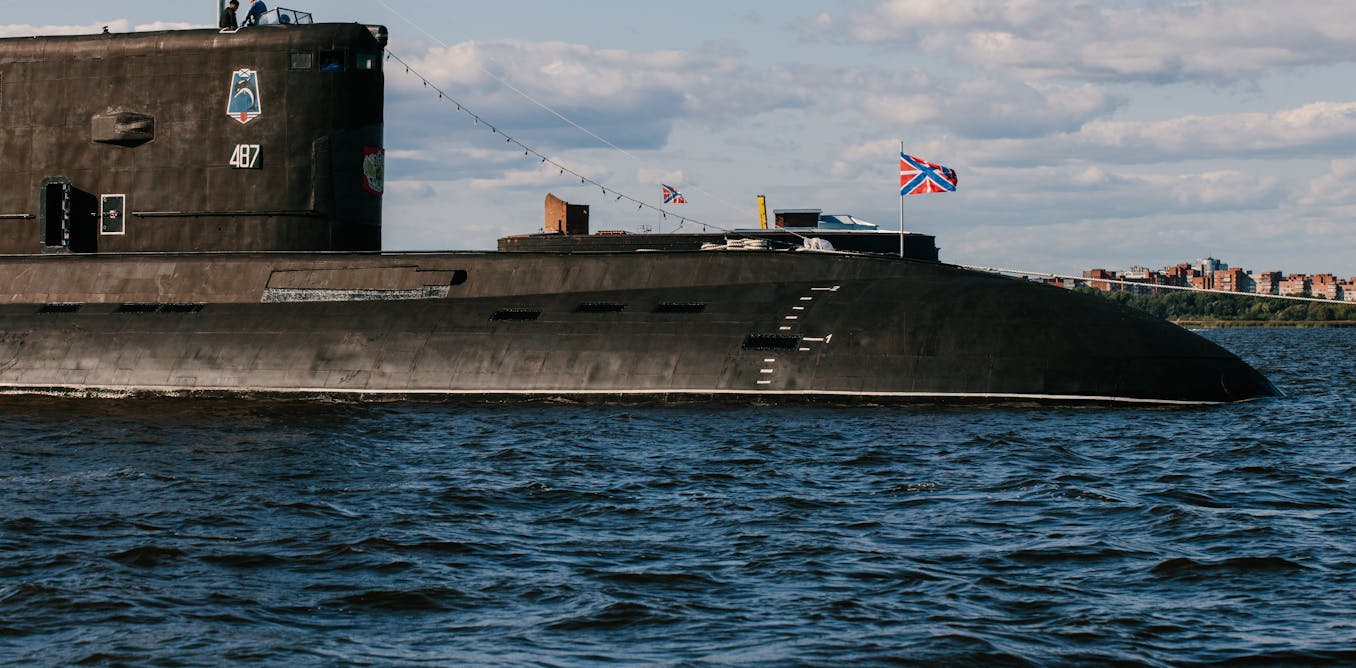
Norway’s defence minister, Tore Sandvik, recently warned that Russia must not be allowed to control the Bear Gap. This is a stretch of water that runs roughly 400 miles between Bear Island in the southernmost portion of the Svalbard archipelago and Cape North on Norway’s northern mainland. It serves as the geographical boundary point where the shallow Barents Sea meets the much deeper Norwegian Sea.
Russia has long sought to control the Bear Gap. Control of the waterway would give Russian submarines easier access to the Norwegian Sea, where complex acoustic conditions make detection much harder for Nato forces. From there, Sandvik warned these submarines would be able to threaten Nato countries such as the UK and Denmark directly with hypersonic missiles, which have an operational range of up to 1,500km.
There is also a defensive element to controlling the Bear Gap. From the 1970s onwards, Soviet and later Russian doctrine has emphasised what is termed a “bastion strategy”. Russia has sought to create heavily defended perimeters in and around the Kola Peninsula in its far north-west to protect its ballistic missile and nuclear-attack submarines in “bubbles” close to home waters.
Russia’s northern fleet, which is based near the port city of Murmansk in the northern part of the Kola Peninsula, accounts for two-thirds of its naval nuclear strike capabilities. Thus, Russia sees control of the Bear Gap as key to ensuring Nato forces are kept out of the area and unable to threaten the northern fleet.
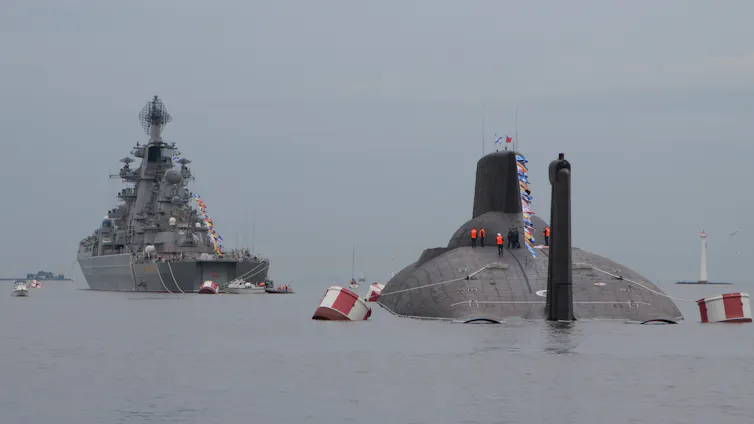
Currently, no one controls the Bear Gap. But Russian activities in the area have become more assertive over the past few years. Russia’s strategy to establish control over this stretch of water seems to depend, fundamentally, on destabilising Norway. Three elements loom large.
First, Russia has been intensifying its GPS jamming operations off the coast of northern Norway in recent years. These activities make the airspace in the region hazardous for military and civilian aircraft, especially during the winter when darkness is the norm. Norway has responded by establishing three monitoring stations for detecting GPS disturbances in the region.
Second, Russia has used disinformation campaigns to frame Norway as an aggressive force. Russia’s state-owned news agency, Tass, reported in April that Ukrainian troops were training with the Norwegian special forces to prepare “terrorist attacks” against Russian ships travelling to and from Murmansk.
Norway has been actively training Ukrainian soldiers since the start of the war in Ukraine in 2022. But there is no evidence that this training is intended to support Ukrainian attacks on Russian maritime traffic in Arctic waters.
And third, Russia has engaged in provocative behaviour in and around the Bear Gap by carrying out military exercises designed to simulate the targeting of Nato assets. Despite the demands currently placed on Russian forces due to the war in Ukraine, these exercises are usually operated at considerable scale with the intention to intimidate.
In July 2025, Russia carried out a naval exercise that involved live missile firing in a vast exclusion zone, some of which extended into Norwegian territorial waters. And in March 2026, Russia’s northern fleet carried out a test of its Oniks anti-ship cruise missile over the Barents Sea, which travelled 300km to its target at sea. Russia released video imagery of the test-fire but did not confirm its exact location.

Svalbard
Russia’s approach to establishing a dominating influence over the Bear Gap is not solely focused on harassing mainland Norway. Just north of the waterway is the Norwegian territory of Svalbard. In January 2022, Russia was widely suspected of damaging undersea fiber-optic cables connecting Svalbard to mainland Norway.
Russia also regularly harangues Norway about its management of this remote territory. The 1920 Svalbard Treaty, which established Norway as the governing authority of the archipelago, prohibits the construction of fortifications there and stipulates that Svalbard cannot be used for “war-like purposes”.
However, Russia frequently complains about what it sees as Norway’s militarisation of the archipelago. Although there is no permanent military base on Svalbard, Russia argues that Norway is violating the 1920 treaty through naval patrols of the surrounding waters as well as the periodic travel of Norwegian armed forces personnel to the islands.
Russia also maintains that Norwegian satellite infrastructure on Svalbard violates the treaty due to its potential to be used for military as well as scientific means.
If Russia is hell-bent on securing Bear Gap dominance, then its long-coveted acquisition of Svalbard could be accelerated to complete this task. One way of achieving this would be to continue complaining that Norway is breaching the terms and conditions of the 1920 Svalbard Treaty.
They might even hope to provoke Norwegian military overreach, which then provides the pretext to act directly to protect Svalbard’s small Russian-speaking community in the town of Barentsburg. The fact that the archipelago is covered by Nato’s collective defence commitment acts as a major deterrent here.
But, regardless, the threat of Russian aggression is something Norway is seemingly very aware of. In January 2025, a Norwegian white paper warned of “Russia’s willingness to use military force to achieve political goals” and called for “total preparedness throughout Norway to strengthen the resilience of the entire population”.
Russia appears to be stepping up its efforts to establish control over the Bear Gap. Preventing it from doing so is a truly daunting task for Nato forces such as Norway and the UK.