8.3 C
London
Thursday, November 12, 2026
Home Blog

Humanitarian Orgs Demand Answers on Yemen War After Hegseth Impeachment Fails

0
humanitarian-orgs-demand-answers-on-yemen-war-after-hegseth-impeachment-fails
Humanitarian Orgs Demand Answers on Yemen War After Hegseth Impeachment Fails


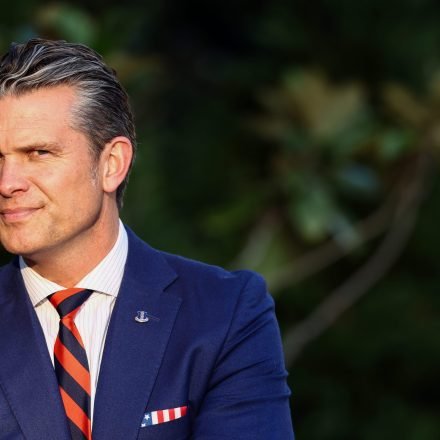
With Pentagon chief Pete Hegseth temporarily safe from impeachment, a dozen humanitarian groups are calling on Congress to investigate one of the eight shelved charges lodged against him: his role in the deaths of hundreds of people during the “unauthorized war in Yemen.”

“We urge members of Congress to conduct robust oversight into Operation Rough Rider and the resulting human toll,” reads a new letter shared exclusively with The Intercept, using the Pentagon’s term for its war against Yemen’s Houthi government. The 12 groups — including Airwars, Amnesty International USA, the Center for Civilians in Conflict, and Mwatana for Human Rights — seize on civilian harm prevention efforts that Hegseth’s War Department slashed, demanding “more information about how and why civilian harm incidents occurred, what lessons the Department learned from these operations, and the status of ongoing civilian harm assessments and investigations.”

The push for accountability follows last week’s electoral rout of the GOP and immediate calls by top Democrats for scrutiny of war powers abuses by the Trump administration. But with Democrats taking the gavel in both chambers next year, a defense official told The Intercept that the Trump administration’s failed 2025 conflict in Yemen risks becoming a “forgotten war” amid a push for accountability focused on higher profile conflicts.

Rep. Adam Smith, D-Wash., the House Armed Services Committee’s incoming chair, announced last week that the committee’s “top priority will be to conduct vigorous oversight of the Department of Defense and the Trump Administration,” specifically singling out “the illegal war against Iran” and “unauthorized military strikes in the Caribbean and Latin America.” Smith did not mention Yemen, and his office did not respond to repeated queries about whether Yemen would also be a priority. The office of Sen. Jack Reed, D-R.I., who is slated to head the Senate Armed Services Committee, also did not immediately respond to questions about whether oversight of Rough Rider would be a focus.

Over just 52 days, from March to May 2025, Rough Rider caused “extraordinarily high numbers of civilian casualties,” the groups noted. As The Intercept first reported in August, the Pentagon’s annual report to Congress on civilian harm acknowledged almost 400 civilian casualties — 153 deaths and 243 injuries — from just three attacks in Yemen: a strike in Sanaa on April 6, a strike on the Ras Isa Port on April 17, and a strike on a migrant detention center in Saada on April 28.

Amnesty, one of the signatories, spoke with five survivors of the strike in Saada who cannot work because of their injuries. “If I don’t take a painkiller, I feel hopeless and wish to die,” said a 22-year-old Ethiopian man who sustained a serious arm injury in the U.S. attack. “I think about how at such a young age I can’t even support myself and still rely on help from others. The metal rod inside me is very painful and uncomfortable. It drives you insane.” 

A U.S. official called the Pentagon’s civilian casualty count “lowball numbers.” According to the Yemen Data Project, the estimated toll was higher: at least 238 civilians killed and 467 injured.

“It’s striking that the Department acknowledged nearly 400 civilian casualties from just three incidents — a staggeringly high rate — without any explanation whatsoever about what happened and why, how they’ll respond to victims and their families, and how they’ll prevent it from happening again,” Annie Shiel, the U.S. director of Center for Civilians in Conflict, told The Intercept.

“How will they get through hundreds of cases for Iran if their one civilian harm person still hasn’t finished Yemen?”

More than a year after Operation Rough Rider ended, 15 additional attacks were still under assessment, according to the civilian harm report. One official told The Intercept in August that the backlog would likely carry over several years. Under Hegseth, the 10-person civilian harm mitigation team at Central Command, or CENTCOM, has been reduced to just one individual.

This lack of attention doesn’t bode well for understanding civilian harm in Hegseth’s longer-running and even more destructive war efforts, officials said.

“How will they get through hundreds of cases for Iran if their one civilian harm person still hasn’t finished Yemen?” a U.S. official asked in August.

At present, CENTCOM claims that the U.S. attack on the Shajarah Tayyebeh elementary school in Minab, Iran – that killed more than 150 people, most of them children — is the lone civilian harm incident of that burgeoning forever war. For months, CENTCOM has failed to answer questions about that attack and additional Iranian civilian casualties, including eight members of a family — the youngest, a 20-day-old infant — killed in a strike documented in an investigation by The Intercept.

Shiel highlighted the connections between the civilian casualties during Rough Rider and those in Iran.

“There is a through-line here from Yemen. We’ll never know if the devastation of Minab would have been prevented through a fully staffed civilian protection program and a more robust inquiry into what happened in Yemen, but it’s clear that important reckoning didn’t happen,” she said. “This is part of a broader trend of focusing on ‘lethality’ over civilian lives, ignoring hard-learned lessons in the process.”

A group of Democratic lawmakers told Hegseth in a July letter that his “gutting” of Civilian Harm Mitigation and Response efforts has left the Pentagon unable to “comply with the law and its congressionally-mandated CHMR responsibilities.” Sent by Sen. Elizabeth Warren, D-Mass., and nine other lawmakers, the letter echoed concerns raised by a War Department inspector general report that described civilian protection efforts as largely “inactive.” The May missive by the Pentagon’s top watchdog says cuts to civilian harm mitigation and response efforts have been so severe under Hegseth that the United States cannot adequately protect civilians in conflict zones or track harm when it occurs. 

These criticisms were echoed in an another report, first revealed by The Intercept in July, that found Hegseth’s Pentagon gutted its premier center devoted to preventing civilian casualties in war zones. The War Department’s Civilian Protection Center of Excellence slashed its staff from 40 personnel in January 2025 to just nine by the end of the year, according to the report.

Last week, The Intercept published an exposé quoting six current and former defense officials under Hegseth who called for his ouster, including a former senior adviser at that center. “He is conducting state terrorism. He is 100 percent a war criminal. He needs to be prosecuted,” said Wes J. Bryant, who was pushed out of his job for blowing the whistle on Hegseth’s efforts to undermine protections for civilians.

The 12 humanitarian groups called on Congress to “fully restore” the Pentagon’s civilian harm mitigation program, “including by mandating minimum staffing levels and earmarking funding in annual appropriations and maintaining robust oversight over DoD implementation of congressionally-mandated policies.” The groups also specifically requested the release of the Civilian Protection Center’s lessons-learned study on Operation Rough Rider, which has been bottled up for months.

During a rare Pentagon press conference on Tuesday, ahead of the impeachment vote, Hegseth celebrated Rough Rider, claiming the Houthis “cried uncle.” But a post-mortem of the operation in the CTC Sentinel — published by the Combating Terrorism Center at the U.S. Military Academy at West Point — said that because of Rough Rider, the Houthi leadership “will have the confidence that, like the Taliban in Afghanistan, it can simply outlast the United States.”

The U.S. has, to date, failed to come to the aid of its staunch ally Saudi Arabia as the Houthis have battered that country’s airports and energy infrastructure for weeks. On Monday, an attack on the financial district in the Saudi capital, Riyadh, damaged an office of Aramco, the state oil giant.

The White House failed to respond to questions about the Yemen war from The Intercept. CENTCOM did not reply to a request for information on the status of civilian harm assessments or formal investigations stemming from Rough Rider.

Shiel was emphatic about the necessity of accountability, telling The Intercept, “Congress needs to step in and force that reckoning through oversight over civilian harm incidents and by mandating and funding the restoration of the civilian harm mitigation program.”

In their letter, the 12 humanitarian organizations urged the U.S. to make amends to survivors and the families of victims.

“The Department’s 2025 report also stated that ex gratia or condolence payments to victims and survivors were ‘determined to not be appropriate’ in the three Yemen incidents. This decision is premature and seemingly arbitrary,” they wrote. “Rather than dismissing amends out of hand, the Department should undertake a good-faith effort to understand families’ needs and preferences for responses.”

Source: Iwpost.com

More Than Numbers: Portraits of U.S. Citizens Detained by Immigration Agents

0
more-than-numbers:-portraits-of-us.-citizens-detained-by-immigration-agents
More Than Numbers: Portraits of U.S. Citizens Detained by Immigration Agents
The Department of Homeland Security says it’s not detaining Americans.

In written statements, it has said that “allegations that ICE is arresting and deporting U.S. citizens is FALSE.”

It has said that “when individuals are briefly questioned under ‘reasonable suspicion’ and are found to be U.S. citizens, they are immediately released.” And it has said that “U.S. citizen agitators are only held while they actively remain a safety threat to our officers and the public.”

But ProPublica has identified more than 500 citizens detained since President Donald Trump returned to office.

They are not just numbers.

Among them is an elderly car wash owner whom agents repeatedly knocked to the ground as they detained several of his workers. A 6-year-old whose mother says still has nightmares after agents pointed guns at him and his siblings. A high school senior who was detained after she tried to stop officers from questioning her autistic younger brother. A dad who was held for several days and missed his daughter’s third birthday.

Over the past year, several of these people shared the lingering effects of what happened to them with ProPublica.

“We have so much trauma just from the 30 minutes we were held.”

Three people stand close together against a teal wall decorated with sketches and family photos. A young woman in a black shirt stands in the center looking into the camera with her hands clasped in front of her. On the left, an older woman wearing a red shirt and a black wrist brace rests her head on the shoulder of the woman in the center. On the right, a person wearing a black polo shirt leans their head against her other shoulder.

Photographed at their home in a Boston suburb

In September 2025, Ana Michelle Ramirez Sanan learned that ICE agents had intercepted members of her family as they drove one of her uncles to a court hearing. Ramirez Sanan, then 17, said she rushed to the scene and discovered agents had broken the car windows and pulled her two uncles, her mother and her younger brother out. Video of the incident showed agents kicking and slamming Ramirez Sanan’s mother to the ground and then twisting her arms to handcuff her. Ramirez Sanan said she saw other agents questioning her brother against a fence, threatening to arrest him if he couldn’t prove he had legal status.

Both she and her brother are citizens.

“Him being a 13-year-old with autism, he doesn’t understand these things like we do. He didn’t know what ‘a legal status’ is. He’s not able to tell them: ‘Yes, I have a legal status. I’m born here,’” Ramirez Sanan said. She said that when she rushed toward her mom and brother, begging agents to let them go, they detained her. “It was really scary thinking that they might have taken us and deported us to Guatemala, where we don’t have anything.”

DHS said that its agents intercepted the car in order to detain the uncle who was going to court that day, and that they “used the appropriate force necessary.” He was facing charges of sexual assault on a child and remains in ICE custody. He has pleaded not guilty.

As for Ramirez Sanan, her mother and her brother, they were released the day of the incident. Her mother, who has lived in the United States for 20 years and has a green card, was treated at a hospital for a concussion, bruising and nerve damage in one of her arms.

DHS denies that they were ever detained.

“We have so much trauma just from the 30 minutes we were held,” said Ramirez Sanan, who struggled with anxiety and depression after the incident. “I lost my whole senior year fighting this. My brother isn’t the same either.”

A portrait of a woman with long dark hair standing outdoors in a park during golden-hour light. She is wearing an oversized dark denim jacket over a blue patterned sweater and light blue jeans, looking directly toward the camera, against a soft-focus backdrop of green grass and trees.

Photographed in Los Angeles

In June 2025, Andrea Velez was dropped off at work at a shoe company in downtown Los Angeles and inadvertently walked into an immigration raid on street vendors. She said one of the masked agents rushed toward her, grabbed her and slammed her to the pavement. Velez said she attempted to shield herself with her work bag.

“Throughout the whole time, I kept saying I was a U.S. citizen,” Velez recalled, saying that agents called her an “alleged U.S. citizen” even after they checked her ID. “They kept saying how many ‘bodies they got’ that day.”

Velez said that she was detained for two days, and that she was denied an opportunity to call family or a lawyer for most of that time. The government charged Velez with assault. DHS said she “made physical contact” with agents and tried to impede them. A judge ultimately dismissed the case.

After her arrest, Velez said she was so afraid of being detained again that she worked remotely and avoided going outside.

A young man with dreadlocks sits on outdoor concrete steps next to a bright blue handrail. He is dressed in a maroon T-shirt, olive green cargo shorts, white crew socks and black sneakers, looking forward against a backdrop of green grass, leafy trees and a blue fence.

Photographed in Inver Grove Heights, Minnesota

In January, not long after immigration agents in Minneapolis had shot and killed an American woman named Renee Good, Quentin Williams, a teaching assistant at nearby Roosevelt High School, was guiding students toward buses when more agents arrived outside his building.

Williams said that agents began confronting students and staff. At some point during the commotion, he said, the agents threw him to the ground and choked him so hard he couldn’t breathe.

“They didn’t even know what they were doing — just kind of being reckless [with] assault rifles out and pepper-spraying staff after they took me down,” Williams recalled.

Agents drove Williams to the Bishop Henry Whipple Federal Building, where they detained him for several hours.

Later, then-Attorney General Pam Bondi published his photo on her social media accounts, describing him as a “Minnesota rioter.” Federal authorities issued a warrant for his arrest for assaulting officers. The charges against him were eventually dismissed, and he’s filed a claim against the government for damages over his arrest.

Williams said he’s still haunted by the idea that he came close to meeting the same fates as Good and George Floyd, who was killed by a Minneapolis police officer in 2020. “I didn’t leave the house for at least up to a week,” he said. “I felt lucky to be alive.”

In October 2025, some 200 federal agents and local police officers in armored vehicles, a helicopter and on horseback conducted a raid on a racetrack in Wilder, Idaho, and detained hundreds of people, including dozens of children. Among them ProPublica identified at least 30 U.S. citizens.

A woman, a teenager and two young children pose together along a paved path in an open park under a clear sky. The children stand in front — a boy in tan sportswear and a girl in a purple shirt — with the woman and teenager standing behind them resting hands on their shoulders.

Photographed at a park in Meridian, Idaho

Anabel Romero had left her kids eating in the car while she went to look at the horses. They were on opposite sides of the track when the raid began.

Romero said the agents wore camouflage and had their guns drawn. She had no idea who they were. So she ran and tried to hide. “They didn’t identify themselves,” Romero said. “I didn’t know who they were.”

She said unidentified officers tackled her, zip-tied her and threatened to “fucking blow your head off.”

On the other side of the track, Romero’s 14-year-old daughter, SueHey Tello, said officers surrounded their car, pointing guns at her brother, 6, and sister, 8. When Tello refused to exit the car without her younger siblings, agents pulled her so roughly out of the car that she fell, leaving bruises. She said agents zip-tied her hands.

Romero and Tello said the agents refused to remove the zip ties for hours, despite Tello’s age. The teenager said the incident has affected her view of law enforcement. Her mother says that the 6-year-old still has nightmares. Officers are meant “to keep us safe,” Tello said. “But yet they treated all of us like that.”

A bearded security guard wearing a black baseball cap that has the word “security” on the front, glasses and a reflective high-visibility vest with the word “security” along the bottom stands outdoors facing the camera with his hands clasped. Flanking him are three other individuals also wearing bright high-visibility vests, facing away toward an open landscape under a clear sky.

Photographed outside of La Catedral Arena in Wilder, Idaho, where they were detained

John Carter was working security at the track when the raid started. He had brought his girlfriend and his two children along with him. He recalls officers throwing a flash-bang near him and his son, and then the officers detained them. “They cinched the zip ties down as tight as they could,” Carter said. He said the officers also zip-tied his 14-year-old daughter but removed the restraints when he complained.

Carter explained that he is active in the local Republican Party and a strong supporter of law enforcement. But he said that what he saw officers doing that day was wrong.

“Things are supposed to be done humanely and correctly,” he said. “This wasn’t.”

A woman with dark hair and glasses sits directly facing the camera on a dark gray couch, hands resting in her lap. She wears a light-colored, floral-patterned pullover jacket and blue jeans against a textured, light gray wall.

Photographed at her home in Caldwell, Idaho

The agents also detained Juana Rodriguez, who attended the event with her family. She said that she was zip-tied beside her 3-year-old son, which left her unable to pick him up and comfort him during the long hours they waited to prove their citizenship. “He wanted me to hug him, to hold him,” Rodriguez said. She and her son are both U.S. citizens and lead plaintiffs in an ACLU of Idaho lawsuit alleging the raid illegally targeted Latinos. ICE, the FBI and several Idaho agencies have denied the charge and asked that the lawsuit be dismissed.

DHS did not respond to any specific allegations made by Rodriguez, Romero, Carter or their families. Instead, a spokesperson wrote in an email statement that the raid successfully helped dismantle an illegal gambling operation, and that ICE officers “didn’t zip tie, restrain or arrest any children.” The FBI declined to comment to ProPublica but told local media no “young children” were zip-tied. DHS, the FBI and multiple Idaho law enforcement agencies have refused to share the number of U.S. citizens held that day.

“I didn’t want to walk to my apartment by myself; I didn’t want to be out in the dark by myself.”

A woman with short brown hair and forearm tattoos stands facing forward in an empty, sunlit paved area wearing an olive green graphic T-shirt and dark pants. In the background, a street leads toward an institutional complex featuring watchtowers, perimeter fencing, utility poles and palm trees under a bright blue sky.

Photographed outside Terminal Island in Los Angeles, where she was detained

In August 2025, Amanda Trebach, a nurse and volunteer with an immigrant advocacy organization, said she was monitoring ICE activities outside a facility that the agency was using to stage operations when agents grabbed her and pinned her to the ground, kneeling on her neck and back. They shoved her into the back of a van and held her for several hours until taking her to a federal detention facility in Los Angeles. She was not given the opportunity to speak with an attorney during the 33 hours that she was in custody. She said agents took her phone and never returned it.

DHS said Trebach was detained because she attempted to physically impede its agents’ operations by jumping in front of moving vehicles, hitting their cars with her protest signs and shouting obscenities at agents. She denies this.

She said that after the incident she felt paranoid that she was being followed.

“I didn’t want to walk to my apartment by myself; I didn’t want to be out in the dark by myself,” she said. “I didn’t know if they were going to come get me.”

A young man in a white T-shirt and patterned shorts sits in the open driver’s-side door of a white car, looking directly toward the camera in warm evening sunlight. Behind the vehicle, a vast green agricultural field stretches out beneath a pale sky.

Photographed in Carpinteria, California, where he was detained

George Retes, a U.S. Army veteran who served in Iraq, was driving into work at a cannabis farm in July 2025 and arrived to find the place being raided by immigration agents. Protesters had gathered outside the farm. He found himself trapped between the agents and the protesters. The agents broke his car window, pepper-sprayed him and pulled him out onto the ground. He was detained for three days, missing his daughter’s third birthday. Retes said, agents refused to explain why he’d been detained or to let him call relatives or a lawyer.

When ProPublica published Retes’ story last year, he said agents knew he was a citizen.

“They didn’t care,” he recalled. “They still sent me away to jail.”

DHS officials made statements claiming Retes had assaulted their agents. But he was never charged.

A bearded man stands outdoors between parked cars with his hands in his pockets. He is wearing a light tan short-sleeved collared shirt, blue jeans and brown shoes.

Photographed at his auto shop in Montebello, California, where he was detained

In June 2025, immigration agents conducted a raid on an auto shop owned by Javier Ramirez and his family. He said agents swept him up as they were detaining his workers. He recalled hearing one of the agents yell: “Hey, just get him! He’s Mexican.” He said agents tackled him and one of them put a knee on his face. He recalled hearing the agents boasting about the numbers of immigrants they were detaining across the city that day, saying: “How many did you get? I got 10, I got 15.” According to a lawsuit that Ramirez filed against DHS, he said he was held in federal custody for four days and was denied medication he needs for diabetes. DHS has not filed a response to the lawsuit, but previously the agency said that Ramirez was arrested for obstructing law enforcement, and that it never denied him medication.

“I was begging them, ‘Just let me breathe!’”

An older man with gray hair stands indoors leaning against a wooden railing, wearing a pale yellow short-sleeved collared shirt — with a pen in his chest pocket — and black trousers with a leather belt.

Photographed at his home in Tarzana, California

Rafie Ollah Shouhed, 79, was born in Iran, moved to Los Angeles after the Islamic Revolution and became a U.S. citizen. On Sept. 9, 2025, Shouhed, owner of Valley Car Wash, watched with alarm as immigration agents stormed into his business and attempted to detain his employees. He rushed outside to see what was going on. Security video of the incident shows agents knocked Shouhed to the ground repeatedly. He told agents that he had just had heart surgery. “They were sitting on me,” he recalled. “I was begging them, ‘Just let me breathe!’” He said in an ongoing lawsuit that the agents kept him handcuffed for 12 hours and left him with injuries to his arm, elbows and ribs. Shouhed said that he’s still receiving treatment for his injuries, and that he has quit working. DHS said Shouhed was arrested for interfering with and assaulting officers and did not answer questions about his lawsuit. He was released without charges.

A woman with short blue-tinted gray hair leans against a blue wooden gate. She is wearing a black graphic T-shirt featuring a green butterfly design and dark trousers, with a large tortoise resting on the ground nearby next to lush green foliage and flowering blue plumbago bushes.

Photographed at her home daycare center in San Diego

When Jeane “Bleu” Wong, an operator of a daycare center and activist, heard in July 2025 that ICE agents had arrived at a nearby apartment complex, she rushed to the scene to provide assistance to people who were being detained. Agents detained her when she tried to remove one of their masks.

She was held in the San Ysidro Port of Entry, the largest and busiest land border crossing in the Western Hemisphere, and later moved to a federal prison. Wong said that during her time in custody she was strip-searched and shackled in chains that restricted her from using the restroom. Federal authorities charged Wong with assaulting a federal agent. She eventually pleaded guilty to a misdemeanor.

A little over a year later, Wong received a notice from the California Department of Social Services that her license to care for children had been revoked because of the assault. She and her wife are selling their home and relocating outside of Southern California.

“We could totally fight, and I’d probably win,” she said. “But we don’t have the money, time, energy.”

A man stands in an open grassy field looking toward the side with hands tucked into the pockets of his blue jeans. He wears a gray long-sleeved hoodie. In the background, a tall fence runs along the horizon beneath a clear sky.

Photographed at a construction site in Foley, Alabama

Leonardo Garcia Venegas was laying concrete with his construction crew in Alabama in May 2025 when immigration agents arrived at the site without a warrant and began detaining his co-workers, including his brother. Garcia Venegas pulled out his phone to film the agents. Videos he and other workers recorded show agents approaching to arrest Garcia Venegas while he filmed, tackling and arresting him while he yelled that he was a U.S. citizen. Garcia Venegas said that he told the agents he had his REAL ID on him, but that they dismissed the document as fake. They held him in handcuffs for an hour before finally releasing him without charges. DHS said he was impeding officers. After that first incident, immigration agents detained Garcia Venegas two more times, each time ignoring statements and identification documents that prove he is a U.S. citizen.

Garcia Venegas filed a lawsuit against DHS over its warrantless raids on construction sites. DHS responded to the lawsuit, saying that its agents didn’t need warrants to operate at construction sites because they’re open to the public. The agency also said that brief stops like Garcia Venegas’ were “reasonable.” Until the case is resolved, a judge ordered a temporary halt to the operations.

“I just want to live in peace,” he told ProPublica after his third arrest.

“Nobody ever asked me for ID, my name or my citizenship.”

A woman stands in the middle of a crosswalk on a sunlit residential street, using a forearm crutch on her left side and wearing a shoulder brace or support across her upper chest. She wears a white blouse and dark trousers. Leafy green trees, a pedestrian traffic signal and orange construction barricades with a “sidewalk closed” sign are visible behind her.

Photographed in Minneapolis near the location she was detained

Aliya Rahman, who is autistic and disabled, was driving to a doctor’s appointment in January when she reached an intersection where protesters were confronting immigration officers. She said several agents swarmed her car and yelled at her to move out of the way. They broke her window and pulled her from the car.

“Nobody ever asked me for ID, my name or my citizenship,” Rahman said.

DHS said agents detained Rahman because she ignored their instructions. She denied that, saying that she was confused and saw no way to move without hitting someone.

She said agents then shackled her feet and held her in a detention cell at the federal building. She passed out and awoke in a hospital room. She was released without charges later that day.

A young woman stands in a bedroom between a tufted headboard and an illuminated white vanity table, looking toward the camera. She wears a white top with black polka dots, a black waistband accent and light blue jeans.

Photographed at her house in Oakdale, Minnesota, where she was detained

In January, Jeyli Salguero awoke when she heard someone banging on her door and then the sound of the door breaking open. Federal agents, their guns drawn, rushed inside and told her family they were looking for her brother.

“We told them yes he lived here, but he doesn’t live here anymore,” Salguero said she told the agents. “They started getting a bit more angry and were like, ‘Since you’re not collaborating, we’re gonna start checking your status.’” An agent grabbed Salguero’s phone and ordered Salguero to face a wall. In an ongoing lawsuit, Salguero has said that the agents entered the home without a valid warrant. DHS said that agents were searching for a fugitive, and that it has suspended the policy of entering homes without a judicial warrant.

Her father has temporary protected status but had not received paperwork showing that his status had been renewed. He was handcuffed and then detained for a month. Salguero’s older sister, who was undocumented, was handcuffed and deported to El Salvador. The rest of her family is now planning to sell their home and move to El Salvador. “It’s been a mental toll — a very big mental toll on all of us.”

A man with a trimmed beard and mustache poses outdoors, dressed in a charcoal suit, white dress shirt and blue patterned tie. He looks slightly upward and away from the camera, positioned against a brick wall overgrown with green climbing vines and orange flowers.

Photographed in Oak Park, Illinois

Juan Muñoz, an elected member of the Board of Trustees that governs Oak Park Township outside of Chicago, was participating in an October protest outside the Broadview ICE Detention Center when he said that he was knocked to the ground by the commander of the Border Patrol. “When I looked up,” Muñoz recalled, “it was Commander Greg Bovino who was standing over me.” In depositions, Bovino denied tackling Muñoz, saying videos of the arrests showed no “reportable uses of force.”

Muñoz said agents knocked away his phone and zip-tied his hands. “Every agent that I encountered, I told the same thing, ‘I’m an elected official.’ No response.”

Muñoz was held inside of the detention center for eight hours before agents dropped him off at a gas station, without explaining why he’d been held. “They were over capacity, keeping people for way longer than that facility was intended for,” he recalled about the detention center. “It was filthy. They don’t have proper hygiene products or are able to feed people properly,” Muñoz said. DHS did not comment on his specific detention. But, referring to Muñoz and other protesters detained with him, it posted a comment on social media, saying, “We will NOT allow violent activists to lay hands on our law enforcement.”

A woman in a black T-shirt and light gray trousers leans against the door of a storefront office featuring signage for Chicago Alderperson Jessie Fuentes and the Chicago city seal.

Photographed at her office in Chicago

In October 2025, Chicago Alderperson Jessie Fuentes said she rushed to a local emergency room because she’d been told that ICE agents had been spotted inside. She identified herself to the agents as an elected official and began asking them whether they’d obtained a warrant. Video taken of the incident shows that agents grabbed and handcuffed her. Fuentes was held for 15 minutes, during which time members of her staff posted the video online and her supporters gathered outside the hospital to demand her release. DHS, in a written statement, told ProPublica that Fuentes was put in “handcuffs but NEVER placed under arrest.”

“These individuals are operating above the law,” Fuentes said. “They’re operating with impunity.”

A woman wearing a baseball cap, an open plaid collared shirt over a purple top and brown flared trousers stands in the center of a quiet paved neighborhood street. She faces forward with hands clasped, flanked by green lawns, a roadside mailbox and mature trees stretching along the road behind her.

Photographed in Maple Park, Illinois, where she was detained

Caitlin Arwen was scrolling through a Facebook group for moms in October when she noticed a shared post that said immigration agents were detaining people in her town, which is about an hour’s drive outside of Chicago. Later that day she saw some of the vehicles that had been posted on Facebook and began following them, honking her horn to alert residents of their presence. One of the vehicles slammed on its brakes. U.S. marshals who were working with ICE surrounded her car, broke her window and pulled her out.

“They threw me on the broken glass, and they were all on top of me. I couldn’t breathe,” she recalled. Arwen estimates she was kept handcuffed face down on broken glass for roughly 35 minutes. “They taunted me, took photos of me, called me names, berated me and acted like I was somehow deserving of this.” DHS referred questions about Arwen’s arrest to the U.S. Marshals Service. A spokesperson for the service said Arwen’s arrest was a “task force arrest” and declined further comment.

Arwen was taken to a hospital, where marshals handcuffed her to the bed. After she was discharged, agents shackled her and moved her to a DHS detention facility, where she was not allowed to contact a lawyer or anyone else for help. “I didn’t have access to water or food the whole time,” said Arwen, adding that she was held for several hours. “Nobody showed me their badge all day. No one identified themselves. No one once read me my Miranda rights.”

Though federal officials declined to prosecute Arwen, state authorities charged her with traffic violations and obstruction of law enforcement. She has pleaded not guilty.

Source: Iwpost.com

What ASEAN really wants from Trump at the Manila summit

0
what-asean-really-wants-from-trump-at-the-manila-summit
What ASEAN really wants from Trump at the Manila summit

<

article id=”post-952853″>

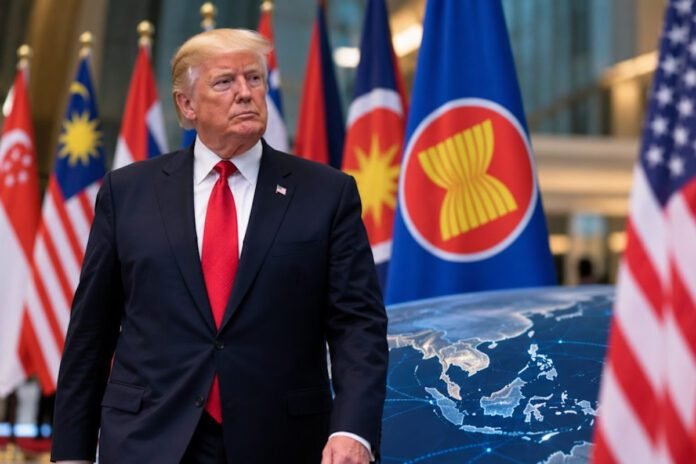
When President Trump arrives in Manila this week for the ASEAN Summit, his presence will carry significance beyond the usual diplomatic formalities.

As Southeast Asia increasingly becomes a focal point of strategic competition between Washington and Beijing, the US president’s attendance offers an opportunity to reaffirm America’s regional commitments.

For ASEAN, however, the more important question is not simply whether Washington intends to remain engaged, but what kind of engagement it is offering and at what cost to the region’s security, economic independence and democratic institutions.

Trump’s visit comes at a particularly consequential moment. The recent US midterm elections, which saw Democrats regain control of Congress, have raised fresh questions about the direction of American policy, particularly on trade and tariffs.

Meanwhile, China continues to deepen its economic and political relationships across Southeast Asia, including through closer defense cooperation with Laos and Cambodia, while positioning itself as a leading voice in global artificial intelligence governance.

At the same time, ASEAN members face a range of challenges, from renewed tensions between Cambodia and Thailand and the continuing crisis in Myanmar to the proliferation of cyberscam networks sweeping through the region and persistent disputes in the South China Sea. Any engagement with the US will likely be judged by its impact on these issues.

Security cooperation is likely to feature prominently in Manila. Secretary of Defense Pete Hegseth’s recent participation in the ASEAN Defense Ministers’ Meeting-Plus in Cebu, where he proposed a new US-ASEAN Framework for Defense Cooperation, suggests Washington is looking to institutionalize its regional security presence through stronger maritime domain awareness and naval coordination.

There is clear rationale for deeper cooperation. The South China Sea is vital to international trade, energy security, and the livelihoods of millions across Southeast Asia. Improved regional military capabilities could improve deterrence measures against Chinese coercion, a central concern for several ASEAN members, including the Philippines and Vietnam.

However, ASEAN members differ considerably in how they perceive China and manage their relationships with Beijing, making any unified security alignment with Washington difficult. ASEAN has also long committed to strategic autonomy and reducing dependence on external powers.

The bloc needs partners that respect its centrality and recognize that regional security cannot be reduced to containing China. A framework that prioritizes military deterrence without sufficient attention to diplomacy, crisis management and confidence building risks making the region more polarized rather than more secure.

The economic dimension of Trump’s visit is equally important. Southeast Asian economies have spent much of the past year navigating the uncertainty created by Washington’s tariffs, first announced in 2025.

While several countries have negotiated bilateral trade agreements with the US to reduce levies – although notably some, including Indonesia’s, are yet to come into effect – this approach risks fragmenting ASEAN’s collective bargaining power.

Rather than engaging with the US as an integrated economic bloc to boost the region’s economy, this approach creates a mismatch of regulatory barriers, tariffs and overall supply chain disruption.

More concerning is what appears to be missing from this transactional approach. Previous US administrations, despite their own inconsistencies, have at times linked economic engagement to broader commitments on labor standards, human rights and democratic governance.

The Trump administration’s emphasis on reciprocal trade and national economic interests places considerably less political weight on these considerations. Although some agreements contain provisions addressing forced labor, these should not be mistaken for meaningful democratic or human rights conditionality.

This matters because economic agreements are not politically neutral. Trade arrangements can strengthen governments, shape domestic regulatory environments and influence the distribution of economic power.

If Washington is willing to overlook democratic backsliding, restrictions on civil society, or attacks on institutional independence in exchange for favorable commercial terms, it risks reinforcing the perception that governance standards are negotiable when strategic or economic interests are at stake.

The consequences of weak governance also extend beyond national borders. A United Nations report last year highlighted how corruption and weak state institutions have enabled the proliferation of a cyberfraud industry across Southeast Asia – an industry which cost the Asia-Pacific more than $88 billion in 2025 alone.

As ASEAN members look to address shared challenges at the summit, including Myanmar, transnational scam networks, and tensions between Thailand and Cambodia, the importance of effective and accountable governance should not be overlooked.

Ultimately, Trump’s attendance in Manila should be judged not by the symbolism of his presence or the number of agreements announced, but by whether it contributes to a more consistent and constructive American role in Southeast Asia.

The region needs reliable security partnerships, predictable economic relationships, and an international environment that supports rather than compromises democratic institutions.

Samady Ou is a Human Rights Foundation Freedom Fellow and ambassador for the Khmer Movement for Democracy. He is also the author of ‘The Cambodia Briefing’ Substack, a fortnightly Cambodian news digest.

Source: Iwpost.com

Review: Apple’s M6 iMac is pricey, but it’s still a good choice for a clean desk

0
review:-apple’s-m6-imac-is-pricey,-but-it’s-still-a-good-choice-for-a-clean-desk
Review: Apple’s M6 iMac is pricey, but it’s still a good choice for a clean desk

The Apple Silicon iMac got its fourth refresh this month.

Every other Apple Silicon Mac has found a way to move forward over the last half-decade—we’ve gotten a more Pro design for the MacBook Pro, a mini-er design for the Mac mini, and a Mac Studio that has finally made Apple admit it doesn’t want to make the Mac Pro anymore.

But the Apple Silicon iMac has always been more interested in looking backward. It’s the thin, screen-on-a-stand iMac design by way of the original Bondi Blue G3 iMac. It’s a clean and pretty desktop computer, one I see all the time in small offices and on TV shows that depict small offices. We’re long past the days when it was Apple’s primary workstation computer.

So I wanted to write about this new iMac from the perspective of that entry-level iMac buyer, who chooses the iMac because it’s simple and then uses it until it breaks. What does a new iMac get you if you’re stepping up from the M1 model or comparing it against an older refurbished M4 model? Without any real external updates, what makes this iMac iteration interesting?

Same friendly face

If you haven’t used an Apple Silicon-era iMac before, here’s a brief primer.

The new iMac is much thinner than the older aluminum Intel models. Its front is mostly one big 24-inch screen, surrounded on all sides by a relatively thick white bezel (I still wish black were at least an option, but Apple apparently doesn’t agree).

White bezel aside, it’s by far Apple’s most colorful computer. The iMacs ship with color-matched fronts, backs, stands, keyboards, mice, trackpads, and cables. Apple has tweaked the color offerings and changed the tints of each specific color a few times over the years, but the M6 iMac uses the same six color tints (plus silver) that the M4 iMac did.

The basic $1,499 iMac is essentially a MacBook Air in terms of ports—it has two Thunderbolt ports on the back and a headphone jack on the left side. Choosing this model also locks you into a lesser version of the Apple M6 with 10 CPU cores and 10 GPU cores instead of 12 of each, a maximum of 24GB of RAM, a minimum of 256GB of storage, and a maximum of 1TB. Its default keyboard doesn’t have Touch ID support, and the only way to get it is to buy the version with the built-in number pad, an $80 upsell.

The M6 iMac still comes with either two or four Thunderbolt 4 ports. The four-port version can run two external displays; the one-port version is limited to one. Ethernet is available on the power brick for an extra $30.

The M6 iMac still comes with either two or four Thunderbolt 4 ports. The four-port version can run two external displays; the one-port version is limited to one. Ethernet is available on the power brick for an extra $30. Credit: Andrew Cunningham

The $1,699 version is the one to get if you still intend to use the iMac as a workstation. It includes the full-speed version of the M6 with all its CPU and GPU cores intact (though there are performance caveats here we’ll talk about later), plus options for 32GB of RAM and up to 2TB of storage. This version also includes four Thunderbolt ports on the back for connecting additional accessories. Both available keyboards on this version have Touch ID.

A 2.5 gigabit Ethernet port can be added to any iMac for $30. This port is located on the desktop’s power brick rather than the iMac itself, an elegant solution that keeps even a wired Internet connection hidden beneath your desk with the other cables. All iMacs also offer a VESA mount adapter option in place of the default stand at no extra charge.

I still really like the effect created by the color-matched keyboard, mouse/trackpad, and cables—even the white bezel complements the white keycaps and mouse. Just know you’re paying quite a lot for how the desktop looks. The $899 Mac mini is $800 cheaper than the iMac with the same chip, the same amount of RAM, and the same amount of storage. Sure, it would cost something to add a nice-looking 4K monitor, but not $800, even if you go for extra frills like a high refresh rate.

It’s fine that the iMac upcharges you for style and convenience. That’s the point of the computer. Just make sure that’s what you want to pay for.

The evolution of the iMac

2019 iMac 2021 M1 iMac 2023 M3 iMac 2024 M4 iMac 2026 M6 iMac
CPU/GPU 8th-gen Intel Core/AMD Radeon Pro 555X (2GB) Apple M1 Apple M3 Apple M4 Apple M6
Neural engine N/A 16-core 16-core 16-core 32-core
RAM 8-32GB 8-16GB 8GB-24GB 16-32GB 16-32GB
Starting storage 1TB Fusion Drive (SSD + HDD) 256GB SSD 256GB 256GB 256GB
Screen 21.5-inch 4096 x 2304 IPS LCD 24-inch 4480 x 2520 IPS LCD 24-inch 4480 x 2520 IPS LCD 24-inch 4480 x 2520 IPS LCD, optional nano-texture 24-inch 4480 x 2520 IPS LCD, optional nano-texture
Ports 2x Thunderbolt 3, 4x USB-A, gigabit Ethernet, SD card, headphone jack 2x Thunderbolt 3, headphone jack, 2x optional 10 Gbps USB 3, optional gigabit Ethernet 2x Thunderbolt 3, headphone jack, 2x optional 10 Gbps USB 3, optional gigabit Ethernet 2x OR 4x Thunderbolt 4 ports, optional gigabit Ethernet 2x OR 4x Thunderbolt 4 ports, optional 2.5 gigabit Ethernet
External display support 1x 5K 60Hz or 2x 4K 60Hz 1x 6K 60Hz 1x 6K 60Hz 1x 6K 60Hz (2-port) OR 2x 6K 60Hz (4-port) 1x 6K 60Hz (2-port) OR 2x 6K 60Hz (4-port)
Starting price $1,299 $1,299 $1,299 $1,299 $1,499

Here are the basic specs for every entry-level iMac Apple has shipped, going all the way back to the last of the Intel models.

The iMac’s evolution has been slow and gradual during the Apple Silicon era. The computer has never gotten a base storage upgrade, and the base M4 and M6 models still only support a single external display (the upgraded models support two external displays, finally surpassing the old Intel model).

If you have any kind of Apple Silicon iMac and you’re happy with how it’s performing and you’re not hankering for more RAM or more displays, I don’t think the M6 model really adds anything worth upgrading for. It’s definitely faster, but even six years on, the Apple M1 remains perfectly serviceable for daily use, especially when it’s attached to 16GB of RAM.

And if you’re in the market for an iMac now, I think the M4 model still gets you the best bang for your buck if you can find one refurbished or on sale. That one still gets you a minimum of 16GB of RAM, Thunderbolt in all four ports for the four-port model, the 32GB RAM option, the nano-texture display option, and support for multiple external displays (again, in the four-port model).

The M6 iMac builds on that, and it comes with real performance benefits (more on that shortly). But the brightest dividing line in the Apple Silicon iMac model history is between the M3 and M4 model, not the M4 and M6 model. And that’s true despite the two-generation silicon upgrade.

Performance and power

CPU S/P/E-cores GPU cores RAM options Display support (including internal) Memory bandwidth
Apple M6  2S/4P/6E 12 16/24/32GB Up to three 153GB/s (16GB), 170GB/s (24GB/32GB)
Apple M5  4S/6E 10 16/24/32GB Up to three 153GB/s
Apple M4  4P/6E 10 16/24/32GB Up to three 120GB/s
Apple M3  4P/4E 10 8/16/24GB Up to two 102.4GB/s
Apple M2  4P/4E 10 8/16/24GB Up to two (one external) 102.4GB/s
Apple M1 4P/4E 8 8/16GB Up to two (one external) 68.25GB/s (est.)

A quick recap on the M6: a total of 12 CPU cores (two super cores, four performance cores, six efficiency cores), either 10 or 12 GPU cores, 16/24/32GB RAM options, and a doubled Neural Engine NPU with 32 cores instead of 16. For the iMac, the M6 also introduces some of the architectural tweaks introduced with the Apple M5, including the addition of neural accelerator hardware to the GPU cores. This boosts the speed of some kinds of local AI workloads compared to the M4, including MetalFX upscaling and frame generation in games.

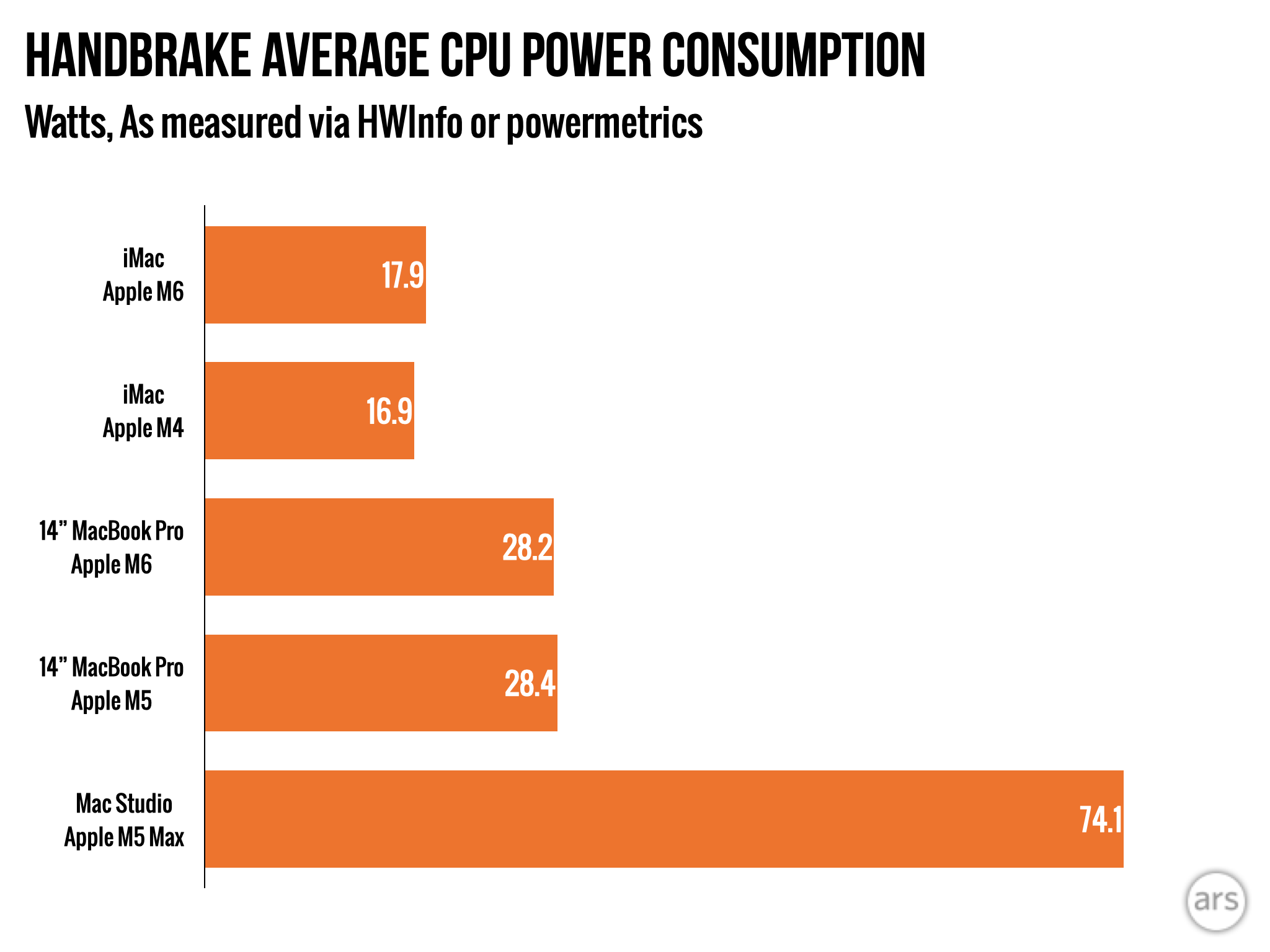
The M6 in the Mac mini and the M6 in the 14-inch MacBook Pro both perform similarly within a roughly 28 W sustained power envelope. The version with 16GB of RAM will perform slightly worse in games and other workloads sensitive to memory bandwidth—the 16GB M6 offers 153 GB/s of memory bandwidth, and the 24GB and 32GB versions offer 170 GB/s. But that’s a pretty minor difference.

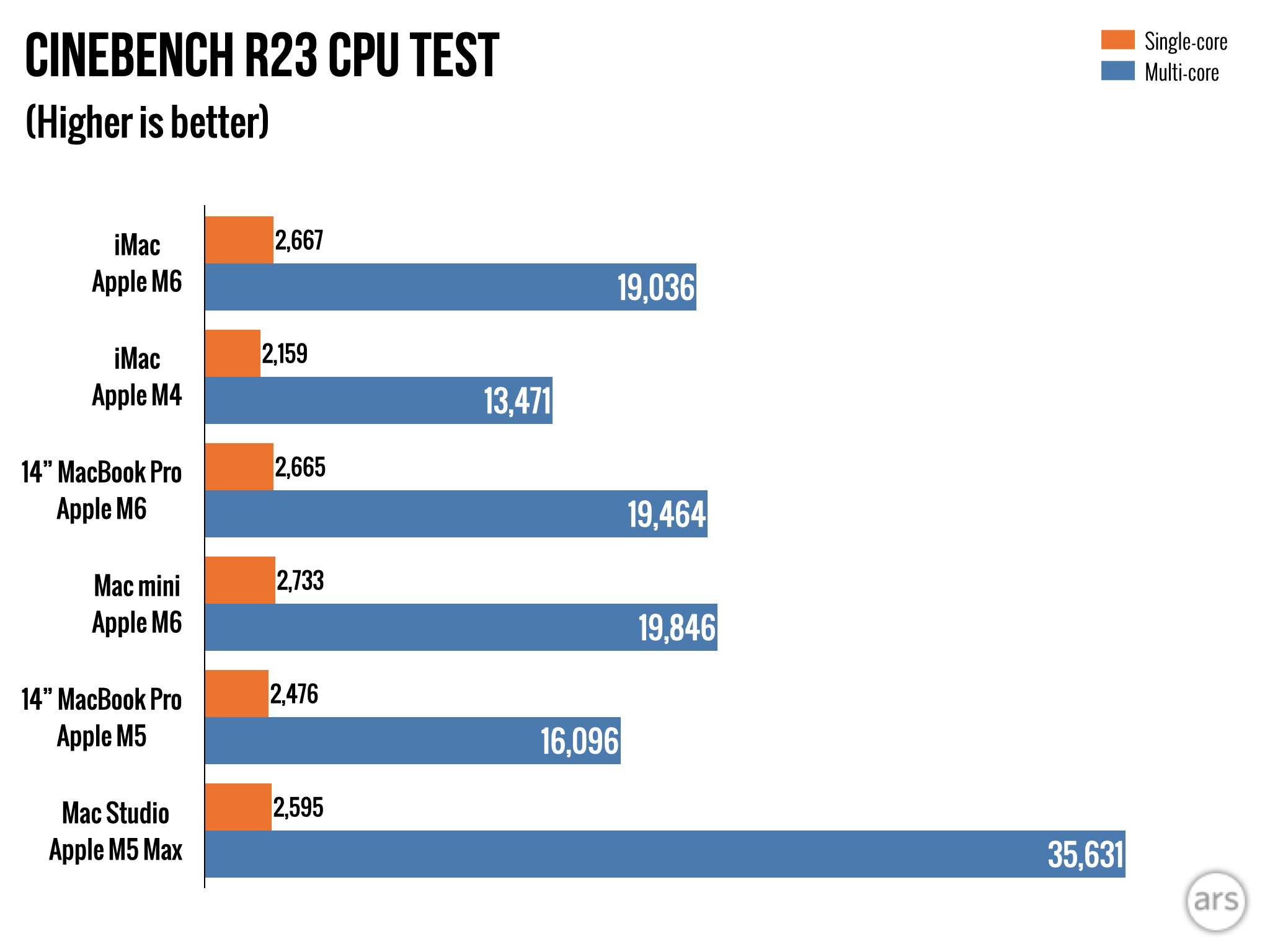
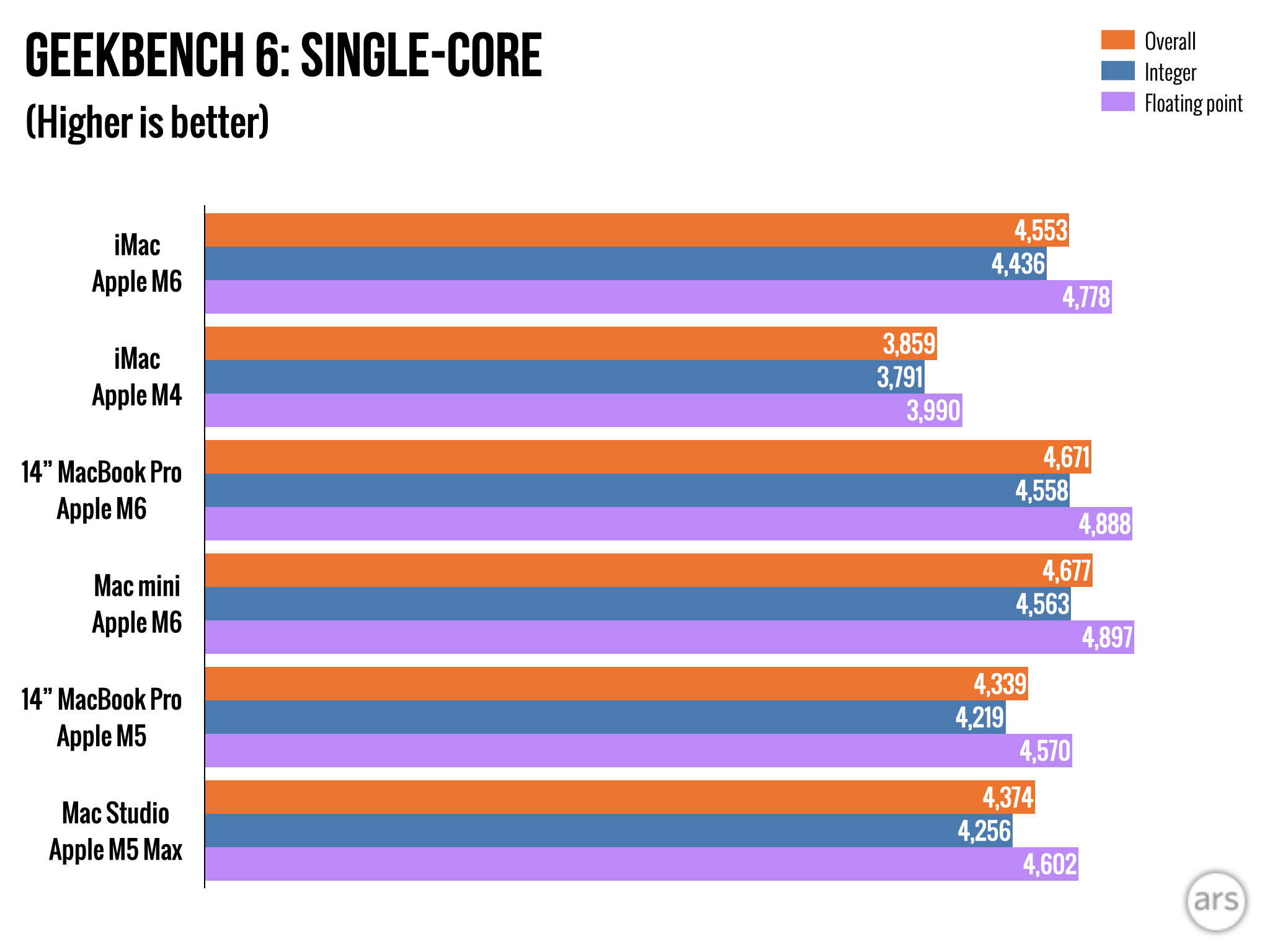
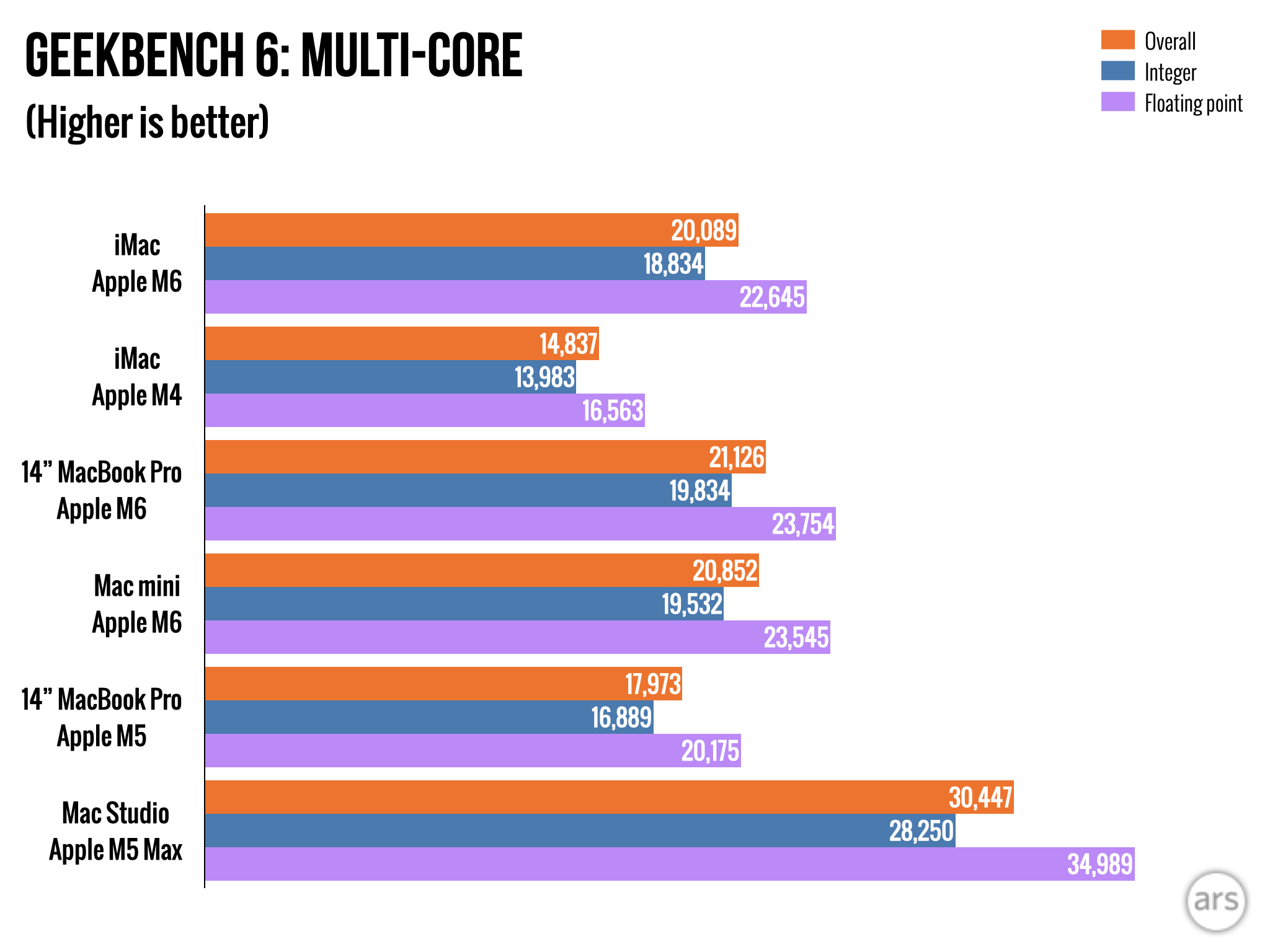
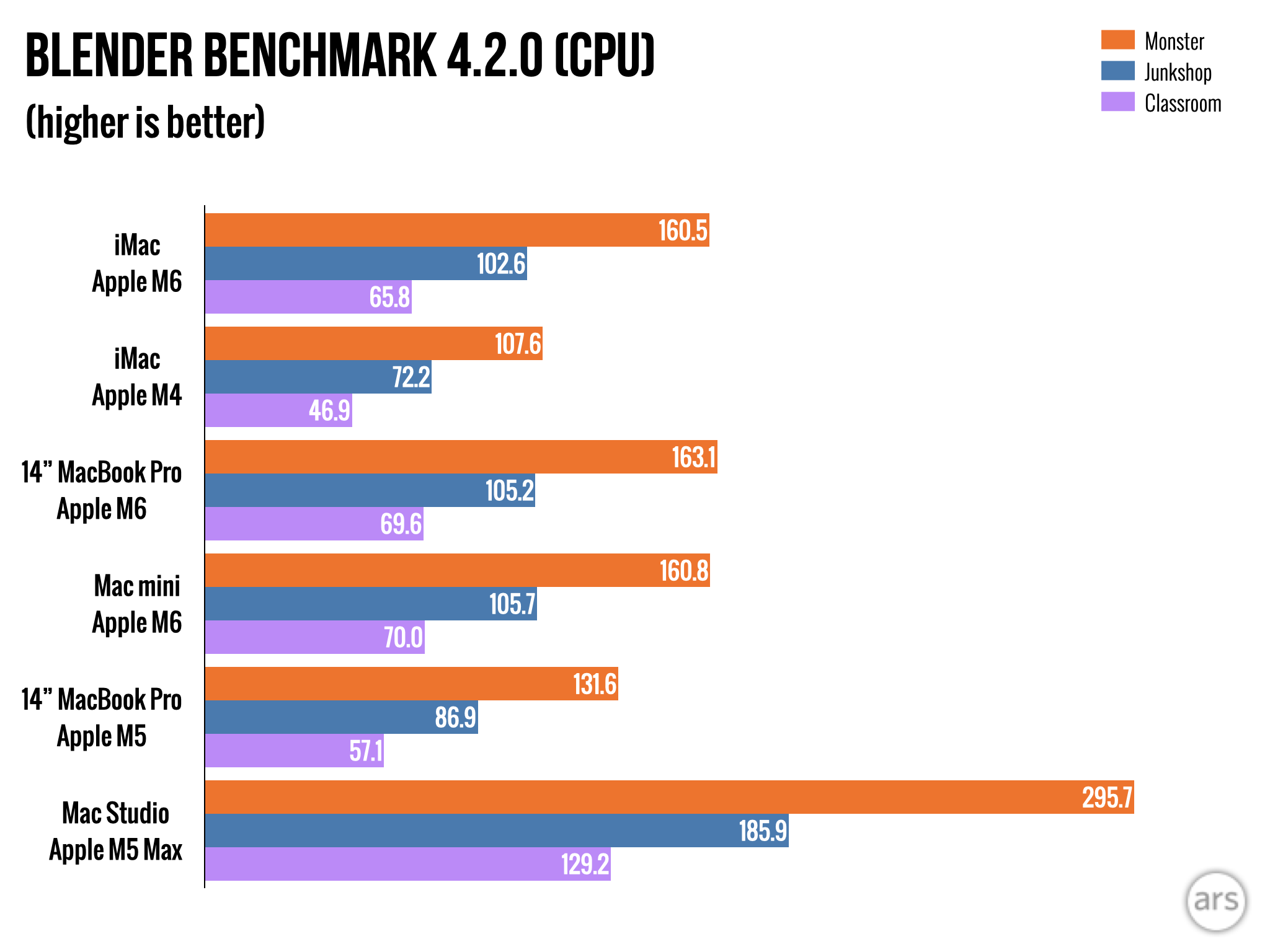
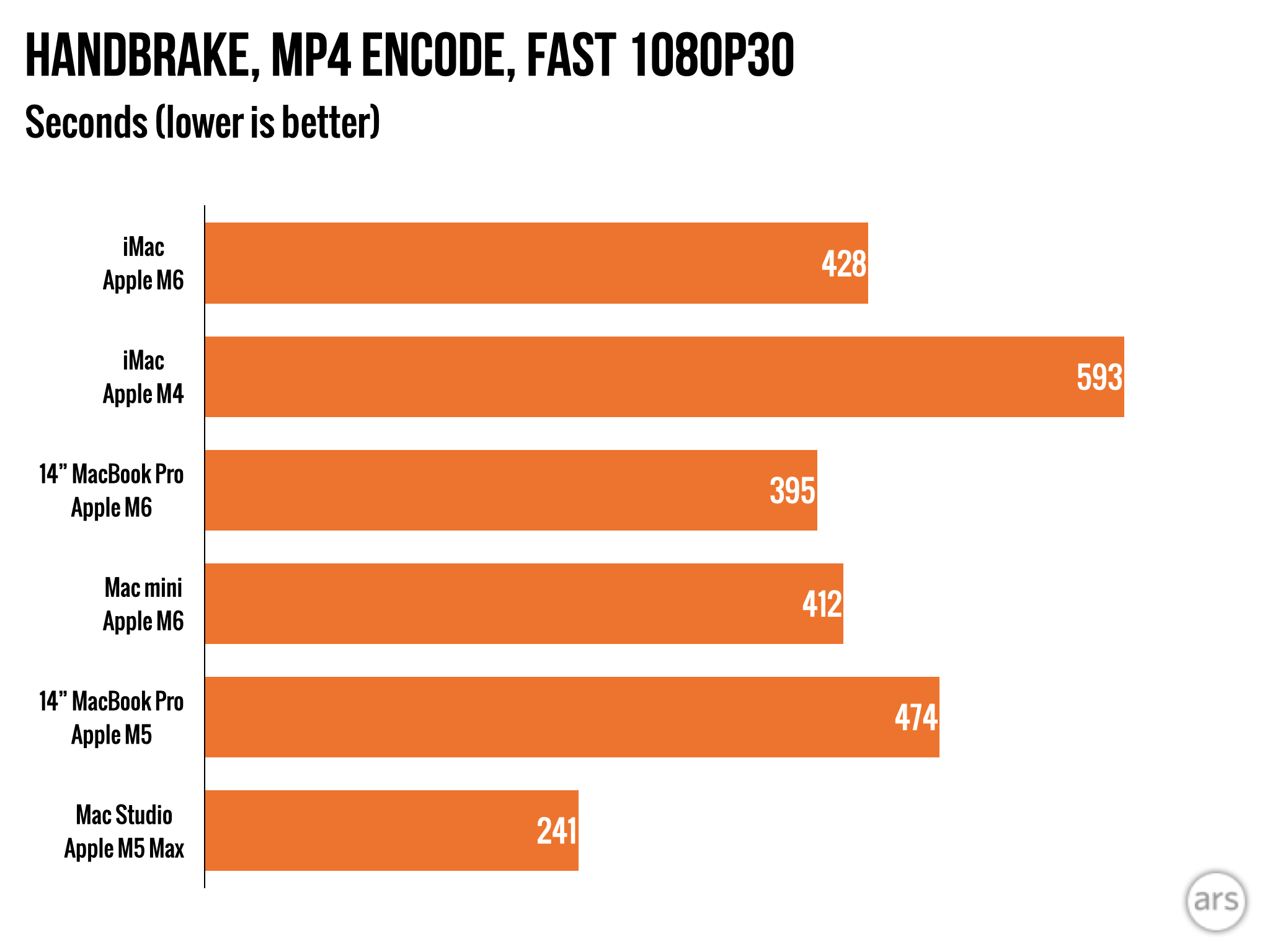
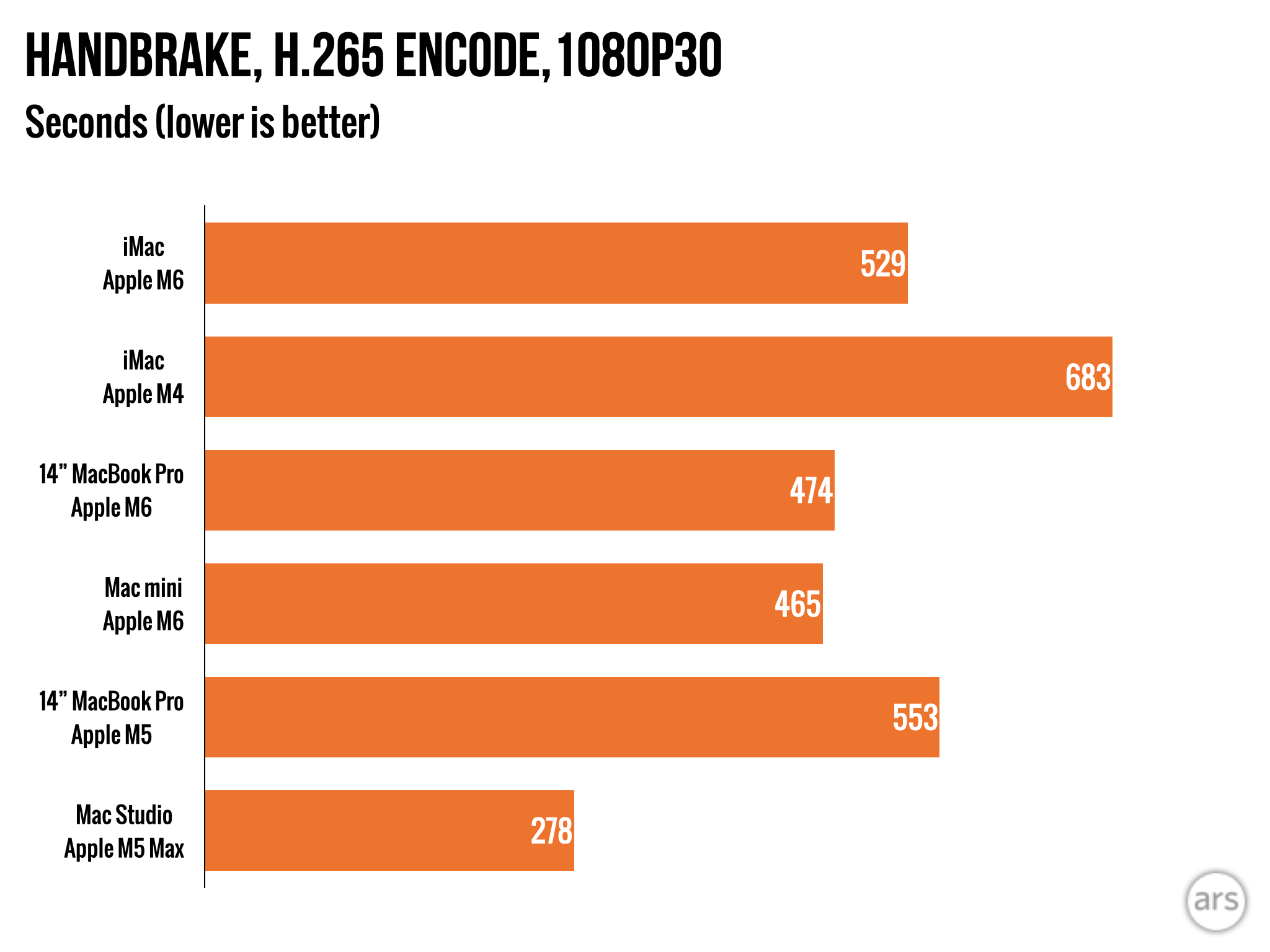
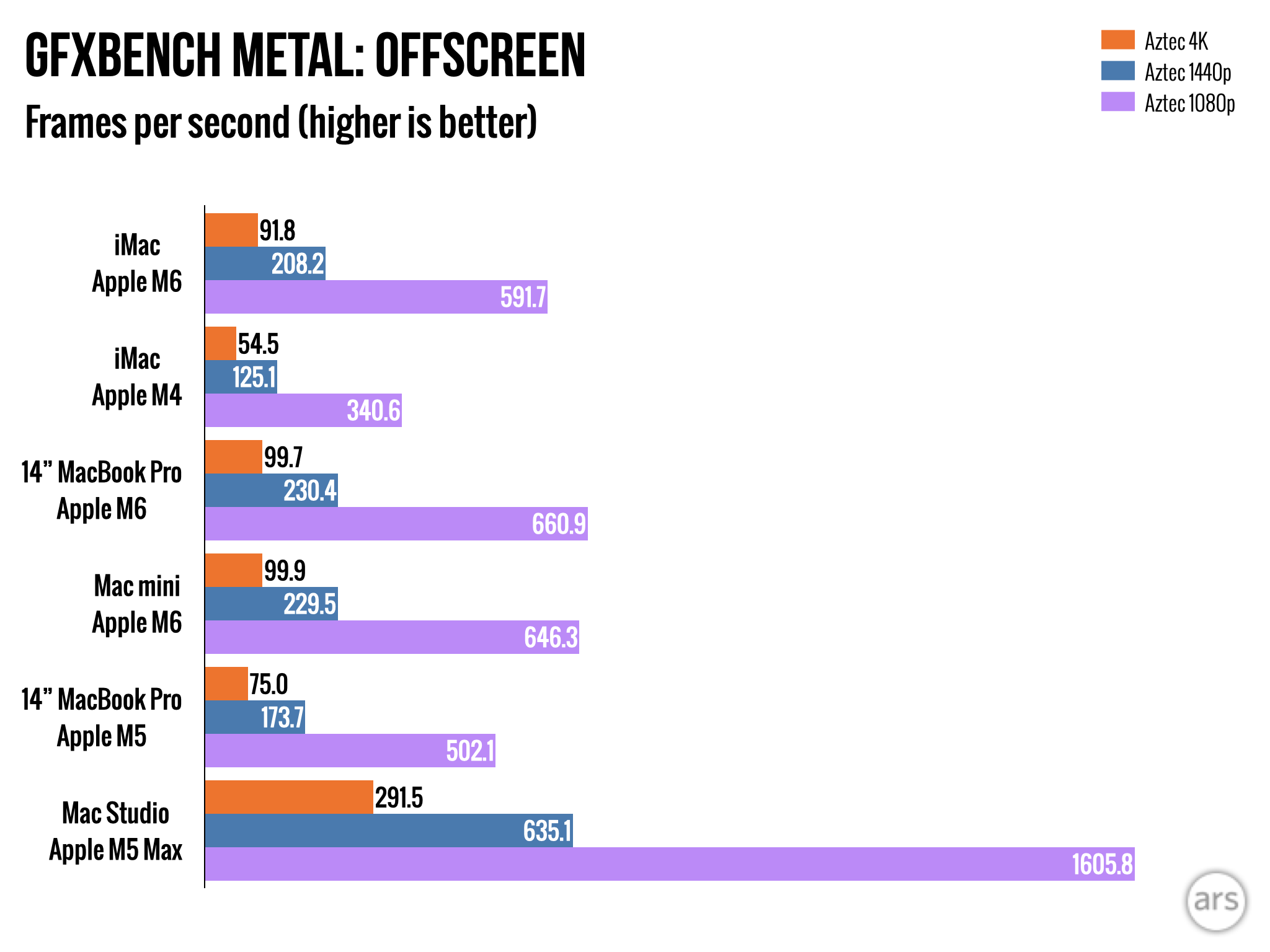
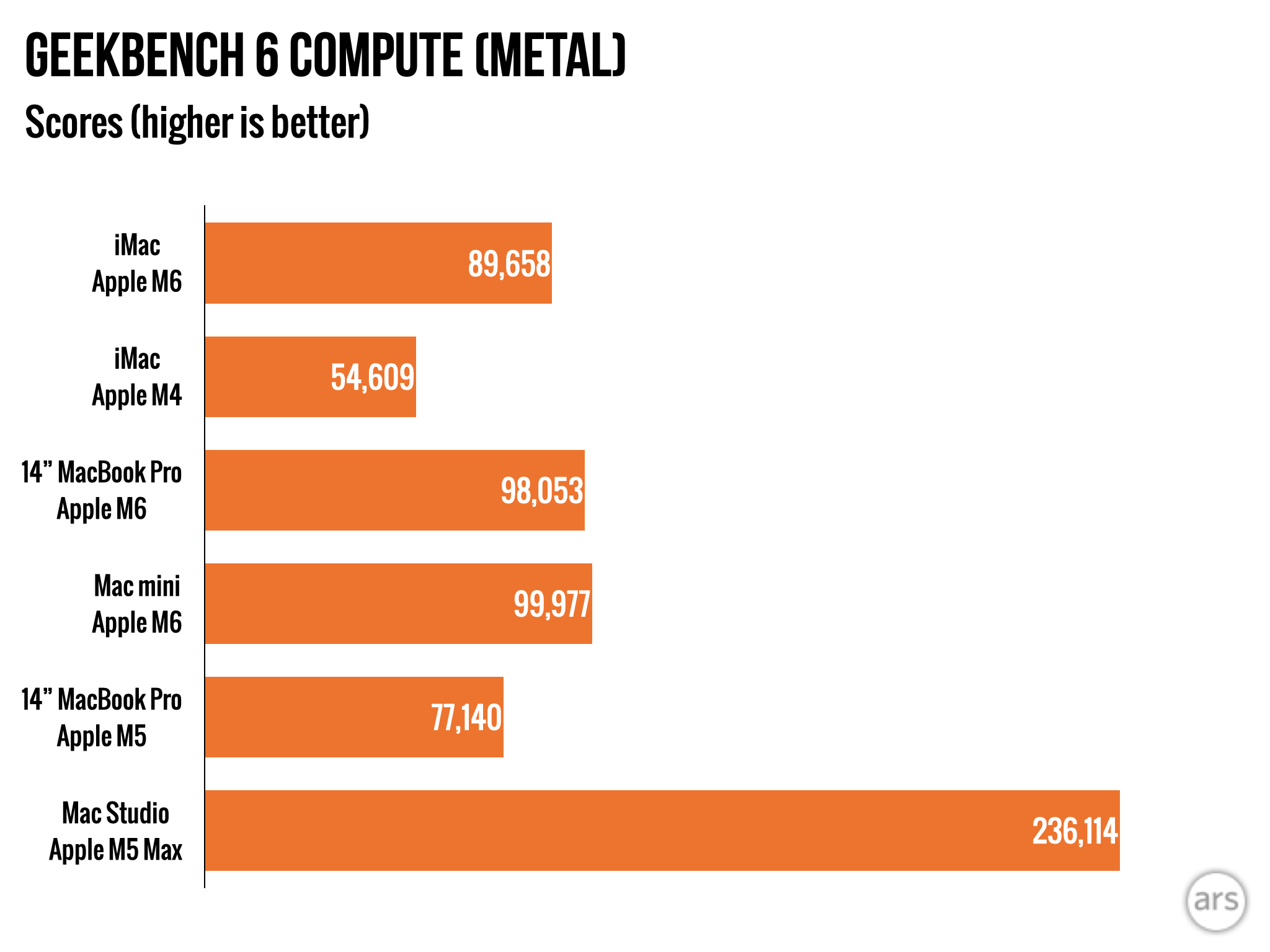
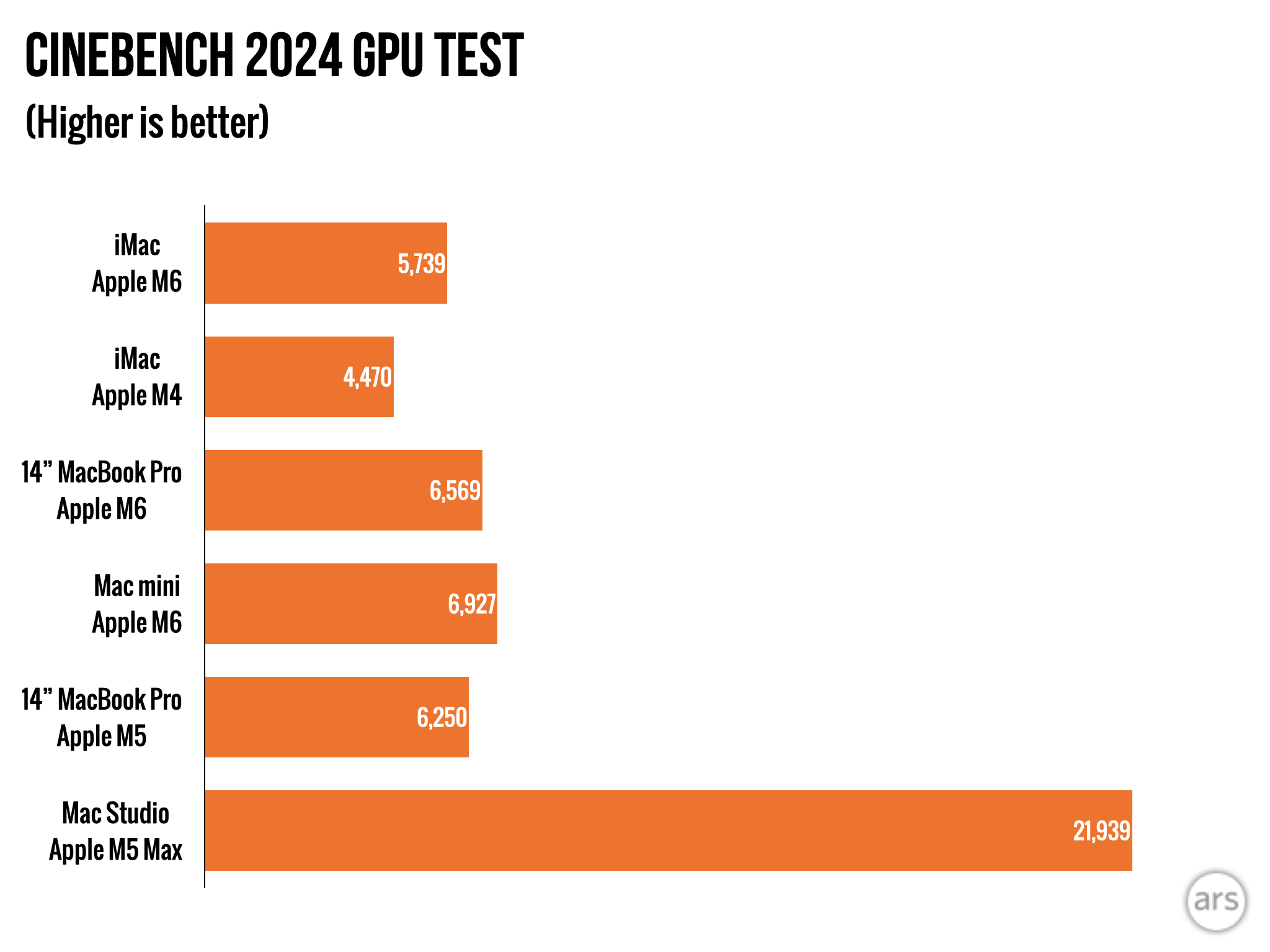
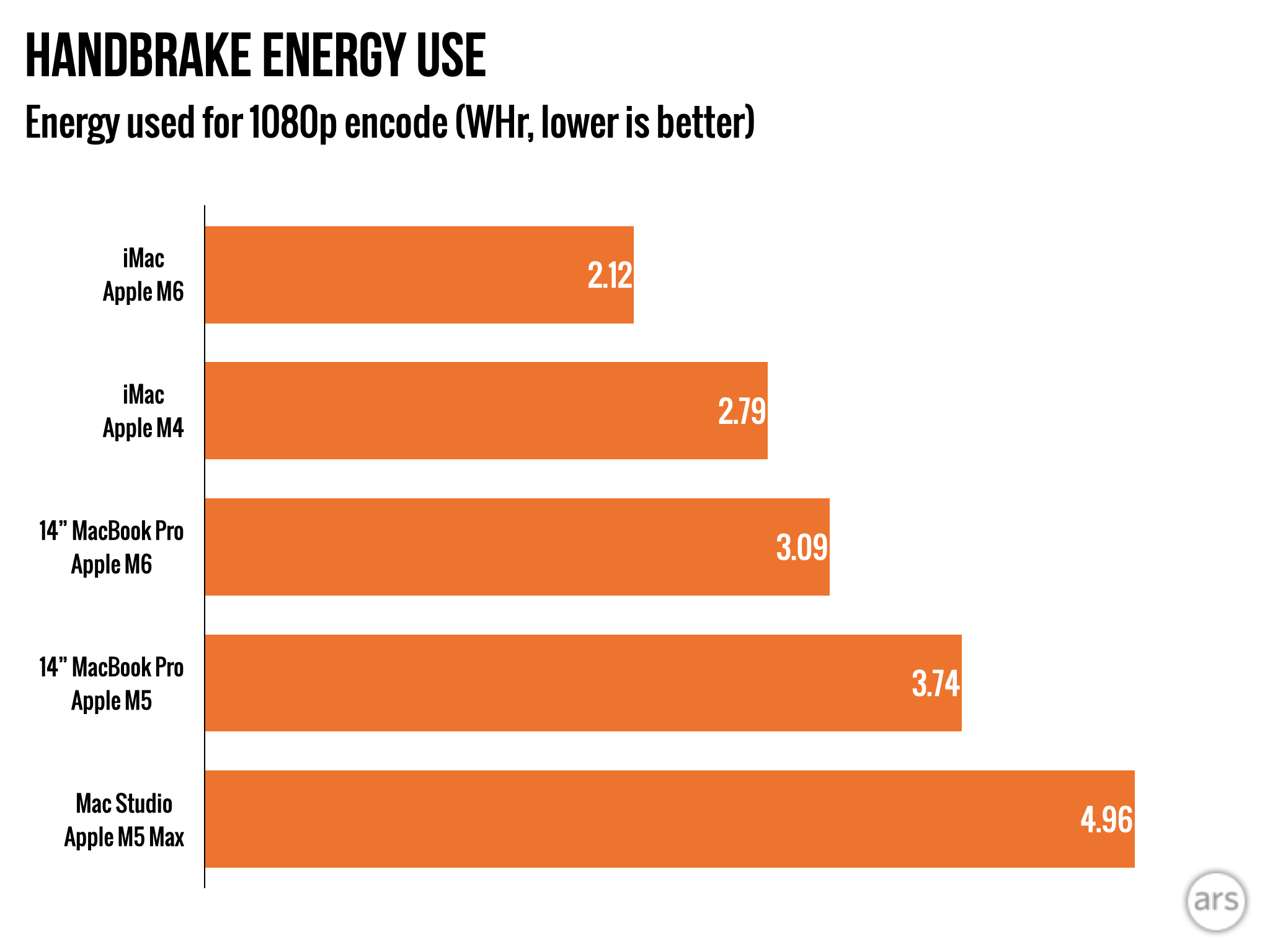
The iMac is slower than either of those two Macs, particularly in multi-core CPU benchmarks and graphics benchmarks, and the HandBrake video encoding test shows the likely culprit. The iMac’s M6 consumes an average of 18 W of power under sustained heavy load. It won’t throttle its speeds as aggressively as a MacBook Air because the iMac still includes an active cooling fan, but the reduced power envelope does mean that the Mac mini or MacBook Pro are 5 to 8 percent faster than the iMac in heavy multi-core CPU tasks and about 8 to 12 percent faster in graphics benchmarks.

One benefit of the smaller power envelope is that the iMac’s chip is even more power-efficient than the regular M6 and the iMac’s version of the M4, using much less power to do the same amount of work.

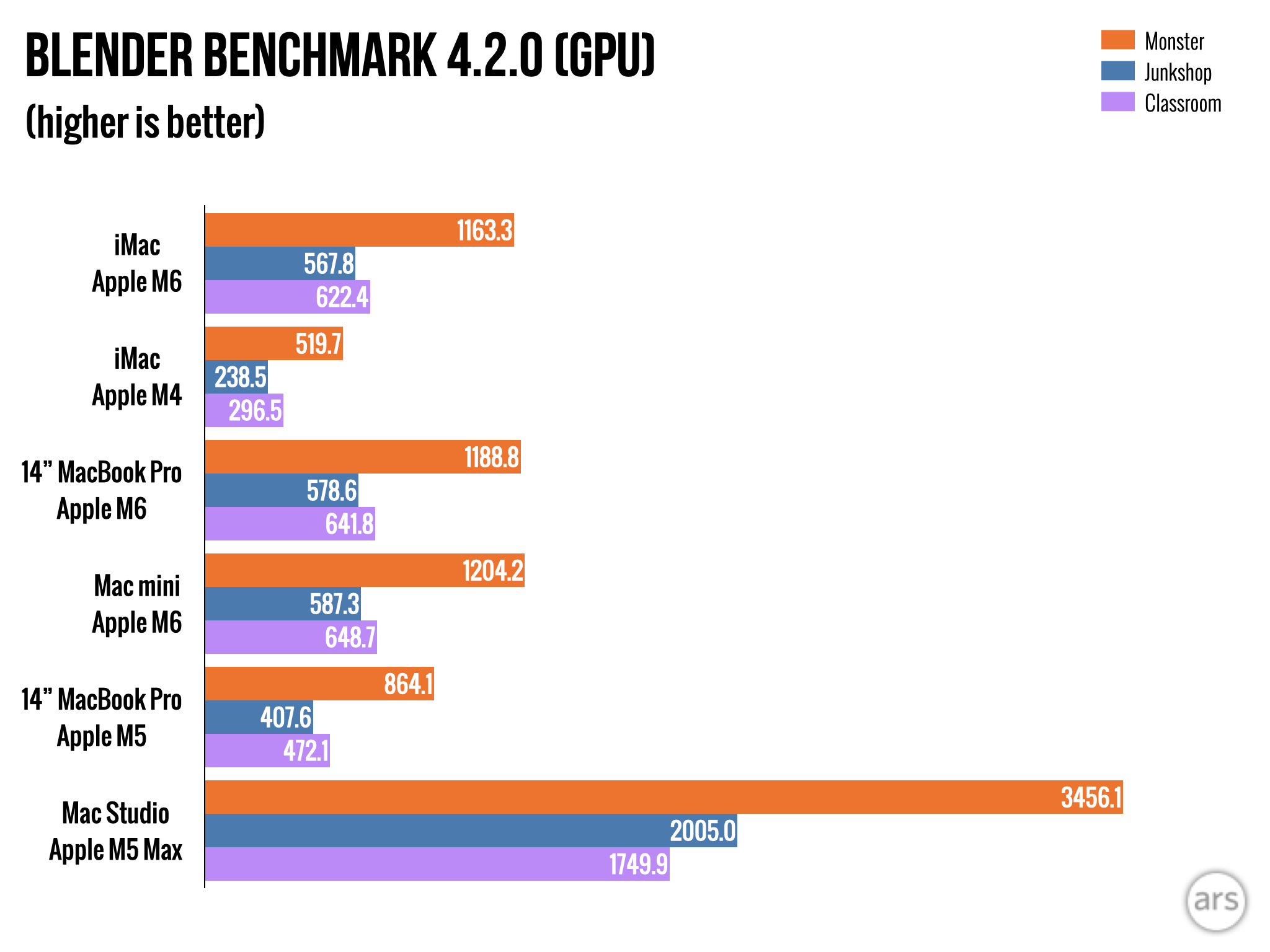
That still makes it a solid upgrade over the M4. The iMac’s M6 is 15 to 20 percent faster in our single-core CPU benchmarks, between 20 and 30 percent faster in multi-core CPU benchmarks, and between 20 and 40 percent faster in graphics benchmarks (the Blender GPU benchmarks do even better—they seem to like the neural accelerators in the M5 and M6 GPUs). Especially with 24GB or 32GB of RAM, it’s perfectly capable of being the heart of a multi-monitor workstation setup or a light photo/video editing rig.

What meets the eye

The M6 iMac changes almost nothing about who the iMac is for, its position in Apple’s lineup, or what it’s technically capable of. It’s a box-ticking upgrade, and the box being ticked is “keep the insides up to date.”

That means today’s iMac is best for the same kinds of computer users it was good for in 1998: people who don’t want a laptop, people who need a friendly and approachable kiosk or office computer, and people who just want something pretty that doesn’t require a lot of fussing with screens or cables.

That’s the main thing I miss about being an iMac user. I like how my current Mac Studio desktop works, and I need flexibility and complexity in my specific setup to get the Mac and a gaming PC connected to all the same stuff. But despite my best efforts, the cable situation has always been a barely managed mess.

If someone you know has a cable management problem and doesn’t need the complexity, congratulations, you’ve found someone the iMac is for. I just wish Apple would use these kinds of pretty, saturated colors in a laptop or desktop that meets my needs, you know?

The good

  • A pretty and capable desktop computer that minimizes the cable mess that most desktops make
  • Energy efficient and quiet, on the rare occasions when you can hear the fan spinning at all
  • Apple M6 is fast, and especially with 24GB or 32GB of RAM, will be more than capable of handling most tasks
  • Like the M4 version, it can support multiple external displays if you pay for the faster chip

The bad

  • Limited port selection
  • Costs $200 more than the M4 model did when it launched
  • Still just 256GB of base storage
  • Slightly slower than M6 versions of the Mac mini and MacBook Pro
  • TouchID is an $80 upgrade for the base model

Source: Iwpost.com

“No intention”: Berlusconi’s children rule out political careers

0
“no-intention”:-berlusconi’s-children-rule-out-political-careers
“No intention”: Berlusconi’s children rule out political careers
cde.news desk · 2 min read

Pier Silvio Berlusconi said on Wednesday that neither he nor his older sister Marina is considering following their late father, Silvio Berlusconi, into politics.

There has been speculation that one or both of the late former prime minister’s older children might enter the political arena to give fresh impetus to the centre-right Forza Italia (FI) party. The party is currently led by Deputy Prime Minister and Foreign Minister Antonio Tajani, 73.

Pier Silvio Berlusconi, chairman and chief executive of the MFE-MediaForEurope group, said this was not on the cards, even though the siblings are in regular contact with Tajani and support FI financially.

“Neither Marina nor I have any intention of entering politics,” Berlusconi, 57, said during a meeting with the press at Mediaset’s headquarters in Cologno.

“Complete, absolute alignment”

“We share an interest in keeping alive what my father created, an interest rooted in our roles as entrepreneurs, because we believe in the values my father always championed,” he said.

He said his sister had been put at the centre of developments within Forza Italia, but had simply spoken with people while keeping the party’s interests in mind. “Marina has been placed at the centre of developments within Forza Italia, but she has simply spoken with people while keeping in mind the interests of the party, one of my father’s greatest legacies, which can still have a future,” he said.

“Marina and I are in complete, absolute alignment,” he added.

Marina Berlusconi, 60, is chair of the family holding company Fininvest and head of Italy’s largest publishing group, Mondadori.

Source: Iwpost.com

US Ambassador Huckabee rejects the term ‘settler violence,’ says only hundreds involved in West Bank attacks

0
us-ambassador-huckabee-rejects-the-term-‘settler-violence,’-says-only-hundreds-involved-in-west-bank-attacks
US Ambassador Huckabee rejects the term ‘settler violence,’ says only hundreds involved in West Bank attacks
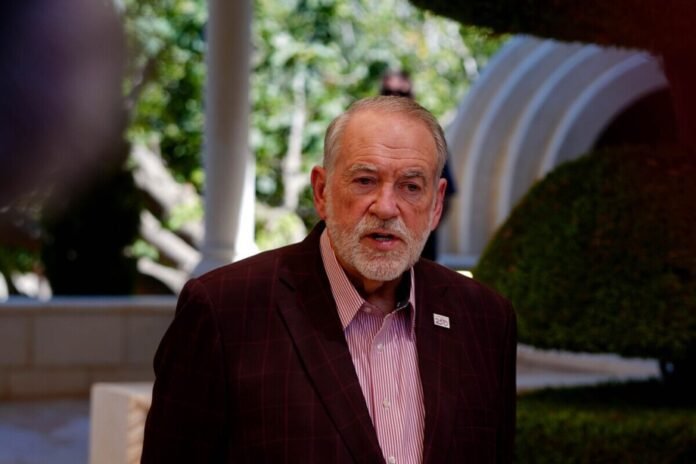
US Ambassador to Israel Mike Huckabee has rejected the term “settler violence” to describe attacks by Israeli settlers against Palestinians in the occupied West Bank, claiming that only a few hundred individuals are responsible for such acts.

Speaking in an interview with Israel’s public broadcaster on Tuesday evening, Huckabee argued that the term unfairly characterises the wider Israeli settler population.

“I am careful to avoid the term ‘settler violence’; it is an inaccurate characterization that does not fairly represent all those living in Judea and Samaria,” Huckabee said, using the biblical terminology for the West Bank.

He estimated that those involved in violent incidents numbered no more than 400 to 500 people, adding that some did not live in West Bank settlements.

“The number of people causing trouble is no more than a few hundred—perhaps 400 or 500—and many of them do not even reside there,” he said.

Despite rejecting the broader terminology, Huckabee condemned attacks against civilians and called for accountability.

“This type of crime and terrorist activity should not be tolerated,” he said.

READ: Israeli army decides to allow settlers to remain in 8 Jericho homes without providing protection

The ambassador added that he had urged Israeli authorities to impose sanctions and punish perpetrators regardless of their nationality.

“I have urged the Israelis to impose sanctions and punish the perpetrators fairly, regardless of whether the person who committed the crime is Israeli or Palestinian,” he said.

Approximately 750,000 Israeli settlers live in 156 settlements and 360 outposts across the occupied West Bank, including East Jerusalem, according to figures cited in the report.

Since October 2023, Israeli military operations and settler attacks against Palestinians and their property have intensified across the West Bank.

Reported incidents include killings, arrests, the demolition of homes and other structures, the burning of mosques and vehicles, damage to agricultural land, restrictions on farmers’ access to their fields, and the displacement of Palestinian residents.

Settlement expansion has also continued amid concerns over the future status of the occupied territory.

Palestinians warn that the combination of settlement expansion, displacement and restrictions on Palestinian communities could facilitate the formal annexation of the West Bank.

They argue that such developments would further undermine prospects for establishing an independent Palestinian state in accordance with relevant United Nations resolutions.

Huckabee’s remarks come amid continuing scrutiny of settler attacks and calls for greater accountability for violence against Palestinians in the occupied West Bank.

READ: Huckabee warns UK of US backlash over Israeli settlement product ban

Source: Iwpost.com

Israel Condemns France for Barring Entry to Samaria Regional Council Head  

0
israel-condemns-france-for-barring-entry-to-samaria-regional-council-head  
Israel Condemns France for Barring Entry to Samaria Regional Council Head  


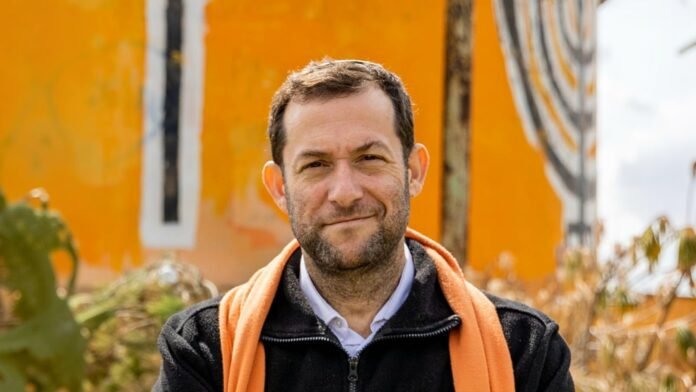
Israel’s Foreign Ministry condemned France’s decision to deny entry to Yossi Dagan, head of the Samaria Regional Council, after he was detained for questioning at a Paris airport, accusing French authorities of politically motivated discrimination against an elected Israeli official and demanding an explanation from Paris. 

“Israel views with grave concern France’s decision to bar the entry of a law-abiding Israeli elected official on clearly political and ideological grounds. This is a completely unacceptable measure, and Israel will demand explanations from the French government and will consider its next steps accordingly.” 

Dagan was stopped by immigration authorities upon arriving in Paris and informed that he would not be permitted to enter the country. The restriction was reportedly connected to his activities supporting Jewish construction and community development in the West Bank. 

During questioning, a French officer reportedly referred to Dagan’s position as head of the Samaria Regional Council and his efforts to expand Jewish communities in the territory. His advocacy for restoring Jewish communities in Gush Katif, in the Gaza Strip, was also reportedly raised as grounds for denying him entry. 

Asked to make a statement for the official record, Dagan replied: “I am proud to be a Jew and a Zionist who builds our historic homeland.” 

Dagan, who has headed the Samaria Regional Council since 2015, has campaigned for the extension of Israeli sovereignty over the West Bank and the expansion of Jewish communities there. 

His involvement in settlement advocacy followed his evacuation from Sa-Nur, a northern West Bank community dismantled during Israel’s 2005 disengagement. He subsequently became an advocate for rebuilding communities removed under that plan. 

After the October 7 massacre, Dagan also called for renewed Jewish settlement in Gaza, including the restoration of communities formerly located in Gush Katif. 

French opposition to Israeli settlement construction in the West Bank has been a longstanding source of disagreement between Paris and Jerusalem. 

Source: Iwpost.com

Big Walk used AI to fix a bug. Now the indie gaming world is having a reckoning.

0
big-walk-used-ai-to-fix-a-bug-now-the-indie-gaming-world-is-having-a-reckoning.
Big Walk used AI to fix a bug. Now the indie gaming world is having a reckoning.

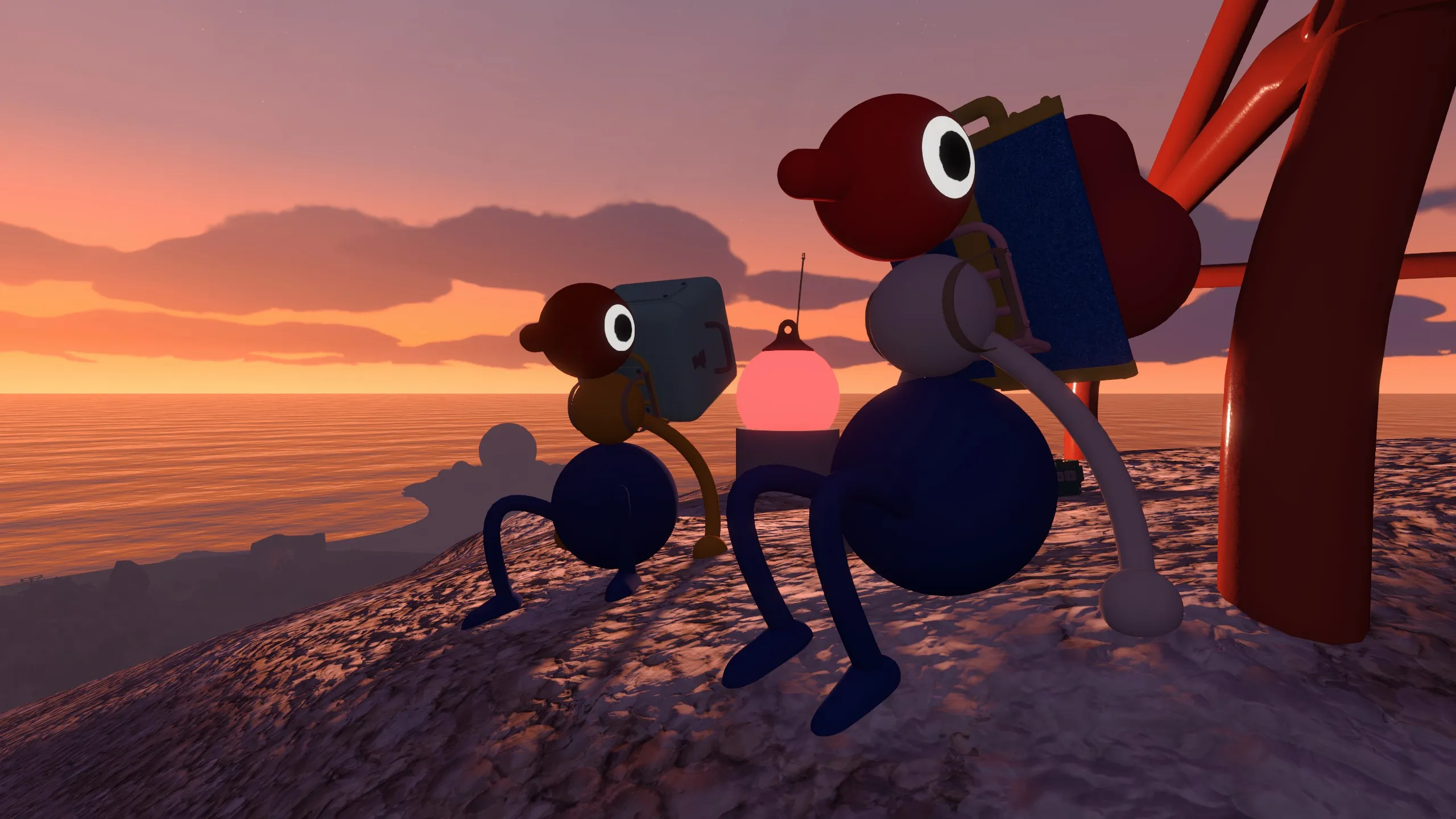
The last few years have seen significant debate over the widespread use of AI-powered tools in game development and the responsible disclosure of that usage to players. That debate has exploded into a full-blown controversy in the indie game development space this week, as Big Walk developer House House has publicly and belatedly disclosed minimal AI use in its popular co-operative puzzle exploration game.

This particular controversy has been brewing behind the scenes for months, as judges and jury members for the prestigious Independent Games Festival Awards discussed the issue in private discussion groups. But the debate started to break into public view on Monday when 19 members of the 50-plus-member jury released a signed statement outlining a stance “declining to vote for any game that uses generative AI in any capacity.”

Noting “a significant increase in the number of submitted games developer with generative AI tools,” the group of jurors called out AI’s ecological, economic, psychological, and labor harms in rejecting tools whose use, they said, is still “not a foregone conclusion in our industry.”

The jurors also urged the IGF as a whole to “adopt a strong anti-AI policy for future years that disallows games containing any AI-generated work.”

The big walkback

Although the jurors’ statement didn’t name any specific games, by Tuesday morning, one critical darling in particular was increasingly being noted as a central part of the debate. In a statement provided to Aftermath (and added to the game’s FAQ page shortly thereafter), developer House House admitted publicly that “LLMs were used sparingly” near the end of Big Walk‘s development “to help work through some difficult technical challenges and bugs.”

That limited AI use—which House House says represents “well under 0.1% of Big Walk‘s code—stemmed in part from a thorny Unity engine bug that was slowing the game down with “infinite length” shadows during some game situations. After consulting with a Unity engineer who determined a fix “wasn’t possible,” House House said it consulted an LLM chatbot, which suggested a possible fix that the developers “had to modify… extensively” into the 10 lines of code that ended up in the final game (At least one social media user says the bug was indeed fixable with significant human effort, though).

The kind of “long shadow” situation that led to a bug House House resorted to using AI tools to fix.

The kind of “long shadow” situation that led to a bug House House resorted to using AI tools to fix. Credit: House House

House House said it didn’t disclose this LLM usage for Big Walk‘s Steam release earlier this year because Valve “does not request disclosure of code or chatbot usage.” Indeed, Valve’s AI disclosure form for developers specifically notes that it is concerned with AI-generated content, not “efficiency gains” from “modern game development environments [that] have AI powered tools built into them.”

The IGF Awards make no such distinction for AI usage, however, which led House House to mention its AI-assisted bug fix in submitting the game for awards consideration. A version of that disclosure is being made public now because “it has become a matter of public interest,” House House said.

“This is not an endorsement of, or argument for, the use of AI tools, however minimal,” House House wrote. “We have some concern that voluntary disclosures like this might contribute to the normalization of this technology, or its treatment as ‘inevitable.’ We support the work of those who are trying to limit the harm generative AI is doing to videogames and our world, and apologize that Big Walk’s LLM usage may not meet their standards.”

All or nothing

Learning of House House’s AI disclosure was particularly painful for some IGF judges who had previously felt a special connection to Big Walk. In a blog post discussing his feelings, IGF jurist Austin Walker called the game “an achievement” that was “remarkable” and “beautiful,” featuring puzzles that “capture a range of play that is largely abandoned by the digital form.” Fellow jurist Damon Reece shared in a blog post that the game is “seriously special to me” and that it gave him “a profound and powerful emotional reaction to being in a space that felt like home.”

But when it comes to IGF awards consideration, Walker and Reece were among those who said that even minimal use of AI tools overrode that deep and abiding respect for the work itself.

“We have our hands on the lever here,” Reece wrote. “This is pain that has to happen [emphasis in original] to try and steer our culture away from this. We need to choose to speak loudly and clearly on this, to prioritize human creativity and labour, to tell the culture and the world that this is unacceptable to us. To do otherwise is rank cowardice.”

This isn’t the first time AI usage has noticeably affected game award judging. Last year, the Indie Game Awards (which are completely separate from the IGF Awards) rescinded awards for Clair Obscur: Expedition 33 after the developers admitted that some in-game textures were made using AI tools (these were later patched out).

“The Indie Game Awards have a hard stance on the use of gen AI throughout the nomination process and during the ceremony itself,” they said at the time.

An example of the placeholder AI-generated texture that got Calir Obscur: Expedition 33 disqualified from some awards consideration.

An example of the placeholder AI-generated texture that got Calir Obscur: Expedition 33 disqualified from some awards consideration. Credit: Sandfall Interactive

We all make mistakes

Since House House’s public disclosure, the anti-AI contingent of IGF judges has found plenty of support from disappointed Big Walk fans and industry observers. In the last few days, the game’s Steam page has been bombed with over 400 negative reviews, though Steam’s anti-review-bomb tools seem to be limiting the impact on the game’s overall “Very Positive” reception there.

But others feel House House’s relatively minimal use of AI here is being blown out of proportion. They say it’s important to differentiate between games that use LLMs as a last-resort technical fix, for instance, and others that lean heavily on AI to generate the bulk of their art, music, or the core of the game engine itself.

IGF judge Liz Ryerson wrote on social media that she didn’t find House House’s AI use to be personally disqualifying for the awards and that “the fact that many acted like there aren’t any levels to this and it’s all the same is bothersome to me.”

“To feel like someone gets punished a lot more for transparency about a smaller level of fuckup vs. just not even attempting to be honest or transparent at all is what bothers me,” she wrote.

Steam Hype staff writer and prolific Steam curator Dominic Tarason also pushed back against the idea that “House House need to be memory-holed and their work never spoken of again” as a “penalty for touching the Forbidden Device.” He said he considers Big Walk “very mildly compromised art” that is still “absolutely, unquestionably art and very human.”

“They spent years on that work of art,” Tarason added. “They asked a chatbot for two minutes how to fix a bug. That’s a ‘That’s lame, don’t do that again’ failing. … Some of you are acting like they’ve been convicted of high crimes against humanity, to be sealed away in the darkest oubliette until not even bones remain.”

But some have argued that using AI to fix a bug rather than hiring an expert to figure it out did make the game’s development at least a bit less human than it could have been. “House House aren’t laying off developers to replace them with Claude, and I’m sure they would be firmly against the mere thought of doing this, but we can also clearly see how their actions are part of the same problem,” AI researcher Mike Cook wrote on his blog.

Still, game developer, author, and professor Brendan Keogh wrote that he thinks “an extreme zero tolerance of any [generative AI] is ultimately counterproductive now. [There’s] a lot of anger at devs that feel deeply conflicted enough about their glorified Google search to disclose it, and [that is] encouraging those using it to actually steal labor to hide that use.”

As time goes on and AI tools are increasingly used in the building of major game engines, it may become increasingly difficult for anti-AI absolutists to avoid every game that has been touched by even a hint of LLM-generated code (if that use is even disclosed in the first place). That said, many still see value in a firm and unyielding public stance against what they see as a scourge to their entire industry.

“I think zero tolerance is a viable political position,” narrative designer and writer Hannah Nicklin wrote on social media. “You use politics against systems, for people you affect change through connection and understanding… The IGF jury statement… levels itself at a system of shared value and asks for change to enable solidarity around a position of harm reduction.”

Source: Iwpost.com
Prabowo gains upper hand as Gibran’s exit weakens Widodo’s grip

0
prabowo-gains-upper-hand-as-gibran’s-exit-weakens-widodo’s-grip
Prabowo gains upper hand as Gibran’s exit weakens Widodo’s grip

<

article id=”post-952843″>

Indonesian Vice President Gibran Rakabuming Raka’s resignation may mark a turning point in the balance of power between President Prabowo Subianto and his predecessor, Joko Widodo.

In 2024, Widodo, popularly known as Jokowi, helped carry Prabowo to the presidency, and his son’s elevation to vice president gave him a direct presence in the new administration. That bridge has now collapsed.

What this means for Jokowi’s network, often called the “Solo group” after the city where his political career began, is the open question. The network drew its strength from personal loyalty, access to state institutions, ties to political and business elites, and the assumption that Jokowi would keep shaping decisions after leaving the palace. Gibran was its most visible foothold in government.

He submitted his resignation to Prabowo on November 11, after 120 lawmakers from eight parliamentary factions signed a proposal asking the House of Representatives to exercise its right to weigh in on his eligibility. The proposal isn’t an impeachment and must clear further parliamentary and constitutional steps.

But its backing is broad: Opposition lawmakers joined members of Gerindra and Golkar, parties central to Prabowo’s coalition. The dispute centers on the educational documents Gibran used to qualify for the 2024 race.

This is not the first time Gibran’s path to the ticket has been challenged. He was 36 when Prabowo picked him as running mate, four years below the minimum age of 40. In October 2023, on the eve of candidate registration, the Constitutional Court ruled 5-4 that younger candidates could run if they had held elected office, an exception that covered Gibran, then mayor of Solo.

The court’s chief justice, Anwar Usman, is Jokowi’s brother-in-law and Gibran’s uncle by marriage. An ethics panel later found that Usman should have recused himself and removed him as chief justice, but it had no power to overturn the ruling, and Gibran stayed on the ticket.

The pressure on Jokowi’s network extends beyond Gibran. Three police generals have been detained in an investigation into allegations that senior officers illegally wiretapped Prabowo and others.

One is Listyo Sigit Prabowo, the former national police chief, who recently moved to the post of presidential chief of staff before being implicated. Some suspects have been linked to Jokowi’s circle, but that doesn’t prove the former president directed or knew about any surveillance.

There has also been movement in the Indonesian Solidarity Party (PSI), which is closely associated with Jokowi’s family. Raja Juli Antoni, Giring Ganesha and Isyana Bagoes Oka have resigned from party positions or membership, saying they want to concentrate on government responsibilities.

That doesn’t mean the party has abandoned Jokowi, but it suggests how loyalties can shift toward a sitting president when government access becomes more valuable than party roles.

Together, these developments point to an erosion of Jokowi’s bargaining power, though not to irrelevance. He retains name recognition, personal networks and a political following. But influence and leverage are different things. Influence draws attention or commands loyalty; leverage turns those assets into concessions from another actor. Jokowi may still have the first while losing some of the second.

In 2024, Prabowo had reason to value Jokowi’s popularity, networks and endorsement. Two years into his term, he has his own electoral mandate, control of the executive and a broad parliamentary coalition. The more alternatives he has, the less he needs his predecessor. None of this shows that Prabowo engineered the Solo network’s decline, but the relationship is now less symmetrical.

Gibran’s vice presidency was more than a family achievement; it was Jokowi’s channel into government. With that channel closed, Jokowi will have to lean more heavily on informal networks, alliances and public standing. Those may still matter in the 2029 elections, but they offer less direct influence than a son in the vice president’s palace.

For Prabowo, Gibran’s departure could provide political insulation. The two men won the 2024 election on one ticket, but the resignation lets Prabowo separate his administration’s future from the controversy surrounding his deputy while keeping the presidency intact.

Under Article 8 of the Constitution, the People’s Consultative Assembly will fill the vacancy from two candidates nominated by the president, giving Prabowo a central role in shaping the next configuration of power.

For Gibran, resignation may be less damaging than removal by impeachment, allowing him to leave on his own initiative rather than after a prolonged constitutional confrontation. It doesn’t settle questions about his eligibility, however, and it doesn’t automatically end the parliamentary process already underway.

Comparisons with Mohammad Hatta, Indonesia’s first vice president, deserve caution. Hatta resigned in 1956 over fundamental disagreements with President Sukarno about the republic’s direction. His departure was an ideological rupture, not a response to questions about the documents behind his candidacy.

The two political projects that once reinforced each other are now separating. Prabowo’s administration is gaining autonomy, while Jokowi’s network is learning the limits of influence without formal authority.

A former president can remain influential and can shape electoral calculations, but without institutional access, cohesive networks and credible bargaining power, his sway over the government is likely to shrink.

The Solo network helped make Prabowo’s election possible. Its predicament shows how an alliance built on mutual need can weaken once one partner acquires alternatives. In Jakarta, the question is how much, if at all, Prabowo still needs Jokowi.

Jannus TH Siahaan is an Indonesia-based social and political analyst. He holds a doctorate from Universitas Padjadjaran, Bandung, Indonesia

Source: Iwpost.com

The Kennedy Family’s Darkest Secret Exposed

0
the-kennedy-family’s-darkest-secret-exposed
The Kennedy Family’s Darkest Secret Exposed


Behind the glamour, wealth and political power of America’s most famous political dynasty lies a heartbreaking family secret that remained largely hidden from the public for decades.

Rosemary Kennedy, the younger sister of President John F. Kennedy, was just 23 years old when her powerful father authorized a controversial brain operation that would permanently change her life.

The procedure, performed in 1941, left the once-vibrant young woman severely disabled, unable to care for herself and eventually isolated from much of her famous family for years.

Her father, Joseph P. Kennedy Sr., had hoped the surgery would address Rosemary’s increasingly difficult behavior. Historians have also described his fears that her struggles could damage the family’s reputation and threaten his sons’ political futures.

Instead, the decision became one of the most troubling chapters in Kennedy family history.

Born September 13, 1918, Rosemary was the third of Joseph and Rose Kennedy’s nine children and their eldest daughter.

Although she grew up surrounded by privilege, her childhood was considerably different from that of her siblings.

Rosemary experienced developmental difficulties from an early age, struggling with reading, writing and other academic skills. Some accounts suggest complications during her birth may have contributed to her disabilities, although the precise cause was never definitively established.

Despite these challenges, she enjoyed sports, social gatherings and family activities. During her father’s time as U.S. ambassador to Britain, Rosemary was even presented to King George VI and Queen Elizabeth at Buckingham Palace.

But as she entered adulthood, her parents became increasingly concerned about her emotional difficulties and behavior.

Joseph Kennedy, determined to maintain the family’s carefully cultivated public image, began searching for a medical solution.

In November 1941, he authorized a prefrontal lobotomy, an experimental brain operation promoted at the time as a treatment for certain psychiatric and behavioral conditions.

The decision was reportedly made without consulting Rosemary’s mother, Rose, and it remains unclear whether Rosemary herself was ever asked for consent.

The procedure involved surgically disrupting connections in the brain’s frontal lobes. According to historical accounts, Rosemary remained conscious during parts of the operation while doctors monitored her ability to speak.

The consequences were devastating.

Rather than improving her condition, the surgery severely damaged Rosemary’s ability to communicate and move independently.

She struggled to walk, lost much of her speech and required extensive care.

The young woman who had once attended fashionable parties and accompanied her family to prestigious social events would never regain her former independence.

Following the operation, Rosemary was placed in institutional care. She eventually moved to St. Coletta, a Catholic facility in Jefferson, Wisconsin, where she would spend most of the remainder of her life.

For years, her condition and the circumstances surrounding the surgery were kept largely out of public view.

Historical accounts indicate that several family members were initially unaware of the operation, while Rosemary’s contact with her relatives became severely limited.

Joseph Kennedy reportedly never visited his daughter at St. Coletta.

The separation continued for years, even as her brother John rose to become one of the most recognizable political figures in the world.

While JFK’s presidency brought the Kennedy family unprecedented fame, Rosemary remained largely absent from the public image of the glamorous political dynasty.

It was not until the 1960s that the family began speaking more openly about her disabilities.

In 1962, her younger sister Eunice Kennedy Shriver publicly discussed Rosemary’s condition in a magazine article that challenged widespread misconceptions about intellectual disabilities.

The family eventually renewed contact with Rosemary, particularly after Joseph Kennedy suffered a debilitating stroke in 1961.

Her mother and siblings began visiting her, and she later participated in family gatherings and vacations while continuing to receive specialized care in Wisconsin.

The family’s painful experience would also help inspire a remarkable movement.

Eunice became a leading advocate for people with intellectual disabilities and founded the Special Olympics in 1968, creating opportunities for athletes who had long faced discrimination and exclusion.

President John F. Kennedy also advanced federal programs supporting people with intellectual disabilities, including signing landmark legislation in 1963 to expand services and research.

Although these efforts could not undo what happened to Rosemary, they helped change how Americans understood and supported people with disabilities.

Rosemary lived until January 7, 2005, when she died at the age of 86 in Wisconsin.

Several of her surviving siblings were reportedly at her bedside.

Today, her story remains a haunting reminder of a time when experimental medical procedures, social stigma and the pursuit of family prestige could have devastating consequences.

For a family celebrated for its power, ambition and influence, Rosemary’s life revealed a painful reality that remained overshadowed by the Kennedy political legacy for generations.

Source: Iwpost.com
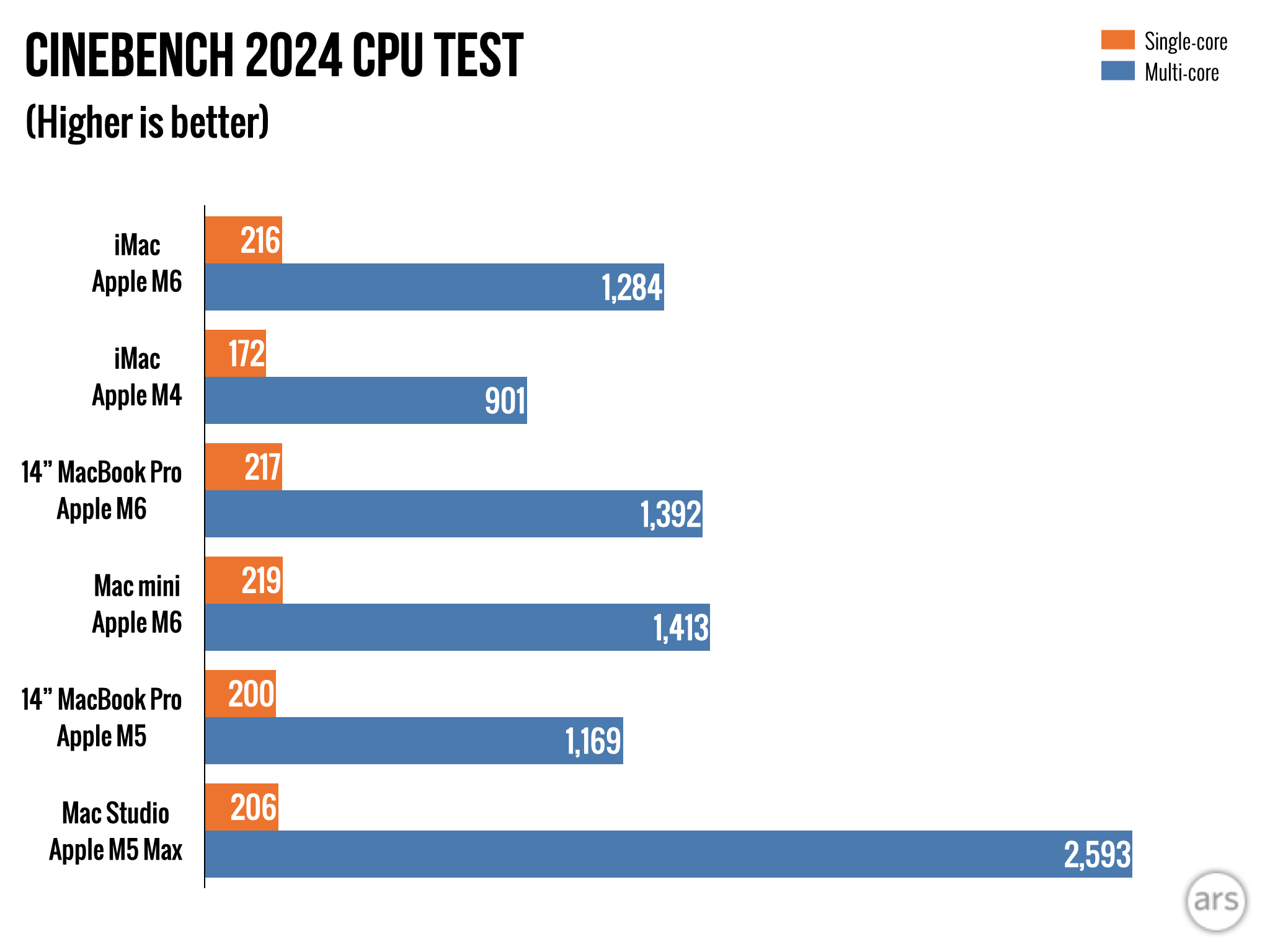
0FansLike
0FollowersFollow
0FollowersFollow
0SubscribersSubscribe
- Advertisement -
Google search engine

Recent Posts