13 C
London
Saturday, June 6, 2026
Home Blog

Anthropic Says We Must Stop Authoritarian AI. But What About Its Authoritarian Investors?

0
anthropic-says-we-must-stop-authoritarian-ai.-but-what-about-its-authoritarian-investors?
Anthropic Says We Must Stop Authoritarian AI. But What About Its Authoritarian Investors?


Anthropic’s high-profile spat with the Pentagon gave it a killer marketing advantage, burnishing its public image as a principled AI company that puts values over profits — unlike more mercenary rivals such as OpenAI or Google. But Anthropic’s double standard on authoritarianism suggests the nearly trillion-dollar firm is as calculating and ethically flexible as any of its competitors.

In a recently published policy paper arguing a full-throated embrace of data center nationalism, Anthropic said that “it’s essential that the US and its allies stay ahead of authoritarian governments like the Chinese Communist Party,” lest the world fall into the grips of tech-powered tyranny. Anthropic and its peers, the company claims, will form a bulwark of democratic values, protecting societies at home and abroad from repression.

Left unmentioned in the document — and seldom publicly acknowledged — is the fact a slice of Anthropic is owned by the Emirati dictatorship of Abu Dhabi, a repressive and authoritarian monarchy.

Anthropic’s policy paper, published in May, tours the same Sinophobic territory heavily trod by its chief competitor OpenAI and a wide swath of the tech industry, who know a “race” with China — the finish line never quite defined — is a weighty cudgel against regulation.

Anthropic is aware of which way the wind blows from Washington to Silicon Valley, and it shrewdly casts the development of machine learning models not just as a matter of hardware and software, but of ideology and geopolitics. “Democracies, not authoritarian regimes, must lead in AI development and deployment,” the company says, or else an era of “authoritarian AI” will begin.

“Already, the CCP is using AI to censor speech, repress dissidents, hack governments and corporations across the world, and strengthen the People’s Liberation Army,” Anthropic writes, and to “enforce draconian policies on ethnic minorities” using machine learning-powered methods like biometric collection and facial recognition.

The policy paper isn’t a condemnation of any of these AI uses per se; the United States is already eagerly using these technologies for intelligence, military, and ethnic minority-repression purposes today. Residents of Tehran, which Anthropic has helped bomb since the start of the joint U.S.–Israeli war against Iran, might question the company’s argument that American AI supremacy is a matter of global “safety.”

Though the policy paper focuses on China, the company has long stated it opposes authoritarianism broadly: “AI-powered authoritarianism seems too terrible to contemplate, so democracies need to be able to set the terms by which powerful AI is brought into the world, both to avoid being overpowered by authoritarians and to prevent human rights abuses within authoritarian countries,” CEO Dario Amodei wrote in a 2024 blog post.

This is not merely a battle between the U.S. and China, Anthropic says in the May paper, but a war between democracy and “authoritarian governments” broadly construed.

But Anthropic’s anti-authoritarian fervor seemingly does not extend beyond China to the Middle East, where Abu Dhabi’s sovereign wealth fund invested in Anthropic twice this year. In February, Anthropic announced it had raised $30 billion in capital from a group of investors that included MGX, the AI-focused investment vehicle of a Emirati government capital controlled by Abu Dhabi’s royal family. Anthropic’s most recent May 28 $65 billion capital round, bringing its valuation to $965 billion, also included MGX.

Like China, the United Arab Emirates outlaws almost everything associated with democratic society: Political parties, a free press, freedoms to associate and assemble, open elections, due process, and free speech are nonexistent. Political dissidents face torture, and any speech, online or offline, that causes “damage to national unity” risks life imprisonment or the death penalty.

Emirati authoritarianism isn’t contested by the U.S., Anthropic’s primary governmental customer. The State Department’s 2024 Country Reports on Human Rights Practices assessed the UAE faces “credible reports of: disappearances; arbitrary arrest or detention; transnational repression against individuals in another country; serious restrictions on freedom of expression and media freedom, including censorship; and prohibiting independent trade unions or significant or systematic restrictions on workers’ freedom of association.” Freedom House, a State Department-backed think tank, gives the UAE a score of 18 out of 100 on its “Global Freedom” index.

Anthropic declined to comment. MGX did not respond to a request for comment.

“Like China, the UAE is at the forefront of AI-based authoritarian surveillance.”

Given that MGX bought into Anthropic at its Series G and H investment rounds, relatively late in the venture capital game, it’s likely that the UAE’s stake in the company is relatively small and its influence limited. But Anthropic’s willingness to sell part of itself to an authoritarian monarchy suggests at least that its mission of “ensuring democracies lead” comes with asterisks.

“Like China, the UAE is at the forefront of AI-based authoritarian surveillance,” said Matthew Tokson, a law professor at the University of Utah who focuses on the security implications of artificial intelligence.

Tokson added that while he generally agrees with Anthropic’s calls to restrict processor exports to China and other measures to bolster American AI firms, he doesn’t buy the nationalist rhetoric, which he attributes to the company’s anti-regulatory agenda rather than patriotism. The more Anthropic and its competitors can convince the public that their bottom line is a matter of national security, the more likely Washington is to take a light touch.

“The fact that Anthropic is partly owned by the government of Abu Dhabi, which is similar to China in its extensive use of AI surveillance to support an authoritarian government, suggests that its anti-authoritarian arguments are more based on a cynical policy position than a sincere passion for democracy or antipathy toward authoritarian governments.”

Many of the emirate’s long record of repressive acts and rights violations are connected to MGX via its chair, Sheikh Tahnoun bin Zayed Al Nahyan. Through his position as the emirate’s national security and intelligence chief and his business portfolio, including chairmanship of the AI firm G42 (itself a founding partner in MGX), Tahnoun has been linked to a bevy of campaigns to surveil and hack into the phones of Emirati dissidents, human rights advocates, and others the monarchy deems an adversary, according to news media reports and scholarly research. A 2020 investigation by Bill Marczak, a senior researcher at the University of Toronto’s Citizen Lab placed “Spy Sheikh” Tahnoun at the center of myriad hacking, espionage, and surveillance operations. A 2025 Wired profile of Tahnoun similarly described him as Abu Dhabi’s “spymaster sheikh,” noting G42’s “special areas of strength in state-sponsored hacking and surveillance tech.”

In 2019, the New York Times reported a covert Emirati government campaign to conduct surveillance through an instant messaging app called ToTok, an app itself Marczak tied to Tahnoon and through G42 in his 2020 analysis. The Wired profile described Tahnoun’s ambitions to “dominate AI” noted that “an engineer who worked at G42 at the time told me that all of the [ToTok] voice, video, and text chats were analyzed by AI for what the government considered suspicious activity.”

G42 declined to comment, and neither it nor MGX responded to interview requests for Tahnoun.

There is reason to believe G42 and MGX have already deployed Anthropic’s powerful large language models. A review of DNS data — internet records that connect website names to numerical addresses understandable by computers — show both G42 and MGX have both configured their servers to allow personnel to access Anthropic tools like Claude, the company’s flagship large language model.

Anthropic has been more candid in internal communications about its stance on authoritarianism.

“Unfortunately, I think ‘No bad person should ever benefit from our success’ is a pretty difficult principle to run a business on,” Amodei wrote in a 2025 memo on Gulf State venture capital obtained by Wired. He wrote that such investment would boost “dictators” and conceded that it would give an authoritarian government “some soft power” to wield against the company. Nonetheless, Amodei dismissed the risk of hypocrisy as a “Comms Headache” — a function of “very stupid” commentators “having a poor understanding of substantive issues.”

Principles aside, Amodei explained in plain terms why he was interested in doing business with a repressive Gulf State. “We gain a very large benefit,” he wrote, “from having access to this capital.”

Review: Spider-Noir recaptures the magic of a bygone era

0
review:-spider-noir-recaptures-the-magic-of-a-bygone-era
Review: Spider-Noir recaptures the magic of a bygone era

My hopes were high for the new Prime Video superhero series Spider-Noir, based on all those amazing trailers. But I also had some trepidation. Could the actual series live up to the hype?

As it turns out, yes, it could. Spider-Noir is a triumph, fusing fast-paced storytelling, compelling characters, gorgeous cinematography and production design, and whip-smart dialogue into a hugely entertaining, loving homage to a magical bygone era.

(Some spoilers below, but no major reveals.)

Marvel Comics created its “noir” line in 2009, reinterpreting familiar Marvel characters in an alternate universe, usually set during the Great Depression in the US. A version of the Spider-Noir character, voiced by Nicolas Cage, briefly appeared in the animated masterpieces, Spider-Man: Into the Spider-Verse (2018) and Across the Spider-Verse (2023). (He is set to reprise that role in the upcoming Beyond the Spider-Verse.) Cage’s portrayal was so compelling that we now have an entire series built around it.

Co-showrunner (with Steve Lightfoot) Oren Uziel is a film noir fan, so that Marvel series naturally appealed to him. The live-action series is still set in 1930s Depression-era New York, but the spidery superhero is not Peter Parker. Uziel thought the Parker character was too closely associated with a boyish high school type, which didn’t really fit the noir vibe. So Cage is playing Ben Reilly, a hard-boiled PI with a secret superhero identity, The Spider.

Ben Reilly has retired his vigilante persona after losing his fiancée, Ruby, five years earlier. Embittered, jaded, and drinking heavily, he’s barely eking out a living with his PI business, aided by his spirited secretary Janet (Karen Rodriguez). And he dismisses his reporter buddy Robbie’s (Lamorne Morris) urging to revive The Spider. Granted, this would help revive Robbie’s flagging career, but with The Spider gone, ruthless Irish mob boss Finn Byrne, aka Silvermane (Brendan Gleeson), pretty much has a chokehold on New York City—not just the bootlegging business, but the media, politicians, and business owners.

Characters matter

Ben in full Spider mode.

Secretary Janet Ruiz (Karen Rodriguez) is the linchpin of Ben’s business.

Circumstances conspire to thrust Ben back into the action. He’s hired to track down a criminal named Addison (Jack Mikesell), who turns out to have pyrokinetic superpowers. And Addison is not the only one. Silvermane’s bodyguard, Flint Marko (Jack Huston), is slowly turning into Sandman, while his buddy Lonnie Lincoln (Abraham Popoola) is becoming Tombstone. Then there’s the egomaniacal Leyden, who dubs himself Megawatt because he can absorb and release electricity.

The catch: Those superpowers are slowly killing them. Faced with a sharply truncated lifespan, Sandman, Tombstone, and Megawatt find themselves recruited by Silvermane to shore up the mobster’s political clout by terrorizing the city. Only The Spider can challenge them—if Ben can be cajoled into picking up the mantle once again. Add in a romantic distraction in the comely form of sultry lounge singer Cat Hardy (Li Jun Li), and all the requisite elements of classic noir are in place.

Cage anchors the series; the role suits the actor’s distinctively flamboyant style, and his performance is extraordinary. The actor has described his portrayal as “70 percent Humphrey Bogart and 30 percent Bugs Bunny.” Cage never lapses into slavish imitation, and he reserves the Bugs-like hamminess for when it suits the plot, such as when Ben gains access to restricted areas by pretending to be a handyman, a mental patient, and so forth.

Cage also said that he viewed Ben as “a spider trying to cosplay as a human” rather than a human with spider-like attributes, and he choreographs his physical movements accordingly, drawing on his many years of tai chi. This is especially relevant in later episodes as Ben’s backstory is revealed, and he receives the infamous bite that gives him superpowers. Ben’s human body in transformation twitches and jerks as he tries to control his movements and suppress his inner Spider. He confesses to Cat that he had to learn how to behave like a human again—but The Spider is nonetheless always there.

Black-and-white vs. True Hue

Cat Hardy in the black-and-white version

Cat Hardy in the black-and-white version versus….

Cat Hardy in the True Hue version.

Cat Hardy in the True Hue version.

The supporting cast is just as strong. Gleeson is positively magnetic when he’s on screen, making Silvermane tough and menacing but also funny and even vulnerable. Rodriguez drew on the character of Sam Spade’s secretary, Effie (Lee Patrick), in The Maltese Falcon for her portrayal of the capable, loyal-yet-steely Janet, while Li Jun Li found inspiration in Gilda-era Rita Hayworth, Lauren Bacall, and Kim Basinger in LA Confidential for Cat.

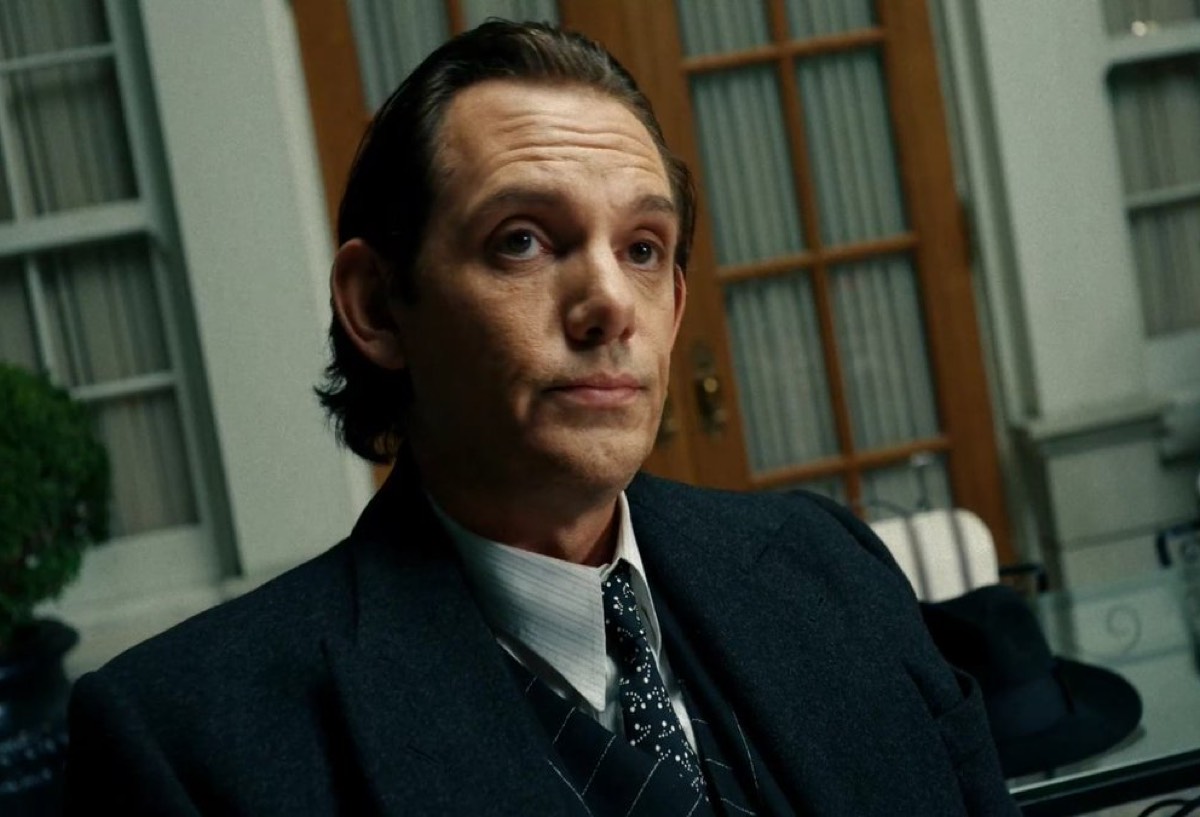
Morris’s Robbie impersonating The Spider in a crucial scene is hilariously on point. Another standout: Andrew Lewis Caldwell’s portrayal of Leyden/Megawatt, a frustrated actor with a penchant for spouting Shakespeare as he zaps away. The character could have just been a campy caricature in lesser hands. And yes, that’s Lukas Haas, who played the little Amish boy in 1985’s Witness, as Silvermane’s menacing henchman Winston.

You can watch Spider-Noir in black and white or color—and it’s not just a clever marketing gimmick. The footage was shot digitally and processed separately rather than being shot in one format and then converted to the other, so both versions look fantastic. Each version also subtly alters the overall tone and texture of the series. The black-and-white version beautifully evokes Old Hollywood noir films from the 1940s. The team coined the term “True Hue” for the color format, since the intent was to create something supersaturated, akin to classic Technicolor. Cage has compared the feel to the 1944 Edward Hopper painting Nighthawks, but it also has a vintage comic-strip quality that perfectly suits the show’s origins.

I give the black-and-white version the edge, although it doesn’t do justice to Cat’s lustrous evening gowns. Your mileage may vary. However, the brilliant opening credits are entirely in black and white regardless of which version you watch. Artistically, it was the right choice, especially when paired with a killer original tune penned specifically for the series: “Saving Grace,” featuring Kirby.

Why does Spider-Noir succeed when so many other superhero spinoff series have been disappointing? Perhaps it’s because there was no pressure to fit the series into a bigger multiverse story arc. Executive Producer Chris Miller has said there was no intention to create a “giant web of interconnected series,” Miller added. “It’s just its own little jewel of a story.” There’s no word yet on whether Spider-Noir will get a second season, but I would be keen to see a shiny new standalone story for our reluctant hero. There’s nothing wrong with “one and done,” though, when that one season is pretty much flawless.

Spider-Noir is now streaming on Prime Video, in both black and white and True Hue.

Coca-Cola CFO flags uneven demand, warns of Middle East risks into 2027

0
coca-cola-cfo-flags-uneven-demand,-warns-of-middle-east-risks-into-2027
Coca-Cola CFO flags uneven demand, warns of Middle East risks into 2027


Coca‑Cola is adjusting ways to keep its drinks both affordable and appealing as consumer demand remains uneven across income ​groups, CFO John Murphy said at an industry conference ‌on Thursday.

The beverages giant, which raised its annual profit target in April, said it was navigating the disruption from the U.S.-Israeli war on Iran “not perfectly ​well, but without fear, without trepidation.”

“The outlook… of the ​Middle East situation is still not clear,” Murphy told ⁠investors at the Deutsche Bank consumer conference in Paris, adding ​that it “is going to be a topic on all of our ​agenda as we go into 2027.”

Coca‑Cola is leaning on a mix of pack sizes, formats and price points, from smaller, lower-cost, single-serve options to ​larger and premium offerings, to cater to a wider range ​of consumers while keeping prices affordable for budget-conscious shoppers.

Recent earnings from major ‌U.S. ⁠retailers suggest consumers remain resilient but are spending more selectively, as rising fuel costs linked to the Iran conflict and persistent inflation weigh on budgets.

Murphy echoed that view, cautioning that “the narrative on ​the consumer being ​resilient is a ⁠nuanced narrative… because they’re not all the same.”

He added that parts of Coca‑Cola’s consumer base ​are under strain, particularly those earning between $50,000 to $60,000 ​annually, noting “we ⁠have segments… that are under pressure, and we have a choice to stay relevant with them or not.”

“The math is pretty ⁠obvious. It ​doesn’t work… they just don’t have ​the purchasing power,” he said.

Source:  Reuters

Trauma porn: buying and selling someone else’s scam center hell

0
trauma-porn:-buying-and-selling-someone-else’s-scam-center-hell
Trauma porn: buying and selling someone else’s scam center hell

In January 2026, the Chinese studio Jade Flame released a first-person interactive game on Steam called “Blood Money: Lethal Eden.” For US$8.99, you get to walk through the story of a trafficking victim trapped inside a scam compound in Southeast Asia. By May 2026, the game had a 93% positive rating on the platform.

Around the same time, Gavesh — a real person who survived one of those compounds in Myanmar — told a reporter: “This is not a game, this is our life.”

This is not a review of a video game. It’s a structural reading of the moment we’re in, for which Blood Money happens to be the cleanest clinical sample of recent years. It’s a look at how we learned to build not just games, but worlds where blood on a screen feels more real than the real thing — and how the hyperreal version of suffering ends up replacing the actual suffering.

The entertainment industry pulls off the perfect crime against reality and sells us our own moral collapse back at retail price.

Context: behind the simulation

Before we get to the architecture of this product, we need to register the scale of the real disaster. The scam compounds in Myanmar, Cambodia and Laos are not a fictional setting.

According to the report “A Wicked Problem”, published by the UN Office of the High Commissioner for Human Rights on February 20, 2026, at least 300,000 people are being held against their will in compounds like these across Southeast Asia. The criminal industry behind them is estimated to bring in $64 billion a year, $43.8 billion of which comes from the Mekong basin alone.

The victims of trafficking to these compounds are lured with promises of legitimate work. English speakers from any origin country are highly sought after as they open the door to scamming affluent victims globally. Thailand will often be given as the location, as Thailand sounds safer and more mainstream than Myanmar, Laos or Cambodia. Once the victims of trafficking arrive in Thailand, they are transferred across the border to their real destinations.

There has been a crackdown on the compounds in Cambodia this year, and many of the trapped forced scammers have been freed or were able to escape. The Cambodian government and many foreign governments have done little to help these people get home, and large numbers of these ex-scammers are now sleeping on the streets of the capital Phnom Penh.

Charities which support the victims of compound cyberslavery in the region include Global Advance Projects and Blue Dragon.

In the compounds, people work 16-hour shifts under threat of violence, scamming strangers around the world. The UN Human Rights Office has documented torture, sexual violence, and what survivors call “water prisons” — used as punishment when targets aren’t met.

Developers turned this into raw material for a commercial product priced under nine US dollars.

Act 1. The design of emptiness: how the question ‘why?’ died

In the history of psychology there’s a famous study: the Stanford Prison Experiment, 1971. Philip Zimbardo put 24 students into a simulated prison and watched what happened to them. The experiment had to be shut down on the sixth day of a planned fourteen, because the simulation became too real and the ethical line had been crossed.

Fifty-five years separate Stanford 1971 from Blood Money 2026, but the basic setup is the same: you give a person a role inside a space of violence. The difference is that Jade Flame runs the same experiment on thousands of players with no oversight and no way to stop it. Part of the games industry has, deliberately, taken apart the ethical infrastructure that was supposed to be standard after Stanford.

As Norie Tsutsui — Japanese writer behind The Redesign Log, a former government official turned IT producer — points out, the problem with Blood Money is the complete absence of any ethical vision.

Designers of serious games used to ask themselves a basic question: what is this game actually putting into question? The Ace Attorney series interrogates the very idea of justice. Oreshika makes the player work through a cycle of inherited pain. In those projects, the ethical frame and the capacity for empathy were not decorations. They were the core of the design.

Blood Money asks nothing. The real suffering of 300,000 people was gutted of any ethical content, leaving only the pure mechanics of revenue extraction. Games like this are usually defended on the grounds that they “raise awareness.”

And in the peer-reviewed literature, there isn’t a single study showing that mass-market violent games increase players’ empathy toward victims. The dominant empirical findings, including recent longitudinal studies by Chinese researchers (Dou and Zhang, 2025; Teng et al., 2019), point the other way: interactive violence leads to desensitization, reduced empathic response, and increased moral disengagement.

What we’re looking at is a moment when the question “why are we making this hyperreality?” simply disappeared, replaced by functional consumption. “Awareness” became a commercial alibi — a retroactive defense against criticism. Former US federal prosecutor Tom O’Malley put it bluntly:

“I don’t think Grand Theft Auto raised awareness about auto theft and carjacking,” O’Malley said. “There’s no social redeeming value in these sick games. You’d have to be somewhat demented to play them.”

The GTA series has sold over 215 million copies, but no study has shown that its players ended up more informed about urban crime or car theft. What the procedural logic of the game rewards is exactly the behavior the surface narrative claims to condemn.

Act 2. The delightful catastrophe as the highest stage of the market

Why does the hyperreal version of pain and suffering keep pushing the real one out of the frame? The answer lives in Jean Baudrillard’s thinking. The actual reality of the scam compounds in Asia is too heavy, too dirty, too hard to grasp for the average consumer to look at directly. Real suffering demands empathy and responsibility.

Hyperreality, on the other hand, takes that humanitarian crisis, runs it through aesthetic filters, and serves it back as something you can actually consume. Following Baudrillard’s logic, that is the “delightful catastrophe” — the state in which horror gets objectified and turned into a routine marketing tool. Catastrophe becomes lovable, as long as there’s a screen between you and it.

The steam tags for Blood Money include “Drama,” “Casual,” “Life Sim” and “Visual Novel” — the same taxonomy used by dating sims. The main female characters are sexualized, and the choice architecture is built around the tagline: “Will you rule with beauty, or betray for life?” This is not documentary. This is trauma porn at its purest, where someone else’s pain becomes a flavor — a marketing hook to sell immersion.

Susan Sontag described the mechanism of all this beautifully in her book “Regarding the Pain of Others”: in our culture, shock has become a leading stimulus of consumption and a source of value. We’ve learned to build worlds where violence looks immaculate, because aestheticizing horror strips it of moral weight. Sontag warned us: when we feel sympathy in front of a screen, what we are really doing is announcing our own innocence — and our complete powerlessness.

Platforms like Steam (Valve) wash their hands of all this. They hand the ethical judgment to user filters and review scores, and only step in when payment systems (Visa, Mastercard) start applying pressure. The 93% positive rating for Blood Money is a measure of customer satisfaction, not of player awareness.

The market has figured out how to extract a profit margin out of someone else’s slavery — packaged, domesticated, sold as a clean digital experience. As Oak, another survivor, put it: “It feels like our pain is being commodified. Developers profit from a theme that, in reality, destroys lives.”

Act 3. The perfect crime: the final victory of consumer society

When the hyperreal has completely replaced the real, the diagnosis is hard to avoid: consumer society has won. Baudrillard called this stage the “perfect crime.”

The perfect crime is the murder of reality itself, where the body was never found, there is no obvious killer, no motive, and the forgery becomes more real than the original — what he calls integral reality. The team at Jade Flame, by turning torture into a product, didn’t just make something morally questionable.

They killed the reality of the suffering of 300,000 people and replaced it with a simulacrum that, as it turns out, some people enjoy. In a perfect crime, the perfection of the forgery is the criminal act itself. Baudrillard wrote that within this logic, humanity ends up being both the killer and the victim: the player voluntarily kills off their own humanity by going into the simulation, and becomes the victim of the same digital alienation.

Baudrillard pushed one more uncomfortable idea: virtualization, he said, is a suicide project — quiet, voluntary, but a slow erasure of the subject all the same. In 1971, at Stanford, participants broke under the pressure of their environment, and the breaking hurt. In 2026, thousands of players willingly pay so that a piece of code will lift the burden of being a living, feeling person off their shoulders.

Blood Money delivers exactly what modern society has been quietly wanting: a perfect refuge from being human. We’re so tired of the fractal era — the world of chaos, endless global crises, information overload, what Baudrillard called the state of being “after the orgy” — that we’re happy to hand our right to empathy and moral choice over to the algorithms.

A genuine awareness game (think This War of Mine, or Papers, Please) always puts the player in a position of weakness, punishes complicity in the system of violence, and refuses to give you a power fantasy. Blood Money does the opposite. It rewards the player with “perfect endings” and the illusion of control. This is the procedural logic of exploitation, in pure form.

Conclusion

We are entering a period where the line between someone else’s grief and our own entertainment has been erased. The industry has learned to build worlds whose technological polish is inversely proportional to their ethical content.

The problem with Jade Flame isn’t malice. It’s that they took the absence of a moral frame and scaled it up into a business model. To follow Norie Tsutsui’s point a bit further: in this kind of design, ethics starts to look like a tax. Stripping it out makes the product simpler, faster, and commercially more convenient.

Blood Money: Lethal Eden is not a glitch in the system. It is not an unfortunate anomaly. It is a mirror of a consumer society that has reached its final stage: feeding on someone else’s grief. The main product of this assembly line is not the lines of code or the visual novels about Chinese scam compounds.

The main product is not the game — it’s the state the player ends up in: a person being offered the amputation of their own capacity for compassion as a form of interactive experience.

And as long as we keep believing the commercial fairy tale that simulations like this “teach” us anything or “raise awareness,” Baudrillard’s perfect crime will keep going, unpunished, with the silent approval of the majority.

While we argue about the nature of simulacra and the limits of ethics, Gavesh — a real person, a survivor of the hell in Myanmar — says something that needs no academic footnote: “This is not a game, this is our life.

But the cold logic of hyperreality is that this truth no longer breaks anything. In the world after the orgy, the voice of the victim doesn’t stop the assembly line — it becomes its best advertising tagline. The perfect crime of Jade Flame works precisely because reality has been killed and its body is now on the shelf.

The world hears Gavesh and keeps buying anyway, because we’ve trained ourselves to consume someone else’s life like a tasteful digital delicacy, in full safety, in complete moral detachment. And as long as the illusion sells for $8.99, nobody needs reality at all.

References

UN Office of the High Commissioner for Human Rights. (2026). “A Wicked Problem”: Seeking Human Rights-Based Solutions to Trafficking into Cyber Scam Operations in South-East Asia. Geneva: OHCHR.

Democratic Voice of Burma. (2026, May). Scam centre survivors criticise Steam video games that closely depict real-life compounds. Republished from ABC News (Australia).

Dou, Y., & Zhang, M. (2025). Longitudinal associations between media violence exposure and aggressive behavior among Chinese adolescents: The mediating role of rumination and empathy. Current Psychology, 44(7), 6066–6078.

Baudrillard, J. (1996). The Perfect Crime (C. Turner, Trans.). London: Verso. (Original work published 1995)

This article first appeared on The Dark Side of Development Substack and is republished here with kind permission. Become a The Dark Side of Development subscriber here. Read story author Mila Agius’ Heuristics vs Traps Substack here.

Animal Planet Star Dead at 47 After Horror Paramotor Crash

0
animal-planet-star-dead-at-47-after-horror-paramotor-crash
Animal Planet Star Dead at 47 After Horror Paramotor Crash


Eugene Cussons, the fearless South African conservationist who became known to millions as the host of Animal Planet’s Escape to Chimp Eden, has died after a tragic paramotor crash.

He was 47.

Cussons was killed on May 23 during an event at a new airfield near Hartbeespoort Dam in South Africa, according to local reports.

Etienne Maré, a spokesperson for the Cussons family, confirmed the heartbreaking news to local media.

Witnesses said the terrifying accident happened roughly 10 minutes after Cussons took off in the air.

His sudden death has stunned the conservation world and devastated fans who followed his daring work rescuing abused and abandoned chimpanzees across Africa.

Cussons was best known as the managing director of Chimp Eden, a sanctuary connected to the Jane Goodall Institute. In that role, he helped coordinate dangerous rescue missions for chimpanzees trapped in heartbreaking conditions.

His work often took him into unstable and dangerous regions, including Angola and Sudan, where he helped save primates from smugglers, illegal traders, conflict zones, and cruel captivity.

Cussons became an international face for animal rescue in 2008 when Escape to Chimp Eden debuted on Animal Planet.

The series followed his high-risk missions across Africa and exposed viewers to the brutal world of wildlife trafficking, illegal animal captivity, and war-zone rescues.

His passion and courage made him a standout figure on television. His work also led to appearances on The Tonight Show with Jay Leno, where he spoke about his life-saving efforts and the animals he fought to protect.

But Cussons was far more than a television host.

He was a tireless conservationist who dedicated his life to protecting animals and inspiring others to do the same.

He founded Generation Now Africa, an organization focused on building future conservation leaders, and also launched The Eugene Cussons Podcast, where he discussed serious issues including poaching, habitat destruction, and wildlife protection.

In 2011, he released Saving Chimpanzees: A Man on A Rescue Mission, a book that detailed his emotional and dangerous work with Chimp Eden.

Cussons’ interest in paramotors was also tied to his conservation mission.

He founded Nirvana Africa, a powered paragliding company that helped support anti-poaching patrols and aerial conservation work, including efforts to protect rhinos.

The company worked on paramotor missions with authorities in areas such as Kruger National Park, according to SA People.

To those who knew him, Cussons was not just a daring conservation figure. He was a husband, father, son, brother, mentor, and friend.

His mother, Marina, paid tribute to him after his death, remembering the man behind the public mission.

“Beyond his remarkable conservation work, Eugene was known as a devoted husband, father, son, brother, mentor and friend whose kindness, gentle spirit and passion for life left a lasting impression on all who had the privilege of knowing him,” she told local media.

She also spoke of her son’s deep faith.

“Those who knew him well will also remember his sincere love for our Heavenly Father, a faith that quietly shaped his character, compassion, and life’s work,” she added.

Cussons leaves behind a legacy built on bravery, compassion, and a lifelong fight to protect animals who could not protect themselves.

S&P 500 rejects SpaceX, also blocking entry for OpenAI and Anthropic

0
s&p-500-rejects-spacex,-also-blocking-entry-for-openai-and-anthropic
S&P 500 rejects SpaceX, also blocking entry for OpenAI and Anthropic

SpaceX has requested unusually swift entry into several leading stock market indexes as a condition of its historic stock market debut. But the S&P 500 stock market index representing many of the largest profitable US companies has surprised market analysts by refusing to bend the rules for Elon Musk’s space and AI company.

The June 4 decision by S&P Dow Jones Indices—the company that creates and manages stock market indexes such as the S&P 500—means that SpaceX will not gain accelerated access to potentially billions more dollars through passive investment funds that automatically purchase shares of S&P 500 companies. An exception for SpaceX could have also allowed leading AI companies such as OpenAI and Anthropic to gain entry not long after their own expected initial public offerings (IPOs). That possibility has now been shuttered.

The news will likely come as a relief to people concerned about passive investor money and people’s retirement savings plans having greater exposure to the market risks associated with SpaceX’s big bet on AI and speculative orbital data center plans. AI companies are generally facing more challenges in funding and building expensive AI data centers, even as they shift more of the subsidized costs of running AI services onto shocked customers through usage-based pricing.

To weigh expedited entry for SpaceX, the S&P Dow Jones Indices held a monthlong consultation to consider changing or waiving several main requirements for so-called MegaCap companies with “unprecedented market capitalizations.”

Those proposed changes included shortening the “seasoning period” for new IPOs from 12 months to six months, waiving the investable weight factor (IWF) requirement for MegaCap companies to make at least 10 percent of their shares publicly available, and waiving the requirements for MegaCap companies to demonstrate profitability in the latest quarter of the financial year along with the previous four quarters.

Such rule changes would have accommodated SpaceX’s plan to only offer approximately 3 percent of its IPO shares to public investors, and the fact that SpaceX is currently unprofitable with a growing debt load that has reached $29 billion because of its spending spree on AI infrastructure.

But in its final decision, the S&P Dow Jones Indices stated that “no changes will be made to the eligibility criteria including financial viability screens, seasoning period, or minimum IWF.” Even after the standard yearlong wait, SpaceX, Anthropic, and OpenAI may struggle to deliver the consistent profitability necessary to qualify for the S&P 500.

Money rules and exceptions

Swift entry into the S&P 500 would have triggered $14 billion of passive fund buying for SpaceX, according to Bloomberg Intelligence. The investment research arm of Bloomberg also estimated that OpenAI could have gained more than $8 billion, and Anthropic could have netted $4.6 billion from similar passive buying sprees triggered by their S&P 500 entries.

This is because $7.5 trillion in passively managed funds—popular among both individual investors and institutional investors—follow the S&P 500 by purchasing shares of companies according to their proportional representation in the S&P 500 index. For example, the Vanguard and Fidelity brokerage giants both offer passive investment funds that track the S&P 500 composition.

However, the S&P Dow Jones Indices did “carve out one concession” by changing the investable weight factor rules for “lower-profile benchmarks” such as the S&P Total Market Index and Dow Jones US Total Stock Market Index, according to Quartz. That could allow an IPO faster entry into those indexes.

By contrast, the Nasdaq stock exchange changed its rules to allow SpaceX to enter the Nasdaq-100 Index within 15 trading days as opposed to the usual three months. Similarly, the FTSE Russell index provider decided to give SpaceX and other follow-on companies accelerated entry to the Russell Top 500 Index after the close of the fifth trading day following an IPO.

The denial of accelerated S&P 500 entry for SpaceX comes just days after Morningstar analysts described SpaceX as having been “significantly overvalued” in the lead-up to its IPO. The investment research firm valued SpaceX at $780 billion—less than half of SpaceX’s $1.75 trillion IPO goal—primarily based on the strengths of SpaceX’s Starlink satellite service and rocket launch business.

An autopsy of American empire

0
an-autopsy-of-american-empire
An autopsy of American empire

While Washington’s war with Iran drags on, month after month, without any end in sight, the world is witnessing the very real limits of US global power. As President Donald Trump lurches repeatedly from threats of devastation to promises of peace, it’s becoming increasingly clear that US military might is no longer capable of subduing even a mid-sized power like Iran, much less holding the rest of the world in its thrall.

Amid all the drama of air raidsdrone strikes, and naval blockades, there are deeper geopolitical forces at play that lend a lasting historical import to events in the Persian Gulf—dynamics best seen by comparing two newspaper editorials with revealing similarities despite the 80 years separating their publication.

Writing in 1942, during some of Britain’s darkest days in World War II, the editors of the venerable London Times looked far beyond the relentless German attacks on their forces in Egypt or the Nazi U-Boat sinkings of Royal Navy ships in the Atlantic to predict their empire’s future with an uncommon prescience.

With its contradictory motto of “Imperium et Libertas” (Empire and Liberty), the vast British Empire, which still covered a quarter of the globe, had already become what those editors called “a self-liquidating concern.”

Once the “temporary circumstances” that had allowed Britain’s ascent — naval dominance, industrial preeminence, and “the relative weakness of rival states” — faded, that empire’s “ultimate reliance on coercion” could no longer hold.

Ready for self-governance, Britain’s many colonies, the editors suggested, would soon begin breaking away and so eclipse the empire. And that prediction couldn’t have been more accurate. Within five years of that editorial’s publication, the British Empire had already started to break apart.

Writing in a May 2026 edition of The New York Times, contributing editor Christopher Caldwell made a strikingly similar prediction about the future of US global hegemony. Under the provocative headline “America Is Officially an Empire in Decline,” Caldwell noted some unsettling parallels between the fate of America today and Great Britain 80 years ago.

Back then, England was “deindustrializing, overcommitted, complacent,” and found itself “essentially bankrupt” by the end of World War II. Apart from its “ill-fated attempt” to seize the Suez Canal from Egypt in 1956, however, it managed to decolonize in a successful fashion by giving up “territories it could no longer afford.” As he points out, Britain even “wound up on reasonably good terms with its former colonial possessions.”

At the start of his second term as president in 2025, Donald Trump, Caldwell continued, “had a chance of pulling off something similar” by withdrawing “to a less expansive sphere of influence” and “refocusing American attention on the Western Hemisphere.” Caldwell considered that strategy potentially “workable” since “imperial systems, whatever you call them, last only as long as their means are adequate to their ends.”

Instead of keeping to that plan, however, Trump “has overextended the empire dangerously” by his intervention in Iran, which has now become nothing less than a “watershed in the decline of the American empire.”

To test the probability of Caldwell’s prediction coming true, we need to go beyond the immediacy of the Iran crisis to explore both the deeper causes of US global decline and its likely long-term consequences for both the United States and the rest of the world.

Explaining US imperial decline

Since most Americans came late (if at all) to the realization that their country was indeed an imperial power, and a stunningly powerful one at that, they have generally remained oblivious to its aging and the inevitable erosion of global power that accompanies such aging.

Ever since, in the late 18th century, English scholar Edward Gibbon published his monumental, multi-volume study, “The Decline and Fall of the Roman Empire”, succeeding imperial rulers have tended to assume that their imperial realms would last, like ancient Rome’s, half a millennium or more. Adolf Hitler, with his dream of “the Thousand-Year Reich,” was hardly the only one to share such an illusion.

But the modern age, with its rapid economic and technological change, has only accelerated imperial decline. Britain’s sprawling global empire lasted just 90 years (1857-1947) and France’s African empire, covering a quarter of that continent, was about the same, while the Soviet empire in Eastern Europe barely lasted 40 years (1945-1989).

So, for the US global imperium to have survived for 80 years (1945-2026) should be considered the most anyone could realistically expect for a modern empire.

Since the US-led global order—exemplified by the International Monetary Fund (IMF), the World Bank, and the World Trade Organization (WTO)—had indeed presided over 80 years of sustained global economic growth, there is a distinctly American twist to the British concept of the “self-liquidating concern.”

As the rest of the world enjoyed a rapid economic recovery from the ravages of World War II, America’s share of the global economy declined from an overwhelmingly dominant 50% in 1945 to less than half that figure today.

Using an index called PPP (Purchasing Power Parity) that measures the real value of economic growth, the IMF calculates that, in 2026, China is producing 20% of global economic output, the US just 15%, and the European Union (EU) 14%.

But the relative economic decline of the United States should by no means be the crucial measure of its failure. Quite the opposite, in fact. It should be considered a tribute to Washington’s success in leading the world economy to unprecedented prosperity. In those 80 years since the end of World War II, the US economy has grown fast, but many other nations have grown faster still.

An economic giant that could structure the global economy as it wished in 1945, the US must now negotiate the terms of trade with a host of peer rivals — whether economic powers like China; major players like India and Japan; or a growing number of regional blocs like the European Union, South America’s Mercosur, and Asia’s ASEAN.

Probe deeper for the forces now driving America’s decline and you’ll notice an underlying geopolitical dimension. As I explained in my new book, “Cold War on Five Continents“, the US achieved its global hegemony after World War II by maintaining an unwavering geostrategic dominance over the Eurasian land mass.

Through its military alliances at both axial ends of that vast continent—the multilateral North Atlantic Treaty Organization (NATO) in the West and five bilateral defense pacts with countries ranging from Japan to Australia in the east—the US imposed an “Iron Curtain” of 5,000 miles of anti-communist containment across Eurasia.

Using those axial ends as anchors, the US encircled the continent with three naval armadas, hundreds of military bases, and thousands of jet aircraft. With Moscow geopolitically isolated and Beijing still a developing power, Washington could simply sit back and wait for the Soviet Union’s increasingly stagnant socialist economy to collapse and its dozens of restive satellite states to break free—as they all did between 1989 and 1991.

In the 35 years since that great Cold War victory, Washington’s foreign policy elites have pursued policies that might all too accurately be branded “bipartisan mismanagement” of the US geopolitical position in Eurasia.

As home to 70% of the world’s population and an even greater share of its productivity, that continent remains the epicenter of global power (as it has been for the past 500 years). No nation can contend for world leadership without competing for geopolitical influence there.

From 2001 to 2021, both Democratic and Republican administrations oversaw long-term military occupations of Afghanistan and Iraq that cost thousands of American lives, millions of civilian deaths, and trillions of dollars in treasure.

While Washington was wasting an estimated $5.8 trillion on those pointless, profitless wars, China’s foreign currency reserves surged from just $200 billion in 2001 to a massive $4 trillion by 2014. Drawing on such unprecedented reserves, President Xi Jinping launched his trillion-dollar Belt and Road Initiative that quickly laid down a grid of railroads, roads, pipelines, and ports across Eurasia from the Baltic to the South China Sea.

By the time American troops finished their humiliating retreat from Afghanistan in August 2021, China had become the dominant power in Central Asia and the US position in Eurasia was starting to crumble.

In his second term, President Trump’s foreign policy has further weakened the US global position. At the western axial end of the Eurasian continent, he compromised NATO, the largest and longest-lasting alliance in modern military history, by pressing Denmark, a founding member of the alliance, to cede its sovereign territory of Greenland, creating a serious crisis and compelling the Europeans to begin acting autonomously when it came to both trade and defense issues.

At the eastern end of Eurasia, Trump’s intervention in Iran and the blocking of key oil supplies to Asia, thanks to the closing of the Strait of Hormuz, weakened longstanding bilateral alliances with Australia, Japan, the Philippines, and South Korea.

The thousands of missiles the US has fired at Iran have also reduced its ability to defend the island of Taiwan and forced Washington to begin withdrawing stocks of missiles from South Korea—exposing both the limits of its military power and Asia’s lowered priority.

As The New York Times editorial board put it after Donald Trump’s recent Beijing summit with Chinese leader Xi Jinping (where the US president showed a “worrisome lack of interest” in Taiwan), “America’s inability to defeat Iran’s much smaller military has raised questions about whether it could help defend Taiwan from a mainland invasion.”

If China ultimately takes that island, the US defensive perimeter in the Pacific would be pushed back from the “first island chain” (Japan-Taiwan-the Philippines) to the “second island chain” (Japan-Guam)—inflicting a major geopolitical blow on the US by crippling its capacity to aid its Asian allies.

More broadly, the Trump administration’s plans, as stated in its recent National Security Strategy, for “a readjustment of our global military presence” by shifting forces into the Western Hemisphere would be tantamount, if fully implemented, to a unilateral surrender in what foreign policy experts have come to call “the new Cold War” with Beijing and Moscow.

Imperial energy

Probe deeper still for the causes of the ongoing all-American imperial decline and you’ll come to the most fundamental but generally least noted factor in the rise and fall of every world empire for the past 500 years: energy innovation.

In the 16th century, Spain and Portugal maximized the caloric output of the human body by developing the slave plantation, whose phenomenal profitability allowed a uniquely cruel form of commercial agriculture to spread from West Africa along the coast of Brazil to the Caribbean and then, of course, to the American South.

A century later, the Dutch mastered wind power, using windmills to saw uniform planks to build efficient sailing ships that won them a commercial empire stretching from the Spice Islands of Indonesia to the island of Manhattan. In the 19th century, Britain’s industrial revolution developed coal-fired steam engines for factories, trains, and ships that facilitated its conquest of colonies covering a quarter of the globe.

After 1945, America’s ascent to global hegemony would be synonymous with the rise of petroleum, quickly supplanting coal as the world’s primary form of energy and leading to repeated US interventions in the Middle East for the past 70 years.

In recent years, however, Beijing has launched a revolution in green energy from the sun and wind whose accelerating pace, driven by its sheer economic efficiency, has the potential to transform much of the global economy, while simultaneously making China the world’s preeminent economic power.

With surprising speed, solar-powered electrical generation has become 41% less expensive (and wind 53% cheaper) than the least expensive form of fossil fuel. In addition, engineering innovations in battery design for both driving and electrical storage are likely to make the cost of carbon-fueled power prohibitively expensive within a decade or less.

Under the Biden administration, Washington invested a trillion dollars to fund America’s baby steps toward a green-energy future. However, as soon as Trump returned to the White House in January 2025, he began working to smother that infant initiative in its cradle beneath a sheaf of executive orders—canceling coastal wind farms, voiding the tax credit for electric vehicles (EVs), and opening vast stretches of US offshore waters for yet more oil and natural gas drilling.

Meanwhile, China increased its total power generation by 16% in 2025, with solar and wind energy accounting for half of its total capacity. And just as China already produces 80% of the global supply of solar panels, so its recent innovations in EV battery design have allowed it to rack up 70% of global electric vehicle production.

While China’s auto industry surged in the last five years to capture 24% of global car production in 2025 (and is projected to reach 35% in just four more years), Detroit’s share has fallen to only 16%, driven in part by its costly retreat from EV production since Trump’s return to office.

Given rapid advances in battery range, charge time, and temperature range, it’s only a matter of years before the low-cost cars rolling out of China’s vast robotic factories supplant legacy brands and come to dominate the global auto market.

With the Detroit vehicle industry, America’s largest manufacturing sector, now struggling to survive (along with other industries wedded to overpriced carbon-generated fuel), the future of much of US manufacturing looks increasingly dim.

The consequences of America’s decline

Yes, the world of a Pax Americana in the previous century (though imperial America never could fully avoid wars) is gone. And a world without active US international leadership will not necessarily be a better place.

Without a single superpower or set of superpowers to backstop otherwise toothless resolutions from the United Nations, international relations in a post-American world order will likely be both more complex and possibly more conflict-ridden as well.

In the new multipolar world likely to emerge in the next decade (if not sooner), even major countries like the United States and China will undoubtedly find themselves exercising their asymmetric power ever closer to home.

While some global areas will suffer from localized rivalries—Beijing versus Tokyo in East Asia, Ankara versus Cairo and Riyadh in the Middle East—regional associations like ASEAN, Mercosur, and the European Union are likely to play an increasingly important role in forging diplomatic consensus and mediating local conflicts.

Instead of the bipolar rivalry of the old Cold War era or American-led interventions in places like AfghanistanPanama, or Kuwait during the more recent decades of its unipolar power, in the future regional rivals will likely wage bitter local wars in hot spots around the globe over boundaries, the control of minerals, water rights, or climate-change refugees.

To take but one example, Ethiopia, an arid, landlocked, overcrowded nation of 140 million people in East Africa, faces potential conflicts with Egypt over the Nile’s headwaters, with Eritrea over port access, and with Somalia over the fate of the breakaway state of Somaliland.

Though their scope might be narrow, regional wars can potentially cause massive human carnage, as shown by the Second Congo War (1998-2003) that ravaged eastern Congo, as neighboring states like Rwanda and warlord armies like the murderous M-23 militia battled over mineral rights, killing an estimated 5.4 million people.

That made it the world’s bloodiest (if least noticed) armed conflict since World War II. Even today, more than 20 years later, warlord armies are still battling for control of the eastern Congo, capturing cities and displacing more than a million refugees.

On the wider world stage, the international institutions that the US created at the peak of its power in the 1940s (the UN, the IMF, and the WTO) might survive. However, the liberal international principles that once inspired Washington’s world order—human rights, humanitarian aid, respect for refugees, women’s rights, and immutable national sovereignty—are likely to fade, even as aspirational ideals. (They already are, of course, in Donald Trump’s America.)

And that will undoubtedly prove to be a genuine loss. After all, even under our current world order, a combination of Western foreign aid, Chinese economic growth, and World Bank loans led to a significant reduction in the percentage of the world’s population living under “extreme poverty” (less than $2.00 a day) from 44% in 1981 to just 9% in 2019.

Now, of course, while leading the West in shifting funds from foreign aid to military defense, the second Trump administration has already abolished the US Agency for International Development (USAID), cutting food and medication aid globally that could cause an extra 14 million deaths by 2030.

Such humanitarian efforts and their supporting principles are already giving way to a far more transactional world order, exemplified by China’s current foreign policy, grounded in mutual self-interest and largely devoid of ethical concerns.

One of the major achievements of Washington’s old order, the avoidance of a world war among the superpowers for more than eight decades, could face increasing strain in the coming years.

Instead of pooling scarce resources to cope with the challenge of climate change, the planet’s leading nations are continuing to raise their military budgets, producing a 13% increase in spending on nuclear weapons in 2023 alone.

To keep pace with China and Russia in a great power rivalry that is clearly in danger of becoming a new Cold War, the US began revamping its nuclear triad in 2010 at a projected cost of $1.7 trillion over the next 30 years.

And mindful that nuclear-armed North Korea remains safe while Iran has been ravaged, even medium-sized states will undoubtedly be seeking the security of nuclear arms, potentially producing a dangerous proliferation of such world-ending weaponry.

Weighing all the changes likely to accompany Washington’s Trump-era retreat from global leadership, I suspect that, surprisingly enough, the world may have good reason to regret the passing of Washington’s world order in the years to come.

Maybe it was growing up on US Army bases where patriotism was pervasive; maybe it was the way I hero-worshipped my dad when he came back from fighting communism in the Korean War; or perhaps it was saluting the US flag every day in Mrs. Stabler’s 6th-grade class.

Whether my view comes from those personal wellsprings or from my professional training as an historian of empires, I’m pretty sure that, within the narrow limits imperialism allows, America’s imperial era did give the world at least some chance for progress.

Despite its many excesses and a frequent failure to honor its own principles, imperial America did offer this planet more chances for change than the great powers that preceded it and possibly the ones likely to succeed it as well. For all those reasons, I say, “Requiescat in pace (rest in peace), Pax Americana, you will be missed.”

Alfred W. McCoy is professor of history at the University of Wisconsin-Madison is the author of “In the Shadows of the American Century: The Rise and Decline of U.S. Global Power.” Previous books include: “Torture and Impunity: The U.S. Doctrine of Coercive Interrogation” (University of Wisconsin, 2012), “A Question of Torture: CIA Interrogation, from the Cold War to the War on Terror (American Empire Project)”, “Policing America’s Empire: The United States, the Philippines, and the Rise of the Surveillance State”, and “The Politics of Heroin: CIA Complicity in the Global Drug Trade.”

This article was first published on Tom Dispatch and republished under Common Dreams’ Creative Commons (CC BY-NC-ND 3.0) license.

Hamas delegation arrives in Egypt for talks on advancing Gaza ceasefire

0
hamas-delegation-arrives-in-egypt-for-talks-on-advancing-gaza-ceasefire
Hamas delegation arrives in Egypt for talks on advancing Gaza ceasefire

A senior delegation from the Palestinian resistance group, Hamas, arrived Friday evening in Cairo for talks with Egyptian officials on completing the implementation of the first phase of the ceasefire agreement in the Gaza Strip, and establishing mechanisms for entering the second phase, Anadolu reports.

In a statement, Hamas said the delegation is led by Khalil al-Hayya, the movement’s leader in Gaza and head of its negotiating team.

“A new round of negotiations is scheduled to begin Saturday and will last for several days,” the statement said.

It said the talks are set to focus on completing the implementation of the ceasefire, including remaining steps in the first phase and the mechanisms for entering its second phase.

The delegation will meet with “Egyptian officials and mediators to finalize the implementation of the first phase of the ceasefire agreement, halt the repeated Israeli attacks on the Gaza Strip, and establish suitable mechanisms for entering the second phase of the agreement,” the statement said.

The movement indicated that the delegation will also meet with Palestinian factions and forces to present a unified national position on various issues and reach a consensus on how to address the challenges facing the Palestinian people.

READ: Israeli strike hits home in Zawaida, Gaza

Hamas noted that the delegation includes Zaher Jabarin, Hamas’ leader in the occupied West Bank, and political bureau members Husam Badran and Ghazi Hamad.

US President Donald Trump announced a 20-point plan in September outlining a ceasefire framework that includes the release of Israeli captives, Israel’s withdrawal from Gaza, the formation of a technocratic administration and the deployment of an international stabilization force, alongside a call for Hamas to disarm.

The first phase of the ceasefire agreement included a ceasefire and prisoner exchange between Israel and Palestinian factions. However, Palestinian sources say Israel has continued to violate the agreement on a near-daily basis.

Under the second phase, Israel is expected to carry out further withdrawals from the territory, while an international stabilization force would assume security responsibilities, including facilitating the delivery of humanitarian aid and reconstruction materials.

Israel’s genocide in Gaza since October 2023 has killed nearly 73,000 Palestinians and injured more than 173,000, most of them women and children, according to Palestinian figures.

Despite a ceasefire that took effect on Oct. 10, 2025, the Israeli army has killed at least 947 Palestinians and injured 2,935 in near-daily attacks, according to the Gaza Health Ministry.

READ: Report: Mossad supplied Kurdish forces with weapons seized from Hamas and Hezbollah

OPINION – Endless War Is Not a Strategy

0
opinion-–-endless-war-is-not-a-strategy
OPINION – Endless War Is Not a Strategy


Israel must defend itself against Hamas, Hezbollah, and Iran, but military strength alone cannot secure the future without a clear diplomatic and strategic plan for the day after

For nearly two years, Israel has been fighting on multiple fronts. Our soldiers continue to risk their lives. Families continue to mourn loved ones. Entire communities have lived under the constant threat of rockets, missiles, drones, and terrorism.

The State of Israel has demonstrated extraordinary resilience and military strength. Our soldiers, reservists, security services, and civilians have faced unprecedented challenges with courage and determination.

But courage cannot substitute for strategy.

Israel cannot afford to remain trapped in endless war. The people of Israel cannot. The Iranian people, who themselves suffer under a regime that prioritizes regional aggression over the well-being of its citizens, cannot.

The Middle East needs a future beyond permanent conflict. Yet any serious discussion about peace must begin with a simple and undeniable truth: Israel cannot be expected to accept insecurity as the price of stability.

For radical Muslims, there is no concept of permanent peace with non-Muslims. Instead, there is the concept of hudna, which refers to a temporary truce or suspension of hostilities rather than a lasting peace agreement.

Today, Israel faces threats on several fronts.

On the southern border, Hamas remains committed to Israel’s destruction. The atrocities of October 7 were not an isolated event. They were the result of an extremist ideology that openly celebrates terrorism and targets innocent civilians. No country in the world would agree to live alongside an armed organization that openly promises future massacres. Israel cannot be expected to do so either.

On the northern border, Hezbollah continues to pose a major threat. Backed, funded, and armed by Iran, Hezbollah has accumulated a massive arsenal of rockets and missiles aimed at Israeli cities and communities. For years, the residents of northern Israel have known no normalcy—living under the persistent threat of attack, with entire communities bearing a heavy and painful price.

Beyond these physical borders stands the central source of instability in the region: Iran.

Iran has deliberately constructed a network of armed proxies across the region—from Gaza to Lebanon, from Syria to Yemen. Rather than investing in the welfare of its own citizens, the regime channels billions into terrorism and military expansion. As long as Tehran believes it can achieve its ambitions through armed proxies and escalation, lasting stability in the region will remain out of reach.

But Israel is fighting another battle as well.

There is a growing international campaign that seeks to portray Israel as the aggressor while ignoring the realities it faces. Too often, international media outlets present images without context, repeat unverified claims, or create a false moral equivalence between a democratic state defending its citizens and terrorist organizations whose stated goal is its destruction.

This battle over truth matters.

When misinformation spreads, it fuels hostility toward Israel, strengthens extremist narratives, and contributes to rising antisemitism around the world. It undermines genuine diplomacy and makes it more difficult for the international community to understand the complex realities on the ground.

Israel faces a double burden: defending its citizens from rockets and missiles, while defending its very legitimacy from systematic distortion and disinformation. That is the reality—and it must be named.

The massacre of October 7 shattered many assumptions. It reminded Israelis that porous borders, weak deterrence, and wishful thinking can carry a devastating cost.

No responsible Israeli government, whether from the right, the center, or the left, can agree to a future in which Hamas remains in power, terrorist armies continue to threaten our borders, and Iran retains the ability to dictate events through its proxies.

These are not partisan positions.

These are not matters of political preference.

They are matters of national survival.

Whether one supports Prime Minister Benjamin Netanyahu or opposes him is a legitimate democratic debate. Israelis hold deeply different views regarding his leadership, his decisions, and his responsibility for the failures that preceded October 7. Ultimately, those questions will be decided by the Israeli public through democratic elections.

But while political arguments continue, strategic realities do not wait.

Major discussions about the future of the Middle East are taking place right now. Regional arrangements, diplomatic initiatives, security understandings, and negotiations involving key regional actors are often conducted in capitals far from Jerusalem.

This is not a criticism of the United States.

America, like every sovereign nation, acts first and foremost in accordance with its own national interests. That is natural, legitimate, and expected. Every American administration, Republican or Democrat, is accountable to the American people before anyone else.

President Donald Trump entered office promising to end wars and reduce instability in the Middle East. Many people welcomed that aspiration. After decades of conflict, the desire to create a more stable region is understandable.

Yet a deal that leaves Israel vulnerable is not a path to stability. It is a path to the next war, but with an experienced and more powerful enemy.

The question is not whether America will pursue its own interests. The question is whether Israel is doing enough to ensure that its own vital interests are fully represented in the discussions that will shape the future of the region.

Too often, Israel appears to be reacting to developments rather than helping shape them.

A strong Israeli leadership must ensure that decisions affecting Israel’s future are not made without a significant Israeli voice at the table. The future of Gaza, the threat from Iran, security arrangements along our borders, and the broader regional architecture will directly affect the lives of Israeli citizens for generations.

At the same time, military success must eventually be translated into political and strategic achievements.

No nation can thrive in a state of permanent war.

The people of Israel deserve security and a future free from constant threat. The Iranian people deserve a government that invests in their prosperity instead of spending their future on regional aggression.

The Middle East does not need another generation raised amid fear, hatred, and violence.

Israel must remain strong. It must maintain its military superiority. It must never compromise on the security of its citizens.

But strength alone is not enough.

Israel needs security, but it also needs a strategy for the day after.

Because endless war is not a strategy.

Security, stability, and hope are.

The saga of the International Space Station air leak took a worrying turn Friday

0
the-saga-of-the-international-space-station-air-leak-took-a-worrying-turn-friday
The saga of the International Space Station air leak took a worrying turn Friday

Five of the seven crew members on the International Space Station briefly sought refuge inside a SpaceX return capsule Friday morning as two Russian cosmonauts worked on an air leak on the other end of the complex.

NASA ordered US astronauts Jessica Meir and Jack Hathaway, French astronaut Sophie Adenot, and Russian cosmonaut Andrey Fedyaev into SpaceX’s Crew Dragon Freedom spacecraft around 9 am EST (14:00 UTC) on Friday. The foursome launched aboard the SpaceX crew capsule on the Crew-12 mission in February, and the ship serves as their lifeboat until the crew’s scheduled return to Earth in September.

NASA astronaut Chris Williams, who flew to the station in a Russian Soyuz ferry ship, joined the Crew-12 astronauts inside the Dragon spacecraft.

“All USOS (US Orbital Segment) crew members need to execute … Emergency Procedure 3.4: Crew Dragon, establish Safe Haven,” NASA mission control radioed to the station crew around 9 am. “If we need (you) to suit up, we will do that once we’re inside the Dragon.”

A short time later, a NASA spokesperson posted a statement on X attributing the shelter order to a repair on persistent air leaks on the Russian segment of the space station. For more than half a decade, engineers from Roscosmos and NASA have tracked the leak rate from a transfer tunnel on the back end of Russia’s Zvezda Service Module. The tunnel, known by the Russian acronym PrK, leads to a docking port for Progress resupply and refueling freighters.

Engineers believe the leaks are caused by microscopic cracks in the module’s structure. Russian cosmonauts have repeatedly inspected and attempted to seal the cracks, but a permanent fix has eluded them. After a few months of pressure stability inside the PrK earlier this year, Roscosmos confirmed in May that the air leaks had returned.

“Following new leaks, Roscosmos has elected to proceed with a more extensive repair operation on Friday, June 5,” NASA spokesperson Bethany Stevens wrote on X. “Out of an abundance of caution, NASA has directed all four of the agency’s SpaceX Crew-12 members and NASA astronaut Chris Williams to assume an elevated safety posture in the Dragon spacecraft while the repair is underway.”

Back to normal

After about 90 minutes, the communications officer at mission control in Houston told the crew that they could reopen hatches and reenter the space station. The specific repair task that caused NASA to issue the shelter order was off. “Our Russian colleagues have elected to perform measurements only today. So, with that, we are comfortable backing out of the safe haven config,” mission control told the crew.

“We don’t have help from our counterparts?” Crew-12 commander Jessica Meir asked mission control. “Affirm,” mission control replied.

Those counterparts—Russian cosmonauts Sergey Kud-Sverchkov and Sergei Mikayevwere working at the leak area on the opposite end of the station, some 200 feet away from the Crew Dragon.

Stevens soon posted an update on X, writing that Roscosmos had “paused” the “structural repair efforts” inside the PrK to take more measurements and assess data. “We look forward to working with Roscosmos on a collaborative approach to address the leaks,” Stevens added.

Ars asked two NASA spokespersons for details on the proposed leak repair and why the agency decided that the repair was risky enough to order the US crew members into the Crew Dragon lifeboat. They did not provide answers to these questions as of the time of this publication, but we will add any information we receive to this story.

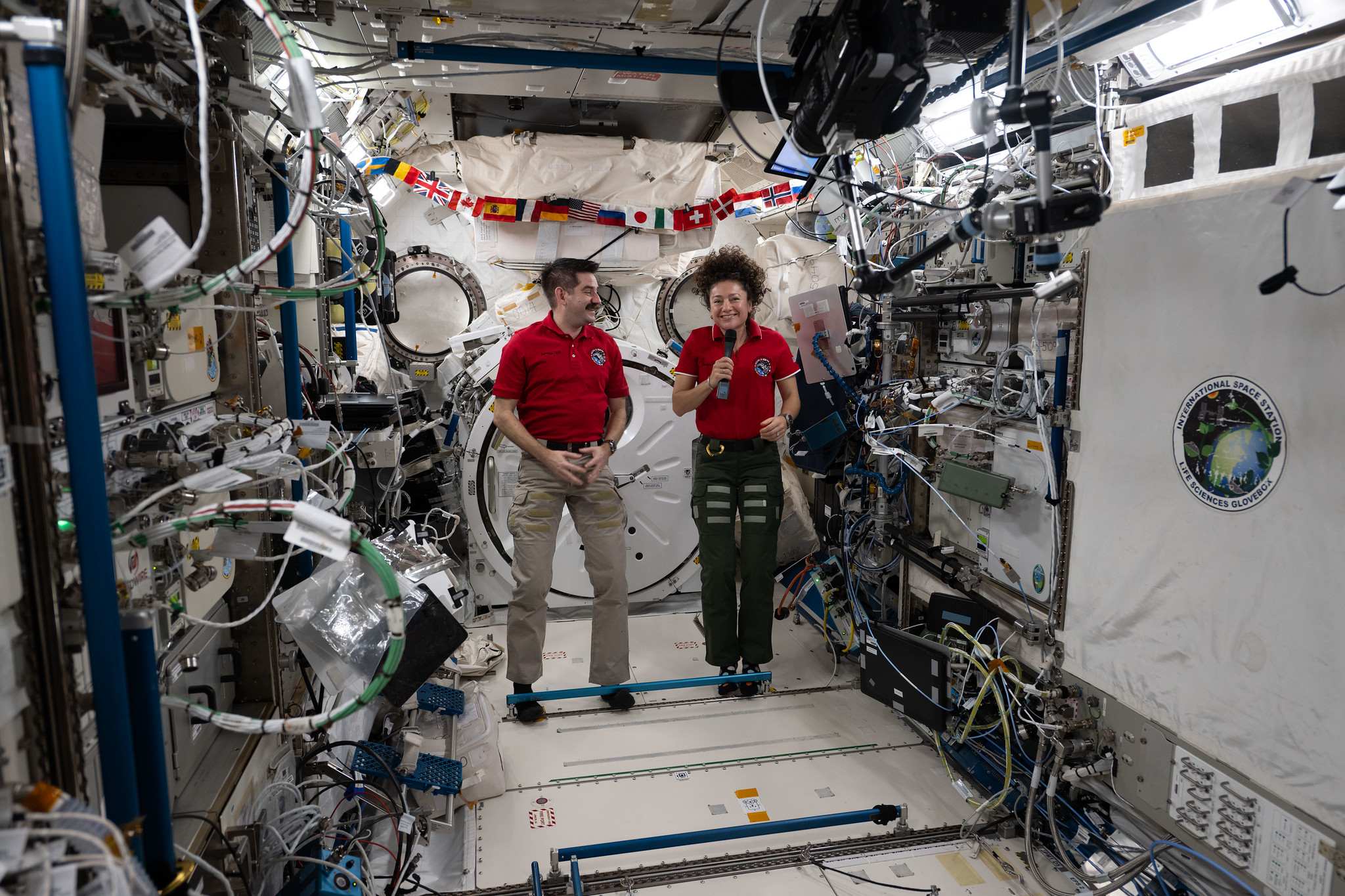
NASA astronauts Jack Hathaway and Jessica Meir inside the International Space Station’s Kibo laboratory module.

NASA astronauts Jack Hathaway and Jessica Meir inside the International Space Station’s Kibo laboratory module. Credit: NASA

Roscosmos, Russia’s space agency, typically keeps the PrK sealed off from the rest of the space station to isolate the leak from the crew’s living quarters and workstations. This allows the transfer tunnel to be maintained at a lower pressure than the rest of the station. When cosmonauts need to access the area, such as for inspections, repairs, or transferring cargo to or from a docked Progress supply vessel, they pressurize the PrK to match the pressure inside the rest of the station. This allows the cosmonauts to open up the PrK to complete their work.

A statement posted by Roscosmos on its Telegram channel suggests this is what was happening early Friday. “Specialists from the Russian ISS segment’s main operations control team detected a leak in the chamber” during pressurization of the PrK.

“Upon inspecting the transfer chamber, cosmonauts identified two potential air leak sites,” Roscosmos said. “The first site was promptly sealed by applying an initial layer of the two-component sealant compound Germetall-1. The second site is located on the conical section of the transfer chamber; preparations to seal it are currently underway.”

Russian and NASA officials also did not say what compelled Roscosmos to plan an immediate repair after discovering the two potential leak sites on Friday. They also did not say when cosmonauts might try again to patch the leak, or if any future repair effort might again force the US crew members to take shelter.

Roscosmos said there is “no threat to crew safety or onboard systems,” and the pressure inside the station “remains stable and is being maintained at the nominal level.”

0FansLike
0FollowersFollow
0FollowersFollow
0SubscribersSubscribe
- Advertisement -
Google search engine

Recent Posts