17.9 C
London
Thursday, June 4, 2026
Home Blog

Israel’s military creep killing Gaza peace plan

0

In recent days, Israeli Prime Minister Benjamin Netanyahu has ordered the Israeli army to seize 70% of Gaza – a sizeable increase from the 60% it currently controls.

This follows an updated map sent to aid agencies in Gaza in late March featuring a new “orange line” demarcating the restricted area under military control – about 11% larger than the area agreed to with the “yellow line” in the October ceasefire with Hamas.

Israel’s defense minister has also confirmed in recent days the government’s intention to move large numbers of Palestinians out of Gaza “at the right time and in the right manner.”

All of this is happening in a charged political environment in Israel: the Knesset dissolved itself on May 20, creating the possibility of an early election in September.

Israel’s actions are in clear violation of the 20-point Gaza peace plan, which called for a staged withdrawal of Israeli troops and actively “encouraged” residents to stay. It reads:

No one will be forced to leave Gaza, and those who wish to leave will be free to do so and free to return. We will encourage people to stay and offer them the opportunity to build a better Gaza.

US Secretary of State Marco Rubio has acknowledged as much, telling a congressional hearing this week that the peace plan “doesn’t call for” expanded military control of the strip.

The 2.1 million Palestinians in Gaza are being squeezed into an ever-smaller pocket of the decimated, overcrowded territory. And it appears the international community is doing little to stop it.

Laws against conquering territory

International law permits militaries to occupy foreign territory in pursuit of war aims, but there are two key limitations here.

First, an occupying force cannot pursue a legal claim to the territory it holds. The UN Charter has clearly outlawed the right to conquest under Article 2(4). Breaches of this article are treated very seriously, as the world’s reaction to Russia’s invasion of Ukraine has shown. This can be considered a war crime – the crime of aggression.

For Israel, this means its control of Gaza cannot result in a claim to sovereignty over any part of the strip. The International Court of Justice (ICJ) underscored this in its 2024 advisory opinion on Israel’s actions in the occupied Palestinian territories.

Second, any occupying military power must comply with international humanitarian law and international human rights law in a conflict. This means ensuring the welfare of the population under its control.

This has been the case in Gaza since Israel captured it from Egypt in the Six-Day War in 1967, beginning a decades-long occupation of the strip.

In fact, Israel’s obligations as an occupying power continued even after it pulled out its troops and dismantled its settlements in 2005.

As part of these obligations, an occupying power must preserve the demographic composition of the territory it controls. In this specific case, international law prohibits the removal of a population (the Palestinians) and the transfer of another population (Israeli settlers) onto occupied land.

A flawed peace plan

Despite these clear legal principles, enforcement of Israel’s obligations will be at best difficult, slow and piecemeal.

In its 2024 advisory opinion, for instance, the ICJ ordered Israel to withdraw fully from the occupied Palestinian territories, saying its presence is in breach of two key legal principles – self-determination and the prohibition against conquest.

The UN General Assembly endorsed the findings and set a deadline of September 14 2025 for the withdrawal. Israel ignored the deadline. The General Assembly can’t enforce an ICJ ruling; only the Security Council can. And this avenue is blocked due to the US veto power.

More worrying is that the clarity provided by international law – prohibiting conquest, genocide, settlements and forced displacement – is being blurred by the 20-point peace plan mediated by US President Donald Trump and the so-called Board of Peace overseeing the process.

US President Donald Trump stands with other world leaders at a Board of Peace meeting in Washington in February 2026. Photo: Mark Schiefelbein / AP via The Conversation

Last November, the UN Security Council endorsed Trump’s plan to end the conflict, disarm Hamas and establish a new transitional government system under the auspices of the Board of Peace and an International Stabilisation Force to keep the peace.

But the ceasefire agreement was flawed from the start. The text, for instance, did not include any specifications about Israel’s presence in the strip, accountability for alleged crimes or demilitarisation of Palestinian groups.

Since the ceasefire, the entire process has predictably stalled. Israeli strikes have continued, killing more than 900 Palestinians. Aid delivery is far below the needs of a desperate population. And Hamas refuses to disarm without firm guarantees on future Palestinian self-determination.

Behind the ‘yellow line’

This stalemate suits Israel perfectly. Under the map of the ceasefire agreement, Israel was permitted to keep its troops in areas behind a “yellow line” encircling the majority of the population along the coast. This gave Israel military control of just over half of Gaza.

Then, in the area under its control, Israel began two activities that speak to its longer-term political aspirations.

First, it leveled entire neighborhoods and hundreds of buildings, turning this part of Gaza into a wasteland devoid of inhabitants and any recognizable landmarks. Second, on this blank canvas, it constructed an impressive array of military roads, outposts and barriers, including permanent earthen berms (walls).

This gives Israel the possibility of perpetual control of a territory devoid of Palestinians. If this status quo continues, it would amount to forced displacement and conquest.

Day by day, Palestinian Gaza is shrinking and a new Gaza is being forged through bulldozers and barriers. Netanyahu has indicated Israel may not stop at 70% depopulation and control.

It may seek to preserve a large “buffer” zone in Gaza – as it is doing in Lebanon and Syria – or perhaps revive the project of Israeli settlement of the strip, which is in full swing across the West Bank.

All of this is happening in violation of international law and a “peace” plan that has no clear vision for a long-term solution for the Palestinian people.

Michelle Burgis-Kasthala is professor of international law, La Trobe University

This article is republished from The Conversation under a Creative Commons license. Read the original article.

Megawatt diplomacy: Water as the missing link in the new architecture of Middle East energy security

0
megawatt-diplomacy:-water-as-the-missing-link-in-the-new-architecture-of-middle-east-energy-security
Megawatt diplomacy: Water as the missing link in the new architecture of Middle East energy security

From oil geopolitics to the water-energy nexus

For more than a century, energy security in the Middle East has been defined by oil and gas. Strategic waterways, export routes, production capacities and geopolitical rivalries have shaped the region’s role in the global energy system. Yet while policymakers continue to debate energy transitions, decarbonisation and the future of hydrocarbon markets, a more fundamental challenge is emerging beneath the surface: water.

The Middle East is simultaneously one of the world’s most energy-rich regions and one of its most water-scarce. This reality is not merely an environmental concern; it is increasingly becoming a strategic one.

As the region seeks to maintain its energy leadership while adapting to climate change and economic transformation, water is emerging as a decisive factor in the future of energy security.

The forgotten foundation of energy security

Energy and water have long been treated as separate policy domains across much of the Middle East. In reality, however, the two are deeply interconnected.

Oil and gas extraction require water. Refineries consume water. Thermal power plants depend on water for cooling. Petrochemical industries require reliable water supplies. Even renewable energy projects and the production of green hydrogen rely on significant quantities of water.

This means that future energy security cannot be measured solely by reserves, production capacity or export infrastructure. It must also be assessed through the availability and sustainability of water resources.

Countries may possess abundant hydrocarbons, but without sufficient water, their ability to sustain energy production and industrial growth will become increasingly constrained.

Electricity diplomacy: The new power in the Middle East

Megawatt diplomacy in an era of scarcity

The concept of energy diplomacy has traditionally revolved around oil contracts, pipeline politics and gas exports. The emerging reality of the twenty-first century demands a broader framework—one that may be described as “Megawatt Diplomacy”. Megawatt Diplomacy refers to a new model of regional cooperation in which electricity networks, desalination technologies, renewable energy projects and water management become central pillars of strategic engagement.

The Gulf states have invested heavily in desalination infrastructure and renewable energy projects. Other countries possess valuable water resources but often lack investment, technology or energy infrastructure. These asymmetries create opportunities for cooperation rather than competition.

Regional electricity interconnections, shared desalination initiatives and cross-border investments in water and energy infrastructure could generate forms of interdependence that strengthen regional stability.

Green hydrogen and the new geography of power

Across the Middle East, governments are positioning themselves for the emerging hydrogen economy. Saudi Arabia, the United Arab Emirates and Oman have announced ambitious plans to become major exporters of green hydrogen. Yet there is a critical reality often overlooked in discussions about the energy transition: green hydrogen requires water.

As global demand for low-carbon energy sources grows, access to sustainable water resources will become a strategic advantage.

In the coming decades, water may prove just as important to the energy economy as oil was during the twentieth century.

The countries that successfully integrate water policy with energy strategy will be better positioned to lead in the next phase of global energy competition.

The geopolitics of energy algorithms: Who will control oil markets in the age of Artificial Intelligence?

Rethinking regional security

The architecture of Middle East energy security is undergoing a profound transformation. Oil and gas will remain important, but they will no longer be sufficient on their own.

Climate resilience, renewable energy systems, electricity connectivity and sustainable water management are becoming essential components of national and regional security.

This shift requires policymakers to rethink traditional assumptions.

Water can no longer be viewed solely as an environmental issue or an agricultural resource. It is increasingly a geopolitical asset, an economic necessity and a strategic determinant of energy security.

Conclusion

The Middle East is entering an era in which the geopolitics of energy will be inseparable from the geopolitics of water. If the twentieth century was defined by oil diplomacy, the decades ahead may well be defined by Megawatt Diplomacy—a framework in which water becomes the missing link connecting energy production, economic development and regional stability.

The most important question for the region’s future is no longer which country possesses the largest oil reserves. It is which countries can most effectively manage the relationship between water, energy and security in a rapidly changing world.

The views expressed in this article belong to the author and do not necessarily reflect the editorial policy of Middle East Monitor.

I Got Access to Hundreds of Teacher Misconduct Complaints in California — and You Can Too

0
i-got-access-to-hundreds-of-teacher-misconduct-complaints-in-california-—-and-you-can-too
I Got Access to Hundreds of Teacher Misconduct Complaints in California — and You Can Too

I was a new reporter at KQED in 2021 when former elementary teacher Joseph Brian Houg was sentenced to more than three decades in prison for sexually abusing 10 students. He’d taught at the same San Francisco Bay Area school for more than two decades. Were there warning signs?  

I soon discovered parents on social media saying they had complained to school administrators for years about Houg. I also knew that schools could release such complaints if they were substantiated or if teachers were disciplined. So I filed public records requests with Houg’s school — something anyone can do. 

I received 43 pages of records within a few months showing that parents had reported Houg to the principal at least four times since 2009. They complained about him for asking students to strip down to their underwear in his classroom in order to try on costumes for a play he was directing, and for coming into their changing room. They also complained about his touching boys’ chests or stomachs and tapping one boy on the butt. I learned that the principal had twice warned Houg to stop touching students. But he was allowed to keep teaching. (The principal said in a deposition that while Houg’s actions crossed professional boundaries, they were not reported to her as sexual.)

Over the next two years, I reported on similar cases of teachers remaining in the classroom after complaints of unwanted touching. Another Bay Area elementary school, in Benicia, reported a teacher to the state’s licensing body after he resigned due to accusations of misconduct. He was hired by another school, and his educator license remained in good standing until he was criminally charged. (He is currently fighting those charges.)

This raised a whole different set of questions for me: Should these teachers have been allowed to keep teaching in new schools? How much about a teacher’s disciplinary history did potential employers know? And what was the state’s responsibility for acting on, and sharing, the information it had about these teachers?

After I entered journalism school at the University of California, Berkeley in 2023, I wanted to investigate how common it was for teachers to continue working with kids after schools found that they had committed misconduct. California law bars the teacher licensing agency from releasing disciplinary records to the public, so my classmate and I requested records from the 300 largest school districts in California. We asked for complaints of teacher sexual misconduct made to schools in the five previous years. We also asked for any reports sent by schools to the state’s teacher licensing agency, which are required to be filed when public school educators are fired or resign due to alleged misconduct.

Read More

Dozens of districts responded within two months. We began building a spreadsheet of teachers against whom complaints were raised. Getting the records was slow: California requires public agencies to determine whether they have records to disclose within 10 days, and to release them promptly, but most dragged their feet. Whenever schools stopped responding, I copied school board members and attorneys on my emails, citing the law. By the time I graduated more than a year after filing the records requests, I had received more than 350 complaints, which I used in my recent investigation with KQED and ProPublica.

To this day, Los Angeles Unified, the largest school district in California, still has not released any records pertaining to teacher misconduct cases that it reported to the state. Instead, the district said it would charge me $8,000 ($100 an hour for 80 hours of work) for it to “investigate approximately 2,500 potentially responsive personnel files.” The First Amendment Coalition, a California nonprofit that advocates for free speech and government transparency, is representing me in a lawsuit filed in May. We argue that the Los Angeles school district is violating public records laws with its failure to release documents pertaining to alleged educator misconduct. A Los Angeles Unified spokesperson told me in a written statement this week that its policies balance the public’s right to access records with “responsible stewardship of public resources” and the law. 

Districts slow-walking their responses isn’t the only obstacle to getting records from schools. Districts typically notify teachers before releasing complaints to give them the opportunity to block the documents’ release. The former Benicia teacher who was criminally charged with sexually abusing students in 2024 sued to block the release of complaints made against him at two school districts. The First Amendment Coalition represented me in that case, too, and we won. It took nine months to get the records. In another case in which I had requested records, the court granted an injunction preventing release of the teacher’s records, but the legal filings contained the details of the allegations against him, so the nature of the complaint became public anyway.

At least four teachers have called or emailed me directly to ask why I’m requesting their disciplinary records. They wanted to share their side of the story, which I was more than happy to hear, and some argued that their cases were not worth my time. One asked me to retract my request. (I did not.) Another sent a 1,700-word email saying that the allegations were only partially true and lamented that he did not have the money to defend himself. 

While I appreciated the complexity of individual cases, I believed that those misconduct complaints might contain important truths. Undeterred by school districts’ recalcitrance, I followed the public record-seekers’ mantra: If you can’t get records from one agency, the answers you’re looking for may exist somewhere else. 

Records of state disciplinary hearings are presumed public when teachers object to their dismissals by school districts or appeal the suspension or revocation of their licenses. And those records reside in the Department of General Services, a state agency that houses another agency responsible for convening administrative hearings of public employees. 

This agency proved helpful with the case of Jason Agan, a San Francisco Bay Area math teacher who KQED and ProPublica reported on last month. Agan had been fired for sexually harassing high school students but went on to teach at two more schools, even after an independent panel convened by the Office of Administrative Hearings deemed him “unfit to teach.” Because he had asked for an outside hearing after the district moved to fire him, I requested those records. 

I got them the next day. The documents contained summaries of testimony from students, administrators and Agan himself at his dismissal hearing. Agan, who has not been accused of a crime, admitted to touching students’ shoulders but denied any sexual motivation, stating during his dismissal hearing that he did so to offer them support and encouragement. He maintained his teaching license. 

Getting a response from the Department of General Services was like discovering a secret portal to obtaining records quickly and easily. 

So I requested five years’ worth of decisions about other teachers by independent panels from this agency, in search of further insights into how the state’s teacher disciplinary system works and where it falls short. I obtained a gold mine of documents in less than a week.

I had learned some important lessons: What seems to be secret isn’t always so. Sometimes you just need to know who to ask, and for what.

How some data center operators are tackling their water use problems

0
how-some-data-center-operators-are-tackling-their-water-use-problems
How some data center operators are tackling their water use problems

On Monday, SpaceX amended its initial public offering to state that water conditions—including water scarcity, regulations around water, and drought—could constrain data center development.

It isn’t the only tech company trying to assess how water scarcity might impact its business. Water use is emerging as one of the most contentious data center issues. A recent Gallup poll found that seven out of 10 Americans are opposed to data center development, with water scarcity ranking as the top resource concern. Facing increasingly fierce resistance, some tech companies are scrambling to assure the public that they’re facing the issue head-on.

Data centers primarily use water to cool server racks, which throw off massive amounts of heat. One popular technique, known as evaporative cooling, uses fresh water to absorb the heat, which is then pumped to cooling towers where it evaporates outside.

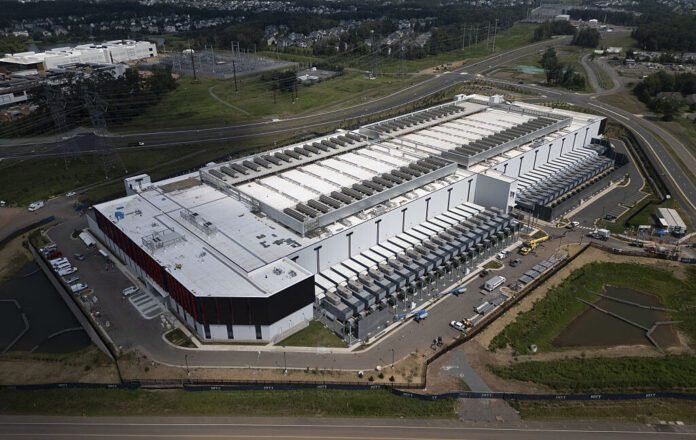
Using more water can save money and reduce emissions for big tech companies by reducing the power needed for cooling that relies on energy-intensive pumps to recirculate water. But it can also come with a large water footprint: Google’s facility in Council Bluffs, Iowa, for instance, which uses evaporative cooling, consumed more than 1 billion gallons in 2024.

Lawrence Berkeley National Laboratory predicted in a 2024 report that hyperscale data centers could consume up to 33 billion gallons of water by 2030 if they relied heavily on evaporative cooling. That’s on par or even less than other thirsty industries, like agriculture or oil and gas—a single fracked well can use 1.5 to 16 million gallons of water—but it poses a risk in regions where water is already scarce. The risk is particularly acute in summer, when data center cooling needs tend to skyrocket at the same time as municipal water use.

“Water is a highly local, highly regional issue,” says Shaolei Ren, a professor of engineering at UC Riverside. “It’s a limited resource, and we have to manage it very carefully.”

Some tech giants, including Microsoft, OpenAI, and Oracle, have made statements in recent months indicating that they are moving away from evaporative cooling entirely in order to save water. That includes OpenAI and Oracle’s massive Stargate expansion in a number of states, including a water-stressed region of Texas.

Google is taking a different approach. On Wednesday, the company rolled out a series of water-related commitments to communities where it has data centers, along with funding announcements for water-related projects in the US.

They include pledges to replenish more freshwater than the company consumes, via investments in local water projects; to scale up the use of reclaimed and recycled water; and to disclose annual water use in data centers. (Other tech companies, including Microsoft, have similar promises around water replenishment and local investment. Google has been working on most of these pledges for a few years.) There’s also a promise to use “a data-driven framework” to decide what data center designs would work best with local watersheds.

Ben Townsend, the global head of infrastructure and sustainability at Google, says that data center design is a lot more complicated than simply swearing off one type of cooling in all cases. The company, he says, has been doing detailed hydrologic assessments of its sites for the past four years to determine what types of cooling would work best.

“Water is scarce in some regions and plentiful in others,” he says. “A one-size-fits-all strategy just doesn’t work.”

In April, Google defended evaporative cooling for areas with what it called “abundant” water in a filing to the European Union as necessary for developing truly sustainable data centers. Google’s arguments line up with new research from Ren and his team, who found that if all data centers in the US were to adopt some kind of evaporative cooling during peak demand, it could free up an additional 10 to 30 gigawatts of power. In areas where grids are stressed but water resources aren’t, using evaporative cooling could provide a meaningful headroom to utilities trying to balance load.

“If you don’t use water, the challenge is that you’re going to be using a lot more power in the summer, and that will push up the cost,” Ren says.

Most tech giants, including Google, have seen their carbon emissions skyrocket as a result of the AI boom. Totally avoiding evaporative cooling could increase emissions if data centers rely on dirty energy to keep facilities cool. Using less evaporative cooling could also mean more water used offsite for electric generation, depending on how data centers are getting their electricity.

Despite efforts to curb water use, tech companies are still struggling to do so—and it could eventually impact business. Even as Microsoft is moving away from evaporative cooling, The New York Times reported in February that the company’s internal records indicate that its water use is set to skyrocket. In 2024, Google halted plans for a data center outside of Santiago, Chile, after a court partially revoked its permits over water concerns. (The permits for that data center were granted in 2020; Townsend says the company adopted its water scarcity framework for new locations a few years after that.)

In 2021, Google funded a lawsuit filed by a town in Oregon fighting a local newspaper to avoid disclosing how much water the tech giant would use for an expansion of its existing data center. The company began disclosing water use from specific data centers in annual reports in 2023.

Priscilla Johnson, an independent consultant who served as Microsoft’s director of water strategy between 2017 and 2020, agrees with Ren that there’s trade-offs between water and power. However, she says, there are ways to push companies to develop better designs that use both less water and energy. Public pushback and regulation, she says, is crucial.

“The industry has to be challenged to design smarter and simplify things,” she says

This story originally appeared on wired.com.

Marilyn Monroe’s Secret Baby Exposed in Heartbreaking Letter

0
marilyn-monroe’s-secret-baby-exposed-in-heartbreaking-letter
Marilyn Monroe’s Secret Baby Exposed in Heartbreaking Letter


Marilyn Monroe was the ultimate Hollywood bombshell, but behind the glowing smile, platinum curls, and movie-star glamour was a woman haunted by pain, loneliness, and one dream she feared she had destroyed.

The late screen legend reportedly worried that her use of sleeping pills and alcohol may have played a role in the loss of an unborn child, according to a heartbreaking handwritten letter that has cast new light on her private torment.

Monroe, who died in 1962 at just 36 years old, spent much of her short life battling severe health problems, emotional turmoil, and a desperate longing to become a mother.

Now, decades after her death, the tragic note reveals just how terrified she was that the pills and booze she turned to during moments of suffering may have harmed the baby she so badly wanted to keep.

Born Norma Jeane Mortenson, Monroe became one of the most famous women in the world. But fame could not protect her from the painful medical battles that reportedly plagued her for years.

The actress suffered from severe endometriosis, a brutal condition that can cause intense pain and fertility problems. Over time, it reportedly led to repeated hospital stays, powerful medications, and struggles to carry a pregnancy.

Monroe is believed to have endured fertility heartbreak and multiple suspected miscarriages during her lifetime.

One source familiar with Monroe’s medical history said the tragedy of her story lies in how badly she wanted a child.

“What makes this story so tragic is that Marilyn desperately wanted a baby and genuinely feared that the medication and drinking she turned to in moments of pain may have harmed her pregnancy,” the source said. “Her letter shows panic, guilt and heartbreak all at once.”

The devastating fear was laid bare in a handwritten note that later surfaced publicly and was put up for auction.

In the letter, Monroe described symptoms that made her believe she might have been pregnant.

“I think I’ve been pregnant for about three weeks or maybe two,” she wrote.

She described painful breasts, cramps, and bleeding that appeared to be getting worse.

Then came the gut-wrenching question that revealed her fear.

Monroe wrote that she had taken several Amitall sleeping pills on an empty stomach and had also consumed sherry wine. Then she asked whether she could have “killed it” by doing so.

Her words showed not a glamorous movie queen, but a panicked woman begging for reassurance.

“If it is still alive I want to keep it!” she wrote.

A Monroe historian said the letter was a rare and painful look at the real woman behind the Hollywood image.

“This wasn’t Marilyn Monroe the movie star,” the historian said. “This was a frightened woman confronting the possibility that she might lose the child she had always wanted. The language in the letter reveals how desperate she was for reassurance.”

Monroe’s beauty and fame made her a global sensation, but those close to her have long said her life behind closed doors was far darker than the fantasy sold to the public.

Anthony Summers, author of the 1985 biography Goddess: The Secret Lives of Marilyn Monroe, documented the devastating toll her endometriosis took on her body, her career, her relationships, and her dreams of motherhood.

According to Summers, the condition was so severe it affected nearly every part of her life. He wrote that before modern treatment options were available, Monroe’s pain helped lead to increasing use of strong painkillers, tranquilizers, and sleeping medications.

Bryan Johns, president and chief executive of the ICON Collection, said Monroe’s health problems were often dismissed or misunderstood during her lifetime.

“She had terrible, debilitating endometriosis, and was hospitalized and under medical supervision for that condition throughout her life,” Johns said.

He claimed that even when Monroe told studio bosses about her health struggles, they often accused her of exaggerating or making excuses.

That pressure only added to the heartbreaking image of a woman trapped between the demands of Hollywood and the reality of a body in constant pain.

Family friend and stylist Amy Greene later recalled that doctors once suggested Monroe undergo a hysterectomy because of her suffering.

But Monroe refused.

According to Greene, Marilyn was firm about wanting to become a mother.

“I can’t do that,” Monroe reportedly said. “I want to have a child. I’m going to have a son.”

Greene said Monroe often talked about having a son.

Those words make the resurfaced letter even more heartbreaking.

For millions, Marilyn Monroe remains the ultimate symbol of Old Hollywood glamour. But the private notes and memories left behind tell a much sadder story.

She was not just a sex symbol. She was a woman in pain, a woman desperate for love, and a woman whose dream of motherhood was crushed again and again.

Decades after her death, the tragedy still cuts deep because the fear in her own handwriting is so raw.

Marilyn Monroe had the world at her feet, but the one thing she wanted most may have been the one thing fame could never give her.

Europe is caught in a squeeze between the US and China

0

The European Union (EU), along with the other major countries in Europe, should be a geopolitical force to be reckoned with. In 2024, the EU was the second-largest economy in the world after the US and before China.

There is also nothing comparable to the trading links between these three players. In 2025, bilateral trade in goods between the US and China was US$414 billion (£307 billion). The EU and US, meanwhile, constitute a staggering third of global trade – with trade between them coming in at €1.77 trillion (£1.53 trillion) that same year.

These figures show that, far from the often-floated idea of a “Group of Two” (G2) where the US and China act as the joint steering committee for the planet, there really needs to be talk of a G3 that includes Europe.

My research has dealt with the relationship between China, Europe and the US for over 30 years. These three powers tend to silo and segregate their relations, which almost always comes at the expense of Europe. This is a phenomenon that has intensified under the US president, Donald Trump, in his two terms in office.

When the US and China meet, the Europeans tend to be outside the room with everyone else, trying to listen in. There is dialogue between China and the EU. There was even, briefly under President Joe Biden, an EU-US dialogue to coordinate their approach to China and the Indo-Pacific. This was mothballed when Trump returned to office in 2025.

However, what there has never been is a proper high-level Europe, China and US trilateral summit. And that situation is unlikely to change. When the British prime minister, Keir Starmer, visited China in January 2026, Trump criticised the trip. He said it was “very dangerous” for the UK to do business with Beijing.

Despite this, when Trump himself visited China in May, the sizeable technology delegation that accompanied him and the agreement for Beijing to buy 200 Boeing aircraft showed dealmaking was absolutely fine for the US. The mindset is clear enough. China and the US as superpowers have the right to deal with each other however they feel fit. No one else gets a look in.

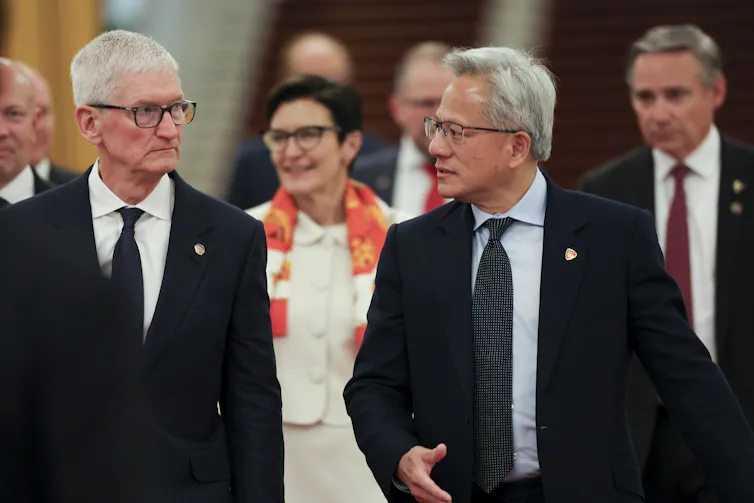
Tim Cook and Jensen Huang arrive for a meeting at the Great Hall of the People in Beijing.

Apple CEO Tim Cook (left) and Nvidia CEO Jensen Huang (right) accompanied Donald Trump on his recent visit to Beijing. Go Nakamura / EPA

Europe’s default position has been to accept this situation and sit between its two most important relationships, trying to balance. This has been demonstrated by the EU’s various high-level iterations of a policy approach towards China over the past 15 years. The most recent, in 2019, ended up balancing China between collaborator, adversary and competitor – illustrating Europe’s ruminative and indecisive mindset.

In terms of collaboration, Europe’s most obvious area of recent engagement with China has been in trade and investment. There has been technology transfer in automotives and manufacturing, and acceptance of Chinese tech company Huawei in European telecoms systems. But here, too, Europe has been cautious, with Huawei’s access to European markets heavily restricted from 2020 after American pressure.

The ways in which Trump has turned on his friends – demanding control of Greenland early in 2026 and criticising Nato and defence spending levels by longstanding allies – has created solid grounds for a rethink. Europe needs to acknowledge that working out its own policy on China means producing not just detailed plans (Europe is pretty good at that), but politically committed ones that place its own interests first.

Europe’s interests first

Brussels and other European capitals are dealing with a harsh emerging reality. Their key security relationship with the US is undergoing profound change and China is becoming a totally different kind of potential partner as it emerges as an innovator and a technology and research powerhouse.

Both phenomenon change the fundamental paradigm in which the EU now sits, and call for a different policy response – one that recognises more overtly that, for many areas and for many reasons, China is a partner and not a straightforward, unambiguous threat.

If we look at vastly consequential global issues, we can see this clearly. Europe is more aligned with China than the US on the threat of global warming from human activity and the need to use alternatives to fossil fuels.

Beijing and Brussels are also on the same page about the benefits and threats from AI, where China is now overtly stipulating the need to manage the effects of this new technology on jobs. And China, like Europe, views Trump’s attack on Iran with misgivings.

At the same time, Europe also worries about the real depth of Trump’s commitments – not just to Nato where his scepticism is well established, but in terms of standing by Taiwan were it ever to be attacked.

Realignment will not happen overnight, nor is there an easy destination. Trump’s White House successor, for example, may well be more into multilateralism. Even the current administration is talking about expanding its nuclear commitments in Europe. But the central reality is clear enough.

At a fifth of global GDP, and with a population of almost half a billion, Europe cannot continue to have a deferential, largely passive posture – and certainly not one where its largest and second-largest economic partners, the US and China, are involved.

At the very least, next time these two superpowers sneak into a room to continue their conversations, Europe should work out good arguments to join them, and not sit outside anxiously eavesdropping alongside everyone else.

What is ‘strategic autonomy’ – and why is everyone suddenly reaching for it?

0
what-is-‘strategic-autonomy’-–-and-why-is-everyone-suddenly-reaching-for-it?
What is ‘strategic autonomy’ – and why is everyone suddenly reaching for it?

Strategic autonomy is having a moment.

European leaders are invoking it to justify a historic defense buildup; India’s foreign ministry has made it the organizing principle of a policy that buys Russian oil while courting American investment; and Canada is treating it as a “core objective.”

The phrase is everywhere in international relations circles, but the explanation is almost nowhere. So what does strategic autonomy actually mean? And why are analysts reaching for it now?

Leverage more than self-sufficiency

The first thing to note is that autonomy does not imply withdrawal from the international order or a severing or reduction of ties with Washington.

Take the European Union, for instance. As one of the few organizations that has made explicit its aspirations for strategic autonomy, the EU is boosting its collective-defense spending to hedge against an America whose long-term commitments can no longer be relied upon.

India still participates in the Quad strategic alliance alongside the U.S., Australia and Japan, but it conducts an independent foreign policy when its interests don’t align with Washington’s. Canada is diversifying its partnerships but not decoupling.

You can argue with the particulars of each case. But from Germany to India to Canada, the basic instinct driving these countries’ foreign policies is the same: seeking to increase their maneuvering room while remaining broadly aligned with the United States.

All remain embedded in the existing U.S.-led global security and economic orders. Only now they are renegotiating the terms of their participation in those orders.

Taken as such, strategic autonomy is best seen as leverage and flexibility rather than self-sufficiency. More specifically, it is the credible ability to say “no” to great-power patrons, such as the U.S.

A strategically autonomous nation can take diplomatic positions that the superpowers of the day dislike. It can field military force without depending entirely on another country’s hardware or authorization. And it can maintain enough control over critical supply chains to blunt coercion from rivals.

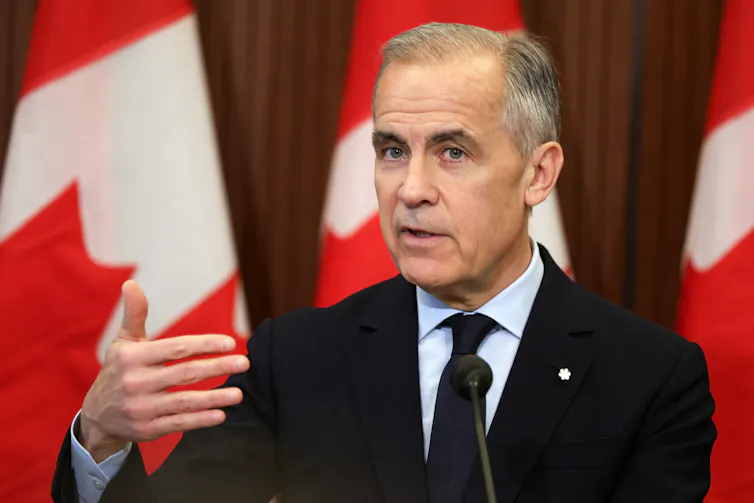
A man gestures as he speaks in front of a red and white flag.

Canadian Prime Minister Mark Carney speaks on Parliament Hill in Ottawa, Canada, on May 14, 2026. Photo by Dave Chan/AFP via Getty Images

Charles de Gaulle’s ghost

The phrase itself is newer than many people realize, even if the underlying logic is not.

France’s postwar leader, Charles de Gaulle, spent much of the 1960s institutionalizing what later became known as strategic autonomy. In 1966 he withdrew France from NATO’s integrated military command, while keeping the country within the alliance itself. What de Gaulle objected to was de facto American authorization on matters of French security.

His reasoning was straightforward: A state dependent on another power for its security is not fully sovereign.

While de Gaulle never used the phrase “strategic autonomy,” it became embedded in official French doctrine in the nation’s 1994 White Paper on Defense.

By 1998, the concept had migrated to wider European politics through the Saint-Malo Declaration between then-U.K. and French leaders Tony Blair and Jacques Chirac. They argued that Europe required “the capacity for autonomous action, backed up by credible military forces.” The European Union formalized the policy in its 2016 Global Strategy.

While de Gaulle was pursuing his policies, a parallel tradition through the Non-Aligned Movement saw India, Indonesia, Yugoslavia and many others chart a Cold War course between the U.S. and the Soviet Union.

Same logic, different crises

The resurgence of interest in strategic autonomy has a common source: A U.S.-led order that for an increasing number of nations has started to feel less like a public good and more like a burden.

While some leaders have been ahead of the curve – France’s Emmanuel Macron argued for European strategic autonomy years before his European peers – it is President Donald Trump’s second term that has changed the political arithmetic.

Governments that once assumed that American security guarantees were unconditional have discovered otherwise. European leaders are no longer asking whether independent military capacity is necessary; they are asking how quickly they can build it.

India’s version of strategic autonomy is, perhaps, the most developed and instructive.

The government of Narendra Modi buys Russian oil despite Western sanctions. It abstains on United Nations votes over Ukraine while deepening defense cooperation with Washington. And it engages multilateral forums that include Beijing while strengthening ties with the Quad.

Viewed through the lens of traditional alliance politics, the behavior appears incoherent. But seen through the lens of strategic autonomy, it becomes more intelligible. India is maximizing leverage across competing relationships while refusing permanent dependence on any of them.

Canada is seemingly arriving at a similar place, albeit through a different route.

Trump’s rhetoric over Canada becoming the U.S.’s 51st state exposes how much dependence Ottawa had accumulated with regards to Washington. In response, Canadian policymakers are now pursing trade diversification, renewed defense investment and broader partnerships.

Turkey and Saudi Arabia illustrate a harder version of the same logic. Ankara remains inside NATO while operating Russian air defense systems. Riyadh is building a domestic defense capacity while cultivating alternative weapons suppliers to Washington.

These are hedging strategies adapted to today’s more fragmented international order, while the older divide separated aligned states from nonaligned states.

A different divide is now emerging. Some governments accept deep patron dependence, whereas others are determined to preserve flexibility even inside formal alliances and partnerships.

And that distinction – between those striving for strategic autonomy and those who are not – is increasingly shaping world politics.

This article is part of a series explaining foreign policy terms commonly used but rarely explained.

Russia’s Afghan pivot risks entanglement in old traps

0
russia’s-afghan-pivot-risks-entanglement-in-old-traps
Russia’s Afghan pivot risks entanglement in old traps

As Russia deepens cooperation with Afghanistan’s rulers, it faces a growing tension between regional influence, connectivity ambitions and its own security concerns.

Few countries have warned more consistently about the dangers emanating from Taliban-ruled Afghanistan than Russia. Yet Moscow is now deepening military cooperation with the Taliban government that controls the territory in which many of those threats lie.

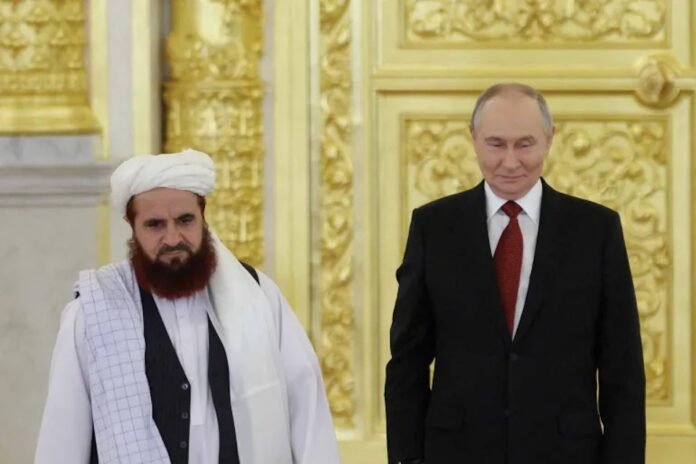
The military-technical cooperation agreement signed in Moscow between Russian Security Council Secretary Sergei Shoigu and Taliban Defense Minister Mohammad Yaqoob marked another milestone in the rapid transformation of relations between the two sides.

Although the contents of the agreement were not publicly disclosed, its symbolism is clear. It follows Russia’s decision to remove the Taliban from its list of banned terrorist organizations and its subsequent recognition of the Taliban government in 2025.

Taken together, these steps show that Moscow is no longer merely engaging the Taliban as a political reality. Rather, it is gradually incorporating Afghanistan into a broader framework of Russian regional strategy.

The question for Moscow is whether its strategy can simultaneously deliver influence and stability.

Touchy engagement

Russia’s engagement with the Taliban is driven by considerations that extend far beyond counterterrorism.

The withdrawal of the United States from Afghanistan created a geopolitical vacuum that regional powers have been competing to fill. For Moscow, Afghanistan occupies a strategically important position linking Central Asia, South Asia and the wider Middle East. Influence in Kabul thus provides leverage across multiple theaters simultaneously.

Economic considerations are equally important. Bilateral trade exceeded US$530 million in 2025 and continued to expand during the first months of 2026, while discussions surrounding infrastructure, energy cooperation, transport connectivity and mineral development have accelerated.

Russian policymakers increasingly view Afghanistan not as a peripheral security problem but as a potential component of their wider Eurasian integration strategy.

Particularly significant is the Trans-Afghan Corridor, which could connect Central Asia to Pakistan’s ports through Afghan territory. Russian and regional planners view the project as a potential extension of broader Eurasian transport networks, with projected freight volumes eventually reaching several million tonnes annually.

Such routes complement Moscow’s efforts to diversify trade networks and reduce dependence on Western-controlled economic corridors. In an era of sanctions and geopolitical fragmentation, alternative transport routes have acquired growing strategic value.

Afghanistan’s considerable untapped reserves of copper, lithium and other critical minerals also boost its geopolitical relevance. While Russia possesses substantial mineral resources of its own, securing influence over future extraction projects offers both economic opportunities and strategic advantages in an increasingly competitive global environment.

Maintaining influence in Afghanistan is also important because Moscow does not want post-American Afghanistan to become exclusively dependent on Chinese economic power. While Beijing’s investments, mining interests and connectivity initiatives continue to expand in Afghanistan, Russia seeks to ensure that it remains an indispensable political and security actor in the country’s future.

Moscow’s objective is not necessarily to compete with Beijing, but to ensure it remains a consequential player. More broadly, maintaining relevance in Afghanistan is one way for Russia to ensure that influence across the heart of Eurasia is not monopolized by any single external actor, including China.

Russia’s Afghan policy is therefore not simply about Afghanistan. It is about Moscow’s wider ambition to remain a decisive actor in the evolving Eurasian order.

Security paradox

Yet the deeper Russia becomes involved in Afghanistan, the more difficult it becomes to reconcile engagement with its own security assessments.

Only days before the military agreement was signed, senior Russian officials publicly warned about the deteriorating terrorist landscape in Afghanistan. Federal Security Service Director Alexander Bortnikov warned that Islamic State-Khorasan was actively recruiting across Central Asia and among migrant communities linked to Russia.

Shoigu separately stated that between 18,000 and 23,000 militants affiliated with more than 20 extremist organizations remain active inside Afghanistan.

These quantified warnings are consistent with repeated assessments by the United Nations and regional security organizations documenting the continued presence of ISIS-K, al-Qaeda, Tehreek-e-Taliban Pakistan, the Islamic Movement of Uzbekistan and other militant groups operating from Afghan territory.

Moscow apparently believes that engagement offers the most practical means of managing and mitigating these threats. In the Kremlin’s view, the Taliban remains the only force capable of preventing a complete security vacuum and limiting the expansion of ISIS-K.

Indeed, international isolation has produced few positive results, while the collapse of Taliban authority could generate even greater instability across Central Asia.

Yet Russia’s strategy rests on an uncomfortable assumption: that the Taliban can simultaneously serve as a partner in countering extremism while governing a territory that continues to host a broad ecosystem of militant organizations.

While the Taliban has demonstrated determination in confronting ISIS-K, it has been far less successful and seemingly committed to addressing wider militant networks that continue to concern many neighboring states, including China.

Moscow’s engagement also grants the Taliban greater international legitimacy despite persistent concerns over militant activity in Afghanistan. The Kremlin appears to believe engagement offers leverage, but critics argue recognition may be advancing faster than meaningful security improvements.

For Moscow, this is the central strategic gamble.

Pakistani test

The most immediate test of Russia’s Afghan strategy may ultimately come not from Kabul but Islamabad.

Over the past decade, Moscow has steadily expanded relations with Pakistan through energy cooperation, defense contacts and regional diplomacy. At the same time, many of Russia’s long-term connectivity ambitions depend upon stable transport routes linking Central Asia, Afghanistan and Pakistan.

Pakistan’s security concerns present perhaps the greatest external challenge to Russia’s Afghan strategy. Moscow increasingly views Pakistan as an important partner in regional connectivity and energy cooperation, yet many of those ambitions depend upon stability in exactly those border regions where Islamabad continues to accuse Afghan-based militant groups of operating.

This creates a delicate balancing challenge for Moscow. On one hand, Russia seeks deeper engagement with the Taliban to advance connectivity, trade and regional influence. On the other hand, its broader Eurasian ambitions require constructive relations with Pakistan, whose security concerns in Afghanistan are far from resolved.

The contradiction is unlikely to disappear anytime soon. If stability improves, Russia could emerge as one of the principal beneficiaries of a new network of transport and economic corridors linking Central and South Asia. If insecurity persists, Moscow may find itself increasingly entangled in the very security challenges it hopes engagement will mitigate.

The military cooperation agreement, therefore, represents far more than a bilateral understanding between Russia and Afghanistan. It reflects Moscow’s broader attempt to shape the geopolitical landscape of post-American Eurasia.

Whether that effort succeeds will depend on a crucial unanswered question. Can the Taliban evolve into a reliable partner for regional stability while continuing to govern a territory that remains a focal point for transnational militant activity?

In betting on engagement, Moscow is wagering that the Taliban can become a stabilizing force before Afghanistan’s militant landscape overwhelms the state’s capacity to control it. If that assumption proves correct, Russia could emerge as one of the principal architects of a new Eurasian connectivity framework stretching from Central Asia to South Asia.

If it proves wrong, Moscow may find that engaging Afghanistan brings more liabilities than opportunities. The outcome will shape not only Russia’s position in post-American Afghanistan but also the future balance of power across Eurasia.

Saima Afzal is a researcher specializing in South Asian security, counterterrorism, and broader geopolitical dynamics across the Middle East, Afghanistan and the Indo-Pacific. She is currently a research scholar at Justus Liebig University, Germany.

EU Parliament to switch to French search engine from Google in tech sovereignty push

0
eu-parliament-to-switch-to-french-search-engine-from-google-in-tech-sovereignty-push
EU Parliament to switch to French search engine from Google in tech sovereignty push


The European Parliament will switch to French ​search engine Qwant from Google, ‌it said on Wednesday, underscoring Europe’s push to reduce its reliance on U.S. technology ​in favour of local alternatives.

The ​European Commission will later on Wednesday ⁠announce measures on chips, cloud computing ​services and AI as part of ​its “Buy and Use European” drive.

“From 4 June 2026, Qwant will become the default search engine ​on the European Parliament’s Microsoft ​Edge and Mozilla Firefox browsers,” a Parliament spokesperson ‌said ⁠in an email.

The change will be applied automatically, though users will still be able to select alternative search ​engines.

“It is ​part of ⁠a larger framework of actions aimed at reducing EP ​reliance on non-EU digital tools ​and ⁠promoting European-based, privacy-focused services,” the spokesperson said.

The Parliament has 720 lawmakers, along ⁠with ​thousands of assistants and ​administrative staff. Euractiv first reported the switch.

Source:  Reuters

Antisemitic Hate Crimes in New York City Jump 71% Since Last Year 

0
antisemitic-hate-crimes-in-new-york-city-jump-71%-since-last-year 
Antisemitic Hate Crimes in New York City Jump 71% Since Last Year 


Antisemitic violence continued to dominate New York City’s hate crime statistics, with the New York Police Department reporting a sharp increase in anti-Jewish offenses both month-over-month and over the longer term. 

According to NYPD figures, antisemitic hate crimes climbed 71% in May compared with May 2025 and were up 46% from the average recorded during the previous three months. 

The data showed that Jewish victims accounted for 60% of all confirmed hate crimes in the city despite Jews representing only about 10% of New York City’s population. 

Police statistics further indicated that anti-Jewish offenses exceeded the combined total of hate crimes directed at every other demographic group during the reporting period. 

Authorities recorded 41 antisemitic hate crimes in May, making Jews the most frequently targeted group in the city’s hate crime data. 

Other reported incidents included three crimes targeting Asians, five targeting Muslims, five based on sexual orientation, one targeting a Hispanic individual, one targeting a white person, one based on gender, one targeting an unspecified ethnicity and 10 targeting unspecified religious groups. 

The figures illustrate the disproportionate concentration of anti-Jewish hate crimes within New York City’s broader hate crime landscape. 

The latest statistics also come amid wider concerns about antisemitism across the United States. Recent records cited in the report showed that assaults against Jews nationwide have reached a 46-year high. 

Experts cautioned that the actual scope of the problem may be larger than official numbers suggest, noting that many incidents are never reported to law enforcement. 

0FansLike
0FollowersFollow
0FollowersFollow
0SubscribersSubscribe
- Advertisement -
Google search engine

Recent Posts