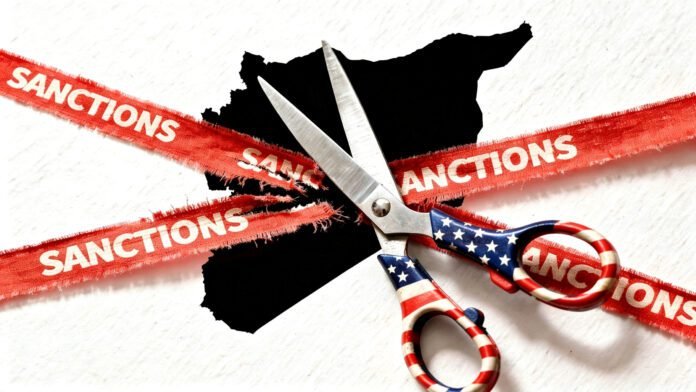
The al-Sharaa–Trump conversation revived hopes of a wider US opening, but the path to growth still runs through damaged infrastructure, weak banking channels, investor doubts, and immense humanitarian need
[DAMASCUS] When Syrian President Ahmed al-Sharaa spoke by phone with US President Donald Trump, the issue of US sanctions was not a passing item in a broader discussion of regional developments and Syria’s recovery. The Syrian president’s office said al-Sharaa stressed that lifting the remaining sanctions represents an essential step toward enabling the Syrian economy to regain momentum and improve citizens’ living conditions. He also emphasized the importance of continued international support during the reconstruction phase and the need to encourage investment across vital sectors.
The focus on sanctions was not unexpected considering Syria’s economic situation. For Damascus, the sanctions file is not simply one diplomatic question among many, but a central element in the country’s effort to emerge from years of economic isolation, war, and institutional strain. Syrian officials increasingly present sanctions relief as a gateway to reconstruction, the return of investment, and the gradual reintegration of Syria into the regional and international economy.
Yet this discussion raises a more complex question than whether sanctions should remain in place or be removed. Have US sanctions truly become the primary obstacle preventing Syria’s economic recovery? Would their complete removal lead to a significant influx of investment, the return of foreign companies, and tangible improvements in living conditions? Or is Syria’s economy now facing deeper structural challenges that extend beyond the sanctions themselves?
For years, US sanctions have constituted one of the most significant sources of economic pressure on Syria. They targeted various sectors, institutions, and individuals while imposing broad restrictions on financial and commercial transactions, prompting many investors and international banks to avoid the Syrian market.
The policy picture has already changed in important ways. In May 2025, the Trump administration moved to ease sanctions by issuing General License 25 and a Caesar Act waiver meant to facilitate new investment, essential services, and broader economic activity in Syria. Trump himself framed the move in sweeping terms, saying, “I will be ordering the cessation of sanctions against Syria in order to give them a chance at greatness.”
The debate is no longer simply about whether Washington is willing to ease pressure on Syria. To an important degree, it already has. The more difficult question is whether additional relief would, by itself, restore investor confidence, normalize banking relations, and produce visible improvements in an economy that has been deeply damaged by war and decline.
Sanctions have undoubtedly harmed the Syrian economy, particularly in the banking sector, financial transfers, and foreign investment
Samir Tawil, a Syrian economist who closely follows developments in the local economy, captured that distinction directly. “Sanctions have undoubtedly harmed the Syrian economy, particularly in the banking sector, financial transfers, and foreign investment,” he told The Media Line. “However, they are not the sole cause of the current crisis.”
He added that Syria’s economy has suffered enormous losses over more than a decade in infrastructure, productive sectors, and human capital, making recovery far more complex than simply removing US restrictions.
The scale of Syria’s economic crisis helps explain why the sanctions issue carries such weight. A recent United Nations Development Program (UNDP) assessment found that years of conflict have erased decades of economic and social progress, while poverty and unemployment have reached devastating levels. The report said that, at the average growth rate recorded between 2018 and 2024, Syria’s economy would need 55 years to return to its pre-conflict GDP level.
Even under conditions of political opening, economic recovery in Syria will not be a short-term process. According to the UNDP, bringing recovery within 10 years would require annual growth to increase sixfold, while a 15-year recovery path would still demand much stronger performance than the country has achieved in recent years.
The World Bank has offered similarly stark figures. In October 2025, it estimated Syria’s reconstruction costs at $216 billion, with a range of $140 billion to $345 billion. It also reported that nominal GDP had fallen from $67.5 billion in 2011 to an estimated $21.4 billion in 2024, while real GDP declined by nearly 53 percent between 2010 and 2022.
Syria’s economy has suffered enormous losses over more than a decade in infrastructure, productive sectors, and human capital, making recovery far more complex than simply removing US restrictions. Even if those sanctions were completely lifted, the country would still face structural challenges ranging from weak infrastructure and chronic energy shortages to declining domestic production, high unemployment, and deteriorating purchasing power.
The banking sector remains among the areas most severely affected by sanctions. Over the years, Syrian banks have faced significant difficulties accessing the global financial system, while financial transfers have become increasingly complex and costly. Even after the partial easing of some restrictions, many international financial institutions continue to avoid dealing with Syria because of legal risks and reputational concerns associated with the market.
Financial institutions fear compliance mistakes or complicated legal reviews, which means caution frequently continues even after sanctions are officially lifted
Loui al-Hassani, a lawyer specializing in financial crimes, explained why. “Even when US regulations permit certain forms of investment or financial activity, major banks often prefer to stay away from markets that have been subject to strict sanctions for long periods,” he told The Media Line. “Financial institutions fear compliance mistakes or complicated legal reviews, which means caution frequently continues even after sanctions are officially lifted.”
This is one reason Syrian officials insist that the goal is not only to remove the remaining sanctions, but to restore Syria’s position within the international financial system. Adel al-Shammari, an investor support official at Syria’s Ministry of Foreign Affairs, told The Media Line that Damascus views the sanctions file as a gateway to restoring normal relations with international financial institutions and encouraging foreign banks to gradually return to the Syrian market. “The country needs stable and reliable banking channels if it wants to attract investment and finance reconstruction projects in the coming years,” he said.
US sanctions have also affected remittances, financial transfers, trade, and investment, with consequences that have often extended beyond their formal legal language. They have contributed to a climate of caution in which many foreign companies and financial institutions have avoided the Syrian market.
In this context, the Syrian government sees sanctions relief as a necessary step toward attracting Gulf, Arab, and international capital. The country’s reconstruction needs are vast, ranging from electricity grids and water networks to roads, airports, seaports, industrial zones, housing, and productive sectors capable of generating employment. For Damascus, easing the remaining restrictions is therefore tied not only to diplomatic symbolism, but to the hope of unlocking the large-scale financing that reconstruction will require.
But are Arab investors simply waiting for sanctions to be lifted before entering Syria?
Mohammad Zaidan, a Syrian businessman studying investment opportunities in Damascus after spending many years working in China, told The Media Line that sanctions have indeed been one of the main factors causing investors to delay entering the Syrian market. However, he emphasized that sanctions are far from the only consideration.
Removing sanctions would send a positive signal to markets, but it would not by itself be enough to justify investment decisions worth billions of dollars
“Investors also look at the stability of the legal environment, the clarity of economic legislation, the ease of transferring profits, the efficiency of the banking sector, and the long-term consistency of government policies,” he said. “Removing sanctions would send a positive signal to markets, but it would not by itself be enough to justify investment decisions worth billions of dollars.”
Zaidan noted that investors view Syria as a market with significant opportunities in energy, infrastructure, real estate, agriculture, and manufacturing.
Yet he stressed that the extent to which these opportunities can be realized will depend on the Syrian government’s success in creating an attractive business environment capable of protecting investments and facilitating economic procedures.
The humanitarian dimension makes the limits of a sanctions-only approach even clearer. In March 2025, UN officials said 16.5 million people in Syria were in need of assistance, and that more than two-thirds of the population required humanitarian support. They also described severe pressure on public services and warned of funding shortages that threatened aid operations at a time when the needs remained immense.
In Washington, sanctions are viewed through a broader lens than economics alone. Mustafa al-Nuaimi, a Syrian affairs analyst and researcher, told The Media Line that sanctions also serve as a political tool used by successive US administrations to pursue foreign policy and regional security objectives.
He noted that any additional steps toward lifting sanctions could be tied to broader political and security discussions involving multiple regional files. The positions of Congress and other US government institutions, he added, will continue to influence the limits of any future American opening toward Syria.
“The Trump administration may view the sanctions issue as an opportunity to redefine relations with Damascus within a broader framework of regional understandings,” al-Nuaimi said. “However, I do not expect sanctions relief to be automatic or free of political and security conditions.”
Against this backdrop, the phone call between al-Sharaa and Trump has revived one of the most pressing questions facing Syria today: what does the Syrian economy actually need in order to emerge from its prolonged crisis?
While the Syrian government is betting that the removal of the remaining sanctions will pave the way for investment, reconstruction, and improved living conditions, many experts argue that sanctions represent only one part of a much larger challenge. The success of any future economic opening, they say, will ultimately depend on Syria’s ability to address the internal problems that have accumulated over years of conflict and economic decline.
Between the optimism expressed by Syrian officials and the caution voiced by investors and economists, one conclusion appears clear: if sanctions are fully lifted, the move would represent an important milestone on the path toward recovery.
Yet the question left unanswered by the al-Sharaa–Trump conversation—and one that continues to dominate economic discussions in Syria—is whether sanctions relief alone can restore sustained growth or whether it will merely mark the beginning of a long process of reforms, challenges, and economic adjustments.


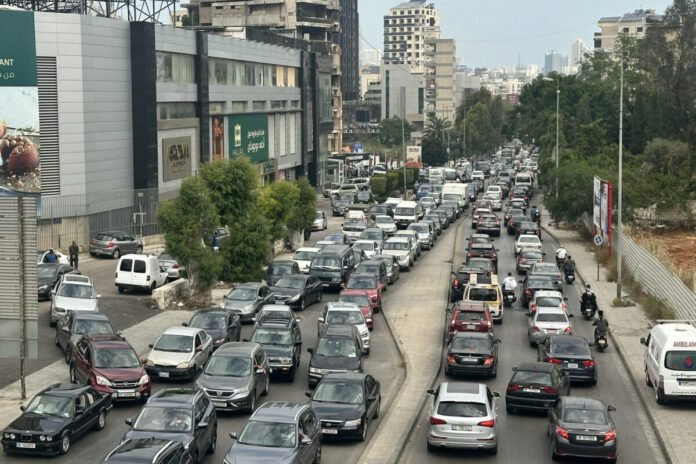
![A view of traffic congestion as people leave the Dahiyeh district in southern Beirut, Lebanon, on June 1, 2026. [Houssam Shbaro - Anadolu Agency]](https://www.middleeastmonitor.com/wp-content/uploads/2026/06/AA-20260601-41545470-41545466-NETANYAHU_ORDERS_ATTACKS_ON_BEIRUTS_DAHIYEH_DESPITE_LEBANON_CEASEFIRE-2-scaled-e1780520094617.jpg)