ROG Xbox Ally X20 adds OLED screen, control upgrades
When the Steam Deck OLED launched three years ago, we were glad to see that the new, more brilliant screen fixed the biggest flaw of Valve’s original handheld hardware. So we’re unsurprisingly excited about today’s announcement that Asus is preparing a new, OLED-equipped ROG Xbox Ally X20 for the coming holiday season. Still, it’s a bit worrying that Asus is positioning the new upgrade as a niche collector’s item rather than its new handheld gaming standard.
The X20 expands the 7-inch screen found on last year’s ROG Xbox Ally line to 7.4 inches, matching the display on the Steam Deck OLED and approaching the 7.9-inch screen on the Switch 2. The 1080p HDR panel also increases the maximum brightness from 500 nits on original Xbox Ally models to a full 1400 and adds some new anti-glare coating that should help when playing in direct sunlight. The X20’s 120 Hz display now supports Dolby Vision HDR colors and FreeSync Premium Pro to help smooth frame rates while still providing a larger color gamut.
On the control front, the X20 introduces magnetic TMR thumbsticks, replacing the carbon-film potentiometers that made the original Xbox Ally more prone to stick drift and physical wear. A new D-pad on the X20 also introduces a neat little lift-and-twist design that can transform it from a four-direction cross to a more circular eight-direction pad, similar to the convertible D-pad found on some now-classic Xbox 360 controllers.
Press outlets that got early hands-on time with the X20 reported a few other incidental upgrades, such as quieter, more rounded face buttons and better-feeling rubberized grips on the translucent black-and-gold shell.
Hope you like augmented reality
Even though the internal specs on the X20 are unchanged from last year’s ROG Xbox Ally X, the surface improvements sound like a welcome refresh to Asus’ promising line of handheld gaming PCs. Unfortunately, Asus seems to be positioning the X20 as a limited-edition bundled curiosity rather than a new standard-bearer for handheld gaming.
That’s because today’s announcement of the ROG Xbox Ally X was really an announcement of an “All-New ROG Xbox Ally X20 bundle,” as Asus puts it (emphasis added). The hardware is currently positioned only as part of a special “20th anniversary” bundle that also includes a pair of Xreal R1 AR glasses. Tethering those glasses to the X20 hardware via USB gives users what Asus promises is a 171-inch virtual screen that can either move with them or stay fixed in virtual space as they move their head.
This AR glasses bundle was the only package Asus announced today.
Credit: Asus
This AR glasses bundle was the only package Asus announced today. Credit: Asus
While those kinds of “virtual display” glasses have their fans, they seem much better suited to being a premium optional accessory than a standard inclusion with every device. Asus already sells Xreal R1 glasses for $850, and the ROG Xbox Ally X was retailing for $1,000 last year, before RAM and storage prices sent prices for game consoles and other computing devices soaring.
While Asus isn’t discussing pricing yet, a bundle price approaching or exceeding $2,000 doesn’t seem out of the question when the X20 launches later this year. That price—plus the “Asus’ 20th anniversary” branding for the hardware—would suggest a device with a very limited market and thus a limited production run.
That would be a shame—the upgrades available in the X20 could find a decent audience if they weren’t literally tethered to a pair of expensive AR glasses. Hopefully, Asus will offer a standalone version of the ROG Xbox Ally X20 hardware that will remain available long after the 20th anniversary bundling ends.
As Trump attacks anew, Iran says Europe’s ‘appeasing aggressors’
Esmaeil Baqaei, a spokesperson for the Iranian Foreign Ministry. Photo: Ministry of Foreign Affairs
Iran’s government on Monday condemned the European Union’s response to Iranian attacks on US military installations in the Middle East as “a masterclass in selective moral outrage” after the Trump administration launched new strikes against Iran over the weekend, with peace talks still at an impasse.
Esmaeil Baqaei, a spokesperson for the Iranian Foreign Ministry, accused EU leaders of “blaming Iran for exercising its right to self-defense against US aggression launched from bases in neighboring countries,” referring to Iran’s attacks on US air bases in Kuwait. Baqaei said Iran’s strikes “against those bases and assets that are used to launch unlawful attacks against Iran are a lawful exercise of self-defense.”
“The EU must remain faithful to the rule of law and the principles of the UN Charter that it has long claimed to uphold. It must stop appeasing aggressors while blaming those who respond to unlawful attacks,” Baqaei added. “States have an established legal obligation not to allow their territory or assets to be used for invading other countries.”
Baqaei’s statement came in response to remarks from a European Commission spokesperson condemning an Iranian attack on a US air base in Kuwait last week, calling it a violation of Kuwait’s sovereignty. The attack reportedly injured at least four US servicemembers and several American contractors.
The Iranian military said it targeted another US air base on Sunday in response to new attacks by the Trump administration, which launched its illegal war against Iran in late February. While Iran did not specify the location of its target, Kuwait said late Sunday that its “air defenses are currently confronting hostile missile and drone attacks.”
The Iranian attacks followed the US military’s announcement that it carried out strikes on “Iranian radar and command and control sites for drones” over the weekend. The US Central Command (CENTCOM) described the attacks as “self-defense strikes” and as a “measured and deliberate response” to “aggressive Iranian actions.”
Brian Finucane, a senior adviser to the US Program at the International Crisis Group, wrote in response to CENTCOM’s statement that “this administration’s use of the terms ‘aggression’ and ‘self-defense’ [is] thoroughly in ‘war is peace’ territory.”
The US military also attacked a Gambia-flagged commercial ship in the Gulf of Oman over the weekend, enforcing a Trump administration naval blockade that Iran has condemned as illegal and said must be lifted as part of any peace agreement.
CBS News reported Saturday that “the broad strokes” of a peace deal under consideration “include a 60-day cessation of violence, along with clauses that call for reopening the strait and a framework to reopen negotiations on Iran’s nuclear program.”
“Multiple sources told CBS that the arrangement also involves the potential of waivers or sanctions relief to Iran that could allow it to access billions in frozen assets depending on the progress of the diplomacy,” the outlet added.
Mohammad Bagher Ghalibaf, Iran’s top negotiator, said early Monday that the Trump administration’s naval blockade and Israel’s “escalation of war crimes in Lebanon” represent “clear evidence of US noncompliance with the ceasefire.”
“Every choice has a price, and the bill comes due,” he added. “It will all fall into place.”
US President Donald Trump, meanwhile, wrote on his social media platform that “Iran really wants to make a deal, and it will be a good one for the USA and those that are with us.”
“Just sit back and relax, it will all work out well in the end,” Trump declared.
Netanyahu, Katz Order Strikes on Beirut as Iran Warns of ‘Consequences’
Iranian Foreign Minister Abbas Araghchi warned on Monday that Israel’s expanding military campaign against Hezbollah violates the ceasefire, after Prime Minister Benjamin Netanyahu and Defense Minister Israel Katz ordered the Israel Defense Forces (IDF) to strike Hezbollah targets in and around Beirut.
In a post on X, Araghchi wrote: “The ceasefire between Iran and the US is unequivocally a ceasefire on all fronts, including in Lebanon,” and explained a violation on one front will be considered as a violation on all fronts.
He warned, “The US and Israel are responsible for the consequences of any violation.”
For immediate attention:
The ceasefire between Iran and the US is unequivocally a ceasefire on all fronts, including in Lebanon.
Its violation on one front is a violation of the ceasefire on all fronts.
The US and Israel are responsible for the consequences of any violation.
The warning came as Israeli leaders signaled a broader offensive against Hezbollah. Earlier Monday, Netanyahu and Katz said Hezbollah headquarters in Beirut’s Dahieh district would no longer be considered exempt from Israeli military action.
“There will be no situation in which Hezbollah attacks our cities and citizens while the terror headquarters in Dahieh remain off-limits,” Netanyahu said in a video statement.
He added that Israeli forces were expanding operations in southern Lebanon and targeting Hezbollah infrastructure.
“We are continuing to deepen our operations on the ground in southern Lebanon, eliminating Hezbollah strongholds. Hezbollah is on the run. We are determined to restore security to the residents of the north, just as we did for the residents of the south,” Netanyahu said.
Israel had previously refrained from striking the Lebanese capital at the request of the Trump administration.
Speaking separately at a military ceremony, Katz said the IDF was continuing both air and ground operations against Hezbollah and achieving “significant gains” against the group.
“If there is no quiet in the north, there will be no quiet in Beirut … We will not allow a situation in which our communities and citizens are harmed while calm is maintained in Beirut,” Katz said.
Katz said the military’s objective is to “turn the Litani area into a zone under IDF security control, free of weapons and terrorists.”
The exchange of warnings came as fighting between Israel and Hezbollah continued despite a ceasefire and ongoing talks in Washington.
A central point of dispute remains Hezbollah’s refusal to disarm, despite a requirement in the ceasefire agreement that the armed group surrender its weapons.
Intel: Our upcoming AI chip will be cheaper, run cooler than Nvidia, AMD options
Intel plans to ship an AI chip by the end of this year that uses cheaper memory and cooling technology than rival offerings from Nvidia and AMD, as the US chipmaker seeks to capitalize on a sharp turnaround in its fortunes.
Kevork Kechichian, who leads Intel’s data center group, told the FT that the company is “starting with the basics” as it tries to challenge its rivals in the booming market for semiconductors that power AI.
Its new “Crescent Island” graphics processing unit is designed to speed up “inference” tasks, the stage when a user makes their request, rather than the training of models, an area where Nvidia’s processors are dominant.
An earlier attempt at building a GPU for training AI models called “Gaudi” saw poor sales, and its planned successor was cancelled last year.
“We decided to start rebuilding our muscles in AI… [but] we are not particularly aiming for [the training market] based on past experience,” said Kechichian, who joined Intel last year from chip designer Arm.
He added the new chip would start shipping in limited quantities to customers by the end of this year, following an 18-month development process.
Intel is also looking to take advantage of two constraints encountered by Nvidia and AMD: the need to incorporate expensive high-bandwidth memory and liquid-cooling infrastructure.
Crescent Island is an air-cooled chip that uses LPDDR5 memory, a significantly cheaper type of memory than the HBM used in chips such as Nvidia’s Blackwell.
The effort is Intel’s first push into the lucrative AI infrastructure market under chief executive Lip-Bu Tan, who took over last year after Pat Gelsinger was ousted amid concerns that his turnaround strategy was failing.
Intel’s new GPU was first unveiled in October as part of Tan’s broader effort to revive a product line-up that had allowed Nvidia to dominate the market for chips used to train models such as OpenAI’s ChatGPT.
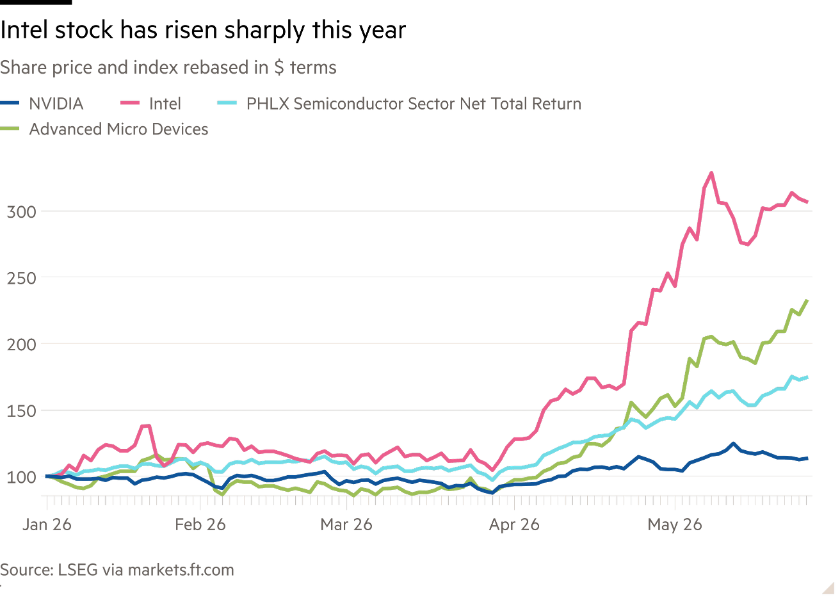
Investors have welcomed the leadership change, after which Tan moved to cut costs and rein in spending on some manufacturing projects. Intel’s shares are up more than 200 percent since the start of this year, part of a broader rally in semiconductor stocks driven by enthusiasm for AI.
Credit: FT
Credit: FT
Kechichian said Intel was assessing whether a version of the chip could potentially be sold in China in compliance with US export controls. Nvidia and AMD’s AI chip sales to the Asian nation have been blocked by trade tensions between Washington and Beijing.
“There are tiers of [the chip] that might be OK there… and we’ll confirm that over time: clearly there is demand for that particular price point in that particular market,” Kechichian said.
In August the US government announced it would take a 10 percent stake in the company over time, as Donald Trump’s administration sought to deter the chipmaker from selling its foundry manufacturing business.
Intel subsequently launched its own advanced PC and server chips built in its own factories this year, after a long period of having them made by Taiwan Semiconductor Manufacturing Company.
Kechichian said Intel hoped to build its new chip in-house, another move that would ultimately make it cheaper than those offered by rivals who rely on TSMC.
“For all data center products we are moving aggressively into our own foundry,” he said. “That’s the intent in general.”
‘Royal Family Leech’ Makes Money Demand from King Charles
Sarah Ferguson is once again at the center of a royal firestorm.
The former Duchess of York, long one of the most controversial figures on the edge of the Royal Family, is being blasted by critics as the “ultimate royal family leech” amid claims she may be seeking long-term financial protection from King Charles.
The alleged demand comes as Ferguson is said to be sitting on potentially explosive information involving her ex-husband, Andrew, and the Jeffrey Epstein scandal that has haunted the House of York for years.
Ferguson, 66, divorced Andrew in 1996, but the pair have remained unusually close. The former couple continued living together at Royal Lodge for years, even as Andrew’s public life collapsed under scrutiny over his friendship with Epstein, the disgraced sex offender.
Now, fresh speculation suggests Ferguson may be weighing whether to accept a lucrative tell-all interview or memoir deal — or quietly secure financial support from the monarchy instead.
According to royal insiders, some figures around the Palace believe Ferguson has repeatedly managed to survive scandal by staying close to the Windsor machine.
“There are people around the institution who see Fergie as the ultimate royal survivor,” one insider claimed, “but also as someone who always finds herself back at the Palace door asking for financial support or protection.”
The source added that the idea of Ferguson receiving a generous private arrangement from King Charles would likely spark outrage among ordinary Britons.
“Critics think the idea of negotiating silence in return for security in the form of a fat annual pension from the King would go down terribly with the public,” the insider said. “She is essentially the ultimate royal family leech, and hard-pressed UK citizens are not fans of freeloaders like her.”
Another royal source claimed there are real fears behind palace walls that Ferguson could reopen one of the monarchy’s most damaging chapters if she ever sat down for a major interview.
“The fear among some senior figures is that any major interview discussing Epstein, Andrew and the York family chaos would reopen one of the darkest chapters of recent royal history,” the source said.
That fear, insiders claim, could make Charles more willing to keep Ferguson quiet.
“He may be likely to effectively buy Sarah’s silence by giving her a pension to shut up for the rest of her life,” the source added.
The latest drama comes after royal biographer Andrew Lownie renewed scrutiny of the York family in his updated book, Entitled: The Rise and Fall of the House of York.
Lownie openly questioned whether Ferguson may be negotiating a private financial arrangement to avoid going public with her side of the story.
“That may be what Fergie’s negotiating at the moment,” Lownie said. “Can she get a nice pension from them and not have to do an Oprah interview?”
The comment immediately fueled speculation that the Royal Family may be facing a difficult choice: let Ferguson talk, or pay to keep her quiet.
Lownie also took aim at Andrew and Ferguson’s daughters, Princess Beatrice and Princess Eugenie, suggesting their place in the modern monarchy has become confusing and awkward.
Beatrice, 37, and Eugenie, 36, remain royal titleholders, but they are not full-time working royals. Still, they continue appearing at high-profile events and are often seen moving in elite international circles.
“The fact that they are still swanning around the Middle East, using their titles… it doesn’t send out the right signals if you want to work your passage back,” Lownie said. “It’s confusing.”
He added that the York sisters appear stuck in a strange royal limbo.
“I think it’s a very schizophrenic relationship at the moment with the royals and Beatrice and Eugenie,” he said.
The renewed spotlight on Ferguson, Andrew, and their daughters comes as King Charles, 77, continues trying to slim down and modernize the monarchy.
But not everyone inside the family is believed to agree on how to handle the York problem.
According to Lownie, there may be two competing camps inside the Palace.
“One minute they’re very publicly being told they’re not going to be invited to Ascot, then they are going,” he said. “You get the sense of distancing.”
He claimed Queen Camilla, Prince William, and Princess Kate are more wary of the damage the York scandals could cause.
“There’s Camilla, William, and Kate, who see the reputational damage and want to keep them at arm’s length,” Lownie said. “And then there’s Charles, who is a bit sentimental and feels obligated to be protective.”
A palace source echoed that view, claiming William and Kate are taking a far tougher line.
“William and Catherine are far more hardline when it comes to reputational risk,” the source said. “There is a belief among some younger royals that the York scandals continue dragging the institution backwards at a time when Charles is trying to modernize it.”
Andrew’s Disastrous Interview Still Haunts the Palace
The York family’s problems have never fully faded since Andrew’s infamous 2019 Newsnight interview with journalist Emily Maitlis.
The interview was intended to explain Andrew’s friendship with Epstein. Instead, it became a public relations catastrophe.
Andrew stepped away from royal duties soon after and has never returned to public life in the same way.
Despite years of controversy, Ferguson has repeatedly defended her ex-husband and remained loyal to him in public. That loyalty has helped keep her tied to royal circles, even after their divorce.
She has continued appearing at family events and royal gatherings, often alongside senior members of the monarchy.
But critics say her continued presence is becoming harder for the Palace to justify.
Lownie’s updated biography also includes fresh allegations about Andrew’s past behavior toward staff and even claims he once kicked a dog during a royal shooting trip.
For a monarchy trying to project stability, dignity, and a cleaner future under King Charles, the York family remains a constant source of embarrassment.
And now, with whispers of tell-all deals, secret negotiations, and alleged pension demands, Ferguson may once again be proving that she is one royal figure who refuses to disappear quietly.
Iran said Monday that a ceasefire with the US covers “all fronts, including Lebanon,” holding the US and Israel responsible for “the consequences of any violation.”
“For immediate attention: The ceasefire between Iran and the US is unequivocally a ceasefire on all fronts, including in Lebanon. Its violation on one front is a violation of the ceasefire on all fronts,” Foreign Minister Abbas Araghchi wrote on the US social media company X.
“The US and Israel are responsible for the consequences of any violation,” he warned.
His remarks came after Iranian Foreign Ministry spokesman Esmaeil Baqaei warned early Monday that Tehran will not hesitate to help Lebanon resist Israel’s “illegal aggression” on the country.
READ: US and Iran remain divided as negotiations continue
Israeli Prime Minister Benjamin Netanyahu ordered the army on Monday to carry out airstrikes in Beirut in renewed escalation despite a US-mediated ceasefire in place since April 17.
Tensions in the Middle East have escalated since the US and Israel launched strikes on Iran in February. Tehran retaliated with attacks targeting Israel and US allies in the Gulf, alongside the closure of the Strait of Hormuz.
A ceasefire took effect April 8 through Pakistani mediation, but subsequent talks in Islamabad failed to produce a lasting agreement.
READ: Netanyahu orders attacks on Beirut’s Dahiyeh despite Lebanon ceasefire
The speed at which the EU is pushing its industry to cut carbon emissions under the Emissions Trading System is “insane,” according to Poland’s deputy climate and environment minister.
Speaking at the POLITICO Energy & Climate Forum in Brussels Monday, Secretary of State Krzysztof Bolesta said the EU was moving too fast to take away free pollution permits for heavy industry — in some cases reducing them by as much as half.
“This is insane. And it’s not one industry branch, it’s quite a few. So for me, this topic is actually something that we need to change,” he said, adding the current trajectory would hand the EU “the moral high ground, but we’ll have no industry.”
The ETS is due for review in July, where the European Commission is expected to soften its trajectory to allow industry to emit more carbon dioxide for longer, in response to intense lobbying from industry and some member countries.
“I’ve had so many conversations around the world [with] industry people, saying, ‘What are you doing? This is insane, what you’re doing with the benchmarks and industrial climate policy,’” said Bolesta, who worked in the Commission’s energy department before joining Polish politics.
EU climate chief Wopke Hoekstra has already said the Commission is open to more free allowances for longer — but has hinted that might come with conditions for Europe’s industry, such as showing they are investing in decarbonizing their processes.
“No One Is Watching”: How Trump Reversed Biden’s Crackdown on Gun Trafficking
Reporting Highlights
Less Gun Enforcement: The ATF referred 30% fewer gun-trafficking charges during Trump’s first year than the year prior. The number of referrals prosecutors declined also rose.
ATF to ICE: Large numbers of ATF agents have been shifted from enforcing gun laws to helping ICE in its campaigns against undocumented immigrants.
Undoing a Crackdown: Trump has reversed a Biden-era crackdown on gun stores that violate the law. There has been a 69% reduction in the number of dealers losing their licenses.
These highlights were written by the reporters and editors who worked on this story.
Marianna Mitchem grew up in the Denver suburbs, where she played high school soccer. One day in April 1999, her team faced off against a nearby rival, Columbine High. The next day, two teenagers went on a shooting rampage at Columbine, killing more than a dozen people.
The massacre left an imprint on Mitchem. After graduating from Providence College, she joined the Bureau of Alcohol, Tobacco, Firearms and Explosives. “Fearing for my friends and watching what was happening — you don’t forget things like that,” she told me. “I wanted to make a difference.”
She started in the ATF’s Denver office as an industry operations investigator, the bureau’s term for inspectors who ensure that firearms dealers are conducting the required background checks on buyers and maintaining sales records. When the bureau found discrepancies, it tended to settle for reprimands and improvement plans, rarely going so far as to revoke a dealer’s license.
In 2021, things started to change. The country was experiencing a surge of deadly violence, with homicides up more than a third since 2019, and the administration of President Joe Biden was desperate to reverse the trend. For years, data had shown that a large share of guns used in shootings came from a small fraction of dealers, and that guns that were trafficked — sold by stores to straw purchasers (people other than the intended users) or resold on the street — were far more likely to be used in shootings.
Acting on this data, the administration in June 2021 announced what became known as “zero tolerance”: Dealers found to be willfully violating the law would lose their licenses, period. Revocations spiked, from fewer than 50 in 2019, 2020 and 2021 to a record 181 in 2023.
Also in 2021, Biden’s attorney general, Merrick Garland, started urging federal prosecutors to prioritize gun violence. A year later, Congress passed a law that added a firearms trafficking conspiracy charge to the federal criminal code, a crucial new tool for prosecutors.
After 2021, the homicide rate started falling, which criminologists attributed to several factors, including repair of the social fabric since the coronavirus pandemic and a closing of the breach in police-community relations that followed the 2020 murder of George Floyd. One other factor got less attention: the clampdown on the illegal flow of firearms.
The Biden administration struggled to broadcast its gains on public safety, and Donald Trump won election in 2024 partly by vowing to restore order. By the time Trump reentered the White House, Mitchem had risen to associate assistant director for industry operations, overseeing inspectors across the country. “We were making incredible progress on trafficking, on violent crime,” she said late last year.
But the Trump administration, driven both by gun-lobby advocacy and its own political priorities, quickly set about undoing much of its predecessor’s moves to combat gun violence. It repealed the zero-tolerance policy, going so far as to invite revoked dealers to reapply for new licenses. It shifted hundreds of ATF agents to immigration work. And it scaled back on prosecutions for gun trafficking. The White House declined to comment, referring questions to the ATF and the Department of Justice.
The homicide rate fell further last year, but criminologists warn against complacency, because the illicit gun trade is a classic pipeline problem: The harm can take a while to make itself felt. Research has found that the typical “time to crime” for trafficked firearms ranges up to about three years, which means that any positive lag of the anti-trafficking efforts of the Biden years would still be in effect now, with any negative effects of the Trump pullback lying in the years to come.
Among those now sounding the alarm is Mitchem. Dismayed at the policy reversal, she left the ATF last spring, after 21 years, and joined Everytown, the gun-safety group founded by Michael Bloomberg.
“Just because no one is watching the trafficking pipelines right now doesn’t mean guns aren’t flowing through it. It just means they’re not being intercepted,” she told me.
“And as you walk away from that, and you don’t have your focus on that anymore,” she added, “that pipeline is going to be flowing, and we are going to start to see the violent crime impact from that over time.”
Estimates put the number of guns in the United States at close to 400 million, but the odds that any of them will be put to ill use rise exponentially if they are obtained illegally. Of the 2.3 million firearms traced from crime scenes between 2017 and 2023, half were bought less than three years earlier and 87% were recovered in possession of someone other than the original, legally authorized buyer. Over that period, stores sold almost 1.3 million guns to traffickers that were subsequently recovered in a crime, according to an Everytown analysis of ATF statistics.
This is why the laws governing gun sales carry such high stakes for public safety. But enforcement of these laws has long occupied an unusual no-man’s-land in this country, scrambling the standard political lines around criminal justice. Conservatives favoring tough-on-crime rhetoric are frequently torn when it comes to firearms trafficking: On the one hand, traffickers are helping fuel the violent crime that conservatives decry; on the other, prosecution of gun laws brushes against tenets that conservatives hold sacrosanct. It is liberals who are more likely to push for tougher enforcement, though they can be conflicted, too, as their belief in stricter gun laws runs up against a general preference for a less punitive approach to lawbreaking.
Marooned in this no-man’s-land for decades now has been the agency assigned the task of enforcing federal gun laws, the ATF. Going back to an episode at Ruby Ridge, Idaho, in 1992, where an ATF investigation of illegal gun dealing led to federal agents killing the wife and son of a white separatist, the ATF has been viewed with scorn by people who otherwise might side with armed government authorities. “ATF IS GAY” read the T-shirt worn by one attendee of a big gun show I attended earlier this year in Manassas, Virginia.
The agency’s radioactivity with the gun-rights lobby has left it on shaky political ground. It went seven years without a Senate-confirmed director. Its budget has not enjoyed the same expansion as that of other federal law enforcement agencies. And stringent laws constrain any ATF capabilities viewed as potentially threatening the rights of gun owners. To comply with a 1986 law preventing the creation of a federal gun registry, for example, the ATF uses software with some features disabled. Steve Dettelbach, who served as director under Biden, joked in a 2024 congressional hearing that the ATF might be “the only customer of Adobe Acrobat that pays money to remove search function.”
Despite these constraints, the ATF has developed its investigative capability. In the 1990s, the agency started sharing with local law enforcement agencies its National Integrated Ballistic Information Network, which collects the unique marks on bullet casings found at shooting scenes. The system has become much more potent as it became easier to share large numbers of images from crime scenes rapidly and compare them against the NIBIN database. The work was boosted further by the creation, starting in 2016, of 25 crime gun intelligence centers to process the data.
Given that a tiny share of the nation’s guns are used in shootings, with many of those used multiple times, the leads produced by the technology can have an outsized impact, said Daryl McCormick, who retired last year as special agent in charge of Ohio and southern Indiana. “It’s crazy how it might spiderweb out,” he told me, “because you have a gun that’s used in three shootings, but in one of those three shootings, there’s a guy that’s linked to three more shootings.”
Starting in the spring of 2020, that technology was put to the test. As homicides rose sharply, so did sales at dealerships. By one estimate, there were 3 million more guns sold between that March and July than would have been expected. Many soon turned up in shootings; the number of guns recovered at crime scenes that had been bought from a dealership less than a year earlier, an especially strong indicator of firearms trafficking, jumped by nearly a third from 2019 to 2021.
Meanwhile, many shootings involved ghost guns assembled from kits, which had begun proliferating a few years prior. Amid other factors driving the killing, the sheer plenitude of weaponry on the streets was pivotal, said Daniel Webster, a gun-violence researcher at Johns Hopkins University. “We know,” he told me, “that a small number of dealers can create a substantial amount of harm, and traffickers as well.”
In the spring of 2021, a 25-year-old man was summoned to help a friend in a confrontation at a low-income housing development in Middletown, Connecticut. It was a petty beef arising from disrespectful comments made to someone’s girlfriend, but Tylon Hardy responded anyway. “He was one of the guys who wanted to protect his community,” his sister, Tianna Hardy, told me later. “He showed up to protect his friend.” After he arrived, Tylon was fatally shot in the back.
A photo of Tylon Hardy in his sister’s house. He was fatally shot in Middletown, Connecticut.Jarod Lew for ProPublica
Guns are tightly regulated in Connecticut, where buyers must first obtain a permit. But this gun had not been sold by a Connecticut store. It had been purchased six days earlier at Smokin’ Barrel Guns and Ammo in Raleigh, North Carolina, more than 600 miles away.
It was a particularly rapid movement up the Iron Pipeline, the name for the trafficking channel from southern states with lax gun laws to northern states with stricter ones. And it turned into a clear example of why trafficking enforcement matters. Investigators obtained camera footage from the shop showing a young man emerging after buying the gun, a Taurus 9 mm pistol, to make a call on his cellphone.
The following spring, the Biden-nominated U.S. attorney for the Eastern District of North Carolina, Michael Easley Jr., produced indictments in the case that started with the camera: Four people were charged with having engaged in a conspiracy to traffic dozens of guns from shops in eastern and central North Carolina. All told, the ringleader had bought more than 100 guns from straw purchasers in North Carolina; 10 of the guns surfaced at crime scenes in Connecticut and New Jersey. The ringleader ended up pleading guilty and being sentenced to more than 10 years in prison; the other three received sentences ranging from 18 months to five years.
Tianna Hardy’s brother, Tylon, was shot with a trafficked gun from North Carolina.Jarod Lew for ProPublica
Easley kept pursuing trafficking cases, poring over spreadsheets full of NIBIN data showing information for every gun traced from shootings in his district. His office would zero in on guns with a short “time to crime” from the initial sale and see if investigators could build leads from purchase records. His team made its interest in trafficking plain to the local ATF division, motivating agents to build cases. “Prosecutors have the ability to send a demand signal to the marketplace of agents, that we have an interest in these and if you bring us the cases, we will push them over the end zone and get convictions,” he told me.
Prosecutors kept getting more encouragement from Washington. In April 2022, the ATF issued a rule decreeing that ghost guns had to conform to the same regulations as regular firearms, including carrying serial numbers and requiring background checks.
Two months later, Biden signed the Bipartisan Safer Communities Act, which got crucial Republican backing from North Carolina Sen. Thom Tillis. In addition to the new trafficking conspiracy charge, the law included a new straw-purchasing charge, expanded background checks for buyers under 21 and funding for states with red-flag laws permitting gun confiscations from those judged dangerous. And a month after that, the Senate confirmed Dettelbach, giving the ATF its first confirmed director since 2015, one who had prosecuted gun crimes as U.S. attorney for the Northern District of Ohio.
Across the country, federal prosecutors took on trafficking cases with gusto. Over the remainder of Biden’s term, they charged more than 500 defendants using the new trafficking statutes; others brought cases using laws already on the books.
In Ohio, McCormick and his ATF colleagues took on a sprawling case that started with a shooting with a machine gun in Avondale, outside Cincinnati, and led to a six-year prison sentence for a 24-year-old man who had made and sold over 80 machine-gun conversion devices; two other men who trafficked the devices to Cincinnati gangs were sentenced to nine and 11 years. As in North Carolina, the Ohio agents were getting encouragement from prosecutors, including Kenneth Parker, the then-U.S. attorney for the Southern District of Ohio. “I made it clear, through my edicts, my announcements to them that we wanted those cases involving violence, that they know how seriously we were taking them,” he told me.
In February, I drove to Raleigh to meet with Easley and visit Smokin’ Barrel — or what used to be Smokin’ Barrel. The shop closed after the ATF revoked its license in early 2023, not for having sold the gun in the Connecticut case, but for an earlier incident, in which the owner sold a gun to an 18-year-old woman, in violation of North Carolina’s 21-year age minimum for buying a handgun. The shop, a small outbuilding adjacent to a used car lot, now sat empty; its fading sign still stood roadside.
Not far away, I found the former owner, Richard Humphries, at his home. He told me how upset he still was over the revocation, especially since, he said, he had self-reported the improper sale.
When I asked him about the Taurus that ended up being used six days later in the Connecticut killing, he initially had trouble recalling it, confusing it with another case in which a man had used a gun bought at the store to kill his wife. What was it like to learn about shootings with the guns he sold? “I hate it,” he said. “I hate that I sold it and he might have used it, but there’s nothing I can, you know …” He trailed off.
I pointed out that in the Connecticut case, investigators had been able to uncover the trafficking ring after tracing the gun to his shop. Was that a good use of resources? “Yeah,” he said. “I mean, they need to be able to do that. But they just, you know, they need to pay more attention to the crooks than people trying to make an honest living.”
I heard similar complaints from other dealers who had their licenses revoked during Biden’s term for transgressions they insisted were mere clerical mistakes. One in Indiana told me that his violations included a mix-up involving an Amish customer’s name; one in South Carolina told me his violations included filling out forms on behalf of elderly customers with shaky handwriting. “If it had been six months earlier, they would have given us a slap on the hand,” he said.
Even some within the ATF had misgivings, worrying that the policy would strain the agency’s relations with law-abiding dealers and make them less likely to offer alerts on suspicious behavior by buyers. “The industry is probably one of the best ways we get information about trafficking,” McCormick, the retired Ohio agent, told me. “But if there’s friction between us and the industry, they’re less likely to report it.”
Gun-safety advocates discounted that risk, saying the policy had both shut down many lawless stores and encouraged countless other sellers to make sure they were complying with the law. “It’s not only targeting bad dealers but sending a message to the entire industry: button up,” Josh Scharff, general counsel of Brady United, told me.
In 2024, revocations rose yet further, to 183. This represented a mere sliver of dealers — only 2% of those inspected that year — but it provoked new ire, not only from traditional lobby groups such as the National Shooting Sports Foundation and National Rifle Association but from ascendant groups of gun owners with even more aggressively anti-regulation stances.
Some dealers challenged their revocations in federal court. In 2023, the ATF revoked the license of a shop in the Phoenix suburbs, Chambered Group, after four inspections in five years turned up a host of violations. The business sought unsuccessfully to block the revocation in court, with a federal judge, Steven Logan, finding that the business had “purposefully disregarded [federal] regulations by repeatedly violating the same regulations despite being given multiple opportunities to cure its mistakes.” In 2024, one of the shop’s co-owners tried to get a new license under a slightly different name, Chambered Custom Firearms, and the ATF blocked him, noting his past role with the revoked store. (A lawyer for the shop declined to comment.)
But after Trump returned to the White House, his administration announced an end to the zero-tolerance policy, urged revoked dealers to reapply and started settling the court cases, one after another. In April 2025, the DOJ informed the court that it had started settlement talks in the Arizona case and a month later alerted it that Chambered Custom had submitted a new application “which ATF will expeditiously process.” It issued the license in July.
In Oregon, a dealer had gone to federal court to challenge the ATF’s 2024 denial of his license renewal for South Valley Firearms in the town of Monroe due to his past conviction for domestic violence. Trump’s DOJ initially contested the dealer’s bid, but early this year, the department notified his attorney out of the blue that his client would be getting his license, after all. “They didn’t give any explanation as to why,” said the lawyer, Leonard Williamson. “They just said, ‘Have him resubmit his application and we’ll give it to him.’”
The end of zero-tolerance was, on its own, hardly a surprise for an administration elected with the strong support of gun-rights and gun-industry groups. What has differed from the first Trump term has been the wholesale shift of resources away from the enforcement of gun trafficking laws and toward the immigration crackdown, both at the ATF and DOJ.
Last spring, the administration began shifting large numbers of ATF agents to a new assignment: assisting with Immigration and Customs Enforcement actions against undocumented immigrants. ICE records obtained by the libertarian Cato Institute in September showed that nearly 1,800 of ATF’s roughly 2,500 agents had taken part in enforcement and removal operations.
While ATF agents were shifted to immigration operations, criminal referrals fell. ATF referrals for common trafficking-related charges, including the two added in the 2022 law, decreased 15% in 2025 from 2024, according to a ProPublica analysis. Asked about the drop, ATF spokesperson Tanya Roman pointed at DOJ prosecutors. “Not every ATF referral is accepted by the [United States Attorney’s Office] for prosecution,” she said in a written response to questions.
Eventually, the shift toward immigration enforcement reached even beyond ATF’s agents to the industry operations investigators who inspect dealers. Terrence Robinson had served in that role for six years, based in Baltimore. He took pride in the work, but soon after Trump’s second term began, Robinson realized it would be a turbulent year for his agency. As part of the push by Elon Musk’s Department of Government Efficiency to shrink the government, the ATF offered early retirement to many of its 800-odd inspectors. In the end, some 125 took the offer, threatening to overburden a corps already struggling to inspect even a sliver of the nation’s 130,000 licensed firearms dealers. “ATF does not comment on personnel matters,” Roman said.
Around the same time, Robinson went to inspect the location of an applicant for a dealership license in Baltimore. The city, long wracked by gun violence, has come to have virtually no licensed dealers within its boundaries; those that remain are mostly in the suburbs. Robinson was startled to discover that this applicant intended to sell guns from his apartment in a building downtown, a few blocks from Camden Yards. Robinson voiced his concerns to his supervisor, who told him that he had to approve it. “According to our rules and regulations now, he passed a criminal background check, and he’s a citizen, so …,” Robinson said. “It’s mind-boggling.”
Most upsetting, though, was the directive that he and other industry operations investigators received in late summer to start spending at least six hours per week on immigration-related work. It was hard to understand what this even meant — their job was to inspect firearms dealers. To comply, he began scouring dealers’ sales records looking for buyers with foreign-sounding names, which were then relayed to the Department of Homeland Security. This struck him as a monumental misuse of resources.
This was what pushed him over the edge and made him decide to take early retirement, too, in September. “I didn’t sign up to be an immigration person,” he said. “I’m just not that.”
Asked about such orders, the ATF’s Roman said: “In support of President Trump’s whole of government approach to combat illegal immigration, ATF is assisting the Department of Homeland Security and other federal law enforcement partners with their immigration enforcement efforts. To ensure operational security and the safety of our agents and partners, ATF does not disclose details or specific numbers of personnel deployments or enforcement activities.”
Now that Robinson was gone, his former team was down from 10 to six, with a temporary supervisor. He worried what the changes at ATF meant for public safety. “I’m not saying I can see the future, but I don’t see things getting better,” he said. “I see things getting worse.”
Terrence Robinson served as an inspector at the Bureau of Alcohol, Tobacco, Firearms and Explosives for six years in Baltimore. The directive that he and other industry operations investigators received in late summer was to start spending at least six hours per week on immigration-related work. This was what pushed him over the edge and made him decide to take early retirement. “I didn’t sign up to be an immigration person,” he said. “I’m just not that.”KT Kanazawich for ProPublica
“Everyone’s been in a little bit of shock about what’s going on,” Marianna Mitchem said last December, speaking from the stage of a conference on gun violence at the Center for American Progress, the center-left think tank in Washington. She described what the ATF had accomplished in recent years, then she laid bare the extent of the pullback now underway.
Mitchem told the advocates that they would have to look to officials in their home states and cities to try to fill the void left by the Trump administration. “It’s up to the states to start tackling this trafficking problem, because unfortunately, you’re not going to have the support of the ATF,” she said.
This has already started happening in a few places. In the suburbs of Philadelphia, a city that suffered one of the worst pandemic-era homicide spikes but has since experienced dramatic improvement, county sheriffs have started doing more inspections of dealers to make up for the decline in ATF enforcement. A member of the conference audience asked Mitchem what else states could be doing to respond. Her answer suggested she wasn’t sure.
“ATF wasn’t always the most widely known agency. I think we sort of liked it that way. We did really, really good work and kept our head down,” she said. “And so now, you’re trying to let everybody know, unfortunately, there are still good people there, but they’ve been redirected.”
In February, Trump’s nominee to lead the agency, Robert Cekada, downplayed that redirection at his confirmation hearing. Cekada is a 20-year ATF veteran, a fact in which gun-safety advocates have tried to take some reassurance. Cekada testified that the agency was continuing to “do dealer inspections uninhibited.”
But ATF has made it much harder for researchers and the public to track that work. It took the administration more than 15 months to release a tally of how many dealer licenses it had revoked: 56 in 2025, down 69% from the year before. Cekada also challenged a report last fall that 80% of the ATF’s agents had been reassigned to immigration enforcement. The reassignment had never amounted to more than 100 agents at a given time, Cekada said. “ATF in those operations has been focused on offenders that were illegally armed with firearms,” he told senators.
But as the former federal prosecutors and ATF agents I spoke with noted, the key question when it comes to the fight against trafficking is whether prosecutors are seeking out cases. After all, the ATF investigates cases, but U.S. attorneys prosecute them. And here the evidence suggests a pullback. A ProPublica analysis shows that in the first year of the Trump administration, the DOJ declined 30% more referrals from the ATF for the main trafficking-related charges than it had the year prior.
Despite the high rate of declinations for ATF referrals, the DOJ last year ended up prosecuting nearly as many gun-trafficking cases from all sources as it had in 2024. But a growing share of the cases, roughly 30%, were under the new trafficking conspiracy charges included in the 2022 law, which since its inception has proven especially useful in cases involving gun trafficking across the Mexican border: About a fifth of all people charged under that law over the course of 2024 and 2025 are in a single district, western Texas. Asked about the rise in declinations of ATF referrals and the shift toward border-related cases, DOJ spokesperson Katie Kenlein said, “The department declines to comment on prosecutorial strategy.”
Webster, the Johns Hopkins researcher, said numbers leave little doubt as to the shift away from general anti-trafficking enforcement. “Everything is diverted,” he said. “It’s all about immigrants.”
On April 29, right after being confirmed as ATF director, Cekada announced 34 proposed rule changes, including requiring dealers to hold records for only 20 or 30 years, not indefinitely, and limiting ATF scrutiny of the state-issued permits that can replace background checks for buyers. “We are proposing to remove unnecessary hurdles that were standing in the way of law-abiding citizens and businesses,” he said, flanked by leaders of the NRA and National Shooting Sports Foundation.
One crucial Biden-era reform has persisted: the clampdown on ghost guns. The 2022 ATF regulation survived a Supreme Court challenge last year, and lawsuits by several cities helped drive the leading producer of ghost guns out of business. Webster and other criminologists note that the reduced flow of ghost guns correlates with a sharply lower rate of shootings by teenagers, who had been heavy users of the guns during the 2020-21 homicide surge.
Even that progress seemed as if it might be at risk. In early April, a joint status report issued to the federal court in Texas where the case originated stated that “ATF has advised that it plans to take agency action to amend the challenged rule” (even though the rule has been upheld by the Supreme Court). A day later, the White House’s 2027 budget called for reversing “the imposition of excessive restrictions on homemade firearms.” But five days after that, the DOJ notified the court in the Texas case that “the government has decided to maintain the definition” that underlies the ghost gun rule. Asked for clarification, the ATF’s Roman said last week: “ATF is still conducting legal reviews for other, more technically challenging rules. If changes are needed following the review, a proposal will be published.” For now, one key valve in the pipeline remains closed.
Investors have spent the last three years asking who will build artificial intelligence (AI).
Nvidia built the chips, Microsoft built the platforms, Amazon, Google and Meta built the infrastructure. Investors rewarded them accordingly, creating trillions of dollars in market value along the way.
This phase of the AI revolution is well understood; the next phase is not. And this is why I believe investors are focusing on the wrong story.
Nvidia’s announcement at Computex on Monday (June 1) generated headlines because of its push into AI-powered personal computers. Analysts immediately began debating what the move means for Intel, AMD, Qualcomm and Apple.
Those questions are understandable. They’re also secondary. The real story is not a new chip. It is that AI is beginning to trigger what could become the first major corporate hardware replacement cycle driven primarily by productivity gains rather than necessity.
That distinction matters. Historically, businesses replaced computers because they had to as machines became obsolete, operating systems changed, security requirements evolved, hardware failed and employees needed newer devices to perform existing tasks.
The coming cycle looks fundamentally different. Companies may upgrade because they believe better hardware can make workers materially more productive.
This has rarely happened at this scale before. The personal computer market has, for years, been treated as mature. Investors stopped expecting meaningful growth. Upgrade cycles stretched.
But AI changes that equation. Executives across every industry are under pressure to deploy AI. Boards are demanding AI strategies. Investors are asking management teams how AI will improve margins, reduce costs and drive growth.
Yet much of the discussion remains strangely disconnected from how productivity is actually generated. AI does not create value simply because a company subscribes to a software platform. It creates value when employees use it effectively.
That’s where the market’s thinking becomes incomplete. The AI boom has largely been analyzed through the lens of infrastructure spending. Investors have become obsessed with GPU demand, data-center capacity and hyperscaler capital expenditure.
Those are important metrics. But they measure the supply side of AI. The next stage will be about demand by putting AI into the hands of hundreds of millions of workers. This opportunity is vastly larger than many investors appreciate.
There are more than 1.5 billion PCs currently in use worldwide. Most were designed before generative AI entered the mainstream. Most were built before AI assistants became capable of writing reports, analyzing data, generating code and automating increasingly complex workflows.
The overwhelming majority of the world’s installed computing base belongs to a pre-AI era. Markets seem remarkably comfortable with that fact. I, for one, am not.
Nvidia plans to launch more than 30 AI-powered PC models. Jensen Huang has described the CPU opportunity as part of a market that could eventually reach $200 billion. Microsoft is embedding AI throughout Windows. Dell, HP, Lenovo, Asus and others are preparing entire product ranges built around AI-native computing.
Collectively, these companies are not preparing for a niche upgrade cycle. They’re preparing for a platform shift, meaning investors should consider the arithmetic. If only 20% of the global PC installed base is replaced due to AI-related capabilities over the next five years, that would represent roughly 300 million devices.
Very few markets offer that scale of potential demand. The implications become even more interesting inside large organizations.
Imagine a company employing 50,000 people. If AI-enabled tools save each employee just one hour per week, the organization effectively recovers more than 2.5 million working hours annually. This is equivalent to adding more than 1,200 full-time employees without increasing headcount.
Viewed through that lens, spending on upgraded hardware starts looking less like a technology expense and more like a productivity investment. This shift in mindset could unlock enormous amounts of capital.
Global productivity growth has remained stubbornly weak across many developed economies for years. Labor costs remain elevated. Management teams are searching relentlessly for efficiency gains. A credible path to higher productivity commands attention, and AI offers one.
Of course, the market consequences could extend far beyond Nvidia. One of the biggest mistakes investors make during tech revolutions is assuming that the most obvious winner remains the biggest winner.
The smartphone revolution created extraordinary wealth for Apple. Yet the broader ecosystem generated trillions more across semiconductors, payments, telecommunications, e-commerce, cloud computing and digital advertising.
The same pattern could emerge with AI.
Memory manufacturers such as Micron and SK Hynix stand to benefit from increasing memory requirements. Enterprise software providers are racing to embed AI into products used by millions of workers. Cybersecurity firms face growing demand as AI creates entirely new risks and attack surfaces.
PC manufacturers themselves may become some of the most surprising beneficiaries after years of being viewed as low-growth businesses. The biggest winners may not be visible or even exist yet.
History rarely reveals the most important beneficiaries of a platform shift at the beginning. Investors who looked at the first iPhone and saw only a mobile phone missed one of the greatest wealth-creation events in modern history.
A similar mistake may be unfolding today. Many investors are looking at Nvidia’s latest PC announcement and seeing another semiconductor story.
I see something much larger. I see the possibility that AI is moving from the server room to the workforce – and that changes everything. Markets have largely priced the first story. They’ve yet begun to price the second.
An OpenAI model solved a famous math problem that stumped humans for 80 years
In mid-May, OpenAI announced that an internal AI model had disproved the Erdős unit distance conjecture, a famous problem in discrete geometry that had stumped human mathematicians for the last 80 years.
OpenAI gave several mathematicians early access to the result and published their reactions. Tim Gowers—who won the Fields Medal, the most prestigious prize in mathematics—wrote that “there is no doubt that the solution to the unit-distance problem is a milestone in AI mathematics.”
University of Toronto professor Daniel Litt wrote that “this is the first example of a result produced autonomously by an AI that I find exciting in itself, as opposed to as a leading indicator.”
It’s arguably the first time that an AI system has found a proof resolving a major open conjecture. That’s impressive, but I don’t view it as a radical break from the previous trajectory of AI progress in mathematics.
When I attended the Joint Mathematics Meetings—the largest annual mathematics conference in the world—in January, I learned that AI systems were starting to contribute to mathematical research, but only in constrained settings. It took significant human interpretation to turn an AI output into a publishable theorem.
OpenAI’s new result is the next step in this progression. The AI model cleverly applied existing ideas drawn from several subfields of mathematics to create a full proof. But it didn’t pioneer any genuinely new techniques. The result has since been cleaned up and extended by human mathematicians.
This points to a medium-term future where human mathematicians and AI models complement each other: AIs have a broader knowledge of past work than any human alive and much more willingness to grind through tedious proof strategies that aren’t likely to work. But humans can still think more deeply about any one problem and ask more interesting questions.
That might not last. AI systems have been improving at math so rapidly that it’s unclear what role, if any, human mathematicians will play a decade from now.
The unit distance problem
Paul Erdős was one of the most prolific mathematicians in history. He wrote over 1,500 papers in his lifetime, the most ever. One of his greatest talents was coming up with problems that are simple to state but have deep roots.
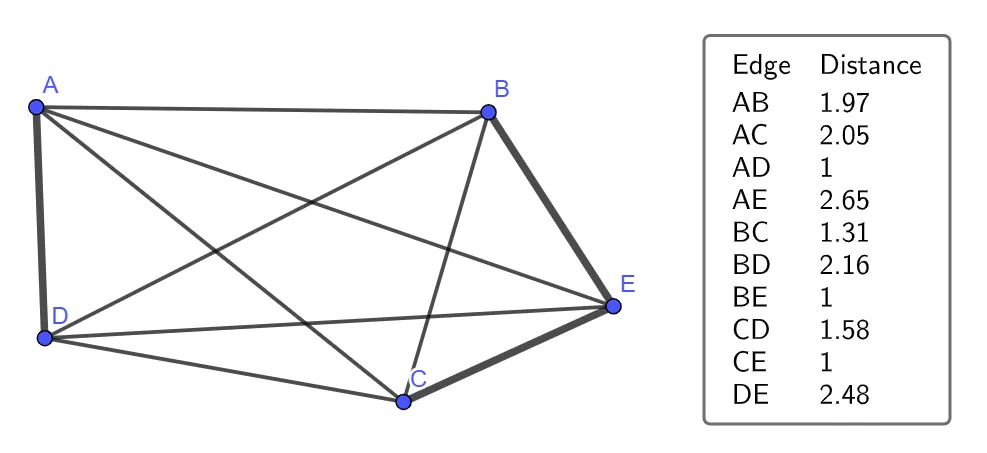
In 1946, he introduced the unit distance problem. Imagine you have some points in a 2D plane and you measure the distance between each pair of points:
Credit: Kai Williams / Understanding AI
Credit: Kai Williams / Understanding AI
In this diagram, there are five points and ten pairs of points. Three pairs happen to be exactly 1 unit apart: AD, BE, and CE.
Can we rearrange the points so that more pairs of points are exactly 1 unit apart?
Yes. For instance, we could move points A and D to be closer to the B, C, and E cluster. With a bit more work, we could further rearrange the points so that there are seven pairs exactly one unit apart. But that’s the most we can do.
We could do the same analysis with 6 points, 7 points, and so on. But as the number of points grows, the problem very quickly becomes too complicated to find the exact answer.
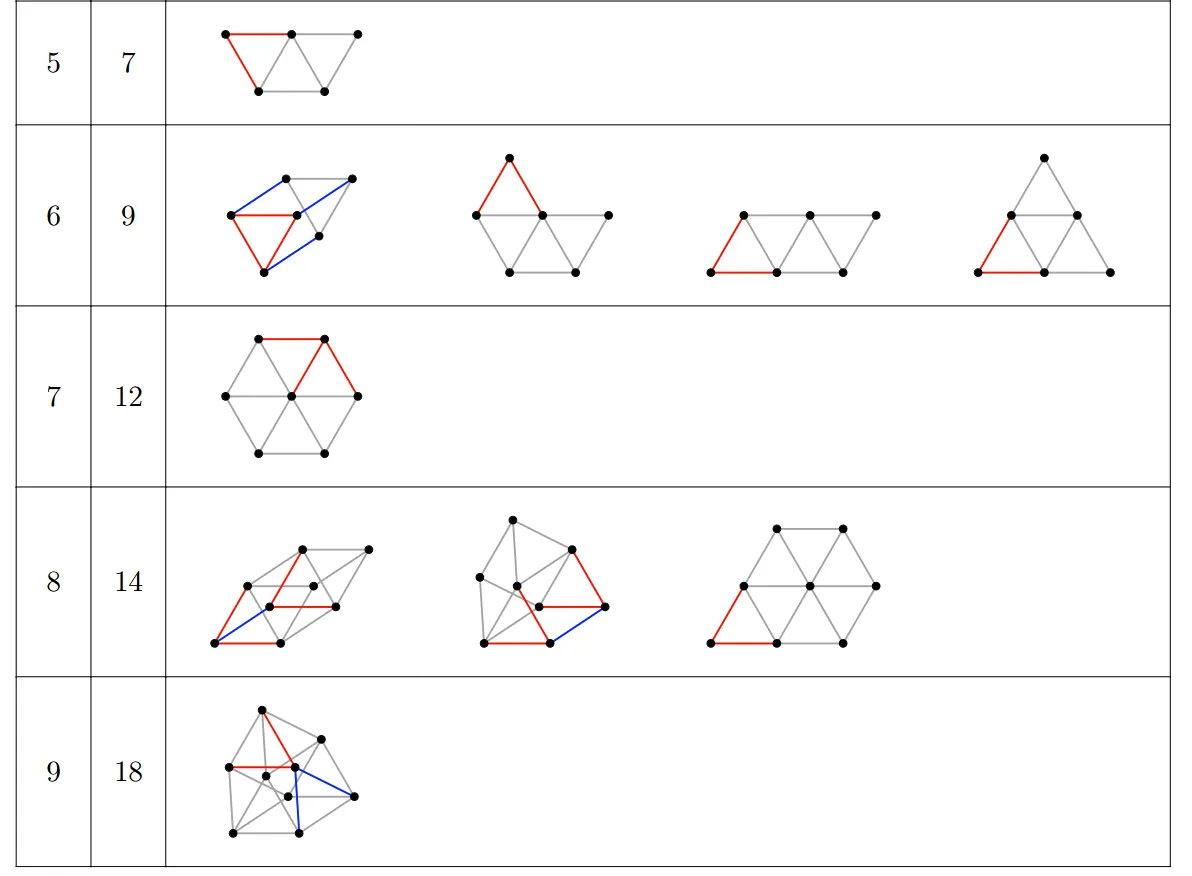
The arrangements of 5, 6, 7, 8, and 9 points that have the most pairs of points exactly one unit apart. Figure from the appendix of “The Erdős unit distance problem for small point sets” by Boris Alexeev, Dustin G. Mixon, and Hans Parshall showing the optimal arrangements for 5 through 9 points. Alexeev et al. give the optimal solutions through 21 points; the question is open after that.
The arrangements of 5, 6, 7, 8, and 9 points that have the most pairs of points exactly one unit apart. Figure from the appendix of “The Erdős unit distance problem for small point sets” by Boris Alexeev, Dustin G. Mixon, and Hans Parshall showing the optimal arrangements for 5 through 9 points. Alexeev et al. give the optimal solutions through 21 points; the question is open after that. Credit: Boris Alexeev et al.
So instead of asking exactly how many unit distances are possible for a given number of points, Erdős tried to calculate upper and lower bounds on the number of length-one lines for npoints, assuming that n is a large number.
To help calculate a lower bound, Erdős assumed that the points would be laid out in a grid. This is probably not the optimal layout, but if he could demonstrate that points in a grid have a certain number of pairs with unit distance, then the optimal arrangement must have at least that number.
If we make the grid smaller, we can intersect more grid points with the unit circle. This gives more unit distances.
Credit: Kai Williams / Understanding AI
If we make the grid smaller, we can intersect more grid points with the unit circle. This gives more unit distances. Credit: Kai Williams / Understanding AI
The simplest option is to space the grid so that every point is distance 1 from its neighbors directly above, below, left, and right. However, Erdős saw that you could do even better if you took diagonals into account. If you make the grid spacing smaller, you can make each point be distance 1 from a greater number of neighbors. In the diagram above, if the grid spacing is 1, then each individual point is one unit away from four neighbors (the left panel). Instead, if the grid spacing is ⅕ (as shown on the right), then each individual point is one unit away from 12 neighbors:
An animation of the distance-one neighbors of nine central points in a 13×13 grid. You can draw similar circles for other points in the grid to get the remaining distance-one pairs, but some points on the circle won’t land on grid points.
Credit: Kai Williams / Understanding AI
An animation of the distance-one neighbors of nine central points in a 13×13 grid. You can draw similar circles for other points in the grid to get the remaining distance-one pairs, but some points on the circle won’t land on grid points. Credit: Kai Williams / Understanding AI
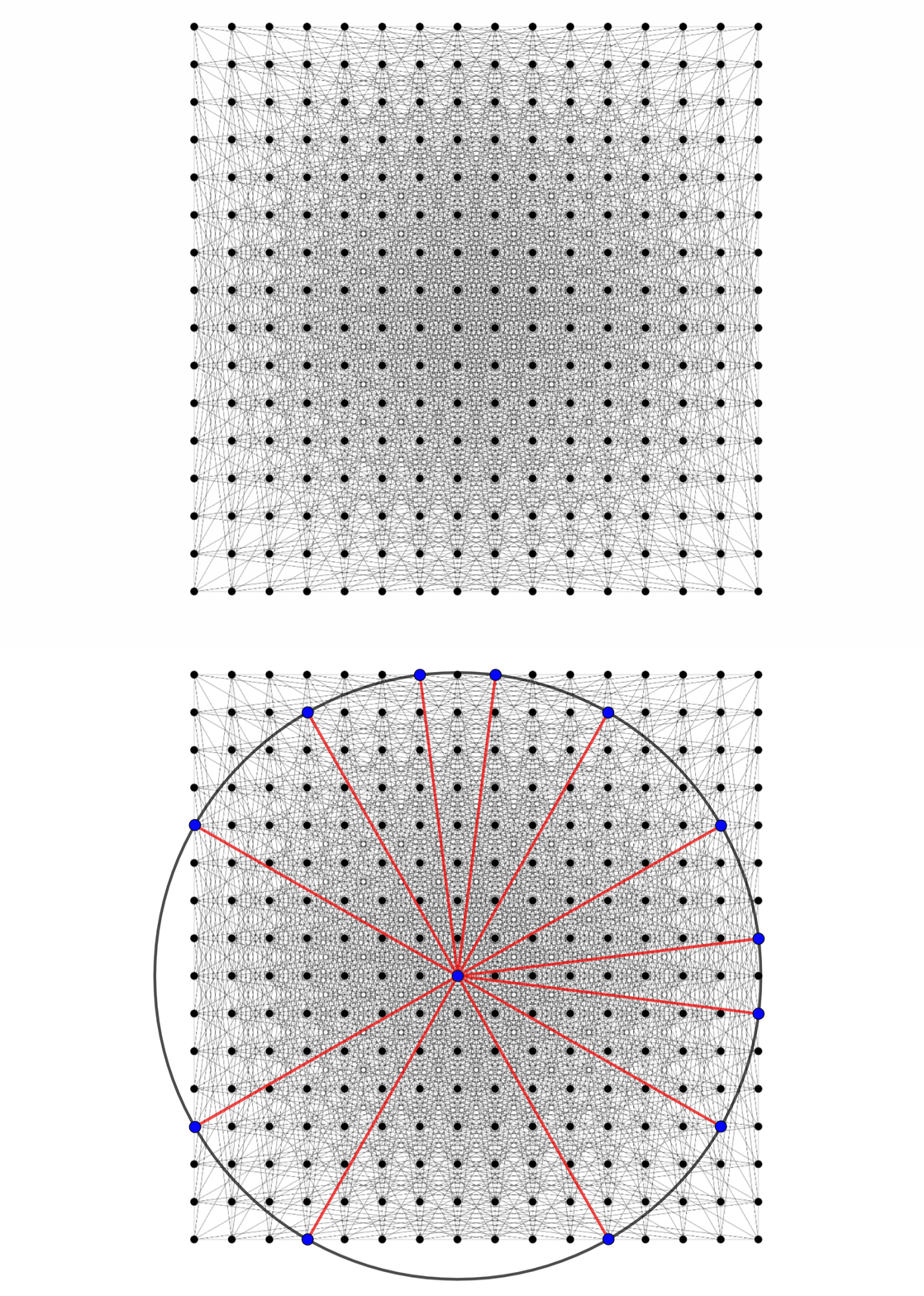
OpenAI’s write-up of its new result included a confusing diagram showing points in a grid with a bunch of lines connecting them. The diagram becomes easier to understand if we superimpose a circle like this:
A diagram from OpenAI’s announcement of the AI’s disproof of the unit distance conjecture, onto which I superimposed a circle showing the distance-one neighbors for one point. The grid spacing here is 1/√65, which produces unit circles that intersect 16 points on the grid (or would if the grid were larger).
Credit: Kai Williams / Understanding AI
A diagram from OpenAI’s announcement of the AI’s disproof of the unit distance conjecture, onto which I superimposed a circle showing the distance-one neighbors for one point. The grid spacing here is 1/√65, which produces unit circles that intersect 16 points on the grid (or would if the grid were larger). Credit: Kai Williams / Understanding AI
This works because of the Pythagorean theorem, which states that if we have a point that is a units to the right and b units above another point, the distance c between those two points satisfies a² + b² = c². The trick is to choose some number c² so that there are a whole bunch of pairs of whole numbers a and b such that a² + b² = c². Then, if we scale the grid down so that each point is 1/c from its neighbors, there will be a bunch of unit distances.
For example, if we choose c² = 25, then the Pythagorean equation can be satisfied by either 0² + 5² = 25 or 3² + 4² = 25. This corresponds to the 12-grid-point circle I showed earlier, with points at (0,5), (3,4), (4,3), (5,0), (-4,3), (-3,4), and so forth. (Technically, these lengths should all be divided by 5 — (⅗, ⅘) for example—but I’m leaving the denominators out for clarity.)
OpenAI’s diagram is based on choosing c² = 65, which can be satisfied by either 1² + 8² = 65 or 4² + 7² = 65. This means that if the grid spacing is 1/√65, each point will be one unit away from 16 other points: (1,8), (4,7), (7,4), (8,1), (-1,8), (-4,7), and so forth. Larger values for c²—if they’re chosen carefully—enable more whole-number diagonals and hence more unit-distance pairs.
However, if c² is too large compared to the number of points in the grid, then many of the potential one-unit-away neighbors will be outside the grid.
In short, we want to choose a c² that’s large enough but not too large. Using insights from number theory, including Jacobi’s two-square theorem, Erdős was able to show that an optimally sized circle will enable the number of unit-distance pairs to grow faster than the number of points, but only barely.
The question became “can you do better?” To find an upper bound, Erdős used an argument from a quite different area of mathematics called graph theory to show that you could only have so many unit distances. But his upper bound grows much, much faster than the best lower bound he was able to construct.
Erdős’s conjecture was that the actual optimum was much closer to the lower bound than the upper one. He predicted, but couldn’t prove, that the maximum number of unit-distance pairs grows just barely faster than the number of points.
To be more precise, Erdős conjectured that the number of unit distances would be n^(1+o(1)). In other words, for a sufficiently large n, the maximum number of unit distances would be less than n^(1+𝜖) for any 𝜖 > 0. That could end up growing a little faster than his lower-bound construction—which was n^(1 + C/(log log n)) for some constant C—but within the same general ballpark.
Proving his guess became known as the unit distance problem. For the next 80 years, it looked like Erdős was right.
Then an OpenAI model proved him wrong.
The AI’s approach
Erdős’s conjecture assumed that, at least for a large number of points, a square grid could yield about as many unit-distance pairs as organizing the points in other ways. OpenAI’s AI proved this wrong by demonstrating that there was another, more complex way to organize n points that allowed more pairs to be exactly one unit apart.
Precisely because the new pattern of points is more complicated, it’s tricky to explain it concisely. But you can think of it as a clever modification of Erdős’s grid.
The AI constructed a grid in a high-dimensional space and then projected this more complex structure into two dimensions. And instead of using a whole-number grid with points like (1,3) or (-3,6), the AI construction used something called algebraic integers to build this more complicated grid. It turns out that this kind of higher-dimensional grid has richer structure, which allows the AI to pack more unit distances into the same number of points.
It’s hard to illustrate this alternative arrangement of points because it only becomes advantageous with a very large number of points. But here’s a simpler arrangement of points that was constructed in a similar way. You can click here if you want to play with the illustration yourself.
It has 1,345 points and only produces 5,916 unit distances, fewer than the 7,632 unit distances that a square 1,296-point grid produces using the Erdős technique. But I think it gives a sense of how a pattern that isn’t a grid could produce more unit distances than a square grid.
A simplified visualization of what the AI model’s arrangement might look like. The 12 red lines emanating from the center are each length one. Click the interactive link to play around with the visualization. Image created with help from ChatGPT, based on an idea by Will Sawin, one of the mathematicians involved in the work.
Credit: Kai Williams / Understanding AI
A simplified visualization of what the AI model’s arrangement might look like. The 12 red lines emanating from the center are each length one. Click the interactive link to play around with the visualization. Image created with help from ChatGPT, based on an idea by Will Sawin, one of the mathematicians involved in the work. Credit: Kai Williams / Understanding AI
The more complicated patterns pay off. While the OpenAI model’s proof does not explicitly state how many unit-distance pairs are possible for n points, human mathematician Will Sawin was able to show that it grows at least at the rate of n1.014. This might seem small, but as n gets really big, this number will become much larger than the counts produced by the Erdős approach.
That being said, the AI’s result doesn’t completely resolve the problem. Our best upper bound for the number of unit distances is around n1.333. More work is needed to close this gap.
How does this result fit into AI for mathematics?
If you’d asked me two weeks ago—before OpenAI’s announcement—about the most novel contributions of LLMs to mathematics, I probably would have pointed to the AlphaEvolve system from Google DeepMind.
AlphaEvolve harnesses LLMs to be the engine of an optimization process. If you can turn a math problem into a piece of code to optimize, which you often can, the LLM might find better solutions than humans have for certain types of problems. In November, four mathematicians (including Terence Tao) released a paper that analyzed AlphaEvolve’s performance on 67 optimization problems across the mathematical literature. They found that AlphaEvolve was able to improve on the established literature in some cases.
This was a step up in autonomy from previous LLM contributions, such as literature review, but it still required humans to frame it as an optimization problem and turn the AI’s output into usable mathematics. And only certain types of problems are amenable to this approach. More conceptual questions that don’t include a number to optimize can’t easily be studied with AlphaEvolve.
So AI companies have been working to develop LLM systems that can directly output a correct solution to any math problem. OpenAI’s result is a substantial step in that direction. But it also fits the pattern of previous AI-assisted mathematics.
For one thing, other companies have also worked to solve Erdős problems. Because Erdős posed hundreds of problems over his career—and because mathematician Thomas Bloom has organized an effort to compile all of them at www.erdosproblems.com—AI companies have used them as a testing ground to evaluate AI systems. In January, Cambridge undergraduate Kevin Barreto worked with a friend to ask GPT-5.2 and Harmonic’s Aristotle to produce the first autonomous solution of an Erdős problem. On May 22, two days after OpenAI’s announcement, Google announced that its AI system had solved nine open Erdős problems, including two that had been open for over 50 years.
To be clear, the problem that OpenAI solved is more impressive than any of the other work I just mentioned. But OpenAI’s solution is more in line with past AI efforts than the headline result might suggest.
One reason the unit distance problem was unsolved for 80 years, despite being so well known, is that most people thought Erdős’s conjecture was true. But the mathematical tools we have are nowhere close to being able to prove Erdős’s bound. So mathematicians expected that any proof of the conjecture would involve major new ideas or approaches.
Instead, as we’ve seen, the AI disproved the conjecture by making an extension of Erdős’s initial construction. It was a clever and nonobvious solution, but it also bore some similarity to the kind of optimization work done by a system like AlphaEvolve.
This dynamic is reflected in some of the mathematicians’ responses. Mathematician Tim Gowers wrote that when he first heard about the AI’s result, he thought it had proved the theorem. “I spent the evening adjusting my world view: If the AI could come up with a proof like that, then maybe it would be all over for mathematicians very soon.”
But the next morning, Gowers and other external reviewers received an email about the result, and he realized that the LLM “had disproved the conjecture rather than proving it, which came as a big relief.”
OpenAI’s solution also had two properties that played to the strengths of AI models relative to humans.
First, the eventual solution relied on applying sophisticated techniques from a quite different area of mathematics: algebraic number theory. AI systems have been trained on huge swaths of mathematics—and there’s a lot of math out there—so they have a broader knowledge of previous mathematical work than any human in the world. For a human to solve this, they would have needed to have the relevant algebraic number theory knowledge while also being interested in the unit distance problem, a rare combination.
Second, the reasoning process was such a grind, and seemingly unlikely to succeed, that most humans would not have thought it worth the trouble. Jacob Tsimerman, a University of Toronto professor, remarked in the OpenAI document that he had briefly considered taking a similar approach to disprove the conjecture. But that type of technique “consumes much time and frequently doesn’t work out,” so he abandoned the project.
An AI, on the other hand, can work through many proof strategies that don’t work out before discovering one that does. OpenAI could have run the problem many times before a model found a solution. Indeed, an OpenAI chart revealed that even with the maximum token budget, the internal model solves the problem only half of the time.
To be clear, what the AI system did is still impressive. “It’s always tempting to look at a completed proof and declare it obvious after the fact,” Tsimerman said later in his remark. But as I noted previously, it also played to the strengths of AI systems.
In the short to medium term, this points to a world where AI models complement humans but do not replace them. AI systems will tackle lists of problems curated by human mathematicians or aid humans in finding relevant approaches from seemingly unrelated mathematical fields. But they won’t immediately displace the human role in choosing which questions to ask or developing wholly new techniques.
Even this result was very much a human-AI collaboration. While the AI system found the proof on its own, human mathematicians verified the result. Other humans came up with better-written proofs that extended the AI’s initial ideas, like Will Sawin finding an explicit lower bound as I mentioned above.
It’s unclear how long this complementarity will last, however. Gowers spent the rest of his comment exploring whether the relief he felt on hearing that AI had disproved the conjecture was justified. He more or less concluded that it was, but in a footnote, he wrote that he would guess “that AI will soon reach a high level at other activities such as building theories, formulating definitions and asking interesting questions.”
In the past year, we’ve gone from AI systems that hadn’t yet beaten high school mathematics competitions to ones that can advance mathematics in interesting ways. It seems likely that AI systems will continue to become more autonomous when working on mathematical problems.
At the same time, we haven’t fully explored what current models can achieve in math. Soon after OpenAI’s announcement, University of Michigan postdoc Xiao Ma found that GPT-5.5 was also able to prove Erdős wrong if given a small hint. If a generally available model could disprove this famous conjecture and no one noticed, what other discoveries could happen today that no one has thought to try?