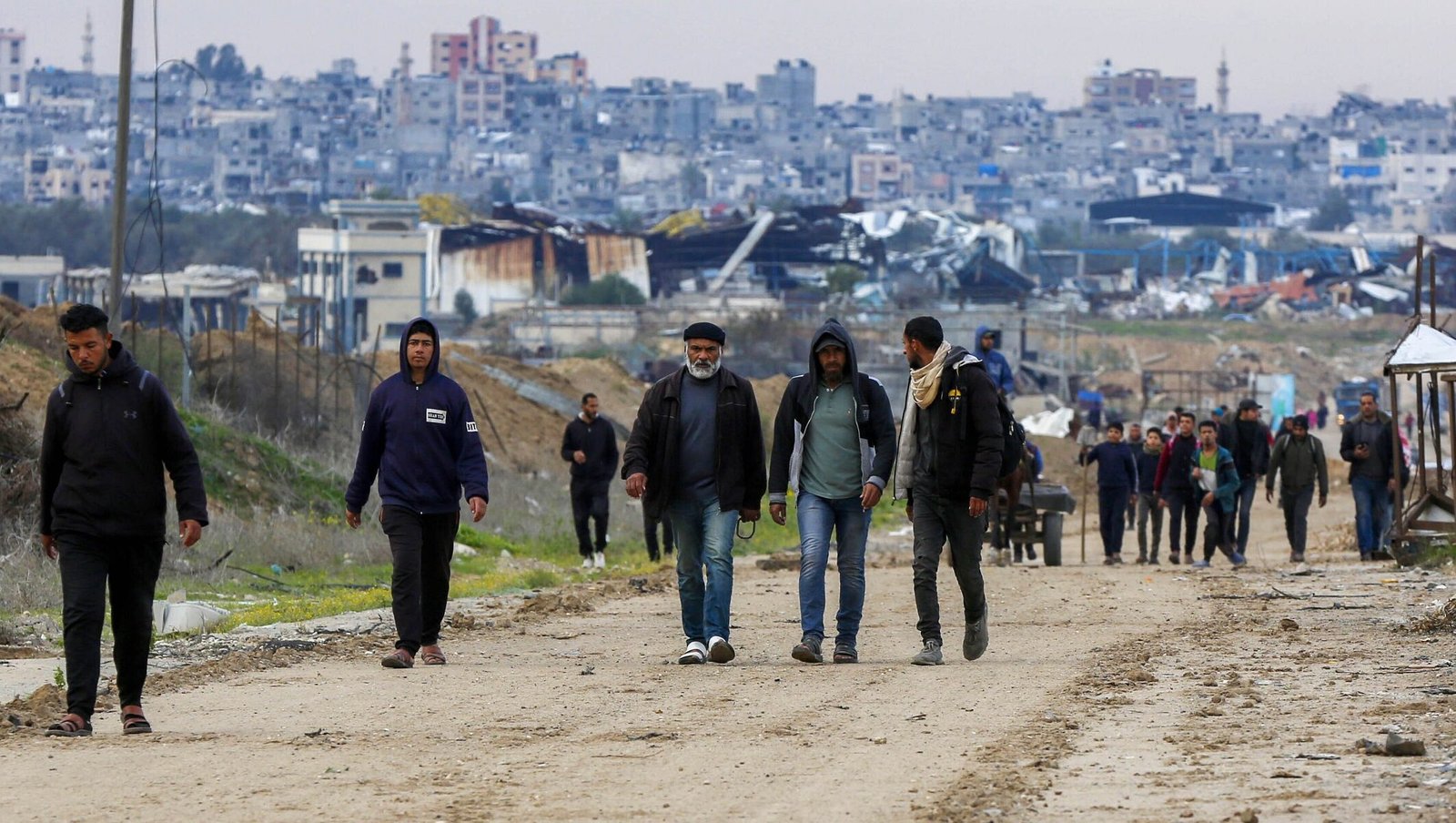
The current status quo, in which Israel remains in control of much of Gaza with Hamas still in power, makes a future conflict between the two imminent
A fragile ceasefire between Hamas and Israel hangs in the balance in Gaza, after Israel killed Hamas’ top military leader on Friday.
The assassination of Izz al-Din al-Haddad was confirmed by both Hamas and Israeli security agencies.
Al-Haddad is seen by Israel as one of the architects of the October 7, 2023, attack Hamas carried out against Israel, which marked the beginning of a regional conflict that engulfed the Middle East.
“This is a significant move,” Ido Zelkovitz, head of the Middle Eastern Studies program at Yezreel Valley College and a research fellow at the University of Haifa, told The Media Line. “This is not only the elimination of the person in charge of Hamas’ military operations, but he also had the knowledge about Hamas’ deployment from the bottom up and was at the heart of Hamas’ organizational memory.”
What we are seeing is Hamas more and more preoccupied with its survival, alongside its natural efforts to keep and develop its strength
“What we are seeing is Hamas more and more preoccupied with its survival, alongside its natural efforts to keep and develop its strength,” Zelkovitz added. “Israel is gradually eliminating all of its leadership, and they are busy running from one hiding place to another.”
According to a statement by Israel Katz, the Israeli defense minister, Israel saw al-Haddad as an impediment to implementing the next stages of the US-brokered agreement.
“He held our hostages captive under extreme cruelty, launched terrorist attacks against our forces, and refused to implement the agreement led by US President Trump to disarm Hamas and demilitarize the Gaza Strip,” according to a statement released shortly after al-Haddad’s death was confirmed on Friday night.
The killing comes amid a deadlock between the sides on the future of the ceasefire. The main point of contention is the demand that Hamas disarm, something the terrorist group refuses to do and Israel refuses to compromise on. Israel vowed to remove Hamas from power when it began its retaliation against the terrorist group in October 2023.
The ceasefire came into effect two years later, in October 2025. Hamas released all of the remaining Israeli hostages, and Israeli forces withdrew from parts of Gaza, retaining a presence along the “Yellow Line,” areas where Israeli forces can still remain, according to the ceasefire agreement.
Last week, Israeli Prime Minister Benjamin Netanyahu said Israel was in control of 60% of the Gaza Strip.
“Today its 60%, tomorrow we shall see,” he told an audience, alluding to Israel’s future intentions.
The current status quo, in which Israel remains in control of much of Gaza with Hamas still in power, makes a future conflict between the two imminent.
According to UN data, humanitarian aid flows into Gaza have steadily increased since the ceasefire. The territory and its population, which were targeted by an intense Israeli military operation, suffered a debilitating blow, and its rehabilitation is estimated to take years.
The humanitarian aid, which is aimed at helping the civilian population, is still being taken over by Hamas
“The confrontation is inevitable,” Sharona Shir Zablodovsky, an expert on public policy and national security at the Dvorah Forum, told The Media Line. “The humanitarian aid, which is aimed at helping the civilian population, is still being taken over by Hamas, which is trading with it, raising funds for its own rehabilitation.”
UN figures show a significant drop in humanitarian aid being intercepted by either Hamas or civilians before it reaches its intended target.
The humanitarian situation in Gaza remains dire. The population is still facing severe shortages of essential supplies, including food, clean water, and medical care. According to recent UN reports, over two million residents are in urgent need of assistance, exacerbated by the ongoing conflict and blockades that hinder aid delivery.
Despite major improvements in the flow of humanitarian aid since the ceasefire, distribution remains inconsistent, leaving many civilians dependent on international support. The continuous military actions and the political stalemate only deepen the crisis, leaving the people of Gaza in a continued state of vulnerability and uncertainty.
Both sides accuse each other of violating the ceasefire, putting President Trump’s ambitious plan to see permanent peace in Gaza at risk. Progress on the plan is being held up by Hamas’ refusal to lay down its weapons as well as continued Israeli presence, coupled with attacks in Gaza.
The American plan, devised by President Trump’s close advisors, Jared Kushner and his special envoy to the Middle East, Steve Witkoff, foresees a future in which Gaza is demilitarized, and a technocratic government is put in place instead of Hamas. According to the plan, these stages should have already begun.
“In reality, we have not seen any steps taken in this direction,” said Zelkovitz. “Hamas has not accepted the basic conditions, and what we are seeing is a gradual intensification of the fighting between the sides.”
Zablodovsky echoed concerns over a worsening trajectory, arguing that the underlying dynamics in Gaza remain largely unchanged, spelling more bloodshed for both sides.
We are reaching a boiling point; the question is when the confrontation will come and what the intensity will be
“We are reaching a boiling point; the question is when the confrontation will come and what the intensity will be,” said Zablodovsky. “As long as Hamas controls territory, with popular support, we are back at square one, and things haven’t changed.”
“Israel’s policy needs to be to use more force and further promote voluntary immigration of Palestinians from Gaza,” she added.
Just weeks after his inauguration last year, President Trump proposed that Gaza’s entire population leave the territory, recommending relocation to neighboring countries while Gaza is being rebuilt. The proposal triggered widespread international backlash and rejection, arguing it would amount to forced displacement and violate Palestinians’ right to remain in their homeland. Supporters framed the idea as a response to Gaza’s destruction and humanitarian crisis. For several of Netanyahu’s senior coalition partners, the idea was a dream come true, bringing them a step closer to their dream of re-occupying Gaza.
A limited number of Gazans have left the territory through evacuation, medical transfer, and emigration channels since the war began. Comprehensive data on permanent resettlement is lacking, but the numbers suggest the trend is not significant.
All the while, Israel is gradually deepening its hold over more territory in Gaza.
While Hamas and others in the international community view this as an Israeli violation of the ceasefire agreement, Israel sees it as a punitive measure against Hamas’ violations–namely, its unwillingness to disarm and allow for a technocratic government to rule Gaza.
“It is also an Israeli statement about its operational intentions, giving it more control over territory that is needed in order to guarantee the safety of its forces in Gaza,” said Zelkovitz. “Hamas has shown no interest in changing the reality on the ground the way the US and Israel want it to change.”
Since the ceasefire, Israel has not only increased its presence in Gaza, but it has also continued to strike at Hamas targets. According to the Hamas-run Gaza Health Ministry, more than 850 Palestinians have been killed since the ceasefire took effect last fall.
In recent weeks, Hamas has made several statements regarding its refusal to disarm.
For now, both Hamas and Israel appear to control the level of confrontation, without significantly escalating the armed conflict between them.
We could see a re-run of what we saw before the war
“We could see a re-run of what we saw before the war,” said Zablodovsky, referring to almost two decades in which Hamas built its strength as Israel turned a blind eye.
The fragility of the ceasefire may not necessarily end in an immediate confrontation, but rather a reality in which Israeli forces remain in Gaza alongside Hamas’ rule of parts of the territory. However, the interplay of military actions, humanitarian needs, and political maneuvering has the hallmarks of a volatile situation that could easily spiral out of control.