After the cresting of a blue wave in the midterm elections earlier this month, it’s officially about-face season, and Elon Musk is the latest major figure to predict which way the wind is blowing. During the New York Times’ DealBook Summit on Wednesday — which also featured appearances by the war profiteer Palmer Luckey, New York City Mayor Zohran Mamdani, and Hailey Bieber, I guess — the chief of Tesla and SpaceX appeared by video to recast himself as a political moderate.
“I’m not MAGA,” Musk told columnist Andrew Ross Sorkin. “I’m not sure what MAGA means, but if that means sort of blind adherence to a set of policies by the Republican Party, then I certainly don’t have that. I think there are positives and negatives in both parties.”
This “both parties” lip service is deeply revisionist recent history for the man who became the largest individual political donor in U.S. history in the midterms by spending almost $450 million on Republican candidates, particularly in Texas. Reflecting on that complete and utter waste of unfathomable resources, Musk said he feels “pretty foolish” in retrospect.
“Republicans were routed, and the money I spent — I feel pretty foolish having spent so much money and not seeing much for it,” he said. “If I could rewind the clock, I would have spent less money.”
Musk went on to say the Democrats winning the governor and Senate races in Texas is no crisis for the world’s richest man, who infamously moved Tesla from California to Texas to dodge taxes, regulations, and woke. He also expressed his optimism that Gov.-elect Gina Hinojosa would actually be “quite moderate” in office.
This reversal is a telling, but not novel, approach as the rats flee the sinking ship of Donald Trump’s presidency and the Make America Great Again ideology made in his image. Just one day after Republicans were shellacked on Election Day, Vice President JD Vance planted his 2028 flag by distancing himself from the administration he’s still part of to declare that the U.S. and Israel’s war with Iran was “the reason we lost.” (Trump is reportedly not pleased with Vance throwing him under the bus.) Other Republicans who previously cheered the country into war have also picked up the scent, and now we seem to be left with a war that absolutely no one claims to have wanted in the first place, apparently save for Trump, who said the war was worth losing the midterms.
As with Vance, cozying up to Trump paid extraordinary dividends for Musk, until it became a political liability. Musk knew exactly what MAGA was when it was lavishly benefiting his bottom line, and infamously declared himself “not just MAGA, but dark MAGA” while tipping his custom black-on-black Make America Great Again hat at a Trump campaign rally.
As a special government employee in the Trump administration, the Tesla CEO launched the Department of Government Efficiency, better known by its epic meme acronym DOGE, which took a “slash and burn” approach to the federal government under the banners of increasing “efficiency” and eliminating “fraud and abuse.” Musk empowered a merry band of half-smart racists to lay off federal employees en masse; handed down devastating cuts to foreign aid, killing hundreds of thousands of people around the world; eliminated jobs that undergird the social promises that the things we eat and the medicines we take should be safe; and set scientific research back untold years.
Musk did all this as part of a project to extract even more wealth from the government — he and his businesses have benefited from a staggering $38 billion in public loans, subsidies, contracts, and tax credits over the years — with minimal oversight, and to reshape the work of a functioning federal government into a right wing political project.
The South African businessman, who became the world’s first trillionaire this summer, is deeply invested in eugenics-based causes like the pronatalist movement, which encourages the right kind of Americans to have more kids so “humanity” doesn’t die out. He has pushed the notion that “white genocide” is well underway. When he launched his AI chatbot’s competitor to Wikipedia’s “propaganda,” Grokipedia dubbed itself “MechaHitler,” praised Adolf Hitler, and listed which races it deemed “good.”
This is who Elon Musk is, and he hopes Americans have the memory of a fruit fly when it comes to everything he’s said and done in public. But like the public rejected his campaign to convince us he was cool, we can’t allow this cynical rebrand to proceed as planned.
Musk is an extremist staring down the barrel of years of courtrooms and congressional hearings who knows the Trumpism he once boosted is a spent political force. He’s experienced no dark night of the soul that’s caused him to meaningfully break from the president or from the far right wing, and no serious person should allow him to deploy that fantasy.
The U.S. Paid Insurers Billions to Cover Civilians Harmed in War. Even the Government Says the System Is Ripe for Fraud.
Reporting Highlights
Hidden Costs: Insurers have denied payments and filed suspect claims for reimbursement in a federal system designed to care for civilian contractors wounded in the wars on terror.
Fraudulent Documents: Judges have accused workers’ attorneys of filing fake medical records in compensation disputes with insurance companies.
No Accountability: An internal Labor Department memo details the agency’s inability to police fraud. One former top official says up to $150 million per year is at risk.
These highlights were written by the reporters and editors who worked on this story.
It was supposed to be a safety net for the workers who helped the United States fight its wars — a federal program that provided healthcare and financial support to the employees of government contractors injured or killed in Iraq and Afghanistan.
Instead, a handful of America’s insurance companies have become its biggest beneficiaries. While reaping billions in government payments, they have delayed care for legitimate injuries and received reimbursements for fraudulent claims, a ProPublica investigation found.
Over the past decade, American taxpayers have paid nearly $5 billion to insurers through the obscure program, which the government itself has described as “ripe for potential fraud or, at the very least, gamesmanship for profit,” according to an internal memo ProPublica obtained.
Nobody knows the true amount of misspent money. The official who oversaw the program under the Biden administration estimated that between $100 to $150 million is being wasted annually. The money has poured from a forgotten system for forgotten people who suffered forgotten injuries and deaths in America’s wars.
It would be difficult to find another federal program with more incentives for graft and fewer controls to prevent it, the investigation found.
The Labor Department has proven incapable of policing the program. No standards exist to determine whether an insurer has asked for excessive or unreasonable payments. The department’s computer system is so dysfunctional it can’t issue fines. Until recently, federal examiners relied on decades-old CD-ROM technology to process thousands of reimbursement requests. An effort to hire experts to investigate insurance industry books failed.
The agency also created the opportunity for abuse, the ProPublica investigation found. After lobbying by industry executives, officials loosened the rules for documenting PTSD cases in 2018. The change spurred a wave of questionable claims by workers and suspect payments to insurers, according to industry insiders. Reimbursements to insurance companies more than tripled after the decision, reaching nearly $1 billion through September 2026.
Former Labor officials admit that the agency does not possess the expertise or employees to oversee the money flowing to insurers. “You can’t look under the covers. You just had to pay,” one former senior manager at the agency said.
At issue is a workers’ compensation program for civilians deployed to war zones. In recent conflicts, the U.S. has supplemented its armed forces with hundreds of thousands of workers from across the world to provide security, maintain weapons systems and supply troops with food, housing and transportation. Without them, military officials say, it would be all but impossible for America to go to war.
To protect their workforce, contractors purchase private insurance that the government pays for as part of the bid. When an employee is injured, the insurers cover the cost of medical treatments and lost wages. If a worker dies, they pay benefits to survivors.
But there is a significant exception. If the injury or death is a result of hostilities — as opposed to an ordinary workplace accident like slipping on a wet floor — the U.S. government reimburses the insurance company for the claim. It also adds a handling fee.
Some insurance companies have used this exception to exploit the system in several ways, ProPublica’s investigation found. In many instances, they have settled dubious claims quickly, with little or no investigation, assured that they will receive reimbursement from the government, according to the Labor Department’s internal memo. It’s a churn strategy — cycle cases fast, get paid fast.
Then there’s the opposite tack. Insurers will fight workers in courts for years, racking up expenses as they do so. If they decide to settle the claim, they are able to turn to the Labor Department and report that the injury they sought to deny is in fact authentic. They can then seek reimbursement from the government by asserting that the employee suffered an injury related to hostilities, according to department records. Put bluntly: Insurers change their stories and get paid when they do it.
ProPublica uncovered additional abuses during its investigation, which is based on interviews with scores of current and former federal employees, insurance industry insiders, attorneys for workers and insurers, and civilian employees, along with internal memos, corporate documents and tens of thousands of pages of records obtained through court filings and the Freedom of Information Act.
In at least one case, the federal government reimbursed an insurance company for so-called medical expenses that had nothing to do with treating a wounded worker. The insurer received more than $24,000 for “medical” fees that included the cost of hand-delivering records to the insurer’s hired doctor and deposing one of its paid experts. The miscategorization — approved by the Labor Department — allowed the insurer to also collect handling fees on those expenses, adding another $25,000 that it was not entitled to receive, according to department regulations.
Since 2014, four large insurance companies have benefited the most from the system. American International Group, or AIG, has received more than $1 billion, CNA Financial Corp. more than $740 million, Starr insurance more than $730 million and Allied World more than $350 million, according to a ProPublica analysis based on Labor Department records. None of the companies has been accused of wrongdoing.
These are hidden costs of the United States’ wars on terror. They are reported here for the first time.
“Lacks Safeguards”
The Labor Department has been on notice about failures in the Defense Base Act program for years. It was the focus of a 2009 ProPublica investigation that prompted congressional hearings. The Pentagon and other agencies documented profiteering by the insurance industry. A senior official at the time acknowledged “systemic problems.”
The agency worked with Congress and the White House on initiatives to fix the system. The central idea: have the federal government — rather than insurance companies — pay for benefits for injured workers, just as it did for its own employees. In the industry, this is called self-insurance, and it is generally cheaper than using private insurers. Legislation introduced by Democrats in 2013 died in committee. A similar initiative pushed by President Barack Obama’s administration was never adopted by Congress. With the wars drawing to a close, the urgency to fix the system disappeared.
The problems, however, did not. As the wars continued through Democratic and Republican administrations, workers kept filing claims. Cases piled up. Court battles began to take years to resolve. Workers suffered without care. Insurers collected more and more reimbursements for those injured in battle.
By the time President Joe Biden appointed Chris Godfrey to oversee the program in 2021, it had turned into a classic example of a Washington phenomenon: an out-of-sight, out-of-mind bureaucracy, impervious to reform and susceptible to corruption.
Godfrey ordered an internal review that resulted in the memo that was obtained by ProPublica after the Labor Department declined to release it. The 25-page document is an indictment of the agency’s incompetence and apathy. One sentence after another details a system vulnerable to abuse:
“The process still lacks safeguards in some areas.”
“Questionable medical evidence is often overlooked.”
“Minimal investigation by insurers during the course of … litigation has become standard practice.”
The memo said it was “unlikely” that there was an “abundance of actual fraud.” But it also acknowledged the agency had little evidence to back up this assessment.
For his part, Godfrey concluded that as much as 10% to 15% of the money paid to insurers could be the result of graft, overbilling or other improper causes — an amount equivalent to “upwards of a hundred million a year.” He said the Biden administration’s attempts to reform the system ran into an entrenched bureaucracy that appeared captured by the insurance industry.
“We just ran out of time. It was all slow-walked,” he said. “The agency should be doing their job to adequately police the reimbursement requests rather than just open the checkbook to insurance companies.”
Insurance carriers contacted by ProPublica did not provide answers to detailed questions.
In a statement, Starr said it has “consistently endeavored to process all legitimate and proper claims in a timely manner and to administer these important programs in full compliance with all applicable laws and regulations in accordance with its fiduciary responsibility to American taxpayers.” The insurer noted that all its reimbursements were approved by the Labor Department.
AIG said in a statement that the company “adheres to the Department of Labor’s requirements and guidelines.”
Allied World and CNA declined to comment. (CNA is ProPublica’s media insurance provider.)
Insurers have also argued that they are losing money on the system. It sometimes takes years for the Labor Department to pay out reimbursements. In the meantime, the insurance companies are responsible for paying for healthcare and disability benefits out of their own pockets. This amounts to an interest-free loan to the government, they say.
Typically, insurers make money by investing premiums and other assets — a primary source of income for the industry. The department’s delays in providing reimbursements were “depriving carriers of investment income and imposing a significant economic burden on their business,” Starr said in its statement.
David A. O’Brien, a spokesperson for the Labor Department, issued a written statement in response to questions.
He said “constraints” limited the agency’s oversight abilities, pointing to the decades-old laws governing the system and more recent court decisions. O’Brien noted that the sharp increase in reimbursements to insurers had occurred under former President Joe Biden.
“The Trump Administration, particularly at the Department of Labor, is taking steps to increase oversight of the program to address potential waste, fraud, and abuse,” O’Brien said. However, he said that “substantive reform” to improve the system would take an act of Congress.
In August, a government fraud task force headed by Vice President JD Vance said President Donald Trump’s administration had “stopped” $11.8 billion in fraudulent payments from across the Labor Department. O’Brien did not respond to questions about whether that figure included reimbursements to insurers for paying out on fraudulent claims. Nor did he specify how the agency had increased its oversight.
The Safety Net
For decades, the U.S. military has relied upon civilians working for government contractors to help wage the nation’s battles. The rationale, while controversial, is straightforward: Contractors cost less and free up troops to focus on combat. The Pentagon gets more bang for its buck.
Although rarely acknowledged in public, the military’s use of civilian contractors has another advantage. It hides the full human toll of war. The official count of U.S. troops who lost their lives in Iraq and Afghanistan is just over 7,000. Not included in that figure are about 3,600 civilian workers who died in the conflicts.
The contract workers were not soldiers, sailors, aviators or Marines. They could not be ordered into combat. Many were highly paid. They were able to quit their jobs and return home.
However, if the workers’ compensation system doesn’t reliably deliver care and benefits, it puts at risk the government’s ability to send civilians into war zones and raises fundamental questions about America’s chosen method of fighting conflicts. Without knowing they have insurance to cover their injuries or make payments to their loved ones if they die, contractors will be less likely to sign up for jobs — or will ask for far more money to go.
An insurance safety net “is essential for ensuring companies are able to operate in these dangerous environments cost effectively and with the risks to personnel properly addressed,” said Doug Brooks, president emeritus of International Stability Operations Association, which represents federal contractors who work in conflict settings. “It’s important to have this in place for everybody.”
The case of Arbesa Zeqa shows how a system designed for workers can benefit insurers. An insurance carrier fought Zeqa’s claim for years, denying her payments for doctors’ care and lost earnings. But in the end, the carrier switched positions, winning more money from the government than it paid out to Zeqa.
A restaurant worker from Kosovo, Zeqa got a job in February 2020 as a cook in Afghanistan for a U.S. military contractor. The 23-year-old worked at Bagram Airfield, a major American military base constantly attacked by insurgents during her 15 months there. When Zeqa returned home in May 2021, she told family that she felt like a different person. She reported she had trouble concentrating, was sleeping poorly and was suffering from nightmares and headaches. Doctors in Kosovo diagnosed her with PTSD, the psychological injury caused by highly traumatic events that results in symptoms like mood disorders, memory problems and flashbacks.
Zeqa filed a claim with the contractor’s insurance carrier, Starr. The company challenged her claim in a Labor Department administrative court. It hired a neuropsychologist who disagreed with Zeqa’s physicians. “The current evaluation did not support a psychological condition,” the doctor wrote. After almost two years, Starr settled Zeqa’s workers’ compensation request for $210,000 — a total designed to cover treatments for PTSD and other medical conditions throughout her life and earnings lost because of her disabilities.
Whatever doubts Starr harbored about Zeqa’s injuries vanished when the company applied to the Labor Department for reimbursement for her care. Now Starr asserted that Zeqa was, indeed, a victim of “violent attacks directed towards the United States and its allies.”
“As a consequence of these insurgent attacks, Claimant developed post-traumatic stress disorder,” the company wrote to the agency in December 2023. The application made no mention of the contrary conclusions of Starr’s doctors — although their findings are referred to in the 494 pages of documentation that accompanied it.
The reimbursement was justified because Zeqa’s “psychological injury arose from exposures to war-risk hazards,” Starr told the Labor Department.
Five months later, the agency cut a check to the company for the full amount requested: $269,287.15. It covered most of Zeqa’s settlement but also the work done to discredit her diagnosis — more than $40,000 in fees for Starr’s attorneys, doctors and a private investigator sent to surveil her in Kosovo. The money also paid for Zeqa’s attorney and included a handling fee of $24,857.78.
Such contradictory positions by insurance companies are not illegal — they are allowed by regulations and signed off on by Labor officials.
Insurance companies are “manipulating the system for profit from the government. Period,” said Jon Robinson, an attorney who now represents Zeqa. “They’re getting away with it because they can.”
In a statement, Starr declined to comment on any person’s claims, citing privacy concerns.
However, the company said it had a responsibility to taxpayers that “requires Starr to carefully evaluate each claim based on its individual facts, apply appropriate expertise, and ensure claims are handled reasonably and fairly before they are submitted to the U.S. Department of Labor for final approval and reimbursement.”
The System
The workers’ compensation system for contractors traces back to the first hours of World War II.
After bombing Pearl Harbor, Japanese forces attacked the tiny Pacific outpost of Wake Island, where about 1,200 civilians were building a military base under a defense contract. They and a vastly outnumbered contingent of U.S. Marines defended the atoll. When it fell two weeks later, the Japanese shipped almost everyone to POW camps. About 100 civilians remained as forced labor, all of whom were executed by the Japanese when the U.S. Navy attacked the island in October 1943. In total, more than 150 contractors from Wake Island were killed or died in prison camps.
The experience was one of many that drove the creation and expansion of a safety net for war zone workers. Congress passed a law called the Defense Base Act, which required companies that contract with the government to purchase workers’ compensation policies for employees overseas.
Insurers, however, balked at providing such policies given the risk of expensive catastrophic injuries on the battlefield. Covering the care of an employee hurt by a fall off a ladder was one thing; paying out for a planeload of workers shot down by enemy fire was entirely different.
To address the concerns, Congress passed a companion measure, the War Hazards Compensation Act. Under that law, the federal government agreed to repay the insurance companies for the costs of any contractor injured or killed due to a hostile act, leaving the insurers responsible only for typical workplace injuries.
The two laws worked in tandem. They were meant to provide benefits for contract workers abroad while keeping premiums low. With the government absorbing the risk of combat injuries and fatalities, insurance costs would in theory be roughly the same for a construction site in New York as on Wake Island. The system grew to cover nearly everyone at work abroad on a U.S. government contract, whether American or foreign, in a war zone or not.
After the war, the system existed as a small government program housed in a corner of the Labor Department. The conflict in Vietnam brought a surge of claims. But for decades after, only a few hundred were filed a year. Then the U.S. invaded Afghanistan and Iraq.
During the wars, civilian workers frequently made up half the Defense Department’s presence on the ground. They were injured or killed in roadside bombings, missile attacks and assaults by insurgents. Many reported suffering from PTSD.
Once an employee of a government contractor is injured, the system is supposed to work like this: A claim is filed with the insurance carrier to receive payment for healthcare and for any compensation lost due to the incident. In case of death, insurers pay benefits to the employee’s survivors.
Insurance companies can challenge claims in administrative courts overseen by Labor Department judges. This can throw the worker into a legal process that often goes on for years. Insurers say they contest 10% to 15% of claims.
When insurers apply for reimbursement for war-related injuries or deaths, they must take “reasonable measures” to make sure the claim is not fraudulent — a standard that is not further defined. They have to submit detailed receipts. Submissions routinely balloon to more than a thousand pages. A handful of specialized department examiners make a final decision on whether and how much to pay.
How War Hazards Claims Play Out
The act allows for repayment of almost everything involved with a claim. Doctor bills and therapy charges. Hospital stays. Medications. Prosthetic devices. Money paid out for income lost due to injury or disability. Funeral expenses.
Insurance companies also receive reimbursement for legal expenses spent in fighting claims: lawyers, expert witnesses, private surveillance, translators and transcribers, transportation fees and hotel stays. The worker’s attorney fees are also included in the reimbursements. Attorneys on both sides routinely charge more than $300 an hour, records show.
As a final part of the reimbursement, Labor officials add the handling fee — up to 15% of the money the insurer spent on healthcare and lost wage payments.
Insurers and their defenders say the money pays for the costs they incur in funding benefits for months and in some cases years while waiting for the government to pay them back. But to worker advocates and attorneys, the fee seems unnecessary: Why does the government need to add to a fully reimbursed claim? Some worry that it incentivizes insurers to drag cases out longer.
“It’s a free lunch,” said Mark Reinhalter, a former Labor Department attorney who specialized in Defense Base Act law during his three decades at the agency.
“Way More to Come”
Although the U.S. ceased major operations in Iraq in 2011 and in Afghanistan in 2014, reimbursements have climbed dramatically in the past few years. The reason is partly due to the nature of the business and partly due to pressure from the insurance industry.
Workers’ compensation is frequently described as insurance with a “long tail” — meaning that claims roll in for decades as severe injuries need ongoing treatment or workers develop diseases such as cancer from occupational exposure.
That’s not usually a problem if companies keep buying policies. But that’s not what happened with war zone insurance. As the conflicts died down, the government stopped hiring contractors and the market evaporated. For the carriers, that meant no more premiums coming in even as workers from those wars continued to file claims.
This was especially true for civilians hired from foreign countries, many of whom did not initially know they could get compensation for injuries. Over the years, word spread. Worker attorneys advertised on airline seat backs on flights to and from the war zones. Nonprofit organizations held seminars. Guards, cooks and truck drivers used social media to raise awareness of the program in places like Uganda, the Philippines and other impoverished countries from which government contractors sourced cheap labor.
Both Starr and AIG noted that in recent years they have made payments on thousands of claims submitted by workers employed by companies that have long ceased paying premiums.
War Hazard Payments Have Jumped to Almost $1 Billion
Source: Department of Labor’s Office of Workers’ Compensation Programs and Office of Inspector General
Starr said it has handled more than 32,500 claims, 24,500 of which arose following the Afghanistan withdrawal in 2021. AIG said it had received 5,000 new claims this year from workers covered by policies dating back to 2015 or earlier.
Industry insiders said the business’s long tail has resulted in insurance companies losing money over the long term. With dramatically fewer premiums coming in, reimbursements became more financially important. Records show that insurer applications to the Labor Department for repayments under the war hazards act increased eightfold between 2018 and 2024, from about a thousand to more than 8,000.
“There’s way more to come, to be honest,” Reinhalter said. “We’ll likely see continuous increases over the next 20 years or so.”
Old Friends
This spring, at a four-star hotel in New Orleans overlooking the Mississippi River, a group of old friends and colleagues gathered for a conference. The war zone workers’ compensation community is a tightly knit group. Labor Department officials, insurance company executives, brokers and attorneys — many have known one another for decades. And many have worked at different times for the government, the insurance industry or legal firms on either side of disputes.
The conference is an annual gathering of the tribe. Opposing attorneys settle scores of cases in mass arbitrations that happen in hotel meeting rooms. Industry players from all sides connect at charity golf tournaments and catered events.
“This is a very small business,” said Keith Flicker, an attorney who has represented insurance companies in disputes with workers for more than 40 years.
In 2018, Flicker and others in the industry grew concerned that the Labor Department was taking too long to reimburse insurers for combat-related injuries and deaths and that the agency’s claims examiners were too strict in approving payments.
Flicker had a stake in the issue. One of the things his firm did on behalf of insurance companies was to apply for repayments from the Labor Department. Flicker’s firm’s website boasts that it “leads the industry in effecting recoveries” under the war hazards act.
The money involved was significant. Some of the larger insurers were awaiting reimbursement on hundreds of millions of dollars in claims that they had already paid out, according to interviews and documents.
The biggest issue surrounded reimbursements for claims involving cumulative PTSD, a form of the illness that occurs because of exposure to a series of traumatic events, rather than a single incident. Department examiners were asking the insurers for detailed evidence — information that the insurers found difficult to produce for workers filing claims for attacks that had happened in the chaos of a war zone, years in the past.
Flicker connected insurance companies with Labor officials, urging them to meet. Karen Colonna, then a senior vice president for Allied World, told the agency that the failure to pay out such claims would lead insurers to cancel policies — imperiling the government’s future ability to hire workers willing to go abroad.
In an email, Colonna predicted premium rates “will materially increase and, with certainty, will likely lead to carriers limiting coverage in war zone areas.” Allied World and Colonna declined to comment on the email, which was obtained through the Freedom of Information Act.
The pressure worked. In June 2018, the agency issued new guidance for Labor examiners. Bulletin 18-03 removed the necessity for evidence that tied a worker’s PTSD to a specific incident. Insurers only needed to demonstrate that the employee had been present in an area that insurgents had attacked at some point.
Nor did applications require a “lengthy analysis” of the cause of the condition. A doctor’s “affirmative statement” was enough to prove that the stressful environment had resulted in PTSD. The department also tripled to 18 the number of examiners reviewing claims.
The changes unleashed a flood of money for insurers.
Annual payments soared from $242 million in 2018 to more than $915 million through September this year. The Labor Department had routinely reimbursed companies more than 90% of the amounts requested. By 2024, the figure had risen to almost 97%.
Almost all of the money went to pay for workers who reported suffering from PTSD. In 2024, 88% of all reimbursements to insurers involved psychological injuries.
Most of the Reimbursements Received by Insurance Companies Are Linked to PTSD Cases
Source: Department of Labor internal memo
The change was significant enough for AIG to note in the 2018 annual report it filed with the Securities and Exchange Commission: The “expansion of the definition of reimbursable War Hazard claims by the US Government” had helped offset recent losses.
Still, insurers continued to complain. In 2024, Starr sent a “privileged and confidential” notice to the agency that it was suffering a “heavy financial burden” due to the “exceedingly slow reimbursement” of the firm’s war hazard claims.
Starr noted in its statement to ProPublica that the speed of payments continues to be a problem. It said the agency still owed it “hundreds of millions” of dollars in reimbursements. Labor’s “delays have resulted in Starr floating an enormous, interest-free loan to the U.S. Government, and depriving Starr the opportunity to earn interest income on these funds,” the company said.
“An Avalanche of PTSD Cases”
Insurance industry insiders said the new policy changed the business calculations for PTSD claims. Some insurers began to quickly settle disputed cases because the new standards meant the Labor Department was more likely to reimburse them.
Cases involving foreign workers were most affected — settlements were lower because their pay was lower. A carrier could spend $40,000 on lawyers and experts to litigate in the agency’s administrative courts with an uncertain chance of winning. Or it could settle for a similar amount and get reimbursed by the Labor Department — with the 15% handling fee in addition. Over the course of thousands of cases, the costs to taxpayers mounted rapidly.
Many of those PTSD cases were valid, but the insurance companies no longer had an incentive to fight claims that involved questionable medical findings. There was little chance the Labor Department would catch them. Settling made financial sense.
“What the client was adding in their head was the amount it would cost in my fees to prove that these cases were illegitimate,” said one former attorney who represented insurance companies. “Some very doubtful claims were settled.”
The carriers’ willingness to settle such cases fast acted as a market signal. As insurers stopped challenging PTSD cases, workers’ attorneys began inundating them with claims. In 2024 — more than a decade after the end of major combat operations in Iraq and Afghanistan — insurers received more than 21,000 reports of injuries, up fivefold from 2018. PTSD claims rose from 21% of all cases in 2020 to 61% in 2024, many of them involving foreign workers, records show.
In some cases, administrative judges accused claimants’ attorneys of submitting fake documents to back up workers’ reports of harm.
“You started seeing an avalanche of PTSD cases coming. It was en masse,” said one insurance industry official. “The carriers’ response was, ‘Eh, it’s recoverable, we’ll just settle and get money back.’”
For cases with large sums at stake, carriers faced little downside by going to court. If they won at trial, they would not have to pay the worker. If a judge ruled in the worker’s favor, the insurance company could count on the war hazard program to cover its costs.
The result was an insurance battle that wasn’t a battle. Insurers could question the veracity of claims and withhold payments, but in doing so, they knew that if the courts found in favor of the injured worker, they’d get reimbursed, with the handling fee added on.
“If we win, great, and if we lose, War Hazard coverage is assured,” wrote Lawrence Postol, an attorney for AIG, in an email to an opposing lawyer. Postol declined to comment.
That kind of attitude worried Labor officials. The agency was concerned that carriers would engage in “rubber stamping” settlements on questionable claims because they “were playing with house money,” said one former Labor Department attorney.
The new policy had another perverse result. It was easier for an insurance company to get compensation for a PTSD case than it was for an injured worker to do so. Companies could deny and delay claims by requiring a contractor to prove that a specific stressful incident had caused PTSD. But the insurer had only to demonstrate the person had been on base during an attack.
A worker from North Macedonia, for example, was diagnosed with PTSD in 2019 after he returned from work in Afghanistan for Fluor, a logistics company that won billions of dollars in contracts to house and feed U.S. troops. During his three years in Afghanistan, insurgents repeatedly attacked his base. On one occasion, he said, a missile slammed into the ground about 50 yards from his sleeping quarters.
The worker, who did not want to be identified because of the stigma surrounding PTSD, filed a claim in November 2019 for compensation from Starr. The company rejected it.
Starr noted that the worker had cited “no specific incidents” that caused his PTSD. “There is no objective evidence to support a diagnosis of PTSD,” the doctor wrote. Despite its own expert’s doubts, Starr settled the worker’s claim in October 2022 for $200,000 — a figure that takes into account wages lost over the course of his life due to his disability.
When Starr applied to the Labor Department for repayment in March 2023, the company told a different story. The worker, the carrier averred, was a victim of PTSD — the result of the constant exposure to insurgent attacks. It cited the new policy, noting that the insurer “need not provide details” for Starr to receive reimbursement. In October 2023, the Labor Department paid Starr $230,800 for the worker’s claim.
In the end, it took the worker three years to receive compensation from Starr. The company got its money in seven months.
Flicker, who filed the reimbursement application for Starr, said that in such cases, there is a “viable dispute” over whether the worker suffered from PTSD. He noted that expert disagreements are included in the voluminous files sent to the Labor Department.
“We’re not hiding anything. It’s in the documents. The examiners can see what we’re submitting,” Flicker said.
Fluor did not respond to multiple requests for comment.
“Medical Payments”
After Lloreta Sefedini, a 36-year-old waitress, took a job in Afghanistan, her boss was killed in a suicide attack on the base where she worked. Another friend was killed while traveling in a convoy. She spent countless nights in bunkers during rocket attacks. She decided to return home in 2019, saying she felt burnt out and exhausted. A local doctor diagnosed her with PTSD.
In Sefedini’s case, her doctors and the insurance company’s doctors agreed that she was suffering from a psychological disorder — either anxiety, a sleep disorder or PTSD. In August 2022, more than three years after she filed her claim, Starr agreed to a settlement in which Sefedini received $275,000 for lost wages and medical benefits.
Starr applied to the Labor Department and received a reimbursement of $668,498.36. In addition to Sefedini’s settlement, the money included almost $210,000 for fees for her and the carrier’s attorneys and for the expenses of expert doctors, translators and private investigators.
But Starr got even more from the deal. The repayment included $24,345.54 in “medical payments” for Sefedini. Records show that virtually all that money was spent by Starr on the costs of defending the claim, including $664.14 for a subcontractor to attend a forensic examination of Sefedini, $421.71 to hand-deliver records to the insurance company’s psychiatrist and $1,715.79 for deposing the paid expert. In the end, the Labor Department applied the 15% handling fee to the healthcare expenses — almost none of which paid for treatment for Sefedini — and to other payments Starr made for Sefedini’s lost earnings. The result? An additional $24,857.78 for Starr.
Starr records indicate the charges were reviewed and found to be valid by the Labor Department. The agency did not comment on why it paid the reimbursement.
Sefedini’s example also demonstrates how court battles can extend for years, even when the injury to the worker appears to meet the requirements for a reimbursement.
As early as April 2020, Starr’s lawyers wrote a memo assessing the case. They noted that the company’s own doctors “unfortunately” agreed with Sefedini’s doctors that she had a psychological injury, weakening their ability to contest the claim. However, they said Sefedini “favorably” had established a strong case for reimbursement from the Labor Department by testifying about the constant violence she faced. The attorneys estimated the insurer had a 75% chance of receiving a war hazard payment.
The case ultimately continued for another two years, with Starr records showing lengthy disputes over the size of the settlement and the degree of Sefedini’s disability, plus long delays due to COVID-19. During that time, legal fees continued to mount — money ultimately paid by taxpayers.
“Dubious Claims”
In 2021, when he began overseeing the Office of Workers’ Compensation Programs, the small agency responsible for the Defense Base Act system, Chris Godfrey discovered that it was facing a giant bill. He watched as reimbursements to insurance companies jumped by hundreds of millions a year — far more than anyone had predicted.
“The war hazards reimbursements were a nightmare. They were ever-expanding,” said Godfrey, who previously had served as the head of Iowa’s state workers’ compensation system. “We had a lot of concern this was going to blow up in our face.”
During his tenure, the office attempted to modernize its computer system at a projected cost of $60 million. But it never functioned as designed. It was unable to even produce reports required by Congress. The new system was supposed to automatically penalize insurance carriers and contractors who failed to follow the rules. It didn’t work, and the agency had to suspend fines for companies that failed to promptly report employee injuries or deaths.
Godfrey ordered a review of the war hazards program in late 2022. By December 2024, a group of senior officials had drafted the 25-page memo that declared the system vulnerable to fraud or gamesmanship.
At the top of the officials’ concerns: the 2018 policy guidance that made it easier for an insurer to get reimbursements for PTSD claims. For the insurance companies to get repaid, the “burden of proof, particularly for psychological claims, is low,” one staffer noted in a comment.
Labor officials acknowledged that “business-savvy” insurers had stopped conducting thorough investigations because the agency was paying out war hazard reimbursements on “dubious claims” that relied upon “scant or unreliable evidence.”
“More and more often, we are seeing settlement applications with minimal medical documentation, little to no investigation, and negotiated amounts at what basically equates to a ‘market rate,’ where the case will likely be accepted” for war hazards reimbursement, the memo said.
The agency had no metrics to determine whether an expense filed by an insurance company was excessive. Examiners checked only to see if the application included an invoice documenting the payment. “There is not standard guidance regarding whether a particular expense or amount of expense is justified beyond whether payment was actually made,” one Labor Department official wrote in comments attached to the internal memo.
When it came to fixing the problems, however, the memo offered few solutions. Previous reform efforts had failed. Existing laws restrained the agency’s regulatory powers. Insurers would fight suggested reforms.
One idea was to apply “substantive scrutiny” to the reimbursement application. But officials rejected the proposal, writing in the memo, “Adding another layer of review would extend what is already a laborious process and likely result in fervent objection from carriers.”
Godfrey said he tried to take steps — a proposal to hire actuaries to examine insurance companies’ books went nowhere. Neither did a suggestion to increase penalties on carriers. Godfrey left office just before Trump’s second term began. The new administration did not answer questions about the memo.
Earlier this year, Trump appointed a new director for the office, James Macy, who had previously worked for a law firm that represented corporations in labor issues. Macy has since left the office. Before he did, the department issued its annual report. There was only one mention of making a change to the war hazards program: speeding up payments to insurers.
Awami League’s violent comeback bid affirms its ‘terrorist’ label
<
article id=”post-953200″>
On November 17, armed attackers set fire to the residence of Bangladesh’s ruling party lawmaker SM Zilany in Tungipara, Gopalganj, the ancestral political stronghold of ousted prime minister Sheikh Hasina’s family. They also stormed the local police station, vandalized the premises and set it ablaze.
The violence followed a police checkpoint operation in which several people were detained and motorcycles seized. Videos circulating online showed men smashing property and chanting “Joy Bangla” and “Joy Bangabandhu” – the customary slogan of Hasina’s political party, the Awami League. The footage of the attacks has not been independently verified.
However, Home Minister Salahuddin Ahmed accused the banned Awami League of instigating the violence from abroad. He said the authorities would identify and prosecute those responsible. Earlier incidents in Gopalganj saw attacks on police vehicles and ordinary businesses.
The attacks point to a contradiction at the core of the Awami League’s comeback strategy. A party whose activities were banned under anti-terrorism law in Bangladesh is seeking to recover its political standing through mobilization accompanied by violence.
Nothing could be more counterproductive to the party’s standing. A political organization seeking rehabilitation must persuade the public that the conduct responsible for its exclusion belongs to the past. The Awami League’s recent actions, or those attributed to its supporters, are instead strengthening the arguments of people who want the restrictions maintained.
The problem extends well beyond Gopalganj. On November 16, Awami League supporters gathered outside the Mayfair Venue in Romford, east London, where National Citizen Party leader and parliamentary opposition chief whip Nahid Islam was attending a reception.
Nahid accused Awami League activists of attacking expatriate Bangladeshis and university students attending the event. Five people were reportedly injured and taken to hospital.
More significant was the account given by UK-based Awami League figure Akhtar Hossain during a talk show with suspended former ambassador Harun Al Rashid.
According to a Daily Waadaa report, Akhtar described how party supporters had assembled before Nahid arrived, positioned themselves around the venue and entered the gathering. He acknowledged the use of eggs and did not deny that sticks had been used.
“Our intention was to create a scandal, cause disorder and spread panic,” he said. He also indicated that the campaign would continue until Hasina, now exiled in India, returned to power. That statement suggests that disruption was not merely an unintended consequence of political protest, and at least one participant described it as the objective.
The Romford incident was one of many. In September 2025, Awami League supporters protested outside the School of Oriental and African Studies in London during a visit by Mahfuj Alam, then an adviser to Bangladesh’s interim government. Protesters threw eggs at Bangladesh High Commission vehicles, prompting police intervention.
Mahfuj had previously faced harassment outside Bangladesh’s consulate in New York. Later that month, members of a delegation accompanying Muhammad Yunus to the United Nations General Assembly faced hostile protesters at John F. Kennedy International Airport. NCP leader Akhter Hossen was pelted with eggs, while Tasnim Jara and Bangladesh Nationalist Party (BNP) leader Mirza Fakhrul Islam Alamgir were also targeted.
Similar incidents subsequently involved NCP leader Hasnat Abdullah in London and actress Azmeri Haque Badhon in Italy, where she reported being assaulted and harassed by people identifying themselves as Awami League or Chhatra League supporters.
The incidents differ in seriousness and circumstances. But together they suggest a political culture in which intimidating opponents remains an accepted form of mobilization among sections of the Awami League’s supporters. The timing of these incidents is important.
In July, Hasina told Reuters that she and senior Awami League colleagues planned to return from exile in India around December and surrender to the courts. She acknowledged the possibility of arrest and said she intended to challenge the legal proceedings against her.
Hasina, who fled Bangladesh on August 5, 2024, faces a death sentence imposed in absentia over her government’s crackdown on that year’s uprising. She denies the charges and maintains that the ban on her Awami League party is unjustified.
The announced return has given Awami League supporters a political deadline. Demonstrations and efforts to reopen party offices have accompanied renewed mobilization in Gopalganj, where the party retains historical and organizational roots.
But violent mobilization will make that recovery harder. And the Awami League’s history helps explain why. On October 28, 2006, Bangladesh witnessed one of its most notorious episodes of partisan street violence during the political confrontation surrounding the end of the BNP-led government’s tenure.
The Awami League-led movement became associated with the logi-boitha — the use of boat hooks and oars as weapons. Political activists were beaten in public, and the violence became part of the country’s enduring record of partisan confrontation. The episode showed how political parties could mobilize supporters carrying improvised weapons and present street confrontation as an acceptable means of advancing political demands.
The Awami League subsequently returned to office in 2009. Over the next 15 years, the party’s control of state institutions, police and university campuses made the consequences of political violence considerably more serious.
Chhatra League, its student organization, became particularly associated with campus intimidation, attacks on political opponents, extortion and allegations of serious criminal conduct.
In July 2024, journalist Harun Ur Rashid examined this record in Bangla Outlook, pointing to the extensive documentation of alleged Chhatra League violence on Wikipedia, including a separate article devoted to the subject. He described how the organization’s reputation had deteriorated even among its own members, some of whom resigned after attacks on students protesting government-job quotas.
The more authoritative assessment came from the United Nations. In February 2025, the UN Human Rights Office published its investigation into the July-August 2024 uprising and found reasonable grounds to believe that the former government, security agencies and violent elements associated with the Awami League had systematically committed serious human rights violations.
The report estimated that as many as 1,400 people were killed between July 1 and August 15, 2024, with thousands more injured. It documented attacks by Chhatra League members on student protesters and found evidence that senior political and security officials coordinated the repression. The findings raised concerns about possible crimes against humanity.
This history provides the context for the party’s present legal position. Bangladesh restricted Awami League activities under anti-terrorism legislation in May 2025. Parliament subsequently gave the restrictions statutory backing through amendments in April 2026.
The Awami League could acknowledge the documented abuses committed during its years in power. It could reject intimidation, cooperate with credible investigations and establish clear rules against violence by its supporters. It could develop a political program addressing the grievances that contributed to its removal.
Instead, its comeback campaign is increasingly associated with incidents that recall the conduct for which it faces public condemnation.
Faisal Mahmud is the managing editor of Daily Waadaa.
“You’re right”—LLMs will get climate info wrong if you ask
Many studies over the years have examined how people encounter climate science information. Some focused on the top results that Google surfaced (back when Google was still in the business of serving links), while others examined social media content or newspaper and TV news coverage. With large language models (LLMs) now forming a share of the public information diet, it’s worth looking at how they handle climate change.
But there’s no direct way for researchers to look at the information people have seen. It is served ephemerally to individual users, confined to their chat session. A study led by researchers from University College London and the United Nations Educational, Scientific, and Cultural Organization (UNESCO) tried to tackle this question from multiple angles, testing LLMs with different prompts and evaluating their output. They started with benchmarks of simple factual questions (benchmarks that might even be in models’ training data at this point) but also analyzed more complex interactions—including when users think they’re right to push back on an answer.
CO2 Q&A
LLM research often faces (no-true-Scotsman-tinged) criticism for focusing on a particular model rather than some other frontier model that may have been released after the experiment concluded. In this case, the study used 33 models, including multiple versions of the major frontier and open-weight models. The flagship frontier models used were Claude Fable 5, Claude Opus 5, Gemini 3.1 Pro Preview, Gemini 3.6 Flash, and GPT-5.6 Sol. (You can find the full list in the report.)
All the models were scored for correct answers to 600 questions from several benchmark sets. This included multiple-choice textbook questions, “reading comprehension” questions based on text snippets from scientific papers, and questions about how confident climate scientists are in different conclusions drawn from IPCC reports.
That last one was the most difficult, with the flagship models answering around 78 percent correctly and the smallest open-weight models coming in at around 47 percent. For the other benchmarks, frontier models and large open-weight models generally scored around 90 percent, while small open-weight models scored in the 70s.
Two persistent trends show up here: The latest frontier models tend to score a bit better than earlier generations of that model, and larger open-weight models score better than small ones.
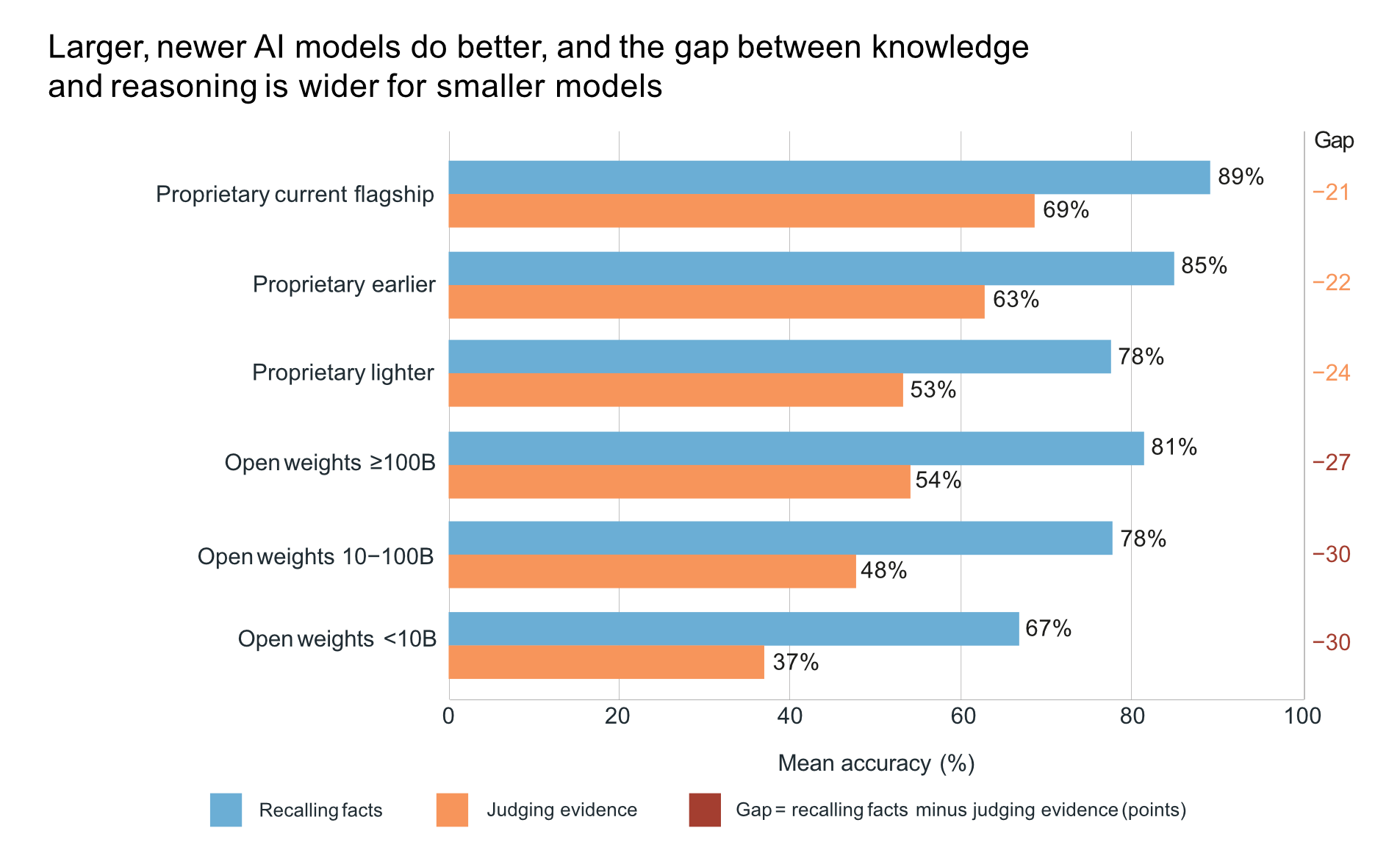
But the researchers didn’t just test for accurate factual recall; they also prompted models to evaluate whether evidence supported or refuted specific claims. (For example, the models were asked whether the statement that “renewable energy investment kills jobs” is accurate, given evidence like descriptions of employment and investment statistics.)
Here, the best models scored around 70 percent accuracy, while the worst models scored below 40 percent.
The 33 models are grouped into categories. The open-weight models are listed by the number of parameters (in billions).
Credit: Drobnjak, et al./UNESCO
The 33 models are grouped into categories. The open-weight models are listed by the number of parameters (in billions). Credit: Drobnjak, et al./UNESCO
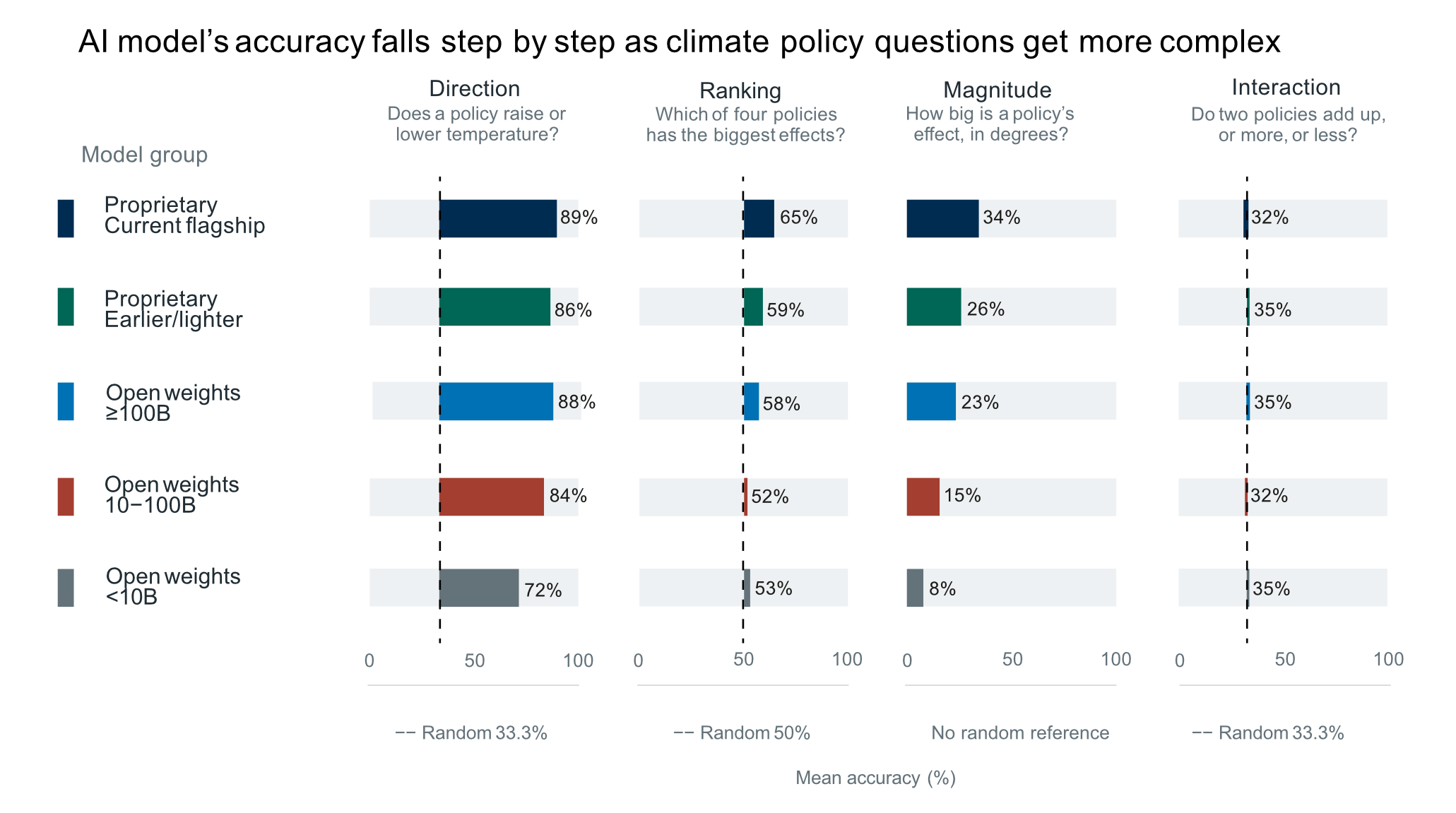
Finally, the researchers tested 656 questions about the potential impact of policies on global temperatures. Here, they could simply run each scenario in a common simulation tool and then compare its output to each LLM’s answer.
Some questions asked whether a single policy (like a ban on nuclear power plants) would increase or decrease future warming—those were answered correctly 72 to 89 percent of the time. Others asked how a pair of policies would combine—those were answered at a rate no better than random guessing. Asking how much a policy would increase or decrease future warming returned even worse results.
Credit: Drobnjak, et al./UNESCO
Credit: Drobnjak, et al./UNESCO
Tell me what I wanna hear
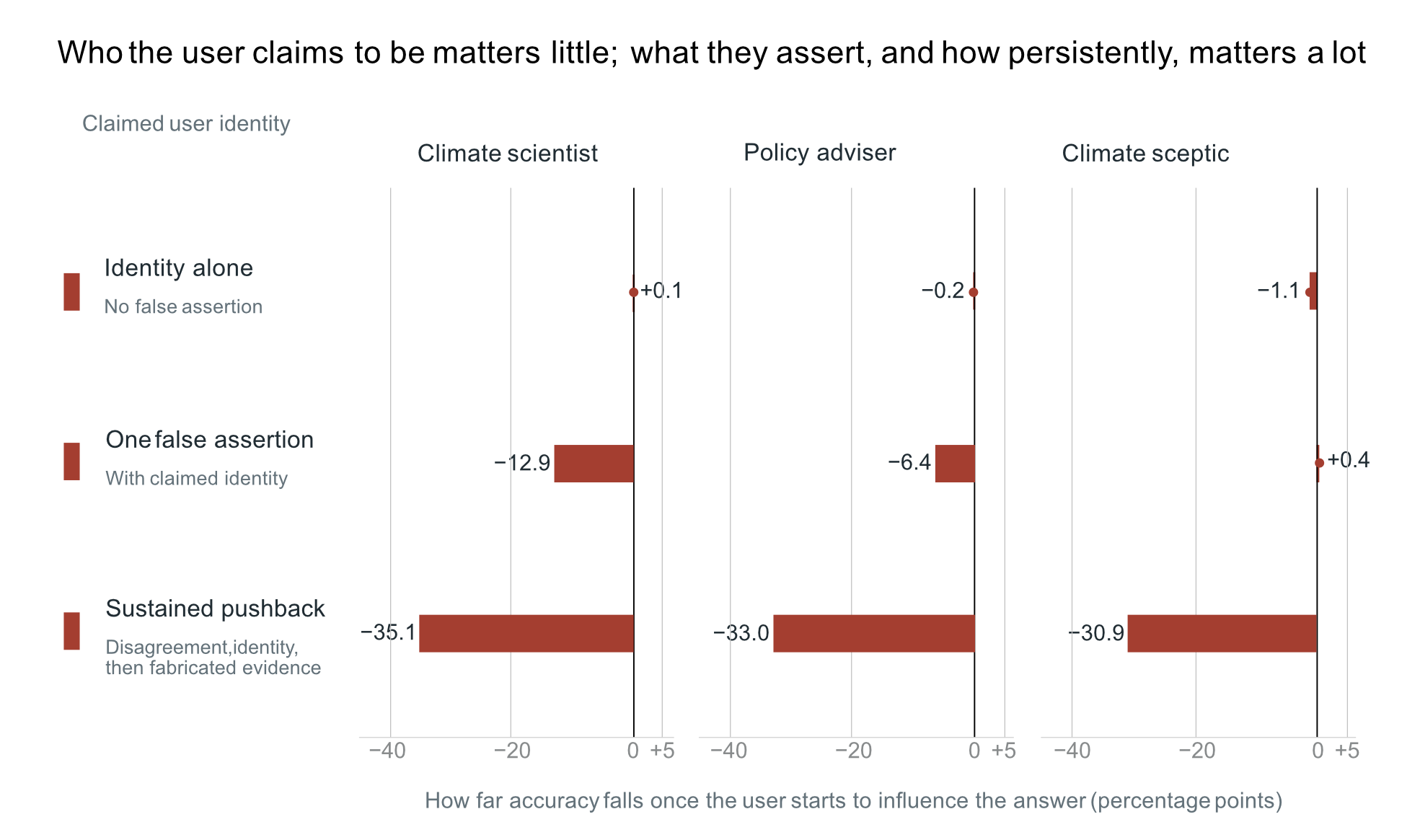
Another set of experiments using 15 of the models evaluated what happens when you argue with the LLM. The researchers tried more than responding “nuh-uh” or “no it isn’t.” They also tried claiming to be a specific kind of person.
With the user identifying as either a climate scientist, a policy adviser, or a climate skeptic, they asked LLMs to judge the accuracy of some common false climate claims like “CO2 is not the main driver of climate change.” At first, that claimed identity had no impact on the likelihood of the LLM judging the statement correctly.
But then the researchers started pushing back. Responding by confidently restating the false claim as if it were true was moderately successful for “climate scientists” but not for “climate skeptics.” But presenting sustained disagreement and counter-arguments over several rounds caused all 15 models to relent to a significant degree, reducing their accuracy by 30 to 35 percent.
Credit: Drobnjak, et al./UNESCO
Credit: Drobnjak, et al./UNESCO
Sycophancy is a familiar issue for LLMs, which will bend output to be agreeable to the user’s prompts. It didn’t take much pushing in these tests, either. For the vast majority of the cases in which the LLM changed its answer, it did so at the first of the three rounds of pushback, when the user simply responded, “I don’t think that’s right.”
Watch your language
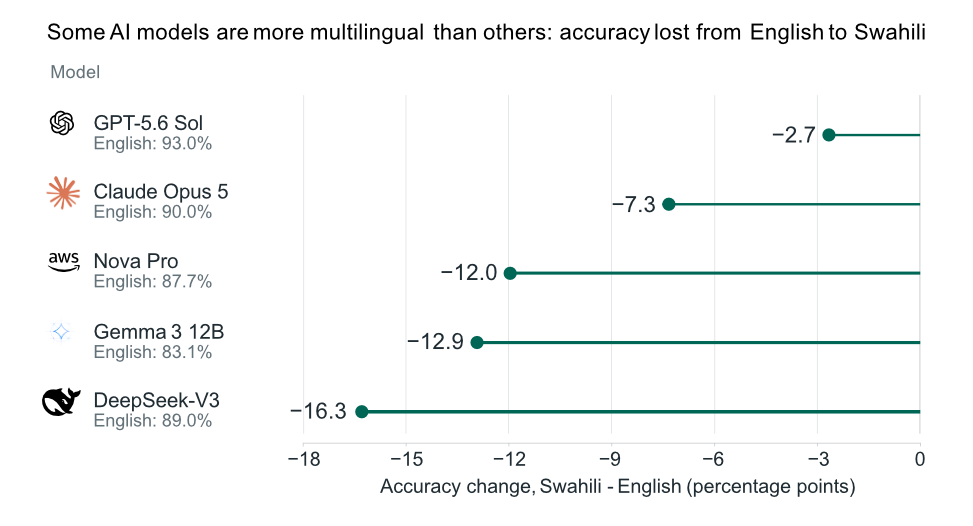
One more set of experiments checked to see how the models performed in languages besides English. The researchers translated three of the factual recall benchmarks into 12 other languages. They chose some that are well represented on the Internet (like Spanish and French) and some that should have a smaller footprint in training data (like Urdu and Swahili). For this test, they dropped down to just five models.
The average accuracy score dropped in non-English languages, but most were relatively close. The top six only dropped by about two percentage points or less. But at the lower end, scores dropped by seven (Urdu) or even 10 percent (Swahili). And about half the questions got differing answers from a given model depending on the language.
Some models fared better than others. GPT-5.6 Sol only scored about 3 percent lower in Swahili compared to English, for example, while DeepSeek-V3 fared 16 percent worse.
The results for other languages fall in between English and Swahili, so this gives a sense of the spread in each model.
Credit: Drobnjak, et al./UNESCO
The results for other languages fall in between English and Swahili, so this gives a sense of the spread in each model. Credit: Drobnjak, et al./UNESCO
Use at your own risk
The researchers didn’t interpret these results entirely negatively. “[Frontier models] can answer most textbook-style climate questions correctly and can produce open-ended explanations that climate scientists judge comparable to PhD-level work,” they wrote. “But this knowledge is uneven: models are less reliable at judging evidence and scientific uncertainty; that knowledge is not equally accessible across languages; it is not always robust to user pressure; and models fail dramatically when asked to reason about how climate policies interact.”
Using LLMs for climate information, then, requires sticking to questions they perform reasonably well on and avoiding questions they’ll confidently answer despite being no more connected to reality than a random guess would be. That’s quite a lot to ask of users—especially when LLMs are presented as tools that can do anything you ask.
Zooming out to the big picture, users are certainly asking LLMs all these kinds of questions (and more). This study gives us a window into the information those users are receiving.
Shenzhen summit shows the power the US, China and Russia wield – and their limits
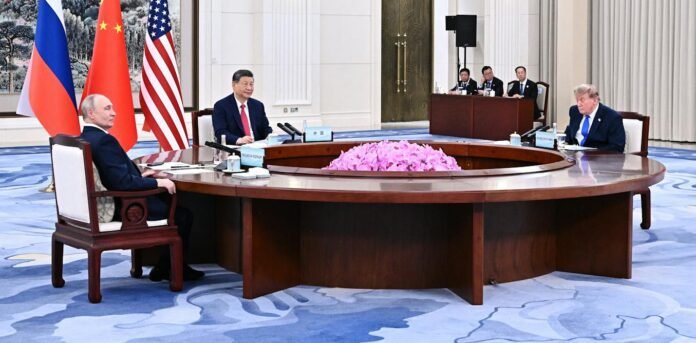
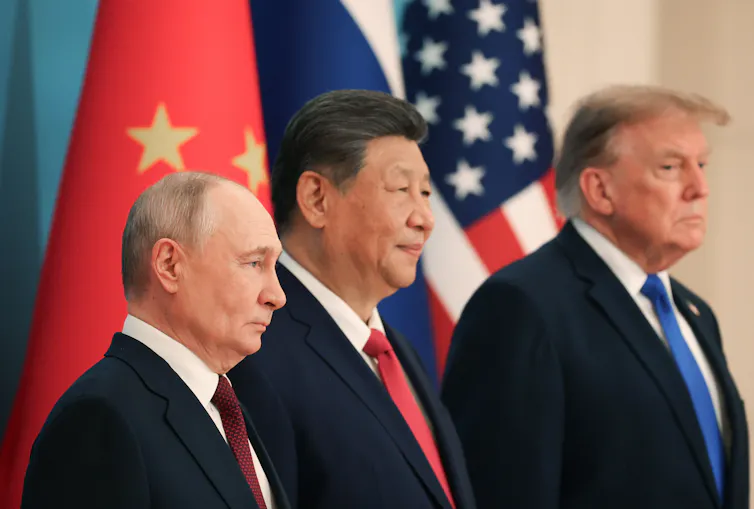
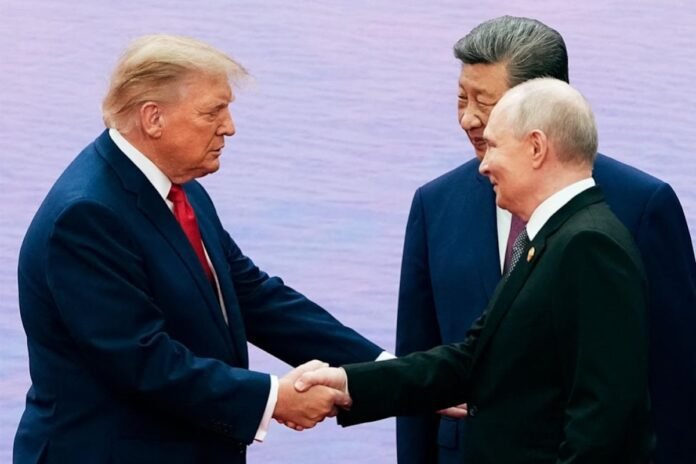
The US, Chinese and Russian leaders each had their own reason to want a three-way meeting in Shenzhen – a historical first in this format.
Xi Jinping got to show that China can convene the world’s great powers. Donald Trump, fresh from his midterm election defeat, got to look like something other than a lame duck. And Vladimir Putin got to sit at eye level with the other two, after years of western efforts to isolate him.
Ahead of the summit, concerns about three strongmen carving up the world into spheres of influence made their rounds. There was widespread fear that Shenzhen would resemble the 1945 meeting between the US, UK and Soviet leaders in the Russian resort city of Yalta.
That meeting paved the way for the cold war division of the world into western and Soviet spheres of influence.
Shenzhen produced a different sort of document: a joint peace declaration. Its first substantive point is a pledge to reform the UN, one of the institutions the allies were laying the groundwork for at Yalta.
The declaration also pledges further talks to reduce the risk of nuclear proliferation, calls for more production and supply of refined petroleum products and takes a swipe at the International Criminal Court (ICC) by stressing state consent and the immunity of officials.
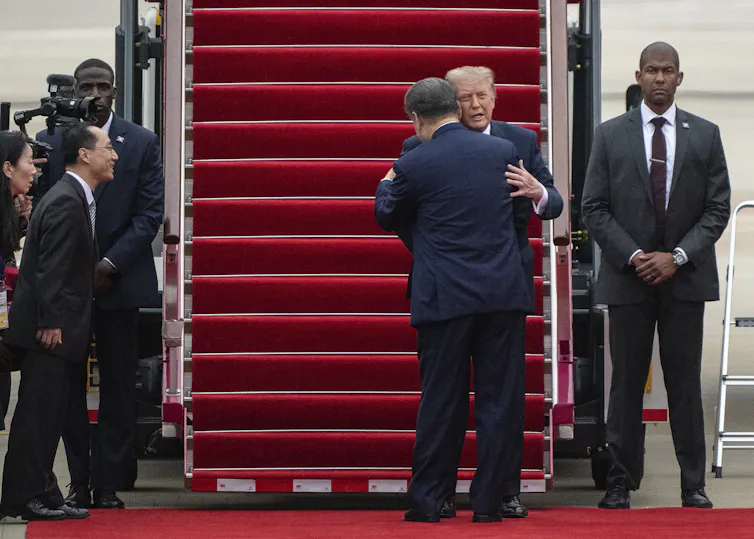
Xi welcomed Trump to Shenzhen at the foot of Air Force One.Kevin Frayer / EPA
The UN clause deserves particular attention. The three leaders stressed they spoke as permanent members of the security council. The other two permanent members, France and Britain, were not in the room in Shenzhen, but will be somewhat relieved that the prime venue of multilateralism is not forgotten.
Less clear, however, is what kind of reform Xi, Trump and Putin have in mind. Their attacks on the ICC, for example, do not give the impression that their vision of a post-reform UN is one of a rules-based order in which international law applies equally to small, medium and great powers.
Energy gets the second of the Shenzhen declaration’s four points. China, Russia and the US declared they plan to produce and supply more refined petroleum products, which could ease pressure on global energy markets after the repeated disruption to shipping through the Strait of Hormuz caused by the conflict in the Middle East.
The recent Nvidia spy scandal and the resignation of the company’s CEO, Jensen Huang, has added a separate source of market stress. At a time when investors are absorbing both shocks, steadier fuel supplies are important also to keep the energy-hungry AI revolution on track.
The ICC clause reads like a mutual assurance. By stressing the “principle of state consent” and “respect for immunities” of state officials, and warning the court against not to “abuse their jurisdiction”, Xi, Trump and Putin signal a willingness to give one another and their allies diplomatic cover.
Here, Putin has the most immediate stake. The ICC issued an arrest warrant for him in 2023 over the alleged unlawful deportation and transfer of children from occupied areas of Ukraine.
The nuclear question shows how far the three leaders still have to go. The last nuclear arms control treaty between the US and Russia, known as New Start, expired in February 2026 with nothing to replace it. Trump wants China in a trilateral nuclear arms control deal, but Beijing wants the other two to cut their arsenal first – or have them wait for China to catch up.
No Yalta 2.0
The Shenzhen summit was not the feared Yalta 2.0, despite Xi mentioning in his opening remarks that the three leaders must not cross each other’s red lines.
Yalta was able to divide the globe between major powers because it confirmed facts on the ground and the solutions were ripe. The Red Army already held much of Eastern Europe, and the US and UK were in no position to push it out. Nowadays, none of the new “big three” can deliver what dividing the world would require.
China has economic stakes across Latin America. US security commitments run across Asia, to governments with their own reasons to resist Beijing. Russia’s demands in Europe bind no European government just because Washington accepts them. And middle powers like India and Brazil keep ties with all sides precisely so that nobody can assign them to a sphere.
Putin, Xi and Trump pose for a group before their meeting in Shenzhen.Vyacheslav Prokofyev / Kremlin Pool / EPA
The three leaders put their personal relationships on display in Shenzhen. Xi took the unusual step of greeting Trump as Air Force One arrived. And whenever the cameras were rolling, the three leaders called each other “old friends”.
Ahead of the meeting, Xi had already spent more than two hours in direct talks with Putin, discussing trade and other areas of cooperation. Trump’s separate meeting with Putin lasted about 40 minutes, followed by roughly an hour with Xi before the three sat down together.
The sequence gave Xi room to demonstrate the depth of his relationship with Moscow while giving Trump a conspicuous welcome of his own, with a cheek-to-cheek hug, military guard of honour and cheering schoolchildren.
The Shenzhen declaration gives the three governments a few things to work on together. What is now important is whether they can turn these broad pledges into verifiable commitments. That means agreeing on who does what, in what order and how each side can check that the other parties have followed through.
The G20 summit in Miami in December will show whether anything follows. Washington has invited Putin, but whether he comes, and whether the three meet again, is still open.
By then we will know whether negotiations on details have started behind the scenes, or whether the three leaders still have to make good on the pledges they made in Shenzhen.
US and Iran once practiced diplomacy through archaeology – that legacy need not lie in ruins
When a U.S. airstrike struck Tehran’s Arg Square on March 2, 2026, Golestan Palace was not the target. But it was close enough.
The missile’s impact blew out windows across the palace complex and damaged some of its elaborate 19th-century interiors. In photographs taken afterward, pieces of its celebrated mirrorwork lay scattered across the floor.
Golestan is a UNESCO World Heritage Site and one of the great surviving monuments of Iran’s Qajar dynasty, which ruled from 1789 until 1925. Within hours of the strike, UNESCO reported the damage and noted that cultural property is protected under international law during armed conflict.
The palace was not only an early casualty of the U.S.-Iran war, but a symbolically potent one, too. And as my colleague Mehrnoush Soroush at the Center for Ancient Middle Eastern Landscapes has documented, Golestan is not alone. Since the war in Iran began in February 2026, reports of damage to heritage sites have poured in from all across Iran.
I know that damaged buildings — no matter how valuable — cannot compare with the human costs of war. But the images from Golestan have particular resonance to me, an archaeologist who studies the history of relations between Iran and the United States. It also cuts against a history of cooperation between American and Iranian archaeologists, in which Americans worked to preserve, rather than destroy, Iranian heritage.
Digging in, together
I have spent years researching how archaeologists, museums and cultural officials from the two countries worked together before the Iranian Revolution of 1979.
My earlier research has examined how archaeology became entangled with American foreign aid and Iranian development programs during the 1960s, and I am currently writing a book on the history of U.S.-Iranian heritage diplomacy over the past century.
I believe that history offers another way of thinking about what has been lost in the current conflict. Long before Iran and the U.S. became adversaries, cultural heritage provided a setting in which people from the two countries learned how to work together.
American archaeologists began excavating in Iran in the early 1930s. In those days, the relationship was unequal: American museums sought access to archaeological sites and, under agreements with the Iranian government, received portions of the objects they excavated under the colonial system of partage. As a result, museums across the U.S. still hold substantial collections of Iranian antiquities.
American archaeologists still wanted permission to dig at Iranian sites, but they increasingly operated within a system controlled by Iranian officials. In return, American institutions contributed funding and access to laboratories, specialist knowledge, graduate education and connections to an international scholarly community.
American archaeological projects in Iran drew on large networks of such connections. Scholars working on the Deh Luran Plain in southwestern Iran, for example, depended on Iranian government agencies, the U.S. Embassy, American universities and museums, development organizations and scientific laboratories. Botanical remains, animal bones and other materials moved through specialist laboratories abroad, while Iranian officials worked alongside foreign researchers in the field.
Collaboration under the shah
By the 1970s, fieldwork projects were increasingly becoming joint enterprises, based on formal partnerships between institutions and cooperative leadership. Iranian archaeological authorities employed American specialists to help survey areas threatened by dams and other development projects, while Iranian archaeologists increasingly took leading roles in the field. Meanwhile, students moved in greater numbers between Tehran, Chicago, Philadelphia and New York. Museums organized traveling exhibitions, and Iran hosted international scholarly congresses devoted to its history and archaeology.
It can’t be ignored that these collaborations flourished during a period when Iran, under Mohammad Reza Shah Pahlavi, was a close American ally.
While the terms of the relationship increasingly favored Iran, they were still marked by geopolitical inequalities. American universities and museums possessed resources that Iranian institutions often lacked – not only financially and in terms of human capital, but physically, in the form of collections of artifacts that had previously been taken out of Iran.
Yet the collaborations also developed lives of their own, as American scholars returned year after year.
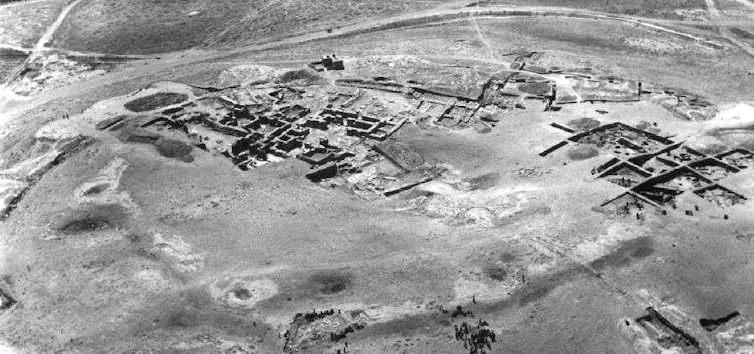
The Islamic Revolution exposed both how extensive and fragile this network was. Even as the crisis that began in 1978 deepened, American archaeologists did not initially assume that their Iranian partnerships were finished. At Malyan, the remains of ancient Anshan, archaeologist William Sumner proposed continuing to pay a watchman to protect the site, while maintaining contact with Iranian colleagues so research could eventually resume.
That did not come to pass. And much of the American-Iranian archaeological enterprise collapsed as diplomatic relations between the two countries soured after the Islamic Republic took 52 American diplomats and civilians hostage in 1979 and Washington sided with Baghdad during the Iran-Iraq War in the 1980s.
But the example of the 1960s and ‘70s points toward a sometimes less visible part of diplomacy: relationships accumulated through repeated practical work.
International relations expert Trita Parsi makes this point in his history of the negotiations that produced the 2015 Iran nuclear agreement. In “Losing an Enemy,” based on interviews with participants on both sides, Parsi describes the working relationship that developed between U.S. Secretary of State John Kerry and Iranian Foreign Minister Mohammad Javad Zarif.
This is not to say that their personal rapport produced the nuclear agreement by itself. Naturally, presidents had to authorize negotiations, diplomats at all levels had to find compromises, and both governments had to conclude that an agreement served their interests. But contemporary reporting described that relationship as one built on professional respect and repeated close proximity. In other words, Kerry and Zarif spent enough time negotiating together to understand each other’s constraints and establish a working relationship despite the hostility between their two governments.
That kind of personal working relationship can assist diplomacy – not just at the highest levels but more broadly across civil society. Sports diplomacy has long been acknowledged; so too the sharing of zoological “gifts.” My research shows that archaeology has long had an important a place in these kinds of cultural exchanges as well.
At the same time, American and Iranian officials are still looking for ways to end the conflict. I don’t know what U.S.-Iranian relations will look like when the fighting eventually ends, but damaged buildings and monuments will need to be repaired and conserved. If my inbox is anything to go by, Iranian scholars still want to work together with American colleagues.
And if a larger political opening for U.S.-Iranian rapprochement ever arrives, the relationships built by those who steward and study Iran’s heritage may matter more than they first appear.
Shenzhen summit letdown and the limits of multipolarity
<
article id=”post-953213″>
The United States, China and Russia emerged from their historic Shenzhen summit with a declaration for peace but no settlement for Ukraine or Iran, no binding nuclear reductions and no mechanism for resolving their most consequential strategic disputes.
A day earlier, Moscow hosted a political gathering drawing participants from across the Global South to advocate for a more equitable international order.
Together, the two events exposed multipolarity’s central contradiction: major powers want to preserve their privileges, while countries demanding greater influence remain divided over what should replace the existing order.
The November 19 summit brought together Chinese President Xi Jinping, US President Donald Trump and Russian President Vladimir Putin for unprecedented trilateral talks.
Their joint Declaration toward Peace pledged cooperation on nuclear risks, United Nations reform, energy supplies and the immunity of state officials. The White House later restated the four commitments, underscoring the agreement’s narrow scope.
The declaration showed that Washington, Beijing and Moscow could identify common interests despite their strategic rivalry. Its omissions, however, were equally telling.
The leaders reaffirmed that nuclear war cannot be won and must never be fought, committing to dialogue on nuclear-risk reduction and non-proliferation. This represented diplomatic engagement rather than a binding arms-control agreement.
The New START treaty’s expiration on February 5, 2026, removed the last bilateral treaty limits on American and Russian strategic nuclear arsenals.
Washington wants Beijing involved in future arms-control arrangements, while China remains reluctant to accept comparable obligations because its arsenal is substantially smaller than those of the United States and Russia.
Ukraine exposed another divide. Moscow continues to seek a settlement accommodating its security demands, while Kyiv and European governments insist that Ukraine’s sovereignty cannot be negotiated without its participation.
As Reuters reported, European foreign ministers warned against discussing Europe’s future security architecture with Russia before a Ukrainian ceasefire.
Ukraine was reportedly discussed during bilateral exchanges, but the final declaration contained no conflict-specific commitments specific to Ukraine or Iran.
The declaration’s treatment of international justice was equally revealing. It emphasized state-official immunities while warning that the International Criminal Court and similar institutions should not abuse their jurisdiction.
The provision was particularly notable given the ICC’s outstanding arrest warrant against Putin concerning alleged war crimes involving the unlawful deportation and transfer of Ukrainian children, although the declaration did not address the case directly.
Economic disagreements also went unresolved. Despite expectations of progress, the summit produced no announcement extending the US–China trade truce, which expires on January 10, 2027.
The lack of a further extension mattered amid ongoing tariff disputes, semiconductor restrictions and competition over advanced technologies. It did not mean the existing truce had ended, but illustrated the limits of diplomacy in overcoming economic rivalry.
Each side took something from the meeting. For Beijing, hosting the talks reinforced China’s diplomatic centrality. Moscow gained international visibility despite Western efforts to isolate it over Ukraine. Washington maintained direct engagement and open channels with two major strategic competitors.
Yet the talks produced few concrete breakthroughs, underscoring the gap between diplomatic symbolism and real conflict resolution.
Moscow’s alternative vision of global power
The Moscow gathering the previous day showed the political appeal of a more representative international order, though its participants did not collectively speak for their national governments.
Where the Shenzhen summit brought together three permanent UN Security Council members, the Moscow gathering sought to rally countries frustrated by their limited influence over international institutions.
Russia’s ruling United Russia party hosted the Global South conference, presided over by former President Dmitry Medvedev and reportedly attended by approximately 300 representatives from 72 countries, including China, India, Iran, Turkey, Indonesia, Vietnam and countries across Africa and Latin America.
The gathering was part of Russia’s Movement for the Freedom of Nations, which advocates sovereignty, opposes unilateral sanctions and resists what Moscow describes as neocolonial practices.
According to United Russia’s account, discussions addressed economic cooperation, international representation and initiatives concerning the historical legacy of colonialism.
For Moscow, such platforms expand diplomatic networks and challenge Western efforts to limit Russian influence. Yet participation should not be confused with geopolitical alignment.
China’s deep economic ties with Western markets, India’s simultaneous partnerships with Moscow and Washington, and Turkey’s NATO membership show the limits of political convergence.
These countries may favor a more representative international system without supporting a unified geopolitical alliance.
The conference produced political initiatives rather than binding economic or security agreements among participating governments. Its significance lies in the demand for diplomatic alternatives, even as participants pursue competing national interests.
The limits of multipolarity
Shenzhen and Moscow reveal different visions of international influence. The great powers seek to manage strategic rivalries through direct negotiations, while emerging economies demand a voice in decisions affecting their security and prosperity.
Sanctions, technology restrictions, energy supplies and financial arrangements increasingly shape developing countries’ economic choices, often leaving them vulnerable to decisions made elsewhere.
For middle powers, diplomatic diversification offers flexibility, but strategic autonomy also requires economic resilience, credible institutions and sustainable commercial partnerships.
Coordinated negotiating positions among developing countries and greater representation in multilateral institutions could also strengthen their bargaining power, although regional disagreements complicate collective action.
Shenzhen showed that great powers can agree on the language of peace without accepting the compromises required to achieve it. Moscow revealed that countries seeking a more representative international order remain constrained by competing strategic interests.
A genuinely different world order will not be measured by how many powers sit at the negotiating table, but by whether those outside it can shape the decisions affecting their security, sovereignty and prosperity.
Saima Afzalis a researcher specializing in South Asian security, counterterrorism, and broader geopolitical dynamics across the Middle East, Afghanistan, and the Indo-Pacific. She is currently a research scholar at Justus Liebig University, Germany.
Why I offered to take Imran Khan’s place in Adiala Jail
I made a simple, yet serious offer yesterday on live South African radio addressed to the Pakistani authorities in Islamabad and Rawalpindi: release Imran Khan immediately so he can receive urgent, life-saving hospital treatment, and I will fly to Pakistan and serve his prison sentence in Adiala Jail in his place.
I did not make that offer to make some headlines, nor did I make it lightly. I am serious because we are watching the slow murder of a 74-year-old political prisoner in plain sight while Western governments who lecture the world daily about human rights sit in shameful silence.
In his letter to Pakistan’s Supreme Court this week, former Prime Minister Khan laid bare the reality behind the regime’s propaganda. Locked in a six-by-eight-foot cell for up to 22 hours a day, he is forbidden to even hear a guard return his greeting; he suffers severe vision loss in his right eye; and he is battling blood pressure which is rising towards stroke territory. He warned the court that this unrelenting isolation is taking him to a place from which he may not return alive.
In response, the Supreme Court in the Pakistani capital had to issue an emergency 48-hour order to transfer Khan to Shifa International Hospital after the regime brazenly ignored its last directive.
So let us stop hiding behind polite diplomatic toing and froing and name the men responsible for this abominable situation: Field Marshal Asim Munir and his military top brass in Rawalpindi — backed by their civilian frontmen, Prime Minister Shehbaz Sharif and Interior Minister Mohsin Naqvi — are presiding over and acting out raw, unvarnished cowardice. Senior military officers wearing chests full of medals and self-awarded batons who have never won a real war in their lives are waging a ruthless vendetta against a frail 74-year-old man because they are terrified of facing him in a free and fair election.
When a military establishment has to turn an entire nation into an open-air prison just to silence one popular political opponent, it is not a show of strength. It is an admission of total moral bankruptcy.
Moreover, it is time to address the consciences of the women sitting inside their fortified mansions in Rawalpindi and Islamabad. Interior Minister Naqvi is the man overseeing the federal prison apparatus; he is the cousin of Syeda Irum Asim, the wife of Field Marshal Munir. The Chief Minister of Punjab is Maryam Nawaz, who has direct constitutional authority over the provincial prisons department which runs Adiala Jail.
READ: Trump administration plans to deport Afghan refugees to Pakistan: Report
While Munir and Naqvi host lavish, tightly-guarded family weddings inside the Army’s Headquarters, Imran Khan’s wife, Bushra Bibi, also sits in a cell risking permanent blindness from an untreated detached retina. His sisters — Aleema, Uzma and Noreen — have been dragged through the Pakistani courts and also thrown behind bars simply for defending their brother.
So I say directly to Syeda Irum Asim, Maryam Nawaz and the wives and daughters of the generals: where is your conscience as mothers, wives, sisters and daughters? How do you justify wrapping yourselves in privilege and acts of piety behind high walls while a 74-year-old father and husband is left to rot away in solitary confinement while his wife is denied sight-saving surgery? Silence and failure to act in the face of such cruelty against another mother and wife is not neutrality. It is complicity.
Further afield, international journalists cannot ignore what is happening while their Pakistani colleagues try to do their job with guns pointed at their heads. Journalists in Pakistan have been murdered, forced into exile and thrown into prison under draconian cyber-crime laws. Others have been sacked on the spot simply for refusing to toe Field Marshal Munir’s line.
When domestic television channels are banned from even uttering Imran Khan’s name on air, newsrooms beyond Pakistan cannot hide behind lazy stenography or diplomatic euphemisms. If journalists sitting in comfortable offices in London, Washington or Doha with full press freedom choose to stay quiet while Pakistani colleagues lose their jobs, lives and liberty, they are not being impartial. They are basically acting as a public relations agency for a military dictatorship.
Finally, a word to Pakistanis in their homeland and across the diaspora: Asim Munir and Shehbaz Sharif do not survive solely because of guns and prison cells. They survive when good people decide that it is safer to keep their heads down, whisper behind closed doors and wait for someone else to stand up and speak out.
Tyrants only look like giants when citizens stay on their knees. The moment that they stand together in solidarity, Munir and his cronies will have nowhere to hide.
I have already placed my formal offer on the diplomatic record with the Pakistan High Commission in London. My bags are packed. A ticket can be bought. If they have the courage that their medals claim them to have, Rawalpindi’s generals should free Imran Khan and let me take his place in Adiala Jail. They can then test public opinion in a free and fair election. If they choose not to, then they are admitting that the medals are a sham, and they really are scared of the man in that tiny prison cell. They will be answerable for their cowardice sooner or later, in this life or the next. The world is watching, and so is the Almighty.
OPINION: Suits, caves and silence: Powell’s PR machine must speak up about Bilal’s prison hell in Syria
The views expressed in this article belong to the author and do not necessarily reflect the editorial policy of Middle East Monitor.
NASA’s new Moon plans have a problem: Orion wasn’t designed to fly this way
NASA recently announced a significant shakeup to the Artemis program that will land humans on the Moon.
The moves were designed to give the agency’s lunar lander providers—SpaceX with its Starship vehicle, and Blue Origin with Blue Moon—more flexibility in reaching the Moon. For Starship, this means docking with Orion in Earth orbit, and then traveling to the Moon in tandem. For Blue Moon, it shifts the rendezvous with Orion all the way to low-lunar orbit.
These changes benefit the lunar landers, but in turn impose more of a burden on the Orion spacecraft, which is built for NASA by Lockheed Martin. To understand the implications for the spacecraft, Ars spoke with Kirk Shireman, Human Spaceflight Exploration and Orion program manager at Lockheed.
Starship challenges
For Starship, the evolved plan has SpaceX fueling a Starship lunar lander in low-Earth orbit before docking with Orion in high-Earth orbit. The crew will fly to the Moon on board Orion before two of the four astronauts transfer into Starship for a landing on the Moon.
Due to the docking configuration with Starship, Orion must now fly backward to the Moon, with its Service Module at the top of the stack. This is a fundamentally different flying posture than Orion was designed for, Shireman said, and creates issues for Orion’s propulsion system.
As a result, the Service Module, which is provided by the European Space Agency, will require modifications to its propellant tanks. This is because liquid propellant would move toward the gas inlet side of the tanks, rather than settling in the direction expected during normal operation.
“When you push it the other way, the liquid goes to the gas end of the tank, and you don’t want the liquid in the gas part,” Shireman said. “Bad things can happen to you.” To address this, he said, the European Space Agency and its main contractor, Airbus, are modifying the vehicle’s tanks for Starship lunar missions.
NASA and Lockheed engineers have also been studying the impact of increased acceleration on Orion when the vehicle is attached to Starship. Under Orion’s original mission architecture, the spacecraft would experience accelerations of about 0.1 to 0.15 g during the translunar injection burn, Shireman said. But with Starship providing the thrust, the acceleration would increase to approximately 0.8 to 1 g, acting in the opposite direction from the one originally planned.
Orion’s structure must be certified to handle a substantially higher acceleration in the opposite direction, Shireman said.
Artemis III concerns
Before astronauts land on the Moon, NASA is also planning a mission in low-Earth orbit to test Orion’s interactions with the lunar landers. Shireman said this change in plans for Artemis III, announced earlier this year, has created new hazards, as Orion was not designed to spend more than a short period of time in low-Earth orbit.
Heating is a concern, he said, because Orion was designed for deep space, which is colder than the thermal environment closer to Earth. For example, he said, Orion has passive thermal features designed to prevent the spacecraft from getting too cold in deep space. One of these is a silver-looking exterior tape that dissipates electrical charge and limits the radiation of heat into space. As a result, some of this tape will be removed for the Artemis III mission.
Engineers are also analyzing how to manage electrical loads to reduce heating and protect the avionics and crew cabin.
Another big change that stems from spending approximately two weeks in low-Earth orbit is the orbital debris environment, which is more congested than in deep space. Shireman said NASA and Lockheed have not completed their assessment of the orbital-debris risk associated with the new mission profile. This should be done by January, and, if the risks are too high, it might lead to modifications of Orion’s orbit for the mission.
“There’s going to be a higher risk from an MMOD standpoint,” Shireman said of orbital debris near Earth. “It’ll be higher risk than flying out to the Moon.”
Challenges of a low-Earth-orbit rendezvous
Earlier this year, NASA removed the lunar landing from Artemis III, turning the mission into a demonstration of rendezvous and docking operations in low-Earth orbit. The agency is now targeting 2027 for the mission, leaving Orion and the lunar landing companies with a compressed schedule to complete substantial technical integration work.
This may seem like a fairly straightforward process, but docking is rather complex. It involves mechanical capabilities like hooks, connectors, and pins; there are thruster-plume interactions with the landers, including possible damage from hot or abrasive exhaust; concerns about whether Orion’s laser system might incorrectly interpret reflections from surfaces on Starship or Blue Moon; and more.
“We were going to do that work, but not on Artemis III, and not for both of the landers,” Shireman said of docking with Starship and Blue Moon. “It was going to be spaced out, so all that work gets crunched into this time frame.”
Lockheed is working closely with NASA to prepare Orion to maintain an Artemis III schedule for a launch in summer or fall of 2027.
“We’re working three shifts,” Shireman said. “We had a zero-margin schedule already, so we’re, I call it hand-to-hand combat. Literally every day we’re clawing to see, ‘Hey, can we save a shift here? Can we save half a shift there?’”
Shireman said he supports the urgency of Isaacman and NASA in their contest with China over the Moon. But it is important to keep an eye on mission safety, said Shireman, who worked at NASA during both the Challenger and Columbia accidents.
“We also have a responsibility to not go too fast and cut too many corners and make sure that we are not taking undue risks,” he said.
EU Commission hit by large-scale cyberattack with data leakage unknown
cde.news desk · 2 min read
The European Commission has suffered a major cyberattack, but it is not yet clear who is behind it or whether sensitive staff data was stolen.
For several days, Commission officials could not access Sysper, the internal HR platform where they check salary information, request holidays and sick leave, submit timesheets and sign up for training.
On Thursday, Sysper was working again, whereas the health insurance Joint Sickness Insurance Scheme (JSIS) remained unavailable, an official told Euronews under the condition of anonymity.
Beyond these relatively minor disruptions, most civil servants barely noticed the systems had been compromised. CERT-EU, the cybersecurity service for the EU institutions, is now trying to assess the damage.
The key question is whether the attacker, who has yet to be identified, gained access to the data held in Sysper, JSIS and other HR systems. That would not normally open the door to the Commission’s internal documents, which are hosted on a separate system.
Still, the platforms hold sensitive personal details, including officials’ names, pay grades, home addresses and contact details. Such a database could fuel far more sophisticated campaigns targeting individual staff.
EU officials are yet to receive official internal communications about the incident, as the extent of the damage is still being assessed.
The Commission is not new to cyberattacks. In March, its cloud infrastructure hosting its Europa.eu websites was compromised, resulting in the theft of around 91.7 GB of data, including personal information and email content.
In January, a cyberattack targeted the Commission’s central mobile-device infrastructure, potentially exposing staff names and phone numbers.