22.8 C
London
Saturday, May 23, 2026
Home Blog

Tensions in Japan’s supplemental budget debate

0
tensions-in-japan’s-supplemental-budget-debate
Tensions in Japan’s supplemental budget debate

Here are developments in Japanese national politics as of the weekend:

The Takaichi government is moving forward with a supplemental budget but faces some choices.

The LDP’s new study group aimed at supporting Prime Minister Takaichi Sanae attracted most of the party’s lawmakers, suggesting limited utility as a base for the prime minister.

The leaders of the LDP’s defense panel endorse not including a firm budget target in its recommendations to the government.

Takaichi’s choices on supplemental budget

The Takaichi government is now firmly committed to introducing a supplemental budget to the Diet in June, ahead of the end of the legislative session in July.

The government is determined to limit the size and focus of the budget. It has indicated that its intention will be a JPY3 trillion budget aimed at shoring up the government’s reserves as it continues providing fuel subsidies and plans to spend JPY500 billion on utility subsidies over the summer.

However, Ishin no Kai, the junior governing party, and opposition parties want the government to provide some economic stimulus amid signs that consumer sentiment is softening.

Despite Prime Minister Takaichi’s commitment to “responsible fiscal expansion” – or because of it, insofar as she wants to deploy fiscal resources on her strategic priorities instead of on short-term stimulus – the government may point to rising bond yields as an argument against these demands.

At the same time, Takaichi’s Friday meeting with Bank of Japan (BOJ) Governor Kazuo Ueda, her first one-on-one meeting with Ueda since February, could point to greater tolerance from the prime minister for another BOJ rate hike – to try to contain inflation that could be creeping up notwithstanding April data that showed inflation running below the BOJ’s 2% inflation target.

In April, inflation appears to have been contained both by fuel subsidies – subsidies that senior Liberal Democratic Party (LDP) officials are arguing cannot continue at an “unrealistic and unsustainable” level – and the newly introduced subsidies for secondary education and school lunches.

Ultimately, the prime minister now has to find a balance between containing inflation and supporting demand and managing the economic shock in the immediate term versus pursuing her longer-term ambitions – all while avoiding steps that might fuel further rises in bond yields.

Takaichi will explain her thinking about a supplemental budget on Monday, May 25.

Takaichi study group attracts most of LDP

The first meeting of the National Power Research Association, the LDP study group organized by Taro Aso and other senior LDP lawmakers to promote Takaichi’s policy agenda, was held on Thursday, May 21. It featured an address by US Ambassador George Glass.

While there has been plenty of speculation about Aso’s intentions in pushing the group’s formation, the fact that 347 LDP lawmakers attended the first meeting diminished the effect somewhat.

After all, 347 lawmakers is more than 80% of the party’s lawmakers, with even some of her intra-party opponents like former prime minister Fumio Kishida in attendance.

It seems that only her most recalcitrant opponents like former prime minister Shigeru Ishiba and his ally Seiichiro Murakami – who referred to the meeting as akin to the wartime “Imperial Rule Assistance Association” (into which prewar parties were dissolved) – stayed away.

But enthusiasm in the meeting itself was “not high,” with one participant describing it as being more like a formal party meetings of lawmakers

The robust attendance suggests that LDP lawmakers do not want to be seen as overly distant from the still-popular prime minister. But a club with virtually the entire party among its members is not a dedicated movement united behind the prime minister either.

For the immediate term, Takaichi’s dinner meeting Friday evening with leaders of the LDP’s upper house caucus may be more significant for her ability to manage the party, insofar as it suggests she has taken seriously their anger at their advice being disregarded and is trying to mend fences.

Working closely with the LDP’s upper house leaders, who will have to work with opposition parties to hammer out the chamber’s agenda, will just be part of the job as long as the LDP lacks a majority in the House of Councilors.

Leaders of LDP defense panel approve no budget target

The leadership of the LDP national security panel preparing recommendations for the Takaichi government’s revision of the three national security documents approved a draft of the party proposal that did not include a concrete target for raising defense spending.

The LDP draft refers to “securing a budget for transforming defense capabilities within five years.”

The draft’s omission of a concrete target for the next mid-term defense plan points to an undercurrent of concern within the LDP that promising higher defense spending without securing a solid fiscal base for larger defense budgets could have serious consequences.

Whether or not the Takaichi government ultimately sticks to the formula, this suggests that, as the LDP learned when the Kishida government set a 2% of GDP target in 2022, the political economy of defense spending is sensitive and divisive and may be even more so now that interest rates have climbed.

Aside from the defense spending question, the LDP draft focuses heavily on the development and deployment of unmanned vehicles and the strengthening of Japan’s defense industrial base.

The LDP panel as a whole will debate the draft on 25 May ahead of final submission to the government in June.

This article is republished with permission from Tobias Harris’s newsletter Observing Japan.

Texas AG sues Meta over claims that WhatsApp doesn’t provide end-to-end encryption

0
texas-ag-sues-meta-over-claims-that-whatsapp-doesn’t-provide-end-to-end-encryption
Texas AG sues Meta over claims that WhatsApp doesn’t provide end-to-end encryption

The Texas Attorney General has sued Meta over allegations that the company’s WhatsApp messenger, used by more than 3 billion people, doesn’t provide the end-to-end encryption (E2EE) it has long claimed.

Since at least 2016, Meta (then named Facebook) has said WhatsApp provides robust end-to-end encryption, meaning that messages are encrypted on a sender’s device with keys that are available only to the receiver’s. By definition, E2EE means that no one else—including the platform itself—can read the plaintext messages.

In sworn testimony before two US Senate committees in 2018, CEO Mark Zuckerberg said Meta does “not see any of the content in WhatsApp; it is fully encrypted” and that “Facebook systems do not see the content of messages being transferred over WhatsApp.” The engine for this E2EE is the Signal protocol, an open source code base that multiple third-party experts have said lives up to its promises.

In a complaint filed Thursday, Texas AG attorneys said Meta’s claims are false and that the company can and does read the unencrypted contents of WhatsApp messages. They said they are filing the action to “prevent WhatsApp and Meta from continuing to willfully deceive [Texans] by misrepresenting that their private communications were just that—private and inaccessible even to WhatsApp and Meta—when, in fact, WhatsApp and Meta have access to all WhatsApp users’ communications in their entirety.”

“The gravity of Meta’s and WhatsApp’s violation of users’ privacy and trust cannot be overstated,” the attorneys wrote. “All users were entitled to believe their communications were private when WhatsApp and Meta unequivocally and repeatedly promised that no one—not even WhatsApp and Meta—can access their messages.”

In an email, Meta called the allegations “baseless” and vowed to fight the lawsuit in court.

He said, she said

The sole factual evidence cited for the claims is an article published last month by Bloomberg. It reported that the US Commerce Department’s Bureau of Industry and Security had abruptly closed an investigation into allegations that Meta could access encrypted WhatsApp messages shortly after one of the department’s agents sent an email outlining the probe’s preliminary findings.

According to Bloomberg, the January 16 email, sent to more than a dozen officials at other agencies, stated, “There is no limit to the type of WhatsApp message that can be viewed by Meta. The misconduct of Meta and its officers, including current and former high-level executives, involve civil and criminal violations that span several federal jurisdictions.”

Thursday’s lawsuit doesn’t indicate that the AG’s office has obtained the email itself or gathered any information from the investigators involved. Instead, it cites only the Bloomberg report for support. The complaint also noted that Meta employees receive plaintext WhatsApp messages that are reported to the company by fellow WhatsApp users. Those messages, however, are taken from the reporting party’s device only after they have been decrypted using the decryption keys available only to the reporting party.

The scarcity of factual support for the claims hasn’t been lost on technologists and encryption experts. They note that a thorough reverse engineering of WhatsApp would almost certainly reveal if it was somehow bypassing the protection provided by the Signal protocol.

A clean bill of health as of 2023

A team of researchers that performed a detailed technical analysis of WhatsApp last year gave the messenger a clean bill of health, finding that it generally works securely and as described by WhatsApp. They found one design flaw that made it possible for a Meta employee with access to the company’s infrastructure to add new members to a group chat without permission or any interaction from existing members. But even in that case, such an addition is fully visible to all other members.

Benjamin Dowling, a senior lecturer in cryptography at King’s College in London and a co-author of the study, said in an email that his team reverse-engineered the WhatsApp cryptographic protocol, meaning the code that makes it work. They found no indication that it was behaving differently from what Meta described. Dowling, however, stressed that the analysis applied only to the WhatsApp client as available in May 2023. Their findings wouldn’t necessarily apply to versions updated since then.

He said the closed source status of WhatsApp makes a definitive assessment of the code impossible. He went on to say that except for the resulting lack of code transparency and the weakness uncovered in group messaging, the Meta messenger nonetheless appeared to provide the same confidentiality promised by the Signal protocol.

Dowling wrote:

Our reverse-engineering of WhatsApp and all the evidence we are aware of points towards WhatsApp providing users with end-to-end encryption for their message contents. While our analysis did find design weaknesses in the protocol, such as a lack of user control over things like group membership, these weaknesses are unlikely to be the basis of the complaint as they would not allow global stealth reading of messages. As it stands, we are not aware of any concrete evidence that WhatsApp has broken their promise of end-to-end encryption. The contents of the complaint do not provide any evidence otherwise.

Three other cryptography experts I interviewed echoed similar doubts.

“The vast majority of this Texas AG lawsuit looks like general dung-throwing in Meta’s direction,” said Kenny Paterson, a researcher at ETH Zurich. “I’m no fan of Meta’s data harvesting practices, but that’s all egregious misdirection on a case that seems to me to be built on a very thin evidence base: essentially, one news article is referenced to support the actual accusation.”

Matthew Green, a professor at Johns Hopkins University, said, “The WhatsApp clients are all available for reverse engineering. For there to be a vulnerability like this, something very bad would have to be happening inside that app.”

Representatives in the Texas AG’s office did not respond to an email asking if its investigators had obtained any evidence laying out definitive evidence beyond the news article. As Texas Attorney General Ken Paxton heads into the final stretch of his US Senate primary runoff against incumbent John Cornyn, it’s tempting to think the lawsuit is an attempt to appeal to voters and appear to be an advocate for the people of his state.

Given Meta’s history of privacy lapses and data grabs, there are plenty of reasons not to install WhatsApp. Unless new evidence comes to light, the allegations in Thursday’s complaint aren’t among them.

Rubio: likelihood of negotiated agreement with Cuba ‘not high’

0
rubio:-likelihood-of-negotiated-agreement-with-cuba-‘not-high’
Rubio: likelihood of negotiated agreement with Cuba ‘not high’


U.S. Secretary of State Marco Rubio said the chances of a negotiated ​settlement with Cuba were “not high”, as Washington steps up ‌pressure on the island’s communist government.

Rubio said the United States would prefer a diplomatic solution.

The Reuters Iran Briefing newsletter keeps you informed with the latest developments and analysis of the Iran war. Sign up here.

“That remains our preference with Cuba,” he told reporters. “I’m just being honest with ​you, you know, the likelihood of that happening, given who ​we’re dealing with right now, is not high. But ⁠if they have a change of heart, you know, we’re here. ​And in the meantime, we’ll keep doing what we need to ​do.”

President Donald Trump is pushing for “regime change” in Cuba, where communists have been in charge since Fidel Castro led a revolution in 1959.

Cuba has accepted a U.S. ​offer of $100 million in humanitarian aid, Rubio said.

Cuban Foreign Minister ​Bruno Rodriguez accused Rubio of inciting military aggression and falsely labeling Cuba a state ‌sponsor ⁠of terrorism.

“The U.S. Secretary of State lies once again to instigate a military aggression that would provoke the shedding of Cuban and American blood,” Rodriguez said, adding that Cuba poses no security threat to ​the United States.

The ​United States announced murder ⁠charges against former Cuban President Raul Castro on Wednesday, in a sharp escalation of tensions between the longtime Cold ​War rivals.

Rubio rejected suggestions Washington was engaged in nation-building.

“It’s ​not ⁠nation-building,” he told reporters before leaving for a NATO ministers meeting in Sweden. “We are addressing something that’s directly related to the national security of ⁠the ​United States.”

Source:  Reuters

Ivanka Trump Targeted in Chilling Assassination Plot?

0
ivanka-trump-targeted-in-chilling-assassination-plot?
Ivanka Trump Targeted in Chilling Assassination Plot?


Ivanka Trump was allegedly marked for death in a terrifying revenge plot tied to an Iran-linked terror suspect, according to authorities and reports.

The alleged target? President Donald Trump’s daughter.

The alleged motive? Revenge for the 2020 killing of Iranian military commander Qasem Soleimani, who died in a U.S. drone strike ordered by Trump in Baghdad.

Now, federal officials claim the suspect had more than violent ideas. He allegedly had a blueprint of Ivanka’s Florida mansion.

Authorities say Mohammad Baqer Saad Dawood Al-Saadi, a 32-year-old Iraqi national, was recently arrested after allegedly plotting attacks against Americans and Jewish targets across Europe and North America.

According to reports, sources claim Al-Saadi specifically focused on Ivanka, 44, blaming the Trump family for Soleimani’s death.

Former Iraqi embassy official Entifadh Qanbar told The New York Post that the suspect openly talked about wanting to strike back at the Trump family in the most personal way possible.

“After Qasem was killed, he went around telling people, ‘We need to kill Ivanka to burn down the house of Trump the way he burned down our house,’” Qanbar said.

That alleged statement has now added a disturbing new layer to what authorities describe as a wide-ranging terror case with international reach.

Sources claim Al-Saadi had a blueprint of Ivanka’s Florida home, where she lives with her husband, Jared Kushner.

He also allegedly shared an image online showing the exclusive neighborhood where the couple’s reported $24 million mansion is located.

In another chilling post, written in Arabic, he reportedly warned Americans that “neither your palaces nor the Secret Service will protect you.”

The message allegedly claimed his group was still in the “surveillance and analysis” stage.

It also reportedly warned that revenge was only “a matter of time.”

Federal authorities say Al-Saadi was arrested in Turkey on May 15 before being extradited to the United States.

The Department of Justice has accused him of being connected to multiple violent attacks, including the firebombing of a Bank of New York Mellon building in Amsterdam and a shooting near the U.S. consulate in Toronto.

Officials also say he was linked to attacks targeting Jewish communities in Belgium and the Netherlands.

Authorities claim Al-Saadi had ties to Iran’s Islamic Revolutionary Guard Corps, known as the IRGC, as well as the Iraqi militia Kata’ib Hezbollah.

Experts further allege he had close connections to Soleimani before the commander’s death, and later developed ties with Esmail Qaani, who replaced Soleimani after the U.S. strike.

Despite the serious allegations, Al-Saadi reportedly lived a very public life online.

He allegedly posted photos from luxury travel destinations, military facilities, and locations where weapons were visible.

Court documents also claim he shared emotional tributes to Soleimani while hinting at future revenge attacks against the United States.

For the Trump family, the alleged plot is especially alarming because it appears to have brought a global conflict directly to their doorstep.

Ivanka, who served as a senior adviser during her father’s first term, has largely stepped away from Washington politics in recent years.

She and Kushner relocated to Florida after leaving the White House, where they have kept a lower profile while raising their family.

But according to authorities, that did not keep her name out of the sights of a suspect allegedly obsessed with revenge.

The case is now raising new fears about threats against high-profile political families, especially as tensions with Iran and its proxy networks continue to loom over U.S. security officials.

Al-Saadi is accused of helping coordinate a violent campaign across multiple countries.

But the alleged fixation on Ivanka Trump may be the most shocking detail yet.

What began with the killing of one of Iran’s most powerful military figures may have turned into an alleged years-long revenge mission aimed at the daughter of the president who ordered the strike.

German court classifies Jewish Voice as “extremist”

0
german-court-classifies-jewish-voice-as-“extremist”
German court classifies Jewish Voice as “extremist”

The German organisation Jewish Voice for a Just Peace in the Middle East (JV) may, for the time being, continue to be classified as “extremist” by Germany’s domestic intelligence service. This was decided by a court in Cologne last Wednesday.

The organisation describes itself as anti-Zionist and is among the most prominent Jewish voices in Germany advocating for Palestinian rights. It characterises what has been taking place in Palestine for more than 100 years as settler colonialism, apartheid, and ethnic cleansing. Its members appear publicly at demonstrations and as speakers, and support initiatives such as the global BDS movement and the German “Kufiyas in Buchenwald” campaign.

While JV has faced a mixture of systematic ignorance and defamation as “self-hating Jews” from the German mainstream media, it has increasingly come under scrutiny from the authorities amid the intensification of anti-Palestinian repression in Germany since October 2023. Prominent members such as Iris Hefets and Udi Raz, for example, have repeatedly been arrested by police in Berlin during protest actions. In 2024, Jewish Voice was labelled “extremist” for the first time in the so-called “Verfassungsschutzbericht“, an annual publication issued by the domestic intelligence service. As in the case of the Palestinian prisoner solidarity network Samidoun and the group “Palästina Solidarität Duisburg“ (Palestine Solidarity Duisburg, PSDU), which were banned by decree of the Interior Ministry in November 2023 and May 2024 respectively, the authorities accuse JV of violating the principle of “international understanding” (an extremely vague concept drawn from the German constitution) and of spreading “anti-Israeli propaganda”. Unlike in the cases of Samidoun and PSDU, however, the issue with Jewish Voice is not an outright ban on the organisation – at least not yet –, though its classification as “extremist” could pave the way for exactly that. In the immediate term, the registered association’s charitable status is also under threat.

JV therefore filed lawsuits both against this classification and against its inclusion in the 2024 “Verfassungsschutzbericht“. In the latter case, it secured an initial victory at the end of April: a Berlin court ruled that its inclusion in the intelligence service’s public report was impermissible, since the evidence presented was insufficient to substantiate the accusation of “extremism”. The Cologne court has now ruled in precisely the opposite direction. The judges there followed the authorities’ argument so far as to portray statements by JV members questioning the framing of the 7th October uprising as an “antisemitic terrorist attack” as effectively amounting to support for Hamas. The ruling states: “The Court sees sufficiently substantiated indications that the applicant continuously agitates against the State of Israel and thereby indirectly contributes to the Hamas activities that violate the principle of international understanding.” This allegation strongly recalls a term coined specifically for the PSDU ban, namely that PSDU had “mental supported” (“geistig unterstützt”) Hamas.

Wieland Hoban of JV commented that the Cologne ruling “says something about the arbitrariness and contradictions of the so-called “Staatsräson“, where Instagram posts are stylised into acts of support for armed resistance – as though we were directing Hamas. Unfortunately, it also shows very clearly that even legal victories are no proof of a properly functioning constitutional state.” He observed that the far-right AfD party has by now become “more respectable” than Jewish Voice.

Indeed, the situation remains contradictory: Germany’s domestic intelligence service is currently permitted to classify Jewish Voice as “extremist”, but for the time being is not allowed to list it as such in the 2024 “Verfassungsschutzbericht“. Since both cases are interim proceedings, the final rulings are still pending. In addition, the 2025 constitutional protection report is expected in June. In light of the Cologne ruling, it must be assumed that Jewish Voice will once again be included in it.

The views expressed in this article belong to the author and do not necessarily reflect the editorial policy of Middle East Monitor.

France bans Israeli Cabinet Minister Ben-Gvir over treatment of Gaza flotilla activists

0
france-bans-israeli-cabinet-minister-ben-gvir-over-treatment-of-gaza-flotilla-activists
France bans Israeli Cabinet Minister Ben-Gvir over treatment of Gaza flotilla activists

France has banned Israeli National Security Minister Itamar Ben-Gvir from entering French territory over what Foreign Minister Jean-Noel Barrot described as “unacceptable actions” against activists aboard a Gaza-bound flotilla, Anadolu reports.

Barrot said Saturday that the move followed incidents involving French and European citizens participating in the Global Sumud Flotilla.

“France cannot tolerate French nationals being threatened, intimidated, or brutalized,” he said, particularly by a serving government minister.

“I note that these actions have been condemned by a large number of Israeli government and political figures. They follow a long list of shocking statements and actions, incitements to hatred and violence against Palestinians,” Barrot wrote on the US social media platform X.

He added: “Like my Italian colleague, I call on the European Union to also impose sanctions on Itamar Ben-Gvir.”

The move follows circulation of footage appearing to show Ben-Gvir, — a key ruling coalition partner of Prime Minister Benjamin Netanyahu — walking among detained activists who were kneeling in tightly packed formations with their hands tied behind their backs.

In the footage, Ben-Gvir appears to wave an Israeli flag and taunt detainees.

Earlier, Italian Foreign Minister Antonio Tajani requested that EU foreign policy chief Kaja Kallas place possible sanctions against Ben-Gvir on the agenda of the next meeting of EU foreign ministers.

Similarly, Irish Prime Minister Micheal Martin wrote to European Council President Antonio Costa requesting formal discussion at the upcoming EU summit on Israel’s treatment of EU citizens aboard the flotilla.

The flotilla, carrying 428 people from 44 countries, departed Thursday from Marmaris, Türkiye, in an effort to break the Israeli blockade on Gaza Strip, which has been in place since 2007.

Solar to overtake coal on Texas grid for the first time ever this year

0
solar-to-overtake-coal-on-texas-grid-for-the-first-time-ever-this year
Solar to overtake coal on Texas grid for the first time ever this year

This story was originally published by Canary Media and is reproduced here as part of the Climate Desk collaboration.

The Texas sun keeps rising, as Texas coal wanes.

For the first time ever, solar is set to generate more electricity than coal in the power market managed by the Electric Reliability Council of Texas, or ERCOT. Nobody is building new coal power plants in the state, but developers are adding more solar there than anywhere else in the country. As a result of those diverging trajectories, the federal government expects ERCOT will receive 78 billion kilowatt-hours from solar in 2026 and just 60 from coal.

This trend does have seasonal variations. Last year, solar output beat coal on a monthly basis from March through August, and this year it is expected to do so from March through December, per the U.S. Energy Information Administration, or EIA, at the Department of Energy.

Nationally, the combination of wind and solar surpassed coal generation in 2024, as noted in an analysis by Ember, a think tank that conducts research on clean energy. In other words, the solar industry is further along in Texas than it is nationwide.

The Texas solar surge undercuts the prevailing energy narratives coming out of the Trump administration, which has attempted to boost coal and gas as tools of ​“energy dominance,” while blocking or canceling American energy that comes from renewables. The Department of Energy, for instance, is keeping struggling coal plants on life support at great expense to taxpayers. Meanwhile, the Department of the Interior is blocking wind and solar developments that intersect with public lands.

Read Next

Trump officials have argued that coal is more reliable than solar because it can generate power around the clock. But even with that advantage, coal plants in Texas can’t keep up with the total annual and monthly production from the rapidly growing solar fleet. This has not damaged grid reliability, because ERCOT meets evening demand with a diverse portfolio, including gas plants, nuclear, wind, and, increasingly, batteries, which store all that excess solar power for use when the sun stops shining.

Of course, Texas leaders did not set out to disprove the Trump administration’s energy claims. The maverick Lone Star State kept its electricity system out of the hands of federal regulators, and in the 1990s and early 2000s reformed it to promote free market competition instead of centralized planning by monopoly utilities. That market, coupled with lots of space and lax building regulations, has made an ideal environment for wind, solar, and batteries to flourish. Now, Texas is fortified with tens of gigawatts of new capacity with which to tackle heat waves and temper price spikes.

Deep-red Texas offers lessons for the liberal states that have committed to lofty climate goals yet failed to build much solar or batteries so far. They can’t immediately switch over to an ERCOT-style market, but they can take steps to speed up the time it takes to get permits and grid connection, dial back the level of deference to habitually conservative legacy utilities, and make sure that clean energy gets a fair shot in the race to serve surging energy needs. And it’s always a good time to reexamine old market rules that subtly privilege entrenched players at the expense of new entrants that would make cheaper and cleaner power.

After more of the rapid-fire solar buildout, EIA expects ERCOT will produce 99 billion kilowatt-hours of solar power in 2027, up 27 percent from 2026. At that point, the upstart industry will have left its well-established coal competition in the dust.


Azov’s drones return to Mariupol as Ukraine expands its kill zone

0

Mariupol became one of the defining symbols of Russia’s invasion and Ukraine’s resistance. Russia reduced the southern port city to ruins during its siege in 2022. Tens of thousands are believed to have died. Satellite imagery later revealed sprawling mass graves outside the city.

Among the Ukrainian units that fought there was Azov, whose last stand inside the Azovstal steel plant became one of the defining images of the war.

Now Azov has returned to Mariupol from the air. On May 8, Ukraine’s 1st Azov Corps released footage showing reconnaissance and strike drones flying over the occupied city. The videos showed roads, industrial sites and military facilities used by Russian forces. Azov fighters described the operation as a “patrol” over their hometown.

“For now, from the air,” the unit wrote on social media. “But there is more to come.”

Mariupol has now spent four years under Russian occupation. Moscow has tried to militarize the city and reshape it demographically, building new apartment blocks while encouraging Russians to settle there.  

The enemy has worked hard to discredit Azov over the years, highlighting the connections of some of its members to far-right groups. After concerns were raised in Congress about its checkered past, the Biden administration State Department performed a vetting process – looking for human rights violations – under the Leahy laws. Once that process was complete, it allowed the brigade to access US weapons in June 2024.

“Beyond the battlefield, this war has also become a fight over historical narratives,” said John Vsetecka, an assistant professor of history at Nova Southeastern University. Ukrainian drones over Mariupol challenge the Kremlin’s narrative that occupation is permanent.

Shaun Pinner, a British fighter captured during the battle for Mariupol and later freed, said Azov’s return to the skies above the city carries both symbolic and military weight.

“Mariupol is not just another occupied city. It was our home,” Pinner said. “It became the centerpiece of Russia’s entire narrative surrounding the war, and Azov itself became central to the Kremlin’s absurd attempt to define an entire nation as ‘Nazi,’ which was always complete garbage.”

He said the drone flights also undermine Russia’s attempt to normalize the occupation.

“The Kremlin wants occupation to appear permanent and stable, but it’s far from that,” Pinner said. “Explosions, drone activity and visible military insecurity damage that image, both for Russian domestic audiences and collaborators inside occupied areas. It gives those waiting for our return hope.”

But the drone flights are not only symbolic. Mariupol now sits at the center of Russia’s southern logistics corridor linking occupied Donbas to Crimea. Since 2022, Russia has invested heavily in roads, rail links and infrastructure around the Azov coast in an effort to reduce dependence on the vulnerable Kerch Bridge. Supplies, fuel and troops increasingly move through this land corridor.

Ukraine is trying to make that corridor unsafe. “There is no safe rear area for the occupiers,” Azov wrote. “There is nowhere to hide and no way to protect themselves.”

Azov says its drones are operating as far as 160 kilometers behind the front line and that strike distances will continue to increase.

Russian military bloggers have noticed. Romanov, a pro-war commentator, warned that Ukrainian forces were now striking logistics routes with drones operating through Starlink and reaching up to 200 km. He added that Ukraine’s AI-enabled Hornet drones “can be seen flying unimpeded over the Mariupol section of the R-150 highway, searching for targets to engage, primarily fuel tankers and other military vehicles.”

“Within six months to a year, we will very likely encounter fully automated Hornets or other drones that won’t be jammed with EW,” Romanov wrote. “The drone will simply fly into a specific area and then circle around until it selects a target, which the neural network prioritizes.”

Dimko Zhluktenko of Ukraine’s 413th Unmanned Systems Regiment said Ukraine’s recent success is not only about the drones themselves. Ukrainian crews, planners and operators have also improved after years of adaptation under battlefield pressure.

Large mechanized assaults have become rarer. Control of the battlefield is increasingly determined by which side can disrupt logistics and command networks farther behind it.

Dmytro Kavun of Dignitas Ukraine said the pace of these strikes has accelerated because several trends have converged at once. Ukraine is rapidly scaling drone production and could potentially produce seven million drones this year.

Communications between drones and operators have improved, while Ukrainian strikes have steadily degraded Russian air defenses, opening corridors for deeper attacks.

“I believe Ukraine has a considerable technological advantage, particularly in electronic warfare, drone connectivity and drone-based air defense,” said Clément Molin, an open-source analyst.

Kavun said the most important targets lie in what Ukrainian planners increasingly describe as the “mid-range” zone, roughly 30 to 300 kilometers behind the front. This is where Russia stores fuel, ammunition and reserves while concentrating the roads and railways needed to sustain frontline operations.

Andrii Pelypenko of Ukraine’s 419th Battalion of Unmanned Systems said Ukrainian engineers spent years designing and testing systems while Russian strikes repeatedly targeted Ukraine’s infrastructure and industry.

Now, he argues, some Ukrainian drone systems have matured enough to secure large state contracts, allowing production to scale further. Domestic production also gives Kyiv greater operational freedom. Western-supplied systems often come with restrictions on how and where they may be used, especially for strikes deep inside Russia. Ukrainian-built drones do not.

George Barros of the Institute for the Study of War said Ukrainian brigades are increasingly trying to destroy the logistics, staging areas and command posts that make Russian assaults possible in the first place. That shift has driven a sharp increase in strikes roughly 30 to 120 kilometers behind the front line.

According to Barros, Ukraine is increasingly using drones to create localized “kill zones” extending 20 to 30 kilometers deep, with the longer-term goal of pushing them to 45 or even 50 kilometers. If Russian logistics hubs and forward bases are forced farther from the front, Moscow’s infiltration-heavy tactics become harder to sustain.

That pattern is already emerging near Dobropillia. OSINT mapper Playfra said fighting there has become increasingly positional, while Azov units have intensified strikes on deeper Russian logistics routes. In the 1st Azov Corps sector, they noted the casualty ratio temporarily improved to as high as 1:20.

Lev Pashko, known by the callsign “Horus,” commander of the 6th Special Purpose Battalion, argued that battlefield adaptation now matters as much as manpower. “Those that adapt faster to changing battlefield dynamics will prevail,” he said.

“The enemy mobilized its modest resources,” wrote the Russian pro-war blogger Alexander Karchenko. “It switched to drone technology and is striving with all its might toward a robot war. Well, that’s when we’ll have to trade a living human for a flying machine.”

The impact reaches beyond the battlefield. Maria Popova, an associate professor of political science at McGill University, said Russia has long relied on the belief that it could eventually overpower Ukraine through superior manpower and attrition. But Ukraine’s expanding strike campaign is beginning to challenge that narrative.

The battle for Mariupol once symbolized Ukraine’s survival. Its skies now reveal how the war is changing. Occupation no longer guarantees safety. Rear areas are no longer truly rearward. Russia’s theory of slow, inevitable victory is becoming harder to sustain.

David Kirichenko is an associate research Fellow at the Henry Jackson Society. Follow him on X: @DVKirichenko.

SpaceX’s Starship V3—still a work in progress—mostly successful on first flight

0
spacex’s-starship-v3—still-a-work-in-progress—mostly-successful-on-first-flight
SpaceX’s Starship V3—still a work in progress—mostly successful on first flight

SpaceX launched the first test flight of its upgraded Starship rocket and Super Heavy booster Friday, with mostly positive results.

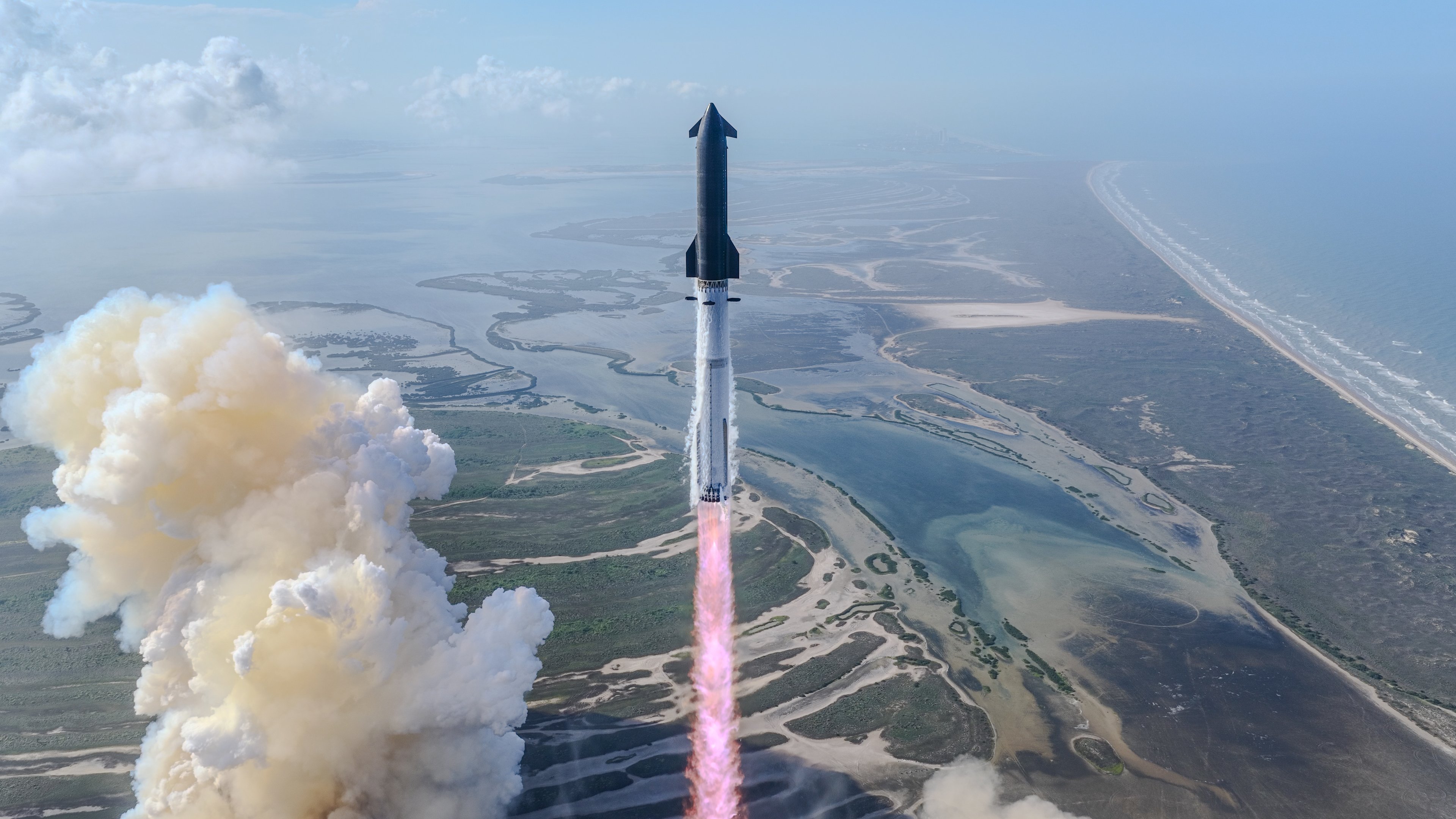
The powerful rocket, propelled by 33 methane-fueled main engines, climbed away from SpaceX’s Starbase launch facility in South Texas at 5:30 pm CDT (6:30 pm EDT; 22:30 UTC) Friday. Within a few seconds, the 408-foot-tall (124-meter) rocket, the largest ever built, cleared the launch tower and turned onto an eastward heading over the Gulf of Mexico.

Starship splashed down on target in the Indian Ocean a little more than an hour later to conclude the first flight of the latest version of SpaceX’s stainless steel mega-rocket. Starship V3 fared better on its debut than the first flights of Starship V1 and V2 in 2023 and 2025. Both past versions of Starship broke apart during launch on their inaugural flights.

SpaceX officials appeared pleased with the performance of Starship V3 on Friday. Elon Musk, the company’s founder and CEO, congratulated his engineers with a post on X: “Congratulations SpaceX team on an epic first Starship V3 launch & landing! You scored a goal for humanity.”

“Congrats and a huge thank you to the SpaceX team that always delivers,” Gwynne Shotwell, SpaceX’s second in command, wrote in an X post. “This was an incredible first flight of a brand new vehicle. Our collective future flying amongst the stars has become so much closer.”

Leaders at NASA, relying on SpaceX to provide Starship as a human-rated Moon lander, were closely watching the launch. NASA Administrator Jared Isaacman was in Texas to witness the launch in person. He lauded SpaceX for a “hell of a V3 Starship launch.”

Starship’s 12th test flight was a long time coming. The last Starship test flight took off last October. The gap of more than seven months was the longest interval between Starship flights since the program’s first full-scale launch in April 2023. SpaceX used the time to complete construction and activation of a second launch pad at Starbase as engineers steered Starship V3 through ground testing, which had its own share of setbacks.

Starship climbs away from Starbase, Texas, after liftoff at 5:30 pm local time Friday.

Starship climbs away from Starbase, Texas, after liftoff at 5:30 pm local time Friday. Credit: SpaceX

What was good?

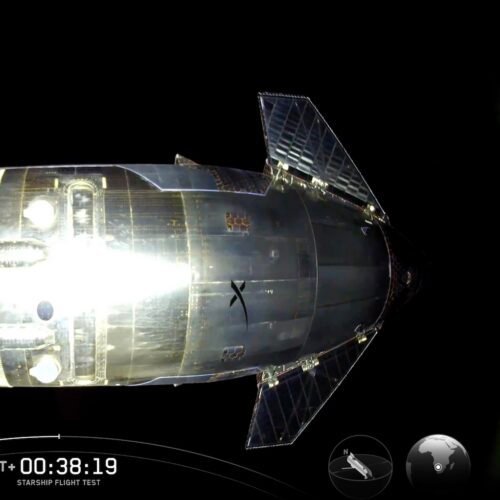
So what worked on Friday’s test flight? Plenty. Most importantly, the ship’s heat shield appeared to hold up during reentry over the Indian Ocean. Onboard cameras showed the vehicle’s aerodynamic flaps intact throughout the fiery descent through the atmosphere. The heat shield and flaps didn’t always fare so well on past Starship test flights. Starship executed a series of banking maneuvers on the way toward the splashdown zone northwest of Australia, simulating the path future ships will take returning to landings at Starbase.

That all went well, with the descent culminating in a dramatic maneuver to flip from horizontal to vertical. A final landing burn with the ship’s Raptor engines downshifted from three to two, then to a single engine as the rocket settled to a gentle water landing. Drones and buoy cameras recorded live views of the on-target splashdown. As expected, the ship—wider than and nearly as long a Boeing 777 jetliner—tipped over and exploded in a fireball, putting an exclamation point on V3’s trip halfway around the world from the Texas Gulf Coast.

Earlier in the flight, SpaceX demonstrated Starship V3’s improved payload deployment mechanism. The system is tailored for releasing SpaceX’s flat-packed Starlink Internet satellites. SpaceX tested the Pez-like deployment system on past test flights, but upgrades on Starship V3 allow the mechanism to release satellites at a faster rate. On Friday, the dispenser deployed 20 mockups of SpaceX’s next-generation Starlink satellites, plus two spacecraft fitted with flashlights and cameras to inspect Starship’s exterior in space.

All of this worked perfectly as the ship soared to a maximum altitude of 121 miles (195 kilometers) in darkness over the South Atlantic Ocean. SpaceX says this version of Starship can haul up to 100 metric tons of payload into low-Earth orbit, more than double the capacity of Starship V2.

Meanwhile, initial inspections of SpaceX’s new launch pad at Starbase, used for the first time Friday, showed the facility weathered the intensity of liftoff with no significant problems. This is a promising sign for SpaceX’s plans for new launch pads at Cape Canaveral, Florida, which use the new Starbase pad as a design template.

What needs more work?

Something caused two Raptor engines—one of 33 on the Super Heavy booster and one of six on Starship itself—to fail during Friday’s launch sequence. Raptor failures are nothing new for SpaceX, but this flight marked the first use of the company’s upgraded Raptor 3, a redesign with higher thrust, lighter weight, and improved efficiency. Collectively, the 33 Raptor engines on the booster produced up to 18 million pounds of thrust at full throttle, twice the power of NASA’s Space Launch System rocket used on last month’s Artemis II mission.

Starship and Super Heavy have engine-out capability, meaning they can recover from an early shutdown of an engine. Both stages proved this Friday. First, an engine in the outer ring on the Super Heavy booster shut down prematurely shortly after liftoff. A few moments later, an outer engine on the Starship upper stage cut off soon after the ship and booster separated from one another high over the Gulf.

The ship compensated by burning its five remaining engines a little longer than usual, and the rocket was still able to reach its planned trajectory. The booster, however, hurtled toward a high-speed impact in the Gulf after it was unable to complete maneuvers to return to a controlled splashdown offshore from Starbase. It was not immediately clear what caused the early end to the rocket’s boost-back burn: whether the malfunction stemmed from an external problem during stage separation or a separate issue within the booster’s propulsion system.

One key objective SpaceX did not accomplish Friday was a planned restart of one of the ship’s Raptor engines in space. Officials elected to forego the brief ignition after the ship’s engine failure during ascent.

What does this mean?

Friday’s results give SpaceX a lot to build on. The performance of the heat shield, widely recognized as perhaps the program’s most challenging engineering problem, must be reassuring for SpaceX officials seeking to eventually recover and rapidly reuse future ships. The ship’s resilience to an engine failure was also encouraging news for SpaceX.

But there’s still more work ahead for SpaceX to perfect the Raptor 3 engine, and skipping the engine relight in space will likely prevent SpaceX from attempting a full orbital flight of Starship on the next launch. All 12 of SpaceX’s Starship test flights to date have flown on suborbital trajectories. Officials want to ensure they can guide Starship back to Earth before putting a vehicle into orbit because an unguided reentry could endanger the public with falling debris. Starship, after all, is the world’s largest and most massive spacecraft other than the International Space Station.

A perfect performance on Flight 12 may have given engineers the data they need for an orbital flight on the next launch, and perhaps even attempt to bring Starship back to the launch site in Texas for a catch by giant mechanical arms on the launch tower. An orbital flight would also move SpaceX closer to beginning critical orbital refueling tests for NASA’s Artemis program, along with deploying real Starlink satellites from Starship.

The results from Friday’s flight show there’s still room for improvement, but SpaceX will be ready to chase perfection again soon. The company has more ships and boosters on track for test flights later this summer.

Review: The Mandalorian and Grogu is … fine

0
review:-the-mandalorian-and-grogu-is-…-fine
Review: The Mandalorian and Grogu is … fine

Hopes were arguably high for The Mandalorian and Grogu, director Jon Favreau’s big-screen offshoot of the popular Disney+ series The Mandalorian. After all, there hasn’t been a new film in the Star Wars franchise since 2019’s The Rise of Skywalker wrapped up the three trilogies that make up the so-called “Skywalker Saga.”

The new film is … fine. It’s an average Star Wars outing, and it will give families a solid Memorial Day Weekend entertainment option. It’s just not the spectacular home run that might have helped launch the flagging franchise into an exciting new era, and diehard Star Wars fans hoping for more are probably going to be disappointed.

(Some spoilers below but no major reveals.)

Grogu (fka “Baby Yoda”) won viewers’ hearts from the moment he first appeared onscreen in the first season of The Mandalorian, and the relationship between the little green creature and his father-figure bounty hunter, the titular Mandalorian, Din Djarin (Pedro Pascal), has only gotten stronger. With the 2023 Hollywood strikes delaying production on season 4 of the series, Favreau got the green light to make this spinoff film.

Mando and Grogu (as his apprentice) are hunting down the scattered remnants of Imperial warlords on behalf of the New Republic, taking orders from Sigourney Weaver’s Colonel Ward, a former pilot with the Rebel Alliance. These missions tend to get messy, with Mando being Mando. Ward really wants the warlords alive to get useful intelligence from them, but they understandably don’t like to come quietly, so sometimes, well, they die with their henchmen. Can’t be helped.

After Mando takes out his latest target, a disappointed Ward offers him a new mission: tracking down Rotta the Hutt (Jeremy Allen White), son of the late Jabba, on behalf of the Hutt Twins, who took over Jabba’s criminal enterprise. In turn, the twins will provide crucial information on the whereabouts of an elusive Empire warlord named Coin. Mando accepts, mostly because Ward offers him a newly refurbished Razor Crest-like ship, just like his old one that blew up at the end of S2.

A paint-by-numbers plot

Alien pilot disembarking from a spaceship

Zeb Orrelios (Steve Blum) is back and working with Mando.

tall woman in red fighter uniform standing next to a fighter spacecraft

Sigourney Weaver plays Colonel Ward, a former Rebel Alliance pilot.

Rotta, it turns out, has become a fan-favorite gladiator on the planet Shakari and doesn’t want to go back home to Nal Hutta, as he’s convinced the Twins will have him killed to cement their power. Complications ensue, and things start to get messy. You don’t want to get on the wrong side of the Hutt Twins, as Mando soon learns to his peril.

The various trailers were thin on plot details, and it’s now clear why: There isn’t much of a plot. Favreau has said that he came up with a new story rather than the one he’d planned for The Mandalorian S4 because of the switch from a streaming series to a theatrical film, but things still feel pretty episodic. The film is largely comprised of a series of side missions in service to the larger arc. There’s some space travel, a fight scene with a cute Grogu moment, a victory, and another cute Grogu moment, then it’s on to the next mission. Rinse and repeat.

It’s all very well-trodden ground with familiar beats happening at the expected times; even the fight scenes are kinda meh. The dialogue in Star Wars films has always been notoriously wooden and uninspired, and The Mandalorian and Grogu is no exception. Good actors can salvage such lines, and Pascal is a very good actor, but it’s much harder when your character wears a helmet the entire time and can’t really emote.

Embo the Kyuzo bounty hunter makes his live action debut.

Mando vs. Dragonsnake.

Otherwise, we’ve mostly got stunt-casting as fan service. We love Weaver, but she’s utterly wasted here. It’s nice to see Embo the bounty hunter from The Clone Wars in his live-action debut, and the return of Zeb Orrelios (voice by Steve Blum), plus the Hutt family characters from The Book of Boba Fett. But casual moviegoers will neither know their history nor care. Bonus: look closely in the climactic battle scene and you’ll spot several directors of Mandalorian episodes and Lucasfilm President and CCO Dave Filoni, the latter reprising his role as Trapper Wolf, a New Republic X-wing pilot.

All that said, there’s no denying that Grogu’s antics are pretty cute, and the little green puppet pretty much carries the entire film. (Grogu partnering with the tiny Anzellans to rescue a kidnapped Mando is tailor-made for merchandising.) The strongest segment is the quietest: Mando collapses from a poisonous bite from a Dragonsnake in the Nal Hutta swamps, sacrificing himself so Grogu can escape. Grogu sticks around instead, building a shelter, finding food, and nursing his father figure back to health. It’s a key turning point in their relationship and the only genuine emotional beat in the entire film.

I don’t know if we’ll ever get that postponed fourth season of The Mandalorian. Box office projections indicate that The Mandalorian and Grogu is tracking even lower than 2018’s Solo, although things might pick up over the holiday weekend. If so, the character dynamics will likely change considerably. And hopefully the series can recover some of that Star Wars magic that is sadly so absent here.

0FansLike
0FollowersFollow
0FollowersFollow
0SubscribersSubscribe
- Advertisement -
Google search engine

Recent Posts