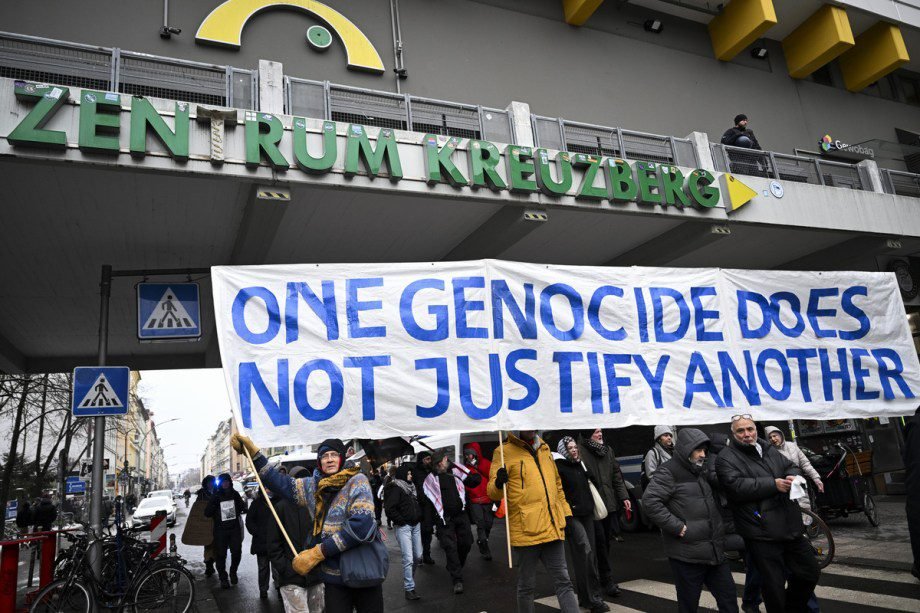
The German organisation Jewish Voice for a Just Peace in the Middle East (JV) may, for the time being, continue to be classified as “extremist” by Germany’s domestic intelligence service. This was decided by a court in Cologne last Wednesday.
The organisation describes itself as anti-Zionist and is among the most prominent Jewish voices in Germany advocating for Palestinian rights. It characterises what has been taking place in Palestine for more than 100 years as settler colonialism, apartheid, and ethnic cleansing. Its members appear publicly at demonstrations and as speakers, and support initiatives such as the global BDS movement and the German “Kufiyas in Buchenwald” campaign.
While JV has faced a mixture of systematic ignorance and defamation as “self-hating Jews” from the German mainstream media, it has increasingly come under scrutiny from the authorities amid the intensification of anti-Palestinian repression in Germany since October 2023. Prominent members such as Iris Hefets and Udi Raz, for example, have repeatedly been arrested by police in Berlin during protest actions. In 2024, Jewish Voice was labelled “extremist” for the first time in the so-called “Verfassungsschutzbericht“, an annual publication issued by the domestic intelligence service. As in the case of the Palestinian prisoner solidarity network Samidoun and the group “Palästina Solidarität Duisburg“ (Palestine Solidarity Duisburg, PSDU), which were banned by decree of the Interior Ministry in November 2023 and May 2024 respectively, the authorities accuse JV of violating the principle of “international understanding” (an extremely vague concept drawn from the German constitution) and of spreading “anti-Israeli propaganda”. Unlike in the cases of Samidoun and PSDU, however, the issue with Jewish Voice is not an outright ban on the organisation – at least not yet –, though its classification as “extremist” could pave the way for exactly that. In the immediate term, the registered association’s charitable status is also under threat.
JV therefore filed lawsuits both against this classification and against its inclusion in the 2024 “Verfassungsschutzbericht“. In the latter case, it secured an initial victory at the end of April: a Berlin court ruled that its inclusion in the intelligence service’s public report was impermissible, since the evidence presented was insufficient to substantiate the accusation of “extremism”. The Cologne court has now ruled in precisely the opposite direction. The judges there followed the authorities’ argument so far as to portray statements by JV members questioning the framing of the 7th October uprising as an “antisemitic terrorist attack” as effectively amounting to support for Hamas. The ruling states: “The Court sees sufficiently substantiated indications that the applicant continuously agitates against the State of Israel and thereby indirectly contributes to the Hamas activities that violate the principle of international understanding.” This allegation strongly recalls a term coined specifically for the PSDU ban, namely that PSDU had “mental supported” (“geistig unterstützt”) Hamas.
Wieland Hoban of JV commented that the Cologne ruling “says something about the arbitrariness and contradictions of the so-called “Staatsräson“, where Instagram posts are stylised into acts of support for armed resistance – as though we were directing Hamas. Unfortunately, it also shows very clearly that even legal victories are no proof of a properly functioning constitutional state.” He observed that the far-right AfD party has by now become “more respectable” than Jewish Voice.
Indeed, the situation remains contradictory: Germany’s domestic intelligence service is currently permitted to classify Jewish Voice as “extremist”, but for the time being is not allowed to list it as such in the 2024 “Verfassungsschutzbericht“. Since both cases are interim proceedings, the final rulings are still pending. In addition, the 2025 constitutional protection report is expected in June. In light of the Cologne ruling, it must be assumed that Jewish Voice will once again be included in it.
The views expressed in this article belong to the author and do not necessarily reflect the editorial policy of Middle East Monitor.